down to earth
  • Home
  • About Us
  • Down To Earth Book
  • Privacy Policy
I am inclined towards a solitary life. Even though I have my family and friends around me, they know that this is my preference and therefore let me get on with it. I know they're all there if I need them and when my mind turns to more social occasions, they're there to help me with that as well. Sometimes I go for long periods without seeing some of the people I love and when we catch up, I silently swear to not allow such a time apart to happen again. It always does because I'm a solitary bee. I am what I am.

Today I'm going to Maleny. I have a few errands but importantly, I'm having lunch with my friend Patrick. I haven't seen him for more than six months, although we have spoken on the phone a few times. When he lived in Sydney, Patrick worked as a dress designer, then, after moving to Queensland with his partner, he retrained as a chef. Now he's well known for his raw and vegan food. When I worked at the Neighbourhood Centre, Patrick came in to the embroidery classes and wowed us all with his sewing skills. There's not much he can't do but I'll be content to be the recipient of his food later today and I'm sure we'll sit together for a couple of hours, looking out over the rolling hills, talking about all sorts of craziness.


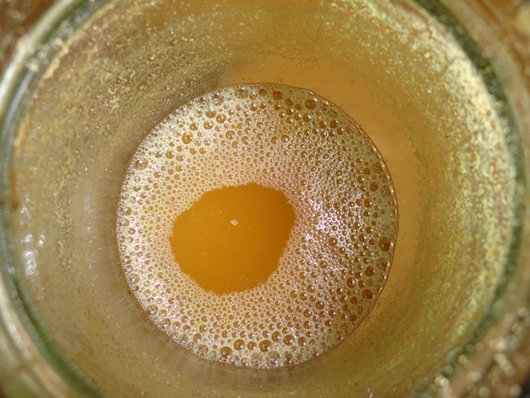
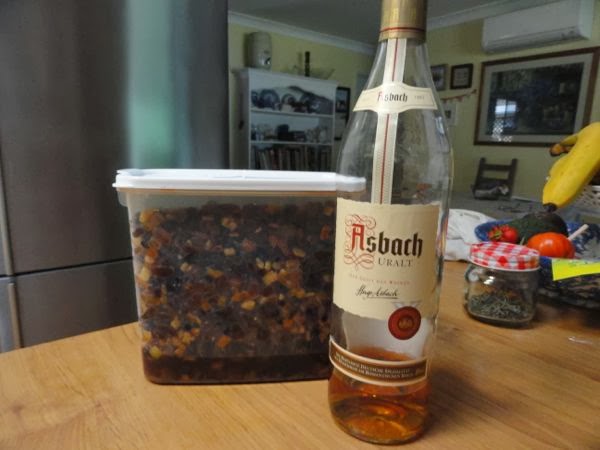
Everything is good here at home. I'm on the fifth day of my new ginger beer plant. It started fermenting on the second day and is going strong. I'll probably make it up on the weekend. The fruit for the Christmas cake is soaking in good German brandy. I'll have to add more as I go along because the fruit is soaking it all up nicely. I'm still cruising along on the cardigan I'm knitting for Jonathan. I've finished the back and one front so I should have it done by Christmas.  Fingers crossed. It's been slow because it's only a few rows at a time, but slow is good, I can work with that.


Later this morning I'm going to the Maleny Dairies, where I'll take some photos and pick up some of their delicious milk and cream. Then on to Rosetta's, my local book store, to buy a book I want to give as a Christmas gift. After that, lunch with Patrick, then back home to Hanno who is still hobbling around on a swollen foot. Thank you for all the suggestions for treating gout. Unfortunately, Hanno is on Warfarin, so he has to be very careful with pills and potions, and even the vegetables he eats. We appreciate your thoughts though and Hanno asked me to thank you for thinking of him.

What are you doing today or tonight? Are we all social butterflies today or are there some solitary bees staying at home with the honey?
All of us who grow food, keep chickens or bees, milk a house cow or a goat, or keep pigs have to know a thing or two about the seasons. Here in the sub-tropics, although we recognise four seasons exist, we usually have two real seasons - hot and cold. I can't tell you how much I usually complain about the hot season. I am a cool woman, what can I say. But I've decided to enjoy every day from now on. All the sweaty days, all the clinking icy drinks, all the bugs, as well as the silent stillness of the early morning and that feeling of calm just before a tropical storm hits, I'm embracing it all. I realised that no amount of complaining will change any of what I'm complaining about and it just highlights it for myself and anyone within ear shot. Enough. I'm over it. Hot weather is the reason I notice cold weather. If it were cold all the time, I'd complain even more about that. No, from now on, I'm embracing the seasons - all two of them. Okay, I got that off my chest. :- )


If you're a gardener, you might already know that you can extend your seasons by creating microclimates. It's the backyard equivalent of dressing in a cool summer dress or pulling on a jumper and boots.

COOL CLIMATE
If you're in a cool climate, you can extend your season by trying to create warmth where you're trying to grow vegetables. There are a few strategies you can try. Some of them might not work but if you can get one to work, you might get an extra crop of tomatoes that might never have been. 
Some of these methods include:
  • Often growing up against a brick or stone wall will help a lot. The wall will absorb the warmth during the day and provide some protection against the cold overnight as the warmth is being released. 
  • Mulching the ground with a couple of inches of straw, hay or sugar cane will help regulate the temperature of the ground, and keep the roots warm and the soil temperature constant. 
  • If you're in a frosty area, think about growing a small hedge around the outside of your garden to stop frost rolling in. 
  • Several stakes and some hessian or heavy black plastic will provide wind protection for plants. 
  • Poly tunnels are easy to make and they'll extend your seasons like nothing else. I've drawn a diagram below that will suit shade cloth or plastic tunnels. If you're trying to keep your vegetables going, these tunnels are very portable, they can be put away at the end of the season and can be made using recycled materials. If you're using the plastic tunnel in cold weather, get extra pieces of plastic so you can cover the ends as well. 
WARM CLIMATE

In a warm climate, it's not heat you're wanting, it's shade and the cool air it provides.
  • If you're growing taller plants such as tomatoes, beans or cucumbers on a trellis, they love full sun, but if you look at where the shade falls on the other side of the trellis, that is where you can plant things like lettuce, spinach, Asian greens, in the shade provided by the trellis.
  • Look for afternoon shade. Many plants love it. You might find a tree or fence provides afternoon shade.
  • Make sure you mulch well - you'll need a thick layer to keep the moisture in and the soil temperature constant. It's a good idea in the hotter climates to lay wet newspaper down on the soil before adding your mulch.
  • Water your plants thoroughly and deeply, depending on how hot it is, two or three times a week.
  • If you've got good mulch down, water in the morning because the moisture will be protected and retained by the mulch. If you don't have mulch down, water in the late afternoon or evening. This will give the water a good chance to soak down to the roots and hydrate the plants overnight.
  • Plants will slowly acclimatise to heat but if your plants suffer from an unexpected very hot day, give them a good drink in the late afternoon and follow it up with a watering of seaweed tea. That will help your vegetables get over the heat shock.
  • If you're in an area that gets torrential downpours, wind and hail, a tunnel will help protect the foliage and the vegetables in your garden.
  • Tunnels to protect your plants can play an important part in your garden and extend your growing season. In a warm climate, you'll use shade cloth instead of plastic and even though it might not seem like much, the plants grow well when they're not sitting in the full sun all day.

MAKE A PORTABLE  POLY TUNNEL OR SHADE TUNNEL


I've looked through my photos to find the shade tunnels Hanno built here but I lost a few years of my photos and I think they may have been in that batch. I know I have a couple of photos of our tunnels on the blog somewhere, but I don't know exactly where they are. Anyhow, I've drawn a diagram (no laughing) to show what I mean. They're simple, easy and cheap to make. You'll need:
  • star peg or steel pickets - 6 for each tunnel, or 8 if they're longer.
  • three pieces of bendable poly pipe that will fit snuggly over the pegs/pickets.
  • a long piece of shade cloth or heavy duty clear plastic that covers the area you want covered.
  • enough zip ties to attach the covering to the pipe.
To make the tunnel:
  1. Attach both ends of the covering to the poly pipe using plastic zip ties. If you're using a middle bracing section, attach that with zip ties too.
  2. Lay the shade cloth out on the ground and mark where your peg will need to go in.
  3. Hammer the star pegs into the ground.
  4. Fit the ends of the plastic pipes over the pegs/pickets.
  5. Straighten it all up and if you have a flap at one end, secure it down with a couple of stones or bricks.
Make sure you make it tall enough to move around in. Getting taller star pegs should give you the right height.  Don't forget to plant what you harvest frequently near the opening, and the trellised plants along the walls.

Most of the information online if for buying tunnel kits, this is a DIY poly tunnel and here is a DIY shade tunnel, both very much like the tunnels we use here.

At the end of the season, dismantle and store the tunnels until next season. I think you'll find they make a difference to the number of months you are able to produce food.


The older I get, the more often I'm reminded of my own mortality. Hanno has very painful gout again. It came up out of the blue and has laid him low for the last couple of days. He has been prone to gout for many years and takes medication to lessen the chance of getting it but something triggered it again and the only thing to do is to keep weight off the foot, drink plenty of water and take the medication he's been given. He's got a walking stick, and that helps when he has to hobble in to go to the bathroom, but the main activity is rest. He doesn't like it at all. Luckily we had a visit from Kerry and Jamie and we all sat on the front verandah for a while to talk.

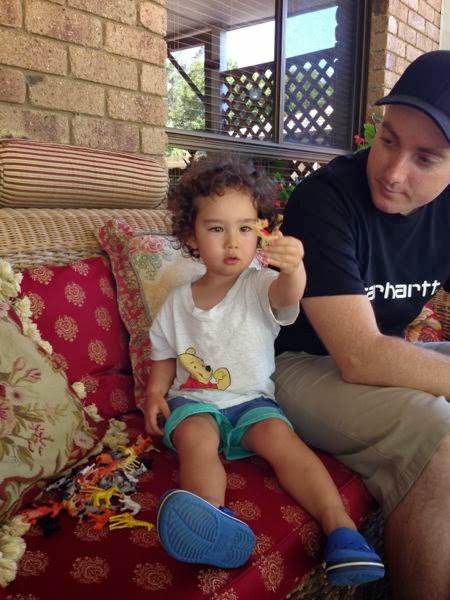
 Jamie with his many animals. When I ask how many animals he has, he always replies: "many".
Our meals were simple - this became coleslaw which we had with buttered herb pasta and sausages.
We had this on Saturday, chicken curry yesterday, with enough left for two more days.
This is how I do my ironing. I take my computer into the bedroom, where the ironing board is, and watch You Tube while I iron. On the weekend I watched 'Breakfast, Lunch and Dinner', a three part BBC series on the origin of mealtimes.

On this slow weekend, I've been watering the garden, cooking our meals, baking, getting glasses of water and cups of tea, ironing, reading, writing and knitting. As you know, I love resting but enforced rest is not as good and Hanno is an impatient patient. He needs scolding and reminding that's he's not 18, or 25, or 40, or 60 anymore. There are some wonderful things I love about getting older - I've developed a deeper understanding of myself and others. I see interesting linkages I never noticed before, or if I did, I didn't understand their importance. I am more tolerant and accepting. Nothing much phases me. If I see a problem, I fix it straight away. I always give a second chance, but never a third. I'm relaxed knowing that Jamie and Alex are my grandchildren and that they will carry on our genes. I'm settled and satisfied. I don't scare easily. My common sense has evolved and is thriving. I know I'm loved.

But on the other hand, when I look at Hanno and his swollen foot I am reminded that we are both wearing out. Our joints are not what they used to be, our bodies don't make the quick repairs of youth. Slowly we're approaching our 'best before' date. When you think about it, it doesn't matter how you live, what you do, how much money you have or who you know, every single one of us will grow old and die. If we're lucky. If we're not lucky we'll die earlier than we should and people will say, 'that's so sad'. I am hoping I've got another 20 or 30 years and that when I die they'll say 'she had a good innings'. But the truth is that even if I died tomorrow, I would feel satisfied and thankful that my life has brought me so much joy, that I've been surrounded by the most wonderful family and friends, and that for a little while I got to write to the world.

And now, it's Monday morning, another week of living ahead for all of us. Let's get on with it.  ♥


You guessed it. If I have time this weekend, I'll be clicking away on the needles. I hope you can do something you love on the weekend too.

Please check below for details of a Permaculture Course in the Lockyer Valley.

Off the grid - Dutch documentary 2011 in English with Dutch subtitles - youtube
Meet the farmer - Joe Salatin - you tube
Living pay cheque to pay cheque
Make your own wine
Libraries and books
Matchstick Lake - Beautiful images of the Canadian bush
Baby knits
Mia asks the question: What makes a house a home?
Eating well on a budget.
Pickled green tomatoes
How not to get tricked: Your favorite online safety tips

From comments here during the week
The quiet country house
Less noise, more green
Girls wear blue too

.......................................................................................................................

INTRODUCTION TO PERMACULTURE
Stockyard Creek Community Hall, Lockyer Valley
Sunday 1st and Sunday 8th December 2013
9.00 am - 5.00 pm
Presented by Tom Kendall 


BOOKINGS: 
cp.stephens@skymesh.com.au or phone 4697 5306
This course will be free of charge, being fully subsidised by the Lockyer Valley Regional Council through their Community Environmental Grants scheme. The only cost to participants will be $20 per day to cover facility hire and catering.

Course outcome: participants will become more aware of methods to become resilient and efficient in their farming operations and will be inspired to become more self reliant.

Course outline:
Day 1

9 – 10.30 am
Introduction to the ethics and philosophy behind permaculture and definitions for terms commonly used in Permaculture.
11 – 12.30 pm
Relative location. How each element performs many functions and each important function is supported by many elements.
12.30 - 1.30 pm Lunch
1.30 – 3.00 pm
Efficient energy planning. How to effectively use biological resources in a permaculture system.
3.30 – 5.00 pm
Question time

Day 2
9 – 10.30am
Energy cycling to achieve closed cycle systems. Small scale intensive systems for urban and suburban permaculture applications.
11 – 12.30 pm
Accelerating succession and evolution. Diversity, edge effect and attitudinal principles in permaculture
1.30 – 2.30 pm
Resources and yield. Composting and effective soil management
3.30 – 5.00 pm
Question time.

I think many of you would agree when I say that there are things on the internet that we don't want our kids or grandkids to see. I don't want to see them either. In certain areas of the internet, there are people waiting in chat rooms looking for children, waiting for adults to befriend so they can steal their hearts and dollars, and in many areas, including the general news sites, chat rooms and forums, there are bullies who hide their real ugliness under the cover of anonymity. There is no doubt about it, the internet can drain the strength from your bones and make you want to give up on humanity.

On the other hand, there is the opportunity to reach out and connect with like-minded souls. We can form lasting friendships, learn from each other's cultures, teach ourselves to knit, sew, mend, recycle, keep livestock, cook, make jam and to preserve it, to grow a garden and produce food for our tables and so many other things. The internet makes all that possible. I like to believe that for every bit of nonsensical behaviour that takes place over the internet, there will be a corresponding act of kindness, gratitude and sharing to balance it out. I can't imagine how many lonely people, who would otherwise not be able to get out, have their social time on the internet - in forums, chat rooms, clubs and craft groups. How many young cooks have started cooking by searching for recipes on the web; how many home work questions have been answered; how proud do we feel when we upload a photo of something we've created, be it a garden, dress, cardigan, cake, cheese or even a newly born baby. For on the internet, yes, there is the unspeakable and the ruthless but there is also a big group of people, just like you and me, who come to their keyboards every day and yell out into the ether: "I'm here! Are you there?" 

And we find each other.

One of the best features of the internet for me is that it makes government and big business more accountable. Pre-internet, there was no way ordinary people could take part in discussions about world politics, finance, society, the arts, politics, corruption or any of the seemingly "important" subjects. Now we can easily comment on news stories, send vision and reports into news groups, or blog about our own experiences and concerns. We've all heard stories about rogue politicians closing down radical or citizen-run newspapers and media outlets but so far, no government has been able to shut down the internet. And that is probably because the internet doesn't belong to anyone and it's not controlled in a formal sense. It belongs to us all.

I think personal responsibility is as important and significant as political ideology. We all have the ability to see what is happening around us, to make decisions based on that knowledge and by taking small steps, change our lives. I have moved away from my consumerist culture to a more solitary life focused on home and on sharing what I know with those who are interested. The internet has given me that opportunity, not only to reach you, but to also reach Penguin publishing and many other media organisations who have helped me spread my message. But mostly I am thankful that I have this community here who support and encourage each other, who learn and teach, and who sit silently reading while never raising their own flag to say "I'm here too." Like every other healthy community, it takes all types, and I love that. I love the fact that while there are other older women here who mirror me in many respects, there are also men and younger folk, and those who are middle aged. What we have here is a carbon copy of what we find in any vibrant community - we have women and men, straight and gay, religions of all denominations and those who are atheist, rich and poor, healthy and ill. We have people here from many cultures and philosophies. There is no one type you can say is typical or acceptable here, we all are.

I have always been amazed at the number of people who read here. I put that down to consistency, my respect for you and the interesting community that has built up around the blog. Overnight we passed the eight million visitors mark. Those people have read over 12.5 million pages here.

Thank you for finding your way here today and all the other times you walked this way. I don't need the validation because I know the way I'm living now is right for me, my family and for the piece of earth we look after. But even though I'm not looking for validation, I am looking for conversation, friendship and the exchange of ideas, and here, my friends, we have that in abundance. Thank you for helping to provide that and for adding to the always thought-provoking conversation. xx

According to this article, handmade crafts are making a big comeback in America, with $29 billion reportedly spent on craft materials in 2011. There are many reasons for the popularity of crafts again; some are working towards self-reliance, some want to learn traditional skills, some want non-commercial and unique items, some want the beauty of something hand made, others just love working with their hands. Whatever the reason, I think the trend towards homemade is just as strong in Australia and from what I can see, in the UK and many European countries as well.


One of the things I'm working on at the moment is replacing some of my household linens. In the past I used to buy tea towels, tablecloths, dishcloths, aprons, curtains, food covers and the other bits and pieces we use here, but now I make all of it. I find when I make it myself, I get exactly what I want and the quality is superior to what I can buy ready-made. And let's face it, it's difficult finding a lot of these unusual linens we use in a simple home. How many times have you seen food covers on the weekly specials table? If we need cloths to drain yoghurt and cheese, a new rag bag, padded coat hangers or a linen apron that is longer than the average apron, those things we have to make ourselves.

A milk jug cover doubling as a cover for our sprouter. This is simply a circle of netting that has been edged with crochet and beads.

Years ago when I started reading blogs, I noticed that many women used their spare hours for sewing, mending and knitting. Some ladies said they felt guilty doing craft work because they enjoyed it. The implication being that they were doing this work for their own pleasure. I don't look at it that way. I see all sorts of craftwork and traditional work as part of my housework. Looking after household linens is part of what I do. I am responsible for having what we need in our home and for keeping all of it in good order. I want to live in a comfortable home and sometimes, to supply that comfort, I need to make new items or repair the old. Sewing, mending and knitting is part of my housework; I see it as one of the duties of the homemaker, male and female.

Our new set of table napkins.
I  use this food cover a lot, especially during the warmer months, to keep flies off the table. Someone gave me this cover, I wish I could remember who, but it is handmade of soft tulle and edged in a fruit patterned cotton.

Some of the work I've done in the past week is to replace old napkins that have outlived their lives and will now serve us from the rag bag. I have replaced a lot of the "disposable" products, such as the paper napkins and dish cloths, with homemade items. I make them here, choosing natural yarns and fabrics and wash and reuse them over and over again. It's a simple thing but it saves money and it makes you think about all the waste generated by purchasing what is supposed to be disposable.

One of Jamie's toy bags. He uses these bags to store toys he wants to take home and bring back again.

If you've never done anything like this before, I encourage you to make a couple of things, even if you're not a great sewer. Most of it is straight lines and simple sewing. You will get a lot of support and encouragement if you go to the forum and tell the ladies what you're doing, or if you need help. This is the link to our handmade forum that I recommend to both women and men who want to learn how to make and mend. No one will laugh or tease you, it will be praise and support all the way.

You can try tote bags for shopping, fabric bags for kids toys and books, a linen bag in which to store your bread, food covers, dish cloths, napkins, tablecloths, jug covers, covers for your ferments while they sit on the kitchen bench, tea cosies, pot holders, curtains, cushion covers, a rag bag, a carry-all for your knitting or crochet, table runners, place mats or aprons. If you have a stockpile of fabric you have the ideal starting point for many of these useful linens. Some of them would make wonderful Christmas gifts too. Imagine giving your neighbour a loaf of your homemade bread in a linen bag that he could store it in. That would make a good teacher's gift as well. What about three organic cotton face cloths with some of your homemade soap. Beautiful!

If you're hoping to improve your sewing, knitting or crochet skills, start by making one of these small projects. Remember, there is no such thing as perfect, so embrace the results of your beginner skills, if that is what they are, and know that the more you do of this type of activity, the better you get at it. What are you making for your home?
I'm not sure why but there are a lot of readers who are interested in what I do each day. I'm ordinary. Usually I'm here at home doing ordinary things.  When I'm writing, which I am at the moment, there's not a lot to report in my normal daily activities - I make three meals, clean up and write most of the day. But yesterday I took time away from the computer and spent most of the day working in my home, and relaxing.


Up at 3.30am, I dressed, cleaned my teeth, checked emails, made tea and crumpets and packed my trusty little trolly in the boot of the car. When I left home at 5.00am to go to the local market, the sun was just peeking through. I was after some fish for our terracotta pond which sits on the front verandah. Tricia bought me a beautiful iris last time she was here, it's been flowering its little head off and while it sits in water to grow, the water provides a breeding ground for mosquitoes. We used to have some native rainbow fish in the pond but when I moved it last week, I realised they'd disappeared. Also on my list, a tall tropical plant for the area near the front door and some avocados. Hanno needed line for his whipper snipper.


The market was packed when I arrived at 5.20. Some were sipping coffee, others walking around eating toasted sandwiches or fruit. It didn't take me long to find what I needed and I was in and out very smartly. I was home again at 6.45. Hanno was sitting at the kitchen table eating his breakfast - rolled oats with blueberries and walnuts.


I had five little guppies in a plastic bag so I had to work fast to get them into their new home. I emptied the water out of the pond with a bucket onto the hanging baskets and pot plants, moved the pond back into the shade of the verandah, then filled it again with rainwater from the tank. I cleaned up the iris, clipped off the dead flower heads and placed the plant in the water. When I opened up that plastic bag the fish swam out into their new home. The verandah feels cool and restful with the water and plants. It's reminds me how easy it is to create a relaxing space when you have shade, somewhere to sit and a few plants. When everything was set, I swept the verandah then went inside to make some cool drinks for us.  By this stage Hanno was watering plants in the front garden. Usually we don't have to water our outdoor plants but we're in the middle of a drought.

We both rested with some early morning tea - apple and cinnamon pikelets and lemon cordial made with sparkling mineral water and ice.  I made the bed, finished off another two napkins (more on that tomorrow), washed up and prepared lunch. Crumbed chicken breast with the last of the potato salad, lettuce, avocado, tomato and cucumber.


After lunch I repotted the large heliconia I bought. It's sitting right near the front door now. It's still a bit untidy but as new leaves grow, it should look really splendid. I gave it a rich potting soil containing worm castings and cow manure so it shouldn't be too long before it takes off. Late in the afternoon we adopted a baby magpie that's been hanging around without its mother for a few days. It flew into the verandah and sat on the back of the lounge where I was sitting, so Hanno got some tiny pieces of pork sausage to feed to it. It must have been very hungry because everything Hanno gave it was eaten. It looks like it has a damaged beak. I have a feeling the mother is dead because this baby it too young to be alone. We'll look out for it over the next few days and continue feeding it if it turns up without mum again.

And for the rest of the afternoon, dear friends, I put my money where my mouth is and I relaxed on the front verandah. I read and knitted Jono's cardigan. It was everyone for themselves at tea time. Hanno made himself sandwiches and I had some watermelon. It was a beautiful mix of productive energy, fixing this and that, and shoes off, feet-up relaxing.  I hope you did some of that as well. It's back to work again today but I'll be out on that verandah again to break the work day up. I work better when I look after myself. I think we all do.

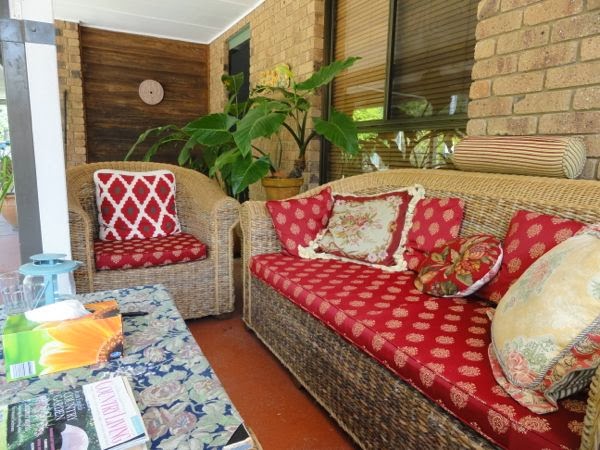
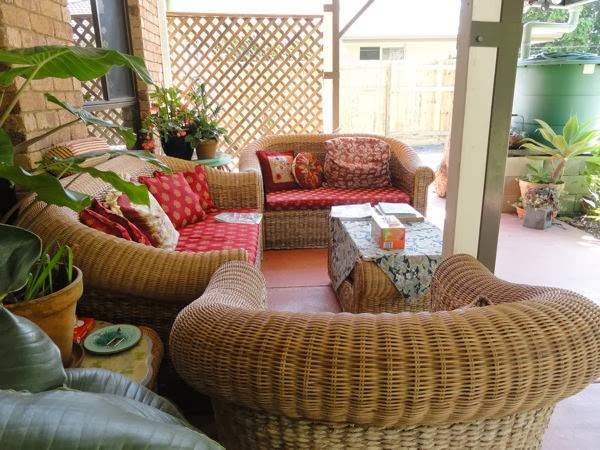
Another week has come and gone. Time seems to go so fast now. Does that mean I'm old(er)? Thank you for joining me here during the week. I'll be spending time in the location pictured above - our front verandah. Enjoy your weekend, spend it with those you love and recharge for next week.  XX

Michael Pollan's family meals
Putting a meal on the table, even when you're dead
Butter and cheese are better
Eumaeus and the Worm
Peace Country Homestead
Coal House - life in 1927 in a small mining town - Youtube
In a soup - many great soup recipes for my friends going into the colder weather.
Your own backyard 

From the comments here during the week

Wilderness Dweller
Flood-proof Mum
Nutmeg and Linen

PLEASE NOTE:
There seems to be a problem with Blogger today and I've lost comments from this and other posts. I apologise to everyone who left a comment that has disappeared. I'm trying to get them back.

We've had enough food posts for the week. Today I'm sitting back and writing about what ever comes into my head. It was a fairly tense day here yesterday spent thinking about my sister Tricia and her family who live in the Blue Mountains. They are in the towns badly effected by the catastrophic bush fires.  Yesterday was supposed to be the worst day when temperatures soared and the winds increased. Tricia had her car packed in case she had to be evacuated and she drove from Blackheath to Springwood to take her grandson home and help out in her son's shop. I spoke to her late yesterday afternoon and she was preparing to drive home. I hope I don't sound above myself but I wasn't surprised when I received a lot of emails from people wanting to know how Tricia and her family were going in the fires. Tricia, however, was amazed that she'd been remembered. She asked me to tell you that all those good wishes helped her a lot during those recent dark days. Such kindness does help when times are tough and I thank you sincerely for helping my family get through them.


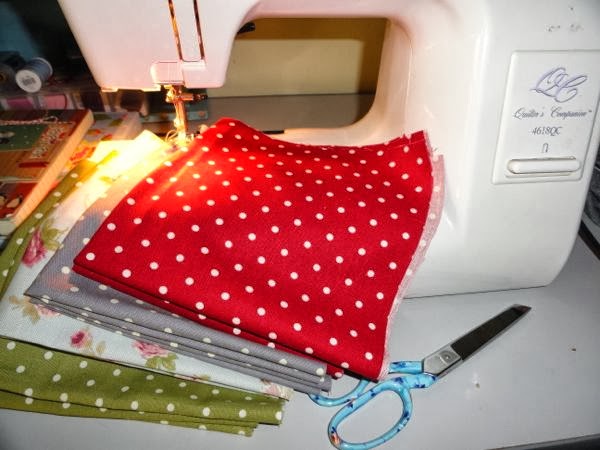
Although I'm working on the Penguin ebooks, my mind keeps wandering to my daily chores and preparations for the coming months. I have household linens to sew soon. I started cutting out the napkins yesterday and I hope to get to them on the weekend. I promised Jamie two drawstring bags to keep his toy animals in so they're on my list as well. They are such small things but I feel I'm doing the right thing when I sew for my home. I have never seen anything in a shop that suits my home better than what I can make right here.


Our main meal is cooked for the next two days because I made a pastryless Angus beef pie yesterday and used all the old vegetables in the fridge. The top is mashed potato and pumpkin. I love it when I know I have the meals sorted and no cooking will be necessary. Then I can concentrate on making other things such as crackers and pickled eggs, that I hope to do on Saturday. I ran down my ice cube supplies last week so I have to remember to fill up the ice trays twice a day and keep the iced water jug full. When the weather is warm, everyone loves a glass of cold water.

On the wider front, I've almost finished organising my Christmas gifts. I'm not sure what we're doing yet, that will depend on when Shane and Kerry are working but I think we'll be travelling up to Gladstone just before Christmas, and having Christmas here. After a break for Christmas with my family, I'll be straight back to writing again to have the set of ebooks ready for my deadline. I'm very pleased to tell you that all these books will be available for international release so that will make it easier for you, particularly if you have an ebook reader. If you don't, ebook readers can be downloaded free for use on your computer.

And speaking of Christmas, I might start my Christmas baking on the weekend. I'm only doing a fruit cake this year. It will be full of dried fruits that have been soaked in brandy for a week or two. I'll start the soaking on the weekend.

Spring and summer are not my favourite seasons, I don't like the warmer weather but this year I've decided to be grateful that I'm healthy and breathing and just get on with it. If I have to live through hot days, I will think of all the best parts of summer, like the holidays, cold salads, frosty drinks and relaxing watching the cricket. If a few hot days are all I have to complain about, then I am living a charmed life.

What has been filling your days lately?
If you can't grow vegetables due to having no time, bad health, young children, or no space, the answer for you might be to buy local seasonal fruit and vegetables. You might have a vegetable garden but not for the full year and buy your local vegies when the garden isn't growing, like we do. As you know we grow a fairly large garden but no matter what time of year, I'm also on the lookout for cheap, good quality, seasonal produce that we can use to supplement what we grow. Sometimes it will be a box of produce; at other times it will be smaller amounts of something we don't eat a lot of. I think this is one of the best ways of maximising the quality and nutrition of the food I put on the table as well as paying the lowest price for it. We all know we can but cheap food, but buying fresh, local, nutritious food, well, that's a challenge. You need to keep your eyes open for the bargains.

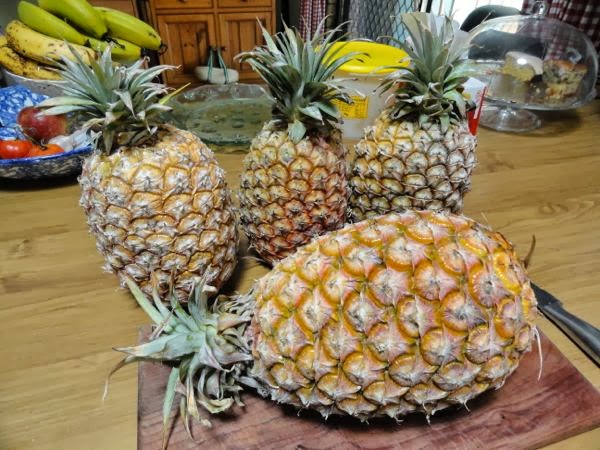
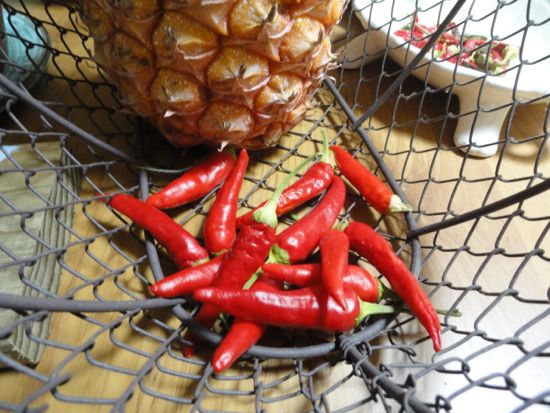
There are so many things you can bring into this category but let me show you an example of something I did here yesterday. I live in an areas surrounded by pineapple farms supplying Golden Circle. Often at this time of year in pineapple season, there are a lot of local pineapples for sale at roadside stalls. I just checked the Woolworth's online store and a fresh pineapple is selling there for $3.98 each. At a nearby roadside stall, local pineapples are selling at two large for $1.80 or three small for $3.00. When we drove passed the other day, I bought four large pineapples for $3.60 or 90 cents each. I have no need for fresh pineapple now, the season will go on for a while yet, but as soon as the holiday makers arrive, the prices will go up. They'll never be as high as the supermarket prices, but they'll be higher than they are now. I wanted to preserve some pineapple for later in the year when the prices will be higher, it will be hotter and the idea of local pineapple and passionfruit on a pavlova, or a glass of pineapple crush, will be very appealing. The passionfruit is already in a sealed container in my freezer. I've been putting aside our home-grown passionfruit so I'll have it on hand over Christmas when I know they'll be expensive. Oh my! I just checked the price of passionfruit at the local Woolworths and they're $1.98 each! How can they justify that? I wonder how much they paid the growers for them.
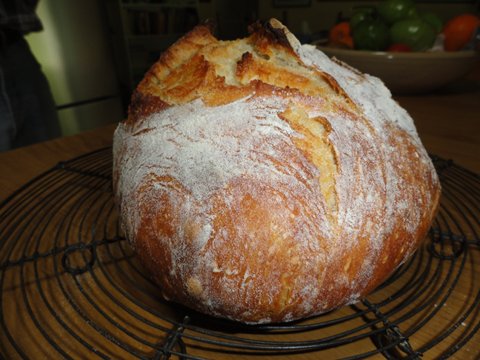


As you can see, you have to outdo the supermarkets at their own game. We're all on budgets and we are all hoping to get the best value for money. I think this is a very intelligent way to buy. It's similar to having a big canning/preserving session with boxes of produce or buckets from the backyard, but it's on a smaller scale for the food you don't eat a lot of. If you're in a food producing region, you'll be able to do something similar.

The entire pineapple processing exercise took me about 20 minutes. All I had to do was top and tail the pineapples, skin them, chop them into chunks, and put them in the food processor to do the heavy work. They'll sit in the freezer quite nicely until needed, probably sometime in December when pineapples will probably be five dollars each. And what did I pay? Ninety cents. If you're in Brisbane, or on the Sunshine Coast, I bought these sweet and delicious pines at the Matilda service station. If you go by in the next week or two, drop in to see if they're still there.

I know there are homemakers - women and men, who are in dairy regions and they buy large quantities of cream when the price is much lower than normal. As soon as the cream gets home, it's made into butter. This is such a excellent way of getting good produce at a low price. I make cultured butter when we can get the bulk cream.

PRESERVING EGGS
Here is a pickling liquid recipe for boiled eggs from Mother Earth News. This is great for preserving eggs for a month. This amount will cover eight hard-boiled duck eggs, 12 hard boiled hen eggs or 20 hard boiled quail eggs.

Golden Pickling Liquid for Eggs
  • 1½ cups cider vinegar
  • ½ cup water
  • 2 teaspoons brown sugar or honey
  • 2 teaspoons pickling or sea salt
  • 1 teaspoon tumeric
  • 1 teaspoon allspice
  • ¼ teaspoon celery seeds
  • 1 cinnamon stick
Fill a sterilised litre/quart jar with peeled, hard-boiled eggs.
Boil the pickling ingredients in a medium saucepan. Cover, reduce the heat to low and simmer for 30 minutes. Allow to cool for 20 minutes then pour it over the eggs. Screw on the lid. Store in the fridge for up to a month.

Do you have any handy hint to share about the storage of eggs?

Andrea left a comment here yesterday, and when I checked her blog, she'd written an excellent post on this same subject, here is the link so you can read what she has to say as well. Andrea's experiences with her group of women in a buying group might give you some good ideas about how to do something similar in your neighbourhood.

I'm sure there are many other examples out there, please share your story so we can all build our skills in this important area. What have you been able to do in your region? 

Newer Posts Older Posts Home

ABOUT ME

Down to Earth is a blog by Rhonda Hetzel, dedicated to simple, intentional living — from home cooking and gardening to frugal budgeting and handmade crafts. It’s a space for gentle inspiration and everyday wisdom on creating a life that feels real, balanced, and deeply fulfilling.

Down To Earth Book

Down To Earth Book
My books are all published by Penguin. Down to Earth, The Simple Life and The Simple Home have been in book shops since they were published in 2012, 2014 and 2016, respectively. On 20 October 2020, Down to Earth was published as a paperback.

MY FAVOURITE PLACES

  • Grandma Donna's Place
  • Grandma Donna's YouTube
  • Grandma Donna's Instagram
  • This Simple Day
  • Nicole's Instagram

Popular Post of All Times

Making ginger beer from scratch

We had a nice supply of ginger beer going over Christmas. It's a delicious soft drink for young and old, although there is an alcoholic version that can be made with a slight variation on the recipe. Ginger beer is a naturally fermented drink that is easy to make - with ginger beer you make a starter called a ginger beer plant and after it has fermented, you add that to sweet water and lemon juice. Like sourdough, it must ferment to give it that sharp fizz. To make a ginger beer plant you'll need ginger - either the powdered dry variety or fresh ginger, sugar, rainwater or tap water that has stood for 24 hours to allow the chlorine to evaporate off. You'll also need clean plastic bottles that have been scrubbed with soap, hot water and a bottle brush and then rinsed with hot water. I never sterilise my bottles and I haven't had any problems. If you intend to keep the ginger beer for a long time, I'd suggest you sterilise your bottles. MAKING THE STARTER In a...
Image

The last post

This will be my last post here.  I've been writing my blog for 18 years and now is the time to step back. I’ve stopped writing the blog and come back a couple of times because so many people wanted it, but that won’t happen again, I won’t be back.  I’ll continue on instagram to remain connected but I don’t know how frequent that will be. I know some of you will be interested to know the blog's statistics. 
Image

How to make cold process soap

I'm sure many of you are wondering: "Why make soap when I can buy it cheaply at the supermarket?" My cold process soap is made with vegetable oils and when it is made and cured, it contains no harsh chemicals or dyes. Often commercial soap is made with tallow (animal fat) and contains synthetic fragrance and dye and retains almost no glycerin. Glycerin is a natural emollient that helps with the lather and moisturises the skin. The makers of commercial soaps extract the glycerin and sell it as a separate product as it's more valuable than the soap. Then they add chemicals to make the soap lather. Crazy. Making your own soap allows you to add whatever you want to add. If you want a plain and pure soap, as I do, you can have that, or you can start with the plain soap and add colour, herbs and fragrance. The choice is yours. I want to add a little about animal and bird fat. I know Kirsty makes her soap with duck fat and I think that's great. I think t...
Image

Preserving food in a traditional way - pickling beetroot

I've had a number of emails from readers who want to start preserving food in jars but don't know where to start or what equipment to buy.  Leading on from yesterday's post, let's just say up front - don't buy any equipment. Once you know what you're doing and that you enjoy preserving, then you can decide whether or not to buy extra equipment. Food is preserved effectively without refrigeration by a variety of different methods. A few of the traditional methods are drying, fermentation, smoking, salting or by adding vinegar and sugar to the food - pickling. This last method is what we're talking about today. Vinegar and sugar are natural preservatives and adding one or both to food sets up an environment that bacteria and yeasts can't grow in. If you make the vinegar and sugar mix palatable, you can put up jars of vegetables or fruit that enhance the flavour of the food and can be stored in a cupboard or fridge for months. Other traditional w...
Image

Cleaning mould from walls and fabrics

With all this rain around we've developed a mould problem in our home. Usually we have the front and back doors open and that good ventilation stops most moulds from establishing. However, with the house locked up for the past week, the high humidity and the rain, mould is now growing on the wooden walls near our front door and on the lower parts of cupboards in the kitchen. Most of us will find mould growing in our homes at some point. Either in the bathroom or, in humid climates, on the walls, like we have now. You'll need a safe and effective remedy at some point, so I hope one of these methods works well for you. Mould is not only ugly to look at, it can cause health problems so if you see mould growing, do something about it straight away. The longer you leave the problem, the harder it will be to get rid of it effectively. If you have asthma or any allergies, you should do this type of cleaning with a face mask on so you don't breathe in any spores. Many peopl...
Image

Five minute bread

Bread is one of those foods that, when made with your own hands, gives a great deal of satisfaction and delight. It's only flour and water but it symbolises so much. I bake bread most days and use a variety of flours that I buy in bulk. Often I make a sandwich loaf because we use most of our bread for lunchtime sandwiches and for toast. Every so often I branch out to make a different type of loaf. I have tried sour dough in the past but I've not been happy with any of them. I'll continue to experiment with sour dough because I like the idea of using wild yeasts and saving the starter over a number of years to develop the flavour and become a part of the family. However, the loaf I've been branching out to most often is just a plain old five minute bread. By five minutes I mean it takes about five minutes actual work to prepare but it's the easiest of all bread to make and to get consistently good loaves from. If you're having people around for lunch or...
Image

This is my last post.

I have known for a while that this post was coming, but I didn't know when. This is my last post. I'm closing my blog, for good, and I'm not coming back like I have in the past.  I've been writing here for 16 years and my blog has been many things to me. It helped me change my life, it introduced me to so many good people, it became a wonderful record of my family life, it helped me get a book contract with Penguin, and monthly columns with The Australian Women's Weekly and Burke's Backyard . But in the past few months, it's become a burden. In April, I'll be 75 years old and I hope I've got another ten years ahead. However, each year I'll probably get weaker and although I'm fairly healthy, I do have a benign brain tumour and that could start growing. There are so many things I want to do and with time running out, leaving the blog behind gives me time to do the things that give me pleasure. On the day the blog started I felt a wonderful, h...
Image

What is the role of the homemaker in later years?

An email came from a US reader, Abby, who asked about being a homemaker in later years. This is part of what she wrote: "I am a stay-at-home mum to 4 children, ages 9-16. I do have a variety of "odd jobs" that I enjoy - I run a small "before-school" morning drop-off daycare from my home, I am a writing tutor, and I work a few hours a week at a local children's bookstore. But mostly, I cherish my blissful days at home - cooking, cleaning (with homemade cleaners), taking care of our children and chickens and goats, baking, meal-planning, etc. This "career" at home is not at all what I imagined during my ambitious years at university, but it is far more enriching. I notice, though, that my day is often planned around the needs of my family members. Of course, with 4 active kids and a husband, this is natural. I do the shopping, plan my meals, cook dinner - generally in anticipation of my family reconnecting in the evening.  I can't h...
Image

Every morning at home

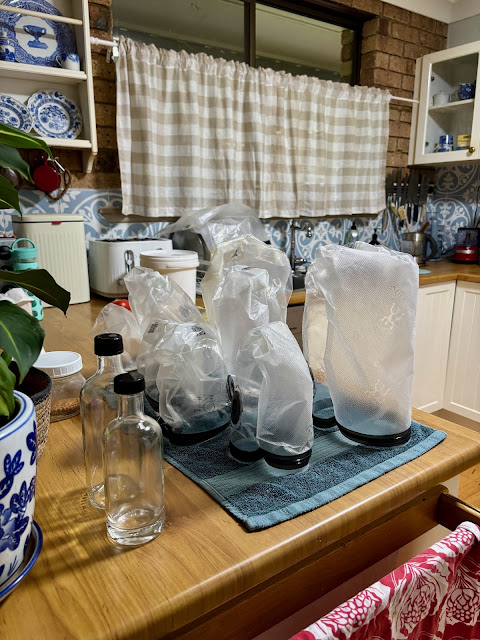
Every morning when I walk into my kitchen it looks tidy and ready for a day's work. Not so on this morning (above), I saw this when I walked in. Late the previous afternoon when I was looking for something, I came across my rolled up Zwilling vacuum bags and decided they had to be washed and dried. So I did that and although I usually put them outside on the verandah to dry it was dark by then. I turned the just-washed bags inside out and left them like this on a towel. It worked well and now the bags are ready to use when I bring home root vegetables, cabbages or whatever I buy that I want to last four or five weeks.
Image

You’ll save money by going back to basics

When I was doing the workshops and solo sessions, I had a couple of people whose main focus was on creating the fastest way to set up a simple life. You can't create a simple life fast, it's the opposite of that It's not one single thing either - it's a number of smaller, simpler activities that combine to create a life that reflects your values; and that takes a long to come together. When I first started living simply I took an entire year to work out our food - buying it, storing it, cooking it, preserving, baking, freezing, and growing it in the backyard. This is change that will transform how you live and it can't be rushed.  
Image

Categories

  • Backyard 244
  • Being Organised 257
  • Books 9
  • Budgeting 142
  • Chickens 42
  • Community life 289
  • Family 269
  • From Scratch 63
  • Grandmothering 69
  • Home 296
  • Individuality 185
  • Mentoring 55
  • My books 49
  • Organic Gardening 348
  • Preserving 97
  • Recycling 22
  • Retirement 22
  • Self Reliance 160
  • Simple Living 777
  • Sustainability 308
  • This blog 107
  • Weekend reading 362
  • Writing 4

Followers

Trending Articles

The last post

This will be my last post here.  I've been writing my blog for 18 years and now is the time to step back. I’ve stopped writing the blog and come back a couple of times because so many people wanted it, but that won’t happen again, I won’t be back.  I’ll continue on instagram to remain connected but I don’t know how frequent that will be. I know some of you will be interested to know the blog's statistics. 
Image

Making ginger beer from scratch

We had a nice supply of ginger beer going over Christmas. It's a delicious soft drink for young and old, although there is an alcoholic version that can be made with a slight variation on the recipe. Ginger beer is a naturally fermented drink that is easy to make - with ginger beer you make a starter called a ginger beer plant and after it has fermented, you add that to sweet water and lemon juice. Like sourdough, it must ferment to give it that sharp fizz. To make a ginger beer plant you'll need ginger - either the powdered dry variety or fresh ginger, sugar, rainwater or tap water that has stood for 24 hours to allow the chlorine to evaporate off. You'll also need clean plastic bottles that have been scrubbed with soap, hot water and a bottle brush and then rinsed with hot water. I never sterilise my bottles and I haven't had any problems. If you intend to keep the ginger beer for a long time, I'd suggest you sterilise your bottles. MAKING THE STARTER In a...
Image

Time changes everything

I've been spending time in the backyard lately creating a contained herb and vegetable garden. My aim is to develop a comfortable place to spend time, relax, increase biodiversity and encourage more animals, birds and insects to live here or visit. Of course I'd prefer my old garden which was put together by Hanno with ease and German precision. Together, we created a space bursting at the seams with herbs, vegetables and fruity goodness ready to eat and share throughout the year. But time changes everything. What I'm planning on doing now, is a brilliant opportunity for an almost 80 year old with balance issues. In my new garden I'll be able to do a wide range of challenging or easy work, depending on how I feel each day. It’s a daily opportunity to push myself or sit back, watch what's happening around me and be captivated by memories or the scope of what's yet to come.
Image

The most wonderful news

This post will give me more joy to write than anything else I could think of today.  I told you  there are a few exciting things happening here at the moment, well, I am now able to tell you the most exciting one of them.  Our son Kerry and his beautiful partner Sunny are having a baby!  Hanno and I will be grandparents in late March.  I can barely believe my eyes when I read what I have just written.  This is one of my original stitchery patterns. This wasn't planned but it's welcomed wholeheartedly by all of us.  Both Kerry and Sunny are hard workers and now that they have a baby to love and care for, they've decided it's time to buy an apartment together.  Sunny is going home to Korea to tell her family and when she comes back again, the search will start to find their first home together.  We are all so excited!  My knitting has taken on a life of its own and when I think of all the projects I could start, my head spins.  Thi...
Image

About Blog


Down to Earth is a blog by Rhonda Hetzel, dedicated to simple, intentional living — from home cooking and gardening to frugal budgeting and handmade crafts. It’s a space for gentle inspiration and everyday wisdom on creating a life that feels real, balanced, and deeply fulfilling.

Last Year's Popular Posts

The last post

This will be my last post here.  I've been writing my blog for 18 years and now is the time to step back. I’ve stopped writing the blog and come back a couple of times because so many people wanted it, but that won’t happen again, I won’t be back.  I’ll continue on instagram to remain connected but I don’t know how frequent that will be. I know some of you will be interested to know the blog's statistics. 
Image

Every morning at home

Every morning when I walk into my kitchen it looks tidy and ready for a day's work. Not so on this morning (above), I saw this when I walked in. Late the previous afternoon when I was looking for something, I came across my rolled up Zwilling vacuum bags and decided they had to be washed and dried. So I did that and although I usually put them outside on the verandah to dry it was dark by then. I turned the just-washed bags inside out and left them like this on a towel. It worked well and now the bags are ready to use when I bring home root vegetables, cabbages or whatever I buy that I want to last four or five weeks.
Image

You’ll save money by going back to basics

When I was doing the workshops and solo sessions, I had a couple of people whose main focus was on creating the fastest way to set up a simple life. You can't create a simple life fast, it's the opposite of that It's not one single thing either - it's a number of smaller, simpler activities that combine to create a life that reflects your values; and that takes a long to come together. When I first started living simply I took an entire year to work out our food - buying it, storing it, cooking it, preserving, baking, freezing, and growing it in the backyard. This is change that will transform how you live and it can't be rushed.  
Image

Workshops update

  This photo shows what the weather's been like here.  That's steam coming off my neighbours shed roof after a brief downpour of rain.  I hope we’re getting closer to organising these workshops. I didn’t explain this clearly enough: Group 1 is four workshops, Group 2 is four workshops. Out of those eight workshops I thought we probably end up doing three or four.
Image

Creating a home you'll love forever

Living simply is the answer to just about everything. It reduces the cost of living; it keeps you focused on being careful with resources such as water and electricity; it reminds you to not waste food; it encourages you to store food so you don't waste it and doing all those things brings routine and rhythm to your daily life. Consciously connecting every day with the activities and tasks that create simple life reminds you to look for the meaning and beauty that normal daily life holds.  It's all there in your home if you look for it. Seemingly mundane tasks like cleaning and cooking help you with that connection for without those tasks, the home you want to live in won't exist in the way you want it to.  Creating a home you love will make you happy and satisfied.
Image

Time changes everything

I've been spending time in the backyard lately creating a contained herb and vegetable garden. My aim is to develop a comfortable place to spend time, relax, increase biodiversity and encourage more animals, birds and insects to live here or visit. Of course I'd prefer my old garden which was put together by Hanno with ease and German precision. Together, we created a space bursting at the seams with herbs, vegetables and fruity goodness ready to eat and share throughout the year. But time changes everything. What I'm planning on doing now, is a brilliant opportunity for an almost 80 year old with balance issues. In my new garden I'll be able to do a wide range of challenging or easy work, depending on how I feel each day. It’s a daily opportunity to push myself or sit back, watch what's happening around me and be captivated by memories or the scope of what's yet to come.
Image

Simple life workshops on Zoom UPDATED

I've added more topics to the list. This post is for those readers who expressed interest in doing online Zoom workshops or who want to register now. The topics haven't been chosen yet but potential topics are:  vegetable gardening and composting; starting a vegetable garden and choosing vegetables suitable for a beginner;  cutting costs in the home, housework and routines; homemade laundry liquid and powder, soaking, stain removal and washing clothes and household linens; cooking from scratch and building your pantry to help you do it; homemade bread - white, rye, wholemeal and ancient grains. I'm not doing sourdough; living on less than you earn and developing a frugal mindset.
Image

Labels

  • Bartering
  • Chickens
  • Community life
  • Food security
  • From Scratch
  • Home Maintenance
  • Homemaking
  • Mentoring
  • My favourite place
  • Recipes - savoury
  • Reminders of what is important to us
  • Simple Living
  • The Simple Home - June
  • The Simple Home - May
  • Utilities
  • Wise Economy

Copyright © Down To Earth. Designed by OddThemes