down to earth

  • Home
  • About Us
  • Down To Earth Book
  • Privacy Policy


Well, as you can see, I didn't get back here yesterday. I had a full on day of Christmas preparations at work. Our Christmas hampers and gifts go out today and we finalised the prep for our free Christmas day breakfast for our town. All is ready, my friends, now I just need a bit of extra sleep to catch up and get back to normal. There is only one thing I really dislike about growing older, I get tired easily. :- (

There were a number of questions from the comments yesterday so I'll answer them today.

Gail: Bunnings do sell some open pollinated (OP) seedlings, but very few. If you remember the varieties you bought, google them and see if they're OP not. I think it's a good idea to swap seeds and I have no problem with those interested in swapping doing that here. We have had an OP seed swap here in the past. I'll talk to Sharon and see if she can set something up. We might be able to get a seed swap happening on the weekends. You have to be mindful that you cannot send to WA though, and I think some things can't go to Tasmania. Other countries would need to work through their own government requirements for sending seeds - some countries are strict, some aren't. Regarding diseases surviving in dried seeds the process of fermenation does kill of some diseases but others do survive. You need to select seeds from disease-free plants.

Kim, until you really know what you're doing, just plant one variety of each veggie and work up from there. Each year, add something new and it will be more manageable. When you do add more variety, add the easy ones first, like tomatoes. Tomatoes rarely cross pollinate, I've been growing beefsteak, paste and cherry tomatoes together, alongside my brandywines and they didn't cross. All I did was put them in different garden beds and they were fine.

Barbara: here is how I ferment tomato and cucumber seeds. Select a couple of your best tomatoes/cucumbers and wait until they are just past the ripe stage. Cut the tomato in two and scoop out the seeds, you'll take out the surrounding flesh when you do, that's fine. Place that in a small glass jar, add about half a cup of water, cover with a cloth to keep insects out and leave it in a warmish place in the kitchen. Depending on the warmth in your kitchen, about three or four days later, mould will develop on top of the tomato pulp. Stir with a spoon to dislodge any seeds caught in the pulp and you'll see a lot of seeds fall to the bottom of the jar. Carefully pour off the rubbish at the top without losing any seeds at the bottom. Then, when most of the pulp and mouldy flesh is gone, pour the seeds into a fine strainer and wash them gently, but thoroughly. Then tip the seeds onto a clean cloth to dry the water from them and place them on a ceramic or glass plate to dry out completely. That will depend on your conditions there but it will be between 10 - 14 days. Then add to your labelled container and put in the fridge.


Rachel: yes, you can cook the leftover beans. It's difficult to tell you how long any seeds will be viable for. It depends on the type of seeds and how well they've been stored. This is good test for seed viability - get a couple of sheets of newspaper, write the date and name of the seeds on the paper, then wet it. You want every sheet moist but not dripping wet. Sprinkle about 10 of the seeds you want to test on one side of the paper, fold in the sides and roll it up into a cigar shape. Place that into a plastic bag, along with any other cigar shapes you're testing, and seal the bag. Leave it for two days, then check. If there are no seeds sprouting, check it again in two days. If you see the seeds are sprouting, note how many sprout because that will give you a good indication of how viable the seeds are. If only a few germinate, I'd still plant your seeds but don't expect all of them to grow. If a lot of them sprout, you'll have no problems growing your plants. Be aware though that not every seed will sprout, generally expect about 80 percent success rate. If the seeds don't show any signs of life for two weeks, the seeds are probably dead. Be aware that some seeds do take a long time to sprout, so check the germination time (on Google) for the seeds your testing. And even with the best seeds and storage, you'll only get about 80 - 90 percent success anyway. Please let us know when baby arrives and take care, love.

Good luck with the laundry soap, Kathy.

Bobbi: Hanno and I had a giggle over your Mary Poppins comment. ; - )

And just a final thought for all those who are nervous about saving seeds. When you step away from the mainstream and go along this path we're all on, there aren't a lot of guideposts along the way. I've made plenty of mistakes, but it was through my biggest mistakes that I made my biggest gains, and went on to becoming quite proficient in a number of unusual tasks. So dive right in, the water's fine.

Check out Lyn's great post on pruning tomatoes here.


Technically, some common vegetables like tomatoes, squash and cucumbers, are fruit. For this post, I'm referring to everything as "vegetable".

After you grow your vegetables and before you save the seeds, you need to know how they're pollinated and if the vegetable is annual, biennial or perennial. Annuals will produce viable seed in the first year, biennials take two years to mature and produce seed, and perennials, produce viable seed in the second year and from then on until the plant dies.

When I write about drying seeds, I don't mean you wait until the outside of the seed is dry. The seed - inside and out - needs to be dry and this will require leaving most seeds on a china or glass plate for a number of days or weeks to dry out completely. Drying seeds on paper towel or newspaper is not the best way to go as the seed will stick to the paper.


You need to monitor your vegetables as the grow to see when they need picking. In the photo above there are two lazy housewife beans. The smaller one is the size I pick them for eating, the larger one I let stay on the vine until it was bigger and I could see the beans developing in the pod. Then I pick it for drying (for the pantry) and for seed.

This is a very good site that lists whether vegetables are annual, biennial or perennial and also how they are all pollinated. Grandpappy also gives excellent instructions for saving seeds, so instead of reinventing the wheel please refer to his site to get instructions for each vegetable. I will write about general principles of seed saving and some differences between warm and cold weather vegetables.

Always pick the best vegetables when you collect seeds and if you have two or three of the same vegetables you can collect from, do that because you provide a stronger gene pool for the plants you grow.


This is a yellow zucchini and a good example of male and female flowers. The male flowers are those on the long stalks and they stand up tall to attract bees. The female flowers develop lower down on the plant and are bigger with a distinct ovary inside the flower. You can see here the female flowers are still attached to the end of the developing zucchinis.

I categorise vegetables, for the purpose of seed saving, into three groups:

WET - tomatoes, cucumbers, luffas. These vegetables have thick flesh around the seed that needs to be removed, and in the case of tomatoes and cucumbers, fermented. Fermentation will happen when you add the seeds to a jar of water and leave it for a few days. Luffas don't have to be fermented but you leave the luffa on the vine until it's brown, then crack it open and pour out the seeds. If you're in a cooler climate, you can pick the luffas green and store them in a dry place until they turn brown and crackly. Melons are another wet seed but you can save these when you're eating the melon. Watermelon seeds just need to be dried. Save rockmelon (cantaloupe) and honeydew melon seeds and put them in a sieve to clean under running water until all the fresh is removed. Then dry them.

DRY - these are the easy seeds to harvest. Let pumpkin and squash mature for a few days after you pick them. Then cut open, scoop out the seeds and dry them. To harvest corn seeds, pick all the corn you will eat, leaving behind the best cobs. Let them sit on the plant for another month and when they look dry, harvest them, peel back the husks and let them dry out more. Tie the cobs together by the husks, and hang them up to finish drying, then pick the kernels off or rub two corn cobs together and they will fall off.

LEGUMES: Beans and peas have pods that are just broken open and the seeds are there waiting. They need to be dried before storing.


These are lazy housewife beans drying on our verandah. These are a great bean as they can be eaten as a green bean or you can dry them out and add them to your pantry.

Sometimes you don't have to sacrifice the vegetable to save the seeds. For instance, pumpkins and squash can be cut open, scoop out the seeds and you can still eat the vegetable. These are dry seeds so when you scoop them out, they just need to be dried before storing.


These are pigeon peas, a great permaculture plant, still in their green stage.


When they're like this, I pick them to use like lentils. These peas make an excellent pea soup and they can be stored in the pantry for months. Pigeon peas may also be fed to chooks when they're still green, and the foliage is an excellent fodder or mulch.

In the middle of our tomato season I generally pick two excellent tomatoes to save seeds from. These are processed in the usual way of scooping out the seeds and adding them to a jar of water to ferment. If, the following day, I cut open another tomato to eat and find it's a really good one, I'll save a few seeds from that one too and just squeeze the seeds from a wedge of that tomato into the fermenting jar.


Tomato seeds must be fermented and dried before storing.

If the vegetables you want seed from are easily cross pollinated you need to plant those vegetables away from their cross pollinators. For instance, chillis and capsicums (peppers) may cross pollinate, so even though they're different varieties of the same vegetable, you need to be mindful of the pollination factor and grow the plants you want to sow seeds from at least 15 metres (50') apart.

While your vegetables are growing, check if they are pollinated by bees, many vegetables are. You have to make sure there are bees in your backyard to pollinate so early one morning, go out to your garden and look for bees. If there are none, you'll have to hand pollinate. If you are serious about your vegetable growing, it's a good idea to grow a small number of flowers in with your vegetables to attract the pollinators like bees and other insects. These flowers can be things like nasturtiums, which are edible, little daisies that bees love, herbs - tansy, oregano, thyme and borage, or marigolds, cosmos and sunflowers.


Luffas should dry out on the vine. If you can't do that, pick them green and dry them in the shade until all the flesh has dried up and the skin will crack open.

Generally, in the case of flower forming vegetables like carrots and lettuce, you only need to put one plant aside to harvest seeds from, but it must be the best plant. You are looking to select the best plant so that you pass those trait onto what you grow in the seeds you save. Look for vegetables that are not diseased in any way, are strong growing, and display the qualities you want in that vegetable, such as early maturing, as well as size and abundance of the crop. If there is only one perfect fruit on the vine, that is not the one to select. Go instead for a vine or plant that has a good yield of many good vegetables, is a good size and is strong.

Lettuce, carrots, celery, parsley - all form flower heads. You have to wait for the flowers to turn to seed but if you can't do that for reasons of weather, wait until the flower head is almost ready to seed, then cut the whole flower off and store it in a paper bag in the house. After a couple of weeks you hear the seeds rattling around in the bag when you shake it. All you have to do then is clean the dried old bits of flower away from the seeds and store them.

The biggest threat to your seed treasure is mould. The seeds must be dried completely before storing, and then stored in dry conditions. The fridge is ideal for most seeds. Pack them in their own little packet with name and date of collection on it, place that, along with all the other packets or little jars, into a larger plastic box and keep it in the fridge until needed. If you live in very humid conditions and this way of storing doesn't work for you, add a little diatomaceous earth to the seeds, shake off most of it, and store the seeds. If you want to be an organic grower, don't use seed fungicides.

I know some of this is confusing if you're new to gardening but it's a very simple process and once you've done it once, you'll realise just how easy it is. This post is a bit disjointed but I just wrote it as it came to mind and now I don't have the time to tidy it up more. I hope you can make sense of it. I'll try to get back later and change a couple of things so it is more coherent.

ADDTIONAL READING
Annete McFarlane's vegetables stories


This is the plant we're saving for its seeds. Sorry, it's a bit overexposed.

There is a celery plant in our vegetable garden that reminds me every day how important it is to save vegetable seeds. Celery, unlike a lot of other common vegetables, is biennial. That means that it will only flower and produce seeds in its second year. My pineapple is similar, it produces its fruit in the second year. Many popular vegetables are annuals - and that means the seed can be planted, and will mature and reproduce all in the space of one year; and if it's an open pollinated plant, you can collect the seeds for planting the following season.


Celery flowers - these fine wispy flowers will soon turn into black seeds ripe for the picking.

First a word about open pollinated seeds and hybrids. Plant open pollinated seeds, they are reproductive. Doing so will ensure biodiversity for the coming generations. Open pollinated seeds are old vegetables whose seeds have been passed down through the generations without anyone tampering with them. And they taste like vegetables should taste. There are many more varieties of open pollinated seeds than hybrids, and they have fabulous names like Pink Brandywine, Lazy Housewife Bean, Mortgage Lifter and Purple Tiger Chilli - they were all named by the people who used them, not by multi-national companies. Open pollinated seeds may be harder to find though, so look online if you don't have a seed company nearby. Try to buy seeds from a supplier near you because those seeds will match your conditions better than those grown half a continent away.

On the other hand...

Hybrid seeds were developed by altering the makeup of particular plants to produce vegetables with certain traits. A good example of this is the supermarket tomato. When I was a girl, way back in the 1950s, tomatoes were large soft skinned fruit that weighed in at around two per pound. This was fine when we all bought our vegetables and fruit from the green grocer, but when supermarkets opened for the first time, when self serve was still a novelty, the stores wanted tomatoes that could be dropped on the floor without splitting, and they wanted four per pound. Tomato growers came up with a new tomato that was smaller and tough skinned. Store keepers were very pleased, housewives were not - they didn't taste like tomatoes used to taste. Over the years we've come to accept that bland tomato taste and only people who grow tomatoes in their backyards, or buy open pollinated tomatoes from the organic market, know the true taste of tomatoes.

Hybrid vegetables are strongly promoted by some seed companies because you can't save seed from them and therefore have to re-buy seeds every year.


Open pollinated seeds, which are now becoming quite popular, will produce vegetables exactly the same as the parent plant for year upon year. It will save you money to grow them, the vegetables are better, you'll help maintain genetic diversity by growing them and they taste divine.


Heritage chooks are a similar thing to open pollinated vegetables. They will go broody, sit on eggs, and happily raise chickens. They are reproductive. There are some chooks now - Hylines, Isa Browns and Lowlines - the familiar small red chook, that have been modified to not go broody and to keep laying eggs. This shortens their lifespan. Like hybrid vegetables and their seeds, Isa Browns and their sisters are programmed to be replaced frequently. Those companies prefer that we buy our vegetable seeds and chickens over and over again instead of taking control of our own gardens and flocks with open pollinated seeds and heirloom chooks.

It's all an encouragement to let someone else take over our food requirements so we don't have to worry our pretty little heads about it. Pfffffffft. If we allow that to continue, we will lose these old skills forever and we will be totally reliant on someone else, or worse still, a commercial enterprise, to feed us.

Self reliance ... make a step towards it every day.

So on to saving seeds ... which I will finish tomorrow by writing about how to select, save and store seeds.


It's been a busy week. After two days at work, I've been confined to my sewing room writing, thinking and making notes. Oh, I did have one outing. I drove my friend, Bernadette, to the airport in her car - a very red, very low on the ground sports car. It was a big change from my little station wagon. Driving back past the shops, it was all Christmas decorations and people with packages, it doesn't look like a world economic crisis out there. On that same day, Hanno drove down to the Gold Coast to help our son, Kerry, move house.

I was back in the sewing room yesterday. It's quite pleasant in there, shut away from what is happening in the house. The phone rings frequently, yesterday there were calls from my sisters and a few from my Centre, but through it all I kept tapping away at the keys, looking out the window and wondering when I should pick the pumpkins.

The book proposal is coming together. I finished one section of it yesterday, then decided to add another section to the book (not the proposal), which means I'll have to rewrite quite a bit of the first chapter, which is part of the proposal. I'll make a start on that today. Did I tell you I'm with the same agency that represented Janet Luhrs and her Simple Living Guide? I am very thankful for that because I know I'm in good hands and I appreciate their knowledge and guidance.

So I was tapping away on the keyboard yesterday, when Hanno walked in with a parcel. "it's from Germany" he said, and I knew immediately what it was. Hilde, a reader here, had sent me Zakka Sewing: 25 Japanese projects for the household, a number of beautiful fabrics, thread and a lovely message on a card. It made my morning! Thank you so much, Hilde! You are very generous. I spent a wonderful thirty minutes looking through the book and then had to force myself back to the computer. I kept thinking of that little squirrel tea cosy though, it's so sweet.

It doesn't feel like Christmas yet. We have no decorations up and I haven't decided what we'll eat for Christmas lunch, but I know it will come together, just like it always does. In the meantime, I'll keep writing and thinking, writing and thinking and hope that soon I'll be confident enough to send my proposal in.

Thank you all for the comments this week, I really look forward to reading them. They remind me every day that you're all out there and there is a world-wide community of us all working towards a better life, and for that, I'm ever thankful.


One of the things we all do every day is eat. If you're looking for a way to start simplifying your life, if you're a new wife or husband, or if you've just moved away from your parents home, learning to cook from scratch is a very important step on your road to independence. Cooking from scratch is home cooking or comfort food - it's those meals your mum or grandma made that used wholesome, fresh ingredients and staples. There was no recipe book for those meals, they came from a long history of understanding food, how to mix it together with good results and from recipes passed from mother to daughter.

No matter how many times you see a food item in a box named "Mama's Choice", "Grandma's Favourite" or "Nana's Pie", those foods would rarely have been used by our mums and grandmas. Food producers know the appeal of comfort food and try to use that longing for old fashioned home cooking to sell their products. Don't be fooled, many of them contain preservatives, artificial colourings, stabilisers, firming agents, colour fixatives and flavour enhancers. Even some precooked organic foods contain these additives, so if you're trying to eat healthy food, the best way to do that is to cook it yourself.


Here is a list of Australian food additives here and here. The FDA USA food additives list is here but I have to tell you it's quite confusing (I wonder why). Information here about UK food additives and colourings. Readers in other countries, I encourage you to Google "food additives ...." < - add the name of your country, to find out more about your food.

Buyers beware.

What you cook will be healthier, cheaper and fresher than any convenience food you buy, and it will contain only what you put in it. Now, I'm not telling you that you'll never buy another take away meal or convenience food, but I want to encourage you to move towards home cooking and to try to make most of your food. I know there are times you need a quick bought meal. Just the other day I bought a vegetarian pizza for our dinner. I'd been at work all day and Hanno was busy, but I doubt we'll do that again for another six months.

Home cooking does take longer, that is why you pay so much for convenience food. You are paying for someone else's time and experience to make your food, along with all the ingredients they use. But over time, as you develop your skills, and hopefully your desire to cook, you'll realise you can cut back on the time it takes for many things. You can cook double the amount and freeze another meal for later, you can pre-prepare and just do the cooking when it's needed, you can use a slow cooker that will cook while you do other things. There are ways around the time issue.

Over the coming weeks I'll add to this, and probably make it a series of how to's, giving hints, tips and short cuts to help you in your kitchen. But in the meantime, please look at the list below and make a start. From scratch cooking is one of the most empowering skills you can have and it will help you on your road to a simpler life.

RECIPES FOR HOME COOKING


Here is a post I wrote a long time ago about developing flavour in home cooking.
Home cooking recipes - USA, there are some good recipes here but it pains me to see them using cans of soup and something called browning sauce. I don't know what that is. Nevertheless, I believe these recipes are a good starting point for the new cook and when you get further down the track, you may wish to use something other than cans of soup to flavour some of the recipes here.
Egg recipes
For UK recipes, who else but Delia
Australian recipes - the cook and the chef
Slow cooker recipes
Australian vegetarian recipes - Kurma
Traditional Christmas dinner (Australia)
Casseroles and stews
Recipes for all meals
Food for baby
Baby food recipes
Food equivalents and substitutes
International measure calculator
Explanations and old fashioned conversions
Can sizes


I didn't think I'd be frightened by our economic crisis. Initially I saw it as a way of slowing everything down, putting the brakes on indiscriminate spending, and forcing many people to rethink the way they live their lives. Now it has gone beyond a simple lesson and is hitting hard. At the Centre I volunteer at, many more people are needing help and some of them are losing hope in the future. The crisis has a long way to go yet, some say life will be very difficult for at least another 18 months. My fear is that our governments have no idea how to handle what is happening and if they continue to throw money at the problem, the chance to grow through this, and eventually prosper, will be lost.

Simple living is the answer but politicians and those in power refuse to acknowledge that reducing what we spend on 'stuff' will help us and our planet. They are choosing to support 'the economy', and here in Australia, sections of our community - pensioners, carers, some people on a low income and families with children are being given one-off payments of over a thousand dollars ($1000 per child) and being encouraged to go out and spend it. It's a great pre-Christmas boost for those people but it's not a long term solution and it totally fails to address the problems associated with always having an economy reliant on non-stop spending, shoddy products and debt.

Simplifying our lives is not just a decision for tough times, although it makes the most sense then. I am not naive enough to believe that moving to a more simple way of life would be easy. I know it would be tough. But would it be tougher than what we are faced with now? Continuing to spend like drunken sailors is not sustainable, there must be a point at which the economy can't "grow" any more. Is climate change telling us we have reached that point?

I think our political agenda needs to change. If we had a Minister for Simplicity, she would be overseeing the development of factories to produce good quality, repairable, electrical appliances and cars that run on hydrogen; she would be encouraging us to attend the sewing or gardening classes in our neighbourhood; she would support the use of renewable energy, give rebates for solar panels and make water tanks compulsory on all homes.

Isn't that alternative an enticing idea. It would be wonderful if we had governments that really meant it when they said "it's time for change". Imagine if our factories reopened to produce sustainable, good quality products we all needed. Imagine if children grew up learning about vegetable gardening instead of sitting in front of an Xbox for hour upon hour. Imagine if credit cards were banned and we went back to thinking carefully about what we need, and then saving for it. The reduction in our landfill dumps alone would be astounding!

Don't worry, I don't believe that is going to happen, at least not in my lifetime. I am an optimist but I'm not stupid. I know handing out money is far more popular than being the instrument of change. I know band-aid measures are popular.

But in the meantime, we can all work towards further reductions in our lives. We can teach ourselves lost skills and be energised by producing some of our own food. We can slow down our spending and pay off debt. Big business hates that - it takes away their control of us. We can sew and knit, keep chooks; teach our children; talk to our neighbours; make do with what we have; be aware of our local natural environment and care for it; cook from scratch, and become healthier because of it; and live smaller instead of bigger.

And while you're doing that, show your friends and neighbours what you're doing; they might be interested. Talk to your children about your family's changes and show them ways they might change too. Explain what you're doing to your extended family and work mates. If we can help others find a way of living that will help them survive this financial crisis, that helps us all. Be open with what you're doing and show others the benefits of your changes. And if you get the chance to talk to your local politicians, tell them how you've changed, what you've done and what you've planned for your future, and then ask them when we will have our first Minister for Simplicity.


This is just a short post to give the orange coconut cake recipe. I'm really busy today and need to go to work early. We're in the midst of our Christmas preparations and there is so much to do! We also have a BBQ lunch with our Flexischool students so the hour I have for that I'll replace with going in an hour early.

I was interested to read Laurie from Amish Country's comment about her relatives coming to Australia in their winter. At the moment, I'm working with a Canadian man who comes to Australia every winter. While he's here, he does voluntary work and this year he is with us. It must be quite a change for him but he's fitting in well and is a pleasure to work with.

And so, the cake. Many of you know that I don't follow recipes, I use them as a starting guide. I have tweaked this recipe quite a bit and now it's a flavour-packed moist orange cake that every one loves. It's the addition of the coconut cream that makes the difference. If you've only made cakes from a box before, this is a good recipe to add to your cook from scratch recipes. It's easy and, apart from pre-soaking the coconut, fairly quick.

Ingredients
  • ¾ cup caster sugar
  • 125 grams butter (¼ lb), room temp
  • 3 teaspoons finely grated orange rind
  • 3 eggs, room temp
  • 1 cup coconut cream - you can buy this at Aldi, most supermarkets or any Asian store
  • 1 ½ cups self-raising flour, sifted OR 1 ½ cups plain (all purpose) flour with 3 teaspoons of baking powder added
  • 1 ½ cups desiccated (shredded unsweetened) coconut
  • 2 tablespoons freshly squeezed orange juice
Method
  1. Place the coconut, the orange juice and the coconut cream in a bowl and let it sit for an hour.
  2. Preheat oven to 160°C.
  3. Place sugar, butter and orange rind in a large bowl, and beat until light and creamy, this will take about 4 or 5 minutes.
  4. Add eggs one at a time, beating well between each one.
  5. Fold flour and coconut mixture into the butter mix. When it's combined, place it in a round greased and lined cake pan.
  6. Cook for 50 minutes or until , when tested with a skewer, it comes out clean.
When it's cold, sprinkle with icing sugar (confectioner's sugar) or you could make the same icing I made.

Pour the juice of a fresh orange into a small saucepan and put on the stove. Allow to come to the boil and let it simmer. Don't walk away because OJ has a lot of sugar and it will burn. Allow it to reduce to half its volume, then take it off the heat, add a teaspoon of butter and let it cool. When it's cool, add enough icing sugar to make a frosting the consistency you would like and pour it over the cake.

OR - this is much simpler: add the juice of an orange to 1 cup of icing sugar and pour that over the cake.

See you tomorrow!


There is a distinct feel to certain times of the year. July at my home is fluffy slippers weather - cold. In July, there is soup on the stove, woollen gloves in the car and I always feel that, given a little time and help, I could mother the entire earth and make everyone warm.

December is altogether different, it's hot and humid bare arms weather. The never-fail signs of December are afternoon thunderstorms rolling in, the clinking of ice cubes in frosty glasses of lemon cordial, the ceiling fan moving slowly on hot summer nights and when I hear kids playing in the street during the day, it's a sure sign school is finished for the year, summer holidays have started and Christmas is just around the corner.

Shane and Sarndra came over for lunch on Saturday. How good it was to see them! I made up some bread rolls, salad from the garden and added a plate of local cheese and some pastrami for the meat eaters. They brought some cold brewed ginger beer and lemon, lime and bitters with them, which went well with the food. Later we all had a slice of my orange coconut cake and coffee.

We caught up on all the news and had a look at photos of their newly acquired mother hen and baby chicks. I am so thankful to see Shane so happy and content with a girl he obviously adores, and she him. There is a lot to be said for these times around the kitchen table, reconnecting and further strengthening our family ties. They seem to go hand-in-hand with Christmas and hot December weather.


Yesterday it was just Hanno and I for morning tea. I started another pair of fingerless mittens, this time in pure Merino wool, for Sarndra. I sneakily had her try on the little red pair I made for size. ; - ) I remember my own mother trying to size something for me, saying she was making it for my sister. I have no doubt Sarndra knew what I was doing, but played by the rules and didn't say a word about it. She is a good fit for our family, there is no doubt about it.


The hot weather is great for the garden but the heavy rain does a fair bit of damage. These golden nugget pumpkins are surviving, but only just. Still, there are quite a few of them out there and soon we'll be able to pick them and store them in the kitchen for eating later in the year. We've had a few more strikes of fruit fly in the tomatoes but overall there seem to be fewer of them around. Of course, it will next summer before we know if these measures we've taken are working. I'm sure there are eggs in the soil, but hopefully, as each year passes, there will be fewer.


And in the background of our lives, the animals wander in and out. Hettie sleeps in the hay in the shed, but every morning, when she hears us having tea on the verandah, she runs over to be fed some cake. The chooks are happy to roam around the backyard, scratching and pecking, searching for bugs. Heather, our salmon Faverolles girl, is broody again and spends her days on the nest where she pushes herself deep into the straw hoping no one will see her. And Alice, our Airedale, is happy to follow Hanno around while he works in the yard, or sleep on her bed in the kitchen, away from the March flies of December.

Life's good.


Hello all. I have been MIA for a bit due to some projects I am working on. I hope everyone is enjoying getting ready for the holidays with their families. It is a wonderful time to spend with friends and family, remembering holidays past and preparing for the holiday to come. As always traditions play an important role in everyone's life and I hope that you remember that traditions are often simple pleasures and not work. Some choose to spend their time running around the malls, but I hope all of us choose a wiser way to prepare for the holidays, celebrating with family and friends. Don't forget that with the economies taking a hit and a hard downturn this year, there are many out there who need a little extra help at this time of year, especially. If you have time, turn to your children and have them help you clean out their drawers and closets and toy boxes; the things that no longer fit, or outgrown toys can be donated. Warm coats are especially needed in colder areas, especially now. If you do go shopping, pick up and extra small toy and take it to your church or your local charity or the local Marine Corps recruiting center (if you live in the US) as a donation for Toys For Tots. It has always been a tradition with my children for each to select a small toy or book, have them buy it with money from their chores and then take it to Toys for Tots or the Salvation Army. It is a tradition we continue to this day, even though my girls are all grown up. If you have the time, go through your pantries and take a few cans or non-perishable foods to your local soup kitchen or church. When you go to the grocery store, it takes very little to buy a few extra cans, an extra turkey or ham that is on sale, an extra bag of beans, really just about anything, for it will all be appreciated by those who are less fortunate than ourselves. This is the time of year to give, which is an important part of the season that often gets overlooked in the frantic search for gifts at the mall. Always remember the Reason for the Season!

I will be updating photos this week-end and also I would like everyone to put their thinking caps on and come up with ideas for our next swap, which will be announced after the New Year. Remember that we are always trying to practice old or new skills, if possible reusing or re-purposing materials, and having a bit of fun along the way. Those who did not send their swap buddies their parcels will not be allowed to sign up for our next swap. Tamara, please send me another e-mail as I accidentally deleted your address. I have something for you.


Clicking on the photos will enlarge them.

There are many way you may express your simple life philosophy to the world. Our ways of living are diverse and singular but we also come together as a group - a group that is growing stronger by the week. It is only about twelve months since I first watched mainstream TV news covering climate change and dwindling oil supplies. Before that, you'd be hard pressed to know there was any kind of environmental calamity happening in our world, now people talk about it on the bus on their way to work. Now governments are setting up environmental departments and appointing ministers to oversee the transition into a world with less reliance on fossil fuels.

Change. It's a good thing.

Here at my home we have set ourselves up on a relatively small (one acre) piece of land that is boarded by an always running creek lined with remnant rain forest. We grow some of our own food, we spend less that we earn, we reuse and utilise all we can instead of buying new, we support and assist those who need it, we try to be good citizens in our community and decent role models for our children and we are mindful that except for legally, we don't own our land, we are merely it's caretakers for a tiny fraction of its history. Life's good.

We started off this life a few years ago, doing as many of you are doing now - taking one small step at a time. Over that initial period we had one or two projects going but as you know, one thing leads to another, one small step leads to many more and soon we were on the march. A brand new life. Who knew.

You will find as soon as you become involved in this way of living that everything is linked. It's like a string of amber beads, in that each small action is a nice and tidy piece of organic loveliness, just like amber. One piece on its own is divine, strung together, it's life changing.

It doesn't matter what you start with, if you stay focused on your change you'll end up in the same place we did - with a new attitude to living and a new life in which to further express your transformation. One of the wonderful things about writing a blog such as this is that it attracts so many people who share the common goal of mindful simplicity.

We all need each other, even though in the past few decades we've been encouraged to believe we don't. That will never change, because we all need the support of people living their lives in a similar way and trying to do their best and be the best they can be. And if we can't get that in our own real communities, and even when we can, we know it will be available here. I am really proud of the community feel that has developed in this blog. Without fail, every time I see someone share information or offer kind counsel to another reader in the comments, it makes me smile.

I wrote the other day that I didn't know why my blog is popular and that caused me to wonder why. I realised yesterday that it is the people who read here that make it. Sure, I write the content and that is why you come here, but if no one was commenting, if there was little involvement with the readers, it would not be the joy it is to write. As it is it's like a little meeting place where you see friends and people you're just getting to know and new comers who've come for the first time. I really like the husbands and partners reading too. I get emails from men who have been shown something here by their partner and felt the need to write. I'm not sure why few men comment here. That's a mystery for another day.

Thank you for being part of this community and for making those contributions in the comments box. As this week draws to a close and Christmas moves closer, I hope you find time to relax and appreciate whatever it is you're doing. Take care, everyone, and enjoy your weekend.


Heather, Margaret Olley, Mary and Anne Shirley out for an afternoon stroll.


Some neighbours arrive.


But what's this! A storm approaches.


Alice, get the chooks in!


Good girl!


Another job done.


It's only 3.30pm but it's getting darker.


And down it comes.


Another tropical thunderstorm.


Newer Posts Older Posts Home


My books were all published by Pengiun, and are available at Amazon US, Amazon UK and Amazon Au

Search here

Total Pageviews

Translate


I'm Rhonda Hetzel and I've been writing my Down to Earth blog since 2007. Although I write the occasional philosophical post, my main topics include home cooking, happiness and gardening as well as budgeting, baking, ageing, generosity, mending and handmade crafts. I hope you enjoy your time here.

MY FAVOURITE PLACES

  • Grandma Donna's Place
  • Grandma Donna's YouTube
  • Grandma Donna's Instagram
  • This Simple Day
  • Nicole's Instagram

Give More

Give More

Popular posts last year

Making ginger beer from scratch

We had a nice supply of ginger beer going over Christmas. It's a delicious soft drink for young and old, although there is an alcoholic version that can be made with a slight variation on the recipe. Ginger beer is a naturally fermented drink that is easy to make - with ginger beer you make a starter called a ginger beer plant and after it has fermented, you add that to sweet water and lemon juice. Like sourdough, it must ferment to give it that sharp fizz. To make a ginger beer plant you'll need ginger - either the powdered dry variety or fresh ginger, sugar, rainwater or tap water that has stood for 24 hours to allow the chlorine to evaporate off. You'll also need clean plastic bottles that have been scrubbed with soap, hot water and a bottle brush and then rinsed with hot water. I never sterilise my bottles and I haven't had any problems. If you intend to keep the ginger beer for a long time, I'd suggest you sterilise your bottles. MAKING THE STARTER In a...
Image

NOT the last post

This will be my last post here.  I've been writing my blog for 18 years and now is the time to step back. I’ve stopped writing the blog and come back a couple of times because so many people wanted it, but that won’t happen again, I won’t be back.  I’ll continue on instagram to remain connected but I don’t know how frequent that will be. I know some of you will be interested to know the blog's statistics. 
Image

How to make cold process soap

I'm sure many of you are wondering: "Why make soap when I can buy it cheaply at the supermarket?" My cold process soap is made with vegetable oils and when it is made and cured, it contains no harsh chemicals or dyes. Often commercial soap is made with tallow (animal fat) and contains synthetic fragrance and dye and retains almost no glycerin. Glycerin is a natural emollient that helps with the lather and moisturises the skin. The makers of commercial soaps extract the glycerin and sell it as a separate product as it's more valuable than the soap. Then they add chemicals to make the soap lather. Crazy. Making your own soap allows you to add whatever you want to add. If you want a plain and pure soap, as I do, you can have that, or you can start with the plain soap and add colour, herbs and fragrance. The choice is yours. I want to add a little about animal and bird fat. I know Kirsty makes her soap with duck fat and I think that's great. I think t...
Image

Preserving food in a traditional way - pickling beetroot

I've had a number of emails from readers who want to start preserving food in jars but don't know where to start or what equipment to buy.  Leading on from yesterday's post, let's just say up front - don't buy any equipment. Once you know what you're doing and that you enjoy preserving, then you can decide whether or not to buy extra equipment. Food is preserved effectively without refrigeration by a variety of different methods. A few of the traditional methods are drying, fermentation, smoking, salting or by adding vinegar and sugar to the food - pickling. This last method is what we're talking about today. Vinegar and sugar are natural preservatives and adding one or both to food sets up an environment that bacteria and yeasts can't grow in. If you make the vinegar and sugar mix palatable, you can put up jars of vegetables or fruit that enhance the flavour of the food and can be stored in a cupboard or fridge for months. Other traditional w...
Image

Cleaning mould from walls and fabrics

With all this rain around we've developed a mould problem in our home. Usually we have the front and back doors open and that good ventilation stops most moulds from establishing. However, with the house locked up for the past week, the high humidity and the rain, mould is now growing on the wooden walls near our front door and on the lower parts of cupboards in the kitchen. Most of us will find mould growing in our homes at some point. Either in the bathroom or, in humid climates, on the walls, like we have now. You'll need a safe and effective remedy at some point, so I hope one of these methods works well for you. Mould is not only ugly to look at, it can cause health problems so if you see mould growing, do something about it straight away. The longer you leave the problem, the harder it will be to get rid of it effectively. If you have asthma or any allergies, you should do this type of cleaning with a face mask on so you don't breathe in any spores. Many peopl...
Image

Five minute bread

Bread is one of those foods that, when made with your own hands, gives a great deal of satisfaction and delight. It's only flour and water but it symbolises so much. I bake bread most days and use a variety of flours that I buy in bulk. Often I make a sandwich loaf because we use most of our bread for lunchtime sandwiches and for toast. Every so often I branch out to make a different type of loaf. I have tried sour dough in the past but I've not been happy with any of them. I'll continue to experiment with sour dough because I like the idea of using wild yeasts and saving the starter over a number of years to develop the flavour and become a part of the family. However, the loaf I've been branching out to most often is just a plain old five minute bread. By five minutes I mean it takes about five minutes actual work to prepare but it's the easiest of all bread to make and to get consistently good loaves from. If you're having people around for lunch or...
Image

This is my last post.

I have known for a while that this post was coming, but I didn't know when. This is my last post. I'm closing my blog, for good, and I'm not coming back like I have in the past.  I've been writing here for 16 years and my blog has been many things to me. It helped me change my life, it introduced me to so many good people, it became a wonderful record of my family life, it helped me get a book contract with Penguin, and monthly columns with The Australian Women's Weekly and Burke's Backyard . But in the past few months, it's become a burden. In April, I'll be 75 years old and I hope I've got another ten years ahead. However, each year I'll probably get weaker and although I'm fairly healthy, I do have a benign brain tumour and that could start growing. There are so many things I want to do and with time running out, leaving the blog behind gives me time to do the things that give me pleasure. On the day the blog started I felt a wonderful, h...
Image

What is the role of the homemaker in later years?

An email came from a US reader, Abby, who asked about being a homemaker in later years. This is part of what she wrote: "I am a stay-at-home mum to 4 children, ages 9-16. I do have a variety of "odd jobs" that I enjoy - I run a small "before-school" morning drop-off daycare from my home, I am a writing tutor, and I work a few hours a week at a local children's bookstore. But mostly, I cherish my blissful days at home - cooking, cleaning (with homemade cleaners), taking care of our children and chickens and goats, baking, meal-planning, etc. This "career" at home is not at all what I imagined during my ambitious years at university, but it is far more enriching. I notice, though, that my day is often planned around the needs of my family members. Of course, with 4 active kids and a husband, this is natural. I do the shopping, plan my meals, cook dinner - generally in anticipation of my family reconnecting in the evening.  I can't h...
Image

Every morning at home

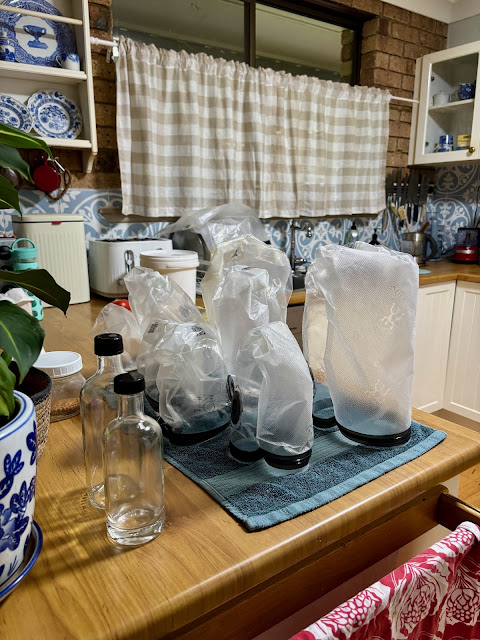
Every morning when I walk into my kitchen it looks tidy and ready for a day's work. Not so on this morning (above), I saw this when I walked in. Late the previous afternoon when I was looking for something, I came across my rolled up Zwilling vacuum bags and decided they had to be washed and dried. So I did that and although I usually put them outside on the verandah to dry it was dark by then. I turned the just-washed bags inside out and left them like this on a towel. It worked well and now the bags are ready to use when I bring home root vegetables, cabbages or whatever I buy that I want to last four or five weeks.
Image

You’ll save money by going back to basics

When I was doing the workshops and solo sessions, I had a couple of people whose main focus was on creating the fastest way to set up a simple life. You can't create a simple life fast, it's the opposite of that It's not one single thing either - it's a number of smaller, simpler activities that combine to create a life that reflects your values; and that takes a long to come together. When I first started living simply I took an entire year to work out our food - buying it, storing it, cooking it, preserving, baking, freezing, and growing it in the backyard. This is change that will transform how you live and it can't be rushed.  
Image


Trending Articles

NOT the last post

This will be my last post here.  I've been writing my blog for 18 years and now is the time to step back. I’ve stopped writing the blog and come back a couple of times because so many people wanted it, but that won’t happen again, I won’t be back.  I’ll continue on instagram to remain connected but I don’t know how frequent that will be. I know some of you will be interested to know the blog's statistics. 
Image

Every morning at home

Every morning when I walk into my kitchen it looks tidy and ready for a day's work. Not so on this morning (above), I saw this when I walked in. Late the previous afternoon when I was looking for something, I came across my rolled up Zwilling vacuum bags and decided they had to be washed and dried. So I did that and although I usually put them outside on the verandah to dry it was dark by then. I turned the just-washed bags inside out and left them like this on a towel. It worked well and now the bags are ready to use when I bring home root vegetables, cabbages or whatever I buy that I want to last four or five weeks.
Image

You’ll save money by going back to basics

When I was doing the workshops and solo sessions, I had a couple of people whose main focus was on creating the fastest way to set up a simple life. You can't create a simple life fast, it's the opposite of that It's not one single thing either - it's a number of smaller, simpler activities that combine to create a life that reflects your values; and that takes a long to come together. When I first started living simply I took an entire year to work out our food - buying it, storing it, cooking it, preserving, baking, freezing, and growing it in the backyard. This is change that will transform how you live and it can't be rushed.  
Image

Creating a home you'll love forever

Living simply is the answer to just about everything. It reduces the cost of living; it keeps you focused on being careful with resources such as water and electricity; it reminds you to not waste food; it encourages you to store food so you don't waste it and doing all those things brings routine and rhythm to your daily life. Consciously connecting every day with the activities and tasks that create simple life reminds you to look for the meaning and beauty that normal daily life holds.  It's all there in your home if you look for it. Seemingly mundane tasks like cleaning and cooking help you with that connection for without those tasks, the home you want to live in won't exist in the way you want it to.  Creating a home you love will make you happy and satisfied.
Image

Time changes everything

I've been spending time in the backyard lately creating a contained herb and vegetable garden. My aim is to develop a comfortable place to spend time, relax, increase biodiversity and encourage more animals, birds and insects to live here or visit. Of course I'd prefer my old garden which was put together by Hanno with ease and German precision. Together, we created a space bursting at the seams with herbs, vegetables and fruity goodness ready to eat and share throughout the year. But time changes everything. What I'm planning on doing now, is a brilliant opportunity for an almost 80 year old with balance issues. In my new garden I'll be able to do a wide range of challenging or easy work, depending on how I feel each day. It’s a daily opportunity to push myself or sit back, watch what's happening around me and be captivated by memories or the scope of what's yet to come.
Image

It's the old ways I love the most

I'm a practical woman who lives in a 1980’s brick slab house. There are verandahs front and back so I have places to sit outside when it's hot or cold. Those verandahs tend to make the house darker than it would be but they're been a great investment over time because they made the house more liveable. My home is not a romantic cottage, nor a minimalist modern home, it's a 1980’s brick slab house. And yet when people visit me here they tell me how warm and cosy my home is and that they feel comforted by being here. I've thought about that over the years and I'm convinced now that the style of a home isn't what appeals to people. What they love is the feeling within that home and whether it's nurturing the people who live there.
Image

Making ginger beer from scratch

We had a nice supply of ginger beer going over Christmas. It's a delicious soft drink for young and old, although there is an alcoholic version that can be made with a slight variation on the recipe. Ginger beer is a naturally fermented drink that is easy to make - with ginger beer you make a starter called a ginger beer plant and after it has fermented, you add that to sweet water and lemon juice. Like sourdough, it must ferment to give it that sharp fizz. To make a ginger beer plant you'll need ginger - either the powdered dry variety or fresh ginger, sugar, rainwater or tap water that has stood for 24 hours to allow the chlorine to evaporate off. You'll also need clean plastic bottles that have been scrubbed with soap, hot water and a bottle brush and then rinsed with hot water. I never sterilise my bottles and I haven't had any problems. If you intend to keep the ginger beer for a long time, I'd suggest you sterilise your bottles. MAKING THE STARTER In a...
Image

An authentic look at daily life here — unstaged and real

Most days Hanno was outside happily working in the fresh air. It may surprise you to know that I started reading my book,  Down to Earth , yesterday - the first time since I wrote it 13 years ago.  I had lent it to my neighbor, and when she returned it, I started reading, expecting to find surprises. Instead, I realised the words were still familiar—as if they were etched into my memory. As I flipped through the pages, I was reminded of how important it was for me to share that knowledge with others. The principles in Down to Earth changed my life, and I truly believed they could do the same for others. After just 30 minutes of reading, I put the book down, reassured that its message still holds true: we can slow down and reshape our lives, one step at a time.
Image