Very early on in my blogging life I wrote a post detailing a lot of green cleaners. It was ridiculous really, I was doing what the supermarkets do - having a different cleaner for each individual cleaning purpose. Over the years, practicality and good sense kicked in and the variety of my own green cleaners shrank to a handful of cleaners that would clean a lot of different areas and surfaces. It saved me time because I had fewer cleaners to make and it saved money. As the internet grew with householders offering advice, instead of the choice of cleaners decreasing, many homemakers developed their own recipes and choices increased, a lot! You don't need them. Forget the supermarket models where you shop for different products for every area to be cleaned, common sense and your grandma will tell you that a cleaner is a cleaner and if it suits the area, it will probably suit similar areas and surfaces in your home.

With the current cost of living crisis, now is the time to try making some of your cleaners instead of buying the pre-made products. They’re easy to make - laundry liquid will take about 10- 15 minutes but you only make an batch every few months.
The foundation recipe of most of my cleaners is laundry liquid. Not only will it clean your clothes with three ingredients, you can add to it to make a creamy scrubber similar to Gumption, you can use it as a stain remover or on greasy kitchen areas such as your stove top, range hood and sink.
I wanted to add the ingredients list from supermarket products such as Dynamo or Cold Power here but they don't have the ingredients list on their products anymore (hmmm, I wonder why 🧐) They refer you to their websites - but they aren't on the Cold Power site and you have to fill in forms to reach the Dynamo info but no matter what I did, I never found it. It's interesting that now, when people are much more interested in using less toxic products on their clothing, bed linen and skin, the ingredients lists to help them choose their products have gone.
Here are the recipes:
Laundry Liquid
I put this first because as well as being a laundry liquid, general surface cleaner and stain remover, it's also the foundation of another handy cleaner, similar to Gumption.
You should be able to buy the ingredients for all these cleaners at your local supermarket and on Amazon au if you can’t find them locally. Please note that washing soda is different to baking soda. Sometimes there are two types of washing soda on sale - washing soda crystals and washing soda powder Buy the powder, it's easier to dissolve.
When I make up a new batch of laundry liquid, I always make it up in a 10 litre bucket with lid that I use for laundry and various cleaning tasks around the home. It’s a cleaner that is perfect for cleaning metal - including stainless steel, porcelain baths and sinks, and spot cleaning on painted walls. It does a good job on appliances - like fridges, food processors and painted cupboards.
HOMEMADE CLEANING RECIPESLAUNDRY LIQUIDMakes 10 litres - use ¼ cup per laundry load
You may add any essential oil of your choice to these homemade cleaners. Oils like tea tree, eucalyptus, lavender or rose are useful but are not an essential ingredient and will add to the cost.
Ingredients
- 1 - 2 litres water
- 1 bar Sunlight or generic laundry soap or any similar pure laundry soap, grated on a cheese grater OR 1 cup of Lux flakes which are now called Softly flakes.
- ½ cup washing soda – NOT baking soda or bicarb soda
- ½ cup borax
Tools
- Saucepan
- 10 litre bucket
- Slotted spoon or wooden spoon for mixing
The ingredients are measured into a saucepan containing one to two litres/quarts of water. Add one cup of soap flakes, half a cup of borax and half a cup of washing soda. Turn on the heat and stir. Bring the mix to the boil, stirring as it heats, and by the time the mixture is boiling, ALL the ingredients should be dissolved.
So, you've nearly finished and it's only taken less than ten minutes so far. When you're sure the ingredients are completely dissolved, pour the mixture into your bucket then fill to the top with water from the hot tap and stir it together thoroughly. You've made laundry liquid. And it's cost you about $3 Australian. Ten litres of laundry liquid at an Australian supermarket costs about $120! When you take into account the making, pouring and storing, it's taken about 15 minutes. I make this about once every three months. If you have a large family, you might make it every two months. And it will save you about $100 every time you make it. How long would you have to work to earn $100? Saving it is much easier and much better for the environment.
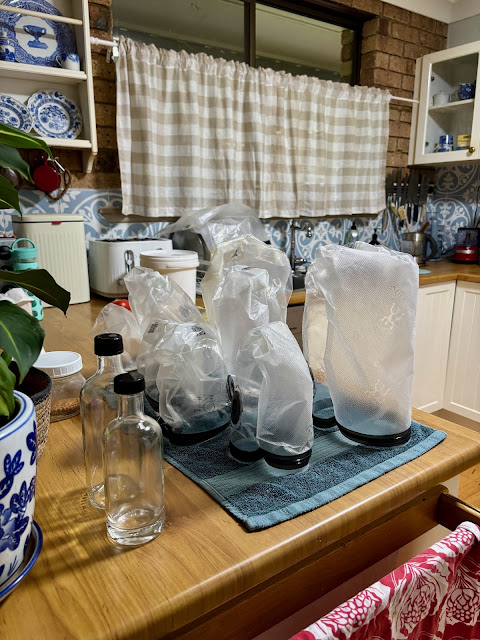
Once you have the laundry liquid in your bucket, stir it around again, then start filling your containers. Be aware that the liquid will split when it's cold - see the photos below. There's nothing wrong with it, it just needs re-mixing or shaking before you use it.
Above is the laundry liquid after it's been sitting for 24 hours. It's clearly separated into layers - the top layer is gel-like, the bottom layer is watery. You need space in your container to shake and mix before you use it. Or, do what I do and get your stick blender and give it a good mix. That will emulsify it and it's more likely to stay like that.
Don't think you've done anything wrong if your mixture separates, it's fine, it just needs a re-mix. This is safe in septic tanks but not for grey water. The borax in the mix might build up as boron in the garden and that is harmful to plants. If you want to use your grey water, don't add the borax.
This laundry liquid will not make suds and that's perfectly okay. The ingredients loosen the dirt and grime in the clothes and the agitation of the washing machine will clean them.
Sometimes you don't have time to make up the liquid, so here is the powder version:
LAUNDRY POWDER
- 4 cups grated laundry or homemade soap or soap flakes (Lux)
- 2 cups borax
- 2 cups washing soda
Mix all the ingredients thoroughly and store in a plastic container with a lid. Use 2 tablespoons per wash. This powder will not make suds and again, it's perfectly okay.
Soaking
Soaking is a very good habit to get into with your clothes (and washing up in the sink). In the past, most people soaked their clothes before washing. If you have a top loader, just fill the machine and add the laundry liquid, let it run for a minute then turn the machine off and let everything soak for about an hour, or overnight. Then turn the machine back on and carry on as normal. If you have a front loader, you can set your washer to run for a minute, then turn it off for an hour or overnight and re-start your wash. Or you could pick out the very soiled items and soak them in a tub before washing.
Stain removerI use laundry liquid and rub it on the stain, leave it for an hour and then add to the washing machine and wash as normal.
Surface Spray Cleaner
- 1 cup white vinegar
- 1 cup water
- ¼ teaspoon washing up liquid
Mix all ingredients together and then add to a spray bottle. You can clean all hard surface areas with this - bench tops, fridge doors, glass stove tops, cupboard doors etc. If your stove top is very dirty, use the creamy scrubber. Just spread some creamy scrubber on the stove surface, let it sit for a couple of minutes then clean off with hot water on a clean rag. Dry the surface with a dry tea towel to finish.
Creamy Scrubber
To make a product similar to Gumption take a small container - about 500 mls/1 pint and add one cup of laundry liquid. Then add enough bicarbonate soda to make a paste. Mix with a spoon until it's mixed well. If you use a stained spoon to do that, your spoon will be sparkling when you finish.
This mix will dry out if you make too much. I make enough for about a month, then make a new batch. I use it to clean the shower, bath, ceramic and stainless steel sinks.
Glass cleaner
Half bucket of water with ½ cup of vinegar added. Use newspaper or clean soft rags to clean and dry the glass.
Washing up Liquid
I've never been able to make a homemade washing up detergent that I was happy with. I use a combination of Ecostore - $4.80 and Earth Choice - $3.50
Cleaners shopping list
I thought I'd make a quick comparison here of the price of the homemade cleaners and all supermarket products. See what you think. 🤔
HOMEMADE INGREDIENTS
Washing soda - $5.00
Borax - $4.10
Soap that you grate or soap flakes that you buy. I use the soap flakes. If you make your own soap, grate it and use that. - $7.50
White vinegar - $3.00
Bicarb soda - $2.70
Vanish Napisan oxyclean bleach - This is a safe bleach which uses peroxide instead of chlorine bleach. It's much safer and easy to use. If your homemade stain remover doesn't work, this would be your next option. - $17.00 or buy it on half price special. It's on sale frequently.
TOTAL $235.80 - I estimated I would buy these six times a year (approx)
SUPERMARKEY PRODUCTS
Ajax Spray and Wipe spray cleaner - $3.50
Ajax Spray and Wipe glass cleaner - $3.50
Duck Deep Action Gel toilet cleaner - $7.00
OzKleen Shower Power Bathroom and Shower cleaner - $7.35
Earth Choice floor cleaner - $3.35
Gumption multi-purpose paste - $5.40
Elbow Grease air fryer cleaner - $5.00 (I laughed when I saw this. It didn't take long for air fryers to get their own cleaner.)
Cerapol Ceramic Glass and Induction Cooktop Cleaner - $6.45
Dynamo Laundry Liquid - $12.00
Pinoclean Disinfectant - $8.00
Vanish Napisan oxyclean bleach - This is a safe bleach which uses peroxide instead of chlorine bleach. It's much safer and easy to use.
TOTAL $615.50 - I estimated I would buy these 10 times a year (approx)
The difference is $379.70 a year. So in ten years of grocery buying, that would be a saving of $3790.00.
Who knows what the health benefits would be.
.jpeg)


.jpeg)
.jpeg)
.jpeg)


.jpeg)
.jpeg)


.jpeg)
.jpeg)
.jpeg)

.jpeg)
.jpeg)


.jpeg)

.jpg)

.jpg)
.jpg)
.jpg)
.jpg)
.jpg)

.jpeg)
.jpeg)
.jpeg)
.jpeg)
.jpeg)
.jpeg)
.jpeg)
.jpeg)
.jpeg)
.jpeg)
.jpeg)
.jpeg)
.jpeg)
.jpeg)

.jpeg)
.jpeg)
.jpeg)
.jpeg)
.jpeg)
.jpeg)


.jpeg)




.jpeg)



.jpeg)
.jpeg)
.jpeg)
