down to earth

  • Home
  • About Us
  • Down To Earth Book
  • Privacy Policy
More than anything else, I am a mother and a worker. Shane and Kerry were 20ish, about to leave home to build their own lives, and although I'd continue being a mother, that hands-on parenting part of my life was over. What was left was a worker so I guess it made sense to return to the work taught to me by the person who gave me my working class values. My mother showed me the true value of work, and through that, how to be reliable, punctual and ambitious. Now that I look back, I think she must have almost given up on me many times because I was the worst student. However, I did remember most of what she taught me and when I needed it most, a few years after she had died, I remembered how to create a home and look after it.

Thanks Mum.

Luckily Hanno is a worker too and with him at my side, I wanted to create a workable system that would allow us to retire. I wanted us to leave paid work but to continue working to grow and home produce whatever was possible. I didn't want to be self-sufficient. I knew that was impossible with the amount of land we had, and our ages. Besides, I didn't want to isolate us, I wanted to be part of a community, helping when I could and being helped when we needed it.  Self-reliance was my aim. I wanted to take back the power that advertising and shops had over me and become independent again.

When I told Hanno my plan, he thought I'd taken leave of my senses.  Plan B - back to stealth mode.


By the time I mentioned it again, a few months had passed by, the kids were gone and although I was still taking the same amount of money out of the bank for housekeeping, I wasn't spending it. With my new method of shopping, home production, increased fruit, vegetables and eggs from the backyard, I was spending a fraction of what I used to spend. Hanno was out working at the shop every day so he didn't know what I was doing. When I showed him the savings, he started believing that maybe we could do this. A few months later he closed the shop and joined me at home.


When all this was happening I hadn't heard of simple living and it was only when I went online to research thrift and the frugal lifestyle that I discovered it was a real movement. I started reading books that I bought from America but I was disappointed that the way I was living this life wasn't mention in those books. My life was centred on work in the home and backyard and how that could support a simple life. I realised that I had to make my own rules and eventually I'd start writing about what I was doing. And that is how our lives have evolved since then - if it fit into our life and suited our values, we did it. We found that one thing would lead us to the next and by following that road less travelled, we discovered what worked for us, true happiness and each other. Again.


Changing your mindset is the most difficult part of changing. You have to be convinced that what you're doing is right and even though it involves a lot of changes, it will benefit you in the long run. I have no doubt that we can only change ourselves. You can't make anyone else change. We can show others what is possible but it is up to them to be convinced and to change themselves.  Giving up $200 haircuts for $25 haircuts and $800 dollar handbags for homemade tote bags takes strength and commitment but it's doable and it will help you with the other changes that follow. Actually, I think those changes are the easy ones, it's committing to daily change that can be difficult because you have to make that commitment every day. Happily, those daily tasks soon become habits and start to form your simple life.

Tomorrow - how to start living simply if you're 30, 25, 20, 15, 10, 5 years younger than Rhonda. :- )


So far we've gone through listing our values and working out what our priorities are, claiming our home and some of the financial matters that might concern us and help us live within our means. Today I'd like to talk about my next step towards simplicity. And I'd like to remind you again that I don't expect anyone to live as I live, I'm not saying that what we do here is the right way, or the only way, it's just how we did it ten years ago and how we continue to live right now. I hope you'll add a comment about your early days too.


When I closed down my business, I was burnt out and I guess I was stressed. I didn't know it then but  now that I look back I see the signs. In those first few days of being at home, after years of working hard and being raised in a working class family where work was what we did, I floundered. If work had defined my life, what was I supposed to do now? What would happen if I didn't earn my keep?

I began a new phase of life. I woke up in the morning and got my family organised. Hanno was working in a little shop we owned in Montville, Shane was at university studying environmental science and Kerry was an apprentice chef. And then there was me. Me alone in this house that I'd never really thought of as a home. I love the land here, that is what made me fall in love with being here, but my home felt alien to me.


I'd never really kept house like my mother and grandmother had but I remembered what they did and I started doing that, mainly because I had nothing else to do. After a couple of days, I decided there were a few things I could change. I started enlarging the vegetable patch and decided we needed more chickens. I also changed a few of the spaces in the kitchen and laundry because they were quite difficult to work in. Those changes made a difference to how I worked and how I felt about working. It started to feel good, I was beginning to see a purpose.


There was a slow, gentle pace that helped me eased my way through those early days and even though I'd lived there for a few years, I felt like I'd just moved in. I was seeing everything with new eyes and I liked what I saw and how it made me feel. All of a sudden, new possibilities opened up and those possibilities were as exciting to me as any big contract I won when I was running my business. I could see freedom and independence ready for the taking and all I had to do to claim it was to work in my home with the same energy that I used to work for money. I'd still get paid for the work I did but my payment would be better than money, I'd be rewarded with satisfaction, opportunity and self-determination.

In those first couple of weeks, I realised that if I could make the most of the money we had and what Hanno was making in the shop, we'd be fine. A saved dollar was worth more than a dollar earned because we didn't pay tax on those saved dollars. Every dollar we made was taxed about 30 percent, so it was worth 70 cents. Every one of our saved dollars was worth one dollar. It was so clear to me, saving what we had was the key.


I realised the modern way of housekeeping, cooking and buying everything we needed cost a lot more than it did when I was younger. And the increased cost wasn't only because of the passing years, it was because thrifty ways of cooking and efficient systems had been replaced by convenience. I thought about that while I was working in my home, I thought about it while I sat on my verandah with a cup of tea. I decided I would examine the work I did in my home and change everything I could that would cut the cost of living.

So there we were, living on the Sunshine Coast, about to move into the 21st century and I was planning on returning to a slower pace and a gentler time. I was about to reinvent myself as a housewife! I kept it quiet though. My family and friends already thought I'd lost it when I closed down my business, how could I tell them that I wanted to make myself and all of them happy with hot bread, warm soup, fresh eggs and vegetable gardens. No, in those first few months, I had to kept this a secret. I went into stealth mode and started developing a plan.

... to be continued.
I thought it would be fun to do a cash challenge. I want to challenge everyone to use cash for the rest of the month to see if it helps you get a better perspective on your spending. I have no doubt some of you have already done this and some others might not get anything out of it, but overall, it will open a lot of eyes. The challenge is to use only cash, no cards, not even a debit card until 31 July for ALL your spending - that includes groceries, petrol, paying bills (if it's possible) etc. Handing over a $50 note makes you think about what you're spending in a different way than paying the same amount with a card. Cash seems more real and you tend to think more about making the purchase. Let me know if you're joining the challenge and go here if you're a forum member for the discussion at the forum about it. There is an older post here about organising your money in envelopes.

In addition to the challenge, I'd like to talk about paying off debt today. If you have more than one debt - maybe a couple of credit cards, a car loan and a mortgage, or something similar to that, I think using the snowball method will help you pay that debt off. Dave Ramsey is credited with coming up with the snowball method but there is a very good example of it on Wikipedia here.

I know, because I've done it myself, how difficult it is to pay off debt. It goes on for years. I think the trick is to keep looking for different ways to pays it off so you feel like you've got control of it and you're doing something. So all these little bits and pieces take your mind off the length of time it takes and focuses you on all the small ways there are to pay it back.


Don't forget it's always a good thing to start a change jar and collect your change at the end of the day. I have about $100 in my change jar at the moment but one of my sons outdid that. He deposited $500 from his change jar last week. He's been collecting it in a big tin for about six months. The good thing about this way of saving is that you don't really miss it and unless you break into it and spend it, it's a great way of saving a few tidy amounts that can either go into your savings account or to make an debt payment.

Go back to your tracking records too and see what non-essential spending you're willing to give up. That can be added to your debt payments. It's really satisfying to see the amounts you owe go down every month. The banks don't want you to do it, because it means much less interest for them, but you can do this, it will make a real difference to your life, so stick with it.


As you're paying off your credit cards, the bank might write you a lovely letter saying you're such a good customer they're raising your credit limit. RESIST! Write back and thank them, but ask that the limit is reduced instead. That will make a difference too - you'll feel in control of your money. When the cards are paid off, I think it's a good management strategy to keep one card - the one with with smallest interest rate and get rid of the rest. Interest rates and how they're applied vary in each country so it's a good thing to google your local interest rates and see how much they are.  Here is an extra payment calculator which vividly shows how much difference extra payments make. Here are a number of different calculators set to Australian rates. Have a play around with them with different repayments and times and I'm sure you'll be surprised at how much difference some changes can make.


Of course, it is you who has to put in the effort here. I can talk about it till the cows come home but if you're the one with the debt, it is up to you to make that first step towards accelerating your payments. There is only so much time you can sit in front of your computer and think about making a difference  at some point you either have to do it, or decide that you can't and be okay with that.

What have you done with your own loans? If you have some ideas on ways to pay back loans, please share them in the comments section.

Morning tea with opa.

Happy Independence Day to all my American friends!

We'll continue our simple living series on Monday when I'll have a challenge for everyone. I think it will make you see money in a new light. I hope you have a wonderful weekend.

- - - ♥ - - -

The value of halting the normal rhythm of life to reflect
Travels with my (sourdough) mother
Make a perfect cuppa without tea bags
Lunches, coffee and transport eating up the money
Drawing a floor
Good news for amputee duck

FROM THE COMMENTS THIS WEEK
This sorta old life
Endo the road
Kristi in the Western Reserve
It will take at least a month to get an accurate idea of what you're spending on non-essentials. It's worthwhile putting the time and effort in to do it though because it will give you real figures to work with instead of guessing it and being wrong. When you're dealing with your money, you need to work with reliable figures. And for that reason, I encourage you to be truthful, no matter what that truth is. You also have to be thoughtful and kind. If you're doing this exercise with your partner and one or both of you have been overspending, blaming each other does no one any good. Start your budgeting in a positive frame of mind, agree that there will be no blame, you're doing something about your financial situation and that's the important thing.


Now you're ready to take control of your finances and you do that by creating your own budget.

To create a budget, you have to know all your annual expenses. If you have access to last year's bills you're in a good position. You need to know how much you spend on internet, phones, TV, electricity, water, rates, rent/mortgage, insurance, health, education, clothes, food, petrol, entertainment, pets, gardening and anything else you pay for during the year - either once or many times.

On a piece of paper or a spread sheet, work out what your categories are and list them according to whether they're paid in cash or in response to an invoice or bill. You'll have three lists:
  1. what you pay for services like insurance, phone, electricity etc.
  2. items you pay for in cash - groceries, petrol etc.
  3. a third list of items you don't need every month but still have to put money aside for
When you make up your lists, you'll need to work out how much you spend every year on each of these items, then divide that amount by 12 to give you a monthly figure to put aside. You don't have to have a monthly budget, set your up according to how you are paid. If it's monthly, do a monthly budget. If it's fortnightly, do up a fortnightly budget - for this you'd add up your yearly expenses and divide them by 26, because you'll be paid 26 times a year. If you get paid weekly, divide your yearly amounts by 52.

Tracking your spending
Now, why did you track your spending? When you write out your budget you may find you don't have enough money to cover your expenses. If that happens, go to your tracking records and see what you spent on non-essential spending. Hopefully, that will cover your budget short fall. If it doesn't you'll have to reduce what you're spending in other areas so you can live within your means. Look at items such as groceries - maybe you can cut ten dollars from that. Look at phone bills. Do you need an expensive phone? Do you need a phone at all? Look at entertainment, you may have to cut down on that until you get your budget sorted out.

For example - your list may be similar to this or different. 

Monthly bills
  • Rent/mortgage payment
  • Insurance - health, car, home, life.
  • Electricity
  • Water
  • Rates
  • Phone
  • Internet
  • Car registration 
Monthly Cash
  • Groceries
  • Petrol
  • Travel
  • Education
  • Entertainment
  • Garden supplies
Extras are not needed every month, but money has to be put aside to pay for these items:
  • Clothing/shoes
  • Haircuts
  • House maintenance
  • Car maintenance
  • Hobbies
  • Annual holiday
When you have your three lists you'll need:
  • money in the bank to pay your bills
  • cash in hand to buy groceries, petrol etc
  • either money in the bank or cash to pay for your extras
Your bank accounts
Set up your bank accounts to facilitate your bill paying and to earn the highest amount of interest. You can pay your bills using a credit card (paying it off each month to avoid interest payments), debit card, cheque or direct debit and if you have enough money in the bank in your bill paying account, this will work well for you. We have a bill paying account that our pensions go into - yours could receive your pay. This is the account you use to pay your bills as they come in. You leave enough money in this account to pay the bills you know you'll have to pay this month as well as the bills you've budgeted for but aren't due this month. What is left is transferred to a higher interest account.

We have a higher interest ING account and the money that doesn't have to cover bills is transferred to that account. We get better interest in this account and we can also withdraw cash for our monthly cash needs such as groceries. We also withdraw money from here to pay in cash for any of our extras - haircuts, house maintenance etc.

Cash envelopes
When cash is withdrawn from the bank, ours is put into envelopes/jars/ziplock bags under their budget categories - groceries, petrol, garden supplies etc., so I know exactly how much I have to spend in each category. When I go shopping, I take money from these envelopes, do my shopping, and return any change to the envelopes. During the month, I can see the money dwindling and I know exactly how much a I have left to spend. Whatever is left in the envelopes at the end of the money can be added to our savings.

It will take you a few months to have this system rolling along effortlessly but when it does, it works very well. Tthe first thing is to get those lists happening. There is plenty for you to get started on. Remember, be truthful, be kind if you're doing this with your partner and make sure you include everything. This isn't easy but if you work out a budget you can live on, your life will be much easier.  Good luck!

I'm tired today, too tired to write anything sensible, so I'll leave our budget post until tomorrow.  Yesterday Hanno and I took the day off and wandered around Brisbane, ending up at the State Library. We'd been invited to attend a function to celebrate the books published by Queensland authors last year. The Minister for the Arts Ian Walker was there along with about 150 authors, readers, librarians and members of the Queensland Writers Centre. We got home around 8, I think I was asleep at 8.30pm. 


Photos above taken last night at the State Library.

Today I'll organise the workshop bookings and send out another email to those of you who have booked. I'll take some time this afternoon to do a general cleanup, and now that the rain has stopped, check out the garden.  See you tomorrow!
Let's talk about money today, specifically how we spend our money. Most of us know how much money we make in a month but very few of us know exactly how much we spend, or on what. When I first started taking control of my money and had to make every penny stretch as much as I could, I found that tracking my money was the best way to discover two important things:
  1. what I was spending my money on;
  2. what my non-essential spending was.
Non-essential spending is often the key to paying off debt. It's that money we all spend on magazines, coffee, movies, a packet of chocolate biscuits, iTunes, takeaway food, convenience food, soft drinks/soda and bottles of water. Most of us know that spending on these things is wasted money, but we still do it, "just this time". If you can identify the money you spend on those non-essential things and add up the money spent over a month, I'm sure you'll be surprised. And if you can harness that money and put it towards debt repayment, or even to buy the groceries you need this month, then it's a step in the right direction.


How to track your spending
Every time you go out - every . time - record exactly what you spend and on what. You can do that in a number of ways:
  1. Take a small notebook and pen with you and write it down as you spend.
  2. Collect every receipt and when you come home, add them up and record the totals.
  3. Use a smartphone app. The one for Australians on the government's Moneysmart website is very good. You can download it here. The data you enter into your phone can later be transferred to an Excel spreadsheet. It also allows you to set your limit and will track as you go and show you where you are in relation to your limit. You can download My Spending for Android phones here or Expense Tracker for iPhone and iPad here.
Changing behaviours is rarely about the big things. The big ticket items stand out and we notice them. They make us stop and think before we buy. It's the small things that do the real damage. Usually they  are items you want but don't need. We buy them because they're relatively cheap but when you track what you spend over a month and then add it up, you'll be surprised at just how much you spent on all those small things. 

When you get to the end of a month's tracking, you'll have a much clearer idea of what you're spending your money on. If you can stop that spending, your money can go towards your budgeting requirements. If you've never done this, it's worth doing. Otherwise you won't know your spending habits or how much all those small things are costing you. One thing is for sure, they cost you a lot more than you actually spend.

When you have at least a month's tracking, you have the two figures you need to make up your budget: how much your income is and an accurate summary of your spending. Then you go to the next step. Working out a budget you can live with, while paying off debt in an organised way, or building your savings account. That, my friends, will be our next post.

Please share your experience of tracking your spending and how you did it.


Sandy made a good point in her comment the other day when she said: We saved and budgeted hard years ago and cleared the mortgage. That is what helped us to live 'easier' now. But easier doesn't mean you give up 'simple'...it makes living 'simply' easier!  That hit the nail on the head for me and it helps to clarify the point that simple life isn't only about frugality and paying off debt. Money isn't, and shouldn't be, the main focal point of life. However, if you have debt it will stop you living the life you want because your efforts will be directed towards paying off your debt instead of living your life fully. Debt reduction and not gaining more debt is part of simple life, but it's just one of many parts that make up how we live.


Hanno and I bought our home on a 20 year mortgage and paid that mortgage off in eight years. Had  we still been in debt when I realised I was burnt out and wanted to stop work, I would not have been able to do what I did. I would have continued working until it was paid off. Luckily we were debt-free, so I had the self-indulgent luxury of giving up work to find a better way to live.

Hanno took control of our debts from day one of our mortgage. He paid the mortgage fortnightly instead of monthly and we paid extra payments whenever we had spare cash. Now that I look back, it wasn't easy but it was much easier than stretching it out to pay over 20 years and, as a consequence, paying so much more in interest payments. By knuckling down to pay that mortgage off fast, we literally saved ourselves tens of thousands of dollars.

You have to be strong to do something like that but I have to tell you I didn't feel strong while we did it. I only recognised our fortitude and strength much later, with the benefit of hindsight. Imagine this: we're both working hard, we have a young family, we're living in an isolated town to maximise our earning potential and friends ask us to to join them and their family for a weekend on a tropical island. It took guts to say no, but that's what we did. It was with trepidation at first but later it got easier. We didn't always say no to invitations but we did it enough to make a financial difference. Over those years we did take our boys off on camping trips, on a trip to Tasmania and to see our national capital - Canberra. But we also focused on our debts and paid them off. When we saw that debt total slowly decrease, it became easier and we knew we were doing the right thing. We didn't realise then what I know now - that paying off debt lifts the weight of the world from your shoulders and gives you the luxury of freedom.

And you never know what that freedom will be used for. It could be for an early "retirement" such as mine, to cut back full-time work to part-time to have more time for the family, it could be to divide your time between work and study. It could be anything. The important thing is that freedom and independence it will be there waiting there for you too.

Tomorrow we'll talk about various strategies you can use to pay off debt.  In the meantime, I'd love you to share your thoughts with us on paying off debt.


A State funeral today for Mr Yunupingu. RIP Mr Yunupingu.

He was one of our great indigenous leaders and a fine musician.

Treaty, the song he co-wrote and sang, on You Tube
The end of another week and time to take it easy for a couple of days. I hope you have that opportunity too. We'll come back stronger for it next week. On Monday we'll continue with our series and start with an important subject, budgeting. Thank you for your comments this week, as usual, they add a lot to what I'm writing about. I hope you have a lovely weekend.  xx


These two photos were taken at the Beerwah CWA rooms when I had my recent talk there. The top photo shows the vintage tea cups waiting to be filled with morning tea and the table cloth is a hand embroidered cloth showing the branch members names. The pineapple embroidery depicts an important local crop - pineapples. So sweet.

Why I haven't been flying much. David Holmgren
Kate at Purple Pear gave me Cecelia Macauley's name as one who has been writing about applying permaculture principles to our homes. Here is her blog.
Don't mess with the knitters
How to enjoy a food market
25 predictions for a future world
Hettie Brown
Our ash grove
Fig Jam and Lime Cordial
Oh Betty
Fields and Fire

FROM THE COMMENTS HERE
Anderson Cottage
The Quiet Home
Dusty Country Road
Before we move onto specific subjects such as budgeting, paying off debt, traditional skills, baking, cooking from scratch, organisation, routines, decluttering, recycling, vegetable gardening, chooks and whatever else we can think of, I'd like to talk about living where you are - claiming your ground.


I suppose simple living is often been seen as a rural pleasure. A way of life that makes sense in the country, or at least outside the city. I think there are arguments for and against most locations, the key here is to work out where you have to be at a particular stage of your life and then make it work for you. Bloom where you are planted.


I live in a semi-rural town about an hour's drive from our capital city and I'm very happy here. There is good rainfall, we've built up our soil so it now produces abundant harvests, the sun shines most days and nothing much happens. At this stage in my life, all those things are important to me. But public transport here isn't as reliable and frequent here as it is in the city, if we needed specialist medical services we'd probably have to drive into the city for them, and entertainment consists of beaches, cinemas and not much else.

Living in the city offers good public transport, a wide variety of shops from which to buy groceries, a better choice of many things such as art galleries, exhibitions and schools. The down side of city life is that in Australia, and probably in other countries too, rents and house prices are much higher.


Usually life tends to place us in certain locations depending on our stage of life. If you are living in an area that doesn't seem to support your wish to live more simply, you might just need to think outside the square and make the most of where you're at. Everything you do will prepare you for a move to another place later but don't waste this part of your life wanting to be where you can't be.


When we moved here we had a large block of land with an 1980s brick house on it. There were no fences, water tanks, solar panels, gardens, verandahs or garage. Over the years, when we could afford to add something, we did, and now we live in a home that easily supports our way of life. If we'd given up on being here, we never would have felt the warm familiarity we feel now. This is our true home now and I reckon we'll both die here.


If you're having trouble claiming your space now, look at the permaculture principles again here. If you can apply any, or several, or these principles to your current home, that will be a starting point for you. If that doesn't work, learn a traditional skill such as knitting, fermenting, baking bread or making wine and see how that fits into your life and if it makes you feel that your home is home (for now).


Whatever you do, don't waste time whining about where you want to be. Get on with your life and focus on the positives. Just do what you can do. It is possible to bloom where you are planted in almost any location. If you have the will to do it you can make a warm and comfortable home anywhere.


At first, staying as motivated as you need to be to live this kind of life looks like it might be too much. I worried if I could stay on track but I had a shift in thinking and it became easier, immediately. Changing your mindset will help you stay on track too. Let's face it, when you're just starting out on this journey and your best friend invites you to go out for coffee or lunch, or to cruise around the shops together or go on a weekend away, it feels like it's just too good to turn down. You might not have a good reason to not go.

I changed my mindset - or how I looked at the common things in my life - by thinking about what I wanted out of life. Did I want to wander aimlessly though shops looking for things to buy? Did I want to remain disconnected and feeling empty? No, what I actually was to feel more alive than ever before. I wanted to be able to get up every morning knowing that the work ahead of me that day would help strengthen me. I wanted to feel more comfortable in my own home than in a shop. I wanted to find myself. I used to live in this body but I'd gone missing in action. I wanted to find my way back home.

I did a lot of thinking on my front verandah. I stared out into the eucalyptus trees and while wrens and willy-wagtails swooped through the trees, I wondered how I could reconnect with my home, how I could enable my family to live on a reduced income, how I could find happiness again. I used to be happy with the simple things in life. What happened?

On those first few days of sitting and thinking, I thought about what I valued in life. I wrote it all down so I could add to it and wouldn't forget it. I used that list in my book, and here it is again, my constant reminder:

I want my life to provide me with:
  • A reason to get up every morning
  • Interesting and productive work
  • Contentment that explodes into happiness occasionally
  • A framework in which to live simply
  • The opportunity and continued ability to learn skills that facilitate our lifestyle
  • A strong and generous family circle that supports every member of our family – during the good times and especially when it’s tougher
  • Opportunities to express generosity, kindness and empathy
  • The strength to be a role model to the younger women in my family
  • The enthusiasm and perseverance to take charge of my home and make it a place of comfort, welcome and warmth
It's quite easy to write a list like that, it's much more difficult to write a list that truly reflects your wishes and then to live by it. I'm pleased to tell you that, so far, I'm living to that list and still feel very strongly about the values I listed.

So how did I go from a workaholic who shopped, to someone who was calmer, kinder and values-driven? I changed my definition of what success meant to me. I used to measure success by the amount of money I made and spent. I had shifted from my working class roots to someone who thought that buying too much for my children would make us all happy. It gives me no pleasure typing that out and I just realised I was frowning as I typed. But everyone is capable of change and over those first few weeks, my successes were good bread, how many eggs I collected each day, having my family notice the change in me and being a much nicer person to be around. I'd stopped being competitive and negative and tried to make improvements not only in my home but in my heart as well. It felt good!

Simple life isn't just about the practical things you do every day, it's also about how you feel about yourself and those around you. When I look back, I barely recognise that old me. I'm no push over now, I say what I think and I'll stand up for what I believe in but I'm not on a crusade to convince everyone that I'm right. I'm much more tolerant and accepting of everyone's view and changing my mindset, changing my view on what success was, that did it for me. I live in a softer place now.

So if you're at the beginning of this journey or if you're not feeling quite right about how you're living, I  encourage you to take some time out, sit and think about what you want out of life. Think about what you don't like about your life and yourself and then try to picture what you want. Write down that new life in short sentences to make up your list. And do it in pencil so you can edit it and make it the refined list you'll happily live with for many a long year. I am living proof that you can change your life with a pencil and a piece of paper. All you need is the quiet time and the will to do it.

Have you had a similar experience to mine or did your change happen in a different way? I would love to read about how your changes started and it may be just the thing someone else needs to read today.
Newer Posts Older Posts Home

MY BOOKS

MY BOOKS


My books were all published by Pengiun, and are available at Amazon US, Amazon UK and Amazon Au

Search here

Total Pageviews

Translate


I'm Rhonda Hetzel and I've been writing my Down to Earth blog since 2007. Although I write the occasional philosophical post, my main topics include home cooking, happiness and gardening as well as budgeting, baking, ageing, generosity, mending and handmade crafts. I hope you enjoy your time here.

MY FAVOURITE PLACES

  • Grandma Donna's Place
  • Grandma Donna's YouTube
  • Grandma Donna's Instagram
  • This Simple Day
  • Nicole's Instagram

Give More

Give More

Popular posts last year

Making ginger beer from scratch

We had a nice supply of ginger beer going over Christmas. It's a delicious soft drink for young and old, although there is an alcoholic version that can be made with a slight variation on the recipe. Ginger beer is a naturally fermented drink that is easy to make - with ginger beer you make a starter called a ginger beer plant and after it has fermented, you add that to sweet water and lemon juice. Like sourdough, it must ferment to give it that sharp fizz. To make a ginger beer plant you'll need ginger - either the powdered dry variety or fresh ginger, sugar, rainwater or tap water that has stood for 24 hours to allow the chlorine to evaporate off. You'll also need clean plastic bottles that have been scrubbed with soap, hot water and a bottle brush and then rinsed with hot water. I never sterilise my bottles and I haven't had any problems. If you intend to keep the ginger beer for a long time, I'd suggest you sterilise your bottles. MAKING THE STARTER In a...
Image

NOT the last post

This will be my last post here.  I've been writing my blog for 18 years and now is the time to step back. I’ve stopped writing the blog and come back a couple of times because so many people wanted it, but that won’t happen again, I won’t be back.  I’ll continue on instagram to remain connected but I don’t know how frequent that will be. I know some of you will be interested to know the blog's statistics. 
Image

How to make cold process soap

I'm sure many of you are wondering: "Why make soap when I can buy it cheaply at the supermarket?" My cold process soap is made with vegetable oils and when it is made and cured, it contains no harsh chemicals or dyes. Often commercial soap is made with tallow (animal fat) and contains synthetic fragrance and dye and retains almost no glycerin. Glycerin is a natural emollient that helps with the lather and moisturises the skin. The makers of commercial soaps extract the glycerin and sell it as a separate product as it's more valuable than the soap. Then they add chemicals to make the soap lather. Crazy. Making your own soap allows you to add whatever you want to add. If you want a plain and pure soap, as I do, you can have that, or you can start with the plain soap and add colour, herbs and fragrance. The choice is yours. I want to add a little about animal and bird fat. I know Kirsty makes her soap with duck fat and I think that's great. I think t...
Image

Preserving food in a traditional way - pickling beetroot

I've had a number of emails from readers who want to start preserving food in jars but don't know where to start or what equipment to buy.  Leading on from yesterday's post, let's just say up front - don't buy any equipment. Once you know what you're doing and that you enjoy preserving, then you can decide whether or not to buy extra equipment. Food is preserved effectively without refrigeration by a variety of different methods. A few of the traditional methods are drying, fermentation, smoking, salting or by adding vinegar and sugar to the food - pickling. This last method is what we're talking about today. Vinegar and sugar are natural preservatives and adding one or both to food sets up an environment that bacteria and yeasts can't grow in. If you make the vinegar and sugar mix palatable, you can put up jars of vegetables or fruit that enhance the flavour of the food and can be stored in a cupboard or fridge for months. Other traditional w...
Image

Cleaning mould from walls and fabrics

With all this rain around we've developed a mould problem in our home. Usually we have the front and back doors open and that good ventilation stops most moulds from establishing. However, with the house locked up for the past week, the high humidity and the rain, mould is now growing on the wooden walls near our front door and on the lower parts of cupboards in the kitchen. Most of us will find mould growing in our homes at some point. Either in the bathroom or, in humid climates, on the walls, like we have now. You'll need a safe and effective remedy at some point, so I hope one of these methods works well for you. Mould is not only ugly to look at, it can cause health problems so if you see mould growing, do something about it straight away. The longer you leave the problem, the harder it will be to get rid of it effectively. If you have asthma or any allergies, you should do this type of cleaning with a face mask on so you don't breathe in any spores. Many peopl...
Image

Five minute bread

Bread is one of those foods that, when made with your own hands, gives a great deal of satisfaction and delight. It's only flour and water but it symbolises so much. I bake bread most days and use a variety of flours that I buy in bulk. Often I make a sandwich loaf because we use most of our bread for lunchtime sandwiches and for toast. Every so often I branch out to make a different type of loaf. I have tried sour dough in the past but I've not been happy with any of them. I'll continue to experiment with sour dough because I like the idea of using wild yeasts and saving the starter over a number of years to develop the flavour and become a part of the family. However, the loaf I've been branching out to most often is just a plain old five minute bread. By five minutes I mean it takes about five minutes actual work to prepare but it's the easiest of all bread to make and to get consistently good loaves from. If you're having people around for lunch or...
Image

This is my last post.

I have known for a while that this post was coming, but I didn't know when. This is my last post. I'm closing my blog, for good, and I'm not coming back like I have in the past.  I've been writing here for 16 years and my blog has been many things to me. It helped me change my life, it introduced me to so many good people, it became a wonderful record of my family life, it helped me get a book contract with Penguin, and monthly columns with The Australian Women's Weekly and Burke's Backyard . But in the past few months, it's become a burden. In April, I'll be 75 years old and I hope I've got another ten years ahead. However, each year I'll probably get weaker and although I'm fairly healthy, I do have a benign brain tumour and that could start growing. There are so many things I want to do and with time running out, leaving the blog behind gives me time to do the things that give me pleasure. On the day the blog started I felt a wonderful, h...
Image

What is the role of the homemaker in later years?

An email came from a US reader, Abby, who asked about being a homemaker in later years. This is part of what she wrote: "I am a stay-at-home mum to 4 children, ages 9-16. I do have a variety of "odd jobs" that I enjoy - I run a small "before-school" morning drop-off daycare from my home, I am a writing tutor, and I work a few hours a week at a local children's bookstore. But mostly, I cherish my blissful days at home - cooking, cleaning (with homemade cleaners), taking care of our children and chickens and goats, baking, meal-planning, etc. This "career" at home is not at all what I imagined during my ambitious years at university, but it is far more enriching. I notice, though, that my day is often planned around the needs of my family members. Of course, with 4 active kids and a husband, this is natural. I do the shopping, plan my meals, cook dinner - generally in anticipation of my family reconnecting in the evening.  I can't h...
Image

Every morning at home

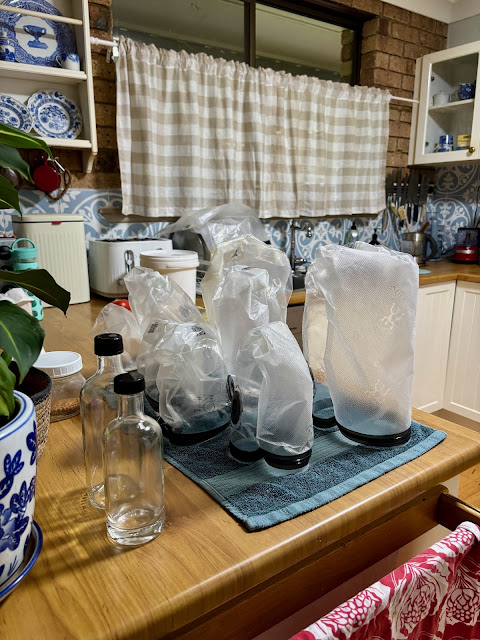
Every morning when I walk into my kitchen it looks tidy and ready for a day's work. Not so on this morning (above), I saw this when I walked in. Late the previous afternoon when I was looking for something, I came across my rolled up Zwilling vacuum bags and decided they had to be washed and dried. So I did that and although I usually put them outside on the verandah to dry it was dark by then. I turned the just-washed bags inside out and left them like this on a towel. It worked well and now the bags are ready to use when I bring home root vegetables, cabbages or whatever I buy that I want to last four or five weeks.
Image

You’ll save money by going back to basics

When I was doing the workshops and solo sessions, I had a couple of people whose main focus was on creating the fastest way to set up a simple life. You can't create a simple life fast, it's the opposite of that It's not one single thing either - it's a number of smaller, simpler activities that combine to create a life that reflects your values; and that takes a long to come together. When I first started living simply I took an entire year to work out our food - buying it, storing it, cooking it, preserving, baking, freezing, and growing it in the backyard. This is change that will transform how you live and it can't be rushed.  
Image

All previous blog posts

  • 2026 3
    • February 3
      • Workshops starting 1 March
      • Planting vegetable seeds and new workshops
      • Back where we belong
  • 2025 7
    • July 1
    • June 2
    • May 1
    • April 2
    • February 1
  • 2024 25
    • December 2
    • November 1
    • October 2
    • September 3
    • August 1
    • July 3
    • June 1
    • May 3
    • April 2
    • March 3
    • February 2
    • January 2
  • 2023 13
    • December 1
    • November 2
    • October 1
    • September 3
    • August 2
    • February 2
    • January 2
  • 2022 17
    • November 3
    • October 4
    • September 3
    • August 2
    • July 3
    • June 2
  • 2021 50
    • December 1
    • November 6
    • October 7
    • September 5
    • August 4
    • July 5
    • June 2
    • May 2
    • April 6
    • March 4
    • February 4
    • January 4
  • 2020 68
    • December 3
    • November 5
    • October 4
    • September 4
    • August 4
    • July 4
    • June 4
    • May 8
    • April 7
    • March 8
    • February 8
    • January 9
  • 2019 66
    • December 2
    • November 4
    • October 5
    • August 3
    • July 4
    • June 6
    • May 8
    • April 8
    • March 8
    • February 11
    • January 7
  • 2018 82
    • December 1
    • September 2
    • August 10
    • July 4
    • June 11
    • May 9
    • April 12
    • March 10
    • February 10
    • January 13
  • 2017 129
    • December 7
    • November 10
    • October 6
    • September 13
    • August 11
    • July 13
    • June 12
    • May 9
    • April 9
    • March 14
    • February 11
    • January 14
  • 2016 125
    • December 7
    • November 13
    • October 10
    • September 11
    • August 11
    • July 8
    • June 9
    • May 9
    • April 12
    • March 10
    • February 13
    • January 12
  • 2015 184
    • December 7
    • November 15
    • October 20
    • September 18
    • August 19
    • July 18
    • June 12
    • May 15
    • April 12
    • March 21
    • February 13
    • January 14
  • 2014 203
    • December 11
    • November 8
    • October 17
    • September 20
    • August 17
    • July 19
    • June 17
    • May 17
    • April 23
    • March 15
    • February 18
    • January 21
  • 2013 225
    • December 13
    • November 17
    • October 17
    • September 17
    • August 21
    • July 24
    • June 20
    • May 19
    • April 17
    • March 22
    • February 17
    • January 21
  • 2012 245
    • December 17
    • November 20
    • October 20
    • September 18
    • August 15
    • July 24
    • June 21
    • May 26
    • April 23
    • March 23
    • February 19
    • January 19
  • 2011 257
    • December 18
    • November 24
    • October 27
    • September 23
    • August 24
    • July 21
    • June 24
    • May 24
    • April 16
    • March 22
    • February 14
    • January 20
  • 2010 283
    • December 20
    • November 18
    • October 18
    • September 19
    • August 25
    • July 24
    • June 25
    • May 26
    • April 25
    • March 22
    • February 29
    • January 32
  • 2009 293
    • December 29
    • November 18
    • October 23
    • September 25
    • August 22
    • July 28
    • June 22
    • May 21
    • April 27
    • March 26
    • February 24
    • January 28
  • 2008 387
    • December 24
    • November 23
    • October 25
    • September 26
    • August 27
    • July 27
    • June 37
    • May 34
    • April 44
    • March 53
    • February 32
    • January 35
  • 2007 372
    • December 37
    • November 40
    • October 55
    • September 51
    • August 49
    • July 63
    • June 49
    • May 28


Trending Articles

NOT the last post

This will be my last post here.  I've been writing my blog for 18 years and now is the time to step back. I’ve stopped writing the blog and come back a couple of times because so many people wanted it, but that won’t happen again, I won’t be back.  I’ll continue on instagram to remain connected but I don’t know how frequent that will be. I know some of you will be interested to know the blog's statistics. 
Image

Every morning at home

Every morning when I walk into my kitchen it looks tidy and ready for a day's work. Not so on this morning (above), I saw this when I walked in. Late the previous afternoon when I was looking for something, I came across my rolled up Zwilling vacuum bags and decided they had to be washed and dried. So I did that and although I usually put them outside on the verandah to dry it was dark by then. I turned the just-washed bags inside out and left them like this on a towel. It worked well and now the bags are ready to use when I bring home root vegetables, cabbages or whatever I buy that I want to last four or five weeks.
Image

You’ll save money by going back to basics

When I was doing the workshops and solo sessions, I had a couple of people whose main focus was on creating the fastest way to set up a simple life. You can't create a simple life fast, it's the opposite of that It's not one single thing either - it's a number of smaller, simpler activities that combine to create a life that reflects your values; and that takes a long to come together. When I first started living simply I took an entire year to work out our food - buying it, storing it, cooking it, preserving, baking, freezing, and growing it in the backyard. This is change that will transform how you live and it can't be rushed.  
Image

Creating a home you'll love forever

Living simply is the answer to just about everything. It reduces the cost of living; it keeps you focused on being careful with resources such as water and electricity; it reminds you to not waste food; it encourages you to store food so you don't waste it and doing all those things brings routine and rhythm to your daily life. Consciously connecting every day with the activities and tasks that create simple life reminds you to look for the meaning and beauty that normal daily life holds.  It's all there in your home if you look for it. Seemingly mundane tasks like cleaning and cooking help you with that connection for without those tasks, the home you want to live in won't exist in the way you want it to.  Creating a home you love will make you happy and satisfied.
Image

Time changes everything

I've been spending time in the backyard lately creating a contained herb and vegetable garden. My aim is to develop a comfortable place to spend time, relax, increase biodiversity and encourage more animals, birds and insects to live here or visit. Of course I'd prefer my old garden which was put together by Hanno with ease and German precision. Together, we created a space bursting at the seams with herbs, vegetables and fruity goodness ready to eat and share throughout the year. But time changes everything. What I'm planning on doing now, is a brilliant opportunity for an almost 80 year old with balance issues. In my new garden I'll be able to do a wide range of challenging or easy work, depending on how I feel each day. It’s a daily opportunity to push myself or sit back, watch what's happening around me and be captivated by memories or the scope of what's yet to come.
Image

It's the old ways I love the most

I'm a practical woman who lives in a 1980’s brick slab house. There are verandahs front and back so I have places to sit outside when it's hot or cold. Those verandahs tend to make the house darker than it would be but they're been a great investment over time because they made the house more liveable. My home is not a romantic cottage, nor a minimalist modern home, it's a 1980’s brick slab house. And yet when people visit me here they tell me how warm and cosy my home is and that they feel comforted by being here. I've thought about that over the years and I'm convinced now that the style of a home isn't what appeals to people. What they love is the feeling within that home and whether it's nurturing the people who live there.
Image

Back where we belong

Surprise! I'm back ... for good this time. Instagram became an impossible place for me. They kept sending me messages asking if I'd make my page available for advertisers! Of course, I said no but that didn't stop them. It's such a change from what Instagram started as. But enough of that, the important part of this post is to explain why I returned here instead of taking my writing offline for good. For a few years Grandma Donna and I have talked online face-to-face and it's been such a pleasure for me to get to know her. We have a lot in common. We both feel a responsibility to share what we know with others. With the cost of living crisis, learning how to cook from scratch, appreciate the work we do in our homes, shop to a budget and pay off debt will help people grow stronger. The best place to do that is our blogs because we have no advertising police harassing us, the space is unlimited, we can put up tons of photos when we want to and, well, it just feels li...
Image

Making ginger beer from scratch

We had a nice supply of ginger beer going over Christmas. It's a delicious soft drink for young and old, although there is an alcoholic version that can be made with a slight variation on the recipe. Ginger beer is a naturally fermented drink that is easy to make - with ginger beer you make a starter called a ginger beer plant and after it has fermented, you add that to sweet water and lemon juice. Like sourdough, it must ferment to give it that sharp fizz. To make a ginger beer plant you'll need ginger - either the powdered dry variety or fresh ginger, sugar, rainwater or tap water that has stood for 24 hours to allow the chlorine to evaporate off. You'll also need clean plastic bottles that have been scrubbed with soap, hot water and a bottle brush and then rinsed with hot water. I never sterilise my bottles and I haven't had any problems. If you intend to keep the ginger beer for a long time, I'd suggest you sterilise your bottles. MAKING THE STARTER In a...
Image