down to earth

  • Home
  • About Us
  • Down To Earth Book
  • Privacy Policy
We plod along most years planting the same varieties of vegetables that worked for us in previous seasons. We've been growing vegetables for a long time now, we used to chop and change but as the years went by we established a set of reliable growers that stood us in good stead. But every so often, we explode into spontaneity again and try something different, new open pollinated seeds. Sometimes it works well and that plant will be added to our permanent rotation list, most of the time our experiment isn't as good in our conditions as what we're already using and after that season it's forgotten.

Not this year though. This year we tried a few new varieties of tomatoes and some new (to us) radishes. This year we met St Pierre tomatoes and Easter Egg radishes for the first time and they've won us over, completely.
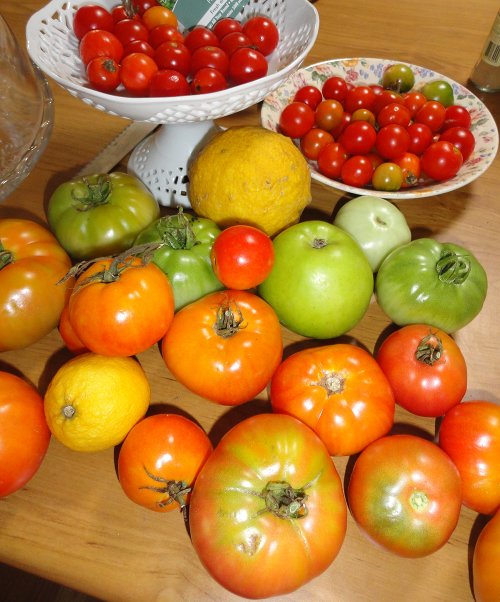

St Pierre is a French heirloom tomato and has pushed the pink Brandywine off top perch as our favourite tomato.  Sorry Brandywine, I was yours for many years, now my heart belongs to another.


We usually grow Daikons and French breakfast radishes and although we'll keep growing the Daikons, Easter Egg radishes have replaced French breakfast for us. They have such vibrant colours - red, purple, white and pink. They're crisp and tasty and not too hot; ideal for a touch of crispy heat and crazy colour in a salad. 

Both these vegetables are open pollinated varieties so I've already saved seeds from the St Pierre; they're now fermenting in water in the kitchen. Soon I'll clean them, let them dry out completely, then save them for sowing next year. The radishes are starting to flower now, soon I'll collect their seeds and store them in the fridge, along with other collected seeds for next year's planting.

There are several reasons to sow open pollinated seeds (also known as heirloom seeds). Every year they grow in your backyard, they change slightly to suit your conditions, and when you have the vegetables growing you won't have to buy new seeds again. You can collect seeds from hybrid vegetables but it's a waste of time because they won't reproduce true to the parent plant. If you do this right, you'll buy seeds once, after that you save seeds, only buying again if you add a new vegetable or variety or your crop fails.

Seeds are such a valuable commodity. Whoever controls seeds controls the world's food production. We must keep these heirloom seeds going. If you can do this in your own backyard, you'll help keep those seeds viable and productive and you'll be much more self-reliant. I could go on and on about how the big seed companies are manipulating seeds but that would be a waste of my time and yours. I prefer instead to actually do something myself. When we decided all those years ago to grow open pollinated seeds and to save them year after year, it was a deliberate act of a radical backyard grower. I might not be able to influence the big seed companies but I can choose to plant heirloom vegetables; that means something. The only reason we have these seeds still here with us today is that many generations before us knew the value of seeds and made the effort to pass them on to us. I don't want all that care and effort to die out in my generation and I want tasty vegetables - therefore I grow open pollinated seeds.

Of course it's easier to buy hybrid seeds, they're in almost every supermarket and hardware store. But now we have all been empowered by the internet, not only can I write this for you to read in your far-off corner of the world today, but it's given us ways of connecting to traders of open pollinated/heirloom seeds. If you google "open pollinated seeds" in your State or country, you'll be surprised at the number of small vendors who pop up. Most of them sell exclusively online so all you have to do is to email for a catalogue or view it online, then order your seeds. It will cost you about the same to set yourself up with open pollinated seeds but if you do it right, you'll only outlay that expense once and you'll have your own repository of seeds to sow and save, and to pass on to your children and grandchildren.

I believe it's worth the effort, I hope you do too.
Last week I received an email from a reader who asked about working parents. She has three children, she and her husband both work (her husband has two jobs) and she wonders if that might be harming her children because she's still at work when they come home from school. Her cousin, who lives near by, picks them up when she collects her own children and they all play at the cousin's house until she picks them up. She said she wants to be a good role model for her children but she has to keep working for another two years - until they have some credit card debt paid off and have made some head way into paying off their mortgage.  I asked if it was okay to reply here and she was happy to share her story with you.

From the details I have it looks to me like "Emma" and her husband are doing a good job recovering from a spending spree. Emma was a full-time homemaker and they got themselves into debt when they moved into their new house. They bought appliances they couldn't afford, put it all on their credit cards and took on the shop finance offer for a house full of furniture. They got to the stage when one wage wasn't making any headway into their debt, they fell behind and it looked like they might lose the house. But they regrouped, he got a second job, Emma went back to her old job and slowly they're recovering. They're making laundry liquid, cooking from scratch, stockpiling and they've cut back a lot. It's taken seven years to get to this point.


Emma, I have always believed that the people who are the most inspiring role models are those who think about what is important to them and who live to those values everyday. You're both doing that. You've provided a home for your children, you've organised safe and secure care for them when you're not there, you're paying off your debts responsibly, and you're looking to the future when you can be the mother you said you want to be - at home with the children and able to help at their school occasionally. You said in your email you started reading my blog about a year ago and you had already regretted going into debt to furnish your home but didn't know how else you could have done it. Now you do, now you wish you'd used second-hand furniture and appliances until you could afford new.

We all know the perfect path to take in hindsight. The real tragedy is not learning from mistakes made. You've done that learning and it's a credit to you both that you recovered so well and will soon be back on your feet again. 


All the while you've been doing that, your children have been watching. You said you told them why you're working, and as they grow to understand the full implications of that they'll be better for it, not deprived. They will grow up knowing their parents worked hard to give them a good home. Me and my sister had that upbringing too, many children do. There are many close and loving families who have to have both parents out working but who come together in the evening and reconnect. These are the times when it's important to sit around the kitchen table, eat together, and ask about what happened to everyone during the day. If you can do that, if you can make that important connection every day, the children will be better for it; you and your husband will be too. It doesn't matter that you're not there when they finish school. What matters is that you've provided a safe place and a trusted person for them to be with and that you're there every day, exactly as you said you would be, to pick them up and take them home. Children need routine and stability and although you're not there when they finish school you've found a way around it and to provide that stability in a safe environment.


Despite what you see on TV, there are few "perfect" homes where mum is waiting with hot biscuits and milk when the children come home from school. We all do what we have to do to get by, which is exactly what you're doing. Don't feel guilty for that, it's a fine example and it's showing your children how to handle the complexities of life. Just know you're doing what you have to do by working, and when you're with the children, make the most of it. Not by giving them gifts or letting them run riot, but by listening, talking, reading and playing with them. Let them help you around the house. Give them tasks that will lighten your load and help build in them a helping attitude. Small tasks like keeping their rooms tidy, setting the table, taking out the rubbish, putting their clean laundry away, feeding the pets - these kind of things will help all of you. Suggest to them they ask dad if there is anything they can do for him too. He's working two jobs and he might have some small tasks for them.

You said in your email you feel you've let your children down and that you should be at home with them. Well I think you've reacted to life. You've been realistic, you've stood up and owned your problems and you've worked out a plan to do something about it. You've taken control of your lives instead of being flattened by the debt. In the process, you've shown your children how to live when things don't go according to plan. I doubt your children have been harmed by you working. I think you should be very proud of yourselves and I hope that when you leave work again you continue to live true to your simple values, even when you don't "have" to.


The Australian Koala Foundation (AKF) is asking everyone to help save the koala by adopting their very own. 

CEO of the Australian Koala Foundation Deborah Tabart OAM said she encourages everyone to adopt a koala through the AKF’s Adopt-A-Koala program. 

“A koala is a perfect gift for any occasion and is a rewarding way to help save the koala”, said Ms Tabart. 

The AKF estimates there are only 80 000 with potentially as few as 40 000, koalas left in the wild 

“It would be heartbreaking if international visitors and indeed Australians could no longer experience the thrill of seeing a koala in the wild” Ms Tabart said.

Koalas on the Australian Koala Foundation’s Adopt-a-Koala program live in sanctuaries around Australia and all proceeds from their adoptions go towards saving their wild cousins and preserving their natural habitat. 

‘Adoptive parents’ receive a certificate and a photo of their koala, find out more at www.savethekoala.com
This is a Friday photo feature that anyone with a blog can join. To take part, post a photo on your own blog, write a short caption explaining it, and link it back to here from your blog by saying you're part of "On my mind". Please write a new post, don't link to an older one. When you've done that, come back here and add a comment below, with a link to your blog.


Today I am thinking about Christmas eve and Christmas day when we'll have family here. I need to work out my menu and decide on what drinks to make. I still have a few litres of pure lemon juice in the freezer and I have elder flowers, hmmmmm. 

We went to visit the family yesterday and had a lovely time on the Gold Coast. It's such a busy place and a big contrast to where we live, but although we were close to shops and department stores, and drove by Ikea, we didn't enter, we concentrated on the family. It was easy to do. We passed by so many people shopping, it reminded me  how easy it is to get sucked in by expectations and be left with unnecessary bills to face in the new year. I have been there.

We called in to see Shane, Sarndra and Alexander in their new flat. They moved last weekend and have found a modern and spacious new home in a quiet neighbourhood. Alex has grown so much. He smiles and his whole face lights up, he's a real charmer. Unfortunately, Shane had to go to work and Sarndra was still busy unpacking so we left them after a short time and went to Kerry and Sunny's. We made plans to get together over the holidays.

Jamie

Jamie has grown a lot too and no doubt will be walking soon. He wasn't quite sure of us when we walked in but soon he was smiling and his usual happy self. Sunny prepared a delicious lunch of Korean BBQ. She had a meat plate with beef and thinly sliced pork belly and vegetable platters with cabbage, cucumbers, onion, bok choy, radishes, sesame leaves and kimchi. We all had our own little seasoning containers with salt, pepper and sesame oil. So we sat around the table, talking, while the Korean BBQ in the centre cooked the meat. The meat is cut in small pieces so we all used the sesame leaves and cabbage to make little mixed rolls of meat and vegetables. It really was delicious. Jamie sat between Sunny and me in his high chair - eating sweet potato, playing with sweet potato and dropping sweet potato. Hmmmm, just like his father used to do.


 Jamie was looking at Hanno in this photo.

After lunch we all walked across the road to a park and playground on the water's edge. Families, teenagers and little children were swimming and playing. Dads and their kids were playing on the flying fox and little bikes attached to a steel track like a railway line. Kids were swinging, a couple of dads were fishing and there were a few picnics. It was such a contrast to the shopping madness just a short distance away. All of this was free - the kids were having a lot of fun, it just needed a commitment to go there and play.


On the way home I thought about that scene in the park and the shopping crowds we passed on the way home. On the one hand there were families connected, playing and enjoying themselves in the park - all free; and then there were rushing shoppers spending money. I wished there was more of one and less of the other and I wondered why some families spend time and some spend money. But I guess if I knew the answer to that or how to fix it, we have a lot more happy people.

And as we drove home, three familiar things popped into my head that I have just now put words to:

Start early
Organising yourself will help you get through all those extra tasks you have around the holiday period. Start your planning early so you have enough time to hand-make some of your gifts or search for perfect gifts at the right price. One gift per person is enough. The things they call stocking stuffers are unnecessary. Work out what you'll be eating and drinking over the holidays so you can start drinks fermenting and get your baking done. The freezer is your friend at Christmas.

Find balance
Now is the time of year when people start to wind down. If you aren't doing that, work out ways to give yourself some time off - no matter what work you do, this is important. It's okay to say no to invitations. Concentrate on your family and friends at this time of year. Draw everyone close, smile, offer hospitality, take photos, play, read, reminisce, talk about your future plans, ask others about theirs. All these simple things bring families together.

Keep it simple
Well organised, simple family gatherings are a joy at Christmas time. If you're having a large gathering, ask everyone to bring a plate. No one minds doing that, in fact most people love being asked. And when it comes to gifts, keep it simple. No one needs elaborate gifts, no one needs a lot of gifts. If your children are still young, don't create an expectation in them that Christmas is the time when they get whatever they want. All children really need is love,  a good education and a fine family; all they really want is to be loved and to spend time with the people they love. It's fine to pepper that with small gifts but it hurts the family, and the child in the long run, if you go into debt to give expensive gifts. It also creates an unrealistic expectation - for everyone.

It doesn't take much to step back from the holiday craziness and watch it from the sidelines.

Today is the first day of summer in Australia. It's also the first day of the first Test cricket match. I have my knitting ready. Today I'll be parked up in front of the TV relaxing, fan on, ice cubes clinking. I am not sure what your pleasures are but I hope you have some of them in your life today.


I can't tell you how much we appreciate the good wishes and loving words sent yesterday. Thank you all.

~*~*~

There are a few ways to get the taste and smell of lemon into your cooking and cleaning products without having to use fresh lemons.  The best way is to use lemon myrtle or citric acid. Lemon myrtle has a wonderful lemon sherbet scent that is almost addictive.

We are growing lemon myrtle here to use in our soap, but it's also great in baking and for cleaning. Studies have shown that the antiseptic elements in lemon myrtle are stronger and more effective than those in tea tree or eucalyptus.  All these plants are indigenous to Australia.  So if you have lemon myrtle growing in your garden, use it in the home as well as outside as an attractive part of the greenery. A Lemon Myrtle will grow to about 20 metres (about 66 feet) if you let it but they're easily clipped back and will make a tidy bush if you keep clipping. Those clippings can be taken inside for use in a number of ways.

You can make lemon myrtle vinegar by steeping three or four leaves in a bottle of white vinegar for two weeks. This lemony vinegar can be used as part of a salad dressing or on fish but it also makes an excellent cleaner. Lemon myrtle also makes a delicious tea.

This is our lemon myrtle - it's still in a large pot.


LEMON MYRTLE
My friend Aunty Bevelry is doing some cultural tours of her country here on the Sunshine Coast during December and she asked me to bake some wattle seed scones and lemon myrtle biscuits for morning teas. I'm using Paula's "cheap and easy biscuits" recipe from the Down to Earth forums to make them. This is an excellent all round biscuit dough that can be modified to different tastes just by adding a sprinkling of dried lemon myrtle, jam, nuts, choc chips, spices, honey etc. This is it:

The recipe makes almost 100 biscuits but the dough can be divided up and frozen to use when you need a quick batch of fresh biscuits.
  • 500 grams/ 1 pound butter - slightly soft
  • 1 cup sugar
  • 1 can sweetened condensed milk 
  • 5 cups wholemeal or unbleached white self raising flour 
Cream the butter and sugar then add the condensed milk and mix well. Stir in flour until everything is completely mixed. The dough should be soft and slightly moist; if it's too dry, add a dash of milk. Roll into balls and flatten into a biscuit/cookie shape or roll out flat and cut with a biscuit/cookie cutter. Before baking, I sprinkle the tops with a little sugar and dried lemon myrtle.

Place on a cookie tray, put the tray in the fridge for 10 minutes to cool the mix, then bake on 180C for 10 minutes. When cooked, cool on rack and store in an air-tight jar.

This biscuit recipe is also great for jam drops, walnut or almond biscuits, or with choc chips mixed through the dough.

CITRIC ACID
Citric acid is found in quite large amounts in citrus and some berries. It can be used to replace fresh lemon in jams and fruit drinks. It's a natural preservative but it has a sour lemony taste so it's useful in cordials as well.  When I make lemon cordial, I make it using half pure lemon juice and half syrup, then I dilute that in water to make up the drink, but there are other ways of making lemon cordial, here is a popular old fashioned recipe:


Stephanie Alaxander's lemon cordial recipe using citric acid and tartaric acid (another safe food acid).

Citric acid can also be used to food in jars - in north America that is called canning, in the UK and Australia it's called preserving. Citric acid is used to retain colour in preserved vegetables and to increase the acidity in the jar. Clostridium botulinum, the bacteria that causes botulism, cannot grow in high acidic conditions. How to preserve/can whole tomatoes.

CITRIC ACID - CLEANING
Mix a strong concentration of citric acid in water - 1 tablespoon of citric acid to 1 cup of water to remove hard water stains from the shower glass.

How to descale your coffee maker using citric acid.

To remove rust from your cast iron cookware. Make a paste of a ½ tablespoon of citric acid and ½ teaspoon of water. Rub the past over the cast iron pan and let it sit for five minutes. Rub the rust spots thoroughly, then clean the panw with soap and water, and rinse. When the pan is dry, sit it on the stove over medium heat for one minute to remove all traces of moisture, then allow to cool. When it is, wipe olive oil over the pan to season.


I have no doubt many of you will have more lemony hints and tips. Please add them in the comments because I'd love to find more ways to cook and clean with these products.


I have some exciting news and a photo to share with you today. I have wanted to show you this for the longest time and I finally have the go-ahead from my publisher, Penguin. My book will be published on 22 February 2012, it's a hard cover and will cost $39.95. Here is the beautiful cover. It was designed by Allison Colpoys, Greg Elms took the photographs. The page design is by Nicki Townsend but I can't show you her work yet. I love it so much, even now, after first seeing the cover so many months ago and having my own copy of the book here. Every time I see it, I smile.


See what I mean! It just suits our topic so well. 


The first photo is the high resolution shot sent from Penguin. The second two are photos I took of the book I have here. The photo quality isn't as good but I wanted to show you the spine and back cover as well. They help tell the story of the book at a glance. I love the buttons sewn on the spine, the wooden spoon and scissors blend so well with the peg, string and egg on the front cover. I think it's beautiful, but then I'm biased.


I remember the day my editor, Jo Rosenberg, sent me my advance copy. I froze when I saw the parcel, unsure about whether I would like the look of the finished book. I'm not good with saying I'm happy with something when I'm not. What if I had to promote a book I didn't like the look of? Well, I shouldn't have worried, I opened that packet and fell in love with it. I love the feel of it - it feels like a linen cover. I love look of it, not only the words I've written but every single atom of it - cover to cover. I am so proud to call it 'my book'.  

What do you think?

ADDED LATER: I'm not sure about overseas sales. I will sell some from my blog and Hanno and I are happy to post world-wide if we are asked to. As soon as I know more, I'll let you know.


The year is winding down fast, soon the summer school holidays will start and then, Christmas. We have extra excitement over Christmas this year - this is our first year with grandchildren. I have a million wonderful memories of our own children at Christmas, now it feels like we're being given another ride on the merry-go-round. Now Alexander and Jamie are here. It will be exciting to have our family here over the holidays but we're also looking forward to closing the gate and winding down properly after a very busy year.

These are some little hand embroidered Christmas decorations I made a few years ago. 

The evenings leading up to Christmas can be a wonderful time for families. Making decorations, baking, making and wrapping gifts, decorating the tree, re-telling family stories from years past - all these small activities bring a family together, they mean something, and over the years they create a tradition that can be relived every year as it slowly passes from one generation to the next. The traditions that we create for ourselves on special occasions bring us together as a strong unit, they give children parts of their family identity and they glue families together.

To help you on your way to Christmas, here are a few links I thought you might like:

I really like this list of homemade Christmas gifts.
A Down to Earth list of Christmas gifts
Ideas for Christmas wreaths
Ideas for Christmas decorations at the Down to Earth forum
These chocolate mice look like fun
Gingerbread - make either people or a house. Make up according to the recipe for gingerbread people, if you want to make a gingerbread house, double the recipe and use M&Ms, licorice, jelly beans and jelly lollies for the roof, door and window decorations.


Apricot Balls recipe from the Next to Nothing Cookbook by Helen Harrison. This is an easy to make and frugal treat for the holidays.
  • 1 large cup minced or finely chopped dried apricots
  • 3 cups coconut
  • ½ tin condensed milk - see my recipe for homemade condensed milk here or a recipe for fructose-free condensed milk, based on the other recipe, here.
  • extra coconut for decorating
Mix all ingredients and shape into small balls. Roll in coconut and store in the fridge.


On Thursday it will be 1st December. Now is the time to organise yourself so you're not rushed and worn out at Christmas. Make up a list of your Christmas tasks and every day (or evening) from this Thursday, make or do something on your list. That way you'll get through your tasks and you'll have control over what you do each day. If you've had a busy day, do one of the easy things, if you're full of energy tackle something bigger.

No matter where you live, the period over Christmas and New Year is the ideal time to relax and take some time out for yourself. Even if it's only for an hour after the kids have gone to bed each night for that week, take the time to pamper yourself in whatever way it works for you. Even if it's just going to bed early with a book, or getting someone to give you a foot massage, whatever you do is valuable. You'll feel like you've taken some time for yourself and you'll start building your strength for the following year.

I haven't made many plans for Christmas yet. I know Kerry, Sunny and Jamie will be here on Christmas Eve and Christmas day and that we'll all go to the Neighbourhood Centre to help cook and serve breakfast for a few hundred people. When that is over, we'll come back here for a late lunch and to relax. Shane, Sarndra and Alexander will be here over Christmas too but Shane is not sure when he's working yet so we'll just be happy to see them when they walk through the door. Whatever we do, I know we'll be eating and drinking so I'll have to plan my menu soon and if I need to prepare something early, I'll be able to do that.  I'm thinking elder Champagne and ginger beer will be on the menu so that will have to be started fairly soon.

Have you started your Christmas prep yet or are you like me and still thinking about most of it?  What are your plans and family traditions? What is your Christmas menu? Are you doing something special this year? I'd love to know.


This is a Friday photo feature that anyone with a blog can join. To take part, post a photo on your own blog, write a short caption explaining it, and link it back to here from your blog by saying you're part of "On my mind". Please write a new post, don't link to an older one. When you've done that, come back here and add a comment below, with a link to your blog.


I'm thinking of the calendulas I picked yesterday. Like everything else in our garden, they're organic, so I'm making calendula salve with them. It's a helpful little home remedy to have on hand for rashes and infections. I'll tell you more about it next week.

Thank you for your visits and comments this week. If you've just discovered my blog, welcome. I hope you find encouragement and interesting information here. Have a wonderful weekend, everyone.
I'm looking forward to a peaceful day today. A walk around the garden, looking in on Mary and her eggs, a few emails and two summer hats for the babies and that will be it for me. I even slept in!  That was a good start to a quiet day and what made me think I should relax instead of work today.  It's the ideal time of year to start taking it easy.  The weather is hot again and everything is starting to wind down towards the summer holidays.

Our vegetable garden is starting to slow down too. There comes a time every year when Hanno and I ask each other: Will we keep planting? The answer now, is no. We'll keep harvesting and watering but own main growing year is almost over now and by late January most of the vegies will be gone, we'll rely on our freezer more and start planting again in March. There is still a lot of food there waiting to be harvested and much more that will keep producing like pumpkins and watermelons, but the planting is over for the year.

Let me introduce Lulubelle and Martha, our buff Orpington and Plymouth Rock chooks. Soon they'll be joined by some more of their type. The eggs under Mary are buff Orpingtons and Plymouth Rocks.

There are still a few gardening chores to carry out. This flower spike is just starting and when it flowers and turns into seeds, we'll collect them for our next planting. 

The beans have grow like wild fire this year. There are still a lot of the climbing green beans to eat fresh and to freeze and the butter beans below, a bush variety, still have another couple of weeks left in them.


The tomatoes have done well this year too. These are the French heirloom St Pierre that I grew in a pot at the garden entrance. We'll be collecting seeds from these so we can continue with them next year.

Over near the bok choy, we planted more mixed heirloom tomatoes about two weeks ago. I don't know what they'll be yet because they were mixed seeds given to me but this one above is a potato leaf variety so if might be a Brandywine or a Prudens Purple, or any number of delicious old fashioned tomatoes. Hopefully the weather won't be too hot for them to produce. Tomatoes stop setting flowers to fruit when the temperature is too high.

 This orange tree is full of small fruit that will be juicy and ripe next winter.

We have a few chilli bushes left from last year that have produced very well. These above are Firecracker - you can see them ripe red, and in the kitchen, below. The capsicums (peppers) and chillis aren't bothered at all by the hot weather. If we keep the water up to them, they'll keep growing happily all through summer. Then we'll cut them back and they'll come on again next year.


These are jalapeno chillis, a great one for spicy cooking or for making chilli jam.

 
 We always grow a lot of cucumbers. This is one of two Lebanese cucumber vines. They're picked small and crisp and are excellent in salads or for bread and butter pickles. Now that the hot humid weather is here, these vines will soon get powdery mildew and we'll pull them out.


And of course we always have flowers and herbs too. Here are some calendulas inviting the bees into the garden and parsley.

And what do we have here? The quiet gardener working on his compost. Shhhh, he doesn't know we're here. Let's walk away quietly.

Happy Thanksgiving to all my American friends. I hope you all have a wonderful day.


Many of the skills we need when living simply don't exist in isolation, if you want to get the full measure of these things we do, you have to learn a number of skills to make it happen successfully. For instance, growing vegetables isn't only about gardening, when you learn how to sow seeds, tend and harvest vegetables, you also have to learn about how to enrich the soil, fertilise and provide water as well as food storage and cooking to make it work. Most skills are part of a process, often with several distinct skills supporting and making up the whole. 


When I did my post on freezing silverbeet (chard) and beans recently, I received a couple of emails asking if I would do a post on blanching. Blanching is one skill that is part of the process of vegetable production and food storage. It's another kitchen skill that used to be commonly taught but with the rise of purchased frozen and convenience foods, has been forgotten by many.  If you're growing your own vegetables or buying in bulk when you see a great special, you should take the time to learn about blanching, and then do it. Blanching takes only a small amount of time but it will help retain the quality of the vegetables you freeze. All vegetables have enzymes in them that help them grow. Blanching in boiling water or steam stops or slows down the action of these enzymes helping to keep optimum flavour, texture and vitamins. You can freeze food without blanching but you may not be retaining vitamins and you increase the risk of the vegetables spoiling in the freezer.

PREPARATION
Start by cleaning your sink. You want a clean work area and your sink will give you a good place to clean the vegetables and if you have a double sink, you'll also have a place to cool the vegetables after blanching them. If you don't have a double sink, use a large bowl or pot filled with cold water. The only other requirements are a colander, a large stockpot with a lid (depending on how much and what you're blanching), a slotted spoon to lift the vegetables out, or basket that fits inside the pot.


The general rule is to use about 4 litres (1 gallon) water per half kilo (pound). For the amount of silverbeet I blanched in these photos, I filled my pot with water to about three-quarters capacity.

Set the pot on the stove to boil with the lid on. Keeping the lid on will help bring the water to the boil faster.

While that is happening, trim or peel your vegetables if they need it, and cut vegetables like beans or carrots into serving size. Whatever you would normally do to prepare your vegetables for cooking, do before blanching. For vegetables like silverbeet, leeks or spinach, make sure you wash them thoroughly to remove all the grit or sand. Make sure you do all your prep properly because when you cook the vegetables after you freeze them there will not be another opportunity to clean, prepare or trim the vegetables.

Green vegetables will turn bright green when they've been blanched.

Make sure you drain the vegetables well. Excess water will turn to ice in the freezer.


BLANCHING TIMES
Make sure you know your blanching times because if you under-blanch it can stimulate the activity of the enzymes and can be worse than not blanching at all, and over-blanching will cause your vegetables to lose vitamins, minerals, colour and flavour.

Click here for blanching times.

Click here for blanching times.

HOW TO BLANCH

  1. Divide the vegetables up into portions that will easily fit into your pot.
  2. When the water is at a rolling boil, put in the first portion and put the lid on the pot.
  3. Check the blanching guides below to find out how long to leave the vegetables in the boiling water. When the time it up, quickly get the vegetables out of the water using your spoon, or lift the basket out, and plunge them into very cold water - add ice if necessary. You want to cool them down fast to stop the cooking process.
  4. If you have several portions to blanche, carry on doing the above in the same water, making sure it's on a rolling boil before you add the vegetables.
  5. When you've finished blanching and cooling the vegetables, place them all into colanders to drain thoroughly. Let them stand for an hour or so to drain off as much water as possible.
  6. When you're happy that has happened, bag your vegetables into portions sizes suitable for your family.
  7. Mark with a permanent marker with the vegetable name and date.
  8. Place in the freezer. If you have a lot of home frozen bags, try to keep all the same types together or use ice cream containers or plastic baskets (depending on the size of your freezer) to organise the vegetables. Remember, you can't rely on coloured packets with photos on them like commercial frozen food so whatever you can do to organise your food will help you recognise what you have and assist your food storage program.


  • A rolling boil is water boiling strongly with large bubbles - and when you stir it, the boiling continues.
  • When you finish blanching you'll have some coloured water in the pot. Let it cool down and use it on the vegetable garden, there will be some nutrients in the water.

Age is starting to make its mark on me. When I was younger, I didn't think about age and I didn't feel a particular age. There has never been a time when I thought okay, I'm 18/30/45/50, I should do ...whatever. Now I'm in my mid-60s, I feel it and I know it. I wonder why that recognition of age is with me now.


No doubt, part of the reason is that both my parents have died and I'm a grandmother. I have moved into the front line, so to speak, if things go according to plan, Hanno and I will be the next to die. My friends have started dying too. It's a sad time but it's also full of good memories of times past and a strong feeling I am glad to be alive and that I have to make every day count.


Age has slowed me down a bit. I've also lost some strength and sometimes I forget things. When those things happen it makes an impact on me.  I wonder if it's the start of something sinister, something that we don't talk about. But it's not all bad news, in fact, most of it is good because I love being over 60 much more than being under 40. I feel as if I've grown into the person I want to be. My hope is that now the baby boomers have started retiring, we'll somehow reverse the idea that ageing is a bad thing and restore it to being just a natural process - a part of life. When you think about it, ageing is a success - if you live long enough to be old, you've survived. If you enjoy your old age, you've not only survived, you've thrived and maybe even triumphed.


I feel that this time of life is the payoff for the industriousness and busyness and of younger years - all those years of child raising, working hard for a living, buying a home and building a strong family. I have many good memories of those times, it was enriching and fulfilling but it was hard work. When I look back to when I was young I see all the hard work yet to come, all the teenage years, the struggle to pay off our home as fast as we could and saying the last goodbye to my parents and some friends - it was all ahead of us then.

We survived it all.

We are still industrious but it's gentle now; it's more a slow and steady working towards sustainability rather than working flat out. We see rewards for that industriousness in the form of our own independence and the genuine feelings of self reliance we both feel.

Busyness is different when you get older - it's multi-layered and on your own terms. My terms are not dictated to me anymore by my job or my children; now I do the productive work of my home, and I choose activities that challenge me and make me think. The self-imposed pressure to succeed has gone and been replaced by acceptance of whatever comes my way, trust in the future and confidence in my ability to cope, no matter what.


I am firmly convinced that, for me, now is not a time for plastic surgery or dyed hair. I wear my wrinkles, thinning skin and grey hair with pride; a kind of badge that says I've been here for a long time, I know what I'm doing, I'm a grandma, I have visited the past and I have a little wisdom to share if you care to listen.

It saddens me when I see women and men who are scared of ageing. This is not something to be frightened of - growing older is the golden prize. It is the time in your life when you can choose what you want to do - and if, like us you choose to take control of your own life and simplify, make your home productive and enjoy the day to day process of that, then you'll have something new to get up for every morning. I reckon I have another 20 years to live, if I'm lucky, I might have 30 or 35. Beyond that, forget it, I don't want to be here forever. I think my job has been to raise my children and to see them raise theirs. I have fulfilled my duty to my species and now is a time for freedom,  happiness and maybe a bit of craziness. Now is the time to really live like there is no tomorrow, but maybe that is how we should live all the time.

Newer Posts Older Posts Home

MY BOOKS

MY BOOKS


My books were all published by Pengiun, and are available at Amazon US, Amazon UK and Amazon Au

Search here

Total Pageviews

Translate


I'm Rhonda Hetzel and I've been writing my Down to Earth blog since 2007. Although I write the occasional philosophical post, my main topics include home cooking, happiness and gardening as well as budgeting, baking, ageing, generosity, mending and handmade crafts. I hope you enjoy your time here.

MY FAVOURITE PLACES

  • Grandma Donna's Place
  • Grandma Donna's YouTube
  • Grandma Donna's Instagram
  • This Simple Day
  • Nicole's Instagram

Give More

Give More

Popular posts last year

Making ginger beer from scratch

We had a nice supply of ginger beer going over Christmas. It's a delicious soft drink for young and old, although there is an alcoholic version that can be made with a slight variation on the recipe. Ginger beer is a naturally fermented drink that is easy to make - with ginger beer you make a starter called a ginger beer plant and after it has fermented, you add that to sweet water and lemon juice. Like sourdough, it must ferment to give it that sharp fizz. To make a ginger beer plant you'll need ginger - either the powdered dry variety or fresh ginger, sugar, rainwater or tap water that has stood for 24 hours to allow the chlorine to evaporate off. You'll also need clean plastic bottles that have been scrubbed with soap, hot water and a bottle brush and then rinsed with hot water. I never sterilise my bottles and I haven't had any problems. If you intend to keep the ginger beer for a long time, I'd suggest you sterilise your bottles. MAKING THE STARTER In a...
Image

NOT the last post

This will be my last post here.  I've been writing my blog for 18 years and now is the time to step back. I’ve stopped writing the blog and come back a couple of times because so many people wanted it, but that won’t happen again, I won’t be back.  I’ll continue on instagram to remain connected but I don’t know how frequent that will be. I know some of you will be interested to know the blog's statistics. 
Image

How to make cold process soap

I'm sure many of you are wondering: "Why make soap when I can buy it cheaply at the supermarket?" My cold process soap is made with vegetable oils and when it is made and cured, it contains no harsh chemicals or dyes. Often commercial soap is made with tallow (animal fat) and contains synthetic fragrance and dye and retains almost no glycerin. Glycerin is a natural emollient that helps with the lather and moisturises the skin. The makers of commercial soaps extract the glycerin and sell it as a separate product as it's more valuable than the soap. Then they add chemicals to make the soap lather. Crazy. Making your own soap allows you to add whatever you want to add. If you want a plain and pure soap, as I do, you can have that, or you can start with the plain soap and add colour, herbs and fragrance. The choice is yours. I want to add a little about animal and bird fat. I know Kirsty makes her soap with duck fat and I think that's great. I think t...
Image

Preserving food in a traditional way - pickling beetroot

I've had a number of emails from readers who want to start preserving food in jars but don't know where to start or what equipment to buy.  Leading on from yesterday's post, let's just say up front - don't buy any equipment. Once you know what you're doing and that you enjoy preserving, then you can decide whether or not to buy extra equipment. Food is preserved effectively without refrigeration by a variety of different methods. A few of the traditional methods are drying, fermentation, smoking, salting or by adding vinegar and sugar to the food - pickling. This last method is what we're talking about today. Vinegar and sugar are natural preservatives and adding one or both to food sets up an environment that bacteria and yeasts can't grow in. If you make the vinegar and sugar mix palatable, you can put up jars of vegetables or fruit that enhance the flavour of the food and can be stored in a cupboard or fridge for months. Other traditional w...
Image

Cleaning mould from walls and fabrics

With all this rain around we've developed a mould problem in our home. Usually we have the front and back doors open and that good ventilation stops most moulds from establishing. However, with the house locked up for the past week, the high humidity and the rain, mould is now growing on the wooden walls near our front door and on the lower parts of cupboards in the kitchen. Most of us will find mould growing in our homes at some point. Either in the bathroom or, in humid climates, on the walls, like we have now. You'll need a safe and effective remedy at some point, so I hope one of these methods works well for you. Mould is not only ugly to look at, it can cause health problems so if you see mould growing, do something about it straight away. The longer you leave the problem, the harder it will be to get rid of it effectively. If you have asthma or any allergies, you should do this type of cleaning with a face mask on so you don't breathe in any spores. Many peopl...
Image

Five minute bread

Bread is one of those foods that, when made with your own hands, gives a great deal of satisfaction and delight. It's only flour and water but it symbolises so much. I bake bread most days and use a variety of flours that I buy in bulk. Often I make a sandwich loaf because we use most of our bread for lunchtime sandwiches and for toast. Every so often I branch out to make a different type of loaf. I have tried sour dough in the past but I've not been happy with any of them. I'll continue to experiment with sour dough because I like the idea of using wild yeasts and saving the starter over a number of years to develop the flavour and become a part of the family. However, the loaf I've been branching out to most often is just a plain old five minute bread. By five minutes I mean it takes about five minutes actual work to prepare but it's the easiest of all bread to make and to get consistently good loaves from. If you're having people around for lunch or...
Image

This is my last post.

I have known for a while that this post was coming, but I didn't know when. This is my last post. I'm closing my blog, for good, and I'm not coming back like I have in the past.  I've been writing here for 16 years and my blog has been many things to me. It helped me change my life, it introduced me to so many good people, it became a wonderful record of my family life, it helped me get a book contract with Penguin, and monthly columns with The Australian Women's Weekly and Burke's Backyard . But in the past few months, it's become a burden. In April, I'll be 75 years old and I hope I've got another ten years ahead. However, each year I'll probably get weaker and although I'm fairly healthy, I do have a benign brain tumour and that could start growing. There are so many things I want to do and with time running out, leaving the blog behind gives me time to do the things that give me pleasure. On the day the blog started I felt a wonderful, h...
Image

What is the role of the homemaker in later years?

An email came from a US reader, Abby, who asked about being a homemaker in later years. This is part of what she wrote: "I am a stay-at-home mum to 4 children, ages 9-16. I do have a variety of "odd jobs" that I enjoy - I run a small "before-school" morning drop-off daycare from my home, I am a writing tutor, and I work a few hours a week at a local children's bookstore. But mostly, I cherish my blissful days at home - cooking, cleaning (with homemade cleaners), taking care of our children and chickens and goats, baking, meal-planning, etc. This "career" at home is not at all what I imagined during my ambitious years at university, but it is far more enriching. I notice, though, that my day is often planned around the needs of my family members. Of course, with 4 active kids and a husband, this is natural. I do the shopping, plan my meals, cook dinner - generally in anticipation of my family reconnecting in the evening.  I can't h...
Image

Every morning at home

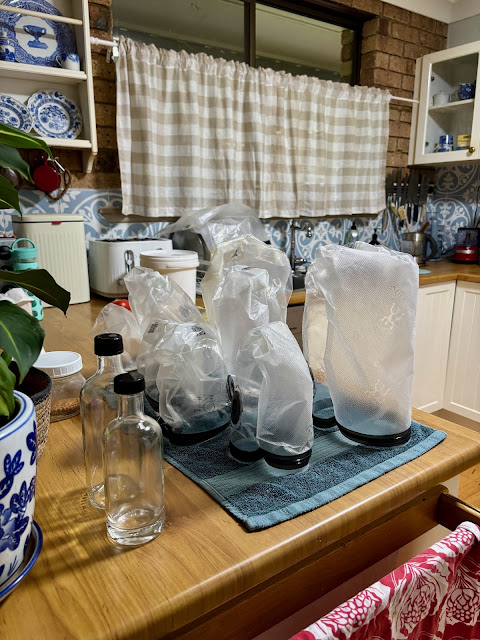
Every morning when I walk into my kitchen it looks tidy and ready for a day's work. Not so on this morning (above), I saw this when I walked in. Late the previous afternoon when I was looking for something, I came across my rolled up Zwilling vacuum bags and decided they had to be washed and dried. So I did that and although I usually put them outside on the verandah to dry it was dark by then. I turned the just-washed bags inside out and left them like this on a towel. It worked well and now the bags are ready to use when I bring home root vegetables, cabbages or whatever I buy that I want to last four or five weeks.
Image

You’ll save money by going back to basics

When I was doing the workshops and solo sessions, I had a couple of people whose main focus was on creating the fastest way to set up a simple life. You can't create a simple life fast, it's the opposite of that It's not one single thing either - it's a number of smaller, simpler activities that combine to create a life that reflects your values; and that takes a long to come together. When I first started living simply I took an entire year to work out our food - buying it, storing it, cooking it, preserving, baking, freezing, and growing it in the backyard. This is change that will transform how you live and it can't be rushed.  
Image

All previous blog posts

  • 2026 3
    • February 3
      • Workshops starting 1 March
      • Planting vegetable seeds and new workshops
      • Back where we belong
  • 2025 7
    • July 1
    • June 2
    • May 1
    • April 2
    • February 1
  • 2024 25
    • December 2
    • November 1
    • October 2
    • September 3
    • August 1
    • July 3
    • June 1
    • May 3
    • April 2
    • March 3
    • February 2
    • January 2
  • 2023 13
    • December 1
    • November 2
    • October 1
    • September 3
    • August 2
    • February 2
    • January 2
  • 2022 17
    • November 3
    • October 4
    • September 3
    • August 2
    • July 3
    • June 2
  • 2021 50
    • December 1
    • November 6
    • October 7
    • September 5
    • August 4
    • July 5
    • June 2
    • May 2
    • April 6
    • March 4
    • February 4
    • January 4
  • 2020 68
    • December 3
    • November 5
    • October 4
    • September 4
    • August 4
    • July 4
    • June 4
    • May 8
    • April 7
    • March 8
    • February 8
    • January 9
  • 2019 66
    • December 2
    • November 4
    • October 5
    • August 3
    • July 4
    • June 6
    • May 8
    • April 8
    • March 8
    • February 11
    • January 7
  • 2018 82
    • December 1
    • September 2
    • August 10
    • July 4
    • June 11
    • May 9
    • April 12
    • March 10
    • February 10
    • January 13
  • 2017 129
    • December 7
    • November 10
    • October 6
    • September 13
    • August 11
    • July 13
    • June 12
    • May 9
    • April 9
    • March 14
    • February 11
    • January 14
  • 2016 125
    • December 7
    • November 13
    • October 10
    • September 11
    • August 11
    • July 8
    • June 9
    • May 9
    • April 12
    • March 10
    • February 13
    • January 12
  • 2015 184
    • December 7
    • November 15
    • October 20
    • September 18
    • August 19
    • July 18
    • June 12
    • May 15
    • April 12
    • March 21
    • February 13
    • January 14
  • 2014 203
    • December 11
    • November 8
    • October 17
    • September 20
    • August 17
    • July 19
    • June 17
    • May 17
    • April 23
    • March 15
    • February 18
    • January 21
  • 2013 225
    • December 13
    • November 17
    • October 17
    • September 17
    • August 21
    • July 24
    • June 20
    • May 19
    • April 17
    • March 22
    • February 17
    • January 21
  • 2012 245
    • December 17
    • November 20
    • October 20
    • September 18
    • August 15
    • July 24
    • June 21
    • May 26
    • April 23
    • March 23
    • February 19
    • January 19
  • 2011 257
    • December 18
    • November 24
    • October 27
    • September 23
    • August 24
    • July 21
    • June 24
    • May 24
    • April 16
    • March 22
    • February 14
    • January 20
  • 2010 283
    • December 20
    • November 18
    • October 18
    • September 19
    • August 25
    • July 24
    • June 25
    • May 26
    • April 25
    • March 22
    • February 29
    • January 32
  • 2009 293
    • December 29
    • November 18
    • October 23
    • September 25
    • August 22
    • July 28
    • June 22
    • May 21
    • April 27
    • March 26
    • February 24
    • January 28
  • 2008 387
    • December 24
    • November 23
    • October 25
    • September 26
    • August 27
    • July 27
    • June 37
    • May 34
    • April 44
    • March 53
    • February 32
    • January 35
  • 2007 372
    • December 37
    • November 40
    • October 55
    • September 51
    • August 49
    • July 63
    • June 49
    • May 28


Trending Articles

NOT the last post

This will be my last post here.  I've been writing my blog for 18 years and now is the time to step back. I’ve stopped writing the blog and come back a couple of times because so many people wanted it, but that won’t happen again, I won’t be back.  I’ll continue on instagram to remain connected but I don’t know how frequent that will be. I know some of you will be interested to know the blog's statistics. 
Image

Every morning at home

Every morning when I walk into my kitchen it looks tidy and ready for a day's work. Not so on this morning (above), I saw this when I walked in. Late the previous afternoon when I was looking for something, I came across my rolled up Zwilling vacuum bags and decided they had to be washed and dried. So I did that and although I usually put them outside on the verandah to dry it was dark by then. I turned the just-washed bags inside out and left them like this on a towel. It worked well and now the bags are ready to use when I bring home root vegetables, cabbages or whatever I buy that I want to last four or five weeks.
Image

You’ll save money by going back to basics

When I was doing the workshops and solo sessions, I had a couple of people whose main focus was on creating the fastest way to set up a simple life. You can't create a simple life fast, it's the opposite of that It's not one single thing either - it's a number of smaller, simpler activities that combine to create a life that reflects your values; and that takes a long to come together. When I first started living simply I took an entire year to work out our food - buying it, storing it, cooking it, preserving, baking, freezing, and growing it in the backyard. This is change that will transform how you live and it can't be rushed.  
Image

Creating a home you'll love forever

Living simply is the answer to just about everything. It reduces the cost of living; it keeps you focused on being careful with resources such as water and electricity; it reminds you to not waste food; it encourages you to store food so you don't waste it and doing all those things brings routine and rhythm to your daily life. Consciously connecting every day with the activities and tasks that create simple life reminds you to look for the meaning and beauty that normal daily life holds.  It's all there in your home if you look for it. Seemingly mundane tasks like cleaning and cooking help you with that connection for without those tasks, the home you want to live in won't exist in the way you want it to.  Creating a home you love will make you happy and satisfied.
Image

Time changes everything

I've been spending time in the backyard lately creating a contained herb and vegetable garden. My aim is to develop a comfortable place to spend time, relax, increase biodiversity and encourage more animals, birds and insects to live here or visit. Of course I'd prefer my old garden which was put together by Hanno with ease and German precision. Together, we created a space bursting at the seams with herbs, vegetables and fruity goodness ready to eat and share throughout the year. But time changes everything. What I'm planning on doing now, is a brilliant opportunity for an almost 80 year old with balance issues. In my new garden I'll be able to do a wide range of challenging or easy work, depending on how I feel each day. It’s a daily opportunity to push myself or sit back, watch what's happening around me and be captivated by memories or the scope of what's yet to come.
Image

It's the old ways I love the most

I'm a practical woman who lives in a 1980’s brick slab house. There are verandahs front and back so I have places to sit outside when it's hot or cold. Those verandahs tend to make the house darker than it would be but they're been a great investment over time because they made the house more liveable. My home is not a romantic cottage, nor a minimalist modern home, it's a 1980’s brick slab house. And yet when people visit me here they tell me how warm and cosy my home is and that they feel comforted by being here. I've thought about that over the years and I'm convinced now that the style of a home isn't what appeals to people. What they love is the feeling within that home and whether it's nurturing the people who live there.
Image

Back where we belong

Surprise! I'm back ... for good this time. Instagram became an impossible place for me. They kept sending me messages asking if I'd make my page available for advertisers! Of course, I said no but that didn't stop them. It's such a change from what Instagram started as. But enough of that, the important part of this post is to explain why I returned here instead of taking my writing offline for good. For a few years Grandma Donna and I have talked online face-to-face and it's been such a pleasure for me to get to know her. We have a lot in common. We both feel a responsibility to share what we know with others. With the cost of living crisis, learning how to cook from scratch, appreciate the work we do in our homes, shop to a budget and pay off debt will help people grow stronger. The best place to do that is our blogs because we have no advertising police harassing us, the space is unlimited, we can put up tons of photos when we want to and, well, it just feels li...
Image

Making ginger beer from scratch

We had a nice supply of ginger beer going over Christmas. It's a delicious soft drink for young and old, although there is an alcoholic version that can be made with a slight variation on the recipe. Ginger beer is a naturally fermented drink that is easy to make - with ginger beer you make a starter called a ginger beer plant and after it has fermented, you add that to sweet water and lemon juice. Like sourdough, it must ferment to give it that sharp fizz. To make a ginger beer plant you'll need ginger - either the powdered dry variety or fresh ginger, sugar, rainwater or tap water that has stood for 24 hours to allow the chlorine to evaporate off. You'll also need clean plastic bottles that have been scrubbed with soap, hot water and a bottle brush and then rinsed with hot water. I never sterilise my bottles and I haven't had any problems. If you intend to keep the ginger beer for a long time, I'd suggest you sterilise your bottles. MAKING THE STARTER In a...
Image