One of my nephews, Charles, is a volunteer wildlife rescuer and he spends a lot of his spare time in the Blue Mountains bush rescuing native animals. We all know our precious native wildlife has been decimated in the ongoing bush fires and injured and scared animals are now coming into local properties and homes looking for water and food. In the coming days, these are the animals Charles will be helping. When the NSW RFS give the all-clear for people to return to the burnt bushland, Charles will set off looking for injured animals. These animals will be carefully handled and taken to either a vet for diagnosis and treatment or a wildlife carer for longer term care. To do this work, Charles supplies his own equipment but there is a chance that he won't have enough wraps and pouches to transport the animals he finds.
I suggested to him that we - you, me and the rest of the gang here - could help him by quickly making a selection of what he needs. I wonder if you'll join in with this. The main need is for bat wraps and he needs 60 of them, he also needs some hanging joey pouches. Bat wraps and pouches are vital to help calm animals during transportation. Both these items are essential to Charles' work.
We're happy to accept whatever you can send - one, two, six or 20. They will help in a significant number of rescues. So who is up for this? The patterns are simple straight sewing and the links are below for you to click on and look at. Please be guided by the suggested fabrics - most are cotton, cotton flannelette, calico or wool. No buttons or Velcro are used. All the finished wraps and pouches need to be sent to Charles in the Blue Mountains, please contact me by email:
rhondahetzel@gmail.com and I'll give you his postal address.
I wonder if there is a vet who reads my blog. I'd like to introduce you to Charles so he can speak to someone about rehydrating animals and general burns first aid. At the moment, he needs some burns cream, syringes and Vet Wraps. If you can email me, I'll give you Charles' phone number so you can talk to him directly. Thank you.
I'll be making this part of our Instagram Sewing Bee so when you finish your sewing, please send me a photo of what you made, along with your IG name, so we can link to you from the Bee.
Thank you all. I know we'll get this started quickly so we can help Charles in his important work.
As the final hours of 2019 rolled along, I sat with increasing sadness watching our country burn. Each new day revealed red landscape and sky and then news reports started trickling in of farmers, homeowners and volunteer firefighters who died protecting properties, and millions of helpless animals dying trying to escape the ferocious, unpredictable fires. These are our unique and beautiful Australian animals - the kangaroos, koalas, wombats, echidnas, possums and bats as well as snakes, lizards, birds and insects. If you have the chance to donate to the recovery programs, please do so. Our communities and wildlife need all the help they can get. Some may never recover, the ones that might need financial assistance to start again.
I've just come in from the garden on this humid morning and want to pass on a few tips for hot and dry summer gardening. I know there are a lot of new gardeners out there so I hope what I share helps you get your garden through these harsh conditions. I was out in my garden filling up the bird baths, watering a few pots that looked parched and I also discovered a paper wasp nest right next to where I was standing. Usually we leave the insects to do their thing, as they leave us to do ours, but with children visiting over the holidays this wasp nest is just too close to where they'll be playing so it has to go. I passed that job over to Hanno who will deal with it later today.
The tree is one of our orange trees. We're watching it like a hawk because it's full of small oranges and if it gets heat stressed, it will drop the fruit.
This is our new cottage garden. I started it in August and it's growing well but it's not quite finished. We've gone from tending a very productive vegetable garden for about 30 years, to a small cottage garden that fits into a third of the old garden. We've taken out some gardens, they're lawn now, the rest are flowers, herbs and fruit.
This is our winter garden in 2006. Now the garden closest to the camera and the middle garden are gone, and the cottage garden is growing in the two gardens closest to the picket fence.
And this is today's garden taken from a different angle. The picket fence in the last photo is on the left of this garden.
Hello sewers. I've started a sewing bee involving recycling old fabric. You can recycle unused old fabric from your stash, an old dress, sheets, towels, coats or whatever you have enough of to make something you'll use. I'm making pillow cases from an old white cotton bed skirt. Would you like to join in? There are no fees and no pressure; we'll all have a bit of fun and learn more about sewing and recycling. I'm hoping new sewers join in as well as our intermediates and experienced sewers. Everyone is welcome. You can join either here or on Instagram - #downtoearthsewingbee.
This is the old bed skirt I'm using to make pillow cases. What will you use?
The item should be finished by Thursday 21 November (or close to it) and when you finish, I'd like you to take a photo and send it to me so I can add it to my Instagram sewing bee gallery. I'm always interested in what other people sew so I'm looking forward to seeing what you create. Start now, let me know what you're sewing and when you finish send a photo of your finished project to downtoearthsewingbee@gmail.com so it can be added to the photo gallery.
It will be cloudy here today with a minimal chance of rain so I'll be out in the garden planting up geranium Rozanne, a Lillipop Soda Pop gaura and a rosea, the final plants in our newish cottage garden. Before that though I want to write about the last legs of our vegetable garden - a thriving collection of common and not-so-common vegetables and fruits we started growing here in 1998.

I've been working in my garden for a few weeks transitioning from a vegetable to a cottage garden and trying to get everything ready for spring. Spring is the season that sets our gardens up for the year and if you get good rain in spring, as we did, it's even better. But I have no illusions of a lush floral display throughout summer, I just hope I can help most of it through the prolonged heat that I know is coming. Our average annual rainfall is about 1800mm and that is one of the reasons we chose to live in this area. However, so far this year we've had 755.4mm, 286mm less than the previous year. This was the first year two of our tanks ran out of water, and the big 10,000 litre tank had only about 2000 litres left. I wouldn't grow vegetables without the safety net of tanks. They're expensive to put in, but like solar panels, they earn their place in most environmentally sound houses. We saved for our tanks, one went in soon after we arrived here, and the big one was established about ten years ago; again, when we had the cash to pay for it. When you set yourself up with tanks, you can water liberally most of the time and know that you're producing food with no hidden costs.
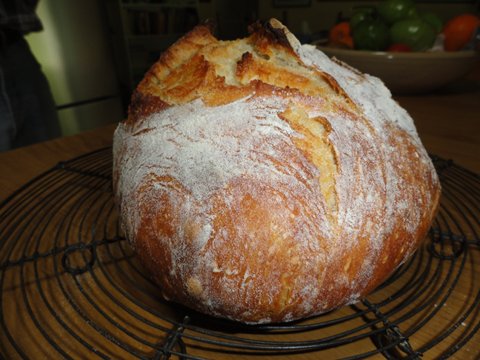
We set off on our first book tour just before Down to Earth was to be published on 22 February, 2012. We had no idea what to expect or if anyone would come along to meet us. There was no need to worry though because at every stop along the way so many lovely people travelled in, often bringing gifts of jams, relish, soap, dish cloths, bread, cake, kombucha and magazines to read on the journey, as well as their good wishes.
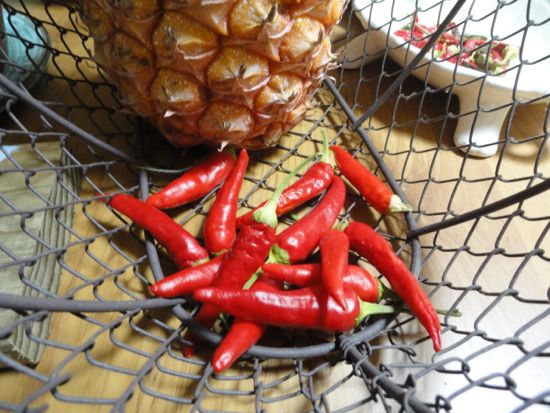
What generosity! Just some of the many gifts we received on the road.
Being interviewed by Richard Stubbs in Melbourne. I also had the good fortune to meet Jon Faine and Clare Bowditch on their radio programs too.
Feeding the chooks. I think this was Channel 7.






.jpeg)


.jpeg)
.jpeg)
.jpeg)
