down to earth

  • Home
  • About Us
  • Down To Earth Book
  • Privacy Policy
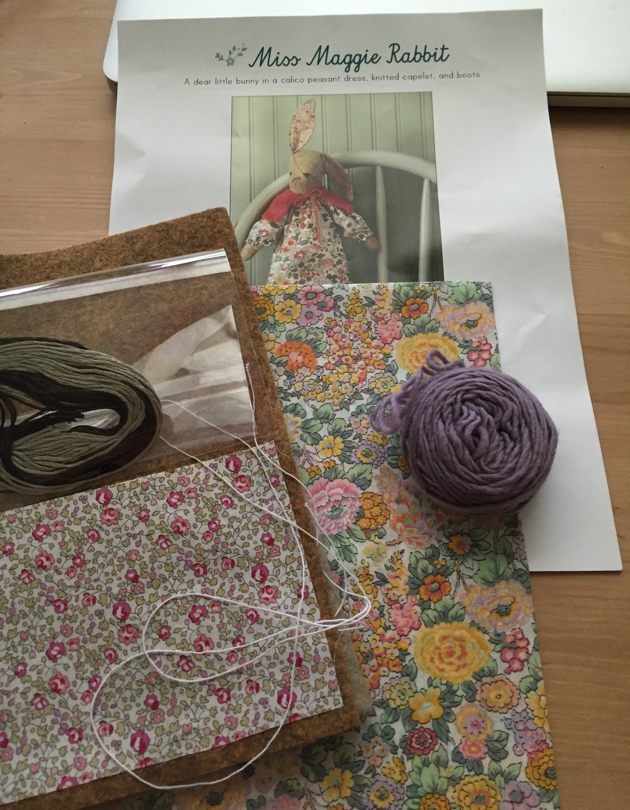
She came into my life as a flat pack kit all the way from Alicia Paulson in Oregon. The kit was beautifully presented, with good quality materials, and it was a pleasure to work on.

She arrived in August - the makings of a little rabbit.


I didn't get around to sewing her until a rainy Friday afternoon a couple of weeks ago. Most of the time I spent hand sewing her, I listened to country music, my newest obsession.


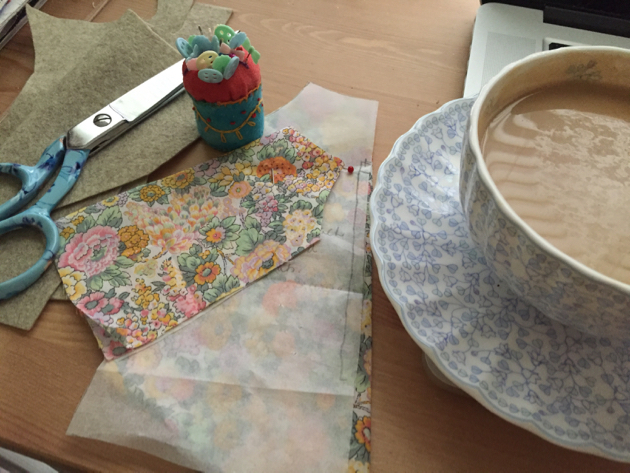
Slowly she came together. The ears first, because that was my favourite fabric in the kit, and then her purple shawl.

She was impatient to have me sew her dress but other things took precedence and it took a while to get around to it.

When the dress was finished, she sat on my box of cottons waiting for her boots.

Then the boots took shape.
And I struggled for the first time with the project - doing up the laces on the boots. I had to undo it five times before I got it right.  When I left my desk to do something in the house, Jamie would bring in a little Lego animal that he'd just made and silently leave it next to whatever I was working on - this one was a cat.

And now she's finished.

I decided to knit her a little smock to go over her dress. The pattern, again from Alicia, advises circular needles and I don't have any that are such a small size. So I'm trying the pattern on flat needles. Maybe it will work, maybe it won't. We'll see. Soon I'll wrap her so she can be given to a very special baby girl in my life. I hope she likes her as much as I do.


There used to be a time when there were no supermarkets - this was in my lifetime, few people owned a car or a phone, the only screens were at the cinema and most people knew how to cook and make general repairs and they lived their lives without much outside help. If a shoe sole was wearing out, the sole was tidied up, a leather patch was glued and tacked on, the patch was cut to suit the shape of the sole and it kept the shoes going another year. Everyone knew how to darn and mend clothes, backyard gardens and chickens were commonplace and haircuts were done at home. There were no convenience foods, few packaged products and every home had at least one person who could easily put up jam, relish, sauce and cordial, as well as store the surplus from the garden and make the daily bread and enough cake and biscuits for the family and visitors. Life was simple then.


Then it wasn't. That life started to quietly fade away in the 1960s and has been replaced by what we have now. First let me say that I love living during this time. I do not yearn for the 1920s, 40s or 60s. Life is easier now, but it's not nearly as simple and safe. We do have the luxury of choice though and many of us have chosen to modify the way we live to regain some of that lost simplicity and become more self reliant.  Those small adjustments make us more capable people and if we're going to survive during the difficult periods that no doubt will come along, we'll need some of the traditional home skills that we so quickly walked away from.

The ease we have now has been brought about by appliances that do a lot of our heavy house work in a very efficient manner, the abundance of good food, cheap shoes and clothing, a wide range of materials that were unknown earlier on and a better understanding of bacteria and viruses and how we should clean our homes. But all of it has to be paid for and often it means working longer to have the money to buy what you need and the convenience you desire.


So if you are going to buy into modern life, how do you develop self reliance? You develop the mindset, take responsibility for yourself and then carefully choose what you'll pay money for and what you can do yourself. Don't look at my life and think I'm the model for simple life. I've got time to do things during the day when you're probably at work, or working in your home looking after children.

If your time is limited, work out what changes will make the biggest difference in your life and go from there. If I were working for a living now, I'd take my lunch and a drink to work every day so I didn't have the added expense of buying something I could easily make myself. No matter how much time is available, most of us have to shop for food, so work out what your food budget is and change the way you shop to get the best value for money. Learn how to store food correctly so you don't waste any. Cook from scratch. That will save you money and keep you healthier because you won't be eating so many preservatives and food additives. If you have more time, do some batch cooking so you have a stock of your own frozen home cooking in the freezer and can feed yourself and the family without having to buy convenience or fast food on those nights when you're tired or running late.

Another thing we all have to do is clean, so find some reliable recipes for cleaners, soap and laundry products and depending on how much time you have, make as many of them as you can. This is a huge money saver and you'll have far fewer chemicals in your home as a result. Start with laundry powder or liquid because it's easy and quick to make and it will save you a packet. If you have more time, cut up old towels for cleaning rags, recycle a spray bottle, fill it with half water and half white vinegar and do some of your cleaning with that. If you have more time, make a citrus version of that. More time? Make your own homemade version of Gumption by mixing a cup of homemade laundry liquid with a cup of bicarb. Or learn how to make soap. If you have more time, do more.


It's the mindset that will see you through. If you convince yourself that being self reliant will make a real difference to your life, you'll eventually fall into the habit of looking for ways to make much of what you use instead of working longer so you can buy it at the supermarket. After a while, home production and being the person who makes that happen will become your new normal and you'll recycle, repair, cut back, save, mend, cook, preserve and make do because that is who you are.

It's a fine way to live - the choice about your level of self reliance is yours - but from my own experiences, the more I did, the more sense it made to keep going. Time is the the biggest barrier. The more you cut back and save, the less you'll have to work and that will give you time to increase what you do in your home. But what can you do right now? The important thing to do today is to make the commitment to develop the twin habits of self reliance and responsibility and then see where that takes you.


Maggie rabbit is almost ready for her public viewing. She'll be waiting for you on Monday. So will I. I hope you have a wonderful weekend. Thanks for your comments and visits during the week. I love reading about what you're doing.

Stressed, Tired, Rushed: A Portrait of the Modern Family
In a time before tech: the Russian sisters living defiantly off the grid
Hundreds of old letters found in Holland
Nigel Slater’s pear and ginger cake
Korean beef short rib kimchi stew (Jjigae)No pets, no kids, no flights: how readers are reducing their carbon footprint
Free colouring-in page download - parrot
Engineering challenges for kids
10 steps to clear the clutter
How to make knots
Make a six cord braided friendship bracelet
Moth-proofing your yarn

I'm looking forward to receiving a parcel from Ecoyarns containing some of their beautiful 8ply hemp yarn. I also ordered two Malachite O-Wool Balance skeins and some of the new Clouds cotton range.  So I wanted to get my yarns in order. I usually knit in the lounge room and over the past six months or so I've had my vintage knitting basket on one side and a magazine holder on the other side of my chair, both full of wool, cotton, alpaca and various works in progress.  I knew I had to sort it all out and if I could do it before the parcel arrived, I'd be one happy woman. It doesn't take much to put a smile on my face.

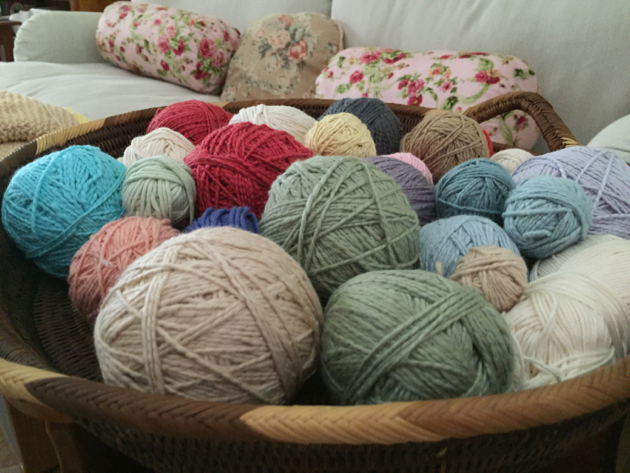
These are mainly Eco-Organic Cottons that I've used for projects and have a little left over, or I've simply wound as balls from skeins.

Yesterday morning, after I had lunch in the oven, I started cleaning that corner of the room, sorting through my yarns, throwing out little bits of paper with instructions I'd written for certain projects, reminders of things I wanted to record on TV, the top of a nightie pattern I drew and some kimchi recipes from my friend Kathleen. The last two I kept. I discovered a lot of end pieces. I usually knit them into dishcloths but these had fallen to the bottom of their containers, so I put all the cotton together, packed away the wool in plastic boxes in my sewing room and sorted through half my knitting needles. I found a small jar in the cupboard and kept a darning needle (for threading in loose ends), embroidery scissors, stitch holders of different sizes, stitch markers and a needle gauge there in the jar.


These are my works in progress. 

Now I have to work out how to store my yarns. Many years ago, there was an outbreak of wool moths here that invaded my wool stash and I had to get rid of a fair bit of wool. After that I put all the wool in the freezer for a week to kill the moth eggs and larvae and then I bought some large Decor clear plastic boxes with lids. By sealing everything in those boxes, I've never had to waste any more wool. But maybe there's a better way. How do you store your wool?  How do you store all your yarns? Please share your ideas with me because I want to keep knitting for a long time and I want to make sure my storage system protects the yarns from moths and dust. I also want to be able to see what I have through the boxes so I don't have to rummage around to find what I need. Who knows, I may keep the system I've got but if there is some other way that's better, I'd like to know about it.

A friend sent me this book and I'm using it to learn a few new stitches. 

I've just started a forum thread about this topic in case you have any photos of your yarn storage you can share. Otherwise, just add a comment here and tell me, and everyone else, how to you sort your yarns.
Now that I'm not working at writing every day, my days have turned into splendid waves of sewing, waves of family, waves of cooking. It's wonderful to be absorbed with the fundamentals of simple life. There's not much thinking to be done, it's all repetition, routine and reaction. Tasks are carried out according to the way I did them last week and will do them next week. Cooking is a combined production of garden and kitchen, there's been some picking and pickling going on because it's that time of year. And through it all I try to react to whatever happens with grace and enthusiasm. I want everyone here to feel comfortable and content; I want to feel that way too.


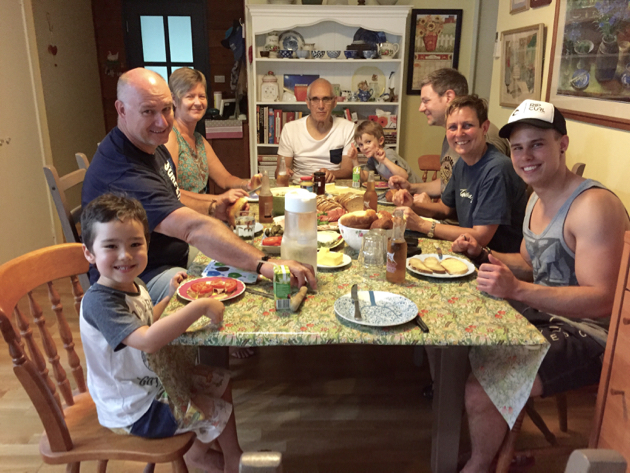
We had our visiting German relatives here for abend brot on Thursday evening. Martina is the daughter of Hanno's late sister, Angelika. She's visiting with her husband Michael and their sons, Luca and Jonah. So Hanno made the trip to the German baker for brotchen (bread rolls) and rye bread, I roasted a chicken and then made chicken salad with pickled cucumbers, red onions, dill, parsley and mustard mayonnaise. At abend brot, the bread is placed on the table with platters of assorted cold cuts, some sort of mayonnaise salad and a variety of cheeses and everyone makes there own open sandwiches. When I lived in Germany this was the meal I enjoyed the most. It seemed to me, in 1979, to be liberated and humble and an easy way to feed good food to a family at a time in the day when everyone was tired and hungry.


On Saturday morning we took Jamie on a river cruise to look at the boats, wildlife and water in one of our local harbours.  We had a seafood lunch as part of the $33-each tour price ($8.50 for Jamie) and we thoroughly enjoyed ourselves. There are very few tourist and entertainment events that we enjoy now. We just don't like all the hype, the crowd or the traffic.


During the week I preserved about 20 of our small Lebanese cucumbers. They'll do us through to Christmas now and I'll probably make up another batch this week. I have about 20 cucumbers in the fridge already and another 20 still on the vine. That is the thing about gardening, when harvest time comes, you need to be able to store an over abundance too so brush up on your pickling, preserving, dehydrating if you're growing common fruits and vegetables such as lemons, tomatoes, herbs, cucumbers or beetroot.


I hope to finish off Maggie rabbit this week. I've blanket-stitched her body, attached the arms and legs and she looks like a rabbit now. Today I'll sew up her Liberty print dress, blanket stitch the boots and finish off her shawl. Then she'll be wrapped in tissue paper and wait quietly to be placed under a Christmas tree. She's been a labour of love that I've really enjoyed working on.

I hope you're starting to prepare for Christmas too. I don't want that last minute frenzy that used to occur in our home almost every year. I've outgrown that and now look forward to a period of quiet reflection, rest and family celebrations. It's so much better than Christmas Eve shopping, over spending and waste. But I know I'm preaching to the converted here. You're probably all doing much the same as I'm doing. I wonder if you are.


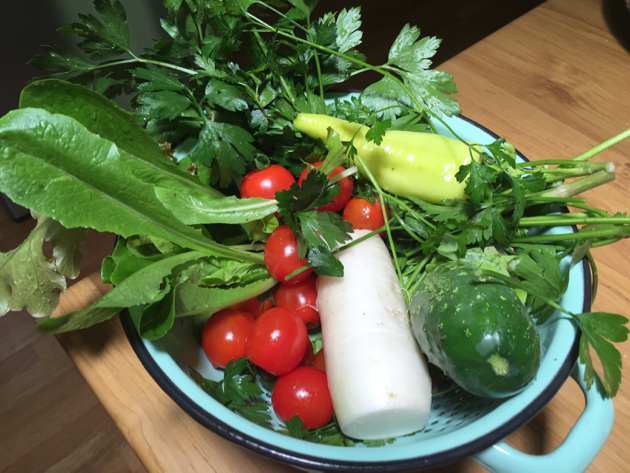
The makings of a salad picked fresh from the garden during the week.

Usually I make a ritual of sitting down to watch the first ball bowled of the first cricket test. Then I sit there on and off throughout the day, knitting and watching. That test started yesterday and I forgot it was on! I used to have an excellent memory so I feel its loss deeply, especially when I forget something I've done for many years. It's one of the downsides of ageing that I'm still getting used to. I don't forget a lot of things but when it's the cricket, pfttttt! I'm not happy. I was busy all day yesterday because Jamie was here and we had the extended family over for dinner. So today, I'm having the day off. Today I'll watch the second day of the test match, I'll sew my Maggie rabbit and I might even pretend it's yesterday. ;- )  I wonder what you'll be doing. See you next week, friends. 

Why women bake: the healing power of a quiet sisterhood
Korean-style pork belly
Easy way to put on a doona/duvet cover
Queensland Country Women's Association
Sowing the seeds of Syria: farming group rescues plant species threatened by war
Bird wing tutorial
DIY handmade lunch bag
Frittata recipes
Roast root hummus - Hugh Fearnly-Whittingstall
Australia deploys sheepdogs to help a penguin colony back from the brinkAlternatives to high kitchen cupboards
Free super hero cape logo patterns
We are slaves to the printed word, but only handwriting conveys real beauty
Middlebrow? What's so shameful about writing a book and hoping it sells?

I watched a BBC documentary on UTube while I was ironing yesterday. It showed a Hutterite community, living on the Canadian prairies, who had voluntarily cut themselves off from the rest of the world. The entire program was interesting but what I liked most was how this small community banded together and as a group of about 160 people in numerous large family groups, sustained themselves and earned a living. They had dairy cows and a chicken farm and the community provided the workforce for the cows to be milked every day and to get the chickens to eggs and meat. There was no outside help. It is their way for the women to work in the home while caring for the family, the children went to primary school and the rest of the people there all had a job working for the collective good of the group. Unfortunately I can't say everyone was happy but they were all productive.

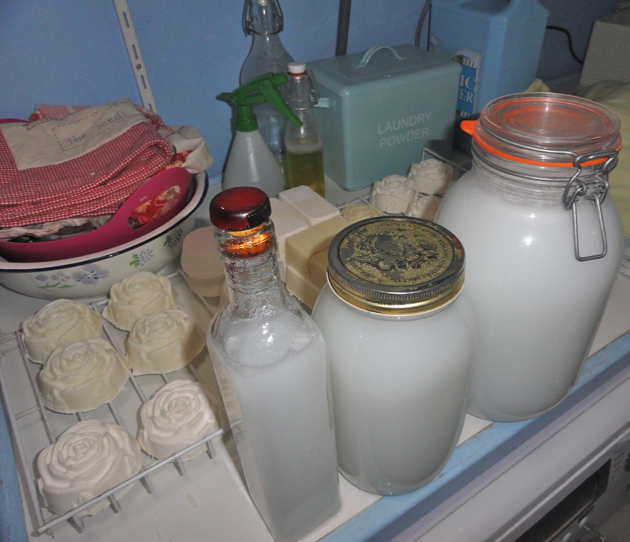
Making your own soap and laundry products will give you good quality cleaning products with far fewer chemicals, while reducing the cost of living.
Growing calendulas and other flowers and herbs allows you to add beneficial extras to your soap and cleaners without added cost.
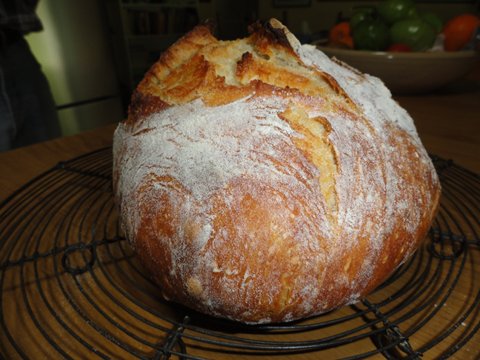
You can make good bread for less than you buy it for.

As most of you know, I'm old enough to have been in my in my teens and 20s during the sixties. Many hippies went back to the land then and while most of them lived in poverty, some thrived. Then in the 1970s, during the world-wide oil crisis, people from all walks of life tried to make good lives working their own land. 

Now in 2015 it is still possible, through hard work, organisation and planning, to work your own land so that it sustains you. There are a number of people who read this blog who do exactly that. Usually they have paid off a mortgage or are close to it, and they give up a full time job and use that time to work the land instead. They still need to earn some money though. Often one part of a couple will go out to part-time work. Or they both work part-time and have the equivalent of a full-time wage. That cash money goes towards bills for phone, electricity, clothing, shoes, health, transport and possibly travel and entertainment.

You'll need to develop the skills to help you store an abundance of food when certain things are in season. Knowing how to preserve/can food will give you seasonal food in the form of jams, sauces and relish even out of season. It will also give you a variety of food all through the year without having to go to the supermarket to get it.

If you have a house cow or goats, you can make a wide variety of dairy foods, including butter to spread on your bread.
Saving the seeds of open pollinated vegetables provides heirloom vegetables and fruit without having to buy new seeds every year. 
Pure breed chickens, with the addition of a rooster, will give you a continuous supply of chickens for eggs and meat.

John Seymour wrote an excellent book The New Complete Book Of Self Sufficiency * (UK) that gives details of backyards, one acre and five acre plots and how you can best manage them. And Carla Emery (USA) has her widely read book The Encyclopaedia of Country Living *. Sadly, both these authors are dead now, but I have had both these books for many years and I am happy to recommend them to you. There are two Australian books I can recommend too - The Permaculture Home Garden by Linda Woodrow and Backyard Self Sufficiency by Jackie French. Three of these books guided me early on. All the authors lived this life for many years and built their skills by doing what they write about. They share good ideas on how to do things most books don't even mention.  *If you're in Australia, all these books are available locally from Booktopia.

These photos of our vegetable garden are from a few years ago when we grew as much as we could. This gave us the opportunity to freeze and preserve the excess for later in the year.


I guess Hanno and I lived off our land too for the past thirteen years before we started to pull back a bit because of our age. Now we are content to tend smaller gardens.  If you have the land and are debt-free, and if you have the energy and will to do it, partial self-sufficiency in a backyard garden is entirely possible. If you start out with the intention of growing all or most of your fruit and vegetables, and you keep chickens or have aquaponics fish, it will take about a year to be in full production but you'll have a good chance of success. If you're vegetarian, it will be quicker. Add bees and a goat or a house cow if you have enough land, you'll also have honey and milk and you'll be able to make cheese, butter yoghurt and soap with the excess. If you're in the sub-tropics or tropics, you could even grow your own coffee, tea and nuts - it's all there for the taking as long as you put in the work. And it's hard rewarding work. You need to know what you're doing or have a mentor close at hand, but it is possible. If you can't grow everything you need, grow as much as you can and buy in the small amount that you can't produce.

There are other things you can do, along with food production, to help reduce the cost of living. Recycling, repairing, mending, solar panels, making your own fertilisers and saving water from the roof will all fit well into your backyard scheme. In fact, if you're going to grow a large garden, setting up a water catchment system from the roof to tanks or several water buts will save money on water and help fulfil your ideal of sustainability. Whatever you can do to recycle and repair and save precious resources - be they financial or produce, will stand you in good stead as the years progress. Foraging and bartering help too and they're both a vibrant part of many sustainable communities. It all takes careful planning though and you have to learn all the skills you need. You can't just stumble along because if a crop fails, you'll be without that particular food for that season or you'll have to return to the shops to buy it.

This is the second water tank we put in and it sits behind our shed. It collects water from the shed roof and part of the house roof.  Using this plastic tank and the metal one below, we can store 15,000 litres of water and we never have to use town water on the garden or for anything outside.
This white down pipe on the side of the house runs under the pathway and over to the large tank photographed above. Hanno rigged this system of collection pipes so we could collect water from the house room and store it in the large tank attached to our shed.
This is the original tank we put in during our first year here. It's still the tank I use to water the vegetable garden and bush house.

Pay off your debt, or get close to it, before you start. Living with no monthly mortgage payments will make the path ahead so much easier. Make a plan - work out what fresh produce you eat every week and every season then find out how much of that you can grow yourself. Work out the cost as well because there is no benefit in growing food if you're paying so much for water that you'd be better off buying what you need. If you live near someone who is already doing this, I'm pretty sure they'll help you learn the skills you need and give you ideas about how to organise yourself. If you don't have anyone and want to dive in, go over to the forum and share your story there. There is a lot of information about building soil fertility, saving seeds, growing various crops, preserving, storage etc. already there and I've just created a thread where this important topic can be discussed over the coming days.  If you're not already a member, you can join free of cost. I'll be popping into the thread when I have time and I'll help as much as I can but there are also a lot of other people there who will be willing to help.
I remember the first day I walked into this house and then roamed around the back yard. We went down to the flowing creek, looked at the many trees here and listened to the birds as it slowly dawned on us that this place at the end of a one lane road, surrounded by pine forest and rain forest, was the home we'd been searching for. That was almost 20 years ago. Even though the house itself was a plain and simple shell and there were no fences, solar panels, tanks, verandahs, gardens or out buildings, there was a powerful feeling that this was our place. Those feelings are still echoing through our lives and almost every time I walk into our backyard I feel thankful to be here.


Let me tell you about where I live. We're in a small semi-rural town about one hour's drive from our State capital. There is a handful of small shops, a couple of cafes, a pub, primary school, a small medical centre, a post office and a small independent supermarket. Most people who come here are on the way to somewhere else. Our closest town, 5km away, is Beerwah, home of the Crocodile Hunter's Australia Zoo. Further up the mountain is Maleny, a 15 minute drive. So even though thousands of people pass through here every day, few of them call this town home and even fewer are travelling to come here. To tell you the truth, Landsborough is considered a bit daggy. There are no 'macmansions' here, most homes don't have a swimming pool, the shopping malls are further away, and the boutique shops are in the mountains behind us. Here the house blocks are big so there's ample room for gardens and chickens; and even horses or goats if that is your thing. But people don't want that. It seems small blocks of land with large houses close to shops and other amenities are prime real estate now. 


During our first few years here, I didn't live the life that I have come to since, but in that first year we installed our first water tank, solar hot water system, put up fences, built a chicken coop and improved the soil to grow vegetables and fruit. We started to modify this place from day one so that it suited us and our sons. But when our lives changed and we used the house as a real home, spending time here, using the land to grow food and the inside space to make as much as we could, the changes accelerated. As life opened up, so did the house. It changed from being a place where we slept and prepared to go out to work, to the place where we did the work. That created a domino effect as we modified the house to suit what we were doing and it turned the house into a home and a home into a sanctuary.


By modifying a house and land to suit you and your aspirations, you create a place where you can do your best work while feeling comfortable and secure. There is no formula for this, just change what isn't right for you. You might reorganise things so you have a stockpile cupboard, or a craft room. You might bake more so you create a baking area in your kitchen where your ingredients are all kept in the same place and your baking tins are on hand. When you start knitting or crocheting, you may move furniture around so you can sit closer to the window where the light is brighter. Your focus might be on outside work so you change your garage or shed to better suit storing tools and working on outdoor projects. I want to encourage those of you who have bought a house that might not be quite right for how you want to live, to start modifying it. Nests have to be fluffed up and changes made and when they are, living is easier and a whole new world can open up for you. It can be life changing.


This is important work. Your home is a firm foundation for you and your children, a safe haven for all of you. It should provide you with the right environment to breathe out and relax. If it doens't, change it. I'm not talking about housekeeping or redecorating, this is about changing the bones of the house to make housekeeping and your life easier. It's worth the time and effort you put into it. And remember, this isn't something you'll do in a weekend or even a year.  This is a life's work. You'll keep changing as you grow older and if your home reflects those constant subtle changes it will always be the softest place to land.

It was back to summer bed linen for us this week although just after I did that, it rained for a few days and I regretted being so eager to change. I hope the weather where you live is good and you're able to get out on the weekend, fill your lungs with fresh air and enjoy yourself.  Our German family arrives tomorrow for a month's holiday. It will be good to see them again.

‘Young women need female role models to inspire success’Australian True Food Guide
Madge, live GMO-free Australia
Pasta key to healthy sustainable diet, says Italian celebrity chef
Repurposing vintage linens
Doritos, deconstructed
How to fold a fitted sheet
Free personalised colouring sheets
The Quick and Easy Hanger Trick
How to make a cake from scratch
Home cooking from the freezer
Mountain cowl knitting pattern
Tomato, mozzarella and basil pizza
This is the final week of my favourite place. My sincere thanks to all the readers who so generously sent in their photos so we could see the small places where everyone feels comfortable and secure in the lands we inhabit all over our wide world  Our final place belongs to Noreen, an Irish woman living in Turkey.

Noreen writes:
I've only just recently found your blog and I love it. It's so positive! I have attached 2 photos of my favourite place in my home. I hope you like them. This is a reclining chair that I bought about 8 years ago. It is fairly tatty by now but I love it. I sit in it with my book under the shade of my lovely loquot tree which protects me with it's broad leaves from the warm Turkish sunshine. I read and I write in this chair, I have many stories to tell. I started a blog myself and write a post once a month. I'd love to know what you and your readers think of it!


Here is a link to my blog:
http://adjustingmyfocusagain.blogspot.com.tr/


Now that the 'experts' have told us that eggs are 'good' for us and not the cholesterol bomb they said they were, let's talk about eggs - what are the best eggs to buy, if you're buying chickens to lay eggs, what chickens should you buy and if you have your own chickens now, how do you get the best eggs from them.

A variety of our hens' eggs - the blue eggs are Araucana eggs.

All eggs contain about 6 grams of protein - 3 grams in the yolk and three grams in the egg white. That is about 12 percent of the daily protein requirement for the average person.

  BUYING EGGS  
There is no doubt about it, after testing eggs from various sources, free range eggs are thought to be the best eggs you can buy. Make sure that 'free range' on the carton is really free range - the chickens should be outside in the sun most of the day, not live in over crowded conditions (there is a limit on the number of chickens allowed in each area), sleep in a barn overnight and be able to eat grass and the bugs that live on it. It is the grass and bugs that gives eggs the boost of Omega 3 oils that are so beneficial and make the eggs tasty. If you're not sure about the eggs available at your supermarket, write and email to the manager, or head office, asking them to clarify the free range issue for you. If you still can't get a straight answer, many cartons have the supplier's name on the carton, so look up their phone number and ask them.

What are the best eggs to buy
Where to buy genuine free range Australian eggs

 Lulubelle, one of our barred Plymouth Rocks.
 Nora Barnacle, our Barnevelder.
From left: buff Sussex, Barnevelder, (back) Araucana, Rhode Island Red, Plymouth Rock, New Hampshire.
 Martha and Margaret Olley our buff Orpington and buff Sussex girls. Buff is the colour.

  IMPROVING THE QUALITY OF YOUR OWN HENS' EGGS  
I believe that buying point of lay red/brown, black or white chickens produced for the caged egg industry is one way of supporting that industry. If you would never buy caged eggs, don't buy the chickens bred to lay those eggs either. However, if you already have those chickens, how can you improve the eggs they lay. This applies to all breeds of chickens, heirloom or pure breeds too, the single best step to take is to give your chickens access to grass. It will boost the nutritional value and taste of the eggs the chooks lay.


Always give your chickens free access to fresh water, they can be fed on pellets with a small amount of grain but if you add greens to their diet, in the form of grass or vegetables leaves, that will make those dark yellow yolks we all love and it will improve the quality of the eggs. Currently we have eight chickens and we get about six eggs per day. I'm feeding them half a small bucket of pellets and a hand full of grain per day. They have access to greens every day and occasionally they get some of our leftovers.

  THOUGHTS ON HEIRLOOM BREEDS AND THE BEST EGGS  
Having had many types of heirloom breeds over the past 35 years has given us a good opportunity to decide which eggs we prefer. This is important because we keep chickens for the eggs. Currently we have Plymouth Rocks, Barnevelders, Australorps, Frizzles and a Wyandotte. In the past we've had Welsummers,  Pekins, Hamburgs, New Hampshires, Orpingtons, a variety of Sussex colours, Rhode Island Reds, Araucanas, Campines, Old English Game Hens and Faverolles. Of all those breeds, I believe the Barnevelder lays the tastiest eggs and the New Hampshires are the most consistent layers in a backyard environment.


Yesterday's eggs, with the dark brown Barnevelder egg on top.
Keeping heirloom chickens is similar to growing heirloom vegetable seeds. They've stood the test of time, they're part of the diverse poultry world, they'll lay longer and are generally healthier than mixed breed chickens. And keeping a few of the pure breeds will help keep that breed alive so they're there for your grandchildren to choose from too.  Which breed produces your favourite eggs?

Chart of pure breed chickens and their characteristics


Newer Posts Older Posts Home

MY BOOKS

MY BOOKS


My books were all published by Pengiun, and are available at Amazon US, Amazon UK and Amazon Au

Search here

Total Pageviews

Translate


I'm Rhonda Hetzel and I've been writing my Down to Earth blog since 2007. Although I write the occasional philosophical post, my main topics include home cooking, happiness and gardening as well as budgeting, baking, ageing, generosity, mending and handmade crafts. I hope you enjoy your time here.

MY FAVOURITE PLACES

  • Grandma Donna's Place
  • Grandma Donna's YouTube
  • Grandma Donna's Instagram
  • This Simple Day
  • Nicole's Instagram

Give More

Give More

Popular posts last year

Making ginger beer from scratch

We had a nice supply of ginger beer going over Christmas. It's a delicious soft drink for young and old, although there is an alcoholic version that can be made with a slight variation on the recipe. Ginger beer is a naturally fermented drink that is easy to make - with ginger beer you make a starter called a ginger beer plant and after it has fermented, you add that to sweet water and lemon juice. Like sourdough, it must ferment to give it that sharp fizz. To make a ginger beer plant you'll need ginger - either the powdered dry variety or fresh ginger, sugar, rainwater or tap water that has stood for 24 hours to allow the chlorine to evaporate off. You'll also need clean plastic bottles that have been scrubbed with soap, hot water and a bottle brush and then rinsed with hot water. I never sterilise my bottles and I haven't had any problems. If you intend to keep the ginger beer for a long time, I'd suggest you sterilise your bottles. MAKING THE STARTER In a...
Image

NOT the last post

This will be my last post here.  I've been writing my blog for 18 years and now is the time to step back. I’ve stopped writing the blog and come back a couple of times because so many people wanted it, but that won’t happen again, I won’t be back.  I’ll continue on instagram to remain connected but I don’t know how frequent that will be. I know some of you will be interested to know the blog's statistics. 
Image

How to make cold process soap

I'm sure many of you are wondering: "Why make soap when I can buy it cheaply at the supermarket?" My cold process soap is made with vegetable oils and when it is made and cured, it contains no harsh chemicals or dyes. Often commercial soap is made with tallow (animal fat) and contains synthetic fragrance and dye and retains almost no glycerin. Glycerin is a natural emollient that helps with the lather and moisturises the skin. The makers of commercial soaps extract the glycerin and sell it as a separate product as it's more valuable than the soap. Then they add chemicals to make the soap lather. Crazy. Making your own soap allows you to add whatever you want to add. If you want a plain and pure soap, as I do, you can have that, or you can start with the plain soap and add colour, herbs and fragrance. The choice is yours. I want to add a little about animal and bird fat. I know Kirsty makes her soap with duck fat and I think that's great. I think t...
Image

Preserving food in a traditional way - pickling beetroot

I've had a number of emails from readers who want to start preserving food in jars but don't know where to start or what equipment to buy.  Leading on from yesterday's post, let's just say up front - don't buy any equipment. Once you know what you're doing and that you enjoy preserving, then you can decide whether or not to buy extra equipment. Food is preserved effectively without refrigeration by a variety of different methods. A few of the traditional methods are drying, fermentation, smoking, salting or by adding vinegar and sugar to the food - pickling. This last method is what we're talking about today. Vinegar and sugar are natural preservatives and adding one or both to food sets up an environment that bacteria and yeasts can't grow in. If you make the vinegar and sugar mix palatable, you can put up jars of vegetables or fruit that enhance the flavour of the food and can be stored in a cupboard or fridge for months. Other traditional w...
Image

Cleaning mould from walls and fabrics

With all this rain around we've developed a mould problem in our home. Usually we have the front and back doors open and that good ventilation stops most moulds from establishing. However, with the house locked up for the past week, the high humidity and the rain, mould is now growing on the wooden walls near our front door and on the lower parts of cupboards in the kitchen. Most of us will find mould growing in our homes at some point. Either in the bathroom or, in humid climates, on the walls, like we have now. You'll need a safe and effective remedy at some point, so I hope one of these methods works well for you. Mould is not only ugly to look at, it can cause health problems so if you see mould growing, do something about it straight away. The longer you leave the problem, the harder it will be to get rid of it effectively. If you have asthma or any allergies, you should do this type of cleaning with a face mask on so you don't breathe in any spores. Many peopl...
Image

Five minute bread

Bread is one of those foods that, when made with your own hands, gives a great deal of satisfaction and delight. It's only flour and water but it symbolises so much. I bake bread most days and use a variety of flours that I buy in bulk. Often I make a sandwich loaf because we use most of our bread for lunchtime sandwiches and for toast. Every so often I branch out to make a different type of loaf. I have tried sour dough in the past but I've not been happy with any of them. I'll continue to experiment with sour dough because I like the idea of using wild yeasts and saving the starter over a number of years to develop the flavour and become a part of the family. However, the loaf I've been branching out to most often is just a plain old five minute bread. By five minutes I mean it takes about five minutes actual work to prepare but it's the easiest of all bread to make and to get consistently good loaves from. If you're having people around for lunch or...
Image

This is my last post.

I have known for a while that this post was coming, but I didn't know when. This is my last post. I'm closing my blog, for good, and I'm not coming back like I have in the past.  I've been writing here for 16 years and my blog has been many things to me. It helped me change my life, it introduced me to so many good people, it became a wonderful record of my family life, it helped me get a book contract with Penguin, and monthly columns with The Australian Women's Weekly and Burke's Backyard . But in the past few months, it's become a burden. In April, I'll be 75 years old and I hope I've got another ten years ahead. However, each year I'll probably get weaker and although I'm fairly healthy, I do have a benign brain tumour and that could start growing. There are so many things I want to do and with time running out, leaving the blog behind gives me time to do the things that give me pleasure. On the day the blog started I felt a wonderful, h...
Image

What is the role of the homemaker in later years?

An email came from a US reader, Abby, who asked about being a homemaker in later years. This is part of what she wrote: "I am a stay-at-home mum to 4 children, ages 9-16. I do have a variety of "odd jobs" that I enjoy - I run a small "before-school" morning drop-off daycare from my home, I am a writing tutor, and I work a few hours a week at a local children's bookstore. But mostly, I cherish my blissful days at home - cooking, cleaning (with homemade cleaners), taking care of our children and chickens and goats, baking, meal-planning, etc. This "career" at home is not at all what I imagined during my ambitious years at university, but it is far more enriching. I notice, though, that my day is often planned around the needs of my family members. Of course, with 4 active kids and a husband, this is natural. I do the shopping, plan my meals, cook dinner - generally in anticipation of my family reconnecting in the evening.  I can't h...
Image

Every morning at home

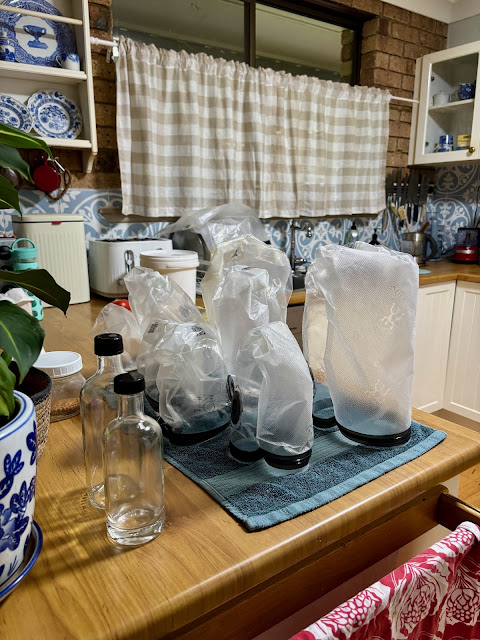
Every morning when I walk into my kitchen it looks tidy and ready for a day's work. Not so on this morning (above), I saw this when I walked in. Late the previous afternoon when I was looking for something, I came across my rolled up Zwilling vacuum bags and decided they had to be washed and dried. So I did that and although I usually put them outside on the verandah to dry it was dark by then. I turned the just-washed bags inside out and left them like this on a towel. It worked well and now the bags are ready to use when I bring home root vegetables, cabbages or whatever I buy that I want to last four or five weeks.
Image

You’ll save money by going back to basics

When I was doing the workshops and solo sessions, I had a couple of people whose main focus was on creating the fastest way to set up a simple life. You can't create a simple life fast, it's the opposite of that It's not one single thing either - it's a number of smaller, simpler activities that combine to create a life that reflects your values; and that takes a long to come together. When I first started living simply I took an entire year to work out our food - buying it, storing it, cooking it, preserving, baking, freezing, and growing it in the backyard. This is change that will transform how you live and it can't be rushed.  
Image

All previous blog posts

  • 2026 3
    • February 3
      • Workshops starting 1 March
      • Planting vegetable seeds and new workshops
      • Back where we belong
  • 2025 7
    • July 1
    • June 2
    • May 1
    • April 2
    • February 1
  • 2024 25
    • December 2
    • November 1
    • October 2
    • September 3
    • August 1
    • July 3
    • June 1
    • May 3
    • April 2
    • March 3
    • February 2
    • January 2
  • 2023 13
    • December 1
    • November 2
    • October 1
    • September 3
    • August 2
    • February 2
    • January 2
  • 2022 17
    • November 3
    • October 4
    • September 3
    • August 2
    • July 3
    • June 2
  • 2021 50
    • December 1
    • November 6
    • October 7
    • September 5
    • August 4
    • July 5
    • June 2
    • May 2
    • April 6
    • March 4
    • February 4
    • January 4
  • 2020 68
    • December 3
    • November 5
    • October 4
    • September 4
    • August 4
    • July 4
    • June 4
    • May 8
    • April 7
    • March 8
    • February 8
    • January 9
  • 2019 66
    • December 2
    • November 4
    • October 5
    • August 3
    • July 4
    • June 6
    • May 8
    • April 8
    • March 8
    • February 11
    • January 7
  • 2018 82
    • December 1
    • September 2
    • August 10
    • July 4
    • June 11
    • May 9
    • April 12
    • March 10
    • February 10
    • January 13
  • 2017 129
    • December 7
    • November 10
    • October 6
    • September 13
    • August 11
    • July 13
    • June 12
    • May 9
    • April 9
    • March 14
    • February 11
    • January 14
  • 2016 125
    • December 7
    • November 13
    • October 10
    • September 11
    • August 11
    • July 8
    • June 9
    • May 9
    • April 12
    • March 10
    • February 13
    • January 12
  • 2015 184
    • December 7
    • November 15
    • October 20
    • September 18
    • August 19
    • July 18
    • June 12
    • May 15
    • April 12
    • March 21
    • February 13
    • January 14
  • 2014 203
    • December 11
    • November 8
    • October 17
    • September 20
    • August 17
    • July 19
    • June 17
    • May 17
    • April 23
    • March 15
    • February 18
    • January 21
  • 2013 225
    • December 13
    • November 17
    • October 17
    • September 17
    • August 21
    • July 24
    • June 20
    • May 19
    • April 17
    • March 22
    • February 17
    • January 21
  • 2012 245
    • December 17
    • November 20
    • October 20
    • September 18
    • August 15
    • July 24
    • June 21
    • May 26
    • April 23
    • March 23
    • February 19
    • January 19
  • 2011 257
    • December 18
    • November 24
    • October 27
    • September 23
    • August 24
    • July 21
    • June 24
    • May 24
    • April 16
    • March 22
    • February 14
    • January 20
  • 2010 283
    • December 20
    • November 18
    • October 18
    • September 19
    • August 25
    • July 24
    • June 25
    • May 26
    • April 25
    • March 22
    • February 29
    • January 32
  • 2009 293
    • December 29
    • November 18
    • October 23
    • September 25
    • August 22
    • July 28
    • June 22
    • May 21
    • April 27
    • March 26
    • February 24
    • January 28
  • 2008 387
    • December 24
    • November 23
    • October 25
    • September 26
    • August 27
    • July 27
    • June 37
    • May 34
    • April 44
    • March 53
    • February 32
    • January 35
  • 2007 372
    • December 37
    • November 40
    • October 55
    • September 51
    • August 49
    • July 63
    • June 49
    • May 28


Trending Articles

NOT the last post

This will be my last post here.  I've been writing my blog for 18 years and now is the time to step back. I’ve stopped writing the blog and come back a couple of times because so many people wanted it, but that won’t happen again, I won’t be back.  I’ll continue on instagram to remain connected but I don’t know how frequent that will be. I know some of you will be interested to know the blog's statistics. 
Image

Every morning at home

Every morning when I walk into my kitchen it looks tidy and ready for a day's work. Not so on this morning (above), I saw this when I walked in. Late the previous afternoon when I was looking for something, I came across my rolled up Zwilling vacuum bags and decided they had to be washed and dried. So I did that and although I usually put them outside on the verandah to dry it was dark by then. I turned the just-washed bags inside out and left them like this on a towel. It worked well and now the bags are ready to use when I bring home root vegetables, cabbages or whatever I buy that I want to last four or five weeks.
Image

You’ll save money by going back to basics

When I was doing the workshops and solo sessions, I had a couple of people whose main focus was on creating the fastest way to set up a simple life. You can't create a simple life fast, it's the opposite of that It's not one single thing either - it's a number of smaller, simpler activities that combine to create a life that reflects your values; and that takes a long to come together. When I first started living simply I took an entire year to work out our food - buying it, storing it, cooking it, preserving, baking, freezing, and growing it in the backyard. This is change that will transform how you live and it can't be rushed.  
Image

Creating a home you'll love forever

Living simply is the answer to just about everything. It reduces the cost of living; it keeps you focused on being careful with resources such as water and electricity; it reminds you to not waste food; it encourages you to store food so you don't waste it and doing all those things brings routine and rhythm to your daily life. Consciously connecting every day with the activities and tasks that create simple life reminds you to look for the meaning and beauty that normal daily life holds.  It's all there in your home if you look for it. Seemingly mundane tasks like cleaning and cooking help you with that connection for without those tasks, the home you want to live in won't exist in the way you want it to.  Creating a home you love will make you happy and satisfied.
Image

Time changes everything

I've been spending time in the backyard lately creating a contained herb and vegetable garden. My aim is to develop a comfortable place to spend time, relax, increase biodiversity and encourage more animals, birds and insects to live here or visit. Of course I'd prefer my old garden which was put together by Hanno with ease and German precision. Together, we created a space bursting at the seams with herbs, vegetables and fruity goodness ready to eat and share throughout the year. But time changes everything. What I'm planning on doing now, is a brilliant opportunity for an almost 80 year old with balance issues. In my new garden I'll be able to do a wide range of challenging or easy work, depending on how I feel each day. It’s a daily opportunity to push myself or sit back, watch what's happening around me and be captivated by memories or the scope of what's yet to come.
Image

It's the old ways I love the most

I'm a practical woman who lives in a 1980’s brick slab house. There are verandahs front and back so I have places to sit outside when it's hot or cold. Those verandahs tend to make the house darker than it would be but they're been a great investment over time because they made the house more liveable. My home is not a romantic cottage, nor a minimalist modern home, it's a 1980’s brick slab house. And yet when people visit me here they tell me how warm and cosy my home is and that they feel comforted by being here. I've thought about that over the years and I'm convinced now that the style of a home isn't what appeals to people. What they love is the feeling within that home and whether it's nurturing the people who live there.
Image

Back where we belong

Surprise! I'm back ... for good this time. Instagram became an impossible place for me. They kept sending me messages asking if I'd make my page available for advertisers! Of course, I said no but that didn't stop them. It's such a change from what Instagram started as. But enough of that, the important part of this post is to explain why I returned here instead of taking my writing offline for good. For a few years Grandma Donna and I have talked online face-to-face and it's been such a pleasure for me to get to know her. We have a lot in common. We both feel a responsibility to share what we know with others. With the cost of living crisis, learning how to cook from scratch, appreciate the work we do in our homes, shop to a budget and pay off debt will help people grow stronger. The best place to do that is our blogs because we have no advertising police harassing us, the space is unlimited, we can put up tons of photos when we want to and, well, it just feels li...
Image

Making ginger beer from scratch

We had a nice supply of ginger beer going over Christmas. It's a delicious soft drink for young and old, although there is an alcoholic version that can be made with a slight variation on the recipe. Ginger beer is a naturally fermented drink that is easy to make - with ginger beer you make a starter called a ginger beer plant and after it has fermented, you add that to sweet water and lemon juice. Like sourdough, it must ferment to give it that sharp fizz. To make a ginger beer plant you'll need ginger - either the powdered dry variety or fresh ginger, sugar, rainwater or tap water that has stood for 24 hours to allow the chlorine to evaporate off. You'll also need clean plastic bottles that have been scrubbed with soap, hot water and a bottle brush and then rinsed with hot water. I never sterilise my bottles and I haven't had any problems. If you intend to keep the ginger beer for a long time, I'd suggest you sterilise your bottles. MAKING THE STARTER In a...
Image