down to earth

  • Home
  • About Us
  • Down To Earth Book
  • Privacy Policy
At the risk of sounding ancient, which I'm close to, or old-fashioned, which I often am, I want to write about dripping today. I know!  Scary stuff in these fat-free times. But a little bit of fat won't do you harm.  All things in moderation, so the saying goes.  Dripping is what we used to call the fat that rendered down off roasted meat. Dripping is beef or lamb fat and pork or bacon fat is called lard. Dripping and lard were a valuable ingredients in many pre-1970s homes. Most households had a dripping pot which was usually aluminium, pottery or an old china bowl.  Most dripping pots had a lid and a well fitted strainer to collect bits and pieces from the cooking. These were discarded or kept in the fridge until the next stew.

Tricia and I never had it but our mother, father and grandmother all talked, with affection, of eating bread and dripping. It was quite common pre-world war 2 to use dripping instead of butter on bread. I have fond memories of my mother's dripping pot, usually full, sitting in a dark cupboard, although I think she would refrigerate it now. And although I've never eaten dripping on bread, I still use dripping in cooking and I hope I can get you to make up a little dripping pot to try it yourself.
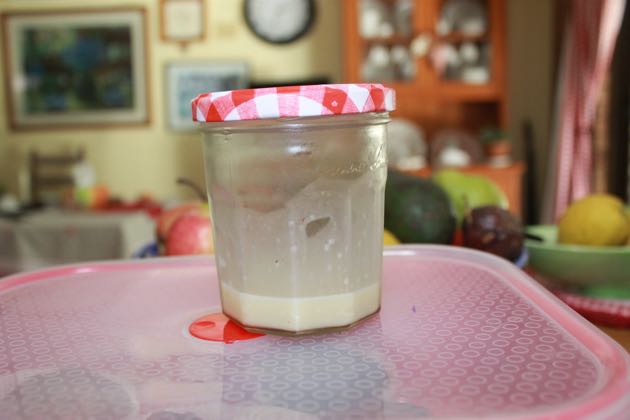


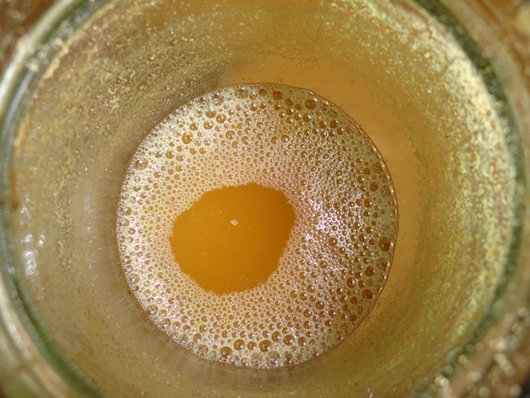
This is a little dripping pot I've just started - it's an old jam jar used for preserving, so the glass is toughened.  I'm on the lookout for a proper pot and when I find one at the second hand store, I'll grab it, give it a good scrubbing and use it for the dripping I save.

I only have a fraction of the dripping my mother collected. Meat is leaner now, we don't eat meat everyday and often I make a sauce with the dripping and don't collect it. But I do save the dripping from our roasts and also from bacon. I strain off the dripping through a strainer or sieve and store it in the fridge until it's needed. After you've saved dripping from a few roasts, you'll see a small dark layer under a lighter colour layer of fat on top. The dark layer is full of flavour but when I use the dripping, I dip the spoon right down the bottom and take some of the dark layer too. Although you can turn the pot on it's head until it's set and have the jelly layer on top.

Dripping can be used to cook roast vegetables or to make delicious gravy. Whatever it goes with it give a lovely flavour to because it has the concentrated flavour of the meat in it. If you brown your meat in dripping when you're making a casserole, it will add an extra level of flavour to the meal.

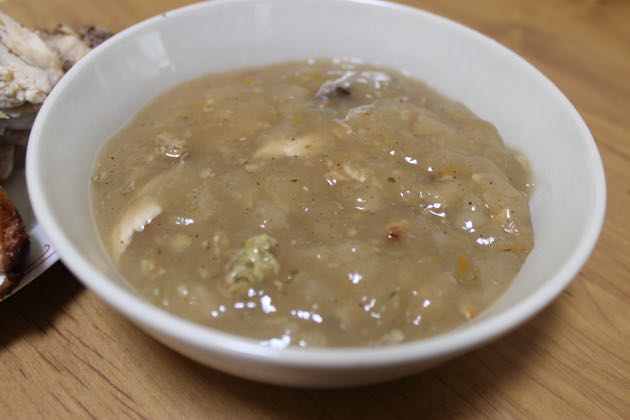
To make gravy, I take two tablespoons of dripping, add 1½ tablespoons of plain flour, salt, pepper and a small sprinkling of paprika (for colour). Stir the dripping and flour together over a medium heat and let it brown while you stir.  When you reach a good rich brown colour, add enough water to make a gravy to the consistency you like.  

If you're raising your own beef or pork, you probably know more about rendering fat than I do and you're might be using it in your soap as well, I'd love to hear from you to know how you're processing that fat and what you're using it for.  But if you have a small amount of dripping left when you cook and usually throw it out, try this and see if you like the extra ingredient and the ability to use as much of the animal as you can.
And here we are again with another end of week post. I'm pretty sure time moves much faster these days. I hope you've had a good week and can take time out to slow down for the weekend. Thanks for your visits and comments. xx

Ten tops books about working life
Tarragon chicken - I love recipes such as these. I haven't made this yet but it looks too good to keep to myself
Twelve of the world's most beautiful bookshops - in pictures
E. coli with your bottled water? Recall effects 14 brands
Scrap wood bike stand (self supporting)
How to make elderflower vinegar
How to test if baking soda or baking powder is expired
18 fruits and vegetables you don’t need to buy organic
Having a working mother works for daughters
Is life's happiness curve really U-shaped?
I became a post-materialist in Priceline


It's always good to get value for money, no matter what your income level or age bracket. However, if you're in a low income group or on an average income with high costs, getting value for the money you spend in essential. I think you have to get into the habit of always looking for ways to save and not wasting what you already have. When you develop that habit, there is a long list of things you can do.

For most of us, apart from rent/mortgage payments, food is our biggest expense. So it follows that if you can save money on food, you've been making a real difference to your own budget. I'm taking it as a given that we're all cooking from scratch, even though there will be some who don't, it is the best starting point for all of us - for our finances, our nutrition and our health. This is one of the ways I use to stretch a chicken so that it not only gives us meals we enjoy, the meals are easy to make and instead of a small chicken feeding us for one meal with leftovers for lunch the next day, this one covers our main meal for three days.


I started off with a small free-range chicken, of 1.5kg/3.3lbs. On the first day I made a stuffed roast chicken with vegetables. The stuffing was stale bread, a small onion with sage, parsley and an egg from the backyard. It was delicious and satisfying. The following day I had one half of the chicken left, still on the bone. I removed the leg and breast, then chopped the carcass in two and put it in a pot with about 1.5 litres/quarts water, salt and pepper and with the lid on brought it to the boil and simmered it for about an hour. The herb stuffing seasoned the stock perfectly and gave it a real boost. For about the last 5 minutes of the simmering, I put the chicken in the stock and warmed it up. Two teaspoons cornflour in the stock thickened it slightly and on the second day we had skinless chicken mashed potato with onion and parsley, some pumpkin from the previous say, peas and a little of the chicken gravy made with the stock.

On the final day of the chicken, I noticed the chicken stock was set like a jelly in the bowl because so much magnesium, collagen and glucosamine had leached out of the bones. A truly nutritious broth. So, all the meat was stripped from the bones, the thick gelatinous stock reheated with the chicken pieces, parsley, salt and pepper added and boiled with a hand full of small shell pasta - a delicious satisfying soup on a cold winter's day. And that was the end of the chicken. It was only a small bird had it been a bit bigger it would have done us for four or five days, but then I would have frozen a couple of meals for later.

It's a simple thing to stretch out food like this. It doesn't take any extra time but you have to have the idea to do it and know what you're doing. Making a list of ideas to stretch out chicken, fish, beef etc. is a great way to start. There must be a hundred ways to serve a chicken but I hope you add this to your repertoire because it will give you value for the money you spend on the chicken and you'll know you're providing healthy and nutritious food, with no waste. How do you stretch your food dollars?


I did the grocery shopping at Woolworths yesterday afternoon. Oh what a dismal place that is. Aisle upon aisle of useless products that I don't even walk into. I got what I needed and I was home again in less than an hour. With the weekend ahead and perfect weather, I think I know what I'll be doing for the next couple of days.  That will make up for the shopping trip. :- )  I hope you have a lovely weekend doing something you love.

How to hold an art exhibition in your home
Love is alive and well
Roundup banned in France
Organising the kitchen
Can the Ikea generation buy into vintage furniture?
How to clean a shaving brush
10 food scraps to always save
Beautiful underground railways
Free motion quilting step-by-step
All the beautiful things
The croissant has evolved
How to Keep Matching Sheets Together in the Closet


This is what today looks like: I'll let the chickens out soon, give them some warm porridge and watch as they push past each other so they can be the first out the gate. It's been raining here on and off for about a week so there'll be worms and bugs for them to catch; extra protein in their diet to turn into delicious golden yolked eggs. Then I'll feed Hettie before I go back inside to have breakfast, after which, I'll wash up. Today's lunch will be roast chicken with fresh herb stuffing, Brussel sprouts, potatoes and pumpkin. A hearty meal on a cool day will keep us fuelled up for work in the afternoon.


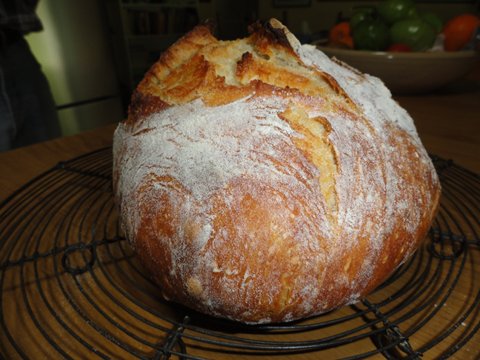
But this morning, apart from preparing the roast, I'll make bread rolls and clean out the fridge. The bed needs to be stripped and clean flannel sheets put on the bed. That will make one load of washing which I'll put on and Hanno will hang out. I washed three wool jumpers yesterday so hopefully they'll be dry enough to press and put away. While the press is hot, I'll also do a small pile of tablecloths and pillowslips sitting there. That's not the end of the ironing but the rest will have to wait a little longer. I don't want to spread myself too thin today. After we eat lunch, I'll wash up and surface clean the kitchen then sit down for an hour. There may be some knitting done then. I'm knitting Hanno some mittens in pure Merino with a strand of baby Alpaca for extra warmth. Since he had an accident with a chain saw and nearly cut off his hand, the circulation in that hand is a bit slow and it's always cold. These mittens are to warm up his hands while he's on the computer or watching TV.


After lunch, finally, I'll be able to do some work with the new plants and pots I bought on Tuesday. I'll start potting new plants in the pots and if time allows, I'll repot a few hanging baskets. On the weekend, I'll need Hanno's help to move some roses in the front garden so I can plant new salvia and Chinese lanterns where the roses once grew. There is a lot of pruning to be done out there but I think that's a weekend job too.


So many things to do, but I'll get to all of them, eventually. All of it has waited patiently for me for these past few months, another day or two will make no difference. I have to do a small amount of grocery shopping, dust and rearrange my cook books, bake a cake, scrub the outdoor table on the back verandah, clean and organise the green house, clean the bathrooms, make soap. Oh, the list could go on and on. I'm sure you know the score and have similar, if not identical, work in your home. It's nothing fancy, just ordinary day stuff, but it feels so good to be doing it again.  What are you doing today?
I'm slowly creeping back towards my real work. I have greeted the light at the end of the writing tunnel and while I still have some odds and ends to deal with this week, the bulk of the work is done. Yesterday I spent some time in the kitchen making spicy pineapple and chilli chutney, apple turnovers and a litre of fresh ginger syrup.  It feels good to get back to cooking whatever I like and not just what we'll eat that day. Housework and creative cooking keep my enrichment levels high.


Today I'll be reading and organising chapters in my file manager so I know where everything is. At the moment I have quite a few different versions of the same file and I want to sort them out immediately so I can delete what I don't need and safeguard what I hope are the treasures.

There won't be much time for housework today, tomorrow we plan on going out for lunch to celebrate, but on Wednesday, I'll look at getting back into some sort of routine. There is a lot to be done here and although Hanno was a great help while I've been writing, we've been operating on the bare essentials. I have some rooms to tidy up and I want to use the French press on a few household linens.  There is a lot of sewing to do, I'm taking on the grocery shopping again and I have a lifetime of gardening to start.

Years ago, when I first realised that housework would be the one thing that would shape my days and give meaning to the hours I spend here, homemaking became a significant part of my life. Not working how I usually do for the past six months has shown me, all over again, what this work has done for me. Of course there are some people who hate housework and there are some parts of it I don't like, but the work I do here in our little home makes me see sense in a sometimes nonsensical world. I've missed it.


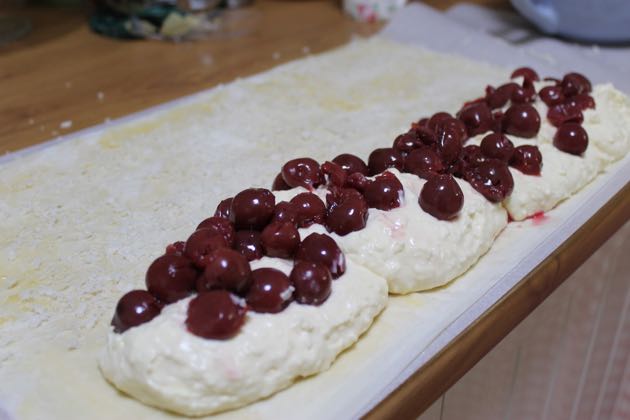
Last weekend, making cheese and cherry strudel.

Not much time for reading this week so it's a shorter list.  Last chapter due next Tuesday then a few bits and pieces after that to finish up. :- )  I hope you all have a lovely weekend.

Spectacular new species of waterlily discovered in Australia
New bird species discovered in China
Seven new species of miniature frogs discovered in cloud forests of Brazil
Our ageing population isn't a disaster. We have the tools to make it a triumph
No place like home
...aprons come off: time for tea - community baking
No knead bread recipe variations
How I simplified and organized my house, room by room
Joey doesn't leave his mum
Noticing
Plaiting/braiding garlic - You Tube

Recession is very interesting and thought provoking thread at the forum that has a lot of us thinking. Erica started it by writing:
I can't help feeling that we are in for a doozy of a recession, that it is not a matter of if, but of when. Having lived - and lost - through the recession we had to have, I am concerned to say the least.

What does everyone else think?

What is going on in your neck of the woods?

Do you notice a change coming?

Thank you all for the good wishes and prayers sent yesterday. My high temperature didn't rise or turn into anything worse. I started feeling better and things only improved after that. It's lovely to have friends who drop by and share their concerns. Thank you for taking the time to send a message or write a comment. Even though we're sometimes a world away from each other, this community is always a close and caring one.


As most of you know, I'm coming to the end of my book writing and have just started on the last chapter. It's been an intense period of sitting at my desk all day, almost every day for the past five months. I have only baked a couple of loaves of bread during that time and I haven't done much pickling or preserving either, but almost all the other culinary tasks I carry out have been done in between paragraphs or when I needed to get off the computer and think something over.


Soap and laundry liquid have been made, I cook from scratch every day and I enjoy time well spent in the garden with Jamie. Hanno has been a great help with washing up, grocery shopping, peeling vegetables and doing whatever I ask of him. But it is this life itself - simple life, that has help us through these busy months. If we weren't living slow and simple, I doubt I would have attempted another book, and I know I wouldn't have been able to do it in that timeframe. I sometimes hear people say that as soon as they get busy, they don't have time for simple living. I feel the opposite, it is because we live simply that I can cope so well with the busy and frantic times.


Simple life builds reliability and organisation into every day, it makes people who live this way resilient and strong. It does seem like more work and often it is but the work itself is its own safeguard. Our bills are paid on time because we've organised our money and created a budget, we have a stockpile of food on hand so we don't have to shop every week, we're healthy because we're eating from scratch and have rid our home of harsh chemicals, menus are planned, work is driven by easy routines, we're relaxed and accepting of everyday life. We know where we're headed.


I'm not sure if I would have been able to commit intellectually or psychologically to such a rigorous writing timeframe if I was living as I used to. But since I slowed down and came to understand myself a whole lot more, I knew I had the strength to do it, a family who would support me and a way of life that would help me cope with not only this, but anything that came my way.  This life has made me much stronger than I used to be, and that has given me the confidence to say yes to so many things that have enriched my soul.


And so to those who think you can only do all those simple life things when you have the time to do them, I encourage you to dive right in and just do it. Don't underestimate simple life, or yourself. You'll be surprised what a great support it becomes around you - from the practical things like a food stockpile to feed you when you can't buy what you need, and routines that help you get through your work, to the strength you need to move forward with confidence when things look shaky. Instead of thinking you can't have the life you want, just start doing things that will sustain you. Stop mindless shopping, create a budget, work in your home, develop a generous and kind attitude, let this new life create itself around you and then rely on it. It may not look like anyone else's life but that's fine. Genuine simplicity is a unique, flexible and moveable feast.

I'm sick, which is unusual for me. I felt okay on Saturday then by the time I went to bed, I was freezing but felt hot. Obviously a fever but our thermometer had a low battery so I couldn't take my temp. Hanno brought me two paracetamol. I had a hot shower, turned the electric blanket on high and still it took hours to warm up. And I kept waking every hour, so at 3am I gave up. Got up and got dressed and felt miserable for the next few hours. 

Yesterday I was still hot and freezing at the same time but kept working on the book while Hanno and Jamie went to the local university for World Environment Day. I was so tired while I sat at my desk, at one point I just caught myself as I fell asleep at the computer and my head started dropping towards the keyboard.  When Hanno came home I went to bed and fell into a deep sleep all afternoon.  I think it's a virus because otherwise, I feel healthy. I'll see how I go today and hopefully will be back here with you tomorrow.


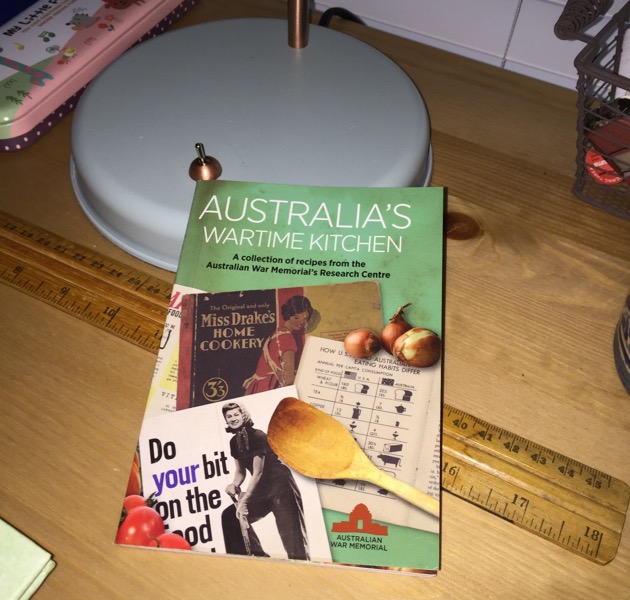
My friend Kathleen sent me this little book during the week. It's a collection of recipes from the Australian War Memorial's Research Centre and copyright to them (awm.gov.au). It's full of basic recipes from WW11 and pictures of posters used to promote austerity during the war.

Thanks for visiting me this week and for your comments.  I hope you have a wonderful weekend.

Berlin becomes first German city to make rent cap a reality
Havoc by Tim Winton
The Small, Happy Life
I ditched the quiet carriage in favour of crunchy crisps, kids and conversation
The Women's Institute to serve tea and cake at Glastonbury this year
Joe Biden's wise words on death
American Red Cross squandered aid
A Beginner’s Guide to Whittling
Want to enjoy the deep, mystical sleep of our ancestors?
Make Your Own Energy-Saving Thermal Curtains
diy: wool insoles

I should not complain. I know that. But here I go again. I want my old routines back. Once upon a time I had this very comfortable routine where I rose early, did a few outside tasks, had breakfast, made the bed, cleaned the kitchen and had bread on the rise before 9am. Starting each day with that unremarkable jumble of activities set me up for the day and seemed to launch me into hours of productivity and, occasionally, creativity.

Work was done, ordinary days were lived, life was simple.


Let me say before it's too late to include it that I know I'm fortunate to have the extraordinary opportunity to write a book. Knowing it's going to be read by a lot of people all over the world still makes me think: who? me!!  My publisher, Penguin Random House, is incredibly supportive. And yet I can hardly wait until the writing phase is over and I'm back to what I think of as my real life.


I long to get back to ordinary days just doing what needs doing around my home. I want to use my sewing machine to make what we need, I want to clean up my green house and repot baskets and pots and increase the number of plants on my front verandah until we can hardly move out there. I want to sit, read and talk to Jamie. This beautiful age will be over soon and maybe I'll forget that he makes me laugh by saying: "that's marvellous" or "it's bad news, grandma." He's so wise as his just turned four year old self, I want to pick his brain for more unforgettable things. I have much to tell him too.


I'm glad there is only a short time to go. In four weeks I'll be finished. Four weeks and my written message to you will be at Penguin with Jo and Andrea and they'll send it to the designer, send me samples and I'll become excited and proud once again. So maybe it's okay to be an old curmudgeon this one time - get it all out and then settle in for the final four weeks. I am really happy I chose a short writing period and met every deadline. And soon I'll have that book in my hands and know that putting my routines aside for six months was a small price because it will give us the chance to travel around again, talking to people and hopefully encouraging everyone to work to routines and be happy doing it.  ♥︎


When I first started living simply, I had to learn a lot and make many mistakes before I felt that I knew what I was doing. The mistakes were an important part of my reinvention. Learning that results from a mistake is the best kind of learning. Instead of working through a step-by-step process, you start with a problem and you have to analyse the steps and work out why you went wrong. That involves active thinking instead of plain old following the steps, and you remember it.


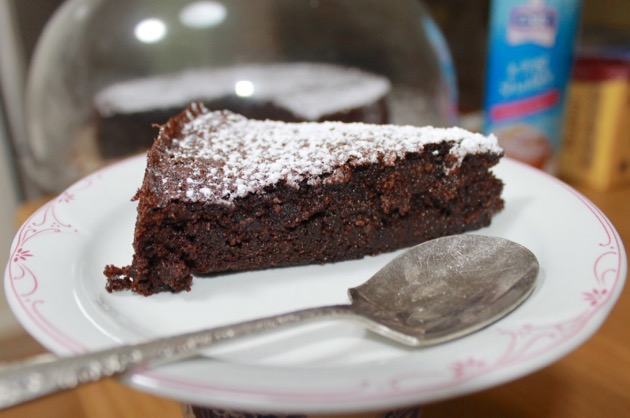
I made a chocolate cake the other day. It was supposed to be my usual Nigella-inspired gluten-free and dairy-free chocolate cake, made with almonds.  Oh dear.

The recipe is:
  • 150ml olive oil
  • ½ cup cocoa mixed with ½ cup boiling water
  • 2 teaspoons vanilla
  • 150 grams almond meal
  • ½ teaspoon bicarb soda
  • pinch salt
  • 200 grams castor sugar
  • 3 large eggs
Preheat the oven to 170C.
  1. Mix the cocoa and water together and stir until the cocoa has dissolved. Add the vanilla to the cocoa mix.
  2. In a medium bowl, add almonds, bicarb and salt and mix together.
  3. Into a mixer bowl, add the sugar, oil and eggs and beat on high for 3 minutes, when it will be light and fluffy. Pour in the cocoa mixture and mix in.
  4. Take the mixer bowl off the stand and fold in the almonds, bicarb and salt.
  5. Pour mixture into a prepared round cake tin that has been oiled on the sides and has a round of paper on the base.
  6. Bake in oven for about 40 minutes.
The cake will rise up in the oven and deflate a little when it comes out.

And that last line alerted me to my mistake. My cake hadn't risen much. I went through the steps again in my mind and realised I hadn't added the oil.  So my cake was gluten-free, dairy-free and oil-free. LOL And it was delicious. It was moistly, densely, heavenly chocolate.

So this time my mistakes have taught me to pay more attention to what I'm doing and that leaving an ingredient out isn't always a catastrophe. Although don't bake bread without yeast because that always is.

Newer Posts Older Posts Home

MY BOOKS

MY BOOKS


My books were all published by Pengiun, and are available at Amazon US, Amazon UK and Amazon Au

Search here

Total Pageviews

Translate


I'm Rhonda Hetzel and I've been writing my Down to Earth blog since 2007. Although I write the occasional philosophical post, my main topics include home cooking, happiness and gardening as well as budgeting, baking, ageing, generosity, mending and handmade crafts. I hope you enjoy your time here.

MY FAVOURITE PLACES

  • Grandma Donna's Place
  • Grandma Donna's YouTube
  • Grandma Donna's Instagram
  • This Simple Day
  • Nicole's Instagram

Give More

Give More

Popular posts last year

Making ginger beer from scratch

We had a nice supply of ginger beer going over Christmas. It's a delicious soft drink for young and old, although there is an alcoholic version that can be made with a slight variation on the recipe. Ginger beer is a naturally fermented drink that is easy to make - with ginger beer you make a starter called a ginger beer plant and after it has fermented, you add that to sweet water and lemon juice. Like sourdough, it must ferment to give it that sharp fizz. To make a ginger beer plant you'll need ginger - either the powdered dry variety or fresh ginger, sugar, rainwater or tap water that has stood for 24 hours to allow the chlorine to evaporate off. You'll also need clean plastic bottles that have been scrubbed with soap, hot water and a bottle brush and then rinsed with hot water. I never sterilise my bottles and I haven't had any problems. If you intend to keep the ginger beer for a long time, I'd suggest you sterilise your bottles. MAKING THE STARTER In a...
Image

NOT the last post

This will be my last post here.  I've been writing my blog for 18 years and now is the time to step back. I’ve stopped writing the blog and come back a couple of times because so many people wanted it, but that won’t happen again, I won’t be back.  I’ll continue on instagram to remain connected but I don’t know how frequent that will be. I know some of you will be interested to know the blog's statistics. 
Image

How to make cold process soap

I'm sure many of you are wondering: "Why make soap when I can buy it cheaply at the supermarket?" My cold process soap is made with vegetable oils and when it is made and cured, it contains no harsh chemicals or dyes. Often commercial soap is made with tallow (animal fat) and contains synthetic fragrance and dye and retains almost no glycerin. Glycerin is a natural emollient that helps with the lather and moisturises the skin. The makers of commercial soaps extract the glycerin and sell it as a separate product as it's more valuable than the soap. Then they add chemicals to make the soap lather. Crazy. Making your own soap allows you to add whatever you want to add. If you want a plain and pure soap, as I do, you can have that, or you can start with the plain soap and add colour, herbs and fragrance. The choice is yours. I want to add a little about animal and bird fat. I know Kirsty makes her soap with duck fat and I think that's great. I think t...
Image

Preserving food in a traditional way - pickling beetroot

I've had a number of emails from readers who want to start preserving food in jars but don't know where to start or what equipment to buy.  Leading on from yesterday's post, let's just say up front - don't buy any equipment. Once you know what you're doing and that you enjoy preserving, then you can decide whether or not to buy extra equipment. Food is preserved effectively without refrigeration by a variety of different methods. A few of the traditional methods are drying, fermentation, smoking, salting or by adding vinegar and sugar to the food - pickling. This last method is what we're talking about today. Vinegar and sugar are natural preservatives and adding one or both to food sets up an environment that bacteria and yeasts can't grow in. If you make the vinegar and sugar mix palatable, you can put up jars of vegetables or fruit that enhance the flavour of the food and can be stored in a cupboard or fridge for months. Other traditional w...
Image

Cleaning mould from walls and fabrics

With all this rain around we've developed a mould problem in our home. Usually we have the front and back doors open and that good ventilation stops most moulds from establishing. However, with the house locked up for the past week, the high humidity and the rain, mould is now growing on the wooden walls near our front door and on the lower parts of cupboards in the kitchen. Most of us will find mould growing in our homes at some point. Either in the bathroom or, in humid climates, on the walls, like we have now. You'll need a safe and effective remedy at some point, so I hope one of these methods works well for you. Mould is not only ugly to look at, it can cause health problems so if you see mould growing, do something about it straight away. The longer you leave the problem, the harder it will be to get rid of it effectively. If you have asthma or any allergies, you should do this type of cleaning with a face mask on so you don't breathe in any spores. Many peopl...
Image

Five minute bread

Bread is one of those foods that, when made with your own hands, gives a great deal of satisfaction and delight. It's only flour and water but it symbolises so much. I bake bread most days and use a variety of flours that I buy in bulk. Often I make a sandwich loaf because we use most of our bread for lunchtime sandwiches and for toast. Every so often I branch out to make a different type of loaf. I have tried sour dough in the past but I've not been happy with any of them. I'll continue to experiment with sour dough because I like the idea of using wild yeasts and saving the starter over a number of years to develop the flavour and become a part of the family. However, the loaf I've been branching out to most often is just a plain old five minute bread. By five minutes I mean it takes about five minutes actual work to prepare but it's the easiest of all bread to make and to get consistently good loaves from. If you're having people around for lunch or...
Image

This is my last post.

I have known for a while that this post was coming, but I didn't know when. This is my last post. I'm closing my blog, for good, and I'm not coming back like I have in the past.  I've been writing here for 16 years and my blog has been many things to me. It helped me change my life, it introduced me to so many good people, it became a wonderful record of my family life, it helped me get a book contract with Penguin, and monthly columns with The Australian Women's Weekly and Burke's Backyard . But in the past few months, it's become a burden. In April, I'll be 75 years old and I hope I've got another ten years ahead. However, each year I'll probably get weaker and although I'm fairly healthy, I do have a benign brain tumour and that could start growing. There are so many things I want to do and with time running out, leaving the blog behind gives me time to do the things that give me pleasure. On the day the blog started I felt a wonderful, h...
Image

What is the role of the homemaker in later years?

An email came from a US reader, Abby, who asked about being a homemaker in later years. This is part of what she wrote: "I am a stay-at-home mum to 4 children, ages 9-16. I do have a variety of "odd jobs" that I enjoy - I run a small "before-school" morning drop-off daycare from my home, I am a writing tutor, and I work a few hours a week at a local children's bookstore. But mostly, I cherish my blissful days at home - cooking, cleaning (with homemade cleaners), taking care of our children and chickens and goats, baking, meal-planning, etc. This "career" at home is not at all what I imagined during my ambitious years at university, but it is far more enriching. I notice, though, that my day is often planned around the needs of my family members. Of course, with 4 active kids and a husband, this is natural. I do the shopping, plan my meals, cook dinner - generally in anticipation of my family reconnecting in the evening.  I can't h...
Image

Every morning at home

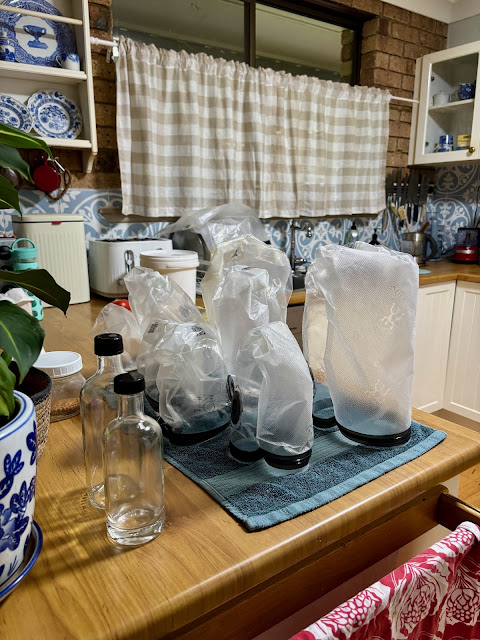
Every morning when I walk into my kitchen it looks tidy and ready for a day's work. Not so on this morning (above), I saw this when I walked in. Late the previous afternoon when I was looking for something, I came across my rolled up Zwilling vacuum bags and decided they had to be washed and dried. So I did that and although I usually put them outside on the verandah to dry it was dark by then. I turned the just-washed bags inside out and left them like this on a towel. It worked well and now the bags are ready to use when I bring home root vegetables, cabbages or whatever I buy that I want to last four or five weeks.
Image

You’ll save money by going back to basics

When I was doing the workshops and solo sessions, I had a couple of people whose main focus was on creating the fastest way to set up a simple life. You can't create a simple life fast, it's the opposite of that It's not one single thing either - it's a number of smaller, simpler activities that combine to create a life that reflects your values; and that takes a long to come together. When I first started living simply I took an entire year to work out our food - buying it, storing it, cooking it, preserving, baking, freezing, and growing it in the backyard. This is change that will transform how you live and it can't be rushed.  
Image

All previous blog posts

  • 2026 3
    • February 3
      • Workshops starting 1 March
      • Planting vegetable seeds and new workshops
      • Back where we belong
  • 2025 7
    • July 1
    • June 2
    • May 1
    • April 2
    • February 1
  • 2024 25
    • December 2
    • November 1
    • October 2
    • September 3
    • August 1
    • July 3
    • June 1
    • May 3
    • April 2
    • March 3
    • February 2
    • January 2
  • 2023 13
    • December 1
    • November 2
    • October 1
    • September 3
    • August 2
    • February 2
    • January 2
  • 2022 17
    • November 3
    • October 4
    • September 3
    • August 2
    • July 3
    • June 2
  • 2021 50
    • December 1
    • November 6
    • October 7
    • September 5
    • August 4
    • July 5
    • June 2
    • May 2
    • April 6
    • March 4
    • February 4
    • January 4
  • 2020 68
    • December 3
    • November 5
    • October 4
    • September 4
    • August 4
    • July 4
    • June 4
    • May 8
    • April 7
    • March 8
    • February 8
    • January 9
  • 2019 66
    • December 2
    • November 4
    • October 5
    • August 3
    • July 4
    • June 6
    • May 8
    • April 8
    • March 8
    • February 11
    • January 7
  • 2018 82
    • December 1
    • September 2
    • August 10
    • July 4
    • June 11
    • May 9
    • April 12
    • March 10
    • February 10
    • January 13
  • 2017 129
    • December 7
    • November 10
    • October 6
    • September 13
    • August 11
    • July 13
    • June 12
    • May 9
    • April 9
    • March 14
    • February 11
    • January 14
  • 2016 125
    • December 7
    • November 13
    • October 10
    • September 11
    • August 11
    • July 8
    • June 9
    • May 9
    • April 12
    • March 10
    • February 13
    • January 12
  • 2015 184
    • December 7
    • November 15
    • October 20
    • September 18
    • August 19
    • July 18
    • June 12
    • May 15
    • April 12
    • March 21
    • February 13
    • January 14
  • 2014 203
    • December 11
    • November 8
    • October 17
    • September 20
    • August 17
    • July 19
    • June 17
    • May 17
    • April 23
    • March 15
    • February 18
    • January 21
  • 2013 225
    • December 13
    • November 17
    • October 17
    • September 17
    • August 21
    • July 24
    • June 20
    • May 19
    • April 17
    • March 22
    • February 17
    • January 21
  • 2012 245
    • December 17
    • November 20
    • October 20
    • September 18
    • August 15
    • July 24
    • June 21
    • May 26
    • April 23
    • March 23
    • February 19
    • January 19
  • 2011 257
    • December 18
    • November 24
    • October 27
    • September 23
    • August 24
    • July 21
    • June 24
    • May 24
    • April 16
    • March 22
    • February 14
    • January 20
  • 2010 283
    • December 20
    • November 18
    • October 18
    • September 19
    • August 25
    • July 24
    • June 25
    • May 26
    • April 25
    • March 22
    • February 29
    • January 32
  • 2009 293
    • December 29
    • November 18
    • October 23
    • September 25
    • August 22
    • July 28
    • June 22
    • May 21
    • April 27
    • March 26
    • February 24
    • January 28
  • 2008 387
    • December 24
    • November 23
    • October 25
    • September 26
    • August 27
    • July 27
    • June 37
    • May 34
    • April 44
    • March 53
    • February 32
    • January 35
  • 2007 372
    • December 37
    • November 40
    • October 55
    • September 51
    • August 49
    • July 63
    • June 49
    • May 28


Trending Articles

NOT the last post

This will be my last post here.  I've been writing my blog for 18 years and now is the time to step back. I’ve stopped writing the blog and come back a couple of times because so many people wanted it, but that won’t happen again, I won’t be back.  I’ll continue on instagram to remain connected but I don’t know how frequent that will be. I know some of you will be interested to know the blog's statistics. 
Image

Every morning at home

Every morning when I walk into my kitchen it looks tidy and ready for a day's work. Not so on this morning (above), I saw this when I walked in. Late the previous afternoon when I was looking for something, I came across my rolled up Zwilling vacuum bags and decided they had to be washed and dried. So I did that and although I usually put them outside on the verandah to dry it was dark by then. I turned the just-washed bags inside out and left them like this on a towel. It worked well and now the bags are ready to use when I bring home root vegetables, cabbages or whatever I buy that I want to last four or five weeks.
Image

You’ll save money by going back to basics

When I was doing the workshops and solo sessions, I had a couple of people whose main focus was on creating the fastest way to set up a simple life. You can't create a simple life fast, it's the opposite of that It's not one single thing either - it's a number of smaller, simpler activities that combine to create a life that reflects your values; and that takes a long to come together. When I first started living simply I took an entire year to work out our food - buying it, storing it, cooking it, preserving, baking, freezing, and growing it in the backyard. This is change that will transform how you live and it can't be rushed.  
Image

Creating a home you'll love forever

Living simply is the answer to just about everything. It reduces the cost of living; it keeps you focused on being careful with resources such as water and electricity; it reminds you to not waste food; it encourages you to store food so you don't waste it and doing all those things brings routine and rhythm to your daily life. Consciously connecting every day with the activities and tasks that create simple life reminds you to look for the meaning and beauty that normal daily life holds.  It's all there in your home if you look for it. Seemingly mundane tasks like cleaning and cooking help you with that connection for without those tasks, the home you want to live in won't exist in the way you want it to.  Creating a home you love will make you happy and satisfied.
Image

Time changes everything

I've been spending time in the backyard lately creating a contained herb and vegetable garden. My aim is to develop a comfortable place to spend time, relax, increase biodiversity and encourage more animals, birds and insects to live here or visit. Of course I'd prefer my old garden which was put together by Hanno with ease and German precision. Together, we created a space bursting at the seams with herbs, vegetables and fruity goodness ready to eat and share throughout the year. But time changes everything. What I'm planning on doing now, is a brilliant opportunity for an almost 80 year old with balance issues. In my new garden I'll be able to do a wide range of challenging or easy work, depending on how I feel each day. It’s a daily opportunity to push myself or sit back, watch what's happening around me and be captivated by memories or the scope of what's yet to come.
Image

It's the old ways I love the most

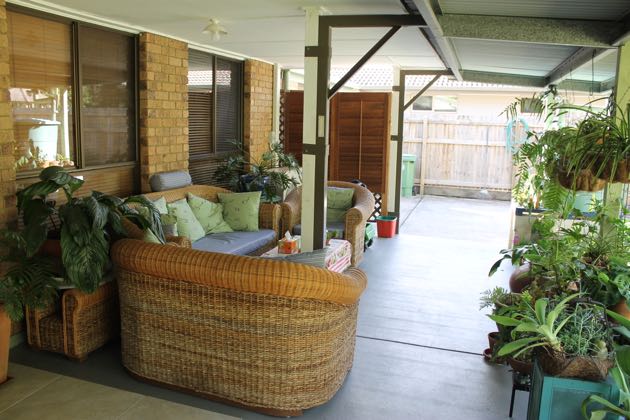
I'm a practical woman who lives in a 1980’s brick slab house. There are verandahs front and back so I have places to sit outside when it's hot or cold. Those verandahs tend to make the house darker than it would be but they're been a great investment over time because they made the house more liveable. My home is not a romantic cottage, nor a minimalist modern home, it's a 1980’s brick slab house. And yet when people visit me here they tell me how warm and cosy my home is and that they feel comforted by being here. I've thought about that over the years and I'm convinced now that the style of a home isn't what appeals to people. What they love is the feeling within that home and whether it's nurturing the people who live there.
Image

Back where we belong

Surprise! I'm back ... for good this time. Instagram became an impossible place for me. They kept sending me messages asking if I'd make my page available for advertisers! Of course, I said no but that didn't stop them. It's such a change from what Instagram started as. But enough of that, the important part of this post is to explain why I returned here instead of taking my writing offline for good. For a few years Grandma Donna and I have talked online face-to-face and it's been such a pleasure for me to get to know her. We have a lot in common. We both feel a responsibility to share what we know with others. With the cost of living crisis, learning how to cook from scratch, appreciate the work we do in our homes, shop to a budget and pay off debt will help people grow stronger. The best place to do that is our blogs because we have no advertising police harassing us, the space is unlimited, we can put up tons of photos when we want to and, well, it just feels li...
Image

Making ginger beer from scratch

We had a nice supply of ginger beer going over Christmas. It's a delicious soft drink for young and old, although there is an alcoholic version that can be made with a slight variation on the recipe. Ginger beer is a naturally fermented drink that is easy to make - with ginger beer you make a starter called a ginger beer plant and after it has fermented, you add that to sweet water and lemon juice. Like sourdough, it must ferment to give it that sharp fizz. To make a ginger beer plant you'll need ginger - either the powdered dry variety or fresh ginger, sugar, rainwater or tap water that has stood for 24 hours to allow the chlorine to evaporate off. You'll also need clean plastic bottles that have been scrubbed with soap, hot water and a bottle brush and then rinsed with hot water. I never sterilise my bottles and I haven't had any problems. If you intend to keep the ginger beer for a long time, I'd suggest you sterilise your bottles. MAKING THE STARTER In a...
Image