down to earth

  • Home
  • About Us
  • Down To Earth Book
  • Privacy Policy
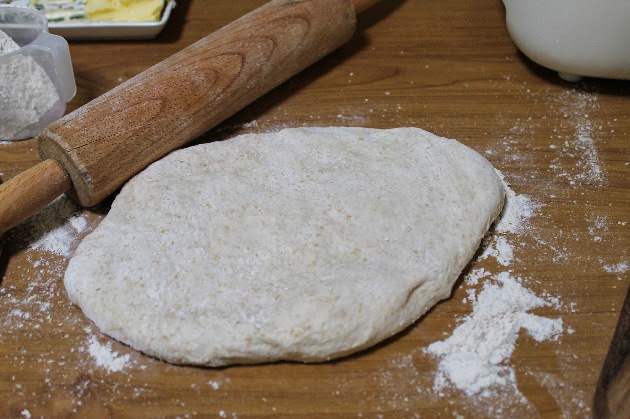
I've spent the past few days baking, sewing and knitting. They are such simple, old-fashioned tasks and I know my great grandmothers (and yours) would have been doing something very similar over the years, way back when. I like how these older tasks so easily fit into modern times, filling life with interest, meaning and purpose; and replacing acquisition for many of us. You see it more and more now - younger women and men taking up the needles, learning how to bake and cook, and being satisfied and enriched by it. I am so pleased this is happening because it means that these traditionally women's tasks and crafts will go on and can be passed on to younger girls and boys, women and men.

 Date scones - a winter favourite here.


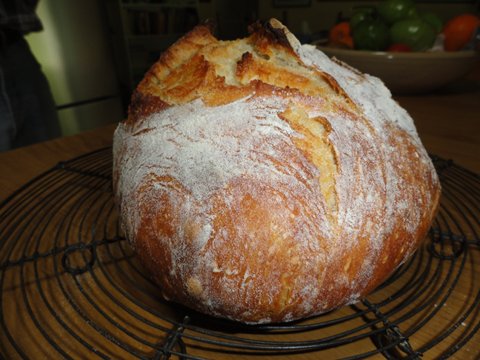
As well as that connection I have with older times and the interest and purpose these tasks give me now, baking, sewing and knitting/crochet also help me cut my household costs. Buying bread flour in bulk helps me produce good bread for my family for less than the five or six dollars a loaf from a good bakery. I completely bypass the supermarket sliced bread, and have done for many years, because I don't want the artificial flavourings and preservatives that come with it, or the plastic it's wrapped in. I believe I can make a loaf of equal quality to that from a good bakery and although I haven't costed it for a few years, I guess it would cost me about three dollars for a good loaf baked at home. It's a saving of about five hundred dollars per year based on three loaves a week.


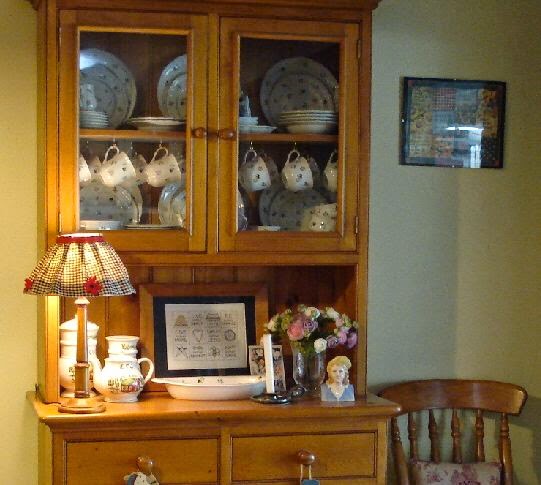
Similar savings can be made if you have a yarn and fabric stash. Making gifts and the soft furnishings you need at home using the fabric from your stash will save you a decent amount each year. Over the weekend I made a lamp shade using fabric I had here. It's much prettier than any I could have bought, I have unusual taste in these things and I doubt I would have been able to buy anything close to what I like, so it's a win-win. I save money and I also get a lamp shade that suits my taste and blends in beautifully with what we already have here.  I'm also using resources I have on hand, don't have to go out to buy what I need and the icing on the cake is the satisfaction I feel when I look at that lamp. Not just now but into the future as well.


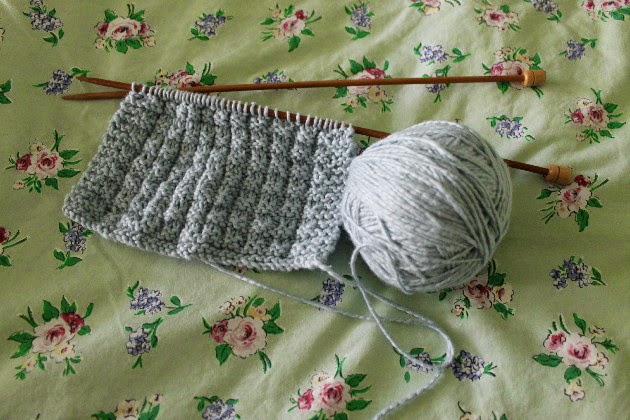
We will welcome a new baby into our family soon. Tricia's son Danny and his partner Laura are expecting a daughter and as part of a gift for the baby, I've started knitting a little dark pink hat. It's a washable, organic wool and cotton blend, done on straight needles, because I didn't have a suitably sized pair of circular needles on hand. I hope it helps keep the baby warm because she will live in the Blue Mountains where it's very cold. Once again, I had the yarn and needles here, so getting our gift underway hasn't cost anything. I love being able to welcome a baby with home knitting.

It's a worthwhile exercise to collect any fabrics or yarn anyone offers you over the years. You might also find inexpensive fabric and yarns at your local second-hand shops. Even if you have no projects in mind, building a stash will help you when you do need something. Having the materials on hand helps you cut your costs, it inspires creativity, it gives that all important feeling of self-reliance and if, like me, you believe that homemade comes from the heart, your gifts will be a fine indication of your feelings towards the person you give your gift to.

I think of my stash as another form of stockpiling. It saves time and money and allows me to have my own materials on hand when I need them. Are you using your stash for your projects too or are you trying to build up a stash?
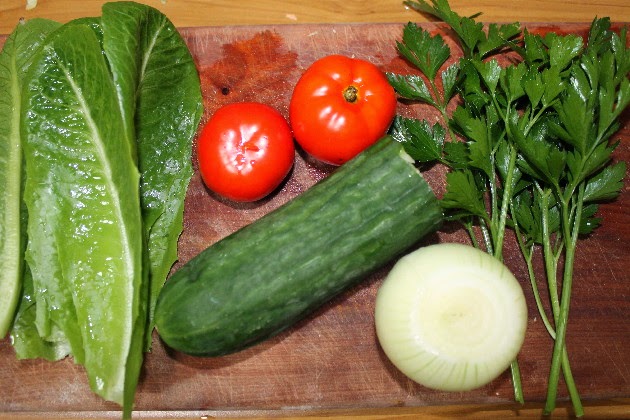
Brrrr, it's cold here this morning but it should warm up later with a sunny day. I hope if your weather is cold, you have warm soup, gloves and jumpers on hand. I hope if it's warm where you are that you have salads, cold drinks and a fan. But who knows what could happen. With the weather the way it is, we don't always get what is expected.

Thank you for your visits this week, and for your comments. Comments mean a lot more than a few words on a screen. It's like you're taking the time to wave back and say "hello, I'm here too!" Those of us who write blogs, need that. Not just me, we all need it.  Whatever you're doing this weekend, take some time for yourself, sit down and relax for a while. The work will still be there when you get back to it.

- - - ♥︎ - - -

Having a baby will simplify your life
CWA halls closing
Pop into Nundle tea cosy
Washington DC is banning polystyrene containers
How to read olive oil labels
Living life on a simple note
Where are all the mothers?
When kids share a room, awesome things happen (apologies for using the word "awesome")
And carrying on from the previous link, here is something I wrote in 2007 about old fashioned houses
Thrifty gardener's guide to companion planting
The revolution - axing our personal debt
I received an email from a young woman the other day who told me that she's so conflicted about a choice she has to make that she's deliberately not thinking about it and she'll probably end up just flipping a coin to decide. She said by doing that she'll be getting what is meant to be. Phttttt! I don't believe in fate or coincidence. I believe we make our own luck and good fortune by working for what we want. Usually the decisions we have to make are those involving your work, family, friends and home so you should do as much thinking about those decisions as you can. The choices you make, whether they be good choices or bad, will impact you when you make them, and like a ripple on a pond, long into the future too. Flipping a coin to make a decision is like saying you're not worth the effort. Everything you do matters.


Flipping a coin and deliberately not thinking about important issues is side stepping the opportunity you have to make your own decisions. I encourage all of you to plan ahead and live according to your values. Own your life! This isn't a dress rehearsal. You don't want to realise that too late.  Plan your life as best you can, but be flexible when you have to be. Planning ahead will give you the best chance of success because you can actively work towards what you want. Non-planning really doesn't take the decision making out of your hands, there will still be an outcome. You're making the choice to not make a decision and then you have to take what comes of that.


When I look back and think of all the people I've met, the work I've done, the places I've seen, the time spent on such a wide variety of things, the countless hours I've spent raising babies and children and teens, the years I've spent working, I can see clearly that my path to here was never straight. It was one with curves, highs and lows, periods of intense happiness but also periods so dark I could barely see what was ahead. Some of my choices were not given enough thought and some just plain wrong, but all those past choices helped make me the person I am now. Sometimes I look back I wonder where all that energy came from, and where it went. I've tried many things, left most of them behind, and am here now with my basket full of what is important to me. I am happy and self-confident and I have the most wonderful family.


So to that young woman who wrote, and to all of you, I encourage you to think about what you want, work hard for it, plan your days and make the most of the intelligence, skill and talents you have. Stay close to your family and friends. I'm not saying this is easy, in fact, I know its not, but since when was the easy option the smart one? No matter what, when you think enough about the issue you're dealing with and then make the decision you need to make, own it, and then put in the effort to make it work.

Are you a decision maker or are you inclined to flip a coin?


I have a couple of food recipes for you today. I love sharing my recipes, they're just plain and simple, but I get a thrill when people say they like them. I really should say I have one recipe because one is for pizza and I don't think you can recommend a recipe for that because everyone has their own ideal toppings. I, for instance, love anchovies on my pizza but most people's eyes glaze over when I say that. Apologies to all with weak stomachs.  


I do however, have a hint for a base that might make pizza night easier for you. When I know I'm going to have pizza during a particular week, when I make my next batch of bread, I add another cup of flour, more water, a pinch more yeast and a splash of olive oil. Oil or butter in dough makes the dough more tender and pliable so it's easier to roll out flat when preparing pizza. It doesn't spoil the bread by adding it. When the dough is made in the bread machine, I take off a piece big enough for one pizza base and freeze it or refrigerate it (depending on when I'll be making it) until it's needed. It saves me the extra step on the pizza night of making the dough. I've been making wholemeal dough lately but pizza dough can be made with any type of bread flour. I should remind you the pizza dough I make is for two people. Adjust yours according to the number of bases you need.


My other recipe is for sausage rolls. These are sold in almost every bakery in Australia and when my boys where young, they were always the most popular food I served at their birthday parties. They're a good standby to have when you're entertaining, especially on cold winter nights. I guarantee you, when you put out a tray of hot sausage rolls and a bowl of tomato sauce, they're be gone in less than five minutes. 


Men and boys in particular, love these and it's a great food for those parents here who like to hide vegetables.  I add carrot, onion and celery to mine and you'd never know it when they're cooked. They're a very devious party food. ;- )  I make most of my pasty but I never make puff pastry or filo pastry. These sausage rolls need two sheets of frozen puff pastry.

SAUSAGE ROLLS
1 kg/2.2 lbs finely minced beef, pork, lamb or chicken
1 medium onion, finely chopped
1 medium carrot, grated
1 stick celery, finely diced
salt and pepper - you need good seasoning in this, don't be shy with the salt and pepper

2 sheets frozen puff pastry
egg wash - egg wash is an egg yolk or a whole egg mixed with a little water


  1. Turn on your oven to 220C/430F to preheat. Puff pastry gets its flaky texture when cold pastry goes into a very hot oven.
  2. Place two sheets of pastry on the bench and cut into two even pieces. Make sure the pastry remains cold. You want it defrosted but not at room temperature.
  3. Combine the meat and whatever finely diced vegetables you're using in a large bowl, add the seasoning. 
  4. Mix well and when it's thoroughly combined run the meat mixture in a narrow sausage along the middle of the pastry. (See photo above.)
  5. Brush the side of the pastry with egg wash to help the pastry seal.
  6. Roll up the sausage roll in a long log shape, make sure it seals along the edges where the pastry meets.
  7. With a pastry brush, brush egg wash over the top of the rolls.
  8. Cut the rolls into the size you need them to be.
  9. Make three small slashes in the top of every sausage roll.
  10. Place on a baking tray, not touching, and place into the hot oven. 
  11. After five minutes, turn the heat down to 180C/355F and cook until golden brown.
  12. Cool on a rack for a couple of minutes before serving.

In addition to hiding the vegies in these rolls, you can also modify them if you're serving a large tray of them at a party. Divide your ingredients up and make three different batches.  Do one according to the recipe above, add one level teaspoon of cayenne pepper OR one finely diced green chilli to batch number two and one level tablespoon of curry powder to batch three. Delicious! Be prepared for a couple of your guests to ask for the recipe. I hope you enjoy them.

One of the ongoing comments I've had since I started writing my blog, and also in my real life, is that simple life isn't that simple. Many people tell me that spending hours growing and preparing food and cleaning products is much more complicated that buying mainstream from the supermarket. Many of them tell me that they're too busy to do those things and that buying what is needed every week simplifies their lives because it's easier.


That's fine by me. I'm not trying to convince anyone that this way of living is the grand panacea for all of life's complexities. I think that to live a simple life, at the very least, you need to cut out or cut back on a variety of things, but how you do that is up to you. I know what works for me and my family and that is how I live. We have cut our environmental footprint considerably over the past 12 - 13 years and we've done it consistently. If you're doing the same thing then you're on the right track. 


I've thought about this a lot and I know the following are simplified by doing them at home, from scratch:
  • baking bread
  • making preserves
  • growing vegetables and some fruit
  • keeping chickens for eggs
  • making cleaning products and laundry liquid
  • making soap
  • cooking from scratch
  • baking from scratch
  • disposing of disposables
  • mending
  • knitting dishcloths, jumpers, cardigans, gloves, hats etc
That list could go on and on.

Let me explain my beliefs. When I bake bread at home, I buy bulk flour in a heavy paper bag, bulk yeast (or I make sour dough), and I add things I have on hand for other purposes - oats, butter, salt, sugar, nuts, seeds etc. So I buy two products specific to bread making, that I buy every couple of months, and I have the rest on hand. Making a loaf of bread takes me about 15 minutes in work time. I make the dough in the bread maker and then bake the dough in the oven. That way I get a delicious loaf without too much time given over to it.  My electricity comes form solar panels.


To buy a loaf of bread at the supermarket, I have to drive to the supermarket and buy the bread - every day if I want fresh bread every day. That bread will have been made in some far off factory that is staffed by people who probably all used fuel to get to the factory, it will be loaded with preservatives and other artificial additives. It will be packaged in plastic with a plastic clip to hold the bag closed.  All the ingredients for the bread will have been transported to the factory, the rolls of plastic or bread bags will have been transported to the factory as well. When the bread is made and wrapped, then it's transported to the supermarket, where I drive to buy it. That's a lot of fuel being used for something that can easily be made at home. It's a lot of artificial additives too - I'm sure you don't add preservatives and artificial flavourings to your bread at home, neither do I. It's not necessary when you make it yourself.


The same could be said for every product on that list. I buy the ingredients, yarn or fabrics a few times a year and they are stored in my home till they're needed. Of course it looks simpler when you think you're just going to the shop to buy those goods, but they're all come from somewhere, they all have a chain of production and delivery, and varying amounts of fossil fuels attached to them. That is not simple, in fact it's extremely complex and unsustainable.

Some tell me they frequently use disposable products - that they save time. I've turned my back on as many disposable products as I can and my housework takes the same amount of time as it did before. Disposables don't save time, they're more convenient, yes, less messy, yes, but also unsustainable and much more expensive. Making do with what we can produce here at home has cut down the amount of rubbish we send to the land fill as well. If I was shopping like I did all those years ago, I'd be sending full bins and not composting or recycling anything at home, and still working to pay for it all.


"Simple" shouldn't be confused with "more convenient" or "easy". Simple usually involves you doing some form of work - to bake the bread, milk the cow, make the cheese, kill the pig, harvest the tomatoes, peel the potatoes, cook the meat, pack the lunch, fill the water bottles, knit the cardigan, darn the socks or whatever. More convenient is getting someone else to do those things for you, or buying the same thing over and over again. It is easier, and it might seem more simple to drive to the shop to pick up all those things, but think about what's gone on to get all those products on the supermarket shelves, all the fuel used to deliver the raw ingredients to the factories, all the people and fuel needed to process the products and to get the people to the factories and the products from the factories to the shops.

There are many definitions of simple living but I think it means taking control of your own life and becoming self reliant in many different ways. Through that self reliance comes the opportunity to pay off debt, to live on less money, to connect with your family and friends and to have your home and family as the centre of your world. Home, family, friends and your community become your focus and the commercial world and the flimflammery of modern life take a back seat. But that's my view, how do you define simple life?


It's been a cold week here in our warm country. We desperately need rain but the forecast isn't offering any hope of that in the near future. I hope the weather at your home is what you want it to be.  I do my last library talk at Nambour next week and then have some scheduled for September in the Moreton Bay area. I'm looking forward to meeting those Brisbane people.

I hope you have a wonderful weekend. Keep smiling. :- )

Cute cotton summer top for a little girl - tutorial from Purl Bee
Experimenting with viruses
Context Institute: whole system pathways to a thriving sustainable future
Good and Cheap - a free download of what look like excellent meals by Leanne Brown
Tips for photographing chickens
McClennan Heritage Farm 
From Scratch free online homesteading magazine
Mara shawl pattern
Reinforcing and darning
Short row spiral knitting - rug, free pattern
Germany breaks solar power records
Where do your donation dollars go?


I've yet to find a more comfortable winter activity than knitting. Just thinking about my wool, cotton and needles gives me a good feeling. And then there's the important choice of where to knit. Even though knitting is so portable when you take the kids to sport or dancing, a little warm chair to knit in is part of winter for me. I have an arm chair set up in the lounge room where I'm surrounded by knitting, needles, wool, patterns, a little jar of markers, a darning needle and small scissors. Bliss.


Alone is a good place to be when you knit because you sometimes need silence to explore the ideas that will form in your brain when you undertake the simple repetition that makes up knitting. Some say that knitting is similar to crochet and I suppose that's right in some ways, but to me, knitting is more like meditation. The long periods of repetition encourage thought that can sometimes be deep and illuminating. But showing her true versatility, knitting will also see you through your favourite TV program, a tennis match or rehearsal.

These photos, above and below, are the same shawl. I'm not sure what happened to the colour but the top one is true.

I've just finished my second shawl. It was very simple knitting, ideal for a beginner who wants to progress beyond scarves and dish cloths. I made both of mine with organic cotton, one in the colour Diligence, a dark grey and the most recent in Patience, a camel light brown. I thought a lot about those two qualities while I was knitting my shawls.  I'm also doing up a few dishcloths to show at my library talks. The one on my needles now is Deb's waffle weave, which is in my book and was asked about at one of the talks. I recently knitted a pair of fingerless mittens (in New Zealand pure Merino) for Hanno but when I finished them and gave them to him I noticed I'd knitted one in a greenish grey and one in a bluish grey. Ahem. I guess I'll be doing up another pair. They'll match this time. :- )


Knitting is a wonderfully creative investment of time in the practical activity of making clothing and soft furnishing for your home. Generally the clothes we knit last for many years so it's wise to use the best yarn you can afford. That yarn will be rubbing against skin when it's worn so try to steer clear of the Chinese acrylics and look for more natural alternatives. Real wool breathes, real cotton is cooling. But think about the time you invest in knitting too and make that time enjoyable by using yarns you like the feel of. Use good needles. I'm totally won over by bamboo needles and although I have metal, wood and vintage plastic, I always choose my Japanese bamboo needles now. I've noticed that Japanese needle sizes are alongside the UK and US sizes on various charts now. I think that reflects the incredible influence that Japanese crafts, fabrics and implements have had in the West in recent years.

I am not the best knitter in the world and my projects are rarely, if ever, perfect, but knitting makes me happy so I'll keep clicking those needles. I really enjoy the time I spend making things from wool and cotton. It feels right. It suits me and my life. If you're a beginner, and you're looking for help and encouragement you'll find it at the forum. There is a monthly thread where members show and tell their latest projects. Chel and Judy are there to keep your hands busy and your mind thinking creatively while the rest of us appreciate all you show us.

What's on your needles?

Purl Bee's knitting tutorials and knitting terms
Purl Bee's knitted home projects
How to knit a bag
Knitting ideas
I have no doubt that a change of mindset towards a less complicated and busy life would help almost everyone pursue their simple life dreams. It's not easy to switch from the culturally-sanctioned spend-up-big-and-then-pay-for-it lifestyle to a simpler life. Almost all good things are difficult to acquire and you have to be prepared to work for them. The easy things are what most people do. So if you were to ask me today how to change a mindset of convenience to something more sustainable, I'd tell you that, like most things, it's a process of small changes.


There is a lot to be said for cultivating respect for oneself, others, our work, our homes and our environments. I doubt you could live this life if there wasn't some respect there to begin with but as you move into it, as your mindset changes, respect grows and builds understanding and contentment into your ordinary days. I never think much about the special days, the births and deaths, the weddings and anniversaries, because those days take care of themselves. It's our ordinary days we need to be mindful of. They need work and commitment.


I want my life to be full of spectacular ordinary days that are sprinkled with special days. I know that no one is going to walk up to me and offer me such a life on a silver platter. The creation of that kind of life is for the person who lives it. For me, respect plays a big part in giving me those memorable ordinary days. I respect the work I do here because it helps give me the lifestyle I want. That includes not only my housework but also my writing in various forms. My housework gives me the comfort and simplicity I want in my life, my writing gives me creative expression and the opportunity to connect with like-minded people all over the world.  For me, that's a great combination. But there are thousands of other combinations and it's up to everyone to find what works for them.


But I am doing all this for a reason other than comfort and connections. I am living according to the values that are important to me. They provide an ethical structure in which to live my life.  Respect, a change of mindset, mindfulness, self reliance, trust, grace and resilience all play a part. So if you're not really connecting with your simple life in the way you want to, although you're being frugal, organising yourself and doing all the practical things, maybe you need to look at your values and your mindset.  Simple life certainly involves a lot of practical things bunched in together but if it's to last, those practicalities are usually built on beliefs and ideology.

Open yourself up to new experiences and read a lot. If you can get hold of some of Wendell Berry's work, he is an excellent guide. In the meantime, read this poem of his. It's sublime. Of course, I'm not going to steer you away from the practical guides and recipe books that teach what you need to know but don't shy away from books that make you think. They can help you build a solid foundation for your life and will give you good reason to continue in times of doubt.

What has influenced you in your simple living journey?

How much is enough by Vicki Robin
The question of lifestyle by the editors of In Context
Enough by me, written in 2010
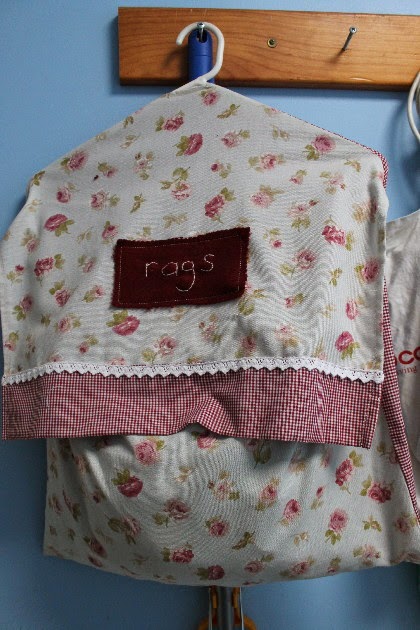
Lori asked about making a rag bag after she read the last post.  I wrote about this way back in 2008 so here is that post, Lori. I hope you can make one up by reading those instructions and seeing the photos. Just start with a sturdy clothes hanger and take your measurements from that.


And here is a post about rags, again. I hope this motivates you to start your own rag bag. Let me know how you get on. 


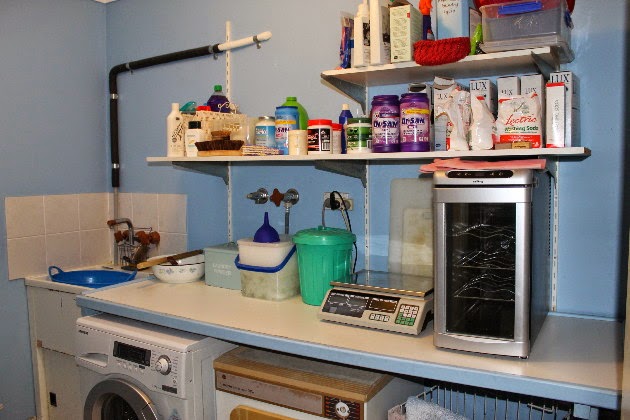
I've been trying to find the time to clean out my laundry and finally got to it yesterday. I scrubbed the sink and bench, cleaned the floor and went through all my products to make sure they were necessary and usable. I went through the rag bag and it was getting low so I found an old towel, cut it up and added the rags to the bag. I threw out some old soap I had in a container. I didn't know it was there; it was rancid. Note to self: don't hide soap, it doesn't last, you silly girl. 


It's not pretty but it's a working laundry so I just need it to be serviceable and productive. I do a fair bit of work in the laundry. As well as storing all my cleaning ingredients, I also use it to store my cheese fridge and to dry out and then store homemade soap. There is a 15 litre bucket in the sink that I use for soaking, which I do a lot of, and on the floor are two buckets and mops. And for Madeleine who emailed asking about mops, I use a cotton mop and bucket most of the time but also a more modern sponge/squeegee mop that I use with a handmade terry cover over the squeegee head. It gets into the corners better than the cotton mop does, although the cotton mop is much easier to use. I don't know what it is about the modern squeegee-type mops. I find they're difficult to move around on the floating floor we have. Do you have that problem?


The main thing though is that the room where all my cleaning is based, is now clean and ordered. There have been few changes in that room over the years and one thing will always remain the same: the work we do in our simple lives is easier if our work spaces and supplies are organised. I'm still making laundry liquid in preference to laundry powder because I can use it for so many other cleaning jobs. Still using oxy-bleach to soak whites and stubborn stains. Still using vinegar and bicarb for general cleaning. I never dry clothes in a dryer, always on the line outside, I'm still washing exclusively in cold water in a front loader. I still hate ironing. I will never go back to commercial cleaners. When the homemade cleaners cost so little to make and they do a better job, using less chemicals, why would I change? I find that as I age, my asthma is getting worse. I think that going back to high chemical cleaners might do me in.


My next task during the coming week is to move all the shopping bags I have in the laundry. The long term task is to remove the old dryer. Even though it still works, it's now 33 years old and I haven't used it for a long, long time. We bought it to dry our new babies' nappies. I hope they'll accept it at the rubbish dump's recycle shop. It's either there or the museum. ;- )


Slow magazine winter edition is out now so if you're looking for a decent read this weekend, see if you can find it at your local newsagent. If they don't have it, ask them to get it in for you. There is a preview of it here on Facebook and yes, that is my article An inconvenient truth about convenience food. So get yourself a cup of tea, find a place in the sun and slow down with Slow. I hope you enjoy it.
Look who's back. Sunny and Jamie flew in from Korean yesterday morning. :- )  We will have a quiet weekend, a mix of work and rest. I hope you have time out for yourself over the coming days and take the opportunity to relax.  I'll see you next week.

 - - - - ♥︎ - - - -

Farmers paying for Woolworths Oliver campaign
Farmers ask Oliver to intervene
Oliver's butcher shop closed after mouse droppings found
Upcycling furniture
Homemade chicken waterer
13 acres
The evolution of leisure
How to mend old shoes
10 vegetarian and vegan blogs you need to know about
Crocheting how-tos, step-by-step
My friend Michele is having a giveaway for the first anniversary of her blog - going grey and slightly green
Newer Posts Older Posts Home

MY BOOKS

MY BOOKS


My books were all published by Pengiun, and are available at Amazon US, Amazon UK and Amazon Au

Search here

Total Pageviews

Translate


I'm Rhonda Hetzel and I've been writing my Down to Earth blog since 2007. Although I write the occasional philosophical post, my main topics include home cooking, happiness and gardening as well as budgeting, baking, ageing, generosity, mending and handmade crafts. I hope you enjoy your time here.

MY FAVOURITE PLACES

  • Grandma Donna's Place
  • Grandma Donna's YouTube
  • Grandma Donna's Instagram
  • This Simple Day
  • Nicole's Instagram

Give More

Give More

Popular posts last year

Making ginger beer from scratch

We had a nice supply of ginger beer going over Christmas. It's a delicious soft drink for young and old, although there is an alcoholic version that can be made with a slight variation on the recipe. Ginger beer is a naturally fermented drink that is easy to make - with ginger beer you make a starter called a ginger beer plant and after it has fermented, you add that to sweet water and lemon juice. Like sourdough, it must ferment to give it that sharp fizz. To make a ginger beer plant you'll need ginger - either the powdered dry variety or fresh ginger, sugar, rainwater or tap water that has stood for 24 hours to allow the chlorine to evaporate off. You'll also need clean plastic bottles that have been scrubbed with soap, hot water and a bottle brush and then rinsed with hot water. I never sterilise my bottles and I haven't had any problems. If you intend to keep the ginger beer for a long time, I'd suggest you sterilise your bottles. MAKING THE STARTER In a...
Image

NOT the last post

This will be my last post here.  I've been writing my blog for 18 years and now is the time to step back. I’ve stopped writing the blog and come back a couple of times because so many people wanted it, but that won’t happen again, I won’t be back.  I’ll continue on instagram to remain connected but I don’t know how frequent that will be. I know some of you will be interested to know the blog's statistics. 
Image

How to make cold process soap

I'm sure many of you are wondering: "Why make soap when I can buy it cheaply at the supermarket?" My cold process soap is made with vegetable oils and when it is made and cured, it contains no harsh chemicals or dyes. Often commercial soap is made with tallow (animal fat) and contains synthetic fragrance and dye and retains almost no glycerin. Glycerin is a natural emollient that helps with the lather and moisturises the skin. The makers of commercial soaps extract the glycerin and sell it as a separate product as it's more valuable than the soap. Then they add chemicals to make the soap lather. Crazy. Making your own soap allows you to add whatever you want to add. If you want a plain and pure soap, as I do, you can have that, or you can start with the plain soap and add colour, herbs and fragrance. The choice is yours. I want to add a little about animal and bird fat. I know Kirsty makes her soap with duck fat and I think that's great. I think t...
Image

Preserving food in a traditional way - pickling beetroot

I've had a number of emails from readers who want to start preserving food in jars but don't know where to start or what equipment to buy.  Leading on from yesterday's post, let's just say up front - don't buy any equipment. Once you know what you're doing and that you enjoy preserving, then you can decide whether or not to buy extra equipment. Food is preserved effectively without refrigeration by a variety of different methods. A few of the traditional methods are drying, fermentation, smoking, salting or by adding vinegar and sugar to the food - pickling. This last method is what we're talking about today. Vinegar and sugar are natural preservatives and adding one or both to food sets up an environment that bacteria and yeasts can't grow in. If you make the vinegar and sugar mix palatable, you can put up jars of vegetables or fruit that enhance the flavour of the food and can be stored in a cupboard or fridge for months. Other traditional w...
Image

Cleaning mould from walls and fabrics

With all this rain around we've developed a mould problem in our home. Usually we have the front and back doors open and that good ventilation stops most moulds from establishing. However, with the house locked up for the past week, the high humidity and the rain, mould is now growing on the wooden walls near our front door and on the lower parts of cupboards in the kitchen. Most of us will find mould growing in our homes at some point. Either in the bathroom or, in humid climates, on the walls, like we have now. You'll need a safe and effective remedy at some point, so I hope one of these methods works well for you. Mould is not only ugly to look at, it can cause health problems so if you see mould growing, do something about it straight away. The longer you leave the problem, the harder it will be to get rid of it effectively. If you have asthma or any allergies, you should do this type of cleaning with a face mask on so you don't breathe in any spores. Many peopl...
Image

Five minute bread

Bread is one of those foods that, when made with your own hands, gives a great deal of satisfaction and delight. It's only flour and water but it symbolises so much. I bake bread most days and use a variety of flours that I buy in bulk. Often I make a sandwich loaf because we use most of our bread for lunchtime sandwiches and for toast. Every so often I branch out to make a different type of loaf. I have tried sour dough in the past but I've not been happy with any of them. I'll continue to experiment with sour dough because I like the idea of using wild yeasts and saving the starter over a number of years to develop the flavour and become a part of the family. However, the loaf I've been branching out to most often is just a plain old five minute bread. By five minutes I mean it takes about five minutes actual work to prepare but it's the easiest of all bread to make and to get consistently good loaves from. If you're having people around for lunch or...
Image

This is my last post.

I have known for a while that this post was coming, but I didn't know when. This is my last post. I'm closing my blog, for good, and I'm not coming back like I have in the past.  I've been writing here for 16 years and my blog has been many things to me. It helped me change my life, it introduced me to so many good people, it became a wonderful record of my family life, it helped me get a book contract with Penguin, and monthly columns with The Australian Women's Weekly and Burke's Backyard . But in the past few months, it's become a burden. In April, I'll be 75 years old and I hope I've got another ten years ahead. However, each year I'll probably get weaker and although I'm fairly healthy, I do have a benign brain tumour and that could start growing. There are so many things I want to do and with time running out, leaving the blog behind gives me time to do the things that give me pleasure. On the day the blog started I felt a wonderful, h...
Image

What is the role of the homemaker in later years?

An email came from a US reader, Abby, who asked about being a homemaker in later years. This is part of what she wrote: "I am a stay-at-home mum to 4 children, ages 9-16. I do have a variety of "odd jobs" that I enjoy - I run a small "before-school" morning drop-off daycare from my home, I am a writing tutor, and I work a few hours a week at a local children's bookstore. But mostly, I cherish my blissful days at home - cooking, cleaning (with homemade cleaners), taking care of our children and chickens and goats, baking, meal-planning, etc. This "career" at home is not at all what I imagined during my ambitious years at university, but it is far more enriching. I notice, though, that my day is often planned around the needs of my family members. Of course, with 4 active kids and a husband, this is natural. I do the shopping, plan my meals, cook dinner - generally in anticipation of my family reconnecting in the evening.  I can't h...
Image

Every morning at home

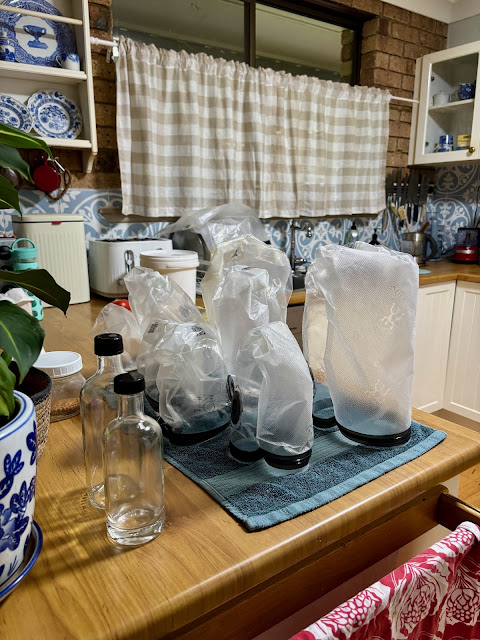
Every morning when I walk into my kitchen it looks tidy and ready for a day's work. Not so on this morning (above), I saw this when I walked in. Late the previous afternoon when I was looking for something, I came across my rolled up Zwilling vacuum bags and decided they had to be washed and dried. So I did that and although I usually put them outside on the verandah to dry it was dark by then. I turned the just-washed bags inside out and left them like this on a towel. It worked well and now the bags are ready to use when I bring home root vegetables, cabbages or whatever I buy that I want to last four or five weeks.
Image

You’ll save money by going back to basics

When I was doing the workshops and solo sessions, I had a couple of people whose main focus was on creating the fastest way to set up a simple life. You can't create a simple life fast, it's the opposite of that It's not one single thing either - it's a number of smaller, simpler activities that combine to create a life that reflects your values; and that takes a long to come together. When I first started living simply I took an entire year to work out our food - buying it, storing it, cooking it, preserving, baking, freezing, and growing it in the backyard. This is change that will transform how you live and it can't be rushed.  
Image

All previous blog posts

  • 2026 3
    • February 3
      • Workshops starting 1 March
      • Planting vegetable seeds and new workshops
      • Back where we belong
  • 2025 7
    • July 1
    • June 2
    • May 1
    • April 2
    • February 1
  • 2024 25
    • December 2
    • November 1
    • October 2
    • September 3
    • August 1
    • July 3
    • June 1
    • May 3
    • April 2
    • March 3
    • February 2
    • January 2
  • 2023 13
    • December 1
    • November 2
    • October 1
    • September 3
    • August 2
    • February 2
    • January 2
  • 2022 17
    • November 3
    • October 4
    • September 3
    • August 2
    • July 3
    • June 2
  • 2021 50
    • December 1
    • November 6
    • October 7
    • September 5
    • August 4
    • July 5
    • June 2
    • May 2
    • April 6
    • March 4
    • February 4
    • January 4
  • 2020 68
    • December 3
    • November 5
    • October 4
    • September 4
    • August 4
    • July 4
    • June 4
    • May 8
    • April 7
    • March 8
    • February 8
    • January 9
  • 2019 66
    • December 2
    • November 4
    • October 5
    • August 3
    • July 4
    • June 6
    • May 8
    • April 8
    • March 8
    • February 11
    • January 7
  • 2018 82
    • December 1
    • September 2
    • August 10
    • July 4
    • June 11
    • May 9
    • April 12
    • March 10
    • February 10
    • January 13
  • 2017 129
    • December 7
    • November 10
    • October 6
    • September 13
    • August 11
    • July 13
    • June 12
    • May 9
    • April 9
    • March 14
    • February 11
    • January 14
  • 2016 125
    • December 7
    • November 13
    • October 10
    • September 11
    • August 11
    • July 8
    • June 9
    • May 9
    • April 12
    • March 10
    • February 13
    • January 12
  • 2015 184
    • December 7
    • November 15
    • October 20
    • September 18
    • August 19
    • July 18
    • June 12
    • May 15
    • April 12
    • March 21
    • February 13
    • January 14
  • 2014 203
    • December 11
    • November 8
    • October 17
    • September 20
    • August 17
    • July 19
    • June 17
    • May 17
    • April 23
    • March 15
    • February 18
    • January 21
  • 2013 225
    • December 13
    • November 17
    • October 17
    • September 17
    • August 21
    • July 24
    • June 20
    • May 19
    • April 17
    • March 22
    • February 17
    • January 21
  • 2012 245
    • December 17
    • November 20
    • October 20
    • September 18
    • August 15
    • July 24
    • June 21
    • May 26
    • April 23
    • March 23
    • February 19
    • January 19
  • 2011 257
    • December 18
    • November 24
    • October 27
    • September 23
    • August 24
    • July 21
    • June 24
    • May 24
    • April 16
    • March 22
    • February 14
    • January 20
  • 2010 283
    • December 20
    • November 18
    • October 18
    • September 19
    • August 25
    • July 24
    • June 25
    • May 26
    • April 25
    • March 22
    • February 29
    • January 32
  • 2009 293
    • December 29
    • November 18
    • October 23
    • September 25
    • August 22
    • July 28
    • June 22
    • May 21
    • April 27
    • March 26
    • February 24
    • January 28
  • 2008 387
    • December 24
    • November 23
    • October 25
    • September 26
    • August 27
    • July 27
    • June 37
    • May 34
    • April 44
    • March 53
    • February 32
    • January 35
  • 2007 372
    • December 37
    • November 40
    • October 55
    • September 51
    • August 49
    • July 63
    • June 49
    • May 28


Trending Articles

NOT the last post

This will be my last post here.  I've been writing my blog for 18 years and now is the time to step back. I’ve stopped writing the blog and come back a couple of times because so many people wanted it, but that won’t happen again, I won’t be back.  I’ll continue on instagram to remain connected but I don’t know how frequent that will be. I know some of you will be interested to know the blog's statistics. 
Image

Every morning at home

Every morning when I walk into my kitchen it looks tidy and ready for a day's work. Not so on this morning (above), I saw this when I walked in. Late the previous afternoon when I was looking for something, I came across my rolled up Zwilling vacuum bags and decided they had to be washed and dried. So I did that and although I usually put them outside on the verandah to dry it was dark by then. I turned the just-washed bags inside out and left them like this on a towel. It worked well and now the bags are ready to use when I bring home root vegetables, cabbages or whatever I buy that I want to last four or five weeks.
Image

You’ll save money by going back to basics

When I was doing the workshops and solo sessions, I had a couple of people whose main focus was on creating the fastest way to set up a simple life. You can't create a simple life fast, it's the opposite of that It's not one single thing either - it's a number of smaller, simpler activities that combine to create a life that reflects your values; and that takes a long to come together. When I first started living simply I took an entire year to work out our food - buying it, storing it, cooking it, preserving, baking, freezing, and growing it in the backyard. This is change that will transform how you live and it can't be rushed.  
Image

Creating a home you'll love forever

Living simply is the answer to just about everything. It reduces the cost of living; it keeps you focused on being careful with resources such as water and electricity; it reminds you to not waste food; it encourages you to store food so you don't waste it and doing all those things brings routine and rhythm to your daily life. Consciously connecting every day with the activities and tasks that create simple life reminds you to look for the meaning and beauty that normal daily life holds.  It's all there in your home if you look for it. Seemingly mundane tasks like cleaning and cooking help you with that connection for without those tasks, the home you want to live in won't exist in the way you want it to.  Creating a home you love will make you happy and satisfied.
Image

Time changes everything

I've been spending time in the backyard lately creating a contained herb and vegetable garden. My aim is to develop a comfortable place to spend time, relax, increase biodiversity and encourage more animals, birds and insects to live here or visit. Of course I'd prefer my old garden which was put together by Hanno with ease and German precision. Together, we created a space bursting at the seams with herbs, vegetables and fruity goodness ready to eat and share throughout the year. But time changes everything. What I'm planning on doing now, is a brilliant opportunity for an almost 80 year old with balance issues. In my new garden I'll be able to do a wide range of challenging or easy work, depending on how I feel each day. It’s a daily opportunity to push myself or sit back, watch what's happening around me and be captivated by memories or the scope of what's yet to come.
Image

It's the old ways I love the most

I'm a practical woman who lives in a 1980’s brick slab house. There are verandahs front and back so I have places to sit outside when it's hot or cold. Those verandahs tend to make the house darker than it would be but they're been a great investment over time because they made the house more liveable. My home is not a romantic cottage, nor a minimalist modern home, it's a 1980’s brick slab house. And yet when people visit me here they tell me how warm and cosy my home is and that they feel comforted by being here. I've thought about that over the years and I'm convinced now that the style of a home isn't what appeals to people. What they love is the feeling within that home and whether it's nurturing the people who live there.
Image

Back where we belong

Surprise! I'm back ... for good this time. Instagram became an impossible place for me. They kept sending me messages asking if I'd make my page available for advertisers! Of course, I said no but that didn't stop them. It's such a change from what Instagram started as. But enough of that, the important part of this post is to explain why I returned here instead of taking my writing offline for good. For a few years Grandma Donna and I have talked online face-to-face and it's been such a pleasure for me to get to know her. We have a lot in common. We both feel a responsibility to share what we know with others. With the cost of living crisis, learning how to cook from scratch, appreciate the work we do in our homes, shop to a budget and pay off debt will help people grow stronger. The best place to do that is our blogs because we have no advertising police harassing us, the space is unlimited, we can put up tons of photos when we want to and, well, it just feels li...
Image

Making ginger beer from scratch

We had a nice supply of ginger beer going over Christmas. It's a delicious soft drink for young and old, although there is an alcoholic version that can be made with a slight variation on the recipe. Ginger beer is a naturally fermented drink that is easy to make - with ginger beer you make a starter called a ginger beer plant and after it has fermented, you add that to sweet water and lemon juice. Like sourdough, it must ferment to give it that sharp fizz. To make a ginger beer plant you'll need ginger - either the powdered dry variety or fresh ginger, sugar, rainwater or tap water that has stood for 24 hours to allow the chlorine to evaporate off. You'll also need clean plastic bottles that have been scrubbed with soap, hot water and a bottle brush and then rinsed with hot water. I never sterilise my bottles and I haven't had any problems. If you intend to keep the ginger beer for a long time, I'd suggest you sterilise your bottles. MAKING THE STARTER In a...
Image