down to earth

  • Home
  • About Us
  • Down To Earth Book
  • Privacy Policy
I'm not sure why but there are a lot of readers who are interested in what I do each day. I'm ordinary. Usually I'm here at home doing ordinary things.  When I'm writing, which I am at the moment, there's not a lot to report in my normal daily activities - I make three meals, clean up and write most of the day. But yesterday I took time away from the computer and spent most of the day working in my home, and relaxing.


Up at 3.30am, I dressed, cleaned my teeth, checked emails, made tea and crumpets and packed my trusty little trolly in the boot of the car. When I left home at 5.00am to go to the local market, the sun was just peeking through. I was after some fish for our terracotta pond which sits on the front verandah. Tricia bought me a beautiful iris last time she was here, it's been flowering its little head off and while it sits in water to grow, the water provides a breeding ground for mosquitoes. We used to have some native rainbow fish in the pond but when I moved it last week, I realised they'd disappeared. Also on my list, a tall tropical plant for the area near the front door and some avocados. Hanno needed line for his whipper snipper.


The market was packed when I arrived at 5.20. Some were sipping coffee, others walking around eating toasted sandwiches or fruit. It didn't take me long to find what I needed and I was in and out very smartly. I was home again at 6.45. Hanno was sitting at the kitchen table eating his breakfast - rolled oats with blueberries and walnuts.


I had five little guppies in a plastic bag so I had to work fast to get them into their new home. I emptied the water out of the pond with a bucket onto the hanging baskets and pot plants, moved the pond back into the shade of the verandah, then filled it again with rainwater from the tank. I cleaned up the iris, clipped off the dead flower heads and placed the plant in the water. When I opened up that plastic bag the fish swam out into their new home. The verandah feels cool and restful with the water and plants. It's reminds me how easy it is to create a relaxing space when you have shade, somewhere to sit and a few plants. When everything was set, I swept the verandah then went inside to make some cool drinks for us.  By this stage Hanno was watering plants in the front garden. Usually we don't have to water our outdoor plants but we're in the middle of a drought.

We both rested with some early morning tea - apple and cinnamon pikelets and lemon cordial made with sparkling mineral water and ice.  I made the bed, finished off another two napkins (more on that tomorrow), washed up and prepared lunch. Crumbed chicken breast with the last of the potato salad, lettuce, avocado, tomato and cucumber.


After lunch I repotted the large heliconia I bought. It's sitting right near the front door now. It's still a bit untidy but as new leaves grow, it should look really splendid. I gave it a rich potting soil containing worm castings and cow manure so it shouldn't be too long before it takes off. Late in the afternoon we adopted a baby magpie that's been hanging around without its mother for a few days. It flew into the verandah and sat on the back of the lounge where I was sitting, so Hanno got some tiny pieces of pork sausage to feed to it. It must have been very hungry because everything Hanno gave it was eaten. It looks like it has a damaged beak. I have a feeling the mother is dead because this baby it too young to be alone. We'll look out for it over the next few days and continue feeding it if it turns up without mum again.

And for the rest of the afternoon, dear friends, I put my money where my mouth is and I relaxed on the front verandah. I read and knitted Jono's cardigan. It was everyone for themselves at tea time. Hanno made himself sandwiches and I had some watermelon. It was a beautiful mix of productive energy, fixing this and that, and shoes off, feet-up relaxing.  I hope you did some of that as well. It's back to work again today but I'll be out on that verandah again to break the work day up. I work better when I look after myself. I think we all do.

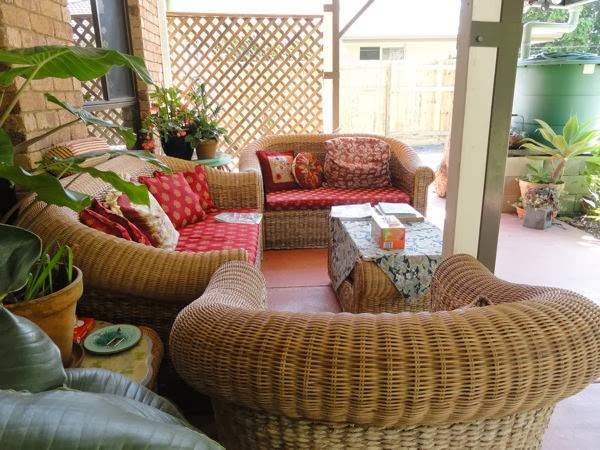
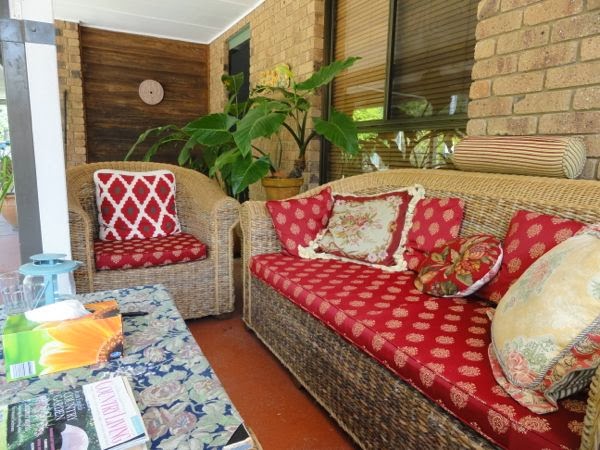
Another week has come and gone. Time seems to go so fast now. Does that mean I'm old(er)? Thank you for joining me here during the week. I'll be spending time in the location pictured above - our front verandah. Enjoy your weekend, spend it with those you love and recharge for next week.  XX

Michael Pollan's family meals
Putting a meal on the table, even when you're dead
Butter and cheese are better
Eumaeus and the Worm
Peace Country Homestead
Coal House - life in 1927 in a small mining town - Youtube
In a soup - many great soup recipes for my friends going into the colder weather.
Your own backyard 

From the comments here during the week

Wilderness Dweller
Flood-proof Mum
Nutmeg and Linen

PLEASE NOTE:
There seems to be a problem with Blogger today and I've lost comments from this and other posts. I apologise to everyone who left a comment that has disappeared. I'm trying to get them back.

We've had enough food posts for the week. Today I'm sitting back and writing about what ever comes into my head. It was a fairly tense day here yesterday spent thinking about my sister Tricia and her family who live in the Blue Mountains. They are in the towns badly effected by the catastrophic bush fires.  Yesterday was supposed to be the worst day when temperatures soared and the winds increased. Tricia had her car packed in case she had to be evacuated and she drove from Blackheath to Springwood to take her grandson home and help out in her son's shop. I spoke to her late yesterday afternoon and she was preparing to drive home. I hope I don't sound above myself but I wasn't surprised when I received a lot of emails from people wanting to know how Tricia and her family were going in the fires. Tricia, however, was amazed that she'd been remembered. She asked me to tell you that all those good wishes helped her a lot during those recent dark days. Such kindness does help when times are tough and I thank you sincerely for helping my family get through them.


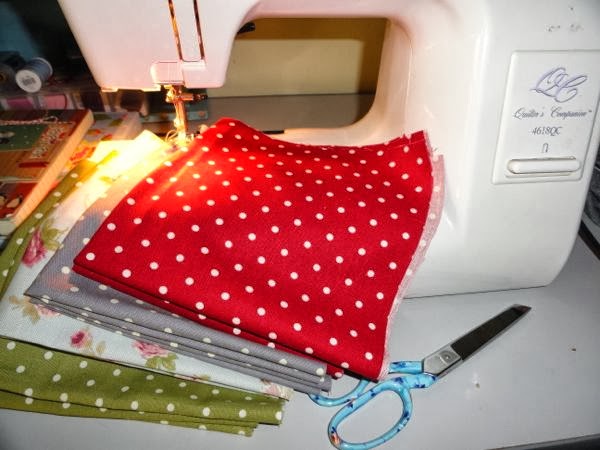
Although I'm working on the Penguin ebooks, my mind keeps wandering to my daily chores and preparations for the coming months. I have household linens to sew soon. I started cutting out the napkins yesterday and I hope to get to them on the weekend. I promised Jamie two drawstring bags to keep his toy animals in so they're on my list as well. They are such small things but I feel I'm doing the right thing when I sew for my home. I have never seen anything in a shop that suits my home better than what I can make right here.


Our main meal is cooked for the next two days because I made a pastryless Angus beef pie yesterday and used all the old vegetables in the fridge. The top is mashed potato and pumpkin. I love it when I know I have the meals sorted and no cooking will be necessary. Then I can concentrate on making other things such as crackers and pickled eggs, that I hope to do on Saturday. I ran down my ice cube supplies last week so I have to remember to fill up the ice trays twice a day and keep the iced water jug full. When the weather is warm, everyone loves a glass of cold water.

On the wider front, I've almost finished organising my Christmas gifts. I'm not sure what we're doing yet, that will depend on when Shane and Kerry are working but I think we'll be travelling up to Gladstone just before Christmas, and having Christmas here. After a break for Christmas with my family, I'll be straight back to writing again to have the set of ebooks ready for my deadline. I'm very pleased to tell you that all these books will be available for international release so that will make it easier for you, particularly if you have an ebook reader. If you don't, ebook readers can be downloaded free for use on your computer.

And speaking of Christmas, I might start my Christmas baking on the weekend. I'm only doing a fruit cake this year. It will be full of dried fruits that have been soaked in brandy for a week or two. I'll start the soaking on the weekend.

Spring and summer are not my favourite seasons, I don't like the warmer weather but this year I've decided to be grateful that I'm healthy and breathing and just get on with it. If I have to live through hot days, I will think of all the best parts of summer, like the holidays, cold salads, frosty drinks and relaxing watching the cricket. If a few hot days are all I have to complain about, then I am living a charmed life.

What has been filling your days lately?
If you can't grow vegetables due to having no time, bad health, young children, or no space, the answer for you might be to buy local seasonal fruit and vegetables. You might have a vegetable garden but not for the full year and buy your local vegies when the garden isn't growing, like we do. As you know we grow a fairly large garden but no matter what time of year, I'm also on the lookout for cheap, good quality, seasonal produce that we can use to supplement what we grow. Sometimes it will be a box of produce; at other times it will be smaller amounts of something we don't eat a lot of. I think this is one of the best ways of maximising the quality and nutrition of the food I put on the table as well as paying the lowest price for it. We all know we can but cheap food, but buying fresh, local, nutritious food, well, that's a challenge. You need to keep your eyes open for the bargains.

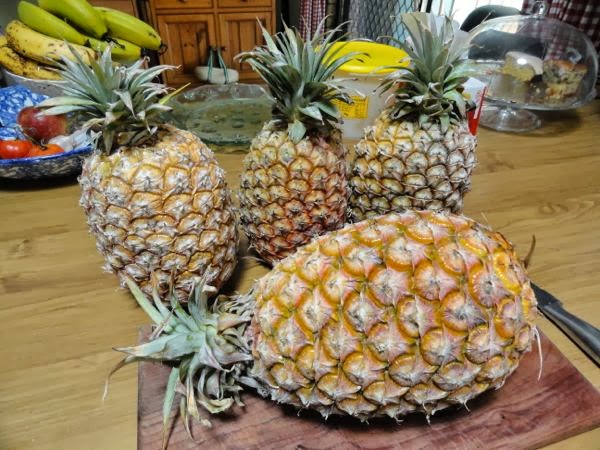
There are so many things you can bring into this category but let me show you an example of something I did here yesterday. I live in an areas surrounded by pineapple farms supplying Golden Circle. Often at this time of year in pineapple season, there are a lot of local pineapples for sale at roadside stalls. I just checked the Woolworth's online store and a fresh pineapple is selling there for $3.98 each. At a nearby roadside stall, local pineapples are selling at two large for $1.80 or three small for $3.00. When we drove passed the other day, I bought four large pineapples for $3.60 or 90 cents each. I have no need for fresh pineapple now, the season will go on for a while yet, but as soon as the holiday makers arrive, the prices will go up. They'll never be as high as the supermarket prices, but they'll be higher than they are now. I wanted to preserve some pineapple for later in the year when the prices will be higher, it will be hotter and the idea of local pineapple and passionfruit on a pavlova, or a glass of pineapple crush, will be very appealing. The passionfruit is already in a sealed container in my freezer. I've been putting aside our home-grown passionfruit so I'll have it on hand over Christmas when I know they'll be expensive. Oh my! I just checked the price of passionfruit at the local Woolworths and they're $1.98 each! How can they justify that? I wonder how much they paid the growers for them.


As you can see, you have to outdo the supermarkets at their own game. We're all on budgets and we are all hoping to get the best value for money. I think this is a very intelligent way to buy. It's similar to having a big canning/preserving session with boxes of produce or buckets from the backyard, but it's on a smaller scale for the food you don't eat a lot of. If you're in a food producing region, you'll be able to do something similar.

The entire pineapple processing exercise took me about 20 minutes. All I had to do was top and tail the pineapples, skin them, chop them into chunks, and put them in the food processor to do the heavy work. They'll sit in the freezer quite nicely until needed, probably sometime in December when pineapples will probably be five dollars each. And what did I pay? Ninety cents. If you're in Brisbane, or on the Sunshine Coast, I bought these sweet and delicious pines at the Matilda service station. If you go by in the next week or two, drop in to see if they're still there.

I know there are homemakers - women and men, who are in dairy regions and they buy large quantities of cream when the price is much lower than normal. As soon as the cream gets home, it's made into butter. This is such a excellent way of getting good produce at a low price. I make cultured butter when we can get the bulk cream.

PRESERVING EGGS
Here is a pickling liquid recipe for boiled eggs from Mother Earth News. This is great for preserving eggs for a month. This amount will cover eight hard-boiled duck eggs, 12 hard boiled hen eggs or 20 hard boiled quail eggs.

Golden Pickling Liquid for Eggs
  • 1½ cups cider vinegar
  • ½ cup water
  • 2 teaspoons brown sugar or honey
  • 2 teaspoons pickling or sea salt
  • 1 teaspoon tumeric
  • 1 teaspoon allspice
  • ¼ teaspoon celery seeds
  • 1 cinnamon stick
Fill a sterilised litre/quart jar with peeled, hard-boiled eggs.
Boil the pickling ingredients in a medium saucepan. Cover, reduce the heat to low and simmer for 30 minutes. Allow to cool for 20 minutes then pour it over the eggs. Screw on the lid. Store in the fridge for up to a month.

Do you have any handy hint to share about the storage of eggs?

Andrea left a comment here yesterday, and when I checked her blog, she'd written an excellent post on this same subject, here is the link so you can read what she has to say as well. Andrea's experiences with her group of women in a buying group might give you some good ideas about how to do something similar in your neighbourhood.

I'm sure there are many other examples out there, please share your story so we can all build our skills in this important area. What have you been able to do in your region? 


The garden really is the queen of all seasons. After all our summer salads, she makes way for all the hearty and nourishing winter vegetables for soups, casseroles and hot winter warmers. Our cold weather crops are cabbage - we grow an early variety called Sugarloaf and red cabbage, curly kale, broccoli, kohl rabi, carrots, turnips, silverbeet, Asian greens, peas, lettuce, beetroot, garlic, onions, potatoes, tomatoes (not in June or July) and herbs. We have our main citrus crops over the winter months - mainly lemons and oranges as well as passionfruit and strawberries late in the season. We never grow enough peas or carrots to freeze, they're all eaten fresh. One year we grew enough cabbage to make sauerkraut but most of the time it's just enough to eat fresh. We always have jars of red cabbage and sauerkraut in the stockpile that we buy from Aldi during their Oktoberfest sales. I'd love to grow swedes/rutabaga but it's not cold enough for long enough. The point is though to grow what you can, when you can and be happy with that. If you can't do it this year, pencil it in for next year and improve your skills as you go.

If you don't know what to grow, there are planting guides for many regions, including international, on my right side bar. The easy ones are cabbage, silverbeet/chard, curly kale, lettuce, carrots and turnips but always take the time to enrich your soil before you start. Adding manure or compost to your soil will make a huge difference to the health and size of your vegetables.


All our northern hemisphere friends will be under snow soon but I wonder how many have some form of cold weather crops going through winter. I've never grown food crops in weather cold enough for frost or snow and I imagine it would be much more difficult than our form of gardening here. Even going outside on a cold morning is a test for me.  Over the years that I've known her, Nita at Throwback at Trapper Creek has never failed to impress me with her expertise at cold climate gardening. Nita grows the food for her family and root vegetables for her house cow, Jane, as well. Currently she's busy putting up a lot of her produce for eating later in the year. If you've never read Nita's blog, I encourage you to pay her a visit, especially if you live in a cold climate. Nita has many excellent posts on pasture management too so if you have a cow, or a herd of them, you'll probably find something of interest.


If you're in Australia and didn't watch Gardening Australia last week, watch this absolutely inspirational couple (at 6.10) from the Czech Republic who settled here four years ago. They are growing an abundance of fruit, vegetables, honey and eggs at a small rental unit in Brisbane. He also shows how he grows food for his chickens and a fabulous version of a wicking bed made with styrofoam boxes and PVC pipes. Genius. He waters the box once a month. It just shows you what you can do if you're renting and have very little.


The way we warmer climate gardeners grow and store food is different to that in colder climates. In warmer climates we have the option of growing most of the year, and therefore preserving for later isn't the high priority that it is in colder climates, especially in the US, UK and the colder European countries. However, growing more or buying seasonal food when it's at its best and cheapest is always a good option when looking to save money as well as for our food security stores.  And that will be tomorrow's topic.

I hope you have a lovely day. :- )

In the next few posts about food security I'd like to write about what we grow for our own fresh food needs, and how we grow food for storage and drying. When you grow food in the backyard, you have to increase your skill level in several directions because everything you grow will have to be harvested at the correct time, processed in a certain way such as cooking, preserving, drying, and then stored safely, either in the fridge, freezer, in a jar, a bag or hanging in a braid/plait. Growing the food is just one part of this. You will let yourself down if you know how to grow great fruit and vegetables but don't know how to process and store it correctly.

Even though we have four seasons, we generally have cold crops and warm crops. We're currently in our warm season now so let's do that first.

Food to grow in warm seasons

FRESH: In the warm seasons the obvious category for fresh food is salad and all the vegetables that can go into a decent salad. We change from year to year but usually grow: tomatoes, cucumbers, beetroot, radishes, capsicums/peppers, chilli, mushrooms, green beans, snake beans, Madagascar beans, corn, eggplant and various herbs. We grow lettuce until it starts to get bitter. As soon as the hot weather sets in, or if we have a hot day out of the blue, the lettuce will go bitter. When it does, we start buying our lettuce.  I grow various types of sprouts in the kitchen and yesterday put a bag of freshly grown mung bean shoots in the fridge.


We also grow daikon, Asian greens, Welsh onions, silverbeet/chard, sweet potato and zucchini. We sometimes have a crop of potatoes in at this time of year but we don't this year. We're just about to plant up a few pumpkin seedlings in the compost heap. The rest of the garden is starting to dry off now but those pumpkins will, hopefully, grow over summer and give us a dozen or so pumpkins to store for the next year.

PRESERVING: If you have the room, grow extras to put up in jars. Tomatoes, cucumbers, beetroot, onions can all be preserved in a water bath and if you have a pressure canner, you can do up jars of green beans, corn, carrots.  Making up jars of sauces will use up all your extra vegetables because you can either make jars of tomato sauce or crushed tomatoes, or you can mix it all together and make chutney or relish. Don't forget to use tried and tested recipes if you're water bathing - they'll have the correct amounts of lemon juice or vinegar and sugar to add for long term storage.

 
 Pickled beetroot ready to go in the fridge.

FREEZER: Don't forget your freezer - you don't have to worry about the acid level of the vegetables you put up if you freeze them. Learn to blanch first, there are very few vegetables that will freeze well long term if they're not blanched. Frozen vegetables include beans, peas, chard and spinach. onions, Corn, capsicums/peppers, chillis and tomatoes don't have to be blanched, and tomatoes, if you want to use them in soups and stews after freezing - freeze them whole and store in a plastic bag. They'll be mushy when thawed.

DRYING: Although I don't have a dehydrator, I do sometimes dry food and store it. Usually it's beans because they're easy to grow, full of protein and they store well. You can grow borlotti beans, lazy housewife beans, haricot beans, or ask your supplier which beans they have for drying. It's simply a matter of growing them as instructed and letting them dry out. You can let them dry on the vine, but the plant will not produce more pods if you do that. Pick the beans as they mature and place them undercover to dry out. When they're completely dry, strip all the beans from the pods and add them to your jar.

 Sprouting sweet potato ready for planting.

Dried pigeon peas in the pod.
Sprouting ginger ready for planting.
This is one of the pineapples we're grown here.
ODDS AND ENDS: If you're in a warm climate, try growing some pigeon peas, they're a really useful crop. They're high in nitrogen, love hot weather and the chickens will eat the fresh young green leaves and the green peas.  You can harvest the peas green or brown. If they're green just steam or boil them, if they're brown and dry, store them in a jar for use later. One tree will give you at least one or two kilos/2 - 5lbs of peas. You use them in the same way you use lentils or split peas, they make an excellent pea soup. The leaves of pigeon peas can be cut back and used as mulch. Sunflowers are also a good crop during the warmer months. They're great for snacks and the chooks love them. Ginger and tumeric are easy to grow in a warmer garden. Just buy some organic ginger and tumeric from the green grocer, break it up and plant it. Sweet potatoes are also easy to grow. They need to shoot first, as soon as they do, plant them. And don't forget your herbs. Whichever herbs you use, they need to be planted in the warmer seasons. Make sure you dry some herbs to store in the cupboard too. I have some bunches of thyme drying out now that are almost ready to put into a jar. In a warm climate, pineapples are the ultimate in recycled fruit. Simply remove the top off a good, sweet pineapple, remove the bottom leaves and let the head dry out for a week or so. Plant the head into enriched soil full of organic matter in an area of the garden that you don't need for the next three years. In the first 18 months the head will grow a pineapple (see the photo above), then it's ripe, harvest it and leave the plant in. Fertilise with comfrey tea and in the following year, another pineapple will grow. Pull the plant out after the second pineapple. If you live in a warm to hot climate, you can keep pineapples growing like this, simply by using the heads, for years.

Tomorrow we'll talk about colder crops and later in the week we'll talk about extending your seasons by creating microclimates.

Please add to this by telling us what you're growing and how you process and store it.
Hanno and I hope you have a wonderful weekend ahead. We are both fine and looking forward to some work and family time over the next couple of days. Thanks for your comments during the week. There is a beautiful community of like-minded souls here and we love sharing and learning as much as we can with all of you.

A short note to everyone who created a Google account so you could comment here. If you have a blog, please put a link to your blog up on your Google page. When I was looking for people to link to this week, I chose quite a number of you who have a Google account, the link takes me to your Circles pages but no further.  If you include a link I'll probably get around to linking to you for the Weekend Readings.  Thanks :- )

Nigel's various mayonnaise recipes
Happiness is joint bank accounts?
Spectacular photos of wildlife
From pigs to pork, an excellent blog about slaughtering pigs on a small farm.
Auburn Meadow Farm
Using manure in the garden
An urban veg patch
Baby hedgehog taken into care - if you need a smile today, or think things are getting tough, have a look at this.
Frontier House - episode 1 +

FROM THE COMMENTS HERE DURING THE WEEK
All things bright and beautiful
Cottage Tales
Frugal in Derbyshire
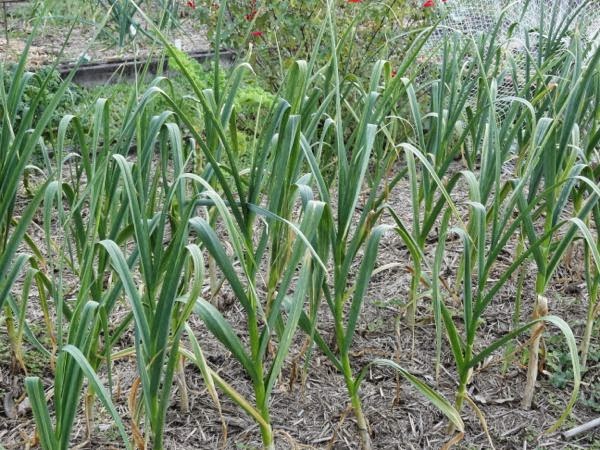
We planted our garlic in March and true to form, it was ready for harvesting in late September. We bought our garlic from Green Harvest, a hard-necked variety called Glenlarge - it is suited to warmer weather and it's the best garlic we've grown so far.  Hanno said the larger cloves, generally from the outside of the garlic bulb, produce the biggest and heaviest bulbs. You can still plant the smaller bulbs but they won't grow as big as the others, so don't think you've done anything wrong. We grew ours over our colder months and hopefully this crop will see us through until next September.  I've already put aside the biggest and best bulbs for planting in March.

Above and below  - our 2013 garlic crop.

Garlic is one of the easiest plants to grow in the vegetable patch. You plant them, 6 - 8 inches apart, in a sunny site and add plenty of organic matter to the soil pre-planting. Break the bulb apart and plant the cloves pointy end upwards, down to about the first knuckle on your finger**, water in with seaweed tea. Depending on your climate, the green shoots will appear two to four weeks after planting.  When the green shoots appear, start fertilising every month with a foliar spray of comfrey tea or seaweed and fish concentrate. Keep watering regularly if it doesn't rain but don't over-water them, too much water will rot them in the ground. As the time for harvest approaches, ease off the watering. They're ready to harvest when the green tops start turning brown and shrivelling up. Don't pull the garlic out of the ground, dig them out with a spade to loosen the soil.

** Added later: I just read this again and wanted to clarify this first knuckle planting. What I mean is that you push your fore finger into the planting soil to the level of your first knuckle. Place the clove, pointy side up, in the hole and cover with soil. The point of the clove should be just below the surface of the soil.


When you harvest, treat them gently because they must be in excellent condition to store them for a long time. Place the crop on a table for a couple of days, undercover, and remove clumps of dirt and any obvious material that would prevent them from drying out - you'll clean them properly a bit later. Divide the harvest up into bunches and hang them to dry out for about three weeks, depending on your climate. If it's humid it may take a bit longer.


Every time you handle the garlic, be gentle and don't drop them. When they've dried out, take down all the bunches and lay them out on a table where you can work on them for a while. You'll need a small pair of scissors - I use an old pair of embroidery scissors because I can cut in around the root without cutting into the garlic flesh. 


Take the first garlic and remove all the dirt, then rub it with your fingers to remove the outer loose papery skin. You don't want to take all the paper off because it protects the bulb while it's in storage. Cut the top off about an inch or so above the bulb. This will help the paper stay on the garlic. Cut the roots off the bottom and generally tidy the bulb up as much as you can without removing too much of the paper. When you're happy with that one, go on to the next.


Don't break the garlic bulb up, they will store better as whole garlics. Store them in a dark, dry space, not the fridge, it's too humid. The place you choose to store your garlic will have the biggest effect on how long it lasts. I have mine in a wire basket at the bottom of my pantry alongside the potatoes and onions. You could also hang them in a mesh bag or plait/braid them and hang them in a cool dry place.

If you don't get a year out of your garlic, it might we worth your while to experiment with two separate crops using two different varieties - an early and a late garlic.  No matter what you use though, take the opportunity to use some of your garlic fresh on the day you pick it. Fresh garlic has a more subtle flavour than older garlic. I used two fresh whole garlics cut through the middle and baked with some roast lamb. It was so delicious and definitely worth growing for the wide variety of health benefits and recipes you can make with it.


I didn't tell you when it happened, but a couple of weeks back, our strange hen-rooster died. She was the black chook that over the course of a year, grew one white feather, rooster tail feathers and a red collar. I don't think she ever laid an egg during her six years with us. When she died we were left with two New Hampshires, one Rhode Island Red, one black Australorp, one lavender Araucana, one Old English Game hen and a Plymouth Rock. We needed to build up our flock again.

Chickens are a vital part of our setup here. They supply us with more than enough fresh eggs, high nitrogen manure for the garden and compost heap and they're the best form of backyard entertainment going. I can't imagine us ever being without chickens.

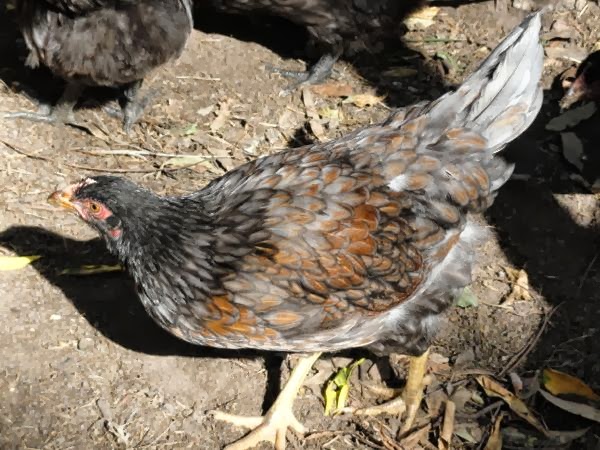
Introducing our new girls: two blue Australorps and two blue laced Barnevelders. They're gangly pre-teens right now, although one looks like she might be laying, but they'll grow into beautiful birds that we'll enjoy watching for many years.


This last photo is of our older girls as they watched the new arrivals carefully.

Early yesterday morning Hanno put some big boxes in the boot of our car and we set off towards Brisbane. We picked up our girls at Samford (there will be more on that later), put four little chickens in the boxes and travelled back home again. I was hoping for a couple of silver laced Wyandottes as well, but they're still small chicks and at the moment they'd make a tasty meal for the pythons that live here. We'll pick them up when they're a bit bigger. Now we have the happy task of getting to know these little ladies who will spend their lives with us eating lots of grain and fresh vegetables in our backyard.


Wiki defines food security as: the availability of food and one's access to it. 

Food security is being able to access enough food to feed yourself and your family. The lower your income, the more you're at risk of not being food secure and while you would think the higher one's income is the less likely they'd be threatened, that's not the case. If there was a food emergency, war, national disaster or weather catastrophe, the rich and the poor would suffer. The people who would have the least concern are those who produced their own food or prepared enough food to live through the disaster. No matter what group you fall into, planning for food security is an important task that we should all take seriously, particularly those of us who are homemakers, mothers, fathers or caregivers. If one of your responsibilities is to provide food for yourself and others, you need to think about this.


When thinking about your own personal food security, the first thing you have to know is how many people are you feeding on a regular basis and, if there was a food shortage in the shops for any reason, would that number of people change. None of us know whether we'll be lucky enough to never experience food shortages so you'll have to work on guesstimates and the likelihood of you having to provide for more people.  I look at it this way. We have Kerry, Sunny, Jamie, Jens and Cathy living within a 15 minute drive from us. If something happened to the food chain, I know we'd pool our resources. Don't think about food only. You also have to consider water, for drinking and personal hygiene. We are fortunate to have tanks that hold 15,000 litres of fresh rain water, but a catastrophe could happen at any time and if it happened during a dry season, we wouldn't have very much water in the tanks. So not only should you consider what would happen if disaster strikes and you're fully prepared with ample water and food, you also need to think about what happens if you're not so fully resourced when the disaster happens.

I doubt it's possible to write a guide that would suit the wide variations in lifestyle, climate and ability of the people who read here. All I can do is to write about what we do, it will be similar for many of you, and encourage you to think about your own situation and work out a plan.


We've all seen it. On trips to the supermarket to stock up, more and more food is being imported from foreign countries. When food comes from a place far away I believe there are two main problems. One, you have no idea how that food was grown and even if our laws prohibit certain practises, our laws don't apply in any other country. Two, we have no control over the food until we buy it. The supply of food could stop at any moment and for a variety of reasons such as weather problems - either drought or floods, war,  or political reasons.


Our solution to both those problems is to grow as much fresh food as we can here and get whatever else we need from local markets. Of the products that come from from further away - olive oil, salt, rice, spices etc, we keep backups. It's worthwhile to work out where all your food comes from so you have something to work with when any of your products are in short supply or stop. We can buy local beef, chicken, pork and fish. Our lamb comes from Victoria. If the supply chain was compromised, we'd stop eating lamb.


We get our milk from the local dairy, and from that milk I've taught myself to make cheese. I don't make cheese often because we have many local cheese makers, but I know how to do it if I need to. In an emergency situation, if there was a problem keeping up the supply of milk, or if the power went off and we couldn't store it, I'd make cheese. That's one of the things you need to think about too - what could you live without? We could live without lamb long-term, but not milk, therefore I've made sure that I could make cheese. We also have backups in the cupboard in the form of powdered milk, condensed milk and evaporated milk.


Today I've written about emergency food supplies. I know there are many of you who have huge food stocks in case of an emergency. I would use my stockpile as our emergency food, along with any food we had growing at that time and what was in the freezer. I tend to think of emergency food in terms of the nutrients they contain. So instead of thinking I have 50 jars of beans, I think of the food pyramid instead and make sure I have protein, carbohydrates and fats - the ingredients to make nourishing food. It's not enough to have the ingredients though, you also have to know how to cook it and you'll need somewhere to cook if the gas and electricity are out - so have means to start a fire and cook on it.


Know where you can forage for food too. In most areas there are local foods growing that are there for the picking. Here where I live avocados, macadamias and mangos are often grown in parks or along the street. I know that at certain times of the year, I can go and pick them. I know there are wild apple trees and blackberries growing on the outskirts of Armidale. I live 15 minutes away from the Pacific Ocean. We have fishing lines. These are the things you should think about in your own area - what is available for the taking? If you don't know, ask around. One day, it might save your life.


I hope this has encouraged you to think about your emergency food supplies and if you have none, to start thinking about who you need to feed and how to do it in an emergency. If an emergency doesn't happen, you can keep the food rotating by using it as you would your stockpiled food. Keep adding to it at the back and take it from the front. Later in the week I want to write about day-to-day food, about growing food to eat fresh, and how to store food to eat later.  I'd love to know what you're doing with your emergency food. Do you have any, what is it, where is it and how do you rotate it so it doesn't go off after a few years?

Newer Posts Older Posts Home

MY BOOKS

MY BOOKS


My books were all published by Pengiun, and are available at Amazon US, Amazon UK and Amazon Au

Search here

Total Pageviews

Translate


I'm Rhonda Hetzel and I've been writing my Down to Earth blog since 2007. Although I write the occasional philosophical post, my main topics include home cooking, happiness and gardening as well as budgeting, baking, ageing, generosity, mending and handmade crafts. I hope you enjoy your time here.

MY FAVOURITE PLACES

  • Grandma Donna's Place
  • Grandma Donna's YouTube
  • Grandma Donna's Instagram
  • This Simple Day
  • Nicole's Instagram

Give More

Give More

Popular posts last year

Making ginger beer from scratch

We had a nice supply of ginger beer going over Christmas. It's a delicious soft drink for young and old, although there is an alcoholic version that can be made with a slight variation on the recipe. Ginger beer is a naturally fermented drink that is easy to make - with ginger beer you make a starter called a ginger beer plant and after it has fermented, you add that to sweet water and lemon juice. Like sourdough, it must ferment to give it that sharp fizz. To make a ginger beer plant you'll need ginger - either the powdered dry variety or fresh ginger, sugar, rainwater or tap water that has stood for 24 hours to allow the chlorine to evaporate off. You'll also need clean plastic bottles that have been scrubbed with soap, hot water and a bottle brush and then rinsed with hot water. I never sterilise my bottles and I haven't had any problems. If you intend to keep the ginger beer for a long time, I'd suggest you sterilise your bottles. MAKING THE STARTER In a...
Image

NOT the last post

This will be my last post here.  I've been writing my blog for 18 years and now is the time to step back. I’ve stopped writing the blog and come back a couple of times because so many people wanted it, but that won’t happen again, I won’t be back.  I’ll continue on instagram to remain connected but I don’t know how frequent that will be. I know some of you will be interested to know the blog's statistics. 
Image

How to make cold process soap

I'm sure many of you are wondering: "Why make soap when I can buy it cheaply at the supermarket?" My cold process soap is made with vegetable oils and when it is made and cured, it contains no harsh chemicals or dyes. Often commercial soap is made with tallow (animal fat) and contains synthetic fragrance and dye and retains almost no glycerin. Glycerin is a natural emollient that helps with the lather and moisturises the skin. The makers of commercial soaps extract the glycerin and sell it as a separate product as it's more valuable than the soap. Then they add chemicals to make the soap lather. Crazy. Making your own soap allows you to add whatever you want to add. If you want a plain and pure soap, as I do, you can have that, or you can start with the plain soap and add colour, herbs and fragrance. The choice is yours. I want to add a little about animal and bird fat. I know Kirsty makes her soap with duck fat and I think that's great. I think t...
Image

Preserving food in a traditional way - pickling beetroot

I've had a number of emails from readers who want to start preserving food in jars but don't know where to start or what equipment to buy.  Leading on from yesterday's post, let's just say up front - don't buy any equipment. Once you know what you're doing and that you enjoy preserving, then you can decide whether or not to buy extra equipment. Food is preserved effectively without refrigeration by a variety of different methods. A few of the traditional methods are drying, fermentation, smoking, salting or by adding vinegar and sugar to the food - pickling. This last method is what we're talking about today. Vinegar and sugar are natural preservatives and adding one or both to food sets up an environment that bacteria and yeasts can't grow in. If you make the vinegar and sugar mix palatable, you can put up jars of vegetables or fruit that enhance the flavour of the food and can be stored in a cupboard or fridge for months. Other traditional w...
Image

Cleaning mould from walls and fabrics

With all this rain around we've developed a mould problem in our home. Usually we have the front and back doors open and that good ventilation stops most moulds from establishing. However, with the house locked up for the past week, the high humidity and the rain, mould is now growing on the wooden walls near our front door and on the lower parts of cupboards in the kitchen. Most of us will find mould growing in our homes at some point. Either in the bathroom or, in humid climates, on the walls, like we have now. You'll need a safe and effective remedy at some point, so I hope one of these methods works well for you. Mould is not only ugly to look at, it can cause health problems so if you see mould growing, do something about it straight away. The longer you leave the problem, the harder it will be to get rid of it effectively. If you have asthma or any allergies, you should do this type of cleaning with a face mask on so you don't breathe in any spores. Many peopl...
Image

Five minute bread

Bread is one of those foods that, when made with your own hands, gives a great deal of satisfaction and delight. It's only flour and water but it symbolises so much. I bake bread most days and use a variety of flours that I buy in bulk. Often I make a sandwich loaf because we use most of our bread for lunchtime sandwiches and for toast. Every so often I branch out to make a different type of loaf. I have tried sour dough in the past but I've not been happy with any of them. I'll continue to experiment with sour dough because I like the idea of using wild yeasts and saving the starter over a number of years to develop the flavour and become a part of the family. However, the loaf I've been branching out to most often is just a plain old five minute bread. By five minutes I mean it takes about five minutes actual work to prepare but it's the easiest of all bread to make and to get consistently good loaves from. If you're having people around for lunch or...
Image

This is my last post.

I have known for a while that this post was coming, but I didn't know when. This is my last post. I'm closing my blog, for good, and I'm not coming back like I have in the past.  I've been writing here for 16 years and my blog has been many things to me. It helped me change my life, it introduced me to so many good people, it became a wonderful record of my family life, it helped me get a book contract with Penguin, and monthly columns with The Australian Women's Weekly and Burke's Backyard . But in the past few months, it's become a burden. In April, I'll be 75 years old and I hope I've got another ten years ahead. However, each year I'll probably get weaker and although I'm fairly healthy, I do have a benign brain tumour and that could start growing. There are so many things I want to do and with time running out, leaving the blog behind gives me time to do the things that give me pleasure. On the day the blog started I felt a wonderful, h...
Image

What is the role of the homemaker in later years?

An email came from a US reader, Abby, who asked about being a homemaker in later years. This is part of what she wrote: "I am a stay-at-home mum to 4 children, ages 9-16. I do have a variety of "odd jobs" that I enjoy - I run a small "before-school" morning drop-off daycare from my home, I am a writing tutor, and I work a few hours a week at a local children's bookstore. But mostly, I cherish my blissful days at home - cooking, cleaning (with homemade cleaners), taking care of our children and chickens and goats, baking, meal-planning, etc. This "career" at home is not at all what I imagined during my ambitious years at university, but it is far more enriching. I notice, though, that my day is often planned around the needs of my family members. Of course, with 4 active kids and a husband, this is natural. I do the shopping, plan my meals, cook dinner - generally in anticipation of my family reconnecting in the evening.  I can't h...
Image

Every morning at home

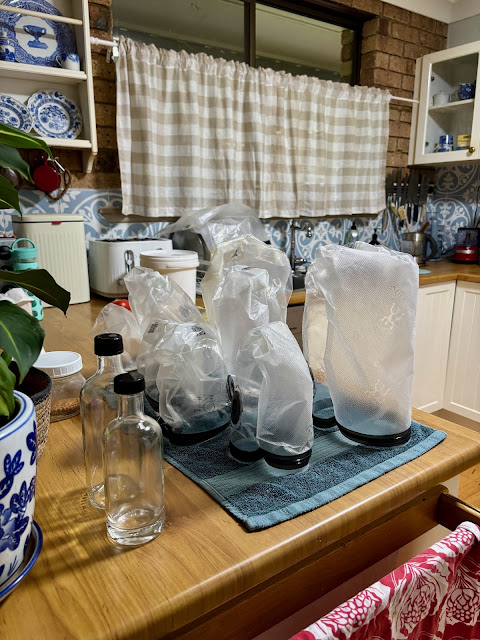
Every morning when I walk into my kitchen it looks tidy and ready for a day's work. Not so on this morning (above), I saw this when I walked in. Late the previous afternoon when I was looking for something, I came across my rolled up Zwilling vacuum bags and decided they had to be washed and dried. So I did that and although I usually put them outside on the verandah to dry it was dark by then. I turned the just-washed bags inside out and left them like this on a towel. It worked well and now the bags are ready to use when I bring home root vegetables, cabbages or whatever I buy that I want to last four or five weeks.
Image

You’ll save money by going back to basics

When I was doing the workshops and solo sessions, I had a couple of people whose main focus was on creating the fastest way to set up a simple life. You can't create a simple life fast, it's the opposite of that It's not one single thing either - it's a number of smaller, simpler activities that combine to create a life that reflects your values; and that takes a long to come together. When I first started living simply I took an entire year to work out our food - buying it, storing it, cooking it, preserving, baking, freezing, and growing it in the backyard. This is change that will transform how you live and it can't be rushed.  
Image

All previous blog posts

  • 2026 3
    • February 3
      • Workshops starting 1 March
      • Planting vegetable seeds and new workshops
      • Back where we belong
  • 2025 7
    • July 1
    • June 2
    • May 1
    • April 2
    • February 1
  • 2024 25
    • December 2
    • November 1
    • October 2
    • September 3
    • August 1
    • July 3
    • June 1
    • May 3
    • April 2
    • March 3
    • February 2
    • January 2
  • 2023 13
    • December 1
    • November 2
    • October 1
    • September 3
    • August 2
    • February 2
    • January 2
  • 2022 17
    • November 3
    • October 4
    • September 3
    • August 2
    • July 3
    • June 2
  • 2021 50
    • December 1
    • November 6
    • October 7
    • September 5
    • August 4
    • July 5
    • June 2
    • May 2
    • April 6
    • March 4
    • February 4
    • January 4
  • 2020 68
    • December 3
    • November 5
    • October 4
    • September 4
    • August 4
    • July 4
    • June 4
    • May 8
    • April 7
    • March 8
    • February 8
    • January 9
  • 2019 66
    • December 2
    • November 4
    • October 5
    • August 3
    • July 4
    • June 6
    • May 8
    • April 8
    • March 8
    • February 11
    • January 7
  • 2018 82
    • December 1
    • September 2
    • August 10
    • July 4
    • June 11
    • May 9
    • April 12
    • March 10
    • February 10
    • January 13
  • 2017 129
    • December 7
    • November 10
    • October 6
    • September 13
    • August 11
    • July 13
    • June 12
    • May 9
    • April 9
    • March 14
    • February 11
    • January 14
  • 2016 125
    • December 7
    • November 13
    • October 10
    • September 11
    • August 11
    • July 8
    • June 9
    • May 9
    • April 12
    • March 10
    • February 13
    • January 12
  • 2015 184
    • December 7
    • November 15
    • October 20
    • September 18
    • August 19
    • July 18
    • June 12
    • May 15
    • April 12
    • March 21
    • February 13
    • January 14
  • 2014 203
    • December 11
    • November 8
    • October 17
    • September 20
    • August 17
    • July 19
    • June 17
    • May 17
    • April 23
    • March 15
    • February 18
    • January 21
  • 2013 225
    • December 13
    • November 17
    • October 17
    • September 17
    • August 21
    • July 24
    • June 20
    • May 19
    • April 17
    • March 22
    • February 17
    • January 21
  • 2012 245
    • December 17
    • November 20
    • October 20
    • September 18
    • August 15
    • July 24
    • June 21
    • May 26
    • April 23
    • March 23
    • February 19
    • January 19
  • 2011 257
    • December 18
    • November 24
    • October 27
    • September 23
    • August 24
    • July 21
    • June 24
    • May 24
    • April 16
    • March 22
    • February 14
    • January 20
  • 2010 283
    • December 20
    • November 18
    • October 18
    • September 19
    • August 25
    • July 24
    • June 25
    • May 26
    • April 25
    • March 22
    • February 29
    • January 32
  • 2009 293
    • December 29
    • November 18
    • October 23
    • September 25
    • August 22
    • July 28
    • June 22
    • May 21
    • April 27
    • March 26
    • February 24
    • January 28
  • 2008 387
    • December 24
    • November 23
    • October 25
    • September 26
    • August 27
    • July 27
    • June 37
    • May 34
    • April 44
    • March 53
    • February 32
    • January 35
  • 2007 372
    • December 37
    • November 40
    • October 55
    • September 51
    • August 49
    • July 63
    • June 49
    • May 28


Trending Articles

NOT the last post

This will be my last post here.  I've been writing my blog for 18 years and now is the time to step back. I’ve stopped writing the blog and come back a couple of times because so many people wanted it, but that won’t happen again, I won’t be back.  I’ll continue on instagram to remain connected but I don’t know how frequent that will be. I know some of you will be interested to know the blog's statistics. 
Image

Every morning at home

Every morning when I walk into my kitchen it looks tidy and ready for a day's work. Not so on this morning (above), I saw this when I walked in. Late the previous afternoon when I was looking for something, I came across my rolled up Zwilling vacuum bags and decided they had to be washed and dried. So I did that and although I usually put them outside on the verandah to dry it was dark by then. I turned the just-washed bags inside out and left them like this on a towel. It worked well and now the bags are ready to use when I bring home root vegetables, cabbages or whatever I buy that I want to last four or five weeks.
Image

You’ll save money by going back to basics

When I was doing the workshops and solo sessions, I had a couple of people whose main focus was on creating the fastest way to set up a simple life. You can't create a simple life fast, it's the opposite of that It's not one single thing either - it's a number of smaller, simpler activities that combine to create a life that reflects your values; and that takes a long to come together. When I first started living simply I took an entire year to work out our food - buying it, storing it, cooking it, preserving, baking, freezing, and growing it in the backyard. This is change that will transform how you live and it can't be rushed.  
Image

Creating a home you'll love forever

Living simply is the answer to just about everything. It reduces the cost of living; it keeps you focused on being careful with resources such as water and electricity; it reminds you to not waste food; it encourages you to store food so you don't waste it and doing all those things brings routine and rhythm to your daily life. Consciously connecting every day with the activities and tasks that create simple life reminds you to look for the meaning and beauty that normal daily life holds.  It's all there in your home if you look for it. Seemingly mundane tasks like cleaning and cooking help you with that connection for without those tasks, the home you want to live in won't exist in the way you want it to.  Creating a home you love will make you happy and satisfied.
Image

Time changes everything

I've been spending time in the backyard lately creating a contained herb and vegetable garden. My aim is to develop a comfortable place to spend time, relax, increase biodiversity and encourage more animals, birds and insects to live here or visit. Of course I'd prefer my old garden which was put together by Hanno with ease and German precision. Together, we created a space bursting at the seams with herbs, vegetables and fruity goodness ready to eat and share throughout the year. But time changes everything. What I'm planning on doing now, is a brilliant opportunity for an almost 80 year old with balance issues. In my new garden I'll be able to do a wide range of challenging or easy work, depending on how I feel each day. It’s a daily opportunity to push myself or sit back, watch what's happening around me and be captivated by memories or the scope of what's yet to come.
Image

It's the old ways I love the most

I'm a practical woman who lives in a 1980’s brick slab house. There are verandahs front and back so I have places to sit outside when it's hot or cold. Those verandahs tend to make the house darker than it would be but they're been a great investment over time because they made the house more liveable. My home is not a romantic cottage, nor a minimalist modern home, it's a 1980’s brick slab house. And yet when people visit me here they tell me how warm and cosy my home is and that they feel comforted by being here. I've thought about that over the years and I'm convinced now that the style of a home isn't what appeals to people. What they love is the feeling within that home and whether it's nurturing the people who live there.
Image

Back where we belong

Surprise! I'm back ... for good this time. Instagram became an impossible place for me. They kept sending me messages asking if I'd make my page available for advertisers! Of course, I said no but that didn't stop them. It's such a change from what Instagram started as. But enough of that, the important part of this post is to explain why I returned here instead of taking my writing offline for good. For a few years Grandma Donna and I have talked online face-to-face and it's been such a pleasure for me to get to know her. We have a lot in common. We both feel a responsibility to share what we know with others. With the cost of living crisis, learning how to cook from scratch, appreciate the work we do in our homes, shop to a budget and pay off debt will help people grow stronger. The best place to do that is our blogs because we have no advertising police harassing us, the space is unlimited, we can put up tons of photos when we want to and, well, it just feels li...
Image

Making ginger beer from scratch

We had a nice supply of ginger beer going over Christmas. It's a delicious soft drink for young and old, although there is an alcoholic version that can be made with a slight variation on the recipe. Ginger beer is a naturally fermented drink that is easy to make - with ginger beer you make a starter called a ginger beer plant and after it has fermented, you add that to sweet water and lemon juice. Like sourdough, it must ferment to give it that sharp fizz. To make a ginger beer plant you'll need ginger - either the powdered dry variety or fresh ginger, sugar, rainwater or tap water that has stood for 24 hours to allow the chlorine to evaporate off. You'll also need clean plastic bottles that have been scrubbed with soap, hot water and a bottle brush and then rinsed with hot water. I never sterilise my bottles and I haven't had any problems. If you intend to keep the ginger beer for a long time, I'd suggest you sterilise your bottles. MAKING THE STARTER In a...
Image