down to earth

  • Home
  • About Us
  • Down To Earth Book
  • Privacy Policy
Our vegetable garden is getting there. It's been slow this year. Hanno had several health set backs and is still consulting specialists - he has an appointment today. But through it all he's kept the garden going. Some days he'd do some weeding, some days he'd just water what was growing but in the past few weeks his strength and drive have returned and the vegetable garden has moved ahead.


The main crop, the one we're both sweating on, is the garlic. I used garlic in today's main meal and we're down to one and a half heads left of last year's harvest. If it lasts another two weeks, the new crop will come in just in time. We're picking strawberries at the moment. Big, red, juicy organic strawberries.  It's one of the fruits that tastes so much better having been grown in the back yard, rather than in a field with thousands of others. If you have no room to grow fruit trees at your place, strawberries may be within your reach. They grow well in the garden but also love to be grown in containers, hanging baskets and plumber's pipe with holes cut in the side. If you're never grown fruit before, find two or three virus-free strawberry plants, plant them into rich soil, give them full sun and stand back. Hopefully, you'll be rewarded for your efforts.

The constant guardians - Lulubelle and Mary.
Daikon, wombok and tomato, with kale in the background.

I doubt we'll grow potatoes in this year, but that's okay, they'll be there for us again next year. I asked Hanno the other day how long he wants to keep the vegetable garden going and said he's happy to work on it for another few years. But we're making changes to make the work easier when we can. Recently we bought a compost tumbler; it's supposed to make a batch of compost in about six weeks. We move the tumbler with a handle so there is no shovelling to turn the heap over. It seems like a step in the right direction.


Daikon and beetroot.

At the moment we're growing, bok choi, daikon, wombok, green beans, beetroot, rainbow chard, silverbeet, tomatoes, garlic, strawberries, chillies, corn, kale, cucumbers, lettuce, parsley - curly and flat leaf, Welsh onions, leeks and last year's solo eggplant is flowering again. We have two capsicum/pepper plants from last season that look healthy but have no leaves. I'll cut them back and see what happens. Hoepfully, they'll spring back to life again for us. I've planted sweet peas and a Buddleia in pots at the front of the garden and hopefully, they'll bring in the bees, butterflies and other pollinators.

Bok choi.


Right now is a good time to grow vegetables in our region. There are few bugs around, the air is warm enough to encourage growth, but not humid, which brings powdery mildew and its cousins. So we'll be content with this smaller garden for now and shop at the local market when we need to. I hope you've discovered the joys of vegetable gardening. It is one of life's true gifts to get your hands into soil and connect with nature.

What fresh feasts will be on your table this season?

The August decluttering challenge continues with three items going today. I am finally giving away my red dress. I kept it for years, even after I stopped wearing it, because I thought I might like it again. Then I decided that wouldn't happen but because the side of the dress has a lot of buttons right down the side as a design feature, I decided to keep it so I could remove the buttons, then it would go. Well, it's been waiting to have those buttons removed for about five years. The buttons are still there, so is the dress. It goes today. Also going are two pairs of shoes. The challenge is still going strong over at the forum. If you want to join in for the last two weeks, you can write your own blog post about it and leave the link to your blog in the comments here, or you can join in the forum thread here.


We had a slow and relaxed weekend. The weather is changing from the cool of late winter to warmer days and nights. It's been a short winter this year and not as cold as it usually is here. I have the feeling it will be a long hot summer.

One of the joys of living where we do is that the weather is often perfect for six months of the year. Spring and Autumn are ideal, summer is too humid and winter, although nothing by European and North American standards, is cold. Spring is almost here. Hanno worked out in the garden most of the weekend. He dug a huge hole to plant the new lemon tree and unfortunately hit a lot of clay. He added gypsum to break it up a bit, filled the hole with compost, chicken manure, garden soil a good sprinkling of organic fertiliser and then built a fence around it so the chickens can't scratch at the root ball. It's in a sunny part of the chick run so when it's fully grown there'll have more shade in there. It's growing alongside a native fig, a pecan tree and another Eureka lemon. Now we have to keep the water up to it over summer and make sure it gets away to a good start. You can never have too many lemons.

Summer Memories

Those chooks are so entertaining. I went out very early to let them out and, as usual, Fiona was first out of the coop into the run, followed by all the others, with Lucy last. It's always in that order. Hanno had dropped one of his gardening gloves in the run and it was laying there, just one glove - natural coloured linen and canvas, nothing too drastic. Yet those chickens carried on like they had a 15 foot python in the backyard. They cackled and squawked and ran in and out wanting a better look at the glove. None of them touched it. Only Lucy, the mother hen, stood back and watched the carryings on with me. They only settled down when I picked the glove up and removed it. They know every inch of their territory and just one thing out of place sends them into a flap - literally.


In the front garden, Hanno pruned back a lot of the ornamental plants and trees. I'm growing old roses now, I have two bushes in, and have just picked the first flower for my desk. It's a very pale pinky-white - a shrub rose called Summer Memories. The other one is a David Austin rose called Claire Rose. They're growing beautifully at the moment but we'll have to help it through summer with extra water this year and hopefully they'll grow well after that. We also have a rose climber called Cecile Brunner which is a tiny pink rose. My mother grew it in her garden and it really loves the weather here. It's on the arbour out the front twinning itself through the wisteria. I'm also trying to cultivate hydrangeas this year. I bought them about 12 years ago, have not been successful in my plantings, but have kept them going as cuttings in the bush house. Now they're in a space just off the front verandah that gets morning sun and remains in shade the rest of the day. I hope it works. I have a feeling they like it there.


Hanno and I both see the garden - front and back - as an important part of our home. The trees provide shade and habitat for wildlife and birds, and although the garden is not grand, it suits our house well. And of course, the back yard provides us with fruit, vegetables and eggs, as well as ample space for grandsons to run around like crazy clowns or build roads in the sand pit.


I go out into the garden early now the weather is warmer. Just after sunrise, when the birds are calling out for the first time that day, I wander around, looking and thinking, watering this and that, clipping, moving and imaging what will come next. I understand now why gardening is such a popular pastime for retired folk. Not only is there a lot of gentle and robust work to be done, there is life and the potential for growth and change and as you grow older, it's wonderful being a part of that.

What's happening in your garden?


I did the last of my library sessions at the Noosa Library yesterday. It's been a real pleasure to go out to these libraries and talk about my simple life. Most of the people who came along didn't know me so it was great to be able to talk to people who are just starting out on their own simple life adventure. But what I really loved was meeting the many blog readers who came along to say hello. That made me so happy. Thanks for taking the time and for saying hello. These sessions were really successful, with most of them booked out. The library has booked me for more talks next year so I'll have to start thinking about that to make up another set of useful and thought-provoking sessions. If you have any ideas, send me an email. 

Thanks for your visits during the week. I appreciate your thoughts, good wishes and ideas coming in through the comments. Have a lovely weekend and don't forget to look after yourself. (I mean it.)

Hanno, Kerry and Jamie spent the day together at Australia Zoo on Wednesday. Pictured here is Jamie standing on top of one of the huge crocodiles they have there.

When I went on my book tour, well over a year ago now, I walked into the foyer of Penguin in Melbourne, and heard someone speak my name. It was Kate from Foxs Lane! We had a brief chat and went our separate ways. Now I see she has published her book. It's called Vantastic and it looks like a great read. If you want to smile today, and keep smiling, go and have a look at Vantastic, the film. I haven't done a lot of blog reading lately but I'm really pleased I found Kate again, just as Vantasic arrived. Check all three links, they're not the same. :- )

Making do with what you've got - withchinthekitchen

How to make sauerkraut - cityhippyfarmgirl

The true story of a seven year marriage

Is there really organic honey?

From the comments here this week:
moleymakes

red dirt momma

dylan's dress


At one of my library talks recently I was asked "do you make bread every day?" It was half way between an accusation and a cry for help, as in, please, say no! Well, I have to come clean, I don't make bread every single day, but I make bread most days - probably six days a week. I don't see having bread left over as a problem, it's just the opportunity to create something else with it. Apart from toast, croutons and feeding it with warm milk (powdered) to the chooks during winter, there are so many uses for stale bread.  


I know there are many of you who are trying your hand at bread for the first time, so I thought it would be a good idea to share some of these links for uses for stale bread. When you use stale bread to make something else it doesn't have to be the best piece of bread or, if you're making breadcrumbs, even the same type of bread. But if you're using plain bread and sweet bread, make sure you keep them to their own recipes. If you're new to bread making and you don't like the taste of your bread, if it's not too far off the mark you may be able to save it by turning it into something like bread and butter pudding. Making a pudding out of it will add extra flavour and if your bread's downfall has been that it looks okay but it hasn't got much taste, then go for the pudding option and add more flavour when you make your next loaf.

  • Bread and butter pudding or Banana bread and butter pudding
  • Italian bread salad
  • Bread cases
  • Bread sauce
  • How to make and freeze breadcrumbs
  • Scroll down the page to find Orangette's Nanny's cinnamon toast snacks. I can vouch for these. Delicious!
  • Nigel Slater's French toast
  • 15 unexpected hacks from chicken soup to broken glass
And now it's over to you. What do you do with your stale bread that's not already on the list?


We had lunch with Kerry, Sunny and Jamie yesterday. It's such a gentle pleasure to sit around a table and share food with loved ones. The sun was shining outside on a warm end of winter day and we had clinking ice cubes in our lemon cordial glasses. A sign of things to come when summer really hits.


I cooked roast pork with baked potatoes, pumpkin, baby parsnips, red cabbage and peas, and followed that with fresh fruit salad and ice cream. Food is always more than food. It's a way of bringing the family together, a reconnection that shows us all that everything is going well, or an early warning that it isn't. You can often get the words that say that over the phone but it's usually the face-to-face meetings that show it unreservedly, and they are made better over a meal, or at least a cup of tea. Yesterday, the conversation was easy, we all enjoyed the shared food and while the warm breeze drifted through the kitchen, Jamie was learning that this is how his family is.


The kitchen table is a powerful symbol of family life. Over the years in my family, we've sat at tables just like mine and talked about dying grandmas, visiting aunties and uncles and the thousand other things that made up our lives then.  I remember my grandma's table, shiny and waxed, holding gem scones, pikelets, corned beef sandwiches and tea. I remember my mother's table - yellow laminex surface with chrome edging, laden with cold drinks, beers and strange cocktail mixes, with chips and fruit cake at Christmas time, when the neighbours visited. We sat together at our kitchen table with a meal at the end of every day, and then, at various times during the year, it would become the centre of joyous hospitality or quiet with tea when sadder times came calling. 

I discovered a lot about my family, and life in general, sitting and listening at the kitchen table. Way back then I don't recall feeling frightened or alarmed at any of the adults talking quietly in the kitchen, nor during the happy and more boisterous occasions. It showed me that adults were vulnerable too and how comfort was sought and given during those times. It showed me the beginnings of hospitality. So in addition to being a focal point in our day-to-day lives where we shared our meals, this humble piece of furniture also became a sewing centre, ironing board, homework desk, games table, it held baby baths, folded washing and a hundred other things. And then during those special times, everyone knew the kitchen table was the place to be during a celebration or when we had to say a sad goodbye.

What happens at your kitchen table?


There will be readers who will gag at these old-fashioned recipes, as well as those who, even though the ingredients are quite cheap, still can't afford to buy them, but there will also be many who are struggling to feed the family each week and if that is you, then I hope these recipes help in some way. I've gone off eating sausages as much as we used to but I do eat them occasionally, mainly because they're tasty and cheap and if I don't think about what I'm eating, I'm fine. I'm sharing this recipe because I remember many times in the past when I was trying to stick to my budget with Hanno and two teenaged boys to feed and another quiche or salad just wasn't going to do it on that particular day. Some men just need to eat meat and I'm not going to go into the whys and wherefores of that, I just know it to be a fact.


This will do a small family of two or three for two meals, just increase the number of sausages if there are more of you. We started with ten sausages. Mine were skinny beef sausages, but they could also be fat ones, pork or chicken sausages. The rest of the ingredients are really dependent on what you have on hand - either in your fridge, pantry, stockpile or garden.


Cook all the sausages in a frying pan on the first night - this will save on the time and electricity/gas to cook them on the second night. Look in your pantry, fridge, stockpile and garden and see what vegetables and herbs you have to use. I think the success of this meal will depend on how many vegies you have because they tend to fill up the plate and provide variety and colour. If you have no fresh vegetables but have tins of beans and tomatoes in the cupboard, you could use those instead. another option would be if you have potatoes and fresh eggs - you could serve the sausages with eggs and potato wedges.


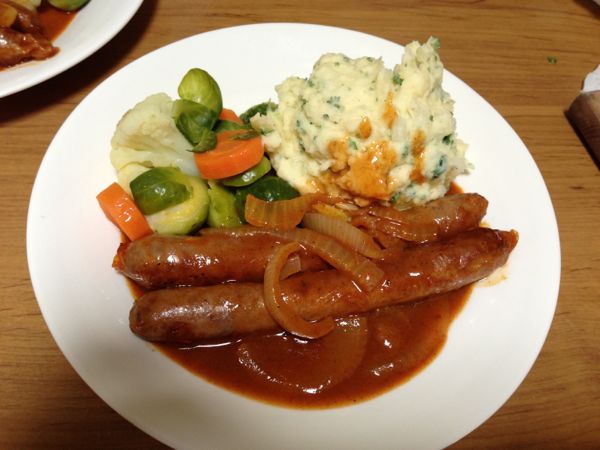
On the first night we had sausages with onion gravy, mashed potatoes with finely chopped onion and parsley, brussel sprouts, cauliflower and carrots. It's winter here so we enjoyed the hot food but if it were summer, a salad, potato salad, coleslaw, homemade pickled beetroot or tomato relish would all be delicious served alongside the sausages.

ONION GRAVY
Pour off some of the dripping in the pan if there is too much there. Add one sliced onion and fry until soft. Add a tablespoon of plain flour, salt and pepper, then stir this until it's brown. If you have paprika, adding a level teaspoon will add a rich colour to the gravy. When the flour mix is coloured, add about a litre/quart of water and stir until the gravy thickens. Allow to simmer on the stove while you serve the sausages and vegetables, then top with hot gravy.

Put the leftover sausages and gravy in a bowl, in the fridge for tomorrow night's dinner.

CURRIED SAUSAGES
The following night, chop the sausages into bite sizes pieces and leave to one side. Add a small amount of oil to the pan and cook one onion until it's slightly browned, then add the vegetables you have on hand, add a tablespoon of curry powder and another of plain flour and stir in. Then add about a litre/quart of water and allow the sauce to thicken. Add the sausage pieces and simmer for 30 minutes to allow the curry flavours to develop. I added ½ cup washed rice to the meal so I didn't have much washing up to do but you could also boil or steam some rice separately to serve with it.

Please note: if you have small children who won't like curry, leave the curry powder out and add paprika instead. You'll still get a good flavour.


I love having a treat after a meal like this - a meal when I feel I've saved money and stayed within my budget. Right now it's strawberry season here so fresh strawberries and cream is the logical (to me) ending to a meal such as this. Just because we're on a budget, it doesn't mean we can't eat the best fruit we can find or create a favourite dessert. Don't be afraid to treat yourself. You deserve it. : - )

Thanks to everyone who suggested radio stations for me to try. I've already listened to Jack Monroe on BBC4. I'll set up NPR and Radio National when I have a chance later in the week.


I'm continuing the decluttering challenge many of us started last Monday. The declutterers at the forum are posting about what they're doing and what they're moving out. It's quite inspiring. If you want to join in, we're decluttering five items on Monday and one item each week day until the end of the month. If you want to blog about what you're decluttering, leave a link for us in the comments and we'll follow it. Here is last Monday's post about it.

The drawer in its original condition.
After a quick clean and tidy.
This is what is being moved out. It wasn't too bad although there are a couple of things there I don't recognise.

Yesterday, after lunch, I decided to clean out one of the gadget drawers in the kitchen. This is the drawer that sits under my kitchen linens drawer, under the oven. It holds things I use, but not often. So it's the mandolin, tomato press, grater, canning tools, rings, lids and those sorts of things. It didn't take long to remove everything, wipe the drawer out, replace the useful items and separate what I didn't need any more. I'm sure there is a reason I kept one of the steel racks from my old oven but I can't think of it now. Whatever the reason, now it will be used to dry soap or as a rack in the bush house to keep wet pots off the wooden benches.

It feels good to have the drawer clean and tidy, ready for service again.

Yesterday I thought I was going to write most of the day but I ended up in my bush house, repotting ferns and plants in hanging baskets. I take the baskets out of the bushouse in spring and hang them on the front verandah. They give the house a cooler feeling when the temperatures start to climb again. So I repotted some king ferns and a few olds and ends and hung them out the front. We rarely sit out there in winter, favouring the back verandah with the sun streaming in during the colder weather.  I love sitting outside to have morning or afternoon tea. We can sit there together in the fresh air, talking about our plans and hopes, while we enjoy a break.


Also after lunch, I juiced two buckets full of lemons. I harvested two litres/quarts of juice last week, now these two buckets have given two more large bottles for the freezer, as well as a litre/quart to use during the week. That lemon tree of ours has served us well over the almost 16 years we've lived here. It was one of the first things we planted here, it's in the chook run so we never have to fertilise it, and although it gives a huge crop of lemons in winter, it generally has a few lemons on it all through the year. I'm guessing we'll get another two or three good years from the tree before it will start producing less and less lemons. If it keeps on producing prolific crops, I'll happily accept it and have more than enough lemons and cordial to share.

LEMON CORDIAL

To make lemon cordial, or any fruit cordial, you start by making a sugar syrup. This is just equal quantities of water and sugar - so 1 cup sugar to 1 cup of water. I use 2 kg/4.4lbs sugar to 2 litres/quarts water and make up a quantity of the syrup - boil till the sugar dissolves and allow to cool. It keeps in the fridge for about six months. Then just mix it with the juice as needed.  I use equal amounts of syrup to juice and then dilute the drink right down with water and this is done according to your taste.


The two plastic bottles will go in the freezer, the glass bottle in the fridge for use during the week. Kerry, Sunny and Jamie are coming over for a family lunch tomorrow so I'll probably make a batch of cordial then. The forecast tomorrow is for 28C/82F and it's still winter! 

Hanno went to the market yesterday and bought another Eureka lemon tree.  It will be planted up in the corner of our property, near the bananas. I can't imagine not having a lemon tree now. They're good for so many things. But soon it will be summer, and that's always lemon cordial time here. I'm looking forward to it with an abundance of juice ready to go.

Just a little request here at the end. Now that I've discovered that I can use my smartphone as an internet radio, I've been trying to find a couple of stations to listen to in the kitchen when I'm working there. I don't want music stations, I like talk, but not talk-back. Something similar to the wonderful Radio National in Australia would be ideal. They have all sorts of interesting broadcasts about lifestyle, books, philosophy, parenting, history, food etc. Do you have anything to recommend?


Vivian is back from her family holiday and she's having a mini sale at EcoYarns this weekend. Most of the yarns with wool content will be on sale. I noticed there are new buttons in now too and, if you're a spinner, several new tools, such as a yarn meter, and winders.

I am knitting Johnathan a summer cardigan in Vivian's softest pale blue organic cotton at the moment. I love using it.  And Tricia is knitting herself a beautiful darm brown cardigan with the Trekeiske Organic Merino. It's so soft and warm.
The master's apprentice. This is where Jamie leaves his spade.

I'll be busy with my writing most of the weekend. I'm hoping to have Sunday afternoon off to relax and prepare for next week. I hope you have the chance to relax too, even if you're busy, especially then. You need it. Whatever you do ever the weekend, I hope you enjoy yourself and spend time with the people you love. I'll see you next week. 

- - - ♥ - - -

If you're buying packet cake mix this week, read this first.
How to be self-sufficent in the city
Learning to live a self-sufficient life
Ben Hewitt
How to eat off the land in August
Sort through the recipes at tinnedtomatoes
The English Kitchen
The Pace of Modern Life
Delicious Vietnamese summer rolls

From the comments here this week
Dusty Country Road
Bread and Butter
Gladys in the Garden


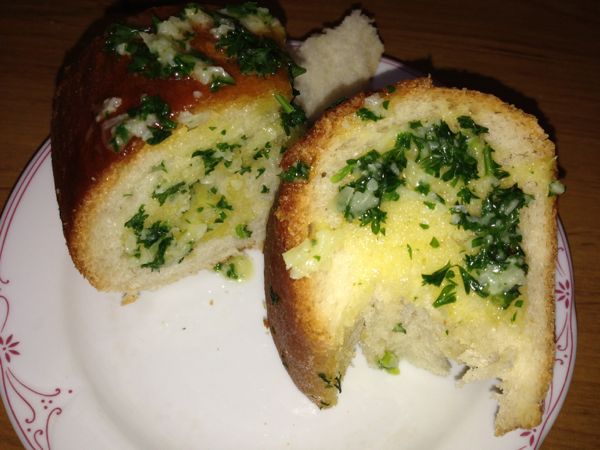
Homemade garlic and herb bread.

Bread is part of our daily lives here. I make it most days and sometimes we buy a good rye loaf from our German baker. I'm happy to say though that I make good rye bread, so the loaf we buy from them at six dollars is only purchased when, for one reason or another, it can't be made at home. Very early on in my simple life I wanted to bake bread instead of buy it. It is possible to buy good bread but it's expensive and supermarket bread contains so many additives, I don't think it's worth eating. The following is a typical ingredient list for Australian packaged white or wholemeal supermarket bread:

  • Wheat Flour, Water, Baker's Yeast, Vinegar, Iodised Salt, Canola Oil, Wheat Gluten, Soy Flour, Emulsifiers (481, 472e, 471), Vitamins (Thiamin, Folate). 

So one of the first things I taught myself how to do was to bake our bread. It took about three months to get a loaf that I was happy with every day. I tried many recipes, reworked, adjusted and finally had a recipe that gave consistent good results.  I've kept tweaking it over the years and I'm happy to share that recipe with you. I know many are learning how to bake for the first time and others struggle, as I did, to get a decent loaf. Bread and soap making are the two subjects I'm asked about most at my library talks. Try this recipe and if it doesn't work, try it again the following day. If it works the second time, it just means you missed something the first time. The amounts must be accurate and you need a warm temperature in the kitchen to proof the dough.

This loaf can be made in a bread machine or completely by hand. I use the machine to knead the dough when I'm busy. One thing a machine is good at is kneading, and the machine keeps a steady warm temperature so that the dough rises well. When all that is done, I take the dough out of the machine and bake the loaf in the oven. The how to guide to making bread by hand is in this early post from 2007. Little has changed, except the recipe. I've developed this new simpler recipe that makes a good loaf, even for beginners. 

This bread contains gluten. I never make gluten-free bread. Gluten is one of the proteins in wheat flour. To make this bread successfully, you need to develop the gluten. That just means it must be kneaded for a long time. The machine will take over an hour to knead and proof the dough. If you do it by hand, you must knead vigorously for at least ten minutes. 


You need fresh ingredients for bread to rise. Use fresh flour and fresh yeast, not those that have been sitting at the back of the cupboard for six months.

BREAD RECIPE
  • Approx. 300 mls/10oz warm water - start off with 280mls/9.5oz water, and add more if the dough needs it. Make sure the water isn't too hot. It will kill the yeast.
  • 2 teaspoons dried/instant yeast *
  • 1 teaspoon sugar (optional) this helps the yeast to activate
  • 400 grams of high protein/baker's flour - it can be white, wholemeal, grain or rye. The only difference this will make to the recipe is the amount of water the different flours will need.
  • 1 teaspoon salt
If you've had problems in the past getting bread to rise, use a heaped teaspoon of bread improver to the above recipe and see if that makes a difference. 

* I never use any other type of yeast so please don't ask me about fresh yeast. I don't know.

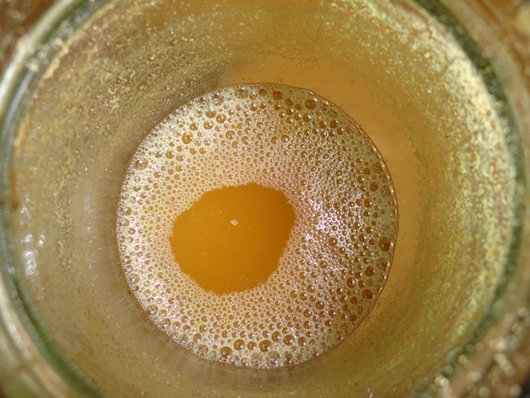
Before loading the bread machine, add 280mls/9.5oz warm water to a cup and add the yeast and sugar. Stir it until it's dissolved. Give the yeast five minutes to activate and if the mixture looks milky or bubbly, the yeast has activated. There is a photo of this in the 2007 link. If the yeast doesn't activate, wait another five minutes. If it still hasn't activated, it must be dead/old yeast. You'll have to buy a fresh batch before you make bread.

Load the flour and salt into the machine then add the yeast water. Turn the machine on to the dough setting and let it start mixing. Keep an eye on it because you'll probably have to add more water. Let the dry ingredients mix and the add the rest of the water if it needs it. You may even have to add more water. It will depend on the weather and the type of flour you use. You're aiming to make the dough moist but not really sticky. When the dough starts the kneading process, it should turn into a nice smooth dough.

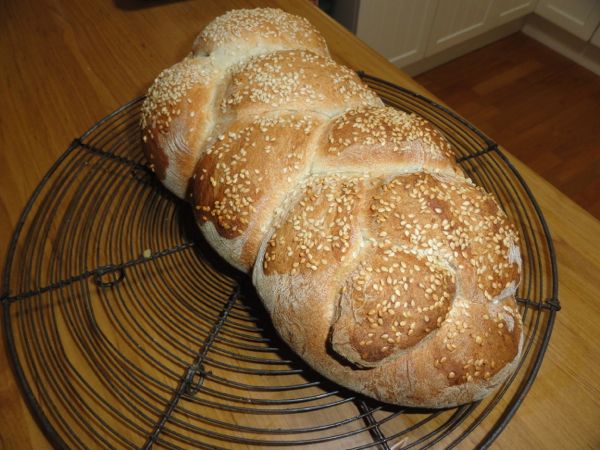
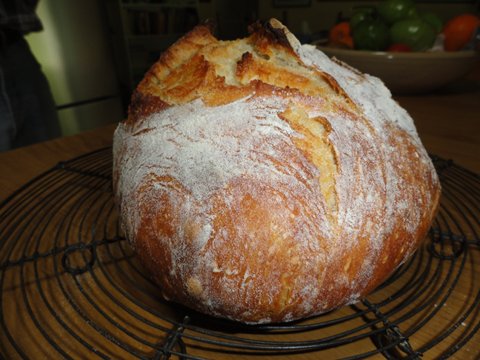
Last week's bread.
Uncut and cut.
Shaping the dough. You roll it into a spiral.
Last week's garlic bread.
I forgot to take a photo before I cut it. Oops.
This is the shaped loaf in the bread tin, sitting in the bread machine to rise.

When the dough cycle has finished. Take the dough out, shape it and put it in your bread tin. Let it sit with a clean tea towel over the top to almost double in size. If you kitchen is cold, you may want to do this by placing the bread tin into the top of the bread machine while it's still turned on. The warmth of the machine will help the dough rise (see above).  When the dough has risen, just before you put it in the oven, add seeds, polenta, oats or whatever you want to add, slash the top with a VERY sharp knife and put the loaf into a very hot oven - 220C/430F. Five minutes after it's in, turn the oven down to 200C/390F. Bake for 20 - 30 minutes or until the loaf is golden and cooked.

Turn the loaf out onto a cake rack to cool.


I made this no knead Dan Lepard's Movida loaf for the first time yesterday but it wasn't a great success. I think I added too much water. The resulting loaf couldn't be cooked free form so I added it to a bread tin for baking. The bread itself was fine but I think I still prefer my loaf above because I have two periods when I load the bread machine and then get it ready for the oven and don't have to worry about coming back in ten minutes when I'm busy doing something else.

If you've had trouble in the past with your baking, I hope you try this recipe and tell me how it goes for you.  Happy baking everyone!

I APOLOGISE! I read the first lot of 13 comments, highlighted them all to publish them but then clicked the wrong button and deleted instead. I'm sorry to everyone who commented. I invite you to add your comment again if you have the time.

I think a lot of people let the idea of perfection get in the way of living. When you expect perfection you raise the bar so high, most of the time you don't live up to it and you're left disappointed. I don't think anything is perfect in day to day living, and it's not meant to be. I'm far from perfect. I'm as flawed as the next person and happily accepted that many years ago. If I was living with the expectation of being perfect or carrying out my tasks perfectly, I'd probably be too scared to try most of the things I have tried.

I do try to do my best though. I try for that in every thing I do. When I write this blog, I try my best. Not so it's the best blog or to outshine any other bloggers. I do it because I want it to be the best I'm capable of. Some days I get it right, some days I don't, but I'm okay with both.


My guess is that this topic wouldn't mean much except that it stops some people from trying new things. They're scared of failure. They don't want to make mistakes. I think mistakes are one of the greatest learning tools. They show you you've done something wrong and if you stop and think about it, often they show you how to fix the mistake as well. Whenever I make a mistake I know that what I did wrong, and what I did to fix it, will be cemented into my brain forever. And although I don't like making mistakes, when I do, I gratefully accept the lessons they have to teach me.


When I first started this blog, in the first few months, I occasionally used material I'd written for a book proposal. I sent it off to three publishers and they all said no to me. But I believed in what I had written, turned that book proposal into this blog and a few months later, Penguin came knocking and offered me a book contract. If I had my choice of book publishers, I would have chosen Penguin, but I didn't send my proposal to them because I didn't think I was that good. Now I have one published Penguin book and am in the process of writing another. It's a good lesson in trying your best in everything you do. When all the ducks are lined up, your best if often exactly what others want.

Mini packs of green beans - servings for two - blanched and ready for the freezer.

So instead of concentrating on perfection, concentrate on giving, on love, on generosity, self-reliance, family tradition, home skills and understanding. You never know, the end result might just be close to perfect.


Decluttering update:
Buried deep in the back of the bathroom cupboard, hair dye! (circa 1998), some disgusting looking orange bath bombs (ugh), two old hair brushes and a hair clip.  They're all going to the rubbish bin, except for the hair clip.

I hope you're continuing along with me. Do your updates in the comments here if you're linking to your blog, or at the forum if you don't have a blog or want to join in the discussions about decluttering.

Newer Posts Older Posts Home

MY BOOKS

MY BOOKS


My books were all published by Pengiun, and are available at Amazon US, Amazon UK and Amazon Au

Search here

Total Pageviews

Translate


I'm Rhonda Hetzel and I've been writing my Down to Earth blog since 2007. Although I write the occasional philosophical post, my main topics include home cooking, happiness and gardening as well as budgeting, baking, ageing, generosity, mending and handmade crafts. I hope you enjoy your time here.

MY FAVOURITE PLACES

  • Grandma Donna's Place
  • Grandma Donna's YouTube
  • Grandma Donna's Instagram
  • This Simple Day
  • Nicole's Instagram

Give More

Give More

Popular posts last year

Making ginger beer from scratch

We had a nice supply of ginger beer going over Christmas. It's a delicious soft drink for young and old, although there is an alcoholic version that can be made with a slight variation on the recipe. Ginger beer is a naturally fermented drink that is easy to make - with ginger beer you make a starter called a ginger beer plant and after it has fermented, you add that to sweet water and lemon juice. Like sourdough, it must ferment to give it that sharp fizz. To make a ginger beer plant you'll need ginger - either the powdered dry variety or fresh ginger, sugar, rainwater or tap water that has stood for 24 hours to allow the chlorine to evaporate off. You'll also need clean plastic bottles that have been scrubbed with soap, hot water and a bottle brush and then rinsed with hot water. I never sterilise my bottles and I haven't had any problems. If you intend to keep the ginger beer for a long time, I'd suggest you sterilise your bottles. MAKING THE STARTER In a...
Image

NOT the last post

This will be my last post here.  I've been writing my blog for 18 years and now is the time to step back. I’ve stopped writing the blog and come back a couple of times because so many people wanted it, but that won’t happen again, I won’t be back.  I’ll continue on instagram to remain connected but I don’t know how frequent that will be. I know some of you will be interested to know the blog's statistics. 
Image

How to make cold process soap

I'm sure many of you are wondering: "Why make soap when I can buy it cheaply at the supermarket?" My cold process soap is made with vegetable oils and when it is made and cured, it contains no harsh chemicals or dyes. Often commercial soap is made with tallow (animal fat) and contains synthetic fragrance and dye and retains almost no glycerin. Glycerin is a natural emollient that helps with the lather and moisturises the skin. The makers of commercial soaps extract the glycerin and sell it as a separate product as it's more valuable than the soap. Then they add chemicals to make the soap lather. Crazy. Making your own soap allows you to add whatever you want to add. If you want a plain and pure soap, as I do, you can have that, or you can start with the plain soap and add colour, herbs and fragrance. The choice is yours. I want to add a little about animal and bird fat. I know Kirsty makes her soap with duck fat and I think that's great. I think t...
Image

Preserving food in a traditional way - pickling beetroot

I've had a number of emails from readers who want to start preserving food in jars but don't know where to start or what equipment to buy.  Leading on from yesterday's post, let's just say up front - don't buy any equipment. Once you know what you're doing and that you enjoy preserving, then you can decide whether or not to buy extra equipment. Food is preserved effectively without refrigeration by a variety of different methods. A few of the traditional methods are drying, fermentation, smoking, salting or by adding vinegar and sugar to the food - pickling. This last method is what we're talking about today. Vinegar and sugar are natural preservatives and adding one or both to food sets up an environment that bacteria and yeasts can't grow in. If you make the vinegar and sugar mix palatable, you can put up jars of vegetables or fruit that enhance the flavour of the food and can be stored in a cupboard or fridge for months. Other traditional w...
Image

Cleaning mould from walls and fabrics

With all this rain around we've developed a mould problem in our home. Usually we have the front and back doors open and that good ventilation stops most moulds from establishing. However, with the house locked up for the past week, the high humidity and the rain, mould is now growing on the wooden walls near our front door and on the lower parts of cupboards in the kitchen. Most of us will find mould growing in our homes at some point. Either in the bathroom or, in humid climates, on the walls, like we have now. You'll need a safe and effective remedy at some point, so I hope one of these methods works well for you. Mould is not only ugly to look at, it can cause health problems so if you see mould growing, do something about it straight away. The longer you leave the problem, the harder it will be to get rid of it effectively. If you have asthma or any allergies, you should do this type of cleaning with a face mask on so you don't breathe in any spores. Many peopl...
Image

Five minute bread

Bread is one of those foods that, when made with your own hands, gives a great deal of satisfaction and delight. It's only flour and water but it symbolises so much. I bake bread most days and use a variety of flours that I buy in bulk. Often I make a sandwich loaf because we use most of our bread for lunchtime sandwiches and for toast. Every so often I branch out to make a different type of loaf. I have tried sour dough in the past but I've not been happy with any of them. I'll continue to experiment with sour dough because I like the idea of using wild yeasts and saving the starter over a number of years to develop the flavour and become a part of the family. However, the loaf I've been branching out to most often is just a plain old five minute bread. By five minutes I mean it takes about five minutes actual work to prepare but it's the easiest of all bread to make and to get consistently good loaves from. If you're having people around for lunch or...
Image

This is my last post.

I have known for a while that this post was coming, but I didn't know when. This is my last post. I'm closing my blog, for good, and I'm not coming back like I have in the past.  I've been writing here for 16 years and my blog has been many things to me. It helped me change my life, it introduced me to so many good people, it became a wonderful record of my family life, it helped me get a book contract with Penguin, and monthly columns with The Australian Women's Weekly and Burke's Backyard . But in the past few months, it's become a burden. In April, I'll be 75 years old and I hope I've got another ten years ahead. However, each year I'll probably get weaker and although I'm fairly healthy, I do have a benign brain tumour and that could start growing. There are so many things I want to do and with time running out, leaving the blog behind gives me time to do the things that give me pleasure. On the day the blog started I felt a wonderful, h...
Image

What is the role of the homemaker in later years?

An email came from a US reader, Abby, who asked about being a homemaker in later years. This is part of what she wrote: "I am a stay-at-home mum to 4 children, ages 9-16. I do have a variety of "odd jobs" that I enjoy - I run a small "before-school" morning drop-off daycare from my home, I am a writing tutor, and I work a few hours a week at a local children's bookstore. But mostly, I cherish my blissful days at home - cooking, cleaning (with homemade cleaners), taking care of our children and chickens and goats, baking, meal-planning, etc. This "career" at home is not at all what I imagined during my ambitious years at university, but it is far more enriching. I notice, though, that my day is often planned around the needs of my family members. Of course, with 4 active kids and a husband, this is natural. I do the shopping, plan my meals, cook dinner - generally in anticipation of my family reconnecting in the evening.  I can't h...
Image

Every morning at home

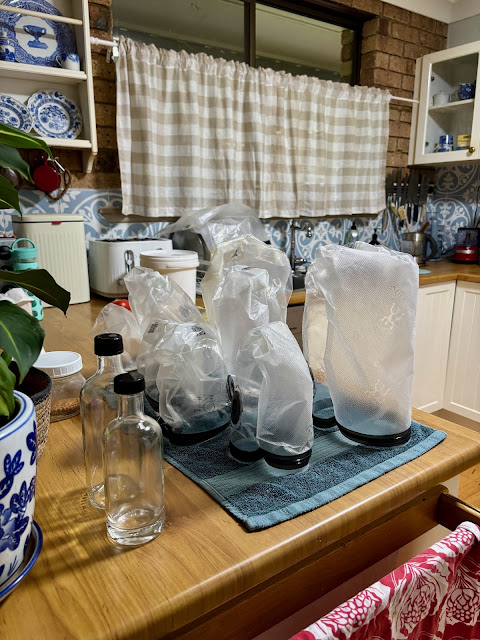
Every morning when I walk into my kitchen it looks tidy and ready for a day's work. Not so on this morning (above), I saw this when I walked in. Late the previous afternoon when I was looking for something, I came across my rolled up Zwilling vacuum bags and decided they had to be washed and dried. So I did that and although I usually put them outside on the verandah to dry it was dark by then. I turned the just-washed bags inside out and left them like this on a towel. It worked well and now the bags are ready to use when I bring home root vegetables, cabbages or whatever I buy that I want to last four or five weeks.
Image

You’ll save money by going back to basics

When I was doing the workshops and solo sessions, I had a couple of people whose main focus was on creating the fastest way to set up a simple life. You can't create a simple life fast, it's the opposite of that It's not one single thing either - it's a number of smaller, simpler activities that combine to create a life that reflects your values; and that takes a long to come together. When I first started living simply I took an entire year to work out our food - buying it, storing it, cooking it, preserving, baking, freezing, and growing it in the backyard. This is change that will transform how you live and it can't be rushed.  
Image

All previous blog posts

  • 2026 3
    • February 3
      • Workshops starting 1 March
      • Planting vegetable seeds and new workshops
      • Back where we belong
  • 2025 7
    • July 1
    • June 2
    • May 1
    • April 2
    • February 1
  • 2024 25
    • December 2
    • November 1
    • October 2
    • September 3
    • August 1
    • July 3
    • June 1
    • May 3
    • April 2
    • March 3
    • February 2
    • January 2
  • 2023 13
    • December 1
    • November 2
    • October 1
    • September 3
    • August 2
    • February 2
    • January 2
  • 2022 17
    • November 3
    • October 4
    • September 3
    • August 2
    • July 3
    • June 2
  • 2021 50
    • December 1
    • November 6
    • October 7
    • September 5
    • August 4
    • July 5
    • June 2
    • May 2
    • April 6
    • March 4
    • February 4
    • January 4
  • 2020 68
    • December 3
    • November 5
    • October 4
    • September 4
    • August 4
    • July 4
    • June 4
    • May 8
    • April 7
    • March 8
    • February 8
    • January 9
  • 2019 66
    • December 2
    • November 4
    • October 5
    • August 3
    • July 4
    • June 6
    • May 8
    • April 8
    • March 8
    • February 11
    • January 7
  • 2018 82
    • December 1
    • September 2
    • August 10
    • July 4
    • June 11
    • May 9
    • April 12
    • March 10
    • February 10
    • January 13
  • 2017 129
    • December 7
    • November 10
    • October 6
    • September 13
    • August 11
    • July 13
    • June 12
    • May 9
    • April 9
    • March 14
    • February 11
    • January 14
  • 2016 125
    • December 7
    • November 13
    • October 10
    • September 11
    • August 11
    • July 8
    • June 9
    • May 9
    • April 12
    • March 10
    • February 13
    • January 12
  • 2015 184
    • December 7
    • November 15
    • October 20
    • September 18
    • August 19
    • July 18
    • June 12
    • May 15
    • April 12
    • March 21
    • February 13
    • January 14
  • 2014 203
    • December 11
    • November 8
    • October 17
    • September 20
    • August 17
    • July 19
    • June 17
    • May 17
    • April 23
    • March 15
    • February 18
    • January 21
  • 2013 225
    • December 13
    • November 17
    • October 17
    • September 17
    • August 21
    • July 24
    • June 20
    • May 19
    • April 17
    • March 22
    • February 17
    • January 21
  • 2012 245
    • December 17
    • November 20
    • October 20
    • September 18
    • August 15
    • July 24
    • June 21
    • May 26
    • April 23
    • March 23
    • February 19
    • January 19
  • 2011 257
    • December 18
    • November 24
    • October 27
    • September 23
    • August 24
    • July 21
    • June 24
    • May 24
    • April 16
    • March 22
    • February 14
    • January 20
  • 2010 283
    • December 20
    • November 18
    • October 18
    • September 19
    • August 25
    • July 24
    • June 25
    • May 26
    • April 25
    • March 22
    • February 29
    • January 32
  • 2009 293
    • December 29
    • November 18
    • October 23
    • September 25
    • August 22
    • July 28
    • June 22
    • May 21
    • April 27
    • March 26
    • February 24
    • January 28
  • 2008 387
    • December 24
    • November 23
    • October 25
    • September 26
    • August 27
    • July 27
    • June 37
    • May 34
    • April 44
    • March 53
    • February 32
    • January 35
  • 2007 372
    • December 37
    • November 40
    • October 55
    • September 51
    • August 49
    • July 63
    • June 49
    • May 28


Trending Articles

NOT the last post

This will be my last post here.  I've been writing my blog for 18 years and now is the time to step back. I’ve stopped writing the blog and come back a couple of times because so many people wanted it, but that won’t happen again, I won’t be back.  I’ll continue on instagram to remain connected but I don’t know how frequent that will be. I know some of you will be interested to know the blog's statistics. 
Image

Every morning at home

Every morning when I walk into my kitchen it looks tidy and ready for a day's work. Not so on this morning (above), I saw this when I walked in. Late the previous afternoon when I was looking for something, I came across my rolled up Zwilling vacuum bags and decided they had to be washed and dried. So I did that and although I usually put them outside on the verandah to dry it was dark by then. I turned the just-washed bags inside out and left them like this on a towel. It worked well and now the bags are ready to use when I bring home root vegetables, cabbages or whatever I buy that I want to last four or five weeks.
Image

You’ll save money by going back to basics

When I was doing the workshops and solo sessions, I had a couple of people whose main focus was on creating the fastest way to set up a simple life. You can't create a simple life fast, it's the opposite of that It's not one single thing either - it's a number of smaller, simpler activities that combine to create a life that reflects your values; and that takes a long to come together. When I first started living simply I took an entire year to work out our food - buying it, storing it, cooking it, preserving, baking, freezing, and growing it in the backyard. This is change that will transform how you live and it can't be rushed.  
Image

Creating a home you'll love forever

Living simply is the answer to just about everything. It reduces the cost of living; it keeps you focused on being careful with resources such as water and electricity; it reminds you to not waste food; it encourages you to store food so you don't waste it and doing all those things brings routine and rhythm to your daily life. Consciously connecting every day with the activities and tasks that create simple life reminds you to look for the meaning and beauty that normal daily life holds.  It's all there in your home if you look for it. Seemingly mundane tasks like cleaning and cooking help you with that connection for without those tasks, the home you want to live in won't exist in the way you want it to.  Creating a home you love will make you happy and satisfied.
Image

Time changes everything

I've been spending time in the backyard lately creating a contained herb and vegetable garden. My aim is to develop a comfortable place to spend time, relax, increase biodiversity and encourage more animals, birds and insects to live here or visit. Of course I'd prefer my old garden which was put together by Hanno with ease and German precision. Together, we created a space bursting at the seams with herbs, vegetables and fruity goodness ready to eat and share throughout the year. But time changes everything. What I'm planning on doing now, is a brilliant opportunity for an almost 80 year old with balance issues. In my new garden I'll be able to do a wide range of challenging or easy work, depending on how I feel each day. It’s a daily opportunity to push myself or sit back, watch what's happening around me and be captivated by memories or the scope of what's yet to come.
Image

It's the old ways I love the most

I'm a practical woman who lives in a 1980’s brick slab house. There are verandahs front and back so I have places to sit outside when it's hot or cold. Those verandahs tend to make the house darker than it would be but they're been a great investment over time because they made the house more liveable. My home is not a romantic cottage, nor a minimalist modern home, it's a 1980’s brick slab house. And yet when people visit me here they tell me how warm and cosy my home is and that they feel comforted by being here. I've thought about that over the years and I'm convinced now that the style of a home isn't what appeals to people. What they love is the feeling within that home and whether it's nurturing the people who live there.
Image

Back where we belong

Surprise! I'm back ... for good this time. Instagram became an impossible place for me. They kept sending me messages asking if I'd make my page available for advertisers! Of course, I said no but that didn't stop them. It's such a change from what Instagram started as. But enough of that, the important part of this post is to explain why I returned here instead of taking my writing offline for good. For a few years Grandma Donna and I have talked online face-to-face and it's been such a pleasure for me to get to know her. We have a lot in common. We both feel a responsibility to share what we know with others. With the cost of living crisis, learning how to cook from scratch, appreciate the work we do in our homes, shop to a budget and pay off debt will help people grow stronger. The best place to do that is our blogs because we have no advertising police harassing us, the space is unlimited, we can put up tons of photos when we want to and, well, it just feels li...
Image

Making ginger beer from scratch

We had a nice supply of ginger beer going over Christmas. It's a delicious soft drink for young and old, although there is an alcoholic version that can be made with a slight variation on the recipe. Ginger beer is a naturally fermented drink that is easy to make - with ginger beer you make a starter called a ginger beer plant and after it has fermented, you add that to sweet water and lemon juice. Like sourdough, it must ferment to give it that sharp fizz. To make a ginger beer plant you'll need ginger - either the powdered dry variety or fresh ginger, sugar, rainwater or tap water that has stood for 24 hours to allow the chlorine to evaporate off. You'll also need clean plastic bottles that have been scrubbed with soap, hot water and a bottle brush and then rinsed with hot water. I never sterilise my bottles and I haven't had any problems. If you intend to keep the ginger beer for a long time, I'd suggest you sterilise your bottles. MAKING THE STARTER In a...
Image