down to earth

  • Home
  • About Us
  • Down To Earth Book
  • Privacy Policy
I'm tired today, too tired to write anything sensible, so I'll leave our budget post until tomorrow.  Yesterday Hanno and I took the day off and wandered around Brisbane, ending up at the State Library. We'd been invited to attend a function to celebrate the books published by Queensland authors last year. The Minister for the Arts Ian Walker was there along with about 150 authors, readers, librarians and members of the Queensland Writers Centre. We got home around 8, I think I was asleep at 8.30pm. 


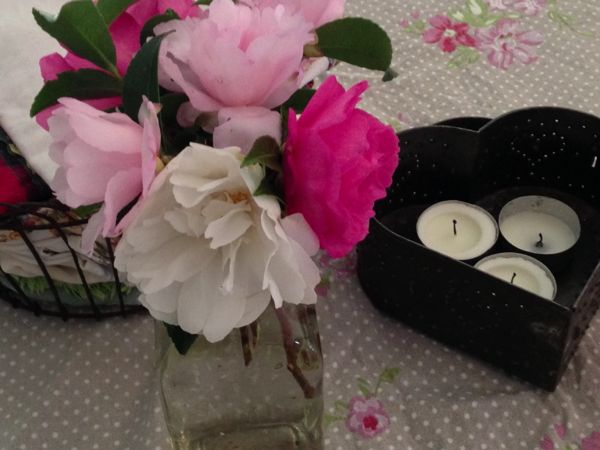
Photos above taken last night at the State Library.

Today I'll organise the workshop bookings and send out another email to those of you who have booked. I'll take some time this afternoon to do a general cleanup, and now that the rain has stopped, check out the garden.  See you tomorrow!
Let's talk about money today, specifically how we spend our money. Most of us know how much money we make in a month but very few of us know exactly how much we spend, or on what. When I first started taking control of my money and had to make every penny stretch as much as I could, I found that tracking my money was the best way to discover two important things:
  1. what I was spending my money on;
  2. what my non-essential spending was.
Non-essential spending is often the key to paying off debt. It's that money we all spend on magazines, coffee, movies, a packet of chocolate biscuits, iTunes, takeaway food, convenience food, soft drinks/soda and bottles of water. Most of us know that spending on these things is wasted money, but we still do it, "just this time". If you can identify the money you spend on those non-essential things and add up the money spent over a month, I'm sure you'll be surprised. And if you can harness that money and put it towards debt repayment, or even to buy the groceries you need this month, then it's a step in the right direction.


How to track your spending
Every time you go out - every . time - record exactly what you spend and on what. You can do that in a number of ways:
  1. Take a small notebook and pen with you and write it down as you spend.
  2. Collect every receipt and when you come home, add them up and record the totals.
  3. Use a smartphone app. The one for Australians on the government's Moneysmart website is very good. You can download it here. The data you enter into your phone can later be transferred to an Excel spreadsheet. It also allows you to set your limit and will track as you go and show you where you are in relation to your limit. You can download My Spending for Android phones here or Expense Tracker for iPhone and iPad here.
Changing behaviours is rarely about the big things. The big ticket items stand out and we notice them. They make us stop and think before we buy. It's the small things that do the real damage. Usually they  are items you want but don't need. We buy them because they're relatively cheap but when you track what you spend over a month and then add it up, you'll be surprised at just how much you spent on all those small things. 

When you get to the end of a month's tracking, you'll have a much clearer idea of what you're spending your money on. If you can stop that spending, your money can go towards your budgeting requirements. If you've never done this, it's worth doing. Otherwise you won't know your spending habits or how much all those small things are costing you. One thing is for sure, they cost you a lot more than you actually spend.

When you have at least a month's tracking, you have the two figures you need to make up your budget: how much your income is and an accurate summary of your spending. Then you go to the next step. Working out a budget you can live with, while paying off debt in an organised way, or building your savings account. That, my friends, will be our next post.

Please share your experience of tracking your spending and how you did it.


Sandy made a good point in her comment the other day when she said: We saved and budgeted hard years ago and cleared the mortgage. That is what helped us to live 'easier' now. But easier doesn't mean you give up 'simple'...it makes living 'simply' easier!  That hit the nail on the head for me and it helps to clarify the point that simple life isn't only about frugality and paying off debt. Money isn't, and shouldn't be, the main focal point of life. However, if you have debt it will stop you living the life you want because your efforts will be directed towards paying off your debt instead of living your life fully. Debt reduction and not gaining more debt is part of simple life, but it's just one of many parts that make up how we live.


Hanno and I bought our home on a 20 year mortgage and paid that mortgage off in eight years. Had  we still been in debt when I realised I was burnt out and wanted to stop work, I would not have been able to do what I did. I would have continued working until it was paid off. Luckily we were debt-free, so I had the self-indulgent luxury of giving up work to find a better way to live.

Hanno took control of our debts from day one of our mortgage. He paid the mortgage fortnightly instead of monthly and we paid extra payments whenever we had spare cash. Now that I look back, it wasn't easy but it was much easier than stretching it out to pay over 20 years and, as a consequence, paying so much more in interest payments. By knuckling down to pay that mortgage off fast, we literally saved ourselves tens of thousands of dollars.

You have to be strong to do something like that but I have to tell you I didn't feel strong while we did it. I only recognised our fortitude and strength much later, with the benefit of hindsight. Imagine this: we're both working hard, we have a young family, we're living in an isolated town to maximise our earning potential and friends ask us to to join them and their family for a weekend on a tropical island. It took guts to say no, but that's what we did. It was with trepidation at first but later it got easier. We didn't always say no to invitations but we did it enough to make a financial difference. Over those years we did take our boys off on camping trips, on a trip to Tasmania and to see our national capital - Canberra. But we also focused on our debts and paid them off. When we saw that debt total slowly decrease, it became easier and we knew we were doing the right thing. We didn't realise then what I know now - that paying off debt lifts the weight of the world from your shoulders and gives you the luxury of freedom.

And you never know what that freedom will be used for. It could be for an early "retirement" such as mine, to cut back full-time work to part-time to have more time for the family, it could be to divide your time between work and study. It could be anything. The important thing is that freedom and independence it will be there waiting there for you too.

Tomorrow we'll talk about various strategies you can use to pay off debt.  In the meantime, I'd love you to share your thoughts with us on paying off debt.


A State funeral today for Mr Yunupingu. RIP Mr Yunupingu.

He was one of our great indigenous leaders and a fine musician.

Treaty, the song he co-wrote and sang, on You Tube
The end of another week and time to take it easy for a couple of days. I hope you have that opportunity too. We'll come back stronger for it next week. On Monday we'll continue with our series and start with an important subject, budgeting. Thank you for your comments this week, as usual, they add a lot to what I'm writing about. I hope you have a lovely weekend.  xx


These two photos were taken at the Beerwah CWA rooms when I had my recent talk there. The top photo shows the vintage tea cups waiting to be filled with morning tea and the table cloth is a hand embroidered cloth showing the branch members names. The pineapple embroidery depicts an important local crop - pineapples. So sweet.

Why I haven't been flying much. David Holmgren
Kate at Purple Pear gave me Cecelia Macauley's name as one who has been writing about applying permaculture principles to our homes. Here is her blog.
Don't mess with the knitters
How to enjoy a food market
25 predictions for a future world
Hettie Brown
Our ash grove
Fig Jam and Lime Cordial
Oh Betty
Fields and Fire

FROM THE COMMENTS HERE
Anderson Cottage
The Quiet Home
Dusty Country Road
Before we move onto specific subjects such as budgeting, paying off debt, traditional skills, baking, cooking from scratch, organisation, routines, decluttering, recycling, vegetable gardening, chooks and whatever else we can think of, I'd like to talk about living where you are - claiming your ground.


I suppose simple living is often been seen as a rural pleasure. A way of life that makes sense in the country, or at least outside the city. I think there are arguments for and against most locations, the key here is to work out where you have to be at a particular stage of your life and then make it work for you. Bloom where you are planted.


I live in a semi-rural town about an hour's drive from our capital city and I'm very happy here. There is good rainfall, we've built up our soil so it now produces abundant harvests, the sun shines most days and nothing much happens. At this stage in my life, all those things are important to me. But public transport here isn't as reliable and frequent here as it is in the city, if we needed specialist medical services we'd probably have to drive into the city for them, and entertainment consists of beaches, cinemas and not much else.

Living in the city offers good public transport, a wide variety of shops from which to buy groceries, a better choice of many things such as art galleries, exhibitions and schools. The down side of city life is that in Australia, and probably in other countries too, rents and house prices are much higher.


Usually life tends to place us in certain locations depending on our stage of life. If you are living in an area that doesn't seem to support your wish to live more simply, you might just need to think outside the square and make the most of where you're at. Everything you do will prepare you for a move to another place later but don't waste this part of your life wanting to be where you can't be.


When we moved here we had a large block of land with an 1980s brick house on it. There were no fences, water tanks, solar panels, gardens, verandahs or garage. Over the years, when we could afford to add something, we did, and now we live in a home that easily supports our way of life. If we'd given up on being here, we never would have felt the warm familiarity we feel now. This is our true home now and I reckon we'll both die here.


If you're having trouble claiming your space now, look at the permaculture principles again here. If you can apply any, or several, or these principles to your current home, that will be a starting point for you. If that doesn't work, learn a traditional skill such as knitting, fermenting, baking bread or making wine and see how that fits into your life and if it makes you feel that your home is home (for now).


Whatever you do, don't waste time whining about where you want to be. Get on with your life and focus on the positives. Just do what you can do. It is possible to bloom where you are planted in almost any location. If you have the will to do it you can make a warm and comfortable home anywhere.


At first, staying as motivated as you need to be to live this kind of life looks like it might be too much. I worried if I could stay on track but I had a shift in thinking and it became easier, immediately. Changing your mindset will help you stay on track too. Let's face it, when you're just starting out on this journey and your best friend invites you to go out for coffee or lunch, or to cruise around the shops together or go on a weekend away, it feels like it's just too good to turn down. You might not have a good reason to not go.

I changed my mindset - or how I looked at the common things in my life - by thinking about what I wanted out of life. Did I want to wander aimlessly though shops looking for things to buy? Did I want to remain disconnected and feeling empty? No, what I actually was to feel more alive than ever before. I wanted to be able to get up every morning knowing that the work ahead of me that day would help strengthen me. I wanted to feel more comfortable in my own home than in a shop. I wanted to find myself. I used to live in this body but I'd gone missing in action. I wanted to find my way back home.

I did a lot of thinking on my front verandah. I stared out into the eucalyptus trees and while wrens and willy-wagtails swooped through the trees, I wondered how I could reconnect with my home, how I could enable my family to live on a reduced income, how I could find happiness again. I used to be happy with the simple things in life. What happened?

On those first few days of sitting and thinking, I thought about what I valued in life. I wrote it all down so I could add to it and wouldn't forget it. I used that list in my book, and here it is again, my constant reminder:

I want my life to provide me with:
  • A reason to get up every morning
  • Interesting and productive work
  • Contentment that explodes into happiness occasionally
  • A framework in which to live simply
  • The opportunity and continued ability to learn skills that facilitate our lifestyle
  • A strong and generous family circle that supports every member of our family – during the good times and especially when it’s tougher
  • Opportunities to express generosity, kindness and empathy
  • The strength to be a role model to the younger women in my family
  • The enthusiasm and perseverance to take charge of my home and make it a place of comfort, welcome and warmth
It's quite easy to write a list like that, it's much more difficult to write a list that truly reflects your wishes and then to live by it. I'm pleased to tell you that, so far, I'm living to that list and still feel very strongly about the values I listed.

So how did I go from a workaholic who shopped, to someone who was calmer, kinder and values-driven? I changed my definition of what success meant to me. I used to measure success by the amount of money I made and spent. I had shifted from my working class roots to someone who thought that buying too much for my children would make us all happy. It gives me no pleasure typing that out and I just realised I was frowning as I typed. But everyone is capable of change and over those first few weeks, my successes were good bread, how many eggs I collected each day, having my family notice the change in me and being a much nicer person to be around. I'd stopped being competitive and negative and tried to make improvements not only in my home but in my heart as well. It felt good!

Simple life isn't just about the practical things you do every day, it's also about how you feel about yourself and those around you. When I look back, I barely recognise that old me. I'm no push over now, I say what I think and I'll stand up for what I believe in but I'm not on a crusade to convince everyone that I'm right. I'm much more tolerant and accepting of everyone's view and changing my mindset, changing my view on what success was, that did it for me. I live in a softer place now.

So if you're at the beginning of this journey or if you're not feeling quite right about how you're living, I  encourage you to take some time out, sit and think about what you want out of life. Think about what you don't like about your life and yourself and then try to picture what you want. Write down that new life in short sentences to make up your list. And do it in pencil so you can edit it and make it the refined list you'll happily live with for many a long year. I am living proof that you can change your life with a pencil and a piece of paper. All you need is the quiet time and the will to do it.

Have you had a similar experience to mine or did your change happen in a different way? I would love to read about how your changes started and it may be just the thing someone else needs to read today.

Although during the previous 30 years we'd kept chickens, stockpiled, paid off debt, cooked from scratch, knitted and sewn, I felt all those things were just single activities that were useful in their own right, certainly, but not part of a useful or recognisable system. One day, soon after I came back to my home full time, I was thinking about how homemaking tasks related to the backyard and it all fell into place. It was all connected, I just didn't have a name for what I was hoping to do. The backyard provided fresh fruit, vegetables and eggs for the kitchen, the stockpile supplemented the backyard produce and the meat, fish and chicken I bought. Cooking from scratch improved our health. All of it impacted on our budget. It was the same for the laundry - making my own cleaners not only gave me better quality at a lower price, if I bought the raw materials in the form of borax, washing soda, soap, vinegar, bicarb, citric acid and salt, I could home produce all my cleaners within my system and leave the commercial cleaners in the supermarket. If I worked on it, I could see myself buying less and producing more of what we needed at home. I hadn't heard of the term 'simple living' then. Soon it would change me, change my life and make me happier than I could imagine.


I started to think about applying a permaculture-related concept to my home, where instead of focusing on each separate element in the home and backyard, I worked to strengthen the relationship between all my tasks so my system would be greater than the sum of its parts. It seemed clear to me that if permaculture could work so well outside in the backyard, then the design principles could also be applied in the home and to housework as well. I looked around on the internet for guidance but to my surprise no one else was writing about this. There were many websites about food production using permaculture principles, there were articles about permaculture and Waldolf and homeschooling, breastfeeding, dying with dignity and other seemingly unrelated elements of home life, but nothing about how to organise a home into zones and how the principles of permaculture also worked inside the home.

These are the commonly accepted permaculture principles:
  • Observe and interact.
  • Catch and store energy.
  • Obtain a yield.
  • Apply self-regulation and accept feedback.
  • Use and value renewable resources and services.
  • Produce no waste.
  • Design from patterns to details.
  • Integrate rather than segregate.
  • Use small and slow solutions.
  • Use and value diversity.
  • Use edges and value the marginal.
  • Creatively use and respond to change.
If I divided my home according to the zone concept in permaculture. The goal then would be to apply the above principles to every zone to create a warm and productive home where every family member thrived.

Permaculture zones in an urban home
Zone 0
The house. Here babies are conceived and cuddled, toddlers turn into school children, then teenagers. The home is where families grow into strong units.
Zone 1
This is the zone were the most action happens and for me, that's the kitchen. Included in this zone are the freezer, pantry, stockpile cupboard and kitchen table.
Zone 2
This zone requires a little less attention but still it's busy. This is the laundry where we wash clothes, make cleaners, make and store soap and keep the ingredients for all our cleaners.
Zone 3
This is the living and relaxation area of our home - the lounge room, front and back verandahs.
Zone 4
This is our maintenance zone. It's is sewing and work room and the linen cupboard. In here I mend, sew, store fabrics, yarns, sewing machine, knitting needles, buttons and sewing tools.
Zone 4
Takes in the garage, the garden shed and Hanno's big shed. These areas are where we store broken furniture, bits and pieces waiting to be fixed, tools, hay and backyard equipment.
Zone 5 
Budgeting zone. Although this is not an actual place and doesn't require daily monitoring, it's an important part of the system because it relates to every zone.

* Information about permaculture from permacultureprinciples.com

Over the years I've checked every now and then to see if anyone is using zones and permaculture principles in their homes but have haven't found it yet. If you know of such a site, please let me know.


It seems to me that applying permaculture principles to our homes would work well and I guess my home is run using permaculture principles and traditional old methods, but more in the way of my grandmother's home rather than my mother's. I use routines, plans, lists and a diary to help me organise my day-to-day tasks. I try to work mindfully, I respect my surrounding environment and support my community. I'm not going to say that my simple system of working here is permaculture but I do use the principles of permaculture in my daily work. 

How would you describe your style of working in your home?


This is the first post in a series that will revisit the basic elements of simple life. It's about how we live here but also about the possibilities, now and in the future, for you to live simply. This is written as much for my own sake as for yours because I find it useful to refocus on what I'm doing quite frequently, to decide if changes are needed, and to improve what I do. Life is never static.


Let's start with the most basic - the name. Simple living isn't all that simple. In fact, when you give your whole life to it, it takes more time and effort because you tend to slow down, stop buying convenience and often home-produce a lot of the things you used to buy. So let's agree that the name doesn't mean much, it's just a way of us identifying a certain mindset and although we're all doing different things, we'll lump it all under the 'simple living' title for the sake of expedience and clarity.

The next thing to agree on is that what Hanno and I do here at our home isn't the only way to simplify. We are older than most of you and now we no longer work for a living, we have the gift of time to do whatever we like. Many of our contemporaries are off enjoying their retirement travelling in caravans around Australia in search of the good life, freedom, satisfaction and enjoyment. Hanno and I found that right here at home.


The two photos above are of my sister's kitchen and fuel stove.

We built a stockpile, grow organic food in our backyard, have stopped buying anything that is not necessary, cook from scratch every day, use our leftovers, preserve our excesses from the garden, bake bread, cake and biscuits, shop locally and support our community, have cut back on electricity and water, mend, repair and keep up our house maintenance. We firmly believe that everything we have here are our assets and we work to keep everything in working order for as long as possible. We recycle and reuse. We value the work we do alone, and together, and we value each other.

That is what WE do. It's not THE recipe for a simple life. There is no recipe and while there are a number of elements we all do, most of us pick and choose how we structure our simple lives according to age, children, work outside the home, income and ability. Simple life is always changing - there will be things you do now that you'll probably stop doing in the future; things that help you now that will become irrelevant. You'll change as your skill set grows, when the time you have in your home increases or decreases and when your passion and mindset start directing how you live.


Everyone who decides to simplify in some way will do it differently. Age plays a big part in this. You will do different things depending on how much time you have and at what stage you're currently at. The trick is to not take on unnecessary debt at any stage so that you have to work to pay back debt instead of living your life. We'll talk about money and it's role in life later but let's just say now that most of us will take on debt in the form of a mortgage and it's important to pay that off as quickly as you can. 


So if you're wondering how to start living more simply, take some time to work out what your values are. Write a list and then depending on what is on your list, start with the most important part or the part that you can do right now - today. The other day, a younger lady asked how she could live more simply, given that she had young children and was working outside the home. I told her to start on making laundry liquid. It only takes five minutes to make ten litres, saves so much money and she would be using a lot of laundry liquid with the young children. What I have found is that when you try one new thing, it tends to lead you to the next thing and the next. So for this woman, she may make laundry liquid when she has time and when she sees it works so well, she might look into making other green cleaners. So for her, cleaning would be her starting point. You can start anywhere - by writing up a budget, menu planning, thinking about how you shop, creating a vegetable garden, buying chooks, making soap, organising your kitchen to better suit how you work, installing solar panels or water tanks/barrels. It could be anything.


I started with grocery shopping. I needed to cut the cost of living in our home so I worked on that first. That lead me to stockpiling, baking, cooking from scratch everyday, preserving, freezing, chooks and the backyard. I started with one thing and it lead on to others. It will be different for all of us, we are a diverse group of differing ages, values, ambitions and capacities. So it doesn't matter what you do first, the important thing is to start.

Making chicken stock.

I'd love you to share how you started living a more simple life. What was the first thing you did and did that lead on to anything else?


I finished arranging dates for the last four workshops yesterday and want to tell you about them straight away. I'm really excited about meeting more people who read my blog and although it means long drives, it's so worth it. I'll remember the Blackheath weekend with Tricia and our wonderful groups for a long time. Hanno will be my helping hand at these workshops and we'll be joined at one of the venues by Chantel, who I met at Blackheath. We'll be at Lismore, Samford, Mudgee and Long Jetty.

I want to support the ladies at the CWA in the various towns we'll be visiting so all the workshops will be at a CWA hall or rooms. I've asked each of the branches to cater for our lunches on both days as well. The CWA are an important part of many rural towns in Australia and I will support them whenever I can. 

The dates and times are:
10 and 11 August, from 9.30am - 3.30pm
CWA Rooms
Molesworth St
Lismore NSW

17 and 18 August, from 9.30am - 3.30pm
CWA Hall 
Main Street
Samford Qld

14 and 15 September, from 9.30am - 3.30pm
CWA Rooms
48 Market St
Mudgee NSW

12 and 13 October, from 9.30am - 3.30pm
CWA Rooms 
1 Pacific St 
Long Jetty NSW

I'll be able to take bookings from 15 people on each day. I want to keep the groups small so we all have a chance to get to know each other and to have decent discussions as we sit together around our table. Our topics will include simple life, budgeting, cleaning, housework and routines, home production of laundry liquid, soap, jams and sauces and there'll be a demonstration of how to make laundry liquid. We'll also have a knitting session for those who want to learn how to knit. There'll be continuous tea and coffee throughout the day and lunch will be served.  The cost is $195 each which includes everything.

If you're interested, please contact me at rhondahetzel@gmail.com  You can add a topic that interests you or find out more details about the workshops.
We had a lovely morning with the CWA ladies over at Beerwah yesterday. I took a couple of photos that I'll show next week. Although I've been taking it easy this week, I'm glad the weekend is coming up because I want to finish making a few things for my beautiful grand-nephew, Johnathan. My head is clearer now after that knock I gave it last weekend and I'm looking forward to finishing off a sleeping bag and a few pairs of mittens for him.

I've almost finished making arrangements for the next workshops. I'll talk to my final venue organiser this morning and have that information for you on Monday.

I hope you have a beautiful weekend with your loved ones, or if you're by yourself, that you do something you enjoy. Don't forget to take time for yourself, it's important to recharge the batteries so you remain strong and focused.  And thanks for the comments you left this week. They kept me going when I felt like such a dumb cluck for falling. xx

- - - ♥ - - - 

Australia's cost of living

How caffeine can cramp creativity

Dan Lepard's best bread

How to not raise a slob

Exhibition of British quilts - thanks to my friend Andrew Davies at Radio National for sending this link.

Colouring in

Colourful and interesting - Homebaked

africanaussie's beaut Bali bag

Gardenmama isn't updated anymore but it's still full of wonderful posts.

FROM MY COMMENTS DURING THE WEEK

Head in the sun

Northern Hills

Miss Townmouse

If you read yesterday's post you may well have your blog set up and ready to go. Let's take a look at content and how to customise your blog now. There are all sorts of strategies that will help you create an audience but I think it comes down to one thing - content. If you write well, write information that people need or find interesting, and if you write frequently, you'll build an audience. You can also build an audience by visiting other blogs and commenting. If you comment under your blog name, or under a name with your blog link, it will leave a little trail back to your blog. That link will stay on that blog and anyone who clicks on it will be transferred to your blog. You can leave another trail by adding your live blog link to your emails, in Facebook and if you belong to any forums, in your forum signature.

I think comments are like payment for a blog. I doesn't take long to leave a comment but it means so much to the blogger. Feedback and adding to the subject matter in comments adds to the value of a blog. Comments can make or break a blogger. I know of people who have given up blogging because of the comments - there either aren't any or they're nasty. Usually it's just one disagreeable person but when you get one of these nutters, they can make your blog life miserable. My advice is to always moderate your comments - the setting for that is in "settings", then "posts and comments". Set the "comment moderation" to "always". Moderating your comments means you read each comment and give your approval before it's published on your blog. That gives you control over what is seen on your blog. If you get a nasty comment, or one that is rude or offensive, delete it and no one will know anything about it. Delete it and don't think about it. These people have nothing better to do with their time. Always remember, it's not about you, they don't know you, it's their immature response, nothing more. So promise me you'll delete any nasty comments and just get on with your blog. Those people are not worth a second thought.

Gadgets: gadgets are a way of adding extra functions to your blog. You can install gadgets for a calendar, a link list, searching, followers, adding an image to your sidebar and many other things. You'll find the gadget function in the Layout section of Blogger. Once you've installed the gadget you need, you simply drag it to the place you want it to be. Please note, adding too many gadgets will slow down your blog.

Mobile Template: If you have readers who read your blog on a mobile phone or tablet, you can check to use the mobile version of the Blogger template you choose. BTW, I have chosen the Simple template and it's the one I keep going back to time and time again. It also has a version of mobile template attached to it.

Respect your readers: Write well and be careful. Make sure your spelling is correct, that you punctuate well and make your writing as clear as possible. Your writing is the only way you can communicate your message to your readers so if readers have problems understanding your writing, the'll leave and find other blogs to read. There is plenty of competition, you have to make people want to come back. 

Reduce size of photos: Photos add a lot of interest to our blogs and if you can, you should add a few photos that illustrate what you're writing about. But you need to reduce the size of your photos. I've been blogging for six years and I'm still under my storage quota. Google gives you a certain amount of space to store photos - the photos that are on your blog. Once you go over that limit, you pay for storage space. Reduce the size of every photo you add down to under 150kb. I use Apple's built in export photo facility and that reduces the size when I export. You can also use a free program called Gimp, I think you can reduce size in Paint and possibly Picasso.

Legals and ethics: Never post copyrighted information, it is illegal to do so. Never write anything that might defame someone, that you know to be untrue or will invade someone’s privacy. Here are the Australian guidelines for blogging copyright. Please search for a similar guide for your own country: http://eprints.qut.edu.au/19714/1/Australian_Copyright_Blog_Guide.pdf 

How often should you blog: In the beginning, to establish an audience, if you can, blog every day or every weekday. That might go on for six months, then you can ease off a little. You do that to get readers into the habit of checking your blog, putting you on their reader list and hopefully visiting you every day or two. Readers love knowing there will be new material waiting when they visit. If they visit a few times and nothing has changed, they’ll drop you. There are so many other blogs, you have to be up there, reliable, interesting and delivering to make a mark. If you're not concerned with building an audience, then blog whenever you feel like it.

We added a new blogging forum to the Down to Earth forums yesterday. It's here.  In that forum you can either ask for help from our experienced bloggers or you can list your blog link in our blog list.

Blogging is such a big subject but I hope I've covered the topic enough in this limited space for you to give it a go. If you have a specific question, go to the forum and post your question there.

Next week we're going back to basics and going over some of our key simple living elements. We all need to revisit subjects like budgeting, paying off debt, cleaning, gardening, food storage, grocery shopping etc. Well, I know I do. It helps me stay on track and look at ways of improving what I'm doing. If there is a certain subject you want covered, let me know.

Newer Posts Older Posts Home

MY BOOKS

MY BOOKS


My books were all published by Pengiun, and are available at Amazon US, Amazon UK and Amazon Au

Search here

Total Pageviews

Translate


I'm Rhonda Hetzel and I've been writing my Down to Earth blog since 2007. Although I write the occasional philosophical post, my main topics include home cooking, happiness and gardening as well as budgeting, baking, ageing, generosity, mending and handmade crafts. I hope you enjoy your time here.

MY FAVOURITE PLACES

  • Grandma Donna's Place
  • Grandma Donna's YouTube
  • Grandma Donna's Instagram
  • This Simple Day
  • Nicole's Instagram

Give More

Give More

Popular posts last year

Making ginger beer from scratch

We had a nice supply of ginger beer going over Christmas. It's a delicious soft drink for young and old, although there is an alcoholic version that can be made with a slight variation on the recipe. Ginger beer is a naturally fermented drink that is easy to make - with ginger beer you make a starter called a ginger beer plant and after it has fermented, you add that to sweet water and lemon juice. Like sourdough, it must ferment to give it that sharp fizz. To make a ginger beer plant you'll need ginger - either the powdered dry variety or fresh ginger, sugar, rainwater or tap water that has stood for 24 hours to allow the chlorine to evaporate off. You'll also need clean plastic bottles that have been scrubbed with soap, hot water and a bottle brush and then rinsed with hot water. I never sterilise my bottles and I haven't had any problems. If you intend to keep the ginger beer for a long time, I'd suggest you sterilise your bottles. MAKING THE STARTER In a...
Image

NOT the last post

This will be my last post here.  I've been writing my blog for 18 years and now is the time to step back. I’ve stopped writing the blog and come back a couple of times because so many people wanted it, but that won’t happen again, I won’t be back.  I’ll continue on instagram to remain connected but I don’t know how frequent that will be. I know some of you will be interested to know the blog's statistics. 
Image

How to make cold process soap

I'm sure many of you are wondering: "Why make soap when I can buy it cheaply at the supermarket?" My cold process soap is made with vegetable oils and when it is made and cured, it contains no harsh chemicals or dyes. Often commercial soap is made with tallow (animal fat) and contains synthetic fragrance and dye and retains almost no glycerin. Glycerin is a natural emollient that helps with the lather and moisturises the skin. The makers of commercial soaps extract the glycerin and sell it as a separate product as it's more valuable than the soap. Then they add chemicals to make the soap lather. Crazy. Making your own soap allows you to add whatever you want to add. If you want a plain and pure soap, as I do, you can have that, or you can start with the plain soap and add colour, herbs and fragrance. The choice is yours. I want to add a little about animal and bird fat. I know Kirsty makes her soap with duck fat and I think that's great. I think t...
Image

Preserving food in a traditional way - pickling beetroot

I've had a number of emails from readers who want to start preserving food in jars but don't know where to start or what equipment to buy.  Leading on from yesterday's post, let's just say up front - don't buy any equipment. Once you know what you're doing and that you enjoy preserving, then you can decide whether or not to buy extra equipment. Food is preserved effectively without refrigeration by a variety of different methods. A few of the traditional methods are drying, fermentation, smoking, salting or by adding vinegar and sugar to the food - pickling. This last method is what we're talking about today. Vinegar and sugar are natural preservatives and adding one or both to food sets up an environment that bacteria and yeasts can't grow in. If you make the vinegar and sugar mix palatable, you can put up jars of vegetables or fruit that enhance the flavour of the food and can be stored in a cupboard or fridge for months. Other traditional w...
Image

Cleaning mould from walls and fabrics

With all this rain around we've developed a mould problem in our home. Usually we have the front and back doors open and that good ventilation stops most moulds from establishing. However, with the house locked up for the past week, the high humidity and the rain, mould is now growing on the wooden walls near our front door and on the lower parts of cupboards in the kitchen. Most of us will find mould growing in our homes at some point. Either in the bathroom or, in humid climates, on the walls, like we have now. You'll need a safe and effective remedy at some point, so I hope one of these methods works well for you. Mould is not only ugly to look at, it can cause health problems so if you see mould growing, do something about it straight away. The longer you leave the problem, the harder it will be to get rid of it effectively. If you have asthma or any allergies, you should do this type of cleaning with a face mask on so you don't breathe in any spores. Many peopl...
Image

Five minute bread

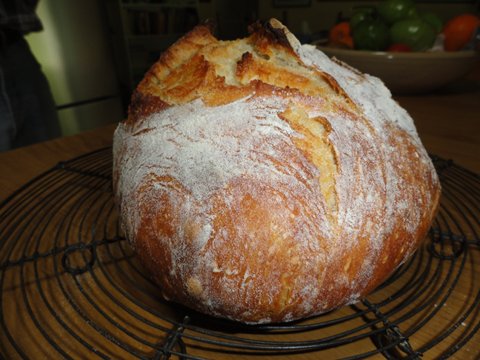
Bread is one of those foods that, when made with your own hands, gives a great deal of satisfaction and delight. It's only flour and water but it symbolises so much. I bake bread most days and use a variety of flours that I buy in bulk. Often I make a sandwich loaf because we use most of our bread for lunchtime sandwiches and for toast. Every so often I branch out to make a different type of loaf. I have tried sour dough in the past but I've not been happy with any of them. I'll continue to experiment with sour dough because I like the idea of using wild yeasts and saving the starter over a number of years to develop the flavour and become a part of the family. However, the loaf I've been branching out to most often is just a plain old five minute bread. By five minutes I mean it takes about five minutes actual work to prepare but it's the easiest of all bread to make and to get consistently good loaves from. If you're having people around for lunch or...
Image

This is my last post.

I have known for a while that this post was coming, but I didn't know when. This is my last post. I'm closing my blog, for good, and I'm not coming back like I have in the past.  I've been writing here for 16 years and my blog has been many things to me. It helped me change my life, it introduced me to so many good people, it became a wonderful record of my family life, it helped me get a book contract with Penguin, and monthly columns with The Australian Women's Weekly and Burke's Backyard . But in the past few months, it's become a burden. In April, I'll be 75 years old and I hope I've got another ten years ahead. However, each year I'll probably get weaker and although I'm fairly healthy, I do have a benign brain tumour and that could start growing. There are so many things I want to do and with time running out, leaving the blog behind gives me time to do the things that give me pleasure. On the day the blog started I felt a wonderful, h...
Image

What is the role of the homemaker in later years?

An email came from a US reader, Abby, who asked about being a homemaker in later years. This is part of what she wrote: "I am a stay-at-home mum to 4 children, ages 9-16. I do have a variety of "odd jobs" that I enjoy - I run a small "before-school" morning drop-off daycare from my home, I am a writing tutor, and I work a few hours a week at a local children's bookstore. But mostly, I cherish my blissful days at home - cooking, cleaning (with homemade cleaners), taking care of our children and chickens and goats, baking, meal-planning, etc. This "career" at home is not at all what I imagined during my ambitious years at university, but it is far more enriching. I notice, though, that my day is often planned around the needs of my family members. Of course, with 4 active kids and a husband, this is natural. I do the shopping, plan my meals, cook dinner - generally in anticipation of my family reconnecting in the evening.  I can't h...
Image

Every morning at home

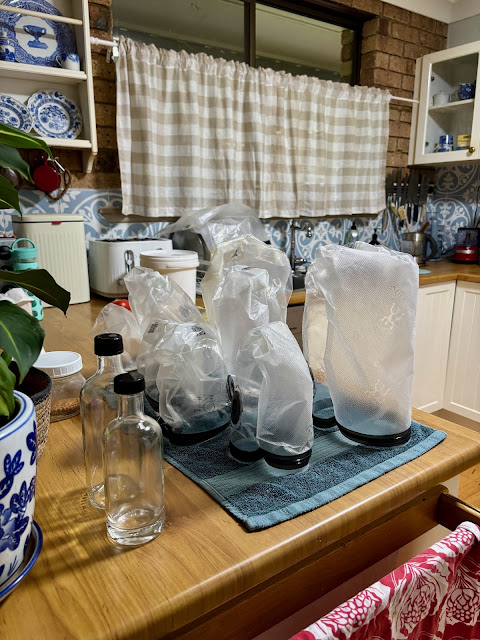
Every morning when I walk into my kitchen it looks tidy and ready for a day's work. Not so on this morning (above), I saw this when I walked in. Late the previous afternoon when I was looking for something, I came across my rolled up Zwilling vacuum bags and decided they had to be washed and dried. So I did that and although I usually put them outside on the verandah to dry it was dark by then. I turned the just-washed bags inside out and left them like this on a towel. It worked well and now the bags are ready to use when I bring home root vegetables, cabbages or whatever I buy that I want to last four or five weeks.
Image

You’ll save money by going back to basics

When I was doing the workshops and solo sessions, I had a couple of people whose main focus was on creating the fastest way to set up a simple life. You can't create a simple life fast, it's the opposite of that It's not one single thing either - it's a number of smaller, simpler activities that combine to create a life that reflects your values; and that takes a long to come together. When I first started living simply I took an entire year to work out our food - buying it, storing it, cooking it, preserving, baking, freezing, and growing it in the backyard. This is change that will transform how you live and it can't be rushed.  
Image

All previous blog posts

  • 2026 3
    • February 3
      • Workshops starting 1 March
      • Planting vegetable seeds and new workshops
      • Back where we belong
  • 2025 7
    • July 1
    • June 2
    • May 1
    • April 2
    • February 1
  • 2024 25
    • December 2
    • November 1
    • October 2
    • September 3
    • August 1
    • July 3
    • June 1
    • May 3
    • April 2
    • March 3
    • February 2
    • January 2
  • 2023 13
    • December 1
    • November 2
    • October 1
    • September 3
    • August 2
    • February 2
    • January 2
  • 2022 17
    • November 3
    • October 4
    • September 3
    • August 2
    • July 3
    • June 2
  • 2021 50
    • December 1
    • November 6
    • October 7
    • September 5
    • August 4
    • July 5
    • June 2
    • May 2
    • April 6
    • March 4
    • February 4
    • January 4
  • 2020 68
    • December 3
    • November 5
    • October 4
    • September 4
    • August 4
    • July 4
    • June 4
    • May 8
    • April 7
    • March 8
    • February 8
    • January 9
  • 2019 66
    • December 2
    • November 4
    • October 5
    • August 3
    • July 4
    • June 6
    • May 8
    • April 8
    • March 8
    • February 11
    • January 7
  • 2018 82
    • December 1
    • September 2
    • August 10
    • July 4
    • June 11
    • May 9
    • April 12
    • March 10
    • February 10
    • January 13
  • 2017 129
    • December 7
    • November 10
    • October 6
    • September 13
    • August 11
    • July 13
    • June 12
    • May 9
    • April 9
    • March 14
    • February 11
    • January 14
  • 2016 125
    • December 7
    • November 13
    • October 10
    • September 11
    • August 11
    • July 8
    • June 9
    • May 9
    • April 12
    • March 10
    • February 13
    • January 12
  • 2015 184
    • December 7
    • November 15
    • October 20
    • September 18
    • August 19
    • July 18
    • June 12
    • May 15
    • April 12
    • March 21
    • February 13
    • January 14
  • 2014 203
    • December 11
    • November 8
    • October 17
    • September 20
    • August 17
    • July 19
    • June 17
    • May 17
    • April 23
    • March 15
    • February 18
    • January 21
  • 2013 225
    • December 13
    • November 17
    • October 17
    • September 17
    • August 21
    • July 24
    • June 20
    • May 19
    • April 17
    • March 22
    • February 17
    • January 21
  • 2012 245
    • December 17
    • November 20
    • October 20
    • September 18
    • August 15
    • July 24
    • June 21
    • May 26
    • April 23
    • March 23
    • February 19
    • January 19
  • 2011 257
    • December 18
    • November 24
    • October 27
    • September 23
    • August 24
    • July 21
    • June 24
    • May 24
    • April 16
    • March 22
    • February 14
    • January 20
  • 2010 283
    • December 20
    • November 18
    • October 18
    • September 19
    • August 25
    • July 24
    • June 25
    • May 26
    • April 25
    • March 22
    • February 29
    • January 32
  • 2009 293
    • December 29
    • November 18
    • October 23
    • September 25
    • August 22
    • July 28
    • June 22
    • May 21
    • April 27
    • March 26
    • February 24
    • January 28
  • 2008 387
    • December 24
    • November 23
    • October 25
    • September 26
    • August 27
    • July 27
    • June 37
    • May 34
    • April 44
    • March 53
    • February 32
    • January 35
  • 2007 372
    • December 37
    • November 40
    • October 55
    • September 51
    • August 49
    • July 63
    • June 49
    • May 28


Trending Articles

NOT the last post

This will be my last post here.  I've been writing my blog for 18 years and now is the time to step back. I’ve stopped writing the blog and come back a couple of times because so many people wanted it, but that won’t happen again, I won’t be back.  I’ll continue on instagram to remain connected but I don’t know how frequent that will be. I know some of you will be interested to know the blog's statistics. 
Image

Every morning at home

Every morning when I walk into my kitchen it looks tidy and ready for a day's work. Not so on this morning (above), I saw this when I walked in. Late the previous afternoon when I was looking for something, I came across my rolled up Zwilling vacuum bags and decided they had to be washed and dried. So I did that and although I usually put them outside on the verandah to dry it was dark by then. I turned the just-washed bags inside out and left them like this on a towel. It worked well and now the bags are ready to use when I bring home root vegetables, cabbages or whatever I buy that I want to last four or five weeks.
Image

You’ll save money by going back to basics

When I was doing the workshops and solo sessions, I had a couple of people whose main focus was on creating the fastest way to set up a simple life. You can't create a simple life fast, it's the opposite of that It's not one single thing either - it's a number of smaller, simpler activities that combine to create a life that reflects your values; and that takes a long to come together. When I first started living simply I took an entire year to work out our food - buying it, storing it, cooking it, preserving, baking, freezing, and growing it in the backyard. This is change that will transform how you live and it can't be rushed.  
Image

Creating a home you'll love forever

Living simply is the answer to just about everything. It reduces the cost of living; it keeps you focused on being careful with resources such as water and electricity; it reminds you to not waste food; it encourages you to store food so you don't waste it and doing all those things brings routine and rhythm to your daily life. Consciously connecting every day with the activities and tasks that create simple life reminds you to look for the meaning and beauty that normal daily life holds.  It's all there in your home if you look for it. Seemingly mundane tasks like cleaning and cooking help you with that connection for without those tasks, the home you want to live in won't exist in the way you want it to.  Creating a home you love will make you happy and satisfied.
Image

Time changes everything

I've been spending time in the backyard lately creating a contained herb and vegetable garden. My aim is to develop a comfortable place to spend time, relax, increase biodiversity and encourage more animals, birds and insects to live here or visit. Of course I'd prefer my old garden which was put together by Hanno with ease and German precision. Together, we created a space bursting at the seams with herbs, vegetables and fruity goodness ready to eat and share throughout the year. But time changes everything. What I'm planning on doing now, is a brilliant opportunity for an almost 80 year old with balance issues. In my new garden I'll be able to do a wide range of challenging or easy work, depending on how I feel each day. It’s a daily opportunity to push myself or sit back, watch what's happening around me and be captivated by memories or the scope of what's yet to come.
Image

It's the old ways I love the most

I'm a practical woman who lives in a 1980’s brick slab house. There are verandahs front and back so I have places to sit outside when it's hot or cold. Those verandahs tend to make the house darker than it would be but they're been a great investment over time because they made the house more liveable. My home is not a romantic cottage, nor a minimalist modern home, it's a 1980’s brick slab house. And yet when people visit me here they tell me how warm and cosy my home is and that they feel comforted by being here. I've thought about that over the years and I'm convinced now that the style of a home isn't what appeals to people. What they love is the feeling within that home and whether it's nurturing the people who live there.
Image

Back where we belong

Surprise! I'm back ... for good this time. Instagram became an impossible place for me. They kept sending me messages asking if I'd make my page available for advertisers! Of course, I said no but that didn't stop them. It's such a change from what Instagram started as. But enough of that, the important part of this post is to explain why I returned here instead of taking my writing offline for good. For a few years Grandma Donna and I have talked online face-to-face and it's been such a pleasure for me to get to know her. We have a lot in common. We both feel a responsibility to share what we know with others. With the cost of living crisis, learning how to cook from scratch, appreciate the work we do in our homes, shop to a budget and pay off debt will help people grow stronger. The best place to do that is our blogs because we have no advertising police harassing us, the space is unlimited, we can put up tons of photos when we want to and, well, it just feels li...
Image

Making ginger beer from scratch

We had a nice supply of ginger beer going over Christmas. It's a delicious soft drink for young and old, although there is an alcoholic version that can be made with a slight variation on the recipe. Ginger beer is a naturally fermented drink that is easy to make - with ginger beer you make a starter called a ginger beer plant and after it has fermented, you add that to sweet water and lemon juice. Like sourdough, it must ferment to give it that sharp fizz. To make a ginger beer plant you'll need ginger - either the powdered dry variety or fresh ginger, sugar, rainwater or tap water that has stood for 24 hours to allow the chlorine to evaporate off. You'll also need clean plastic bottles that have been scrubbed with soap, hot water and a bottle brush and then rinsed with hot water. I never sterilise my bottles and I haven't had any problems. If you intend to keep the ginger beer for a long time, I'd suggest you sterilise your bottles. MAKING THE STARTER In a...
Image