down to earth

  • Home
  • About Us
  • Down To Earth Book
  • Privacy Policy
Yesterday I wrote about blogging and said then: "now we've all got our own printing press sitting inside our computers and we can all publish whatever we like." I've been thinking about that and it's not completely true. Yes, we've got the ability to print what we want now but we also have to have a belief in ourselves to make it happen. So it's what's inside our computers as well as what's inside our heads that counts. I believe we all need to start with the truth. Nothing will lose readers faster than lack of credibility and while the truth may not always be pretty, you can create beauty with words and by writing with integrity. 

Like many of you, I blog about the ordinary domestic life I live. I see beauty in that and I hope my words and photographs portray what I see, as well as the truth of it, to you. But blogs can be about anything, the subject matter is crucial, so choose your subject carefully because you'll spend a lot of time thinking and writing about it. And remember, blogging is not compulsory. There will be many people who prefer to read blogs but not write them.

Before you start you'll have to decide a few things, the most important being who is your audience. Of course your family and friends will be your audience, but who else? If you don't want an audience, if your blog really is for your own family and circle of friends, you can change your settings so that only those people can access it. However, if you are hoping to develop a wider audience, then you'll need to decide who you're writing for and then keep your audience in mind when you write. That doesn't mean you must write about that topic every day but it does mean that most of your writing will focus on that topic. I write about families, ageing, retirement, the value of work and other things in addition to my main topic, simple living. I also try to mix practical posts with more philosophical ones. Writing my blog that way gives me a lot of satisfaction and I hope it shows that I'm not just a work horse; I take time for myself too.

You'll need to choose a blog name. Pick a name that relates to your topic but also means something to you. You won't be able to choose a name that's already in use and Google will check the names before registering a unique one for you. When you're setting up your blog remember the blog only becomes public and available for reading when you have your readers (in basic settings) set to "anybody" (so that anybody can read it) and then you press the "publish" button. All your changes of templates, column width, colour and font can be changed over and over until you hit on the right mix for you, but none of it becomes public until you press "publish". So experiment, change things around and be bold. Remember though that the background should never overshadow your writing and photographs. Aim for clarity and subtlety rather than flamboyance if you're hoping to attract an audience. Dazzle your readers with your words and thoughts rather than your background or template.

The other thing you'll need in the set-up phase is a header. My header is the photo at the top of my blog with Down to Earth and the chicken on it.  Actually, there is the option to have either a header or just the blog name. If you choose just the name, you don't have to worry about a header but if you want one, then you'll need a program like Photoshop, Coreldraw or a free program I use is called Inkscape - available for Mac and Windows. You start off with a photo, crop it, add your blog name and save it as either a jpg or png file. Then you can load it to your blog in the "Layout" section.

Some experienced bloggers advise newcomers to have a number of posts prewritten before starting. I very rarely pre-write posts because I want my blog to be about daily life so I have to wait until I do it to write about it and take my photos. When I started, it took me about a day to look through all the options and find a template and style I was happy with. Then I wrote a couple of blog posts but didn't publish them. I came back the following day, fine tuned a couple of things, re-read the posts and was happy with them, then I pressed "publish". Remember, you can change your template, colours, font etc at any time. I regularly change mine, mainly to keep things fresh and to add interest.

Books are written about building an audience and many bloggers have differing ideas about how to do it effectively. I never expected success when I started I just tried to write well and give my readers information they may not find elsewhere. I guess what I'm saying here is not to worry about numbers of visitors when you start. While it's definitely not a build it and they will come-type situation, you do need to actively build your readership if that's important to you. But we can talk about that later.

I use the Blogger software to connect to you. There are other more complex programs with more features such as Wordpress, Tumblr and Typepad but Blogger does everything I want it to do, it's easy to use, free, and those of us who blog using Blogger have Google looking after our security. On some other programs you have to take care of that yourself. I've been using Blogger for six years and I can count on one hand the number of times I've had problems with it. You may want to move to another program when you're well established, but whatever you do, Blogger is a good starting point.

Here is a very good video on how to set up a Blogger blog. How to set up a blog video. You'll need a gmail account to start, then log in to Blogger and start setting up your blog following the video as your guide. To do that, open two tabs on your computer - one with the video open and one on your Blogger page. Just switch over from one to the other while you go through the process.

Take your time, make notes as you go and enjoy the process. Blogging is a wonderful pastime and one that will give you a lot of pleasure. I had no idea I had so much to say about blogging. This post is getting quite long and I haven't written half of what I want to share with you so I'll stop here. You have the information here to allow you to get a Blogger account and set up a basic blog so go ahead and do that if you want to. Tomorrow I'll have a list of more specific things that will help you on your way to press that "publish" button for the first time.


Thanks to everyone who sent a message about my bruised face. I'm fine and feeling even better today. I think I have the sweetest readers on the internet.

xxx ♥ xxx 

Although I didn't know what a blog was ten years ago, now blogging is part of my daily life. The internet has given us all the freedom to roam internationally and what we write now has the potential to be read world-wide. I love that because when I grew up, children, particularly girls, where expected to be seen and not heard. Those old ways changed drastically in the early 1960s when, among other things, The Beatles arrived and music started giving teenagers a voice. I don't think I've stopped talking since.


Still, no matter how much we had to say, the media - TV, radio, newspapers, magazines etc. acted as filters for our thoughts. If someone wanted to do an article or program on a certain kind of home or way of living, first you'd have a reporter giving her or his interpretation of it, the editing process would further refine it and the way it was eventually portrayed might be quite different to how things really were. Until blogs came along, we had to be chosen to be written about, now we've all got our own printing press sitting inside our computers and we all can publish whatever we like.


Blogs have given all of us the ability to be heard, so we can advocate on behalf of our local school, we can criticise or praise our politicians, we can write words no magazine would publish, or we can write about and photograph our domestic lives, our families and how to knit dishcloths until the cows come home and no one with an agenda or the opposite viewpoint can to stop us. Yes, blogs have given us the power to communicate to an audience. That is a good thing.


I love the authenticity of blogs. Instead of the old way of viewing everything through someone else's filter, now women and men are writing their own stories, taking their own photographs and telling us how it really is. There is good and bad in that because now we have all those blogs writing their own authentic stories but it brings with it a lot of writing that would benefit from an editor's pencil. It's not always authentic either. We all have our own ways of selecting favourite blogs. I tend to go back to the blogs that are well written and have non-staged photographs. I want to see how things really are. I don't want a staged version of it.


So now here we are with the means to write what we want to write and for that to be available for reading all over the world. It's a powerful thing. I'd like to encourage more people to blog because there is always room for more interesting blogs and for writers with fresh ideas. Blogging gives a lot to the writer too. It provides the best kind of life record for you and your family and you never know, you might write exactly what's needed and build a popular blog. Tomorrow I'll blog about setting up a Blogger blog in the hope of motivating those of you who don't blog.  In the meantime, I'd love to hear about your blogging experiences or why you don't blog now.
Saturday started out well although it was cold and very windy. We invited some of the family over for lunch so I spent the morning tidying up and preparing for that. When Jens and Cathy arrived they told us a tree had come down in the front yard and it was perched, swaying, on the electrical lines on the road.  Energex was called to deal with it, Kerry and Jamie arrived, we closed the doors to keep the wind out, then settled down to enjoy our lunch. We spent a few very pleasant hours with them and when they left at 3.30pm, we cleaned up and settled in for an evening in with the wind still blowing outside.


In the evening I went into the bedroom to turn on the electrical blanket. Unfortunately for me, my foot caught up in the blanket's electrical cord and when I went to walk away, I tripped and fell in the dark room, smashing my face against the floor and crushing my glasses into my nose. Luckily it was carpeted. Now I have a gash between my eyes, a bruised nose and knees and two black eyes. That's me below yesterday.
Not a pretty sight.

I'm feeling a bit silly about it but I'm a tough old bird and although I look like I've gone three rounds with Mike Tyson, I'm fine although I am a bit sore. I'm giving a talk at the Beerwah CWA on Thursday so I hope I don't scare the ladies.

A few emails arrived after the last post on knitting dishcloths asking for another project for beginners. I also had a few ladies ask about my shawl at the Blackheath workshop so I thought it was a great second project for all those beginner knitters. I know it looks complicated but it isn't and if you know how to cast on and knit garter stitch, you'll only have to learn how to increase and decrease. Simple! 

I have several links below to either patterns or blogs of people who have knitted their own version of this shawl. I love mine and I'm really pleased I knitted it. I used organic cotton and made it in one piece, not using the I-cord that some patterns mention. I used circular needles, size 5, but used as you would normally use two needles. This allowed me to keep a lot of stitches on my needles.


If you don't want the back a triangular shape, don't increase as much.

You'll find the start edge will be straight and the knit front and back edge will be slanted. From the third row you'll increase one stitch in each increase row and every second row is just plain stitching to get back to the straight edge start. If this slant is too much, instead of increasing every second row, increase every fourth row and plain knit three rows. In addition to the cast on and knit stitches you already know, you'll have to learn knit one front and back (K1 f&b), and knit two together (K2tog).  Look at this link to see how to do those two stitches. I didn't want a triangle back so when I got to the back, I stopped increasing so much and only increased about every eighth or twelfth row. If you do this, write down what you do because you'll have to do the exact reverse on the other side when you're decreasing.
This is the start of the shawl.

TOP TIP: Write down your pattern as you knit because when you get to the half way point, you have to mirror what you did on the other side. By writing it all down, you can accurately mirror the decrease side to the increase side.

This is how I did mine, it is all in plain/knit stitch with the increase stitch:
  1. Cast on two stitches.
  2. Knit two stitches - you're now back at the start.
  3. Knit the first stitch, then knit front and back (K1 f&b), knit to the end.
  4. Knit the row back to the start.
Keep knitting in this way until it looks like it might be about half way. Measure the shawl on yourself and when the pointed end hangs down low enough and the back feels comfy, you're half way finished and need to start decreasing.

To do that, at the half-way point:
  1. Knit your next row till you have three stitches left on your left needle. Knit two together (K2tog), then knit the final stitch.
  2. Knit the row back to the start.
Continue those two rows until you're back to your pointy end, then cast off and bind in your loose ends.

I hope you'll try this or one of the other patterns. It's quite a big project but it's easy and fast and doing something like this will build up your knitting skills. Remember, as in everything in life, it doesn't have to be perfect, it just needs to be as good as you can do it. My shawl has a couple of uneven edges but it just serves to show me that I should improve on my next project.

As usual, if you have any problems with this, come to the forum and I, or one of the other members, will help you. Click here to go to the knitting forum.


SHAWL LINKS
Kate at Purple Pear with her shawl
Amanda at Soulemama's shawl
The river knitter's garter stitch shawl.
Pattern for sontag shawl.
How to knit an I cord - You Tube
This is a more complicated shawl for experienced knitters.
Beginners knitting patterns
Thanks to everyone who commented on the community workshops I'm doing. Hanno and I will be work out what we can do and I'll post about that on Sunday.  I hope you have a beautiful weekend.

- - - ♥ - - - 

"Cooking is a politician act." - Michael Pollan on his new book Cooked - A Natural History of Transformation

A conversation with David Holmgren on Radio National - audio file

Samuel Alexander from the Simplicity Institute has written a book of fiction about the catastrophic collapse of society and the rebuilding of it using a simple sustainable model. Titled Entropia: Life Beyond Industrial Civilisation, it's available in print and Kindle versions. More info here.

Various ways to mend knitted garments and dishcloths.

How to wash various garments

How to decorate your rented home

Free labels for all your homemade cleaning and laundry products

FROM THE COMMENTS HERE DURING THE WEEK

Cassandra @ stitchandsewcreates

Jusmom1 @ UggaBear Cottage

Margo @ Thrift at Home
Thanks to everyone who commented on the workshops. I'm sorry, but Melbourne is too far for us to come. I no longer fly and the drive to Melbourne would take us four days there and back. I'm still looking into it in various towns and I'll let you know where we'll be soon.

- - - ♥ - - - 

Every so often Hanno and I look at our home to see if there are changes we need to make. I was 50 when we moved here so most of the changes then were to accommodate our family and make our home a productive workspace. Now 15 years have passed by and while we've kept up a maintenance program to keep our home functioning and productive, now it's time to think about our ages and prepare for the future.


We both want to live here for as long as possible. We do not want to go into an aged persons' facility or live with our family (as much as we love them), we want to continue to work here at home, safely, and we hope to die here - Hanno in the garden and me at the computer, writing one last book. (The unfinished masterpiece.) To do that we need to stay healthy, make sure there are no safety hazards and do only what we can do now, not what we could do 10 years ago. We're not quite at the safety rails in the shower stage but with Hanno turning 73 this year, I'm guessing it won't be too long. We both have brief periods of dizziness occasionally.

We've decided we have to do something about our front and back verandahs. In the past, the front verandah was for morning teas and pot plants, and the back verandah was for the pets and garden equipment. We both want a more secure screen door on the front of the house - a steel one that can remain open in the hot months while still giving some protection from who knows what. While we were looking into that, Hanno noticed there are some cracks appearing in the front door, so we've decided to replace that too.


Before we do anything, we'll have to rainproof both front and back verandah roofs. We get torrential downpours here and often have water leaking through the roof, both front and back. So the roofs needs fixing and that creates a problem because Hanno can't climb up on there anymore. Yesterday we had a local handyman come around to give us a quote to have some of this work done. We'll probably have him do the roof work and hang the new doors, the other work we can do together.


We've decided that now we no longer have dogs, we want to make the back verandah much more comfortable with some outdoor furniture and maybe a cane lounge. We'll buy all that secondhand. We did get a quote to have the floors tiled but it would have cost a few thousand dollars and we didn't see the value in that. Painted concrete will be fine. We can add a bit of sand to the paint to make it non-slip. When it's finished we'll have an alternative to the kitchen table for people to sit and chat.

This is a big change for us. Having to rely on others to do work we normally would have done ourselves doesn't quite feel right yet but it will enable us to get on with the work we can do. We've always we proudly self-reliant but I guess we all reach a stage when we have to leave some things behind and not feel too much regret. I'm looking forward to the changes and hope we can successfully create an area that's aesthetically pleasing while remaining productive and functional.

How are you managing the stages in your life at home? Are you undergoing the age changes we're starting now, are you modifying for small children or are you still at the regular maintenance stage?

I just found that Kate at Purple Pear Organics blogged about maintenance and repairs this past Monday. Check out her blog as well.


I've been thinking a lot about the recent workshops I've presented along with Hanno and Tricia and if I had to come up with one word to describe my feelings about the workshops, it's motivating. After both the Lockyer Valley workshop and the Blackheath workshop, I came away motivated and sure that what we're doing here it right for us, right for our community and a small step in the right direction towards repairing some of the environmental damage we've done in the past. I doubt we'll ever make up for our share of the damage our indiscriminate shopping has done but I swear I'll never stop trying to. I also felt a recommitment to the way we live after both workshops because of the people I spoke with and knowing that we'll all working in a similar way towards shared goals.


The two workshops were very different. Lockyer Valley was organised by a strong community group, originally formed to help oppose a gas pipeline snaking through the small communities in their valley. I'm very pleased to report that the pipeline didn't go ahead. The Lockyer Valley is a beautiful area just west of Brisbane that has a strong tradition of fresh food production. But now many of the primary producers are going out of business or moving to other work when it's available. Often it isn't. The workshop brought those people together to share ideas that may be beneficial for all of them and encouraged talks about a way forward. The group applied to the local council for a grant to pay for the workshops.

We held a community forum at the end of the workshop to create a list of actions to take into the future. There is a possibility they'll form a small simple living group and share ideas and skills. Carol Stephens, who leads the group, told me that many farmers are frugal by necessity rather than choice and they're in that situation when the general cost of living is rising. It makes life difficult. Carol said the pressures of falling commodity prices despite the rising cost of food in the supermarkets, rising production costs and increasingly unpredictable weather patterns all contribute to make primary production dangerously unsustainable. Farmers and family farms have always been the backbone of Australia and now that network of farmers is fragile.

One thing we can all do to help our farmers is to insist on buying Australian fruit, vegetables and meat. If you can travel out into these small rural communities on a weekend, stay, buy fresh produce there and that money will stay in the community. It's a small gesture but our farmers need our support and it is worth doing. We should also be asking our local members of parliament to address the problem of unclear food labelling in Australia. I want to see food labels that clearly indicate what has been produced in Australia and what is Australian owned. What is so difficult about that? A label that tells me a product has been processed in Australia from imported ingredients doesn't tell me anything. The government must do something about labelling now that benefits our farmers and the consumer, not the multi-national corporations that are filling more and more of our food shelves.


The more recent Blackheath workshop was full of people who were committed to living simply and who wanted to meet like-minded people. I organised that one and participants paid a fee to attend. I talked about various aspects of simple living, how Hanno and I work to save water, electricity and money, how we pay our bills and try to cut down on what we can. All of us want to live well on less and this little hall was a good place to talk about how we all try to do that. There was a calm and friendly atmosphere at Blackheath - similar to friends at a picnic. When I sat with those knitters, there was no other place I would have preferred to be. We shared recipes, stories and our hopes and, I think, we all thoroughly enjoyed the contact with others who share a similar outlook on life. I know I certainly did.

So when I drove back home from those workshops - both of them a long way from home, I had a chance to think about that time I spent out in those communities. And I have to tell you I came home feeling really motivated and inspired to keep going, keep blogging about what we're doing and keep writing about what this simple life is all about. Because it's different for each of us, there is no must-use recipe, there is no right way. These workshops are important and I must try to do more of them. They show me, as well as everyone who comes along to them, just how diverse, empowering and enriching simple life can be. And when we're all working alone in our homes far away from anyone who understands what we're doing and why we're doing it, the fond memory of those connections we made with like-minded people will see us through.

I'm going to start writing a new book soon and so I'm hoping to fit a few workshops in before that. There has been interest in Lismore and Brisbane so they may be possibilities. I also think Orange, Wagga, Canberra or Mudgee, as well as Dalby and Warwick in south-west Queensland might also be possible. If you're interested in attending a workshop, and you think others in your region may be interested, please let me know.

Below is the program of talks I'll be giving at the Sunshine Coast Libraries soon. The talks are free but you have to book. You can do that here.


Title
Date
Time
End Time
Library
Registered
Max
Living simply
living smart
9/07/2013
10:00 AM
11:30 AM
Coolum Library
14
25
Living simply
living smart
10/07/2013
10:00 AM
11:30 AM
Nambour Library
25
35
Living simply
living smart
11/07/2013
10:00 AM
11:30 AM
Maleny Library
14
40
Living simply
living smart
17/07/2013
10:00 AM
11:30 AM
Cooroy Library
15
40
Living simply
living smart
26/07/2013
10:00 AM
11:30 AM
Kawana Library
13
25
Living simply
living smart
31/07/2013
2:00 PM
3:30 PM
Beerwah Library
12
30
Living simply
living smart
2/08/2013
10:00 AM
11:30 AM
Maroochydore Library
19
40
Living simply
living smart
6/08/2013
10:00 AM
11:30 AM
Caloundra Library
32
40
Living simply
living smart
15/08/2013
1:00 PM
2:30 PM
Noosa Library
20
55

Additional Reading
Report on food labelling law and policy (Australia).

Newer Posts Older Posts Home

MY BOOKS

MY BOOKS


My books were all published by Pengiun, and are available at Amazon US, Amazon UK and Amazon Au

Search here

Total Pageviews

Translate


I'm Rhonda Hetzel and I've been writing my Down to Earth blog since 2007. Although I write the occasional philosophical post, my main topics include home cooking, happiness and gardening as well as budgeting, baking, ageing, generosity, mending and handmade crafts. I hope you enjoy your time here.

MY FAVOURITE PLACES

  • Grandma Donna's Place
  • Grandma Donna's YouTube
  • Grandma Donna's Instagram
  • This Simple Day
  • Nicole's Instagram

Give More

Give More

Popular posts last year

Making ginger beer from scratch

We had a nice supply of ginger beer going over Christmas. It's a delicious soft drink for young and old, although there is an alcoholic version that can be made with a slight variation on the recipe. Ginger beer is a naturally fermented drink that is easy to make - with ginger beer you make a starter called a ginger beer plant and after it has fermented, you add that to sweet water and lemon juice. Like sourdough, it must ferment to give it that sharp fizz. To make a ginger beer plant you'll need ginger - either the powdered dry variety or fresh ginger, sugar, rainwater or tap water that has stood for 24 hours to allow the chlorine to evaporate off. You'll also need clean plastic bottles that have been scrubbed with soap, hot water and a bottle brush and then rinsed with hot water. I never sterilise my bottles and I haven't had any problems. If you intend to keep the ginger beer for a long time, I'd suggest you sterilise your bottles. MAKING THE STARTER In a...
Image

NOT the last post

This will be my last post here.  I've been writing my blog for 18 years and now is the time to step back. I’ve stopped writing the blog and come back a couple of times because so many people wanted it, but that won’t happen again, I won’t be back.  I’ll continue on instagram to remain connected but I don’t know how frequent that will be. I know some of you will be interested to know the blog's statistics. 
Image

How to make cold process soap

I'm sure many of you are wondering: "Why make soap when I can buy it cheaply at the supermarket?" My cold process soap is made with vegetable oils and when it is made and cured, it contains no harsh chemicals or dyes. Often commercial soap is made with tallow (animal fat) and contains synthetic fragrance and dye and retains almost no glycerin. Glycerin is a natural emollient that helps with the lather and moisturises the skin. The makers of commercial soaps extract the glycerin and sell it as a separate product as it's more valuable than the soap. Then they add chemicals to make the soap lather. Crazy. Making your own soap allows you to add whatever you want to add. If you want a plain and pure soap, as I do, you can have that, or you can start with the plain soap and add colour, herbs and fragrance. The choice is yours. I want to add a little about animal and bird fat. I know Kirsty makes her soap with duck fat and I think that's great. I think t...
Image

Preserving food in a traditional way - pickling beetroot

I've had a number of emails from readers who want to start preserving food in jars but don't know where to start or what equipment to buy.  Leading on from yesterday's post, let's just say up front - don't buy any equipment. Once you know what you're doing and that you enjoy preserving, then you can decide whether or not to buy extra equipment. Food is preserved effectively without refrigeration by a variety of different methods. A few of the traditional methods are drying, fermentation, smoking, salting or by adding vinegar and sugar to the food - pickling. This last method is what we're talking about today. Vinegar and sugar are natural preservatives and adding one or both to food sets up an environment that bacteria and yeasts can't grow in. If you make the vinegar and sugar mix palatable, you can put up jars of vegetables or fruit that enhance the flavour of the food and can be stored in a cupboard or fridge for months. Other traditional w...
Image

Cleaning mould from walls and fabrics

With all this rain around we've developed a mould problem in our home. Usually we have the front and back doors open and that good ventilation stops most moulds from establishing. However, with the house locked up for the past week, the high humidity and the rain, mould is now growing on the wooden walls near our front door and on the lower parts of cupboards in the kitchen. Most of us will find mould growing in our homes at some point. Either in the bathroom or, in humid climates, on the walls, like we have now. You'll need a safe and effective remedy at some point, so I hope one of these methods works well for you. Mould is not only ugly to look at, it can cause health problems so if you see mould growing, do something about it straight away. The longer you leave the problem, the harder it will be to get rid of it effectively. If you have asthma or any allergies, you should do this type of cleaning with a face mask on so you don't breathe in any spores. Many peopl...
Image

Five minute bread

Bread is one of those foods that, when made with your own hands, gives a great deal of satisfaction and delight. It's only flour and water but it symbolises so much. I bake bread most days and use a variety of flours that I buy in bulk. Often I make a sandwich loaf because we use most of our bread for lunchtime sandwiches and for toast. Every so often I branch out to make a different type of loaf. I have tried sour dough in the past but I've not been happy with any of them. I'll continue to experiment with sour dough because I like the idea of using wild yeasts and saving the starter over a number of years to develop the flavour and become a part of the family. However, the loaf I've been branching out to most often is just a plain old five minute bread. By five minutes I mean it takes about five minutes actual work to prepare but it's the easiest of all bread to make and to get consistently good loaves from. If you're having people around for lunch or...
Image

This is my last post.

I have known for a while that this post was coming, but I didn't know when. This is my last post. I'm closing my blog, for good, and I'm not coming back like I have in the past.  I've been writing here for 16 years and my blog has been many things to me. It helped me change my life, it introduced me to so many good people, it became a wonderful record of my family life, it helped me get a book contract with Penguin, and monthly columns with The Australian Women's Weekly and Burke's Backyard . But in the past few months, it's become a burden. In April, I'll be 75 years old and I hope I've got another ten years ahead. However, each year I'll probably get weaker and although I'm fairly healthy, I do have a benign brain tumour and that could start growing. There are so many things I want to do and with time running out, leaving the blog behind gives me time to do the things that give me pleasure. On the day the blog started I felt a wonderful, h...
Image

What is the role of the homemaker in later years?

An email came from a US reader, Abby, who asked about being a homemaker in later years. This is part of what she wrote: "I am a stay-at-home mum to 4 children, ages 9-16. I do have a variety of "odd jobs" that I enjoy - I run a small "before-school" morning drop-off daycare from my home, I am a writing tutor, and I work a few hours a week at a local children's bookstore. But mostly, I cherish my blissful days at home - cooking, cleaning (with homemade cleaners), taking care of our children and chickens and goats, baking, meal-planning, etc. This "career" at home is not at all what I imagined during my ambitious years at university, but it is far more enriching. I notice, though, that my day is often planned around the needs of my family members. Of course, with 4 active kids and a husband, this is natural. I do the shopping, plan my meals, cook dinner - generally in anticipation of my family reconnecting in the evening.  I can't h...
Image

Every morning at home

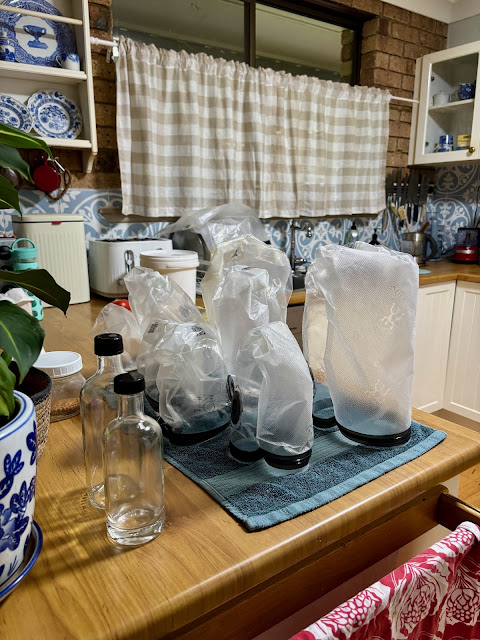
Every morning when I walk into my kitchen it looks tidy and ready for a day's work. Not so on this morning (above), I saw this when I walked in. Late the previous afternoon when I was looking for something, I came across my rolled up Zwilling vacuum bags and decided they had to be washed and dried. So I did that and although I usually put them outside on the verandah to dry it was dark by then. I turned the just-washed bags inside out and left them like this on a towel. It worked well and now the bags are ready to use when I bring home root vegetables, cabbages or whatever I buy that I want to last four or five weeks.
Image

You’ll save money by going back to basics

When I was doing the workshops and solo sessions, I had a couple of people whose main focus was on creating the fastest way to set up a simple life. You can't create a simple life fast, it's the opposite of that It's not one single thing either - it's a number of smaller, simpler activities that combine to create a life that reflects your values; and that takes a long to come together. When I first started living simply I took an entire year to work out our food - buying it, storing it, cooking it, preserving, baking, freezing, and growing it in the backyard. This is change that will transform how you live and it can't be rushed.  
Image

All previous blog posts

  • 2026 3
    • February 3
      • Workshops starting 1 March
      • Planting vegetable seeds and new workshops
      • Back where we belong
  • 2025 7
    • July 1
    • June 2
    • May 1
    • April 2
    • February 1
  • 2024 25
    • December 2
    • November 1
    • October 2
    • September 3
    • August 1
    • July 3
    • June 1
    • May 3
    • April 2
    • March 3
    • February 2
    • January 2
  • 2023 13
    • December 1
    • November 2
    • October 1
    • September 3
    • August 2
    • February 2
    • January 2
  • 2022 17
    • November 3
    • October 4
    • September 3
    • August 2
    • July 3
    • June 2
  • 2021 50
    • December 1
    • November 6
    • October 7
    • September 5
    • August 4
    • July 5
    • June 2
    • May 2
    • April 6
    • March 4
    • February 4
    • January 4
  • 2020 68
    • December 3
    • November 5
    • October 4
    • September 4
    • August 4
    • July 4
    • June 4
    • May 8
    • April 7
    • March 8
    • February 8
    • January 9
  • 2019 66
    • December 2
    • November 4
    • October 5
    • August 3
    • July 4
    • June 6
    • May 8
    • April 8
    • March 8
    • February 11
    • January 7
  • 2018 82
    • December 1
    • September 2
    • August 10
    • July 4
    • June 11
    • May 9
    • April 12
    • March 10
    • February 10
    • January 13
  • 2017 129
    • December 7
    • November 10
    • October 6
    • September 13
    • August 11
    • July 13
    • June 12
    • May 9
    • April 9
    • March 14
    • February 11
    • January 14
  • 2016 125
    • December 7
    • November 13
    • October 10
    • September 11
    • August 11
    • July 8
    • June 9
    • May 9
    • April 12
    • March 10
    • February 13
    • January 12
  • 2015 184
    • December 7
    • November 15
    • October 20
    • September 18
    • August 19
    • July 18
    • June 12
    • May 15
    • April 12
    • March 21
    • February 13
    • January 14
  • 2014 203
    • December 11
    • November 8
    • October 17
    • September 20
    • August 17
    • July 19
    • June 17
    • May 17
    • April 23
    • March 15
    • February 18
    • January 21
  • 2013 225
    • December 13
    • November 17
    • October 17
    • September 17
    • August 21
    • July 24
    • June 20
    • May 19
    • April 17
    • March 22
    • February 17
    • January 21
  • 2012 245
    • December 17
    • November 20
    • October 20
    • September 18
    • August 15
    • July 24
    • June 21
    • May 26
    • April 23
    • March 23
    • February 19
    • January 19
  • 2011 257
    • December 18
    • November 24
    • October 27
    • September 23
    • August 24
    • July 21
    • June 24
    • May 24
    • April 16
    • March 22
    • February 14
    • January 20
  • 2010 283
    • December 20
    • November 18
    • October 18
    • September 19
    • August 25
    • July 24
    • June 25
    • May 26
    • April 25
    • March 22
    • February 29
    • January 32
  • 2009 293
    • December 29
    • November 18
    • October 23
    • September 25
    • August 22
    • July 28
    • June 22
    • May 21
    • April 27
    • March 26
    • February 24
    • January 28
  • 2008 387
    • December 24
    • November 23
    • October 25
    • September 26
    • August 27
    • July 27
    • June 37
    • May 34
    • April 44
    • March 53
    • February 32
    • January 35
  • 2007 372
    • December 37
    • November 40
    • October 55
    • September 51
    • August 49
    • July 63
    • June 49
    • May 28


Trending Articles

NOT the last post

This will be my last post here.  I've been writing my blog for 18 years and now is the time to step back. I’ve stopped writing the blog and come back a couple of times because so many people wanted it, but that won’t happen again, I won’t be back.  I’ll continue on instagram to remain connected but I don’t know how frequent that will be. I know some of you will be interested to know the blog's statistics. 
Image

Every morning at home

Every morning when I walk into my kitchen it looks tidy and ready for a day's work. Not so on this morning (above), I saw this when I walked in. Late the previous afternoon when I was looking for something, I came across my rolled up Zwilling vacuum bags and decided they had to be washed and dried. So I did that and although I usually put them outside on the verandah to dry it was dark by then. I turned the just-washed bags inside out and left them like this on a towel. It worked well and now the bags are ready to use when I bring home root vegetables, cabbages or whatever I buy that I want to last four or five weeks.
Image

You’ll save money by going back to basics

When I was doing the workshops and solo sessions, I had a couple of people whose main focus was on creating the fastest way to set up a simple life. You can't create a simple life fast, it's the opposite of that It's not one single thing either - it's a number of smaller, simpler activities that combine to create a life that reflects your values; and that takes a long to come together. When I first started living simply I took an entire year to work out our food - buying it, storing it, cooking it, preserving, baking, freezing, and growing it in the backyard. This is change that will transform how you live and it can't be rushed.  
Image

Creating a home you'll love forever

Living simply is the answer to just about everything. It reduces the cost of living; it keeps you focused on being careful with resources such as water and electricity; it reminds you to not waste food; it encourages you to store food so you don't waste it and doing all those things brings routine and rhythm to your daily life. Consciously connecting every day with the activities and tasks that create simple life reminds you to look for the meaning and beauty that normal daily life holds.  It's all there in your home if you look for it. Seemingly mundane tasks like cleaning and cooking help you with that connection for without those tasks, the home you want to live in won't exist in the way you want it to.  Creating a home you love will make you happy and satisfied.
Image

Time changes everything

I've been spending time in the backyard lately creating a contained herb and vegetable garden. My aim is to develop a comfortable place to spend time, relax, increase biodiversity and encourage more animals, birds and insects to live here or visit. Of course I'd prefer my old garden which was put together by Hanno with ease and German precision. Together, we created a space bursting at the seams with herbs, vegetables and fruity goodness ready to eat and share throughout the year. But time changes everything. What I'm planning on doing now, is a brilliant opportunity for an almost 80 year old with balance issues. In my new garden I'll be able to do a wide range of challenging or easy work, depending on how I feel each day. It’s a daily opportunity to push myself or sit back, watch what's happening around me and be captivated by memories or the scope of what's yet to come.
Image

It's the old ways I love the most

I'm a practical woman who lives in a 1980’s brick slab house. There are verandahs front and back so I have places to sit outside when it's hot or cold. Those verandahs tend to make the house darker than it would be but they're been a great investment over time because they made the house more liveable. My home is not a romantic cottage, nor a minimalist modern home, it's a 1980’s brick slab house. And yet when people visit me here they tell me how warm and cosy my home is and that they feel comforted by being here. I've thought about that over the years and I'm convinced now that the style of a home isn't what appeals to people. What they love is the feeling within that home and whether it's nurturing the people who live there.
Image

Back where we belong

Surprise! I'm back ... for good this time. Instagram became an impossible place for me. They kept sending me messages asking if I'd make my page available for advertisers! Of course, I said no but that didn't stop them. It's such a change from what Instagram started as. But enough of that, the important part of this post is to explain why I returned here instead of taking my writing offline for good. For a few years Grandma Donna and I have talked online face-to-face and it's been such a pleasure for me to get to know her. We have a lot in common. We both feel a responsibility to share what we know with others. With the cost of living crisis, learning how to cook from scratch, appreciate the work we do in our homes, shop to a budget and pay off debt will help people grow stronger. The best place to do that is our blogs because we have no advertising police harassing us, the space is unlimited, we can put up tons of photos when we want to and, well, it just feels li...
Image

Making ginger beer from scratch

We had a nice supply of ginger beer going over Christmas. It's a delicious soft drink for young and old, although there is an alcoholic version that can be made with a slight variation on the recipe. Ginger beer is a naturally fermented drink that is easy to make - with ginger beer you make a starter called a ginger beer plant and after it has fermented, you add that to sweet water and lemon juice. Like sourdough, it must ferment to give it that sharp fizz. To make a ginger beer plant you'll need ginger - either the powdered dry variety or fresh ginger, sugar, rainwater or tap water that has stood for 24 hours to allow the chlorine to evaporate off. You'll also need clean plastic bottles that have been scrubbed with soap, hot water and a bottle brush and then rinsed with hot water. I never sterilise my bottles and I haven't had any problems. If you intend to keep the ginger beer for a long time, I'd suggest you sterilise your bottles. MAKING THE STARTER In a...
Image