down to earth

  • Home
  • About Us
  • Down To Earth Book
  • Privacy Policy
I need your help. A lovely couple I know, good friends of mine who live in Melbourne, are about to have their first baby. They wholeheartedly share our values and are preparing for the baby's arrival and life thereafter with a frugal and eco mindset. Can you help us with the following questions?
  1. Where are the best places in Melbourne for new parents to shop for environmentally-friendly baby needs that suit a low budget?
  2. What are the best online eco-friendly baby shops for things like cot sheets, towels and washers? They would love organic but price is a factor.
  3. And these two from Jo herself: There’s so much people say you ‘must have’ for your baby, it’s overwhelming how much stuff I’ve already acquired (almost all of it second hand, thankfully). Surely it’s not all completely necessary? So I guess I’d like to know what people were told they needed but found they didn’t actually need.
  4.  I’d also like advice on the best nappies, slings, and any other hot tips that your readers want to share.
Thank you for taking the time to help. 
~~~~~~
My DIL Sarndra has been making the most wonderful and unique baby clothes. She started off making these clothes for Alex and it's lead to her setting up a little business sewing for other babies as well.  You can see what she's doing on her Facebook page - Bluebell Alexander. If you like what Sarndra is doing, please "like" her page. And yes, that is my beautiful grandson Alex below modelling the outfit described under the photos.


I'll let Sarndra explain: This is my little set that will be in an auction held by Hraani Handmade to raise money for the Starlight foundation, from June 10th. I hope someone out there loves this set as much as I do and raises some money for a great cause!! 

Vintage cotton vest lined, with gorgeous cotton crochet back; and matching fine cord flares with flat front and elasticised back, size 0 - 1 (my bub is 11 months and fits him with room to grow). Flares have generous hem that can be let down when the little legs grow longer at around 1 yr old. Soft and slightly stretchy cord, which is easy to crawl in. This was made to be a girls set but I quite like it on my Alex too! (The long sleeve onesie is not included.)

If you don't have time to make clothes for a baby you love, do the next best thing and buy from someone who runs an at home business and who cares about the quality of their products.  ♥

~~~~~
I was very pleased to be told a couple of days ago that I'm on this bestsellers' list. It's quite a surprise but I suppose all the good work put into publicity by Dianne at Penguin is paying off, and there also seems to be a strong element of 'word of mouth' advertising happening.


Can I ask a favour of you if you have the time for it. If you've read my book, could you go online and do an honest review? The link to do that is here or here, or wherever you bought it online  Thank you. :- )

According to the media, it seems that young families and pensioners are the two main groups feeling the most pressure due to the current financial circumstances. Personally, I think it has hit most of us. In a HeraldSun article recently, it stated:

A St Vincent de Paul analysis of cost pressures on families, to be released at an Australian Council of Social Service conference this week, shows cash-strapped pensioners and young families are suffering. Actual costs of electricity, health and food have not only increased above inflation, but cost pressures have compounded over time. Pensioners and young families spend a higher proportion of their income on health, utilities and food.

I'm sure many of you would agree, times are tough for many people, and not only in those two categories. When I work at the neighbourhood centre, I see people coming in for food parcels. These people often fall into these two categories, and others, and although we have workshops discussing how to decrease the cost of living, very few of them come along. I think that governments need to play an active part in the re-education of the electorate so that many of the frugal things most of us here do - making cleaning products, cooking from scratch, budgeting etc, become commonplace again.


It will help not only people on low incomes, it will help the average single or family person survive the tough times much better than they do now. When you read about the Great Depression, its inspiring and amazing to read what they did to get by. My grandparents and parents lived through the Great Depression and they did it using the life skills they had that were commonplace then. Many of those skills can still save a substantial amount of money and they still have the potential to help people who take the time to learn them. Many don't know anything except what they know, they don't know there is another way or where to get help in equipping themselves for a more frugal life.


I would like to see Life Skills taught in secondary schools so young people move into their own independent lives better equipped for today's reality. I think tuition in how to write a budget and handle credit cards, compound interest, simple contracts, consumer rights, how to complain effectively, renters' rights and responsibilities, cooking from scratch and using leftovers, sewing, mending, green cleaning, how to wash and iron clothes, how to grow fruit and vegetables in a backyard and general home economics would stand our students in good stead, particularly in their teenage years and leading into young adult life. Ideally, these skills would routinely be handed down from parents to their children, but often parents now don't have these skills themselves. It would help young people to understand the legalities of life before anyone takes advantage of them and it would show them that life is tough but can be made better, and even wonderful, with work hard.

We all have to do our fair share. No one gets a free ride.

Our governments should be leading us. They should be watching duopolies and making sure grocery prices are not destabilised and remain within the reach of families, working people, retired folk and pensioners. They should be proposing innovative ways of teaching our children, not playing it safe. I wonder if we could interest the CWA or Women's Institute in teaching home economics classes. It needs real people with real skills to do the teaching. We want our young people to know how to look after themselves, not how to open a can of soup or cook a packet of cake mix. We need to get our communities involved. Hopefully, this would put us back on track and in 20 years, when parents would be well equipped again to teach their own children, we'd be able to stop the classroom teaching of life skills.

What is your government doing? Are their any bright lights where you live that can shine the way for us over here?  What can we all do to help our young people learn what we know?


When we first decided to become home bodies and to make and mend as much as we could, I thought we'd be leading a quiet life and the longer we did it, the fewer opportunities we'd have to go out and connect with others. At the very beginning it seemed like a solitary life, just Hanno and I, working away on our various projects, with visits from family and friends to add interest on occasional days. But as the years have crawled along, that is not how it panned out. We now have more friends than we ever had, we are taken up with this and that, and we fully understand now, that most important of details - we are a part of our community.


I didn't get that part of simple life when I started on my journey. We all know that the products we choose to buy are not those that are commonly sought after and so we'll never see them advertised on TV or hear about them on the radio. No, the things we deal in, the natural products of the region, we find out about them from our community. Now I know that without my community I don't know where the heirloom chooks are being sold at auction, I have no idea where to buy heirloom seeds and seedlings, I don't have a clue where the raw milk and honey is and I have no community to fall back on when things aren't going as well as they might. Our community is the human element of the place we live; it's the knowledge bank for all things local, it's the connection to the history of here and it's part of way forward to the future.

Community is important, not only to find what we need in our homes and backyards but in the sense of belonging to a place. We're lucky here. We live in an area where people barter, there are co-ops and primary producers, and a feeling that the community exists for and because of its people, not just because a town happens to be there.

Of course, there are online communities, and I am proud to be part of our community here and at the Down to Earth Forum. My online friends are a constant reminder to me and Hanno and that we might be working here in our small patch but we're also connected to people doing a similar thing in cities and towns all over the world. Some of us are here because we haven't found a local community where we live, and there are towns that have not developed their own communities.

Communities are a bit like children, they need someone to take the lead. They need that person to step up, wave their hankie and shout: Woohoo, we're over here, we need you to be here with us!


A couple of weeks ago I was contacted by a woman out west who waved her hankie wrote to ask if I would consider doing a workshop in her town. She and her friends have bought the old local hall and are using part as a vintage themed cafe. They want to use the back for workshops and a space for community bartering. I phoned her, we talked about it and I said that I'd happily come out and do a day-long workshop. I hope it will give them a good start on their business and the workshops they hope to run. It might also be the start of a community of like-minded souls who get together and discover each other and the interests they share. That's all it takes - the initial connection and the determination to keep the group working together.

This workshop will be at Bell in south west Queensland on Saturday 23 June. It will cost $40 each, which will include morning tea and lunch. The red and white sign above is on the flyer advertising the event - it's handmade, to reflect all that will happen on that day. We'll be talking about simple life, making and water-bathing jam and relish and making laundry liquid. Everyone who comes along will take some home, so if you're coming, bring jars with you and some things to barter. The women who own the hall will serve a delicious home made morning tea and lunch and I'm sure we will all have a great day out. I know there will be friendships made and a lot of talking, and not just by me. Let me know (rhondahetzel@gmail.com) if you're interested and I'll get back to you with the details and booking information.

I'd love to know about your local community. If it's a strong part of your local life, what makes it so special? Or are you in one of those places that hasn't developed a sense of community yet?  

There are some delicious looking recipes on Roostblog, start with this one for cinnamon donuts.

Likewise, on Running with Tweezers, there are many wonderful modern recipes, excellent food photos and this - The Soothing of Shelling - it's slowing down, shelling peas and a magnificent pea salad.

I love this blog - Wayward Spark and this post what what lured me into it. It's about The Grange and the importance of community.

Meet The West ladies at Homestead Blessings.

One of the good things about going out is that there is no phone to answer, no emails coming in. Switch off your smartphone picks up on that.

The UK recession may be worse than expected.

Are you getting enough sleep? Podcast (40 minutes).

FROM OUR MOB
Wendy lives in South Africa and writes a very interesting blog - Urban Homestead South Africa.

Everything is here on Evi's blog, Sister Sun - from snow on Cradle Mountain to feeding a little possum, mothering, knitting and all things in between.

I've loved reading your comments this week. I'm so proud of our little community here. We have a group of supportive and interested women and men who share knowledge and encourage others and that is something I love being a part of. I'm speaking at the Maroochydore Library today so if you're coming along it will be great to meet you. Otherwise I'll 'see' you back here next week.


I made a very simple button necklace recently. Just using bead thread and old buttons, the only other requirements were a safety pin and a needle. The buttons I used are nothing special. I think they were bought a few years ago as a bag of red, green, yellow and blue plain buttons. If you have special buttons that are just sitting in a tin, use them. Maybe you've inherited some buttons from your mother or grandmother. They would make up a very special necklace and have the added bonus of being useful again.


Start by deciding your colour or size pattern. If you want to make one like mine, just tip out the buttons and start threading.  You'll need some bead thread, cut to the size of your finished necklace. Thread it onto an ordinary sewing needle with the other end tied to a safety pin, so the buttons don't slip off the thread.


If you're only doing one colour, sort them out first. If you want differing sizes or a set sequence of colours,  work out your pattern on a flat surface first, then thread the buttons one at a time from the laid out pattern.


Thread through two holes only, even if there are four holes. The buttons will tend to fall in a certain way, let them do that and push them as tightly as possible up against the preceeding button. Push all the buttons you've threaded right to the end of the thread near the safety pin, allowing for some thread to either make a knot or to add a clasp. It's too difficult to move them along later then there are a lot of buttons on the thread.


When you have enough buttons on the thread to make the length you want, go along the thread and push the buttons together again to tighten the line. When they're all tucked up nicely, you can tie them off - which is what I did, or you can add a clasp. You'll need a clasp if you're making either a bracelet or a short necklace that won't fit over your head. If you're a sewer, you may have a hook and eye, similar to this. That will work perfectly. Otherwise, buy a small clasp from Spotlight or your local craft store.


And here is the finished product. Please disregard the model who looks like a deer caught in the headlights. She is the only one I can afford. : - )
ATTENTION EVERYONE

Becci is running a potholder swap at the down to earth forum. You must sign up before June 4.


Today I'm commenting on Cat's recent comment. She asked me to talk about "green guilt". Add your thoughts on this as well. I'm sure she is not the only one feeling this way and pooling our thoughts on this will help some work their way through it. Here is Cat's comment:

I wonder if you might be able to talk about the whole idea of "green guilt".

I try very hard to live an environmentally friendly lifestyle. I garden and compost - I even compost the kitty litter, I don't use chemical fertilizers or pesticides, I drive less than 1000 miles per year, I don't use shampoo, only use TP for "number 2", keep the house cold in the winter and hot in the summer, pay extra to get all my electricity from wind power, use cloth dish towels, napkins and handkerchiefs, rarely buy things - and when I do I opt for used as much as reasonably possible, bring reusable bags to the store, run most errands on my bike or on foot, I don't travel by air (actually - I don't really travel at all), I make the vast majority of my food from scratch, and a whole host of other things.

But even with all that, there are plenty of ways that I know I could do so much more. And constantly feeling like I "should" be so much "better", sends me into a terrible cycle of guilt for not doing more, and anger at those who do nothing - neither of which is very productive.


When I first read Cat's comment, it surprised me a bit, reading it again now, it makes me sad that trying to do her best is making her miserable. I think this might be similar to wanting to have everything perfect at home and beating yourself up because you want "perfect". I doubt there is such a thing as "perfect" and I also doubt that anyone would have the time or energy to do all the green things they could do, or think they should do. I have friends who are environmental scientists and who work to provide green solutions as part of their jobs. They also live according to those values in their own homes. Even they find things they just don't do because of lack of time, energy or because they have a life to live and there is more to a well rounded life than fixing problems.


When I first started blogging there were few simple living blogs around and those that did write about this beautiful lifestyle wrote mainly about political themes, greenhouse gasses etc. I found very few writing in a positive way  about their own homes and none that reflected how I was living - making the most of home production and trying to live from scratch. I decided that I would just write about what I was doing - that was my special subject, it was what I knew best. I didn't care that no one else was writing this stuff, I hoped that by focusing my blog on my home and the way I worked here, that my ripples would work their way out and help others. I knew then as I know now, that getting angry, being holier and better than the others and TELLING everyone would get me no where. No, for me, the only way was gentle and to show, by example, that living this way is beautiful, satisfying and significant. It worked. 

You can catch more flies with honey than vinegar.


Cat, please remember that by doing all we do, we're all trying to make our lives better, and in doing so, we'll make the world better too. There is nothing in the contract that says we have to do more than we can, there is no requirement for misery or guilt. If people watch you and see you being made happy and content by how you live your life, they'll be more inclined to follow your example. Don't try to do it all. Focus on what you need to do for your own well being and be content with that.

Simply doing what you can do is enough. 

There are many people reading here who know exactly what simple life is all about. There are those who live in a very similar way to me and Hanno and those who live their simple life in a completely different way. There is no right or wrong way to do this - you will know you've got it right if you're spending less, feeling you have control of your life, if you're less stressed than you used to be and despite what is happening in the world with the financial ups and downs, rising prices and unemployment, you know you'll be okay. Maybe you're happy too, or at least content most of the time.


However, I still get a lot of emails from readers asking about "how to start living simply". There would probably be thousands of answers to that question and I know the people who ask it want specifics - they want a starting point. So let's say: start with what you're doing now or what troubles you most. For instance, if living within your means has given you a few problems, start with that. Or if you're currently looking for new recipes, start cooking from scratch and ensure that all your new recipes are from scratch. You'll find that once you've started on one project, that will lead to another. If you start on budgeting, that will probably lead you on to stockpiling, menu planning, recycling, mending, mindful shopping or anything that will help you save money and still live well. If you start with scratch cooking and you gather a lot of recipes, that will lead you to organising yourself, possible with a home management journal, and maybe stockpiling. Take your lead from what you're already doing. Trust yourself. There are no simple living police who will tap you on the shoulder and tell you you've got it all wrong.


The truth is that anything you do to simplify your life is a start. That could be gathering the family at the kitchen table for dinner each night, it could be walking to work, it could be reducing the amount of rubbish you put in your bins each week. When you make a start, follow on with whatever comes up next. For instance, if you start with the family at the dinner table at night, that might lead on to washing up by hand and them drying up. My sister and I grew up doing that - although she tells me now that I made excuses to get out of it. Funny, I don't remember that.   ;- ). If you start walking to work, that might lead you on to taking a water bottle from home instead of buying it; or walking the kids to school too. If you start with the rubbish bins, that might lead you to composting or worm farming. Whatever you are lead to, continue on.


There are no grand gestures in this way of life. All of it - every single part of it - is made up of small steps. Starting with one step, will lead to the next, it is up to you to keep walking. Think about your life and what direction you want to go in and be consistent. Own your life, be a good example to your children and talk about what you're doing. This may be different to what your friends or neighbours are doing but it is nothing to be ashamed of, it's just different. Who knows, you explaining what you're doing to someone else, may well be the encouragement they need to join you. We all start with ourselves and those ripples slowly move outwards. It all starts with a single action.


I guess I started as I was growing up with an intelligent and resourceful mother who had very little money, yet she always managed to give us what we needed. I didn't know it then but I was watching her and remembering. I forgot her lessons for a while, but when I needed them again, it all came flooding back. When I gave up work we were already growing vegetables and keeping chooks, so I started organising myself properly and shopping for groceries with intention. For me, that lead on to stockpiling, menu planning, learning about food storage and many more things, all focused on our home. But I guess the thing that gave me the biggest incentive to keep going was to see how I could support my family while we spent considerably less than we did before, and then the contentment that turned into happiness that flowed from it.

How did you start your simple living journey?

There have been many claims about how our future will be shaped by the end of cheap fuel and increasing prices that will result from that. Of course, no one knows for sure what will happen in the future but anyone who takes any notice will know that for the past few years, fuel prices have been increasing and along with it the cost of living.This is bad news for those who rely on their cars to get around but as prices rise, fewer kilometres will be driven and it will help reduce the amount of pollutants coming from these emissions. Increasing fuel prices also impacts substantially on the price of food and clothing and almost everything we buy. All those products are delivered via a system that runs on fuel and often use fuel and/or electricity at some point during manufacture as well. 


I'm very sad to report that Australia is the seventh-worst polluter on Earth

We often focus on ways to reduce the cost of our grocery bills but what else can we do to help reduce greenhouse gasses.
  1. Stop buying water in plastic bottles.
  2. Refuse to accept plastic shopping bags. Make cotton tote bags and net fruit and vegetable bags, and use them.
  3. Replace as many of the disposable products you use in the home with alternatives, such as handmade dishcloths.
  4. Stop buying over-packaged products and tell the manager of the shop why you're not buying it. We have to start talking and complaining about this because it won't change unless we do.
  5. Buy in bulk when you can. Ask family and friends if they want to buy with you so you can all save money (and gasses).
  6. Reduce, reuse and recycle as much as possible. 
  7. Learn to sew and mend.
  8. Recycle mobile phones, ink cartridges and any of your old computer equipment that can be recycled.
  9. If you have appliances that use batteries, use rechargeable batteries.
  10. Shop at second-hand shops and garage sales.
  11. Use public transport, car pool, ride a bike or walk.
  12. Cook from scratch - buy ingredients that can be used for several meals, not just one. This will cut down on the packaging you bring into your home and you'll know what's in your food.
  13. Stop buying convenience foods and processed foods. 
  14. Buy fruit and vegetables that you prepare at home - not pre-washed salads and pre-cut fruit.
  15. Eat less meat.
  16. If you have land, use it - plant vegetables, nuts and fruit.
  17. Focus on buying seasonally and what is local.
  18. Make compost with your vegetable and yard waste. Start a worm farm or use a bokashi.
  19. Before you turn on the air-conditioner or heater, put on or take off, layers of clothes.
  20. Wash your clothes with cold water. 
  21. Hang your clothes outside to dry. 
  22. Stop buying cleaning products and make your own. Use vinegar, bicarb and soap.
  23. Produce more of what you use at home.

I am firmly convinced that we do make a difference by changing our own behaviour. That ripple effect can be quite powerful. Don't take the easy way out and think it's not worth doing anything because you're only one person. Every "one person" got us to this point, it will take an equal effort from every one person to turn the tide again.


And don't forget, be satisfied with what you can do. If you can't do some of the things on the list above, or your own list, be grateful for the things you can do. Everything you do makes a contribution to the problem. Of course the good news is that if we carry out a focused and prolonged personal campaign in our own homes to do our bit towards reducing green house gasses, we'll also be living a healthier and thriftier life - these things go hand in hand.

The schools in Australia seem to have a good understanding on how to teach children the ins and outs of a healthier planet. The young children I talk to certainly know a lot more about these problems than their parents do, and they know the simple ways we can all work towards a solution. Is that the same in your country as well? If you work for a living, does your workplace have some sort of sustainability policy? What are you doing in your home and backyard?


Just popping in for two reminders.

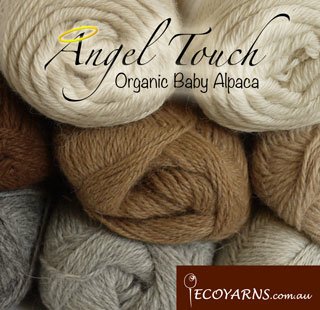
Vivian at EcoYarns is having a Camelid Yarn sale from the 21st to 27th May. There will be alpaca, llama, pacovicuna and bison yarns on sale. Vivian's blog is here, there is a lot of information and knitting tips there and at the moment, she's just started a sock knitting tutorial. Well worth a visit.


My next talk will be at the Maroochydore Library next Friday, 25 May from 10 - 11.30am. Its free but you have to book. More details are here on the Sunshine Coast Council's website.
Small Measure - It's all here, a life lived with an open heart.

There is some beautiful writing at Mount Custard, particularly Steven Again. Do yourself a favour, visit and read.

50 ways to get dinner on the table.

I made David Leboitz's Blue Cheese Dressing for a roasted root vegetable salad. It's divine.

I have a few vegetarian cook books but the one I'd like to have is the River Cottage Veg Everyday. It's listed here with several other recommended vegetarian food books.

FROM OUR MOB

Homespun Fields is a lovely blog full of baking days, recipes, projects, chooks and wondering about life. But it's had no comments! Let's all go over there and say hello to Mrs Homespun. :- )

There are lots of chooks here on Life At Arbordale Farm and you can also see inside a fairy egg.

Thank you for visiting me this week and for leaving comments here for all of us to read. I'm looking forward to the weekend - my plan is for a gentle mix of rest and work. Whatever you do, I hope you enjoy it.


As you can see, I've changed the template again. My apologies to those of you who visited yesterday while I was working on it. There were all sorts of strange things on the blog while I sampled different templates. I wanted one with a post date and a footer and while the one I eventually chose doesn't have everything I want, it's close enough for the time being. I still have some work to do on it - such as removing that grey band, working out how to swap the time for the date, moving the navigation bar and a few other tweaks, but at the moment I've given as much time to it as I have and now it has to wait for a day or so until I have the time to finish it.  I'm sorry for the inconvenience it causes but I love change and do change the look of my blog every few months. It's slow because I have to teach myself the coding as I go. Still, I look on it as a learning exercise and I am grateful for everyone of those.

Hanno asked me to thank everyone for their kind thoughts and messages. We will go back to the doctor and physiotherapist today and see what progress has been made. He is still in a lot of pain but he said yesterday that he thinks it is easing slightly. When I get Hanno back home again and settled, I have a couple of meetings to attend this afternoon, then I'll go into Brisbane for the talk and book signing at Avid Reader. I'm really looking forward to it because I've been told so many good things about that wonderful book shop.

~~~~~~~~~~

The bunnies are warming themselves on the flannel sheets.

Today I want to talk about the seasonal work we all do. We live in the sub-tropics so we don't experience the full wonder of four seasons. I would say we get a very brief autumn and spring and a long winter and summer. Nevertheless, as soon as the cool weather arrives, I feel like I'm deep in the heart of  New England or Manitoba, and I start my autumn tasks. We have no fire wood to gather here but I have on my lambswool slippers and extra layers of clothing but my most important ritual is to take the flannel sheets from the linen cupboard and make the bed warm and cosy.


Just doing that one thing takes me instantly from thoughts of a cool salad for dinner with ice cubes in water to going into the kitchen to get out the slow cooker. When those flannel sheets are on the bed and wool slippers are on my feet, everything changes.


When you do most of your own cooking at home, you notice how much the weather effects what you do. Bread takes longer to rise, yoghurt needs an extra covering overnight and you need to find a warmer spot for your sourdough starter and fermenting. But here it is also a good time for cheesemaking. We're about to eat two very good looking camembert cheese I made a while back, soon I'll have a hard cheese on the go too, with the option to leave it to ripen on a cool shelf instead of in the fridge.


So while a beef casserole and herb dumplings bubbles away slowly in the kitchen, we also have our garden to look after and that takes on a different feel in the cooler months. In summer it's all heat, humidity and bugs here. In autumn and winter it's perfect growing weather and there's a slight feel of urgency in March as we sow seeds and Hanno prepares the soil for yet another year's planting. Watering the garden takes on a different feel too. Instead of the playful and cooling exercise it becomes later in the year, in winter, I rug up and wear gloves when I water the garden.

I love working to the seasons. It gives a new feel to the work we do. In the cooler months I feel I'm providing protection from the cold and warming food to those I love and in the hotter months, it's all shade trees, ice cubes and salads. One day I would love to build a fire in the fading light of day and sit near a wood stove to warm up and knit at night but in the meantime, tell me how you stay warm in winter and how you go about your seasonal work.


Newer Posts Older Posts Home

MY BOOKS

MY BOOKS


My books were all published by Pengiun, and are available at Amazon US, Amazon UK and Amazon Au

Search here

Total Pageviews

Translate


I'm Rhonda Hetzel and I've been writing my Down to Earth blog since 2007. Although I write the occasional philosophical post, my main topics include home cooking, happiness and gardening as well as budgeting, baking, ageing, generosity, mending and handmade crafts. I hope you enjoy your time here.

MY FAVOURITE PLACES

  • Grandma Donna's Place
  • Grandma Donna's YouTube
  • Grandma Donna's Instagram
  • This Simple Day
  • Nicole's Instagram

Give More

Give More

Popular posts last year

Making ginger beer from scratch

We had a nice supply of ginger beer going over Christmas. It's a delicious soft drink for young and old, although there is an alcoholic version that can be made with a slight variation on the recipe. Ginger beer is a naturally fermented drink that is easy to make - with ginger beer you make a starter called a ginger beer plant and after it has fermented, you add that to sweet water and lemon juice. Like sourdough, it must ferment to give it that sharp fizz. To make a ginger beer plant you'll need ginger - either the powdered dry variety or fresh ginger, sugar, rainwater or tap water that has stood for 24 hours to allow the chlorine to evaporate off. You'll also need clean plastic bottles that have been scrubbed with soap, hot water and a bottle brush and then rinsed with hot water. I never sterilise my bottles and I haven't had any problems. If you intend to keep the ginger beer for a long time, I'd suggest you sterilise your bottles. MAKING THE STARTER In a...
Image

NOT the last post

This will be my last post here.  I've been writing my blog for 18 years and now is the time to step back. I’ve stopped writing the blog and come back a couple of times because so many people wanted it, but that won’t happen again, I won’t be back.  I’ll continue on instagram to remain connected but I don’t know how frequent that will be. I know some of you will be interested to know the blog's statistics. 
Image

How to make cold process soap

I'm sure many of you are wondering: "Why make soap when I can buy it cheaply at the supermarket?" My cold process soap is made with vegetable oils and when it is made and cured, it contains no harsh chemicals or dyes. Often commercial soap is made with tallow (animal fat) and contains synthetic fragrance and dye and retains almost no glycerin. Glycerin is a natural emollient that helps with the lather and moisturises the skin. The makers of commercial soaps extract the glycerin and sell it as a separate product as it's more valuable than the soap. Then they add chemicals to make the soap lather. Crazy. Making your own soap allows you to add whatever you want to add. If you want a plain and pure soap, as I do, you can have that, or you can start with the plain soap and add colour, herbs and fragrance. The choice is yours. I want to add a little about animal and bird fat. I know Kirsty makes her soap with duck fat and I think that's great. I think t...
Image

Preserving food in a traditional way - pickling beetroot

I've had a number of emails from readers who want to start preserving food in jars but don't know where to start or what equipment to buy.  Leading on from yesterday's post, let's just say up front - don't buy any equipment. Once you know what you're doing and that you enjoy preserving, then you can decide whether or not to buy extra equipment. Food is preserved effectively without refrigeration by a variety of different methods. A few of the traditional methods are drying, fermentation, smoking, salting or by adding vinegar and sugar to the food - pickling. This last method is what we're talking about today. Vinegar and sugar are natural preservatives and adding one or both to food sets up an environment that bacteria and yeasts can't grow in. If you make the vinegar and sugar mix palatable, you can put up jars of vegetables or fruit that enhance the flavour of the food and can be stored in a cupboard or fridge for months. Other traditional w...
Image

Cleaning mould from walls and fabrics

With all this rain around we've developed a mould problem in our home. Usually we have the front and back doors open and that good ventilation stops most moulds from establishing. However, with the house locked up for the past week, the high humidity and the rain, mould is now growing on the wooden walls near our front door and on the lower parts of cupboards in the kitchen. Most of us will find mould growing in our homes at some point. Either in the bathroom or, in humid climates, on the walls, like we have now. You'll need a safe and effective remedy at some point, so I hope one of these methods works well for you. Mould is not only ugly to look at, it can cause health problems so if you see mould growing, do something about it straight away. The longer you leave the problem, the harder it will be to get rid of it effectively. If you have asthma or any allergies, you should do this type of cleaning with a face mask on so you don't breathe in any spores. Many peopl...
Image

Five minute bread

Bread is one of those foods that, when made with your own hands, gives a great deal of satisfaction and delight. It's only flour and water but it symbolises so much. I bake bread most days and use a variety of flours that I buy in bulk. Often I make a sandwich loaf because we use most of our bread for lunchtime sandwiches and for toast. Every so often I branch out to make a different type of loaf. I have tried sour dough in the past but I've not been happy with any of them. I'll continue to experiment with sour dough because I like the idea of using wild yeasts and saving the starter over a number of years to develop the flavour and become a part of the family. However, the loaf I've been branching out to most often is just a plain old five minute bread. By five minutes I mean it takes about five minutes actual work to prepare but it's the easiest of all bread to make and to get consistently good loaves from. If you're having people around for lunch or...
Image

This is my last post.

I have known for a while that this post was coming, but I didn't know when. This is my last post. I'm closing my blog, for good, and I'm not coming back like I have in the past.  I've been writing here for 16 years and my blog has been many things to me. It helped me change my life, it introduced me to so many good people, it became a wonderful record of my family life, it helped me get a book contract with Penguin, and monthly columns with The Australian Women's Weekly and Burke's Backyard . But in the past few months, it's become a burden. In April, I'll be 75 years old and I hope I've got another ten years ahead. However, each year I'll probably get weaker and although I'm fairly healthy, I do have a benign brain tumour and that could start growing. There are so many things I want to do and with time running out, leaving the blog behind gives me time to do the things that give me pleasure. On the day the blog started I felt a wonderful, h...
Image

What is the role of the homemaker in later years?

An email came from a US reader, Abby, who asked about being a homemaker in later years. This is part of what she wrote: "I am a stay-at-home mum to 4 children, ages 9-16. I do have a variety of "odd jobs" that I enjoy - I run a small "before-school" morning drop-off daycare from my home, I am a writing tutor, and I work a few hours a week at a local children's bookstore. But mostly, I cherish my blissful days at home - cooking, cleaning (with homemade cleaners), taking care of our children and chickens and goats, baking, meal-planning, etc. This "career" at home is not at all what I imagined during my ambitious years at university, but it is far more enriching. I notice, though, that my day is often planned around the needs of my family members. Of course, with 4 active kids and a husband, this is natural. I do the shopping, plan my meals, cook dinner - generally in anticipation of my family reconnecting in the evening.  I can't h...
Image

Every morning at home

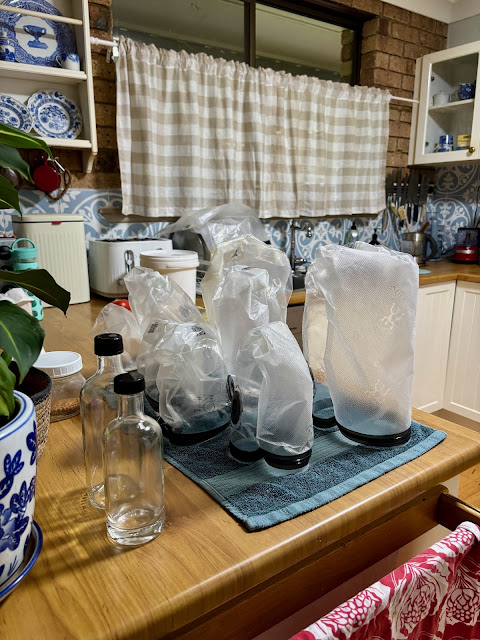
Every morning when I walk into my kitchen it looks tidy and ready for a day's work. Not so on this morning (above), I saw this when I walked in. Late the previous afternoon when I was looking for something, I came across my rolled up Zwilling vacuum bags and decided they had to be washed and dried. So I did that and although I usually put them outside on the verandah to dry it was dark by then. I turned the just-washed bags inside out and left them like this on a towel. It worked well and now the bags are ready to use when I bring home root vegetables, cabbages or whatever I buy that I want to last four or five weeks.
Image

You’ll save money by going back to basics

When I was doing the workshops and solo sessions, I had a couple of people whose main focus was on creating the fastest way to set up a simple life. You can't create a simple life fast, it's the opposite of that It's not one single thing either - it's a number of smaller, simpler activities that combine to create a life that reflects your values; and that takes a long to come together. When I first started living simply I took an entire year to work out our food - buying it, storing it, cooking it, preserving, baking, freezing, and growing it in the backyard. This is change that will transform how you live and it can't be rushed.  
Image

All previous blog posts

  • 2026 3
    • February 3
      • Workshops starting 1 March
      • Planting vegetable seeds and new workshops
      • Back where we belong
  • 2025 7
    • July 1
    • June 2
    • May 1
    • April 2
    • February 1
  • 2024 25
    • December 2
    • November 1
    • October 2
    • September 3
    • August 1
    • July 3
    • June 1
    • May 3
    • April 2
    • March 3
    • February 2
    • January 2
  • 2023 13
    • December 1
    • November 2
    • October 1
    • September 3
    • August 2
    • February 2
    • January 2
  • 2022 17
    • November 3
    • October 4
    • September 3
    • August 2
    • July 3
    • June 2
  • 2021 50
    • December 1
    • November 6
    • October 7
    • September 5
    • August 4
    • July 5
    • June 2
    • May 2
    • April 6
    • March 4
    • February 4
    • January 4
  • 2020 68
    • December 3
    • November 5
    • October 4
    • September 4
    • August 4
    • July 4
    • June 4
    • May 8
    • April 7
    • March 8
    • February 8
    • January 9
  • 2019 66
    • December 2
    • November 4
    • October 5
    • August 3
    • July 4
    • June 6
    • May 8
    • April 8
    • March 8
    • February 11
    • January 7
  • 2018 82
    • December 1
    • September 2
    • August 10
    • July 4
    • June 11
    • May 9
    • April 12
    • March 10
    • February 10
    • January 13
  • 2017 129
    • December 7
    • November 10
    • October 6
    • September 13
    • August 11
    • July 13
    • June 12
    • May 9
    • April 9
    • March 14
    • February 11
    • January 14
  • 2016 125
    • December 7
    • November 13
    • October 10
    • September 11
    • August 11
    • July 8
    • June 9
    • May 9
    • April 12
    • March 10
    • February 13
    • January 12
  • 2015 184
    • December 7
    • November 15
    • October 20
    • September 18
    • August 19
    • July 18
    • June 12
    • May 15
    • April 12
    • March 21
    • February 13
    • January 14
  • 2014 203
    • December 11
    • November 8
    • October 17
    • September 20
    • August 17
    • July 19
    • June 17
    • May 17
    • April 23
    • March 15
    • February 18
    • January 21
  • 2013 225
    • December 13
    • November 17
    • October 17
    • September 17
    • August 21
    • July 24
    • June 20
    • May 19
    • April 17
    • March 22
    • February 17
    • January 21
  • 2012 245
    • December 17
    • November 20
    • October 20
    • September 18
    • August 15
    • July 24
    • June 21
    • May 26
    • April 23
    • March 23
    • February 19
    • January 19
  • 2011 257
    • December 18
    • November 24
    • October 27
    • September 23
    • August 24
    • July 21
    • June 24
    • May 24
    • April 16
    • March 22
    • February 14
    • January 20
  • 2010 283
    • December 20
    • November 18
    • October 18
    • September 19
    • August 25
    • July 24
    • June 25
    • May 26
    • April 25
    • March 22
    • February 29
    • January 32
  • 2009 293
    • December 29
    • November 18
    • October 23
    • September 25
    • August 22
    • July 28
    • June 22
    • May 21
    • April 27
    • March 26
    • February 24
    • January 28
  • 2008 387
    • December 24
    • November 23
    • October 25
    • September 26
    • August 27
    • July 27
    • June 37
    • May 34
    • April 44
    • March 53
    • February 32
    • January 35
  • 2007 372
    • December 37
    • November 40
    • October 55
    • September 51
    • August 49
    • July 63
    • June 49
    • May 28


Trending Articles

NOT the last post

This will be my last post here.  I've been writing my blog for 18 years and now is the time to step back. I’ve stopped writing the blog and come back a couple of times because so many people wanted it, but that won’t happen again, I won’t be back.  I’ll continue on instagram to remain connected but I don’t know how frequent that will be. I know some of you will be interested to know the blog's statistics. 
Image

Every morning at home

Every morning when I walk into my kitchen it looks tidy and ready for a day's work. Not so on this morning (above), I saw this when I walked in. Late the previous afternoon when I was looking for something, I came across my rolled up Zwilling vacuum bags and decided they had to be washed and dried. So I did that and although I usually put them outside on the verandah to dry it was dark by then. I turned the just-washed bags inside out and left them like this on a towel. It worked well and now the bags are ready to use when I bring home root vegetables, cabbages or whatever I buy that I want to last four or five weeks.
Image

You’ll save money by going back to basics

When I was doing the workshops and solo sessions, I had a couple of people whose main focus was on creating the fastest way to set up a simple life. You can't create a simple life fast, it's the opposite of that It's not one single thing either - it's a number of smaller, simpler activities that combine to create a life that reflects your values; and that takes a long to come together. When I first started living simply I took an entire year to work out our food - buying it, storing it, cooking it, preserving, baking, freezing, and growing it in the backyard. This is change that will transform how you live and it can't be rushed.  
Image

Creating a home you'll love forever

Living simply is the answer to just about everything. It reduces the cost of living; it keeps you focused on being careful with resources such as water and electricity; it reminds you to not waste food; it encourages you to store food so you don't waste it and doing all those things brings routine and rhythm to your daily life. Consciously connecting every day with the activities and tasks that create simple life reminds you to look for the meaning and beauty that normal daily life holds.  It's all there in your home if you look for it. Seemingly mundane tasks like cleaning and cooking help you with that connection for without those tasks, the home you want to live in won't exist in the way you want it to.  Creating a home you love will make you happy and satisfied.
Image

Time changes everything

I've been spending time in the backyard lately creating a contained herb and vegetable garden. My aim is to develop a comfortable place to spend time, relax, increase biodiversity and encourage more animals, birds and insects to live here or visit. Of course I'd prefer my old garden which was put together by Hanno with ease and German precision. Together, we created a space bursting at the seams with herbs, vegetables and fruity goodness ready to eat and share throughout the year. But time changes everything. What I'm planning on doing now, is a brilliant opportunity for an almost 80 year old with balance issues. In my new garden I'll be able to do a wide range of challenging or easy work, depending on how I feel each day. It’s a daily opportunity to push myself or sit back, watch what's happening around me and be captivated by memories or the scope of what's yet to come.
Image

It's the old ways I love the most

I'm a practical woman who lives in a 1980’s brick slab house. There are verandahs front and back so I have places to sit outside when it's hot or cold. Those verandahs tend to make the house darker than it would be but they're been a great investment over time because they made the house more liveable. My home is not a romantic cottage, nor a minimalist modern home, it's a 1980’s brick slab house. And yet when people visit me here they tell me how warm and cosy my home is and that they feel comforted by being here. I've thought about that over the years and I'm convinced now that the style of a home isn't what appeals to people. What they love is the feeling within that home and whether it's nurturing the people who live there.
Image

Back where we belong

Surprise! I'm back ... for good this time. Instagram became an impossible place for me. They kept sending me messages asking if I'd make my page available for advertisers! Of course, I said no but that didn't stop them. It's such a change from what Instagram started as. But enough of that, the important part of this post is to explain why I returned here instead of taking my writing offline for good. For a few years Grandma Donna and I have talked online face-to-face and it's been such a pleasure for me to get to know her. We have a lot in common. We both feel a responsibility to share what we know with others. With the cost of living crisis, learning how to cook from scratch, appreciate the work we do in our homes, shop to a budget and pay off debt will help people grow stronger. The best place to do that is our blogs because we have no advertising police harassing us, the space is unlimited, we can put up tons of photos when we want to and, well, it just feels li...
Image

Making ginger beer from scratch

We had a nice supply of ginger beer going over Christmas. It's a delicious soft drink for young and old, although there is an alcoholic version that can be made with a slight variation on the recipe. Ginger beer is a naturally fermented drink that is easy to make - with ginger beer you make a starter called a ginger beer plant and after it has fermented, you add that to sweet water and lemon juice. Like sourdough, it must ferment to give it that sharp fizz. To make a ginger beer plant you'll need ginger - either the powdered dry variety or fresh ginger, sugar, rainwater or tap water that has stood for 24 hours to allow the chlorine to evaporate off. You'll also need clean plastic bottles that have been scrubbed with soap, hot water and a bottle brush and then rinsed with hot water. I never sterilise my bottles and I haven't had any problems. If you intend to keep the ginger beer for a long time, I'd suggest you sterilise your bottles. MAKING THE STARTER In a...
Image