down to earth

  • Home
  • About Us
  • Down To Earth Book
  • Privacy Policy

Earthships, what are they?  on You tube

If you like clog dancing or buck dancing, you'll love this. It all seems so familiar to me but I guess it's a look back in time for many of you.  Bluegrass music and clog dancing.

Are you living true to your environmental values, or trying to, and renting accommodation? Look at this great website: Green Renters Lots of tips and encouragement here.

A knitted Waldorf-style doll.

The five regrets of dying. I've linked to this before but I think it's a good article to refer back to occasionally. It certainly refocuses me.

After reading Lusi's comment on yesterday's post about this post, I re-read it and decided to add it here. Thanks Lusi, happy Easter to you and your family. xx

Blogs found via my comments during the week

Melissa - Melissa has a beautiful garden and blog. Do yourself a favour and check it out, it's more than gardening.

Africanaussie has been transplanted from the heat in Africa to the heat in tropical Queensland, Australia. There is so much to read here - permaculture, food production and crazy tropical plants.

If you celebrate the religious holidays, I wish you a happy Easter or Passover. Whatever you do over the coming days, I hope you're with people you love and you enjoy yourself. Thanks for your visits during the week, I look forward to seeing you again on Monday.
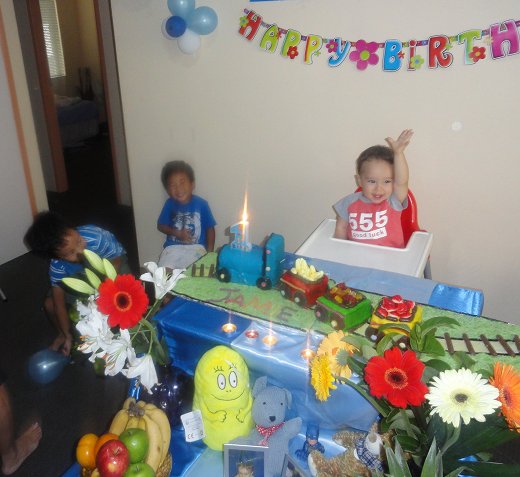
I love my family. We aren't perfect but we support each other, we show affection and love and there is a warm and comfortable thread that ties us to each other. We celebrated Jamie's first birthday last weekend and of course, there was a get-together of family and friends to mark this wonderful occasion.

(Sorry for the poor quality of the photos today. I just cleaned the lens. ahem. :- O)

Jamie with two of his cousins. They came over from Korea for a holiday and to be here for Jamie's big day.

Sunny and Jamie above. Below Sunny, her sister, Sarndra and Alexander watch while Jamie is dressed in his traditional Korean first birthday costume.

The jacket and hat didn't stay on long.

The first birthday in Korea is a big celebration with traditional costume, gold jewellery, flowers, gifts and a banquet, so that was coupled with our more casual Australian way. It was a good mix and a delightful party. Sunny, along with her mother and sister, cooked a delicious Korean meal that we all enjoyed. Shane and Sarndra made the most brilliant birthday cake in the form of a train and Sunny gave us all traditional Korean rice cakes to take home with us.

 Shane proudly holds his son, Alexander.
 And here are Opa and Grandma with Alexander. He's such a gorgeous baby.


Here is the cake made by Shane and Sarndra and the lunch banquet below.


Jamie wasn't quite sure of the decorations and costumes and he often had a puzzled look on his face but there were also lots of smiles and the chance to spend time with his cousins, surrounded by balloons and birthday cake and lollies. He is such a happy boy. I'm not sure how many birthdays I'll be around for. I hope to see him turn 21 and even 30, but if I don't, he can look back, maybe to this blog, and see how much he was loved by all of us and how his family came together to celebrate his first birthday. 
Yesterday I wrote about making camembert cheese in the home kitchen. We got to the point where the milk had turned from liquid to curds and whey.

Cutting the curds:
Your cheese mix still needs to be at 32C/89.6F. If the temperature has dropped, turn the stove on again for about a minute.
  1. Take the long sharp knife and prepare to cut the curd. This is done by gently slicing through the curd at 2cm/i inch strips from top to bottom.
  2. When you have strips, cut the strips into cubes but slicing through from left to right.
  3. When you have cubes, then slice through the curds diagonally - both ways, left ot right, then right to left.
  4. Stir the curds with the slotted spoon for 15 minutes and check to make sure all the curds are in small 2cm/1inch cubes. If you see any larger ones, cut them with your knife.
  5. Let the curds rest for 15 minutes. This will allow the whey to ooze out of the curd.
Cutting the curds - from top to bottom.
And diagonally to make small cubes.
Stir the curds gently for 15 minutes and look for curds that haven't been cut small enough.

Putting the curds into the moulds
  1. After the curds have rested for 15 minutes, the whey will have risen to the top and the curds will have sunk down.
  2. Pour off the whey into a container. I found the container too heavy to easily pick up and pour so I used a soup ladle to scoop off the whey.
  3. When most of the whey is in another container - my batch yielded about 4 litres of whey - you have start filling the moulds.
  4. Place the moulds on a sterile draining rack that will allow the whey to drain off. I used the draining rack from the botton of a plastic container and placed it over a bowl. I supported the rack on both sides of the bowl and with a small upturned bowl in the middle. The four liitres/quarts of milk I used filled two moulds.
  5. Fill them right to the top and wait a short while for the whey to drain off. Pour this whey into your containers. Don't waste it. Keep filling the moulds until they reach the top of the moulds and you've used all the curds.
  6. Let the moulds drain for an hour.

Pour or scoop off the whey from the curds and store it in a jar.
When most of the whey is in the jars, start forming the cheese.
This cheese yielded about 1½ litres/quarts of whey. I'll use this for making ricotta.

Turning the moulds:
  1. When the moulds have drained for an hour, you need to turn them over to make sure they drain evenly. Making sure you have very clean hands, gently slide the curds from the mould onto your hand. It should slide out easily. Then turn the curd over and slide it back into the mould.
  2. Now you'll have the curds in the mould again but what was the top is not on the bottom.
  3. Do this every hour for the rest of the day, or about 5 or 6 times.
  4. Allow the moulds to sit on the rack and drain overnight. I put mine in the microwave and closed the door.
Load the moulds to the top and let them drain into a bowl. Save the whey.
I took the cheese out of the moulds too soon. Let them stay in the moulds overnight and remove them in the morning.

Salting the cheese:
  1. The next morning you can remove the cheese from the moulds and salt it.
  2. Use good salt - kosher or pure sea salt - sprinkle it all over the cheese and rub it in slightly.
Maturing the cheese:
  1. Place the cheese on a rack in a sterile box that will fit in your fridge or cheese cave. You need a humid coolish environment for the moulds to develop. The cheese needs air for the bacteria and moulds to develop - so don't keep the lid on the container.
  2. Set the temperature at between 8 - 10C and place an open container of water in the fridge to increase humidity. If you think the humidity level isn't high enough, place moist cheesecloth or cotton cloth in the fridge. You could also use a spray bottle of boiled water that has cooled down and spray the inside of the fridge.
  3. It will take about 14 days for the cheese to be fully covered with white mould but you'll probably notice it growing at the end of the first week.
  4. When you see the first signs of white mould, turn the cheese over.
  5. When the white mould is completely covering the cheese, wrap them in cheese wrap and continue to mature the cheese at 8 - 10C for another 3 - 4 weeks.


White mould not growing?
If, after a week, the white mould doesn't grow, you'll need to provide more humidity. Place the cheese inside a plastic box that has a drainage rack. Place a small amount of boiled cool water in the base, place the rack in, put the cheese on the rack and close the lid. This is important: every 2 days, open the lid to allow fresh air in, then close the lid again.

What sort of milk?
Almost all fresh milk can be used - whole milk, skim milk, goat or cow's milk. I used raw milk but if you can't get that, look for unhomogenised milk at the shop. If you can't get that, use plain pasturised milk.

It's best to start your cheesemaking in the morning. It will take all day to make camembert but most of that time is waiting for the next step; the actual hands-on work takes about an hour.

The amount of milk I used will give you about 1½ litres/quarts of whey. Don't throw it out, it's a valuable food full of beneficial bacteria. Store your whey in a preserving/canning jar. It will keep well in the fridge for at least three months. I'm going to make ricotta with this whey and it will sit happily in the fridge until I have time to do it.

I hope I've encouraged you towards cheesemaking. If you have the right equipment and cultures and a supply of good milk, you can make some very good cheese. It's not too difficult and although some of the processes can be time consuming, most of that time is waiting for the whey to drain or for the curds to set. It's another great skill that will add to the delicious and simple foods you can place on the table for your family and friends.

ADDITIONAL READING
This is my favourite cheese site - Fankhauser's Cheese Page
The last time I made camembert cheese was on 19 May 2007. This is what I said after doing it:

The entire process took all day and half way through it I realised that cheese making is not "my thing". I'm too impatient for it. But I persevered and produced a decent enough Camembert. I've told everyone who would listen to me that I won't make cheese again but I doubt that's true. I just have to put space between myself and the event and just like childbirth, I'll be back for seconds.

And true to my word, I came back for seconds, albeit five years later - that must have been the space I was talking about. :- ) It seems I have changed a bit over those years because this time I was much more organised and calm and mixing up a batch of raw milk cheese didn't seem like such a palaver this time. In fact, I enjoyed it although it wasn't without its dramas.

I bought a Mad Millie camembert kit from the local stockist at Maroochydore. The kit contained two hoops to help form the cheeses as well as the cultures and rennet needed to make it, or so I thought. I made the first batch up on Friday, I came to the second addition of culture and it looked like I had two cultures the same. I rang the shop. I was assured it was right, she remembered me, and encouraged me to add both cultures. The cheese didn't set. I sat down to read a cheese troubleshooting page on the web. There I read the cheese would not set because the bacterial count was too high - adding that second batch of the same culture ruined the cheese. I rang back and told her, she said the rep was there and he'd bring the right culture over to me. I appreciate that he did that, but that doesn't excuse her bad advice, the fact that she didn't apologise and that I had to throw out four litres/quarts of fresh milk. The high bacterial count made it unfit for the chooks. I won't be using Mad Millie or that stockist again - for cheese or brewing supplies. 

I'm going to try Australian Home Cheese Making for my next batch of cultures. They run courses so I'm guessing they know their cheese. It looks to be the most reasonably priced Flora Danica at $17.50, enough for 250 litres/quarts of milk. These cultures are stored in the freezer so it's fine to buy a larger amount. If you're interested in cheese making, stay tuned because I'll continue to try different suppliers and let you know which ones offer the best service and value for money.

I had four litres of milk left so early Saturday morning I started up again. Four litres will make up two fairly large camemberts. To make camembert you will need:
  1. A large saucepan - like an 8 litre soup or stockpot
  2. A slightly smaller saucepan that will fit inside the larger pot to act as a double boiler OR a double boiler capable of holding four litres of milk
  3. A slotted spoon for stirring
  4. A milk thermometer - I am using the candy thermometer I use when making soap
  5. Two hoops - you can buy these or make them using food grade plastic plumbing pipe that you drill many drainage holes in
  6. A long knife
  7. A syringe to measure out very small amounts of liquid
  8. A wine fridge or an old fridge modified to a set temperature with a thermostat. Narelle has a post on making these modifications on her blog Just like my nan made. We bought a wine fridge at Aldi for $79. Don't pay any more than that because you need to keep your costs down to make it good value for money. I'm pretty sure I'll include cheesemaking in my monthly kitchen tasks from now on, so we should recoup the cost of our fridge in the next 12 months.

This is my double boiler - a soup pot with a 4 litre capacity saucepan resting in it. The soup pot contains water that heats up and allows the milk in the top saucepan to warm gently and stay warm during the process.

You'll need a slotted spoon with a long handle. This will help you gently stir the milk without incorporating too much air into the mix.

To make the cheese:
Everything you use must be scrupulously clean and the milk containers and utensils must be sterile. The kit contained some sterilising liquid to add to water and I used that this time but in the future, I'll use something else.


  1. Put the milk in the pot on the stove and bring the milk to 32C/89.6F
  2. Stir in the starter bacteria Flora Danica according to the instructions on the pack. Don't stir too vigorously, this bacteria doesn't like too much air.
  3. Turn off the heat.
  4. Let the milk sit for 90 minutes with the lid on the saucepan.
  5. After 90 minutes stir in the mould spores - Penicillium Camemberti
  6. Add the diluted rennet. I used 0.5ml vegetarian rennet and diluted it in 2ml water.
  7. Stir for a minute using the slotted spoon.
  8. Cover again and let sit for 60 minutes. Check that the temperature is still at 32C/86.9F. If it's gone down a little, turn on the stove for about 45 seconds to bring it back up to the correct temperature.
When 60 minutes is up, the milk should have set and if you touch the top of the milk, it will be soft, but not liquid anymore. Your milk is now more like cheese and now you'll cut the curd and take off the whey. I'll write about forming the cheese in the hoops, turning it out and maturing tomorrow. Unlike my earlier attempt at camembert I found making this cheese was easy and well within my skill level. I enjoyed the entire process and I know that I'll make much more cheese after this. So come back tomorrow and see what this milk turned into. Hopefully you'll be inspired to make your own cheese too.

There is no doubt that living as we do and trying to stay on budget presents us with many decisions. Do we buy organic? Do we buy local? Do we grow our own? What are the pros and cons of those options? One thing is for sure, if you want to stay healthy while saving money, there will probably not be one single answer to this. Prices and circumstances will keep changing and we have to be flexible enough to change what we do.

Many of you know what we do here. We try to grow as much as we can right here in our backyard. We keep chickens - we have 12 rare breed chooks at the moment and we keep them for eggs, not meat. But what do we do for the rest of our food? How do we continue to buy healthy food while staying within our budget?


Aldi is our main grocery shop, the things we can't buy at Aldi we usually buy at IGA at Maleny. We have an Aldi shop just five minutes away from our home. If you've never shopped at Aldi and you have one close buy, I encourage you to try them out. You'll save about 30% on what you'd spend at Woolworths or Coles. If you're spending $100 a week at the supermarket on groceries every week and you change to Aldi, that's a saving of $30 a week or $1560 a year. Just say you spend that $560 on items you can't get at Aldi, you're still way ahead. It would be wonderful to be able to pay off an extra $1000 off your mortgage each year just by changing where you shop.

There is a bit of a learning period when you first shop at Aldi, it's not set out like your average supermarket but it only takes one or two visits to get the general idea. Also, they have specials that run for a week or so, then you won't see them again in the shop for another year. It's a German-owned company selling 97% Australian fruit and vegetables, 94% Australian dairy and 100% Australian meat; the rest of the groceries, like other supermarkets, come from all over the world - often from Germany. They won best supermarket in Australia last year and that was voted for on customer satisfaction.

Aldi have a range of organic goods and we buy them but here is where the dilemma presents itself. Their tomato paste is organic but made in Italy. Do we go for an organic product we can afford or an Australia product that is not organic? I hope you check where all your food comes from and if you do, you'll see that a lot of the tomato products being sold in Australia now are either from Italy or China. When I find Australian tomatoes or tomato paste in cans I buy it, if not, I buy Aldi's Italian organic range. I think we should all support our local famers and industries. If you're in the US, Canada, UK, France, Holland or Sweden - you should buy the products grown and packaged in your own country. We have no right to complain that our jobs are being sent overseas if we don't buy goods from our own countries. Check the country of origin and help your own country keep its jobs by buying locally produced goods. It may cost a little more but we have to get used to the idea that not all food is cheap and buying local is a wise investment.


We're fortunate in having a local butcher that we trust. We buy our meat in bulk from him so we get good meat at a good price. Most of his meat is killed and processed locally, by him and his sons. The rest of it  - the lamb and pork, is brought in from farmers he trusts. That's fine by me. If I didn't have such a butcher, if I was buying supermarket meat, if my butcher wouldn't tell me where the meat was coming from, I'd start looking for a reliable source of good meat and chicken. If I couldn't find a reliable source, I'd buy very little meat and move more towards a vegetarian diet with additions of sustainable fish. If I had a large backyard, I would also consider keeping chickens for meat and eggs. This is what I mean by flexibility and changing what you do as times and circumstances change.

When we're not growing our own vegetables and we buy from the farmers market or Aldi, we buy organic if we can afford it but for me, fresh food grown close to where we live always beats organic. If I have a choice, I prefer fresh vegetables over older organic vegetables. You will have to think about this and decide for yourself what your preference is.

We buy bread flour in bulk bags of 12.5kg/30lbs from a shop that also sells loose dried fruit, nuts, spices, tea, coffee, pasta, rice and grains. They're Simply Good in Morayfield and Alderley. If you make bread at home it is worthwhile looking for one of these shops. They generally have a very good range and are cheaper than the supermarkets. There are plenty of online shops we can buy organic dried foods from but generally we support our local co-op in Maleny. They have a good range of organic foods of every description and the profits go back into the town.

We all support, or choose not to support, with the dollars we spend every week on food and groceries. This is long-term spending. If you can save money here, they will be continued savings that will add up over time. You'll go through stages too. You start off as a single, often turn into a couple, add children, then have ravenous teenagers, and go back to a single or a couple somewhere along the way. All these stages require different shopping strategies and hopefully the way you shop through every stage will result in savings in your pocket every week. With careful and thoughtful shopping and putting in an extra effort at home, it is possible to save in every stage. You have control over this. It is worth some thought.

What is your shopping strategy at the moment and how has it changed over time?
Country of origin labelling in Australia
How are Australian spending their money?


Every week from now on I'm including links to two regular commenters on my blog in my weekend read post. It helps spread the love around and is a little thank you from me for taking the time to contribute on a regular basis.  This week they are:

Jamie's NGO Farm - a family working towards living off the land

When you visit here, read A Hairy Concern, it contains some wisdom from The Accidental Housewife that I wish I'd written: I will teach them to be wise, so that they can choose their own path. 

Great recipes at the Smitten Kitchen

Just in time for our winter, another great knitting site This was linked to at the forum by Nannyrai during the week and too good not to pass on.

A Farm for the Future - you tube

Charity shops are thriving.

Orang-utans are dying.

And bees are getting lost.

Another week has gone by and we move closer to cooler temperatures down here. And that means it's Spring time for the majority of the world's population. I hope you're all enjoying the change of seasons.  Thank you for visiting this week, enjoy what you do this weekend and be kind to yourself.
Just a short post today because I'm a bit busy, but I do have a few things to update you on. 

Most readers would know that Sharon was very sick last year and a couple of times we thought we might lose her. It was really frightening but thankfully she survived after a long stay in hospital. She's been back helping me behind the scenes here, especially with the apron swap, and on the forum, but she's still sick and may have to go back to hospital. She's also supporting another member of her family in their illness. I would like everyone to give Sharon a cyber hug and let her know how much we appreciate her and her work here. I can honestly tell you that she gives me a lot of support behind the scenes and she really does help keep this place going. Thanks Sharon. I send love and hugs to you and your mob over there! Get well soon.

Sunny and Jamie watching the chooks.  : - )

Okay, now I'll surprise you all by telling you that Jamie will be one year old on Saturday. How fast has that time gone! Sunny's mum, Sunja Cho, is here with Sunny's sister and nephews at the moment, so we'll be having a party on the weekend to celebrate Jamie's first year - it will be our family as well as Sunny and Kerry's friends. We'll catch up with Shane, Sarndra and Alexander too. We're all looking forward to it. 

Our New Hampshire chickens are laying now and giving us an egg a day each.  Chooks are such a joy to watch and when they give you delicious fresh eggs every day, they also play a valued part in the backyard food production.

My column in the Women's Weekly doesn't appear this month. When full page ads come in late, a single page column is taken out to accommodate it. This month is was my turn. I'll be back next month. Make sure you give WW some feedback on their site or on Facebook. Just like all of us publishing on a regular basis, we like to know if what we're producing is worthwhile and helpful.

You all know my Friday post is all links - some to interesting reading somewhere in the web, some to other blogs. I try to send you off to blogs that I find interesting and are well presented, to do otherwise would be misleading. Often when I read blogs I am disappointed they receive so few readers. Both Hanno and I read the comments every day and he often follows the links back to your blogs and tells me when he finds something of interest. I've decided that in addition to the links I already give you, I'm going to check out a lot more of the people who comment here regularly. So from now on, I'll link to a couple of blogs who have commented here during the week. I hope to spread the love around and find some interesting people and ideas in the process.

If you have an Australian Blogger blog and have been struggling to find your editing tools (the little screwdriver and pencil) since they added the "au" to your blog address, there is a solution. Just open your blog, go to the address bar and delete the ".au/". Then type in its place "/ncr". That stand for no country redirect, it will keep your blog just as a ". com" blog and your editing tools will return. But you will have to do it everyday. I haven't worked out yet how to make it permanent.

I washed the hoops yesterday, everything else is ready. 

BTW, I'm busy today because I'm making camembert, yoghurt and sour cream. This is only my second batch of camembert, the first years was ago. I thought it was about time to dive into curds and whey again. I have milk from a local dairy that I bartered for a whole orange cake. :- ) My kitchen dairy will be in full swing after breakfast. Wish me luck. 

After sorting through all the comments, and because some swappers did not communicate with their partners or decided not to participate after all, I have had to update the apron swap list as follows. If you do not find your name on this list, it is because I have had to re-pair several swappers (and in the process remove those that did not communicate). Here's the list:

Jessica jessica.bunneh (at) gmail (dot) com AND Ellen 3kidsanderson@gmail.com
Brenny brendadotseaderatgmaildotcom AND Jacinta jchute3 at bigpond dot com
Bel spiralbel at gmail dot com AND Beulah bfields at gmail dot com
Jacqui rjblhadams(at)y7mail(dot)com AND Rozann rozylass at gmail dot com
Carla moraliaweblog (at) yahoo (dot) ca AND Clarien Clarien at zonnet dot nl
Rozlyn rozlynchidgeyatiprimusdotcomdotau AND Denise shllwbrk at msn dot com

PS. Melissa in Costa Rica, please leave your email in the comments after this post as soon as possible for a possible swap partner.

Sharon
I guess that most people reading here every day would be working people - either out in the wide world earning money and/or at home running the household in ways to save it. I am proudly working class; work is part of my core, it's something I expect to do most days, but most of the work I do nowadays is not for money, it's to maintain the way I love to live. It may sound strange to some but I think that working for what you need and want makes you treasure it more, it has meaning because you know the hours of toil that went into it. And yet it seems to me that we have gone off the rails a bit with work. Many of us will work until we drop because we have too much debt to retire earlier. 


I believe that most of us work to get together our life's assets and to buy a house to live in, or to rent one. We might also buy a car. Once we have our assets, we work steadily to pay off the debt we acquired to buy it all. We hope to stay employed, we cut back and save what we can and if we're lucky, the mortgage is paid off earlier than planned and a few years later the credit card and car are all squared away. This kind of debt management is entirely possible, Hanno and I paid off our 20 year mortgage in eight years and have lived debt-free for many years.

But somewhere along the way, a whole generation fell for the idea that buying everything you want on a credit card is normal; encouraged in that by banks looking for higher profits and advertising promising happiness in a pair of shoes, a flash car, diamond earrings, or a jet ski, etc etc etc. It saddens me that many of these good honest people realise too late that they're in over their heads and they'll be working far into the future to pay for today's must-haves. Long after the bling has lost its shine, it is still being paid for.


There is a better way, although it requires sacrifice and hard work. It requires that we cut back on our desires, stop listening to best friends and focus on slowing down and living well rather than expecting to have it all, and then working to pay for it.

There is only one sure way to financial security. Spend less than you earn. One of the things that can delay paying off debt is paying more for the things you use a lot of, or for convenience foods. And by convenience I mean washed salads, processed food, pre-cooked frozen meals, tinned soups, as well as takeaway and fast food, and a whole array of foods that seemed to be a good idea at the time because they cut down on preparation and cooking time but they cost more and therefore add to the cost of living. When you're paying off debt, you want to reduce your cost of living, not raise it. Get back to basics and buy unprocessed foods, cook from scratch and reap the benefits - both in your health and in the money saved.

There is a decision to be made here. Do you work less so you have the time to do some things yourself or do you work more so you have the money to pay for everything you want? Your answer to that question will depend on whether you want to work your whole life so you can buy every thing you want and need, or whether you see value is cutting back on your wants so you have more time to enjoy life. 


You will never see an advertisement suggesting caution and prudence. On the contrary, they encourage excess and acquisition at any price. So I am going to encourage you to look beyond today, think about all those months you'll be handing over money to pay for what you buy today. Try to cut the cost of living and pay your debts off as fast as you can. Don't be conned into buying too much, expect to work hard for what you have, expect to do your fair share and think about saving rather than spending - not just this week or next, but far into the future too. Because if you can get off the debt roller coaster, if you stop spending just because you can, if you knuckle down and get serious about debt reduction, you will be able to retire sooner rather than later and just live. It may be with less "stuff" but it will be on your own terms and you'll own your life. I hope you find a plan of attack, encouragement and support in my group of budgeting posts here.

It all starts with a commitment to your own future, a clear vision about how you'll reduce debt and then the determination to get back on track and out of the clutches of the bank. I wish you the best and I'd be interested in hearing your story.

Kristen has done a review of my book and is generously giving away a copy of my book to Australians only. You can find her blog here for the details. The giveaway finishes next Monday. 


According to the Wikipedia, value adding refers to "extra" feature(s) of an item of interest (product, service, person etc.) that go beyond the standard expectations and provide something "more" while adding little or nothing to its cost.


I like to think that Hanno and I have added value to our lives simply by the way we live.

I often think back to a young woman who attended one of my workshops at the neighbourhood centre. She listened intently to everything said, then right at the end, she said: "You mean to tell me we don't have to live like this?" "No," I said, "you can live however you see fit." She was astounded. She'd never considered the possibility that life may be lived beyond the consumerist model. There is a choice to be made here. You either go with the flow, do what is expected of you, don't make waves and be the mirror image of all the people your age, or you can step outside that mainstream bubble, make your own decisions, envision the life you want, then work to make it happen.

You can add value to your life and make it better.  Much better.


You will make choices every day you're alive. Will I get up at 7am or 8? Eat breakfast or have a cup of tea?  Get married, or remain single. Spend or save? Live according to your values or go along with everyone else? I have never been a follower, and regardless of the consequences, I've always gone for the interesting option rather than the safe one. I have lived a most remarkable life and I think one of the main reasons for that is that I don't take the easy option and often the paths I walk along are not main roads, they're back streets. I am convinced that those back streets and all I experienced along them, added value to my life.


There are certain questions you can ask yourself and  what you do as a consequence of your answer may help change your life and might also add value to it. 
  • Can I learn how to do for myself or will I continue to buy convenience?
  • Am I strong enough to take on my debt and pay it off as fast as I can?
  • Will I make my own cleaners?
  • Will shopping in a different way and stockpiling save me money and time?
  • Should I grow vegetables?
  • Should I learn how to knit and mend?
  • How can I set up an effective recycling system so I can cut down on the waste products leaving my home?
  • Will I try to become more self reliant?
  • What will make me happy?
  • What can I do today that will make my life better?
Simplifying your life isn't just about the practical things you do every day - although that is a big part of it - it's also about creating a better life for yourself, discovering your own level of "enough" and being prepared to step outside your comfort zone and reconnect with real life again.

One thing is for sure, if you do change how you live, those life changes have the potential to make you content and satisfied. I well remember when I first started working in my home, making soap, cooking from scratch, baking fresh bread every day, it made me feel so alive! Simple things like cleaning the floors and rearranging furniture and appliances to better suit how I worked, made me feel that what I was doing really mattered and that I had regained control of my life. Decluttering opened up my life to let new possibilities in. In the space of one week I went from avoiding housework and thinking it was below me, to being challenged by it, and wanting to make my home a haven for me and my family. Doing what I had believed to be menial work was the making of me. I felt that if I could get my house in order, get back to healthier living, become more self-reliant, and strategise how to shop in a more mindful way, we would all be better for it. I regained the desire to care for my family and we all reconnected and became stronger because of it. That same desire slowed me down enough to let the stress melt away. Here in my home, I learnt how to live well, without many of the modern conveniences that prop us up and that we pay for with our lives.

I am not going to tell you that this is easy, because it's not. It can be time consuming and, at times, difficult. But you know what? It makes you happy, it helps you believe in your own abilities again, it makes you believe you can do almost anything; and maybe you can. I remember when frozen peas first came on the market, and when TV started, those two things went on to convince us all that we would save a lot of time buying convenience foods. Then we all got credit cards and started a whole new form of problematic behaviour. At the time we were told that all these new things would make our lives better. What we weren't told was that we'd have to work more to pay for things to be done for us, work more to pay for clothes and jumpers because we were too busy working to make them ourselves. Now, on top of those things we work to buy, we work more to pay for people to wash our lettuce leaves and cook or partially cook our food, to fabricate and package cleaning rags that we use instead of cutting up our own, we work more to buy chemical cleaners and laundry products that probably add 20 or 30 dollars to the grocery bill when we could use vinegar, bicarb, soap, borax and washing soda that cost a fraction of that.


And the good part is that you don't have to dive into this full-time like I did. If you're younger and don't have the time I have, you can do it your way. Just fit a few of these things into your life around what you're already doing. Do what you have the time to do. Making bar soap will take about 30 minutes to make enough soap for a family of four for about three months. It will take about 15 minutes to make enough laundry liquid to do that same family for 80 machine washes. Cook from scratch on the weekends. Start packing school and work lunches and drinks. Do the small things first and see how it makes you feel and how much you save.


Stepping back from convenience, being content with less and learning a few old skills has the potential to change your life. I know that to be true because that is what happened to me and it added value to my life. I hope you decide to dip your toe in these simple living waters and realise you can add value to yours too.


When we returned from the book tour, I received emails from two readers eager to know what I bought while I was away. I thought it was quite odd to assume I'd bought anything seeing as I write about moving away from a consumerist mindset. And mindset really is the key word here - you need to have thought about your spending and materialism and have turned your back on it for this kind of life to be your new "normal". That is not saying that I will never buy anything frivolous again, it's saying instead that I only buy necessities and what will give me pleasure, and therefore enhance my life.

Bottoms up!

So, where did we shop while we were away for those two weeks? Well, we went to book shops, naturally, to sign books. While I was in two of those book shops I bought a packet of stationery in one and two cards in another. They were for thank you notes to send to people who had gone out of their way to help us during the trip.  We also bought Hanno a new pair of shoes when the ones he brought with him cracked along the sole. We bought food and drinks to sustain us - these were generally bought at small supermarkets and market stalls along the way.

I know what you're thinking - surely she bought more than that! Well, yes, I did, and I'm still not sure what category I'd place these purchases - necessities or pleasure; I think they're both. I need a pair of new slippers for winter. I wanted to buy real Ugg slippers and had already priced them on the Sunshine Coast. Too expensive. I wanted quality but I knew I could get quality at a better price so I was prepared to wait. When we moved here I bought a pair of real Uggs. They lasted me for eight years. Then I bought cheap slippers, and each time I did, they lasted about two years. I wanted to get back to the Uggs - to buy the best quality I could afford - but I wanted the price to be right. I found them at Blue Mountains Uggs at Faulconbridge. We bought a pair of Ugg scuffs for Hanno and a pair of short ankle Uggs for me - I like my slippers to cuddle my feet. Both are real sheepskin and wool. Both pairs together cost the same price I was quoted for one pair here. Well worth the wait.


The other thing I bought was a vintage potato masher. The one I had been using had a very long handle on it, much longer than any person would need. It is uncomfortable to use and doesn't do a great job. I wanted one like my mother used, although I didn't know that until I saw it sitting inside a beautiful vintage glass mixing bowl/jug. It cost $8 and has remnants of the old green paint on the wooden handle. This was made in the days before plastic. When I picked it up I felt like I'd picked it up a hundred times before. I bought it. When we came home, I soaked it in vinegar water for an hour, gave it a good scrubbing with hot water and soap, and added it to my kitchen utensils. It makes the best mash. 

I found this masher treasure in a place called Frou Frou in Springwood. My nephew Danny told me about this shop, I tried to get there last time I was in Springwood at Easter, but they were moving then and the shop was closed during my visit. If you're in the Blue Mountains and like vintage clothes and bits and pieces, it's well worth a visit. Just looking at the stock brought back a few memories for me and made me smile.

And that's it, folks. No big shopping spree, no souvenirs, just cards and a stationery set, shoes for Hanno to wear on the trip, Uggs and a potato masher. All necessities that will bring pleasure too; I reckon that's good shopping. We didn't need anything else and we certainly didn't go walking through shops looking for "stuff" to buy.

Are you having trouble stopping shopping? What are your downfalls? What are you doing to get back to frugality? Maybe you've found not shopping much easier than you imagined it to be. If so, tell me your story.
By now all of you should have contacted your swap buddies. Please be sure to check your bulk mail boxes and your spam boxes. If you have done this and not heard from your swap buddy they will be out of the swap and you will be paired with a new swap buddy. Leave a comment here in this post by tomorrow night so I can rework the buddy list as needs be. Robyn, I will start looking for a new buddy for you. Clarien, have you heard from your swap buddy yet?
Here is a link with ideas and tutorials about aprons for you to have fun looking at:

Have fun with these ideas. Hugs Sharon
Newer Posts Older Posts Home

MY BOOKS

MY BOOKS


My books were all published by Pengiun, and are available at Amazon US, Amazon UK and Amazon Au

Search here

Total Pageviews

Translate


I'm Rhonda Hetzel and I've been writing my Down to Earth blog since 2007. Although I write the occasional philosophical post, my main topics include home cooking, happiness and gardening as well as budgeting, baking, ageing, generosity, mending and handmade crafts. I hope you enjoy your time here.

MY FAVOURITE PLACES

  • Grandma Donna's Place
  • Grandma Donna's YouTube
  • Grandma Donna's Instagram
  • This Simple Day
  • Nicole's Instagram

Give More

Give More

Popular posts last year

Making ginger beer from scratch

We had a nice supply of ginger beer going over Christmas. It's a delicious soft drink for young and old, although there is an alcoholic version that can be made with a slight variation on the recipe. Ginger beer is a naturally fermented drink that is easy to make - with ginger beer you make a starter called a ginger beer plant and after it has fermented, you add that to sweet water and lemon juice. Like sourdough, it must ferment to give it that sharp fizz. To make a ginger beer plant you'll need ginger - either the powdered dry variety or fresh ginger, sugar, rainwater or tap water that has stood for 24 hours to allow the chlorine to evaporate off. You'll also need clean plastic bottles that have been scrubbed with soap, hot water and a bottle brush and then rinsed with hot water. I never sterilise my bottles and I haven't had any problems. If you intend to keep the ginger beer for a long time, I'd suggest you sterilise your bottles. MAKING THE STARTER In a...
Image

NOT the last post

This will be my last post here.  I've been writing my blog for 18 years and now is the time to step back. I’ve stopped writing the blog and come back a couple of times because so many people wanted it, but that won’t happen again, I won’t be back.  I’ll continue on instagram to remain connected but I don’t know how frequent that will be. I know some of you will be interested to know the blog's statistics. 
Image

How to make cold process soap

I'm sure many of you are wondering: "Why make soap when I can buy it cheaply at the supermarket?" My cold process soap is made with vegetable oils and when it is made and cured, it contains no harsh chemicals or dyes. Often commercial soap is made with tallow (animal fat) and contains synthetic fragrance and dye and retains almost no glycerin. Glycerin is a natural emollient that helps with the lather and moisturises the skin. The makers of commercial soaps extract the glycerin and sell it as a separate product as it's more valuable than the soap. Then they add chemicals to make the soap lather. Crazy. Making your own soap allows you to add whatever you want to add. If you want a plain and pure soap, as I do, you can have that, or you can start with the plain soap and add colour, herbs and fragrance. The choice is yours. I want to add a little about animal and bird fat. I know Kirsty makes her soap with duck fat and I think that's great. I think t...
Image

Preserving food in a traditional way - pickling beetroot

I've had a number of emails from readers who want to start preserving food in jars but don't know where to start or what equipment to buy.  Leading on from yesterday's post, let's just say up front - don't buy any equipment. Once you know what you're doing and that you enjoy preserving, then you can decide whether or not to buy extra equipment. Food is preserved effectively without refrigeration by a variety of different methods. A few of the traditional methods are drying, fermentation, smoking, salting or by adding vinegar and sugar to the food - pickling. This last method is what we're talking about today. Vinegar and sugar are natural preservatives and adding one or both to food sets up an environment that bacteria and yeasts can't grow in. If you make the vinegar and sugar mix palatable, you can put up jars of vegetables or fruit that enhance the flavour of the food and can be stored in a cupboard or fridge for months. Other traditional w...
Image

Cleaning mould from walls and fabrics

With all this rain around we've developed a mould problem in our home. Usually we have the front and back doors open and that good ventilation stops most moulds from establishing. However, with the house locked up for the past week, the high humidity and the rain, mould is now growing on the wooden walls near our front door and on the lower parts of cupboards in the kitchen. Most of us will find mould growing in our homes at some point. Either in the bathroom or, in humid climates, on the walls, like we have now. You'll need a safe and effective remedy at some point, so I hope one of these methods works well for you. Mould is not only ugly to look at, it can cause health problems so if you see mould growing, do something about it straight away. The longer you leave the problem, the harder it will be to get rid of it effectively. If you have asthma or any allergies, you should do this type of cleaning with a face mask on so you don't breathe in any spores. Many peopl...
Image

Five minute bread

Bread is one of those foods that, when made with your own hands, gives a great deal of satisfaction and delight. It's only flour and water but it symbolises so much. I bake bread most days and use a variety of flours that I buy in bulk. Often I make a sandwich loaf because we use most of our bread for lunchtime sandwiches and for toast. Every so often I branch out to make a different type of loaf. I have tried sour dough in the past but I've not been happy with any of them. I'll continue to experiment with sour dough because I like the idea of using wild yeasts and saving the starter over a number of years to develop the flavour and become a part of the family. However, the loaf I've been branching out to most often is just a plain old five minute bread. By five minutes I mean it takes about five minutes actual work to prepare but it's the easiest of all bread to make and to get consistently good loaves from. If you're having people around for lunch or...
Image

This is my last post.

I have known for a while that this post was coming, but I didn't know when. This is my last post. I'm closing my blog, for good, and I'm not coming back like I have in the past.  I've been writing here for 16 years and my blog has been many things to me. It helped me change my life, it introduced me to so many good people, it became a wonderful record of my family life, it helped me get a book contract with Penguin, and monthly columns with The Australian Women's Weekly and Burke's Backyard . But in the past few months, it's become a burden. In April, I'll be 75 years old and I hope I've got another ten years ahead. However, each year I'll probably get weaker and although I'm fairly healthy, I do have a benign brain tumour and that could start growing. There are so many things I want to do and with time running out, leaving the blog behind gives me time to do the things that give me pleasure. On the day the blog started I felt a wonderful, h...
Image

What is the role of the homemaker in later years?

An email came from a US reader, Abby, who asked about being a homemaker in later years. This is part of what she wrote: "I am a stay-at-home mum to 4 children, ages 9-16. I do have a variety of "odd jobs" that I enjoy - I run a small "before-school" morning drop-off daycare from my home, I am a writing tutor, and I work a few hours a week at a local children's bookstore. But mostly, I cherish my blissful days at home - cooking, cleaning (with homemade cleaners), taking care of our children and chickens and goats, baking, meal-planning, etc. This "career" at home is not at all what I imagined during my ambitious years at university, but it is far more enriching. I notice, though, that my day is often planned around the needs of my family members. Of course, with 4 active kids and a husband, this is natural. I do the shopping, plan my meals, cook dinner - generally in anticipation of my family reconnecting in the evening.  I can't h...
Image

Every morning at home

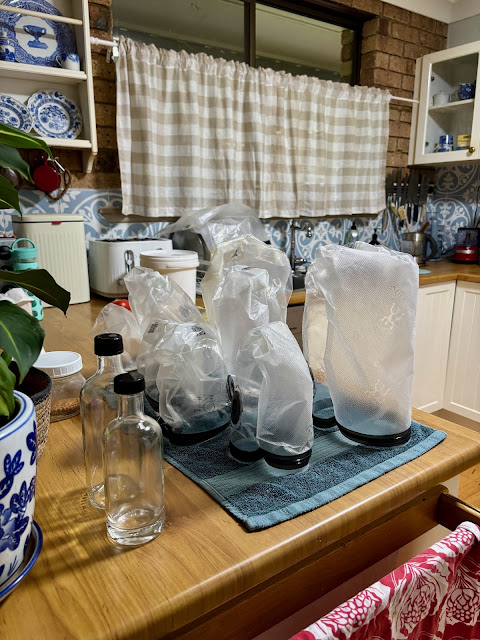
Every morning when I walk into my kitchen it looks tidy and ready for a day's work. Not so on this morning (above), I saw this when I walked in. Late the previous afternoon when I was looking for something, I came across my rolled up Zwilling vacuum bags and decided they had to be washed and dried. So I did that and although I usually put them outside on the verandah to dry it was dark by then. I turned the just-washed bags inside out and left them like this on a towel. It worked well and now the bags are ready to use when I bring home root vegetables, cabbages or whatever I buy that I want to last four or five weeks.
Image

You’ll save money by going back to basics

When I was doing the workshops and solo sessions, I had a couple of people whose main focus was on creating the fastest way to set up a simple life. You can't create a simple life fast, it's the opposite of that It's not one single thing either - it's a number of smaller, simpler activities that combine to create a life that reflects your values; and that takes a long to come together. When I first started living simply I took an entire year to work out our food - buying it, storing it, cooking it, preserving, baking, freezing, and growing it in the backyard. This is change that will transform how you live and it can't be rushed.  
Image

All previous blog posts

  • 2026 3
    • February 3
      • Workshops starting 1 March
      • Planting vegetable seeds and new workshops
      • Back where we belong
  • 2025 7
    • July 1
    • June 2
    • May 1
    • April 2
    • February 1
  • 2024 25
    • December 2
    • November 1
    • October 2
    • September 3
    • August 1
    • July 3
    • June 1
    • May 3
    • April 2
    • March 3
    • February 2
    • January 2
  • 2023 13
    • December 1
    • November 2
    • October 1
    • September 3
    • August 2
    • February 2
    • January 2
  • 2022 17
    • November 3
    • October 4
    • September 3
    • August 2
    • July 3
    • June 2
  • 2021 50
    • December 1
    • November 6
    • October 7
    • September 5
    • August 4
    • July 5
    • June 2
    • May 2
    • April 6
    • March 4
    • February 4
    • January 4
  • 2020 68
    • December 3
    • November 5
    • October 4
    • September 4
    • August 4
    • July 4
    • June 4
    • May 8
    • April 7
    • March 8
    • February 8
    • January 9
  • 2019 66
    • December 2
    • November 4
    • October 5
    • August 3
    • July 4
    • June 6
    • May 8
    • April 8
    • March 8
    • February 11
    • January 7
  • 2018 82
    • December 1
    • September 2
    • August 10
    • July 4
    • June 11
    • May 9
    • April 12
    • March 10
    • February 10
    • January 13
  • 2017 129
    • December 7
    • November 10
    • October 6
    • September 13
    • August 11
    • July 13
    • June 12
    • May 9
    • April 9
    • March 14
    • February 11
    • January 14
  • 2016 125
    • December 7
    • November 13
    • October 10
    • September 11
    • August 11
    • July 8
    • June 9
    • May 9
    • April 12
    • March 10
    • February 13
    • January 12
  • 2015 184
    • December 7
    • November 15
    • October 20
    • September 18
    • August 19
    • July 18
    • June 12
    • May 15
    • April 12
    • March 21
    • February 13
    • January 14
  • 2014 203
    • December 11
    • November 8
    • October 17
    • September 20
    • August 17
    • July 19
    • June 17
    • May 17
    • April 23
    • March 15
    • February 18
    • January 21
  • 2013 225
    • December 13
    • November 17
    • October 17
    • September 17
    • August 21
    • July 24
    • June 20
    • May 19
    • April 17
    • March 22
    • February 17
    • January 21
  • 2012 245
    • December 17
    • November 20
    • October 20
    • September 18
    • August 15
    • July 24
    • June 21
    • May 26
    • April 23
    • March 23
    • February 19
    • January 19
  • 2011 257
    • December 18
    • November 24
    • October 27
    • September 23
    • August 24
    • July 21
    • June 24
    • May 24
    • April 16
    • March 22
    • February 14
    • January 20
  • 2010 283
    • December 20
    • November 18
    • October 18
    • September 19
    • August 25
    • July 24
    • June 25
    • May 26
    • April 25
    • March 22
    • February 29
    • January 32
  • 2009 293
    • December 29
    • November 18
    • October 23
    • September 25
    • August 22
    • July 28
    • June 22
    • May 21
    • April 27
    • March 26
    • February 24
    • January 28
  • 2008 387
    • December 24
    • November 23
    • October 25
    • September 26
    • August 27
    • July 27
    • June 37
    • May 34
    • April 44
    • March 53
    • February 32
    • January 35
  • 2007 372
    • December 37
    • November 40
    • October 55
    • September 51
    • August 49
    • July 63
    • June 49
    • May 28


Trending Articles

NOT the last post

This will be my last post here.  I've been writing my blog for 18 years and now is the time to step back. I’ve stopped writing the blog and come back a couple of times because so many people wanted it, but that won’t happen again, I won’t be back.  I’ll continue on instagram to remain connected but I don’t know how frequent that will be. I know some of you will be interested to know the blog's statistics. 
Image

Every morning at home

Every morning when I walk into my kitchen it looks tidy and ready for a day's work. Not so on this morning (above), I saw this when I walked in. Late the previous afternoon when I was looking for something, I came across my rolled up Zwilling vacuum bags and decided they had to be washed and dried. So I did that and although I usually put them outside on the verandah to dry it was dark by then. I turned the just-washed bags inside out and left them like this on a towel. It worked well and now the bags are ready to use when I bring home root vegetables, cabbages or whatever I buy that I want to last four or five weeks.
Image

You’ll save money by going back to basics

When I was doing the workshops and solo sessions, I had a couple of people whose main focus was on creating the fastest way to set up a simple life. You can't create a simple life fast, it's the opposite of that It's not one single thing either - it's a number of smaller, simpler activities that combine to create a life that reflects your values; and that takes a long to come together. When I first started living simply I took an entire year to work out our food - buying it, storing it, cooking it, preserving, baking, freezing, and growing it in the backyard. This is change that will transform how you live and it can't be rushed.  
Image

Creating a home you'll love forever

Living simply is the answer to just about everything. It reduces the cost of living; it keeps you focused on being careful with resources such as water and electricity; it reminds you to not waste food; it encourages you to store food so you don't waste it and doing all those things brings routine and rhythm to your daily life. Consciously connecting every day with the activities and tasks that create simple life reminds you to look for the meaning and beauty that normal daily life holds.  It's all there in your home if you look for it. Seemingly mundane tasks like cleaning and cooking help you with that connection for without those tasks, the home you want to live in won't exist in the way you want it to.  Creating a home you love will make you happy and satisfied.
Image

Time changes everything

I've been spending time in the backyard lately creating a contained herb and vegetable garden. My aim is to develop a comfortable place to spend time, relax, increase biodiversity and encourage more animals, birds and insects to live here or visit. Of course I'd prefer my old garden which was put together by Hanno with ease and German precision. Together, we created a space bursting at the seams with herbs, vegetables and fruity goodness ready to eat and share throughout the year. But time changes everything. What I'm planning on doing now, is a brilliant opportunity for an almost 80 year old with balance issues. In my new garden I'll be able to do a wide range of challenging or easy work, depending on how I feel each day. It’s a daily opportunity to push myself or sit back, watch what's happening around me and be captivated by memories or the scope of what's yet to come.
Image

It's the old ways I love the most

I'm a practical woman who lives in a 1980’s brick slab house. There are verandahs front and back so I have places to sit outside when it's hot or cold. Those verandahs tend to make the house darker than it would be but they're been a great investment over time because they made the house more liveable. My home is not a romantic cottage, nor a minimalist modern home, it's a 1980’s brick slab house. And yet when people visit me here they tell me how warm and cosy my home is and that they feel comforted by being here. I've thought about that over the years and I'm convinced now that the style of a home isn't what appeals to people. What they love is the feeling within that home and whether it's nurturing the people who live there.
Image

Back where we belong

Surprise! I'm back ... for good this time. Instagram became an impossible place for me. They kept sending me messages asking if I'd make my page available for advertisers! Of course, I said no but that didn't stop them. It's such a change from what Instagram started as. But enough of that, the important part of this post is to explain why I returned here instead of taking my writing offline for good. For a few years Grandma Donna and I have talked online face-to-face and it's been such a pleasure for me to get to know her. We have a lot in common. We both feel a responsibility to share what we know with others. With the cost of living crisis, learning how to cook from scratch, appreciate the work we do in our homes, shop to a budget and pay off debt will help people grow stronger. The best place to do that is our blogs because we have no advertising police harassing us, the space is unlimited, we can put up tons of photos when we want to and, well, it just feels li...
Image

Making ginger beer from scratch

We had a nice supply of ginger beer going over Christmas. It's a delicious soft drink for young and old, although there is an alcoholic version that can be made with a slight variation on the recipe. Ginger beer is a naturally fermented drink that is easy to make - with ginger beer you make a starter called a ginger beer plant and after it has fermented, you add that to sweet water and lemon juice. Like sourdough, it must ferment to give it that sharp fizz. To make a ginger beer plant you'll need ginger - either the powdered dry variety or fresh ginger, sugar, rainwater or tap water that has stood for 24 hours to allow the chlorine to evaporate off. You'll also need clean plastic bottles that have been scrubbed with soap, hot water and a bottle brush and then rinsed with hot water. I never sterilise my bottles and I haven't had any problems. If you intend to keep the ginger beer for a long time, I'd suggest you sterilise your bottles. MAKING THE STARTER In a...
Image