down to earth

  • Home
  • About Us
  • Down To Earth Book
  • Privacy Policy
This is a Friday photo feature that anyone with a blog can join. To take part, post a photo on your own blog, write a short caption explaining it, and link it back to here from your blog by saying you're part of "On my mind". Please write a new post, don't link to an older one. When you've done that, come back here and add a comment below, with a link to your blog.
I'll finish the book reading this morning, then I have in mind that I'll do some sewing for the babies. Probably a couple more nappy/diaper soakers - the idea and pattern from The Byron Life,  and a few bibs. I'm looking forward to a relaxed weekend full of knitting and sewing. I hope your weekend is as restful as you hope it will be.

I just want to take a bit of time to tell you how much I appreciate your support - for me, my blog and the book. Denise asked yesterday if I ever dreamed when I started the blog if I ever thought something as wonderful as a book would happen.  Of course the answer to that is no, I didn't have any expectations; I just wanted to write and connect with other women and men who were living as Hanno and I do. There were no thoughts of followers or popularity. And yet here we are - it amazes me when I stop and think about it. So thank you, not only for your good wishes for the book, but for the support and encouragement you've shown over the years that kept me writing.

This is just a teaser - an indiction of what you'll find in the book.

In a busy week full of reading and workshops, today I am totally focused on finishing the final reading of my book before it goes to the printer. I am so happy with what I have here - the book with photos and graphics - fully presented as you will see it when it's published (next March). So please bear with me, I'll be back here with you tomorrow.

Today I'm featuring an email from a lady who wrote a couple of weeks ago about establishing a life while paying a mortgage and saving for retirement. I think this might be a topic of interest for quite a few readers. She comments here so let's call her Martha.  Martha wrote:

"I became a single Mum almost 4 years ago I realised that my priority had to be to spend nothing so that I could buy another house to bring my kids up in. And it had to have a yard big enough for fruit trees, veggies etc...I bought probably the worst house in a safe area for the kids. I was soooo lucky to achieve this just as the GFC was picking up pace, especially given that I had given up my work (self-employed) to be home with my kids, and was just re-establishing my business. 

My question now is, do I keep trying to pay the mortgage down fast and finish renovating (necessary for health and safety), or should some of my money be going towards super? (I have only about $30000 and I'm 44. My thought is, what if I make us as self-sufficient as possible by saving for solar panels, water tanks etc… and of course gardening and making things - am I deluded if I think I will be able to survive on a tiny amout of super if I'm debt-free and self-sufficient? I really don't think much will be available in the way of pensions when I'm 65 and I wonder what you would do in my position?

My children are 8 and 11. I do support myself with my business (I'm a pianist and teach too, mostly from home). However, without child support and a bit of family tax benefit I wouldn't be able to support my family - unless I took on a lot more work. I was working every other Saturday to try and get ahead financially, but realised this only made me more exhausted and stressed, my kids didn't want me to do it, and it didn't seem to give me extra income in the long run. This is because I had to let the vegetable garden go, stopped baking bread etc...  The good news is, I have no debt other than my mortgage, and a bit of rainy day savings."

Well Martha, the short answer is, yes, you are deluded to think you can survive on that amount of money when you retire if there is no pension then.  And I think that in 21 years time, when you're 65, the retirement age will be closer to 70.  However, you asked what I would do. I think you're doing the right thing, actually. Buying an older home in a good area is what I would have done.  The good news is, if you have no debt and live in your own home with opportunities to grow food and have chooks, you won't need nearly as much as they say you need when you retire. 

I would stop paying superannuation at the moment while you renovate, but in the long term, I think it's wise to continue paying it. Remember, it's not only the lump sum at the end of your working life, there are also tax benefits too. If I were in your shoes, I would to continue to pay off the mortgage as fast as possible, even if some months you can only manage an extra $50. Everything extra is a real bonus.

But you also need to renovate. While you're renovating, buy as much as you can from ebay, demolition yards and second hand shops. There are lots of ways you can cut back, even when you're renovating. It's good you have those "rainy day savings" - that can be your emergency fund while you renovate.

If you're self employed, you'll probably be doing your own payments into your super fund, these may be regular payments or lump sums. As soon as the renovating is over, build yourself an emergency fund, then start regular contributions to your superannuation again. You still have over 20 years you can pay into your fund, taking a couple of years off to get your renovations done won't make too much difference in the long run. The main focus should be to get the home in order, make sure it's safe and sound, and you and your family are too, then start thinking about your retirement.

There is absolutely no doubt in my mind that you and your children will be better off living in a home that you own. If that home is set up to support a frugal and simple life, with vegetable gardens, hens, water tanks and solar panels, you will reap those benefits for many years. But you also need money to pay rates, for the emergencies that will come up over the years, for insurance and for the enjoyment of life. "The Association of Superannuation Funds of Australia, together with Westpac, found that to have a comfortable lifestyle, retired singles who live in their own home need to spend $36,607 a year and couples $48,648." This is from How much do you need to retire?  Hanno and I live on less than that, anyone can - it all depends on what you're will to do without and how much work you can do in your home, while remaining happy, optimistic and strong.

There can't be a definitive answer to the question about how much money you'll need in retirement, because it depends on how long you'll live and no one can predict that. But if you produce some of your own food, if you have set your home up well to support an environmentally sound life and if you live simply, then you will be in a better position to live well than if you didn't have those supports. Don't forget to learn as much as you can about the things that will support you and live simply now. That will help with your current financial situation and when you do retire, it will be a smooth transition to your new life.

This is a really good retirement calculator. You can fiddle around with it and see how much you'd have on retirement using differing super payments. It also gives actions plans and ideas about working longer.

So to summarise, I would: 
  1. stop superannuation payments for the time being 
  2. keep paying as much as possible on the mortgage 
  3. renovate the home on a tight budget, without cutting corners
As soon as the renovation is finished:
  1. build an emergency fund
  2. start paying into the superannuation fund again
  3. keep paying off the mortgage as fast as possible
There are just two points I'd like to add. 1. Make sure all your superannuations is in ONE account. Fragmented super will cost you money. Usually the industry-specific funds give the best returns so I hope you're in one of those. If you have to transfer fragmented funds to one account, know the cost of your transfer fees before you act. 2. Enjoy life as you go along. That is easily done while living simply but you are the sole breadwinner and that can brings responsibilities and concerns that may keep you from the lighter side of life. Look for ways you and your children can spend time together and have fun without it costing a lot of money. Camping, homemade pizza and movie nights,  swimming in summer, hiking in winter - all these things will show your children that enjoyment isn't always bought. It will also give you a break from those sole parent responsibilities and help you see that happiness is still all around you.

That is what I would do. Do you have any thoughts for Martha?

I haven't written about our garden much lately but it's still here, happily bubbling away in the background, providing much of our fresh food. It's getting towards the end of winter here so we'll be planting a few more summer vegies now - increasing the number of potatoes, tomatoes, capsicums (peppers) and cucumbers.  We have a wonderful crop of Portuguese cabbage, grown for the first time this year from seeds sent to me by a permaculturalist in Melbourne. It's fast become my favourite cabbage. Hanno does a wonderful job in our garden. I love that he feeds the gardens so well between plantings and the quality of the food that comes out of that garden is a real credit to him and the work he puts into it.

These Pontiac potatoes were dug up last week.

The basket is usually filled with what we'll eat that day but I often grab the tomatoes to ripen indoors.


No matter what we do in the garden, the chooks are always watching, hoping for a bug to be thrown their way.

Two of our chickens died in the past week. They were old girls and we'll miss them. The rest of them - I think we have about six or seven chooks left - are keeping us in eggs, even though a couple of them are too old to lay regularly. Soon we'll start looking around for a few more ladies to join our family. After 30 years keeping chickens in the backyard, I can't imagine living without them now, and it would be impossible to live happily without good eggs. Whatever we give them - a safe home, good food, fresh water and love, they always give back more.

The empty spaces don't stay empty for long. To successfully plant for the table, you need to have seeds on the go most of the time, know how long they take to grow to maturity and keep on top of the bug population.


This garden has been weeded, raked over and had manure added. It's ready for planting.

Corn, Colossal tomatoes and lettuce.
Radishes, Welsh onions, kohl rabi, potatoes, Portuguese cabbage, tomatoes and silverbeet (chard).


The black kale plants (Cavolo nero) have grown really tall this year and as they've been harvested from below, they're started to look like palm trees.
Chillis
The last of the turnips.
Bok choy, Daikon radishes and brussel sprouts.

It's always peaceful out there wandering down the green pathways between garden beds. Gardening, particularly vegetable and fruit gardening for the home is such a satisfying way to spend time. Plunging my hands into fertile soil connects me back to the natural world in a way nothing else can. We're lucky to have such a wonderful climate here and can produce food year round. It can be hard work, but as we get such wonderful harvests, we wouldn't have it any other way.

New lettuce beside lettuce waiting to be harvested. Such is the look of a productive garden.


Speaking of gardens, I received a gift from my editor at Penguin - Kitchen Gardens of Australia by Kate Herd gives a wonderful account of 18 local kitchen gardens, complete with garden plans, photos and the stories of the gardens and the people who work in them. It's interesting and inspiring and I can't wait to dive right into it. There are a number of people we Australians recognise - Jeremy Colby Williams' wonderful garden at his home, Bellis; the beautiful Gay Bilson's country kitchen garden as well as a self-sufficient garden on an historic Tasmania farm and a locavores' garden in the Red Centre, and much much more.  I'd been taking peaks into this book whenever I visited my local book shop, and I'm so pleased I now have a copy that I can relax with and read from cover to cover.

After water, tea is the most popular non-alchoholic drink in the world. My favourite drink is orange juice made from our backyard oranges, but I live many days without drinking organic orange juice, I never go one day without tea. I drink it for breakfast and lunch, and often have one or two more cups during the day. Tea is part of my ordinary days. 


When you think about it, millions of cups of tea would be enjoyed every day. I wonder how many of them are made using tea bags. Just think of all those one-use, "disposable" bags and all the string that makes those bags dangle. Then there are all the staples that attach the string to the bag and the label. It makes me shudder to think of all that waste. Every day. For tea.


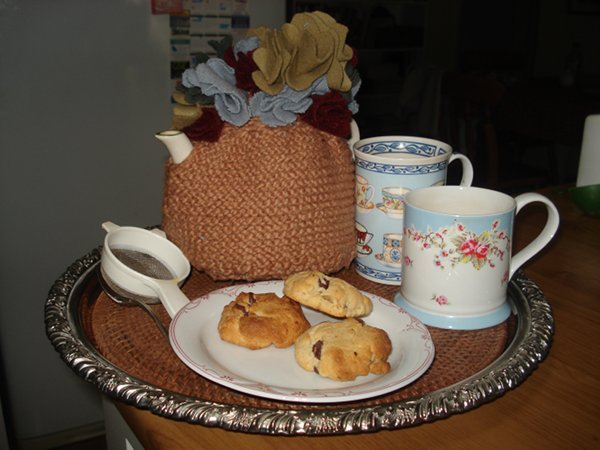
I grew up drinking tea made in a tea pot. I still prefer pot-brewed tea now, but when Hanno drinks coffee, I'm make one cup of tea and make it right there in the cup. No, not with a tea bag; I use a tea infuser or tea ball. They're like sustainable tea bags. I have several - those I use in cups and one for the tea pot. Spooning tea into an infuser and making tea in a cup takes slightly longer than using a tea bag to make tea, but it saves all that waste. When you multiple one tea bag by millions - every day - it doesn't take a genius to know we should be moving away from tea bags and towards tea infusers or tea pots. I know tea bags - minus the staple, are compostable, but that doesn't make up for all that paper, string and staples being made in the first place.

Loose tea makes a better cup of tea. The tea that goes into tea bags is called fannings or dust - it's low grade tea that is left over at the bottom of the barrel when all the loose tea is removed. Many tea bags are made using paper that has been bleached. A tea infuser will cost you a few dollars, but it will last a lifetime, or close to it. And speaking of the economics of tea, high quality loose black tea is much cheaper than tea bags. With tea bags you don't pay for the quality of tea, you pay for the packaging. And then you throw it all away.


This is one of those small steps I've talked about many times before. It's a way in - an easy way to start your simple journey. Or it might be the next sustainable thing you add to your simple life. It may not seem important alone - just one cup of tea - but add that cup to all those you'll make in your life. That, my friends, is significant.

I've been drinking loose tea all my life but for the past couple of years I've also been buying Aldi's organic black (and green) teabags. I'm not doing that anymore.  I have found what looks like a very good organic and fair trade black loose tea that I'm going to order online from Honest to Goodness in Sydney. It's only $35 for a kilo. Sealed in a glass jar and stored in the fridge, that will keep me going for many months. I've never ordered from them before so I hope they live up to my expectations. If you've bought from this company, were you happy?

Why don't you join me in this move towards sustainable tea drinking. All it requires are some tea infusers, or a tea pot and strainer, and loose tea. Tea bags offer convenience and fast tea. I am not going to settle for that anymore. I want to slow down and I want to buy quality tea for a good price, not inferior tea and packaging. Will you take this small step with me?

This is a Friday photo feature that anyone with a blog can join. To take part, post a photo on your own blog, write a short caption explaining it, and link it back to here by saying you're part of "On my mind". Please write a new post, don't link to an older one. When you've done that, come back and add a comment below, with a link to your blog.

Please note: I've simplified the explanation of On my Mind (above) because last week someone told me that when she went visiting the blogs that had left a link here, many of them did not link back or say they were part of this. She didn't leave comments on the blogs she thought weren't taking part.


I am thinking about this scene, watching Sunny show Jamie some books we gave him when they came to visit on Wednesday. While I was watching, Sunny and Kerry made a pact - Sunny will read to Jamie in Korean and Kerry will read to him in English. What a lucky boy Jamie is!

A couple of days ago I made a batch of cultured cream and some chilli jam and Eclair asked if I would write more about them. We have quite a bit of fermented dairy here and I home-make yoghurt, cultured sour cream, fresh cheese, and sometimes hard cheese. I will be making cheddar when I get fresh milk and the spare time. If you've never tasted fermented foods before, you're in for a real treat. Not only are they delicious, but they contain probiotics and will do you the world of good.


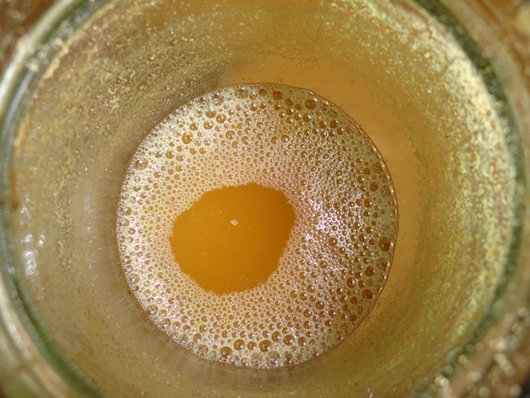
I live in a very good dairy area so I couldn't go past our local Guernsey cream from Maleny Dairies. It's a soft yellow colour and sometimes it's so think, you can stand your spoon up in it. Good sour cream starts with good fresh cream. It must be pure cream, not cream thickened with gelatin. There is absolutely no hidden secret to making it - it's a mixture of cream, heat and the right bacteria. You will find that bacteria either in commercial cultured sour cream or buttermilk, or in a starter that you can buy online. I do both. I buy starters, and have them in the freezer, but I generally make small batches and make the new batch with some of the old batch. When I want a break, or there is no old batch, I use a starter. You can use the same starter to make cultured butter milk. There are details on where to buy them below, with links.

METHOD
  1. Put 500 mls/17oz pure fresh cream in a saucepan and heat to 30C/86F. Take the cream off the heat and stir in half a starter pack (or whatever the instructions for your starter say). Usually it's a sachet to one litre/quart but I only make up half that amount at a time; the leftover half sachet can be refrozen.
  2. Pour the warm cream into a pre-sterilised warm preserving/canning jar and put the lid on. I then wrap the jar in a fleece and a towel and leave it on a warmish bench or in a warmish oven, overnight. The next day it is ready. Instead of using towels to keep it warm, you can also make it in a yoghurt maker, slow cooker or Thermos. The cream will continue to develop in flavour while it is stored in the fridge and will keep for two weeks, easily.
If you use commerical sour cream as the starter, you still need to warm it up to 30C/86F, remove from the heat, add ½ cup of sour cream and mix it well. Place it in a sterile warm jar and keep it warmish for 24 hours.

A FEW CREAMY FACTS
  • If the fresh cream you buy is very thin, add ½ cup powered milk to it and mix it in when it's warming in the saucepan. That will give you thick sour cream.
  • If you beat this sour cream, it will make cultured butter.
  • It's not cheaper to make sour cream (or butter) like this but it tastes MUCH better and you know what's in it. Often commercial sour cream contains stabilisers.
  • You can make cream sour by adding lemon juice or white vinegar to it, but cultured sour cream is either made this way - with a starter, or by using raw milk and cream that is left unrefrigerated till it goes sour naturally. 
  • If you leave pasteurised cream or milk out, they will go bad because all the good bacteria have been removed. Raw milk will turn sour - not bad - and it's perfectly fine to drink. 
In Australia, you can buy these starters online from Country Brewer (cheaper) and Green Living. In other countries, Google "sour cream starter" and choose one from your country.

CHILLI JAM
I have been trying to replicate the delicious Maleny Clean Cuisine Chilli Jam that I buy for $5.95 a jar.  This is my first attempt. It's useable but it needs refining. I'll do another post about making chilli jam when I've got it to the stage I want it. That will take some time because I have to get through the two small jars I have here - I gave one to Sunny - before I start a new batch. What I made this time is more a sweet chilli sauce, rather than a thick jam.


This sauce is made up of:
  • 1½ cups good vinegar - any type
  • ½ brown sugar
  • ½ white sugar
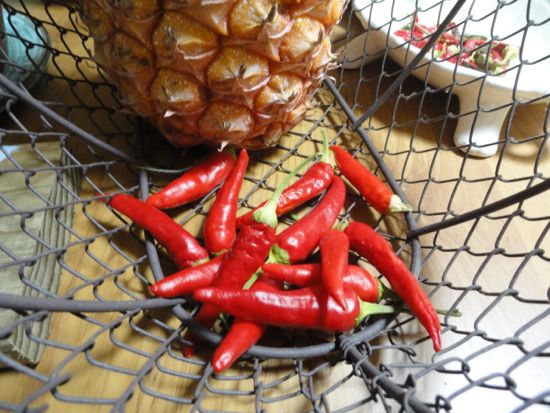
  • 10 cayenne chillis, sliced finely
  • ¼ cup of dried chilli flakes and seeds
  • 2 cloves garlic - finely crushed
  • 1 pack pectin, about two tablespoons
It's all placed in a saucepan, boiled, then simmered for 15 minutes. 

It is much too hot for my taste, but I'll be able to use it in cooking. Next time I'll halve the chilli portions, add mustard seeds and water, and a bit of fish sauce. I don't want any tomatoes or other vegetables or fruit in it. It needs to be red, but almost transparent; not opaque as it would be if it had tomato or sweet peppers in it. What I'm after is a thick, but runny, jam consistency. I'll get there, like many things, it just takes time. This is the opposite of fast food.


Once upon a time, suburban homes were showpieces where the smartest appliances, the largest screens and latest furnishings combined to place the home owners on a pedestal alongside their neighbours - pillars of the community and working hard to pay for every new thing that caught their eye. Often the king and queen spent long hours working away from the castle so that whenever a new sparkler appeared, it could be bought straight away and added to the trophy house.


Times have changed. A breath of fresh air sweep through and now many people are more concerned with self reliance than acquisition, and along with the smell of home cooked meals, we hear the click of knitting needles and the buzzing of the sewing machine. People have returned home again. Many are discovering the joy of cooking for the first time and along with that, gathering their family to the table for meals and the significant connection it brings. Gardens are being dug, nesting boxes for chickens being built, fruit trees planted. Garments are being mended instead of replaced with something new. Shopping in second hand stores and op shops is no longer looked down on - it's cool now. And the wonderful thing that has come hand-in-hand with these new (old) ways, is a feeling of contentment and something close to pride in building self reliance and working towards sustainable lives.


Who would have thought a few short years ago that the sale of DIY and craft supplies would soar as people take to doing things in their own homes again. And it's not only that - home cooking is popular now, chemical cleaners are being ditched in favour of soap, bicarb and vinegar, jars of food are being preserved, and hand made knits, made with luxurious pure wool, alpaca and cotton yarns, are on our backs again. Household savings rates in Australia have gone from negative figures a few years ago to positive again.  There is a very interesting article about world wide household savings rates here, as well as a chart of rates for many countries from 1992 to 2011.


I've been really surprised at the interest in the life skills workshops I'm currently presenting in my local town. Each one is booked out as soon as it's announced and a waiting list started for the next. Just yesterday someone in the next town asked if I would do a Frugal Home workshop for his sustainability group. These are ordinary people opening up to change the way they live. They want to know now about budgeting, reading electricity meters, cooking from scratch, shopping for groceries in different ways, vegetable gardening and green cleaning. I am going to take advantage of this trend and show as many people as I can the true wonder of living a simple life - that it's not just about a list of life skills that are ticked off, it's about personal growth, self reliance, independence and sustainability. It's empowering, and if two ageing hipsters in rural Australia can do it, anyone can.


I regret it's taken an economic crisis to bring us to this point but it seems nothing else was strong enough to change us. Worries about global warming didn't, neither did peak oil. Even drowning in debt didn't stop us. But the good thing is that when this changed was forced upon us, we discovered it was a healthy and sound way to live. It's not mean, it doesn't deprive us - having less gives us a richness we can only see when we step back from the excesses of the past to really see, and understand, that less is more.

I wonder if you see the same signs I do. Do you see a change happening in your neighbourhood? Or am I reading too much into what I see. Maybe I'm living in an area that is leading the way, or maybe I'm living in dream land.


Last week I received a sad email from Sophie in New Zealand, she wrote:

"I just wanted to write you a wee note to tell you of my experinces in the last month. I was away in the US with my daughter having a new baby (she paid for me to go over to her) and my husband was killed in a car accident. He was 52 years old, and I am 51. We had been married almost 32 years and were very happy. 

The main reason i am writing to tell you this is that while I have followed your blog for several years now and posted sometimes I am on my own now and am very unprepared. We have some debt, a mortgage etc. my income for the next five years is going to be about a third of what he was earning. I have never worked outside the home. After 5 years my payments will cease and I am not sure what I will do then. We had no life insurance but do have a little savings which will help with funeral expenses etc. I have learnt so much from your blog and I know I can do it, but I do somewhat regret that we were unprepared. We never thought anything like this would happen to us and that we had time to get into a better position. I am grateful that the government here in New Zealand will help me for the next five years as I know in other countries there would be no help for me. There is no use in looking back and I will go forward and do the best I can."

Although Sophie didn't specifically ask for help, I asked her if she would like me to show this email on my blog, open it up to helpful comments, and for me to put in my two cents worth. She was happy to do that. I think the major help Sophie will have will be from people she knows, but sometimes people who are are further removed, especially people who live in a similar way, can come up with suggestions that others may not have thought about. That was the reasoning behind my offer, as well as offering the hand of friendship and support to someone going through a sad and difficult time.

My first thought was that Sophie is lucky to have that buffer provided by her government - five years financial support.  We have a similar payment here in Australia for widows born before 1955. My second thought was that, depending on how much equity you have in your home, Sophie, you probably have a sizeable asset you can use. If there is not much to pay off the mortgage, I would suggest selling the home, paying off the mortgage and the other debt and buying a smaller house or unit. That would be a huge burden lifted and would open up the future for saving and living frugally. No matter what happens, your debt will have to be paid off somehow. Now that you're on a pension it will be difficult to pay off that mortgage. If it was all paid off using the house, and enough left over to buy a smaller property, you would be in a much better financial position. Did your husband have any superannuation? You say there was no life insurance but if he has been working all his life, there has to be superannuation. 

When your five years is up, you'll be 56 years old - still nine years away from retirement. If I were you, I'd use those five years to build up skills so you can get a job. Hopefully, you can get a job doing something you enjoy. Five years will give you a good amount of time to think about what you could do, then the experience or training you may need.

Overall though, if you've been reading my blog for a few years, you have probably been doing a lot of the things I do. You may already be living frugally, you may already have a vegetable garden and cook from scratch. Keep doing all those things because the lower your weekly expenses, the better off you'll be. It might be a good move, when you can, to sell off anything you no longer need - like a second car, and to pare down on mobile phone, internet and pay TV accounts, if you have any of them. Do a little bit at a time, not all at once, and start with the most expensive things first.

I can't imagine how stressful this time must be for you, Sophie, but if you can pay off that debt, I'm sure you'll worry less and feel better. Moving from the family home will probably be a wrench for you but remember that you carry your memories with you, they do not reside in any one place. I have no doubt you developed the strength to get you through recent events and I hope that strength and resilience continue to support you. 

Now, as a reader, you can offer some wise words to Sophie? And hopefully our New Zealand friends will be able to give very practical, relevant and sound advice about the local things we in other countries know nothing about. Thank you.


Another weekend - another mix of work and sitting back with our feet up. I did some knitting and reading, presented a blogging workshop at Maleny on Saturday, spoke to loved ones on the phone and did a lot of cooking. Maybe cooking isn't the right word - I worked in the kitchen with food. I made a beautiful thick cultured sour cream - the best I've ever eaten, and made yoghurt and set it into a sieve to drain to make fresh cheese. I couldn't resist taking a cup full of it to mix with homemade strawberry jam for a treat later in the week, and I made three small jars of chilli jam.  So much for swearing off jam making for a while.


Last night we had corned beef, cabbage and potatoes for tea. I dabbed some sour cream, with green onions mixed through, on the potatoes - wow. The cabbage was wonderful too. About 6 months ago, a reader sent me some Portuguese cabbage seeds. Well, they grew this season, and were harvested just before being cooked last night. What a great cabbage it is. It's the first time I've tasted it but it won't be the last. It will be part of our yearly rotation from now on. Thank you Richard. I love it when what we eat comes together so well - a small portion bought at a local shop and the rest produced by our own hands and hard work. There is nothing like it.


I made up the last of the soap orders too. They're now ready to send off and we can get back to our version of normal again. I am really happy some of you got to try our soap, and many people said they loved it, but I'm happier not selling it. I know that doesn't make sense to some people - to stop doing something that brings in money, but I'm more focused on quality of life rather than acquisition, and we have enough - of almost everything. I've had to explain our decision to quite a few people and even though a few may not have understood my explanation, it makes perfect sense to me.

This week I'll be concentrating on knitting and sewing. More of Vivian's Eco Yarns are arriving this week and I'm so excited waiting for them. I love this part of knitting - when I choose yarns and patterns and try to work out if I have the time or if I am deluding myself. I always think I have the time and the skills, and usually, even though it might sometimes take longer than I expected, I get my projects finished. I like to pick simple patterns that stretch my capabilities, dotted with little things that I can pick up and put down several times a day. Oh, I finished a little orange and blue bamboo hat for Alexander on the weekend too. Tick! another little garment for my sweet boy. My sewing will involve a couple of aprons for the shop, including yours Lusi, and some table runners.

So here we are headed for another week. I hope mine is full of productive work and the satisfaction that comes from that; I hope yours is too. There is so much that goes into a happy home; it takes time and effort and sometimes we might feel overwhelmed by it. Always remember there is no need for perfection, you can take breaks when the chance arises, and if you work steadily at your own pace, you will get through your work. And if you don't, it will wait for you, you can start again tomorrow.

This is a Friday photo feature that anyone with a blog can join. It opens the door to us sharing our lives through these photos, gives us all a new way to discover each other and maybe form new friendships.  To take part, all you have to do is post a photo on your own blog, write a short caption explaining it, and link it back to here by saying you're part of "On my mind".  Please write a new post, don't link to an older one. When your photo is published, come back and add a comment below, with a link to your blog photo so we can all find you. Your photo should show something you're thinking about TODAY. If you're in another country you should join in when you read this, even if it's still Thursday. Please visit all the blogs that appeal to you and leave a comment. Slow down, take the time to cruise around and enjoy your cyber visits.


For over fifty years it stood in our front yard - a camphor laurel tree, a declared weed in these parts, but also a wonderful shade tree and shelter for all sorts of wild life, including me. It had to come down because it was starting to fruit again and the birds spread the seeds far and wide; especially along the creek where the camphors tend to block the flow. Hanno thought the roots were undermining the house foundations so he's happy it's gone. I'm in two minds. I'll miss the old girl and it will take a long time to get used to that bare space where once there was inviting shade.

I've been making jam lately. Lots of it. I started off when strawberry season started and they were only $1.50 a punnet. I asked Hanno to get some because I was about to do a workshop about making jam and relish and they would be perfect. Naturally we bought some for us and I made my own jam. Sweet homemade strawberry jam - it tastes of strawberries, not sugar.


We usually make jam twice a year when the seasons give us strawberries in winter and peaches in summer. In January I made peach jam and we still have a ton of it.


And when I did the jam workshop, one of the ladies there offered me some Seville oranges from trees on her farm! Sevilles! You can never buy them in the shops now - they are those tart oranges, the ones used in traditional  marmalade. Naturally I received them with open arms. I made orange marmalade. Ahem.


I have just looked in the stockpile cupboard. We have 17 jars of homemade jam! We also have three jars of organic raspberry jam and three of organic apricot jam. Oh, and we also have jam, marmalade and relish - homemade and given to us. And we don't eat a lot of jam. At least there are plenty of jars for giving.

Okay, I will stop now.

Newer Posts Older Posts Home

MY BOOKS

MY BOOKS


My books were all published by Pengiun, and are available at Amazon US, Amazon UK and Amazon Au

Search here

Total Pageviews

Translate


I'm Rhonda Hetzel and I've been writing my Down to Earth blog since 2007. Although I write the occasional philosophical post, my main topics include home cooking, happiness and gardening as well as budgeting, baking, ageing, generosity, mending and handmade crafts. I hope you enjoy your time here.

MY FAVOURITE PLACES

  • Grandma Donna's Place
  • Grandma Donna's YouTube
  • Grandma Donna's Instagram
  • This Simple Day
  • Nicole's Instagram

Give More

Give More

Popular posts last year

Making ginger beer from scratch

We had a nice supply of ginger beer going over Christmas. It's a delicious soft drink for young and old, although there is an alcoholic version that can be made with a slight variation on the recipe. Ginger beer is a naturally fermented drink that is easy to make - with ginger beer you make a starter called a ginger beer plant and after it has fermented, you add that to sweet water and lemon juice. Like sourdough, it must ferment to give it that sharp fizz. To make a ginger beer plant you'll need ginger - either the powdered dry variety or fresh ginger, sugar, rainwater or tap water that has stood for 24 hours to allow the chlorine to evaporate off. You'll also need clean plastic bottles that have been scrubbed with soap, hot water and a bottle brush and then rinsed with hot water. I never sterilise my bottles and I haven't had any problems. If you intend to keep the ginger beer for a long time, I'd suggest you sterilise your bottles. MAKING THE STARTER In a...
Image

NOT the last post

This will be my last post here.  I've been writing my blog for 18 years and now is the time to step back. I’ve stopped writing the blog and come back a couple of times because so many people wanted it, but that won’t happen again, I won’t be back.  I’ll continue on instagram to remain connected but I don’t know how frequent that will be. I know some of you will be interested to know the blog's statistics. 
Image

How to make cold process soap

I'm sure many of you are wondering: "Why make soap when I can buy it cheaply at the supermarket?" My cold process soap is made with vegetable oils and when it is made and cured, it contains no harsh chemicals or dyes. Often commercial soap is made with tallow (animal fat) and contains synthetic fragrance and dye and retains almost no glycerin. Glycerin is a natural emollient that helps with the lather and moisturises the skin. The makers of commercial soaps extract the glycerin and sell it as a separate product as it's more valuable than the soap. Then they add chemicals to make the soap lather. Crazy. Making your own soap allows you to add whatever you want to add. If you want a plain and pure soap, as I do, you can have that, or you can start with the plain soap and add colour, herbs and fragrance. The choice is yours. I want to add a little about animal and bird fat. I know Kirsty makes her soap with duck fat and I think that's great. I think t...
Image

Preserving food in a traditional way - pickling beetroot

I've had a number of emails from readers who want to start preserving food in jars but don't know where to start or what equipment to buy.  Leading on from yesterday's post, let's just say up front - don't buy any equipment. Once you know what you're doing and that you enjoy preserving, then you can decide whether or not to buy extra equipment. Food is preserved effectively without refrigeration by a variety of different methods. A few of the traditional methods are drying, fermentation, smoking, salting or by adding vinegar and sugar to the food - pickling. This last method is what we're talking about today. Vinegar and sugar are natural preservatives and adding one or both to food sets up an environment that bacteria and yeasts can't grow in. If you make the vinegar and sugar mix palatable, you can put up jars of vegetables or fruit that enhance the flavour of the food and can be stored in a cupboard or fridge for months. Other traditional w...
Image

Cleaning mould from walls and fabrics

With all this rain around we've developed a mould problem in our home. Usually we have the front and back doors open and that good ventilation stops most moulds from establishing. However, with the house locked up for the past week, the high humidity and the rain, mould is now growing on the wooden walls near our front door and on the lower parts of cupboards in the kitchen. Most of us will find mould growing in our homes at some point. Either in the bathroom or, in humid climates, on the walls, like we have now. You'll need a safe and effective remedy at some point, so I hope one of these methods works well for you. Mould is not only ugly to look at, it can cause health problems so if you see mould growing, do something about it straight away. The longer you leave the problem, the harder it will be to get rid of it effectively. If you have asthma or any allergies, you should do this type of cleaning with a face mask on so you don't breathe in any spores. Many peopl...
Image

Five minute bread

Bread is one of those foods that, when made with your own hands, gives a great deal of satisfaction and delight. It's only flour and water but it symbolises so much. I bake bread most days and use a variety of flours that I buy in bulk. Often I make a sandwich loaf because we use most of our bread for lunchtime sandwiches and for toast. Every so often I branch out to make a different type of loaf. I have tried sour dough in the past but I've not been happy with any of them. I'll continue to experiment with sour dough because I like the idea of using wild yeasts and saving the starter over a number of years to develop the flavour and become a part of the family. However, the loaf I've been branching out to most often is just a plain old five minute bread. By five minutes I mean it takes about five minutes actual work to prepare but it's the easiest of all bread to make and to get consistently good loaves from. If you're having people around for lunch or...
Image

This is my last post.

I have known for a while that this post was coming, but I didn't know when. This is my last post. I'm closing my blog, for good, and I'm not coming back like I have in the past.  I've been writing here for 16 years and my blog has been many things to me. It helped me change my life, it introduced me to so many good people, it became a wonderful record of my family life, it helped me get a book contract with Penguin, and monthly columns with The Australian Women's Weekly and Burke's Backyard . But in the past few months, it's become a burden. In April, I'll be 75 years old and I hope I've got another ten years ahead. However, each year I'll probably get weaker and although I'm fairly healthy, I do have a benign brain tumour and that could start growing. There are so many things I want to do and with time running out, leaving the blog behind gives me time to do the things that give me pleasure. On the day the blog started I felt a wonderful, h...
Image

What is the role of the homemaker in later years?

An email came from a US reader, Abby, who asked about being a homemaker in later years. This is part of what she wrote: "I am a stay-at-home mum to 4 children, ages 9-16. I do have a variety of "odd jobs" that I enjoy - I run a small "before-school" morning drop-off daycare from my home, I am a writing tutor, and I work a few hours a week at a local children's bookstore. But mostly, I cherish my blissful days at home - cooking, cleaning (with homemade cleaners), taking care of our children and chickens and goats, baking, meal-planning, etc. This "career" at home is not at all what I imagined during my ambitious years at university, but it is far more enriching. I notice, though, that my day is often planned around the needs of my family members. Of course, with 4 active kids and a husband, this is natural. I do the shopping, plan my meals, cook dinner - generally in anticipation of my family reconnecting in the evening.  I can't h...
Image

Every morning at home

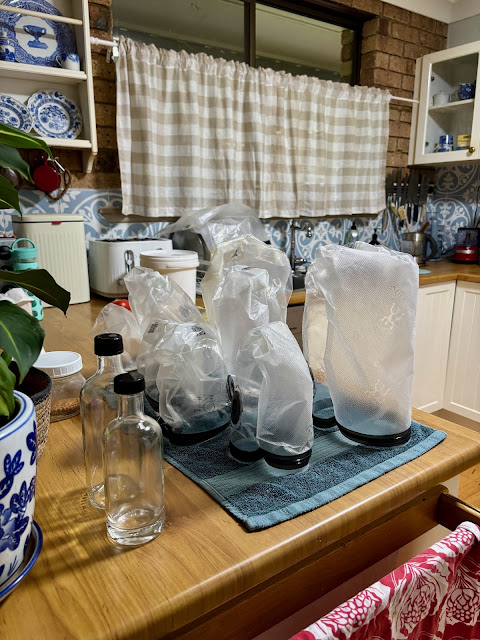
Every morning when I walk into my kitchen it looks tidy and ready for a day's work. Not so on this morning (above), I saw this when I walked in. Late the previous afternoon when I was looking for something, I came across my rolled up Zwilling vacuum bags and decided they had to be washed and dried. So I did that and although I usually put them outside on the verandah to dry it was dark by then. I turned the just-washed bags inside out and left them like this on a towel. It worked well and now the bags are ready to use when I bring home root vegetables, cabbages or whatever I buy that I want to last four or five weeks.
Image

You’ll save money by going back to basics

When I was doing the workshops and solo sessions, I had a couple of people whose main focus was on creating the fastest way to set up a simple life. You can't create a simple life fast, it's the opposite of that It's not one single thing either - it's a number of smaller, simpler activities that combine to create a life that reflects your values; and that takes a long to come together. When I first started living simply I took an entire year to work out our food - buying it, storing it, cooking it, preserving, baking, freezing, and growing it in the backyard. This is change that will transform how you live and it can't be rushed.  
Image

All previous blog posts

  • 2026 3
    • February 3
      • Workshops starting 1 March
      • Planting vegetable seeds and new workshops
      • Back where we belong
  • 2025 7
    • July 1
    • June 2
    • May 1
    • April 2
    • February 1
  • 2024 25
    • December 2
    • November 1
    • October 2
    • September 3
    • August 1
    • July 3
    • June 1
    • May 3
    • April 2
    • March 3
    • February 2
    • January 2
  • 2023 13
    • December 1
    • November 2
    • October 1
    • September 3
    • August 2
    • February 2
    • January 2
  • 2022 17
    • November 3
    • October 4
    • September 3
    • August 2
    • July 3
    • June 2
  • 2021 50
    • December 1
    • November 6
    • October 7
    • September 5
    • August 4
    • July 5
    • June 2
    • May 2
    • April 6
    • March 4
    • February 4
    • January 4
  • 2020 68
    • December 3
    • November 5
    • October 4
    • September 4
    • August 4
    • July 4
    • June 4
    • May 8
    • April 7
    • March 8
    • February 8
    • January 9
  • 2019 66
    • December 2
    • November 4
    • October 5
    • August 3
    • July 4
    • June 6
    • May 8
    • April 8
    • March 8
    • February 11
    • January 7
  • 2018 82
    • December 1
    • September 2
    • August 10
    • July 4
    • June 11
    • May 9
    • April 12
    • March 10
    • February 10
    • January 13
  • 2017 129
    • December 7
    • November 10
    • October 6
    • September 13
    • August 11
    • July 13
    • June 12
    • May 9
    • April 9
    • March 14
    • February 11
    • January 14
  • 2016 125
    • December 7
    • November 13
    • October 10
    • September 11
    • August 11
    • July 8
    • June 9
    • May 9
    • April 12
    • March 10
    • February 13
    • January 12
  • 2015 184
    • December 7
    • November 15
    • October 20
    • September 18
    • August 19
    • July 18
    • June 12
    • May 15
    • April 12
    • March 21
    • February 13
    • January 14
  • 2014 203
    • December 11
    • November 8
    • October 17
    • September 20
    • August 17
    • July 19
    • June 17
    • May 17
    • April 23
    • March 15
    • February 18
    • January 21
  • 2013 225
    • December 13
    • November 17
    • October 17
    • September 17
    • August 21
    • July 24
    • June 20
    • May 19
    • April 17
    • March 22
    • February 17
    • January 21
  • 2012 245
    • December 17
    • November 20
    • October 20
    • September 18
    • August 15
    • July 24
    • June 21
    • May 26
    • April 23
    • March 23
    • February 19
    • January 19
  • 2011 257
    • December 18
    • November 24
    • October 27
    • September 23
    • August 24
    • July 21
    • June 24
    • May 24
    • April 16
    • March 22
    • February 14
    • January 20
  • 2010 283
    • December 20
    • November 18
    • October 18
    • September 19
    • August 25
    • July 24
    • June 25
    • May 26
    • April 25
    • March 22
    • February 29
    • January 32
  • 2009 293
    • December 29
    • November 18
    • October 23
    • September 25
    • August 22
    • July 28
    • June 22
    • May 21
    • April 27
    • March 26
    • February 24
    • January 28
  • 2008 387
    • December 24
    • November 23
    • October 25
    • September 26
    • August 27
    • July 27
    • June 37
    • May 34
    • April 44
    • March 53
    • February 32
    • January 35
  • 2007 372
    • December 37
    • November 40
    • October 55
    • September 51
    • August 49
    • July 63
    • June 49
    • May 28


Trending Articles

NOT the last post

This will be my last post here.  I've been writing my blog for 18 years and now is the time to step back. I’ve stopped writing the blog and come back a couple of times because so many people wanted it, but that won’t happen again, I won’t be back.  I’ll continue on instagram to remain connected but I don’t know how frequent that will be. I know some of you will be interested to know the blog's statistics. 
Image

Every morning at home

Every morning when I walk into my kitchen it looks tidy and ready for a day's work. Not so on this morning (above), I saw this when I walked in. Late the previous afternoon when I was looking for something, I came across my rolled up Zwilling vacuum bags and decided they had to be washed and dried. So I did that and although I usually put them outside on the verandah to dry it was dark by then. I turned the just-washed bags inside out and left them like this on a towel. It worked well and now the bags are ready to use when I bring home root vegetables, cabbages or whatever I buy that I want to last four or five weeks.
Image

You’ll save money by going back to basics

When I was doing the workshops and solo sessions, I had a couple of people whose main focus was on creating the fastest way to set up a simple life. You can't create a simple life fast, it's the opposite of that It's not one single thing either - it's a number of smaller, simpler activities that combine to create a life that reflects your values; and that takes a long to come together. When I first started living simply I took an entire year to work out our food - buying it, storing it, cooking it, preserving, baking, freezing, and growing it in the backyard. This is change that will transform how you live and it can't be rushed.  
Image

Creating a home you'll love forever

Living simply is the answer to just about everything. It reduces the cost of living; it keeps you focused on being careful with resources such as water and electricity; it reminds you to not waste food; it encourages you to store food so you don't waste it and doing all those things brings routine and rhythm to your daily life. Consciously connecting every day with the activities and tasks that create simple life reminds you to look for the meaning and beauty that normal daily life holds.  It's all there in your home if you look for it. Seemingly mundane tasks like cleaning and cooking help you with that connection for without those tasks, the home you want to live in won't exist in the way you want it to.  Creating a home you love will make you happy and satisfied.
Image

Time changes everything

I've been spending time in the backyard lately creating a contained herb and vegetable garden. My aim is to develop a comfortable place to spend time, relax, increase biodiversity and encourage more animals, birds and insects to live here or visit. Of course I'd prefer my old garden which was put together by Hanno with ease and German precision. Together, we created a space bursting at the seams with herbs, vegetables and fruity goodness ready to eat and share throughout the year. But time changes everything. What I'm planning on doing now, is a brilliant opportunity for an almost 80 year old with balance issues. In my new garden I'll be able to do a wide range of challenging or easy work, depending on how I feel each day. It’s a daily opportunity to push myself or sit back, watch what's happening around me and be captivated by memories or the scope of what's yet to come.
Image

It's the old ways I love the most

I'm a practical woman who lives in a 1980’s brick slab house. There are verandahs front and back so I have places to sit outside when it's hot or cold. Those verandahs tend to make the house darker than it would be but they're been a great investment over time because they made the house more liveable. My home is not a romantic cottage, nor a minimalist modern home, it's a 1980’s brick slab house. And yet when people visit me here they tell me how warm and cosy my home is and that they feel comforted by being here. I've thought about that over the years and I'm convinced now that the style of a home isn't what appeals to people. What they love is the feeling within that home and whether it's nurturing the people who live there.
Image

Back where we belong

Surprise! I'm back ... for good this time. Instagram became an impossible place for me. They kept sending me messages asking if I'd make my page available for advertisers! Of course, I said no but that didn't stop them. It's such a change from what Instagram started as. But enough of that, the important part of this post is to explain why I returned here instead of taking my writing offline for good. For a few years Grandma Donna and I have talked online face-to-face and it's been such a pleasure for me to get to know her. We have a lot in common. We both feel a responsibility to share what we know with others. With the cost of living crisis, learning how to cook from scratch, appreciate the work we do in our homes, shop to a budget and pay off debt will help people grow stronger. The best place to do that is our blogs because we have no advertising police harassing us, the space is unlimited, we can put up tons of photos when we want to and, well, it just feels li...
Image

Making ginger beer from scratch

We had a nice supply of ginger beer going over Christmas. It's a delicious soft drink for young and old, although there is an alcoholic version that can be made with a slight variation on the recipe. Ginger beer is a naturally fermented drink that is easy to make - with ginger beer you make a starter called a ginger beer plant and after it has fermented, you add that to sweet water and lemon juice. Like sourdough, it must ferment to give it that sharp fizz. To make a ginger beer plant you'll need ginger - either the powdered dry variety or fresh ginger, sugar, rainwater or tap water that has stood for 24 hours to allow the chlorine to evaporate off. You'll also need clean plastic bottles that have been scrubbed with soap, hot water and a bottle brush and then rinsed with hot water. I never sterilise my bottles and I haven't had any problems. If you intend to keep the ginger beer for a long time, I'd suggest you sterilise your bottles. MAKING THE STARTER In a...
Image