down to earth

  • Home
  • About Us
  • Down To Earth Book
  • Privacy Policy
When Tricia was here and madly hand stitching her red quilt, a number of readers asked to see the quilt. Well, I'm slow but I generally get there. No quilt looks as good in a photo as it does having it right before you, but you can see the work that's gone into it. This quilt started off with the supper cloth in the centre. Tricia attached the various shapes, then added borders to that and worked outwards. There are many pieces of appliqué on the large borders, my favourites being the two rabbits and the many pieces of old lace I remember from our childhood. On all four corners, she's hand stitched each of her sons' names.


There are many forms of patchwork, this one is, I think, a memory quilt. If you're new to sewing and would like to try your hand at patchwork, don't think you have to stick with the traditional patchwork patterns, there are many other forms as well. I didn't "get" patchwork for many years and wondered why Tricia bothered with it. I remember her husband saying that she was cutting up pieces of fabric and then sewing them back together again. Well, of course, that is what patchwork is, but it's much more, there is a greater significance in this simple craft. I see it now as a beautiful and meaningful way to put off-cuts and left over fabric to good use. There is something about providing a meal to a hungry family and providing warmth with scraps of fabric, that fills me up. It must be one of our primitive instincts to provide food and warmth for our family and I feel it most when cooking from scratch and piecing together random pieces of fabric. I love how it starts as nothing more than scraps but ends up being a beautiful object, often holding memories of clothing made, or the people who wore those fabrics.


The other quilt featured here is another one Tricia made with French fabrics. She brought it with her to have it machine quilted by my DIL Cathy. Cathy ended up not doing this quilt but handed it over to one of her friends. Tricia was really thrilled with the quilting, which is called stippling. Both these quilts might be featured in a magazine soon. I think it's part of the Homespun group, called Country Collections. They were at Tricia's home yesterday taking photos.


If you want to try your hand at patchwork and hope to make a quilt, start off with a smaller project, work out your techniques, then move on to a bigger project. Basically, you would cut up all your shapes, sew the shapes into long strips, then sew the strips together. But look here at these links, there are some very good instructions here.


When you have made the top of the quilt, you layer the top to some warm wadding and attach them both to a backing. The backing can be any large piece of material that suits the top or provides additional warmth. When you have your three layers, you quilt them together. In the old days every quilt was hand stitched, now there are sewing machines that can handle quilting. The quilt above was quilted on one of those specialist quilting machines Tricia's red quilt is hand stitched. If you're never sewn anything like this before, using recycled fabric or scraps, I hope I've inspired you to give it a try. Let me know if you give it a go and remember to start small and work up to a larger project.

Happy sewing everyone!
I've been thinking about the one thing that helps the most in keeping us on track here. I know my DIL Sarndra will love this, because that one true thing, is organisation. She thrives on it, she's a natural, she knows instinctively where to place things, how to effectively store almost anything and how to arrange household goods to best suit their efficient usage. By doing those things, Sarndra knows where everything is, she works efficiently and she has enough time to do what she wants to do when she's finished. I'm a bit more challenged in that direction. and when I'm really busy I let things go, even though I know in the long run it will create extra work. I let my sewing/work room get into a real mess before I fix it, and I tend to do the most important things and leave those less noticeable. When I stick to my routines I'm fine but at the moment with Hanno away and being so busy with various things, I'm not doing all I should and I know it will be a real push to put it all to rights again.


I have a quite a few small tasks that need doing right now. My plan is to go through all of them in the next few days, and then stay on top of everything in the coming months when I'll be well and truly pressed for time while I'm writing the rest of my book. If I don't do that, I'll feel I've let myself down and that my home is not what it should be. I love that feeling when I can sail through my home and know everything that needs doing has been done and that I can relax and enjoy being there. And let me remind you here, I'm not aiming for perfection, mainly because it doesn't exist, but also because I want a functional, warm and inviting home, not a show piece.

Today, Monday 25 October, marks that day for me where I draw the line and declare that I will fix everything, stay on top of it all, carry out my routines properly every day and have my mind free to concentrate on the writing. Organisation is the key for me. If I can organise myself and my work I'll be able to do everything else that needs doing. So I'm seeing this as a gift for me that only requires a bit of work, sticking to my routines and making the most of the time I have to do my work and to write. I can't concentrate properly if the house isn't right and writing what I need to put in the book would be dishonest and foolish if I was writing one thing and living in another way. So this is it.

Line drawn.


Who will join me? Who needs to do this too? I am going to start a thread at the forum to monitor this and to keep me on track. I challenge you all to join me, to make your own organising challenge that will help you live to your potential in your own home. With many of us doing it and with the support and encouragement that will give us, I know we'll do it. So, who is stepping forward beside me?

The link to the forum thread is here. If you're a member of the forum, you'll go straight there. If you're not yet a member, you'll need to register first. It's free and easy, so take the plunge.

One of the most frequently asked questions I get is: "What's the secret is to having a popular blog?" The truth is, I have no idea. I am more amazed that any one of you that this blog attracts so many readers. My guess is that most of my readers are like minded folk wanting to connect with people who understand them and their way of life. I hope that what I write is clear and easily understood, that the way we live our version of the simple life may light the way for others, and that the intense passion I feel for life is relayed somehow through the words I tap out on my keyboard. And I guess I have to put some of it down to plain old hard work, to the mindset of never giving up, and believing that the mundane and humble tasks of everyday life, housekeeping, family, growing food in the backyard, knitting and sewing are profound and important subjects that others find as interesting as I do.


I feel incredibly lucky to have all sorts of opportunities before me right now that have come from my blog. I am grateful that at a time when many of my contemporaries are starting to wind down, I'm winding up again in a brand new direction with interesting challenges I never thought I'd face. And so now, when I should be settling into my elder years, waiting for grand babies to come along and knitting in my chair, I'm getting ready to complete the book I started so long ago. I never set out to cultivate popularity and I cringe when people say, "Oh you're Rhonda with the blog!" but my focus these past few years has been to show others, and as many of them as I can reach, that living a life of mindless consumerism, debt and detachment, will never come close to the enrichment and satisfaction that simple living brings. The blog gives me the ideal way to convey that message and to show, by example, what comes from developing simple values and living true to them.


I am happier here in my own home than I am in any other place. And when I make my bed in the morning, or sweep the floor, or pull carrots, or collect eggs, I know that here is where I am meant to be. I don't know what I did right to get the family and the life I have; whatever it is I wish I could bottle it and give it away. But I have a feeling that living as we do here, within the simple confines of our home, working side by side, supporting each other, our family and our community, goes a long way towards developing and nurturing the happiness we feel everyday. And maybe that is what people find here - happiness in ordinary life and being content with what we have. Is it that simple?

This is another post on dishcloths. If you've had your fill of them, turn away now and come back later in the week. I've had a few emails asking about yarn and needles, so here we go again on one of my favourite topics. :- )


Making your own dishcloths is a great way to learn how to make a jumper or mittens or baby clothes. It's true! If you've never taken up knitting needles before, knitting a dishcloth will help you start and will keep you amused and focused until you've developed the skills of a knitter capable of bigger and better things. A knitted dishcloth is just a square of knitting - it can be all plain, all purl, a combination of both, or any other pattern you want to practise. But all this practise knitting will give you practical useful items for your home. With every finished square, you'll have one more dishcloth. Once you have a stash of dishcloths, you can stop buying your disposable dishcloths and you'll have enough cloths for your kitchen and shower; if you colour code them you'll have enough for all your cleaning tasks. Keep going and you'll be able to give them away as gifts. Along with a bar of homemade soap, they made the perfect small gift.

This is my favourite pattern - the waffle weave. You can find the pattern here on Deb's blog.

I make a light and a heavy dishcloth. I find the light ones are better for cleaning glass, glasses and small items. I use the heavier cloths for general cleaning and washing up. The heavy cloths are made with 8 ply cotton. Cotton dries out quickly, washes well in the washing machine and lasts for years. The lighter cloths are 4 ply cotton, they dry faster than the heavier cloths; I wash them in the washing machine along with the normal washing and, again, they're long lasting. Generally when you knit, you use varying sizes of needles according to the yarn you're using. I use size 6, 7 or 8 needles for 8 ply and 4 ply. When I'm making a 4 ply cloth, I like the loopy spaces between stitches the larger needles give me. I prefer to use metal needles. I find they slide well and grab the stitches better that other needles. But everyone has different preferences. Go with what feels right for you. If you have to buy needles, check out your thrift shops. They often have pairs of knitting needles for 20 cents or so.

The darker colour yarn above is 8 ply, overlaid on 4 ply lighter yarn.

If you're using 8 ply, cast on about 30- 36 stitches. You'll need more for 4ply, so cast on about 40, or 50 - 60 for a larger cloth. Then just choose a stitch or a pattern you like and keep knitting until you have a square. Cast off, weave in your end bits and that's it. There are many, many patterns here if you want something more challenging than plain and purl.

This is the kind of knitting you can take with you when you go out, even as a beginner. You'll probably not be counting stitches or rows and it's easy to pick up and put down if you're busy. The good thing is, you'll be learning a new and valuable skill and producing useful items while practising. If there was a flag for this simple life we all aspire to, I'm sure it would have a dishcloth on it. It's a common, simple, useful piece of home equipment we all recognise and use constantly, and I'm sure there are people knitting them as I type this in all corners of the world.

Happy knitting, friends.

Learn to knit videos on you tube.
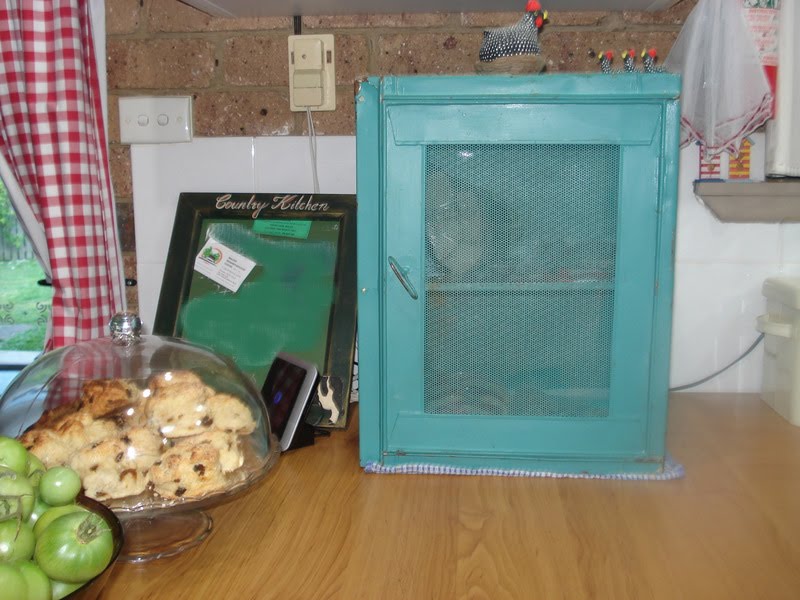
Hanno and I are always looking for low-tech ways to improve what we do here so when Tricia and I stopped at a thrift shop the other day and saw a Coolgardie safe for $40, I grabbed it. I gave it a good scrubbing and now it's sitting on the kitchen bench. I'm going to use it as it was originally intended, to store food without refrigeration.

In the old days, before the introduction of electricity, Coolgardie safes were used to keep food, including meat, milk and cheese, cool. The safe is made of sturdy wire mesh on four sides with a tray at the bottom and top. The top tray held a pool of water, the bottom one prevented ants climbing up if the safe stood on the ground. The one I have has a handle on top to hang it in a tree or on a hook on a verandah. When full of food, hessian/burlap bags were thrown over the top, they soaked up water from the tray and when a breeze came through, this wet covering cooled the air that entered the safe, thus keeping the contents cool. This one has lost its trays but as I do not intend using it with the hessian bags, I'm not bothered by it.

I am using it to store my bread and cakes, as well as butter during the day. I'll put the butter back in the fridge overnight but the rest can stay out, safe from any flies or bugs that might wander by. I intend to put my homemade bread in a bread bag and put that in the safe to stay fresh and covered without the need of plastic or electricity.

It got me thinking about other low-tech methods we're currently using. I often use a broom instead of the vacuum cleaner. I soak stained clothes after adding my liquid soap to the stain instead of spraying with a harsh chemical. In winter, I place my rising bread dough, covered by a clean tea towel, in the sun to rise instead of turning on the oven for a few minutes to warm. Cooking in a solar oven would be another example of taking advantage of a low tech method to get a job done. Hand sewing instead of using a machine is another low tech method I often use. And, of course, all us knitters know the value of a pair of knitting needles and how often they outshine even the best high tech knitting machines.

What other low tech options are you using in your home? I'd love to expand on what we're doing here so I'm looking for clues in the comments today.
I received an email a couple of weeks ago from a couple who have been following my blog for over a year. They have two children, both are working outside the home but have reduced their work hours to spend more time together, they're growing a garden this year for the first time and are doing a lot of the things I do here at my home. But they don't feel they're really living a simple life and wonder when they'll feel it as well as live it.

How long is a piece of string?


There is no answer to that question. I felt I was living more simply the week after I started committing myself to conserving rather than consuming. I think it's a change in mindset that happens when you really feel compelled to live a certain way and you know deep down in your bones that you're doing the right thing and you'll never go back. There is also the element of working out what will work for you in your own life. Copying what I do isn't going to work for everyone - each person will have their own path. This is handmade living at its finest, there is no one size fits all.

I don't think you need to identify a reason for living simply. I used to, but I've changed my mind. My reason for changing was that my way of life was making me sad. The things that used to comfort me made me sadder and I realised that not only was endless spending bad for me, it was pointless and environmentally unsound. I had turned "green" back in the 60s and 70s so it didn't take much of a push to get me back on that familiar path again but when I started thinking about changing, I knew what my reason was and I thought everyone else would have a specific reason too. Things like peak oil, climate change and the global economy peppered my earlier posts and then I realised that while it's fine to be motivated towards a simpler life by those things, it's also intelligent and sensible to change just because the lifestyle is so enriching. There doesn't need to be a reason.

Another Eureka moment.

So to that couple, I say that you should sit and talk about what you're doing. Are you happier now? Examine what difference your changes have made to your lives. You say you've reduced your spending, you're paying off your debts, you're cooking from scratch most of the time, you're recycling, repairing and producing some of your own food in the backyard. It seems to me that you're doing well and if you're not yet on the road to a simpler life, you're certainly on the road away from mainstream living. Do you have any friends who have simplified? Sometimes we need to see our life reflected somewhere else to connect the dots on what we're doing. Can you join a permaculture or organic gardening group? Can you connect with others at your local markets or at your children's school? Turn off the TV and have no-electricity evenings with the whole family. Join the forum, there are many people from all over the globe there, all with a similar ambition for a simpler life. You might find someone close to your location, or you may find your answers there somewhere on the hundreds of pages.


In the meantime, keep doing what you're doing, be mindful when you work, continue to read books and blogs that inspire you, and believe in yourselves. You've already taken the first important steps, building on that beginning in the practical ways of day-to-day living and working towards your goals, will help form the belief you're seeking. Above all else, don't give up.

I have no doubt there will be readers here who will have some ideas for you, so read the comments attached to this post, there may be hidden treasure waiting.
Well, I've just spent a few busy days catering for a community development seminar at my neighbourhood centre. Three days spent out in the community, watching on the side lines as a group of about 25 social workers and youth workers met to exchange ideas and to be motivated to continue their work. It was the last big event I'll help at as co-ordinator of the Centre because I'm beginning to slow down and transition towards handing over the reins to someone else. Last Thursday, I helped shortlist ten excellent applicants for my job. All the while I've been working there I've hoped that when I walked away, I would be leaving behind a strong and efficient Centre and a paid job for a local person. I'm happy to say that job will be a paid one when I leave; I don't want to stay, paid or unpaid, because I feel I've done as much as I can do there and now my priorities are here, at home ... again. I will stay to get the new co-ordinator happily settled and then just go in to do my frugal home workshops and to develop the series of life skills workshops I've just started.

Those of you who listened to my last radio interview will know that I'm working towards a book publishing deal with Penguin Australia. I am so excited! Not only to have the deal but to be working with Penguin. If anyone had asked me who I would like to publish my book, in a spit second I would have said "Penguin". They are a company who have supported great authors, and writing in general, for longer than I care to remember. I grew up reading Penguin books and now, here I am. It's amazing. The proposed publication date is February 2012 and although that is a while away, I've got a lot of work to do to deliver the best book I can. I want to put my name to something that encourages people towards change, that teaches and inspires and I want a book that you can go back to again and again to find information, recipes and motivation. There will be days in the coming months when I won't be able to write here because my concentration will be focused on the book. But I will write as much as I can and I'll also visit the forum every day.

As usual, other things are happening here that I haven't yet told you about. The most important being that Hanno has been in Germany these past few weeks. The kids, my sister and I bought him the ticket for his 70th birthday. He's been enjoying catching up with his family and visiting places he knew in his youth, and, of course, eating all that German food he misses when he's here. I'm missing him a lot but he'll return in another week or so and in the meantime, my sister Tricia, is here now; she came up on Wednesday. She has been helping me with the catering and hand quilting a beautiful red quilt. It's been interesting watching the evolution of this quilt. She brought it will her in her on several visits but now it's nearing completion and has turned into an absolute beauty.

Today I'll be catching up on housework; there is laundry to be done, cleaning and a bit of cooking, but overall I'll be resting and preparing myself for the book. I have to organise my notes and workout a schedule for myself that is realistic and workable. I also have to apologise to the many people who have written emails that I haven't had time to respond to. I love getting your emails, and when I have a few minutes, I do reply to some, but there are so many, most go unanswered. Please be assured though, they are read and many put a smile on my face.

I hope you're having a peaceful weekend and that the week ahead is a great one for all of us.


Tomorrow, the Future Tense program on Radio National will do a follow up interview with me. The program starts at 8.30am and I think I'll be on towards the end.

This is the link to the interview podcast:

http://www.abc.net.au/rn/futuretense/stories/2010/3036464.htm
I've never been what you would call an organised person but now I feel a bit like a quantum physicist - out of the chaos, order emerges. I have found, through trial and error, that unless there is a fair amount of order and planning, and a changed mindset that embraces making do with what I have, I would be running out to the shop to buy a last minute ingredient or spending more money on bits and pieces than I would like. That kind of thinking is unsustainable and contrary to how we now live.


Now I make lists and plans for all the new things I do. Once I have them down pat, I don't have to list and plan, but in the beginning, it's vital. When we first started stockpiling - which is another wonderful form of planning - I had menu plans. Now I have a set number of dishes, that change with the seasons, and unless I'm incorporating a new dish into the rotation, it's done without writing it down. But you don't get to that point without the initial plans and working to them every day.


We have a permanent shopping list now so we know that we have all the raw ingredients for everything we need to make - from delicious home cooked meals to laundry liquid and green cleaners. We rarely deviate from the list and only buy more when we have a family gathering or visitors staying with us. When the items are brought home, they're sorted to be stored in either the stockpile, pantry or freezer and added to those areas so that older items are brought to the front and new items added at the back. That system encourages constant rotation of stock.


I have arranged my fabric stash in colours, have jars for buttons so I know where I can always find a button and have all my scissors in the same place. Embroidery cottons are contained in two boxes, pins and needles are in separate containers, tape measures are wound up and stored together and thimbles are lined up along a small shelf. It took a bit of time to organise it all but now it's easy to find what I need and as I am sewing fairly often, and sometimes need running repairs quickly, it saves time and the frustration of searching.


I'm not obsessed with having everything in the exact place. I'm flexible and will return things to their rightful place when I can, not because I must have order, but because it's easier that way. Once that order is established, you'll find you'll slip into a natural rhythm with your work. You won't be constantly interrupted by looking for something you need, with everything in it's own place, your rhythm will take you through the day, you'll be mindful of what you're doing and get everything done that needs doing.


If you've not yet organised yourself or you home, or if you have but you keep slipping backwards, I encourage you to do it again and when a few things start becoming untidy or are found away from where they should be, take a small amount of time to set everything right again. Being organised, without being obsessive about it, will help you maintain your home and your sanity. And even if you believe yourself to be a chaotic or unorganised person, order, planning and organisation are just new skills to learn that will help you live to the plan you have for yourself. Are you good at organising yourself? Tell me what your tricks are.


I have written here in the past about the satisfaction Hanno and I feel by being independent. For us, independence means that we're able to look after ourselves well, choose what we'll do with our time every day, and if there was a disaster here and we were cut off from the shops, or water, or electricity, we'd happily stay afloat for months before we'd need assistance. But we also know that to remain independent in the long term, we need to be a part of an inclusive and supportive community. No matter how smart and capable you are, there will always be a time you need help and will have to rely on others to get you through. If you're part of a supportive community you're more likely to maintain your independence, albeit within the framework of interdependence.

There is another important element here to consider as well. No one can do everything. There are very few of us who could learn every skill, have access to all the raw ingredients, give the time to making everything from scratch and still have time for the sweet enjoyment this way of living brings. So there will be common sense trade offs along the way. You don't know how to make soap? Fine, barter good soap from a local trader and trade something you have that s/he needs. You don't have the land to grow a garden? Not a problem, barter your knitting, sewing, car maintenance, lawn mowing, jam making, sour dough services to a local vegetable gardener who doesn't have your skills. Need eggs but your local government authority doesn't allow you to keep chickens? Who cares, trade the honey from your bees, your homemade soap or laundry liquid for eggs. There are any number of trades you could come up with, or you could buy what you need from local people and help keep you local economy strong and robust.

Your currency here, just as in many other circumstances, are your life skills. Learning how to make a lot of what you need will help put you in a position to barter those skills to get the items you have neither the time nor inclination to make yourself. But you need to be part of a healthy community to know who to barter with.

This type of community doesn't just happen, it needs to be built; it takes time and a lot of interested people to do it. You can help move it along by:
  • compiling a list of local skilled people (contact them and let them know what you're doing);
  • writing an article for the local paper to ask if there are any others interested in building the community;
  • bartering and sharing;
  • passing on what you know;
  • getting to know your neighbours;
  • helping your neighbours;
  • starting a car pool for school.
Communities don't build themselves. It requires dedication, commitment and generosity from many people. But unless someone steps up to start this, often it falls by the way side because people don't know what to do or even if there are others out there who want the same thing. Start by knowing your neighbours, and the teachers at your children's school, walk into your local neighbourhood centre and see if they have space for you to teach what you know. There might well be some people longing to make bread or soap, or wanting to learn how to clean without commercial cleaners. If you know how to do these things, you'll be a god-send. You have no neighbourhood centre? Use your community notice board. Put up signs. Call a meeting of like minded souls, offer to teach and barter. Whether you have the skills to pass on or want to learn them, get involved, start the wheel turning and be part of something important. Reach out, and hopefully you'll find others reaching back, and as soon as that interaction happens, you're on the road to real community development.

I see a time in our future when Hanno and I won't be able to garden as we do now, but because we live in a thriving and caring community, we'll continue to eat fresh, organic, backyard produce because we will barter weekly eggs or bread for the vegetables we need. That's like an insurance policy. We invest in our community now, we help support this most valuable and significant of resources, and we reap the benefits of being a part of it for a long time. This is long term planning but it needs to start with your small steps towards it now. Who knows what your community might turn into with a little bit of help. I do know one thing, you'll never know unless you, or someone who looks very much like you, starts that wheel turning.
.........................................................................................................................................................

The story of the photo.
Recently I was asked by an English publisher for some photos of loofahs, both growing and being processed. I sent what they needed and they wrote back and said the final photos of the loofahs soaking in water with a little bleach added weren't suitable and could I send others. It was a particularly busy time and after looking for the photos I thought I had without finding them, I decided to take new photos. I found a box full of loofahs that were waiting to be cleaned up, and took the photos they needed. But because I was so busy, I just left the bowl there and got on with life. A week later, I was really surprised to see two loofah vines growing from inside the loofah, and even more vines developing inside the sponge. It goes to show that given the right circumstances, amazing things can happen.
It's been a wild and woolly weekend here with a lot of rain and wind. Our rain gauge overflowed so I'm not sure how much we got but Shane told me the TV news reported we got around 250mm, that's about 10 inches. It's been raining non-stop overnight, I reckon the rain gauge would be close to full again. I emptied it on Saturday morning. We just have to watch the creek which has been rising steadily for about a week now. With the rain, the temperatures dropped again so I'm back into winter clothes and rugged up in my cardigan and slippers.

It was good to be able to stay indoors and be productive and relatively busy. I've been sewing and making soap, and on Saturday I made a batch of dog food for Alice. It's a cheap and easy way to feed a dog good wholesome food and if you haven't tried our recipe for dog food and you have a dog, please try it. I'm sure your dog will love you for it.

We buy 1kg/2.2lbs of mince from the local butcher and add to it whatever vegetables we're growing or what we have in the fridge, but make sure you never give your dog onions or leeks. You could also use fish or chicken with the bones removed. The only other ingredients are some carbohydrates in the form of rice - 2 cups, and pasta - 2 cups, and I added a tablespoon of Vegemite, but you could replace that with peanut butter. It's just for flavouring so if you have neither the Vegemite nor the peanut butter, leave it out.

This time I used carrots, green beans, zucchini and swiss chard.

Use a large stockpot that will hold around 9 litres/quarts of water. Fill the stockpot to three-quarters full and add the meat. Break up the meat with your spoon and then stir in the Vegemite/peanut butter. Chop up all the vegetables, add them and the rice and pasta and stir. Bring to the boil and simmer for about 40 minutes. You have to make sure all the vegetables are soft as the dog might have problems digesting vegetables not fully cooked.

I store the food in portion-sized, plastic containers, and freeze them. The containers hold two cups. I make 12 containers, enough for 24 days. Alice eats half of one container a day, but you'd have to gauge the amount you feed your dog. It will depend on their size and weight. Alice is an Airedale, a medium sized dog and she's old. She also has breakfast.

It costs us about four dollars for the meat and maybe two dollars if we were to buy the vegetables, another one dollar for the rice, pasta, Vegemite or peanut butter and we've got a nourishing meal that our dogs love and I'm sure most others would as well. And again, we take control of the ingredients so we're not getting contaminants in the food we give our pets.

The closest I could find our food to do a price comparison was the 680 gram can of Supercoat dog food casserole (chicken vegetables and rice) for $3.18 at Woolworths. My guess is we would get two feeds for Alice from one can. So for 24 days, the canned dog food would cost us $38.16. or $1.59 per day. For 24 days of the home cooked dog food, if costs us $7, or 30 cents per day. One year's supply of the canned dog food would cost us $580.35 per year; one year's supply of the home cooked dog food costs $110. This is a saving of $470.35 per year. Alice is 13 years old so that saving for us in her lifetime, so far, is $6115. I would much rather have that money in my pocket than in the hands of a huge corporation. It proves once again that these small steps, the steps that only take us a bit of time and effort, can help us live well without buying into the convenience food market. You might not have thought of canned dog food as convenience food, but that is what it is. Minor adjustments could have your dog eating home cooking, which will keep him/her healthy and well nourished for many years. I wonder how much we've saved on vet bills in that time. Hmmmmm.
I received an email recently from a woman who has developed a phobia about cooking from scratch, particularly when it involves cooking meat. This is part of her email:

"Meat is a particular issue. If I don't use it on the day of purchase I HAVE to freeze it or I think it will go off but then I worry that it has not defrosted properly before cooking so I'm going to kill us all anyway. However, I can panic about listeria on salad if there is no meat in the meal. I have never given us food poisoning. I don't even remember having food poisoning."

In all the years I've been cooking, and in the years before that as a child eating my mother's food, I don't remember having food poisoning either. If cooks maintain general standards of hygiene, store food correctly, wash their hands before handling food and buy food from reputable merchants, the problem of food poisoning should be minimal.

If there is blame here, I lay it at the feet of manufacturers and advertisers of antibacterial wipes, soap and hand washes. The best thing to clean any home is soap and water, then dry your surfaces with a dry rag. Antibacterial cleaners don't kill all bugs, or even 99 percent of them, as the advertisers claim. And we shouldn't even be aiming to kill off all the bacteria on our skin or in our homes. Much of it is beneficial and if we didn't have it around us, we wouldn't be able to digest our food and our immune systems would be compromised.


These are simple steps that will help you deliver healthy food to your family.
  • Always wash your hands before handling food and frequently while preparing food.
  • Wipe your preparation area down with soap and water and dry with a dry rag before and after food prep.
  • Wash your hands after you handle meat, fish or chicken.
  • Use a brightly coloured board chopping board for meat, fish and chicken only.
  • Keep meat on the bottom shelf of the fridge so any drips don't land on food sitting underneath it.
  • Defrost meat in the fridge, on the bottom shelf.
  • Keep meat in the fridge until you need to cook it.
  • Avoid contact between cooked and uncooked food.
  • When meat is cooked, serve it straight away.
  • Buy fresh food that is in season.
  • Know where your food comes from. I believe fruit and vetgetables from a market is superior to that in a supermarket. Ask the market seller where s/he gets the produce from and how old it is.
  • Get to know your butcher. A local butcher is more likely to be able to tell you where the meat comes from. Our local butcher sells local meat. The fewer miles your food has travelled to get to you, the better.
  • When you get the food home, store it correctly.
  • Change your dishcloths and tea towels daily.

While it is debilitating to have a phobia such as this, I believe it can be overcome by following these simple rules and remembering what you told me in the email: "I have never given us food poisoning. I don't even remember having food poisoning."

What you're already doing is effective and safe. Pat yourself on the back, get rid of your antibacterial wipes, continue to prepare food in a safe and sensible way, and don't watch those stupid commercials about antibacterial cleaning. I guess we all have to believe in ourselves too. Remember, there are good bacteria as well as the bad stuff and going by your record of never having food poisoning, I'd say you're doing the right things, you just have to believe you are.

ADDITIONAL READING
From Australian ABC
News in Science

Newer Posts Older Posts Home

MY BOOKS

MY BOOKS


My books were all published by Pengiun, and are available at Amazon US, Amazon UK and Amazon Au

Search here

Total Pageviews

Translate


I'm Rhonda Hetzel and I've been writing my Down to Earth blog since 2007. Although I write the occasional philosophical post, my main topics include home cooking, happiness and gardening as well as budgeting, baking, ageing, generosity, mending and handmade crafts. I hope you enjoy your time here.

MY FAVOURITE PLACES

  • Grandma Donna's Place
  • Grandma Donna's YouTube
  • Grandma Donna's Instagram
  • This Simple Day
  • Nicole's Instagram

Give More

Give More

Popular posts last year

Making ginger beer from scratch

We had a nice supply of ginger beer going over Christmas. It's a delicious soft drink for young and old, although there is an alcoholic version that can be made with a slight variation on the recipe. Ginger beer is a naturally fermented drink that is easy to make - with ginger beer you make a starter called a ginger beer plant and after it has fermented, you add that to sweet water and lemon juice. Like sourdough, it must ferment to give it that sharp fizz. To make a ginger beer plant you'll need ginger - either the powdered dry variety or fresh ginger, sugar, rainwater or tap water that has stood for 24 hours to allow the chlorine to evaporate off. You'll also need clean plastic bottles that have been scrubbed with soap, hot water and a bottle brush and then rinsed with hot water. I never sterilise my bottles and I haven't had any problems. If you intend to keep the ginger beer for a long time, I'd suggest you sterilise your bottles. MAKING THE STARTER In a...
Image

NOT the last post

This will be my last post here.  I've been writing my blog for 18 years and now is the time to step back. I’ve stopped writing the blog and come back a couple of times because so many people wanted it, but that won’t happen again, I won’t be back.  I’ll continue on instagram to remain connected but I don’t know how frequent that will be. I know some of you will be interested to know the blog's statistics. 
Image

How to make cold process soap

I'm sure many of you are wondering: "Why make soap when I can buy it cheaply at the supermarket?" My cold process soap is made with vegetable oils and when it is made and cured, it contains no harsh chemicals or dyes. Often commercial soap is made with tallow (animal fat) and contains synthetic fragrance and dye and retains almost no glycerin. Glycerin is a natural emollient that helps with the lather and moisturises the skin. The makers of commercial soaps extract the glycerin and sell it as a separate product as it's more valuable than the soap. Then they add chemicals to make the soap lather. Crazy. Making your own soap allows you to add whatever you want to add. If you want a plain and pure soap, as I do, you can have that, or you can start with the plain soap and add colour, herbs and fragrance. The choice is yours. I want to add a little about animal and bird fat. I know Kirsty makes her soap with duck fat and I think that's great. I think t...
Image

Preserving food in a traditional way - pickling beetroot

I've had a number of emails from readers who want to start preserving food in jars but don't know where to start or what equipment to buy.  Leading on from yesterday's post, let's just say up front - don't buy any equipment. Once you know what you're doing and that you enjoy preserving, then you can decide whether or not to buy extra equipment. Food is preserved effectively without refrigeration by a variety of different methods. A few of the traditional methods are drying, fermentation, smoking, salting or by adding vinegar and sugar to the food - pickling. This last method is what we're talking about today. Vinegar and sugar are natural preservatives and adding one or both to food sets up an environment that bacteria and yeasts can't grow in. If you make the vinegar and sugar mix palatable, you can put up jars of vegetables or fruit that enhance the flavour of the food and can be stored in a cupboard or fridge for months. Other traditional w...
Image

Cleaning mould from walls and fabrics

With all this rain around we've developed a mould problem in our home. Usually we have the front and back doors open and that good ventilation stops most moulds from establishing. However, with the house locked up for the past week, the high humidity and the rain, mould is now growing on the wooden walls near our front door and on the lower parts of cupboards in the kitchen. Most of us will find mould growing in our homes at some point. Either in the bathroom or, in humid climates, on the walls, like we have now. You'll need a safe and effective remedy at some point, so I hope one of these methods works well for you. Mould is not only ugly to look at, it can cause health problems so if you see mould growing, do something about it straight away. The longer you leave the problem, the harder it will be to get rid of it effectively. If you have asthma or any allergies, you should do this type of cleaning with a face mask on so you don't breathe in any spores. Many peopl...
Image

Five minute bread

Bread is one of those foods that, when made with your own hands, gives a great deal of satisfaction and delight. It's only flour and water but it symbolises so much. I bake bread most days and use a variety of flours that I buy in bulk. Often I make a sandwich loaf because we use most of our bread for lunchtime sandwiches and for toast. Every so often I branch out to make a different type of loaf. I have tried sour dough in the past but I've not been happy with any of them. I'll continue to experiment with sour dough because I like the idea of using wild yeasts and saving the starter over a number of years to develop the flavour and become a part of the family. However, the loaf I've been branching out to most often is just a plain old five minute bread. By five minutes I mean it takes about five minutes actual work to prepare but it's the easiest of all bread to make and to get consistently good loaves from. If you're having people around for lunch or...
Image

This is my last post.

I have known for a while that this post was coming, but I didn't know when. This is my last post. I'm closing my blog, for good, and I'm not coming back like I have in the past.  I've been writing here for 16 years and my blog has been many things to me. It helped me change my life, it introduced me to so many good people, it became a wonderful record of my family life, it helped me get a book contract with Penguin, and monthly columns with The Australian Women's Weekly and Burke's Backyard . But in the past few months, it's become a burden. In April, I'll be 75 years old and I hope I've got another ten years ahead. However, each year I'll probably get weaker and although I'm fairly healthy, I do have a benign brain tumour and that could start growing. There are so many things I want to do and with time running out, leaving the blog behind gives me time to do the things that give me pleasure. On the day the blog started I felt a wonderful, h...
Image

What is the role of the homemaker in later years?

An email came from a US reader, Abby, who asked about being a homemaker in later years. This is part of what she wrote: "I am a stay-at-home mum to 4 children, ages 9-16. I do have a variety of "odd jobs" that I enjoy - I run a small "before-school" morning drop-off daycare from my home, I am a writing tutor, and I work a few hours a week at a local children's bookstore. But mostly, I cherish my blissful days at home - cooking, cleaning (with homemade cleaners), taking care of our children and chickens and goats, baking, meal-planning, etc. This "career" at home is not at all what I imagined during my ambitious years at university, but it is far more enriching. I notice, though, that my day is often planned around the needs of my family members. Of course, with 4 active kids and a husband, this is natural. I do the shopping, plan my meals, cook dinner - generally in anticipation of my family reconnecting in the evening.  I can't h...
Image

Every morning at home

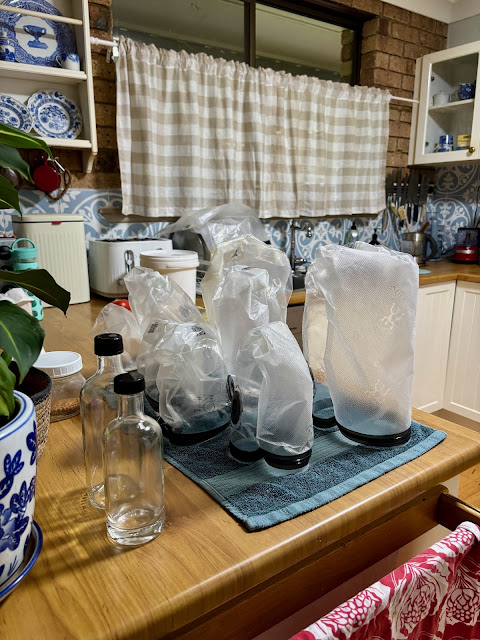
Every morning when I walk into my kitchen it looks tidy and ready for a day's work. Not so on this morning (above), I saw this when I walked in. Late the previous afternoon when I was looking for something, I came across my rolled up Zwilling vacuum bags and decided they had to be washed and dried. So I did that and although I usually put them outside on the verandah to dry it was dark by then. I turned the just-washed bags inside out and left them like this on a towel. It worked well and now the bags are ready to use when I bring home root vegetables, cabbages or whatever I buy that I want to last four or five weeks.
Image

You’ll save money by going back to basics

When I was doing the workshops and solo sessions, I had a couple of people whose main focus was on creating the fastest way to set up a simple life. You can't create a simple life fast, it's the opposite of that It's not one single thing either - it's a number of smaller, simpler activities that combine to create a life that reflects your values; and that takes a long to come together. When I first started living simply I took an entire year to work out our food - buying it, storing it, cooking it, preserving, baking, freezing, and growing it in the backyard. This is change that will transform how you live and it can't be rushed.  
Image

All previous blog posts

  • 2026 3
    • February 3
      • Workshops starting 1 March
      • Planting vegetable seeds and new workshops
      • Back where we belong
  • 2025 7
    • July 1
    • June 2
    • May 1
    • April 2
    • February 1
  • 2024 25
    • December 2
    • November 1
    • October 2
    • September 3
    • August 1
    • July 3
    • June 1
    • May 3
    • April 2
    • March 3
    • February 2
    • January 2
  • 2023 13
    • December 1
    • November 2
    • October 1
    • September 3
    • August 2
    • February 2
    • January 2
  • 2022 17
    • November 3
    • October 4
    • September 3
    • August 2
    • July 3
    • June 2
  • 2021 50
    • December 1
    • November 6
    • October 7
    • September 5
    • August 4
    • July 5
    • June 2
    • May 2
    • April 6
    • March 4
    • February 4
    • January 4
  • 2020 68
    • December 3
    • November 5
    • October 4
    • September 4
    • August 4
    • July 4
    • June 4
    • May 8
    • April 7
    • March 8
    • February 8
    • January 9
  • 2019 66
    • December 2
    • November 4
    • October 5
    • August 3
    • July 4
    • June 6
    • May 8
    • April 8
    • March 8
    • February 11
    • January 7
  • 2018 82
    • December 1
    • September 2
    • August 10
    • July 4
    • June 11
    • May 9
    • April 12
    • March 10
    • February 10
    • January 13
  • 2017 129
    • December 7
    • November 10
    • October 6
    • September 13
    • August 11
    • July 13
    • June 12
    • May 9
    • April 9
    • March 14
    • February 11
    • January 14
  • 2016 125
    • December 7
    • November 13
    • October 10
    • September 11
    • August 11
    • July 8
    • June 9
    • May 9
    • April 12
    • March 10
    • February 13
    • January 12
  • 2015 184
    • December 7
    • November 15
    • October 20
    • September 18
    • August 19
    • July 18
    • June 12
    • May 15
    • April 12
    • March 21
    • February 13
    • January 14
  • 2014 203
    • December 11
    • November 8
    • October 17
    • September 20
    • August 17
    • July 19
    • June 17
    • May 17
    • April 23
    • March 15
    • February 18
    • January 21
  • 2013 225
    • December 13
    • November 17
    • October 17
    • September 17
    • August 21
    • July 24
    • June 20
    • May 19
    • April 17
    • March 22
    • February 17
    • January 21
  • 2012 245
    • December 17
    • November 20
    • October 20
    • September 18
    • August 15
    • July 24
    • June 21
    • May 26
    • April 23
    • March 23
    • February 19
    • January 19
  • 2011 257
    • December 18
    • November 24
    • October 27
    • September 23
    • August 24
    • July 21
    • June 24
    • May 24
    • April 16
    • March 22
    • February 14
    • January 20
  • 2010 283
    • December 20
    • November 18
    • October 18
    • September 19
    • August 25
    • July 24
    • June 25
    • May 26
    • April 25
    • March 22
    • February 29
    • January 32
  • 2009 293
    • December 29
    • November 18
    • October 23
    • September 25
    • August 22
    • July 28
    • June 22
    • May 21
    • April 27
    • March 26
    • February 24
    • January 28
  • 2008 387
    • December 24
    • November 23
    • October 25
    • September 26
    • August 27
    • July 27
    • June 37
    • May 34
    • April 44
    • March 53
    • February 32
    • January 35
  • 2007 372
    • December 37
    • November 40
    • October 55
    • September 51
    • August 49
    • July 63
    • June 49
    • May 28


Trending Articles

NOT the last post

This will be my last post here.  I've been writing my blog for 18 years and now is the time to step back. I’ve stopped writing the blog and come back a couple of times because so many people wanted it, but that won’t happen again, I won’t be back.  I’ll continue on instagram to remain connected but I don’t know how frequent that will be. I know some of you will be interested to know the blog's statistics. 
Image

Every morning at home

Every morning when I walk into my kitchen it looks tidy and ready for a day's work. Not so on this morning (above), I saw this when I walked in. Late the previous afternoon when I was looking for something, I came across my rolled up Zwilling vacuum bags and decided they had to be washed and dried. So I did that and although I usually put them outside on the verandah to dry it was dark by then. I turned the just-washed bags inside out and left them like this on a towel. It worked well and now the bags are ready to use when I bring home root vegetables, cabbages or whatever I buy that I want to last four or five weeks.
Image

You’ll save money by going back to basics

When I was doing the workshops and solo sessions, I had a couple of people whose main focus was on creating the fastest way to set up a simple life. You can't create a simple life fast, it's the opposite of that It's not one single thing either - it's a number of smaller, simpler activities that combine to create a life that reflects your values; and that takes a long to come together. When I first started living simply I took an entire year to work out our food - buying it, storing it, cooking it, preserving, baking, freezing, and growing it in the backyard. This is change that will transform how you live and it can't be rushed.  
Image

Creating a home you'll love forever

Living simply is the answer to just about everything. It reduces the cost of living; it keeps you focused on being careful with resources such as water and electricity; it reminds you to not waste food; it encourages you to store food so you don't waste it and doing all those things brings routine and rhythm to your daily life. Consciously connecting every day with the activities and tasks that create simple life reminds you to look for the meaning and beauty that normal daily life holds.  It's all there in your home if you look for it. Seemingly mundane tasks like cleaning and cooking help you with that connection for without those tasks, the home you want to live in won't exist in the way you want it to.  Creating a home you love will make you happy and satisfied.
Image

Time changes everything

I've been spending time in the backyard lately creating a contained herb and vegetable garden. My aim is to develop a comfortable place to spend time, relax, increase biodiversity and encourage more animals, birds and insects to live here or visit. Of course I'd prefer my old garden which was put together by Hanno with ease and German precision. Together, we created a space bursting at the seams with herbs, vegetables and fruity goodness ready to eat and share throughout the year. But time changes everything. What I'm planning on doing now, is a brilliant opportunity for an almost 80 year old with balance issues. In my new garden I'll be able to do a wide range of challenging or easy work, depending on how I feel each day. It’s a daily opportunity to push myself or sit back, watch what's happening around me and be captivated by memories or the scope of what's yet to come.
Image

It's the old ways I love the most

I'm a practical woman who lives in a 1980’s brick slab house. There are verandahs front and back so I have places to sit outside when it's hot or cold. Those verandahs tend to make the house darker than it would be but they're been a great investment over time because they made the house more liveable. My home is not a romantic cottage, nor a minimalist modern home, it's a 1980’s brick slab house. And yet when people visit me here they tell me how warm and cosy my home is and that they feel comforted by being here. I've thought about that over the years and I'm convinced now that the style of a home isn't what appeals to people. What they love is the feeling within that home and whether it's nurturing the people who live there.
Image

Back where we belong

Surprise! I'm back ... for good this time. Instagram became an impossible place for me. They kept sending me messages asking if I'd make my page available for advertisers! Of course, I said no but that didn't stop them. It's such a change from what Instagram started as. But enough of that, the important part of this post is to explain why I returned here instead of taking my writing offline for good. For a few years Grandma Donna and I have talked online face-to-face and it's been such a pleasure for me to get to know her. We have a lot in common. We both feel a responsibility to share what we know with others. With the cost of living crisis, learning how to cook from scratch, appreciate the work we do in our homes, shop to a budget and pay off debt will help people grow stronger. The best place to do that is our blogs because we have no advertising police harassing us, the space is unlimited, we can put up tons of photos when we want to and, well, it just feels li...
Image

Making ginger beer from scratch

We had a nice supply of ginger beer going over Christmas. It's a delicious soft drink for young and old, although there is an alcoholic version that can be made with a slight variation on the recipe. Ginger beer is a naturally fermented drink that is easy to make - with ginger beer you make a starter called a ginger beer plant and after it has fermented, you add that to sweet water and lemon juice. Like sourdough, it must ferment to give it that sharp fizz. To make a ginger beer plant you'll need ginger - either the powdered dry variety or fresh ginger, sugar, rainwater or tap water that has stood for 24 hours to allow the chlorine to evaporate off. You'll also need clean plastic bottles that have been scrubbed with soap, hot water and a bottle brush and then rinsed with hot water. I never sterilise my bottles and I haven't had any problems. If you intend to keep the ginger beer for a long time, I'd suggest you sterilise your bottles. MAKING THE STARTER In a...
Image