down to earth

  • Home
  • About Us
  • Down To Earth Book
  • Privacy Policy


We are changing the way we eat. This is a big decision for us because we're going to eat meat again. I suppose it's less of a change for Hanno because he occasionally eats meat during winter, but I haven't eaten any meat for close to ten years. I started off being meat, chicken and fish-free because I was trying to help Hanno reduce his cholesterol level - he was having problems getting to a decent level, even though he'd given up eating a lot of the cheeses and other foods he loved. I thought that by him giving up meat it would take a burden from his diet that his body couldn't cope with. A couple of years into it, I went back to eating fish because I could never get a decent meal when I went travelling in my job. So we settled into this meat-less diet and I have to say that I always thought we were doing the right thing. Until now.

Then I read Nourishing Traditions, the revolutionary book by Sally Fallon. It changed the way I view food and has convinced me to eat meat again. Two days ago I ate meat for the first time in many years. I must admit I felt a bit sick at first and wondered if it was right for me but I soon settled down and felt fine. We had a beef casserole, made with shin beef, including the marrow bone. This meal was chosen to provide us with natural gelatin, minerals and enzymes.

I first came across Nourishing Traditions on the Lentils and Rice blog and was intrigued that the book had convinced Robyn to change what she ate and how she fed her family. Over the next month or two, I read more about the book and the influence it was having so when, quite by chance, I saw it for sale in my local organic co-op, I grabbed it. Hanno and I have both been reading it since and we're convinced by what the author writes. It's an easy book to read. It has a subject index as well as a recipe index and although I started reading from the beginning, now I'm looking up subjects that interest me, and spot reading.

I'm sure that people would get different messages from this book but this is what I have understood so far. There is no blanket advice that any doctor or government can give because we are all different, our bodies need differing elements and it's difficult to cover all people in one food pyramid or accepted body of knowledge. We are mammals - so we are programmed to drink milk. This starts off being human milk but expands into other types of milk and milk products - mammals commonly drink the milk of other mammals. Tampering with food to remove certain elements from it - like fat or salt - devalues it. Fat is needed to allow the take up of many of the beneficial elements in food. Raw food, in its many forms, is the best food. When I say raw I mean unprocessed - so raw milk, honey, cheese etc. Eat only pasture fed meat, not grain fed, or lot fed.

But most of all, as the title of the book states, it's about going back to the diet our great grandmas cooked. They used to eat soups and stocks made with bones; they ate the entire carcass of whatever animal they had available and didn't waste anything. They drank raw full cream milk, and made cheese from that same milk, they pre-soaked a lot of their grains and cereals - making the nutrients easily digestible when eaten. They pickled and preserved using whey.

This book made a lot of sense to me. I rarely read anything that changes how I view what I'm doing, but this book did it. I always think a lot about what I'm doing and generally, when I decide to change, it's for a reason that I've thought about and makes good sense to me. I know that many people won't get the same understanding from this book as I did. But if you get the chance to read it, do so. It might convince you to make a change.

Please note: You will most likely get this book at your local library. If you wish to buy a copy, I've added the Amazon link for the USA and UK to my side bar.
I'm very happy to tell you I'm feeling better today. I went back to the doctor yesterday and my medication was changed. It's made a difference. :- ) I can now sit here at the computer for more than 30 seconds and write what I want to write. It's been so frustrating not being able to do that.


I finished off the Ascot scarf I started the other day and have now started on a pair of these fingerless mittens that Heather wrote about on the Simple Green Frugal Co-op. The last two days have also seen these wonderful posts from Eilleen about Learning How to Sew and Oh Darn! Mending Socks or Gloves, written by Sadge.

The only other constructive work I've done in the past week is to pickle some beetroot (beets). We had a small crop of about 20 beetroot that I picked last week and left in the fridge. I finally got to them a few days ago and turned them into the most delicious bright red salad ingredient.

When you pick your beetroot, don't cut the tops off - twist the tops off and tidy the top with a knife but don't cut into the flesh of the vegetable as it will bleed into the water while it's being cooked. Wash the vegies thoroughly but don't peel them or cut into the flesh at all. Place in a pot of salted water and boil until cooked.


Then it's just a matter of making up a pickling liquid that suits your taste. I make mine like this:
1 cup apple cider vinegar
1 cup water
2 tablespoons sugar
some new fresh bay leaves
salt and pepper

I would normally have added some mustard seeds too but didn't have any.


When the beets are cooked, let them cool for a short while and when you can handle them, slip the skins off with your fingers.


Then just chop the beets into the shapes you want - either quarters or slices, place in a jar and pour over your pickling liquid. Store in the fridge. They will last for at least three months without any form of canning or preserving.

Before I go today I'd like to say a sincere thank you to a wonderful group of women who have been helping behind the scenes here. You all know that Sharon organises the swaps. She often makes more than she originally intended to because sometimes swappers drop out, and rather than allow our ladies to be disappointed, Sharon steps in. There were a number of swappers who didn't receive their promised swap this time and I'm so pleased to say that Ann R, Christine K and Stephanie all stepped in and helped. They made extras and sent them. I believe that generosity and kindness are a big part of simple lives and it tells me a lot about these women that they stepped up and helped out. Thank you ladies. I appreciate it and I'm sure the women to whom you sent your extras did too. It makes me feel stronger to see the strength of others and I want to thank Sharon, Ann, Christine and Stephanie for being a great example to us all.


Knitting has been my saving grace these past couple of days and nights. At first I couldn't concentrate on my knitting, or read a book, but with the pain easing slightly, I've taken up the needles again. I'm also reading a very interesting book, but more about that in another post. I started another Ascot scarf, for which I'm using a soft Australian 100% merino wool. The needles I'm using on this project are a pair of vintage pale aqua needles made of a very pliable soft plastic, with amber tops. They are warm in the hand and easily slide under thick wool.

I find that knitting is very similar to simple living. It's a mindful process that slows you down. It allows you to make productive that time you use to rest, and even though rest on it's own is a wonderful thing, there are many times I want to rest but still have something material come from that time. As I sit here, slowly making one stitch after another - like one small step - I know that each of those stitches is added to the overall fabric of what I'm making, just like each small step builds into a simple life.


I knitted the Ascot scarf above to wear this past winter. It's made of Lion brand organic cotton and is really soft and cuddly next to my neck. I made it wide so it's doubled over when worn to provide extra warmth. I secure it with my mum's vintage black and silver brooch/pin.


This is the rest of my recent knitting. I have a stack of cotton washcloths there that I'm adding to all the time and the red item is the beginning of a red cotton bag.

If you haven't tried knitting yet, I urge you to give it a go. You will be able to create some lovely unique things for yourself and your family and also to give as gifts for your friends. It's a truly useful skill to have and will fit into your simple life in a variety of ways. When I knit a gift I always keep the label of the yarn I use and attach that to the gift. That way the person who receives the gift knows exactly what it is made with and how to care for it.

Take care everyone.


Our driveway with a wall of star jasmine and agapanthus.

I'm not sure if I told you all about my knee. I had a painful attack like this about five weeks ago, just after driving back from my aunt's funeral. Now it's back again after another long drive associated with the conference I went to last week. After the first episode, I went to the doctor and had an ultrasound, xrays and blood tests. I'm happy to say my blood tests were perfect, but the ultrasound showed the beginnings of osteoarthritis in my right knee. Grrrrrrrrr. I'm not a good patient but Hanno has put up with me and fed me with toasted Vegemite soldiers, tea and plates of watermelon cut up into little pieces. Anyhow, it looks like it's getting better. I've just been for a walk around the garden and reconnected with the outside world.


The front yard this morning.

I've been watching mainstream TV for the last three days and nights. Sometimes I had it on just to take my mind off the pain, sometimes I watched. There is so much rubbish on the box now! I didn't know the full extent of it - the never-ending info-mercials at 2am, the sex websites advertising their shonky wares and the inane advertising for everything a mainstream consumer could ever hope to want. It's pretty depressing.


Hanno is fixing the roof with his friend, Hilton. They're currently at the hardware store buying supplies.

I'm going back to sit in my chair again now. I'll see you all again soon.
Hello everyone. This is just a short note to let you know that I'm okay but I have a sore knee and it's not letting me sit at the computer for any length of time. I've been sleeping in a lounge chair for the past three nights. However, it seems to be showing signs of improvement this morning so I'll be back with a post, and to answer all those emails and comments, hopefully, later today.
I can't tell you how good it feels to me to be home again doing "normal" things. I thought that going away for a couple of nights would be sort of semi-exciting, how wrong I was. When I was out, I was in the middle of a large and extremely busy city; when I was "home" I was in a hotel, cut off from nature with air-conditioning, thick walls and a little glass door that lead out to a very un-natural pebble courtyard. I couldn't hear anything when I was in the room, it was just me and the TV. I took a book to read but I went to sleep when I tried to read it. In the end I watched the "live" cricket beaming in from India. What a strange world we live in.


When I got home we had to deal with the problem of Seth's incessant crowing at 3 o'clock in the morning. The neighbours do not like it, neither does Hanno. Eep! I knew we'd have a problem giving him away, so many roosters are given away and end up in the soup pot, and I didn't want that for him. So I put a free advert on the farm stock online site for a pair of Sussex chooks and low and behold, we had people ringing up and emailing hoping to be given them. In the end, he and one of his silver Sussex ladies - Polly , went to a farm about ten minutes away. He would have been miserable without her and I hope they live a happy life there. The woman who took them wants to breed light Sussex. She came over with her husband who is a bee keeper. A lovely couple and I'm sure they'll look after Seth and Polly.


Seth - caught in the act.


I was hoping to have time yesterday to cook up these beetroot pulled from the garden a couple of days ago, but they're still uncooked. Hanno and I spent yesterday afternoon at the Centre where I hosted a Sunday lunch for the volunteers, committee and a couple of people from the local relocalisation group, who we auspice. It was a lovely lunch, we all brought food to share, and we sat - about 25 of us - under the shade of some very old conifer trees at the Centre. When we came home again, the people arrived to pick up Seth and Polly, so not much else was done. I had a long sleep last night, almost 11 hours, but I'm still a bit weary this morning. I'm going to work but I think I'll be a bit slow today.

I miss being at home, doing those things that usually make up my day. It might seem boring to some but I was bored in the middle of the city and wishing I was home again baking bread and eating real food. There was a time in my life when nothing could have kept me out of the city and all the excitement of it. Now it just exhausts me, now I have found a better place and I am fulfilled by pottering around my home. I think I'll settle back in fully by writing about knitting tomorrow. Thinking about that today will settle my mind and distance me from where I've been.

On the left is a flowering cactus that is growing on our front verandah and in the bush house. I'm not sure of the name of it, I grew it from cuttings I got from my DIL, but it flowers like this every Spring and hangs down from its container in long strands of pink. It's a real beauty.

I hope you're all well and happy and working steadily on your small steps to a simpler life. Oh, and I have to tell you, I really missed this blog and all of you while I was away.
I got back from the conference a little earlier today and have since caught up with a bit of sleep on the couch. It's a different world out there! I'm happy to be home again with Hanno.

Last week, a day was set aside by some bloggers to write about world poverty. I didn't write anything on that day because I was at a conference discussing the problems that poverty invariably bring to those living in those circumstances. The conference link is here. I found fifty percent of the presentations and workshops I attended to be very helpful. I also made very good contacts and hope to have a No Interest Loans Scheme (NILS) operating very soon at the centre I volunteer at.

I also talked to some specialist workers fairly close to our Centre who work solely with the homeless. Our homelessness problem is increasing and I'm sad and a bit ashamed to say that, at the moment, there isn't anything we can do for those people who come to us for help. There is no where to send them - no emergency housing available, no short term fixes, no long term ones either. I hope the current government comes up with a solution quickly. There is a quote, I forget by whom, that says something like the strength and worth of a country is judged by the way they treat their poor. Australia is usually a benevolent country but we are falling far below our own standards in this area.

I'm pleased to tell you all that the Simple Green Frugal Co-op is going really well and already has a readership of over 2000 people a day. I'm hope that, with the other writers, we build up a site that helps people move easily towards a simpler kind of life. Enjoy your weekend. :- )


UPDATE: Thanks for letting me know Kim and I will take you off the list! Thanks Kris, your parcel will be on its way.
Hello all. I hope that everyone has taken the time to visit Rhonda's new site : http://simple-green-frugal-co-op.blogspot.com/ you will find lots of information from sewing, cooking, and landscaping ideas to saving money! I also wish to thank the three kind and talented ladies that are helping me make pin cushions and needlebooks for the ladies who never received their parcels from their swap buddies-Ann, Christine, and Stephanie. Kudos ladies!! How lucky I am to belong to a blog community that is so generous and talented! I have heard from four of the ladies who never received their parcels, but still need to hear from Amy-you need to send me an e-mail (cdetroyes at yahoo dot com) with your address and the nameof your swap buddy. As soon as I get the e-mail we can get busy and get parcels out to you!! Oh, and Rhonda, so glad you are getting rain!
I just had to tell you that. : - ))) It's been raining all night and all the tanks are full to overflowing! Happy days. I'm leaving now to go away for a couple of days. Don't forget to update at the simple | green | frugal co-op while I'm away. There's lots of great reading over there.


While I was at work yesterday, Hanno planted up a lot of seedlings for our summer garden. When we first came to live here 12 years ago, we only ever planted in autumn and winter because the bugs and heat of summer made gardening too much of a chore. Things have changed now; we changed the way we thought about our garden, we changed how we shopped and our garden changed with us. We eat from the garden every day - sometimes our entire meal comes from our back yard. Last night, for instance, we had silverbeet (swiss chard) omelettes - freshly picked steamed chard was added to our backyard eggs, salt and pepper and a sprinkling of fresh chives. I would usually add a salad but was too tired to make one so I served the omelettes with a dollop of tomato chutney that I made about three months ago. Delicious!


The garden is important to us and allows us to eat healthy, organic food at a fraction of what it costs to buy it in a shop.


We eat a lot of tomatoes. These are beefsteaks and the first of them should be ready in about two weeks. Nothing beats the taste of heirloom tomatoes. If you've never tasted them, you're missing out on a real treat. They are real tomatoes, that taste like tomatoes should taste. Tomatoes at the store are gassed to produce a rich red colour and although they look good, they're often hard and tasteless. You never have that problem with the heirlooms - particularly the salad varieties like beefsteak, oxheart, Brandywine and German Johnson.


More tomatoes have been planted along the new lattice. These are oxhearts and Topic, which we're trying for the first time. They are supposed to be a good hot weather tomato.


And, you guessed it - more tomatoes. These little babies will be producing well into January, as long as the sun doesn't frazzle them. We do have sunshades for the garden. We didn't need them last year because we had a mild summer, but they're on standby.


Further over near the chook house we have corn at the top of the photo, more chard, and seedlings of capsicum (peppers) and beans. We grow a lot of chard and green leafy vegetables because we always share it with the chooks. They love green leaves and it makes the yolks of their eggs a rich golden yellow.


Between us and the chickens we plow through this stuff. Silverbeet, and most leafy greens, are rich in iron so being non meat eaters, it helps us keep our iron levels healthy.


And finally, just to show you that we are not perfect by any stretch of the imagination, our failed nectarine tree. Remember when we wrapped it up? It didn't work. After the first storm, gaps appears and the fruit fly got in. Every nectarine is riddled with fruit fly grubs. The chooks will happily eat every one of these fruit. We, on the other hand, will have none. Hanno thinks the trees are too much trouble and want to cut them down. I'm still undecided. We have some peaches protected from the fruit fry by exclusion bags. I think that one bite of a good peach will convince me not to get rid of the trees. We might just have to beat the fruit fly at their own game next year. I'll keep you posted.

I'm going to be away for a few days. Tomorrow I have to go to a conference related to my voluntary work. I'll be back on the weekend. I hope you all have a good week. Thank you for visiting and for your support with the co-op. I'll see you again next week, my friends.


If you're not already baking your own bread, I want you to think about doing it. Not only is it preservatives-free, it's cheaper, tastes better and it a great skill to have. Bread is one of our staple foods and in days gone past everyone, and I mean everyone, knew how to make it. Bread baking is just one of the skills we've traded for the sake of convenience - we give them our money and our independence, they give us back a loaf of bread (usually inferior to what we'd make) and the convenience of not having the bake the bread ourselves.

I know that many of you don't have a lot of time to spend in the kitchen baking bread. If you are one of those people, I encourage you to buy, barter, or swap your way to a breadmaker. It doesn't have to be new or fancy, it just has to knead the dough for you. Then you shape the loaf and bake it in the regular oven. Making bread this way will take you about 10 minutes in the various stages of putting the ingredients in the machine, shaping the loaf and taking it from the oven. Baking bread using a breadmaker does NOT make you an inferior cook. If using a breadmaker allows you to make your own bread, then go for it. Don't think you HAVE to make the dough by hand, it doesn't matter! The object of the exercise is to produce bread and if using a bread maker is how you do it, so be it.
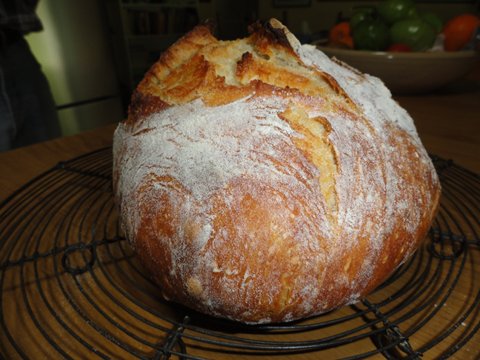
I did a tutorial for hand making bread
so you can try that if you want to. I added gluten flour to that recipe because it is a beginner's loaf and the gluten flour helps with the rise. You can leave it out if you can't find gluten or if you feel you'll knead the dough well enough without it.

In the posts here and here I'm talking about the cost of bread. If you can find a supplier of good high protein flour - or bakers flour - you will be able to produce loaf after loaf at a fraction of the price of store bought bread. BTW, the protein in bread flour is gluten so if you can't find high protein flour or bakers flours, use your plain all purpose flour and add gluten to it - ratio is one cup of flour to one teaspoon of gluten.

There are two more posts about bread making here and here.

There are thousands of recipes for bread and this is the one I used to make my flower pot loaves last weekend.

SOY AND LINSEED BREAD - MADE IN A BREADMAKER

First take two teaspoons of dry yeast and a tablespoon of sugar or honey, add to a cup of warm water and stir. Let that sit on the bench to prove (bubble up) while you prepare your other ingredients.

In this order, or the order described in your breadmaker manual, place in your breadmaker:

3 cups bread flour/bakers flour/high protein flour or plain flour with 3 teaspoons of gluten flour added to it. I used soy and linseed flour, you can use white, wholemeal, wholegrain or whatever flour you have.
1 teaspoon of salt
1 tablespoon of milk powder -- if you have no milk powder leave it out

If you have no milk powder, add some milk as part of your liquid component. You've already got a cup of water that the yeast is proving in, when the yeast has bubbled up (therefore you know it's alive and will activate the bread properly) pour the cup of yeast water in the breadmaker on top of the flour. If you didn't add milk powder, add half a cup of milk. If you did add milk powder, add another half cup of water.

Now, here is where you have to use your common sense. Turn on your machine on the "dough" setting and let it mix all the ingredients for a few minutes. Stay at the machine and watch it. You probably need to add more liquid. I can't tell you how much to add because all flour is different and even the humidity in your home will effect the amount of water you'll need to add at this point. If the dough is too dry, start adding water from a cup in very small amounts. Let the machine mix it in well before you judge whether you need more. One of the skills of breadmaking is judging the right amount of water and I always poke my finger in to check it. You're hoping for a moist dough that has mixed in all the ingredients - you don't want dry dough and you don't want sloppy dough. When you're happy that you've got it right, let the machine do it's work. I'll just say that the amount of liquid you'll add will be between 1½ cups and 2 cups. How much of that extra ½ cup you add you'll have to decide.

When the machine is finished, take the dough out, sprinkle a small amount (one tablespoon) of flour on your bench and knead the dough into a smooth ball. You'll notice at this stage, the dough is elastic - if you pull a piece out, it's springy. Shape the loaf, put it in a greased or lined bread tin and let it sit in a warm place until the bread has risen. This will take about 30 minutes in a warm kitchen but up to an hour in a cool one. You could also put your tin on top of a hot water system, or in the sun with a moist tea towel on the top to help it rise. I used three flower pots and divided the dough equally into three portions and added them to the pots.

When the dough is doubled in size and has risen just above the top of the bread tin, place it in a hot oven. Preheat your oven to its highest temperature, then when you put the bread in, lower the temp to 200C (395F). Bake until you smell the delicious smell of bread and the top is golden. It will take between 20 - 30 minutes.

And that's it. Even though there are a lot of instructions above, they have been written for those of us who have little experience. Anyone who has baked before will just need the recipe and will go on with it. As I said, it will only take about 10 minutes in various stages.


The little flower pot loaves were baked in real plant pots, but they need to be seasoned. DON"T BUY CHINESE POTS and don't use old pots that have had plants in them. I think mine were 5 inch pots. Clean them thoroughly with soap and warm water, rinse well and allow to dry for at least 12 hours. Rub cooking oil into the pots and make sure you cover ever part of every pot. The oil will soak into the terracotta. Make sure you apply a good amount of oil. Put the pots into a COLD oven and turn the heat up to 180C (350F). Let the pots cook in the oven for 20 minutes, then turn the heat off. Leave them in the oven, with the door closed, overnight to cool completely. Next day, repeat that process again. When they come out of the oven the second time, they're ready to be used for baking.


You can bake anything in these pots. I have used them in the past for baking little Christmas cakes that I gave as Christmas gifts - still in the pot - and tied with a red ribbon. They were a real hit. But on the weekend I baked bread in them. I lined them with parchment paper, both on the bottom and sides, to make sure the bread didn't stick.


If you're not a baker, or if you're young and new to home cooking, I hope you'll try making bread. It will save you money and it's better for you because there is no preservative in home baked bread. But best of all, it tastes like bread should taste and you'll be gaining back your independence because you'll be able to provide for yourself.

I wonder how many of you are having problems with bread making. Are there many? Read through my tutorial and try the recipe above and see how you go with it. If there are a few still having problems making a decent loaf, I'll do a troubleshooting post in the next week or so and well see if we can work out the problems together.

Happy baking!


UPDATE: Thank-you so much for the offers to help to make sure no one gets left out. Steph and Christine many many thanks and please e-mail me and I will get you a buddy who has been left out. Our blog family is just amazing!!!
Hello ladies. In order to wind up our swap I would like to ask that Tracy G., Lisa (the tin house), Jo (french knots), Amy, Kim, and Kris (quilted simple ) -to please e-mail me today ( with their names and addresses) and I , with the help of Ann (still at home) --many, many thanks my friend) will be getting out pin cushions and needle books to each of them. If I have left anyone off this list, please, please e-mail me as soon as possible. Their swap buddies will go on my naughty swapper list-sort of like Santa's list) and won't be swapping again. We had one swapper who had a valid excuse (and a wonderfully understanding swap buddy) and we hope and pray she gets to feeling better soon. I have a handful of photos still to be posted (including yours Mandy) and those will be up this week. Would Jo (french knots), who has had a bit of trouble reaching me, please forward a copy of your e-mail to Rhonda also, so that we don't have any that go astray and get lost in Internet land! Thanks and hugs, Sharon
Newer Posts Older Posts Home

MY BOOKS

MY BOOKS


My books were all published by Pengiun, and are available at Amazon US, Amazon UK and Amazon Au

Search here

Total Pageviews

Translate


I'm Rhonda Hetzel and I've been writing my Down to Earth blog since 2007. Although I write the occasional philosophical post, my main topics include home cooking, happiness and gardening as well as budgeting, baking, ageing, generosity, mending and handmade crafts. I hope you enjoy your time here.

MY FAVOURITE PLACES

  • Grandma Donna's Place
  • Grandma Donna's YouTube
  • Grandma Donna's Instagram
  • This Simple Day
  • Nicole's Instagram

Give More

Give More

Popular posts last year

Making ginger beer from scratch

We had a nice supply of ginger beer going over Christmas. It's a delicious soft drink for young and old, although there is an alcoholic version that can be made with a slight variation on the recipe. Ginger beer is a naturally fermented drink that is easy to make - with ginger beer you make a starter called a ginger beer plant and after it has fermented, you add that to sweet water and lemon juice. Like sourdough, it must ferment to give it that sharp fizz. To make a ginger beer plant you'll need ginger - either the powdered dry variety or fresh ginger, sugar, rainwater or tap water that has stood for 24 hours to allow the chlorine to evaporate off. You'll also need clean plastic bottles that have been scrubbed with soap, hot water and a bottle brush and then rinsed with hot water. I never sterilise my bottles and I haven't had any problems. If you intend to keep the ginger beer for a long time, I'd suggest you sterilise your bottles. MAKING THE STARTER In a...
Image

NOT the last post

This will be my last post here.  I've been writing my blog for 18 years and now is the time to step back. I’ve stopped writing the blog and come back a couple of times because so many people wanted it, but that won’t happen again, I won’t be back.  I’ll continue on instagram to remain connected but I don’t know how frequent that will be. I know some of you will be interested to know the blog's statistics. 
Image

How to make cold process soap

I'm sure many of you are wondering: "Why make soap when I can buy it cheaply at the supermarket?" My cold process soap is made with vegetable oils and when it is made and cured, it contains no harsh chemicals or dyes. Often commercial soap is made with tallow (animal fat) and contains synthetic fragrance and dye and retains almost no glycerin. Glycerin is a natural emollient that helps with the lather and moisturises the skin. The makers of commercial soaps extract the glycerin and sell it as a separate product as it's more valuable than the soap. Then they add chemicals to make the soap lather. Crazy. Making your own soap allows you to add whatever you want to add. If you want a plain and pure soap, as I do, you can have that, or you can start with the plain soap and add colour, herbs and fragrance. The choice is yours. I want to add a little about animal and bird fat. I know Kirsty makes her soap with duck fat and I think that's great. I think t...
Image

Preserving food in a traditional way - pickling beetroot

I've had a number of emails from readers who want to start preserving food in jars but don't know where to start or what equipment to buy.  Leading on from yesterday's post, let's just say up front - don't buy any equipment. Once you know what you're doing and that you enjoy preserving, then you can decide whether or not to buy extra equipment. Food is preserved effectively without refrigeration by a variety of different methods. A few of the traditional methods are drying, fermentation, smoking, salting or by adding vinegar and sugar to the food - pickling. This last method is what we're talking about today. Vinegar and sugar are natural preservatives and adding one or both to food sets up an environment that bacteria and yeasts can't grow in. If you make the vinegar and sugar mix palatable, you can put up jars of vegetables or fruit that enhance the flavour of the food and can be stored in a cupboard or fridge for months. Other traditional w...
Image

Cleaning mould from walls and fabrics

With all this rain around we've developed a mould problem in our home. Usually we have the front and back doors open and that good ventilation stops most moulds from establishing. However, with the house locked up for the past week, the high humidity and the rain, mould is now growing on the wooden walls near our front door and on the lower parts of cupboards in the kitchen. Most of us will find mould growing in our homes at some point. Either in the bathroom or, in humid climates, on the walls, like we have now. You'll need a safe and effective remedy at some point, so I hope one of these methods works well for you. Mould is not only ugly to look at, it can cause health problems so if you see mould growing, do something about it straight away. The longer you leave the problem, the harder it will be to get rid of it effectively. If you have asthma or any allergies, you should do this type of cleaning with a face mask on so you don't breathe in any spores. Many peopl...
Image

Five minute bread

Bread is one of those foods that, when made with your own hands, gives a great deal of satisfaction and delight. It's only flour and water but it symbolises so much. I bake bread most days and use a variety of flours that I buy in bulk. Often I make a sandwich loaf because we use most of our bread for lunchtime sandwiches and for toast. Every so often I branch out to make a different type of loaf. I have tried sour dough in the past but I've not been happy with any of them. I'll continue to experiment with sour dough because I like the idea of using wild yeasts and saving the starter over a number of years to develop the flavour and become a part of the family. However, the loaf I've been branching out to most often is just a plain old five minute bread. By five minutes I mean it takes about five minutes actual work to prepare but it's the easiest of all bread to make and to get consistently good loaves from. If you're having people around for lunch or...
Image

This is my last post.

I have known for a while that this post was coming, but I didn't know when. This is my last post. I'm closing my blog, for good, and I'm not coming back like I have in the past.  I've been writing here for 16 years and my blog has been many things to me. It helped me change my life, it introduced me to so many good people, it became a wonderful record of my family life, it helped me get a book contract with Penguin, and monthly columns with The Australian Women's Weekly and Burke's Backyard . But in the past few months, it's become a burden. In April, I'll be 75 years old and I hope I've got another ten years ahead. However, each year I'll probably get weaker and although I'm fairly healthy, I do have a benign brain tumour and that could start growing. There are so many things I want to do and with time running out, leaving the blog behind gives me time to do the things that give me pleasure. On the day the blog started I felt a wonderful, h...
Image

What is the role of the homemaker in later years?

An email came from a US reader, Abby, who asked about being a homemaker in later years. This is part of what she wrote: "I am a stay-at-home mum to 4 children, ages 9-16. I do have a variety of "odd jobs" that I enjoy - I run a small "before-school" morning drop-off daycare from my home, I am a writing tutor, and I work a few hours a week at a local children's bookstore. But mostly, I cherish my blissful days at home - cooking, cleaning (with homemade cleaners), taking care of our children and chickens and goats, baking, meal-planning, etc. This "career" at home is not at all what I imagined during my ambitious years at university, but it is far more enriching. I notice, though, that my day is often planned around the needs of my family members. Of course, with 4 active kids and a husband, this is natural. I do the shopping, plan my meals, cook dinner - generally in anticipation of my family reconnecting in the evening.  I can't h...
Image

Every morning at home

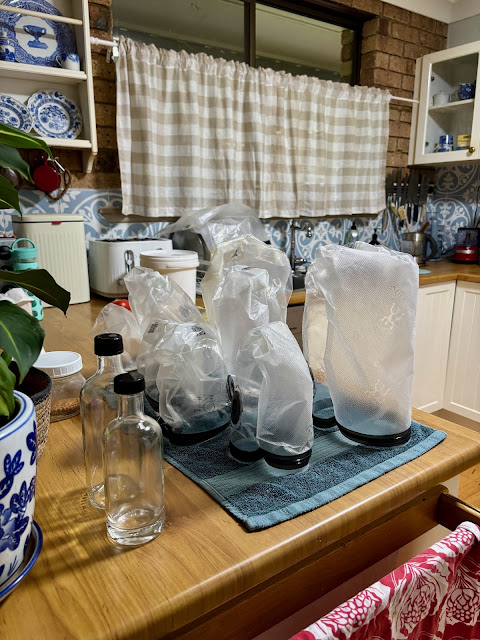
Every morning when I walk into my kitchen it looks tidy and ready for a day's work. Not so on this morning (above), I saw this when I walked in. Late the previous afternoon when I was looking for something, I came across my rolled up Zwilling vacuum bags and decided they had to be washed and dried. So I did that and although I usually put them outside on the verandah to dry it was dark by then. I turned the just-washed bags inside out and left them like this on a towel. It worked well and now the bags are ready to use when I bring home root vegetables, cabbages or whatever I buy that I want to last four or five weeks.
Image

You’ll save money by going back to basics

When I was doing the workshops and solo sessions, I had a couple of people whose main focus was on creating the fastest way to set up a simple life. You can't create a simple life fast, it's the opposite of that It's not one single thing either - it's a number of smaller, simpler activities that combine to create a life that reflects your values; and that takes a long to come together. When I first started living simply I took an entire year to work out our food - buying it, storing it, cooking it, preserving, baking, freezing, and growing it in the backyard. This is change that will transform how you live and it can't be rushed.  
Image


Trending Articles

NOT the last post

This will be my last post here.  I've been writing my blog for 18 years and now is the time to step back. I’ve stopped writing the blog and come back a couple of times because so many people wanted it, but that won’t happen again, I won’t be back.  I’ll continue on instagram to remain connected but I don’t know how frequent that will be. I know some of you will be interested to know the blog's statistics. 
Image

Every morning at home

Every morning when I walk into my kitchen it looks tidy and ready for a day's work. Not so on this morning (above), I saw this when I walked in. Late the previous afternoon when I was looking for something, I came across my rolled up Zwilling vacuum bags and decided they had to be washed and dried. So I did that and although I usually put them outside on the verandah to dry it was dark by then. I turned the just-washed bags inside out and left them like this on a towel. It worked well and now the bags are ready to use when I bring home root vegetables, cabbages or whatever I buy that I want to last four or five weeks.
Image

You’ll save money by going back to basics

When I was doing the workshops and solo sessions, I had a couple of people whose main focus was on creating the fastest way to set up a simple life. You can't create a simple life fast, it's the opposite of that It's not one single thing either - it's a number of smaller, simpler activities that combine to create a life that reflects your values; and that takes a long to come together. When I first started living simply I took an entire year to work out our food - buying it, storing it, cooking it, preserving, baking, freezing, and growing it in the backyard. This is change that will transform how you live and it can't be rushed.  
Image

Creating a home you'll love forever

Living simply is the answer to just about everything. It reduces the cost of living; it keeps you focused on being careful with resources such as water and electricity; it reminds you to not waste food; it encourages you to store food so you don't waste it and doing all those things brings routine and rhythm to your daily life. Consciously connecting every day with the activities and tasks that create simple life reminds you to look for the meaning and beauty that normal daily life holds.  It's all there in your home if you look for it. Seemingly mundane tasks like cleaning and cooking help you with that connection for without those tasks, the home you want to live in won't exist in the way you want it to.  Creating a home you love will make you happy and satisfied.
Image

Time changes everything

I've been spending time in the backyard lately creating a contained herb and vegetable garden. My aim is to develop a comfortable place to spend time, relax, increase biodiversity and encourage more animals, birds and insects to live here or visit. Of course I'd prefer my old garden which was put together by Hanno with ease and German precision. Together, we created a space bursting at the seams with herbs, vegetables and fruity goodness ready to eat and share throughout the year. But time changes everything. What I'm planning on doing now, is a brilliant opportunity for an almost 80 year old with balance issues. In my new garden I'll be able to do a wide range of challenging or easy work, depending on how I feel each day. It’s a daily opportunity to push myself or sit back, watch what's happening around me and be captivated by memories or the scope of what's yet to come.
Image

It's the old ways I love the most

I'm a practical woman who lives in a 1980’s brick slab house. There are verandahs front and back so I have places to sit outside when it's hot or cold. Those verandahs tend to make the house darker than it would be but they're been a great investment over time because they made the house more liveable. My home is not a romantic cottage, nor a minimalist modern home, it's a 1980’s brick slab house. And yet when people visit me here they tell me how warm and cosy my home is and that they feel comforted by being here. I've thought about that over the years and I'm convinced now that the style of a home isn't what appeals to people. What they love is the feeling within that home and whether it's nurturing the people who live there.
Image

Making ginger beer from scratch

We had a nice supply of ginger beer going over Christmas. It's a delicious soft drink for young and old, although there is an alcoholic version that can be made with a slight variation on the recipe. Ginger beer is a naturally fermented drink that is easy to make - with ginger beer you make a starter called a ginger beer plant and after it has fermented, you add that to sweet water and lemon juice. Like sourdough, it must ferment to give it that sharp fizz. To make a ginger beer plant you'll need ginger - either the powdered dry variety or fresh ginger, sugar, rainwater or tap water that has stood for 24 hours to allow the chlorine to evaporate off. You'll also need clean plastic bottles that have been scrubbed with soap, hot water and a bottle brush and then rinsed with hot water. I never sterilise my bottles and I haven't had any problems. If you intend to keep the ginger beer for a long time, I'd suggest you sterilise your bottles. MAKING THE STARTER In a...
Image

An authentic look at daily life here — unstaged and real

Most days Hanno was outside happily working in the fresh air. It may surprise you to know that I started reading my book,  Down to Earth , yesterday - the first time since I wrote it 13 years ago.  I had lent it to my neighbor, and when she returned it, I started reading, expecting to find surprises. Instead, I realised the words were still familiar—as if they were etched into my memory. As I flipped through the pages, I was reminded of how important it was for me to share that knowledge with others. The principles in Down to Earth changed my life, and I truly believed they could do the same for others. After just 30 minutes of reading, I put the book down, reassured that its message still holds true: we can slow down and reshape our lives, one step at a time.
Image