down to earth

  • Home
  • About Us
  • Down To Earth Book
  • Privacy Policy
I am worried about Rosie, our 12 year old Airedale Terrier. She's lost a bit of weight over the last week or so and she's been vomiting. She's still eating her evening meal but won't touch the biscuits in the morning. I've been giving her a little bit of porridge during the day, which she loves. Hanno will take her to the vet today. :- |


For the past few months, we've been talking about putting up a screen near our bedroom to shade the wall from the summer western sun. Our plan is to grow luffas all along the screen during summer and smaller crops, that would allow the sun through, in winter. Well, last week Hanno built that screen. You can see him in action, with his sidekick, Rosetta, above. (Clicking on the photos will enlarge them.)


We enriched the soil, which was mainly the natural clay we are on here, with compost, worm castings and some of the rich soil from the chicken coop. It was watered in with a weak solution of seaweed tea. Our first crop is lettuce and tomatoes - two Tropics and two beefsteaks. We've covered it all with straw to keep the soil at an even temperature and to conserve the water used on the garden. When these tomatoes have cropped, they'll be pulled out and the luffas planted. I will be selling those organic luffas with my homemade soap in a few months time.


Tomatoes are an important crop to us and generally I like to plant pink Brandywines. If you've never seen a Brandywine, above is a photo of one we ate on the weekend. I think they're the perfect tomato - juicy without being watery, more sweet than tart, few seeds and they have the most divine flavour.


What we eat depends on what is growing in the backyard. On Saturday I made some coleslaw and we had that with a garden salad with snow peas, and potatoes with butter and parsley.


I had just started taking off the outer leaves of the cabbage and out popped this little fellow! He's a sedge frog - a tiny leaf dwelling green frog which, when fully grown, will be about two inches long. He's now living in our green house.


We pulled out all the brandywines and cucumbers last week, enriched the soil again and planted up some leeks and more tomatoes. If you're new to vegetable gardening, I can't encourage you enough to enrich your soil. Compost, worms and all sorts of organic matter in your soil will help you grow the best vegetables possible. It is well worth the time it takes to do it.


And here is yesterday's garden, taken from behind the lazy housewife beans. We're eating some of these green beans raw and the rest I'm allowing to dry on the vine. I'll harvest a couple of jars of the finest dried white beans for my stockpile cupboard from them. They'll be a nutritious addition to soups and casseroles later in the year. I love those dual purpose vegetables.


Above you can see a pineapple growing among the kale. I am hoping it will produce pineapples this summer.


And in this last photo, meet some of my peeps. Here are Pippa and Mrs Rudd - two silver sussex, Margaret, my big light sussex, Martha, the buff Orphington at the top, and Bernadette, the Barnevelder at the bottom. Bernadette always looks angry but she's quite timid and sweet.

Gardening and knitting took up the best part of my weekend. My daughter-in-law, Cathy, found some Lion organic pure cotton for me last week so I experimented with that, knitting and unpicking it a few times until, at last, I was happy with the result.

Every so often my family and friends tell me they've read something on my blog, but none of them ever comments. So, in the hope of flushing them out, I'd like to say hello to Trisha, Kathleen (my sisters), and friends Susan, Bernadette, Wendy and Anna. :- )

Just one last word to my Australian friends. If this truck drivers' strike goes ahead, I encourage you to top up your stockpiles. Hanno and I are not due to shop for a while yet, but if the truck strike is on, it will affect grocery deliveries very quickly, so Hanno will stock up on a few items today. If you need to stock up, shop today or tomorrow if you can.

Hello friends. I hope you enjoy your weekend and find time to spend with your family or those you love.

I want to let you know about the book being passed on by Niki. If you would like to go into the draw for the book, visit Niki here.
Yesterday was the coldest day of the year here in our little home. It was raining and dark and just right for a day of reflection and knitting. Of course I made bread and did a few other chores - there was quark waiting to be made and a batch of soap to be stored away, but my focus yesterday was inside my own head. I need days like that because it gives me a chance to think about my life and what I hope for the future. The way I live my life requires quite a bit of thought. I like to plan what I do, concentrate on chores and activities as I do them, and then think about the value of what I've done.


I have always been a thinker but now I believe awareness is a big part of how I live. Simple living isn't all about the practical things we do in our day to day lives. There is a philosophy that goes with my life that requires generosity and grace to be ever present. Gone are the days I lived on auto-pilot, now I give more and expect less. Now I am mindful that my thoughts and actions are familiar bedfellows.


I have told the story of the sampler I made in an older post, but for those of you new to my blog, I'll tell it again because that sampler was a great help to me when I first embarked on this brand new life. Basically, it is that I could easily remember recipes for making soap and food and many of the practical things I needed to do, but I didn't always remember the finer things like being kind or not having more than I needed. I thought about how I could remind myself, every day, about the values I wanted to develop. I wanted a less-is-more approach to become a significant part of my life. So I drew that sampler, stitched it and put it in a frame to look at every day as I went about my life. Having that there in my kitchen reminded me of the person I wanted to become. A few years down the track, I felt confident enough in myself and how I'd changed to be able to give that stitchery away, now it lives with Peggy in the USA.

I'm a bit dense sometimes. I need visual reminders. It's easy to become caught up in the practice of day to day living, of putting food on the table and being organised enough to do everything I need to do. But now the sentiments behind that sampler, those important values, are ingrained deep within me. Now all I need are days like yesterday when I can sit and knit and think about where I am heading and what is the gentlest and most interesting way to get there.


This is Lulubelle, she is a really big girl and she looks angry, but she's the sweetest and most gentle of all our chooks. Lulubelle is a barred Plymouth Rock.

Today I was going to write about keeping chickens in the backyard but I've just read a post I did in May last year on this same topic and there is not a lot I want to change. So instead of writing the same information in a different way, I've copied that old post and I'll add a few bits and pieces.

Chickens are a chaotic jumble of gentleness, cannibalism, stupidity and raw cunning so it was not surprising that the first pet I bought for my children were chooks. My kids grew up looking after chickens. They fed and watered them, carried them around, collected their eggs, played with them and helped buried them when they died. My sons are two of the most gentle people you’d ever meet. The chooks and I made them like that.


Here, from left, are Bernadette (Barnevelder), Heather (Faverolles) and Martha (buff Orpington). They are puffed up because they're cold.

The first thing you need to consider if you want to keep chooks is where you’d keep them. You’ll need a coop or chook dome for them to sleep in, some nesting boxes, a roost – this is where they’ll perch while they sleep and some room for them to roam during the day. It’s much easier to have a cement floor in the coop because you need to be able to collect the manure to use on your garden and to hose out the coop each week. Smelly chickens will have your neighbours complaining and after a few days of rain you’ll be pulling your hair out if you decide against putting down a cement floor. The hen house will need to be surrounded by a tallish fence with a gate that can be closed every night and whenever you need the hens out of the way, like when you mow the lawn. Many areas of Australia are infested with foxes and wild dogs or dingoes. If you buy some chickens you must care for them well and make sure they’ll be safe, even when you’re not a home.

Chook house designs here, here, here, here and here.

You’ll need shredded paper or straw for the nests, a feeder and a water container – we use a bucket. You could scatter the hen’s food each day and have them forage for it. Unlike other animals, hens don’t over eat so it’s much easier (for you) to have a feeder that you can fill up that will feed them for a week or so. A large plastic chicken feeder will cost about $35, a metal one will cost about $50, but they are a good investment.

The number of eggs a chook will lay is dependent upon what type they are and your climate. Chooks lay less in the cold weather and if you have pure breeds, they will take time off laying during the year to moult and replenish their calcium levels. Hybrid chooks don't do that, they're bred to be egg machines and will continue laying most of the year. Where I live, each chicken will lay about 300 eggs per year, or one every 25 hours. They lay best during warmer weather but will stop laying when they lose their feathers or if they are stressed. Work out how many hens you’ll need to supply your family with eggs. At their peak, each hen will lay about four to five eggs a week so if your family eat an egg each a day you’ll need one and a bit hens per family member. So, for example, if you have four people in your family, you’ll need five or six hens and from them you’ll get around between 25 to 30 eggs per week.


Before you buy your first chickens, ring your local council and find out what the regulations are for raising chickens in your backyard. For instance, my local council has banned roosters and the hen house must be a certain distance from neighbourhood fences, there are also restrictions on the number of chooks we keep (20), but apart from that anything goes. Find out what your local authority requirements are and be guided by them. If your local authority won't allow you to keep chickens. I encourage you to write a letter to them, and your local member of parliament, to protest that decision. Chooks were commonly kept in backyards by out grandparents and their grandparents and it is a fairly recent decision to keep backyards chicken-free. I believe it is everyone's right to keep chooks for eggs or for meat, and that right should not have been taken away from you simply because your neighbour doesn't want to see livestock in the neighbourhood. Surely we don't want to live in a place that has been landscaped and cemented with no natural elements in it. Chickens are an important part of a sustainable backyard and if that right has been taken away from you, you should fight to get it back.

Another decision you need to make before you buy is to decide if you want to keep hens for eggs or if you also want to raise your chickens for meat. Some hens are bred to maximize their egg laying potential, others are bred to have big breasts and legs so that they are best for meat chickens. Or you can do what ordinary folk have done for hundreds of years and kill the male birds for meat and keep the girls for eggs. Check the Henderson's chart for meat and egg layers.

This is Mary, one of our Australorps. Look at her pretty black-green feathers. The Australorp is an Australian breed.

There are many different types of chickens but you should buy the type you find visually pleasing and those that will suit your purpose for size, eggs or meat. For example, I keep Rhode Island Reds, Australorps, Plymouth Rocks, Orpingtons, light Sussex and others, in the past we’ve had Pekin bantams. Light Sussex is a dual purpose bird as they are good layers, good broody hens and mothers and have a good body size for meat. If you have small children, maybe you’d like to keep silkies. They are gentle and don’t mind being handled but they don’t produce a lot of eggs, so there is a downside to them. They also have black meat which might put some people off. If you’re in a city, and don’t have much space, you might consider bantams. Three would give you enough eggs for a couple or small family. I have written about the important of pure breed chooks here. I will never buy chooks bred for the caged poultry industry again; from now on, all my chooks will be pure breeds.

If you're unsure of the various types of pure breed chickens, or what conditions they're suited to, read this wonderful chart.


Here are light Sussex, Stella Gladys, and silver Sussex, Poppy. Stella Gladys is really tall her her age and has legs that look like emu legs!

You can buy day old chicks, young chickens or pullets. My recommendation for first timer chicken keepers is to buy pullets. These are chickens that are about 16-20 weeks old and will be ready to lay eggs in the next couple of weeks. Buying pullets gives you a couple of weeks to get used to looking after them and then you will have the eggs to reward you. Try to buy from a local hatchery or a local breeder. This will give valued support to your local community, it will be easier for you to travel there and back with chickens in the car and there will be less stress on the birds. They will also be acclimatised to your local area.

CHOOK FEED
Make sure your hen house is ready before they arrive, complete with food and fresh water. Chickens need four vital things to keep them healthy and laying:

  • Grains – mixed wholegrain, not just sunflower seeds, corn or wheat. They will eat all those grains and seeds but it’s much better for them, and for you as you’ll be eating their eggs, that they have a healthy mix of grains.
  • Fresh green food like spinach, silverbeet, cabbage leaves, lettuce, grass and weeds that you’ve pulled from the garden. They will also eat tomatoes, apples, pears and a number of other fruits.
  • Protein – chickens need a high protein diet to enable them to produce eggs. If your girls are free ranging, their diet will be supplemented with bugs, grasshoppers and caterpillars. This is good for the chickens and the garden. If your chickens are in a pen all day they will need high protein food in the form of laying pellets or laying mash. You can also give them meat, chicken or fish scraps from the kitchen or a little bread soaked in milk as a treat.
  • Water – this is vital to the life of your chickens. A chook can die within a short amount of time if it doesn’t have water. If you’re free ranging your chooks, have a couple of water containers that they can see. If they gather in the afternoon for a rest under a shade tree, put some water there and another under a tree near where they scratch around. There should always be a container should be in their coop. All the water containers must be clean with fresh water every day. Scrub out the containers every week to make sure you have no contaminants in the water.
We feed our girls warm porridge when the weather is cold. They love it, and see it as a treat, but it also provides extra protein and will keep them warm during those cold days and nights of winter.

My local heirloom seed store, Green Harvest, recommend the following plants for chook forage: Asian greens, buckwheat, Ceylon spinach, cherry guava, clover, corn, cucumber, golden purslane, linseed, lucerne, millet, nasturtium, oats, passionfruit, New Zealand spinach, rocket, silverbeet, soybean, tamarillo and wheat. I have found my chooks also love kale, cabbage, all types of chard, capsicum (peppers), tomatoes, pigeon peas and radish tops.


The magnificent Lulubelle.

Remember that everything you give your hens will go into producing eggs that you and your family will eat. If you give them fresh, clean water and healthy food you will be rewarded with beautiful golden eggs. You will have healthy birds that will give you few problems. If you don’t intend to look after them like you would your dog or cat, don’t buy chickens as they deserve to be treated like loved pets and, unlike cats and dogs, for their ability to produce fresh food for you and your family.

Your chickens will need a high protein diet if they are to regularly lay eggs for you. You could feed them exclusively on laying pellets or mash which you can buy from the local produce store. A more natural alternative is to give them a mixture of whole grains, amaranth, kitchen scraps and a few handfuls of laying pellets or mash. Chickens will also eat grass and will get a large amount of their nutrition from it if left to free range all day. Grass eating chickens will have a higher level of Omega-3 in their eggs than chickens that don’t eat grass. You should remember that chickens are omnivores, which means they need to eat bugs, and animal protein (meat) as well as grains and grass. Chickens are creatures of habit so start out the way you will continue to feed them, as once they are used to one thing it’s sometimes difficult to make them change their food preference.

Chickens also need shell grit which you can get from the local produce store. It will help prevent calcium deficiency. You can supplement the grit with finely crushed egg shells. To do this, wash the egg shells and allow them to dry completely. Then finely crush the shells with a rolling pin or pulse a couple of times in the food processor. The aim here is to provide a variety of grit sizes for the chickens. They will choose which size they need. A small bag of shell grit lasts a long time so don’t buy a huge amount.

We let our chickens out of their house every morning about 9am, after they're laid their eggs, and they forage around the backyard eating bugs and grass. We give them most of our food scraps. They love meat and fish, old bread, eggs, crushed up egg shells (for extra calcium), most vegetables and fruit, rice, oats, wheat and most seeds and grains. To be honest, they are will eat almost anything.

CARING FOR YOUR LADIES
The number one consideration in keeping chickens in your backyard is to keep them safe from predators. Check out what predators live in your neighbourhood. If you’re in a suburban area it may be dogs, cats and hawks. If you’re in the country or on the edge of a township you may have foxes, wild dogs and cats, owls, hawks etc. Here at my home we have huge pythons, foxes, feral cats and dogs and dingoes. The hen house we constructed is not fancy – it’s made of recycled materials with a cement floor, but it’s strong and lockable and my girls feel safe in there. We have two large dogs, Airedale Terriers and although one of them rounds up the chickens they have never chased or hurt them. Chickens are sensitive to stress. They have been known to drop dead during thunderstorms or die a couple of days after being chased by dogs. We have wild thunderstorms here during summer and I’ve never lost any hens during one but I have had hens stop laying for weeks after they’ve been scared by visiting dogs or children.

If you have a dog and bring new chickens into the backyard, you'll have to watch your dog for a long time to make sure it accepts the chickens as part of the family. A dog's natural instinct is to see the chook as something to chase and eat. The dog should not be punished for a natural tendency, you need to train it to accept the newcomers. When we bring new chickens home for the first time, our two dogs watch them carefully for a couple of weeks. Hanno often sits with them and will encourage the chickens to come up to him for food and will have the dogs sitting with him. That teaches the chickens that the dogs are friendly and it shows the dogs that the chickens are ours and we look after them. If you have dogs and new chooks, never leave your dog alone with them until you're satisfied you can trust it. It is a good idea to keep the chickens behind a dog proof fence and only let them out together when you're there with them. The more time you can spend out there with the dog and the chickens, the faster they'll grow to accept each other.

Be aware that predators come from the sky too, they are not just lurking around corners. If you have dogs, hawks won’t be so much of a problem. Chickens have a natural tendency to sit under trees and bushes so they will be protected from sight much of the time if they free range in your backyard. After a while you’ll get used to their clucking and just like a baby you’ll learn by their various noises if something is wrong. If they are scared, they’ll let you know.

Always make sure you lock them in their hen house at night. That’s the time animals like foxes, cats and nocturnal predators will be creeping about. If they are safe and secure in their house, even if you have a silent fox in your backyard, they’ll be out of harm’s way.

Try to spend time with your chickens, especially when you first get them, so they accept you as part of their flock. You’ll need to be able to pick up your chickens and check them out occasionally and they will let you do this if you spend time with them and they know you are a friendly human.

Give them treats sometimes. I’ve made it my rule that whenever we take eggs from the nest the girls get a handful of seeds. They love seeds and grain, so a handful for the eggs makes them happy and makes the yolks in the eggs a rich yellow colour.

EGGS
When you collect the eggs each day they should be clean and well formed. When your feathered ladies first start laying they may lay a few without yolks or a couple of double yolkers. The eggs will be small and light when they first start laying. When they settle into laying, the eggs will develop a good weight, the shells will be smooth and strong and the shell colour will be consistent.

Collected eggs should be stored in the refrigerator. If you provide a clean nest the eggs should also be clean when you collect them but sometimes they might be soiled or dirty. If you find an egg like this don’t wash it. Eggs have a protective membrane on the shell that protects the contents from becoming contaminated. Take the dirty egg inside and wipe it with dry kitchen paper. If you must wash it to remove the dirt, dry it with paper and use that egg next time you need an egg.

Chickens are one of the few creatures you can easily keep in your suburban backyard that produce food. So if you’ve been thinking about getting your first chooks, my advice is to jump into it. There is nothing better than fresh golden eggs from your backyard.


Graphic from the Carl Larsen gallery

I was going to write about starting off your chicken flock but there are a few loose ends from yesterday's post so I'll tidy those up and write about chooks tomorrow.

First of all, welcome to the newcomers, especially those who have taken the time to say hello. The comments here are a big part of the blog so it's nice to know who has joined the community. Also, thanks to everyone for the lovely comments, I do appreciate them and although I might not always have the time to answer, I do read everyone of them. Yesterday, for instance, they provided a welcomed respite in a busy day at work. When I was waiting on the phone, or in between other activities, I peeked in, read and moderated the comments. I often think to myself that I have to respond to a particular comment but the hours roll by and I forget, or get busy again. Rest assure though, every comment is read.

Sara, wise move to use your stock of plastics, disposals and chemicals, then start afresh. We had a swap here about a year ago for cloth napkins and many of the ladies here didn't go back to the disposals after that.

Coleen, it's going well although we did run out of a few things - loose tea, brown sugar, brown rice and apples - so I bought them at the local IGA on my way home from work. All our other supplies are healthy and will go the distance.

Hello Stuff, you are the same age as my sons :- ) If you have the will to do it, there will be many things you could start with in your home - your cleaning, trash, knitting dishcloths, cooking from scratch, decluttering. Many things only need a solo effort, and the first step - that one is the most difficult. Let me know when you post and I'll make sure I come over to visit you.

Kristi, I don't know where Mt Clare is but I'm about 2000 kms north of Melbourne, the capital of Victoria. If you have a look at a map of Australia, find Brisbane, which is north of Sydney, and I'm 100 kms north of Brisbane, in the hinterland of the Sunshine Coast.

Sophie, how wonderful to be working alongside your daughter making soft nappies for Ava. Sharing those gentle tasks really strengthens relationships while making memories for the future. I hope you enjoy the rest of your visit.

Hello Mandy and girls. Yes, Caloundra isn't the little fishing village is once was, still, it's good to see those things to understand the value of what you have at home.

Anonymous, here is my soap making tutorial, with recipe. It seems like quite a daunting task when you first start on soap making but after your first batch you'll know it's a simple process that needs to be done with care. You will use caustic soda (lye) and that will burn anything that it touches, so make sure the kids and pets are out of the room and go steadily and you'll be fine. BTW, the lye in the soap neutralises during and after the soap making process and there is no way of making soap from scratch without it. Overall, it's a great skill to have because you will be able to make good soap, using only vegetable oils, and you can add scents and herbs of your choice. Start off with the simple recipe in the tutorial, or the one that follows and I'm sure you'll make a good basic soap.

BTW, Copha in the following recipe is solidified coconut oil. You could also use Frymaster, which is solidified palm oil. If you decide to change the recipe, make sure you run your recipe through the soap calculator - the link is in the tutorial.

OLIVE OIL AND COPHA SOAP Olive Oil - 500 grams
Copha - 4 blocks or 1 kg (2.2 lbs) - melted slowly
Rain water - 550 mls
Lye (caustic soda) - 230 grams

The main thing to remember about soap making is that it is five basic steps that must be followed to the letter:
  1. Accurately measure your ingredients.
  2. Mix the lye and water and allow it to cool (it will heat up without being put on the stove).
  3. Heat your oils and allow them to cool.
  4. When the lye and the oils are at the same temp (about 50C), mix them together.
  5. Then stir your mix until you reach trace.
Read the tutorial, it is, I hope, a much clearer guide.

Sharon, you're right, every little bit helps. Doing what you can makes you part of the solution.

Bec, Belinda is a good friend to me. She has done some wonderful guest posts here on living simply with children. See above about the soap recipe.

Anna, congratulations! That is wonderful news. Please pass on my best wishes to Mr T as well. I send warm hugs and love to you.

Sarah, you are a wise woman. "I cannot count the number of times I've wondered if I'll ever be "as good as" you. Perhaps I really should just work on being "as good as" I can be at doing things my way....whatever that is..." You hit the nail right on the head and summed up the point of my post in those two sentences.

Kym, change is an incredible thing, isn't it. Just as you have looked back and rejoice in how you have changed, I too look back at the old me and celebrate the journey from there to here. I hope you all enjoy your camping. What is a hydro?

Great work, Jules. That is exactly what I do. I don't want to make cheese, I find it difficult and tedious, so I buy local cheese, just as you have found your local egg suppliers. It's a win/win. You get fresh local product, you also support your local growers. Good luck with your fruit.

Beth from upstate NY, the pickles made the other day are for the fridge only. I did not sterilise them but they will be fine in the fridge for a couple of months. I'll write more about the difference between sterilising preserves and making them for the fridge in the next week or so.

Cathy, I'll write about the dogs and chooks tomorrow when I do my getting started with chickens post.

I know I still haven't answered all the questions, or the emails for that matter. Please be patient with me, I do as much as I can on each given day. I hope you're not disappointed if I haven't responded to you yet.

It's raining here, and cold (10C) , and I'm looking forward to lighting the fire at work as soon as I get there. I hope you are well and today has brought you contentment. Thank you for reading my blog and for your comments.


There is a season for all things. I know the way Hanno and I live now will change in the future. At some point, we will grow too tired to garden as much as we do now, and there will be a time we don't have chickens. We will always live simply, there will be no change in our philosophy of living, but the way we go about our day to day lives will change according to our circumstances. That is a healthy thing, all natural systems change.

That applies to everyone - simple living is a changeable feast.

It's quite clear from the comments made here that we are not all the same. Although most of us aspire to live our lives in a simpler, more gentle fashion, that is being done in many different ways. My blog shows just one way to live simply and I write sharing what we do in the hope that when others see how we live, it will show that change is possible. We have gone from being consumers to conservers and have made ourselves content in the process of doing it.

You will read here about what Hanno and I do and you will also read in the comments how others live their lives. If you are new to this way of living you may want to copy our lives, or wonder if you are doing the right thing because your circumstances don't allow you to. One of the ladies commented the other day that she couldn't have a vegetable garden yet because she had small children, others have commented that they can't keep chooks because they're in the city or their local authority won't allow it. Others are younger and still at university with no time to tend vegetables, some live in climates that are too harsh for livestock or gardens. Many don't have land they can cultivate, they either live in homes with very little surrounding yards, or they rent and aren't allowed to use their outdoor spaces.

That is okay, we all must live according to our own circumstances. My life is not THE model for simple living, it's just one way it can be done. There a many ways. So if you can't garden or keep chooks, or sew or knit, there will be many other things you can do. You have to look at your own life and examine carefully what you can simplify in your own life. I would imagine that most people could change how they clean themselves and their home, so maybe your cleaning routines could be simplified. There are posts here about green cleaning, how to make soap, laundry powder, how to clean teeth and hair with bicarb, and there are many sites of the web that share similar information. May be your first simple process will be to reduce the amount of chemicals you bring into your home for cleaning. Or is it cooking that you might tackle first? Simplifying your diet will flow over into how you cook and shop, and they are two important areas that contribute to a simple life.

I hope I can encourage you to start working towards a more simple and sustainable way of living. You don't have to do what I'm doing, you should be guided by your own circumstances. Your life might be screaming out to be changed in some way, that is where you should start. You might be already doing something I've never written about, or even thought about, and if so, I'd love you to tell me about what you're doing.

If you're on the edge of change, I encourage to dive in. Take small steps, be mindful of what you're doing each day, live generously and with grace. If you've made your start, keep at it. Don't give up. There will be difficult times and sometimes the work is hard, but moving closer to goals you have set for yourself and living according to your values will be very satisfying. Slowly you'll build the life you wish for yourself and looking back on your achievements will give you the provocation and energy to continue.

So be guided by my life but build your own into a one of a kind life that is true to the person you are. Remember there is a season for everything and we will all move from stage to stage as our circumstances change. There are many things we can aspire to, but living an ethical life that reflects your authentic self, and living that life out loud and as a model for your children, is, I believe, one of the finest things anyone could hope to do.


We had a lovely weekend. Hanno worked at the food and coffee stall at our local organic farmers markets on Saturday morning. Our Centre runs the stall and we make quite a pretty penny from it. Hanno gets to socialise and I get some alone time - win/win. He was home just after lunch so we sat on the front verandah with a cup of tea while he told me all the news from the markets and relaxed. Then we closed the front gates and spent the rest of the weekend together, alone, in our little semi-rural homestead.


Most of my weekend was spent gardening, knitting and cooking. The garden of tomatoes and cucumbers was pulled out, raked over, had worm castings and compost added and will be planted up again this week with more vegetables. A basket of cucumbers was harvested and although there were a few good ones the majority of them had marks on the skin. I sorted out the good ones for salads and put them in the fridge, the others were made into bread and butter pickles. I had to peel the skin off two of them, some where given to the chooks because the damage was internal, the rest were fine for pickling.


I have written about pickled cucumbers - called bread and butter cucumbers - before, but here is the recipe again. It's a good recipe to have as it will help you preserve a glut of cucumbers or those that aren't perfect. When you're a gardener, it's important to have recipes such as this because you don't want to waste any food. It's fine to give some to the chooks, but as long as the vegetables are okay inside and just have damaged skin, it should be human food.

BREAD AND BUTTER CUCUMBERS
5 medium cucumbers cut into 5 mm slices
350g onions, sliced very thinly
green capsicum and red chilli are optional
50g salt
350 ml cider or white wine vinegar
350g sugar
2 level tablespoons mustard seed
2 level tablespoons celery seed
½ level teaspoon turmeric
¼ level teaspoon cayenne pepper
Slice the cucumbers, onions, capsicums and chilli and place in a bowl, and salt and let stand for 3 hours. Drain, rinse under the cold tap and drain thoroughly. Bring the remaining ingredients to the boil in a stainless steel saucepan and then add the vegetables. Reduce the heat, bring just to the simmer and cook 2 minutes. Pour hot into sterilized jars, making sure the liquid covers the cucumbers and seal.


I also did up one large jar of mustard pickles. That used up two of my small cauliflowers, some of the celery and cabbage.

The recipe is from here.

MUSTARD PICKLES
Chef: Mrs. Betty McVinish Rockhampton Qld.

In the ABC Gardening Talkback Great Home-made Pickles and Jam Challenge, this recipe won second prize in the Best Pickles category.

You need:
500g Cauliflower (Chopped) [1.1 lb]
250g Beans (Chopped) [9oz]
360g Onions (Chopped) [13 oz]
150g Red Capsicum (Chopped) [6oz]
¼ cup coarse cooking salt
2 tabs seeded mustard
2 teas dry mustard
3 teas curry powder
¼ teaspoon turmeric
1 ¾ cups white vinegar
1 cup brown sugar
2 tabs plain flour
¼ cup white vinegar – extra

[I added ¼ chopped cabbage and green capsicums (peppers) as we had no red ones on the bushes.]

Method:
Combine cauliflower, beans, onions and capsicum in large bowl.Sprinkle with salt, cover and stand overnight.
Rinse vegetables under cold water and drain.
Combine vegetables with other ingredients in large boiler.
Stir over heat without boiling until sugar is dissolved.
Bring to boil, simmer uncovered for about 10 minutes
Stir in blended flour and extra vinegar.
Stir over heat until mixture boils and thickens.
Pour into sterilised jars.


The mustard pickles are on the far right with the green lid.

On Sunday we had a delicious lunch on the front verandah with the sun streaming in to warm us. I'd made wholegrain bread rolls, collected lettuce and tomatoes from the garden and also added the coleslaw I made on Saturday. It was a very local meal - chickpea burgers.


This is a simple recipe that is very easy to make.

CHICKPEA BURGERS

Into a blender or food processor add:
two cups of pre-soaked chickepeas
2 small onions
one carrot
1 stick celery
2 eggs
1 cup dry breadcrumbs or two potatoes
salt and pepper
¼ teaspoon turmeric
¼ teaspoon cumin

Whiz that up until it forms a thick paste. Form into four patties and fry in oil until brown on both sides.


Hanno had two of these, I had one but will take the other, and some coleslaw, to work today for my lunch. Chick pea burgers are delicious, healthy and cheap and I think meat eaters would enjoy them.

I have a very busy day ahead with work, then a meeting after it. It looks like a 10 hour day for me. But I feel rested and loved so no matter what comes my way today, I'm ready for it, with a smile.


My life seems to be nicely balanced at the moment. I have days at home when I cook, garden, write, sew, knit and relax and just when I feel the need to talk to outsiders again, Monday comes around and I have a few days at work. Then, I satisfy the need to connect with others, I contribute to my community, I feel useful and that the time time spent away from my home life has been meaningful and valuable. And just as my cup starts to overflow and I need a break from that ...

I come home to this ...


Contentment: Happiness with one's situation in life.

I am happy here. I live with a happy and generous husband. I feel that everyday is its own golden capsule full of meaningful work that gives me a life worth living. Of course, not everything is perfect. I neither expect nor want perfection. But when the tomatoes develop wilt and die too early, or the caterpillars survive the winter and continue munching their way through the cabbages, I take that in my stride because, overall, things are as they should be and I feel I am doing my best.


I took my camera into the garden yesterday afternoon, because I know my blog friends like to see our little vegetable garden. Below are the only tomatoes to survive the wilt. My precious pink Brandywines yielded about 10 kilos of delicious, juicy tomatoes, then turned their toes up and died of wilt. These smaller Tommy Toe tomatoes seem to be immune to the disease and hopefully will keep us in tomatoes until we get some larger ones fruiting again.


Further over, spaces are getting bigger as we harvest vegetables for our table every day. Some vegetables are eaten raw, some are cooked and some are blanched and frozen for later in the year. Today some of these cauliflowers will be picked to make mustard pickles. When the days start to warm up, we'll be eating those pickles on a good sharp local cheese and home baked rye bread.


There is still a forest of kale there, even though Hanno has just finished his five day pot of pork and kale. I haven't frozen kale before but there is so much growing now I think I'll look into that. Does anyone here freeze kale? If so, is it just the normal blanching routine before sealing?


As I wandered around our little garden, I was accompanied by Rosetta, our almost human golden spangled Hamburg chicken. She doesn't damage the garden at all, she is just pleased for the human company and will follow Hanno or I around the yard, clucking gently and hoping to be picked up.


Another item of work today will be to pick the bulk of this chard and freeze it. We eat a lot of chard (silverbeet) , below you can see rhubarb chard and green chard, further over, we have the old fashioned swiss chard. We call that silverbeet in Australia.


Right next to the chook run we have snowpeas growing along with silverbeet, lazy housewife beans, cabbages, cauliflowers, lettuce, celery, welsh onions and herbs. That is my favourite part of the garden and I often stand there talking to the chooks.


I was surprised to find peaches already growing on our tree yesterday, and it's only mid winter. The peach blossoms are filling the evening air with a sweet perfume and when I wander around the garden then, I swear it fills my heart and soul to its limits.


I always plant flowers in the vegetable garden. It adds to the overall beauty and encourages bees to pollinate the fruiting plants. The flowers above are little daisies that are growing next to the bok choi.

This is more than a garden. It it a place to connect with the natural world, to reflect and renew my spirit, and being able to eat what we grow there is simply the icing on the cake. I can't imagine a frugal life without a garden. It gives us tasty organic food for the price of seeds and the time we take to cultivate it. If you have the space for it, I encourage you to grow a garden, it will give you vegetables and it will also grow your spirit.

I hope you had a good week and are looking forward to a restful weekend. Thank you for visiting me here, I appreciate the time you take to read what I write and I love reading your comments. Welcome to the new readers who arrived this week. Please take the time to say hello.

There is so much one could write concerning water conservation. Everyone uses water. We all need it to survive and yet it's one of those things that we don't take a lot of notice of until we have to. As you know, we harvest and store as much water as we can on our property. It is used outside on the animals, chickens and garden. Inside, we use our town water supply but we are extremely frugal with every drop. Water is easy to use and waste. I found this list that shows just how much common household activities use. That is a lot of water running down the drain.

Brushing teeth with tap running 5 litres 1.1 gallons
Flushing toilet on a dual single flush 5 litres 1.1 gallons
Flushing toilet on a dual full flush 10 litres 2.2 gallons
A load in the dishwasher 50 litres 10.9 gallons
A 5 minute shower 100 litres 21.9 gallons
Hosing the driveway 100 litres 21.9 gallons
A load in the washing machine 150 litres 32.9 gallons
Washing car with hose 200 litres 43.9 gallons
Garden sprinkler per hour 1000 litres 210 gallons

There is another list of water usage here. There are level 5 water restriction in our capital city of Brisbane. People are required to use less than 140 litres per person. We use much less than that and we have found it quite easy to do it.

I think there are three ways you can go on this:
  1. If you don't have a garden and only use water indoors, then the obvious thing to do is to work out a good way to cut down on your water usage inside your home.
  2. Like us, you could harvest your rainwater, store it in tanks and use it for all your outdoor needs and team this with a water conservation program inside.
  3. You could harvest rainwater and have your tank water plumbed into your home to flush toilets, or if you have enough water, for all your indoor needs. You would probably also team this with frugal water usage.
You can monitor how much water you use by learning how to read your water meter. If you're in Australia you can learn how here and here. There is information here and here for my USA friends, and here and here for my UK friends.

If you are living in an area with high air pollution or there are a lot of birds or wildlife that can get on your roof, you may be able to install a first flush diverter that will run-off the first flush of water from your roof, then divert the flow after that to your tank. This will help you with water purity if you intend to drink the water you harvest. Here is a guide to maintaining a healthy water tank.

General maintenance requires that you check for leaks and make sure your mosquito screens are in place and not blocked with leaves or other debris. You'll also need to keep your roof guttering clear of debris. If you own a plastic tank, every few years, whenever your tank is empty, or close to it, you should tip the tank over, hose it out and reconnect it. There is information about desludging and cleaning your tank here.

Size of various types of Australian water tanks are here, check the Slimline and Transport types too. The links are on the right. Mrs T, although these might not be available in Israel, it will give you and Mr T an idea of what is in common use here. There are space saving water tanks here.

How can I make sure that my water is safe to drink? from here.
The following simple precautionary measures can significantly reduce the likelihood of harmful
microorganisms or chemicals being a problem in your water supply.
  • Collect and store your water so that contamination from human, chemical or animal sources is minimised. If possible, store drinking water in an above ground tank rather than in an underground tank.
  • Ensure that surface runoff, channel water, irrigation water, leakage from sewer pipes, sullage drainage or shallow underground seepage cannot enter your drinking water supply.
  • Make sure that any deep bore used as a source of drinking water is properly encased, with an above ground wellhead. A deep bore should ideally be located at least 250 metres away from any sources of pollution likely to affect groundwater quality.
  • Do not collect water for drinking from recently painted roofs, timber roofs preserved with chemicals, roofs coated with lead-based paints or tar-based coatings, or parts of roofs near flues from solid wood heaters. Most other roof types will normally be safe for water collection, provided they are kept clean.
  • Regularly clean your roof and gutter to remove leaves, animal or bird remains, dust and other debris. Install simple screens between your roof and the water tank.
  • The first rainfall after a dry period usually collects most of the contaminants on your roof.
  • Installing a ‘first flush’ or other diversion system will prevent this water from entering your water tank. This ‘first flush’ water can be stored separately and used for yard washing, garden watering or fire fighting.
  • If your house is in an agricultural area where there is a risk of being oversprayed by aerial chemical spraying, divert the collection pipe from your rainwater tank to prevent any pesticides from entering the tank. Clean the roof or wait until after the next rainfall before reconnecting your drinking water tank to your roof.
  • Maintain screens on the inlet and overflow openings of your water tank so that insects, small animals, birds and sunlight can not enter (this will also help to minimise the growth of algae).
  • Regularly maintain your water tank and clean out accumulated sludge from the floor.
  • Ensure that your domestic drinking water plumbing is completely separate from all other plumbing or pipe systems on your property. Use approved safe plumbing materials and ensure that all pipe joints are properly sealed.
  • Disinfect your water supply to kill any harmful microorganisms.
If you live in a bushfire zone, you'll need to give your tank some care after each fire. There is information about that here.

You should cover your water tank as algae will grow in water that is allowed to sit in the sun. All openings should be protected from mosquitoes with fine screening.

How many of you are monitoring your water usage now? Can you read your meter? Although water meters are on most Australian homes I am aware that this is not the case in all homes. Do you have access to your meter? This is an important part of every simple life and I'd be very interested knowing how you intend cutting back your water usage.


One of the questions I am often asked in emails is: "I am trying to reduce the amount of plastic I use but I can't seem to find a way to get rid of the plastic bin liner. Any ideas?" This is difficult to answer because it really depends on the type of rubbish you're putting into the bin.

A good way to deal with the problem of garbage is to reduce the amount of packaging you bring into your home. I won't buy anything that is over packaged now, and I try to find someone in the store to explain that I want the product but won't buy it because it's over packaged. The more people who do this the better, otherwise manufacturers don't know. I won't buy little packets of anything that are packaged in a bigger pack; I try to buy large containers to decant into smaller ones at home and long ago I gave up on those packs of biscuits (cookies) and chocolates that are individually wrapped, placed in a plastic tray, in a box, covered with cellophane. pfffffffft! My general strategy on packaging is to buy in bulk when I can, buy products stored in paper, cans or glass. If it's in plastic I always check what type of plastic it is and if it's recyclable in my area, I buy it.


Save old bottles and jars for your preserves and cordials. If you buy a larger pack of something like coffee or tea, use your old clean jars to store the product when it's opened.

Not every local area recycles every type of plastic. You need to check your own shire council or local authority to know what it is they recycle. If you're in Australia, click here to check your nearest recycle station. If you click here, you will see what types of paper, cardboard and plastic my local rubbish dump accepts. You should do a Google search for your own recycle station and rubbish dump. There you will find out exactly what they accept and you can monitor your shopping to buy only that type of packaging.

A great side benefits of making compost, keeping chickens and dogs and having a worm farm is that most food scraps and vegetable waste is used to feed them. All our garden waste is given to either the chooks, the worms or the compost. Food scraps go to the dogs, worms or chooks. Our paper products and plastics are recycled - we have a special bin supplied by our council that is collected every second week. Our recycle station also accepts old computers, mobile phones, printers etc and they have information of their website about how to correctly dispose of oil and batteries.


As you can see, we don't have a lot of rubbish and what we do have is dry waste so it goes straight into the bin, without a liner. If I have a lot of smaller items, I wrap them in newspaper and put them in the bin. You could do this with your moist waste if it's not too wet and you use a few sheets of paper. So that is the short answer to the question of plastic bin liners - you can either line the bin with newspaper, or wrap the waste in newspaper parcels.

But the overall answer is to reduce your waste. This is one of the important things you will do in your simple life and it's vital you work out your own strategy for dealing with your household waste. Start by checking out your local area websites so you know what they recycle, then look at your own garbage and work out what you are throwing out. Then make a plan to reduce, reuse and recycle. Everyone's plan will be different but this is an area that we can all share what works for us in the comments section. Please let us know what you do, because I am always looking to improve what I do and I am sure there are many others who are working on this same problem.


"Hmmm, I wonder if there's anything to eat in there."

We have water containers everywhere. They stand like sad reminders of the drought our country is experiencing right now. When we moved to this house 11 years ago, the first thing we did was install a water tank, now we've moved to a state where, if there is a downpipe, there is a bucket or some other container under it to collect whatever runs off the roof. We don't have water restrictions here, but the shires surrounding us do, so we have restricted our own water usage in preparation for the time ahead when we will be legally bound to do it.


Currently we have two tanks that hold 15,000 litres (about 4000 gallons). These tanks are used to water the garden and for fresh water for the animals and chooks. I also use this water for soap making and washing vegetables before they come into the house. Sometimes I drink this tank water, untreated. There are health warnings in Australia that say not to drink tank water but I know people who have lived on untreated tank water all their lives and in their 90th year they are still walking around, the picture of good health. I doubt I'd drink untreated tank water if I lived in a city though. My home is on the edge of a huge pine forest, in a semi-rural area, and there is little air pollution here.


Last weekend, Hanno had to go to the hardware store to pick up supplies for a lattice screen he is building in the backyard. While he was there he noticed a little tank that had been reduced to $49. It was the last one in the store, so he quickly purchased it and had the store hold it for him while he came home to get our trailer. An hour later he rolled in with it. It's the green tank Rosie is sniffing in the first photo. It hold 500 litres, not much, but enough to water our front yard potatoes and avocado trees.


Hanno installed it on a front downpipe, just near our garage. About an hour after it was collected, it started raining. It's not full yet but it's holding about 200 litres, more than enough to keep the potatoes going when they dry out after the rain that fell on the weekend.

Water is a big part of vegetable gardening. If you're growing food for the first time make sure you have easy access to water and if you can, harvest water from your roof and store it for the garden. If you're a seasoned gardener and haven't yet thought about harvesting water for your garden, it would be a valuable exercise to check your water consumption, then look to ways to save whatever water you can. Start small, with buckets, the next time it rains and work up from that. Many of us don't have water restrictions but you are probably paying for water. After an initial investment, water tanks and barrels will save you money. If you're living in Australia, enquire at your local council to see if they offer rebates on tanks. Many do. Here is info about the rebates in Queensland.

Water is another resource we need to conserve. Back in the old days, saving water was an important, life saving skill everyone had. We need to move back toward the knowledge that we should all be saving whatever we can. The days of mass water waste are over.

I get the impression sometimes that a few of my friends here think I'm a bit of a saint, and that I selflessly work from daylight to dusk to provide my family with their needs. While there is an element of truth in that statement, there are times when all I want to do is nothing.

And that is what I did do on Saturday.

It was a cold and gloomy day and I started off replying to a few emails but there were so many I gave up and organised my desk instead. That didn't feel right either so I looked around for something to do - it was still dark and I wanted to work in silence - I found my knitting. It was then I decided that it was time for a day off.

I made porridge for breakfast, I made bread and soup for dinner, I made the bed, but that was all I did. The rest of the day I swanned around taking photos, reading, knitting and napping. I am better for it. I feel refreshed and ready for everything now. It is surprising just how good a day of nothing feels.

That is Rosie on the left. She is watching Rosetta who has decided that she much prefers the company of dogs and humans to that of her sisters. She's a funny chook and Hanno spoils her by carrying her around and letting her sit INSIDE the grain bin. Yes, inside the bin. She scratches around in there picking out pieces of choice grain and when she has her fill, she flies out and wanders around with Alice and Rosie.

Hanno did his own cooking on Saturday. It was his kale and pork day and he made up a big pot of it, enough for about five meals. It slotted in perfectly with my workless day. Here he is on the back verandah with Alice. Hettie, our cat, is asleep behind him on the green bench.

He is inspecting each leaf of kale for bugs. He then strips the green off the stalk and places it in another bucket. When the whole lot is done, he takes it inside for washing, chopping and cooking.

Like many men, Hanno has his meal favourites and kale and pork is the food he loves most in Winter. It reminds him of living in Germany, and his mum, and I think the smell of it cooking during the day and the memories that invokes is as much a part of the experience as sitting down to eat is.

It's a good experience for me too. I love to see the process of vegetables being harvested, prepared fresh and made into good healthy food for the table. It's not so much the single elements of gardening and how we live that I enjoy, it's the connection of all those elements that make it into something more - that is what gives me pleasure and satisfaction. Of course it's a wonderful thing to see vegetables growing in a garden but when you see those vegetables used for their purpose, when they are harvested and cooked to provide nutrition; that connection of elements is what is significant. The completed circle, combining our skills with what we are able to produce in the backyard, that is what makes my life a joy. That, and knowing we can do it.


We have recently spread our food production from the backyard to the front. We have been growing two avocado trees in the front garden, and have at times grown tomatoes there, but now we've moved up a notch and have planted potatoes along the front drive. You can see them in this photo as they've just started to show their green tops in the straw mulch.

We are lucky to have the amount of land we have. It's not huge by any stretch of the imagination, we have an acre, but it is certainly enough to provide us with the food we need. We are also blessed with the amount of rainfall we get. If we are prudent, we can harvest enough water from our roof to enable us to continue growing food, and to provide enough fresh water for ourselves, the chooks and animals. Being self sufficient in one of the things we must have is very empowering.

I wonder though if, with climate change, that will remain as it is. Australia is in the midst of the worst drought in our history and we are reminded of that fact every day as our state government is currently building a huge pipeline to carry water from our local dams into our capital city, about 100 kms south. That pipeline is being built quite close to our home and although we can't see the work being carried out, we can hear trucks working every day. It's a powerful reminder that we are all responsible for the harvesting and storage of water on our own properties and that when we have more than enough, and even when we don't, we share what we have.

I hope you have a wonderful week. I am moving into this week with a feeling of optimism and joy. I hope you feel something similar in your own life and that we all look back on this week as a good one.

Newer Posts Older Posts Home

MY BOOKS

MY BOOKS


My books were all published by Pengiun, and are available at Amazon US, Amazon UK and Amazon Au

Search here

Total Pageviews

Translate


I'm Rhonda Hetzel and I've been writing my Down to Earth blog since 2007. Although I write the occasional philosophical post, my main topics include home cooking, happiness and gardening as well as budgeting, baking, ageing, generosity, mending and handmade crafts. I hope you enjoy your time here.

MY FAVOURITE PLACES

  • Grandma Donna's Place
  • Grandma Donna's YouTube
  • Grandma Donna's Instagram
  • This Simple Day
  • Nicole's Instagram

Give More

Give More

Popular posts last year

Making ginger beer from scratch

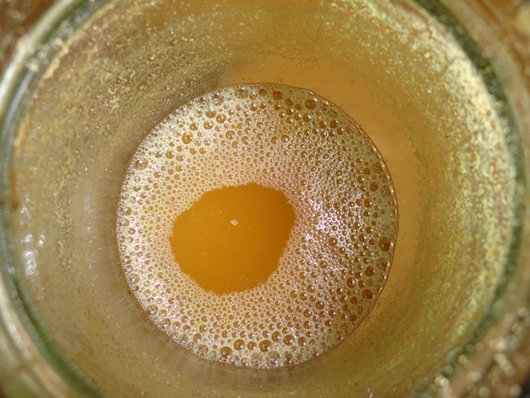
We had a nice supply of ginger beer going over Christmas. It's a delicious soft drink for young and old, although there is an alcoholic version that can be made with a slight variation on the recipe. Ginger beer is a naturally fermented drink that is easy to make - with ginger beer you make a starter called a ginger beer plant and after it has fermented, you add that to sweet water and lemon juice. Like sourdough, it must ferment to give it that sharp fizz. To make a ginger beer plant you'll need ginger - either the powdered dry variety or fresh ginger, sugar, rainwater or tap water that has stood for 24 hours to allow the chlorine to evaporate off. You'll also need clean plastic bottles that have been scrubbed with soap, hot water and a bottle brush and then rinsed with hot water. I never sterilise my bottles and I haven't had any problems. If you intend to keep the ginger beer for a long time, I'd suggest you sterilise your bottles. MAKING THE STARTER In a...
Image

NOT the last post

This will be my last post here.  I've been writing my blog for 18 years and now is the time to step back. I’ve stopped writing the blog and come back a couple of times because so many people wanted it, but that won’t happen again, I won’t be back.  I’ll continue on instagram to remain connected but I don’t know how frequent that will be. I know some of you will be interested to know the blog's statistics. 
Image

How to make cold process soap

I'm sure many of you are wondering: "Why make soap when I can buy it cheaply at the supermarket?" My cold process soap is made with vegetable oils and when it is made and cured, it contains no harsh chemicals or dyes. Often commercial soap is made with tallow (animal fat) and contains synthetic fragrance and dye and retains almost no glycerin. Glycerin is a natural emollient that helps with the lather and moisturises the skin. The makers of commercial soaps extract the glycerin and sell it as a separate product as it's more valuable than the soap. Then they add chemicals to make the soap lather. Crazy. Making your own soap allows you to add whatever you want to add. If you want a plain and pure soap, as I do, you can have that, or you can start with the plain soap and add colour, herbs and fragrance. The choice is yours. I want to add a little about animal and bird fat. I know Kirsty makes her soap with duck fat and I think that's great. I think t...
Image

Preserving food in a traditional way - pickling beetroot

I've had a number of emails from readers who want to start preserving food in jars but don't know where to start or what equipment to buy.  Leading on from yesterday's post, let's just say up front - don't buy any equipment. Once you know what you're doing and that you enjoy preserving, then you can decide whether or not to buy extra equipment. Food is preserved effectively without refrigeration by a variety of different methods. A few of the traditional methods are drying, fermentation, smoking, salting or by adding vinegar and sugar to the food - pickling. This last method is what we're talking about today. Vinegar and sugar are natural preservatives and adding one or both to food sets up an environment that bacteria and yeasts can't grow in. If you make the vinegar and sugar mix palatable, you can put up jars of vegetables or fruit that enhance the flavour of the food and can be stored in a cupboard or fridge for months. Other traditional w...
Image

Cleaning mould from walls and fabrics

With all this rain around we've developed a mould problem in our home. Usually we have the front and back doors open and that good ventilation stops most moulds from establishing. However, with the house locked up for the past week, the high humidity and the rain, mould is now growing on the wooden walls near our front door and on the lower parts of cupboards in the kitchen. Most of us will find mould growing in our homes at some point. Either in the bathroom or, in humid climates, on the walls, like we have now. You'll need a safe and effective remedy at some point, so I hope one of these methods works well for you. Mould is not only ugly to look at, it can cause health problems so if you see mould growing, do something about it straight away. The longer you leave the problem, the harder it will be to get rid of it effectively. If you have asthma or any allergies, you should do this type of cleaning with a face mask on so you don't breathe in any spores. Many peopl...
Image

Five minute bread

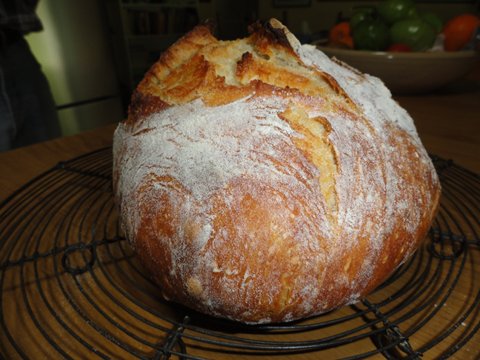
Bread is one of those foods that, when made with your own hands, gives a great deal of satisfaction and delight. It's only flour and water but it symbolises so much. I bake bread most days and use a variety of flours that I buy in bulk. Often I make a sandwich loaf because we use most of our bread for lunchtime sandwiches and for toast. Every so often I branch out to make a different type of loaf. I have tried sour dough in the past but I've not been happy with any of them. I'll continue to experiment with sour dough because I like the idea of using wild yeasts and saving the starter over a number of years to develop the flavour and become a part of the family. However, the loaf I've been branching out to most often is just a plain old five minute bread. By five minutes I mean it takes about five minutes actual work to prepare but it's the easiest of all bread to make and to get consistently good loaves from. If you're having people around for lunch or...
Image

This is my last post.

I have known for a while that this post was coming, but I didn't know when. This is my last post. I'm closing my blog, for good, and I'm not coming back like I have in the past.  I've been writing here for 16 years and my blog has been many things to me. It helped me change my life, it introduced me to so many good people, it became a wonderful record of my family life, it helped me get a book contract with Penguin, and monthly columns with The Australian Women's Weekly and Burke's Backyard . But in the past few months, it's become a burden. In April, I'll be 75 years old and I hope I've got another ten years ahead. However, each year I'll probably get weaker and although I'm fairly healthy, I do have a benign brain tumour and that could start growing. There are so many things I want to do and with time running out, leaving the blog behind gives me time to do the things that give me pleasure. On the day the blog started I felt a wonderful, h...
Image

What is the role of the homemaker in later years?

An email came from a US reader, Abby, who asked about being a homemaker in later years. This is part of what she wrote: "I am a stay-at-home mum to 4 children, ages 9-16. I do have a variety of "odd jobs" that I enjoy - I run a small "before-school" morning drop-off daycare from my home, I am a writing tutor, and I work a few hours a week at a local children's bookstore. But mostly, I cherish my blissful days at home - cooking, cleaning (with homemade cleaners), taking care of our children and chickens and goats, baking, meal-planning, etc. This "career" at home is not at all what I imagined during my ambitious years at university, but it is far more enriching. I notice, though, that my day is often planned around the needs of my family members. Of course, with 4 active kids and a husband, this is natural. I do the shopping, plan my meals, cook dinner - generally in anticipation of my family reconnecting in the evening.  I can't h...
Image

Every morning at home

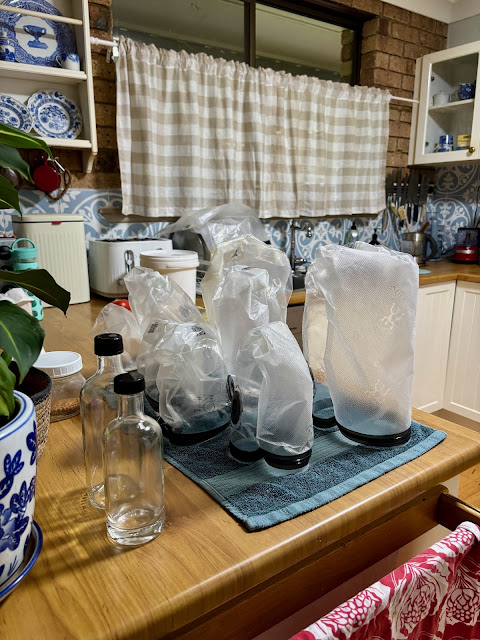
Every morning when I walk into my kitchen it looks tidy and ready for a day's work. Not so on this morning (above), I saw this when I walked in. Late the previous afternoon when I was looking for something, I came across my rolled up Zwilling vacuum bags and decided they had to be washed and dried. So I did that and although I usually put them outside on the verandah to dry it was dark by then. I turned the just-washed bags inside out and left them like this on a towel. It worked well and now the bags are ready to use when I bring home root vegetables, cabbages or whatever I buy that I want to last four or five weeks.
Image

You’ll save money by going back to basics

When I was doing the workshops and solo sessions, I had a couple of people whose main focus was on creating the fastest way to set up a simple life. You can't create a simple life fast, it's the opposite of that It's not one single thing either - it's a number of smaller, simpler activities that combine to create a life that reflects your values; and that takes a long to come together. When I first started living simply I took an entire year to work out our food - buying it, storing it, cooking it, preserving, baking, freezing, and growing it in the backyard. This is change that will transform how you live and it can't be rushed.  
Image

All previous blog posts

  • 2026 3
    • February 3
      • Workshops starting 1 March
      • Planting vegetable seeds and new workshops
      • Back where we belong
  • 2025 7
    • July 1
    • June 2
    • May 1
    • April 2
    • February 1
  • 2024 25
    • December 2
    • November 1
    • October 2
    • September 3
    • August 1
    • July 3
    • June 1
    • May 3
    • April 2
    • March 3
    • February 2
    • January 2
  • 2023 13
    • December 1
    • November 2
    • October 1
    • September 3
    • August 2
    • February 2
    • January 2
  • 2022 17
    • November 3
    • October 4
    • September 3
    • August 2
    • July 3
    • June 2
  • 2021 50
    • December 1
    • November 6
    • October 7
    • September 5
    • August 4
    • July 5
    • June 2
    • May 2
    • April 6
    • March 4
    • February 4
    • January 4
  • 2020 68
    • December 3
    • November 5
    • October 4
    • September 4
    • August 4
    • July 4
    • June 4
    • May 8
    • April 7
    • March 8
    • February 8
    • January 9
  • 2019 66
    • December 2
    • November 4
    • October 5
    • August 3
    • July 4
    • June 6
    • May 8
    • April 8
    • March 8
    • February 11
    • January 7
  • 2018 82
    • December 1
    • September 2
    • August 10
    • July 4
    • June 11
    • May 9
    • April 12
    • March 10
    • February 10
    • January 13
  • 2017 129
    • December 7
    • November 10
    • October 6
    • September 13
    • August 11
    • July 13
    • June 12
    • May 9
    • April 9
    • March 14
    • February 11
    • January 14
  • 2016 125
    • December 7
    • November 13
    • October 10
    • September 11
    • August 11
    • July 8
    • June 9
    • May 9
    • April 12
    • March 10
    • February 13
    • January 12
  • 2015 184
    • December 7
    • November 15
    • October 20
    • September 18
    • August 19
    • July 18
    • June 12
    • May 15
    • April 12
    • March 21
    • February 13
    • January 14
  • 2014 203
    • December 11
    • November 8
    • October 17
    • September 20
    • August 17
    • July 19
    • June 17
    • May 17
    • April 23
    • March 15
    • February 18
    • January 21
  • 2013 225
    • December 13
    • November 17
    • October 17
    • September 17
    • August 21
    • July 24
    • June 20
    • May 19
    • April 17
    • March 22
    • February 17
    • January 21
  • 2012 245
    • December 17
    • November 20
    • October 20
    • September 18
    • August 15
    • July 24
    • June 21
    • May 26
    • April 23
    • March 23
    • February 19
    • January 19
  • 2011 257
    • December 18
    • November 24
    • October 27
    • September 23
    • August 24
    • July 21
    • June 24
    • May 24
    • April 16
    • March 22
    • February 14
    • January 20
  • 2010 283
    • December 20
    • November 18
    • October 18
    • September 19
    • August 25
    • July 24
    • June 25
    • May 26
    • April 25
    • March 22
    • February 29
    • January 32
  • 2009 293
    • December 29
    • November 18
    • October 23
    • September 25
    • August 22
    • July 28
    • June 22
    • May 21
    • April 27
    • March 26
    • February 24
    • January 28
  • 2008 387
    • December 24
    • November 23
    • October 25
    • September 26
    • August 27
    • July 27
    • June 37
    • May 34
    • April 44
    • March 53
    • February 32
    • January 35
  • 2007 372
    • December 37
    • November 40
    • October 55
    • September 51
    • August 49
    • July 63
    • June 49
    • May 28


Trending Articles

NOT the last post

This will be my last post here.  I've been writing my blog for 18 years and now is the time to step back. I’ve stopped writing the blog and come back a couple of times because so many people wanted it, but that won’t happen again, I won’t be back.  I’ll continue on instagram to remain connected but I don’t know how frequent that will be. I know some of you will be interested to know the blog's statistics. 
Image

Every morning at home

Every morning when I walk into my kitchen it looks tidy and ready for a day's work. Not so on this morning (above), I saw this when I walked in. Late the previous afternoon when I was looking for something, I came across my rolled up Zwilling vacuum bags and decided they had to be washed and dried. So I did that and although I usually put them outside on the verandah to dry it was dark by then. I turned the just-washed bags inside out and left them like this on a towel. It worked well and now the bags are ready to use when I bring home root vegetables, cabbages or whatever I buy that I want to last four or five weeks.
Image

You’ll save money by going back to basics

When I was doing the workshops and solo sessions, I had a couple of people whose main focus was on creating the fastest way to set up a simple life. You can't create a simple life fast, it's the opposite of that It's not one single thing either - it's a number of smaller, simpler activities that combine to create a life that reflects your values; and that takes a long to come together. When I first started living simply I took an entire year to work out our food - buying it, storing it, cooking it, preserving, baking, freezing, and growing it in the backyard. This is change that will transform how you live and it can't be rushed.  
Image

Creating a home you'll love forever

Living simply is the answer to just about everything. It reduces the cost of living; it keeps you focused on being careful with resources such as water and electricity; it reminds you to not waste food; it encourages you to store food so you don't waste it and doing all those things brings routine and rhythm to your daily life. Consciously connecting every day with the activities and tasks that create simple life reminds you to look for the meaning and beauty that normal daily life holds.  It's all there in your home if you look for it. Seemingly mundane tasks like cleaning and cooking help you with that connection for without those tasks, the home you want to live in won't exist in the way you want it to.  Creating a home you love will make you happy and satisfied.
Image

Time changes everything

I've been spending time in the backyard lately creating a contained herb and vegetable garden. My aim is to develop a comfortable place to spend time, relax, increase biodiversity and encourage more animals, birds and insects to live here or visit. Of course I'd prefer my old garden which was put together by Hanno with ease and German precision. Together, we created a space bursting at the seams with herbs, vegetables and fruity goodness ready to eat and share throughout the year. But time changes everything. What I'm planning on doing now, is a brilliant opportunity for an almost 80 year old with balance issues. In my new garden I'll be able to do a wide range of challenging or easy work, depending on how I feel each day. It’s a daily opportunity to push myself or sit back, watch what's happening around me and be captivated by memories or the scope of what's yet to come.
Image

It's the old ways I love the most

I'm a practical woman who lives in a 1980’s brick slab house. There are verandahs front and back so I have places to sit outside when it's hot or cold. Those verandahs tend to make the house darker than it would be but they're been a great investment over time because they made the house more liveable. My home is not a romantic cottage, nor a minimalist modern home, it's a 1980’s brick slab house. And yet when people visit me here they tell me how warm and cosy my home is and that they feel comforted by being here. I've thought about that over the years and I'm convinced now that the style of a home isn't what appeals to people. What they love is the feeling within that home and whether it's nurturing the people who live there.
Image

Back where we belong

Surprise! I'm back ... for good this time. Instagram became an impossible place for me. They kept sending me messages asking if I'd make my page available for advertisers! Of course, I said no but that didn't stop them. It's such a change from what Instagram started as. But enough of that, the important part of this post is to explain why I returned here instead of taking my writing offline for good. For a few years Grandma Donna and I have talked online face-to-face and it's been such a pleasure for me to get to know her. We have a lot in common. We both feel a responsibility to share what we know with others. With the cost of living crisis, learning how to cook from scratch, appreciate the work we do in our homes, shop to a budget and pay off debt will help people grow stronger. The best place to do that is our blogs because we have no advertising police harassing us, the space is unlimited, we can put up tons of photos when we want to and, well, it just feels li...
Image

Making ginger beer from scratch

We had a nice supply of ginger beer going over Christmas. It's a delicious soft drink for young and old, although there is an alcoholic version that can be made with a slight variation on the recipe. Ginger beer is a naturally fermented drink that is easy to make - with ginger beer you make a starter called a ginger beer plant and after it has fermented, you add that to sweet water and lemon juice. Like sourdough, it must ferment to give it that sharp fizz. To make a ginger beer plant you'll need ginger - either the powdered dry variety or fresh ginger, sugar, rainwater or tap water that has stood for 24 hours to allow the chlorine to evaporate off. You'll also need clean plastic bottles that have been scrubbed with soap, hot water and a bottle brush and then rinsed with hot water. I never sterilise my bottles and I haven't had any problems. If you intend to keep the ginger beer for a long time, I'd suggest you sterilise your bottles. MAKING THE STARTER In a...
Image