down to earth

  • Home
  • About Us
  • Down To Earth Book
  • Privacy Policy
My life seems to be nicely balanced at the moment. I have days at home when I cook, garden, write, sew, knit and relax and just when I feel the need to talk to outsiders again, Monday comes around and I have a few days at work. Then, I satisfy the need to connect with others, I contribute to my community, I feel useful and that the time time spent away from my home life has been meaningful and valuable. And just as my cup starts to overflow and I need a break from that ...

I come home to this ...


Contentment: Happiness with one's situation in life.

I am happy here. I live with a happy and generous husband. I feel that everyday is its own golden capsule full of meaningful work that gives me a life worth living. Of course, not everything is perfect. I neither expect nor want perfection. But when the tomatoes develop wilt and die too early, or the caterpillars survive the winter and continue munching their way through the cabbages, I take that in my stride because, overall, things are as they should be and I feel I am doing my best.


I took my camera into the garden yesterday afternoon, because I know my blog friends like to see our little vegetable garden. Below are the only tomatoes to survive the wilt. My precious pink Brandywines yielded about 10 kilos of delicious, juicy tomatoes, then turned their toes up and died of wilt. These smaller Tommy Toe tomatoes seem to be immune to the disease and hopefully will keep us in tomatoes until we get some larger ones fruiting again.


Further over, spaces are getting bigger as we harvest vegetables for our table every day. Some vegetables are eaten raw, some are cooked and some are blanched and frozen for later in the year. Today some of these cauliflowers will be picked to make mustard pickles. When the days start to warm up, we'll be eating those pickles on a good sharp local cheese and home baked rye bread.


There is still a forest of kale there, even though Hanno has just finished his five day pot of pork and kale. I haven't frozen kale before but there is so much growing now I think I'll look into that. Does anyone here freeze kale? If so, is it just the normal blanching routine before sealing?


As I wandered around our little garden, I was accompanied by Rosetta, our almost human golden spangled Hamburg chicken. She doesn't damage the garden at all, she is just pleased for the human company and will follow Hanno or I around the yard, clucking gently and hoping to be picked up.


Another item of work today will be to pick the bulk of this chard and freeze it. We eat a lot of chard (silverbeet) , below you can see rhubarb chard and green chard, further over, we have the old fashioned swiss chard. We call that silverbeet in Australia.


Right next to the chook run we have snowpeas growing along with silverbeet, lazy housewife beans, cabbages, cauliflowers, lettuce, celery, welsh onions and herbs. That is my favourite part of the garden and I often stand there talking to the chooks.


I was surprised to find peaches already growing on our tree yesterday, and it's only mid winter. The peach blossoms are filling the evening air with a sweet perfume and when I wander around the garden then, I swear it fills my heart and soul to its limits.


I always plant flowers in the vegetable garden. It adds to the overall beauty and encourages bees to pollinate the fruiting plants. The flowers above are little daisies that are growing next to the bok choi.

This is more than a garden. It it a place to connect with the natural world, to reflect and renew my spirit, and being able to eat what we grow there is simply the icing on the cake. I can't imagine a frugal life without a garden. It gives us tasty organic food for the price of seeds and the time we take to cultivate it. If you have the space for it, I encourage you to grow a garden, it will give you vegetables and it will also grow your spirit.

I hope you had a good week and are looking forward to a restful weekend. Thank you for visiting me here, I appreciate the time you take to read what I write and I love reading your comments. Welcome to the new readers who arrived this week. Please take the time to say hello.

There is so much one could write concerning water conservation. Everyone uses water. We all need it to survive and yet it's one of those things that we don't take a lot of notice of until we have to. As you know, we harvest and store as much water as we can on our property. It is used outside on the animals, chickens and garden. Inside, we use our town water supply but we are extremely frugal with every drop. Water is easy to use and waste. I found this list that shows just how much common household activities use. That is a lot of water running down the drain.
Brushing teeth with tap running 5 litres 1.1 gallons
Flushing toilet on a dual single flush 5 litres 1.1 gallons
Flushing toilet on a dual full flush 10 litres 2.2 gallons
A load in the dishwasher 50 litres 10.9 gallons
A 5 minute shower 100 litres 21.9 gallons
Hosing the driveway 100 litres 21.9 gallons
A load in the washing machine 150 litres 32.9 gallons
Washing car with hose 200 litres 43.9 gallons
Garden sprinkler per hour 1000 litres 210 gallons

There is another list of water usage here. There are level 5 water restriction in our capital city of Brisbane. People are required to use less than 140 litres per person. We use much less than that and we have found it quite easy to do it.

I think there are three ways you can go on this:
  1. If you don't have a garden and only use water indoors, then the obvious thing to do is to work out a good way to cut down on your water usage inside your home.
  2. Like us, you could harvest your rainwater, store it in tanks and use it for all your outdoor needs and team this with a water conservation program inside.
  3. You could harvest rainwater and have your tank water plumbed into your home to flush toilets, or if you have enough water, for all your indoor needs. You would probably also team this with frugal water usage.
You can monitor how much water you use by learning how to read your water meter. If you're in Australia you can learn how here and here. There is information here and here for my USA friends, and here and here for my UK friends.

If you are living in an area with high air pollution or there are a lot of birds or wildlife that can get on your roof, you may be able to install a first flush diverter that will run-off the first flush of water from your roof, then divert the flow after that to your tank. This will help you with water purity if you intend to drink the water you harvest. Here is a guide to maintaining a healthy water tank.

General maintenance requires that you check for leaks and make sure your mosquito screens are in place and not blocked with leaves or other debris. You'll also need to keep your roof guttering clear of debris. If you own a plastic tank, every few years, whenever your tank is empty, or close to it, you should tip the tank over, hose it out and reconnect it. There is information about desludging and cleaning your tank here.

Size of various types of Australian water tanks are here, check the Slimline and Transport types too. The links are on the right. Mrs T, although these might not be available in Israel, it will give you and Mr T an idea of what is in common use here. There are space saving water tanks here.

How can I make sure that my water is safe to drink? from here.
The following simple precautionary measures can significantly reduce the likelihood of harmful
microorganisms or chemicals being a problem in your water supply.
  • Collect and store your water so that contamination from human, chemical or animal sources is minimised. If possible, store drinking water in an above ground tank rather than in an underground tank.
  • Ensure that surface runoff, channel water, irrigation water, leakage from sewer pipes, sullage drainage or shallow underground seepage cannot enter your drinking water supply.
  • Make sure that any deep bore used as a source of drinking water is properly encased, with an above ground wellhead. A deep bore should ideally be located at least 250 metres away from any sources of pollution likely to affect groundwater quality.
  • Do not collect water for drinking from recently painted roofs, timber roofs preserved with chemicals, roofs coated with lead-based paints or tar-based coatings, or parts of roofs near flues from solid wood heaters. Most other roof types will normally be safe for water collection, provided they are kept clean.
  • Regularly clean your roof and gutter to remove leaves, animal or bird remains, dust and other debris. Install simple screens between your roof and the water tank.
  • The first rainfall after a dry period usually collects most of the contaminants on your roof.
  • Installing a ‘first flush’ or other diversion system will prevent this water from entering your water tank. This ‘first flush’ water can be stored separately and used for yard washing, garden watering or fire fighting.
  • If your house is in an agricultural area where there is a risk of being oversprayed by aerial chemical spraying, divert the collection pipe from your rainwater tank to prevent any pesticides from entering the tank. Clean the roof or wait until after the next rainfall before reconnecting your drinking water tank to your roof.
  • Maintain screens on the inlet and overflow openings of your water tank so that insects, small animals, birds and sunlight can not enter (this will also help to minimise the growth of algae).
  • Regularly maintain your water tank and clean out accumulated sludge from the floor.
  • Ensure that your domestic drinking water plumbing is completely separate from all other plumbing or pipe systems on your property. Use approved safe plumbing materials and ensure that all pipe joints are properly sealed.
  • Disinfect your water supply to kill any harmful microorganisms.
If you live in a bushfire zone, you'll need to give your tank some care after each fire. There is information about that here.

You should cover your water tank as algae will grow in water that is allowed to sit in the sun. All openings should be protected from mosquitoes with fine screening.

How many of you are monitoring your water usage now? Can you read your meter? Although water meters are on most Australian homes I am aware that this is not the case in all homes. Do you have access to your meter? This is an important part of every simple life and I'd be very interested knowing how you intend cutting back your water usage.


One of the questions I am often asked in emails is: "I am trying to reduce the amount of plastic I use but I can't seem to find a way to get rid of the plastic bin liner. Any ideas?" This is difficult to answer because it really depends on the type of rubbish you're putting into the bin.

A good way to deal with the problem of garbage is to reduce the amount of packaging you bring into your home. I won't buy anything that is over packaged now, and I try to find someone in the store to explain that I want the product but won't buy it because it's over packaged. The more people who do this the better, otherwise manufacturers don't know. I won't buy little packets of anything that are packaged in a bigger pack; I try to buy large containers to decant into smaller ones at home and long ago I gave up on those packs of biscuits (cookies) and chocolates that are individually wrapped, placed in a plastic tray, in a box, covered with cellophane. pfffffffft! My general strategy on packaging is to buy in bulk when I can, buy products stored in paper, cans or glass. If it's in plastic I always check what type of plastic it is and if it's recyclable in my area, I buy it.


Save old bottles and jars for your preserves and cordials. If you buy a larger pack of something like coffee or tea, use your old clean jars to store the product when it's opened.

Not every local area recycles every type of plastic. You need to check your own shire council or local authority to know what it is they recycle. If you're in Australia, click here to check your nearest recycle station. If you click here, you will see what types of paper, cardboard and plastic my local rubbish dump accepts. You should do a Google search for your own recycle station and rubbish dump. There you will find out exactly what they accept and you can monitor your shopping to buy only that type of packaging.

A great side benefits of making compost, keeping chickens and dogs and having a worm farm is that most food scraps and vegetable waste is used to feed them. All our garden waste is given to either the chooks, the worms or the compost. Food scraps go to the dogs, worms or chooks. Our paper products and plastics are recycled - we have a special bin supplied by our council that is collected every second week. Our recycle station also accepts old computers, mobile phones, printers etc and they have information of their website about how to correctly dispose of oil and batteries.


As you can see, we don't have a lot of rubbish and what we do have is dry waste so it goes straight into the bin, without a liner. If I have a lot of smaller items, I wrap them in newspaper and put them in the bin. You could do this with your moist waste if it's not too wet and you use a few sheets of paper. So that is the short answer to the question of plastic bin liners - you can either line the bin with newspaper, or wrap the waste in newspaper parcels.

But the overall answer is to reduce your waste. This is one of the important things you will do in your simple life and it's vital you work out your own strategy for dealing with your household waste. Start by checking out your local area websites so you know what they recycle, then look at your own garbage and work out what you are throwing out. Then make a plan to reduce, reuse and recycle. Everyone's plan will be different but this is an area that we can all share what works for us in the comments section. Please let us know what you do, because I am always looking to improve what I do and I am sure there are many others who are working on this same problem.


"Hmmm, I wonder if there's anything to eat in there."

We have water containers everywhere. They stand like sad reminders of the drought our country is experiencing right now. When we moved to this house 11 years ago, the first thing we did was install a water tank, now we've moved to a state where, if there is a downpipe, there is a bucket or some other container under it to collect whatever runs off the roof. We don't have water restrictions here, but the shires surrounding us do, so we have restricted our own water usage in preparation for the time ahead when we will be legally bound to do it.


Currently we have two tanks that hold 15,000 litres (about 4000 gallons). These tanks are used to water the garden and for fresh water for the animals and chooks. I also use this water for soap making and washing vegetables before they come into the house. Sometimes I drink this tank water, untreated. There are health warnings in Australia that say not to drink tank water but I know people who have lived on untreated tank water all their lives and in their 90th year they are still walking around, the picture of good health. I doubt I'd drink untreated tank water if I lived in a city though. My home is on the edge of a huge pine forest, in a semi-rural area, and there is little air pollution here.


Last weekend, Hanno had to go to the hardware store to pick up supplies for a lattice screen he is building in the backyard. While he was there he noticed a little tank that had been reduced to $49. It was the last one in the store, so he quickly purchased it and had the store hold it for him while he came home to get our trailer. An hour later he rolled in with it. It's the green tank Rosie is sniffing in the first photo. It hold 500 litres, not much, but enough to water our front yard potatoes and avocado trees.


Hanno installed it on a front downpipe, just near our garage. About an hour after it was collected, it started raining. It's not full yet but it's holding about 200 litres, more than enough to keep the potatoes going when they dry out after the rain that fell on the weekend.

Water is a big part of vegetable gardening. If you're growing food for the first time make sure you have easy access to water and if you can, harvest water from your roof and store it for the garden. If you're a seasoned gardener and haven't yet thought about harvesting water for your garden, it would be a valuable exercise to check your water consumption, then look to ways to save whatever water you can. Start small, with buckets, the next time it rains and work up from that. Many of us don't have water restrictions but you are probably paying for water. After an initial investment, water tanks and barrels will save you money. If you're living in Australia, enquire at your local council to see if they offer rebates on tanks. Many do. Here is info about the rebates in Queensland.

Water is another resource we need to conserve. Back in the old days, saving water was an important, life saving skill everyone had. We need to move back toward the knowledge that we should all be saving whatever we can. The days of mass water waste are over.

I get the impression sometimes that a few of my friends here think I'm a bit of a saint, and that I selflessly work from daylight to dusk to provide my family with their needs. While there is an element of truth in that statement, there are times when all I want to do is nothing.

And that is what I did do on Saturday.

It was a cold and gloomy day and I started off replying to a few emails but there were so many I gave up and organised my desk instead. That didn't feel right either so I looked around for something to do - it was still dark and I wanted to work in silence - I found my knitting. It was then I decided that it was time for a day off.

I made porridge for breakfast, I made bread and soup for dinner, I made the bed, but that was all I did. The rest of the day I swanned around taking photos, reading, knitting and napping. I am better for it. I feel refreshed and ready for everything now. It is surprising just how good a day of nothing feels.

That is Rosie on the left. She is watching Rosetta who has decided that she much prefers the company of dogs and humans to that of her sisters. She's a funny chook and Hanno spoils her by carrying her around and letting her sit INSIDE the grain bin. Yes, inside the bin. She scratches around in there picking out pieces of choice grain and when she has her fill, she flies out and wanders around with Alice and Rosie.

Hanno did his own cooking on Saturday. It was his kale and pork day and he made up a big pot of it, enough for about five meals. It slotted in perfectly with my workless day. Here he is on the back verandah with Alice. Hettie, our cat, is asleep behind him on the green bench.

He is inspecting each leaf of kale for bugs. He then strips the green off the stalk and places it in another bucket. When the whole lot is done, he takes it inside for washing, chopping and cooking.

Like many men, Hanno has his meal favourites and kale and pork is the food he loves most in Winter. It reminds him of living in Germany, and his mum, and I think the smell of it cooking during the day and the memories that invokes is as much a part of the experience as sitting down to eat is.

It's a good experience for me too. I love to see the process of vegetables being harvested, prepared fresh and made into good healthy food for the table. It's not so much the single elements of gardening and how we live that I enjoy, it's the connection of all those elements that make it into something more - that is what gives me pleasure and satisfaction. Of course it's a wonderful thing to see vegetables growing in a garden but when you see those vegetables used for their purpose, when they are harvested and cooked to provide nutrition; that connection of elements is what is significant. The completed circle, combining our skills with what we are able to produce in the backyard, that is what makes my life a joy. That, and knowing we can do it.


We have recently spread our food production from the backyard to the front. We have been growing two avocado trees in the front garden, and have at times grown tomatoes there, but now we've moved up a notch and have planted potatoes along the front drive. You can see them in this photo as they've just started to show their green tops in the straw mulch.

We are lucky to have the amount of land we have. It's not huge by any stretch of the imagination, we have an acre, but it is certainly enough to provide us with the food we need. We are also blessed with the amount of rainfall we get. If we are prudent, we can harvest enough water from our roof to enable us to continue growing food, and to provide enough fresh water for ourselves, the chooks and animals. Being self sufficient in one of the things we must have is very empowering.

I wonder though if, with climate change, that will remain as it is. Australia is in the midst of the worst drought in our history and we are reminded of that fact every day as our state government is currently building a huge pipeline to carry water from our local dams into our capital city, about 100 kms south. That pipeline is being built quite close to our home and although we can't see the work being carried out, we can hear trucks working every day. It's a powerful reminder that we are all responsible for the harvesting and storage of water on our own properties and that when we have more than enough, and even when we don't, we share what we have.

I hope you have a wonderful week. I am moving into this week with a feeling of optimism and joy. I hope you feel something similar in your own life and that we all look back on this week as a good one.

Dana over at Old Red Barn is having a giveaway. The prize is a quilt! There are no photos yet but the photos of her first quilt giveaway are fabulous. You can read all about it here on Dana's blog. It is wonderful to see such generous giveways. Thank you Dana.
The pincushion, needle book/water bottle holder swap seems to be going well after a little bit of tweaking and sorting out swap buddies. As always, if there are any problems, please e-mail me at: cdetroyes at yahoo dot com and I will do my best to fix the problem. I am still gathering tutorials, blog sites, e-zines, and blogs for knitting and crochet help, patterns and ideas. I had no idea there were so many and always visit the links before I give them to you so it will be next week-end before I post the list. I would, however, like to leave you with a couple more sewing links: the first is a site that gives a lot of information on textile arts and sewing tips: http://www.lindrix.com/index.html and the second is a tutorial for making your own microwave heating packs for all those aches and pains, for keeping tootsies warm in cold weather or for wonderful home-made gifts, especially if you vary the essential oils. Rose, vanilla, lavender for calming, eucalyptus and mint for colds and flu, or your own personal favorite scent or combination can personalize each heating pack: http://creativeoutletdesigns.blogspot.com/2007/12/diy-wheat-sacks-tutorials.html Until next week-end, happy swapping and have fun creating your own home-made life. Sharon


There was a real nip in the air when I got out of bed yesterday. It was only 5 C (41 F) and when the sun came up the sky was bright blue, with not a cloud to be seen. It was windy and cold all day, the perfect day to stay indoors and knit, but, like most days, there was work to be done. We had hot porridge for breakfast, and as usual, I made enough for Hanno and I, the dogs and the chooks. It's a treat the chickens look forward to on these cold mornings and it fills their little bellies up with warm carbohydrates to keep them clucking and scratching happily all morning.


With breakfast over, I tidied up the kitchen, made the bed and cleaned the bathroom. I am using my soap and old terry towelling rags for most of the wet kitchen cleaning nowadays. That soap really cuts through food spills and any grease on the stove, then it's just a quick wipe with a clean damp rag, and a polish with a dry one, and it's nice and clean again. With the kitchen clean, I set to making the bread. Yesterday's loaf was a wholemeal and rye mix with oats and sesame seeds on the top. I vacuumed the house - I do this about once a week or so, I sweep on other days. After the vacuuming, I washed the floors using hot water with a splash of my liquid soap and vinegar.

I spent an hour in the garden while the floors dried. Hanno was out there erecting some posts for a lattice screen we will have outside our bedroom windows. We'll grow food vines, like loofahs, cucumbers and beans, there in the summer to shade that wall from the western sun ,and leave it open in winter to let the sun in. We had a cuppa on the back porch and then I went to talk to the chooks and inspect the vegetable garden. The cucumbers are ready to come out, the kale is really high - Hanno will pick it today for his kale and meat fest, the snow peas are starting to produce little sweet pods and there are some beans hanging like temptresses in the breeze. I planted lazy housewife beans this year, they're very similar to the blue lakes, but I keep eating them fresh from the vines so we don't have enough for eating with our meals. ;- ) I pulled out a few plants, picked a cauliflower, baby silverbeet leaves and some herbs and came back inside to bake the bread for lunch.


After lunch I finished off my Warm Earth article and emailed it in, went in and looked at Shane's quilt and decided to knit instead. I bundled myself in my rosebud quilt and knitted while I watched Time Team. This week they were looking for an Anglo-Saxon palace, but didn't find it. To all the others out there who watch this wonderful program, I like Phil the best. And yes, he is very much like Worzel Gummidge (another favourite of mine). After my break I tidied the front verandah, pruned back the camellias and wrote emails.


Late in the afternoon, I hand washed some jumpers and set them to dry on the back verandah, then came in to prepare our meal. Last evening it was baby silverbeet, herbs and cheese omelettes. We are currently getting three eggs a day with only the Australorpes and Rhode Island reds laying, but that is enough for us. Soon, when the rest of the girls start, we'll be able to sell our excess eggs and that money will go towards their feed. I made some little raspberry and apple pastries for dessert that we had, with tea, after the omelette.

There have been times in my life when I didn't think about happiness. Those were the days when I didn't feel happy at all and I didn't know it was possible to actively seek it out. Two things have changed now. Now I live with happiness every day and although I know it is possible to find happiness, my happiness now finds me. To many people, that day spent in my home yesterday, working alongside my husband, doing the chores that provide our needs, would seem banal and tiresome. To me though it is a joy to be here. Our work provides us with the life we wish for ourselves. It isn't hard work by any means but it is life affirming and enriching, and when we go to bed each night there is satisfaction knowing that we made our own lives that day and tomorrow we will willingly get up and do again.


I met Hanno on my 28th birthday, we married when I was 31 and our first baby, Shane, was born a year later. Shane turns 28 next Tuesday. He has never brought any of his girlfriends home to meet us but a couple of weeks ago, we met his girl. She admired my dishcloth knitting that was beside my chair, she's fond of vegetable gardening and chooks and she's a really lovely girl. Next week she's leaving her job and part time university to move in with Shane. They will both work at the resort and live in a house on the property. There isn't a smiley face big enough to insert here so let's just say I'm a very happy mother.

That hasn't got much to do with today's post, I just had to tell my good news. We'll be driving over there to have lunch with them next week. I'll try to slip in this subject.

The Story of Stuff

If I was setting up a home today with the same sensibilities and knowledge I have in my head now, I'd reject much of the new made in China products and go for either second hand, hand made or good quality items that would last many years and be repaired when needed. I wish I could say I did that the first time around, or even the second, but you know my story and I was caught up in the conspicuous wealth syndrome back then and I bought things that looked good. I should have known better because I am a working class woman and I feel ashamed that I fell for the advertising hook, line and sinker.

I'm glad I changed.


One of my grandmothers was Swedish, so buried deep in my genes is a love of the Swedish style of painted furniture. This style of decorating a home relies on plain and simple old wooden furniture that is painted in beautiful tones of milky blue or green with bright splashes of red. Much of this furniture could be picked up on road side throw outs, bought at garage sales or in op shops, and repainted. Often chairs and couches are covered with homemade cotton covers that have been sewn to fit the shape. Not only is this a very frugal way of furnishing a home, it's also environmentally sound and it cuts out the Chinese middleman.


When it comes to appliances, I think it's better to buy new energy efficient, good quality items that are built to last and can be repaired. Curtains and soft furnishings can be home made and bit by bit you build your new home into something unique, and not the carbon copy of a thousand other houses nearby. When I look around my home now, I love my red and white curtains the most - they were made for me in my own home by my sister, Tricia. I like and value the curtains I hand made in my kitchen much more than the custom made ones I have in the loungeroom. Those kitchen curtains are "me", they symbolise my life now, the others are just a reflection of the money I used to earn. pffffffffffft!


The same applies to clothes. I used to buy all my clothes, now I make as much of it as I can. I still buy some things, but I plan on teaching myself how to make everything I need in the coming years. I really dislike all the cheap clothes that flood in from China. It's a false economy to think it's a bargain when what it is doing is harming our own manufacturing industries, and giving us more of everything, when what we need is less. I would like to see the manufacturers in Australia regain the strength they had in former years, when they produced good quality local products and even though they were more expensive, they lasted and built our local economy. We had less waste then because we didn't have the option to go to a department store and buy a cheap replacement that we would need to replace again a couple of years down the track.

I think the current economic climate will require more prudent consumption of almost everything, and that is a good thing. It's wiser now to pay off debt than to take it on. That is what I'll try to slip into our birthday conversation with Shane. It won't be a lecture, it will be gentle and linked to lifestyle instead of economics, but the result, I hope will be the same. When they embark on a new life together, I hope they won't fall for the McMansion-I have to have everything I want syndrome, and instead be mindful of a future with less debt and less waste.

Graphics from the Carl Larsen gallery.


From left, these chooks are Plymouth Rocks, a buff Orphington (at front), a buff Sussex, Faverolles (whitey at back) and Anne Shirley our New Hampshire.

Thank you all so much for your support, love and blessings yesterday. As I wrote then, it is not the writing, it's a feeling I get sometimes that I might be exposing our family too much. Hanno said I am worrying about nothing and to do what I feel is best, and my instinct is to just keep on blogging. However, when I get those horrible emails, I'm sure many of you get them, I wonder just who is reading my blog. I only get that type of email at the email address I post on this blog. Everyday there are several emails referring me to various sites and sometimes there are p orn links posted in the comments. Ugh. The writing itself is a breeze. I am a natural writer and it's something I need to do every day in one form or another. I guess it's a form of therapy for me. It's just what the writing brings that worries me at times.

But if I look at it like that, I also have to know that it brings me all of you, and that is a true blessing. I never thought my blog would become so popular. I see myself as an elder and with that, I believe, comes the responsibility to pass on what I know. Blogging, and the voluntary work I do, is the ideal way to do that, I just didn't know so many would want to know about my life. It's comforting, rewarding, exciting and scary all at the same time. So I'll just keep plodding along and see what happens. :- )

Someone asked a day or so ago about my thoughts on volunteer plants. For those who don't know, a volunteer plant is one that isn't planted on purpose but instead comes up from a random seed. Generally I like these plants and tend to leave them where they grow. However, I do that because I only grow open pollinated seeds and I know that every seed will produce a duplicate of its parent plant. If you're growing hybrid seeds they might not grow true to type and will often revert to one of the types used in the hybridisation. Usually that will give you something other than what you were hoping for. So if you're using only open pollinated or heirloom seeds, it will be fine, and if you need to you can move the plant to a more suitable place. Just wait until it has developed its true leaves and is nice and healthy and when you transplant, water it in with a seaweed solution. That helps with transplant shock.


This is Hanno's favourite chook, Rosetta, she is blind in one eye. Whenever she sees Hanno, she flies up and sits on his shoulder. Just recently she's taken to flying out of the chook run, walking to the back door - after she has stared down the dogs - and looking in the back door.

Gill asked yesterday about a soap making tutorial. It's here, Gill. If anyone wants to search this blog, there is a search option on the bar at the top of the screen. It's on the left side near the Blogger logo. You just type in the subject you're looking for and press the 'search blog' button next to it.

Recently I found a new Australian site called small footprints. There is a blog and forum and it looks like the beginnings of a valuable and interesting site. If you have a few spare minutes, check it out.

I was asked for the recipe of the copha soap. I'm sorry I forget who asked and it takes too much time to look, but here is what I used - the method is the same as that in the cold pressed soap tutorial - the link is above.

OLIVE OIL AND COPHA SOAP
Olive Oil - 500 grams
Copha - 4 blocks or 1 kg (2.2 lbs)
- melted slowly
Rain water - 550 mls
Lye (caustic soda) - 230 grams


It's confession time! There are days, like today, when I get up in the morning and can't be bothered writing. I feel overwhelmed sometimes, not with the writing, but with the knowledge that there are so many people looking into my life. Most of the time that's okay, some days it isn't.

I was not going to post this morning because I was feeling fragile but I just read the comments and you have won me over yet again with your thoughtful and generous words. Now I am compelled to write. Thank you.

Sharon J, I really liked your comment about being busy with your organising but you took time out to play with your kitten. Wise move. Kittens have a way of easing tension, don't they.

River, yes, just lightly brush the soap forms with vegetable oil.

Christine, I don't know if I would like Sex in the City or not, I haven't seen it, only the promotions. I doubt I'd like it though. I'd rather go and have afternoon tea with your mum. ;- )

Fifi, I just loved your comment. Happy birthday for yesterday! You really have got it. I watched the very end of the tennis - it's finished here at about 5.30am and it was really exciting.

Silversewer, it's good to know your OH is slowly recovering. Take care of yourself as well.

Jenny, my work makes me more thankful for Hanno and my boys too.

Terry, I don't see myself as vegetarian. We eat fish, we have a leather couch and wear leather shoes and Hanno eats meat sometimes. We do eat mainly grains, fruit and vegetables though. If you're thinking of moving to a meat free diet, I'd encourage you to buy a good recipe book that helps you understand what complete protein is - or essential amino acids. Meat is complete protein, vegetables are not, although there is protein in vegetables and fruit. Fruit and vegetables are incomplete protein, you need to combine your foods. For instance, baked beans on wholemeal toast in complete protein and a good example of combining one food with another to get what you require. I have this book, it's been a really good guide for me and it has some great recipes.

Katie, I love long comments. Your comment made me smile and was just what I needed this morning. It's okay if you don't agree with some of my reasons for change - we all come to it from different places. The important thing is that you're moving towards a a gentler life. I send my best wishes to you both and hope you find some posts here that will help you on your journey.

Amanda, it's small steps all the way, love. That's what I did and it worked well. Slowing down, organising your life and recognising your own happiness is a big part of this way of living. I think the most difficult part is the first step and I think you may have taken that. :- )

This is my low fat version of tuna bake. It's like a meat loaf only it's tuna, and very tasty.

TUNA LOAF
Large tin tuna
Vegetables - onions, spinach, celery, parsley
2 eggs
1 cup breadcrumbs
salt and pepper
1 tablespoon paprika OR curry powder


Into a bowl place all your ingredients and mix well. Make sure you break up all the tuna pieces.

Grease a loaf form and pack the tuna mix into it firmly. Top with tomato (optional).


And bake in the oven on 180C (350F) for about 25 - 30 minutes.


Serve with vegetables or a salad.


This lasts us two days. We have one day with a salad, one day with vegetables. It's also really tasty on a sandwich, just like cold meatloaf.

It's raining heavily here, but I love the cold rainy weather. I hope the weather isn't too harsh in your neck of the woods. Enjoy your day, I'll see you tomorrow. :- )

Hanno and I spent a peaceful weekend together working away on our various chores and watching a couple of TV shows that I recorded through the week. I really have no patience with TV now and find it difficult to watch unless I can fast forward through the advertising. I have to admit too that I find it difficult to understand sometimes. I have never watched the popular programs like Sex in the City or Lost and I find that if I come across them in a promotion, I wonder what on earth they're talking about. Maybe that's my age playing a part or maybe it's a cultural thing because sometimes I do have problems understanding an American accent, especially if it's being spoken fast, as a lot of what I hear is. I mean no offence to any of my American friends. I find I can always understand the southerners, is that because they speak slower?

Anyhow, my favourite programs at the moment are the ABC's The Cook and the Chef and the Book Show, and Time Team, that strangely addictive English program about digging up the ancient past. So my love and I settled in together to watch those programs as the rain fell on the roof, and there under the fleecy rosebud quilt he gave me for my birthday, and with our hot cuppas and just cooked banana and walnut cake, we enjoyed a couple of hours away from the wet coldness outside. I finished off one dishcloth and started on another and Hanno flicked through the Weekend Australian as we watched.


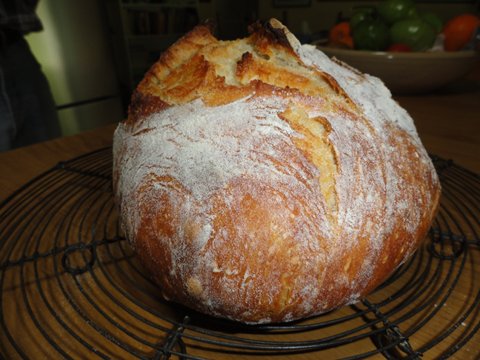
As usual, there was hot bread for lunch, mine with brandywine tomato and fresh cucumber, Hanno's with quark and avocado. You can see Saturday's loaf above, I was just finishing off the rolling out of it when my sister Tricia rang from Sydney to say goodbye. She left for a holiday in Germany and Sweden yesterday so we talked about her plans while I fumbled the dough into the bread tin and placed it in the oven. When the bread was baked there was that big bump coming out the side that you can see in the photo above. Very odd.

And here are the brandywines and cucumbers just after they were harvested. I brought in about 5 kilos (10.5 lbs) of them as well as six cucumbers and a cauliflower.


I did a few lines of sewing on Shane's quilt and hope to have it finished by his birthday, July 15, so we can take it with us when we have lunch to celebrate his 28th birthday. He lives about three hours drive away from us, in a very cold part of the country that is generally below freezing on winter mornings. I think he will welcome an extra quilt and I hope he sees the special things I've sewn into it for him. Actually, for those of you in the south east of Queensland, Shane was on TV last Saturday afternoon. He works at the Peppers Spicers Ridge resort and was filmed in the kitchen cooking, as part of a segment on the resort. You might have seen him.

I made soap on the weekend too. Most of this will go to my sons. They both love my soap and it will be part of their birthday gifts. This one is a olive soap and copha soap. (Copha is a solid block of coconut oil and soy lecithin.) It's the first time I've made soap with copha but it worked well. It took longer to reach trace - about 15 minutes - but it's made up into a nice soap that has a good firm feel to it. I'll dry it on this rack for a couple of weeks, turning it every two days, them wrap it up with raffia and special personalised wrappers.


And here is the new soap form Hanno made for me using an old mitre box. It worked really well as I wanted these long thick blocks of soap.


I have been feeling pretty lazy lately as I haven't done anything about my book, even after all those wonderful comments you all made when I wrote about it a couple of weeks ago. I thought by now I would have sent off a couple of letters, with examples of my work, to some publishers, but no, it's still undone. Hopefully I'll get to it soon. When I do I'll let you know.

Today I'm back at my voluntary job with all the hard work, organisation and effort that takes. I adore my job, it gives me much more than it takes, and I think it keeps me on my toes. I work with a lot of young people there, as well as families and the aged, so it keeps me grounded and well informed. We are in the process of building a new building to house our Centre so there is a lot of work going on with that - meetings, phones calls, letters etc., but there are also the day to day things, like lighting the fire in the morning and providing hot tea and hospitality to our visitors, that give me a lot of joy. I am the manager of the Centre so there is a lot of responsibility that goes with the job but it is a part of my life that I embrace as life affirming and significant. We look after the homeless and disadvantaged and as many of our clients are the same age as my own sons, I try to create an atmosphere of acceptance and love that I would like my boys to find if ever they needed this kind of help. I am ever thankful they don't and I show my appreciation for that by helping provide it for others.

I hope you have a wonderful week full of satisfying work and some quiet time to balance it and regenerate you. To all the new visitors, and I'm always surprised how many of you arrive each week, I welcome you and hope you find what you're looking for here.

Newer Posts Older Posts Home

MY BOOKS

MY BOOKS


My books were all published by Pengiun, and are available at Amazon US, Amazon UK and Amazon Au

Search here

Total Pageviews

Translate


I'm Rhonda Hetzel and I've been writing my Down to Earth blog since 2007. Although I write the occasional philosophical post, my main topics include home cooking, happiness and gardening as well as budgeting, baking, ageing, generosity, mending and handmade crafts. I hope you enjoy your time here.

MY FAVOURITE PLACES

  • Grandma Donna's Place
  • Grandma Donna's YouTube
  • Grandma Donna's Instagram
  • This Simple Day
  • Nicole's Instagram

Give More

Give More

Popular posts last year

Making ginger beer from scratch

We had a nice supply of ginger beer going over Christmas. It's a delicious soft drink for young and old, although there is an alcoholic version that can be made with a slight variation on the recipe. Ginger beer is a naturally fermented drink that is easy to make - with ginger beer you make a starter called a ginger beer plant and after it has fermented, you add that to sweet water and lemon juice. Like sourdough, it must ferment to give it that sharp fizz. To make a ginger beer plant you'll need ginger - either the powdered dry variety or fresh ginger, sugar, rainwater or tap water that has stood for 24 hours to allow the chlorine to evaporate off. You'll also need clean plastic bottles that have been scrubbed with soap, hot water and a bottle brush and then rinsed with hot water. I never sterilise my bottles and I haven't had any problems. If you intend to keep the ginger beer for a long time, I'd suggest you sterilise your bottles. MAKING THE STARTER In a...
Image

NOT the last post

This will be my last post here.  I've been writing my blog for 18 years and now is the time to step back. I’ve stopped writing the blog and come back a couple of times because so many people wanted it, but that won’t happen again, I won’t be back.  I’ll continue on instagram to remain connected but I don’t know how frequent that will be. I know some of you will be interested to know the blog's statistics. 
Image

How to make cold process soap

I'm sure many of you are wondering: "Why make soap when I can buy it cheaply at the supermarket?" My cold process soap is made with vegetable oils and when it is made and cured, it contains no harsh chemicals or dyes. Often commercial soap is made with tallow (animal fat) and contains synthetic fragrance and dye and retains almost no glycerin. Glycerin is a natural emollient that helps with the lather and moisturises the skin. The makers of commercial soaps extract the glycerin and sell it as a separate product as it's more valuable than the soap. Then they add chemicals to make the soap lather. Crazy. Making your own soap allows you to add whatever you want to add. If you want a plain and pure soap, as I do, you can have that, or you can start with the plain soap and add colour, herbs and fragrance. The choice is yours. I want to add a little about animal and bird fat. I know Kirsty makes her soap with duck fat and I think that's great. I think t...
Image

Preserving food in a traditional way - pickling beetroot

I've had a number of emails from readers who want to start preserving food in jars but don't know where to start or what equipment to buy.  Leading on from yesterday's post, let's just say up front - don't buy any equipment. Once you know what you're doing and that you enjoy preserving, then you can decide whether or not to buy extra equipment. Food is preserved effectively without refrigeration by a variety of different methods. A few of the traditional methods are drying, fermentation, smoking, salting or by adding vinegar and sugar to the food - pickling. This last method is what we're talking about today. Vinegar and sugar are natural preservatives and adding one or both to food sets up an environment that bacteria and yeasts can't grow in. If you make the vinegar and sugar mix palatable, you can put up jars of vegetables or fruit that enhance the flavour of the food and can be stored in a cupboard or fridge for months. Other traditional w...
Image

Cleaning mould from walls and fabrics

With all this rain around we've developed a mould problem in our home. Usually we have the front and back doors open and that good ventilation stops most moulds from establishing. However, with the house locked up for the past week, the high humidity and the rain, mould is now growing on the wooden walls near our front door and on the lower parts of cupboards in the kitchen. Most of us will find mould growing in our homes at some point. Either in the bathroom or, in humid climates, on the walls, like we have now. You'll need a safe and effective remedy at some point, so I hope one of these methods works well for you. Mould is not only ugly to look at, it can cause health problems so if you see mould growing, do something about it straight away. The longer you leave the problem, the harder it will be to get rid of it effectively. If you have asthma or any allergies, you should do this type of cleaning with a face mask on so you don't breathe in any spores. Many peopl...
Image

Five minute bread

Bread is one of those foods that, when made with your own hands, gives a great deal of satisfaction and delight. It's only flour and water but it symbolises so much. I bake bread most days and use a variety of flours that I buy in bulk. Often I make a sandwich loaf because we use most of our bread for lunchtime sandwiches and for toast. Every so often I branch out to make a different type of loaf. I have tried sour dough in the past but I've not been happy with any of them. I'll continue to experiment with sour dough because I like the idea of using wild yeasts and saving the starter over a number of years to develop the flavour and become a part of the family. However, the loaf I've been branching out to most often is just a plain old five minute bread. By five minutes I mean it takes about five minutes actual work to prepare but it's the easiest of all bread to make and to get consistently good loaves from. If you're having people around for lunch or...
Image

This is my last post.

I have known for a while that this post was coming, but I didn't know when. This is my last post. I'm closing my blog, for good, and I'm not coming back like I have in the past.  I've been writing here for 16 years and my blog has been many things to me. It helped me change my life, it introduced me to so many good people, it became a wonderful record of my family life, it helped me get a book contract with Penguin, and monthly columns with The Australian Women's Weekly and Burke's Backyard . But in the past few months, it's become a burden. In April, I'll be 75 years old and I hope I've got another ten years ahead. However, each year I'll probably get weaker and although I'm fairly healthy, I do have a benign brain tumour and that could start growing. There are so many things I want to do and with time running out, leaving the blog behind gives me time to do the things that give me pleasure. On the day the blog started I felt a wonderful, h...
Image

What is the role of the homemaker in later years?

An email came from a US reader, Abby, who asked about being a homemaker in later years. This is part of what she wrote: "I am a stay-at-home mum to 4 children, ages 9-16. I do have a variety of "odd jobs" that I enjoy - I run a small "before-school" morning drop-off daycare from my home, I am a writing tutor, and I work a few hours a week at a local children's bookstore. But mostly, I cherish my blissful days at home - cooking, cleaning (with homemade cleaners), taking care of our children and chickens and goats, baking, meal-planning, etc. This "career" at home is not at all what I imagined during my ambitious years at university, but it is far more enriching. I notice, though, that my day is often planned around the needs of my family members. Of course, with 4 active kids and a husband, this is natural. I do the shopping, plan my meals, cook dinner - generally in anticipation of my family reconnecting in the evening.  I can't h...
Image

Every morning at home

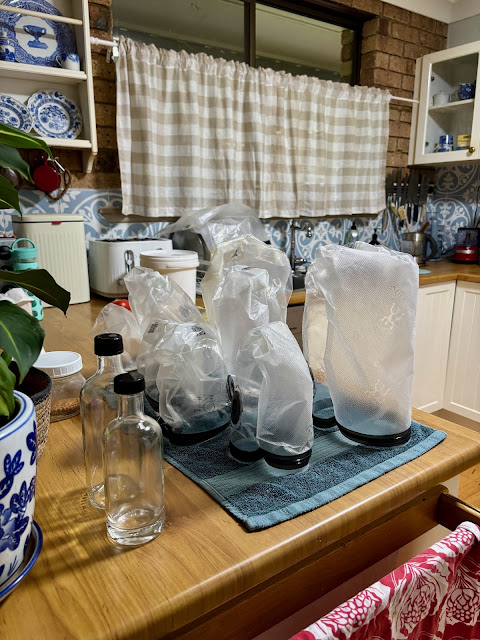
Every morning when I walk into my kitchen it looks tidy and ready for a day's work. Not so on this morning (above), I saw this when I walked in. Late the previous afternoon when I was looking for something, I came across my rolled up Zwilling vacuum bags and decided they had to be washed and dried. So I did that and although I usually put them outside on the verandah to dry it was dark by then. I turned the just-washed bags inside out and left them like this on a towel. It worked well and now the bags are ready to use when I bring home root vegetables, cabbages or whatever I buy that I want to last four or five weeks.
Image

You’ll save money by going back to basics

When I was doing the workshops and solo sessions, I had a couple of people whose main focus was on creating the fastest way to set up a simple life. You can't create a simple life fast, it's the opposite of that It's not one single thing either - it's a number of smaller, simpler activities that combine to create a life that reflects your values; and that takes a long to come together. When I first started living simply I took an entire year to work out our food - buying it, storing it, cooking it, preserving, baking, freezing, and growing it in the backyard. This is change that will transform how you live and it can't be rushed.  
Image

All previous blog posts

  • 2026 3
    • February 3
      • Workshops starting 1 March
      • Planting vegetable seeds and new workshops
      • Back where we belong
  • 2025 7
    • July 1
    • June 2
    • May 1
    • April 2
    • February 1
  • 2024 25
    • December 2
    • November 1
    • October 2
    • September 3
    • August 1
    • July 3
    • June 1
    • May 3
    • April 2
    • March 3
    • February 2
    • January 2
  • 2023 13
    • December 1
    • November 2
    • October 1
    • September 3
    • August 2
    • February 2
    • January 2
  • 2022 17
    • November 3
    • October 4
    • September 3
    • August 2
    • July 3
    • June 2
  • 2021 50
    • December 1
    • November 6
    • October 7
    • September 5
    • August 4
    • July 5
    • June 2
    • May 2
    • April 6
    • March 4
    • February 4
    • January 4
  • 2020 68
    • December 3
    • November 5
    • October 4
    • September 4
    • August 4
    • July 4
    • June 4
    • May 8
    • April 7
    • March 8
    • February 8
    • January 9
  • 2019 66
    • December 2
    • November 4
    • October 5
    • August 3
    • July 4
    • June 6
    • May 8
    • April 8
    • March 8
    • February 11
    • January 7
  • 2018 82
    • December 1
    • September 2
    • August 10
    • July 4
    • June 11
    • May 9
    • April 12
    • March 10
    • February 10
    • January 13
  • 2017 129
    • December 7
    • November 10
    • October 6
    • September 13
    • August 11
    • July 13
    • June 12
    • May 9
    • April 9
    • March 14
    • February 11
    • January 14
  • 2016 125
    • December 7
    • November 13
    • October 10
    • September 11
    • August 11
    • July 8
    • June 9
    • May 9
    • April 12
    • March 10
    • February 13
    • January 12
  • 2015 184
    • December 7
    • November 15
    • October 20
    • September 18
    • August 19
    • July 18
    • June 12
    • May 15
    • April 12
    • March 21
    • February 13
    • January 14
  • 2014 203
    • December 11
    • November 8
    • October 17
    • September 20
    • August 17
    • July 19
    • June 17
    • May 17
    • April 23
    • March 15
    • February 18
    • January 21
  • 2013 225
    • December 13
    • November 17
    • October 17
    • September 17
    • August 21
    • July 24
    • June 20
    • May 19
    • April 17
    • March 22
    • February 17
    • January 21
  • 2012 245
    • December 17
    • November 20
    • October 20
    • September 18
    • August 15
    • July 24
    • June 21
    • May 26
    • April 23
    • March 23
    • February 19
    • January 19
  • 2011 257
    • December 18
    • November 24
    • October 27
    • September 23
    • August 24
    • July 21
    • June 24
    • May 24
    • April 16
    • March 22
    • February 14
    • January 20
  • 2010 283
    • December 20
    • November 18
    • October 18
    • September 19
    • August 25
    • July 24
    • June 25
    • May 26
    • April 25
    • March 22
    • February 29
    • January 32
  • 2009 293
    • December 29
    • November 18
    • October 23
    • September 25
    • August 22
    • July 28
    • June 22
    • May 21
    • April 27
    • March 26
    • February 24
    • January 28
  • 2008 387
    • December 24
    • November 23
    • October 25
    • September 26
    • August 27
    • July 27
    • June 37
    • May 34
    • April 44
    • March 53
    • February 32
    • January 35
  • 2007 372
    • December 37
    • November 40
    • October 55
    • September 51
    • August 49
    • July 63
    • June 49
    • May 28


Trending Articles

NOT the last post

This will be my last post here.  I've been writing my blog for 18 years and now is the time to step back. I’ve stopped writing the blog and come back a couple of times because so many people wanted it, but that won’t happen again, I won’t be back.  I’ll continue on instagram to remain connected but I don’t know how frequent that will be. I know some of you will be interested to know the blog's statistics. 
Image

Every morning at home

Every morning when I walk into my kitchen it looks tidy and ready for a day's work. Not so on this morning (above), I saw this when I walked in. Late the previous afternoon when I was looking for something, I came across my rolled up Zwilling vacuum bags and decided they had to be washed and dried. So I did that and although I usually put them outside on the verandah to dry it was dark by then. I turned the just-washed bags inside out and left them like this on a towel. It worked well and now the bags are ready to use when I bring home root vegetables, cabbages or whatever I buy that I want to last four or five weeks.
Image

You’ll save money by going back to basics

When I was doing the workshops and solo sessions, I had a couple of people whose main focus was on creating the fastest way to set up a simple life. You can't create a simple life fast, it's the opposite of that It's not one single thing either - it's a number of smaller, simpler activities that combine to create a life that reflects your values; and that takes a long to come together. When I first started living simply I took an entire year to work out our food - buying it, storing it, cooking it, preserving, baking, freezing, and growing it in the backyard. This is change that will transform how you live and it can't be rushed.  
Image

Creating a home you'll love forever

Living simply is the answer to just about everything. It reduces the cost of living; it keeps you focused on being careful with resources such as water and electricity; it reminds you to not waste food; it encourages you to store food so you don't waste it and doing all those things brings routine and rhythm to your daily life. Consciously connecting every day with the activities and tasks that create simple life reminds you to look for the meaning and beauty that normal daily life holds.  It's all there in your home if you look for it. Seemingly mundane tasks like cleaning and cooking help you with that connection for without those tasks, the home you want to live in won't exist in the way you want it to.  Creating a home you love will make you happy and satisfied.
Image

Time changes everything

I've been spending time in the backyard lately creating a contained herb and vegetable garden. My aim is to develop a comfortable place to spend time, relax, increase biodiversity and encourage more animals, birds and insects to live here or visit. Of course I'd prefer my old garden which was put together by Hanno with ease and German precision. Together, we created a space bursting at the seams with herbs, vegetables and fruity goodness ready to eat and share throughout the year. But time changes everything. What I'm planning on doing now, is a brilliant opportunity for an almost 80 year old with balance issues. In my new garden I'll be able to do a wide range of challenging or easy work, depending on how I feel each day. It’s a daily opportunity to push myself or sit back, watch what's happening around me and be captivated by memories or the scope of what's yet to come.
Image

It's the old ways I love the most

I'm a practical woman who lives in a 1980’s brick slab house. There are verandahs front and back so I have places to sit outside when it's hot or cold. Those verandahs tend to make the house darker than it would be but they're been a great investment over time because they made the house more liveable. My home is not a romantic cottage, nor a minimalist modern home, it's a 1980’s brick slab house. And yet when people visit me here they tell me how warm and cosy my home is and that they feel comforted by being here. I've thought about that over the years and I'm convinced now that the style of a home isn't what appeals to people. What they love is the feeling within that home and whether it's nurturing the people who live there.
Image

Back where we belong

Surprise! I'm back ... for good this time. Instagram became an impossible place for me. They kept sending me messages asking if I'd make my page available for advertisers! Of course, I said no but that didn't stop them. It's such a change from what Instagram started as. But enough of that, the important part of this post is to explain why I returned here instead of taking my writing offline for good. For a few years Grandma Donna and I have talked online face-to-face and it's been such a pleasure for me to get to know her. We have a lot in common. We both feel a responsibility to share what we know with others. With the cost of living crisis, learning how to cook from scratch, appreciate the work we do in our homes, shop to a budget and pay off debt will help people grow stronger. The best place to do that is our blogs because we have no advertising police harassing us, the space is unlimited, we can put up tons of photos when we want to and, well, it just feels li...
Image

Making ginger beer from scratch

We had a nice supply of ginger beer going over Christmas. It's a delicious soft drink for young and old, although there is an alcoholic version that can be made with a slight variation on the recipe. Ginger beer is a naturally fermented drink that is easy to make - with ginger beer you make a starter called a ginger beer plant and after it has fermented, you add that to sweet water and lemon juice. Like sourdough, it must ferment to give it that sharp fizz. To make a ginger beer plant you'll need ginger - either the powdered dry variety or fresh ginger, sugar, rainwater or tap water that has stood for 24 hours to allow the chlorine to evaporate off. You'll also need clean plastic bottles that have been scrubbed with soap, hot water and a bottle brush and then rinsed with hot water. I never sterilise my bottles and I haven't had any problems. If you intend to keep the ginger beer for a long time, I'd suggest you sterilise your bottles. MAKING THE STARTER In a...
Image