down to earth

  • Home
  • About Us
  • Down To Earth Book
  • Privacy Policy
There is a revolution happening out there. It’s starting right in front of you, at the kitchen sink. Most of my regular readers would know I rarely write about political topics, I leave that for the “experts”, but I’ve been thinking about the revolution for a while now and it just has to come out.

A few years ago, when I started to live more simply, my friends and family thought I was a bit of a nutter to want to give up spending, cook from scratch and save resources. They didn’t understand it at all. I’d already closed down my business and was stumbling along with no clear direction when I started reading everything I could on sustainability, in particular, David Holmgren’s articles on energy descent. I’d read his books on Permaculture back in the early 80s but his energy descent articles lead me to read more about climate change, and then Peak Oil. It turned my world upside down. Instead of now thinking the need was to reskill, relearn and rethink because I was no longer working for a living, I had a different focus. I wanted to plan my own energy descent and make sure I knew as much as I could to help my family through the many changes coming our way.

When I talked to friends and colleagues about it, they didn’t believe me. Well, to make a long story shorter, over the years I realised that the best way to deal with these looming problems was to make sure I had my house in order. I reskilled myself to the best of my ability, I made plans for our future here, and everyday I researched more and more in books and on the internet. Blogs were yet to become a part of our daily reading so I headed for a large American frugal forum. I learnt a lot there but most of the other forum users were only interested in saving money. A frugal life, so they had money to spend on other things. I found the Americans to be quite a bit behind the rest of us; environmental damage and climate change were rarely discussed. While quite a few countries were working towards greening themselves, America seemed to sit in a cosy backwater, waiting for technology to save them and refusing to believe they needed to do anything themselves. That has changed.

Now a revolution has started and you can read about it every day in thousands of blogs all over the world. Now the cost of oil has skyrocketed, taking many other costs along with it and most people know that the weather is changing. They might not know a lot about it, they might question some of the research, but at least the terminology has seeped into general conversation. When the words become part of our language, there is no stopping it. Some of these changes are now being talked about in our mainstream media – there are stories on rising food and oil prices almost everyday now. But they are only now discovering what we in blogland have known for a long time – we need to change how we live. Now there is no way of ignoring the elephant in the room.


I believe many of us changed because we read and write blogs. Our changes were not directed by mainstream media or our governments, they came from the grass roots – us. We talked to each other about our fears, we showed each other what we were doing in our own lives, we taught, we listened, we encouraged, we rejected past ways. We read each others blogs and discovered that not only is a change to a greener way of living necessary, we are made happy and fulfilled in the living of this kind of life.

Every time we blog about reducing our fuel consumption, every time we decide to install solar panels, when we start growing some of our own food, when we step out of the mainstream and mend our clothes, when we decide to downshift or get rid of our debt, every time we blog about our greener lives – it makes the corporate world gulp and take notice. People power is an incredible force.

At my home we are doing what a lot of you are doing. We’re growing food in our backyard, we’ve installed solar hot water, we harvest our rain water, we stockpile, cook from scratch, have eliminated as many chemicals from our lives as we can, we sew and mend, we have stopped recreational shopping, we stopped spending. We make do, we live well on less than we ever thought possible. We live simply. We have rejected the mish mash that has become modern life.


Growing some of your own food makes a difference.

Whatever you can do, do it. Whatever changes you’re thinking about, make them happen. There is a revolution happening and we are leading it, my friends. It might be a quiet and gentle start but what we are doing is significant and vital. I’m sure the mainstream media will claim the revolution as its own soon, and will shout loudly about living greener and more frugal lives, and I know our governments will then be more pro-active. In the meantime, we need to keep encouraging each other through our blogs, we need to show and tell everyday about how our lives are being lived in all our small towns, in our suburbs and in our cities. We need to lead our governments to this brave new world.

In the past we have often been lead by mainstream media, but they have missed the boat on this one. Blogs took the lead well before it ever occurred to the traditional media that there was a new revolution happening. Blogs are leading the push towards a better way of life, they give us the inspiration, the knowledge and the power to change for the better.

Welcome to the revolution.

I love that first day after work is finished for the week when I get back into the garden again. That space is where I grow too. I have a garden bench out there and I sit and think, talk to the animals, watch the chooks and generally just luxuriate in the natural wonder of it all. Oh, and sometimes I help with the gardening. ; - )

It's looking good out there now that the plants are starting to put on good growth. The silverbeet in this photo will be picked today for dinner tonight. I love the coloured stems of silverbeet (chard). Here we have rhubarb chard, which is the very dark red one, ruby chard, a lighter brighter red, the plain white stems and hidden in there are yellow stems as well.

Just at the side of the chard we're growing button squash and when I picked some for dinner last night, I noticed powdery mildew starting to grow on them. I'll have to do something about that today.

A bit further over there are cucumbers just beginning their climb to the top of a trellis, guarded at their front by a thick row of French radishes; at the side sweet capsicums (peppers) are ripening in the sun.


For dinner last night we had steamed potatoes and pumpkin dressed with parsley and butter, button squash and red onions - lightly sauteed, and brussel sprouts. That was followed by a simple rice pudding (recipe given a few days ago) with warm peaches that I preserved last summer.

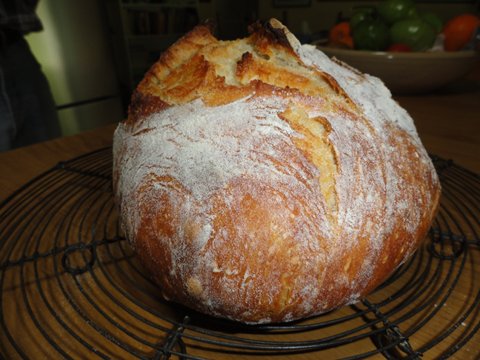
I made bread rolls for lunch that we had still warm from the oven. I had fresh tomato and avocado on mine, with a cup of black tea. Delicious. The rolls were very good - crispy on the crust with light and fluffy bread inside. They were sprinkled with a little polenta. When you grow some of your own food and know how to cook, one thing is certain - you can always rustle up a decent feed.

At the end of the day, when I went out to pick our dinner from the garden, I took a couple of these bread rolls out for the chooks to eat. They enjoyed them too. No doubt Hanno will polish off the last of them for breakfast this morning.

The rest of the day was taken up with a bit of cleaning and a lot of knitting. I'm knitting some dishcloths with a new bamboo and cotton yarn. It's very strong and comes in some beautiful colours, but it's a bit fiddly to knit. I hope to do some knitting today as well but I have to start a magazine article so my day will be fashioned around getting that done.

Thank you all for dropping by and for the comments you leave. I read every single one of them. I am sometimes sent links to various sites and videos by my regular readers and I always look at them when I have time. However, I am also being sent a lot of email requests to do paid reviews, put links on my blog and generally promote a lot of commercial topics. I will never do any of that, so to all those people who drop by to promote their own product or website, save your time and try elsewhere.
LATE ADDITION - BREAD ROLLS RECIPE:

I'm making these again today to make sure of my amounts. I'm pretty sure this is what I used yesterday. I rarely use written recipes so this is just from my head. If there needs to be a change, I'll let you know later this morning.

Recipe for bread rolls in the bread machine

  • 3½ cups bread flour - can be white, wholemeal, rye, grain - whatever. If you use a heavier flour you'll need to increase the amount of water used.
  • 1 teaspoon salt. Please use good salt, not table salt. Even cooking salt is better than table salt.
  • 1 tablespoon butter
Put all the above in your bread machine bucket.

In a teacup add and mix up:
  • ¾ cup lukewarm water
  • ½ tablespoon sugar
  • 2 teaspoons yeast


  • plus another cup of warm water - I can't tell you the exact amount of water you'll use. That will depend on your flour and the weather. Start with the 1¾ cups and you might have to add more.
Mix the ingredients in the cup and allow to stand for 5 minutes. You want your yeast to prove - it will look like this:


If the yeast doesn't froth up, it's dead and you'll have to buy new yeast. Always store your yeast in the fridge, it will keep longer. When the yeast is frothy and bubbling, add it to the dry mix, making sure all the sugar is either dissolved or added to the flour mix. Turn your machine on to the "dough" setting and let it mix the dough.

When it's finished, remove the dough and roll it into a long cigar shape - about 12 inches long. Cut into about 8 pieces for large rolls or 12 pieces for small rolls. Take each piece of dough and work it with your hands into a nice round ball. Place all the balls on a baking tray, add seeds, polenta or a criss-cross and allow to rise for about 30 minutes - depending on the temperature in your house. If you can put them in the sun they'll only take about 10 minutes to rise.

Turn on your oven so it's hot when you put the rolls in. Bread has two types of rising - one is from the yeast you use, the other is called "oven lift" - you get this when you put properly proved bread dough into a HOT oven. The heat immediately starts to lift the bread. That, my friends is what you want. Adding dough to a warm oven won't give you the same result.

Good luck with your rolls, everyone.

OOPS - ruralinspirations has just reminded me I didn't tell you about the temp for baking these rolls. As I said, put the rolls into a HOT oven (that is one that has been sitting on at least 200C for about 10 minutes). Then cook on 200C (395F) until they're golden brown and you can smell baked bread.

YET ANOTHER UPDATE...

I tested the above recipe and everything is fine. Just monitor the water yourselves as it's always a bit different. Pictured below are today's bread rolls, just out of the oven.

Happy baking everyone!

It was cold here yesterday. Well, let me qualify that - it was cold for here. The highest temp was 19C (66F), and while I worked away at the Centre, I kept looking at the fireplace and imaging how warm and cosy it would be if it was blazing away with red hot logs. I have no idea how to make a fire in one of those stoves, or even if the fireplace there is safe, so I didn't advance beyond my warm and toasty fantasy. It's still fairly cold now at 17 C. I have my slippers on, a skirt, two jumpers and a vest. Now that I'm 'an older woman', I don't cope very well with extremes of temperature. And yes, I know 17C (62F) is not an extreme, but that probably proves my point.

I love change. I'm not at my best when things stay the same so when the temperature starts to cool down, and I see and feel the changes that brings, it soothes my black heart. There is a lot to be said for seasonal change.

One of the things I most enjoy about the different seasons and the changes they bring is the opportunity to extend hospitality according to the temperature. Nothings warms the spirit more than being offered a hot cup of tea or coffee with scones that send up puffs of steam when you open them. How good is it to come home to hot homemade soup sitting on the stove and just baked bread that lifts the neighbourhood just with the smell of it.

The same is true in the hot and humid months of summer. A glass of homemade lemon cordial, with rivers of condensation flowing down the glass and ice cubes happily clinking, makes any hot day a fine one. Greeting visitors with the hospitality of a cold drink is one of life's simple pleasures that I doubt I'll ever tire of.

But now we're in Autumn and with each day it gets a little bit colder. Warm quilts and flannel sheets are on the beds and the frequent salads of summer have given way to steamy bowls of soup, warm rice pudding and cooked spicy fruit - warm and delicious straight from the stove.

I haven't told you all yet what Hanno gave me for my birthday. It was a smallish quilt to be used when I'm sitting in the lounge room. One side is pure cotton tiny pink rosebuds on a very pale creamy yellow background, other side is pale creamy yellow fleece. I've used it a few times in the past week and unlike a completely cotton quilt, the fleece feels warm as soon as I cover myself with it. I feel like an old granny with it wrapped around my legs and when I draw it up around my chest, I swear I could melt for the way it warms me.

Simple pleasures come in all shapes and sizes, they usually cost little more than the effort it takes to make them happen and yet they are what memories are made of. I have wonderful memories of my sister and I sitting in front of a warm winter's fire in our flannel pyjamas while our mum tested our spelling. I remember fondly feeling very grown up and with it sitting at a table of adults when I was about 18 and being offered a glass of icy water along with the rest of the group. That water tasted like the finest wine to me.

There is a lot to be said about seasonal hospitality and our own ability to make our daily lives more comfortable with simple things. I know that I will live happily with my rosebud quilt for the rest of my life. If I'm lucky enough I'll lay my grandbabies on it one day and as they grow they'll learn, by example, about the value of these simple gestures.

You can bring anything to life by assigning meaning to it. What are the meaningful parts of your seasons? What makes you enjoy one season over all others? What are the things you're doing now that you know will be the memories of a lifetime?

Photo taken last year in our herb patch.

It is strangely comforting to be in a group of people all excited by the possibilities presented by frugality. I started one of my budgeting courses yesterday, six people made a booking to attend, 13 showed up. There was a bit of last minute photocopying, cups of tea and coffee were made and then we settled into it.

I usually make a few notes to work from when I do one of these workshops but I'd been busy with other matters and meetings, so the notes went unwritten. No matter, I've done the course a few times now, I write about my frugal life frequently, I thought I could wing it. It was the best thing I could have done. Just speaking to what I know and not from a pre-prepared list, made it all flow naturally and it encouraged questions and discussion.

With the price of food and fuel rising so fast, the discussions where mainly on how to shop wisely. We talked about stockpiling, shopping at Aldi and local markets. I gave out a collection of my cleaning recipes, instructions for making bread in a machine and a few cheap recipes for a family to make from stockpiled items. I didn't think they'd be interested in making soap, so at the last moment I removed the soap recipe, but they asked for it. It will be in the next bundle of recipes I give when they all return next week.

My group was mostly women, there were two men. I loved that they were really enthusiastic about learning these new ways. Most of them were already doing a lot of wise things and having new strategies presented to them gave a sense of excitement to the room. We didn't talk about simple living but I did talk about how living within your means can bring joy and satisfaction and that it is possible to live a full and rich frugal life.

Sometimes in the past people have come along to my groups when they've been struggling with their finances for years and feel defeated by the entire process. This group was optimistic about the possibilities of frugality. They understood that almost everyone deals with having to financially restrict themselves in some way and that choosing new ways of dealing with those restrictions could open up their lives. They also understood that spending less makes a very strong green statement, when people realise that they often see cutting back in a new light.

I set some homework to be done before they return next week for the final session. They're tracking their money. Many of us here know what a surprise that often it and I'm sure it will trigger a healthy discussion which will lead us onto how to make up a budget. THE BUDGET - that often misunderstood piece of paper that many see as a way of ending fun and closing down lives. I see it as a map to future happiness, a way of showing where the money is and what needs to be put aside for regular bills and food needs, while keeping some for those bright spots that make life a joy - be that books, a little holiday, a trip to the movies or a special meal with friends or family. For one thing is certain, if we spend until nothing is left in our purse, if we don't take the time to examine our financial needs and to organise them to suit the life we live, we will be poorer for it - and not just poorer in a financial way.
I love reading about some of the readers here in Rhonda’s Our Simple Lives posts this past week. It is so uplifting to read of others’ journeys different and similar to my own. Thank you all for sharing.

I have decided to post an adapted article about home education I originally wrote a few years ago for a newsletter. I hope to write guest posts for Down To Earth again, but this is the final of my five-part Living Simply series for April. Thank you to Rhonda for allowing me to write from my heart and trusting that what I have to say might be of interest to others. I feel honoured to have contributed to this highly regarded online space again.


Home education is an intrinsic part of our simple life. If it weren’t for home ed., things would be much more complicated, and I think more expensive! This doesn’t mean that schooling families can’t implement a lot of the living-simply ideas shared here by Rhonda and myself, but being at home with my children has really allowed me to weave the routines into our days. I could go on and on about our homeschooling days, but I think that sharing the why? of home education in Australia will help others to understand the essence of what we’re doing.


My children have time to cook and garden with me. We can spend hours choosing a pattern and fabric remnant from my stash to sew some clothes. Their animals are an important part of their lives. We create presents and cards together. We go out to pick fruit and come home to make preserves. We meet interesting people in our community who have much to share. Our children’s consumer expectations are generally lower than their schooled peers. Daily discussion topics include Peak Oil, relocalisation, relevant history and current affairs to explain what is really going on in the world, spiritual matters, environmental issues and more. We’re very aware of the ‘real world’ and feel that we’re more in touch than most schooling families because we have the luxury of time together to discuss and study what matters to us. Life is full and chaotic, but it’s our chaos. I feel blessed to be responsible for educating my own children at home.


I hope you enjoy this article.

Why Home Based Learning?

“Children are being freed to learn as nature intended” – just one comment I love from my research into why Australian parents are homeschooling their children. I asked friends and mailing list members, read comments from studies on the subject, and gathered some reasons as to why so many are taking the plunge into home based learning in Australia.

Some parents actively choose to home educate. They make the decision sometime – whether when their children are infants (and even earlier), or when they feel dissatisfied with their children’s schooling for any reason. Some parents feel that there was no other choice. They may have exceptional children (ranging from those labelled “learning disabled” to those with apparent giftedness – and many others in between), or their children are sick or injured, or unable to cope with the stress of school, or they are geographically isolated. In most of these cases, school was the original or preferred choice, but it just didn’t work out for the families involved – they feel that home education is the only option left for them. Yet, most declare that it is the best thing to happen to their families and continue with homeschooling even if the original hurdles are overcome (eg: in case of illnesses or living in a remote area).

Many parents lament that at 4,5 or 6 children are too young to hand children over to a system that is seen as having many flaws at the moment. Beverley Paine (homeschooling pioneer) explained, “We loved April and didn’t want to miss a minute of her five year old life.” I think many home educating parents utter a resounding “hear, hear” at that touching comment. Indeed, these early years are a sensitive time for the little ones. Many argue that it the ideal time to begin academics – the children are so open to new ideas and often learn at an accelerated rate – but at what cost? Pioneer homeschool authors Raymond and Dorothy Moore, in their book ‘School Can Wait’, give a great deal of evidence that early academics and separation from parents can do a great deal of harm.

In my research, parents reiterated that the freedom home based learning allowed them was the greatest gift. Time with their children, without the constraints of the school bus, cut lunches, school uniforms and a lot of rushing was what they valued most. Others stated that the upholding of family values and their religion are the main reasons they chose to educate outside the system. It is true that most schools today in Australia are not inclusive of all belief systems, and logically so – with so many people in an artificial social structure it would be near impossible to be so diverse in their curriculum alone!

I was touched and enlightened by a comment that home education allowed a child to evolve as a spirit at her own pace, to grow beyond what a school environment would allow. One caring mother said, “Maybe some of us homeschool out of curiosity of the possibilities. I’m sure that’s part of why I do.” And that gentle statement rang true with me. I see my children and can imagine how a school education would shape them – in and out of the classroom. I know I don’t like those possibilities. I can see the difficulties in home education and be hopeful that any obstacles are outweighed by benefits. The mother quoted above also said to me, “I think living in the inquiry and continuing each day and being open to questions allows the flexibility that gives her the space she needs to grow. And I don’t think that’s a bad place to be.”

Some parents argued that, due to the pitfalls of attending most Australian schools, home education is an ideal, holistic environment to learn. They see home based learning as a near-perfect, tailor-made education, superior to even the “best” private schools available. The school community commonly resents this attitude; they see it as elitist and therefore un-Australian. I must admit to subscribing to the idea that home education offers the Individual Education Plan which schools hope to offer, but logistically are unable to manage. We were taught at University, during my Bachelor of Education, that this was the way of the future. Over ten years on, there is still mass-production schooling happening in almost all Australian schools. Perhaps I am the only student of my class able to put theory into practice as a now home educating mother of six?

Parents are deciding to home educate for many reasons. Each family has its’ own list of reasons and its’ own method of conducting their home based learning journey.

Resources:
Home Education Association
Aussie Homeschool Classifieds
Home of Learning
Joyous Learning
Home Education Posts on my Blog


* Fifth in a series of five guest posts by Belinda Moore. Here are part one, part two, part three and part four of this series.
Our vegetable garden is vitally important to us. It gives us the freshest organic food at minimal cost. To keep the cost of the garden down as much as possible, we make our own fertiliser, harvest rain water and save a lot of our own seeds. That has two advantages - it provides us with a closed system - reducing the risk of introducing weeds and disease from outside, and it increases our level of sustainability.

We have two big clumps of comfrey that grow all through the year. Comfrey makes a great fertiliser as it's chocka block full of nitrogen - the element that makes green leaves grow well. Comfrey tea is made by cutting half a bucket of comfrey leaves, putting a brick on them to keep them under water, then filling the bucket to the top with water. You need a lid for the bucket as this brew stinks to high heaven. Leave it for a week or so, then dilute a small amount of the brew with plain water till it looks like weak tea. And that's your nitrogen fertiliser. This is perfect for plants like silverbeet (swiss chard), lettuce, cabbage, kale and all the leafy greens, but should be used sparingly on fruiting plants like tomatoes, capsicums and cucumbers. Putting too much nitrogen on fruiting plants will cause them to grow lots of green leaves and not so many tomatoes or cucumbers.

The fruiting plants are much better served with worm castings as it provides a rich fertile soil in which they will thrive. Read more
about the benefits of microbes in the soil here and here. Microorganisms in your garden soil will increase your yield of fruit and vegetables. The simplest way to increase the level of microbes is to add worm castings to your garden.

I have already written
about setting up a worm farm using an old bathtub, now I'll talk about harvesting the castings and maintaining the worm farm.

From day one of your worm farm, when the
catching bucket under the worm farm is full, you should pour that back into the farm. After about a week or so, you can start using the worm juice as fertiliser. The longer the worm farm goes for, the better the juice will be - beneficial bacteria and various microbes will built up in the juice and castings and will boost your crops when you apply it to the garden.

But let's get back to maintenance. Over the months you can scrape off castings from the top of the farm and use them on your plants. However, there will come a time, depending on how many worms you start off with, when it will be worth your while to rebuild the worm farm and harvest all the castings. In the photo below there are thousands of worms lurking. So how do I get them out of the castings so I can use it on the garden and
keep the worms working in the farm? There are a few ways to do this, this is what I do.

I move all the castings over to one side of the bathtub. Use your hands, with gloves if you prefer, to move most of the castings - using a shovel or trowel will kill too many worms. Then, if you have weed mat or a microfibre filter under your castings, pick that up and roll the casts over. You will then have half the tub with only gravel under the filter material and half the tub full of castings and worms. Click on the photos to enlarge them.

Now start building up the empty side. You can do that the same as the instructions for building the worm farm, here I used shredded paper and completely composted horse manure. Before adding the next layer, I hosed this layer down to make sure it was completely wet. Remember though, you don't want your castings wet as the worms are in there and they don't like wet conditions - like like it moist, not wet.

My next layer was straw and any organic food I could find. Make do with what you have on hand. Here I have some old organic chook pellets that we decided were too old to be fed to the chooks and some green leaves picked from the garden. You're after variety here. The worms will eat everything you put in - the paper, manure, chook food and the leaves. Hose this layer to make sure it's completely wet.

Then I covered the new section with an old wet bathmat. The worms will eventually eat that too. I wanted to create a tasty attractive environment so that the worms would travel from the castings over to the new side.

I did this one week ago and when I checked yesterday the worms had already moved into the new food. I'll give it another week and then take all the castings out and use them on the garden. There's about 30 kgs of castings there - a huge boost for our vegetables and fruit. When that side is empty, I simply repeat the layering exercise, and the worms will eventually eat their way back to that side too.

If you've been thinking about starting a worm farm, jump right in. Even if you're in an apartment and want to do some composting, a small worm farm will use up all your kitchen scraps and give you great castings for your indoor plants. And don't worry about constant care. If you've given your worms a good feed and they're in moist conditions you can easily leave them for a week without feeding.

Hello ladies! I am in the process of moving all the tote photos to a flickr account. The address is here: http://www.flickr.com/photos/down-to-earth_swap_photos/
I am still in the process of moving photos, so if you don't see yours up yet, don't get worried, as it may take a while to get everything sorted out. Those of you who sent photos using 'photobucket' will need to send me a jpeg attachment so that I can upload it to flickr. Once you get to flickr you can click on each photo for the "tag" --who sent it and to whom it was sent. Please be patient while I finish switching all the photos. Eventually, I will move all the swaps photos to flickr groups, but this may take a few weeks.
This is the second part of our simple lives. It's been a real eyeopener to me to read all these incredible stories. Thanks to everyone who shared their simple story.

Lis at alteredcutlery write about how she lives simply with two children, an ex-husband, a new partner and a job. Lis is a great cook so check out her story and stay for the cooking, here.

Jessica is in the USA and she writes:

Hi Rhonda Jean,

I enjoy your blog. It's inspiring for me!

I began trying to live simply when my husband went back to school full time and we needed to cut back on expenses. We lowered the temperature that we heat our home and covered the windows with blankets in the winter. I line-dry our clothing outside when weather permits and use lines in our basement otherwise. When our youngest was born, we went with cloth diapers instead of disposables (I love them!) I've been composting, too, and my husband is building raised beds to grow our own veggies. I'm so excited! It's been amazing to see how much less we put in the trash when we aren't throwing away food scraps or diapers. Eventually we want to move from the city and have a small farm where we can do a LOT more as far as sustainablity.

Thanks for the invitation to share!

Elaine needs some answers to a couple of questions. Can anyone help? Elaine writes:

Hello. We live in town and are really mere beginners at this journey but this is what we are accomplishing so far. I enjoy cooking and baking from scratch--no box products for me (although I do seem to have a weakness for box cakes mixes-oh well!); growing tomatoes and peppers; canning same tomatoes and sauce, jam, peaches, pears, applesauce and freezing peppers; making own cleaning products; composting leaves and yard waste; keeping home a bit cooler in the winter months; working closer to home; packing own lunches.

I enjoy learning things from these blogs so much! I would love to learn from you girls how to make a good "green" carpet cleaner (not just a freshner but for a deeper cleaning); also some kind of "green" lawn weed controller--we don't use chemicals but I yearn for a lush lawn; lastly for those of you who refuse the plastic bags--I know you must have some trash--what do you put it in?

Have a wonderful day. I have enjoyed the blog so much as well as the comments.

Nicole is teaching her children about living simply as they grow. She writes:

Hi Rhonda Jean,

I do have a blog over at http://www.cottonwoodherbals.blogspot.com/ and will be writing a bit more on simplifying over the next week.Thank you so much for taking the time to post about your life. I get so many ideas to implement into my own home. I don't have any land to have a garden but we do have containers full of herbs we use. We put up tomatoes and apples we purchase from the local farmer's market.I'm teaching my children about recycling and making healthy choices. We always purchase organic when possible, turn the lights off, use less water and be ever mindful of not wasting anything.Each week we introduce something new to add on to what we are already doing. It may be making our own shampoo and conditioner, I already make our own laundry soap and herbal remedies. It may be using the back sides of paper for my 6 year old to draw on, it may be making our own bread (thanks to you)All the little steps we take add up. I teach my children it isn't All or nothing. For us, it is baby steps and hopefully I can share what we do with others.

Kym is reusing everything she can, she writes:

I am inspired by all the things that I have read here, I am fairly new to the idea of simple living but I think I have been doing some of it most of my life. The concept of a disposiable world has always bothered me So reusing everything possible is my mantra. I have recently started using homemade cleaners and laundry soap,wow not only supper cheap but no more plastic jugs in the recycle bin, they just keep getting refilled. It is interesting to read what others are doing and hopefully I will move into a greener life as I go along. Keep up the inspireation we really enjoy it.

Leanne is in New Zealand and, naturally, raising lambs. Check out her story at her blog here. She really is living the good life.

Kristi in the Western Reserve is living with her son in Ohio. She writes:

I am a 63 year old new widow who lives with my vegetarian grad student son on an acre and a half of land in Bath, Ohio. In a way, we were never wildly into consuming, but as I was older, and my husband ill, I began to do things like buy paper towels for convenience. I am just beginning to redesign my changed life. I'm not sure how long I will live here, certainly until Andy finishes his degree. I am trying to recycle and am giving away many things as we have much to much.........But we have lived here for 28 years and it will take a while to streamline things...But I am working on it. We have always believed people are more important than things and I want to be involved again in work with local refugees. I am debt free, I guess. (Well, I just had to buy a new car and it will be paid for in two years. I din't want to pay for it outright since I want to keep my money together. I could have, but got zero per cent financing. I wish it got a little better mileage, but it could be worse. We garden, Andy and I, but in Ohio one can only garden from about April to October.....We belong to a local CSA farm and I buy locally from a lady who raises chickens....I'm diabetic and try not to eat too many carbs, but eat a lot of tofu and am trying to increase this......So far I am not a vegetarian but can see I might end up closer to this. I do buy from and donate to thrift shops. People are more important than things was something Paul and I always tried to teach our children and I think we succeeded. My kids don't really watch tv, and I am being more selective (partly because there is so little that's any good and I don't want a cable package. We have a 99% efficient furnace and pretty good insulation.....I have a freezer and a pantry and stockpile stuff. I'm not a fanatic, (don't mean the term to make being green sound bad!) but find myself doing more and more greenly. My blog is not active yet. That may change this year......

lorisdoris is simplifying and teaching her children as she goes. Check out her story here, there are some really nice photos and a very interesting story.

Kimberly is living in suburbia and dreaming of a home in the country. She's made big inroads into living more simply by taking small steps. Here is her story.

Jeannie, yours sounds like the perfect life. What a wonderful place to live in. Jeannie writes:

I live on an acre section in a tiny coastal village of the West Coast, North Island, New Zealand. Living is easy here, proximity to the ocean provides abundant shellfish and fish, the river has whitebait and trout, the riverbanks give us blackberries and mushrooms, there are even wild plum trees in the village.

Like most I have a large vegetable garden,but am fortunate enough to also have an orchard, greenhouse with hydroponics, run a few chickens. Preseve most of our fruit and vegeatbles, make cordials, wines and whisky!Have been living the simple life for over thirty years, keen spinner, and weaver, and knit, sew and crochet some of our clothes.Our house is sited to make best use of the sun, and we have installed a woodburner for the colder days (wood is freely available along the riverbanks )

Our lifestyle is frugal by choice, we make our own cleaning products and reduce, reuse and recycle wherever possible.

This is from earth heart. She and her husband are living in a similar way to Hanno and I. You will find her simple living post here.

And finally, Mrs Kaos, who is just about to celebrate her first anniversary, writes about carry on family traditions. You can read her blog here.

Thank you all so much for taking part in this wonderful excerise. I found it a real eye opener. It reaffirmed my belief that simple lives may be lived anywhere and that while all our lives are different, we share a lot of similarities. Please take the time to visit each of the blogs listed and leave a comment. One of the reasons I wanted to do this was to connect us all and help us feel that we are part of a caring community.

Nadine write about her life here.

Libby described her version of simple living here.

Niki at Rural Writings shares her simple farm life here.

And Amy writes about her simple sustainable choices here.

Being part of this blogging community has a few benefits - we connect on a daily basis with like minded people, we share ideas, we learn new skills and sharpen up old ones and we gain inspiration to live according to our own terms and circumstances, going against the tide of the mainstream. Here are some of your stories. They are listed in the order I received them. This is a post I doubt you'll get through in one session. I'll put it over on the side bar so you can easily come back to it.

Kim at hedgeshappenings talking about simple living and the chicken house.

Trying to be green tells us about the simple life of a college student who grew up in a green loving home.

Journeyer writes about changing and improving her life.


Lizzie writes about her simple life in England.

Lightening wrote: We're a long way from "arrived" yet (I guess for most people simple living is a journey rather than a destination). Anyway, my journey initially started with a quest for frugality that would enable us to pay off a house without me returning to paid work. It was then fast-tracked when I had a nervous breakdown and "things" suddenly seemed less important to us than life itself. In a way it was similar to a "near death" experience.

We sold what assets we had in order to pay down debt and since then have continued to live a frugal lifestyle. With the sale of a couple of small assets and some VERY careful saving, we ended up paying off our home in about 2 years. We've just come through 6 of the worst years farming has ever seen and yet we seem to be in a stable financial position due to our desire for "less stuff" and "more life". Frugality has been our saviour in many ways.

I wrote a series on my blog "our journey toward simpler living" a while back which details my nervous breakdown and the changes we made to our lifestyle as a result of that. The links for this series are in my sidebar on my blog.

I know for many our level of "simple living" is nowhere near the level many people are at. And yet the changes in our life have been significant and we're making slow and gradual changes each year.My DH has just gotten enthusiastic about the benefits of my vegetable garden (health wise more than anything). I'm hoping that'll lead to him getting going on our chook run which I want to turn into a kind of permaculture set-up. That will allow me to grow more vegies than we currently do which would be great.

For me it's all about baby-steps toward a more sustainable and frugal lifestyle. :) Her blog is here.


Kristina in Nebraska wrote: What a great idea Rhonda Jean! I do not have a blog but absolutely LOVE reading other people's stories and gleaning from them as much information about simple living that I can!
We have a farm here in Nebraska and we live as simply as possilbe. We raise a huge garden every year and I preserve a huge portion of our own food. I can tomato salsa, tomato soup, whole tomatoes, green beans, dill pickles, berry jellies, and sweet relish. I cut corn off the cob and freeze that. I also freeze as much brocolli, cauliflower, brussel sprouts, and herbs as possible. We raise our own meat --beef and chicken -- so we know what goes into our meat.
We entertain ourselves at home as much as possible. We have just the very basic satellite package for our television as we cannot receive "free" television here and we do like to watch the news and some sports programs and public television. I make my own laundry detergent and only line-dry my laundry unless it is 20 below outside as it sometimes gets in winter here. I have started using only homemade cleaners. Organization is the key to simple living and I have purged so much unnecessary clutter from our house.
My kids go to public school and the bus picks them up in our yard and delivers them each afternoon. I limit them to one or two activities a year -- anymore and we get too bogged down with activities and no LIVING! We are not debt free yet but we are working diligently on that. Times are so tough for everyone now and they are only getting tougher. I think it's so important for all of us who want to live simply to work together and encourage each other with kind words and advice. Thanks so much Rhonda! You're an inspiration!


Rachel is over in New Zealand, she writes about her simple life here.


Maggie is a single woman living simply in Canada. Nice photos of your baking, Maggie!

Kate in NY and her family are downsizing and reclaiming their lives. This is what she wrote:

We are in the process of getting ready to sell our big home in an affluent suburb of NY so that we can "downsize" to a more modest home in a more modest town. My husband's commute will go from 1 hr. 15 min. each way to 25 minutes door to door! We will be able to pay off all our non-mortgage debts and take on a smaller, 15 year mortgage (rather than 30). It will be a little tight with 4 kids and (hopefully) more to come, but we are thinking of it as "cozy." Our new town will not have the "top rated" schools the current one does, but our children will be exposed to many different racial, ethnic and socio-economic groups.

When we bought our home 5 years ago, we were thrilled about how "impressive" it seemed - but the only thing impressive now is how much it costs to maintain, and how hard my husband has to work to do so. Thank you for being an integral part of our newfound, simpler-living philosophy. Thank you!

Carla is living the simple life in north Idaho and loving it. Check out her seedlings here.

Stephb has dived right into her simple life. This is what she wrote:

What a great idea Rhonda.
Well....My family is at the beginning of trying to live a simple life. We have two small children (3 & 1). I left a high paid job to care for them as I could'nt face leaving them with a stranger. Since Christmas, when I realised that we were living beyond our means, I have discovered your website and have begun my journey to a simpler life.
During the day, I bake my own bread, cook all meals & puddings from scratch, I have converted to your laundry powder and cleaning products. I have made my own soap, took part in the Tote bag swap which introduced me to a sewing machine for the first time in my life. I next plan to do one of your stichery patterns and also take up knitting.
I work in a local supermarket three nights per week to help pay off our debts a little quicker. Working in the evening is demoralising, but it is a better option than leaving my children in daycare.
I love my new way of life, I do find it alot of hard work as cooking from scratch take alot of time, and with coping with two small children, it can be tricky, but we get there.
Most of the changes I have made are through reading your blog Rhonda, so I doubt there is anything new here. I just wanted you to know how you have changed my life and made me see the light. I am 32, and hope that withn the next 5 years because of your help and guidance, we will be debt free and living a sounder exisitence.
All my love and respect.


Rosieb is living her simple life in an English village. She writes:
I live (alone) in a tiny rented property in a village (England) and have no car so my outgoings are fairly straightforward. A few years ago I became too ill to work and needed to get a grip of my finances. Now I work to a budget, keep track of my spends and, just by this one change, my life became simpler and less stressful.
I reduce, reuse, recycle as much as possible; since early last year I haven’t bought any new clothes (apart from underwear and socks!) but instead I’ve sourced elsewhere - ebay, freecycle, charity shops, etc.; this has filtered down to other areas of my life too and I’m currently reworking curtains to fit my new home.
I couldn’t manage a vegetable garden on my own but I’ve had success growing a good variety of vegetables in pots and this year I’m also planning a small herb garden. I’m enjoying cooking again, I make my bread, preserves and even make butter sometimes; I’d forgotten how much satisfaction there is in home cooking! Having been through some very lean times when my kids were small I like to keep a very well stocked pantry but now I buy ingredients rather than ‘ready made’ and I’m lucky that I can buy good quality food from a local butcher and greengrocer.
I’m rediscovering old skills that I’d forgotten - making rag rugs (like we used to when I was a child), sewing and knitting and I’m getting a lot of satisfaction in being able to provide for my own needs. As you said, Rhonda, ‘This is a journey, not a destination…‘ and I’ll find many more ways to simplify a I go along.
I’m looking forward to reading other people’s stories. :)

Vickie and her husband are celebrating life in Canada. Check out her story here.

Linda is living simply in remote Australia. Her interesing story is here.

Anonymous @ 13.37 is living the good life in remote Alaska. She wrote:

Hi, Rhonda Jean. I do not have a blog and I rarely ever comment. I do read your blog daily and enjoy it so much - I refer to you as my Australian friend - and you don't even know me! I live in the bush - Alaska, USA that is. We live 33 miles from a town of 1,400 where my husband drives daily to work at the post office. We had homeschooled our children and they are now with their own families and we look forward for them coming home to visit. Our son is a US Marine and is gone a lot. We try to live as sustainable as we can. We garden and I can and dry a lot of vegetables (tame and wild), we gather wild as much as possible - fruit, herbs and meat. We have no shopping centers around us to tempt - the closest city to us is a 4 1/2 hour drive. This is our year of trying to pay off debts - our truck - credit card. We live without electricity - we have a generator when we need it -and haul water from my Mom's which is next door to us. We have in a 3 mile radius two full time neighbors, other than my Mom. I'll keep this short -I'm not good with words - just wanted you to know how much I enjoy your blog and thank you for all the time you put into it. I want to start making soap too!


Busy Woman is living the old fashioned way. She writes about her life here.

Elizabeth is walking her own path and enjoying life with her husband and Miss Candi. Read about her changes here.


Maria is living in Tasmania. She wrote:
Thanks for your blog. We do the best we can and I'm gradually incorporating simple things into our lifestyle. We are still in "the rat race" but here are some of the things we do:
My husband takes the bus to work.
I make his lunch every day so he doesn't have to spend extra on lunches.
I bake our own bread, and cook meals and bake from scratch as much as I can.
I stay home with my children - my mother-in-law helps me out sometimes too.
I use cloth nappies, I breastfeed, and I don't buy jars of baby food.
We don't have a vegetable garden but I buy farm-grown produce whenever possible, free range eggs and butter from my butcher.
We recycle what we can, and I can sew and mend clothing.
I'm about to try making my own cleansers.
We don't have a credit card debt. We save for what we need before buying it.
We don't have pay TV but we do enjoy the internet!

p~ writes: Rhonda, It's been so long since I commented, I feel remiss.
I always enjoy reading about your simple ways of looking at things. I work a full time job out of the home, so my daily schedule is faily boring, I have however thought about getting the real captain of our ship, my wife A~, to write a guest entry for us talking about all the things that she does. Good suggestion Rhonda, I'll get on that this weekend for sure.
Don't forget to check p~'s blog later in the weekend for their story.

Sadge hasn't written her story yet either, but there is plenty of information about her simple life already on her blog, Firesign Farm.

Rachael has written about her simple life in Sydney with her expanding family. Congratulations on the baby, Rachael.

Jenny has written about how she and her family live their simple lives. You can visit Jenny here.

Tracie has discovered farmers markets, cooking from scratch and many other things using a small steps approach. Read her story here.

Pebbledash is content living her simple life in Cornwall. She writes:
Hello Rhonda, I'm going to put my contribution here....have a rather hectic day ahead! My journey started six years ago when I moved to Cornwall after nearly twenty years in London. I live on my own in a little granite cottage, along with my two current dogs (rescue golden retrievers who've been with me for nearly a year). I'm fortunate to have a garden (a lot of people in my small town only have tiny yards)which I've just started to work on, with the aim of having a small veg patch and eventually a couple of chickens.
Some things I've done for years - green cleaning products, though another step, I'm now making my own,organic gardening, recycling etc. I don't have a tv - when I moved here the tv licence was an easy thing to say no to! I read a lot, and since having a computer at home, I use the internet too. I've always cooked from scratch, and I love cooking, so that side isn't hard for me. I also make jam, marmalade, chutneys etc. I've just taken up knitting, and am learning how to use my sewing machine properly. I love crafting, especially with paper, and like to make my own cards etc.
I'm quite a solitary soul, and self-reliant, so not going 'out' is not a problem, I do love being at home! However, while all that sounds good , I am carrying a lot of debt and am slowly slowly making progress on this, but it's a big mountain! I think I finally 'woke up' at the start of the year. I used to be a consumer, beyond what I could afford. Happily, I've seen the light!! I do several jobs to make ends meet, but need more work. Cornwall has a very poor economy and wages are very low compared to the rest of the country - particularly the south east. I'm proud of the progress I've made in the last few months, and am really enjoying this journey. Rhonda Jean, I have to thank you for all the inspiration. Visiting Down to Earth, and reading your posts along with all the comments from your readers gives a wealth of information, guidance, warmth and friendship. Happy hugs to everyone! Diana Diana's blog is here.
She adds: I buy local - often from the farm gate, and from June to February I have a locally produced veg box - all the produce is grown four miles up the road from me. I don't use plactic bags, ever, it's something I feel really strongly about, and water in plastic bottles. I'm just starting to knit my own dishcloths....so much pleasure in a simple thing like that! I spent a year working in and managing a farm shop (this was a couple of years ago) and learnt so much about the food industry, and the journey our food takes to reach our plates. It was a valuable experience. The other thing on the road to simplicity is clearing the clutter - not only not consuming, but getting rid of the excess - ebay, car boots, freecycle and charity shops. This makes life so much simpler, makes home feel bigger, and easier to organize and clean, and makes a few pounds in the process.


Danielle is happily living in the suburbs. She writes:
I dont have a blog im afraid but i will tell you a bit about me. I have recently become a SAHM to my four kids- it should have happened years ago really. I have chooks and a vege patch and love growing herbs. i make my own clothes washing goop and use bicarb and vinegar for most of the other cleaning. I make a lot of stuff from scratch- it tastes better and you know whats in it- its also cheaper. We live on a large suburban block and we are surviving on hubbys wage and doing ok thus far (fingers crossed). I am loving having time with the kids and the garden and not having the daily anxiety attacks from going to work. I sew, knit and crochet. We dont have pay tv but we do have broadband ;-). I buy a lot of our stuff secondhand and make a point of never paying full price for anything- shopping around and waiting for sales. Love your blog!


Pippa is one who, like many others, has discovered simple living after becoming ill. She writes:
I never thought of our life being simple or otherwise until I became ill and the doctor told me it was all due to stress. While I was supposed to be 'recovering' and away from work I started reading about how to make our life simple and less stressful.
I haven't returned to work because of the changes we have made in the way we live I didn't need to. My darling husband now works withhin walking distance of home. I have the time to make our bread and cook all our meals from scratch. I can go to the farm shop but I do still use the supermarket.
I have the time to think about menus etc before I go, therefore I don't buy on impulse. Laundry is much simpler as now I can hang out on the line to dry during the day. We make do and mend many things. Darling husband has always had a workshop where he tinkers. I have started sewing, kitting and stitching again. We stay at home in our free time, reading, making, watching TV and of course using the internet.
I am in the process of making a small veg plot but this will still be about half of our garden. I feel I need to be growing some of our own food.
We stopped going on hotel holidays and bought a tent. Never had so much fun in all my life, camping is just brilliant.
We aren't debt free because with four children going through school and some to uni we needed to offer asssistance. That has ended this year so hopefully debt will become a thing of the past very soon.
There are other things we need to address to help us on our road to the simple life. I am working on simple cleaning at the moment. Using less shop bought products and making my own. Love to try soap making next. Just a little taste of how we are trying for the simple life.


Chas talks about her family's simple life over at Heritage Farm. Great photos Chas, thanks for sharing them.


Anna Marie writes from England. She and her husband have downshifted and simplified. She writes:
After twenty years of the rat-race, my husband and I decided to down-shift and simplify. House:
We live in an old farmhouse in the UK that is heated by woodstove. Our goal is to get ourselves off the power grid by the end of this year, as we are still reliant on supplied electricity. We are adding a wind turbine to our "green energy" arsenal.
Garden and food:
We have a large veg garden and a greenhouse, with 2 apple trees. We just put in grape vines, and I have planted blueberry bushes and some hardy apricot and plum trees. As Rhonda knows, we will be reintroducing chooks into our garden (we have foxes, and the last batch succumbed). I bake our own bread and cookies/biscuits that my hub takes for lunch, and we eat meat once per week now, as I am a bit anemic. I'm learning how to preserve food again after a bit of a hiatus. What we can't grow, we buy from the local farm shop, milk is from the local dairy. I am negotiating with the farmer down the road to "rent a ewe" so we can have lamb this next year.
Entertainment:
We have broadband, but no television, though we do treat ourselves to a season's worth of cheapie seats at the symphony, because we both love music. We take holidays in our 25-year old caravan in the Uk and on the Continent, and neither of us has flown for the past four years. I hope frankly I don't have to get on a plane again, and I think hub feels the same way.
Careers/finance:
We both still work, hub full-time as an engineer, and me part time as a university lecturer/historian but have enough emergency savings we could get by for a number of years without a job. After lots of years of saving, we now have no debt and a rental property that provides us income. Mainly we are still working to save more in our pensions and diversify investments.
Transport:
We have one paid for car that is high efficiency diesel that husband uses for his 5 mile commute to work. I take the train.
Goals:
1. to get off the power grid
2. to increase vegetable/fruit production for total self-sufficiency
3. to learn enough about canning/bottling food to do without a refrigerator and freezer.
4. to be proficient as a basic sewer, though, by gum, I can now knit a dishcloth and mend!
;-) thanks for the blog Rhonda. It is a wonderful creation.


Christine has written about what it's like to live a simple life as the wife of a military man. She writes about many things on her blog, check it out here.

Boondoggle has written about the steps she has taken towards living simply. Check out her story here.

Roobeedoo has a blog here, but she wrote about simplifying:

Well, I live on an 85-acre farm, but sadly it is no longer cultivated, as we made a loss every time we tried to grow crops for sale. We had to hire contractors to plough / sow / harvest and it was more expensive than the value of the crops. So for now we grow a little bit of veg for the family. I want to keep chckens, but because my husband is ill, this has been postponed for a while - one more responsibility too many! I bake our bread and buy beans, flour etc from a wholefood co-op. We eat meat because my kids are dairy allergic and a vegan diet feels like a step too far while they are growing. I make my own clothes... and it sounds like I make a lot of excuses too! I love reading your blog - it is inspirational!

Rinelle has given us a condensed version of what she is doing, but you can read more on her blog here:
I read this too late to actually do a specific post about our simple living on my blog, since I've just written two posts tonight anyway, so I thought I'd do a quick summary here. There are lots of pictures and stories on our blog about our lifestyle change though.We moved from an apartment in the city a little over a year ago, and are currenly living in a garage while our house is being built. We have bought 3/4 of an acre in North Brisbane, have bought our first chooks, and are starting a vegie garden. I love making our own clothes and household items, and even have a spinning wheel and plan to spin our own wool. We will begin homeschooling our nearly 4 year old daughter formally next year.Though neither DH nor I expected to be going down this road, we are really loving it, and DD often comments that she loves our new home. Every day is an adventure, and you never know what it will bring.

Charis writes: I've bee a frugal homemaker for 32 years and I'm still learning. I was reading a 'posh' woman's magazine last night and they were extolling the virtues of being a career driven granny "many of my colleagues have photos of their grandchildren in their briefcases" the journalist wrote. What have I missed out on? Maybe the back of the mag was a clue. Pages of adverts for nannies, live in help, gardeners, carers for the elderly. Only the elite can afford to 'have it all'. And at what cost? I prefer what I have. It's authentic. Even if it's patched ;-)

Pauline is in Scotland, working from home and homeschooling. She writes:
I've just recently discoverd your blog, and totally empathise with your lifestyle. I live in Scotland, UK, and have recently moved from a lovely simple, crofting lifestyle on a small island to a bigger village with a metropolitan attitude on the mainland. My children are all home-schooled and are now flown the nest,(my partner also - flown, that is!) and i'm trying to establish my simple life here among neighbours - trying to recreate that very haven of peace that is home. I am very rich, except in money, live frugally, i make, mend, sew, knit,read,grow veggies and much more. I miss my goat,chucks especially, and am having to re- learn my skills to suit my new environment, eg learning about food growing in a confined space. I am lucky enough to work from home, making fishing creels and also having a small etsy store, and aim to make just enough money as I need.

Silver sewer is living on a limited budget, but enjoying life and travel. Her blog is here and she writes:I was brought up for part of my early life on asmall holding where as much as possible was grown. We kept pigs and chickens and also had my uncles heffers grazing on our fields.
My first marriage was a long one, but try as I might I could not get my husband to get interested in any form of gardening although he was quite happy for me to do it.
I had 4 chidlren and much as I wanted to stay at home I ended up going back to work in term time, to put shoes on their feet and clothes on their backs, althoug I still cooked from scratch, knitted and sewed, made bread etc.In 1990 I decided I had enough, all the chidlren were grown and living their own lives so I left.
My now OH and I lived togetehr for 7 years before we were able to marry. We mananged to buy a house and as far as possible grew what we could, we did not have the opportunity or the cash to do what we wanted to do, which was to buy a house with a large garden so we could be as self sufficient as possible.
To cut a long story short, we had to move into assisted living accomodation last year. We have an allotment where we grow as much as we can, we have fruit and veg on there. I cook from scratch, bake, make bread, preserve mostly by freezing.....I am thinking of going back to making my own clothes. We live on a very restricted income as pensioners. We use the local transport to buy our food, shopping on the local market for what fruit and veg we cannot grow. We are reliant on a supermarket.....I haunt the reduced shelves picking up what I can which is either frozen or cooked straight away. I shop for staples one a month. I find I spend less that way.
For years I have used a monthly menu list and I have a shopping list on the computer which I use to check my store cupboard before buying new stock, always bringing old stuff to the front and putting new at the back.
I use no chemicals to clean. dusting is done with a microfibre cloth slightly damp and furniture is then buffed up with a dry cloth. I have old flanellette sheets which I cut up and overlock to use for buffing. once every 3 months I use a beeswax polish on my furniture and then again buff it up. windows are cleaned with a spray I make up of white distilled vinegar and water, spray on the window and buff off with a dry cloth. I also use vinegar to clean the bathroom and kitchen, I do use bleach in the loo just once a week. the rest of the time the loo is wiped each day with a dmap cloth.I make my washing powder by using the cheapest powder I can find and mix it with a bag of washing soda, just half a cup to each load of washing.....I have a friend who was sceptical about this until I put a load of her washing in the machine without any added powder, there was enough soap residue in her clothes to do a wash. She now uses the same mix as me and there is no difference in results.
I could go on for ages, but this post is long enough.........

Cindi has written about her lifelong simple life on her blog. They have bees now too!

Tania writes about her simple life in the outback of Australia. It's a great insight into remote living in Australia. Check out her blog here.

Shelley is living in Texas making do with what she has and making a good life in the process; I really enjoyed reading her story. You can find it here, on her blog.

Tocco is wondering is there is such a thing as simple living. Read all about it here and about the new chickens.

OK, I'm taking a break now. I've been at it for three hours on this post. I'll return after I've had some tea and toast.
When I'm reading comments or emails I often wonder how others live and what I can learn from the people who contact me. You see, most of the emails and comments thank me for my contribution and assistance, but I know full well that given the chance I could learn from that person in return. We all have our own story - everyone has something to teach. The thing is, you never know what it is others need to learn. Everyone seems to pick up on different things.

So here is my plan. I want us to blog today about our simple lives. I'll give you a concise rundown of how I live, I want you to do the same, on your own blog if you have one. Write about your life on your blog, put up some photos and give us a link to it. If you don't have a blog, tell us in the comments section. Tomorrow my post will be the links and descriptions of our simple lives. Sharing how we all live, showing others how far along the path we are, might open up a whole new world for some readers or give others ideas on what they could be doing.

I know that many of you would like to live as Hanno and I do, and you all know I wouldn't change our lives, but the truth is, the way we live is only one version of simple living. There are many other ways. I hope that by sharing all your stories, the readers here will see the variety and be encouraged to give it a go, or to keep doing what they've already started. I think that as soon as you start, you're living simply. We all come to this way of living for various reasons, some want to be greener; some see the need to cut back to basics and live a frugal life; when you live simply, you do all those things. This is a journey, not a destination, it is never finished, there is always room for improvement or things to change when new and better ideas present themselves. So let's get to it. Let's open up this sometimes mysterious world of simple living and see how many ways it can be done.

This is our story: I retired early and Hanno is on an aged pension. Our plan is to live an ethically and environmentally sound, frugal life for as long as we are able to do the work that supports it. We left the rat race behind and don't work for a living anymore, but we do work for our lives. The amount of work we do at home now is much more than what we did when we both worked. We stopped buying convenience and the time other people put into what we need and we put that time in ourselves. We have an acre of land with a creek, so we're well placed to grow vegetables and fruit.

These photos were taken yesterday afternoon.

We have a flock of hens that supply us with eggs and will soon give us enough to sell. Selling fresh free range eggs doesn't bring in heaps of money but it does pay for their food and allows us to replace them when they die with other pure breed chooks. We support seed saving, heirloom seeds, keeping pure bred poultry and dogs. We hope in some small way we help keep these old breeds going for the children of the future.

We eat from our backyard as often as possible but we also supplement the backyard fresh food with stockpiled simple food bought as cheaply as possible as close to home as we can. We support local food - our main local groups here are dairy farmers, so we always buy local milk, cream and cheese. We don't eat meat. We use our resources sparingly and I keep a close watch on our electricity and water meters, making sure our usage doesn't quietly rise.

A simple sweet rice pudding. Recipe: one cup of raw white rice, three cups milk (I used powdered milk), a splash of vanilla and two tablespoons of sugar. Mix it all together and let it heat up slowly. Cook for an hour on low. It's ready when the rice has absorbed all the milk. Stir frequently to prevent sticking. Serve with stewed fruit.

I cook from scratch, making sauces, jams, preserves, bread, cakes, biscuits, tea, cordials, stocks and soups. I make our own cleansers, knit dishcloths and recycle old towels as cleaning cloths. I knit mend and sew. We try to use as little of everything as we can. Almost everything now is either made with, or transported by, fuel/petrol/diesel, so using less of everything means we are reducing our dependence on oil. We have a small car, we use it sparingly. Hanno does most of our household repairs and makes most of what we need in the backyard from recycled materials.

We live debt-free. We have given up a lot of the entertainments we used to reply on in days gone by and are content with reading, talking, knitting, TV, radio or surfing the internet in our free time. We live on $400 a week which covers all our needs, including health and other insurances. It's getting harder to cover everything with that amount, so we've been cutting back even more in some areas.

My philosophy is to love and nurture my family, to be kind and generous to others, share what I know, volunteer some of my spare time to a local charity, remain aware of my community and my world and to do my fair share in all things. I am content to live as I do, I am happiest when I'm at home and I look for the beauty that surrounds me. It's sometimes difficult to see, and often surprising, but it's always there.

And now it's your turn, either write a short story about your way of living in the comments section, or write about your life, with photos, in your own blog and give us the link so we can visit you. Tomorrow's post will be about all your stories ...

Hello ladies! Here are the swap buddies for the seed swap. There were two ladies who didn't leave their e-mail addresses, so if Julie in WAu and Hopewell mom school could please give me their e-mails I can get them down on my list (Sharon: cdetroyes at yahoo dot com). Please check your e-mail address here and if there is a change e-mail me. All swap buddies can now e-mail their partners to work out the details of the seeds they will swap. Enjoy this exchange! Update: Thanks hopewellmomschool!!
SEED SWAP FINAL PAIRS

Heggie: heggie at roadrunner dot com swaps with Hopewell momschool: hopewellmomschool at yahoo dot com
Mim mimsfam at gmail dot com swaps with Sharon :cdetroyes at yahoodotcom
Anne: backyardtreasures at wordpress dot com swaps with Regina: rcs at stancills dot com
Carla: nooncarl at yahoo dot com swaps with Jayedee:ntiveheart at cfl dot rr dot com
Erikka: smadaakkire at gmail dot com swaps with hedgeshappenings:kmhedges at gmail dot com Jean: jean dot maples at yahoo dot co dot uk swaps with Babs:babs331176 at aol dot com
Clare:clare0311 at hotmail dot co dot uk swaps with Cat: sistersconranbrown at hotmail dot com
Rhonda Jean :rhondahetzel at gmail dot comswaps with Tracy:sunnycorner2340 at yahoo dot com dot au
Robbie: rc at skymesh dot net dot au swaps with Jennie Tanovic: jennifer dot tanovic at three dot com dot au
Hannah: han underscore ysic at hotmail dot com swaps with Paddysmum:littlepaddy at adam dot com dot au
Bel: bel at spiralgarden dot com dot au swaps with Lorraine: ma underscore pabarney at hotmail dot com
Ruby Red: alexia dot broome at student dot qut dot edu dot au swaps with:Paula: mrs dot paula dot moss at gmail dot com
Julie :marchett at bigpond dot net dot au and Lara (the crone):larazheng at hotmail dot com
Ann: forhim1981 at shaw dot ca swaps with Constance:connie at trepanier dot com
If you need any help or have any questions just e-mail me (Sharon) and we will get it sorted out. For those waiting for more photos of the shopping totes, I am working on getting a Flickr group up where we can post all the swap photos and everyone can go and look at all of them without having to hunt for them in the blog posts. I hope to have this up and running by Sunday!!
Newer Posts Older Posts Home

MY BOOKS

MY BOOKS


My books were all published by Pengiun, and are available at Amazon US, Amazon UK and Amazon Au

Search here

Total Pageviews

Translate


I'm Rhonda Hetzel and I've been writing my Down to Earth blog since 2007. Although I write the occasional philosophical post, my main topics include home cooking, happiness and gardening as well as budgeting, baking, ageing, generosity, mending and handmade crafts. I hope you enjoy your time here.

MY FAVOURITE PLACES

  • Grandma Donna's Place
  • Grandma Donna's YouTube
  • Grandma Donna's Instagram
  • This Simple Day
  • Nicole's Instagram

Give More

Give More

Popular posts last year

Making ginger beer from scratch

We had a nice supply of ginger beer going over Christmas. It's a delicious soft drink for young and old, although there is an alcoholic version that can be made with a slight variation on the recipe. Ginger beer is a naturally fermented drink that is easy to make - with ginger beer you make a starter called a ginger beer plant and after it has fermented, you add that to sweet water and lemon juice. Like sourdough, it must ferment to give it that sharp fizz. To make a ginger beer plant you'll need ginger - either the powdered dry variety or fresh ginger, sugar, rainwater or tap water that has stood for 24 hours to allow the chlorine to evaporate off. You'll also need clean plastic bottles that have been scrubbed with soap, hot water and a bottle brush and then rinsed with hot water. I never sterilise my bottles and I haven't had any problems. If you intend to keep the ginger beer for a long time, I'd suggest you sterilise your bottles. MAKING THE STARTER In a...
Image

NOT the last post

This will be my last post here.  I've been writing my blog for 18 years and now is the time to step back. I’ve stopped writing the blog and come back a couple of times because so many people wanted it, but that won’t happen again, I won’t be back.  I’ll continue on instagram to remain connected but I don’t know how frequent that will be. I know some of you will be interested to know the blog's statistics. 
Image

How to make cold process soap

I'm sure many of you are wondering: "Why make soap when I can buy it cheaply at the supermarket?" My cold process soap is made with vegetable oils and when it is made and cured, it contains no harsh chemicals or dyes. Often commercial soap is made with tallow (animal fat) and contains synthetic fragrance and dye and retains almost no glycerin. Glycerin is a natural emollient that helps with the lather and moisturises the skin. The makers of commercial soaps extract the glycerin and sell it as a separate product as it's more valuable than the soap. Then they add chemicals to make the soap lather. Crazy. Making your own soap allows you to add whatever you want to add. If you want a plain and pure soap, as I do, you can have that, or you can start with the plain soap and add colour, herbs and fragrance. The choice is yours. I want to add a little about animal and bird fat. I know Kirsty makes her soap with duck fat and I think that's great. I think t...
Image

Preserving food in a traditional way - pickling beetroot

I've had a number of emails from readers who want to start preserving food in jars but don't know where to start or what equipment to buy.  Leading on from yesterday's post, let's just say up front - don't buy any equipment. Once you know what you're doing and that you enjoy preserving, then you can decide whether or not to buy extra equipment. Food is preserved effectively without refrigeration by a variety of different methods. A few of the traditional methods are drying, fermentation, smoking, salting or by adding vinegar and sugar to the food - pickling. This last method is what we're talking about today. Vinegar and sugar are natural preservatives and adding one or both to food sets up an environment that bacteria and yeasts can't grow in. If you make the vinegar and sugar mix palatable, you can put up jars of vegetables or fruit that enhance the flavour of the food and can be stored in a cupboard or fridge for months. Other traditional w...
Image

Cleaning mould from walls and fabrics

With all this rain around we've developed a mould problem in our home. Usually we have the front and back doors open and that good ventilation stops most moulds from establishing. However, with the house locked up for the past week, the high humidity and the rain, mould is now growing on the wooden walls near our front door and on the lower parts of cupboards in the kitchen. Most of us will find mould growing in our homes at some point. Either in the bathroom or, in humid climates, on the walls, like we have now. You'll need a safe and effective remedy at some point, so I hope one of these methods works well for you. Mould is not only ugly to look at, it can cause health problems so if you see mould growing, do something about it straight away. The longer you leave the problem, the harder it will be to get rid of it effectively. If you have asthma or any allergies, you should do this type of cleaning with a face mask on so you don't breathe in any spores. Many peopl...
Image

Five minute bread

Bread is one of those foods that, when made with your own hands, gives a great deal of satisfaction and delight. It's only flour and water but it symbolises so much. I bake bread most days and use a variety of flours that I buy in bulk. Often I make a sandwich loaf because we use most of our bread for lunchtime sandwiches and for toast. Every so often I branch out to make a different type of loaf. I have tried sour dough in the past but I've not been happy with any of them. I'll continue to experiment with sour dough because I like the idea of using wild yeasts and saving the starter over a number of years to develop the flavour and become a part of the family. However, the loaf I've been branching out to most often is just a plain old five minute bread. By five minutes I mean it takes about five minutes actual work to prepare but it's the easiest of all bread to make and to get consistently good loaves from. If you're having people around for lunch or...
Image

This is my last post.

I have known for a while that this post was coming, but I didn't know when. This is my last post. I'm closing my blog, for good, and I'm not coming back like I have in the past.  I've been writing here for 16 years and my blog has been many things to me. It helped me change my life, it introduced me to so many good people, it became a wonderful record of my family life, it helped me get a book contract with Penguin, and monthly columns with The Australian Women's Weekly and Burke's Backyard . But in the past few months, it's become a burden. In April, I'll be 75 years old and I hope I've got another ten years ahead. However, each year I'll probably get weaker and although I'm fairly healthy, I do have a benign brain tumour and that could start growing. There are so many things I want to do and with time running out, leaving the blog behind gives me time to do the things that give me pleasure. On the day the blog started I felt a wonderful, h...
Image

What is the role of the homemaker in later years?

An email came from a US reader, Abby, who asked about being a homemaker in later years. This is part of what she wrote: "I am a stay-at-home mum to 4 children, ages 9-16. I do have a variety of "odd jobs" that I enjoy - I run a small "before-school" morning drop-off daycare from my home, I am a writing tutor, and I work a few hours a week at a local children's bookstore. But mostly, I cherish my blissful days at home - cooking, cleaning (with homemade cleaners), taking care of our children and chickens and goats, baking, meal-planning, etc. This "career" at home is not at all what I imagined during my ambitious years at university, but it is far more enriching. I notice, though, that my day is often planned around the needs of my family members. Of course, with 4 active kids and a husband, this is natural. I do the shopping, plan my meals, cook dinner - generally in anticipation of my family reconnecting in the evening.  I can't h...
Image

Every morning at home

Every morning when I walk into my kitchen it looks tidy and ready for a day's work. Not so on this morning (above), I saw this when I walked in. Late the previous afternoon when I was looking for something, I came across my rolled up Zwilling vacuum bags and decided they had to be washed and dried. So I did that and although I usually put them outside on the verandah to dry it was dark by then. I turned the just-washed bags inside out and left them like this on a towel. It worked well and now the bags are ready to use when I bring home root vegetables, cabbages or whatever I buy that I want to last four or five weeks.
Image

You’ll save money by going back to basics

When I was doing the workshops and solo sessions, I had a couple of people whose main focus was on creating the fastest way to set up a simple life. You can't create a simple life fast, it's the opposite of that It's not one single thing either - it's a number of smaller, simpler activities that combine to create a life that reflects your values; and that takes a long to come together. When I first started living simply I took an entire year to work out our food - buying it, storing it, cooking it, preserving, baking, freezing, and growing it in the backyard. This is change that will transform how you live and it can't be rushed.  
Image

All previous blog posts

  • 2026 3
    • February 3
      • Workshops starting 1 March
      • Planting vegetable seeds and new workshops
      • Back where we belong
  • 2025 7
    • July 1
    • June 2
    • May 1
    • April 2
    • February 1
  • 2024 25
    • December 2
    • November 1
    • October 2
    • September 3
    • August 1
    • July 3
    • June 1
    • May 3
    • April 2
    • March 3
    • February 2
    • January 2
  • 2023 13
    • December 1
    • November 2
    • October 1
    • September 3
    • August 2
    • February 2
    • January 2
  • 2022 17
    • November 3
    • October 4
    • September 3
    • August 2
    • July 3
    • June 2
  • 2021 50
    • December 1
    • November 6
    • October 7
    • September 5
    • August 4
    • July 5
    • June 2
    • May 2
    • April 6
    • March 4
    • February 4
    • January 4
  • 2020 68
    • December 3
    • November 5
    • October 4
    • September 4
    • August 4
    • July 4
    • June 4
    • May 8
    • April 7
    • March 8
    • February 8
    • January 9
  • 2019 66
    • December 2
    • November 4
    • October 5
    • August 3
    • July 4
    • June 6
    • May 8
    • April 8
    • March 8
    • February 11
    • January 7
  • 2018 82
    • December 1
    • September 2
    • August 10
    • July 4
    • June 11
    • May 9
    • April 12
    • March 10
    • February 10
    • January 13
  • 2017 129
    • December 7
    • November 10
    • October 6
    • September 13
    • August 11
    • July 13
    • June 12
    • May 9
    • April 9
    • March 14
    • February 11
    • January 14
  • 2016 125
    • December 7
    • November 13
    • October 10
    • September 11
    • August 11
    • July 8
    • June 9
    • May 9
    • April 12
    • March 10
    • February 13
    • January 12
  • 2015 184
    • December 7
    • November 15
    • October 20
    • September 18
    • August 19
    • July 18
    • June 12
    • May 15
    • April 12
    • March 21
    • February 13
    • January 14
  • 2014 203
    • December 11
    • November 8
    • October 17
    • September 20
    • August 17
    • July 19
    • June 17
    • May 17
    • April 23
    • March 15
    • February 18
    • January 21
  • 2013 225
    • December 13
    • November 17
    • October 17
    • September 17
    • August 21
    • July 24
    • June 20
    • May 19
    • April 17
    • March 22
    • February 17
    • January 21
  • 2012 245
    • December 17
    • November 20
    • October 20
    • September 18
    • August 15
    • July 24
    • June 21
    • May 26
    • April 23
    • March 23
    • February 19
    • January 19
  • 2011 257
    • December 18
    • November 24
    • October 27
    • September 23
    • August 24
    • July 21
    • June 24
    • May 24
    • April 16
    • March 22
    • February 14
    • January 20
  • 2010 283
    • December 20
    • November 18
    • October 18
    • September 19
    • August 25
    • July 24
    • June 25
    • May 26
    • April 25
    • March 22
    • February 29
    • January 32
  • 2009 293
    • December 29
    • November 18
    • October 23
    • September 25
    • August 22
    • July 28
    • June 22
    • May 21
    • April 27
    • March 26
    • February 24
    • January 28
  • 2008 387
    • December 24
    • November 23
    • October 25
    • September 26
    • August 27
    • July 27
    • June 37
    • May 34
    • April 44
    • March 53
    • February 32
    • January 35
  • 2007 372
    • December 37
    • November 40
    • October 55
    • September 51
    • August 49
    • July 63
    • June 49
    • May 28


Trending Articles

NOT the last post

This will be my last post here.  I've been writing my blog for 18 years and now is the time to step back. I’ve stopped writing the blog and come back a couple of times because so many people wanted it, but that won’t happen again, I won’t be back.  I’ll continue on instagram to remain connected but I don’t know how frequent that will be. I know some of you will be interested to know the blog's statistics. 
Image

Every morning at home

Every morning when I walk into my kitchen it looks tidy and ready for a day's work. Not so on this morning (above), I saw this when I walked in. Late the previous afternoon when I was looking for something, I came across my rolled up Zwilling vacuum bags and decided they had to be washed and dried. So I did that and although I usually put them outside on the verandah to dry it was dark by then. I turned the just-washed bags inside out and left them like this on a towel. It worked well and now the bags are ready to use when I bring home root vegetables, cabbages or whatever I buy that I want to last four or five weeks.
Image

You’ll save money by going back to basics

When I was doing the workshops and solo sessions, I had a couple of people whose main focus was on creating the fastest way to set up a simple life. You can't create a simple life fast, it's the opposite of that It's not one single thing either - it's a number of smaller, simpler activities that combine to create a life that reflects your values; and that takes a long to come together. When I first started living simply I took an entire year to work out our food - buying it, storing it, cooking it, preserving, baking, freezing, and growing it in the backyard. This is change that will transform how you live and it can't be rushed.  
Image

Creating a home you'll love forever

Living simply is the answer to just about everything. It reduces the cost of living; it keeps you focused on being careful with resources such as water and electricity; it reminds you to not waste food; it encourages you to store food so you don't waste it and doing all those things brings routine and rhythm to your daily life. Consciously connecting every day with the activities and tasks that create simple life reminds you to look for the meaning and beauty that normal daily life holds.  It's all there in your home if you look for it. Seemingly mundane tasks like cleaning and cooking help you with that connection for without those tasks, the home you want to live in won't exist in the way you want it to.  Creating a home you love will make you happy and satisfied.
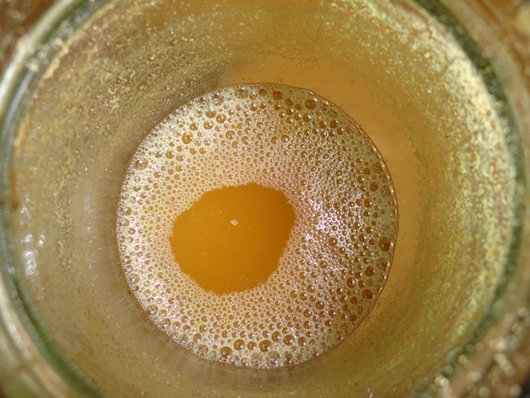
Image

Time changes everything

I've been spending time in the backyard lately creating a contained herb and vegetable garden. My aim is to develop a comfortable place to spend time, relax, increase biodiversity and encourage more animals, birds and insects to live here or visit. Of course I'd prefer my old garden which was put together by Hanno with ease and German precision. Together, we created a space bursting at the seams with herbs, vegetables and fruity goodness ready to eat and share throughout the year. But time changes everything. What I'm planning on doing now, is a brilliant opportunity for an almost 80 year old with balance issues. In my new garden I'll be able to do a wide range of challenging or easy work, depending on how I feel each day. It’s a daily opportunity to push myself or sit back, watch what's happening around me and be captivated by memories or the scope of what's yet to come.
Image

It's the old ways I love the most

I'm a practical woman who lives in a 1980’s brick slab house. There are verandahs front and back so I have places to sit outside when it's hot or cold. Those verandahs tend to make the house darker than it would be but they're been a great investment over time because they made the house more liveable. My home is not a romantic cottage, nor a minimalist modern home, it's a 1980’s brick slab house. And yet when people visit me here they tell me how warm and cosy my home is and that they feel comforted by being here. I've thought about that over the years and I'm convinced now that the style of a home isn't what appeals to people. What they love is the feeling within that home and whether it's nurturing the people who live there.
Image

Back where we belong

Surprise! I'm back ... for good this time. Instagram became an impossible place for me. They kept sending me messages asking if I'd make my page available for advertisers! Of course, I said no but that didn't stop them. It's such a change from what Instagram started as. But enough of that, the important part of this post is to explain why I returned here instead of taking my writing offline for good. For a few years Grandma Donna and I have talked online face-to-face and it's been such a pleasure for me to get to know her. We have a lot in common. We both feel a responsibility to share what we know with others. With the cost of living crisis, learning how to cook from scratch, appreciate the work we do in our homes, shop to a budget and pay off debt will help people grow stronger. The best place to do that is our blogs because we have no advertising police harassing us, the space is unlimited, we can put up tons of photos when we want to and, well, it just feels li...
Image

Making ginger beer from scratch

We had a nice supply of ginger beer going over Christmas. It's a delicious soft drink for young and old, although there is an alcoholic version that can be made with a slight variation on the recipe. Ginger beer is a naturally fermented drink that is easy to make - with ginger beer you make a starter called a ginger beer plant and after it has fermented, you add that to sweet water and lemon juice. Like sourdough, it must ferment to give it that sharp fizz. To make a ginger beer plant you'll need ginger - either the powdered dry variety or fresh ginger, sugar, rainwater or tap water that has stood for 24 hours to allow the chlorine to evaporate off. You'll also need clean plastic bottles that have been scrubbed with soap, hot water and a bottle brush and then rinsed with hot water. I never sterilise my bottles and I haven't had any problems. If you intend to keep the ginger beer for a long time, I'd suggest you sterilise your bottles. MAKING THE STARTER In a...
Image