down to earth

  • Home
  • About Us
  • Down To Earth Book
  • Privacy Policy

This is the quark I made from my yoghurt last week. It drained for four days before I could get back to it, but that's fine as long as it's kept refrigerated. The cheese on the left is savory with cucumber, red capsicum (red pepper), green onion and salt and pepper. It's great on crackers or a sandwich. The one on the right is sweet with honey stirred through it. It's delicious on toast for breakfast. I also collected a small jug of whey that I'll use to make a cake and pikelets (flapjacks).

Housework never ends! You could work half the day just doing what needs to be done in your home, or you could work to a schedule and have your chores organised for the days during the week, but even if you stuck rigidly to your schedule, you'd still have to do it all again tomorrow or next week. Because housework never ends.

I used to struggle with this. I had real trouble coming to terms with the endless nature of it. How could you ever want to do any chore, and get joy from it, when it would never end? No matter how well I did what I had to do, there would always be something else to do tomorrow - or I would have to do the same thing, over and over again.

When I first starting living simply, this was the one thing that didn't just fall into place for me. If I wanted to live well, get joy from the simple things that made up my day and provide a good home for my family and myself, then I had to look at my chores in a different way. I am one of those women who, although I've worked outside the home most of my life, when I became a full time homemaker/housewife, I wore that badge with pride and wanted to live up to the true and full meaning of the name.

So I started thinking about the never-ending nature of housework, as that was the bit that bothered me the most. I didn't have a problem with most of the chores themselves. One of the things Hanno impressed me with early on in our relationship was his attitude of "It has to be done, I'll just do it." So I started with that and I just did what had to be done. I made sure I didn't do all the things I liked doing on the same day, and sprinkled them throughout the week so there were always days I did chores I liked doing - like cooking, baking, gardening and mending with things I didn't like so much - like cleaning toilets, ironing and vacuuming. That worked! But no matter how many times I packed the dishwasher or cleaned the shower, or how well I did it, it still had to be done the next day or next week. Hmmmmm.

Then it hit me like a ton of bricks. If housework never ends then I should get rid of that feeling that if I clean the fridge out or mop the floor, then that's done. Over with. Finished. Completed. All fixed. If housework never ends, then I never have to finish it. Eureka!

When I stopped thinking that I'd work through my chores, get everything finished and then they'd get messed up again so I'd have to start over again, and replaced it with I'll do the ironing, mopping, washing up, make the beds and bake today and if I don't have time for the mopping, I'll do that tomorrow, that made a difference. I continued working with chores I liked, mixed with those I didn't like so much, and that worked well for me. I also changed things to better suit the way I worked. I stopped vacuuming so much and started sweeping. I liked sweeping, so I could still keep the floors clean without the vacuum cleaner. Now I vacuum once a week and sweep the rest of the time. I stopped using the dishwasher and started washing up by hand, and found I really liked it. I stopped ironing everything we wore and now just iron my work clothes and the napkins, tablecloths and pillow slips that I like ironed. I stopped washing everything that had been used once and now only wash what is dirty or smelly - this helped reduce my washing to two or three loads a week. That made a big difference to the amount of housework I did and also cut back on our power and water usage. A big plus.

I guess what I'm saying is that if you want to live in a clean and comfortable home that you can enjoy with your family and friends, then housework is a part of your life. If it's inevitable then you should try to make the most of it. You might end up liking most of it, like I do. Rethink how you work. Just because you've always done something one way, it doesn't mean it has to be like that forever. If you can modify something to better suit how you work, do it. Streamline your tasks and don't aim for perfection. Take breaks. Do everything you do well and find the pleasure in it - it will be there lurking, you just have to find it. Be proud of what you achieve every day because you are providing a comfortable home for your family, you are making the most of the resources you have and looking after what you own. That is a good thing. And most of all, stop thinking that you'll never get through it all. Housework never ends, so don't try to finish it.
We started our Christmas planning yesterday. Not here at home, but at the Centre where I work. Our two main projects are Santa's Helpers and a Christmas breakfast. Both of them are a big part of this caring and open community and both require a lot of organisation.

Of course the end result of both projects is quite simple. Santa's Helpers enables us to give gifts of toys, books, games and clothes to children in our town who might otherwise go without, and we give a hamper of Christmas food, including ham and a few treats like coupons for haircuts and a box of chocolates, to their parents. Our Christmas breakfast is simply that. A breakfast that we cook for the town residents. Our local politicians come along to help with the cooking and we serve all who come along. We encourage those who are living alone or away from their families, and the homeless to join us, as well as town residents who want to meet and get to know people they otherwise wouldn't meet. Last year we served over 350 people.

And the best part is - everything, every toy, game, book, box of chocolates, bike, all clothes, bags, ham, drink, haircut, bread, salad, fruit, yoghurt, water, softdrink, eggs, croissant, and all the goodies that make up the hampers and the breakfast, is donated by the wonderful people in our town.

Christmas has always been a time of family get-togethers for me. But it can be a time of sadness and stress for a lot of people. We see that in the work we do at the Centre. Some people have too much and seem to drown in their excess and some don't have enough and feel guilty and sad because of it. We help redress those problems by encouraging those who can donate to do so, and we give those donations to people who really need them. The rest is used in a breakfast of celebrations on Christmas morning where everyone comes to sit and eat together. Often Santa calls in to have breakfast with us after he's finished visiting all the children in Australia.

Hanno and I are having a dinner with our sons a week or so before Christmas as they are both working on Christmas day. On Christmas day we will be up early to help set up for the breakfast, to cook, serve and clean up and to celebrate the real meaning of Christmas with the people we'll meet at the breakfast. It will be a very simple Christmas for us. We aren't exchanging gifts but we'll be richer for the experience of it.

What are your Christmas plans?

graphic from all posters.com

I often watch a local TV program on Sunday at lunchtime. Landline is an ABC program about all things rural and it gives a good insight into important issues facing our farmers and people in country towns in Australia.

Last
Sunday their lead story was about the effect equine flu has had on the people who own horses but aren't part of the horse racing industry. For those of you who aren't local, in the past few months horse flu has devastated the Australia horse industries - there are two of them, the racing industry and the pleasure and performance industry. The latter being all those horses used for trail, pleasure and equine show riding as well as all the horses in pony clubs and horse studs. The government rushed to help the racing industry but has done very little for the pleasure and performance industry. The end result being that thousands of people who live from pay packet to pay packet are left with no income or any means to live. Those who applied for government benefits, had to wait seven or eight weeks to the first payment to come through.

Imagine living for those seven or eight weeks with no money to buy food or pay the rent or mortgage.

Watching that program and seeing the hardship many of these people are suffering made me realise, yet again, that a disaster that can effect our lives can happen at any time, even if we think it can't. I'm sure all those people who worked in those very well established horse businesses, and especially those who owned them, would have thought that the future looks bright and that nothing would threaten their livelihood. How wrong they were. And it could happen to any of us.

Although it won't fix any great problem that may impact on your life, a stockpile will help you live until you can get government help or work out a way around what has happened, whatever that is. Knowing that you have enough food in your cupboard to tide you over for a couple of months puts a comfortable buffer between your family and those unexpected and devastating things that might happen.

Both men and women have a role to play here. If you're a man who is the sole bread winner for your family, it is your responsibility to help provide food, even when there is no money coming in. If you're a homemaker, the organiser of your family finances and food buyer, you should be prepared for good times and bad. If you're a single parent who fills both roles, it is vital to think about how you will feed your children and yourself if you have no income.

Having a healthy stockpile that is used well and replenished frequently is the best way I know of to protect against the unexpected. That could be the loss of income or a national or local disaster. The side effects of saving you money and time are the icing on the cake. If you haven't got a stockpile, why not look into it and find out how you go about starting one. It will be one of your family's assets. And even if no disaster strikes or you never lose your income, you'll have a cupboard full of food that will make your life easier because you won't have to run to the shop every week. How good is that!

My simple life is changing all the time, just like any healthy process, it's not stagnant. I try to improve what I do so that I get the best results for the time and effort I put in and I'm always thinking about ways to make the more mundane chores pleasant and satisfying.

Ironing has always been a problem for me. I think it stems from when I was a nursing sister. That was way back in the days when nurses wore crisp starched white aprons that crossed over at the back, over a slightly less starched blue uniform. Cuff and collars were almost solid, it always amazed me how stiff they were, and they were attached with removable buttons. All this was held together with a belt that even though it was cotton, was starched to resemble a thin slice of steel. Naturally there were thick black stockings and big clumpy, sensible, lace up shoes. My cap, and later my veil, held enough starch to sink a ship and they were bobby pinned to my head so that movement was almost impossible. I loved that uniform. LOL It's hard to understand why because it was uncomfortable and it took a lot of time to dress, but it symbolised to me and to my patients the long line of tender care I was a part of. But that is totally off the subject.

That uniform was washed, starched and ironed for me. Each week when I picked up my laundry, it was neatly folded and the bundles firmly held with string. When I got those aprons out, they could stand upright without my help. That starch was a powerful force. ; ) I think that level of washing, starching and ironing excellence spoiled me for anything less. I didn't like ironing at all because I didn't use starch and my ironing was always floppy.

Each week when I ironed I tried to make it just another part of a pleasant day. It didn't work. I tried various things, like turning on the TV and listening to the radio, they made no difference. Yesterday I hit the jackpot. I ironed and I enjoyed it.

I think the two key elements to my success where silence and mindfulness. Why didn't I already know this! I decided on silence because I was thinking about something. I was being interviewed by email and I wanted to think about my answers as I ironed. Yes, not being mindful, I know, but let me continue. As I thought about this interview, things fell into place and I was happy with my answers. I continued on with the ironing, still in silence, and started to notice the ironing more. I thought about the clothes, how I would wear them at work, there was a button missing on Hanno's shirt so I got a needle and thread and repaired it while I stood at the ironing board. Each piece of clothing was checked to make sure it was in good repair, ironed and added to a bundle or hung on a hanger. It felt right working bit by bit through the basket, sorting, repairing, ironing and placing items into their own bundle.

When the ironing was finished, I took my bundles to their rightful places. Dishcloths were placed on the kitchen window sill in a wire basket, napkins were folded and placed on the kitchen bench for another week of home cooking. Pillow slips and a table cloth were folded and placed in the linen cupboard. Skirts, dresses, pants and shirts were hung back in our wardrobes. The process of doing this simple task gave me a lot of satisfaction. It was the payoff for the ironing. All items returned, clean and fresh, to their rightful places; order was restored. It felt good. I hope it works again next week. ; )

THIS IS FOR THOSE SWAPPERS WHO DIDN'T RECEIVE THEIR NAPKINS

If you sent napkins in the swap and didn't receive a package, please contact Sharon at cdetroyes@yahoo.com Sharon will be sorting these stragglers out.

Sharon, I spoke with Rhonda Gay, Karen's partner. She is sending a new set of napkins as hers have been lost and the Post Office can't track them.

There is a lot work to be done here today. We have our new floor and kitchen repairs happening tomorrow week, and I only have six free days before it starts. I want to do a few extra things like make some food for us for the time we won't have a functioning kitchen and start moving plates, pot, pans and glasses to another room. I'll think about relocating food later next week. I also have to do a fair bit of writing on projects separate to my blog. It looks like I'll be busy today and all next week.

I love change and the chance to reassess past choices. When everything is repaired and the new floor is down, I'm changing how I store things in my kitchen. This upheaval is giving me the chance to do that. Everything must come out of the kitchen, and when it goes back in, it will mirror how I have changed and how I now use my kitchen.

I also hope to do some sewing today, although that might be a late afternoon activity. I would like to finish off my swap aprons so they can be posted in the next couple of days. If I don't finish them today, they'll have to wait until late next week. I hope everyone is having fun with their apron and the swaps in general. The purpose of these swaps is to make contact with fellow blog readers and to give everyone the opportunity to work on
small and fairly simple craft projects we all use. I see it as a way of building skills for those of us who need that and hopefully it will also build confidence so that you continue on and plan other projects for yourself.

Last time I received a swap package it was opened by Australian Customs. Being the only island continent and very mindful of protecting our unique flora and fauna, we have very strict customs regulations. I want to make everyone aware of the restrictions so that when you wrap up your packages you know what is allowed. This is a very helpful site that gives information about what is not allowed to be sent to Australia:

http://www.daffa.gov.au/aqis/mail/cant-mail

This is from their website:

If you are sending international mail to Australia:
  • do not send prohibited food, plant material or animal products

  • make sure you fill out the declaration label clearly and correctly, itemising everything inside the package, including any packaging materials you’ve used

  • do not pack items in egg cartons, wooden boxes, or cardboard boxes that have been used to hold fruit, vegetables or meat/smallgoods - this packaging is a quarantine risk and is prohibited

  • do not pack with straw or dried plant material, use newspaper or foam to wrap fragile goods
So basically you can't send any seeds, nuts, plants, food, animal products or anything with soil on it. It's fine to send extras in your parcel if you want to, but please check the website above to make sure we in Australia can legally receive what you send. It might also be a good idea if you're sending to other countries to ask your swap partner if they're aware of any restrictions. I will put this information in my side bar too.

Sunday is usually a restful day here in my home. We still do our regular chores but there is also a lot of sitting around and relaxation. I doubt I'll be doing that today but I hope you are. I hope you're all having a wonderful
weekend and that you take time to look after yourself as well as your family. Thank you for stopping by today.

This is my adorable dog, Rosie. Rosie is an Airedale Terrier and she's 12½ years old. Hanno has just clipped her for summer and she's come into the kitchen to see if there is a spare honey biscuit for an old girl. Hello to another Rosie, hello Rosetta!

I was
talking to an acquaintance the other day about retirement. She asked me if Hanno and I had enough money for travelling, entertainment and "enjoying life", her words, not mine. The reason she asked was because she does have a lot of money but she's struggling to find a reason to get up every morning. Poor her. Imagine not having a reason to get out of bed.

I am catapulted out of bed every morning by the knowledge that there is a full and interesting day waiting for me. No matter how tired I have gone to bed the previous night, I always have this same enthusiasm to get up and live, really live, the next day. Living simply gives me that.

If I were to have given that woman a full and clear answer, instead of the short one I gave, I would have told her about my simple life, but I fear that some people only hear what they want to hear and I'm sure my words would have echoed somewhere in the recesses of her brain and soon been forgotten. You see, she and I have a major fundamental difference in how we view our lives. She believes that life's enjoyment is bought with dollars, and I know that is not true. She has been deceived into believing that joy is a commodity with a price tag, she believes retirees need a huge retirement payout to live well, she thinks that happiness is purchased.

As you all well know by now, I am a homemade gal. I make my own happiness. Joy ferments along with the ginger beer and sourdough right here in my home. We are happy people because we have have something to do, someone to love and something to look forward to. We truly live each day and we aren't reliant on others to deliver invitations to lunch or a shopping spree to help us enjoy ourselves.

It's a commonly held belief that when you retire you sit around and just soak up life's pleasures. But unless you're almost brain dead, or incredibly lazy, sitting around gets boring after a while. It's much better to have a purpose to each day and if that purpose changes constantly, that makes for an interesting life. Humans need interest, and what finer interest is creating a wholesome life for yourself. Of course there is room for travelling and entertaining, but they're very small portions of life's abundance and complexity.

Life should be made up of the elements of living like proving food for ourselves and maintaining a comfortable and warm home, as well as those things that make our existence meaningful like nurturing our families and maintaining valuable friendships and knowing, really knowing by experience, the joy in that. All else is flim flam.
Can we have a check of the swaps. Have any of the people who are waiting on the last swap received their napkins?

Has everyone in the current apron swap made contact with their swap partner? Please check into the comments box so I have a better idea what's happening. Thanks everyone. : )

When I first started living as I am now, I was searching and hoping for happiness and contentment and thought I might find it with fewer possessions and less attachment to mainstream ideals and what modern life had evolved into. I focused myself on the lifestyle and not what would eventually bring me real happiness, my inner self. I know now that the simple lifestyle is merely the means of attaining that inner peace and contentment; it's not the destination, it's just the ticket to ride.

Of course, when you think about it, the entire package is inner peace and contentment brought about via the daily work we all do in our lives. Everything you do in your day has the potential to deliver or delay that contentment. If we are striving to achieve our own personal happiness that is more likely to come when we work towards it with a purpose without getting sidetracked along the way by incidentals like buying another TV or new shoes. When I began to understand that, it helped me readjust what I did during the day. I stopped watching TV - mainly because I was watching pay TV lifestyle programs where people were looking for their ideal life, or cleaning programs where they'd clean up their lives and homes with the help of an outsider. I realised that I was trying to change my life while watching others try to change theirs. I needed to focus on what I was doing, so the daytime TV stopped. That lead to a kind of domino effect. We didn't watch much TV at all then, the cost of having pay TV was too high a cost in my simplified life, so it went. That freed up my daytime hours to concentrate on planning what I wanted to do. It gave me time to expand our vegetable garden, to learn how to mend and sew, I had time to learn how to make good bread. My goal now was to do everything well and with a purpose. It wasn't good enough just to bake bread, it had to be the best bread I was capable of. There was no reason to bake mediocre bread when we could, with just a few adjustments and more mindfulness, be eating excellent bread.

Being mindful is really the key to this. I discovered that when I slowed my mind down to focus on what I was doing at that minute, without thinking ahead to what was coming later, or what had passed, I was able to work systematically. I could improve what I was doing as I did it, I tried new ways and ditched old ones and eventually, over the course of about a year, I'd developed a new way of working that produced consistent results, I'd taught myself a lot of new skills and rediscovered old ones, and I was happy with my results.

That is the point of simple living to me - happiness. When you're happy with what you're capable of and how you live, whether that is cheering on your child at the school sports day, making the best peach jam you've tasted, delivering a well thought out presentation to your boss, saying hello to your new neighbours, hugging your partner with real affection, enjoying the company of your family and friends or growing the perfect tomato, that will deliver contentment to you. The satisfaction you feel when you do all those commonplace things builds into genuine contentment and self respect. You learn to respect yourself and what you do. That opens up a whole new world of good feelings, it will bring excellence to your life and the ability to be generous.

I know this opinion will be believed by some and not by others, but I know it to be true - as you simplify, consume less and pare back your needs, you will enrich your life. You'll create a new standard of quality for yourself because you'll start making excellent products for yourself instead of buying mediocre ones. And the end result of this new way of living will be that the richness of your everyday life will not allow the mediocrity of mainstream life to impact on you as much as it did in the past. You'll replace the mindlessness of TV, weekly magazines and shopping at the mall with a life full of purpose where you'll want less but be a whole lot more.
I am having a wonderful day. I am alone here today, it's just me with the dogs and chooks. Hanno is off having some medical tests done and will then go to pick up our new kitchen appliances.

I love being alone and haven't been for the longest time. My only alone time now is when I drive back and forth to my job. Today was a real treat for me.

And it's been raining. : )

This morning I took my tea out to the verandah and watched the rain fall, and I thought about how my life has be changed in the past few years. I was sitting here smiling like the Cheshire Cat when the phone rang so I talked to Kathleen for about 15 mintues. She's in Perth this week and we talked while she took the train from Perth to Fremantle.

I spent the morning after that on my aprons. I am doing them as a pair - I cut one out, I cut the other; I cut the ties for one, then the other. All I have to do now is the hemming and I'm done. It's been a real pleasure working on them. I love the fabrics I chose and how they all fell together with few hiccoughs and NO mistakes. : )))

I have just had a sandwich for lunch and another cup of tea and soon I'll prepare a tuna casserole for dinner and tidy the kitchen. Then I'm going to sort through some quilt material until it's time to serve our evening meal.

We decided this morning that we will remove our peach and nectarine trees. I'm really sad about this but know it's for the best. We've had a terrible trouble with fruit fly this year and they are all coming for the peaches and nectarines. Unfortunately they are stinging the tomatoes too. We didn't have fruit fly at all in our garden till we planted those trees and even though they're only in their second year, they'll have to go. The chooks will have a feast on the fruit that we'll probably strip off tomorrow.

I also wanted to thank my lovely readers for ordering your books, DVDs and CDs through my amazon ad. I forgot to look at it until just now and there's almost $10 in commissions there, so thank you for being so thoughtful.
Yoghurt and quark can be made from ingredients usually found in the fridge or stockpile cupboard. With the price of food seeming to rise every week, they're handy recipes as you'll be able to make yoghurt for snacks and desserts, and quark for sandwiches and crackers. Quark is an easy to make from scratch simple cheese that's popular in the Germanic countries, and maybe also in Scandinavia. I hope one of the readers will tell me if that's right. It's a cheese made from yoghurt that can be either sweet or savory.

Here is my way of making yoghurt from scratch. If you buy yoghurt for this, make sure it has no preservatives, colourings, flavourings or gelatin. Greek yoghurt tends to be thick and will make up a good quark. But if you want to make your own yoghurt, this is a recipe I've cut from earlier in my blog:

I made yoghurt today. It's easy, delicious and inexpensive, costing about half the price of supermarket yoghurt. You can make yoghurt with any kind of milk, low fat cow's or from goat or sheep milk. All your equipment should be clean and make sure you use clean tea towels. Adding milk powder to the milk will make a thicker yoghurt.

You can use ordinary bought yoghurt as a starter, but make sure it doesn't contain gelatin. Generally the organic and biodynamic yoghurts have no gelatin. You can buy specialist milk thermometers, but for some reason they have very small dials. I've got a candy thermometer with a bigger dial for my older eyes. You probably need to use a thermometer until you know what the temps feel like on your clean finger. After that, it's easy enough to judge by poking your clean finger in the mix.

YOGHURT RECIPE
makes one litre (quart)
4 cups milk - the milk can be made with milk powder
½ cup instant milk powder, more if you want thicker yoghurt
3 tablespoons plain yoghurt at room temperature

Pour 4 cups milk into saucepan and clip a thermometer to the side of the pan. You need to pasturise the milk again to make sure only the beneficial bacteria grow. Heat milk to 80 - 95 degrees C (176 - 203F) or until little bubbles form around the edge of the pan. Stir the milk while it's heating to stop it scorching.

When the temperature is reached, remove the milk from the stove. Stir in the powdered milk.

Leave the thermometer clipped to the pan and cool the milk to 40 - 50 degrees C (104 - 122F). To speed up the cooling process, you can transfer it to a cool bowl or put it in the fridge.

Add the starter. Place the plain yoghurt in a small bowl, stir in 1/3 cup of the warm milk and mix until smooth. Then stir the starter mixture into remaining milk and mix well.

Incubate the yoghurt in the crockpot (or in a warm place like an oven on low heat). Preheat the crockpot on low for about 15 minutes, until it feels very warm to the fingertips. Pour yoghurt mixture into the crockpot, cover the crockpot, and turn off the heat. At 35 to 45-minutes intervals, heat the crockpot on low for 10 to 15 minutes then turn off the heat. Be warned that if you overheat the yoghurt, it will turn into a solid blob. Don't ask me how I know that. ; )

The mix needs to incubate for 3-5 hours at a temperature of 43-45 degrees C (110 - 113F). Do not shake or disturb it during incubation. After 3 hours, check to see if the yoghurt is set by gently tilting the container. If yoghurt is set and firm, place it in the refrigerator and chill for 6 hours before serving. If not, continue to incubate. Check the yoghurt every hour and place in refrigerator as soon as it sets. The longer the yoghurt incubates the tarter the flavor will be.

If your yoghurt sets within 3 hours, but you'd prefer more tartness, continue the incubation process for another hour or so. Yoghurt making is only successful if you use fresh viable cultures, so check the use by date on
your yoghurt starter and make it as soon as you can after buying it. Once you've made your own yoghurt you can use it as your next starter.

QUARK

When you have your yoghurt made and you want to make quark, you need a large jug, a strainer and a piece of clean cotton cloth. Wash the cloth with pure soap, rinse well and wring it out so it's not dripping wet. Place the strainer in the jug and the cloth over the strainer. Then add the yoghurt.

Cover the yoghurt with the cloth, so the mix is entirely covered.

Put a plate on top and and weigh the plate down with something fairly heavy. I have used a pot of jam. The process of making quark involves removing the water (whey) from the yoghurt. You do that by sitting the yoghurt in the strainer, in the fridge, weighed down so the whey can drain from the yoghurt into the jug.

To get a suitable dry quark, you'll need to allow it to drain for at least 24 hours, possibly 48 hours. When you think it's able to be molded into a cheese shape, remove the quark from the strainer, pack it into a mold and then turn it out onto a plate.

The quark below is an old photo of quark I made a few months ago. The savory quark was made by adding salt and pepper to taste to the finished quark and adding some chopped chives. You could also add chilli and chilli sauce over the top of the quark.

This sweet quark below was sweetened with a little honey and then I added a small amount of homemade strawberry jam to the top of the quark.

FROZEN YOGHURT

Instead of making quark with your yoghurt, you could make frozen yoghurt popsicles or dessert. Just freeze some fruit - berries, banana, apple with a squeeze of lemon juice added to stop browning. Make sure the yoghurt is cold after making it.

Popsicles

If you intend making popsicles, put the frozen fruit in the blender and whizz it up. Add about ½ cup fresh orange juice and the yoghurt mix, then whizz it again until the mix is thoroughly combined. Pour the mix into popsicle molds and freeze.

Frozen yoghurt dessert

You could also make a bowl of frozen yoghurt by adding frozen fruit to a blender and whizz to break up the fruit. Add about third cup of honey and the yoghurt mix, and whizz again. Pour into a bowl and freeze.

You might think the subject of today's post is a bit odd but it's the unusual things that aren't generally thought about in today's consumer driven life that make the simple home what it is. Today's topic - corks, lids and food covers.

We had a recent post about jars so lets start with jar lids. Mason jars have two types of lids. You have the general metal screw on lid as well as a variation of that - the two part lid. When you buy these lids and have to replace them, you can just buy the centre piece, which saves buying more metal. The centre disc holds the rubber which makes the jar air tight. It is that part that will wear out, and therefore need replacing. See below.

These lids act as a general lid for a mason jar but I use them when I'm growing sprouts too. I remove the central disc and use a piece of netting or loose weave cotton cloth. I screw that on to the jar with the screw down section and then have a very good glass container that I can run water into, drain easily and stand on its lid so the water can drain out.

And the end result of the sprouting.


There are different types of lids that can be used on glass jars. The green lids below are the Fowlers Vacola lids that you can buy to fit on your preserving jars when you open them. It's not a good idea to keep the metal lid on the jar when it's open. But you don't need to buy the FV lids. The red lid below is in a Fowlers jar but it's actually the stopper from a French mustard pot - recycled from my son's restaurant. If you find any of these tops, or anything similar, grab it and add it to your cork and lid collection. Also below is a pottery lid, originally from a sugar container that broke, I now use it for my FV jars. Anything safe and solid is good. It will be safe if it has been sold to cover some kind of food, and solid if it's glass or pottery with no cracks. Also below is an old lolly jar, it's on the far right. It is partly glass, partly plastic. anything like this is great and if you save these tops, at some point you'll find a jar it will fit. Often things don't have to be air tight, they just need to be covered so the contents of the jar aren't open to the air. For instance, the FV green tops fit fairly loosely, so does the red top, but that's fine.


Next on our list are corks. What a fine ancient food and drink stopper a cork is. Made from the bark of a special tree, cork is becoming quite scarce and many wine companies have now stopped using corks. If you have some corks, save them, they're precious. Below you can see a nice bottle with a cork that I use for flavoured vinegar. You can recycle a nice looking bottle, fill it with flavoured oil or spiced vinegar, cork it and give it as a gift. It looks rustic and lovely and most people will love it. Also below is the pottery top featured above, here it is being used as the cover on a small jam bowl. That jam bowl can also be covered with the large cork and the pottery pot on the far left is the mustard pot that the red top comes from that I have in my FV jar above.

The covers below are cloth covers. The one on the left is a crocheted cover, the other is a light cotton cloth that I've stitched around the edge and sewn beads on to keep it in place. Both these covers can be used for covering your ginger beer plant or sourdough starter as it will allow the wild yeasts to enter your jar while keeping bugs out. Here is a pattern to make a crocheted cover.

Cloth covers can also be made from a clean tea towel or any clean cloth you have at home. You can use a cloth cover instead of plastic wrap to cover cheese that is stored in the fridge. If you do this, simply wet the cloth, wring it out well so that it's just slightly damp and cover your cheese with that. Moisten it again when it dries out. This is a very old way of covering cheese but it still works well.

Our last photo is a dish stack that can be used to store two different types of foods. I generally place my stack on a larger plate at the bottom. On top of that is a bowl that could hold something like salad. The bread and butter or salad plate on top of that covers the salad and also holds leftover salmon cakes or cheese (or whatever) and this is covered by an upturned bowl. It saves space in the fridge and also covers your food without using plastic.

I hope this has given you a few ideas to use in your kitchen. Many things we commonly throw away can be reused, you just have to think outside the square. So if you've started a jar collection, or already have one, also think of how you will cover your jars, and start searching.

Newer Posts Older Posts Home

MY BOOKS

MY BOOKS


My books were all published by Pengiun, and are available at Amazon US, Amazon UK and Amazon Au

Search here

Total Pageviews

Translate


I'm Rhonda Hetzel and I've been writing my Down to Earth blog since 2007. Although I write the occasional philosophical post, my main topics include home cooking, happiness and gardening as well as budgeting, baking, ageing, generosity, mending and handmade crafts. I hope you enjoy your time here.

MY FAVOURITE PLACES

  • Grandma Donna's Place
  • Grandma Donna's YouTube
  • Grandma Donna's Instagram
  • This Simple Day
  • Nicole's Instagram

Give More

Give More

Popular posts last year

Making ginger beer from scratch

We had a nice supply of ginger beer going over Christmas. It's a delicious soft drink for young and old, although there is an alcoholic version that can be made with a slight variation on the recipe. Ginger beer is a naturally fermented drink that is easy to make - with ginger beer you make a starter called a ginger beer plant and after it has fermented, you add that to sweet water and lemon juice. Like sourdough, it must ferment to give it that sharp fizz. To make a ginger beer plant you'll need ginger - either the powdered dry variety or fresh ginger, sugar, rainwater or tap water that has stood for 24 hours to allow the chlorine to evaporate off. You'll also need clean plastic bottles that have been scrubbed with soap, hot water and a bottle brush and then rinsed with hot water. I never sterilise my bottles and I haven't had any problems. If you intend to keep the ginger beer for a long time, I'd suggest you sterilise your bottles. MAKING THE STARTER In a...
Image

NOT the last post

This will be my last post here.  I've been writing my blog for 18 years and now is the time to step back. I’ve stopped writing the blog and come back a couple of times because so many people wanted it, but that won’t happen again, I won’t be back.  I’ll continue on instagram to remain connected but I don’t know how frequent that will be. I know some of you will be interested to know the blog's statistics. 
Image

How to make cold process soap

I'm sure many of you are wondering: "Why make soap when I can buy it cheaply at the supermarket?" My cold process soap is made with vegetable oils and when it is made and cured, it contains no harsh chemicals or dyes. Often commercial soap is made with tallow (animal fat) and contains synthetic fragrance and dye and retains almost no glycerin. Glycerin is a natural emollient that helps with the lather and moisturises the skin. The makers of commercial soaps extract the glycerin and sell it as a separate product as it's more valuable than the soap. Then they add chemicals to make the soap lather. Crazy. Making your own soap allows you to add whatever you want to add. If you want a plain and pure soap, as I do, you can have that, or you can start with the plain soap and add colour, herbs and fragrance. The choice is yours. I want to add a little about animal and bird fat. I know Kirsty makes her soap with duck fat and I think that's great. I think t...
Image

Preserving food in a traditional way - pickling beetroot

I've had a number of emails from readers who want to start preserving food in jars but don't know where to start or what equipment to buy.  Leading on from yesterday's post, let's just say up front - don't buy any equipment. Once you know what you're doing and that you enjoy preserving, then you can decide whether or not to buy extra equipment. Food is preserved effectively without refrigeration by a variety of different methods. A few of the traditional methods are drying, fermentation, smoking, salting or by adding vinegar and sugar to the food - pickling. This last method is what we're talking about today. Vinegar and sugar are natural preservatives and adding one or both to food sets up an environment that bacteria and yeasts can't grow in. If you make the vinegar and sugar mix palatable, you can put up jars of vegetables or fruit that enhance the flavour of the food and can be stored in a cupboard or fridge for months. Other traditional w...
Image

Cleaning mould from walls and fabrics

With all this rain around we've developed a mould problem in our home. Usually we have the front and back doors open and that good ventilation stops most moulds from establishing. However, with the house locked up for the past week, the high humidity and the rain, mould is now growing on the wooden walls near our front door and on the lower parts of cupboards in the kitchen. Most of us will find mould growing in our homes at some point. Either in the bathroom or, in humid climates, on the walls, like we have now. You'll need a safe and effective remedy at some point, so I hope one of these methods works well for you. Mould is not only ugly to look at, it can cause health problems so if you see mould growing, do something about it straight away. The longer you leave the problem, the harder it will be to get rid of it effectively. If you have asthma or any allergies, you should do this type of cleaning with a face mask on so you don't breathe in any spores. Many peopl...
Image

Five minute bread

Bread is one of those foods that, when made with your own hands, gives a great deal of satisfaction and delight. It's only flour and water but it symbolises so much. I bake bread most days and use a variety of flours that I buy in bulk. Often I make a sandwich loaf because we use most of our bread for lunchtime sandwiches and for toast. Every so often I branch out to make a different type of loaf. I have tried sour dough in the past but I've not been happy with any of them. I'll continue to experiment with sour dough because I like the idea of using wild yeasts and saving the starter over a number of years to develop the flavour and become a part of the family. However, the loaf I've been branching out to most often is just a plain old five minute bread. By five minutes I mean it takes about five minutes actual work to prepare but it's the easiest of all bread to make and to get consistently good loaves from. If you're having people around for lunch or...
Image

This is my last post.

I have known for a while that this post was coming, but I didn't know when. This is my last post. I'm closing my blog, for good, and I'm not coming back like I have in the past.  I've been writing here for 16 years and my blog has been many things to me. It helped me change my life, it introduced me to so many good people, it became a wonderful record of my family life, it helped me get a book contract with Penguin, and monthly columns with The Australian Women's Weekly and Burke's Backyard . But in the past few months, it's become a burden. In April, I'll be 75 years old and I hope I've got another ten years ahead. However, each year I'll probably get weaker and although I'm fairly healthy, I do have a benign brain tumour and that could start growing. There are so many things I want to do and with time running out, leaving the blog behind gives me time to do the things that give me pleasure. On the day the blog started I felt a wonderful, h...
Image

What is the role of the homemaker in later years?

An email came from a US reader, Abby, who asked about being a homemaker in later years. This is part of what she wrote: "I am a stay-at-home mum to 4 children, ages 9-16. I do have a variety of "odd jobs" that I enjoy - I run a small "before-school" morning drop-off daycare from my home, I am a writing tutor, and I work a few hours a week at a local children's bookstore. But mostly, I cherish my blissful days at home - cooking, cleaning (with homemade cleaners), taking care of our children and chickens and goats, baking, meal-planning, etc. This "career" at home is not at all what I imagined during my ambitious years at university, but it is far more enriching. I notice, though, that my day is often planned around the needs of my family members. Of course, with 4 active kids and a husband, this is natural. I do the shopping, plan my meals, cook dinner - generally in anticipation of my family reconnecting in the evening.  I can't h...
Image

Every morning at home

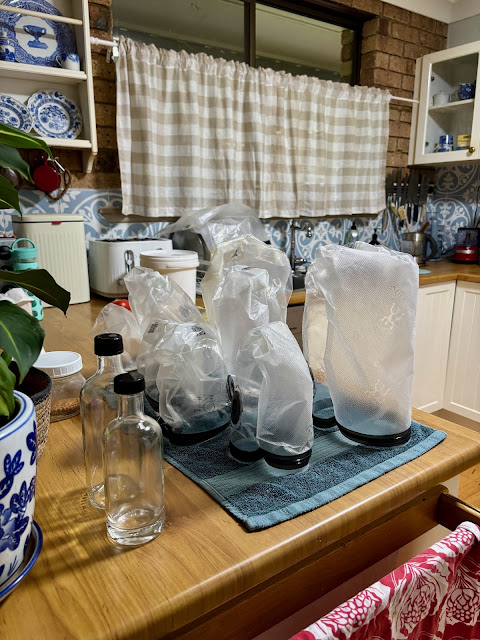
Every morning when I walk into my kitchen it looks tidy and ready for a day's work. Not so on this morning (above), I saw this when I walked in. Late the previous afternoon when I was looking for something, I came across my rolled up Zwilling vacuum bags and decided they had to be washed and dried. So I did that and although I usually put them outside on the verandah to dry it was dark by then. I turned the just-washed bags inside out and left them like this on a towel. It worked well and now the bags are ready to use when I bring home root vegetables, cabbages or whatever I buy that I want to last four or five weeks.
Image

You’ll save money by going back to basics

When I was doing the workshops and solo sessions, I had a couple of people whose main focus was on creating the fastest way to set up a simple life. You can't create a simple life fast, it's the opposite of that It's not one single thing either - it's a number of smaller, simpler activities that combine to create a life that reflects your values; and that takes a long to come together. When I first started living simply I took an entire year to work out our food - buying it, storing it, cooking it, preserving, baking, freezing, and growing it in the backyard. This is change that will transform how you live and it can't be rushed.  
Image

All previous blog posts

  • 2026 3
    • February 3
      • Workshops starting 1 March
      • Planting vegetable seeds and new workshops
      • Back where we belong
  • 2025 7
    • July 1
    • June 2
    • May 1
    • April 2
    • February 1
  • 2024 25
    • December 2
    • November 1
    • October 2
    • September 3
    • August 1
    • July 3
    • June 1
    • May 3
    • April 2
    • March 3
    • February 2
    • January 2
  • 2023 13
    • December 1
    • November 2
    • October 1
    • September 3
    • August 2
    • February 2
    • January 2
  • 2022 17
    • November 3
    • October 4
    • September 3
    • August 2
    • July 3
    • June 2
  • 2021 50
    • December 1
    • November 6
    • October 7
    • September 5
    • August 4
    • July 5
    • June 2
    • May 2
    • April 6
    • March 4
    • February 4
    • January 4
  • 2020 68
    • December 3
    • November 5
    • October 4
    • September 4
    • August 4
    • July 4
    • June 4
    • May 8
    • April 7
    • March 8
    • February 8
    • January 9
  • 2019 66
    • December 2
    • November 4
    • October 5
    • August 3
    • July 4
    • June 6
    • May 8
    • April 8
    • March 8
    • February 11
    • January 7
  • 2018 82
    • December 1
    • September 2
    • August 10
    • July 4
    • June 11
    • May 9
    • April 12
    • March 10
    • February 10
    • January 13
  • 2017 129
    • December 7
    • November 10
    • October 6
    • September 13
    • August 11
    • July 13
    • June 12
    • May 9
    • April 9
    • March 14
    • February 11
    • January 14
  • 2016 125
    • December 7
    • November 13
    • October 10
    • September 11
    • August 11
    • July 8
    • June 9
    • May 9
    • April 12
    • March 10
    • February 13
    • January 12
  • 2015 184
    • December 7
    • November 15
    • October 20
    • September 18
    • August 19
    • July 18
    • June 12
    • May 15
    • April 12
    • March 21
    • February 13
    • January 14
  • 2014 203
    • December 11
    • November 8
    • October 17
    • September 20
    • August 17
    • July 19
    • June 17
    • May 17
    • April 23
    • March 15
    • February 18
    • January 21
  • 2013 225
    • December 13
    • November 17
    • October 17
    • September 17
    • August 21
    • July 24
    • June 20
    • May 19
    • April 17
    • March 22
    • February 17
    • January 21
  • 2012 245
    • December 17
    • November 20
    • October 20
    • September 18
    • August 15
    • July 24
    • June 21
    • May 26
    • April 23
    • March 23
    • February 19
    • January 19
  • 2011 257
    • December 18
    • November 24
    • October 27
    • September 23
    • August 24
    • July 21
    • June 24
    • May 24
    • April 16
    • March 22
    • February 14
    • January 20
  • 2010 283
    • December 20
    • November 18
    • October 18
    • September 19
    • August 25
    • July 24
    • June 25
    • May 26
    • April 25
    • March 22
    • February 29
    • January 32
  • 2009 293
    • December 29
    • November 18
    • October 23
    • September 25
    • August 22
    • July 28
    • June 22
    • May 21
    • April 27
    • March 26
    • February 24
    • January 28
  • 2008 387
    • December 24
    • November 23
    • October 25
    • September 26
    • August 27
    • July 27
    • June 37
    • May 34
    • April 44
    • March 53
    • February 32
    • January 35
  • 2007 372
    • December 37
    • November 40
    • October 55
    • September 51
    • August 49
    • July 63
    • June 49
    • May 28


Trending Articles

NOT the last post

This will be my last post here.  I've been writing my blog for 18 years and now is the time to step back. I’ve stopped writing the blog and come back a couple of times because so many people wanted it, but that won’t happen again, I won’t be back.  I’ll continue on instagram to remain connected but I don’t know how frequent that will be. I know some of you will be interested to know the blog's statistics. 
Image

Every morning at home

Every morning when I walk into my kitchen it looks tidy and ready for a day's work. Not so on this morning (above), I saw this when I walked in. Late the previous afternoon when I was looking for something, I came across my rolled up Zwilling vacuum bags and decided they had to be washed and dried. So I did that and although I usually put them outside on the verandah to dry it was dark by then. I turned the just-washed bags inside out and left them like this on a towel. It worked well and now the bags are ready to use when I bring home root vegetables, cabbages or whatever I buy that I want to last four or five weeks.
Image

You’ll save money by going back to basics

When I was doing the workshops and solo sessions, I had a couple of people whose main focus was on creating the fastest way to set up a simple life. You can't create a simple life fast, it's the opposite of that It's not one single thing either - it's a number of smaller, simpler activities that combine to create a life that reflects your values; and that takes a long to come together. When I first started living simply I took an entire year to work out our food - buying it, storing it, cooking it, preserving, baking, freezing, and growing it in the backyard. This is change that will transform how you live and it can't be rushed.  
Image

Creating a home you'll love forever

Living simply is the answer to just about everything. It reduces the cost of living; it keeps you focused on being careful with resources such as water and electricity; it reminds you to not waste food; it encourages you to store food so you don't waste it and doing all those things brings routine and rhythm to your daily life. Consciously connecting every day with the activities and tasks that create simple life reminds you to look for the meaning and beauty that normal daily life holds.  It's all there in your home if you look for it. Seemingly mundane tasks like cleaning and cooking help you with that connection for without those tasks, the home you want to live in won't exist in the way you want it to.  Creating a home you love will make you happy and satisfied.
Image

Time changes everything

I've been spending time in the backyard lately creating a contained herb and vegetable garden. My aim is to develop a comfortable place to spend time, relax, increase biodiversity and encourage more animals, birds and insects to live here or visit. Of course I'd prefer my old garden which was put together by Hanno with ease and German precision. Together, we created a space bursting at the seams with herbs, vegetables and fruity goodness ready to eat and share throughout the year. But time changes everything. What I'm planning on doing now, is a brilliant opportunity for an almost 80 year old with balance issues. In my new garden I'll be able to do a wide range of challenging or easy work, depending on how I feel each day. It’s a daily opportunity to push myself or sit back, watch what's happening around me and be captivated by memories or the scope of what's yet to come.
Image

It's the old ways I love the most

I'm a practical woman who lives in a 1980’s brick slab house. There are verandahs front and back so I have places to sit outside when it's hot or cold. Those verandahs tend to make the house darker than it would be but they're been a great investment over time because they made the house more liveable. My home is not a romantic cottage, nor a minimalist modern home, it's a 1980’s brick slab house. And yet when people visit me here they tell me how warm and cosy my home is and that they feel comforted by being here. I've thought about that over the years and I'm convinced now that the style of a home isn't what appeals to people. What they love is the feeling within that home and whether it's nurturing the people who live there.
Image

Back where we belong

Surprise! I'm back ... for good this time. Instagram became an impossible place for me. They kept sending me messages asking if I'd make my page available for advertisers! Of course, I said no but that didn't stop them. It's such a change from what Instagram started as. But enough of that, the important part of this post is to explain why I returned here instead of taking my writing offline for good. For a few years Grandma Donna and I have talked online face-to-face and it's been such a pleasure for me to get to know her. We have a lot in common. We both feel a responsibility to share what we know with others. With the cost of living crisis, learning how to cook from scratch, appreciate the work we do in our homes, shop to a budget and pay off debt will help people grow stronger. The best place to do that is our blogs because we have no advertising police harassing us, the space is unlimited, we can put up tons of photos when we want to and, well, it just feels li...
Image

Making ginger beer from scratch

We had a nice supply of ginger beer going over Christmas. It's a delicious soft drink for young and old, although there is an alcoholic version that can be made with a slight variation on the recipe. Ginger beer is a naturally fermented drink that is easy to make - with ginger beer you make a starter called a ginger beer plant and after it has fermented, you add that to sweet water and lemon juice. Like sourdough, it must ferment to give it that sharp fizz. To make a ginger beer plant you'll need ginger - either the powdered dry variety or fresh ginger, sugar, rainwater or tap water that has stood for 24 hours to allow the chlorine to evaporate off. You'll also need clean plastic bottles that have been scrubbed with soap, hot water and a bottle brush and then rinsed with hot water. I never sterilise my bottles and I haven't had any problems. If you intend to keep the ginger beer for a long time, I'd suggest you sterilise your bottles. MAKING THE STARTER In a...
Image