down to earth

  • Home
  • About Us
  • Down To Earth Book
  • Privacy Policy
This is when your simple life starts. At this very minute. If you've decided you want to change the way you live and intend to make a plan to live simply, then I want you to think of yourself as living simply. Tell other people too; tell your family, friends and neighbours. Tell them: "I've changed how I live my life, I'm living simply now." You'll find that if you tell others and verbalise your changes, that the change itself will be easier. You'll feel like you've already made inroads on your new life and the change is underway.

I want to emphasise that simple living can be started at any time of your life, with each period having its own challenges and rewards. If you’re in your 50s or beyond, like me, it will put you on the path towards a healthy and ethically-based lifestyle that will allow you to do more good than harm. If you are in the period when you’re nurturing a young family and buying a home, I hope you’ll gain valuable insight into how to build a sustainable and fulfilling life. If you’re younger and just starting out, I hope you will use your simple values to build an ethical and secure base on which to build a fine future.

As soon as you finished reading this blog today, I have a task for you. Your first small step: sit down with a pen and notepad and think about the kind of life you want to live. Picture yourself in your ideal location doing what would make you happy. What is complicating your life? What do you need to change in your life to achieve what you want? Write down the points of change as you think of them. Write down how you believe you could achieve the changes you want. Write down what you’re prepared to give up to make the changes happen. List what you don’t like about your life now. List what is important to you.

Your list will show you what areas you need to focus on, and you can then work through your list point by point. If you’re like me, you’ll need to change a lot to achieve the life you want. Take a bit of time with this first exercise, think about what is important to you and your family and write it all down. It will be very interesting in the coming weeks and months to look at these points again to see how your path or your ideas change. Be aware it won't be all smooth sailing. You'll need to compromise on some of your wishes but maybe you can revisit them in coming months and move them closer to where you want to be.

When undertaking any major change in life you need to be organised to be able to cope with it and do it in the most efficient way. You will probably change a lot of small things to live simply, so organisation is vital. Each simple life is different as well, there is no fixed formula for what we're doing here. Your life will be different to mine, your plans will vary according to the stage of life you're at, if you're married or not, if you have children, if you're working at home or outside the home, there are many variables. You must plan your changes and keep all your information at hand.

I've written before about how to declutter and organise your home, but decluttering is only one part of this organisation. I am going to encourage you to start making lists. Shopping lists, stockpile lists, to do lists. Make up any sort of list that will help you achieve what you hope for. Use your lists to give yourself reminders during the day about what you should be focusing on. Use a calendar to mark important dates like birthdays, anniversaries and meetings. Keep a diary to record notes for yourself and to remind you of what you need to do.

This is your second small step. Start a simplicity journal in which you record new ways of doing things and new ideas you want to work on. The list of how you want your life to change should be the first thing in your journal. It will also hold the general information about your home like your To Do’s, your garden plan and a record of your harvests, when and what you preserve, and any new recipes you find for both food and cleaning. I hope you'll include some of my ebooks in your simplicity journal too.

I recycled one of those old cardboard covered three ring binders, covered it in a fabric and I use that for all my simple notes, recipes and reminders. My journal also contains letters people write to me, seeds that I've decided to plant but haven't planted yet, a calendar so I can mark down what I'm doing, my water meter card, seed and tree catalogues and many recipes.

If you find something online that will help you in your new life, download it and add it to your folder. It is important that you keep a folder to organise
your transition to simplicity, not only will it be the repository of all your notes and reminders, it will also document your journey to your new way of living. Keep this folder and your diary together so you always know where they are. You can put in some dividers and have sections for recipes, seed catalogues, ideas you want to try, stories from others who inspire you to be the best you can be. If you're trying to reduce your electricity and water consumption, keep your bills in your folder, along with your weekly meter readings. Tailor your journal to suit what you're doing and it will help you simplify. You'll have all your information in one place and you can add to it or read it easily.

Starting a simplicity journal might sound like an extra burden in a changing life, but being organised will focus you and keep you on track for all the good things that will become part of your simple life.
I am way overdue answering emails and comments. With my sister here I don't have the spare time throughout the day when I usually answer them. I will write as soon as I can. Thank you for your patience. : )

Many people want to live simply but don’t know how, or where, to start, or even what simple living really is. The simple answer is that simplicity is about many small things that add up to become entire way of life. For me, simple living has been a mixture of personal growth, thrift, making do with what I have, resource conservation, a change in attitude about what is considered success and achievement, slowing down, expanding horizons, living well on less money and making deliberate choices about my life and how I live it. Of course, it encompasses much more than those elements but that’s it in a nutshell. It is a fine honest lifestyle and when you get a taste of it, nothing else will be good enough for you.

I have been trying to set out information in my blog about the practical aspects of a simple life. Things like how to:
  • budget and shop mindfully
  • store and preserve food
  • grow some of your own food
  • keep chickens and worms
  • organise your home and declutter
  • and how to make some of homemade cleaners

Many of these tasks are things that will help you live simply and generally they're all fairly easy to do. The difficult part of your simple living change will be to have a deep understanding of how you are personally responsibile for how you live your life, to develop simple values and consistently live according to them, and to change your mindset about spending and possessions.

We live in an increasingly artificial world. We can have anything our heart desires, for a price. If you’ve got the money, you can buy disposable mops, toothbrushes and underwear, robotic vacuum cleaners and lawn mowers, fake jewellery as well as authentic gems that may have cost someone their life, frozen dinners, fake finger nails and suntans, cigarettes that might kill you, clothes that look divine but hide their exploitative creation, and meat, fruit and vegetables that look perfect and healthy but often aren’t.

Many people have deliberately cut themselves off from the natural world. Some won’t eat a tomato that has had a bug on it but will happily eat vegetables that have been fed with artificial fertilisers, meat that comes from animals that are poorly treated and fed unnatural food, or fish and prawns that have lived their lives in polluted waters far from our shores. Even though an important part of simplicity is to have enough money to live, one thing is certain, simple living cannot be bought. No credit card has enough credit, no amount of dollars, euros or gold will deliver it to your door. It is one of those rare things of true and enduring value that you have to work for.

I'd be lying if I told you that simple living is easy. It is satisfying, rewarding, healthy, beautiful, it makes you feel happy and content, it's substantial and important and necessary, but it isn't easy, especially when you start. But it's a wonderful and significant way of life and I hope all of you decide that even if it isn't easy, it is how you want your life to be.

Mrs mk from Polly

Chookasmum from Sharon

Emme from Kathleene

It is now 2½ weeks since the posting deadline for the napkin swap. All the napkins should have been received by now. If you have not received your napkins, please comment on this post. Carla has not received from Hannah yet. Is there anyone else? Hannah, would you let me know when you posted your napkins, thanks.


I have been amazed and delighted in these past few months to see the mainstream media finally give time and space to the problems associated with Global Warming and Peak Oil. It’s been a long time coming. These two problems alone, even without factoring in the current drought conditions we’re experiencing, are enough to worry a lot of us. Some people seem to be so frightened by these problems that they are unable to do anything. Some believe that technology will save us all. Others believe there is little we can do. The vast majority though do know a little about the mess we’re in, but continue on regardless. While I’m aware that no one is really one hundred percent sure how to assist in the recovery of the environment, I do know we got into this mess by each and every thing we all do in our modern lives, and we can lend a hand in reversing the trends by stopping such careless extravagance and by taking small steps back to equilibrium - by living simply.

Every one of us has a part to play in this recovery. It is not too difficult. It requires that we all monitor our spending, cut back on our excesses, produce some of our own food and work towards a healthy future one step at a time.

One of the small steps to take when you’ve got your spending under control is to learn how to produce some of your own food. With worldwide food shortages now in their second year and the drought continuing, countries like Australia and the US, that supply much of the world’s wheat and meat, just can’t keep up with the demand. It’s a worrying sign that most people are ignoring. In the future, food will be much more expensive as there will be less of it grown on an international scale and less fuel to transport it around. The fuel that is used will be more expensive. The days of cheap food are coming to an end. Now is the time to learn how to garden and store food effectively, and to cook well using those foods you produce and stockpile.

If you don't already have a productive vegetable garden, now is the time to start one, or to plan one for the next growing season in your area. There is much to be done. First audit your own food preferences and work out how much of that food you could grow in your own backyard. You should work out a plan for bartering in your area. Swapping what you can grow for things you can't is a great thing to factor into your food plan. You'll also have to learn how to store all your food safely.

We've talked about budgeting here and having a spending plan, we talk about menu plans but we also need to think about a food plan. Where will the food come from that you use in your menu plan? How much will you have to put aside in your spending plan for food next year and the year after?

As wives and mothers we are the organisers of food in our homes. If the food shortages continue and grow worse, as they are predicted to do, how will you continue to feed your family within the confines of your budget? Your food plan should answer questions like: 'how much food do we eat in a month?', 'what kind of foods do we eat?', 'where does that food come from?', 'can I produce some of our food?', 'what foods are produced in my local area?', 'can I produce something that I can barter for local milk, eggs, bread, meat etc?'

I'll continue to write about food plans as they're an important part of our simple lives. In the meantime, start your own food plan and ask yourself all those important questions about the chain of supply. It will stand you in good stead in the coming months.


FURTHER READING

  • Food shortages in Australia here and here and here
  • Worldwide food price rises here.
  • Wheat shortage in USA here
  • Food shortages in Japan.

Graphic from allposters.com

I've had a few emails recently from people wanting to simplify but they don't know what their first step should be. No matter what style of simple life you want for yourself, you'll need to have your finances in order, so the first step is to track your money. This is a simple process where you take a small notebook with you wherever you go and every time you buy something, you write it down in your note book. You must be consistent and mark down everything, even the smallest amounts.

You'll get a fairly good idea of what you're spending habits are at the end of a week, but keep your tracking going for a month to get a more accurate picture. Tracking your money might not reveal what's really important to you but it will show you what is important enough for you to spend money on it. You'll discover what your priorities are, what your spending patterns are and you can then use this information to change habits and focus on positive spending, like debt reduction.

I doubt there is anyone who hasn't wondered at some point where their money went in a particular pay period. Often we're so tied up with work, or the children, or things that are happening in our lives that we spend without knowing it. We may also be spending small amounts frequently without thinking how those small amounts add up over a longer period. For instance, if you're buying a coffee every morning on your way to work, or when you meet your girlfriends after you've all dropped off the children at school, I bet you'll be surprised how much that will add up to over the course of a year. If that coffee is $3.50 a cup, that's $17.50 a week, $70 a month and if you buy it for ten months in a year, that's $700 for one cup of coffee. I'm not saying that you should stop having your coffee, but make it at home, put it in a Thermos and take it with you. Or invite the girls back to your home for coffee. If there are four of your, you're all paying someone $2,800 to make a cup of coffee for you. That money could make an extra payment on your mortgage or be saved in the bank for an emergency.

Once you'll got a month's tracking done, look critically at what you're spending your money on. I bet you'll be surprised. Who knew those weekly magazines would add up to $800 over a year, surely your $5 lunch at work isn't costing you $1000 a year, your new mobile phone deal, with all those cute extras, can't be costing $900 a year! It's incredible how all those tiny amounts, when added up, cost far more than we thought and far more than they're worth.

I'm not telling you to give up all your small pleasure, but choose your pleasures wisely and know, really know, what they are costing you. When you know the full cost of something - not just the monetary cost, but also what you have to give up and how long you have to work to pay for something, you often don't want it anymore because the cost is too great.

So if you're wanting to simplify, start by tracking what your spend. It will be one of your first exercises in the self discipline of simple living and hopefully it will show you not only how your money is slowly leaking out of your life, but how to stop those leaks and start using your money to help you live the way you want to live.

Graphic from allposters.com


Congratulations Peggy. I'll be sending you the simple living stitchery. If you send me your postal address, I'll get it in the mail in the next couple of days.

I'm sorry there is no second prize but for those of you who want to stitch this, here is the pattern. Simply click on the drawing above, right click your mouse, "save as", print it out and then transfer the pattern to your fabric according to the instruction in the stitchery tutorial. The stitches are mainly back stitch and french or colonial knots, with running stitch for the border and the dotted lines. Happy stitching everyone.

Today is a day of preparation for me because aside my normal daily chores, I’m preparing for the arrival of my sister. We’ve finished breakfast and Hanno has been to the farmers market near here to buy some fruit and a few odds and ends he needs. I will wash up shortly, clean the kitchen and sweep the floors. Instead of baking bread this morning, I’ll bake this afternoon so we’ll have fresh warm bread with our meal tonight. That simple meal will be pasta with my own preserved tomato sauce and a sprinkling of parmesan cheese. We’ll have a crisp fresh salad from the garden as well, and cold watermelon wedges for dessert.

My most put off task, ironing, has been half completed and I’ll finish it off before lunch. After lunch I’ll make the bed up for Tricia, pick a small posy of flowers for her room and arrange a radio for her bedside. She is one who wakes in the middle of the night and likes to listen to the radio while she settles back into sleep. I will check her bathroom too and make sure there is homemade soap and some organic shampoo, and maybe another posy of flowers should find its way in there too. After lunch I have more lettuces and cucumbers to plant and I’ll tidy the front verandah as I know it will be in constant use over the coming couple of weeks.

It is at times like these, when I want to welcome someone special to my home and extend a healing heart, that I realise how much my home means to me. It really is so much more than bricks and mortar. It then becomes a place of shelter, not just from the weather but from everything else too. When we are here, it is just us; just this family, with no thoughts or cares for what is outside our fence. When we are here, this is a place where we can reconnect with each other, slow down time, or ignore it; we can wake when we choose, sleep and rest in the warm spring air on the verandahs and listen to the birds zip by. The breeze will rustle leaves and make them to spin gently to the ground and we will sit and talk and drink cool cordial and hot tea and forget for a while that the outside world isn’t as enriching as this.

Here are some photos of the napkins received so far. If you have not yet sent or received your napkins, please let me know. Senders and receivers names are below the photos. If you have a photo of the swap you want to share with us, please email it to me and I'll include it in the next swap lot.

I'm sure you'll agree there are a lot of lovely items here. Well done to everyone who took part in the swap.

I also wanted to add that my package from Kimberly was opened by Australian customs. Nothing was taken out but it was picked up by one of the customs dogs as having a "herbal" smell. LOL Kimberly had included a little lavendar sachet.

Australian customs is the strictest in the world. We are an isolated country, the only island continent, and it is because of this isolation that we've been free of many of the diseases in other lands. Many things are banned from being sent to Australia so on the next wswap, I'll list these banned substances as listed in the literature the Customs Department sent in Kimberly's package. They're all innocent, but not allowed to be sent here.

Christi from Leah

Tami from Elizabeth

Tracy from Jayedee


Marianna from Morgan


Morgan from Marianna


Deb from Rhonda Jean


Rhonda Jean from Deb


Rhonda Jean from Kimberly


Kathleene from Emme

Lenny from Niki


Niki from Lenny

Linda from Aimee


Polly from Mrs Mk


Cheryl (cooper'swife) from Jenny (wren)
Jenny from Cheryle (cooperswife)

Heather from Lisa


Lisa from Heather You're a talented artist, Heather!

This is Tricia and I when we were little girls in Sydney. This photo was taken at my grandma's house at Strathfield in the early 1950s.

My sister Tricia is two years older than me, next year we will both be in our sixties. When I look at that sentence, I know it is true, but I can barely believe it.

She has lived all her life in Sydney and the Blue Mountains (just outside Sydney). Her husband, she was also married to a German man, died suddenly a few years ago so the past few years have been hard for her. She's been trying to keep a business going, keep a family together and keep her sanity. When we were younger, we were worlds apart, now we've grown much closer and we have a very good relationship. It's one of the great parts of growing older. You mellow (well I did) and accept people, warts and all. I wish I had done that when I was younger. I had very strong views in my younger years and I wish I would have lightened up a bit much earlier than I did. I have said before in this blog, I'm a slow learner sometimes. Tricia's main wart, as far as I was concerned, was that she liked football. See! I told you. Dumb.

Anyhow, all this is the preamble to tell you that Tricia is coming to visit us tomorrow. She'll stay for a couple of weeks. I'm really happy that she'll be spending some time with us. She wants to relax, swim, visit, sleep, come to work with me and read. Oh, she's also helping me make some curtains - she is bringing some curtain fabric she bought for me in Sydney. I'm really looking forward to it.

Tricia loves fruit cake. I made her this one that we can have for morning teas while she's here. Brandy was poured over it while it was still hot from the oven. For medicinal purposes, of course.

FESTIVE
FRUIT CAKE
Ingredients
  • 1 kg (2.2 lbs) dried currants, sultanas and raisins
  • 50g (1.75 oz) glacé cherries and 100 grams dried cherries
  • 150 grams chopped nuts - I used walnuts
  • 1 cup sherry or port - or brandy, whatever you have
  • 100 grams butter at room temperature
  • 275 grams (8 oz) brown sugar
  • 5 eggs at room temperature
  • grated rind of 1 orange - grate on a fiine Microplane if you have one
  • grated rind of 1 lemon - ditto
  • 350 grams (12 oz) plain flour
  • 2 teaspoons mixed spices - I used cinnamon and nutmeg
  • 3 tablespoons black treacle
  • 50 mls brandy or Grand Marnier or sherry for pouring over when the cake is cooked
Method
  1. Soak the fruit in 1 cup port overnight.
  2. Weigh out all the ingredients into suitable containers so they are to hand when needed.
  3. Before starting mixing, make sure you've lined the correct tin and turned on the oven to 150°C (300°F).
  4. Make sure the butter and eggs are left out of the fridge for a while before use, as this will help stop the mixture from curdling later when adding the eggs.
  5. Cream the butter, sugar and treacle together using the beater on a high speed until light. Stop the machine and give the beater and bowl a scrape down using a plastic scraper.
  6. Add the eggs one at a time on a medium speed.
  7. Sieve the flour and spices together. Add the flour and spices gradually on a low speed.
  8. Stop the machine and scrape down the beater and bowl once more.
  9. Add the fruit and nuts and mix in with a wooden spoon.
  10. Add the mixture to the tin, level and smooth the top with the back of a spoon. Place into the middle of the oven at 150°C (300°F) for about 2½ to 3 hours. Check the cake after the alloted time using a skewer. Place the skewer into the middle of the cake: if it comes out clean, then the cake is done. If it needs a little more time, put it back in for another ten or fifteen minutes. Remove from the oven, leave the cake in the tin on a cooling rack to cool down. Pour over the brandy while the cake is still hot.
This cake will keep for many weeks. Wrap it in greaseproof paper and the tightly wrap it in aluminium foil.
TOMATO SAUCE
3 large onions - chopped
Splash of olive oil
1.25kg (3lbs) ripe tomatoes, skinned and chopped
150 ml (5 fl oz) cider vinegar
2 tablespoons brown sugar
2 teaspoons salt
1 teaspoon black pepper

Place the onions and oil in a large saucepan and soften the onions without drowning them. Add tomatoes and all other ingredients and bring to the boil. Allow to simmer for 20 minutes, stirring occasionally. Put through a blender or food mill to smooth the sauce. Check the taste, you might need to add more seasoning. Return to the saucepan and bring to the boil again. Pour into two 500ml (½ quart) jars and process.

BEETROOT FOR SALADS (Unprocessed)
Boil four medium sized beetroots until they are tender. Leave a small portion of the green top on. Drain and set aside. Make up a portion of the Spiced Vinegar for Pickles or the Strong Spiced Vinegar (according to your own taste) in the previous post.

When the beetroots have cooled enough, cut off the tops and bottoms and slip the skins off with your fingers. Slice the beetroots and layer them in a jar. Pour over the prepared vinegar and put the tops on the jars.

This will keep in the fridge for 6 weeks.

ROSELLA JAM AND CORDIAL RECIPES HERE
Before you start your preserving session, wash all your jars and lids and run your fingers around the rims to check for chips or cracks. Check the lids for dents, rust or holes. Never use damaged jars or lids.

I only sterilise the jars and lids if I'm not going to process them in a water bath. Sometimes I know something won't last a long time, so after it's cooked, I place it in a sterilized jar and store it for a few weeks in the fridge. If the jars will be filled and sterilized in a water bath, they need to be warm/hot when the hot food is placed in them to prevent cracking.

Always use new rubber rings and soak them before using them. It makes them easier to put on the jar.

Now you are ready to deal with the contents of the jars. This can be either a recipe like jam or chutney that you cook and pour, boiling hot, into the jar, or fruit that you add syrup to, or vegetables (pickles) that you add spiced vinegar to.

If you're cooking jam, make it according to your recipe and using your wide mouth funnel, pack the jars to within about 7mm (¼ inch) of the jar top. This is called headspace and is the space you allow for the content to expand, when boiling, without bursting out of the jar. If you're using FV jars, put the rubber ring, lid and clip on. If you're using screw on lids, screw them on fairly tightly, but not too tight.

If you're packing fruit or pickles, pack your jars firmly and neatly, using a packing stick or wooden spoon handle to remove any air bubbles. Air in the jar will cause mould to form when the jar is being stored. When the jar is packed, pour syrup, fruit juice or water over the fruit and the spiced vinegar over the pickles to within about 8mm (¼ inch) of the jar top.

Wipe the jars to make sure no jam or syrup is on the jars. Place the jars into your processor/pot. If you can cover the jars by 1 or 2 inches or so of water, do so.


Bring the processor/pot slowly up to the boil - this will take 45 to 60 minutes. When it's slowly boiling, hold it at a slow boil for another 45 minutes for small jars, for 1 hour for large jars and for 90 minutes for very large jars. When the time is up, using your canning tongs, remove the jars to sit on a tea towel on the bench to cool slowly for 24 hours. The prolonged heat will form a vacuum in the jars and you'll notice the lids will be slightly inverted, or the poptop will be inverted.

When the jars are cool, check that all poptops on the lids are inverted, remove clips from the FV jars and make sure all the jars are sealed. If you're unsure, or it there has been a spillage, put that jar in the fridge as use it as soon as you can. All the jars must have a perfect seal to be stored in a cupboard.

Don't be tempted to display your jars on an open shelf. They will lose their colour. If you want long term storage, the jars should be stored in a cool dark cupboard. They will keep well for about a year without losing their nutrition.

TO MAKE SYRUP FOR FRUIT
Light - 1 cup sugar to 3 cups of water makes 3½ cups of syrup
Medium - 1 cup sugar to 2 cups of water makes 2 cups of syrup
Heavy - 1 cup sugar to one cup of water makes 1¾ cups of syrup

Add the above quantities to a saucepan and bring to the boil. Stir to dissolve the sugar. Allow to cool. You could also use fruit juice, honey, molasses or golden syrup instead of sugar but it will add another flavour to your fruit. Fruit may also be preserved in plain water but it won't keep as well as that preserved in a sweet liquid.

Artificial sweeteners are not recommended for preserving as they develop a bitter taste over time.

TO MAKE SPICED VINEGAR FOR PICKLES
Please note, good quality vinegar need to be used for preserving, with an acetic acid content of at least 5%. The following vinegars are all good to use: brown malt, white malt, balsamic, white wine, red wine or apple cider.

1½ cups vinegar
¾ cup water
¾ cup sugar
½ teaspoon peppercorns
½ teaspoon mustard seeds
¼ teaspoon pure salt (sea salt or kosher salt)
2 bay leaves

Place all ingredients in a sauce pan and bring to the boil, simmer for 5 minutes. Remove from heat and allow to cool. Strain off the chunky bits before using.

MY TOMATO RELISH
Will make up approximately 3½ kg or 7½lbs of relish

2 kg (4½ lb) ripe tomatoes
1 kg (2.2lb) chopped onions
3 chopped capsicums (peppers)
3 sticks celery very finely chopped or you could use 2 zucchini
2 green apples, finely chopped
1 teaspoon dry mustard
1 teaspoon curry powder
1 tablespoon pure salt
½ teaspoon cracked black pepper
½ teaspoon cayenne pepper or chilli powder
650 grams (1½lb) brown sugar
900 mls (1½ pints) vinegar

Place all in a steel saucepan and mix. Slowly bring to the boil with the lid off and allow to simmer until it thickens up. Stir frequently to prevent sticking on the bottom of the pan.

STRONG SPICED VINEGER

1 litre (1 quart) vinegar
1 teaspoon salt
1 teaspoon whole peppercorns
6 whole cloves
4 small pieces of fresh ginger - slightly crushed OR ½ teaspoon powdered ginger
4 bay leaves

Place all ingredients in a sauce pan and bring to the boil, simmer for 5 minutes. Remove from heat and allow to cool. Strain off the chunky bits before using.

I'll type up some recipes for jam and sauce later.
Newer Posts Older Posts Home

MY BOOKS

MY BOOKS


My books were all published by Pengiun, and are available at Amazon US, Amazon UK and Amazon Au

Search here

Total Pageviews

Translate


I'm Rhonda Hetzel and I've been writing my Down to Earth blog since 2007. Although I write the occasional philosophical post, my main topics include home cooking, happiness and gardening as well as budgeting, baking, ageing, generosity, mending and handmade crafts. I hope you enjoy your time here.

MY FAVOURITE PLACES

  • Grandma Donna's Place
  • Grandma Donna's YouTube
  • Grandma Donna's Instagram
  • This Simple Day
  • Nicole's Instagram

Give More

Give More

Popular posts last year

Making ginger beer from scratch

We had a nice supply of ginger beer going over Christmas. It's a delicious soft drink for young and old, although there is an alcoholic version that can be made with a slight variation on the recipe. Ginger beer is a naturally fermented drink that is easy to make - with ginger beer you make a starter called a ginger beer plant and after it has fermented, you add that to sweet water and lemon juice. Like sourdough, it must ferment to give it that sharp fizz. To make a ginger beer plant you'll need ginger - either the powdered dry variety or fresh ginger, sugar, rainwater or tap water that has stood for 24 hours to allow the chlorine to evaporate off. You'll also need clean plastic bottles that have been scrubbed with soap, hot water and a bottle brush and then rinsed with hot water. I never sterilise my bottles and I haven't had any problems. If you intend to keep the ginger beer for a long time, I'd suggest you sterilise your bottles. MAKING THE STARTER In a...
Image

NOT the last post

This will be my last post here.  I've been writing my blog for 18 years and now is the time to step back. I’ve stopped writing the blog and come back a couple of times because so many people wanted it, but that won’t happen again, I won’t be back.  I’ll continue on instagram to remain connected but I don’t know how frequent that will be. I know some of you will be interested to know the blog's statistics. 
Image

How to make cold process soap

I'm sure many of you are wondering: "Why make soap when I can buy it cheaply at the supermarket?" My cold process soap is made with vegetable oils and when it is made and cured, it contains no harsh chemicals or dyes. Often commercial soap is made with tallow (animal fat) and contains synthetic fragrance and dye and retains almost no glycerin. Glycerin is a natural emollient that helps with the lather and moisturises the skin. The makers of commercial soaps extract the glycerin and sell it as a separate product as it's more valuable than the soap. Then they add chemicals to make the soap lather. Crazy. Making your own soap allows you to add whatever you want to add. If you want a plain and pure soap, as I do, you can have that, or you can start with the plain soap and add colour, herbs and fragrance. The choice is yours. I want to add a little about animal and bird fat. I know Kirsty makes her soap with duck fat and I think that's great. I think t...
Image

Preserving food in a traditional way - pickling beetroot

I've had a number of emails from readers who want to start preserving food in jars but don't know where to start or what equipment to buy.  Leading on from yesterday's post, let's just say up front - don't buy any equipment. Once you know what you're doing and that you enjoy preserving, then you can decide whether or not to buy extra equipment. Food is preserved effectively without refrigeration by a variety of different methods. A few of the traditional methods are drying, fermentation, smoking, salting or by adding vinegar and sugar to the food - pickling. This last method is what we're talking about today. Vinegar and sugar are natural preservatives and adding one or both to food sets up an environment that bacteria and yeasts can't grow in. If you make the vinegar and sugar mix palatable, you can put up jars of vegetables or fruit that enhance the flavour of the food and can be stored in a cupboard or fridge for months. Other traditional w...
Image

Cleaning mould from walls and fabrics

With all this rain around we've developed a mould problem in our home. Usually we have the front and back doors open and that good ventilation stops most moulds from establishing. However, with the house locked up for the past week, the high humidity and the rain, mould is now growing on the wooden walls near our front door and on the lower parts of cupboards in the kitchen. Most of us will find mould growing in our homes at some point. Either in the bathroom or, in humid climates, on the walls, like we have now. You'll need a safe and effective remedy at some point, so I hope one of these methods works well for you. Mould is not only ugly to look at, it can cause health problems so if you see mould growing, do something about it straight away. The longer you leave the problem, the harder it will be to get rid of it effectively. If you have asthma or any allergies, you should do this type of cleaning with a face mask on so you don't breathe in any spores. Many peopl...
Image

Five minute bread

Bread is one of those foods that, when made with your own hands, gives a great deal of satisfaction and delight. It's only flour and water but it symbolises so much. I bake bread most days and use a variety of flours that I buy in bulk. Often I make a sandwich loaf because we use most of our bread for lunchtime sandwiches and for toast. Every so often I branch out to make a different type of loaf. I have tried sour dough in the past but I've not been happy with any of them. I'll continue to experiment with sour dough because I like the idea of using wild yeasts and saving the starter over a number of years to develop the flavour and become a part of the family. However, the loaf I've been branching out to most often is just a plain old five minute bread. By five minutes I mean it takes about five minutes actual work to prepare but it's the easiest of all bread to make and to get consistently good loaves from. If you're having people around for lunch or...
Image

This is my last post.

I have known for a while that this post was coming, but I didn't know when. This is my last post. I'm closing my blog, for good, and I'm not coming back like I have in the past.  I've been writing here for 16 years and my blog has been many things to me. It helped me change my life, it introduced me to so many good people, it became a wonderful record of my family life, it helped me get a book contract with Penguin, and monthly columns with The Australian Women's Weekly and Burke's Backyard . But in the past few months, it's become a burden. In April, I'll be 75 years old and I hope I've got another ten years ahead. However, each year I'll probably get weaker and although I'm fairly healthy, I do have a benign brain tumour and that could start growing. There are so many things I want to do and with time running out, leaving the blog behind gives me time to do the things that give me pleasure. On the day the blog started I felt a wonderful, h...
Image

What is the role of the homemaker in later years?

An email came from a US reader, Abby, who asked about being a homemaker in later years. This is part of what she wrote: "I am a stay-at-home mum to 4 children, ages 9-16. I do have a variety of "odd jobs" that I enjoy - I run a small "before-school" morning drop-off daycare from my home, I am a writing tutor, and I work a few hours a week at a local children's bookstore. But mostly, I cherish my blissful days at home - cooking, cleaning (with homemade cleaners), taking care of our children and chickens and goats, baking, meal-planning, etc. This "career" at home is not at all what I imagined during my ambitious years at university, but it is far more enriching. I notice, though, that my day is often planned around the needs of my family members. Of course, with 4 active kids and a husband, this is natural. I do the shopping, plan my meals, cook dinner - generally in anticipation of my family reconnecting in the evening.  I can't h...
Image

Every morning at home

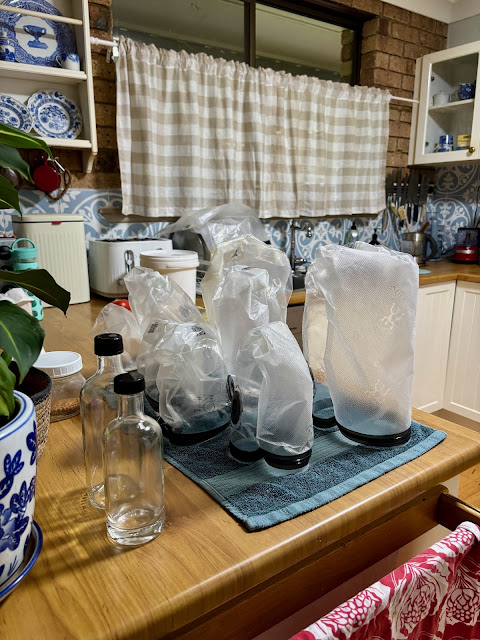
Every morning when I walk into my kitchen it looks tidy and ready for a day's work. Not so on this morning (above), I saw this when I walked in. Late the previous afternoon when I was looking for something, I came across my rolled up Zwilling vacuum bags and decided they had to be washed and dried. So I did that and although I usually put them outside on the verandah to dry it was dark by then. I turned the just-washed bags inside out and left them like this on a towel. It worked well and now the bags are ready to use when I bring home root vegetables, cabbages or whatever I buy that I want to last four or five weeks.
Image

You’ll save money by going back to basics

When I was doing the workshops and solo sessions, I had a couple of people whose main focus was on creating the fastest way to set up a simple life. You can't create a simple life fast, it's the opposite of that It's not one single thing either - it's a number of smaller, simpler activities that combine to create a life that reflects your values; and that takes a long to come together. When I first started living simply I took an entire year to work out our food - buying it, storing it, cooking it, preserving, baking, freezing, and growing it in the backyard. This is change that will transform how you live and it can't be rushed.  
Image

All previous blog posts

  • 2026 3
    • February 3
      • Workshops starting 1 March
      • Planting vegetable seeds and new workshops
      • Back where we belong
  • 2025 7
    • July 1
    • June 2
    • May 1
    • April 2
    • February 1
  • 2024 25
    • December 2
    • November 1
    • October 2
    • September 3
    • August 1
    • July 3
    • June 1
    • May 3
    • April 2
    • March 3
    • February 2
    • January 2
  • 2023 13
    • December 1
    • November 2
    • October 1
    • September 3
    • August 2
    • February 2
    • January 2
  • 2022 17
    • November 3
    • October 4
    • September 3
    • August 2
    • July 3
    • June 2
  • 2021 50
    • December 1
    • November 6
    • October 7
    • September 5
    • August 4
    • July 5
    • June 2
    • May 2
    • April 6
    • March 4
    • February 4
    • January 4
  • 2020 68
    • December 3
    • November 5
    • October 4
    • September 4
    • August 4
    • July 4
    • June 4
    • May 8
    • April 7
    • March 8
    • February 8
    • January 9
  • 2019 66
    • December 2
    • November 4
    • October 5
    • August 3
    • July 4
    • June 6
    • May 8
    • April 8
    • March 8
    • February 11
    • January 7
  • 2018 82
    • December 1
    • September 2
    • August 10
    • July 4
    • June 11
    • May 9
    • April 12
    • March 10
    • February 10
    • January 13
  • 2017 129
    • December 7
    • November 10
    • October 6
    • September 13
    • August 11
    • July 13
    • June 12
    • May 9
    • April 9
    • March 14
    • February 11
    • January 14
  • 2016 125
    • December 7
    • November 13
    • October 10
    • September 11
    • August 11
    • July 8
    • June 9
    • May 9
    • April 12
    • March 10
    • February 13
    • January 12
  • 2015 184
    • December 7
    • November 15
    • October 20
    • September 18
    • August 19
    • July 18
    • June 12
    • May 15
    • April 12
    • March 21
    • February 13
    • January 14
  • 2014 203
    • December 11
    • November 8
    • October 17
    • September 20
    • August 17
    • July 19
    • June 17
    • May 17
    • April 23
    • March 15
    • February 18
    • January 21
  • 2013 225
    • December 13
    • November 17
    • October 17
    • September 17
    • August 21
    • July 24
    • June 20
    • May 19
    • April 17
    • March 22
    • February 17
    • January 21
  • 2012 245
    • December 17
    • November 20
    • October 20
    • September 18
    • August 15
    • July 24
    • June 21
    • May 26
    • April 23
    • March 23
    • February 19
    • January 19
  • 2011 257
    • December 18
    • November 24
    • October 27
    • September 23
    • August 24
    • July 21
    • June 24
    • May 24
    • April 16
    • March 22
    • February 14
    • January 20
  • 2010 283
    • December 20
    • November 18
    • October 18
    • September 19
    • August 25
    • July 24
    • June 25
    • May 26
    • April 25
    • March 22
    • February 29
    • January 32
  • 2009 293
    • December 29
    • November 18
    • October 23
    • September 25
    • August 22
    • July 28
    • June 22
    • May 21
    • April 27
    • March 26
    • February 24
    • January 28
  • 2008 387
    • December 24
    • November 23
    • October 25
    • September 26
    • August 27
    • July 27
    • June 37
    • May 34
    • April 44
    • March 53
    • February 32
    • January 35
  • 2007 372
    • December 37
    • November 40
    • October 55
    • September 51
    • August 49
    • July 63
    • June 49
    • May 28


Trending Articles

NOT the last post

This will be my last post here.  I've been writing my blog for 18 years and now is the time to step back. I’ve stopped writing the blog and come back a couple of times because so many people wanted it, but that won’t happen again, I won’t be back.  I’ll continue on instagram to remain connected but I don’t know how frequent that will be. I know some of you will be interested to know the blog's statistics. 
Image

Every morning at home

Every morning when I walk into my kitchen it looks tidy and ready for a day's work. Not so on this morning (above), I saw this when I walked in. Late the previous afternoon when I was looking for something, I came across my rolled up Zwilling vacuum bags and decided they had to be washed and dried. So I did that and although I usually put them outside on the verandah to dry it was dark by then. I turned the just-washed bags inside out and left them like this on a towel. It worked well and now the bags are ready to use when I bring home root vegetables, cabbages or whatever I buy that I want to last four or five weeks.
Image

You’ll save money by going back to basics

When I was doing the workshops and solo sessions, I had a couple of people whose main focus was on creating the fastest way to set up a simple life. You can't create a simple life fast, it's the opposite of that It's not one single thing either - it's a number of smaller, simpler activities that combine to create a life that reflects your values; and that takes a long to come together. When I first started living simply I took an entire year to work out our food - buying it, storing it, cooking it, preserving, baking, freezing, and growing it in the backyard. This is change that will transform how you live and it can't be rushed.  
Image

Creating a home you'll love forever

Living simply is the answer to just about everything. It reduces the cost of living; it keeps you focused on being careful with resources such as water and electricity; it reminds you to not waste food; it encourages you to store food so you don't waste it and doing all those things brings routine and rhythm to your daily life. Consciously connecting every day with the activities and tasks that create simple life reminds you to look for the meaning and beauty that normal daily life holds.  It's all there in your home if you look for it. Seemingly mundane tasks like cleaning and cooking help you with that connection for without those tasks, the home you want to live in won't exist in the way you want it to.  Creating a home you love will make you happy and satisfied.
Image

Time changes everything

I've been spending time in the backyard lately creating a contained herb and vegetable garden. My aim is to develop a comfortable place to spend time, relax, increase biodiversity and encourage more animals, birds and insects to live here or visit. Of course I'd prefer my old garden which was put together by Hanno with ease and German precision. Together, we created a space bursting at the seams with herbs, vegetables and fruity goodness ready to eat and share throughout the year. But time changes everything. What I'm planning on doing now, is a brilliant opportunity for an almost 80 year old with balance issues. In my new garden I'll be able to do a wide range of challenging or easy work, depending on how I feel each day. It’s a daily opportunity to push myself or sit back, watch what's happening around me and be captivated by memories or the scope of what's yet to come.
Image

It's the old ways I love the most

I'm a practical woman who lives in a 1980’s brick slab house. There are verandahs front and back so I have places to sit outside when it's hot or cold. Those verandahs tend to make the house darker than it would be but they're been a great investment over time because they made the house more liveable. My home is not a romantic cottage, nor a minimalist modern home, it's a 1980’s brick slab house. And yet when people visit me here they tell me how warm and cosy my home is and that they feel comforted by being here. I've thought about that over the years and I'm convinced now that the style of a home isn't what appeals to people. What they love is the feeling within that home and whether it's nurturing the people who live there.
Image

Back where we belong

Surprise! I'm back ... for good this time. Instagram became an impossible place for me. They kept sending me messages asking if I'd make my page available for advertisers! Of course, I said no but that didn't stop them. It's such a change from what Instagram started as. But enough of that, the important part of this post is to explain why I returned here instead of taking my writing offline for good. For a few years Grandma Donna and I have talked online face-to-face and it's been such a pleasure for me to get to know her. We have a lot in common. We both feel a responsibility to share what we know with others. With the cost of living crisis, learning how to cook from scratch, appreciate the work we do in our homes, shop to a budget and pay off debt will help people grow stronger. The best place to do that is our blogs because we have no advertising police harassing us, the space is unlimited, we can put up tons of photos when we want to and, well, it just feels li...
Image

Making ginger beer from scratch

We had a nice supply of ginger beer going over Christmas. It's a delicious soft drink for young and old, although there is an alcoholic version that can be made with a slight variation on the recipe. Ginger beer is a naturally fermented drink that is easy to make - with ginger beer you make a starter called a ginger beer plant and after it has fermented, you add that to sweet water and lemon juice. Like sourdough, it must ferment to give it that sharp fizz. To make a ginger beer plant you'll need ginger - either the powdered dry variety or fresh ginger, sugar, rainwater or tap water that has stood for 24 hours to allow the chlorine to evaporate off. You'll also need clean plastic bottles that have been scrubbed with soap, hot water and a bottle brush and then rinsed with hot water. I never sterilise my bottles and I haven't had any problems. If you intend to keep the ginger beer for a long time, I'd suggest you sterilise your bottles. MAKING THE STARTER In a...
Image