down to earth

  • Home
  • About Us
  • Down To Earth Book
  • Privacy Policy
TOMATO SAUCE
3 large onions - chopped
Splash of olive oil
1.25kg (3lbs) ripe tomatoes, skinned and chopped
150 ml (5 fl oz) cider vinegar
2 tablespoons brown sugar
2 teaspoons salt
1 teaspoon black pepper

Place the onions and oil in a large saucepan and soften the onions without drowning them. Add tomatoes and all other ingredients and bring to the boil. Allow to simmer for 20 minutes, stirring occasionally. Put through a blender or food mill to smooth the sauce. Check the taste, you might need to add more seasoning. Return to the saucepan and bring to the boil again. Pour into two 500ml (½ quart) jars and process.

BEETROOT FOR SALADS (Unprocessed)
Boil four medium sized beetroots until they are tender. Leave a small portion of the green top on. Drain and set aside. Make up a portion of the Spiced Vinegar for Pickles or the Strong Spiced Vinegar (according to your own taste) in the previous post.

When the beetroots have cooled enough, cut off the tops and bottoms and slip the skins off with your fingers. Slice the beetroots and layer them in a jar. Pour over the prepared vinegar and put the tops on the jars.

This will keep in the fridge for 6 weeks.

ROSELLA JAM AND CORDIAL RECIPES HERE
Before you start your preserving session, wash all your jars and lids and run your fingers around the rims to check for chips or cracks. Check the lids for dents, rust or holes. Never use damaged jars or lids.

I only sterilise the jars and lids if I'm not going to process them in a water bath. Sometimes I know something won't last a long time, so after it's cooked, I place it in a sterilized jar and store it for a few weeks in the fridge. If the jars will be filled and sterilized in a water bath, they need to be warm/hot when the hot food is placed in them to prevent cracking.

Always use new rubber rings and soak them before using them. It makes them easier to put on the jar.

Now you are ready to deal with the contents of the jars. This can be either a recipe like jam or chutney that you cook and pour, boiling hot, into the jar, or fruit that you add syrup to, or vegetables (pickles) that you add spiced vinegar to.

If you're cooking jam, make it according to your recipe and using your wide mouth funnel, pack the jars to within about 7mm (¼ inch) of the jar top. This is called headspace and is the space you allow for the content to expand, when boiling, without bursting out of the jar. If you're using FV jars, put the rubber ring, lid and clip on. If you're using screw on lids, screw them on fairly tightly, but not too tight.

If you're packing fruit or pickles, pack your jars firmly and neatly, using a packing stick or wooden spoon handle to remove any air bubbles. Air in the jar will cause mould to form when the jar is being stored. When the jar is packed, pour syrup, fruit juice or water over the fruit and the spiced vinegar over the pickles to within about 8mm (¼ inch) of the jar top.

Wipe the jars to make sure no jam or syrup is on the jars. Place the jars into your processor/pot. If you can cover the jars by 1 or 2 inches or so of water, do so.


Bring the processor/pot slowly up to the boil - this will take 45 to 60 minutes. When it's slowly boiling, hold it at a slow boil for another 45 minutes for small jars, for 1 hour for large jars and for 90 minutes for very large jars. When the time is up, using your canning tongs, remove the jars to sit on a tea towel on the bench to cool slowly for 24 hours. The prolonged heat will form a vacuum in the jars and you'll notice the lids will be slightly inverted, or the poptop will be inverted.

When the jars are cool, check that all poptops on the lids are inverted, remove clips from the FV jars and make sure all the jars are sealed. If you're unsure, or it there has been a spillage, put that jar in the fridge as use it as soon as you can. All the jars must have a perfect seal to be stored in a cupboard.

Don't be tempted to display your jars on an open shelf. They will lose their colour. If you want long term storage, the jars should be stored in a cool dark cupboard. They will keep well for about a year without losing their nutrition.

TO MAKE SYRUP FOR FRUIT
Light - 1 cup sugar to 3 cups of water makes 3½ cups of syrup
Medium - 1 cup sugar to 2 cups of water makes 2 cups of syrup
Heavy - 1 cup sugar to one cup of water makes 1¾ cups of syrup

Add the above quantities to a saucepan and bring to the boil. Stir to dissolve the sugar. Allow to cool. You could also use fruit juice, honey, molasses or golden syrup instead of sugar but it will add another flavour to your fruit. Fruit may also be preserved in plain water but it won't keep as well as that preserved in a sweet liquid.

Artificial sweeteners are not recommended for preserving as they develop a bitter taste over time.

TO MAKE SPICED VINEGAR FOR PICKLES
Please note, good quality vinegar need to be used for preserving, with an acetic acid content of at least 5%. The following vinegars are all good to use: brown malt, white malt, balsamic, white wine, red wine or apple cider.

1½ cups vinegar
¾ cup water
¾ cup sugar
½ teaspoon peppercorns
½ teaspoon mustard seeds
¼ teaspoon pure salt (sea salt or kosher salt)
2 bay leaves

Place all ingredients in a sauce pan and bring to the boil, simmer for 5 minutes. Remove from heat and allow to cool. Strain off the chunky bits before using.

MY TOMATO RELISH
Will make up approximately 3½ kg or 7½lbs of relish

2 kg (4½ lb) ripe tomatoes
1 kg (2.2lb) chopped onions
3 chopped capsicums (peppers)
3 sticks celery very finely chopped or you could use 2 zucchini
2 green apples, finely chopped
1 teaspoon dry mustard
1 teaspoon curry powder
1 tablespoon pure salt
½ teaspoon cracked black pepper
½ teaspoon cayenne pepper or chilli powder
650 grams (1½lb) brown sugar
900 mls (1½ pints) vinegar

Place all in a steel saucepan and mix. Slowly bring to the boil with the lid off and allow to simmer until it thickens up. Stir frequently to prevent sticking on the bottom of the pan.

STRONG SPICED VINEGER

1 litre (1 quart) vinegar
1 teaspoon salt
1 teaspoon whole peppercorns
6 whole cloves
4 small pieces of fresh ginger - slightly crushed OR ½ teaspoon powdered ginger
4 bay leaves

Place all ingredients in a sauce pan and bring to the boil, simmer for 5 minutes. Remove from heat and allow to cool. Strain off the chunky bits before using.

I'll type up some recipes for jam and sauce later.


Preserving food in jars is something of a mystery to many people but bottling/canning is one of the skills of simple living that will allow you to extend the life of some of your seasonal produce, to eat good quality food with no chemical preservatives and to save money.

It's an old skill that our grannies took for granted and we forgot about because we could buy all our goods in jars already processed for us. The problem with those commercially processed goods is that we don't know what's in them and often they contain artificial colourings, flavour enhancers and preservatives that are not good for our health. Home grown and home preserved food, withus adding what we want to suit our own taste, is the way bottled food should be. Pure and simple.

I have never used a pressure canner and when I talk about bottling/canning here, I am only writing about water bath preserving. It is suitable for high acid foods like fruit, or foods that vinegar or lemon juice have been added to. It is not suitable for preserving meat, vegetables, fish, soups or any non-acid food. They must be processed in a pressure canner.

Some will come to this type of preserving as a step towards self sufficiency, others will do it for its economy and others still for the quality and wide variety of jams, chutneys, sauces and pickles that water bath preserving will help you add to your stockpiling cupboard. Last night I used the last of my tomato relish - bottled in November 2006. That one bottling session of about 3 hours last November allowed me to keep my home grown tomato relish in the cupboard for almost a full year. The relish is a recipe I've developed over time, has no chemical preservatives, colourings or flavours enhancers. I use it for pizza bases, on sandwiches, with salads and eggs. It's delicious and it's something I would never be able to buy at a supermarket. But I can make it myself and I make enough for a year and to give as gifts. These treasures should be part of your kitchen tradition. You can start your own tradition and teach it to your children so that these simple skills, even if they are forgotten in the general community, are never forgotten in your family.


The last of the tomato relish, about to be spread on some homemade pizza dough I had in the freezer. On top we had caramelised onions and two cheeses. It was truly a delicious and quick homemade meal.

I am going to warn you that you need to know what you're doing, and the reasons for doing it, if you are to safely preserve food in jars. This way of preserving uses heat to kill bacteria and to seal jars so that new bacteria can't enter while the food is being stored. On the other hand, storing food in a freezer stops most bacteria growing and frozen food can be kept for months. Food stored in a fridge is a kind of short term preserving. It does not kill bacteria, it just slows down the rate at which bacteria multiply. This is why if you keep meat of milk etc in the fridge, it will start to go off after a couple of weeks - the bacteria have multiplied enough to spoil the food. When you process high acid foods in a water bath, it kills the bacteria and the sealed jar stops further contamination - you've sterilised the food. This food doesn't have to be frozen or refrigerated, it can be kept in a cupboard because there is no bacteria present.

Vegetables are low in natural acid and may contain bacteria that is not killed by the heat generated in a water bath. If these foods are stored in a cupboard in a sealed container, the botulism toxin can develop. These foods need to be processed in a pressure canner which can reach the high temperatures necessary to kill this bacteria. In the US, there are about ninecases of botulism poisoning every year. That not a high incidence but botulism poisoning can be fatal.

Fruit is generally high in acid which stops the growth of bacteria and stops the formation of the botulism toxin. If fruit is processed properly, and stored in a cupboard in sealed jars, it is safe to eat. Some properly processed vegetables, with added acid in the form of vinegar or lemon juice, are also safe.

If you are new to bottling/canning I urge you to buy a NEW copy of Secrets of Successful Preserving - Fowlers Vacola Instruction & Recipe Book if you're in Australia or New Zealand. If you're in North America a NEW copy of Ball Blue Book of Preserving and if you're in the UK or Europe a NEW copy of The Basic Basics Jams, Preserves and Chutneys. Or the 9th edition, or later, or Carla Emery's Encyclopedia of Country Living. The Big Book of Preserving the Harvest: 150 Recipes for Freezing, Canning, Drying and Pickling Fruits and Vegetables is also very good. The reason I emphasise a NEW copy, is that all these books have been published for many years and the old versions may contain instructions for the old ways of preserving which are unsafe. If you have preserving books from before the 1990s, the recipes in them probably aren't safe to use. All these preserving/canning processes - worldwide - were updated in the 1980s after many cases of botulism in the US. You must use a NEW book with the updated procedures and processing times.

I hope I haven't scared too many of you off. I would understand that many people would read the information above and decide this is too dangerous and not for you. Please be assured that if you bottle the recommended foods according to the instructions given here or in the new preserving books, you will produce good quality safe food. Following the instructions will protect you, they are there for a reason. One or two preserving/canning sessions will stand you in good stead and set you on the way to safe and delicious preserved food in jars.

EQUIPMENT
  • A large pot, water bath canner or Fowlers Vacola (FV). If you're using a large pot, you'll also need some newspaper or a tea towel on the bottom of the pan to stop the jars having direct contact with the bottom of the pot.
  • Jars - either clip sealed or screw on lids. I use store bought jars for large jars and undamaged recycled jars or good quality for jams and chutneys. You will need to check the lids thoroughly for damage, rust, dents etc. Only use perfect lids.
  • Rubber seals and clips, if you're using FV jars.
  • Canning tongs and wide-mouthed funnel.

If I knew then what I know now I would not have bought FV jars, I would have used all screw top jars. These are freely available on ebay or in supermarkets.

New lids and other preserving accessories are available here.

Further reading here.

There will be another post soon. I'll write about how to process in a water bath and give you some recipes to get you started.

Colleen asked for some book suggestions after my last post. Here are some I've read and am happy to recommend:

Australian Readers Digest book - Back to Basics - ISBN 0 86449 028 3. This book has information about building, crafts, preserving, growing food, cooking and baking and a lot more.

The Encyclopedia of Country Living by Carla Emery

The Permaculture Home Garden ISBN: 0-670-86599-Linda Woodrow

Easy Organic Gardening and Moon Planting by Lyn Bagnall. This is the best Australian organic gardening book I've read.

Backyard Self-sufficiency - Jackie French

Simple Living: One Couple's Search for a Better Life by Frank Levering and Wanda Urbanska

Home Comforts by Cheryl Mendelson

Simple Living Guide by Janet Luhrs, is not so much a practical guide but a guide to slowing down and reinvention.

Your Money or Your Life by Joe Dominguez and Vicki Robin will transform the way you think about money.

ON THE NET

David Holmgren's Retrofitting the Suburbs for Sustainability, available here on pdf.

MAGAZINES

Warm Earth, Grass Roots and Earth Garden. All available at the newsagent and your local library, I hope. I will have an article in Warm Earth in January. In north America, Countryside magazine is one I enjoy very much. I had a friend who sent me a couple of copies from Canada.

I thought this might be a good time to let you know more about me. A few people have asked for that in the comments and in emails. I understand if you're not interested, just return tomorrow when I'll be returning to simple living subjects. Tomorrow's topic is bottling/canning/preserving.

I was born in Sydney and have one sister, Tricia, and one pretend sister, Kathleen. Tricia and I grew up at Strathfield and went to a convent school. When I left school, I worked briefly at an advertising agency, then started nursing. I did my nurses training at Royal Prince Alfred Hospital. After graduation, I worked at the Transplant Unit at Sydney Hospital and the Emergency Department at Balmain Hospital.

Sick of city life, in the mid-70s I went to live on Cape York, which is the pointy bit on the top of Australia. I ran a small hospital there on an aboriginal reserve and found a whole new wonderful world living with tribal aboriginees. They taught me a lot of things I still use today. Important things like showing respect, not judging others, loving one's family, generosity, kindness and how to live within nature without doing too much damage. Older women hold an esteemed place within aboriginal culture - they are teachers and are expected to pass on information to those younger. It is a position of trust and honour. I have often thought about those older women I knew when I was much younger. They are a big part of the reason I am blogging. I am trying to emulate their example by passing on what I know to younger people. It is something that used to be done in our culture in the past, but now older women are invisible and often viewed as passed their use by date. Not me though! I hope I am improving with age.

After Cape York I lived for a few months on Thursday Island, which is in the Torres Strait between Australia and Papua New Guinea. I was on my way back to Sydney from there when I called into Mount Isa to visit a friend I had known in Sydney. It was just before my 28th birthday and my friend convinced me to stay and have my birthday in Mount Isa. It was on my 28th birthday there that I met a very handsome German man named Hanno.

I didn't continue my journey.

In March 1979 we decided to go to Germany so I could meet his parents. He met mine on the way over there as we travelled back to Sydney then so he could meet my mum and dad before we left. We were going to stay in Germany for two months but ended up staying for two years. We were married there and ten months later in July, Shane was born. When he was three months old, we came back to Australia. Shortly after we arrived home, Hanno's mother died.

We stayed in Sydney with my parents for a couple of months but both of us wanted to leave the city and go back to the bush, so just after Christmas we headed back to Queensland. We bought a caravan and decided that Hanno would work in the coal mines. Just after we got back to Queensland, on the day John Lennon died, and when Shane was 12 weeks old, I realised I was pregnant again. Kerry was born in July.

After living in various towns with Hanno working as a heavy equipment fitter and me looking after our babies, we eventually settled in a mining town in Central Queensland. When the boys were in primary school I went back to serious study. I did a degree that I could study at home and majored in Journalism, Literature and Communication. I was already working to produce the local newspaper and went on to create a business on contract to MIM Holdings to write and publish the paper. I did that for 12 years. During that time I was often asked to write technical manuals for the mine and went on to form technical writing business. When we left there, I gave the newspaper business to my good friend Susan, who worked for me. When I was living in the bush I learnt a lot of the skills I now use like gardening, keeping chickens, stockpiling, baking bread, preserving etc. It was through necessity then as we were over three hours from the nearest supermarket.

In 1997, we moved to where we are living now. Shane had just finished school - he and Kerry went to boarding school in Townsville - and Kerry still had one year to go. Kerry used to fly home for school holidays and we'd ring him a few times a week. Shane went to university and started a degree in environmental science. He dropped out in his last year to become a chef. Kerry went straight into his chef's apprenticeship when he left school. They're now both fully qualified chefs.

Hanno retired when he left the mines, they asked him to go back, he went back but hated being there alone. He left after a few months and came back home to retire again. I was supporting the family with my technical writing business and Hanno settled in to be a house husband. He nearly drove us all nuts because he wanted things to be perfect all the time. We convinced him he needed to do something else. LOL He bought a shop in Montville, which is a small tourist type town fairly close by. We ran that shop for almost seven years.

While all this was going on, I was working in my business, occasionally travelling to the mines to collect information and take photos. I had two other people working with me. Every year I grew more discontent with my life and when I finished a year long contract with BHP (Australia's largest company) I knew I didn't want to do that kind of work any more. I saw unhappiness and backstabbing in the corporate world and I didn't want to be part of it. When my BHP contract ended, I closed my business.

I had no idea what I would do but I did know that if I wasn't going to work, I had to get rid of my housekeeper and start saving money so it would lessen the impact of me not working. I'd had a computer since 1988 so I used it to find information about how to live frugally. I discovered there was a name for what I wanted to do although the American version of frugal living in those days had every little environmental awareness. I found simple living through those frugal living sites. I searched my memory for how my mother and grandmother used to work in their own homes and I read as much as I could find on sustainability within a household context. I learnt all I could about frugal and simple living but with an emphasis on environmental issues, that lead me to the permaculture forums, which lead me to start aussieslivingsimply with Dan and a few others. Over this time I slowly developed my version of simple living. I started writing a book about it but now here I am blogging. I have used a lot of that book information here and I'm now working on some ebooks that I'll soon be selling here.

Well, that's me in a nutshell. We'll be moving on to more important things like preserving in the next post. : )

We have been out this morning so Hanno could fix my friend Bernadette's washing machine. We came home and the counter had clicked over to 50,116 visitors. We did it!

When I started blogging in May, I had no idea my blog would be popular. Of course, being a writer, I tend to expect people to read what I write but I never for one second expected this. I want to thank each and every person who comes here to read the blog. I'm getting to know a lot of you via your comments and emails. You make blogging a real pleasure for me.

I love the comments. They're intelligent and thought-provoking and they make me continue my blog posts because, to me, it feels like I'm carrying on a conversation with you all. So thank you so reading and for helping me know that there are really people out there who want to read what I write.

To mark this milestone, I'm giving away something that is very precious to me. When I first started living simply, I wanted to have something that would be a constant reminder of what I was trying to do. I drew and stitched the stitchery below, framed it and hung it up where I saw it every day. Sometimes I forgot the who, why, what, when and how of simple living, but the stitchery reminded me. I hope it will help whoever wins it to live a good and decent life by reminding them to give more and expect less, and to live simply.

The stitchery is roughly 20 x 30 cm (10"x12") and is on a piece of white pure cotton. The edges are unfinished so you'll be able to frame it or use it as part of a cushion, bag or a wall hanging.

To be in the draw for the stitchery, just comment on this post. On Sunday, I'll write all the names down and pull one out of a hat. Good luck. : )

Pigeon peas are a crop grown primarily in warm climates. We've just harvested our first pigeon peas, and although I haven't shelled them yet, I think we have about 1 kilogram (2.2lbs) of dried peas. They can be eaten green or dried. In India, they're one of the peas used as dahl. We've had them here as a substitute to split yellow peas for pea soup.

Pigeon peas are one of the traditional permaculture plants. They're a multi-function plant being used as human food, forage for chickens and animals, they make a good green manure and can be cut back and used as mulch. Native birds also love them.

Although they're an unusual plant, they're quite handy as they can be grown during the warm weather and when harvested, can be stored in jars in the stockpile for eating throughout the year.

Further reading.

This is not where we went yesterday. I took this is a photo a bit further down the coast, closer to where we live. This is King's Beach, Caloundra where we had lunch earlier in the year.

I got through my chores yesterday and just as we were about to go out, there was an almighty storm with loud cracking thunder, lightning and a lot of rain. The dogs were terrified and we were almost convinced we should stay home when it cleared and settled back to normal, so off we went on our merry way.

We went to the library first, it was a library I don't usually go to - we have four libraries in our shire, and they didn't have many of the type of books I usually read. Hanno read the day's newspaper while I browsed the shelves, looking for something to borrow. I ended up taking the Reader's Digest book of Australian birds, the knitty.com knitting book and one called The Country Store which is about traditional Western food. I think I'll have them all read by Friday and go back to my regular library that caters to my more unconventional tastes.

Lunch was at the Maroochy surf club and it was there that I realised the battery in my camera was dead. I wanted to take a photo of the view because the surf club is right on the beach. Oh well, maybe next time. After lunch we went to the huge shopping complex at Maroochydore where the movie was showing. Luckily we could enter the cinema at the side and bypassed most of the shops.

The movie was very good and we both enjoyed it. I think almost everyone there was over 50, which was a shame because it's not just an oldies movie. If you get a chance to see it, please do. It is not suitable for children. In Australian it has an M rating - mature audience.

We laughed on the way home that it was the first time in a couple of years we'd been out while cars had their lights on. We used to always go out at night but now we're quite content to do our roaming during daylight hours and be home together at night.

Hanno took $50 from the change jar for our outing, so what did this afternoon out cost our frugal family? $48.50 I think that's a lot of money but I guess by today's standards it isn't. The breakdown is: 2 lunches @ $10.95 each = $21.90 + one ginger ale @ $2.10 so our lunch cost $24. Movie tickets cost $14 for me and $10.50 for Hanno, he got a pensioner discount. We paid for the outing with some of the money we had left over from our holiday. There is another $100 of holiday money still in the change jar to be used on whatever takes our fancy. Who knows what we'll get up to next. ; )

True to my word, I made this toast: "To all my blog readers spread far and wide all over the world. Thank you for making blogging so much fun for me." I took a sip of my drink and told Hanno he had to as well. It was then he gave me THE look. LOL! I knew I'd get it at some point. It's a wonderful thing to know someone so well.

I'll be back later with another post.
All the napkins should have been sent ten days ago and most of them should have been received by now. I'd like to show as many of them as I can so if you can take a photo of what you received I'd appreciate you sending me a copy via email.
If you have not yet sent or received your napkins, please email.
I'm about half way through the emails so if you've sent me one, please know I've read it and I'll write back as soon as I can. Thank you for extending your patience once again.

I've just spent two very busy, but satisfying, days at work. I swear that when I drive home after a day's work, I feel elated and happy and able to move mountains. When I arrived home yesterday I talked to Hanno, there was mail to read - a thank you note from two little boys : ) - and lots of emails. I usually have a million things battling for space in my head when I get home, it's a mix of sorting through what I've done during the day, and being at ease with decisions made and the actions taken. Yesterday I was two hours late leaving work and I didn't have time to make notes and lists of follow ups, so when I got home, that is what I did. After that, I fell in a heap. I had a shower and went to bed.

I still feel tired this morning so I'll take it easy today and look after myself. I have a few things to catch up on, Hanno did the washing yesterday to beat the storms so washing isn't one of them. Good. But I do have to tidy up, write a couple of letters, answer a lot of emails and work in the garden for a short period. I have to finish picking the pigeon peas before the king parrots take them all and tie up some tomatoes.

I hope to have that all completed by 12 noon as I have plans to take Hanno out to lunch and a movie. I have been wanting to see Away from Her since I saw it reviewed on the SBS Movie Show. It finishes tomorrow so we have to go today. I think lunch and this movie is just what I need to relax for the day. We haven't been out for a long time so I know Hanno will enjoy it. He will choose where we have lunch so it will probably be one of the surf clubs overlooking the beach. : )

I have been thinking of what I could use as a giveaway to mark 50,000 visitors. We should pass that mark tomorrow. I've decided the prize will be the Give More, Expect Less stitchery that is featured on this blog under my photo. It is very precious to me as it is little dots of my philosophy of life bound up in stitches. It's no great work of art but it's a nice way to remind oneself of what has meaning in this life. It's important to me to sometimes give away something I really want to keep. It keeps me on my toes. So when we pass the milestone number, I'll make a special post where you can enter your name if you'd like to be in the draw for the prize.

I hope everyone is well and happy. Thank you for stopping by today.

Graphic: Still Life with Sleeping Woman, Henri Matisse, from art.com

Graphic from allposters.com

McMansions pffffffffffft!! It is environmentally and economically smart to live in a house that meets your needs without exceeding them. It is economically sound to save up a deposit for a home and then to pay the loan off as fast as possible. If you are being wise economically and environmentally, you’ll also have a car that suits the size of your family and not the size of your ego.

Our standard of living seems to have exceeded our means to achieve it. The Australian Bureau of Statistics reports that two-thirds of Australian households currently have some form of debt. For the first time since the 1960s the Household Savings Ratio is in the negative. Which means that although we have traditionally saved about 10% of our after tax income, now we Australians are spending more than we earn. A shift in our thinking is overdue. Maybe Australia is ready for a simple change. Maybe the world is too.

When I decided that enough was enough, I realised that buying more things didn’t make me feel better, in fact, it made me feel worse. I started to think about all the rubbish I’d bought over the years and how much money I’d wasted buying it. I stopped wanting to go shopping and started thinking about a more sustainable way of life. New things didn’t satisfy me anymore. What I needed was a new way of living, new values and a more self-sustaining and holistic way of being, not (more) new clothes. I didn’t want to run into the hills and live like a hippy, I wanted to live a decent and fulfilling simple life in modern Australia. Living more simply and paring down my wants gave me that life, and much more.

You would think that giving up things would make me feel miserable and powerless, but it did the opposite - it strengthened me. It showed me that I was strong and sound and appealing without all the props that I'd had in the past. I was still okay, even if I wasn't dressed in the "right" colour for this year. Who knew! LOL

Working out what I needed and what I should still spend on made me more mindful of my spending. After a while it became a game to see how little I could spend. I wasn't being cheap and I didn't feel poor, I was readjusting my life and having fun while I did it. And you know what, now that I spend very little and I rarely give purchased gifts, I feel generous; I feel I have an abundance and I give freely of myself. That's the real gift, all else is flim flam.

I wrote about connecting the dots the other day and if you want to change your life and try to live more sustainably and simply, connecting the dots on what you're already doing and what you need to do is a good way to plan for your future. You must have a plan or a map. When you write things down they become more concrete and real. Your plan could be a written point by point list of where you are now and what you're doing today to live the life you want to live. What do you want your life to be? If you want to live in your own home, be debt-free and stay home with the kids, work out a step-by-step guide to how you will start to do that today. And if you do start today, what will you have to do next week and next month to continue towards your goal? Write it all down. If you want to change jobs and move to another part of the world, write down what you have to do today, tomorrow, next week and next year to make that happen. Even if all you want to do is to change the way you shop so you can save for a family holiday, write down all your points. Map your future.

In our consumer driver society, this is uncharted territory. You need a map, and your point by point plan will be your map. There will be many temptations put in your way to try to lure you back to spending and being "normal". Don't fall for it. If you lose your way or if you get side tracked, your map will be there to help you back to your chosen path. A journey of a thousand miles starts with one step. Make your first step today.

As there have been a few comments on shredded paper and shredders lately, I thought you might be interested in these photos. This shredder is the one I used for the last 15 years in my business. It's still going strong.

We use shredded computer paper for hen's nests. You can really build a substantial and comfortable nest for a chook with shredded paper. When it's dirty, we put the nests in the compost heap. I've mulched plants with shredded paper but you have to sprinkle on some blood and bone, or some form or nitrogen fertiliser, to stop the nitrogen lock down in the soil as the paper breaks down.

Shredded paper is a really good carbon additive to your compost. When you add it, also add some wet green material like vegetable peels, green leaves or clippings, and wet the paper to help it break down.

We also use a lot of newspaper on the garden and in the worm farm. Worms will eat through newspaper fairly quickly. I just tear the newspaper into strips for the worms but when we have a lot of newspaper, we shred it and add it to the stockpile you see above. Hanno spends about an hour or so shredding paper every month. He places it into the bags in the garden shed so it's ready for use when needed.

You can use ordinary newspaper, but not the glossy, coloured segments, nor magazines. All children's paints, crayons and pencil are safe so kid's drawings are usually fine to use on your garden.
Newer Posts Older Posts Home

MY BOOKS

MY BOOKS


My books were all published by Pengiun, and are available at Amazon US, Amazon UK and Amazon Au

Search here

Total Pageviews

Translate


I'm Rhonda Hetzel and I've been writing my Down to Earth blog since 2007. Although I write the occasional philosophical post, my main topics include home cooking, happiness and gardening as well as budgeting, baking, ageing, generosity, mending and handmade crafts. I hope you enjoy your time here.

MY FAVOURITE PLACES

  • Grandma Donna's Place
  • Grandma Donna's YouTube
  • Grandma Donna's Instagram
  • This Simple Day
  • Nicole's Instagram

Give More

Give More

Popular posts last year

Making ginger beer from scratch

We had a nice supply of ginger beer going over Christmas. It's a delicious soft drink for young and old, although there is an alcoholic version that can be made with a slight variation on the recipe. Ginger beer is a naturally fermented drink that is easy to make - with ginger beer you make a starter called a ginger beer plant and after it has fermented, you add that to sweet water and lemon juice. Like sourdough, it must ferment to give it that sharp fizz. To make a ginger beer plant you'll need ginger - either the powdered dry variety or fresh ginger, sugar, rainwater or tap water that has stood for 24 hours to allow the chlorine to evaporate off. You'll also need clean plastic bottles that have been scrubbed with soap, hot water and a bottle brush and then rinsed with hot water. I never sterilise my bottles and I haven't had any problems. If you intend to keep the ginger beer for a long time, I'd suggest you sterilise your bottles. MAKING THE STARTER In a...
Image

NOT the last post

This will be my last post here.  I've been writing my blog for 18 years and now is the time to step back. I’ve stopped writing the blog and come back a couple of times because so many people wanted it, but that won’t happen again, I won’t be back.  I’ll continue on instagram to remain connected but I don’t know how frequent that will be. I know some of you will be interested to know the blog's statistics. 
Image

How to make cold process soap

I'm sure many of you are wondering: "Why make soap when I can buy it cheaply at the supermarket?" My cold process soap is made with vegetable oils and when it is made and cured, it contains no harsh chemicals or dyes. Often commercial soap is made with tallow (animal fat) and contains synthetic fragrance and dye and retains almost no glycerin. Glycerin is a natural emollient that helps with the lather and moisturises the skin. The makers of commercial soaps extract the glycerin and sell it as a separate product as it's more valuable than the soap. Then they add chemicals to make the soap lather. Crazy. Making your own soap allows you to add whatever you want to add. If you want a plain and pure soap, as I do, you can have that, or you can start with the plain soap and add colour, herbs and fragrance. The choice is yours. I want to add a little about animal and bird fat. I know Kirsty makes her soap with duck fat and I think that's great. I think t...
Image

Preserving food in a traditional way - pickling beetroot

I've had a number of emails from readers who want to start preserving food in jars but don't know where to start or what equipment to buy.  Leading on from yesterday's post, let's just say up front - don't buy any equipment. Once you know what you're doing and that you enjoy preserving, then you can decide whether or not to buy extra equipment. Food is preserved effectively without refrigeration by a variety of different methods. A few of the traditional methods are drying, fermentation, smoking, salting or by adding vinegar and sugar to the food - pickling. This last method is what we're talking about today. Vinegar and sugar are natural preservatives and adding one or both to food sets up an environment that bacteria and yeasts can't grow in. If you make the vinegar and sugar mix palatable, you can put up jars of vegetables or fruit that enhance the flavour of the food and can be stored in a cupboard or fridge for months. Other traditional w...
Image

Cleaning mould from walls and fabrics

With all this rain around we've developed a mould problem in our home. Usually we have the front and back doors open and that good ventilation stops most moulds from establishing. However, with the house locked up for the past week, the high humidity and the rain, mould is now growing on the wooden walls near our front door and on the lower parts of cupboards in the kitchen. Most of us will find mould growing in our homes at some point. Either in the bathroom or, in humid climates, on the walls, like we have now. You'll need a safe and effective remedy at some point, so I hope one of these methods works well for you. Mould is not only ugly to look at, it can cause health problems so if you see mould growing, do something about it straight away. The longer you leave the problem, the harder it will be to get rid of it effectively. If you have asthma or any allergies, you should do this type of cleaning with a face mask on so you don't breathe in any spores. Many peopl...
Image

Five minute bread

Bread is one of those foods that, when made with your own hands, gives a great deal of satisfaction and delight. It's only flour and water but it symbolises so much. I bake bread most days and use a variety of flours that I buy in bulk. Often I make a sandwich loaf because we use most of our bread for lunchtime sandwiches and for toast. Every so often I branch out to make a different type of loaf. I have tried sour dough in the past but I've not been happy with any of them. I'll continue to experiment with sour dough because I like the idea of using wild yeasts and saving the starter over a number of years to develop the flavour and become a part of the family. However, the loaf I've been branching out to most often is just a plain old five minute bread. By five minutes I mean it takes about five minutes actual work to prepare but it's the easiest of all bread to make and to get consistently good loaves from. If you're having people around for lunch or...
Image

This is my last post.

I have known for a while that this post was coming, but I didn't know when. This is my last post. I'm closing my blog, for good, and I'm not coming back like I have in the past.  I've been writing here for 16 years and my blog has been many things to me. It helped me change my life, it introduced me to so many good people, it became a wonderful record of my family life, it helped me get a book contract with Penguin, and monthly columns with The Australian Women's Weekly and Burke's Backyard . But in the past few months, it's become a burden. In April, I'll be 75 years old and I hope I've got another ten years ahead. However, each year I'll probably get weaker and although I'm fairly healthy, I do have a benign brain tumour and that could start growing. There are so many things I want to do and with time running out, leaving the blog behind gives me time to do the things that give me pleasure. On the day the blog started I felt a wonderful, h...
Image

What is the role of the homemaker in later years?

An email came from a US reader, Abby, who asked about being a homemaker in later years. This is part of what she wrote: "I am a stay-at-home mum to 4 children, ages 9-16. I do have a variety of "odd jobs" that I enjoy - I run a small "before-school" morning drop-off daycare from my home, I am a writing tutor, and I work a few hours a week at a local children's bookstore. But mostly, I cherish my blissful days at home - cooking, cleaning (with homemade cleaners), taking care of our children and chickens and goats, baking, meal-planning, etc. This "career" at home is not at all what I imagined during my ambitious years at university, but it is far more enriching. I notice, though, that my day is often planned around the needs of my family members. Of course, with 4 active kids and a husband, this is natural. I do the shopping, plan my meals, cook dinner - generally in anticipation of my family reconnecting in the evening.  I can't h...
Image

Every morning at home

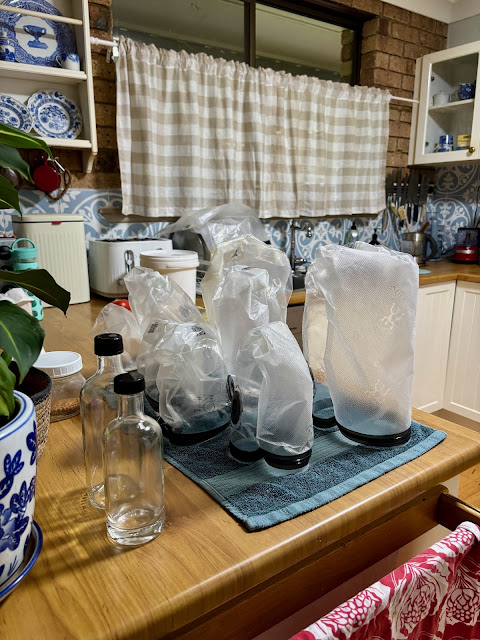
Every morning when I walk into my kitchen it looks tidy and ready for a day's work. Not so on this morning (above), I saw this when I walked in. Late the previous afternoon when I was looking for something, I came across my rolled up Zwilling vacuum bags and decided they had to be washed and dried. So I did that and although I usually put them outside on the verandah to dry it was dark by then. I turned the just-washed bags inside out and left them like this on a towel. It worked well and now the bags are ready to use when I bring home root vegetables, cabbages or whatever I buy that I want to last four or five weeks.
Image

You’ll save money by going back to basics

When I was doing the workshops and solo sessions, I had a couple of people whose main focus was on creating the fastest way to set up a simple life. You can't create a simple life fast, it's the opposite of that It's not one single thing either - it's a number of smaller, simpler activities that combine to create a life that reflects your values; and that takes a long to come together. When I first started living simply I took an entire year to work out our food - buying it, storing it, cooking it, preserving, baking, freezing, and growing it in the backyard. This is change that will transform how you live and it can't be rushed.  
Image

All previous blog posts

  • 2026 3
    • February 3
      • Workshops starting 1 March
      • Planting vegetable seeds and new workshops
      • Back where we belong
  • 2025 7
    • July 1
    • June 2
    • May 1
    • April 2
    • February 1
  • 2024 25
    • December 2
    • November 1
    • October 2
    • September 3
    • August 1
    • July 3
    • June 1
    • May 3
    • April 2
    • March 3
    • February 2
    • January 2
  • 2023 13
    • December 1
    • November 2
    • October 1
    • September 3
    • August 2
    • February 2
    • January 2
  • 2022 17
    • November 3
    • October 4
    • September 3
    • August 2
    • July 3
    • June 2
  • 2021 50
    • December 1
    • November 6
    • October 7
    • September 5
    • August 4
    • July 5
    • June 2
    • May 2
    • April 6
    • March 4
    • February 4
    • January 4
  • 2020 68
    • December 3
    • November 5
    • October 4
    • September 4
    • August 4
    • July 4
    • June 4
    • May 8
    • April 7
    • March 8
    • February 8
    • January 9
  • 2019 66
    • December 2
    • November 4
    • October 5
    • August 3
    • July 4
    • June 6
    • May 8
    • April 8
    • March 8
    • February 11
    • January 7
  • 2018 82
    • December 1
    • September 2
    • August 10
    • July 4
    • June 11
    • May 9
    • April 12
    • March 10
    • February 10
    • January 13
  • 2017 129
    • December 7
    • November 10
    • October 6
    • September 13
    • August 11
    • July 13
    • June 12
    • May 9
    • April 9
    • March 14
    • February 11
    • January 14
  • 2016 125
    • December 7
    • November 13
    • October 10
    • September 11
    • August 11
    • July 8
    • June 9
    • May 9
    • April 12
    • March 10
    • February 13
    • January 12
  • 2015 184
    • December 7
    • November 15
    • October 20
    • September 18
    • August 19
    • July 18
    • June 12
    • May 15
    • April 12
    • March 21
    • February 13
    • January 14
  • 2014 203
    • December 11
    • November 8
    • October 17
    • September 20
    • August 17
    • July 19
    • June 17
    • May 17
    • April 23
    • March 15
    • February 18
    • January 21
  • 2013 225
    • December 13
    • November 17
    • October 17
    • September 17
    • August 21
    • July 24
    • June 20
    • May 19
    • April 17
    • March 22
    • February 17
    • January 21
  • 2012 245
    • December 17
    • November 20
    • October 20
    • September 18
    • August 15
    • July 24
    • June 21
    • May 26
    • April 23
    • March 23
    • February 19
    • January 19
  • 2011 257
    • December 18
    • November 24
    • October 27
    • September 23
    • August 24
    • July 21
    • June 24
    • May 24
    • April 16
    • March 22
    • February 14
    • January 20
  • 2010 283
    • December 20
    • November 18
    • October 18
    • September 19
    • August 25
    • July 24
    • June 25
    • May 26
    • April 25
    • March 22
    • February 29
    • January 32
  • 2009 293
    • December 29
    • November 18
    • October 23
    • September 25
    • August 22
    • July 28
    • June 22
    • May 21
    • April 27
    • March 26
    • February 24
    • January 28
  • 2008 387
    • December 24
    • November 23
    • October 25
    • September 26
    • August 27
    • July 27
    • June 37
    • May 34
    • April 44
    • March 53
    • February 32
    • January 35
  • 2007 372
    • December 37
    • November 40
    • October 55
    • September 51
    • August 49
    • July 63
    • June 49
    • May 28


Trending Articles

NOT the last post

This will be my last post here.  I've been writing my blog for 18 years and now is the time to step back. I’ve stopped writing the blog and come back a couple of times because so many people wanted it, but that won’t happen again, I won’t be back.  I’ll continue on instagram to remain connected but I don’t know how frequent that will be. I know some of you will be interested to know the blog's statistics. 
Image

Every morning at home

Every morning when I walk into my kitchen it looks tidy and ready for a day's work. Not so on this morning (above), I saw this when I walked in. Late the previous afternoon when I was looking for something, I came across my rolled up Zwilling vacuum bags and decided they had to be washed and dried. So I did that and although I usually put them outside on the verandah to dry it was dark by then. I turned the just-washed bags inside out and left them like this on a towel. It worked well and now the bags are ready to use when I bring home root vegetables, cabbages or whatever I buy that I want to last four or five weeks.
Image

You’ll save money by going back to basics

When I was doing the workshops and solo sessions, I had a couple of people whose main focus was on creating the fastest way to set up a simple life. You can't create a simple life fast, it's the opposite of that It's not one single thing either - it's a number of smaller, simpler activities that combine to create a life that reflects your values; and that takes a long to come together. When I first started living simply I took an entire year to work out our food - buying it, storing it, cooking it, preserving, baking, freezing, and growing it in the backyard. This is change that will transform how you live and it can't be rushed.  
Image

Creating a home you'll love forever

Living simply is the answer to just about everything. It reduces the cost of living; it keeps you focused on being careful with resources such as water and electricity; it reminds you to not waste food; it encourages you to store food so you don't waste it and doing all those things brings routine and rhythm to your daily life. Consciously connecting every day with the activities and tasks that create simple life reminds you to look for the meaning and beauty that normal daily life holds.  It's all there in your home if you look for it. Seemingly mundane tasks like cleaning and cooking help you with that connection for without those tasks, the home you want to live in won't exist in the way you want it to.  Creating a home you love will make you happy and satisfied.
Image

Time changes everything

I've been spending time in the backyard lately creating a contained herb and vegetable garden. My aim is to develop a comfortable place to spend time, relax, increase biodiversity and encourage more animals, birds and insects to live here or visit. Of course I'd prefer my old garden which was put together by Hanno with ease and German precision. Together, we created a space bursting at the seams with herbs, vegetables and fruity goodness ready to eat and share throughout the year. But time changes everything. What I'm planning on doing now, is a brilliant opportunity for an almost 80 year old with balance issues. In my new garden I'll be able to do a wide range of challenging or easy work, depending on how I feel each day. It’s a daily opportunity to push myself or sit back, watch what's happening around me and be captivated by memories or the scope of what's yet to come.
Image

It's the old ways I love the most

I'm a practical woman who lives in a 1980’s brick slab house. There are verandahs front and back so I have places to sit outside when it's hot or cold. Those verandahs tend to make the house darker than it would be but they're been a great investment over time because they made the house more liveable. My home is not a romantic cottage, nor a minimalist modern home, it's a 1980’s brick slab house. And yet when people visit me here they tell me how warm and cosy my home is and that they feel comforted by being here. I've thought about that over the years and I'm convinced now that the style of a home isn't what appeals to people. What they love is the feeling within that home and whether it's nurturing the people who live there.
Image

Back where we belong

Surprise! I'm back ... for good this time. Instagram became an impossible place for me. They kept sending me messages asking if I'd make my page available for advertisers! Of course, I said no but that didn't stop them. It's such a change from what Instagram started as. But enough of that, the important part of this post is to explain why I returned here instead of taking my writing offline for good. For a few years Grandma Donna and I have talked online face-to-face and it's been such a pleasure for me to get to know her. We have a lot in common. We both feel a responsibility to share what we know with others. With the cost of living crisis, learning how to cook from scratch, appreciate the work we do in our homes, shop to a budget and pay off debt will help people grow stronger. The best place to do that is our blogs because we have no advertising police harassing us, the space is unlimited, we can put up tons of photos when we want to and, well, it just feels li...
Image

Making ginger beer from scratch

We had a nice supply of ginger beer going over Christmas. It's a delicious soft drink for young and old, although there is an alcoholic version that can be made with a slight variation on the recipe. Ginger beer is a naturally fermented drink that is easy to make - with ginger beer you make a starter called a ginger beer plant and after it has fermented, you add that to sweet water and lemon juice. Like sourdough, it must ferment to give it that sharp fizz. To make a ginger beer plant you'll need ginger - either the powdered dry variety or fresh ginger, sugar, rainwater or tap water that has stood for 24 hours to allow the chlorine to evaporate off. You'll also need clean plastic bottles that have been scrubbed with soap, hot water and a bottle brush and then rinsed with hot water. I never sterilise my bottles and I haven't had any problems. If you intend to keep the ginger beer for a long time, I'd suggest you sterilise your bottles. MAKING THE STARTER In a...
Image