down to earth

  • Home
  • About Us
  • Down To Earth Book
  • Privacy Policy
LOL, I didn't expect so many would want this recipe. I'll give it to you next week. Just joking. ; ) Here it is. Be warned, it's a calorie bomb, but it tastes good.

SHORTCRUST PASTRY
2 cups plain (all purpose) flour
¼ cup icing sugar
150 grams (5.2oz) cold butter
1 egg yolk - keep the white for the meringue top
cold water - between 2 to 4 tablespoons - the amount you use will depend on your flour and the amount of humidity in the air.

Place flour, icing sugar and butter in your food processor and mix until the butter has been incorporated into the flour. Add the egg yolk and mix in for 3 seconds. With the processor going, pour cold water into the shute. Start with 2 tablespoons straight in, and then drizzle in a little more if needed. You don't want to over process. As soon as the pastry comes away from the sides and forms a ball, it's ready. Take it out, put it in a bowl with a damp cloth over the top and put it in the fridge for 15 minutes. This allows it to relax. If you used it straight away your pastry would be tough and it would shrink while cooking.

After 15 minutes, take the dough out of the fridge, and on a lightly floured bench, flatten it out so you can roll it with a lightly floured rolling pin. Try to roll it into a circle. Roll it, turn it a quarter circle, roll, turn a quarter circle, roll, turn until you have it the thickness needed for pastry. The pastry is deleicate at the point so be careful. Get your rolling pin and gently place it at the side of the dough. Now roll the pastry around the pin so it's wrapped around your rolling pin. Place the pastry gently over your greased tin and roll it out over the tin. shape the pastry into the tin, making sure it's neat and into all corners. Cut the top off so it fits the tin perfectly. Keep the pastry off cuts as you can make a few biscuits/cookies from it.

Put the uncooked pastry in the freezer for 10 minutes before you cook it. This is important.

With a fork, prick the bottom of the flan a lot. This allows the pie shell to cook without rising. If you have some dried beans you could also place a piece of bake paper over the base and add the beans - the weight of the beans would stop the pastry from rising. I just prink the bottom and check that it's not rising while it's cooking. If it rises a bit, prick it some more and flatten it with your fork.

A lot of people are scared of making pastry, don't be. It's a simple process if you remember to use cold butter and water and keep it as cool as possible during the making. Pastry doesn't work if it's too hot or you use warm ingredients. Placing it in the fridge and freezer also helps a lot.

Cook on 180C until it's light brown. Remove from the oven and allow it to cool slightly (or a lot if you have time).

FILLING
350 grams cream cheese
1 can condensed milk or make your own from the recipe here. I made my own.
½ cup fresh lemon juice

Mix this all in your processor until it's smooth. The lemon juice helps it to set. Taste it before adding it to the pie base. You might need to add more juice. You could also add one passionfruit at this stage if you wanted to. When the filling is to your liking, put it in the pie base and smooth it out.

TOPPING
Whisk two egg whites with two tablespoons of sugar and a slurp of white vinegar until they're stiff and form peaks. Add that to the top of your pie and run your fork through it to form peaks.

Cook in 180C oven until the top is golden.

Please note that the other egg yolk may be frozen in a small plastic bag. Eggs freeze quite well. You just need to seperate the yolks from the whites.

Looks like we'll be having that lemon pie with our dinner. ; )

I made a simple shortcrust pastry and filled it with a non-traditional lemon filling, more like a cheesecake than a lemon meringue filling. I realised I had some cream cheese in the fridge that was just slightly over its use by date. I hate wasting things so I decided to use that instead of my intended recipe. It looks okay, I hope it tastes good.

I love being able to eat the food we grow in our own backyard. It's hard work sometimes, and we do have occasional failures, but generally things go according to plan and the hard work pays off in fresh organic food. Above is the last of the most recent crop of kipflers potatoes. Last night I turned some of them into a potato salad that we had with a spinach pie. The pie was made with half English spinach and half silverbeet, Welsh onions, garlic, and eggs, all from our back yard and picked just before I cooked dinner. The cheese in the pie was a local cow's milk feta and some imported Parmesan. The potato salad was made with our backyard radishes and green onions with homemade mayonnaise. A thoroughly satisfying meal, on all levels.

I have a full day today with gardening, sewing, cleaning and writing. I'll knit while I'm resting. I've just made bread and it's on the first rise now, soon I'll make the bed and clean our bathroom.


A native frangipani growing on the edge of the rainforest along the back boundary of our land. Those grey sticks are part of a trellis on which we grow passionfruit.


I've changed to my summer routine this week as all of a sudden it's quite warm. Yesterday it was 34C (93F) and although the next few days will be slightly cooler, I'll work to my summer routine from now until autumn. After an hour or so on the computer this morning, I put the washing on, and went out to the garden. The smoky darkness was just being broken by light and there was a strong scent of native frangipani in the air. I could hear the whip birds in the rainforest and somewhere in the distance, my favourite sacred kingfisher was screeching. Wild ducks flew overhead with their gentle whistling to each other and in the distance I could see a flock of birds flying towards me. It turned out to be 16 black cockatoos squawking as they flew. They settled in the rainforest at the edge of our land and set to strip one of the trees. I'm pleased there is still some native food for them to eat. I've never seen such a big flock of black cockies. They usually fly around in twos or threes here. I wonder if it's a good sign to see so many.


Our land ends at the creek edge, which is about 20 metres past this point. We put a fence up here to keep the dogs and chooks in but the chooks often squeeze themselves through and forage down at the creek edge.

I watered the garden, then stood staring at the beds working out where to transplant the onions. The pigeon peas are ready to be harvested. When I do that a bit later in the day, I'll cut the bushes back and use the cuttings as mulch on the potatoes. I have some tomatoes to plant and I'll pick something later for tonight's dinner. Hmmmm, maybe we'll have the rest of the potato salad with some fresh coleslaw, beetroot, green salad and boiled eggs. I defrosted 1.25 litres of lemon juice yesterday to make cordial so I might use some of the juice to make a lemon meringue pie. We'll see how we go on that one as I might not have the time. Maybe my love of lemon pie might make me work faster so I have the time to make it. Motivation is a wondrous creature. ; )

Renee asked in the comments how much land we have. Renee, like you, we have one acre. Our house is right in the middle of the property, we have neighbours on both sides, a creek at the back and a one lane road at the front. There are just pine trees across the road hiding an old timber mill.
Our vegetable garden is fairly small but enough for our needs. Our garden beds are about 2 x 6 metres (6.5'x19.5') and the overall garden is 12.5 metres x 8 metres (41' x 26'). The chook yard is next to the garden and is about the same size. I took the following photo so you can see the garden where is stands near the house.

Our vegetable garden is behind this picket fence, although the first bit of fence is just our small back yard. We've fenced it off like this to keep the dogs out or in, depending on what's happening.

Where I'm standing taking the photo above is where we grow bananas, passionfruit, grapefruit, oranges, loquats and grapes. We have that big expanse of grass which I do not like but Hanno doesn't want to plant anything there because it makes it too difficult to mow. We only have a hand mower, not a ride on.

Out the front we have mainly ornamental plants including this wisteria and 15 foot high white rose, but we also have two avocado tree out there that will bear their first fruit this year. Fingers crossed. ; )

This post is by guest writer, Bel. Bel's blog is here.

NB: a nappy is also known as a diaper


I have six children. If I hadn’t used cloth nappies, our family could have put thousands of little bundles of paper, plastic, wee and poo into landfill. And we’d have paid around $20000 for the privilege. Yuck! Just thinking about that makes me guilty for the disposables we did use.

We used some disposable nappies – regular ones and then eco-brands once they became readily available – especially for overnight (when I couldn’t find a cloth nappy and cover to suit heavy wetting), travel, and when it just rained and rained and rained, which interfered with my washing. But mostly we used re-usable cloth ones – terry flats and cheap, basic flannelette fitted nappies with my firstborn, full systems of fancy fitted all-in-one modern cloth nappies (MCNs) for my next two (with the firstborn’s hand-me-downs as backup), and a mixture of what I had and what I could get for the following three children. I still have two children wearing night-time pull-up nappy pants most nights. One is five and one is three. I’ve made some of these pants, and bought another two pairs for around $20 each. That’s a bargain compared to the disposable option for preschoolers @ $1+ per pair.


The nappy pants I made for my toddlers for bedtime.

Choosing cloth nappies for your baby or toddler (it’s never too late to switch) can be an overwhelming task with the variety available now. There’s bamboo, hemp, soy, organic cotton and various other fabrics. Styles include all-in-ones, pockets, pre-folds, basic fitteds and more. If you’re unsure and have time to research, perhaps you could visit one of the nappy forums online to read what other parents are saying, and ask questions.

ozclothnappies.org
modernclothnappies.org
nappycino.com
nappiesaustralia.com.au
thenappynetwork.org.nz
diaperdecisions.com
(from Kindred #23, p18)

Try a nappy or two before committing to a full set. Consider fabric type, colour, style, washing and drying requirements, price, quality of the nappy, environmental impact of the product, ease-of-use, health (is the fabric used something you want next to your baby’s skin around the clock?), and sizing (will it fit your baby for long, or do you need a set in several sizes?).

Modern cloth nappies are a joy to use. They’re easy to put on, soft and cuddly and come in all the colours of the rainbow. Washing them is no big deal. It’s just like washing towels, sheets or clothes. The washing has to be done and it works in with your daily routine so that you have nappies clean and dry and ready for baby to use. The only thing I found is that when I had my first sets of fitted real nappies, they couldn’t go in the dryer and they were very thick with multiple layers of flannelette. In our North Queensland wet seasons I found it difficult to get them dry because it rained for weeks on end. I later purchased nappies which could go in the dryer, and learned to revert back to the good old terry squares with a nice, snuggly cover for those very wet weeks.

Covers aren’t required for most all-in-one nappies. Covers themselves come in a wide variety of styles and fabric types and colours. These are part of your nappy system. There are also liners and boosters for within the nappy – to make changing easier, for baby’s comfort and also to increase the absorbency of the nappy for outings and night use especially. Another nappying requirement is wipes. There are regular wipes from the supermarket, eco-varieties of the same, or cloth wipes. Cloth wipes are often flannel squares with an overlocked or hemmed edge. Or bought face washers! They’re useful again and again and no problem to wash with the nappies. Lastly, you might need a wet bag to carry used nappies home from outings. This is simply a water-proof bag, usually drawstring, which is handy when you’re a no-plastic-bags household!

If you or someone you know can sew nappies, covers, liners, boosters, wipes and wetbags – you will save yourself a fortune! There are free printable patterns online for all of these items, or by looking at those available for purchase, you can make them up yourself. See Ottobre Designs Magazine Printables and scroll through the projects to see one example of a fitted nappy pattern and a pattern for a ‘wool diaper cover’. When searching online for patterns, include the U.S. term ‘diaper’ in your search. Patterns for these items are also available for purchase.

To purchase nappies and accessories, you can go to your local department store, baby boutique, some health shops or look online. There are online stores for large businesses and a variety of options to buy from cottage industries as well. Using the forum links above, you should be able to find an online supplier to suit your nappy preference and budget.

If you’re not ready to use cloth or prefer to use both real and disposable nappies, please consider the type of nappies you purchase. There are more earth-friendly disposable options in the supermarket, and even greener nappies such as Safeties, Moltex and Bamboo Nature brands.

And if you’d like to avoid nappies altogether – look up Natural Infant Hygiene or Elimination Communication. This is something we didn’t really know about when our babies were little, but did naturally with our children from the summer that fell around their first birthdays. All of our children were using the potty and/or toilet before their second birthdays, depending on when they began and showed interest.

Best wishes to you in your quest for the perfect nappy system. Enjoy these short years of your children’s lives and I hope you can manage to lessen the impact on the planet and budget using some of the options outlined above.

I am always surprised and delighted by the visitors who call into my blog from all over the world. Today we've had visits from Australia, United States, Canada, Indonesia, United Kingdom, New Zealand, Norway, Sweden, South Africa, France, Venezuela, Ireland, Switzerland, Germany, Netherlands, Romania, Spain, United Arab Emirates and Portugal.

I am particularly pleased to see the visitors from Scandinavia as I had a Swedish grandmother and I feel a connection to your icy lands. I'm sure it's why I enjoy the cold instead of the heat.

Most people don't comment so this is my chance to say hello and welcome. I would love an email if you have time to make contact.

I hope you all enjoy the reading. Please get involved in the swaps, they are a lovely way to connect with people all over the world. There will be a new one starting soon.

We have had over 45,000 visitors since May and I must say, it still surprises me that my blog is popular. I must look in my sewing room and find a nice giveaway for the day of the 50,000th visitor, which will probably be next week.

Thank you for stopping by today. : )
Apart from a mortgage, rent, child care or car repayments, food is usually the biggest ongoing expense we all have to contend with. We eat food every day so it has the potential to make a huge impact on our budgets. If you can save money on food and groceries, and prevent wastage, it could save you a lot of money over a long period.

Saving money on food is not the only reason that it is an important part of a simple life – home grown and home cooked food is also healthier. Organic vegetables and fruit grown in a backyard and eaten fresh is possibly the best food you can eat. If you paid for food that fresh, it would cost you a lot more than a few seeds, water and some outdoor work. When you harvest that backyard food or buy fresh local fruit and vegetables, and cook it with items in your stockpile, you are cooking frugal, healthy food that will add to your well being and, hopefully, keep you healthy.

Home produced food or buying local food also cuts down significantly on “food miles”, which is the term for the distance your food travels from its source to you. Food that is transported long distances is responsible for the emission of tonnes of greenhouse gases in that delivery process, so cutting food miles will decrease the amount of greenhouse gasses associated with your food.

Stockpiling food adds another dimension to your productive backyard. It will expand your ability to make meals with what you have on hand and will save you time and money by staying out of the supermarket. Of course, you can stockpile without a garden in the backyard. If you find a good supplier of local fruit and vegetables, or have access to a good market, then stockpiling and your fresh produce is a marriage made in heaven. Stockpiling will reduce the amount of money you have to spend on food and save you time. Instead of spending a couple of hours each week at the supermarket, when you stockpile is fully operational, you’ll only have to do a once a month shop, you might even stretch this out to once every two months.

Stockpiling and growing some of your own food also gives you the ability to feed yourself and your family in case of an emergency. If there is a cyclone, damaging storm, a system breakdown or something more sinister, you will have enough food and water to see you through. Fruit and vegetable gardening, keeping chickens for eggs or meat, making do with what is in the pantry and cooking from scratch were all a common household skills in days gone by. Some people now see that style of living as abnormal but the way we waste food, eat processed food and live on credit is the real aberration. It is good to see those old common skills being part of our lives again because it really is a sensible and sustainable way of living.

It is a great thing to become at least partially independent of the supermarket and provide as much food as you can from your own backyard, or from local roadside stalls or farmers’ markets. You can create your own little market at home, which is stocked with your favourite products bought at a reduced price or made yourself. Just imagine, your own little grocery store, open seven days a week, 24 hours a day. And not only that, your grocery store has the lowest prices every day.

If you have the time and space in your own home garden, have a go at growing fruit and vegetables. You will be eating home grown organic produce in no time and keeping a few hens in the backyard will give you the freshest and most tasty eggs available.

When you’re confident with your vegetable gardening, try to grow a bit more than you can eat fresh. You can either preserve the excess with bottling or freezing, or barter it with neighbours. Preserving fruit and vegetables by buying a box of whatever is cheap and in season is another excellent option. Ask at the market for their best price and you might get a full box of good tomatoes for a bargain. You can often get good peaches at the markets – a box for ten dollars, enough to eat fresh and for making a year’s supply of peach jam. Preserving is a great way of providing many special, preservative-free foods at a reasonable price.

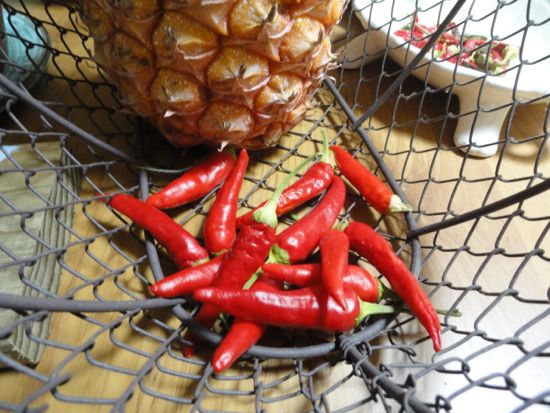
Making chilli jam for the stockpile cupboard.

Experiment with different recipes and make sauces and jams that you’ll eat during the year. Homemade tomato and BBQ sauce and relish are delicious and you can make them to exactly suit your taste – less salt, more lemon, a little bit more sugar, whatever. They’ll also healthier and cheaper. If you have a glut of cucumbers, preserve some – pickled cucumbers store well in the fridge for about a month, without processing in a water bath. Teach yourself how to make lemon butter and cordial with your backyard lemons and turn your own oranges into the best marmalade you’ll ever eat. Learn to make ginger beer and replace those soft drinks full of preservatives and colourings. You can make simple cheese and yoghurt at home with no special equipment. You’re only limited by your imagination and the time you have to put into it. It all goesto providing healthy options for your family’s diet and can help you provide interesting, tasty food within a sparse budget. And remember, the more you produce and make yourself, the more independent you become.

CHILLI JAM
6 ripe tomatoes
1 cup white wine vinegar
1 cup sugar
1 cup ripe chillies - a mixture of mild and hot chilli according to your taste

Cut the tomatoes into quarters and place in a thick bottomed pan. Add the vinegar and chilli and bring to the boil. When the mixture is boiling add the sugar. When the sugar has dissolved, turn down the heat and let the mixture simmer until it has reduced to about half. Pour into sterilised jars and seal.

It will keep well in the fridge for two months. If you want to store this for a few months, place in a water bath and process.
All the napkins should have been posted by now. If there is anyone who hasn't yet posted, can you please let me know. Thanks. : )

Addition: Could Jen, who is partnered with Bobbi Jo, please email me. Thanks!

Lisa J, one of the lovely ladies who comments here, asked if I would give some instructions for doing stitcheries. I'm happy to do that as stitchery can be used to make a wide range of gifts for the people in your life and for beautiful things in your own home. It's a great skill to have.

These are the fabrics I use. On the left is a white cotton and the right a beige linen.

I always stitch pure cotton or linen. Polycotton tends to pucker. You need a soft fabric with an open weave. I use DMC embroidery thread, Anchor is also good. You generally use white or off white as the threads are the feature, not the fabric. I use two strands of cotton when I stitch and I back the fabric with some sort of backing. This stabilises the stitchery and gives the stitches a bit of padding in which to sit so it lays well on the surface of the fabric. You can buy sew on or iron on backings and you should experiment and see what works well for you.

I always draw my own designs because I like to customise my gifts for my friends, but there are free patterns on the web and I have some here for free down load. You can also buy patterns at the craft store. If you can draw, try doing your own design. They don't have to be perfect because stitchery should have a handmade look. The appeal of stitchery is that it's not like mass produced embroidery.

Once you have your pattern, which is usually just a piece of paper, you need to transfer it to your fabric. I just pin the pattern to the back of the fabric and trace it onto the fabric with a dark soft pencil. Here are some instructions on how to transfer a pattern. How to transfer the pattern to your fabric.

Once you have transferred the pattern and attached the backing to the fabric, you'll need to work out your colours and prepare your threads. You will start in the centre and work your way outwards, so choose a colour for the centre and thread your needle with two strands of thread about 75 cm long. The needle you use should be the finest needle you can manage to thread. Pull the thread through the eye of the needle so the thread closest to the eye is doubled (4 strands) and the end of the thread, the thread that will be in your fabric, is single (two strands). Now you're ready to start. You can use an embroidery hoop if you like. I don't like working with a hoop but many stitchers do.

Most of the stitches you'll do will be back stitch. This makes up about 90% of your stitches. Here are some instructions: How to do back stitch. And here are some photos of me starting a back stitch. Start under the fabric.

And following along in a straightish line. Pull each stitch firmly but not tightly.

Here are three stitches completed. Try to keep your stitches to an even length.

So you just follow your pattern with back stitch, from the centre out and when you need to do dots, like in the pattern below, they are colonial or French knots. How to do a colonial or French knot. The leaves, or to make a flower, are detached chain or daisy stitch How to do detached chain or daisy stitch.


Instructions for other stitches.

Tutorial for using finished stitchery.

I hope these instructions help get you started as you can make gifts for women, men and children with stitchery and a bit of know-how.


One smart way to cut down on food waste is to plan your menus. This will help you with your shopping, it will save time because you don’t have to stand in front of the fridge every afternoon and wonder “what will I cook for dinner” that decision has already been made and your ingredients are already in the fridge or the pantry.

Like most things we do in this simple life, organisation is the key. If you can invest an hour of your time to make up a menu plan for a month, you can use that plan 12 times during the year. Sometimes you might want to modify it, but if you don’t, you have your menus covered for the next year.

Plan your menu around what's in your stockpile and what you're growing. If you don’t stockpile and shop for grocery on a weekly basis, start off your menu planning by using what you already have in the kitchen. Check your fridge, pantry cupboard and in the kitchen for what food is available to work with. Have your local supermarket flyers on hand so you can plan according to what is on special that week. Make sure you understand the principles of good nutrition and be guided by the recommended requirements for healthy living.

You’ll save time and money if you cook double the quantity. For instance, the tuna casserole listed in my summer menus serves four. We eat it two nights in a row, the second night being the best as the flavours have had time to develop. You can do this with soup, pasta sauces, casseroles, roasts, curries and many other dishes. The meal takes the same amount of time to prepare but the second night you save on the preparation time and you save on the energy bills by just using enough energy to reheat the food. Alternatively, if the meal is freezable, cover the second portions tightly and freeze it for the following week.

This is a sample breakdown of two week’s dinner/supper menu plan; one summer, one winter. We eat no meat or chicken, just fish, vegetables and dairy. I plan for six meals as there are usually leftovers one night. I never plan breakfasts or lunch. Breakfast for us is usually eggs on toast, or toast and tea, sometimes baked beans or weetbix. Lunch is a sandwich made with bread just out of the oven.

Summer
1 – tuna casserole, garden salad and sprouts/home grown fruit if available/tinned fruit, homemade buttermilk ice cream.
2 – vegetarian burritos with beans, sprouts and salad/watermelon slices.
3 – crumbed fish, potato salad, tomatoes/homemade banana cake.
4 – garden salad with sprouts, potatoes, boiled eggs and avocado/fresh fruit salad and homemade ice cream.
5 – pumpkin risotto/junket with peaches.
6 – cheese and herb omelet/stewed apples and frozen yoghurt.

Winter
1 – vegetable soup with homemade hot bread/apple pie.
2 – vegetable curry/fresh fruit.
3 – crumbed fish, mashed potato, beans, carrots/homemade lemon cake.
4 – pumpkin soup with homemade hot bread/ lemon cake.
5 – bean and vegetable casserole/pancakes with homemade lemon butter filling.
6 – tinned salmon cakes with homemade chilli jam and pan fried potatoes and grilled tomatoes/apple crumble and egg custard.

Buttermilk ice cream
This will make enough ice cream for three people.
1 cup good cream
6 large egg yolks
½ cup sugar
1 cup buttermilk

Place cream in a saucepan and gently bring it up to a slow simmer. Separately in a medium bowl, whisk egg yolks and sugar together. The slowly pour the hot cream into egg yolk mixture, whisking as you pour.

Now you need to make this into a custard. To do that, return the mixture to the saucepan and stir it over low heat until the custard thickens slightly. Don't boil it or it will spoil. It should take about 5 minutes of constant stirring to make the custard. When it's thickened, pour the mixture into a bowl and stir in 1 cup cold buttermilk.

Put this mixture in the fridge until it's cold and then pour into an ice cream maker and process according to the directions of your machine. If you don't have a machine, pour into container, cover with plastic wrap and place in the freezer. When it starts to freeze, get a fork and stir it around, breaking up the ice crystals. Keep doing this every 45 minutes until the ice cream is solid.

Printable weekly menu sheets here.

For most people, myself included, the transition to simple living is quite a long period of time. The idea is formed that it might be a possibility, plans are made, compromises discussed and then it's often a series of small steps until you're really there, living simply every day.

So I thought it might be useful to make a list of simple steps that are all elements of simple living, can be started as small projects, and when bundled together, will make an excellent entry to your simple life. Some are easy, some aren't, but all are worth a try because they will help you, one step at a time, live the kind of life you want. And remember, the way I live, might be different to the kind of simple life you want for yourself. You have to plan your own life and hopefully these steps will help you devise your plan and walk your path.

I've already written about convincing your partner, and I am well aware that often it's one person who starts on the road to simplicity, then takes the whole family with them, in varying degrees of compliance. This list could help you convince your partner or the family, that making life style change is achievable and these small steps will bring it closer.

You might like to print out the list - or modify it to include things you need to do - and show it to your family. See what they are willing to do or if they have any suggestions about what to add, or how to go about your transition.
  1. Stop spending on wants - this is ALWAYS at the top of the list.
  2. Write up a spending plan/budget that will show you where you stand financially.
  3. Pay off debt. The previous step will help with this.
  4. Declutter your home.
  5. Give away or sell everything that is not useful or precious to you.
  6. Give more and expect less.
  7. Smile.
  8. Start a change jar.
  9. Start an emergency fund.
  10. Learn how to bake bread.
  11. Learn how to make preserves.
  12. Grow some of your own food, even if it's sprouts. Everyone can grow something.
  13. Use up all your chemical cleaners and start a green cleaning routine.
  14. Conserve electricity.
  15. Conserve water.
  16. Learn how to read your electricity and water metres.
  17. Stop using the car for short trips. Make every trip out count and do as much as you can so you can cut down on the number kilometres/miles you drive.
  18. Stop buying disposable products.
  19. Stop accepting plastic carry bags at the shops.
  20. Make your own cotton shopping bags.
  21. Make sure you take your shopping bags with you every time you go out.
  22. Learn how to make simple cheese.
  23. Shop locally and support your local neighbourhood.
  24. Be generous.
  25. Keep some chickens in your back yard for eggs, and if you eat meat, for meat.
  26. Plant fruit trees.
  27. Learn how to make soap.
  28. Grow loofahs.
  29. Slow down and relax. The world will not stop if you have a break.
  30. Teach your children well. You are their role model, be the person you want them to be.
  31. Learn how to mend clothes.
  32. Learn to knit.
  33. Cook from scratch. This means cooking from non-processed foods, not cooking with tinned soups and mixes.
  34. Get rid of toxic friends. They will drain the living daylights out of you.
  35. Start making gifts for friends.
  36. Change your idea of what success is.
  37. Reinvent yourself. Do something different today.
  38. Get rid of as many spray cans as possible in your home. Make your own products and put them in pump bottles.
  39. Make an apron.
  40. Wear it.
  41. Explain what you're trying to do to your children.
  42. Tell as many people as you can what you're doing, and why.
  43. Reduce the amount of everything you use. Less salt, less sugar, less meat, less butter, less bread, less fuel, less electricity, fewer clothes and shoes.
  44. Increase the amount of things you do for others. Generosity always returns to you.
  45. Stockpile and shop mindfully for groceries.
  46. Talk to your neighbours. Try to develop a friendly and helpful relationship with them.
  47. Talk to your children. Ask them what they think about global warming, I bet they surprise you.
  48. Save seeds from heirloom vegetables. Unless we do this, our old vegetables will disappear under the weight of corporatised hybrid vegetables, and you will have to buy new seeds every year.
  49. Keep pure breed chickens. They, like the hybrid vegies, are in danger of being lost with hybrid chickens just bred to lay eggs, and not to go broody and raise chicks.
  50. And finally, as that wise man, Mahatma Gandhi once said: be the change you want to see in the world.

We find the most difficult thing to manage in our garden is the continuity of supply. We go alright for a while, then it all falls apart. Currently the garden looks bare because we thought we still had a bit to go before the warm weather, then all of a sudden it was warm. Pfffft! The seeds weren't even sown! So a couple of weeks ago, I set to sowing seeds in pots and trays and in the garden. Some in the garden are starting to come up and the tray seeds are almost ready to pot on now. But we are having to buy capsicums and tomatoes - ugh. Store bought tomatoes are not good.

Above is an overview of the garden taken yesterday morning. In the first garden (that's a bird feeder that looks like it's in the middle of the garden, but isn't) we have radishes and the last of Hanno's kale. At the end of this garden we've planted Golden Nugget pumpkin. Like most hot weather gardeners, we have water containers everywhere.

This garden has some silverbeet (swiss chard), capsicums (peppers) and bok choy (chinese cabbage). At the end of this garden are carrots, french radishes, beetroot, eggplant, two different lettuces and celery. In the garden behind there are potatoes under straw, a lone pineapple and one of the last cabbages. Oh, and a clump of old fashioned nasturtiums - a yellow one with red splashes. It's been left there so I can collect seeds from it. That row of green, in the next garden behind the potatoes, are blue lake beans. I've just been out watering the garden before the sun hits it and noticed the first of the potatoes are coming up. They're Dutch Creams.

The Richmond Green Apple cucumber is growing nicely with the first flowers just starting to form. This is a delicious old Australian variety that was very popular when I was growing up.


The silverbeet freak. This silverbeet is almost a metre (3') tall. It's the only one in the old crop of silverbeet to grow this high. I wish I could collect seeds from this little beauty but silverbeet never flowers here.


We've harvested cabbages from these bare spaces, just a few remain. Today I'll be pulling out the rest of the English spinach (right-hand corner), which is starting to flower, and will give it to the chooks to eat. They love spinach. In the photo above you can see foodhook zucchini coming up as well as daikon radish at the back and some herbs at the front. Rhonda Gay gave me the seed for the vine on the right. It's some sort of Asian gourd.

Here we have a young group of silverbeet, with bok choy at the top. We use a lot of silverbeet and have it growing year round. Whatever we don't eat, the chooks have. Giving them dark green leaves like silverbeet and spinach gives their egg yolks a dark golden yellow colour. Today, these little babies, and the rest of the leafy vegies, will be getting a drink of worm tea.

This is the potato patch again. It's the only part of our garden we put under straw, as now the drought's in full swing, it's almost impossible to find straw or lucerne hay at a reasonable price. We usually buy about 12 bales of mulch a year, and supplement that with what we grow in the garden, like pigeon pea and lawn clippings. We have one bale left from our last purchase and we're saving that for the potatoes, with a small portion going to the tomatoes I have growing in pots. I have four tomatoes in pots, one Brandywine, an Amish paste and (I think) two Mortgage Lifters. In the aquaponics garden, I have Brandywines, Amish paste and some Sweet Bites. In the bottom of the above photo you can also see Judi B's amazing onions. She has sent them to so many people, I'm sure they must be taking over Australian backyards by now. A quiet revolution. I hope to cut them back today as they're dying down after flowering and have been attacked by aphids. When they do that each year, it's time to transplant them.

Right outside the vegetable garden, along the picket fence, we're growing Sunshine Blue and Rabbit Ears blueberries. They're in full flower now and starting to produce fruit again. It takes blueberries a while to establish here, as our weather is so warm, but each year these bushes get a little bigger and give us more fruit. Small steps.

And finally, here is a view of our house from the garden. You can see our small water tank (5000 litres), the aquaponics system and behind the lattice, is my greenhouse. If you click on this photo to enlarge it, you'll see this is the back verandah of a functional house, not a place for entertainment. Although we did have my 50th birthday party there with about 50 people sitting at tables with flowers and candles glowing in the twilight. Now we're more practical and our home reflects that. You can see a wheelbarrow waiting to carry a load, a disconnected pay TV satellite dish on the roof, some skylights to light rooms with sunlight and not electricity. Just out of sight is a solar hot water system. Look carefully and you'll also see clothes racks for drying when it's raining, plants waiting to be taken inside and fruit and vegies waiting to have seeds collected or to be planted. It's not a pretty site, but it works well for us. Oh, and that window behind the white clothes rack is where I'm now sitting typing this. : )

I never tire of the simple sounds of my home and garden. I suppose noise is that sound most people don't want to hear, but I welcome most of that too. But not television. In fact, television noise was what triggered this post. Hanno was watching something on ABC 2 that was repeated from last night. He then went outside, leaving the TV on. grrrrrrrrrr! Don't you hate that! I went in and turned it off, then immediately heard the sound of a Sacred Kingfisher as it was flying past. Noise can sometimes mask sounds.

At this very moment, I can hear the sound of my washing machine spinning through its last cycle; I can hear geese honking on the pond; there is a chook clucking after laying an egg. Hanno is outside tidying up the edges of the lawn, I hear the clink of the steel spade against the edge of the path. Airedale Alice is inside and when she walks up to me, I hear her claws on the wooden floors; they sound like tap shoes.

Pee Wees are calling, a train goes by in the distance, the phone rings. It's Kerry, he's not well and he always has to tell his mum when he's sick. He has a virus. I listen to him as he tells me about his new girlfriend - a Korean girl called Kai Lin (I hope that spelling is close). We end our conversation with me telling him to look after himself and to drink plenty of water, and him telling me not to worry.

But I do.

A car drives in, it's Jens, my step son, coming to borrow the trailer for a trip to the rubbish dump. I hear him and Hanno talking about the football. Apparently there is the grand final of something on today. Yawn.

Silence, I hear the soft buzzing of my computer. Rosie barks, and the kingfisher flies past again with the mad screech that sounds like the music from Psycho. I can't work out why a tiny bird with such a lovely name and blue feathers, would sound like that. Another of nature's wonders.

I can tell the time with the sounds around here. In the morning I hear the children going to school and know it's 8.30ish, they mark my time again when they return home at three. The postman comes on his bike at 10.30, our next door neighbours return from work at 5. It's a gentle way to tell the time and as I never wear a watch now (I gave them all away when I stopped working) and rarely look at a clock, these simple sounds keep me on track through out my day.

King parrots are calling - I see three of them, they're about to eat some pigeon peas and peaches in our garden. That's ok, I'm happy to share as I know a lot of their habitat has been taken. Their sounds bring Hanno back into the yard again and he yells out, "Rhonda! king parrots in the back yard!" I pretend I don't know they're there and take my camera out to take a photo.
There are two king parrots in this photo. See if you can find them. 

Click as I plug in the cable connecting the camera to the computer, click, click click. Photos are in the computer. Resize, tap tap. And I finish typing this. These tappings are the sounds that connect me to you - these are sounds I like.
He's started the lawn mower. Ack. I smell biscuits cooking. Time to hear the kettle boil and to experience the sound of crunching into a walnut biscuit.

I hope you all have a wonderful weekend. Thank you for sharing your day with me.
Newer Posts Older Posts Home

MY BOOKS

MY BOOKS


My books were all published by Pengiun, and are available at Amazon US, Amazon UK and Amazon Au

Search here

Total Pageviews

Translate


I'm Rhonda Hetzel and I've been writing my Down to Earth blog since 2007. Although I write the occasional philosophical post, my main topics include home cooking, happiness and gardening as well as budgeting, baking, ageing, generosity, mending and handmade crafts. I hope you enjoy your time here.

MY FAVOURITE PLACES

  • Grandma Donna's Place
  • Grandma Donna's YouTube
  • Grandma Donna's Instagram
  • This Simple Day
  • Nicole's Instagram

Give More

Give More

Popular posts last year

Making ginger beer from scratch

We had a nice supply of ginger beer going over Christmas. It's a delicious soft drink for young and old, although there is an alcoholic version that can be made with a slight variation on the recipe. Ginger beer is a naturally fermented drink that is easy to make - with ginger beer you make a starter called a ginger beer plant and after it has fermented, you add that to sweet water and lemon juice. Like sourdough, it must ferment to give it that sharp fizz. To make a ginger beer plant you'll need ginger - either the powdered dry variety or fresh ginger, sugar, rainwater or tap water that has stood for 24 hours to allow the chlorine to evaporate off. You'll also need clean plastic bottles that have been scrubbed with soap, hot water and a bottle brush and then rinsed with hot water. I never sterilise my bottles and I haven't had any problems. If you intend to keep the ginger beer for a long time, I'd suggest you sterilise your bottles. MAKING THE STARTER In a...
Image

NOT the last post

This will be my last post here.  I've been writing my blog for 18 years and now is the time to step back. I’ve stopped writing the blog and come back a couple of times because so many people wanted it, but that won’t happen again, I won’t be back.  I’ll continue on instagram to remain connected but I don’t know how frequent that will be. I know some of you will be interested to know the blog's statistics. 
Image

How to make cold process soap

I'm sure many of you are wondering: "Why make soap when I can buy it cheaply at the supermarket?" My cold process soap is made with vegetable oils and when it is made and cured, it contains no harsh chemicals or dyes. Often commercial soap is made with tallow (animal fat) and contains synthetic fragrance and dye and retains almost no glycerin. Glycerin is a natural emollient that helps with the lather and moisturises the skin. The makers of commercial soaps extract the glycerin and sell it as a separate product as it's more valuable than the soap. Then they add chemicals to make the soap lather. Crazy. Making your own soap allows you to add whatever you want to add. If you want a plain and pure soap, as I do, you can have that, or you can start with the plain soap and add colour, herbs and fragrance. The choice is yours. I want to add a little about animal and bird fat. I know Kirsty makes her soap with duck fat and I think that's great. I think t...
Image

Preserving food in a traditional way - pickling beetroot

I've had a number of emails from readers who want to start preserving food in jars but don't know where to start or what equipment to buy.  Leading on from yesterday's post, let's just say up front - don't buy any equipment. Once you know what you're doing and that you enjoy preserving, then you can decide whether or not to buy extra equipment. Food is preserved effectively without refrigeration by a variety of different methods. A few of the traditional methods are drying, fermentation, smoking, salting or by adding vinegar and sugar to the food - pickling. This last method is what we're talking about today. Vinegar and sugar are natural preservatives and adding one or both to food sets up an environment that bacteria and yeasts can't grow in. If you make the vinegar and sugar mix palatable, you can put up jars of vegetables or fruit that enhance the flavour of the food and can be stored in a cupboard or fridge for months. Other traditional w...
Image

Cleaning mould from walls and fabrics

With all this rain around we've developed a mould problem in our home. Usually we have the front and back doors open and that good ventilation stops most moulds from establishing. However, with the house locked up for the past week, the high humidity and the rain, mould is now growing on the wooden walls near our front door and on the lower parts of cupboards in the kitchen. Most of us will find mould growing in our homes at some point. Either in the bathroom or, in humid climates, on the walls, like we have now. You'll need a safe and effective remedy at some point, so I hope one of these methods works well for you. Mould is not only ugly to look at, it can cause health problems so if you see mould growing, do something about it straight away. The longer you leave the problem, the harder it will be to get rid of it effectively. If you have asthma or any allergies, you should do this type of cleaning with a face mask on so you don't breathe in any spores. Many peopl...
Image

Five minute bread

Bread is one of those foods that, when made with your own hands, gives a great deal of satisfaction and delight. It's only flour and water but it symbolises so much. I bake bread most days and use a variety of flours that I buy in bulk. Often I make a sandwich loaf because we use most of our bread for lunchtime sandwiches and for toast. Every so often I branch out to make a different type of loaf. I have tried sour dough in the past but I've not been happy with any of them. I'll continue to experiment with sour dough because I like the idea of using wild yeasts and saving the starter over a number of years to develop the flavour and become a part of the family. However, the loaf I've been branching out to most often is just a plain old five minute bread. By five minutes I mean it takes about five minutes actual work to prepare but it's the easiest of all bread to make and to get consistently good loaves from. If you're having people around for lunch or...
Image

This is my last post.

I have known for a while that this post was coming, but I didn't know when. This is my last post. I'm closing my blog, for good, and I'm not coming back like I have in the past.  I've been writing here for 16 years and my blog has been many things to me. It helped me change my life, it introduced me to so many good people, it became a wonderful record of my family life, it helped me get a book contract with Penguin, and monthly columns with The Australian Women's Weekly and Burke's Backyard . But in the past few months, it's become a burden. In April, I'll be 75 years old and I hope I've got another ten years ahead. However, each year I'll probably get weaker and although I'm fairly healthy, I do have a benign brain tumour and that could start growing. There are so many things I want to do and with time running out, leaving the blog behind gives me time to do the things that give me pleasure. On the day the blog started I felt a wonderful, h...
Image

What is the role of the homemaker in later years?

An email came from a US reader, Abby, who asked about being a homemaker in later years. This is part of what she wrote: "I am a stay-at-home mum to 4 children, ages 9-16. I do have a variety of "odd jobs" that I enjoy - I run a small "before-school" morning drop-off daycare from my home, I am a writing tutor, and I work a few hours a week at a local children's bookstore. But mostly, I cherish my blissful days at home - cooking, cleaning (with homemade cleaners), taking care of our children and chickens and goats, baking, meal-planning, etc. This "career" at home is not at all what I imagined during my ambitious years at university, but it is far more enriching. I notice, though, that my day is often planned around the needs of my family members. Of course, with 4 active kids and a husband, this is natural. I do the shopping, plan my meals, cook dinner - generally in anticipation of my family reconnecting in the evening.  I can't h...
Image

Every morning at home

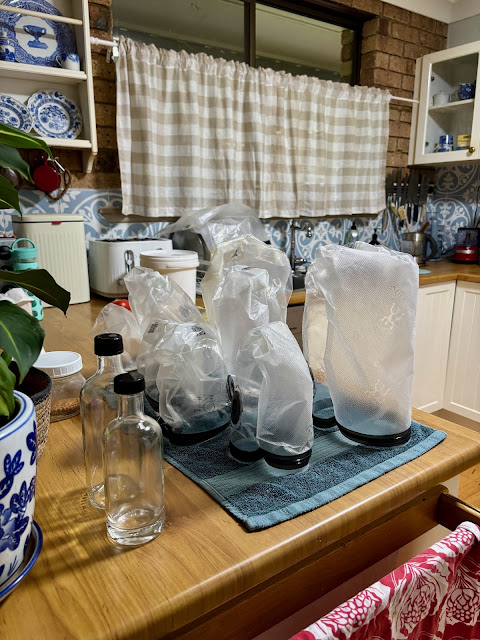
Every morning when I walk into my kitchen it looks tidy and ready for a day's work. Not so on this morning (above), I saw this when I walked in. Late the previous afternoon when I was looking for something, I came across my rolled up Zwilling vacuum bags and decided they had to be washed and dried. So I did that and although I usually put them outside on the verandah to dry it was dark by then. I turned the just-washed bags inside out and left them like this on a towel. It worked well and now the bags are ready to use when I bring home root vegetables, cabbages or whatever I buy that I want to last four or five weeks.
Image

You’ll save money by going back to basics

When I was doing the workshops and solo sessions, I had a couple of people whose main focus was on creating the fastest way to set up a simple life. You can't create a simple life fast, it's the opposite of that It's not one single thing either - it's a number of smaller, simpler activities that combine to create a life that reflects your values; and that takes a long to come together. When I first started living simply I took an entire year to work out our food - buying it, storing it, cooking it, preserving, baking, freezing, and growing it in the backyard. This is change that will transform how you live and it can't be rushed.  
Image

All previous blog posts

  • 2026 3
    • February 3
      • Workshops starting 1 March
      • Planting vegetable seeds and new workshops
      • Back where we belong
  • 2025 7
    • July 1
    • June 2
    • May 1
    • April 2
    • February 1
  • 2024 25
    • December 2
    • November 1
    • October 2
    • September 3
    • August 1
    • July 3
    • June 1
    • May 3
    • April 2
    • March 3
    • February 2
    • January 2
  • 2023 13
    • December 1
    • November 2
    • October 1
    • September 3
    • August 2
    • February 2
    • January 2
  • 2022 17
    • November 3
    • October 4
    • September 3
    • August 2
    • July 3
    • June 2
  • 2021 50
    • December 1
    • November 6
    • October 7
    • September 5
    • August 4
    • July 5
    • June 2
    • May 2
    • April 6
    • March 4
    • February 4
    • January 4
  • 2020 68
    • December 3
    • November 5
    • October 4
    • September 4
    • August 4
    • July 4
    • June 4
    • May 8
    • April 7
    • March 8
    • February 8
    • January 9
  • 2019 66
    • December 2
    • November 4
    • October 5
    • August 3
    • July 4
    • June 6
    • May 8
    • April 8
    • March 8
    • February 11
    • January 7
  • 2018 82
    • December 1
    • September 2
    • August 10
    • July 4
    • June 11
    • May 9
    • April 12
    • March 10
    • February 10
    • January 13
  • 2017 129
    • December 7
    • November 10
    • October 6
    • September 13
    • August 11
    • July 13
    • June 12
    • May 9
    • April 9
    • March 14
    • February 11
    • January 14
  • 2016 125
    • December 7
    • November 13
    • October 10
    • September 11
    • August 11
    • July 8
    • June 9
    • May 9
    • April 12
    • March 10
    • February 13
    • January 12
  • 2015 184
    • December 7
    • November 15
    • October 20
    • September 18
    • August 19
    • July 18
    • June 12
    • May 15
    • April 12
    • March 21
    • February 13
    • January 14
  • 2014 203
    • December 11
    • November 8
    • October 17
    • September 20
    • August 17
    • July 19
    • June 17
    • May 17
    • April 23
    • March 15
    • February 18
    • January 21
  • 2013 225
    • December 13
    • November 17
    • October 17
    • September 17
    • August 21
    • July 24
    • June 20
    • May 19
    • April 17
    • March 22
    • February 17
    • January 21
  • 2012 245
    • December 17
    • November 20
    • October 20
    • September 18
    • August 15
    • July 24
    • June 21
    • May 26
    • April 23
    • March 23
    • February 19
    • January 19
  • 2011 257
    • December 18
    • November 24
    • October 27
    • September 23
    • August 24
    • July 21
    • June 24
    • May 24
    • April 16
    • March 22
    • February 14
    • January 20
  • 2010 283
    • December 20
    • November 18
    • October 18
    • September 19
    • August 25
    • July 24
    • June 25
    • May 26
    • April 25
    • March 22
    • February 29
    • January 32
  • 2009 293
    • December 29
    • November 18
    • October 23
    • September 25
    • August 22
    • July 28
    • June 22
    • May 21
    • April 27
    • March 26
    • February 24
    • January 28
  • 2008 387
    • December 24
    • November 23
    • October 25
    • September 26
    • August 27
    • July 27
    • June 37
    • May 34
    • April 44
    • March 53
    • February 32
    • January 35
  • 2007 372
    • December 37
    • November 40
    • October 55
    • September 51
    • August 49
    • July 63
    • June 49
    • May 28


Trending Articles

NOT the last post

This will be my last post here.  I've been writing my blog for 18 years and now is the time to step back. I’ve stopped writing the blog and come back a couple of times because so many people wanted it, but that won’t happen again, I won’t be back.  I’ll continue on instagram to remain connected but I don’t know how frequent that will be. I know some of you will be interested to know the blog's statistics. 
Image

Every morning at home

Every morning when I walk into my kitchen it looks tidy and ready for a day's work. Not so on this morning (above), I saw this when I walked in. Late the previous afternoon when I was looking for something, I came across my rolled up Zwilling vacuum bags and decided they had to be washed and dried. So I did that and although I usually put them outside on the verandah to dry it was dark by then. I turned the just-washed bags inside out and left them like this on a towel. It worked well and now the bags are ready to use when I bring home root vegetables, cabbages or whatever I buy that I want to last four or five weeks.
Image

You’ll save money by going back to basics

When I was doing the workshops and solo sessions, I had a couple of people whose main focus was on creating the fastest way to set up a simple life. You can't create a simple life fast, it's the opposite of that It's not one single thing either - it's a number of smaller, simpler activities that combine to create a life that reflects your values; and that takes a long to come together. When I first started living simply I took an entire year to work out our food - buying it, storing it, cooking it, preserving, baking, freezing, and growing it in the backyard. This is change that will transform how you live and it can't be rushed.  
Image

Creating a home you'll love forever

Living simply is the answer to just about everything. It reduces the cost of living; it keeps you focused on being careful with resources such as water and electricity; it reminds you to not waste food; it encourages you to store food so you don't waste it and doing all those things brings routine and rhythm to your daily life. Consciously connecting every day with the activities and tasks that create simple life reminds you to look for the meaning and beauty that normal daily life holds.  It's all there in your home if you look for it. Seemingly mundane tasks like cleaning and cooking help you with that connection for without those tasks, the home you want to live in won't exist in the way you want it to.  Creating a home you love will make you happy and satisfied.
Image

Time changes everything

I've been spending time in the backyard lately creating a contained herb and vegetable garden. My aim is to develop a comfortable place to spend time, relax, increase biodiversity and encourage more animals, birds and insects to live here or visit. Of course I'd prefer my old garden which was put together by Hanno with ease and German precision. Together, we created a space bursting at the seams with herbs, vegetables and fruity goodness ready to eat and share throughout the year. But time changes everything. What I'm planning on doing now, is a brilliant opportunity for an almost 80 year old with balance issues. In my new garden I'll be able to do a wide range of challenging or easy work, depending on how I feel each day. It’s a daily opportunity to push myself or sit back, watch what's happening around me and be captivated by memories or the scope of what's yet to come.
Image

It's the old ways I love the most

I'm a practical woman who lives in a 1980’s brick slab house. There are verandahs front and back so I have places to sit outside when it's hot or cold. Those verandahs tend to make the house darker than it would be but they're been a great investment over time because they made the house more liveable. My home is not a romantic cottage, nor a minimalist modern home, it's a 1980’s brick slab house. And yet when people visit me here they tell me how warm and cosy my home is and that they feel comforted by being here. I've thought about that over the years and I'm convinced now that the style of a home isn't what appeals to people. What they love is the feeling within that home and whether it's nurturing the people who live there.
Image

Back where we belong

Surprise! I'm back ... for good this time. Instagram became an impossible place for me. They kept sending me messages asking if I'd make my page available for advertisers! Of course, I said no but that didn't stop them. It's such a change from what Instagram started as. But enough of that, the important part of this post is to explain why I returned here instead of taking my writing offline for good. For a few years Grandma Donna and I have talked online face-to-face and it's been such a pleasure for me to get to know her. We have a lot in common. We both feel a responsibility to share what we know with others. With the cost of living crisis, learning how to cook from scratch, appreciate the work we do in our homes, shop to a budget and pay off debt will help people grow stronger. The best place to do that is our blogs because we have no advertising police harassing us, the space is unlimited, we can put up tons of photos when we want to and, well, it just feels li...
Image

Making ginger beer from scratch

We had a nice supply of ginger beer going over Christmas. It's a delicious soft drink for young and old, although there is an alcoholic version that can be made with a slight variation on the recipe. Ginger beer is a naturally fermented drink that is easy to make - with ginger beer you make a starter called a ginger beer plant and after it has fermented, you add that to sweet water and lemon juice. Like sourdough, it must ferment to give it that sharp fizz. To make a ginger beer plant you'll need ginger - either the powdered dry variety or fresh ginger, sugar, rainwater or tap water that has stood for 24 hours to allow the chlorine to evaporate off. You'll also need clean plastic bottles that have been scrubbed with soap, hot water and a bottle brush and then rinsed with hot water. I never sterilise my bottles and I haven't had any problems. If you intend to keep the ginger beer for a long time, I'd suggest you sterilise your bottles. MAKING THE STARTER In a...
Image