down to earth

  • Home
  • About Us
  • Down To Earth Book
  • Privacy Policy
I never tire of the simple sounds of my home and garden. I suppose noise is that sound most people don't want to hear, but I welcome most of that too. But not television. In fact, television noise was what triggered this post. Hanno was watching something on ABC 2 that was repeated from last night. He then went outside, leaving the TV on. grrrrrrrrrr! Don't you hate that! I went in and turned it off, then immediately heard the sound of a Sacred Kingfisher as it was flying past. Noise can sometimes mask sounds.

At this very moment, I can hear the sound of my washing machine spinning through its last cycle; I can hear geese honking on the pond; there is a chook clucking after laying an egg. Hanno is outside tidying up the edges of the lawn, I hear the clink of the steel spade against the edge of the path. Airedale Alice is inside and when she walks up to me, I hear her claws on the wooden floors; they sound like tap shoes.

Pee Wees are calling, a train goes by in the distance, the phone rings. It's Kerry, he's not well and he always has to tell his mum when he's sick. He has a virus. I listen to him as he tells me about his new girlfriend - a Korean girl called Kai Lin (I hope that spelling is close). We end our conversation with me telling him to look after himself and to drink plenty of water, and him telling me not to worry.

But I do.

A car drives in, it's Jens, my step son, coming to borrow the trailer for a trip to the rubbish dump. I hear him and Hanno talking about the football. Apparently there is the grand final of something on today. Yawn.

Silence, I hear the soft buzzing of my computer. Rosie barks, and the kingfisher flies past again with the mad screech that sounds like the music from Psycho. I can't work out why a tiny bird with such a lovely name and blue feathers, would sound like that. Another of nature's wonders.

I can tell the time with the sounds around here. In the morning I hear the children going to school and know it's 8.30ish, they mark my time again when they return home at three. The postman comes on his bike at 10.30, our next door neighbours return from work at 5. It's a gentle way to tell the time and as I never wear a watch now (I gave them all away when I stopped working) and rarely look at a clock, these simple sounds keep me on track through out my day.

King parrots are calling - I see three of them, they're about to eat some pigeon peas and peaches in our garden. That's ok, I'm happy to share as I know a lot of their habitat has been taken. Their sounds bring Hanno back into the yard again and he yells out, "Rhonda! king parrots in the back yard!" I pretend I don't know they're there and take my camera out to take a photo.
There are two king parrots in this photo. See if you can find them. 

Click as I plug in the cable connecting the camera to the computer, click, click click. Photos are in the computer. Resize, tap tap. And I finish typing this. These tappings are the sounds that connect me to you - these are sounds I like.
He's started the lawn mower. Ack. I smell biscuits cooking. Time to hear the kettle boil and to experience the sound of crunching into a walnut biscuit.

I hope you all have a wonderful weekend. Thank you for sharing your day with me.
I took you all with me yesterday. I went to my friend Bernadette's home to pick up some cuttings and then down the road a bit to a meeting in Maleny. This is Mountain View Road, I didn't take a photo of the Glasshouse Mountains, which were behind me, but of a big new home and paddocks under construction. These horse heads are on both sides of the entrance but I couldn't fit them both in my photo.

Then I wandered on, down hill and dale, past contented moo cows.

Along pretty lanes where the verbena was shining in the afternoon sun.

Past palatial homes.

and pretty cottages ...

and gardens...

and into Bernadette's street.


After my visit, I went into Maleny to collect some seeds. This is the main street - Maple Street.

This is the supermarket I shop at when I don't go to Aldi. It's the original shop built about 100 years ago. Woolworths is down the road on Obi Obi Creek - a platypus habitat > : (
And here is the famous Upfront Club and Co-op that have been operating successfully as local co-ops for many years.

I was going to take more photos after the meeting, but it was too dark when I came home. I hope you've enjoyed this little peek into my afternoon. I'll be back later with another post.

I met Hanno on my 28th birthday, he was 37. He was recovering from a divorce and the death of his daughter. Two years later we were married at the registry office in Hamburg, Germany. Today is our 28th wedding anniversary.

Here we are on 28.9.1979, a couple of dags about to get hitched. We didn't have much money so it was just Hanno and I and our witnesses at the ceremony. We invited family and friends to a celebration at home later in the day.

Like every marriage, ours has had its up and downs. We both have strong personalities and have fought like Kilkenny cats over the years but now that I look back, it's been a good marriage, and stable from the start. Although I grew up not wanting to get married, when I tied the knot, I went into it knowing it was forever. For me, there was no going back.

I think that's one reason why our marriage has survived, we knew it would be tough at times but we weren't going to walk away when it was. There was also love, respect and trust along with the commitment, and those four important elements held us together in the rocky times. Our sons were the icing on our cake. They taught us all we now know about patience, pride, gratitude, understanding and unconditional love.

It's really easy now. We fit together like a pair of old gloves. Oh, we still argue sometimes about silly things but those arguments are forgotten ten minutes later. Our lives have developed a kind of relaxed easiness. We are living in a beautiful part of the world, our days are ours to do with as we want, and we enjoy each other's company. We've grown into that, it's like the payoff for the times that were difficult. I knew that Hanno and I would be together forever, but I didn't think it would get better every year and I didn't think it would be this good.
The swapped napkins are starting to be received all over the world so I'll take this opportunity to remind everyone that the deadline for posting is next Monday. Also, when you receive your parcel, would you take a photo of what you receive and send it to me? I want to make up a post with as many of the napkins as I can manage. Thanks everyone.

This is a photo of the sauerkraut I made from our home grown cabbages. It's delicious. I put it in jars this morning and will store it in the fridge. The stone crock next to the sauerkraut is the container I made the sauerkraut in. I also use it to make ginger beer. After each job, I fill the crock with warm water and vinegar to take away any smell. The crock is simply the botton bit of a spring water container. If you find one of these at a garage sale, grab it. They're very handy in the kitchen.

Shopping! {shudder} I did my grocery shopping yesterday from the comfort of my own backyard. Let me explain - I wrote a shopping list, Hanno went shopping alone and I worked in the garden. Good eh? And now we're set for at least another month before we need to stock up again. I do pick up local milk and cream when I go to work each week, sometimes I also have to buy local fruit and vegetables, but the bulk of the groceries is taken care of for another month, at least. Phew.

I should add too that Hanno loves shopping to my list. He chooses exactly what is on the list when he's at Aldi and scans the bins for perfect fruit and vegetables. At the other supermarket, IGA (we refuse to shop at Woolworths and Coles), where we go to for items not at Aldi, he unit shops, which is the most frugal way to shop. Unit shopping is going beyond comparing the cost of different brands of the same product, it also takes into account the size or weight, as well as the price. When you unit shop, you break down the cost to the unit - be that gram, millilitre, ounce or pound, and buy the cheapest unit price. When he returns, yes there are a couple of things I didn't ask for, but very few, and the rest is exactly to the list.

Yesterday we stocked up on honey @ $2.99 per 500grams x 4 jars, red salmon 210 grams @ $3.49 x 4, tuna in spring water 425 grams @ $1.89 x 4 tins, sandwich tuna 185 grams @ 99 cents x 4 tins, tomatoes 1 kilo @ $1.99 x 2. granny smith apples 1 kilo @ $2.89, oranges 1 kilo @ 99 cents x 2, bananas $1.32, tasty cheese @ 1 kilo $5.49, cottage cheese 500 grams @ $2.49, butter 250 grams x 12 @ 99 cents $11.88, pasta @ 49 cents x 4, strawberries 500 grams @ 99 cents x 2, plus a number of other things. At Simply Good, our bulk food store we spent $31 on 12.5 kg of baker's flour, Iranian dates, Californian walnuts, 1 kg mixed dried fruit, 200 grams glace cherries and some yeast. We spent $16 on pet meat - we make our own dog food here using this $16 we will be able to make enough food for our two dogs for a month. Hanno also bought some meat for his last kale meal of the season - he loves smoked pork sausage and kassler with our fresh kale. That meal will last him 5 or 6 days, I eat salads and eggs when he enjoys his German feast. All up we spent $195 on food that has topped up our stockpile and will keep us eating well for at least the next month.

We could live on our stockpile for a few months if we had to. Stockpiling groceries is the best way to provide your food needs. You'll shop the specials and store those items in your stockpile cupboard, so over time you'll create your own little supermarket that you can shop at any time of the day or night without leaving your home. And when you've been shopping this way for a while, all your groceries will be at the best prices, and less than the normal retail price. You will also save time because instead of shopping weekly, or every couple of days, you go once a month, with quick trip in to the local shop to pick up your milk. If you have a productive vegetable garden and chickens, you'll be eating fresh organic food, complemented with what's in your stockpile cupboard and pantry. It's the best of both worlds - organic food served with freshly baked bread, rice, pasta, fish etc from your pantry, stockpile and freezer. Stockpiling is worth the effort, and if you have a husband who likes to shop carefully, you can do it all while planting celery and beetroot. ; )
We lost a guiding light yesterday. After much thought, Jewels has decided to make her wonderful journal, Eyes of Wonder, private again. No public access.

While I completely understand her decision to protect herself and her family from the evil lurking on the internet, I regret losing her wisdom very much. Jewels taught us all, with grace and understanding, how to be a wife and mother. She did what all effective teachers do, she taught by example. Looking at her photos was like roaming through her house and garden. We all grew to know the family by name, we shared their joys and their sorrows, as well as the day-to-day activities of their everyday lives.

I can’t let this day pass by without a small comment on the love Jewels shared with people all round the world who didn’t know her, but felt they did. That was a nice thing to see and be a small part of. Jewels is a one off. So if you read this, Jewels, know that your words have inspired me, and I’m sure many others, to try to be better people, to hold our families close and to see the beautiful and joy in ordinary family life.

These are photos of some of my herbs, taken this morning. This is yarrow, borage, parsley, oregano, with daisies, to attract bees, in the background.

No home garden is complete without herbs. You can use them in your cooking and salads, for medicinal purposes and for crafts; you can make fertiliser and attract bees into the garden with herbs. Some herbs attract insects, some repel them. They're a very interesting group of plants.

A botanist's definition of a herb is a plant that doesn't have a permanent woody stem, like a tree or a shrub. To a gardener, a herb is a useful plant that can be used in cooking or for medicinal purposes. Gardener's use bay trees as herbs, and rosemary, which is a shrub. Even bananas are classed as herbs. It's confused to say the least, but no matter what your definition of herbs, they're great in the garden.

Borage

I grow herbs for cooking, to attract bees, to make fertiliser and to make tea. At the moment I'm growing the following: parsley, borage, lemon balm, mint, garlic, aloe vera, oregano, marjoram, nasturtiums, comfrey, curry plant, Italian thyme, yarrow, lavender and bay.

When growing herbs, they should be grown slowly so their flavours can develop fully. So don't keep pushing them along with fertiliser. Plant them in full sun, in good draining soil and apply a weak liquid fertiliser three weeks after planting, and again at 12 weeks. Flowering plants like lavender should be cut back after they flower, which, at the right time of year, will stimulate another flush of flowers.

COMFREY FERTILISER
Cut the green leaves from your comfrey clump and fill a bucket half full of leaves. Place a brick, or something heavy, on the leaves to keep them under the water. Fill the bucket to the top with water. Place a lid on the bucket - this stinks to high heaven when it's ready to use - and leave in a shaded place for three weeks. When you take the lid off, be prepared for a bad smell, but this brew is FULL of nitrogen.

To use, pour one litre (1 quart) of the mix into a nine litre (2½ gallon) bucket and fill with water. Pour this onto your plants that need a nitrogen boost, like lettuce, spinach and the leafy vegetables. Pour any left overs onto your compost, it speeds up decomposition of decaying plant material.

Comfrey

Comfrey is grown from root cuttings and it loves slightly moist conditions. When you plant comfrey, make sure you choose a space where it can grow forever. Comfrey doesn't run, like bamboo, but it forms a nice big clump and the tiniest piece of root will regenerate. So if you try to remove it and leave any piece of plant behind, it will regrow.


GARLIC SPRAY
Chop up 100 grams (3½ oz) of garlic cloves and mix with 2 tablespoons of cooking oil. Leave to infuse for 48 hours. Dissolve 2½ tablespoons of pure soap (homemade is good for this) in 500mls (16 fl oz)) hot water and mix everything together. Strain the mix to remove the garlic and store in a glass or plastic container. To use, dilute the garlic mix with ten times the amount of water and spray on insects. This is a contact spray so it has to be sprayed onto the insects, but it doesn't harm you or the plant.

LEMON BALM TEA
Pick fresh leaves - you'll need about 30 leaves - wash them. Place the leaves in 2 cups of boiling water in a tea pot and allow to infuse for 5 minutes. Strain the leaves before drinking. A small teaspoon of honey is a delicious addition.

HEALING WITH ALOE VERA
When I cut or burn myself, I squeeze the gel from a piece of aloe vera and rub it on. It always works well. Some people with sensitive skins may develop a rash using aloe vera, so test a small patch of skin before using it.

PARSLEY AND MINT CLEANSER
Pick a large bunch of paisley and about 2 tablespoons of mint leaves. Add to 500mls (16 fl oz)boiling water and allow to infuse for one hour, then strain through a fine filter. When cool, use this as a facial cleanser. It will store for three days.


Parsley and oregano.

LAVENDAR OR ROSE WATER
Place 120 grams (4oz) fresh lavender flowers or rose petals in a china or ceramic (not aluminium) bowl and pour over 500 mls (16 fl oz) boiling water. Place a clean cotton cloth on top and allow to steep overnight. Strain off the flowers and store in a glass bottle. This is nice as a facial splash but I usually use it instead of plain water when spraying my ironing.


Lavender

You can use herbs in so many ways and I could write about them all day and still not tell you all their wonderful uses. So next time you're at a friends house and see a herb you like, ask for a cutting and instructions on growing it. It might also help if you borrow a book on herbs from the library, they make fascinating reading. This is the most valuable website about herbs that I've found. It's the wonderful Isabel Shipard's site, full of information and enthusiasm for herbs and how we can use them.
Most of us see the sense of not spraying pesticides and herbicides in the garden, nor using chemical cleaners in our homes. There are many recipes for good garden bug sprays and cleaners so no one needs to resort to buying products that will help keep the bugs away and the house clean. That sensible thinking should also extend to how you manage the various bugs and pests in your home too. Flies, mosquitoes, cockroaches, ants, rats, mice, spiders and a whole range of other pests can be controlled with natural remedies too. And as usual, what is safe and environmentally sound is also frugal.

Good housekeeping plays a big part in keeping your home bug-free, so make sure your benches are clean, food isn't left lying around, your compost bucket has a lid on it, all your food is in containers, vacuum once a week and sweep daily. You should also block the places where bugs can enter. Blocking small holes to prevent creepy crawlies from entering your home is the first line of defense.

We do this in the garden too. Instead of spraying for fruit fly, we put exclusion bags on our fruit so the peaches can ripen naturally inside the bag where the fruit fly can't get at them. You'll see what I mean in the photo below. It also keeps the parrots away from the fruit.

Fly screens are a good way of keeping bugs and other pests out of your home. Fly screens on windows and doors are quite common in Australia and, I expect, in most other countries where flies and insects are a problem. If you have fly screens, make sure you look after them so they do the job they're intended for. Every couple of months, wipe the screens to remove dust and grime and check the rubber seals are firmly in place. If there is a tear in a screen, replace it.

So let's imagine you've blocked up all the holes, your fly screens are in place, but you're just about to serve up dinner and you see a fly. The best way to get rid of flies is with a fly swat. I grew up in the age before aerosol fly sprays and really hate them. You can easily kill flies with a swat and all you need then is to pick it up, either with the swat itself or a piece of scrap paper, put it in the bin or give it to the chooks. I keep my swat on top of the fridge and I make sure it's washed in hot soapy water every month or so to keep it clean. You can also use your fly swat to kill other insects like cockroaches, beetles and spiders.

Cockroaches can be a real pest in warm climates too. I have no idea how these creatures enter houses but I know once in, they're hard to get rid of. There is some very useful information here about natural cockroach baits. Boron or boric acid is available in Australia here or at most pharmacies and diatomaceous earth is available in Australia here or at garden centres. You can also make a cockroach bait by mixing borax and a little honey. Put it in an upturned lid in a dark near where you've seen cockroaches. Make sure borax and boron are well away from children and pets. They have a low toxicity but you always need to be cautious.

I have a selection of bug screens that I use on food too. I have milk jug covers that are used on any jugs I take outside, I also use it when I have a glass of water beside my bed at night. I use a little cotton cover for my sourdough (see below), which needs to be open to the air but protected from bugs. You can make a lovely outdoor food cover simply by cutting some netting or cotton to size and sewing a cotton border on it. So think about where you have problems with insects and make some covers to protect your food. Here is a pattern for a crocheted milk jug cover. Or you can make a very simple cover with some netting or fine cotton held down by buttons or shells. See what I use in this photo.

Organic fly spray (from Grass Roots Magazine)
1 tablespoon eucalyptus oil
1 teaspoon bergamot oil
5 tablespoons vodka
2 tablespoons white vinegar
5 cups water

Dissolve eucalyptus and bergamot oils in the vodka.
Add the vinegar and water and mix well.
Store in a spray bottle and shake before use.

General purpose bug spray
1 teaspoon of eucalyptus oil
1 teaspoon of liquid soap or ½ teaspoon of grated soap dissolved in water.
500ml of water

Mix the ingredients together in a small sprayer. Always shake thoroughly before each use. You have to spray this directly onto the bug.

Organic mosquito spray recipe here.
How are you all going with your electricity and water meter readings? I hope you have mastered the meters and are now doing weekly readings. It really will help you cut your usage back if you know what you're using a lot of electricity and water on. We've completely moved over to compact fluro globes in the entire house now, even the down lights and it's made a different in our bill. We bought four globes every month, or more if they were on special, so it didn't hit our small grocery budget too much while we were buying them. If you do this, replace the globes you use the most first.

One of the readers here, Wildside, has reduced her electricity bill a lot and I asked her to share her secrets. Here they are:
  • candlelight, kind of romantic, it hides the dust bunnies when you have company and forgives wrinkles -- everything/everyone looks better by candlelight!
  • strategically placed nightlights to light the way at night.
  • don't turn on an overhead light or lamp unless you have to -- and if you do, make it a nightlight or energy efficient bulb.
  • make good use of natural daylight.
  • think/talk in the dark -- it can be fun!
  • cook on a grill over coal fire outside year-round and think of it as fun -- and how much better food cooked this way tastes!
  • energy efficient fridge.
  • a smaller freezer.
  • consider manual appliances/power over electric -- or make use without some other way!
  • stretch your garden as far as possible and appreciate raw, simple food.
  • wash dishes by hand.
  • only run full loads of laundry and try to limit that to one per day maximum! (My rule: you can do far less than that, but not more!)
  • only run the dryer for 20 minutes then hang everything to finish drying (we live in a damp, rainy climate where stuff gets mildewy and there is a laundry law about hanging clothes outside in view anyway) ... 20 minutes is enough to give things a head start on drying and take the wrinkles out.
  • turn stove burner, oven off just before things are set to come out and let food finish on residual heat.
  • a better thing for us to do (or at least ½ of us [meaning me!]) would be to only use our computer and TV during hours of darkness as a rule... I think I'll decide to pick this habit up again -- we do use both the computer and TV a lot!

Thanks Wildside.


I moved into my new sewing room yesterday. I haven't got everything exactly as I want it yet, I'm using pieces of furniture I'd rather not use, but I'm in there. The room used to be Hanno's office, it's where he did all his after hours work for the shop, and even now he has a cupboard in there, and drawers, as well as space on the desk. In Australia we have to keep business and tax records for seven years, so all that is being stored in "the sewing room". I'm pretending it's not there. : )

The room overlooks the front garden and there is a radio, so I expect to be quite comfy as I work on my mending and sewing. I'd like to eventually replace the melamine furniture with old wooden pieces and I have a friend, who is like a hawk collecting old bits and pieces, on the lookout for me. I'd like two old tables, a cupboard and a chest of drawers. But in the meantime I'm happy to work with what I've got and I'm thankful that I have this room as a workspace.

In the past few years I've discovered the "stash". I know those who patchwork and sew will smile at my innocence. Who knew there would be such beauty in all those pieces of fabric.

Early on in my search for a simpler life I realised that sewing, mending, knitting and homemade gifts would play a big part in what I did. I'd never been interested in crafts before, although my mother did try to teach me and my sister is a talented quilter. I toddled off on my own path, convinced they were old fashioned and would eventually catch up with me one day. LOL Oh the shame. I think my mother would love to see me know. I'm living like she used to, and what a fine roll model she is for me, even though she's been dead 14 years. I still remember how it used to be in our pre-plastic days and the skills my mother taught me all those years ago are finally being used. I am a slow learner sometimes.

I am trying to improve my sewing and knitting, I think they are skills that develop with repetition. Often when my sister visits, I get her to teach me how to do something I haven't been able to manage on my own and slowly I'm becoming more confident and happier with my finished work. Suzanne, who runs the sewing circle where I work, is going to teach me how to darn. I have a couple of jumpers that have small holes in them and they will have many more years of service when I fix those holes. Darning was the way women used to mend socks, jumpers and precious hand made clothes. Most women knew how to darn and mend but along with a lot of other useful activities, it's no longer common. In the past, women made do with what they had and it was seen as wasteful to throw something away simply because it had a hole in it. We need to get back into that mending mindset because the true cost of "cheap" clothes is damaging our environment.

One of the handicrafts I've discovered is stitchery, or as my grandma would call it, fancywork. I love drawing patterns and stitching them to see what they look like. They make wonderful gifts as they can be tailored to suit the person who will receive it and although they look complicated, they're quite simple and straight forward to make. Pictured above are two works in progress that will be given as Christmas gifts this year.
I have big plans for my little sewing room. I hope it will be a place of homely creativity, where clothes are given a second life, where my sewing talents develop, where fabric and stitch combine to produce beautiful gifts and where all aspects my simple life will continue to emerge and sustain us.

One of the things I struggled with when I first decided I wanted to change the way we lived, was my husband's reaction to the change. He didn't understand why I wanted to change and then he decided such a change would be impossible.

What I proposed was to transition from a reasonably affluent middle class family with all the trappings of that, give up work completely, spend only on needs, reskill ourselves so we could supply ourselves with most of the services and products we relied on, to become more self reliant, independent and better able to look after ourselves.

While Hanno liked the idea of giving up paid work, he thought it was idealistic and unreasonable to think that two aging hipster doofuses could drop out and live without suffering financial consequences. So, his response when I posed the question was a firm NO!

Pffffffffft! Of course I did what any good wife would do. I went ahead with it anyway. LOL Initially what I did didn't include him at all. I had already closed down my writing business so my plan now was to show Hanno, that it could be done. I respected his decision but I didn't agree with it. I didn't know how much we would need to live on but I intended to find out.

The first thing I did was to completely change the way I shopped. I'd already given up frivolous shopping and now the only money I had on a regular basis was the grocery money. It was my only tool, so I used it. You all know how I shop - I stockpile, I make and grow as much as I can and always cook from scratch - so I went from spending $300 a week on groceries to spending much less by using those new (to me) methods. I started an emergency fund and put the leftover grocery money in it. I didn't tell Hanno what I was doing and he didn't notice a change in the quality of our food or that I'd stopped buying any chemical cleaners.

Over the months I built up our vegetable garden, bought more chooks, taught myself to bake good bread, bought a preserver on eBay and taught myself how to preserve food in a water bath. And I read everything I could get my hands on. Books were the last things I gave up buying because I needed a few good books to learn from, and those books lead me to others. I researched online too, joined an American frugal forum and learnt as much as I could there. All the time I never mentioned what I was doing or why.

By the time I again brought up the subject of Hanno giving up work, our two sons had left home (they both returned again a few times) and there was just the two of us to look after. Over the years, Hanno has been the best husband and father anyone could hope for. He's been a really hard worker and has never been out of work in all the time I've known him. So I guess the pressure of providing for a family was off and he was willing to look at the possibility of him leaving work. But the thing that showed him it might be possible was seeing the amount of money I had saved from our normal grocery money.

He could see that we didn't need a large amount of money to live on. We were growing a lot of our own vegetables and eggs, fruit trees had been planted and things were progressing nicely in the vegetable garden. He could now see the potential of providing many of our own needs from our back yard. And, of course, we didn't need a lot of money to feed and clothe ourselves anymore, and, most importantly, we had no debt. I'd done up a budget and it showed that we could live on $400 a week, and that included our rates, groceries, insurances, car and dog registrations, everything. When he saw it, he was almost convinced we could do it.

Not long after that we closed our shop in Montville and started the free fall into our new life. Hanno applied for an old age pension which helped cover some of our ongoing expenses. We'd never been in the welfare system before and it was a bit of an eyeopener for both of us. But we coped. He wasn't completely convinced we could do it until we'd lived the life for six months. Then he realised that, yes, it is possible!

I think that when it comes to change one partner usually tends to see the possibilities before the other. It is frustrating for both parties because one is convinced it can be done and the other is convinced it can't be. I took the soft approach, and it worked. I thought the best way to show it could be done, was to do it. Everyone who is shopping for groceries each week can do what I did. You can show your partner that cutting costs is not only possible, it's sustainable. And when you save all that money with out him knowing, and you suddenly produce it, it opens up all sorts of possibilities.

So if you have a partner who is hesitant about your life change, try to change yourself and what you do before you try to change him/her. Showing by example is a very powerful way of teaching and it just might work for you.
I've been very busy all week and haven't had a chance to reply to the many emails that have come in. I love getting emails, and love hearing from people who read my blog. Please don't think I'm ignoring you, I intend replying to as many as I can as soon as I finish my main post today. Thanks to all for your patience.

And just a gentle reminder - there is just over a week until the napkins need to be posted to swap partners. The deadline is Monday October 1. There were so many ladies who joined this swap it overwhelmed me trying to match them all up. Luckily for me, Sharon stepped in and asked if I needed help. Did I! I think we have everyone sorted and I think we accommodated everyone, even the late comers. So thank you to Sharon for all your work behind the scenes. If you join the next swap, I'm going against my mad method of blindly stabbing names on a pad with a pencil to choose my swap partner. I hope you'll be my partner so I can send a little gift of thanks.
Newer Posts Older Posts Home

MY BOOKS

MY BOOKS


My books were all published by Pengiun, and are available at Amazon US, Amazon UK and Amazon Au

Search here

Total Pageviews

Translate


I'm Rhonda Hetzel and I've been writing my Down to Earth blog since 2007. Although I write the occasional philosophical post, my main topics include home cooking, happiness and gardening as well as budgeting, baking, ageing, generosity, mending and handmade crafts. I hope you enjoy your time here.

MY FAVOURITE PLACES

  • Grandma Donna's Place
  • Grandma Donna's YouTube
  • Grandma Donna's Instagram
  • This Simple Day
  • Nicole's Instagram

Give More

Give More

Popular posts last year

Making ginger beer from scratch

We had a nice supply of ginger beer going over Christmas. It's a delicious soft drink for young and old, although there is an alcoholic version that can be made with a slight variation on the recipe. Ginger beer is a naturally fermented drink that is easy to make - with ginger beer you make a starter called a ginger beer plant and after it has fermented, you add that to sweet water and lemon juice. Like sourdough, it must ferment to give it that sharp fizz. To make a ginger beer plant you'll need ginger - either the powdered dry variety or fresh ginger, sugar, rainwater or tap water that has stood for 24 hours to allow the chlorine to evaporate off. You'll also need clean plastic bottles that have been scrubbed with soap, hot water and a bottle brush and then rinsed with hot water. I never sterilise my bottles and I haven't had any problems. If you intend to keep the ginger beer for a long time, I'd suggest you sterilise your bottles. MAKING THE STARTER In a...
Image

NOT the last post

This will be my last post here.  I've been writing my blog for 18 years and now is the time to step back. I’ve stopped writing the blog and come back a couple of times because so many people wanted it, but that won’t happen again, I won’t be back.  I’ll continue on instagram to remain connected but I don’t know how frequent that will be. I know some of you will be interested to know the blog's statistics. 
Image

How to make cold process soap

I'm sure many of you are wondering: "Why make soap when I can buy it cheaply at the supermarket?" My cold process soap is made with vegetable oils and when it is made and cured, it contains no harsh chemicals or dyes. Often commercial soap is made with tallow (animal fat) and contains synthetic fragrance and dye and retains almost no glycerin. Glycerin is a natural emollient that helps with the lather and moisturises the skin. The makers of commercial soaps extract the glycerin and sell it as a separate product as it's more valuable than the soap. Then they add chemicals to make the soap lather. Crazy. Making your own soap allows you to add whatever you want to add. If you want a plain and pure soap, as I do, you can have that, or you can start with the plain soap and add colour, herbs and fragrance. The choice is yours. I want to add a little about animal and bird fat. I know Kirsty makes her soap with duck fat and I think that's great. I think t...
Image

Preserving food in a traditional way - pickling beetroot

I've had a number of emails from readers who want to start preserving food in jars but don't know where to start or what equipment to buy.  Leading on from yesterday's post, let's just say up front - don't buy any equipment. Once you know what you're doing and that you enjoy preserving, then you can decide whether or not to buy extra equipment. Food is preserved effectively without refrigeration by a variety of different methods. A few of the traditional methods are drying, fermentation, smoking, salting or by adding vinegar and sugar to the food - pickling. This last method is what we're talking about today. Vinegar and sugar are natural preservatives and adding one or both to food sets up an environment that bacteria and yeasts can't grow in. If you make the vinegar and sugar mix palatable, you can put up jars of vegetables or fruit that enhance the flavour of the food and can be stored in a cupboard or fridge for months. Other traditional w...
Image

Cleaning mould from walls and fabrics

With all this rain around we've developed a mould problem in our home. Usually we have the front and back doors open and that good ventilation stops most moulds from establishing. However, with the house locked up for the past week, the high humidity and the rain, mould is now growing on the wooden walls near our front door and on the lower parts of cupboards in the kitchen. Most of us will find mould growing in our homes at some point. Either in the bathroom or, in humid climates, on the walls, like we have now. You'll need a safe and effective remedy at some point, so I hope one of these methods works well for you. Mould is not only ugly to look at, it can cause health problems so if you see mould growing, do something about it straight away. The longer you leave the problem, the harder it will be to get rid of it effectively. If you have asthma or any allergies, you should do this type of cleaning with a face mask on so you don't breathe in any spores. Many peopl...
Image

Five minute bread

Bread is one of those foods that, when made with your own hands, gives a great deal of satisfaction and delight. It's only flour and water but it symbolises so much. I bake bread most days and use a variety of flours that I buy in bulk. Often I make a sandwich loaf because we use most of our bread for lunchtime sandwiches and for toast. Every so often I branch out to make a different type of loaf. I have tried sour dough in the past but I've not been happy with any of them. I'll continue to experiment with sour dough because I like the idea of using wild yeasts and saving the starter over a number of years to develop the flavour and become a part of the family. However, the loaf I've been branching out to most often is just a plain old five minute bread. By five minutes I mean it takes about five minutes actual work to prepare but it's the easiest of all bread to make and to get consistently good loaves from. If you're having people around for lunch or...
Image

This is my last post.

I have known for a while that this post was coming, but I didn't know when. This is my last post. I'm closing my blog, for good, and I'm not coming back like I have in the past.  I've been writing here for 16 years and my blog has been many things to me. It helped me change my life, it introduced me to so many good people, it became a wonderful record of my family life, it helped me get a book contract with Penguin, and monthly columns with The Australian Women's Weekly and Burke's Backyard . But in the past few months, it's become a burden. In April, I'll be 75 years old and I hope I've got another ten years ahead. However, each year I'll probably get weaker and although I'm fairly healthy, I do have a benign brain tumour and that could start growing. There are so many things I want to do and with time running out, leaving the blog behind gives me time to do the things that give me pleasure. On the day the blog started I felt a wonderful, h...
Image

What is the role of the homemaker in later years?

An email came from a US reader, Abby, who asked about being a homemaker in later years. This is part of what she wrote: "I am a stay-at-home mum to 4 children, ages 9-16. I do have a variety of "odd jobs" that I enjoy - I run a small "before-school" morning drop-off daycare from my home, I am a writing tutor, and I work a few hours a week at a local children's bookstore. But mostly, I cherish my blissful days at home - cooking, cleaning (with homemade cleaners), taking care of our children and chickens and goats, baking, meal-planning, etc. This "career" at home is not at all what I imagined during my ambitious years at university, but it is far more enriching. I notice, though, that my day is often planned around the needs of my family members. Of course, with 4 active kids and a husband, this is natural. I do the shopping, plan my meals, cook dinner - generally in anticipation of my family reconnecting in the evening.  I can't h...
Image

Every morning at home

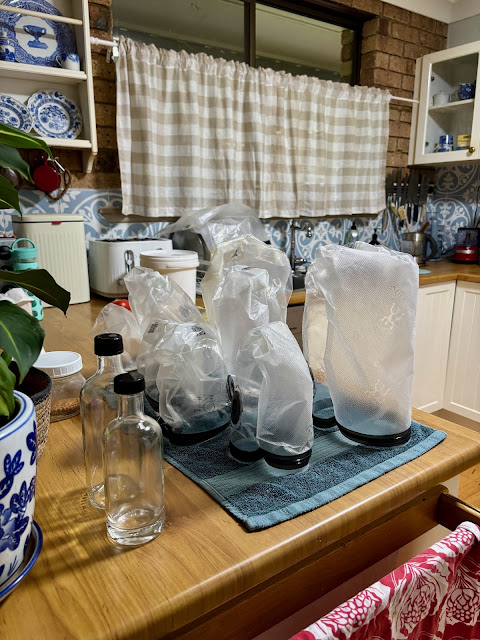
Every morning when I walk into my kitchen it looks tidy and ready for a day's work. Not so on this morning (above), I saw this when I walked in. Late the previous afternoon when I was looking for something, I came across my rolled up Zwilling vacuum bags and decided they had to be washed and dried. So I did that and although I usually put them outside on the verandah to dry it was dark by then. I turned the just-washed bags inside out and left them like this on a towel. It worked well and now the bags are ready to use when I bring home root vegetables, cabbages or whatever I buy that I want to last four or five weeks.
Image

You’ll save money by going back to basics

When I was doing the workshops and solo sessions, I had a couple of people whose main focus was on creating the fastest way to set up a simple life. You can't create a simple life fast, it's the opposite of that It's not one single thing either - it's a number of smaller, simpler activities that combine to create a life that reflects your values; and that takes a long to come together. When I first started living simply I took an entire year to work out our food - buying it, storing it, cooking it, preserving, baking, freezing, and growing it in the backyard. This is change that will transform how you live and it can't be rushed.  
Image

All previous blog posts

  • 2026 3
    • February 3
      • Workshops starting 1 March
      • Planting vegetable seeds and new workshops
      • Back where we belong
  • 2025 7
    • July 1
    • June 2
    • May 1
    • April 2
    • February 1
  • 2024 25
    • December 2
    • November 1
    • October 2
    • September 3
    • August 1
    • July 3
    • June 1
    • May 3
    • April 2
    • March 3
    • February 2
    • January 2
  • 2023 13
    • December 1
    • November 2
    • October 1
    • September 3
    • August 2
    • February 2
    • January 2
  • 2022 17
    • November 3
    • October 4
    • September 3
    • August 2
    • July 3
    • June 2
  • 2021 50
    • December 1
    • November 6
    • October 7
    • September 5
    • August 4
    • July 5
    • June 2
    • May 2
    • April 6
    • March 4
    • February 4
    • January 4
  • 2020 68
    • December 3
    • November 5
    • October 4
    • September 4
    • August 4
    • July 4
    • June 4
    • May 8
    • April 7
    • March 8
    • February 8
    • January 9
  • 2019 66
    • December 2
    • November 4
    • October 5
    • August 3
    • July 4
    • June 6
    • May 8
    • April 8
    • March 8
    • February 11
    • January 7
  • 2018 82
    • December 1
    • September 2
    • August 10
    • July 4
    • June 11
    • May 9
    • April 12
    • March 10
    • February 10
    • January 13
  • 2017 129
    • December 7
    • November 10
    • October 6
    • September 13
    • August 11
    • July 13
    • June 12
    • May 9
    • April 9
    • March 14
    • February 11
    • January 14
  • 2016 125
    • December 7
    • November 13
    • October 10
    • September 11
    • August 11
    • July 8
    • June 9
    • May 9
    • April 12
    • March 10
    • February 13
    • January 12
  • 2015 184
    • December 7
    • November 15
    • October 20
    • September 18
    • August 19
    • July 18
    • June 12
    • May 15
    • April 12
    • March 21
    • February 13
    • January 14
  • 2014 203
    • December 11
    • November 8
    • October 17
    • September 20
    • August 17
    • July 19
    • June 17
    • May 17
    • April 23
    • March 15
    • February 18
    • January 21
  • 2013 225
    • December 13
    • November 17
    • October 17
    • September 17
    • August 21
    • July 24
    • June 20
    • May 19
    • April 17
    • March 22
    • February 17
    • January 21
  • 2012 245
    • December 17
    • November 20
    • October 20
    • September 18
    • August 15
    • July 24
    • June 21
    • May 26
    • April 23
    • March 23
    • February 19
    • January 19
  • 2011 257
    • December 18
    • November 24
    • October 27
    • September 23
    • August 24
    • July 21
    • June 24
    • May 24
    • April 16
    • March 22
    • February 14
    • January 20
  • 2010 283
    • December 20
    • November 18
    • October 18
    • September 19
    • August 25
    • July 24
    • June 25
    • May 26
    • April 25
    • March 22
    • February 29
    • January 32
  • 2009 293
    • December 29
    • November 18
    • October 23
    • September 25
    • August 22
    • July 28
    • June 22
    • May 21
    • April 27
    • March 26
    • February 24
    • January 28
  • 2008 387
    • December 24
    • November 23
    • October 25
    • September 26
    • August 27
    • July 27
    • June 37
    • May 34
    • April 44
    • March 53
    • February 32
    • January 35
  • 2007 372
    • December 37
    • November 40
    • October 55
    • September 51
    • August 49
    • July 63
    • June 49
    • May 28


Trending Articles

NOT the last post

This will be my last post here.  I've been writing my blog for 18 years and now is the time to step back. I’ve stopped writing the blog and come back a couple of times because so many people wanted it, but that won’t happen again, I won’t be back.  I’ll continue on instagram to remain connected but I don’t know how frequent that will be. I know some of you will be interested to know the blog's statistics. 
Image

Every morning at home

Every morning when I walk into my kitchen it looks tidy and ready for a day's work. Not so on this morning (above), I saw this when I walked in. Late the previous afternoon when I was looking for something, I came across my rolled up Zwilling vacuum bags and decided they had to be washed and dried. So I did that and although I usually put them outside on the verandah to dry it was dark by then. I turned the just-washed bags inside out and left them like this on a towel. It worked well and now the bags are ready to use when I bring home root vegetables, cabbages or whatever I buy that I want to last four or five weeks.
Image

You’ll save money by going back to basics

When I was doing the workshops and solo sessions, I had a couple of people whose main focus was on creating the fastest way to set up a simple life. You can't create a simple life fast, it's the opposite of that It's not one single thing either - it's a number of smaller, simpler activities that combine to create a life that reflects your values; and that takes a long to come together. When I first started living simply I took an entire year to work out our food - buying it, storing it, cooking it, preserving, baking, freezing, and growing it in the backyard. This is change that will transform how you live and it can't be rushed.  
Image

Creating a home you'll love forever

Living simply is the answer to just about everything. It reduces the cost of living; it keeps you focused on being careful with resources such as water and electricity; it reminds you to not waste food; it encourages you to store food so you don't waste it and doing all those things brings routine and rhythm to your daily life. Consciously connecting every day with the activities and tasks that create simple life reminds you to look for the meaning and beauty that normal daily life holds.  It's all there in your home if you look for it. Seemingly mundane tasks like cleaning and cooking help you with that connection for without those tasks, the home you want to live in won't exist in the way you want it to.  Creating a home you love will make you happy and satisfied.
Image

Time changes everything

I've been spending time in the backyard lately creating a contained herb and vegetable garden. My aim is to develop a comfortable place to spend time, relax, increase biodiversity and encourage more animals, birds and insects to live here or visit. Of course I'd prefer my old garden which was put together by Hanno with ease and German precision. Together, we created a space bursting at the seams with herbs, vegetables and fruity goodness ready to eat and share throughout the year. But time changes everything. What I'm planning on doing now, is a brilliant opportunity for an almost 80 year old with balance issues. In my new garden I'll be able to do a wide range of challenging or easy work, depending on how I feel each day. It’s a daily opportunity to push myself or sit back, watch what's happening around me and be captivated by memories or the scope of what's yet to come.
Image

It's the old ways I love the most

I'm a practical woman who lives in a 1980’s brick slab house. There are verandahs front and back so I have places to sit outside when it's hot or cold. Those verandahs tend to make the house darker than it would be but they're been a great investment over time because they made the house more liveable. My home is not a romantic cottage, nor a minimalist modern home, it's a 1980’s brick slab house. And yet when people visit me here they tell me how warm and cosy my home is and that they feel comforted by being here. I've thought about that over the years and I'm convinced now that the style of a home isn't what appeals to people. What they love is the feeling within that home and whether it's nurturing the people who live there.
Image

Back where we belong

Surprise! I'm back ... for good this time. Instagram became an impossible place for me. They kept sending me messages asking if I'd make my page available for advertisers! Of course, I said no but that didn't stop them. It's such a change from what Instagram started as. But enough of that, the important part of this post is to explain why I returned here instead of taking my writing offline for good. For a few years Grandma Donna and I have talked online face-to-face and it's been such a pleasure for me to get to know her. We have a lot in common. We both feel a responsibility to share what we know with others. With the cost of living crisis, learning how to cook from scratch, appreciate the work we do in our homes, shop to a budget and pay off debt will help people grow stronger. The best place to do that is our blogs because we have no advertising police harassing us, the space is unlimited, we can put up tons of photos when we want to and, well, it just feels li...
Image

Making ginger beer from scratch

We had a nice supply of ginger beer going over Christmas. It's a delicious soft drink for young and old, although there is an alcoholic version that can be made with a slight variation on the recipe. Ginger beer is a naturally fermented drink that is easy to make - with ginger beer you make a starter called a ginger beer plant and after it has fermented, you add that to sweet water and lemon juice. Like sourdough, it must ferment to give it that sharp fizz. To make a ginger beer plant you'll need ginger - either the powdered dry variety or fresh ginger, sugar, rainwater or tap water that has stood for 24 hours to allow the chlorine to evaporate off. You'll also need clean plastic bottles that have been scrubbed with soap, hot water and a bottle brush and then rinsed with hot water. I never sterilise my bottles and I haven't had any problems. If you intend to keep the ginger beer for a long time, I'd suggest you sterilise your bottles. MAKING THE STARTER In a...
Image