down to earth

  • Home
  • About Us
  • Down To Earth Book
  • Privacy Policy

This post is by guest writer, Bel. Bel's blog is here.

Through time and across cultures, the menstrual cycle h
as been sacred and taboo, celebration and woe. In our society, menstruation is generally treated as an inconvenient condition. ‘The curse’ sentiment lingers while our negativity toward our monthly bleeding shapes our daughters’ expectations. In order to feel good about our bodies and their natural processes we need to accept and love ourselves as we are. If it weren’t for menstruation, there would be no human life.

Modern advertising for disposable menstrual items focuses on the products, not the physical, spiritual and emotional process that is our cycle. Females are bombarded with many sterile, slim, paper products that invariably announce that periods are things you should not feel, see, smell or tell others about. But are the disposables as convenient and hygienic as we’re led to believe? With disposable options there are the issues of cost, dioxins and other chemical nasties, landfill and the environmental costs of production of all those individually wrapped, perfectly white sanitary items.

There is a myriad of alternative menstrual products. Cloth pads and liners are more comfy, cool and clean than the feminine hygiene items that the supermarkets stock. They are readily available in many health food stores, some markets, by mail order and online. A comprehensive list of online cloth pad sellers can be found here. I recommend that you try a sample pad or pack before purchasing all of your pads from the one seller. There are so many types of pads available, and only you will know which suits your size, shape and cycle.

Fabric pads are quite easy to sew at home, which is a special menarche or moontime ritual in itself. Bright and funky fabrics (or whatever your preference is) make this project lots of fun. And if we’re going to bleed, why not make it fun? If you browse the free printable pad patterns here, you will see that there are many designs to choose from. I have tried and prefer this one and this one. Or you can do what our mothers and grandmothers and those before them did. Pads can be as simple as a few strips of old towel, held together and to your pants with a safety pin. Or face washers folded into quarters lengthwise. But I do think the slim, snap-on version is more comfortable! Pads can be made from recycled materials – towels, bunny rugs, old clothing, buttons etc. The fabrics need to be absorbent and easy to wash and dry. On the underside of the pad, polyester fabrics can be used and help create a leak-proof barrier. Fabrics can be purchased specifically for that leak-proof barrier if you prefer – taslon, PUL, polar fleece etc.

Cloth pads are not a hassle to store or clean. Used pads can be placed in a small bag such as a cosmetic bag for when you are home to rinse and soak them. The ones with wings fold up onto themselves and snap shut so only the outer layer is showing – this is great for transporting used pads. There are many different methods for washing pads, as you can read here.

If you prefer internal methods of protection, menstrual cups are a reusable option. The most common brands available are The Keeper, Diva Cup and Mooncup. The former is latex rubber, the other two are silicon. The Keeper is available in Australia from http://www.menstruation.com.au/ and http://www.moonpads.com.au/. The others can be ordered from overseas, postage is fairly cheap because the item is lightweight and delivery is usually only a week or so. If you type any of the brands into a search engine, it is easy to find local suppliers or mail order services worldwide.

As well as reusable pads and cups, sea sponges and organic disposable tampons and pads should be considered. The sustainability of most commercially available disposable menstrual products is a valid concern. We are making greener choices in our food, clothing, cleaning and health care. We use cloth nappies on our babies, so why not cloth pads for ourselves and our daughters? If you’re initially turned off by the ‘ewww’ factor (I was), please still try cloth at least once. The environment, your budget and your body will rejoice!

May knowing and celebrating your natural cycles encourage wellness and empower your spirits and those of your daughters.

* Photo - these pads I made for my firstborn daughter's menarche. I tried to create different shapes, sizes, absorbency, textures and colours. Some are for daytime use, some for night, some for going out (with matching storage bag) and some are liners for in-between days. She loves them and has hardly used a disposable item since her periods began.
I’ve learnt a lot from my blog neighbours. When I left work I thought I might find myself in a cultural and intellectual vacuum. I was excited about reskilling myself in many of the life skills I’d forgotten and needed to relearn, but I expected that it would be a lonely job where the tumbleweed of a thousand yesterdays would roll through my days like a lazy Sunday. I expected my physical spaces to be filled with a million discoveries, but I thought my mind would stagnate and I would seek, and not find, kindred spirits.

It’s funny what happens when you least expect it. I discovered the mother-lode of intelligent, friendly, caring and talented women all tapping away on keyboards in their own homes and connected via millions of cables and links across the www.

This blog community is a wonderful thing. It’s enriched my life to know some of the women I’ve met online. I’ve learnt more than I thought possible, I’ve seen the most beautifully hand made clothing, dolls, knitting, soft furnishings, bags, quilts, curtains, embroidery and crafts of all shapes. I’ve been amazed by gardens producing healthy organic food that have inspired me to be a better gardener. I’ve read recipes that make my mouth water and have made my family and friends smile when I presented them on our own kitchen table.

But the thing that really surprises me and gives me a lot of joy, even now all these years later, are the intelligent, well thought out and defined ideas I discover most days when I’m reading the blogs of other women. Some posts deserve a larger audience as they open minds and expand thoughts but even though we have to be content with what we do and who we reach within our neighbourhood, I’m sure, that in the future, some of the blogs around now will be seen as a meaningful and significant part of our time. Here are just some of the posts from the past week or so that have made me read a second time:
Natalie's post on the history of work and women in the home.
Jenn'y post on enriching family life.
This post by Kate made me celebrate our changing seasons, something we don't do much of in Australia.
Jewels writes about the family like no other. This post celebrates children, generosity and being a brother and a sister.
This post by Stephanie clearly illustrates the world wide embrace of the blog community. It shows us how bloggers around the world reach out to others with friendship and generosity.
And although it's a month old now, I have to include this profound and wonderful post by the duck herder about living in tutti fruiti time.
Thank you for some wonderful reading.
It doesn't look the best, but these little creatures will help you grow good organic food. They will recycle your kitchen waste and help fill your fruit and vegetables with all the nutrients and trace elements they need for good healthy growth. Yes, ladies and gentlemen, today it's worms on parade.


When I first got my compost worms, I kept them in a couple of polystyrene boxes. They were happy enough but then they started reproducing and I realised they needed more room. We bought an old bathtub from the local recycle shop for $20 and Worm Hilton was born.

The worms need bedding to live in. They also eat this bedding and over time is must be replaced. The worms will turn the bedding into worm castings, which is the best complete fertiliser for the garden.

Just a word on the worms. You need compost worms in a worm farm - reds, tigers or blues, not earth worms. Earth worms do not like living in worm farm conditions, compost worms will not burrow through soil.

So how do you make a worm farm in a bath tub?
In addition to your bathtub or large container, you'll need:
  • about two buckets full of road gravel,
  • a sheet of microfilter, weedmat or tightly woven shade cloth,
  • lots of compost or good garden soil,
  • aged manure of some sort,
  • shredded computer paper, newspaper or cardboard, straw or hay,
  • some sort of covering like hessian bags, thick wads of newspaper or cardboard
  • worm food aka kitchen scraps,
  • and of course, our old friend, the compost worm - at least a thousand of them.
Worms need a dark environment so you'll need to cover the bedding with moist bagging or newspaper, and a hard cover to keep rain out, like a corrugated roofing sheet. Of course, I'm telling you my experience with my worm farm. I live in a fairly dry and sometimes hot environment but when it rains, we get torrential rain. If you live in a moderate climate, you'll be able to keep your covered worm farm under a tree. If you're in a cold place, it will have to be somewhere protected from the cold. If it's really hot where you live, your worm farm will need to be in the coolest place. The idea is to provide a fairly stable temperature, with moist conditions. If the temperature is too hot or too cold, the worms will either die or they'll escape to find a better home. When you start your worm farm, monitor it to make sure the worms are ok and like where you've put them.

START YOUR FARM CONSTRUCTION

Get a wheelbarrow and place the dry materials like the shredded paper and straw in it to soak. All your materials need to be moist.
Using an angle grinder, cut slits in the bath tub about 5cm from the base. This allows air in. Although the worms will be living in the bedding, it needs to have air in it or they will die. When you've added the slits, place the bath tub where it will sit permanently. Mine is in my bushhouse under a bench. When it's in place, add the gravel. The gravel provides good drainage so that the bottom of the bathtub doesn't fill with water and drown some of the worms. Notice the slits cut in the side of the tub, there are some under the gravel as well.


The gravel has been placed on the base of the tub, now cover it with the filter sheet or weedmat to prevent the worm castings mixing into the gravel.


Now you're ready to start placing the bedding. Wring out the paper/straw/hay and put it into the tub, top that with lots of compost and manure and mix it all together. You need to make a nice organic bed for your worms. One that they'll happily eat, reproduce and live in. The better the conditions you give them, the faster they'll reproduce and the more castings you'll have for your garden. This photo shows the first of the bedding - the shredded paper.


Now add the compost or garden soil and mixed well, water it to make it nice and moist - not wet.


The bedding should be about 40% water. A good test is to wring out a handful of bedding material, if you can only get a couple of drops of water, that's great. If water drips out, that's way too much and you'll need to drain the bedding to remove some of the water before placing the worms in there.


Place a container under the outlet to catch the worm juice. This is valuable fertiliser. Make sure you dilute it before using it. It should look like weak black tea - maybe 100 mls per 1 litre. To start your farm off well, it’s a good idea to run some worm juice and molasses through the farm. The molasses will feed the beneficial bacteria that will help the worms establish themselves in the new bedding. Get an old one litre container and fill it with worm juice, mix in two tablespoons of ordinary pure molasses, mix and pour over the farm.


When you've got the bedding in place and it's all mixed well with just enough water, place some food on the bedding and mix it in. Now put the worms on top of the bedding. Just put them on the top, they'll burrow in themselves. Now cover the bed with moist hessian or cardboard/paper.

This is what the worm bed looked like about an hour after I placed the worms into the new home.


When I feed the worms I usually chop the food up so it's in small pieces. It takes them a while to eat big pieces of food. Remember, the faster they feed, the bigger they grow, the more they reproduce and the more worms and castings you'll have. When you've got them in their new home, don't forget to place a rain proof cover over the worm farm.

MAINTENANCE OF THE WORM FARM
You should keep the covering on the top moist. I sprinkle mine with rainwater every second day for 10 seconds. During summer I'll do this every day. With a fork or a little claw rake, fluff up the bedding once a week to make sure there's enough air in the bedding. Apart from that and feeding them, leave them alone to do their thing. Worms hate to be disturbed all the time and they don't like light. If the worm farm starts to smell a little, you're feeding them too much. Cut back the food and sprinkle a little lime over the worm farm. That should sweeten it up again.

This is my worm farm today. I have no hessian bags at the moment so it's covered with wads of moist newspaper.


As you can see the farm is teaming with worms. I feed the worms about every second day. Usually I chop up their food but you can see some celery stalks here that I just threw in after removing them from the aquaponics system. The worms will eat all the food you give them, but the bigger it is, the longer it takes them to eat it. They love high protein food too, and thrive on it, so if you have a spare egg or two, they'll eagerly devour it.

I have just harvested about three buckets full of worm castings for my organic garden. To harvest the castings, about two weeks prior to harvesting, start feeding the worms on one side of the farm. They will all move to that side to feed. After a couple of weeks, harvest the non-feeding side and refill it will bedding. When the worms have settled down again, start feeding on the new bedding side and harvest the remaining castings.

Our harvested castings were mixed in with the rest of the organic materials we added to the garden beds when we changed from our winter plantings to our summer ones. Remember, worm castings need to be covered when you put them in a garden bed. Don't let them dry out and cover with either soil, compost or mulch.


FEEDING THE WORMS

Feed the worms every day or two. Watch how much they eat, and feed accordingly. You don't want the feed sitting in the worm farm too long. Worms will eat anything that was once alive, so give them your kitchen scraps, old dishcloths, hair, worn out cotton or wool, tea leaves or tea bags, coffee grounds, old bread, eggs, shredded paper, wet cardboard or garden waste. DO NOT GIVE then too many citrus peels or onions, although they can take a small amount. Give them a variety of food, then you'll get the best possible worm castings.

When you feed the worms, dig the food into the bedding so it's not available to wandering rats, mice or cockroaches.

If you use animal manure, like cow or horse manure, make absolutely sure those animals haven't just been wormed. If that manure is contaminated at all with worm medication, it will kill your worms.

Make sure the bedding is always moist.

WORM REPRODUCTION

When they're mating, worms will produce about 12 babies per adult per week. You'll know that they're mating when you see little worm capsules in the bedding. Each capsule contains around four babies. The babies hatch after about 30 days and are ready to breed about two months later.

WORM JUICE AND WORM TEA

Both must be diluted as they could burn your plants. To use the worm juice that filters down through your worm farm, just dilute in water to the colour of weak black tea, and apply to your plants.

To make worm tea from castings, scrape about ¼ bucket of castings from the top of the farm and soak them in water for a few hours. Then dilute this with water to the colour of weak black tea. The microbes in the tea will stay active for about 15 hours, so apply it within that time.

This is the shambles that I call my sewing room storage. Soon I'll have much more room for my fabrics, cottons, yarns and ribbons. By next week, all this will be in a new place in another room.

We are reorganising our home again. Just when things seem stable and fixed, circumstances change and we modify our home to suit the new circumstances. In this instance we’re taking apart H’s office, which he used when we had the shop and it will soon be my new sewing room. My old sewing room will be turned into a small guest room. Now that we’re older, we seem to have many more visitors. I’m not sure if they think we have more time now, or if it’s because our sons have left home. Whatever the reason, I like the idea of family and close friends visiting and I like the idea of changing our home again. I love change.

This change got me thinking about how we express our individuality in our own spaces and how the character of a home changes many times during the stages of our lives. When we moved here with our teenage sons we needed bedrooms for them and one for us. Then we built an extension of our current bedroom and en suite, and our old room became a guest room. Later Kerry went to live in Canada for a year and H got his office. Shane moved out and I made a sewing room for myself in his bedroom. Now there is no further need for an office, I’ll move my sewing in there as it has much better storage and the former sewing room will be our second guest room. We are geared up for guests instead of teenage boys but it’s wonderful that our sons will continue to sleep in those rooms when they visit us. The first time the new set up will be used is when one of Kerry’s Canadian friends visits with him in a couple of week’s time.

These transformations, either complete room changes or smaller changes within a room, are what make your home uniquely yours. Over the course of your time in that house, especially when you have your children at home, your home will mold itself around you and change according to the needs of everyone in the family. The changes you make to accommodate your shifting family needs will give a cosy, lived-in feeling and provide a practical way to express your creativity and uniqueness. This is where the frugal talents of home sewing and crafts come in to play, as well as the ability to paint furniture and walls. Over time your changes make the house your home, instead of a show house, a copy of something in a magazine, your friends house or your mother’s. Creating your own home style piece by piece is one of the creative tasks we all take on – some do it with flair, some don’t, but overall as long as everyone is happy with their own efforts, it’s all good.

This is an Airedale tea cosy I made a few years ago. For some reason is was sitting in the sewing room waiting to be photographed.

We found this little fellow in a bucket near our tank. It's nice and moist there and it looks like there are tiny tadpoles forming. 

In our grandmother's day, everything in the home was valued and cared for. When something was past its prime, it was sent down a chain where it kept giving value at every stage of its descent. For instance, a hand knitted wash cloth might have been used washing dishes for a year of two, when it started showing signs of age, it would be sent to the laundry to do service as a cleaning rag in the home, then a cleaning rag outside and finally it would end up in the garden, either dug into the garden for worms to feed on or in a compost heap.

That
hierarchy of thorough usage for all items is still being used in my home, and every day I use that hierarchy to deal with our household waste. I want to get the most value from everything at every stage of its life. We've been hoodwinked into thinking lately that products only have one life. Wrong! When something is past its made-for or bought-for use, it can be used in other ways.

We get the most value from our food waste if it is eaten by the chooks. They will turn it into lovely eggs for us to eat - our kitchen waste becomes part of an egg laying cycle. Chooks need high protein food to lay good sized eggs, so we make sure that all our high protein waste goes to the chooks. They are on top of our hierarchy. In the past week they're been given a bowl of left over vegetable soup, some milk that soured before its use by date - chooks LOVE sour milk, some stale cake and finely crushed up egg shells, as well as a lot of greens from the garden and their daily ration of pellets and grain. The chooks will also eat and turn over all the grass clippings, fruit and vegetable peelings, so they're all put into a fenced area in the chook pen and the ladies spend a lot of time in there eating, scratching, pooing on and generally making the best fast compost possible. In our climate, that compost is ready to use in 3 - 4 weeks. The chooks also get most of our shredded paper for their nests.

The next level down in the hierarchy are the dogs. They have absolutely no food value at all but we love them, they give us a lot of joy and they keep us and our home safe and free of snakes and cats. So the dogs get a few small bits of the high protein waste that the chooks get. They get things like uneaten toast with butter on it, or little bits of cheese in a leftover sandwich, bits of egg or cracked eggs etc. If the complete truth be told, they also get their own toast and Vegemite for breakfast. ; )

Next down on the hierarchy is the worm farm. The worms will eat almost anything organic - anything that was once alive. I give them some shredded paper, cellophane, wet and cut up cardboard packets, old cotton, linen or woolen items that have completely exhausted their use, the contents of the vacuum cleaner - checked first for plastic pieces, hair from my hair brush, any overflow of kitchen waste that hasn't gone to the chooks or dogs, garden waste like old plants and leaves and some crushed up egg shells, tea bags, tea leaves, coffee grounds and a small amount of onion peels and citrus skins. All the worm food needs to be very small as it's consumed faster then, so I always chop up every thing that goes in the worm farm.

The next level down is my cold compost heap. This is just an area in the corner of our vegetable garden that is about one metre square and consists of garden waste that doesn't go to the chooks, onion skins and citrus peel, as well as a couple of containers of lawn clippings to help with decomposition and any other organic item that doesn't go to the higher levels of the hierarchy. We turn this heap when we think of it and after a few months we get the most beautiful, dark, moist compost. Following is a photo of that heap. You can see the top layers are still recognisable as lawn clippings and shredded paper, but underneath it's a black gold mine. We have been using this and the compost from the chook pen to build up our garden beds as we change from one season to the next. Compost is the best fertiliser you can use on your garden.


We never throw out any organic waste, it's all recycled either into food, dog energy, eggs or compost. Not only does it give our chooks and dogs treats they look forward to, it also cuts down a lot on the waste we put into our rubbish and recycling bins.

I forgot to let you all know the time frame of the swap. Your napkins must be posted on, or before, October 1. That gives everyone 3½ weeks to make or buy their napkins. I will finish replying to emails later today. If you can't make contact with your partner, please let me know and I'll help you.

I hope you all have fun with the swap. It's a great way of getting to know each other.

I had a big day at my voluntary job yesterday and when I came home, I promptly sat in a lounge chair and went to sleep. I've just woken from a good night's sleep, that was filled with the sound of rain falling on the roof, and now I'm feeling ready to take on the world.

H and I will drive the youth bus into Brisbane today to pick up food for the Centre's emergency food bank. We'll do our own shopping at Aldi on the way home, unpack that, then drive up to the Centre to unload the foodbank food. I'm hoping to have enough time this afternoon to answer some emails, so if you've sent one, I hope to answer soon.

Thank you for stopping by today. : )
This swap is for four 100% cotton napkins, you can send six if you prefer, plus anything else your heart desires. It is fine if you send something extra, it is fine if you don't. The choice is yours. If your swap partner has click-able link (on their name in the swap comments box) to their email, please contact them to say hello and ask for postal details. If you can't make contact, email me and I'll contact them for you. If you are one of the swappers who has not got an email link, please email me with your postal details, as well as the name of your swap partner (so I don't have to keep looking at my list). Thanks everyone. I hope you all enjoy this swap and have some fun with it.

Here is the list of swap partners for the napkin swap.

rhonda gay and karen
alita and darlene
niki and lenny
lib and michele
kate and kim
sharon and chookasmum
jenny and cheryl (copper's wife)
knitterforlife and kirsty
briget and pura
busy woman and dee
susan and debbie
lisa and heather
jen and bobbi jo
polly and mrs mk
tracy and jayedee
alexia and wyndesnow
rhonda jean and deb

Ok swappers, start your engines. : )
I'll just do a small post now, and tidy up a couple of loose ends, and hopefully get time to post again later.

I'm so pleased to announce that I'll have the first guest writer on my blog this week. Bel from belindamoore.com will be sharing some of her wisdom with us. Bel is an Australian mum of six children, aged 3 - 13 years, who lives with her husband and kids on the Atherton Tableland. Bel will be writing about cloth sanitary pads this week and will follow it up, probably a week later, with information about cloth nappies/diapers. I'm sure we'll all learn a lot from her input. Thank you, Bel. Check out Bel's site. There is a lot of information sharing going on there about homeschooling, mothering and life in general.

How is everyone going with their electricity meter readings? Did you work out ways you can reduce your consumption after reading your meter? If you did, please tell me about it, either in the comments box or in an email. If you have any tips for us, let me know so I can share them on the blog.

It's really good to see everyone is so keen on preserving. I'll definitely write more about it in the weeks to come and I'll share some recipes with you all too. If you have a preserved/canned recipe that is a real winner, drop me a line and I might share it with everyone.

Now I'm off to make up the swap buddies list. Stand by swappers! : )

Bread and butter cucumbers with red onion and mustard seeds.

I have only one jar of peach jam left! It's my favorite. I'm hoping to keep this jar going until the peaches are ready to be picked this year. My sister is visiting soon, when she arrives I doubt there will be much hope for the peach jam.

Tomato relish and ginger beer.
I make chutney, relish, sauces, jams, marmalade, butters and cordials during the year. My aim is to make and preserve as many of these things as I can so I'm not buying inferior products at the market. My preserving season will start soon. I'll fire up the old Fowlers water bath and start stacking my shelves with home grown and home preserved goodies.

Home made tomato sauce, made with Amish paste tomatoes.

The first step in this process is to collect a many jars as possible. I have quite a few Fowlers Vacola jars - my favourites are a set of 80 year old jars that are a greenish colour, but I also recycle the French jam jars with the gingham lids and Aldi have recently been selling some jam in nice jars. The thing you look for is a wide mouth on the jar for easy filling. The lids need to be in perfect condition with the rubbery seal inside the lid undamaged. You can buy new lids for these jars. Here is part of my collection of jars. As you can see I reuse a lot of varying sizes. If it's not good enough for preserving, it's generally good enough for storing dry goods in the cupboard.

Some of the jars I use for the various sauces and jams.

Preserving anything generally happens in two stages. Stage one is when you cook the jam, relish or sauce, stage two is transferring the product to a jar or bottle and boiling it long enough to kill bacteria. If you do that correctly, you can store your goods for a year in the cupboard. Sometimes, when I make a small amount of something that I know will be eaten within a couple of months, I don't boil the jars, and just store them in the fridge. Some things can be safely stored that way for a short amount of time.

Pickled onions and beetroot. The beetroot was home grown, the onions bought at the market.

It's coming up to preserving season here, or canning season for our North American friends. I always make peach jam, but this year I'll also make orange marmalade, lemon cordial, ginger beer, tomato sauce, tomato relish, chilli jam, bread and butter cucumbers, pickled onions, beetroot, lemon butter, strawberry jam and rosella jam. This year I'll be making rosella cordial too. There has been research at the Queensland University that indicates eating rosellas in jams and cordials helps reduce blood pressure. H suffers for high blood pressure so I'm hoping to make enough rosella cordial for the year and keep it in the cupboard. I'm sowing rosella seeds next week and when they're a good size, we'll plants about 20 bushes out in the front garden.

Lemon cordial, made from home grown lemons. It is really satisfying to be able to offer friends and family home made refreshing drinks on a hot day. This lemon cordial with crushed ice, cold water and some mint leaves is a wonderful drink during summer.

I'll write more about preserving when I'm actually doing it and if there is anyone here who'd like to learn, I'm happy to post a tutorial and share photos and ideas.

We love eating peaches fresh, but if we have an abundance, I always preserve some for eating later in the year when peaches are a pleasant memory.

Let's face it, homemakers are looked down on as a sort of female underclass. They're seen as old-fashioned, not quite with it and definitely passed their "best before" date. I have a big problem with that, not only because I proudly see myself as a homemaker but also because it just plain wrong ... and stupid.

There is a new type of homemaker emerging. She (sometimes he) is keen to raise happy and responsible children, is environmentally and financially aware and health conscious. There is nothing old-fashioned in that. The new homemaker sees her job as being a confident and capable role model for her children, she not only makes sure they attend school with an eagerness to learn, she also teaches manners and life skills at home. Many SAHMs homeschool their children, taking on the formal role of teacher. This is is certainly not something that some dullard with no ambition would choose to do.

Homemaking is a profession. It's made up of people who choose to develop their own family's life instead of working outside the home. Of course, there are many homemakers here who do work outside the home, but they also hold a strong emphasis on the importance of their home and their place in it. All new homemakers see their home as the heart of the family, a place where everyone relaxes and can be their true self, where important relationships are nurtured away from the influences of the outside world.

The new homemaker acknowledges the importance of a family working hard to reduce its impact on the environment. Where possible she uses green cleaners, shops locally, produces some of her family's food, conserves energy, fuel and water, cooks from scratch, reuses, recycles and repairs, makes do and uses her energy and her intelligence, instead of just her money, to provide for her family and care for her home.

New homemakers see their role as raising healthy children, creating a home where everyone feels at ease and comfortable, shopping responsibly, saving for the future and being environmentally sound. Instead of seeing housework as never-ending, they see each day having its own cycle with new possibilities every day. In the new homemaker's life, the most important place is home, and it is a home where children, family and friends will always find kindness, generosity and affirmation.

These new homemakers see money as not just a means of buying products, but as something that creates more options. They're frugal, often not because they have to be, but because they have changed their attitude to money and possessions. There is a depth of meaning in being frugal that most people don't quite get ... yet. They will catch up sometime in the future. Catch up with what new homemakers have known all along - that more possessions, the latest fashions and biggest car don't make people happy. Happiness is found in creating a meaningful life with those you love and care about. The new homemakers are working towards that contentment with innovation and a sense of purpose, and every new homemaker knows she is a pioneer in a new world.

(graphic from
allposters)
I have been honoured by being awarded Best Homesteading Site for the month of September by The Modern Homestead.

Thank you to Phelan at a-homesteading-neophyte for nominating my blog.
We had a lot of fun with the dishcloth swap, and we may do another one in the future, but today we'll start another swap.

This time we will be swapping four cotton napkins, preferably handmade. If you can't sew, you can buy your napkins, but they must be 100% cotton. They should be around 25 cm square, or 10 inches, give or take a couple of cm. This will help us all build up our stocks of cloth napkins so we can all leave the disposable ones at the store. Another step towards a healthier planet.

If you would like to join the swap, just make a comment and I'll team up swap partners early next week.

Everyone is welcome to join. : )
Newer Posts Older Posts Home

MY BOOKS

MY BOOKS


My books were all published by Pengiun, and are available at Amazon US, Amazon UK and Amazon Au

Search here

Total Pageviews

Translate


I'm Rhonda Hetzel and I've been writing my Down to Earth blog since 2007. Although I write the occasional philosophical post, my main topics include home cooking, happiness and gardening as well as budgeting, baking, ageing, generosity, mending and handmade crafts. I hope you enjoy your time here.

MY FAVOURITE PLACES

  • Grandma Donna's Place
  • Grandma Donna's YouTube
  • Grandma Donna's Instagram
  • This Simple Day
  • Nicole's Instagram

Give More

Give More

Popular posts last year

Making ginger beer from scratch

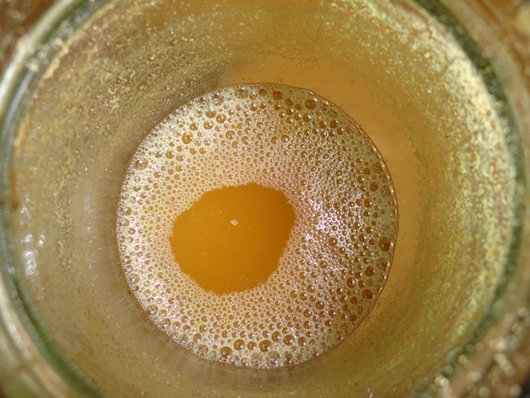
We had a nice supply of ginger beer going over Christmas. It's a delicious soft drink for young and old, although there is an alcoholic version that can be made with a slight variation on the recipe. Ginger beer is a naturally fermented drink that is easy to make - with ginger beer you make a starter called a ginger beer plant and after it has fermented, you add that to sweet water and lemon juice. Like sourdough, it must ferment to give it that sharp fizz. To make a ginger beer plant you'll need ginger - either the powdered dry variety or fresh ginger, sugar, rainwater or tap water that has stood for 24 hours to allow the chlorine to evaporate off. You'll also need clean plastic bottles that have been scrubbed with soap, hot water and a bottle brush and then rinsed with hot water. I never sterilise my bottles and I haven't had any problems. If you intend to keep the ginger beer for a long time, I'd suggest you sterilise your bottles. MAKING THE STARTER In a...
Image

NOT the last post

This will be my last post here.  I've been writing my blog for 18 years and now is the time to step back. I’ve stopped writing the blog and come back a couple of times because so many people wanted it, but that won’t happen again, I won’t be back.  I’ll continue on instagram to remain connected but I don’t know how frequent that will be. I know some of you will be interested to know the blog's statistics. 
Image

How to make cold process soap

I'm sure many of you are wondering: "Why make soap when I can buy it cheaply at the supermarket?" My cold process soap is made with vegetable oils and when it is made and cured, it contains no harsh chemicals or dyes. Often commercial soap is made with tallow (animal fat) and contains synthetic fragrance and dye and retains almost no glycerin. Glycerin is a natural emollient that helps with the lather and moisturises the skin. The makers of commercial soaps extract the glycerin and sell it as a separate product as it's more valuable than the soap. Then they add chemicals to make the soap lather. Crazy. Making your own soap allows you to add whatever you want to add. If you want a plain and pure soap, as I do, you can have that, or you can start with the plain soap and add colour, herbs and fragrance. The choice is yours. I want to add a little about animal and bird fat. I know Kirsty makes her soap with duck fat and I think that's great. I think t...
Image

Preserving food in a traditional way - pickling beetroot

I've had a number of emails from readers who want to start preserving food in jars but don't know where to start or what equipment to buy.  Leading on from yesterday's post, let's just say up front - don't buy any equipment. Once you know what you're doing and that you enjoy preserving, then you can decide whether or not to buy extra equipment. Food is preserved effectively without refrigeration by a variety of different methods. A few of the traditional methods are drying, fermentation, smoking, salting or by adding vinegar and sugar to the food - pickling. This last method is what we're talking about today. Vinegar and sugar are natural preservatives and adding one or both to food sets up an environment that bacteria and yeasts can't grow in. If you make the vinegar and sugar mix palatable, you can put up jars of vegetables or fruit that enhance the flavour of the food and can be stored in a cupboard or fridge for months. Other traditional w...
Image

Cleaning mould from walls and fabrics

With all this rain around we've developed a mould problem in our home. Usually we have the front and back doors open and that good ventilation stops most moulds from establishing. However, with the house locked up for the past week, the high humidity and the rain, mould is now growing on the wooden walls near our front door and on the lower parts of cupboards in the kitchen. Most of us will find mould growing in our homes at some point. Either in the bathroom or, in humid climates, on the walls, like we have now. You'll need a safe and effective remedy at some point, so I hope one of these methods works well for you. Mould is not only ugly to look at, it can cause health problems so if you see mould growing, do something about it straight away. The longer you leave the problem, the harder it will be to get rid of it effectively. If you have asthma or any allergies, you should do this type of cleaning with a face mask on so you don't breathe in any spores. Many peopl...
Image

Five minute bread

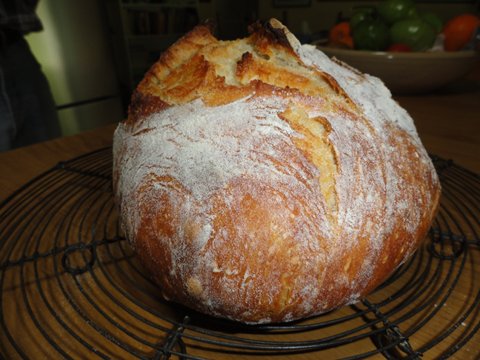
Bread is one of those foods that, when made with your own hands, gives a great deal of satisfaction and delight. It's only flour and water but it symbolises so much. I bake bread most days and use a variety of flours that I buy in bulk. Often I make a sandwich loaf because we use most of our bread for lunchtime sandwiches and for toast. Every so often I branch out to make a different type of loaf. I have tried sour dough in the past but I've not been happy with any of them. I'll continue to experiment with sour dough because I like the idea of using wild yeasts and saving the starter over a number of years to develop the flavour and become a part of the family. However, the loaf I've been branching out to most often is just a plain old five minute bread. By five minutes I mean it takes about five minutes actual work to prepare but it's the easiest of all bread to make and to get consistently good loaves from. If you're having people around for lunch or...
Image

This is my last post.

I have known for a while that this post was coming, but I didn't know when. This is my last post. I'm closing my blog, for good, and I'm not coming back like I have in the past.  I've been writing here for 16 years and my blog has been many things to me. It helped me change my life, it introduced me to so many good people, it became a wonderful record of my family life, it helped me get a book contract with Penguin, and monthly columns with The Australian Women's Weekly and Burke's Backyard . But in the past few months, it's become a burden. In April, I'll be 75 years old and I hope I've got another ten years ahead. However, each year I'll probably get weaker and although I'm fairly healthy, I do have a benign brain tumour and that could start growing. There are so many things I want to do and with time running out, leaving the blog behind gives me time to do the things that give me pleasure. On the day the blog started I felt a wonderful, h...
Image

What is the role of the homemaker in later years?

An email came from a US reader, Abby, who asked about being a homemaker in later years. This is part of what she wrote: "I am a stay-at-home mum to 4 children, ages 9-16. I do have a variety of "odd jobs" that I enjoy - I run a small "before-school" morning drop-off daycare from my home, I am a writing tutor, and I work a few hours a week at a local children's bookstore. But mostly, I cherish my blissful days at home - cooking, cleaning (with homemade cleaners), taking care of our children and chickens and goats, baking, meal-planning, etc. This "career" at home is not at all what I imagined during my ambitious years at university, but it is far more enriching. I notice, though, that my day is often planned around the needs of my family members. Of course, with 4 active kids and a husband, this is natural. I do the shopping, plan my meals, cook dinner - generally in anticipation of my family reconnecting in the evening.  I can't h...
Image

Every morning at home

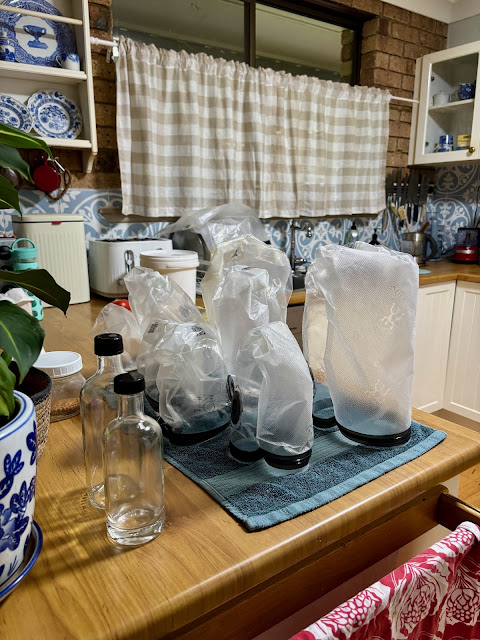
Every morning when I walk into my kitchen it looks tidy and ready for a day's work. Not so on this morning (above), I saw this when I walked in. Late the previous afternoon when I was looking for something, I came across my rolled up Zwilling vacuum bags and decided they had to be washed and dried. So I did that and although I usually put them outside on the verandah to dry it was dark by then. I turned the just-washed bags inside out and left them like this on a towel. It worked well and now the bags are ready to use when I bring home root vegetables, cabbages or whatever I buy that I want to last four or five weeks.
Image

You’ll save money by going back to basics

When I was doing the workshops and solo sessions, I had a couple of people whose main focus was on creating the fastest way to set up a simple life. You can't create a simple life fast, it's the opposite of that It's not one single thing either - it's a number of smaller, simpler activities that combine to create a life that reflects your values; and that takes a long to come together. When I first started living simply I took an entire year to work out our food - buying it, storing it, cooking it, preserving, baking, freezing, and growing it in the backyard. This is change that will transform how you live and it can't be rushed.  
Image

All previous blog posts

  • 2026 3
    • February 3
      • Workshops starting 1 March
      • Planting vegetable seeds and new workshops
      • Back where we belong
  • 2025 7
    • July 1
    • June 2
    • May 1
    • April 2
    • February 1
  • 2024 25
    • December 2
    • November 1
    • October 2
    • September 3
    • August 1
    • July 3
    • June 1
    • May 3
    • April 2
    • March 3
    • February 2
    • January 2
  • 2023 13
    • December 1
    • November 2
    • October 1
    • September 3
    • August 2
    • February 2
    • January 2
  • 2022 17
    • November 3
    • October 4
    • September 3
    • August 2
    • July 3
    • June 2
  • 2021 50
    • December 1
    • November 6
    • October 7
    • September 5
    • August 4
    • July 5
    • June 2
    • May 2
    • April 6
    • March 4
    • February 4
    • January 4
  • 2020 68
    • December 3
    • November 5
    • October 4
    • September 4
    • August 4
    • July 4
    • June 4
    • May 8
    • April 7
    • March 8
    • February 8
    • January 9
  • 2019 66
    • December 2
    • November 4
    • October 5
    • August 3
    • July 4
    • June 6
    • May 8
    • April 8
    • March 8
    • February 11
    • January 7
  • 2018 82
    • December 1
    • September 2
    • August 10
    • July 4
    • June 11
    • May 9
    • April 12
    • March 10
    • February 10
    • January 13
  • 2017 129
    • December 7
    • November 10
    • October 6
    • September 13
    • August 11
    • July 13
    • June 12
    • May 9
    • April 9
    • March 14
    • February 11
    • January 14
  • 2016 125
    • December 7
    • November 13
    • October 10
    • September 11
    • August 11
    • July 8
    • June 9
    • May 9
    • April 12
    • March 10
    • February 13
    • January 12
  • 2015 184
    • December 7
    • November 15
    • October 20
    • September 18
    • August 19
    • July 18
    • June 12
    • May 15
    • April 12
    • March 21
    • February 13
    • January 14
  • 2014 203
    • December 11
    • November 8
    • October 17
    • September 20
    • August 17
    • July 19
    • June 17
    • May 17
    • April 23
    • March 15
    • February 18
    • January 21
  • 2013 225
    • December 13
    • November 17
    • October 17
    • September 17
    • August 21
    • July 24
    • June 20
    • May 19
    • April 17
    • March 22
    • February 17
    • January 21
  • 2012 245
    • December 17
    • November 20
    • October 20
    • September 18
    • August 15
    • July 24
    • June 21
    • May 26
    • April 23
    • March 23
    • February 19
    • January 19
  • 2011 257
    • December 18
    • November 24
    • October 27
    • September 23
    • August 24
    • July 21
    • June 24
    • May 24
    • April 16
    • March 22
    • February 14
    • January 20
  • 2010 283
    • December 20
    • November 18
    • October 18
    • September 19
    • August 25
    • July 24
    • June 25
    • May 26
    • April 25
    • March 22
    • February 29
    • January 32
  • 2009 293
    • December 29
    • November 18
    • October 23
    • September 25
    • August 22
    • July 28
    • June 22
    • May 21
    • April 27
    • March 26
    • February 24
    • January 28
  • 2008 387
    • December 24
    • November 23
    • October 25
    • September 26
    • August 27
    • July 27
    • June 37
    • May 34
    • April 44
    • March 53
    • February 32
    • January 35
  • 2007 372
    • December 37
    • November 40
    • October 55
    • September 51
    • August 49
    • July 63
    • June 49
    • May 28


Trending Articles

NOT the last post

This will be my last post here.  I've been writing my blog for 18 years and now is the time to step back. I’ve stopped writing the blog and come back a couple of times because so many people wanted it, but that won’t happen again, I won’t be back.  I’ll continue on instagram to remain connected but I don’t know how frequent that will be. I know some of you will be interested to know the blog's statistics. 
Image

Every morning at home

Every morning when I walk into my kitchen it looks tidy and ready for a day's work. Not so on this morning (above), I saw this when I walked in. Late the previous afternoon when I was looking for something, I came across my rolled up Zwilling vacuum bags and decided they had to be washed and dried. So I did that and although I usually put them outside on the verandah to dry it was dark by then. I turned the just-washed bags inside out and left them like this on a towel. It worked well and now the bags are ready to use when I bring home root vegetables, cabbages or whatever I buy that I want to last four or five weeks.
Image

You’ll save money by going back to basics

When I was doing the workshops and solo sessions, I had a couple of people whose main focus was on creating the fastest way to set up a simple life. You can't create a simple life fast, it's the opposite of that It's not one single thing either - it's a number of smaller, simpler activities that combine to create a life that reflects your values; and that takes a long to come together. When I first started living simply I took an entire year to work out our food - buying it, storing it, cooking it, preserving, baking, freezing, and growing it in the backyard. This is change that will transform how you live and it can't be rushed.  
Image

Creating a home you'll love forever

Living simply is the answer to just about everything. It reduces the cost of living; it keeps you focused on being careful with resources such as water and electricity; it reminds you to not waste food; it encourages you to store food so you don't waste it and doing all those things brings routine and rhythm to your daily life. Consciously connecting every day with the activities and tasks that create simple life reminds you to look for the meaning and beauty that normal daily life holds.  It's all there in your home if you look for it. Seemingly mundane tasks like cleaning and cooking help you with that connection for without those tasks, the home you want to live in won't exist in the way you want it to.  Creating a home you love will make you happy and satisfied.
Image

Time changes everything

I've been spending time in the backyard lately creating a contained herb and vegetable garden. My aim is to develop a comfortable place to spend time, relax, increase biodiversity and encourage more animals, birds and insects to live here or visit. Of course I'd prefer my old garden which was put together by Hanno with ease and German precision. Together, we created a space bursting at the seams with herbs, vegetables and fruity goodness ready to eat and share throughout the year. But time changes everything. What I'm planning on doing now, is a brilliant opportunity for an almost 80 year old with balance issues. In my new garden I'll be able to do a wide range of challenging or easy work, depending on how I feel each day. It’s a daily opportunity to push myself or sit back, watch what's happening around me and be captivated by memories or the scope of what's yet to come.
Image

It's the old ways I love the most

I'm a practical woman who lives in a 1980’s brick slab house. There are verandahs front and back so I have places to sit outside when it's hot or cold. Those verandahs tend to make the house darker than it would be but they're been a great investment over time because they made the house more liveable. My home is not a romantic cottage, nor a minimalist modern home, it's a 1980’s brick slab house. And yet when people visit me here they tell me how warm and cosy my home is and that they feel comforted by being here. I've thought about that over the years and I'm convinced now that the style of a home isn't what appeals to people. What they love is the feeling within that home and whether it's nurturing the people who live there.
Image

Back where we belong

Surprise! I'm back ... for good this time. Instagram became an impossible place for me. They kept sending me messages asking if I'd make my page available for advertisers! Of course, I said no but that didn't stop them. It's such a change from what Instagram started as. But enough of that, the important part of this post is to explain why I returned here instead of taking my writing offline for good. For a few years Grandma Donna and I have talked online face-to-face and it's been such a pleasure for me to get to know her. We have a lot in common. We both feel a responsibility to share what we know with others. With the cost of living crisis, learning how to cook from scratch, appreciate the work we do in our homes, shop to a budget and pay off debt will help people grow stronger. The best place to do that is our blogs because we have no advertising police harassing us, the space is unlimited, we can put up tons of photos when we want to and, well, it just feels li...
Image

Making ginger beer from scratch

We had a nice supply of ginger beer going over Christmas. It's a delicious soft drink for young and old, although there is an alcoholic version that can be made with a slight variation on the recipe. Ginger beer is a naturally fermented drink that is easy to make - with ginger beer you make a starter called a ginger beer plant and after it has fermented, you add that to sweet water and lemon juice. Like sourdough, it must ferment to give it that sharp fizz. To make a ginger beer plant you'll need ginger - either the powdered dry variety or fresh ginger, sugar, rainwater or tap water that has stood for 24 hours to allow the chlorine to evaporate off. You'll also need clean plastic bottles that have been scrubbed with soap, hot water and a bottle brush and then rinsed with hot water. I never sterilise my bottles and I haven't had any problems. If you intend to keep the ginger beer for a long time, I'd suggest you sterilise your bottles. MAKING THE STARTER In a...
Image