down to earth

  • Home
  • About Us
  • Down To Earth Book
  • Privacy Policy

Can a family do it?

There is a common understanding in contemporary Australia that it’s financially wise for both husband and wife to work. While I believe that is true when there are no children in the marriage, I don’t believe that’s necessarily true for all couples with young children. When you add up the actual cost of having both parents in the workforce, when child care costs are in the equation, and often when they are not, it’s often financially sound to have one parent at home. And when I say “parent” I mean either the mother or the father. The partner who can earn the most money, for the least expense and the shortest time away from home, should be the one who goes out to work.

The actual costs of earning a living are those that might be hidden or forgotten about. Some things to consider are whether you will go into a higher tax bracket, day care or babysitting costs, transportation, fuel costs or running a second car, clothing for the new job, equipment needed or tools of the trade, cleaning costs for clothes, grooming in the form of haircuts and cosmetics necessary for your level of work, lunch at work, all those lattes and espressos, magazines to read en route to work and at lunchtime, bottles of water and the added cost of food at home when you start buying convenience and pre-packaged foods. When you calculate all those factors in, many people find that they are working for less than the basic wage.

You should factor in related matters too - those factors that will lessen the impact of one parent not working. When one parent is at home with the children, their job is to look after the day-to-day needs of the children and to save money in the home. When one parent is home they can shop for grocery bargains to make the most of the food budget, food can be cooked from scratch and they can bake bread – this is the healthiest way to cook and it’s also the cheapest. When one parent is at home they can grow vegetables and have chickens for eggs. If there is surplus in the garden they can preserve the excess for eating later in the year - again saving money. Clothes can be sewn and knitted and in general, there will be time to look after the things you already own.

When one parent stays at home with the children, you can read to them, teach them how to write their name, tie a knot, how to count and identify colours. You could teach them to garden, bake cookies and boil eggs and you could show them, by example, what a joy simple living can be. You can be there when they come home from school, or homeschool them, and you can watch them grow to their true potential. Value comes from many things apart from those with a dollar sign attached.

This is one of those decisions you need to make with your partner before have children. It's better to go into your big life changes having already discussed them together and knowing what each other wants. I think the ideal, which is not always possible, is that you both work hard when you first marry to save for the deposit on a home and then to pay off as much as you can on your mortgage. When your babies come along, you can start on this next stage of your life - raising your children within a strong and loving family where both mum and dad have a good balance between family and work.

So if you're thinking about taking on a job sit down and work out if it will really be worth it. For instance, if your new job will pay $500 a week you might pay $150 of that in taxes, making your take home pay $350. You have to get to work so you spend $50 a week on public transport or running the car. Your $350 is now $300. Child care costs $100 a week, so now your income is $200. Take off the amount you need to spend on clothes and grooming, your coffees and lunches and you’ll soon realise that working when you have to pay childcare is sometimes a no-go zone.

As you can see, it's not straight forward and you need to think about what you get from working as well as what you'll give away. There is no doubt that working together to pay off the mortgage is a good thing to do, but your first priority as parents is to your children and you may find there is more value in having one parent be with the children to guide them through childhood. No matter which way you go, when you think about it and talk to your partner and then make your decision, make sure you do everything to make that decision work for your family as a whole. And if you're sure that your decision is the best for your family, work towards your goals together with no guilt and no regrets.

Tomorrow I will continue this theme with - Transitioning to a single income.

As always, I'm interested in your opinions and comments. If you've had experience with this one way or the other, please let me know how you coped.

While I was cleaning up my untidy corner in the bedroom this morning, I found some stitcheries that I think would make a good give-away prize. They all relate to chickens, and they were all drawn and stitched by me on an off-white pure cotton fabric.

Here they are:

They measure about 10 -12 inches by 8 inches and have a border of fabric to allow them to be attached to something - maybe a cushion, a tray cover, a tote bag or a wall hanging. They look a bit wonky but the edges are straight. I had them on an uneven surface for the photos.

So if you would like to be included in the draw for one of these stitcheries, put your name in the comments section, I'll draw the three winners on Sunday and post them out on Monday. Everyone is welcome to enter.


Another Tuesday and another day for catching up on the two days I wasn't here. I have so much I have to do today and as usual, if I write about it here, it makes me more accountable and more likely to get through my tasks.

I'll start in the kitchen as the benches need cleaning. That means moving everything I have on the benches, wiping it all down with a homemade dishcloth dipped in warm soapy water. I'll wipe them all dry with a terry cloth and replace everything. The fridge needs checking, just a quick check to make sure there are no science experiments lurking in the back. After breakfast and the cleaning up of it, I'll start my bread off and get it on the rise. I have to put it outside in the sun with a clean tea towel over it as the kitchen is too cold at the moment to allow a good rise.

Into the bedroom then to strip the bed and wash the bed linen. I'll remake the bed, do a small amount of tidying in an untidy corner, check H's side of the bed for snotty tissues (ack) and open the windows to let in some fresh air. The shower needs a wipe over but I'll do that when I take my shower tonight, but this morning I'll wipe over the sink and mirror. When all that is done, I'll vacuum all the floors and wash the wood floors with some hot water, vinegar and eucalyptus oil.

Hopefully all that is done by 10am when I'll make us some morning tea and sit on the verandah in the sun with H and my knitting. I'm going a bit nuts on the dishcloths at the moment and I want to use up all that cotton yarn I bought recently. Between 11 and 12.30pm I'll be in the garden. The blueberries need some blood and bone and potash as they're just starting to put on new growth. H will be preparing a garden bed for our main potato crop of the year, so I'll "supervise" that project ; ), do some watering and talk to the chooks.

After lunch I want to do some sewing. We are going to visit a good friend in her new house in a couple of weeks time and I want to take her a few house warming gifts. Late this afternoon, just before I start on dinner, I want to pull down the luffah vines that are still standing like skeletons over two trellises. This evening I'll be reading before I fall asleep to prepare for, hopefully, a less strenuous day tomorrow. If I do everything I wrote about above, tomorrow I'll be rewarded with a day where I only have to sweep the verandahs, and make the bed and some bread.

I operate really well when I tell others what I'm about to do. Sorry everyone, I am using you! But if I do that, I feel obliged to do what I said I would do and it's more likely to be done. It's a bit primitive, I know, but I am what I am. : )

I do realise my post is pretty ho-hum today but I have a treat for you all. Visit Duck Herder's blog to read the most sublime post. She is on my must read list now and I'm sure many visitors here will appreciate her writing as much as I do.

As always, I love your visits, your comments and your emails. Thank you for stopping by and if you haven't made contact yet, please do. I'd love to hear from you.


Graphic from http://www.allposters.com/


When my sons were in primary school, there was an anti-drug message aimed specifically at kids to say no to drugs. It was on T shirts, on TV, on billboards. The message was everywhere. And although that message didn't save everyone, it did save a lot of kids from a life defined by crime and the horrors of drug use.

At work yesterday I talked to a young man who I see every so often when he needs help with a bit of food. When he came in yesterday he was nervous and looked sick. After a few questions, he told me he'd been with "friends" on the weekend and had "shot up speed". For those of you not used to the terminology, he'd been injected with amphetamines. He'd since been to the doctor, was on antibiotics for an infected arm that he couldn't bend and would need a lot more treatment to get back to normal. I asked him why he did such a stupid thing and he told me it that he was with friends and didn't want to say no when they suggested it. But in the cold light of Monday morning, saying no seemed like a much better option to him, he just wished he'd been strong enough to say it when he needed to.

I told him he has to learn how to say no, and if he can't learn it, he has to say no to going out with these people. Luckily, the entire episode scared him a lot. I'm not sure he's scared enough to stay away from these people but after our talk about saying no, he certainly knows now that it's ok to say no, and often it's important for our own safety and health that we do say it.

It was really busy at the Centre yesterday. When I thought it was about 11am, I looked at the clock and it was 1.20pm. I decided to say no to taking a call and yes to a cup of tea. I try to pack a lot into those two days. I work as the co-ordinator, so I have that work to do but I also have a lot of people who come in to talk to me or ring up, so that adds to the work load. Yesterday my day was longer than normal as there was a two hour committee meeting at the end of the day. At that meeting, I agreed to take on a couple of extra things that I can do on the two days I work. I was also asked to be on a panel of three who will administer a community fund for local children. This I said no to. It would require that I work outside my two days and I'm not prepare to do that. I also said no to another request for my time, but gave them a solution so it was not a problem.

One of the skills you must learn when living simply, and even when you're not, is to say NO. If you say yes to everything you lessen the time you have to live the way you want to live. Simplifying isn't just cutting down on the clutter in your cupboards, it's also cutting the clutter in your day to day life. Saying no to some requests for your time and energy helps you to cut this clutter.

You have to make judgements about what you give yourself to and stick to your decision, even when you're pressured. Just like the young man earlier in the day, saying no is sometimes the intelligent and sensible thing to do. You do need to think about it beforehand though. Think carefully about the amount of time you have available and make conscious judgements about what you're comfortable doing and what will make your life more difficult. If you've thought about it beforehand, saying no when the question arises - no matter what the question is or who it comes from - makes the no word come out more easily. If you're prepared to say no, and not try to please everyone with yes, then it makes it easier.

It's impossible to please everyone and your first responsibility is to yourself and your family. You have to have enough energy and time for the things you've decided are important to you. So think about how to say no, think about what you've got time for, what is good for you and your family, and say no to the rest of it. And if you can do this, if you can say no in a polite but definite way, it will allow you to say YES to all those things that are significant and valuable.


I've been thinking a lot about growing old lately. It's something that's never really bothered me before, but seeing H so sick and frail this past week focused my mind of some unthinkable thoughts.

Yesterday, as H was working slowly through his day, he kept coming inside to rest. He sat in a lounge chair and almost immediately, was asleep. He did that four times. I told him not to overdo it but he insisted he was ok and felt better doing something.

It made me think of how we both used to work hard when we were a bit younger and it never affected us. H used to be really strong and took pride in being able to work on most projects alone, but was always ready to help others along side him not as strong. We've both lost a lot of our strength in recent years and when I saw H so sick, I realised it's not just physical strength that's been lost.

It's a strange thing growing older when you get past about 55. Until then I still felt I was as strong and capable as I had ever been, and then in a really short time, I felt much weaker. H has also become weaker in the past few years. He has tried to keep going as he always did but he's given up trying now and asks for my help fairly frequently.

It is good that we're still happily married as I think it would be quite different, and maybe difficult, if we were alone. It seems we compliment each other now better than we ever have. What I can't do, H does, and what he can't do, I can. I hope it continues on like that because it feels very comfortable. Old shoes fit the best.

But I also know that our future will hold sad goodbyes to many friends, both human and animal, and that scares me a little. We've already been to the funeral of one friend this year and it was sad and very confronting. Who knows who the next funeral will be for. The Australian statistics tell us that if you're a man and you've reached the age of 60, you have, on average, another 22 years to live. An Australian woman, having reached 60, is likely to live another 25 years. So if the statistics prove to be accurate in our case, we still have a long way to go.

Having someone you love so sick makes you think though. Listening to breathing in the still of the night makes your mind wander to the unthinkable. I was glad to be up and showered this morning and glad that it's a new week with so many new possibilities.

It's been a busy morning here with everyone up at 5.30 to get Kerry on the bus that will take him home. We all had toast and tea and I made the men up some scrambled eggs with herbs to get them through the morning. The remainder of Kerry's birthday cake was packed in a plastic bread box for the trip back; I hope he doesnt throw the bag around and end up with squashed cake.

Before he left I had a load of washing on, when he left I did another with his bed linen and towels. I had him warmly cocooned in a heavy blue flannelette and a doona (duvet) and quilt that he loves in Winter. I put out a couple of wheat bags for him and some extra throw rugs to keep him warm while he watched TV at night. I know my kids think I sooky them up when they stay here buy I love doing it and it teaches them, by example, how to nurture others. I hope that when they have their own babies, they'll pass on this heritage of cosiness and support that is but one of the ways parents express their love for their children.

After the washing was hung out to dry, I did the dishes, swept the floor, made the guest room up again - my sister is visiting soon, made our bed and did some ironing. I've just picked a cabbage for our dinner tonight and dug up some kipflers to have with pumpkin, carrots and herbs. I'll make a cheese sauce for the cabbage and bake it in the oven so it's golden and crispy.

It's taken H a full week to recover from the flu. It made him really sick and weak and the only time he looked ok was when he dosed himself up on flu medication to go out to dinner the other night. But now he's almost back to his healthy self and he's been catching up on chores in the backyard. He's cleaned out the chook coup, let the chooks out for some free ranging and done some gardening.

Soon I'll make a lunch of leftovers and a cup of tea for us both and we'll enjoy the afternoon doing whatever we want to do - nothing is planned and nothing needs to be done. H will probably have a nap and I'm going to do some sewing. I want to make a ironing pad for my sewing circle ladies. After that, I'll put my feet up and read about the Nearings. Everything back to normal after a week of celebrations, visitations and a time with children (albeit adult children) at home again. Another good week. : )

This is our home.

I cannot stress enough that simple living is not about a particular geographical location, it is not something that happens only in the countryside, it is not confined to a certain city, nor to the suburbs. Simple living is more about a change in your attitude to your life and how you apply that change to the way you live. You could be living on the top of Mount Kosciusko, in a high rise apartment in Melbourne, in the suburbs of London or in the wild open spaces of Alaska; it is possible anywhere.

Natalie, in her Isabella in the 21st Century blog, wrote yesterday: "I used to think that to live a simple life I must up-sticks and head for a rural idyll; perhaps Dorset or Mid-Wales; there I would learn all about goats and pullets and clothe my children in hand spun woolly jumpers dyed with woad. I would also keep bees and make my own candles and balms out of their wax and mead out of the honey ... I've come to understand that simple living is not just for country folk, and it's definitely not just for the rich." Natalie knows.

The vision of packing up and leaving the city to live a simple life in the country is a common one, but it is not all that realistic. It’s often a romantic, idealised dream to live a life uncomplicated by traffic, pollution, crowds, violence and uncertainty. Sometimes people move to a location that looks perfect but when they get there, they can't find a job, the schools are too far away and the idyllic simple life they dreamed of is still out of reach. Their life is still complicated and difficult, but by different things.

This is part of our front garden.

One of my favourite aspects of simple living is that you make do with what you have. It's a really old fashioned thing, and the opposite of what's currently in favour - instant gratification and having what you want at any price. Simple living is not about buying a lifestyle, it's about making one. Instead of buying your simple life premade, you fashion it yourself from scratch. And just like a meal when you make it from basic ingredients, what you end up with is something that is suited exactly to you, it's not someone else's idea of what you should want. So if you're living in a flat in the city, or a small home in the suburbs, or even a larger place that you're not happy in, you can make it better by changing your attitude and by making the best of what you have.

Location is just a small part of a simple life. Along with location there is building a strong family; raising healthy, happy and decent children; reducing debt; not spending; reskilling yourself for the life you want to live by learning to bake, preserve, cook, mend, sew, knit and garden; building your community; getting to know your neighbours; slowing down and living with a peaceful mindset; cultivating generosity and kindness; decluttering unwanted and unnecessary possessions; being aware of your environmental responsibilities; reducing your use of water, power, petrol and gas; reusing, reducing and recycling; being grateful for what you have and making do. Maybe you can start on the many other aspects of a simple life and location might sort itself out while you concentrate on other things.

This is where I've done a lot of my thinking about the way I live and it's where we sit to enjoy our morning tea.

Make the best out of what you have right now - and that is if you're currently living your dream or if you are still far from it. That is simple living just as much as growing vegies, collecting eggs and making soap in the middle of an old growth forest. I can’t tell you what will give you a life of happiness, enjoyment and satisfaction, that is for you to decide. What I hope to do however, is to give you the courage to start moving towards simplicity, and to tell you as clearly as I can, that you can start living your simple life today.
We are going on a short holiday soon. It will be a trip on the tilt train to visit good friends in Townsville, about 2000 kms north, in the dry tropics. We saved the money for the holiday from our meagre monthly allowance, by putting whatever was leftover in to our change jar.

Let me explain.

We spend $355 a week, or $1420 a month, on everything we need. Of that $1420, $765 is put in the bank for our fixed expenses like payments for rates, electricity, phone, car and dog registration, insurance - health, car and house. When the bills come in, the money is already there waiting, the bills are paid by direct debit. Any money left over in this account is transferred to a no-free interest bearing ING online account and goes towards our savings.
Out with the old and in with the new.
This is the leftover cash from last month to put into the change jar,
along with a new allocation of cash for this month.

We also withdraw $655 in cash and that is the money we live off for the month. That covers food, petrol, garden, dogs, cat and chook food and flea and tick meds, medical and chemist, postage and house maintenance. We also give each other $40 a month pocket money. Yep, ten dollars a week to be spent on whatever our hearts desire.

I have a number of ziplock bags and I put the allocated amount for all the above items into each bag. So I have a bag with $50 for chemist and medical, a bag with $250 for food, a bag with $50 for the animals etc. Organising my money this way has helped me a lot with budgeting and knowing when I've reached my limit. Actually seeing the money separated in the bags has been the one thing that's kept me on the straight and narrow. When nothing is left, well, nothing is left, so I can't spend anything. But I always have money left over. Usually it's about $60, this month it was $65 and that goes straight into the change jar.

My change jar is an old Carl Larsen tin that hold all our spare coins and notes. If I have any coins in my purse after shopping, they go in; we sell our eggs, that goes in; money left over from our month's budget, that goes in. I now have $255.40 in my change jar. We haven't given up anything to save that money, it's just leftover cash, that we SAVED. It's easy enough to go out and spend it, but the trick is to not spend and SAVE instead. That $255.40 might not seem like much in the overall scheme of things, but when it's collected from a very tight budget, it's not just a big saving, it's a confirmation that it is possible to live well and be happy while spending very little.

The coins from the change jar - the notes are out of shot.

We do have our pocket money to spend during the month and although H always spends his, I hardly ever do. Not spending becomes a part of you after a while and spending on unnecessary things seems kind of wasteful. In the old days I would have thought nothing of spending $10 on a magazine, now I think it's pointless. So I usually save mine for the makings of small gifts - fabric or yarn and the like.
All the bags full for the month and my $40 pocket money for my purse.
I have two purses, one for my money, one for household money.


I have to say too, that organising your money like this takes the thought of it away from your everyday life. You don't have to think about money because you know it's all taken care of and waiting in your bags to pay bills and to live on. You stop worrying about money, you don't think about it all the time and it seems to just take care of itself.

If you're having trouble trying to manage your money, try the ziplock bags to see if they help. Just divide the cash you have to live on and put it in your bags. Be responsible with it - this is about personal responsibility and change - and after a couple of months you'll probably have settled into a new way of living with your cash. Good luck.

Just one last post today to show you the birthday cake I made for Kerry, they'll have a slice each for dessert tonight. It's a sour cherry chocolate cake, no butter it's made with olive oil so it should be moist. It's a chocolate ganache on top and 650 grams of cherries in the middle.

Thank you all for for visiting today, and other days, and thanks as well for all your generous comments. I do appreciate them and love having contact with everyone who reads here.

As per Lisa's request, here is the recipe for the cake.

Chocolate Celebration Cake
2½ cups plain flour (all purpose)
pinch salt
2 teaspoons baking powder
1 teaspoon baking soda (bicarb)
¾ cup unsweetened cocoa
1½ cups sugar
1 cup olive oil
1 cup hot coffee
2 eggs
1 teaspoon vanilla extract
½ cup milk
Sift together all dry ingredients in a mixing bowl. Add oil, coffee and milk, mix at medium speed for 2 minutes. Add eggs and vanilla, beat for anther 2 minutes. The batter will be thin. Pour into a greased cake tin and bake at 175C (320F) for about 40 minutes, or until a toothpick comes out clean.

Cherry Filling
Empty a jar of sour cherries into a saucepan and add a tablespoon of cornflour. Heat up while stirring, until the juice is clear and thick. Allow to cool.

Chocolate Ganache
Equal amounts of dark chocolate with cream. Break the chocolate up and heat in the microwave, on medium, for 3 minutes. Then stir the chocolate through the hot cream until it's all combined. Cool, then place in the fridge for about 15 minutes until it's starting to set but is still pliable.


One of the things that's allowed us to live well on little money is our stockpile. That, along with our backyard vegetables, fruit and chickens, and the abundance of eggs they produce, give us good healthy food year round. It's a wonderful thing to be able to pick your own food fresh from the backyard, or to crack open an egg that is gorgeously golden and tastes like eggs used to taste. I find that having a stockpile to supplement all our fresh food gives us a balanced diet without it costing too much.

Like everything in our simple life, the stockpile needs to be looked after. Generally the food in your stockpile will be what can be stored for a few weeks or months, but you can't store your food away and just leave it until you use it. It's a major investment and it needs to be checked and stored correctly.

Make sure you buy food with perfect packaging. You don't want dents in your cans, rips in paper or plastic bags or squashed boxes. Leave them behind and only buy undamaged stock. Check use by and best before dates while still in the shop. If you intend storing your purchase for a few months, make sure the use by date doesn't expire before that time. If you do a big stockpile shop, pack everything well for the trip home and go home as soon as you can so you can get frozen or fresh goods into their appropriate places and out of the hot car. When you bring home new food from the supermarket, pack your cold items away first, then go on to everything else.

If you have grains, seeds, flour, cereals etc., try to put them in the freezer for a couple of days to kill off any bugs that might be present. Even the best quality produce might contain these hidden additions, so putting them in the freezer will ensure that you don't have an outbreak of pantry moths and all the weevil eggs are killed before they hatch. It's amazing what we eat that we don't know about. LOL! = : - 0

When you pack your stockpile goods away, add everything to the back, so you take the oldest first. This will give you a constantly rotating stockpile. While you're packing your stockpile, take note of other things that are there. Check everything is in order, that lids aren't bulging, all packets are unbroken and you have no unwanted visitors, like rodents or cockroaches. If you do, you'll have to unpack everything, clean your shelves and check every packet for contamination. Remember, all the packets in your stockpile should be unopened. Whenever you open anything, store it in a sealable jar, and transfer it to your pantry cupboard.

I have a little cold room stockpile now. A few months ago we bought a medium sized 3.5 star chest freezer specifically for stockpile items for $300. I'd had a couple of outbreaks of pantry moths and I was determined to find a way to beat them. In this little cold room, I store my bulk flours, grains, cereals, nuts, rice etc., as well as home baked bread and cake and frozen lemon juice. There is no meat or anything else that can go off in this freezer. So if the electricity goes off, it doesn't matter. And as far as electricity goes to run it, it's been minimal. I have it set on its lowest setting (1) and it's barely rated on our electricity bill. It's been a really good solution for us in the warm and humid climate.


Here we all are out having dinner last night at the local German restaurant. The boys both ate four courses and it was very interesting listening to their expert discussion about what they were eating and the wording of the menu. Being chefs I guess they never really leave work behind as they have food in their lives every day.


I had one of these organic wheat beers and that filled me up, and then a plate of steamed vegies and a dumpling and could eat no more. The others all had pretzels, potato soup with frankfurts, various types of pork, sauerkraut, red cabbage, dumplings, potatoes, salad, sour cherry dessert, apple strudel, beers, (complimentary) schnapps and coffee. We were sitting next to an open fire, it was warm and comfy, the company was excellent, we had a few laughs, talked non-stop and generally had a wonderful time together. It wasn't a frugal meal but the memories are priceless.

I've just returned from a very pleasant lunch with my fellow budgeting course presenters. There were about ten of us. Our parent organisation paid for us to meet and have lunch, so it was enjoyable and frugal.

I was the only one
there who didn't use the prescribed budgeting course, I wrote my own, but the other presenters really liked the frugal emphasis I gave my course and I've been asked to email it around to the others so they can use bits and pieces of it, or the full course if they so desire. The original course focused on budgeting and money, whereas I talked about that and showed them how to make a budget, then gave them strategies that would help them save. Those strategies are changing attitudes towards money, tracking spending, tips for saving electricity, water and petrol, maximising the potential of the money they had with careful grocery shopping and stockpiling, cooking from scratch and growing vegies etc. I also include a section on homemade recipes for laundry detergent, soap, bread etc.

Although I was very interested in what the other ladies where doing, it's a long time since I've spent time with people who aren't living simply and it amazed me that almost everything I said surprised them. After their initial shock though, they were all asking questions about how H and I live and get by. I forget that what we are doing is far from mainstream. Which is a pity.

I told the ladies about aussieslivingsimply and invited them to join up. All in all it was a lovely way to spend a couple of hours. We were sitting outside in the garden at the Mad Hatters Tea Rooms, about 3 minutes from my home.


The lunch menu was cream of mushroom
soup, sandwiches, tea and scones with jam and cream. I was just about to eat these sandwiches when one of the ladies mentioned how delicious the chicken was! I passed on these sandwiches and got a couple of salad ones instead.

Now I'm waiting for H to come home with Kerry. Tonight we eat out again. It's a long time since I've eaten out and I'm doing it for both lunch and dinner today. I'd better not get used to this. LOL
Newer Posts Older Posts Home

MY BOOKS

MY BOOKS


My books were all published by Pengiun, and are available at Amazon US, Amazon UK and Amazon Au

Search here

Total Pageviews

Translate


I'm Rhonda Hetzel and I've been writing my Down to Earth blog since 2007. Although I write the occasional philosophical post, my main topics include home cooking, happiness and gardening as well as budgeting, baking, ageing, generosity, mending and handmade crafts. I hope you enjoy your time here.

MY FAVOURITE PLACES

  • Grandma Donna's Place
  • Grandma Donna's YouTube
  • Grandma Donna's Instagram
  • This Simple Day
  • Nicole's Instagram

Give More

Give More

Popular posts last year

Making ginger beer from scratch

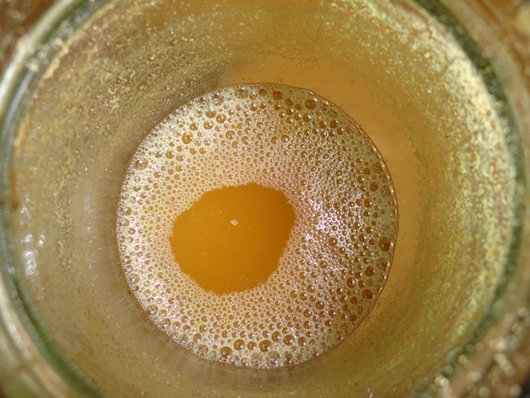
We had a nice supply of ginger beer going over Christmas. It's a delicious soft drink for young and old, although there is an alcoholic version that can be made with a slight variation on the recipe. Ginger beer is a naturally fermented drink that is easy to make - with ginger beer you make a starter called a ginger beer plant and after it has fermented, you add that to sweet water and lemon juice. Like sourdough, it must ferment to give it that sharp fizz. To make a ginger beer plant you'll need ginger - either the powdered dry variety or fresh ginger, sugar, rainwater or tap water that has stood for 24 hours to allow the chlorine to evaporate off. You'll also need clean plastic bottles that have been scrubbed with soap, hot water and a bottle brush and then rinsed with hot water. I never sterilise my bottles and I haven't had any problems. If you intend to keep the ginger beer for a long time, I'd suggest you sterilise your bottles. MAKING THE STARTER In a...
Image

NOT the last post

This will be my last post here.  I've been writing my blog for 18 years and now is the time to step back. I’ve stopped writing the blog and come back a couple of times because so many people wanted it, but that won’t happen again, I won’t be back.  I’ll continue on instagram to remain connected but I don’t know how frequent that will be. I know some of you will be interested to know the blog's statistics. 
Image

How to make cold process soap

I'm sure many of you are wondering: "Why make soap when I can buy it cheaply at the supermarket?" My cold process soap is made with vegetable oils and when it is made and cured, it contains no harsh chemicals or dyes. Often commercial soap is made with tallow (animal fat) and contains synthetic fragrance and dye and retains almost no glycerin. Glycerin is a natural emollient that helps with the lather and moisturises the skin. The makers of commercial soaps extract the glycerin and sell it as a separate product as it's more valuable than the soap. Then they add chemicals to make the soap lather. Crazy. Making your own soap allows you to add whatever you want to add. If you want a plain and pure soap, as I do, you can have that, or you can start with the plain soap and add colour, herbs and fragrance. The choice is yours. I want to add a little about animal and bird fat. I know Kirsty makes her soap with duck fat and I think that's great. I think t...
Image

Preserving food in a traditional way - pickling beetroot

I've had a number of emails from readers who want to start preserving food in jars but don't know where to start or what equipment to buy.  Leading on from yesterday's post, let's just say up front - don't buy any equipment. Once you know what you're doing and that you enjoy preserving, then you can decide whether or not to buy extra equipment. Food is preserved effectively without refrigeration by a variety of different methods. A few of the traditional methods are drying, fermentation, smoking, salting or by adding vinegar and sugar to the food - pickling. This last method is what we're talking about today. Vinegar and sugar are natural preservatives and adding one or both to food sets up an environment that bacteria and yeasts can't grow in. If you make the vinegar and sugar mix palatable, you can put up jars of vegetables or fruit that enhance the flavour of the food and can be stored in a cupboard or fridge for months. Other traditional w...
Image

Cleaning mould from walls and fabrics

With all this rain around we've developed a mould problem in our home. Usually we have the front and back doors open and that good ventilation stops most moulds from establishing. However, with the house locked up for the past week, the high humidity and the rain, mould is now growing on the wooden walls near our front door and on the lower parts of cupboards in the kitchen. Most of us will find mould growing in our homes at some point. Either in the bathroom or, in humid climates, on the walls, like we have now. You'll need a safe and effective remedy at some point, so I hope one of these methods works well for you. Mould is not only ugly to look at, it can cause health problems so if you see mould growing, do something about it straight away. The longer you leave the problem, the harder it will be to get rid of it effectively. If you have asthma or any allergies, you should do this type of cleaning with a face mask on so you don't breathe in any spores. Many peopl...
Image

Five minute bread

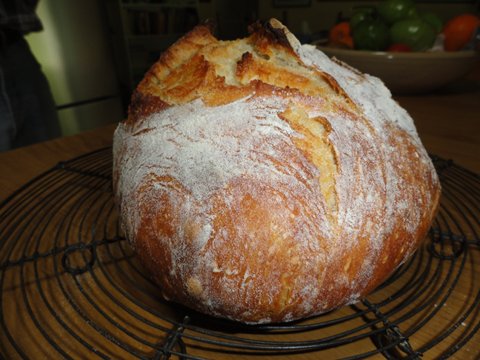
Bread is one of those foods that, when made with your own hands, gives a great deal of satisfaction and delight. It's only flour and water but it symbolises so much. I bake bread most days and use a variety of flours that I buy in bulk. Often I make a sandwich loaf because we use most of our bread for lunchtime sandwiches and for toast. Every so often I branch out to make a different type of loaf. I have tried sour dough in the past but I've not been happy with any of them. I'll continue to experiment with sour dough because I like the idea of using wild yeasts and saving the starter over a number of years to develop the flavour and become a part of the family. However, the loaf I've been branching out to most often is just a plain old five minute bread. By five minutes I mean it takes about five minutes actual work to prepare but it's the easiest of all bread to make and to get consistently good loaves from. If you're having people around for lunch or...
Image

This is my last post.

I have known for a while that this post was coming, but I didn't know when. This is my last post. I'm closing my blog, for good, and I'm not coming back like I have in the past.  I've been writing here for 16 years and my blog has been many things to me. It helped me change my life, it introduced me to so many good people, it became a wonderful record of my family life, it helped me get a book contract with Penguin, and monthly columns with The Australian Women's Weekly and Burke's Backyard . But in the past few months, it's become a burden. In April, I'll be 75 years old and I hope I've got another ten years ahead. However, each year I'll probably get weaker and although I'm fairly healthy, I do have a benign brain tumour and that could start growing. There are so many things I want to do and with time running out, leaving the blog behind gives me time to do the things that give me pleasure. On the day the blog started I felt a wonderful, h...
Image

What is the role of the homemaker in later years?

An email came from a US reader, Abby, who asked about being a homemaker in later years. This is part of what she wrote: "I am a stay-at-home mum to 4 children, ages 9-16. I do have a variety of "odd jobs" that I enjoy - I run a small "before-school" morning drop-off daycare from my home, I am a writing tutor, and I work a few hours a week at a local children's bookstore. But mostly, I cherish my blissful days at home - cooking, cleaning (with homemade cleaners), taking care of our children and chickens and goats, baking, meal-planning, etc. This "career" at home is not at all what I imagined during my ambitious years at university, but it is far more enriching. I notice, though, that my day is often planned around the needs of my family members. Of course, with 4 active kids and a husband, this is natural. I do the shopping, plan my meals, cook dinner - generally in anticipation of my family reconnecting in the evening.  I can't h...
Image

Every morning at home

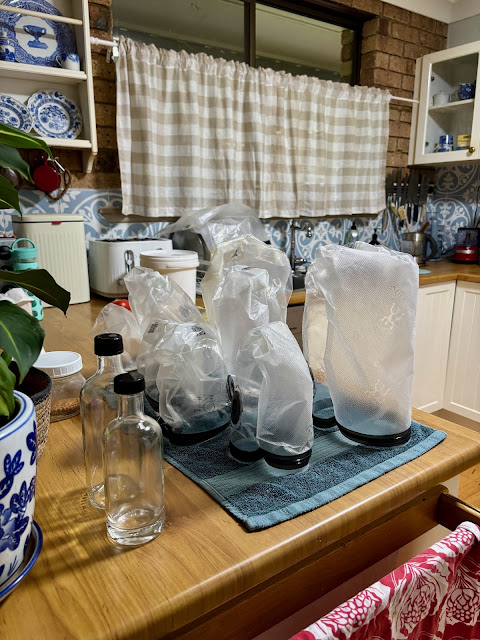
Every morning when I walk into my kitchen it looks tidy and ready for a day's work. Not so on this morning (above), I saw this when I walked in. Late the previous afternoon when I was looking for something, I came across my rolled up Zwilling vacuum bags and decided they had to be washed and dried. So I did that and although I usually put them outside on the verandah to dry it was dark by then. I turned the just-washed bags inside out and left them like this on a towel. It worked well and now the bags are ready to use when I bring home root vegetables, cabbages or whatever I buy that I want to last four or five weeks.
Image

You’ll save money by going back to basics

When I was doing the workshops and solo sessions, I had a couple of people whose main focus was on creating the fastest way to set up a simple life. You can't create a simple life fast, it's the opposite of that It's not one single thing either - it's a number of smaller, simpler activities that combine to create a life that reflects your values; and that takes a long to come together. When I first started living simply I took an entire year to work out our food - buying it, storing it, cooking it, preserving, baking, freezing, and growing it in the backyard. This is change that will transform how you live and it can't be rushed.  
Image

All previous blog posts

  • 2026 3
    • February 3
      • Workshops starting 1 March
      • Planting vegetable seeds and new workshops
      • Back where we belong
  • 2025 7
    • July 1
    • June 2
    • May 1
    • April 2
    • February 1
  • 2024 25
    • December 2
    • November 1
    • October 2
    • September 3
    • August 1
    • July 3
    • June 1
    • May 3
    • April 2
    • March 3
    • February 2
    • January 2
  • 2023 13
    • December 1
    • November 2
    • October 1
    • September 3
    • August 2
    • February 2
    • January 2
  • 2022 17
    • November 3
    • October 4
    • September 3
    • August 2
    • July 3
    • June 2
  • 2021 50
    • December 1
    • November 6
    • October 7
    • September 5
    • August 4
    • July 5
    • June 2
    • May 2
    • April 6
    • March 4
    • February 4
    • January 4
  • 2020 68
    • December 3
    • November 5
    • October 4
    • September 4
    • August 4
    • July 4
    • June 4
    • May 8
    • April 7
    • March 8
    • February 8
    • January 9
  • 2019 66
    • December 2
    • November 4
    • October 5
    • August 3
    • July 4
    • June 6
    • May 8
    • April 8
    • March 8
    • February 11
    • January 7
  • 2018 82
    • December 1
    • September 2
    • August 10
    • July 4
    • June 11
    • May 9
    • April 12
    • March 10
    • February 10
    • January 13
  • 2017 129
    • December 7
    • November 10
    • October 6
    • September 13
    • August 11
    • July 13
    • June 12
    • May 9
    • April 9
    • March 14
    • February 11
    • January 14
  • 2016 125
    • December 7
    • November 13
    • October 10
    • September 11
    • August 11
    • July 8
    • June 9
    • May 9
    • April 12
    • March 10
    • February 13
    • January 12
  • 2015 184
    • December 7
    • November 15
    • October 20
    • September 18
    • August 19
    • July 18
    • June 12
    • May 15
    • April 12
    • March 21
    • February 13
    • January 14
  • 2014 203
    • December 11
    • November 8
    • October 17
    • September 20
    • August 17
    • July 19
    • June 17
    • May 17
    • April 23
    • March 15
    • February 18
    • January 21
  • 2013 225
    • December 13
    • November 17
    • October 17
    • September 17
    • August 21
    • July 24
    • June 20
    • May 19
    • April 17
    • March 22
    • February 17
    • January 21
  • 2012 245
    • December 17
    • November 20
    • October 20
    • September 18
    • August 15
    • July 24
    • June 21
    • May 26
    • April 23
    • March 23
    • February 19
    • January 19
  • 2011 257
    • December 18
    • November 24
    • October 27
    • September 23
    • August 24
    • July 21
    • June 24
    • May 24
    • April 16
    • March 22
    • February 14
    • January 20
  • 2010 283
    • December 20
    • November 18
    • October 18
    • September 19
    • August 25
    • July 24
    • June 25
    • May 26
    • April 25
    • March 22
    • February 29
    • January 32
  • 2009 293
    • December 29
    • November 18
    • October 23
    • September 25
    • August 22
    • July 28
    • June 22
    • May 21
    • April 27
    • March 26
    • February 24
    • January 28
  • 2008 387
    • December 24
    • November 23
    • October 25
    • September 26
    • August 27
    • July 27
    • June 37
    • May 34
    • April 44
    • March 53
    • February 32
    • January 35
  • 2007 372
    • December 37
    • November 40
    • October 55
    • September 51
    • August 49
    • July 63
    • June 49
    • May 28


Trending Articles

NOT the last post

This will be my last post here.  I've been writing my blog for 18 years and now is the time to step back. I’ve stopped writing the blog and come back a couple of times because so many people wanted it, but that won’t happen again, I won’t be back.  I’ll continue on instagram to remain connected but I don’t know how frequent that will be. I know some of you will be interested to know the blog's statistics. 
Image

Every morning at home

Every morning when I walk into my kitchen it looks tidy and ready for a day's work. Not so on this morning (above), I saw this when I walked in. Late the previous afternoon when I was looking for something, I came across my rolled up Zwilling vacuum bags and decided they had to be washed and dried. So I did that and although I usually put them outside on the verandah to dry it was dark by then. I turned the just-washed bags inside out and left them like this on a towel. It worked well and now the bags are ready to use when I bring home root vegetables, cabbages or whatever I buy that I want to last four or five weeks.
Image

You’ll save money by going back to basics

When I was doing the workshops and solo sessions, I had a couple of people whose main focus was on creating the fastest way to set up a simple life. You can't create a simple life fast, it's the opposite of that It's not one single thing either - it's a number of smaller, simpler activities that combine to create a life that reflects your values; and that takes a long to come together. When I first started living simply I took an entire year to work out our food - buying it, storing it, cooking it, preserving, baking, freezing, and growing it in the backyard. This is change that will transform how you live and it can't be rushed.  
Image

Creating a home you'll love forever

Living simply is the answer to just about everything. It reduces the cost of living; it keeps you focused on being careful with resources such as water and electricity; it reminds you to not waste food; it encourages you to store food so you don't waste it and doing all those things brings routine and rhythm to your daily life. Consciously connecting every day with the activities and tasks that create simple life reminds you to look for the meaning and beauty that normal daily life holds.  It's all there in your home if you look for it. Seemingly mundane tasks like cleaning and cooking help you with that connection for without those tasks, the home you want to live in won't exist in the way you want it to.  Creating a home you love will make you happy and satisfied.
Image

Time changes everything

I've been spending time in the backyard lately creating a contained herb and vegetable garden. My aim is to develop a comfortable place to spend time, relax, increase biodiversity and encourage more animals, birds and insects to live here or visit. Of course I'd prefer my old garden which was put together by Hanno with ease and German precision. Together, we created a space bursting at the seams with herbs, vegetables and fruity goodness ready to eat and share throughout the year. But time changes everything. What I'm planning on doing now, is a brilliant opportunity for an almost 80 year old with balance issues. In my new garden I'll be able to do a wide range of challenging or easy work, depending on how I feel each day. It’s a daily opportunity to push myself or sit back, watch what's happening around me and be captivated by memories or the scope of what's yet to come.
Image

It's the old ways I love the most

I'm a practical woman who lives in a 1980’s brick slab house. There are verandahs front and back so I have places to sit outside when it's hot or cold. Those verandahs tend to make the house darker than it would be but they're been a great investment over time because they made the house more liveable. My home is not a romantic cottage, nor a minimalist modern home, it's a 1980’s brick slab house. And yet when people visit me here they tell me how warm and cosy my home is and that they feel comforted by being here. I've thought about that over the years and I'm convinced now that the style of a home isn't what appeals to people. What they love is the feeling within that home and whether it's nurturing the people who live there.
Image

Back where we belong

Surprise! I'm back ... for good this time. Instagram became an impossible place for me. They kept sending me messages asking if I'd make my page available for advertisers! Of course, I said no but that didn't stop them. It's such a change from what Instagram started as. But enough of that, the important part of this post is to explain why I returned here instead of taking my writing offline for good. For a few years Grandma Donna and I have talked online face-to-face and it's been such a pleasure for me to get to know her. We have a lot in common. We both feel a responsibility to share what we know with others. With the cost of living crisis, learning how to cook from scratch, appreciate the work we do in our homes, shop to a budget and pay off debt will help people grow stronger. The best place to do that is our blogs because we have no advertising police harassing us, the space is unlimited, we can put up tons of photos when we want to and, well, it just feels li...
Image

Making ginger beer from scratch

We had a nice supply of ginger beer going over Christmas. It's a delicious soft drink for young and old, although there is an alcoholic version that can be made with a slight variation on the recipe. Ginger beer is a naturally fermented drink that is easy to make - with ginger beer you make a starter called a ginger beer plant and after it has fermented, you add that to sweet water and lemon juice. Like sourdough, it must ferment to give it that sharp fizz. To make a ginger beer plant you'll need ginger - either the powdered dry variety or fresh ginger, sugar, rainwater or tap water that has stood for 24 hours to allow the chlorine to evaporate off. You'll also need clean plastic bottles that have been scrubbed with soap, hot water and a bottle brush and then rinsed with hot water. I never sterilise my bottles and I haven't had any problems. If you intend to keep the ginger beer for a long time, I'd suggest you sterilise your bottles. MAKING THE STARTER In a...
Image