down to earth

  • Home
  • About Us
  • Down To Earth Book
  • Privacy Policy

If you believed the advertisements on TV, washing clothes is one of the most difficult things to do if you don't have THE special magic potion. The reality is that washing can be done easily and effectively with simple products, a bit of time and some elbow grease.

WASHING IN A WASHING MACHINE
In our house we often have clothes that need washing but aren't really dirty. They might have been worn for a few days and are starting to get a bit grubby or smelly, but there are no stains that have to be treated. These go straight into the washing machine and are washed with my home made laundry powder. We also have clothes that need stain removal - that stain might be grease or oil stains on H's work clothes, or stains from a food or coffee spills. These clothes go into the laundry tub with some oxygen bleach and hot water and stay there either overnight or until the water is cold. Then they are checked to see that the stain is gone, scrubbed with laundry soap if it's not, and put into the washing machine on a normal wash with the HM powder.

If pre-soaking hasn't removed a stain, usually scrubbing with laundry soap will do the trick. Don't wash the soap off, put it straight into the washing machine and let it wash with the extra soap. This generally removes even difficult stains.

I
use a cold water setting with most of my washing but every so often I'll wash the sheets on a hot water wash. I also use hot water if H has some greasy work clothes. I soak them first, then hot wash.

Don't overcrowd your machine. Everything needs to move around inside the machine, it's part of the washing action that cleans then. If they can't swish around, they won't wash properly.

DISHCLOTHS AND TEA TOWELS
These need special treatment as they're used in the kitchen so need to be disinfected. When I've used a dishcloth for a couple of days it's placed in the laundry room in a dry bucket and left until the rest of the washing needs to be done. The night before I start the washing, I fill the bucket up with hot water and some oxygen bleach to soak the cloths. Every so often, I give this same treatment to the tea towels. It keeps them looking good and removes any food stains that have built up since the last soaking. After the cloths have soaked overnight, they are washed in the machine with the general washing.

SOAK BEFORE WASHING
Most clothes benefit from being soaked. It loosens dirt and is a good treatment for stains. If you can soak clothes before washing, do it. It's gentler on fabric than washing. If you start your washing with cleaner clothes you need less laundry powder, less energy to run the machine on complicated hot water washes and less time in the machine.

KNOW YOUR MACHINE
I have a fully automatic washing machine but I never use the programmed settings. I modify every wash according to what goes into the machine. So if I have towels, my auto setting tells me a hot water wash and three rinses. I disagree with that - I use cold water and two rinses. Every couple of months I give all my towels the hot water and oxygen bleach soaking mentioned above. It disinfects the towels and gets rid of in ground grime.

Remember, you don't need a mountain of different products in the laundry. Generally homemade detergent, laundry soap, oxygen bleach and ammonia will keep your fabrics fresh and clean. Soaking will get rid of stains - then just wash as normal.

GENERAL REMINDERS
  • Read the labels on new clothes and wash accordingly.
  • Always wash with phosphate-free detergents.
  • Try using homemade laundry detergent, there is a recipe for it in this blog. Not only is it an excellent cleaner, it's also much cheaper.
  • Try to always hang your washing on the line to dry. Dryers use more energy than any other home appliance.
  • Treat stains as soon as you can. The longer a stain remains on the fabric, the harder it is to remove it.

FURTHER READING

How to fold a fitted sheet
Washing in Victorian times
Staying clean in the colonial outback

I've been meaning to post these photos for a while. I took them when we attended the funeral of a dear friend of H's a couple of months ago.

The Purga Creek Church and School sit isolated at the end a long, dry and dusty part-dirt road, west of Ipswich. The church is a non-denominational timber church about 100 years old, the interior is unlined
and unpainted. It is truly a simple and beautiful church.
The school house next door started out as a school for aboriginal children. It's stood empty and silent for at least the past 50 years. But both these buildings show the authentic beauty of funtional buildings that are built for a specific purpose and used for that purpose by ordinary people. Although they are not grand and prestegious buildings, I love how those people who went to church and school here look great care of their buildings, so although they are simple structures, they survived the years and are standing strong today. It's a testament to the generations before ours who valued what they had and made sure the buildings they used were cared for.

I've just realised that Frugal Gifts is my 100th blog post. I've been blogging almost eight weeks and so far, I'm loving it. I thought you might like some stats to go with the 100th post, so here goes.
There have been 2,998 pageloads this month, and 9,893 in total. So far there have been 3787 visitors. This is the summary map for past week.


This is yesterday's visitors list:

298 - 61.57%
Australia

121 - 25.00%
United States

42 - 8.68%
United Kingdom

8 - 1.65%
Canada

6 - 1.24%
New Zealand

3 - 0.62%
Ireland

2 - 0.41%
Germany

2 - 0.41%
Switzerland

1 - 0.21%
Unknown

1 - 0.21%
Barbados


It's been wonderful to see so many Australians reading my blog but I also like the visitors from so many far off lands. Thank you to everyone who reads regularly. I appreciate and look forward to all your comments, so keep them coming.

If there is something you'd like me to write about
, or if you have any questions. Please send an email. And thank you for being part of my blog world.
It's Christmas in July here next weekend. For our international friends that is the time when many Australians - at least those in areas near here - celebrate a fake Christmas so they can enjoy a "real Christmas dinner". That includes hot food like turkey and ham with all the trimmings and hot plum pudding under a blanket of flaming brandy. Anyhow, it started me thinking about the real Christmas in December and what gifts I have and what I'll make.

Last year I felt quite satisfied with the gifts I gave and only fell short of my goal to give all homemade gifts, with my two sons. For them I bought "stuff". I'm not sure why I did that. They both know what H and I are aiming for in our lives now but because they don't live as we do, I crumbled when it came to their gifts. I hope I'm stronger this year.

Good organisation is the key to frugal gifts. You need to be well prepared and to start thinking about your gift list well in advance of Christmas. The June/July sale season is an ideal time to start. Making a list of people you want to give a gift to is essential, and if this is the first time you've really been mindful of what you're giving and to whom, the list might give you a few worries. A few years ago I culled my list to the bare bone. I realised that giving gifts just for the sake of it, or because they were expected, is wasteful and adds significantly to an overspending culture. So I contacted those people, well before Christmas, and explained my new philosophy. Most were relieved to get off the merry-go-round of Christmas spending, others said they didn't care. So with my new improved list that now comprised my immediate family and a couple of close friends, I started thinking about the specifics. The next step is to work out how much you intend spending - this needs to be an overall budget as well as an amount for each person. When you've done this, you're ready for the interesting part - the gifts.

Remember your goal is to give all your gifts spending the least amount you can, but all your gifts MUST be something the person will like and use. It's a total waste, and defeating the purpose of frugal gift giving, if you give someone a piece of junk because you don't know what else to give. That piece of junk will sit in a cupboard and will add to the billions of dollars spent on gifts that have no real meaning. The key to this is to think carefully about your gifts and give something that will be used or treasured.

The practical gift
If you have a friend who is just getting into simple living, give her some thing that reflects simple values. Something like a nice enamel "Laundry Powder" container with the makings of homemade laundry power with it. A container will cost you about $25, the makings - laundry soap, borax and washing soda, will cost another $5.

You could so the same for soap making. Make up a parcel with olive oil, coconut oil, caustic soda and some soap moulds. Print out the instructions for making soap from the internet and parcel it all together in a tea towel and you have another gift for under $30.

The scraps gift
Look around your home and see what fabric you have to make a few gifts. You could make a tea cosy, apron, peg bag, wall hanging, table mats, cushion covers or tote bags.

The outdoor gift
Something for the gardens. Buy some attractive pots and potting mix and try to swap (or buy) heirloom seeds for tomatoes, chilli or herbs. In September, plant them up and nurture them until you give them on Christmas Day. You could also paint some plain terracotta pots in favourite colours.

If your person has a favourite plant, get some cuttings and six months of care should give you some nice plants to give. Or if you can't think of exactly the right thing, give a voucher for a Sunday of lawn mowing and clippings removal - and do that yourself. Just make up the voucher on your computer.

The food gift
This could be just about anything. Really popular things will include homemade jams and preserves, plum puddings, fruit cakes, home made fruit cordial, wine or ginger beer. Or you could make up a bread makers gift of a kilo of bread flour, yeast or sourdough starter, good salt and a bread tin - print off a tried and true recipe from the internet.

The bathroom gift
Homemade soap, home grown loofahs and soap, bath salts, shampoo bars, shaving soap, or any homemade cosmetics would fit well in this category.

The hobby gift
If you friend loves sewing, knitting or needlework, make up a kit of things she'd love. A keen gardener would probably love a new hat and gloves.

Tea and Coffee gift
This speaks for itself. Make up a little basket with a selection of various teas or a bag of organic Australian coffee and a nice mug.

Children's gifts
I haven't given gifts to children for a long time but you could think about books bought on sale, homemade playmats, bags for Legos, marbles or small treasures, colouring in pencils, homemade tote bags, fairy wings and skirt, Harry Potter cape or Hogwarts scarf. For older children or teens, a voucher for one CD will cost $25 - $30, or movie tickets will cost less.

Just about everything above can be bought cheaper than retail price if you started buying your items at the mid year sales. For things like tea and coffee or the hobby items, look for those things as you're progressing through the months. You can often pick up a good special if you keep your eyes open. If you're going to make most of your gifts, start now so you're not rushed later. Work out how many you have to make, and work according to your list. You may need to make one gift a week, or one a month. Don't leave them all till December because you'll be overwhelmed and wonder why you ever started this type of gift giving.

The most important thing is to make everything as well as you can and make sure your gifts suit your recipients. Wrap them nicely in a tea towel or brown paper, decorated with leaves, ribbon or kids drawings and you'll be giving a gift that is full of love and good intentions. And that, my friends, is the best gift of all.

(Image from Allposters.com)
One of my current projects in the garden is to cultivate more fruit. I would love to be able to have days when I eat all raw food, preferably my own home grown organic fruit. If all of our fruit plants produced as well as our lemon tree, I'd be one very satisfied woman.

When we moved here ten years ago, we planted a few fruit trees but we didn't look after them; they didn't die but never really produced much. A couple of years ago I started fertilising with blood and bone and potash, giving each plant the required amount of water and everything turned around, we started getting healthy looking fruit trees. This year we allowed the flowers that developed on the trees, shrubs and vines to produce a few fruit and this is the result from one of the Washington Navel orange trees. I picked this orange yesterday afternoon and ate it last night, it was delicious and juicy and everything a good orange should be. And true to the saying: you can't judge a book by its cover, the skin didn't look too appetising as it was a bit mottled and had blotches on it. It didn't look like the perfect orange, but it was! Long ago I stopped judging books by their covers, and I like getting reminders along the way that reinforce that clever strategy.


The Washington Navel tree is on the eastern side of our vegetable garden, so it doesn't shade the vegetables. In that same vegie garden we are also growing some rhubarb, a peach tree and a nectarine tree. I pruned those trees a couple of weeks ago as I want them to remain small enough for me to net them. Last year we grew about 200 perfect peaches and nectarines, and then fruit fly found our garden and we ended up eating five. The chooks got the rest. This year, more care and vigilance, and fruit fly baits, will hopefully reward our efforts.

Just outside the fenced garden we've planted four blueberries. They've been producing in small quantities ever since. Hopefully when spring comes they'll bush out a lot and grow lots of berries.


Our main fruit growing area is on the other side of the garden. There we're growing new sultana grapes, lady finger and dwarf cavendish bananas, a pink grapefruit, a mandarin, passionfruit, raspberries, loquats and another navel orange. In the past they've always suffered from lack of water so we installed a water tank near them last November and they're now getting enough water to thrive. I'm also growing vanilla orchids in the bush-house and avocados in the front garden.

Last year's bananas.

We're still a long way from being self sufficient in fruit, but that is our goal. Like many other things in this simple life, it's small steps all the way. We've put in the hard yards during the year so I'm hoping that like the orange, our other fruit plants will produce abundant harvests for us in Spring.


I nominate the following blogs for the Bloggers for Positive Global Change Award:

Towards Sustainability
Julie is a stay at home mum to three little kids, in her former life she was an environmental scientist. She lives with her family in average Australian suburbia on a 730sq.m. (0.18 acre) block.

Children in the Corn
Farm mom is the mother of two small children who, along with DH, are in a rural area of the US attempting to homestead 2 acres. Interests include gardening, poultry, knitting, organic and local foods, cooking, homeschooling, and eco-friendly self suffiency.

Living the Good Life
Linda, Trev and Caleb are living the good life in Tasmania. They're building a new house that reflects their sustainable values and teach us a lot along the way.

Little Jenny Wren
Jenny shares her simple life with us and in doing so inspires us all to do more and be better.

Scarecrow's Garden
Scarecrow lives in the dry Mid North of South Australia on a half acre town block. Now the children have left home she and her husband enjoy a simple lifestyle growing food and eating the results.

Fellow Positive Global Change Award recipients, it’s easy to participate in this meme. At minimum, you can proudly display the BPGC badge (Click here for the image url) on your blog and bask in the glow of our collective good will. If you are sharing the kudos, however, please make sure you pass this list of rules to the blogs you are tagging.The participation rules are simple:
1. When you get tagged, write a post with links to up to 5 blogs that you think are trying to change the world in a positive way.
2. In your post, make sure you link back to so that people can easily find the exact origin of the meme.
3. Leave a comment or message for the bloggers you’re tagging, so they know they’re now part of the meme.
4. Optional: Proudly display the “Bloggers For Positive Global Change” award badge with a link to the post that you write up.


Wow, what can I say. I was nominated for this by downshifting-path to simplicity and I'm surprised and delighted by it. Thank you.

The award was started at Climate Of Our Future to highlight blogger's efforts around the world to share their knowledge and thoughts in making our world better, healthier and more sustainable.

One of the rules of the award is that I have to tag five other blogs that I believe are sharing what they know and inspiring others towards change. I will be back later to do that.

As soon as you realise that lifestyle change is essential in every affluent country and understand that you must be part of that change, your personal transformation can begin. You don’t need special equipment or anyone else to help, you just need to start and to remain focused and motivated. We got into this climate change predicament over the course of several decades; I believe we will get out of it with each of us taking small steps.

Of course every one's small steps will be different but there are a number of common measures that will probably be a part of every one's strategy. These include:
* Getting off the mindless consumption merry-go-round
* Reduced spending
* Cutting back on your consumption of electricity, petrol, gas and water
* Reduce, reuse, repair and recycle – both at home and at work

It could also include such things as:
* Not eating meat
* Shopping locally
* Growing your own food and supplement it with your stockpiled staples
* Not eating takeaway food
* Cooking from scratch

We had a surprise visitor here yesterday. It was a friend that we’ve known for many years, we had our first babies at the same time and lived in the same isolated town for many years. She is six months older than me but she will be working until she is 70 to pay off all her debts. She was surprised when I told her how little we spend but I doubt that small surprise will be enough to change her mindset. You see that’s the thing. You have to be so concerned or shocked or unhappy that you realise without reservation that you must change. My friend is not there yet.

H and I live on $350 a week. We live well and we are happier now than we have ever been. We have private health insurance, we have holidays, we have everything we need, we have no debt. We live a truly simple life that allows us to choose whatever we want to do each day. We could both still be working if we chose to but our mindset has changed; we don’t view success in the same way anymore. We want to be part of a solution, we don’t want to add to the problem. We’ve implemented strategies that are easy to follow that have allowed us to reduce our electricity consumption to 11.7 kWh per day from 13.9 last year and around 25 kWh five years ago. We’ve reduced our water usage to 100 litres each a day, we use 6000 litres a month. We used to use so much water we paid hundred of dollars in excess water bills.

So you can see that it is possible and they are not huge changes – it’s reducing in small steps. We are just ordinary people, if we can do it, anyone can. All it takes is the change in mindset and the willingness to start. That first step is the most difficult and after that it’s a matter of remaining focused. You can stay motivated by reading the many blogs on this subject and reskilling yourself for your new life. It is that simple.

Ready, set ……… go.

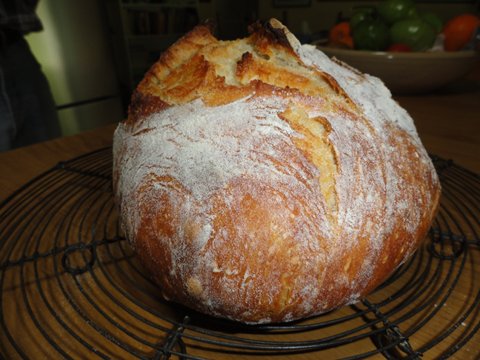
This sourdough bread is delicious! Really, it's got a lovely depth of flavour unlike plain yeast breads. And it's nicer than the sourdough we used to buy at the bakery.

I cooked it in my cast iron dutch oven, which is why it's a flattish round
shape. Next time I'll use something else to give it more height. I'm really looking forward to making more sourdough now and to improve on this first one. But I must say, the flavour of this loaf is excellent.
I feel like I have my full strength back now. I have no back pain at all. Yay!

I didn't make brownies for Shane yesterday as I didn't have enough chocolate on hand, so today I made him a stack of white chocolate chip biscuits. H and I had one each for morning tea and although they're a bit sweet, they are nice. I find most American recipes too sweet for the average Australian taste so I cut the sugar back to one cup instead of the recipe's 1.5 cups. I think it could come back again to half what the recipe calls for, so three-quarters of a cup (total) of white and brown sugar. The recipe is here.

This is the sourdough about half way through its final rise.
I'll be putting int in to bake soon.
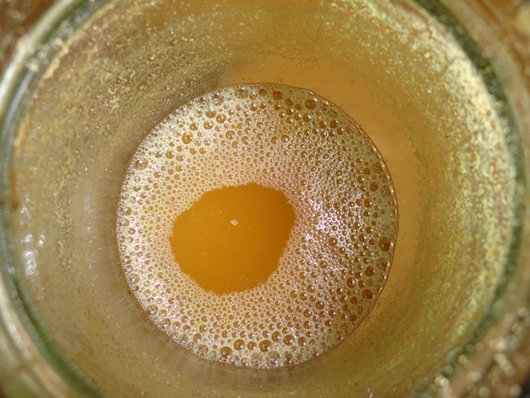
The sourdough saga continues. Kim advised to keep feeding the starter, so I have half my original starter still in the fridge and it's been fed twice today. I also made up another sourdough starter yesterday afternoon and it's been bubbling away nicely overnight and all today. It's almost ready to bake. This is the recipe I used here. When the bread is out of the oven, you'll be the first to see the snaps.

I’ve been thinking a lot about positive role models lately and how there are so few of them. I look at my friends and none of them live as I do, they are all still caught up with spending and over consumption. I love my friends dearly but I am not inspired by how they live.

So where do we usually find women, or men for that matter, who act as role models – who simply by the way they live and present themselves, inspire others to live to their true potential? Certainly not in the popular media, and I won’t go further than that as this would turn into a tirade if I did. If there is no inspiring light in your group of friends or someone at work, then where?

Well, for me it’s been in blogs. I have found wonderful role models online. Women who show me a way of being that allow me to stay true to who I am, and simply by sharing their lives demonstrate important, honourable and creative ways to live.

The blogs I like best are those written by women who are living an authentic life. I’m not interested in the political and intellectual blogs that talk about change and how to achieve it; I prefer to get that information in books. I am more interested in people who live their changes rather than talk about them, and who share their experiences. I’m fascinated by those blogs that show you, with words and photos, how others live simply, while being mindful of environmental responsibilities, in ordinary and every day ways. For me, living a life that works well, and honestly sharing it with all its ups and downs, is the best example.

At the moment I find inspiration in a few blogs that you might have already discovered yourself. If you haven’t, I encourage you to check these places out. 


Path to Freedom I have been visiting this website for the past five years and am still as motivated by them as I was on the first visit. The Dervaes family live in California and show us all that true change is possible.

Sometimes I see love and caring in photos and I see it often in Little Jenny Wren’s photos of her home. Jenny is a Tasmanian woman who shares her family and her crafts with all of us. There is plenty of simple wisdom there.

When she writes about her day-to-day life Jewels clearly demonstrates that everyone and everything matters. She lives in the US with her husband and ten children and shows us that simply living can also be elegant, heart warming and a lot of fun.

Phelan is living on farm and tell us about all the changes she's making. I love her honesty and her enthusiastic small steps.

I really like the cooking on the free range living blog, but there is also a lovely small house she sold recently and the excitement of a new house she and her family are now moving in to.

There must be many more blogs that document the authentic extraordinary lives of ordinary people. I would love to find more blogs to inspire and motivate me. If you have favourite blogs you go to everyday, please tell me, and everyone else, about them and add a link so we can visit.

Here it is, the yellow apron with cross over straps. It feels really comfy and I like that there are no ties to do up.

I started my sourdough sponge and it died! I left it sit for a while in the bowl and although it was suppose to rise a little, nothing happened. It looked dead and had stopped fermenting, so I've started again. Hopefully I can get to it again over the weekend.

Newer Posts Older Posts Home

MY BOOKS

MY BOOKS


My books were all published by Pengiun, and are available at Amazon US, Amazon UK and Amazon Au

Search here

Total Pageviews

Translate


I'm Rhonda Hetzel and I've been writing my Down to Earth blog since 2007. Although I write the occasional philosophical post, my main topics include home cooking, happiness and gardening as well as budgeting, baking, ageing, generosity, mending and handmade crafts. I hope you enjoy your time here.

MY FAVOURITE PLACES

  • Grandma Donna's Place
  • Grandma Donna's YouTube
  • Grandma Donna's Instagram
  • This Simple Day
  • Nicole's Instagram

Give More

Give More

Popular posts last year

Making ginger beer from scratch

We had a nice supply of ginger beer going over Christmas. It's a delicious soft drink for young and old, although there is an alcoholic version that can be made with a slight variation on the recipe. Ginger beer is a naturally fermented drink that is easy to make - with ginger beer you make a starter called a ginger beer plant and after it has fermented, you add that to sweet water and lemon juice. Like sourdough, it must ferment to give it that sharp fizz. To make a ginger beer plant you'll need ginger - either the powdered dry variety or fresh ginger, sugar, rainwater or tap water that has stood for 24 hours to allow the chlorine to evaporate off. You'll also need clean plastic bottles that have been scrubbed with soap, hot water and a bottle brush and then rinsed with hot water. I never sterilise my bottles and I haven't had any problems. If you intend to keep the ginger beer for a long time, I'd suggest you sterilise your bottles. MAKING THE STARTER In a...
Image

NOT the last post

This will be my last post here.  I've been writing my blog for 18 years and now is the time to step back. I’ve stopped writing the blog and come back a couple of times because so many people wanted it, but that won’t happen again, I won’t be back.  I’ll continue on instagram to remain connected but I don’t know how frequent that will be. I know some of you will be interested to know the blog's statistics. 
Image

How to make cold process soap

I'm sure many of you are wondering: "Why make soap when I can buy it cheaply at the supermarket?" My cold process soap is made with vegetable oils and when it is made and cured, it contains no harsh chemicals or dyes. Often commercial soap is made with tallow (animal fat) and contains synthetic fragrance and dye and retains almost no glycerin. Glycerin is a natural emollient that helps with the lather and moisturises the skin. The makers of commercial soaps extract the glycerin and sell it as a separate product as it's more valuable than the soap. Then they add chemicals to make the soap lather. Crazy. Making your own soap allows you to add whatever you want to add. If you want a plain and pure soap, as I do, you can have that, or you can start with the plain soap and add colour, herbs and fragrance. The choice is yours. I want to add a little about animal and bird fat. I know Kirsty makes her soap with duck fat and I think that's great. I think t...
Image

Preserving food in a traditional way - pickling beetroot

I've had a number of emails from readers who want to start preserving food in jars but don't know where to start or what equipment to buy.  Leading on from yesterday's post, let's just say up front - don't buy any equipment. Once you know what you're doing and that you enjoy preserving, then you can decide whether or not to buy extra equipment. Food is preserved effectively without refrigeration by a variety of different methods. A few of the traditional methods are drying, fermentation, smoking, salting or by adding vinegar and sugar to the food - pickling. This last method is what we're talking about today. Vinegar and sugar are natural preservatives and adding one or both to food sets up an environment that bacteria and yeasts can't grow in. If you make the vinegar and sugar mix palatable, you can put up jars of vegetables or fruit that enhance the flavour of the food and can be stored in a cupboard or fridge for months. Other traditional w...
Image

Cleaning mould from walls and fabrics

With all this rain around we've developed a mould problem in our home. Usually we have the front and back doors open and that good ventilation stops most moulds from establishing. However, with the house locked up for the past week, the high humidity and the rain, mould is now growing on the wooden walls near our front door and on the lower parts of cupboards in the kitchen. Most of us will find mould growing in our homes at some point. Either in the bathroom or, in humid climates, on the walls, like we have now. You'll need a safe and effective remedy at some point, so I hope one of these methods works well for you. Mould is not only ugly to look at, it can cause health problems so if you see mould growing, do something about it straight away. The longer you leave the problem, the harder it will be to get rid of it effectively. If you have asthma or any allergies, you should do this type of cleaning with a face mask on so you don't breathe in any spores. Many peopl...
Image

Five minute bread

Bread is one of those foods that, when made with your own hands, gives a great deal of satisfaction and delight. It's only flour and water but it symbolises so much. I bake bread most days and use a variety of flours that I buy in bulk. Often I make a sandwich loaf because we use most of our bread for lunchtime sandwiches and for toast. Every so often I branch out to make a different type of loaf. I have tried sour dough in the past but I've not been happy with any of them. I'll continue to experiment with sour dough because I like the idea of using wild yeasts and saving the starter over a number of years to develop the flavour and become a part of the family. However, the loaf I've been branching out to most often is just a plain old five minute bread. By five minutes I mean it takes about five minutes actual work to prepare but it's the easiest of all bread to make and to get consistently good loaves from. If you're having people around for lunch or...
Image

This is my last post.

I have known for a while that this post was coming, but I didn't know when. This is my last post. I'm closing my blog, for good, and I'm not coming back like I have in the past.  I've been writing here for 16 years and my blog has been many things to me. It helped me change my life, it introduced me to so many good people, it became a wonderful record of my family life, it helped me get a book contract with Penguin, and monthly columns with The Australian Women's Weekly and Burke's Backyard . But in the past few months, it's become a burden. In April, I'll be 75 years old and I hope I've got another ten years ahead. However, each year I'll probably get weaker and although I'm fairly healthy, I do have a benign brain tumour and that could start growing. There are so many things I want to do and with time running out, leaving the blog behind gives me time to do the things that give me pleasure. On the day the blog started I felt a wonderful, h...
Image

What is the role of the homemaker in later years?

An email came from a US reader, Abby, who asked about being a homemaker in later years. This is part of what she wrote: "I am a stay-at-home mum to 4 children, ages 9-16. I do have a variety of "odd jobs" that I enjoy - I run a small "before-school" morning drop-off daycare from my home, I am a writing tutor, and I work a few hours a week at a local children's bookstore. But mostly, I cherish my blissful days at home - cooking, cleaning (with homemade cleaners), taking care of our children and chickens and goats, baking, meal-planning, etc. This "career" at home is not at all what I imagined during my ambitious years at university, but it is far more enriching. I notice, though, that my day is often planned around the needs of my family members. Of course, with 4 active kids and a husband, this is natural. I do the shopping, plan my meals, cook dinner - generally in anticipation of my family reconnecting in the evening.  I can't h...
Image

Every morning at home

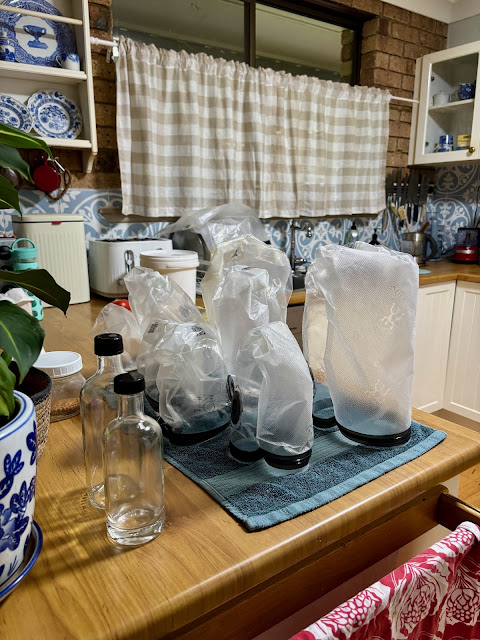
Every morning when I walk into my kitchen it looks tidy and ready for a day's work. Not so on this morning (above), I saw this when I walked in. Late the previous afternoon when I was looking for something, I came across my rolled up Zwilling vacuum bags and decided they had to be washed and dried. So I did that and although I usually put them outside on the verandah to dry it was dark by then. I turned the just-washed bags inside out and left them like this on a towel. It worked well and now the bags are ready to use when I bring home root vegetables, cabbages or whatever I buy that I want to last four or five weeks.
Image

You’ll save money by going back to basics

When I was doing the workshops and solo sessions, I had a couple of people whose main focus was on creating the fastest way to set up a simple life. You can't create a simple life fast, it's the opposite of that It's not one single thing either - it's a number of smaller, simpler activities that combine to create a life that reflects your values; and that takes a long to come together. When I first started living simply I took an entire year to work out our food - buying it, storing it, cooking it, preserving, baking, freezing, and growing it in the backyard. This is change that will transform how you live and it can't be rushed.  
Image

All previous blog posts

  • 2026 3
    • February 3
      • Workshops starting 1 March
      • Planting vegetable seeds and new workshops
      • Back where we belong
  • 2025 7
    • July 1
    • June 2
    • May 1
    • April 2
    • February 1
  • 2024 25
    • December 2
    • November 1
    • October 2
    • September 3
    • August 1
    • July 3
    • June 1
    • May 3
    • April 2
    • March 3
    • February 2
    • January 2
  • 2023 13
    • December 1
    • November 2
    • October 1
    • September 3
    • August 2
    • February 2
    • January 2
  • 2022 17
    • November 3
    • October 4
    • September 3
    • August 2
    • July 3
    • June 2
  • 2021 50
    • December 1
    • November 6
    • October 7
    • September 5
    • August 4
    • July 5
    • June 2
    • May 2
    • April 6
    • March 4
    • February 4
    • January 4
  • 2020 68
    • December 3
    • November 5
    • October 4
    • September 4
    • August 4
    • July 4
    • June 4
    • May 8
    • April 7
    • March 8
    • February 8
    • January 9
  • 2019 66
    • December 2
    • November 4
    • October 5
    • August 3
    • July 4
    • June 6
    • May 8
    • April 8
    • March 8
    • February 11
    • January 7
  • 2018 82
    • December 1
    • September 2
    • August 10
    • July 4
    • June 11
    • May 9
    • April 12
    • March 10
    • February 10
    • January 13
  • 2017 129
    • December 7
    • November 10
    • October 6
    • September 13
    • August 11
    • July 13
    • June 12
    • May 9
    • April 9
    • March 14
    • February 11
    • January 14
  • 2016 125
    • December 7
    • November 13
    • October 10
    • September 11
    • August 11
    • July 8
    • June 9
    • May 9
    • April 12
    • March 10
    • February 13
    • January 12
  • 2015 184
    • December 7
    • November 15
    • October 20
    • September 18
    • August 19
    • July 18
    • June 12
    • May 15
    • April 12
    • March 21
    • February 13
    • January 14
  • 2014 203
    • December 11
    • November 8
    • October 17
    • September 20
    • August 17
    • July 19
    • June 17
    • May 17
    • April 23
    • March 15
    • February 18
    • January 21
  • 2013 225
    • December 13
    • November 17
    • October 17
    • September 17
    • August 21
    • July 24
    • June 20
    • May 19
    • April 17
    • March 22
    • February 17
    • January 21
  • 2012 245
    • December 17
    • November 20
    • October 20
    • September 18
    • August 15
    • July 24
    • June 21
    • May 26
    • April 23
    • March 23
    • February 19
    • January 19
  • 2011 257
    • December 18
    • November 24
    • October 27
    • September 23
    • August 24
    • July 21
    • June 24
    • May 24
    • April 16
    • March 22
    • February 14
    • January 20
  • 2010 283
    • December 20
    • November 18
    • October 18
    • September 19
    • August 25
    • July 24
    • June 25
    • May 26
    • April 25
    • March 22
    • February 29
    • January 32
  • 2009 293
    • December 29
    • November 18
    • October 23
    • September 25
    • August 22
    • July 28
    • June 22
    • May 21
    • April 27
    • March 26
    • February 24
    • January 28
  • 2008 387
    • December 24
    • November 23
    • October 25
    • September 26
    • August 27
    • July 27
    • June 37
    • May 34
    • April 44
    • March 53
    • February 32
    • January 35
  • 2007 372
    • December 37
    • November 40
    • October 55
    • September 51
    • August 49
    • July 63
    • June 49
    • May 28


Trending Articles

NOT the last post

This will be my last post here.  I've been writing my blog for 18 years and now is the time to step back. I’ve stopped writing the blog and come back a couple of times because so many people wanted it, but that won’t happen again, I won’t be back.  I’ll continue on instagram to remain connected but I don’t know how frequent that will be. I know some of you will be interested to know the blog's statistics. 
Image

Every morning at home

Every morning when I walk into my kitchen it looks tidy and ready for a day's work. Not so on this morning (above), I saw this when I walked in. Late the previous afternoon when I was looking for something, I came across my rolled up Zwilling vacuum bags and decided they had to be washed and dried. So I did that and although I usually put them outside on the verandah to dry it was dark by then. I turned the just-washed bags inside out and left them like this on a towel. It worked well and now the bags are ready to use when I bring home root vegetables, cabbages or whatever I buy that I want to last four or five weeks.
Image

You’ll save money by going back to basics

When I was doing the workshops and solo sessions, I had a couple of people whose main focus was on creating the fastest way to set up a simple life. You can't create a simple life fast, it's the opposite of that It's not one single thing either - it's a number of smaller, simpler activities that combine to create a life that reflects your values; and that takes a long to come together. When I first started living simply I took an entire year to work out our food - buying it, storing it, cooking it, preserving, baking, freezing, and growing it in the backyard. This is change that will transform how you live and it can't be rushed.  
Image

Creating a home you'll love forever

Living simply is the answer to just about everything. It reduces the cost of living; it keeps you focused on being careful with resources such as water and electricity; it reminds you to not waste food; it encourages you to store food so you don't waste it and doing all those things brings routine and rhythm to your daily life. Consciously connecting every day with the activities and tasks that create simple life reminds you to look for the meaning and beauty that normal daily life holds.  It's all there in your home if you look for it. Seemingly mundane tasks like cleaning and cooking help you with that connection for without those tasks, the home you want to live in won't exist in the way you want it to.  Creating a home you love will make you happy and satisfied.
Image

Time changes everything

I've been spending time in the backyard lately creating a contained herb and vegetable garden. My aim is to develop a comfortable place to spend time, relax, increase biodiversity and encourage more animals, birds and insects to live here or visit. Of course I'd prefer my old garden which was put together by Hanno with ease and German precision. Together, we created a space bursting at the seams with herbs, vegetables and fruity goodness ready to eat and share throughout the year. But time changes everything. What I'm planning on doing now, is a brilliant opportunity for an almost 80 year old with balance issues. In my new garden I'll be able to do a wide range of challenging or easy work, depending on how I feel each day. It’s a daily opportunity to push myself or sit back, watch what's happening around me and be captivated by memories or the scope of what's yet to come.
Image

It's the old ways I love the most

I'm a practical woman who lives in a 1980’s brick slab house. There are verandahs front and back so I have places to sit outside when it's hot or cold. Those verandahs tend to make the house darker than it would be but they're been a great investment over time because they made the house more liveable. My home is not a romantic cottage, nor a minimalist modern home, it's a 1980’s brick slab house. And yet when people visit me here they tell me how warm and cosy my home is and that they feel comforted by being here. I've thought about that over the years and I'm convinced now that the style of a home isn't what appeals to people. What they love is the feeling within that home and whether it's nurturing the people who live there.
Image

Back where we belong

Surprise! I'm back ... for good this time. Instagram became an impossible place for me. They kept sending me messages asking if I'd make my page available for advertisers! Of course, I said no but that didn't stop them. It's such a change from what Instagram started as. But enough of that, the important part of this post is to explain why I returned here instead of taking my writing offline for good. For a few years Grandma Donna and I have talked online face-to-face and it's been such a pleasure for me to get to know her. We have a lot in common. We both feel a responsibility to share what we know with others. With the cost of living crisis, learning how to cook from scratch, appreciate the work we do in our homes, shop to a budget and pay off debt will help people grow stronger. The best place to do that is our blogs because we have no advertising police harassing us, the space is unlimited, we can put up tons of photos when we want to and, well, it just feels li...
Image

Making ginger beer from scratch

We had a nice supply of ginger beer going over Christmas. It's a delicious soft drink for young and old, although there is an alcoholic version that can be made with a slight variation on the recipe. Ginger beer is a naturally fermented drink that is easy to make - with ginger beer you make a starter called a ginger beer plant and after it has fermented, you add that to sweet water and lemon juice. Like sourdough, it must ferment to give it that sharp fizz. To make a ginger beer plant you'll need ginger - either the powdered dry variety or fresh ginger, sugar, rainwater or tap water that has stood for 24 hours to allow the chlorine to evaporate off. You'll also need clean plastic bottles that have been scrubbed with soap, hot water and a bottle brush and then rinsed with hot water. I never sterilise my bottles and I haven't had any problems. If you intend to keep the ginger beer for a long time, I'd suggest you sterilise your bottles. MAKING THE STARTER In a...
Image