down to earth
  • Home
  • About Us
  • Down To Earth Book
  • Privacy Policy
Harvesting ice the Amish way

Making baby shoes

Budget Bytes - a great cooking blog

Human gummi bears

Creepy photo portraits of retired ventriloquist dummies  (!!)

How to make an emergency candle with butter

FROM THE COMMENTS THIS WEEK

Missus Moonshine

Winkel's Crazy Ideas

The Canadian Housewife

...............................................................................................................................................................

The free workshops I'm doing with Ernie start next week at the Sunshine Coast Libraries. If you come along, please introduce yourself. I'd love to meet you. There are also paid full day weekend workshops as well. Email me if you need details of those.

It's been a big week here and I'm looking froward to the weekend. I hope you enjoy yourself over the next couple of days and do something you love.  ♥♥

WRITING WORKSHOPS

9/03/2013
1:00 PM
2:30 PM
Noosa Library
13/03/2013
2:00 PM
3:30 PM
Beerwah Library
14/03/2013
2:00 PM
3:30 PM
Kawana Library
19/03/2013
2:00 PM
3:30 PM
Cooroy Library
20/03/2013
10:00 AM
11:30 AM
Nambour Library
21/03/2013
1:00 PM
2:30 PM
Maleny Library
22/03/2013
10:00 AM
11:30 AM
Coolum Library
23/03/2013
2:00 PM
3:30 PM
Maroochydore Library
26/03/2013
10:00 AM
11:30 AM
Caloundra Library


BLOGGING FOR BEGINNERS WORKSHOPS

7/03/2013
10:30 AM
12:00 PM
Maroochydore Library
12/03/2013
10:00 AM
11:30 AM
Caloundra Library
15/03/2013
10:00 AM
11:30 AM
Coolum Library
17/03/2013
10:30 AM
12:00 PM
Noosa Library
26/03/2013
12:30 PM
2:00 PM
Kawana Library
27/03/2013
10:00 AM
11:30 AM
Cooroy Library
28/03/2013
1:00 PM
2:30 PM
Maleny Library


During the week a wonderful comment came in on the post about Kevin's Man Made Home. It was from rabidlittlehippy. I started writing a long response but then thought it was too long and I should make a post of it. The comment follows:

I'm a stay at home mum to 3 kids 4 and under and life can be very challenging sometimes. I've also battled with depression for most of my life and ante natal and post natal depression with my older 2 kids. I only share this for context. Since falling pregnant with my youngest who is now 18 months old I have finally found my niche. I am a homemaker and budding homesteader. Greening up our lives, making do, mending and doing without as well as "damning the man" by making at home as much as I possibly can (this is a learning curve and work in progress but we are getting there) and avoiding supermarkets wherever possible has become my life. We moved in December last year to our new home on 1/2 acre in rural Victoria and I realised on Sunday that I am actually happy. :) Not every moment is cotton wool and fluffy bunnies but the satisfaction I gain from baking my own sourdough bread, growing fruit and veggies (not much harvested this season but we've learned a lot) and I'm even learning to take satisfaction and pleasure from the most mundane and despised of tasks. There is incredible satisfaction in getting my overwhelmingly large pile of clean washing folded and put away or clearing the kitchen, even if it's just stacking the dirty dishes neatly. As much as I enjoyed my work before I had kids I am not planning to return any time soon as I thoroughly enjoy my slower life. I just hope we can one day be in a position that my husband can stay home with us whilst the kids are still young enough that we can all be happy together. :)

rabid, I sometimes go through a range of emotions when I read the comments people leave here. When I read your comment it was joy, and from "sunday" onwards, I smiled all the way to the end. I brought it over here so everyone can read it. Sometimes when I talk about happiness, I think many readers believe I'm smiling all through the day or that I have the most wonderful home life, or even that my expectation of happiness is so high, I trip over it.  But you know EXACTLY what I'm talking about. What you've described above is what I feel.


It's a feeling of low simmering contentment and fleeting happiness throughout the day. And it's brought about by the daily tasks I carry out every day. You're right, it's not all cotton wool and bunnies, it's satisfaction, self-reliance and doing the ordinary work of a simplified life that makes it so. When you go about housework by rushing through it, you don't feel this. The slowness of our days seems to magnify it, and makes it tangible.

Pure wool from my wonderful sponsor, Eco Yarns. Their new website is looking great.

Happiness is rarely one big thing, it's a hundred small fragments that come together to make what we feel. Those hundred things can be the tasks we carry almost every day, what we see around us, what we learn or simply knowing that our life is what we make it. Many others look at this life and shake their head in disbelief that anyone would want to make bread when you can buy it, or knit, or be made happy by folding clothes and stacking dishes. What they are seeing is the physical work carried out, but they don't understand that doing those things - knowing how to do them, having the time for them and being content to give that time brings about a level of satisfaction not much else can match. I'm sure there'll be readers wondering what I'm going on about just by writing that sentence. But you and I know. And that's enough.


This way of living gives you a real purpose. You feel that purpose when you know your house work is important and you know that by doing it you help make your home more sustainable. You take control of your domestic tasks, make menu plans, stockpile, work to a routine and a budget, you work with a purpose and to a plan. And during the day, while you're doing all the tasks that bring a family together by providing good food, clean clothes and comfy beds, happiness is always lurking. It's there for all of us, not just the mothers who stay at home; this is not tied to gender, marital status, or whether you live with two cats or ten children. It's there for all of us who work in our homes and love it.

I'm going a bit bonkers. I woke up an hour ago, felt that I'd had a very restful sleep, lay there for a few minutes listening to the rain and got up. I had no idea what time it was but I didn't want to be late this morning, I have to go out later and have a few things to do before I go. I looked at the bedside clock in the darkness, it was 4.45. Damn, I'd slept in. Quietly I went into the bathroom, dressed and came to the computer to finish my blog. When sat down here, I looked at the clock, it was 1.50 am! I debated whether to go back to bed or not, so here I am up and wide awake two hours early.


I have an easy, frugal, vegetarian recipe for you today - stuffed sweet potato. It's delicious and I'm guesstimating that it cost less than four dollars to make for two people.

Start off by peeling the sweet potato and cutting them lengthwise - you want a larger piece and a small piece, about 2/3 and 1/3. Spray lightly with olive oil. Put them in an oven-proof dish and bake until they're just cooked, about 20 minutes.


When they're cooked, allow them to cool down enough for you to handle them and scoop out the middle of the larger piece, leaving nice, sturdy potato boats that will hold the filling. Add the smaller piece to the filling and mash it all together with a small knob of butter.


Have a look in the fridge and see what aged vegetables you have in there. If it's all fresh, that's even better. Take out what you want to use, chop it all up finely and mash it in with the sweet potato middles. I used red onion, celery, capsicum and corn. If you have people who just can't eat a meal without meat, add a small amount of cooked bacon or finely chopped chorizo. Pile the stuffing into the sweet potato boats, add a sprinkling of grated cheese and bake in a hot oven for about 15 minutes, or until the filling is cooked and the cheese melted.

THE BEST MOIST CHOCOLATE CAKE
Just so you're well aware that it's not all angels, love hearts and sweetness in my kitchen, here (below) is the beginning of the ugliest cake I've ever made. I made this on the same day I make my last batch of butter and cultured butter and I used the buttermilk as the liquid element in the cake. This is the recipe I used, the only change I made was I halved the sugar portion. I find North American recipes are far too sweet for my taste and even with one cup of sugar it was sweet enough. As you can see in the photo below, it looked good when the batter was poured into the cake tin.


When it was baked, there was a weird volcano-like lump on the top corner. Ahem. I thought I had some cream in the fridge, I didn't, so after I sliced the top off, I spread it thinly with some of the just made cultured butter and topped that with a spread of cherry jam. Finally, I iced it with a frosting made with icing sugar, cocoa, and the last of the buttermilk.

It was absolutely the worst looking cake I've ever made. 

It sat on the kitchen bench for a couple of hours and then we had a cup of tea and sliced off two portions. No matter what it looked like, we had to eat it. It was without doubt, the best chocolate cake I've . ever . tasted . in . my . life. The cake was richly moist and very chocolately, it wasn't too sweet and for some reason, the hodge-podge of fillings and frosting worked very well. It stayed moist for the four days it took us and our visitors to demolish it. I wish I had taken a photo of it when it was iced and ready to eat. It looked really terrible! Just goes to show that you can't judge a book by the cover. This recipe is now written out in long-hand in my Real Food recipe book. I encourage you to try it and I hope it looks better than mine did. My thanks to Jennifer at Foodess for sharing her recipe.


On the weekend, me and my sister were talking about a TV program called Kevin's Man Made Home. Kevin McCloud from the Grand Designs program has this new show about building an off the grid shed in the woods in England. There's been a lot of debate about how self indulgent the project is, that it's not authentic and that building regulations would prevent most people building this way etc. etc. but I see the entire program from a different perspective. I'm interested in the happiness factor.


Of course this is not the first time such a social experiment has been done. I have this quote in my book, written by Henry David Thoreau, who did a similar thing. He went to live alone in the woods for two years on Walden Pond, USA, and then wrote this: "I went to the woods because I wished to live deliberately, to front only the essential facts of life, and see if I could not learn what it had to teach, and not, when I came to die, discover that I had not lived. I did not wish to live what was not life, living is so dear; nor did I wish to practice resignation, unless it was quite necessary. I wanted to live deep and suck out all the marrow of life, to live so sturdily and Spartan-like as to put to rout all that was not life, to cut a broad swath and shave close, to drive life into a corner, and reduce it to its lowest terms, and, if it proved to be mean, why then to get the whole and genuine meanness of it, and publish its meanness to the world; or if it were sublime, to know it by experience, and be able to give a true account of it in my next excursion."


At the beginning of the program, Kevin explains how work, stress, debt and traffic can make life difficult and miserable. He wants to see if living alone, slowing down, making the things he needs in a rural home will make him happier. I think it will and I'll be watching him as he goes about it to see what he does and how he feels at the end of it.

We can all do this. Not in the flamboyant way he is doing it but we can all slow down and take our time. I think that is one of the keys to happiness, or at least contentment. When I moved from working for pay to the domestic work I do now, I realised that slowing down, as difficult as it is at first, made me concentrate on what I was doing and live that moment. It made me look inward instead of outward. I stopped multi-tasking because I wanted to really experience what I was doing. The other key point is to find joy and happiness in your own life, and that includes the simple, small, ordinary, mundane things that go into day-to-day living, as well as the big things, the celebrations and the beauty that make us sing out loud.

The way modern life has evolved has turned many of us away from our homes, to focus on what is outside. We're told that we can rely on convenience and to buy everything we need, whether we can make it ourselves or not and whether we can afford it or not. To do that you have to work hard for a long time to pay for it. I'm not against hard work, in fact I think it plays a large part in defining who we are. I have always been a hard worker but now my work, if it defines who I am, tells me that my family and home life are paramount and that convenience, for the sake of it, makes no sense at all.  We are encouraged to work to pay for cheap products that break, for clothes that last only a year, for new technology that is quickly out of date. There is little encouragement to buy quality products that last, to look after what we have, to repair and mend, to make do with less.


I am happier now than I've ever been. I think part of that is that I know I can look after myself and my family. I am independent and self reliant and that gives me confidence to do whatever I want to do. All the domestic work we have done here has allowed us to built our relationship with this home and the land we live on. When you step back from it all and think about how you're living, it is very satisfying to know that we, anyone of us, can reduce the amount we need to live on, the junk we live with and the time we need to work for a living to pay for all of it.

I don't know what Kevin McCloud will discover in his quest for happiness. I do know it will be lurking there if he slows down, looks inward, makes as much as he can and connects with the work he does in that English woodland. Can it really be that simple?

Addition: The link in the first paragraph is to iView for Australian viewers. When I looked for international links to it, they were all copyrighted, so I couldn't check them out and therefore can't recommend them. Please google the name if you're not in Australia and want to watch it. If you have a weak stomach, you'd best not watch Kevin's Man Made Home because along with the innovation and all the building, there is a lot of human and animal waste.


Joel Salatin at Polyface Farm

Community by Design

Arm knitting - You Tube

Scientists urging to halve meat consumption

The Australian heatwave

Why drag it out?

Moist chocolate cake recipe

Lifemade creations


FROM THE COMMENTS THIS WEEK

In  a special place

The Life of Clare

The Simple Life of Us

The seasons seem to be changing here a little earlier than usual. Autumn can't come fast enough for me. Autumn and winter are my favourite seasons. Wherever you are, I hope the weather is becoming a bit milder and if you have snow on the ground, I hope you'll see signs of new life there soon. 

Thank you for taking the time to comment this week. I really enjoy reading what you have to say. Enjoy the weekend. I'll see you again next week.
The first of this season's vegetable seeds were planted in trays and then I stopped because of the rain. We had a drought in the last six months of last year, then all hell broke lose and since then we've had 1078mm/41 inches. About 275mm/5 inches of that fell yesterday. Now the seed trays are undercover because I don't want them to be wet for too long as this stage. Some seedlings are susceptible to damping off at this stage. So we have a tray of pak choi (they germinated in two days), Moneymaker tomatoes, pickling onions and curly kale, soon I'll plant up some sweet peas, and two large cherry tomatoes in pots. I'll need to made a trellis for them but I have the canes from next door's tall grass plant. I'm not sure what it's called but it's long and strong so that's all I need to know. A teepee of canes will hold them up nicely.


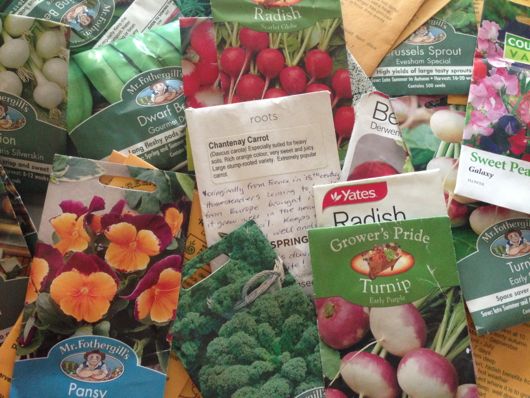
Hanno prepared one of the garden beds with manure and organic matter and he has another one dug over and weeded. When the rain stops, that will be were the root vegetables go as they don't like rich soil with manure. This year's root crop will be Derwent Globe beetroot, Chantenay carrots (sent by my good friend Sherri in Canada), Early Purple turnips, Gentle Giant radish and Miyashinge Daikon radish. We'll probably put in a few potatoes too. We eat celeriac, swede (rutabaga) and turnips but they don't grow well here so we'll continue to buy them. We want to put in climbing Lazy Housewife beans and dwarf beans at their base, along with some sugar snap peas. They'll have to wait for the rain to ease off too because they'll rot in the ground if the soil is too wet.


If you're keeping an eye on your money, the cheapest way to grow vegetables if to use heirloom seeds. Heirlooms come in a huge range of different vegetables and at the end of the season you can save the seeds from your best plants and keep them going the following year. If you do it right, you only have to buy one lot of seeds, not new seeds every year. This is how we all use to garden way back when. It's cheap using F1 or hybrid seeds too but you can't save those seeds for the following years. They won't grow true to type. If you can get your hands on heirloom seeds, you'll be on your way to some fine frugal vegetables.  If you happen to have seeds at home now and you're not sure if the seeds are alive, read this post I did a few years ago and test them for viability.

The best way to store seeds is to package them tightly in their own packet and put as many of the packs into a sealable jar as you can. Then place that in the fridge. They'll keep well for a few years. They'll also store well in the freezer but if you freeze them, do it in a plastic container.


The capsicums/peppers and chilli bushes are growing well and into that bed I think Hanno will add mushroom compost and manure and plant the Moneymakers I've just sown. He has planted two seedlings of Moneymaker that we bought at the market and hopefully they'll be producing fairly soon. What a disappointment the shop tomatoes are. When you're used to the freshest home grown produce, it's a big step down in quality when you have to buy weekly fruit and vegetables. A friend up the road, Fairy at Organised Castle blog rang to tell me she'd leave some Lebanese cucumber seedlings at the gate early Monday morning. Sure enough, they were there and survived sitting out in the rain nicely in their tray and plastic covering. That will save me sowing any cuc seeds and I'll have some to give to Sunny as well.


Our greens include silverbeet, sugarloaf cabbage, red cabbage, Lombok cabbage, Portuguese cabbage, the curly kale already planted and Great Lakes lettuce. It's really a cold climate lettuce but it does well enough here without developing the solid heart. I love it for its crispiness and sharp crunch.

This year's vegetable garden flowers include Queen Anne's lace - for attracting beneficial insects, nasturtiums - for salads, compost material and just for the sheer beauty of the flowers. I have a beautiful pale yellow type with a red centre called Peach Melba. It's so pretty. I still have calendulas in and hopefully some will self-seed as well, I'll have to keep an eye open for them because a certain over zealous gardener sometimes whips out self-sown plants along with the weeds.  I want to pot up a couple of hanging baskets too. I have Jolly Joker pansies and Alyssum Snow Cloth here so I think they'll look beautiful hanging off the side of the bush house. Later in the season, I'll plant up some sunflowers for the chooks and wild parrots.

If your sweet potato starts to sprout, allow the shoot to grow long, then plant them in the garden. You'll probably get a really good harvest.

After a lot of thought, we've changed the way we grow certain plants. Although we still grow tomatoes in the ground, and that is where you always get the best yield, we're also growing some in pots. With the weather so unpredictable, I want to be able to move some tomatoes so if there is a lot of rain we can have them under shelter, or a prolonged drought, we can easily keep the water up to them. I've also moved the thyme and oregano, both in pots, over to the bush house along with the potted blueberries. When the rain stops, I'll get out there, make a small ornamental garden on the corner of the bush house near the sand pit, and then scatter the potted plants around that new garden. It keeps them in one zone where I can keep and eye on them, they're sheltered during winter. I'll add a bit of colour to that zone by planting up a large pot of Sweet Peas - Galaxy, a scented pea. 

We have plenty of compost, straw, comfrey, seaweed extract, manures, water and enthusiasm and we're ready to go. It feels more important than ever to grow our own vegies this year. Food gardening has the potential to save us all so it's good you know how to do it, or you're learning how to. I know many of you join us every year in this journey into self-reliance and I'm guessing there are more and more new gardeners raising their first crops this year. No matter what category you fall into I hope you have a lot of fun in your garden, learn plenty and enjoy abundant harvests. If you need help with your planting and want to ask a question, we have a special section over at the Down to Earth forum. I drop in there most days and will answer questions but there are many excellent gardeners there who will be happy to help you along.

I was asked by a reader the other day why I don't do more posts on budgeting and frugal living. There are three reasons: 
  1. The mindset of frugality is as important as how you spend your money. I think I could write about cutting back, paying off debt and wise economy until the cows came home but unless you really "get it" nothing much is going to change. 
  2. Budgeting and frugality are carried out in the context of each life. I understand fully how my own finances work. I know that by doing certain things, we can live well on our pensions and on what I earn and save money every week. While many of you would have budgets similar to ours, most people don't and I don't pretend to know what it's like in 2013 to rent a home, pay off a mortgage or be unemployed and desperately want a job
  3. There is a limit to how much I want to think about money.
Saving money is a life-long activity. While you're moving through life and paying off your home or rent, and all the other things we need through the years, you also need to make provision for your later life. It wasn't so long ago that life in retirement was very short. The idea of having a pension after the age of 60 or 65 came about when most people lived till they were about 70. Times have changed and it's becoming quite clear that most governments won't be able to pay the living costs of all their elderly citizen much longer.  I think that in Australia, when people start retiring after having worked their entire working life paying into a superannuation scheme (pension/401K), the government will start cutting back on age pensions.  Let's face it, many of us will live into our 80 and 90s, not the 70 year mark the pensions were meant to support. Compulsory superannuation was introduced into Australian workers' lives in 1992, so, in theory, all those people who started full time work after 1992 should have enough money on which to retire when they're 65 or 70. A lot of those funds are invested in the stock market. Of course, we all know that things don't always go according to plan. We're slowly emerging from the GFC which started in 2008. Self-funded retirees I know who thought they'd planned well and invested well via their superannuation fund, lost a lot of money in the stock market and ended up almost broke. Luckily Australia has the age pension which acts as a safety net for our citizens.

I don't think anyone should work until they drop but we all have to do our fair share of the work. It makes sense to me to work until you have enough on which to live then you stop paid work, whenever that may be. Our government is encouraging older Australian to work longer and put off retirement. From what I can tell when I ask around, my contemporaries tell me there are no jobs for older people and the jobs that are there always go to the younger folk.


In the past I've talked about a lot of ways to help cut back, pay off the mortgage and save enough for later life. I'm not going over it again because you either have the mind to do it or you don't. Me writing about it here on a continuing basis won't make anyone who is inclined to spend, pay off debt.


I will say though that if you do cut back, make do with what you have, develop a frugal mindset, be prepared to give up working for a living and then start working for a life, you might find yourself where Hanno and I are now.  We might have given up work but we haven't given up working. Not all work must be done in an office, a factory, a shop, a hospital, or a school. Many people make their living from home and even when they don't make as much money as they would working full time in their old job, they turn their backs on 2013 desires, have the time to grow food in the backyard, to shop for specials, to stockpile and cook from scratch. All those things help reduce the cost of living.


I have had some wonderful emails recently from young couples who have either just left the traditional workforce, or are about to. And please don't write in and tell me that if everyone did that the economy would collapse. I am so proud of those people who have confidence in their own abilities, who decide to step back from the mainstream and who believe in themselves and in how they want to live. I know it's not for everyone but for those who chose it, it's a wonderful and enriching way of living.


And after all that carry on above, if you were to ask me what my money advice is, it is this:
  • Buy only what you can afford to pay for in cash.
  • Have an emergency fund.
  • Forget about fashion, style and keeping up with the Joneses. The Joneses are probably up to their eyeballs in debt, and style and fashion as such fleeting, inconsequential things.
  • Stop watching advertising on TV.
  • Stop shopping online and in the shops.
  • Believe in yourself - you're probably much stronger than you think you are.
There were a few requests for the cinnamon rolls recipe so here is where I found it.  I didn't use their cream cheese icing though, my icing was a mixture of icing sugar, a little melted butter and lemon juice.


Last week I wrote about vegetable garden preparation, maintenance and production but there are many other parts of gardens that are interesting enough to write about. All gardens are a complete little ecosystem and if you want to plant, make the area productive or just sit, you need to take in what goes on out there. Gardens are safe havens for birds, reptiles, spiders and insects. In suburbia, gardens provide useful watering holes, hollow spaces for living, shelter from the weather and hiding places from pets, other wildlife and people.

You can hardly see them here but there are two tiny finches drinking from this container we keep filled with water for the birds.
When Alex and Jamie first started walking, the backyard was where they both wanted to be. Here you can see Hanno showing Alex through the garden.

If you have children, the backyard can be one of the best playgrounds. When my sons were growing up, they spent a lot of time in the backyard swinging on ropes and a homemade swing, watching the chickens, riding bikes, playing games, camping in the background and, on the rare occasions when it rained, running like super charged maniacs through the water that would pool in the backyard. I often think they were lucky to be born when they were. They had an old-fashioned childhood like I did, full of exploring, physical activity, camping out, riding bikes and playing with their friends. Later on in their childhood, computers came into our lives and from the age of seven and eight, there were computer games, but they were so basic and primitive that they didn't keep them glued to the screen. They were just a small part of life.

Now, with our two beautiful grandsons, we're setting up for children again. Hanno built a sandpit that is covered when not in use and we bought a standard little wading pool for the very hot days. The water from that comes from the tank, and when the swimming is over, the water is transferred, via watering cans, to the garden.

We share this land with a family of about 11 kookaburras. They often visit and watch us as we watch them. There is a family of magpies as well, they sneak in and eat Hettie's food when she's not there.

One of the many things I hope to show Jamie and Alex in the coming years is the amazing variety of insects, spiders, reptiles and birds we have in our backyard. Of course, we'll talk about their safety, as well as the respect, gentleness, water and food these creatures need. Much of it we can provide for them in a natural setting. There is a strip of remnant rainforest running along the creek and that provides habitat for many creatures that visit our backyard. We often hear the cries of Sacred Kingfishers and whip birds and sometimes we'll see a water dragon sunning itself on a tree stump. We must teach our boys not to be afraid, to be wary and respectful and that we share this land with all wild things.


When we first came to live here, we had to orient ourselves to the rising sun in summer and winter, take notice of where strong winds, rain and violent storms came from and, in the hottest months, where the shade and the coolest parts of the garden were. Our chooks taught us both of those places because that's where they went when it was hot. Our chooks live in a fairly secure coop that is rain and wind-proof so their backyard environment is comfortable and safe.

When it rains heavily, watch to see where the water pools and runs off.

Before we set up the garden, we had to know about our soil and where the water pooled in heavy downpours and prolonged rain - something we hadn't been used to in our last home but is quite common here. Hanno did quite a bit of work putting in underground drainage that ran down to our creek. When we moved in we knew the creek hadn't flooded into our backyard in living memory, but we had to live here for a few years before we knew we were safe because the overflow on the other side of the creek was much lower than our side and the flooding rains went there into paddocks instead of into our backyard and home.

Above is our bush house and the water tank we put in when we first came to live here. Below is a 10,000 litre tank we installed a few years ago.
Very early on we decided to put in water tanks. We thought that if we were going to plant a garden that we should be responsible to collect water to irrigate it, so our first tank went in soon after we arrived. A few years ago we added another tank, double the size, and soon we'll add another space saving, narrow tank that can butt up against the wall at the side of the house. With the average amount of rainfall we get now, those three tanks should do us for the front and back gardens in the foreseeable future.

In the bottom left of this photo you can see part of the bench Hanno and I sit on to watch what's going on in the garden. When the sun fades into the west, this is the prime location in our garden.


Backyards can be so many things but one of the most important parts of ours is a place to sit, relax, think and observe.  We don't have enough seating areas but we're working on that. My main seat at the moment is a simple bench Hanno made from recycled timbers, that is under the elder tree. It faces the vegetable garden and chook house so whenever I sit there I have more than enough to look at. Soon we'll move a cast iron table and chairs over near the sand pit so whoever is looking after the littlies will have a table on which to put a sippy cup or a cup of tea and maybe a magazine or seed catalogue. One thing is for sure, a good garden evolves into being its best. You don't move in and buy everything you need in one hit. It takes a few years of observation and living there to see what the garden needs and what to leave alone. And when you get it set up, don't be afraid to change it. Our backyard changes when it needs to. We've put in fences, taken them down again, started with a smaller garden than we have now and, no doubt, that will change in the future. We also bought things when we could afford them. You and your garden will change with your seasons and nature's seasons.

So if you're about to set up a garden in your backyard, or if you have one that isn't working as well as it might, take some time to walk around and observe where the shade is, where the sun rises and sets, where the water pools in the rain, where the natural runoffs occur. Make sure you check your fences and boundaries because runoff from a neighbouring property might cause a problem in your yard. Having a productive backyard is much more than just planting seeds and weeding. Your backyard is a haven, not only for the wildlife but for family life as well.

Just a quick post to let you know that my dil Sarndra is having a "giveaway" on her Facebook page. Sarndra explains what that is on her page. Click here to go there. It ends this evening (Sunday) at 6.59pm Australian Eastern time - that's about 11 hours from now. Good luck everyone!
Externalities - A short film (4 mins) by David Suzuki. Thanks to Sarndra for the link.

Humanise it - Seth Godin

The price we pay

How to make a clock

Simple cleaning tips

Too old to work?

Sleeping babies

Bellis in Brisbane, a subtropical garden

Another new virus

FROM COMMENTS HERE DURING THE WEEK

Thistlebear

Little Retro House

Vintage Folk Painter

There is so much going on in the backyard right now that it's inspired me to continue with the backyard posts next week. I hope you have a lovely weekend doing exactly what you want to do. See you next week!
Newer Posts Older Posts Home

ABOUT ME

Down to Earth is a blog by Rhonda Hetzel, dedicated to simple, intentional living — from home cooking and gardening to frugal budgeting and handmade crafts. It’s a space for gentle inspiration and everyday wisdom on creating a life that feels real, balanced, and deeply fulfilling.

Down To Earth Book

Down To Earth Book
My books are all published by Penguin. Down to Earth, The Simple Life and The Simple Home have been in book shops since they were published in 2012, 2014 and 2016, respectively. On 20 October 2020, Down to Earth was published as a paperback.

MY FAVOURITE PLACES

  • Grandma Donna's Place
  • Grandma Donna's YouTube
  • Grandma Donna's Instagram
  • This Simple Day
  • Nicole's Instagram

Popular Post of All Times

Making ginger beer from scratch

We had a nice supply of ginger beer going over Christmas. It's a delicious soft drink for young and old, although there is an alcoholic version that can be made with a slight variation on the recipe. Ginger beer is a naturally fermented drink that is easy to make - with ginger beer you make a starter called a ginger beer plant and after it has fermented, you add that to sweet water and lemon juice. Like sourdough, it must ferment to give it that sharp fizz. To make a ginger beer plant you'll need ginger - either the powdered dry variety or fresh ginger, sugar, rainwater or tap water that has stood for 24 hours to allow the chlorine to evaporate off. You'll also need clean plastic bottles that have been scrubbed with soap, hot water and a bottle brush and then rinsed with hot water. I never sterilise my bottles and I haven't had any problems. If you intend to keep the ginger beer for a long time, I'd suggest you sterilise your bottles. MAKING THE STARTER In a...
Image

The last post

This will be my last post here.  I've been writing my blog for 18 years and now is the time to step back. I’ve stopped writing the blog and come back a couple of times because so many people wanted it, but that won’t happen again, I won’t be back.  I’ll continue on instagram to remain connected but I don’t know how frequent that will be. I know some of you will be interested to know the blog's statistics. 
Image

How to make cold process soap

I'm sure many of you are wondering: "Why make soap when I can buy it cheaply at the supermarket?" My cold process soap is made with vegetable oils and when it is made and cured, it contains no harsh chemicals or dyes. Often commercial soap is made with tallow (animal fat) and contains synthetic fragrance and dye and retains almost no glycerin. Glycerin is a natural emollient that helps with the lather and moisturises the skin. The makers of commercial soaps extract the glycerin and sell it as a separate product as it's more valuable than the soap. Then they add chemicals to make the soap lather. Crazy. Making your own soap allows you to add whatever you want to add. If you want a plain and pure soap, as I do, you can have that, or you can start with the plain soap and add colour, herbs and fragrance. The choice is yours. I want to add a little about animal and bird fat. I know Kirsty makes her soap with duck fat and I think that's great. I think t...
Image

Preserving food in a traditional way - pickling beetroot

I've had a number of emails from readers who want to start preserving food in jars but don't know where to start or what equipment to buy.  Leading on from yesterday's post, let's just say up front - don't buy any equipment. Once you know what you're doing and that you enjoy preserving, then you can decide whether or not to buy extra equipment. Food is preserved effectively without refrigeration by a variety of different methods. A few of the traditional methods are drying, fermentation, smoking, salting or by adding vinegar and sugar to the food - pickling. This last method is what we're talking about today. Vinegar and sugar are natural preservatives and adding one or both to food sets up an environment that bacteria and yeasts can't grow in. If you make the vinegar and sugar mix palatable, you can put up jars of vegetables or fruit that enhance the flavour of the food and can be stored in a cupboard or fridge for months. Other traditional w...
Image

Cleaning mould from walls and fabrics

With all this rain around we've developed a mould problem in our home. Usually we have the front and back doors open and that good ventilation stops most moulds from establishing. However, with the house locked up for the past week, the high humidity and the rain, mould is now growing on the wooden walls near our front door and on the lower parts of cupboards in the kitchen. Most of us will find mould growing in our homes at some point. Either in the bathroom or, in humid climates, on the walls, like we have now. You'll need a safe and effective remedy at some point, so I hope one of these methods works well for you. Mould is not only ugly to look at, it can cause health problems so if you see mould growing, do something about it straight away. The longer you leave the problem, the harder it will be to get rid of it effectively. If you have asthma or any allergies, you should do this type of cleaning with a face mask on so you don't breathe in any spores. Many peopl...
Image

Five minute bread

Bread is one of those foods that, when made with your own hands, gives a great deal of satisfaction and delight. It's only flour and water but it symbolises so much. I bake bread most days and use a variety of flours that I buy in bulk. Often I make a sandwich loaf because we use most of our bread for lunchtime sandwiches and for toast. Every so often I branch out to make a different type of loaf. I have tried sour dough in the past but I've not been happy with any of them. I'll continue to experiment with sour dough because I like the idea of using wild yeasts and saving the starter over a number of years to develop the flavour and become a part of the family. However, the loaf I've been branching out to most often is just a plain old five minute bread. By five minutes I mean it takes about five minutes actual work to prepare but it's the easiest of all bread to make and to get consistently good loaves from. If you're having people around for lunch or...
Image

This is my last post.

I have known for a while that this post was coming, but I didn't know when. This is my last post. I'm closing my blog, for good, and I'm not coming back like I have in the past.  I've been writing here for 16 years and my blog has been many things to me. It helped me change my life, it introduced me to so many good people, it became a wonderful record of my family life, it helped me get a book contract with Penguin, and monthly columns with The Australian Women's Weekly and Burke's Backyard . But in the past few months, it's become a burden. In April, I'll be 75 years old and I hope I've got another ten years ahead. However, each year I'll probably get weaker and although I'm fairly healthy, I do have a benign brain tumour and that could start growing. There are so many things I want to do and with time running out, leaving the blog behind gives me time to do the things that give me pleasure. On the day the blog started I felt a wonderful, h...
Image

What is the role of the homemaker in later years?

An email came from a US reader, Abby, who asked about being a homemaker in later years. This is part of what she wrote: "I am a stay-at-home mum to 4 children, ages 9-16. I do have a variety of "odd jobs" that I enjoy - I run a small "before-school" morning drop-off daycare from my home, I am a writing tutor, and I work a few hours a week at a local children's bookstore. But mostly, I cherish my blissful days at home - cooking, cleaning (with homemade cleaners), taking care of our children and chickens and goats, baking, meal-planning, etc. This "career" at home is not at all what I imagined during my ambitious years at university, but it is far more enriching. I notice, though, that my day is often planned around the needs of my family members. Of course, with 4 active kids and a husband, this is natural. I do the shopping, plan my meals, cook dinner - generally in anticipation of my family reconnecting in the evening.  I can't h...
Image

Every morning at home

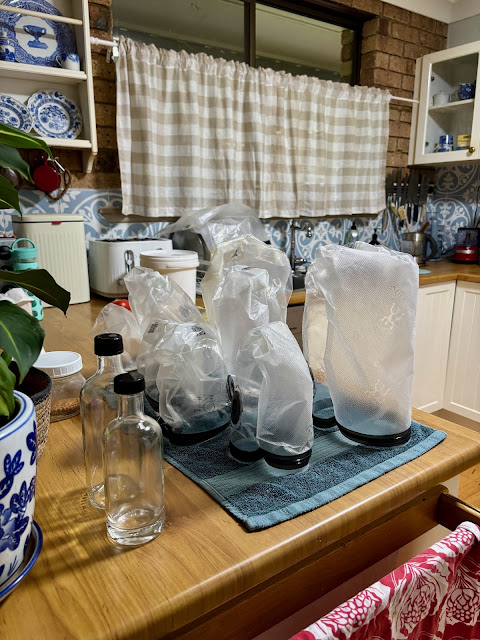
Every morning when I walk into my kitchen it looks tidy and ready for a day's work. Not so on this morning (above), I saw this when I walked in. Late the previous afternoon when I was looking for something, I came across my rolled up Zwilling vacuum bags and decided they had to be washed and dried. So I did that and although I usually put them outside on the verandah to dry it was dark by then. I turned the just-washed bags inside out and left them like this on a towel. It worked well and now the bags are ready to use when I bring home root vegetables, cabbages or whatever I buy that I want to last four or five weeks.
Image

You’ll save money by going back to basics

When I was doing the workshops and solo sessions, I had a couple of people whose main focus was on creating the fastest way to set up a simple life. You can't create a simple life fast, it's the opposite of that It's not one single thing either - it's a number of smaller, simpler activities that combine to create a life that reflects your values; and that takes a long to come together. When I first started living simply I took an entire year to work out our food - buying it, storing it, cooking it, preserving, baking, freezing, and growing it in the backyard. This is change that will transform how you live and it can't be rushed.  
Image

Categories

  • Backyard 244
  • Being Organised 257
  • Books 9
  • Budgeting 142
  • Chickens 42
  • Community life 289
  • Family 269
  • From Scratch 63
  • Grandmothering 69
  • Home 296
  • Individuality 185
  • Mentoring 55
  • My books 49
  • Organic Gardening 348
  • Preserving 97
  • Recycling 22
  • Retirement 22
  • Self Reliance 160
  • Simple Living 777
  • Sustainability 308
  • This blog 107
  • Weekend reading 362
  • Writing 4

Followers

Trending Articles

The last post

This will be my last post here.  I've been writing my blog for 18 years and now is the time to step back. I’ve stopped writing the blog and come back a couple of times because so many people wanted it, but that won’t happen again, I won’t be back.  I’ll continue on instagram to remain connected but I don’t know how frequent that will be. I know some of you will be interested to know the blog's statistics. 
Image

Making ginger beer from scratch

We had a nice supply of ginger beer going over Christmas. It's a delicious soft drink for young and old, although there is an alcoholic version that can be made with a slight variation on the recipe. Ginger beer is a naturally fermented drink that is easy to make - with ginger beer you make a starter called a ginger beer plant and after it has fermented, you add that to sweet water and lemon juice. Like sourdough, it must ferment to give it that sharp fizz. To make a ginger beer plant you'll need ginger - either the powdered dry variety or fresh ginger, sugar, rainwater or tap water that has stood for 24 hours to allow the chlorine to evaporate off. You'll also need clean plastic bottles that have been scrubbed with soap, hot water and a bottle brush and then rinsed with hot water. I never sterilise my bottles and I haven't had any problems. If you intend to keep the ginger beer for a long time, I'd suggest you sterilise your bottles. MAKING THE STARTER In a...
Image

Time changes everything

I've been spending time in the backyard lately creating a contained herb and vegetable garden. My aim is to develop a comfortable place to spend time, relax, increase biodiversity and encourage more animals, birds and insects to live here or visit. Of course I'd prefer my old garden which was put together by Hanno with ease and German precision. Together, we created a space bursting at the seams with herbs, vegetables and fruity goodness ready to eat and share throughout the year. But time changes everything. What I'm planning on doing now, is a brilliant opportunity for an almost 80 year old with balance issues. In my new garden I'll be able to do a wide range of challenging or easy work, depending on how I feel each day. It’s a daily opportunity to push myself or sit back, watch what's happening around me and be captivated by memories or the scope of what's yet to come.
Image

The most wonderful news

This post will give me more joy to write than anything else I could think of today.  I told you  there are a few exciting things happening here at the moment, well, I am now able to tell you the most exciting one of them.  Our son Kerry and his beautiful partner Sunny are having a baby!  Hanno and I will be grandparents in late March.  I can barely believe my eyes when I read what I have just written.  This is one of my original stitchery patterns. This wasn't planned but it's welcomed wholeheartedly by all of us.  Both Kerry and Sunny are hard workers and now that they have a baby to love and care for, they've decided it's time to buy an apartment together.  Sunny is going home to Korea to tell her family and when she comes back again, the search will start to find their first home together.  We are all so excited!  My knitting has taken on a life of its own and when I think of all the projects I could start, my head spins.  Thi...
Image

About Blog


Down to Earth is a blog by Rhonda Hetzel, dedicated to simple, intentional living — from home cooking and gardening to frugal budgeting and handmade crafts. It’s a space for gentle inspiration and everyday wisdom on creating a life that feels real, balanced, and deeply fulfilling.

Last Year's Popular Posts

The last post

This will be my last post here.  I've been writing my blog for 18 years and now is the time to step back. I’ve stopped writing the blog and come back a couple of times because so many people wanted it, but that won’t happen again, I won’t be back.  I’ll continue on instagram to remain connected but I don’t know how frequent that will be. I know some of you will be interested to know the blog's statistics. 
Image

Every morning at home

Every morning when I walk into my kitchen it looks tidy and ready for a day's work. Not so on this morning (above), I saw this when I walked in. Late the previous afternoon when I was looking for something, I came across my rolled up Zwilling vacuum bags and decided they had to be washed and dried. So I did that and although I usually put them outside on the verandah to dry it was dark by then. I turned the just-washed bags inside out and left them like this on a towel. It worked well and now the bags are ready to use when I bring home root vegetables, cabbages or whatever I buy that I want to last four or five weeks.
Image

You’ll save money by going back to basics

When I was doing the workshops and solo sessions, I had a couple of people whose main focus was on creating the fastest way to set up a simple life. You can't create a simple life fast, it's the opposite of that It's not one single thing either - it's a number of smaller, simpler activities that combine to create a life that reflects your values; and that takes a long to come together. When I first started living simply I took an entire year to work out our food - buying it, storing it, cooking it, preserving, baking, freezing, and growing it in the backyard. This is change that will transform how you live and it can't be rushed.  
Image

Workshops update

  This photo shows what the weather's been like here.  That's steam coming off my neighbours shed roof after a brief downpour of rain.  I hope we’re getting closer to organising these workshops. I didn’t explain this clearly enough: Group 1 is four workshops, Group 2 is four workshops. Out of those eight workshops I thought we probably end up doing three or four.
Image

Creating a home you'll love forever

Living simply is the answer to just about everything. It reduces the cost of living; it keeps you focused on being careful with resources such as water and electricity; it reminds you to not waste food; it encourages you to store food so you don't waste it and doing all those things brings routine and rhythm to your daily life. Consciously connecting every day with the activities and tasks that create simple life reminds you to look for the meaning and beauty that normal daily life holds.  It's all there in your home if you look for it. Seemingly mundane tasks like cleaning and cooking help you with that connection for without those tasks, the home you want to live in won't exist in the way you want it to.  Creating a home you love will make you happy and satisfied.
Image

Time changes everything

I've been spending time in the backyard lately creating a contained herb and vegetable garden. My aim is to develop a comfortable place to spend time, relax, increase biodiversity and encourage more animals, birds and insects to live here or visit. Of course I'd prefer my old garden which was put together by Hanno with ease and German precision. Together, we created a space bursting at the seams with herbs, vegetables and fruity goodness ready to eat and share throughout the year. But time changes everything. What I'm planning on doing now, is a brilliant opportunity for an almost 80 year old with balance issues. In my new garden I'll be able to do a wide range of challenging or easy work, depending on how I feel each day. It’s a daily opportunity to push myself or sit back, watch what's happening around me and be captivated by memories or the scope of what's yet to come.
Image

Simple life workshops on Zoom UPDATED

I've added more topics to the list. This post is for those readers who expressed interest in doing online Zoom workshops or who want to register now. The topics haven't been chosen yet but potential topics are:  vegetable gardening and composting; starting a vegetable garden and choosing vegetables suitable for a beginner;  cutting costs in the home, housework and routines; homemade laundry liquid and powder, soaking, stain removal and washing clothes and household linens; cooking from scratch and building your pantry to help you do it; homemade bread - white, rye, wholemeal and ancient grains. I'm not doing sourdough; living on less than you earn and developing a frugal mindset.
Image

Labels

  • Bartering
  • Chickens
  • Community life
  • Food security
  • From Scratch
  • Home Maintenance
  • Homemaking
  • Mentoring
  • My favourite place
  • Recipes - savoury
  • Reminders of what is important to us
  • Simple Living
  • The Simple Home - June
  • The Simple Home - May
  • Utilities
  • Wise Economy

Copyright © Down To Earth. Designed by OddThemes