down to earth
  • Home
  • About Us
  • Down To Earth Book
  • Privacy Policy
It was a typical day here yesterday although the summer sun was shaded by thick clouds and heavy rain. I love days like that, knowing that the rain will pour down, making me feel cosy and safe. I rose at 4am and checked the blog.  Nothing much to be done there so I had a chance to look in my Reader and go visit a few of my favourite bloggers. Emails were waiting too I answered about 10 of them then realised I could be there all day, so I went to the kitchen and put on some oats for breakfast. While they cooked, I went outside, talked to our blue parrot boarder Chiko, fed Hettie and then, with umbrella in hand, walked out across the wet grass to let the chooks out. They went a bit mental when they saw the umbrella - so I put it down while they ran passed me, then collected an egg and walked back inside.
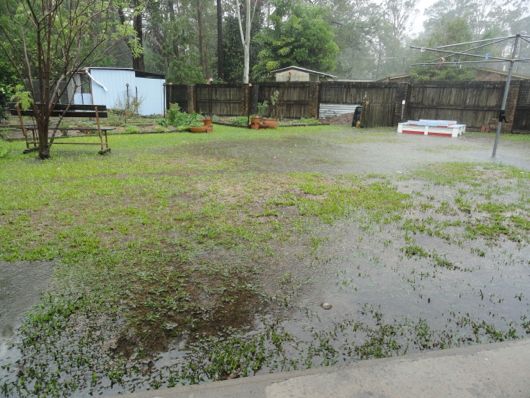
Remember that parched backyard I took a photo of a few days ago. Well, this is it yesterday afternoon.

I love stirring food at the stove. It is a quiet and slow activity that allows me to think. I stood there stirring the porridge and thought about the rain falling on our roof, how it was cleaning out the creeks and rivers, filling up tanks and dams and how much we all rely on rain to keep us alive. Meteorologists are predicting increasing severe weather events due to climate change. There have been catastrophic summer floods here for the past three years. So as I stood there stirring, with the rain pelting down on the roof, I made a silent vow to cut back on everything that isn't necessary and to encourage others to do that too. With the hot porridge in a bowl, I poured on some milk and honey, made a cup of black tea and enjoyed my breakfast. Hanno was still in bed listening to the flood updates and enjoying the sound of rain on the roof.

This is our creek, it went from almost empty and stagnant, to this overnight. We can usually walk around where you can see the water. The bottom of the photo is at the level of our backyard so if it rose another couple of feet, we'd be flooded. Luckily, I can't see that happening.

We've had 421mm/16½ inches as of 3pm yesterday afternoon. Certainly enough to fill many rivers and dams and here, our tanks are full, the grass is turning green in front of our eyes and it's a magnificent boost for our fast approaching main vegetable planting. We had wind gusts overnight that sounded like freight trains rushing past. I hope it settles down today and that everyone to the north and south of us are safe.

And now my exciting news! Kerry, Sunny and Jamie are moving back here to the Sunshine Coast. Yesterday was to be the day, but it was too wet and dangerous to even think about it. So the move is on today, I think. Kerry has lined up a couple of friends to help pack the hired truck and Jens will help at this end. Hanno will travel down to the Gold Coast on the train this morning to help Sunny with her car. She's not used to driving on the highway and with Jamie and the wet conditions, Hanno offered his help to drive her here. So if all goes according to plan, the truck will be packed by about lunchtime, Hanno, Sunny and Jamie will drive up in the car and Kerry will follow in the truck. The'll all come here for something to eat and drink, unload some of their gear here in our big shed, then Kerry and Sunny will take the truck and car the few kilometres over to their new home. They're renting a house from a family friend about 15 minutes away. Jamie will stay here with us for the afternoon while Kerry and Sunny get everything settled in their new home.  :- )

I am so happy they'll be close. No more 400 km trips when we want to see them. We'll be able to help with Jamie if we're needed, they'll be there if we need them and we'll be close for Sunny while Kerry's away at work. He's working away two weeks on and two weeks off. We won't be living in each others' pockets, none of us want that, but we'll be close enough to offer help in the difficult times, to have family lunches every so often and to see Jamie grow up. And I'm sure all the other grandmas and grandpas will know how that feels.

Happy Australia Day to all my fellow Australians! We're all lucky to live in this great country. I hope you have the chance to celebrate that today.

Here is a little extra weekend reading to help brighten your day. I hope you enjoy it as much as I did.
Ladies and gentlemen, we have rain. It started early yesterday morning and rained gently all day; the heavier rain came overnight. We got about 30mL yesterday, I haven't checked the rain gauge yet but I'm guessing it would be up to 100mL/4 inches by now. All the tanks are full. 

There is a monsoon low bringing the rain right down the coast from an ex-tropical cyclone. I know there has been flooding up north. We have many readers in Cairns, Townsville, Mackay, Rocky and Gladstone. I've been watching the weather radar because Shane and Sarndra live in Gladstone now. Rockhampton and Gladstone been covered in green and yellow rain for nearly 24 hours. I hope you are all safe and sound up there. And for those of you south of us, I hope you get your fair share of this wonderful rain. The sound of rain on the roof  is one of the best sounds I know. 

- - ☂- - ☂- - ☂- -

Building community in your neighbourhood

The Sufficiency Economy

Counterspill - take action

Stickman - this is my type of computer game :- )

Nigel's eat well for less recipes

Paying less

How to make a $4 wool nappy cover/soaker from a blanket

FROM OUR COMMENTS DURING THE WEEK

Mrs Dishpanhands

The happy larder

At my September cottage
Like many Australians, I watched Food Inc. the other night when it aired on TV here. I'd already seen the DVD of it a couple of years ago but it did me good to see it again. If nothing else, as our ex-prime minister Gough Whitlam asked of us, it helped me to "maintain the rage". And watching it again certainly helped me do that. If you haven't seen this documentary and you're in Australia, it's on SBS On Demand for another four days.  For those who haven't seen it, it's an account of the unsustainable and unhealthy practices in parts of the food industry in the USA; but the conditions discussed are happening in many Western countries, not just the USA. It features Michael Pollan, Joel Salatin and Eric Schlosser.


The program examines unhygienic conditions in feed lots, the large increase in the number of E.coli and other bacterial food contaminants, appalling factory conditions worked by illegal immigrants - with a blind eye from the authorities, how the cheap price of food does not reflect its real price, how the meat processing business has moved from having many participating and often local players to now being in the hands of four huge corporations, how Monsanto sues farmers for saving their own corn and soybean seeds, how food labelling laws are set to deceive rather than inform, and much, much more. When you see it for the first time it's shocking and very confronting. When I saw it again I was just plain mad.

It took me a while to work out how to discuss this in a sane and rational way. The subject is so emotive and the program is difficult to watch because it shows animal cruelty and the unbearable conditions cattle and chickens are routinely kept in. We keep our own animals and chickens in good conditions,  but I felt real shame that we've (all of us) allowed the conditions some farm animals are kept in to build over the years and not done anything about it. Many would argue that not much can be done, that these corporations are so powerful that nothing will stop them but I don't believe that. Our dollars will stop them.


Every time we shop, we vote with our money. Every single time. All potential customers with money to spend have the power to keep a product going or to bring it down. Buying isn't just about the product we choose, it's also about those we don't choose. By not choosing local products, slowly, the local businesses die off. That has already happened in Australia, and probably many other countries too.

The main decision I made when watching Food Inc is to support my local businesses as much as I can and to cut down on buying meat. Now I'm buying free range and organic meat only and to make up for the cost of that, I'm buying the cheaper cuts and we're eating less of it. It's the only way we can do it. I know it will be difficult at times but doing nothing is no longer an option for me. I don't approve of the way that animals and chickens are treated; I want food labelling to change; I don't think that higher profit margins justify cruelty; I think we have to get used to the fact that there is no such thing as never-ending economic growth. Not buying cheap meat and foreign foods will send that message.

I should have done it sooner.


We need to think about the environment more. We know the climate is changing but many people think it's up the "the government" or "them" to do something about it. When I saw those huge feedlots and thought about all the methane going up into the air, it almost made me weep. The faecal waste of piggeries and chicken farms floating down what were once clean waterways made me feel sick. We all have to make our own changes - we have personal responsibility in this. The buck stops with all of us.

I'm not going to harp on and on about this except to say out loud: every time you shop, you vote with your money. Please think about that. I'd rather hand my money over to farmers who treat their animals well, who harvest organic or local foods and who are more interested in producing fresh, heathy food than in what a faceless stockholder will think. We may not always eat in the way we used here in my home but I can no longer be part of the shopping majority who keep these conditions going.

Thank you for all the kind and encouraging comments yesterday. It seems that what I thought is a localised drought is being felt world-wide.

- - - ♥- - - 

I haven't had a lot of time for knitting lately but every time I sit down, there I am, clicking away. Knitting is such a pleasure for me because I make household cloths I can't buy, make gifts that are unique and it gives me something to do when I sit down, so I feel productive. Knitting isn't something I make time for as a craft, I see it as part of my day-to-day housework, so I knit most days. I use the beautiful yarns from Vivian at Eco Yarns. Their organic cotton is the best I've ever worked with. I'm also using her super fine merino in fingering weight and NZ royal lambs wool for a scarf and matching arm warmers for my sister Tricia. It was her birthday on Saturday so when she arrived here yesterday afternoon, I had a nice little parcel for her.

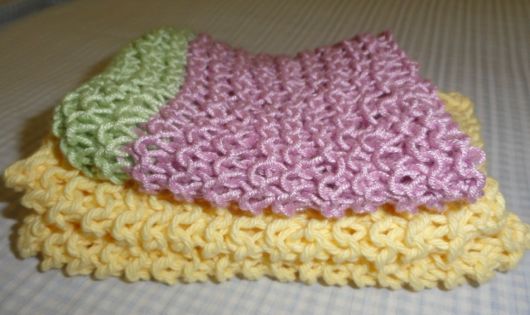
This top dishcloth is bamboo, the bottom two are pure cotton. All were made using the end pieces and scraps from my yarn stash.

I went through my yarn stash over Christmas and pulled out all the odd and ends. I'm using all of them in the coming weeks to knit up another set of dishcloths. I'd like another 10 so I can retire some of the older ones. When I first started off on the dishcloths, I always used 8ply pure cotton, now I prefer a lighter cloth for washing up. I've knitted up a few of the bamboo scraps and they make a light and useful cloth. They're very soft, fit easily into wine glasses and small sippy cups and they dry out quickly. I've also done a couple of 4 ply cloths on large needles. Using only plain stitch, I get through one in a couple of hours. While I love the look of the fancy dishcloths, and when I give them as a gift I always do up Deb's waffle weave pattern, my own preference is a much simpler cloth. I always do my own cloths in plain garter stitch.

Tricia's pure NZ wool scarf - almost finished.

Are you a knitter? I know very many readers of my book started knitting dishcloths even before they finished the book, and wrote to tell me about it. I think dishcloths and laundry liquid were the first two projects most people tried. I certainly received a lot of mail telling me about grandmas teaching knitting years ago and now this! A welcomed return to knitting via the dishcloth. To me, dishcloths and aprons are symbols of this way of life. They're homemade, simple and part of every productive home. Making a dishcloth is a great way to start knitting. If you can pick up some knitting cotton for a reasonable price, all you need is a pair of needles, the size doesn't really matter because what you're making doesn't have to fit anyone. If you want a tight weave, choose fine needles if you're after a loose weave, choose thicker needles. You could make a beautiful gift for a new baby by making a simple set of organic cotton wash cloths. Knitted or crocheted, what could be better than a set of organic cloths and gentle, nourishing homemade soap. For that the ideal cotton would be Eco Yarn's organic cotton.

Lion's organic cotton made up into a little scarf and held together with half a vintage knitting needle with a  beehive tip.

If you get the knitting bug, see if you can find some thick organic cotton like Lion's Organic. I've made Tricia a couple of cotton neck warmers for winter. She lives in Blackheath and although she loves the cold weather, like I do, she and I both feel uncomfortable if we have cold necks or hands. Enter the homemade scarf and arm warmers. She can wear these in winter and remain warm during the day without lighting the fire. You can make a scarf by casting on as you would for a dishcloth, then knit plain stitch for every row - that's garter stitch. When you can wind it around your neck loosely a couple of times, cast off and sew both ends together. Or, even more simply, when it's long enough to go around your neck once, add a bit more for a twist, then cast off. You'll get a nice looking cowl scarf without having to master the mobius twist.


The wonderful thing about knitting is that you can make useful and beautiful pieces quite soon after you start. All the knitting on this page is very basic, yet it's all useful and will keep the wearers warm or the dishes clean for many years. Start off with simple practical projects and after you develop your skills, move on to more complicated patterns. If, like me, you end up loving the feeling of twisting and turning yarn with sticks you'll always have something to do because when you're a knitter there are always new patterns to be discovered and all those dish cloths to knit.

What's on your needles right now?

Eco Yarn blog - lots of great posts and photos about knitting and some patterns.
At the D2E forum we have a very popular thread to showcase finished knitting projects.
Ravelry - online knitting and crochet community
Eastern European knitting
One of the reasons we chose to live in this area was that the climate and rainfall would help us grow food in the backyard. Usually we get about 1300mm/51 inches of rain a year here. The January average is about 200mm/8 inches, so far this year it's 0. In the past six months we've had a drought in our neighbourhood. It's not a generalised drought over the whole region, it just seems to be contained in our small area. Strange. Hanno and I went for a drive out west a couple of weeks ago, we drove through the rainforest and came out the other side in a town that is usually dry and brown. But this time it was as green as could be. It seems our rain moved west.

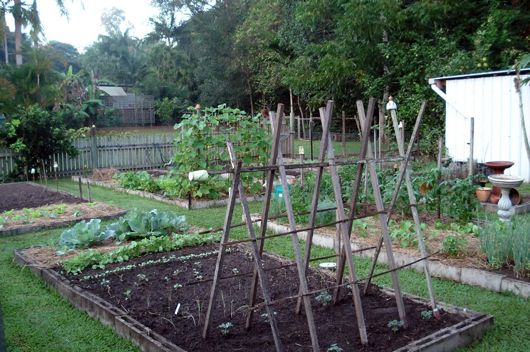
The next few photos are our garden at various times throughout the year. As you can see, Hanno does a great job organising the plants and keeping the weeds down while growing the most delicious fresh food for our table.


I think we've had only about a quarter of our normal rainfall in the past six months. Luckily we didn't keep our vegetable garden going over summer because even though we have town water and two water tanks, we don't like using the town water on the garden and the tanks are almost empty. It breaks my heart to see the backyard now. In the 15 years we've lived her, this is only the second time I've seen it like this. Usually our grass is bright green all year, we never water it with the hose, it's kept that way with natural rainfall. But now it is brown and the grass crackles under your feet.

Above is this area of the garden a couple of years ago. Below is the same area yesterday afternoon.


Producing organic vegetables and eggs is an important part of our lives now. We don't want to lose that. We usually end our vegetable planting in November, keep harvesting till December, then let the soil rest until we sow our annual crops in March. But the garden is looking parched and dead. I wonder how long it will take the worms to come back once the rains start again.


But we won't give up. In the next couple of weeks, we'll plan our 2013 garden. We'll start most things as seeds sown in the bush-house, then transplant to the garden when they're big enough. This is the most cost effective way of producing vegetables.

From seeds, they'll grow into seedlings and will then be planted out.

Generally we have enough for us and to give away to family and friends. It gives us a good feeling to be able to do that.

Above is the garden last March when we had just started to plant up for the year.

This is what it looks like now.

The drought has severely effected the citrus. Many of the small lemons are falling off now and our orange trees, usually packed full at this time of year, have very few fruit.

In these two photos - above and below, you can see our back lawn. It usually looks like this all year round.


But this is what it looks like now.

Above is the chicken run last year. Now it's a dry dust bowl.


This flock of plumed whistling ducks landed in the yard late yesterday. They didn't stay long, they were looking for green grass and water. Photo by Hanno.

Above is what the garden looks like when viewed from the back verandah. 
This photo was taken from the same spot yesterday afternoon. Those few patches of green are chilli and capsicum/pepper bushes. They're still growing well.

I have no doubt our climate is changing. Australia is experiencing the hottest summer ever recorded. The weather bureau has added a new colour to our weather map - it's for over 50C/122F. We need to change how we live.

Hanno said the other day that he'll be starting the garden off early this year. It's essential we get those seeds sown in February so from about late March we have the beginnings of nine months of fresh organic food. But we can't do anything without water. Hopefully it will rain soon, the sub-soil and the top soil will be wet enough to entice the worms back, we'll sow our seeds, they'll start growing and the vegetables will turn this brown landscape into a green oasis. It all depends on the rain.

I sometimes get the feeling that many readers here think our garden is perfect all the time. Well, nothing is perfect and the photos above show you that we struggle as much as anyone. There is no golden ticket for anyone when there is no rain. But over the years we've learned patience and acceptance and I know that it might not be tomorrow but soon that monsoon will bring rain and new life to our backyard.

What is your greatest worry in your garden right now? If you have any photos to share of your backyard, post them over at the forum and we'll have a talk about it during the day.

I have been watching a few Amish documentaries on You Tube while I've been ironing lately and it made me wonder why I enjoy watching them so much. I guess I'm inspired. Not by their lifestyle so much as by the way they work together. I love seeing that. It reminds me of days I've read about, a long time before the advent of supermarkets and department stores, when we use to work together as families, and in groups to get more difficult work done. When I see people working along side each other like that, it makes me want to join in. I love seeing the CWA ladies working away on their various fundraising ventures - buttering scones and making pots of tea; I love watching quilters working on one piece together; I admire the strength of the men who raise Amish barns and the grace of the women who provide food and drinks to keep them going.

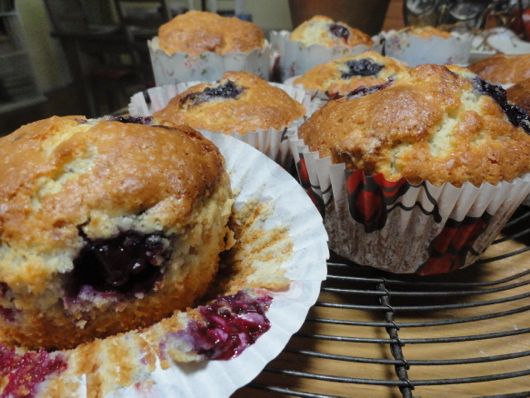
Yesterday's blueberry muffins.


I get a lot of mail from readers who regret they can't find anyone who shares their values. Many of us feel the same because we live in towns and cities inhabited by people who are firmly and seemingly happily cemented into their mainstream lives. They have no interest in learning life skills or in reducing their spending and consumption. I doubt they'd understand the concept of shared work. I think that's one of the reasons so many people read here. They find validation here in what they do, they know I don't think they're strange because they're knitting dishcloths, growing pumpkins and baking bread, because I do it too. It's like we're working alongside each other. And that may be hundreds or thousands of kilometres apart but you know I am here, I know you are there and together we're quietly working. People gravitate here and to the forum to read about like-minded people going about their everyday business of homemaking, growing crops, storing and preparing food, raising pigs and milking cows and goats.  And they are satisfied and fulfilled by it.


We all go through various stages in our lives and we have to be open to those changes and flexible enough to adapt as we age. In the past I have worked with many women and men. The workload we all shared was made easier because we worked together. Now I'm working alongside my husband and I reckon we make a great team. We both do what we think we have a talent for and the jobs we like doing and luckily for us, that divides the tasks neatly down the middle. Most of our tasks are easily done by one person but when one of us is ill, the other takes it all on; when something is too big for one, we both do it.


When you look back on it, all those stages of work make up a productive life. Whether you're working in a large group or a small one, working as a couple, or you're alone raising children, or as a carer of adult children or parents. We're all working alongside each other and if you feel isolated and alone, all you have to do is to reach out here or at the forum and I or someone who hears you will reach back. No one is working alone when they work towards their own simple life. We're all connected by the work.


Free eBook on self sufficiency. If you don't have a Kindle, do what I did and download the Kindle software for your computer. It's fast, simple and completely free. Then you can read the book on your computer. Please note: this comment was sent my Barb: Here in the US that self-sufficiency book is $2.99 to buy, or you can 'borrow' it for free if you have an Amazon Prime account. Just a warning, for those who might click without thinking.

Round-up ready canola and wheat in Australia!

What's in the water?

Men who knit

People are slowly waking up to the fact that you teach children to be consumers from a very young age.

The temperature is rising

A good chicken blog

The benefits of molasses for your chooks

Egg substitutes

prairieharmony over at the D2E forum has started a 2013 Christmas savings thread in Basic Budgeting.

FROM THE COMMENTS THIS WEEK

Chez is writing about their holiday in West Australia

Minnie and her cats

Queen of the armchair is baking, caring and stitching

Hanno and I want to thank everyone for the thoughts and prayers sent to us this week. Hanno's test have finished now. The news was pretty good and helped along, no doubt, by this beautiful community here. I hope you have a wonderful weekend. Relax and put your feet up if you can. If not, take time out to sit with a cold drink or a hot cuppa. A few minutes alone can do wonders.

See you next week.  xxx


I'm quite comfortable with chaos. I like order because it helps me be productive and efficient, but chaos is an old friend. Recently, Sarndra told me she'd clean out my Tupperware cupboard when she was here next time. The toll bell in my head rang immediately - I knew it was time to clean it out. I generally use some of the time over the Christmas holidays to get these organisational tasks done. If I can get to them all, it makes a big difference to the year that follows. When I go into the year knowing that, like a saint, I've cleaned and polished every nook and cranny, done all the ironing and every room can take a white glove inspection, well, I'm at peace and I work better during the following months.

I don't like doing it though and it doesn't always get done.

So I cleaned out the cupboard, threw out all manner of lids and containers I had no idea I had and just kept what I use. The cupboard is easy to see into now, I can easily and quickly reach what I need and I no longer dread going to the cupboard for a container or water bottle. On the contrary, now I stare at all my clean cupboards. And the oven, I cleaned that too, ditto the kitchen bench cleaned and rearranged and the laundry, spare room cleaned out and clothes cupboard decluttered. (I would understand if you left now. LOL)

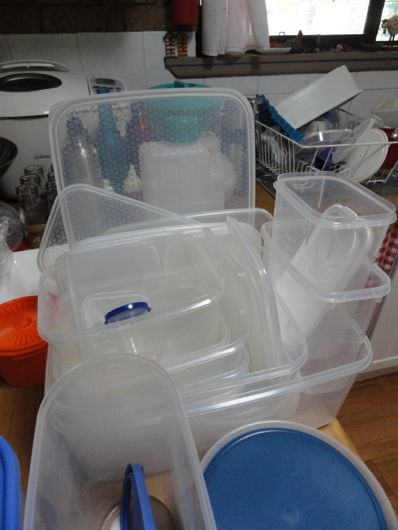
This is what it looked like. No wonder Sarndra offered her help.

I dumped them all on the kitchen bench and examined them.

 Decided what I needed to keep and what was a lost orphan.

 Then cleaned the cupboard out and replaced it all.

All lids and bottoms are together. I don't have to search for them now.

All cheese making equipment together, plastic dishes for the grand-babies are together, water bottles together. I can even say: "it's in the corner cupboard" without embarrassment and know they'll find what they're looking for.

I'm not telling you this to be a complete pain. I just want to gently remind you, as we slowly move through January, there is still time to do these tasks before the real year begins. Even though they seem monumental before you start them, most of them are quick and easy and they make you feel SO good when you finish. That feeling lasts a long time too because as you work through the year you keep secretly patting yourself on the back for being such an efficient homemaker. Well, I do.  ; - )

How are you going with your annual organisational and cleaning tasks? Do you have one time in the year when you do these things, do you do something different, or nothing at all?


A few years ago we were vegetarians. That lasted about eight years but ended when Hanno wanted to eat meat again and it became so difficult to get genuine vegetarian meals when I was travelling for work. In the bush here vegetarian = a boiled egg salad if you were lucky and hot chips if you weren't. When I started eating meat again, I felt better for it, although I regret the lives lost to feed me and if I do waste food, I feel real shame when I waste meat. We still eat vegetarian meals, still enjoy them but I feel our health is better when we combine a small number of meat meals with vegetarian ones or reduce the meat portion of the meal.

I know it's difficult if you're cooking for people who feel they must have meat and nothing else will do but I would suggest you try one vegetarian meal each week and see how that goes. If you can't successfully introduce one vegetarian meal a week, you may get away with something like this meal, which is substantial and filling, to which you add a hint of meat (bacon or chorizo) to the sauce or the filling.

This is what we had for dinner last night - roast pumpkin ravioli - completely home made, of course, and made without a pasta maker.

FILLING - enough for two
¼ small japanese pumpkin or ½ small butternut - chop into small pieces and roast in a hot oven till brown
1 garlic clove - roast this, in the skin, with the pumpkin
chilli (optional)
salt and pepper
½ cup fresh breadcrumbs - made from stale bread
½ cup grated cheese - I used Mersey Valley, a very sharp cheese, you could also use parmesan - it needs to have a lot of flavour
thyme, parsley or chives, chopped (optional)

When the pumkin is cooked and cool, put it in a bowl and mash it. Squeeze the garlic out of the skin and add it to the pumpkin. Add all the other ingredients and let it sit.


PASTA - I only used half and froze the rest
2 cups pasta flour or 000 flour - you can buy this at the supermarket. If you can't find it, use plain flour.
4 eggs
½  teaspoon salt
1 tablespoon olive oil
a small amount of water to add teaspoon by teaspoon if the pasta is too dry

I made mine in the bread maker. Just put all the ingredients in and knead for 10 minutes. Take the dough out, flatten it a little, cover in plastic wrap and put it in the fridge to relax for 30 minutes. I used half the dough for this and have half in the freezer. I'll make a thick strips pasta with homemade spicy tomato sauce later in the week.

Use plain flour is you don't have 000 flour.
Kneading the pasta in the bread maker is the easiest way to do it. If you make it by hand, make a well in the centre of the flour, add everything to the well and slowly start incorporating the flour into the wet centre. When it's all mixed in, knead for 8 - 10 minutes.
When you roll the dough out, don't use too much flour on the bench - it will make the pasta tough.
The ravioli is cooked when it rises again in the boiling water.

Cook the pasta in boiling salted water. When they are added to the pot, they'll sink. When they rise to the top again, they'll be cooked. That will take about 5 minutes, depending on how many you have in the pot.

SAUCE
Generally I have a tomato-based sauce with pasta but not with pumpkin. I don't think they go together well. You could make a coconut cream and chilli sauce. Just open a tin of coconut cream, put it in a pot, add salt, pepper and chilli sauce or flakes and stir. You could also do a cream herb sauce, using the same herbs you used in the ravioli in the sauce.
If you have filling left over, like I did, you can make this: place the extra filling in a saucepan, add half cup of cream, half cup of water and stir. You'll have to use your common sense for this. If it's too thick, add more water, if you don't have much filling, add more cream and less water. You could also use milk, not cream and water. 


To make up the ravioli, divide the pasta up into smaller portions because it's easier to handle that way. I divided mine in two and froze half, then divided the remainder in two. Roll the pasta out with your rolling pin until it's as thin as shop bought pasta. Try to roll it into a circle or a rectangle shape - it's easier to cut. Grab a scone cutter or a large glass and cut the round shapes for the ravioli. 


To fill the ravioli: in the middle of each shape, place a small teaspoon full of the filling. Pick up the shape, fold the pasta over the filling and crimp the edges, pressing them together firmly so no filling escapes while they're cooking.

If you want to make this ahead of time, lay the filled ravioli on a baking sheet in the fridge. Make sure the pasta isn't touching because it will stick. Make the sauce up and keep it in the fridge. When you make it up, all you'll have to do is to cook the ravioli in boiling water and warm the sauce.


Now that we've eaten this, I'd change two things. I'd add herbs to the sauce, or a sprinkling of herbs over the dish at the end, because it looked too bland. I would also make a side salad to have with it. It was delicious though. Hanno said: This is good! And after another mouthful: This is VERY good!


Newer Posts Older Posts Home

ABOUT ME

Down to Earth is a blog by Rhonda Hetzel, dedicated to simple, intentional living — from home cooking and gardening to frugal budgeting and handmade crafts. It’s a space for gentle inspiration and everyday wisdom on creating a life that feels real, balanced, and deeply fulfilling.

Down To Earth Book

Down To Earth Book
My books are all published by Penguin. Down to Earth, The Simple Life and The Simple Home have been in book shops since they were published in 2012, 2014 and 2016, respectively. On 20 October 2020, Down to Earth was published as a paperback.

MY FAVOURITE PLACES

  • Grandma Donna's Place
  • Grandma Donna's YouTube
  • Grandma Donna's Instagram
  • This Simple Day
  • Nicole's Instagram

Popular Post of All Times

Making ginger beer from scratch

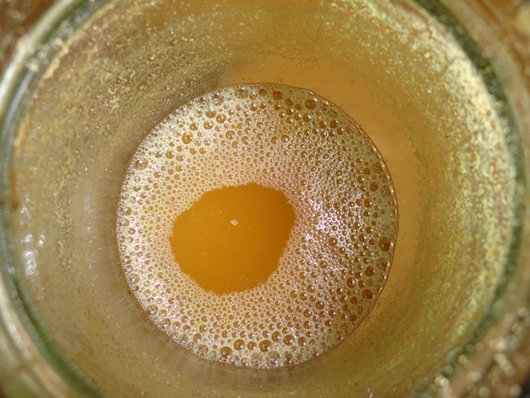
We had a nice supply of ginger beer going over Christmas. It's a delicious soft drink for young and old, although there is an alcoholic version that can be made with a slight variation on the recipe. Ginger beer is a naturally fermented drink that is easy to make - with ginger beer you make a starter called a ginger beer plant and after it has fermented, you add that to sweet water and lemon juice. Like sourdough, it must ferment to give it that sharp fizz. To make a ginger beer plant you'll need ginger - either the powdered dry variety or fresh ginger, sugar, rainwater or tap water that has stood for 24 hours to allow the chlorine to evaporate off. You'll also need clean plastic bottles that have been scrubbed with soap, hot water and a bottle brush and then rinsed with hot water. I never sterilise my bottles and I haven't had any problems. If you intend to keep the ginger beer for a long time, I'd suggest you sterilise your bottles. MAKING THE STARTER In a...
Image

The last post

This will be my last post here.  I've been writing my blog for 18 years and now is the time to step back. I’ve stopped writing the blog and come back a couple of times because so many people wanted it, but that won’t happen again, I won’t be back.  I’ll continue on instagram to remain connected but I don’t know how frequent that will be. I know some of you will be interested to know the blog's statistics. 
Image

How to make cold process soap

I'm sure many of you are wondering: "Why make soap when I can buy it cheaply at the supermarket?" My cold process soap is made with vegetable oils and when it is made and cured, it contains no harsh chemicals or dyes. Often commercial soap is made with tallow (animal fat) and contains synthetic fragrance and dye and retains almost no glycerin. Glycerin is a natural emollient that helps with the lather and moisturises the skin. The makers of commercial soaps extract the glycerin and sell it as a separate product as it's more valuable than the soap. Then they add chemicals to make the soap lather. Crazy. Making your own soap allows you to add whatever you want to add. If you want a plain and pure soap, as I do, you can have that, or you can start with the plain soap and add colour, herbs and fragrance. The choice is yours. I want to add a little about animal and bird fat. I know Kirsty makes her soap with duck fat and I think that's great. I think t...
Image

Preserving food in a traditional way - pickling beetroot

I've had a number of emails from readers who want to start preserving food in jars but don't know where to start or what equipment to buy.  Leading on from yesterday's post, let's just say up front - don't buy any equipment. Once you know what you're doing and that you enjoy preserving, then you can decide whether or not to buy extra equipment. Food is preserved effectively without refrigeration by a variety of different methods. A few of the traditional methods are drying, fermentation, smoking, salting or by adding vinegar and sugar to the food - pickling. This last method is what we're talking about today. Vinegar and sugar are natural preservatives and adding one or both to food sets up an environment that bacteria and yeasts can't grow in. If you make the vinegar and sugar mix palatable, you can put up jars of vegetables or fruit that enhance the flavour of the food and can be stored in a cupboard or fridge for months. Other traditional w...
Image

Cleaning mould from walls and fabrics

With all this rain around we've developed a mould problem in our home. Usually we have the front and back doors open and that good ventilation stops most moulds from establishing. However, with the house locked up for the past week, the high humidity and the rain, mould is now growing on the wooden walls near our front door and on the lower parts of cupboards in the kitchen. Most of us will find mould growing in our homes at some point. Either in the bathroom or, in humid climates, on the walls, like we have now. You'll need a safe and effective remedy at some point, so I hope one of these methods works well for you. Mould is not only ugly to look at, it can cause health problems so if you see mould growing, do something about it straight away. The longer you leave the problem, the harder it will be to get rid of it effectively. If you have asthma or any allergies, you should do this type of cleaning with a face mask on so you don't breathe in any spores. Many peopl...
Image

Five minute bread

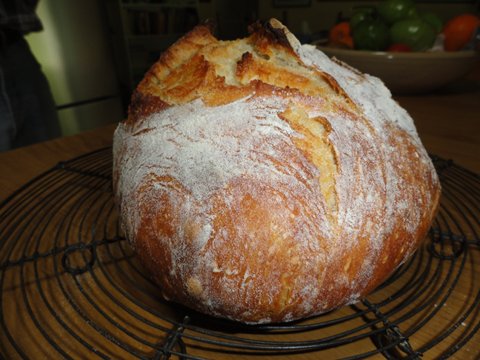
Bread is one of those foods that, when made with your own hands, gives a great deal of satisfaction and delight. It's only flour and water but it symbolises so much. I bake bread most days and use a variety of flours that I buy in bulk. Often I make a sandwich loaf because we use most of our bread for lunchtime sandwiches and for toast. Every so often I branch out to make a different type of loaf. I have tried sour dough in the past but I've not been happy with any of them. I'll continue to experiment with sour dough because I like the idea of using wild yeasts and saving the starter over a number of years to develop the flavour and become a part of the family. However, the loaf I've been branching out to most often is just a plain old five minute bread. By five minutes I mean it takes about five minutes actual work to prepare but it's the easiest of all bread to make and to get consistently good loaves from. If you're having people around for lunch or...
Image

This is my last post.

I have known for a while that this post was coming, but I didn't know when. This is my last post. I'm closing my blog, for good, and I'm not coming back like I have in the past.  I've been writing here for 16 years and my blog has been many things to me. It helped me change my life, it introduced me to so many good people, it became a wonderful record of my family life, it helped me get a book contract with Penguin, and monthly columns with The Australian Women's Weekly and Burke's Backyard . But in the past few months, it's become a burden. In April, I'll be 75 years old and I hope I've got another ten years ahead. However, each year I'll probably get weaker and although I'm fairly healthy, I do have a benign brain tumour and that could start growing. There are so many things I want to do and with time running out, leaving the blog behind gives me time to do the things that give me pleasure. On the day the blog started I felt a wonderful, h...
Image

What is the role of the homemaker in later years?

An email came from a US reader, Abby, who asked about being a homemaker in later years. This is part of what she wrote: "I am a stay-at-home mum to 4 children, ages 9-16. I do have a variety of "odd jobs" that I enjoy - I run a small "before-school" morning drop-off daycare from my home, I am a writing tutor, and I work a few hours a week at a local children's bookstore. But mostly, I cherish my blissful days at home - cooking, cleaning (with homemade cleaners), taking care of our children and chickens and goats, baking, meal-planning, etc. This "career" at home is not at all what I imagined during my ambitious years at university, but it is far more enriching. I notice, though, that my day is often planned around the needs of my family members. Of course, with 4 active kids and a husband, this is natural. I do the shopping, plan my meals, cook dinner - generally in anticipation of my family reconnecting in the evening.  I can't h...
Image

Every morning at home

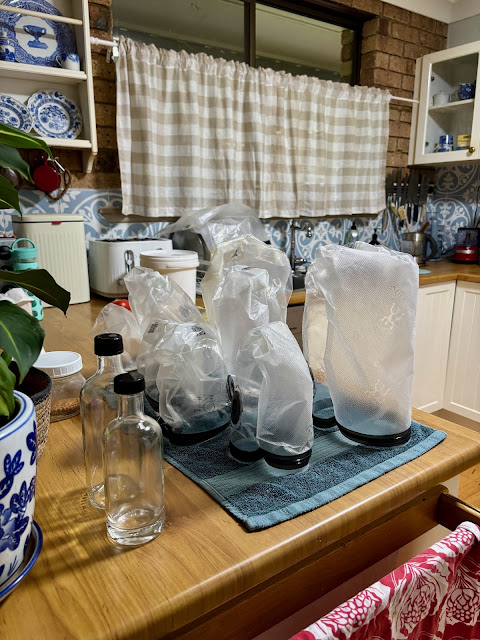
Every morning when I walk into my kitchen it looks tidy and ready for a day's work. Not so on this morning (above), I saw this when I walked in. Late the previous afternoon when I was looking for something, I came across my rolled up Zwilling vacuum bags and decided they had to be washed and dried. So I did that and although I usually put them outside on the verandah to dry it was dark by then. I turned the just-washed bags inside out and left them like this on a towel. It worked well and now the bags are ready to use when I bring home root vegetables, cabbages or whatever I buy that I want to last four or five weeks.
Image

You’ll save money by going back to basics

When I was doing the workshops and solo sessions, I had a couple of people whose main focus was on creating the fastest way to set up a simple life. You can't create a simple life fast, it's the opposite of that It's not one single thing either - it's a number of smaller, simpler activities that combine to create a life that reflects your values; and that takes a long to come together. When I first started living simply I took an entire year to work out our food - buying it, storing it, cooking it, preserving, baking, freezing, and growing it in the backyard. This is change that will transform how you live and it can't be rushed.  
Image

Categories

  • Backyard 244
  • Being Organised 257
  • Books 9
  • Budgeting 142
  • Chickens 42
  • Community life 289
  • Family 269
  • From Scratch 63
  • Grandmothering 69
  • Home 296
  • Individuality 185
  • Mentoring 55
  • My books 49
  • Organic Gardening 348
  • Preserving 97
  • Recycling 22
  • Retirement 22
  • Self Reliance 160
  • Simple Living 777
  • Sustainability 308
  • This blog 107
  • Weekend reading 362
  • Writing 4

Followers

Trending Articles

The last post

This will be my last post here.  I've been writing my blog for 18 years and now is the time to step back. I’ve stopped writing the blog and come back a couple of times because so many people wanted it, but that won’t happen again, I won’t be back.  I’ll continue on instagram to remain connected but I don’t know how frequent that will be. I know some of you will be interested to know the blog's statistics. 
Image

Making ginger beer from scratch

We had a nice supply of ginger beer going over Christmas. It's a delicious soft drink for young and old, although there is an alcoholic version that can be made with a slight variation on the recipe. Ginger beer is a naturally fermented drink that is easy to make - with ginger beer you make a starter called a ginger beer plant and after it has fermented, you add that to sweet water and lemon juice. Like sourdough, it must ferment to give it that sharp fizz. To make a ginger beer plant you'll need ginger - either the powdered dry variety or fresh ginger, sugar, rainwater or tap water that has stood for 24 hours to allow the chlorine to evaporate off. You'll also need clean plastic bottles that have been scrubbed with soap, hot water and a bottle brush and then rinsed with hot water. I never sterilise my bottles and I haven't had any problems. If you intend to keep the ginger beer for a long time, I'd suggest you sterilise your bottles. MAKING THE STARTER In a...
Image

Time changes everything

I've been spending time in the backyard lately creating a contained herb and vegetable garden. My aim is to develop a comfortable place to spend time, relax, increase biodiversity and encourage more animals, birds and insects to live here or visit. Of course I'd prefer my old garden which was put together by Hanno with ease and German precision. Together, we created a space bursting at the seams with herbs, vegetables and fruity goodness ready to eat and share throughout the year. But time changes everything. What I'm planning on doing now, is a brilliant opportunity for an almost 80 year old with balance issues. In my new garden I'll be able to do a wide range of challenging or easy work, depending on how I feel each day. It’s a daily opportunity to push myself or sit back, watch what's happening around me and be captivated by memories or the scope of what's yet to come.
Image

The most wonderful news

This post will give me more joy to write than anything else I could think of today.  I told you  there are a few exciting things happening here at the moment, well, I am now able to tell you the most exciting one of them.  Our son Kerry and his beautiful partner Sunny are having a baby!  Hanno and I will be grandparents in late March.  I can barely believe my eyes when I read what I have just written.  This is one of my original stitchery patterns. This wasn't planned but it's welcomed wholeheartedly by all of us.  Both Kerry and Sunny are hard workers and now that they have a baby to love and care for, they've decided it's time to buy an apartment together.  Sunny is going home to Korea to tell her family and when she comes back again, the search will start to find their first home together.  We are all so excited!  My knitting has taken on a life of its own and when I think of all the projects I could start, my head spins.  Thi...
Image

About Blog


Down to Earth is a blog by Rhonda Hetzel, dedicated to simple, intentional living — from home cooking and gardening to frugal budgeting and handmade crafts. It’s a space for gentle inspiration and everyday wisdom on creating a life that feels real, balanced, and deeply fulfilling.

Last Year's Popular Posts

The last post

This will be my last post here.  I've been writing my blog for 18 years and now is the time to step back. I’ve stopped writing the blog and come back a couple of times because so many people wanted it, but that won’t happen again, I won’t be back.  I’ll continue on instagram to remain connected but I don’t know how frequent that will be. I know some of you will be interested to know the blog's statistics. 
Image

Every morning at home

Every morning when I walk into my kitchen it looks tidy and ready for a day's work. Not so on this morning (above), I saw this when I walked in. Late the previous afternoon when I was looking for something, I came across my rolled up Zwilling vacuum bags and decided they had to be washed and dried. So I did that and although I usually put them outside on the verandah to dry it was dark by then. I turned the just-washed bags inside out and left them like this on a towel. It worked well and now the bags are ready to use when I bring home root vegetables, cabbages or whatever I buy that I want to last four or five weeks.
Image

You’ll save money by going back to basics

When I was doing the workshops and solo sessions, I had a couple of people whose main focus was on creating the fastest way to set up a simple life. You can't create a simple life fast, it's the opposite of that It's not one single thing either - it's a number of smaller, simpler activities that combine to create a life that reflects your values; and that takes a long to come together. When I first started living simply I took an entire year to work out our food - buying it, storing it, cooking it, preserving, baking, freezing, and growing it in the backyard. This is change that will transform how you live and it can't be rushed.  
Image

Workshops update

  This photo shows what the weather's been like here.  That's steam coming off my neighbours shed roof after a brief downpour of rain.  I hope we’re getting closer to organising these workshops. I didn’t explain this clearly enough: Group 1 is four workshops, Group 2 is four workshops. Out of those eight workshops I thought we probably end up doing three or four.
Image

Creating a home you'll love forever

Living simply is the answer to just about everything. It reduces the cost of living; it keeps you focused on being careful with resources such as water and electricity; it reminds you to not waste food; it encourages you to store food so you don't waste it and doing all those things brings routine and rhythm to your daily life. Consciously connecting every day with the activities and tasks that create simple life reminds you to look for the meaning and beauty that normal daily life holds.  It's all there in your home if you look for it. Seemingly mundane tasks like cleaning and cooking help you with that connection for without those tasks, the home you want to live in won't exist in the way you want it to.  Creating a home you love will make you happy and satisfied.
Image

Time changes everything

I've been spending time in the backyard lately creating a contained herb and vegetable garden. My aim is to develop a comfortable place to spend time, relax, increase biodiversity and encourage more animals, birds and insects to live here or visit. Of course I'd prefer my old garden which was put together by Hanno with ease and German precision. Together, we created a space bursting at the seams with herbs, vegetables and fruity goodness ready to eat and share throughout the year. But time changes everything. What I'm planning on doing now, is a brilliant opportunity for an almost 80 year old with balance issues. In my new garden I'll be able to do a wide range of challenging or easy work, depending on how I feel each day. It’s a daily opportunity to push myself or sit back, watch what's happening around me and be captivated by memories or the scope of what's yet to come.
Image

Simple life workshops on Zoom UPDATED

I've added more topics to the list. This post is for those readers who expressed interest in doing online Zoom workshops or who want to register now. The topics haven't been chosen yet but potential topics are:  vegetable gardening and composting; starting a vegetable garden and choosing vegetables suitable for a beginner;  cutting costs in the home, housework and routines; homemade laundry liquid and powder, soaking, stain removal and washing clothes and household linens; cooking from scratch and building your pantry to help you do it; homemade bread - white, rye, wholemeal and ancient grains. I'm not doing sourdough; living on less than you earn and developing a frugal mindset.
Image

Labels

  • Bartering
  • Chickens
  • Community life
  • Food security
  • From Scratch
  • Home Maintenance
  • Homemaking
  • Mentoring
  • My favourite place
  • Recipes - savoury
  • Reminders of what is important to us
  • Simple Living
  • The Simple Home - June
  • The Simple Home - May
  • Utilities
  • Wise Economy

Copyright © Down To Earth. Designed by OddThemes