down to earth
  • Home
  • About Us
  • Down To Earth Book
  • Privacy Policy
One of the difficult parts of gardening for those new to it is when to harvest. When Reuben and Katie were here last week, Reuben told me that the section in my book about harvesting was really helpful. But it's not only vegetables that need to be harvested, it's herbs too. You don't want to waste anything, so keep an eye on your herbs and when they're growing abundantly, clip them off and dry them for storage so you don't waste any.


Always try to cut your herbs just above the nodes because that is where the new growth will come from when the herb starts growing again. Everyone dries herbs their own way, this is what works for me. I always water my herbs the day before I cut them, then cut them first thing in the morning before the sun hits them. After cutting off what I want, I give the herbs in the pot or in the ground a drink of weak fertiliser tea - something like comfrey tea or manure tea.  Don't let it be too strong though, like most vegetables, most herbs should not grow too fast because they need time to develop flavour.


We can grow most herbs all year round here but there are times when, if I don't go into the garden for a couple of days, a sneaky grasshopper will have moved in and the mint disappears. We all know that mint is the easiest of herbs to grow, but when you're waiting for leaves for mint sauce or drinks, you need mint NOW.


You can dry many herbs by hanging them in a dry and airy place out of sunlight (below). Or you can do what I do and just place them on a piece of towelling and put them in a slow oven. If you only have a small amount, I lay them on towelling on a plate on the kitchen bench and let them dry there (above). I move them around a couple of times a day (with dry hands) and generally they will dry out well in a week using this method.


Use a slip knot to tie your herbs. It's the same one you use for knitting.


If you use the hang and dry method, make sure you strip off all the leaves near the point where you'll hang them. Having leaves there might cause the bunch to go moldy, and stripped stems will help prevent that.  Don't throw out the leaves you strip off. Make use of them. I made mint sauce with the stripped off mint leaves I had today.

MINT SAUCE
  1. Wash mint leaves and pat dry.
  2. Finely chop the leaves.
  3. Boil small amount of water.
  4. Add half cup of water to a jug.
  5. Add 2 tablespoons sugar.
  6. Stir until the sugar dissolves.
  7. Add two tablespoons good vinegar, I always use malt vinegar because that's what my mother used.
  8. Add mint leaves, and stir.

You can adjust all the ingredients to suit your own taste. I tend to add a little more vinegar because I like a tart taste.  It's delicious on lamb.

Wait until this cools and store it in the fridge. It will be fine for at least three months stored in the fridge. 


Or you can bottle it in a fancy bottle for a gift or store it in a jar for your own use during the next few months.


Yesterday I picked a couple of bunches of mint and oregano for storage. Mint always tastes like mint but oregano changes a little and gets stronger. I like to have some in the pantry cupboard for winter stews and soups and for that to happen, I have to dry it when it's growing well.  I don't like microwaving herbs, I prefer to let them air dry or to dry them in a low conventional oven. About 110C for an hour will usually dry most herbs out well. Then it's just a matter of checking they're completely dry, crushing them and putting them in a jar with a firm lid for storage.  The enemy of dried herbs is moisture so in the first week of storing your dried herbs, check the jars every day to make sure they're not going moldly. If you see any sign of it - like condensation in the jar, place them back in the convention oven on paper towelling and dry them out again.

Another good way to store herbs for later use is to freeze them. Wash them carefully without bruising them, cut the leaves if you need to, then place some in ice cube trays, Fill up with water and freeze them. When they tray is frozen, pop them out and store in a zip lock bag in the freezer until you need them.


I also have lemon myrtle leaves I'm going to use in my next soap. I dried them in the slow oven and they've been sitting in a jar for a couple of weeks. I'll pulverise them with the stick blender just before I use them. My next lot of drying will be the chillies. Chilli bushes grow all year here but they only produce chillies during the hotter months.  I'll take advantage of that and dry some every couple of weeks during the growing season. 

This is an easy task and it saves on paying for herbs and spices during the year, which tend to be quite costly. All it takes is a bit of time and effort and it's one less thing I have to buy at the shops.

Are you a leaf dryer too?
I have a few photos I've been wanting to show for a little while, so here they all are today. It's not often I can show you 15 recent photos and everyone in the photos is part of my family.

Hanno in Sydney two weeks ago.

Martina and Sasha - Martina is my neice, the daughter of Hanno's sister, and Sasha is Martina's cousin. They're visiting from Hamburg, Germany with Martina's husband, Michael, and son Jona.

 Hanno and Martina.

Jona, Martina and Michael's son.

Jona at the Golden Guitar in Tamworth on the way back from Sydney.

In the Blue Mountains, near Sydney, (from left) my nephew David (Tricia's son), my sister Tricia, Michael holding Jona and Martina.
Hanno and Tricia in the mountains.

Michael, Martina, Jona, Sasha and Hanno overlooking the Three Sisters at Katoomba in the Blue Mountains.
 Back home again, Jona with the beautiful Jamie.
Everyone starting to sit down for lunch last Thursday. That's Jens my step-son with DIL Cathy his wife, my son Kerry, his son Jamie at the end of the table and Sunny, my DIL. Lunch was chicken casserole, with vegetables our drinks were water, homemade raspberry cordial and elderflower cordial. Jamie and Jona had juice.

After lunch, we all came inside for coffee and cake - chocolate and coffee cake.

I love this photo - my son Kerry with his son Jamie.

 My grandson Jamie helping to pick parsley.

 Jona with Sunny, picking vegetables before travelling back home.

And this is is yesterday's foggy morning when I went out to feed the chooks. It's rare to get fog here so I had to take a photo of it.
Coralie Allmin, a faithful Down to Earth reader, died after a short illness on 6 November, 2012. 
Rest in peace, Coralie.

♥♥♥


Sara asked a question last week in her comment on the truth in advertising post. My answer was much too long for the comments, so here it is now. Sara wrote:

I began questioning the "norm" a few years ago and I haven't looked back. I make as much as I can from scratch now. While I haven't tried your laundry liquid yet I buy a locally made environmentally friendly powder. It costs about the same as the commercial stuff but no nasty ingredients. I will try to make my own soon.

Based on my own experience with those older than me (my parents, their friends, relatives) I think you are amazing for choosing to make these changes. I cannot get through to my parents no matter how I approach it. My Mum thinks I'm mad that I don't douse my house in every product on the market and she can't understand why I'd pay an extra $1 per kg for apples from our local organic supplier rather than just buy ones from Coles.

However, as much as this irritates me, I also understand it. There are things I would love to try but I'm hesitant on taking the next steps. I would love to learn how to sew past a basic level, knit and crochet but sometimes I feel like I'm almost too old now to learn to do these so I can get to a point where I'm making clothes, knitting booties and jumpers etc. I anticipate it will take me years and years to get past a basic level. As it is, I just can't see I will be able to even start to learn within the next two years simply because of the ages of my two children. I don't have the energy in the evenings and being home full time with them the focus I need just isn't there. That may sound like an excuse however I know within myself it is genuine, I have gone to huge effort the past year to change the way we live and we have made huge progress.

Did you find making these changes daunting? Did you ever feel that it wasn't "worth your while" to learn to make your own clothes and it would just be easier to op-shop? I'm not sure if I'm explaining myself well...hopefully you understand what I mean!

Hello Sara. I understand it too. Most people do what is familiar and comfortable. My guess is that the older people you know have not yet found a good reason to change. I know, from personal experience, that no amount of talking will convince anyone to change along with you. It's like teaching children - you can tell them to be respectful or courageous or gentle until the cows come home but they are much more likely to do it if they see you do it. Role models are such a powerful force. If you want your parents to change, stop telling them what to do and just get on with your simple life. If they see the difference it makes in your life, and that you are happy, they're much more likely to try a few small changes themselves.


Yes, I found some changes daunting, I still do; I will keep changing. But I also realised that while some changes simply slip into our lives easily, others require their own time. I'm much more patient and I know now that this life is a series of never ending small steps. The changes I've completed so far have taken ten years. I haven't regretted learning anything and although I didn't use all my new skills straight away, there always came a time when I needed what I had learned. Many things must wait while you raise your children - that is your main focus for now, and should be. As they grow, the amount of time you have and your energy level will increase. So don't worry about not doing everything you want to do, that time will come. It's not necessary to do it all at once.

So instead of pushing yourself to grow vegetables in the backyard, find a good local market to buy your fresh fruit and vegies. Use simple living tactics for the things you're doing in your daily life instead of opting for convenience - use a menu plan, stockpile, stick to your budget, pay off debt and be a good role model. The time will come later on for soap making, compost and vegetable gardens.


I would encourage you to learn to knit at this time. Unlike sewing, knitting is a small thing - you don't need a large space to cut out fabric, you don't need a sewing machine. Knitting is just you, two needles and some yarn. Also, if you make a mistake while knitting, you can just unravel it and start that row again. It's portable, so you can take it with you when you take the children out, or you can do a few rows while you sit with them as they play. Start with dishcloths/facecloths. They are just a knitted square but they're an excellent way of replacing Chux and sponges, and all those squares will help you practise your knitting skills. You can buy knitting needles and, sometimes, yarn or old woollen jumpers to unravel at the op shop. For dishcloths you'll need 100 percent pure cotton and you can get that from Bendigo Mills (a 200 gram ball is four normal sized balls) and sometimes on special at Spotlight. It doesn't really matter what size needles you use on dishcloths. There are excellent instructions on how to start knitting on Youtube.


The next step I would like to see you make is to make your own washing powder. Grate up some yellow laundry soap, add borax and washing powder, mix it together and that's it. It will take you less than five minutes to make enough for a couple of months. Laundry liquid will take about 15 minutes. There are more detailed instructions on the blog. It will save you some money and with that money, maybe you can buy organic yarn when you learn to knit. : - )

There is not a set in cement way of living simply. We all do it in the way it suits us and that will change all the time, depending on your season of life and the circumstances you find yourself in. A good example of this was when Hanno had his recent accident. We use my homemade soap in the shower and to wash our hands. When Hanno was able to use only one hand, it was easier for him to use liquid hand wash and body wash in the shower. I had absolutely no problem using those products because it made it easier for him. Now things are almost back to normal, as soon as the containers are empty, we'll go back to soap. I feel no guilt for making that change and if I had to do it again, I would. If it were going to be a permanent thing, I'd make liquid soap.

Forget the idea you have of the perfect way to live and just do the best you can do each day. Some days that will be 10 out of 10, some days it will be 1 out of 10. As long as the 1 out of 10 is the best you can manage on that day, then you're still living true to your values. I will not walk in and ask you to account, there are no simple living police to tell you you're not doing it right.  Do the best you can every day and let that be enough.

Material Obsession - Marg's quilting group, that Kathy is writing about, is the group my sister Tricia has been going to for 20 years.  Over all that time, they've remained firm friends and sewn side-by-side. I think that's incredible and wonderful. BTW, Tricia is in the first photo with blue top and white hair. She is also in the sixth photo, erm, with the same blue top and hair. : - )

My Rose Valley - Scandinavian Homespun

Home grown vege protein - enter the Madagascar bean. I grew these for a few years and as one of my sons would say, "they're epic".

A Simpler Way to a Greener Future


Radio National's Mediation Challenge - including how to do it, and guides

Women bloggers meet in London


How to devise passwords that drive hackers away - this is for mamma-lana and anyone else with an easy, short password. 

FROM THE COMMENTS HERE DURING THE WEEK:

Thoughts from the Thicket House

Linni at Home - waiting for a baby to be born

The Frugal Hill Way

Thank you for your visits this week. I noticed quite a few new names, so welcome to those folk. I hope we all have a relaxing and wonderful weekend. See you on Monday! ♥
I'm wondering how you all deal with spam on your blogs. I have tried to simplify the comments process here by taking off word verification. Over the months since I did that, I've had thousands of spam comments. I deleted almost a 1000 spam comments last week (a couple of days worth) and then waited to see how many more came in. In 14 minutes I got 54 spam comments. I then put word verification back on again and have had two since. So word verification has to stay even though I know it makes it difficult if you're commenting from an iPad or phone.

Bloggers ability to pick up spam and put it straight into the spam folder is excellent, but there's so much of it, just getting rid of it every few days takes time because I can only delete 100 at a time.

There is also a problem some readers have reported about comments disappearing. Does that happen on your blog too? Do you know why? I've written to Google about this but haven't had a reply. I doubt I'll get one now. If you're a new reader here, it is much easier to comment if you have a Google ID. It's the same one you get if you sign up for any of the Google accounts - gmail, Reader, Feedburner etc., or you can use your ID from Wordpress, Livejournal, Typepad, Aim, your name and url or as anonymous.  You just make your selection from the comments section. Once you choose an ID, it remembers it, so you'll probably only have to do that once.

I was going to stop the anonymous comments too because when I get hate-filled comments, they're always anonymous. Funny that. You would think that if you felt so strongly about something that you'd step up and own your comments, but there are a lot of cowards hiding on the internet. However, I know some people who comment can only comment as anonymous so I'm leaving that on. I'm not sure why that is but a few readers have told me that is their experience. 

I am so grateful for comment moderation. Do you use it? I know very many of my regular readers by name but those who are new to me with a name I don't recognise, I am now checking them out before I publish their comment. Reinstating the word verification has stopped hundreds of spam comments but some human spammers are now creating a ID, then they make a comment that is related to the post so it looks genuine. I've just realised though that many of these are fake and have a link to a business or website that none of us want to see, or even know about. So I've been going through the old comments and deleting those. If you find one, can you drop me an email with the link to the page please. Thank you.

And that's another way spam comes in - emails. They probably don't think of themselves as spammers but I get a lot of emails from advertising agencies and PR firms asking to advertise on my blog. I got one this week inviting me for cocktails at a fashion extravaganza! Do they not read my posts? Anyhow, if you work for one of these places, please take me off your mailing list because I will never reply to your emails. I will only ever recommend products that I use myself, I know fit in to the life we're all trying to live or for some small home businesses through my sponsor buttons.

Surely it's not only me who has a big problem with spam. If you do I'd love to know how you deal with it.
When I first decided that I'd had enough of my rampant spending and the insidious system that encouraged it, I realised that a lot of the products I bought were advertised under a veil of misinformation. I knew that if I was to go on to develop a better life based on my values, I'd either have to disregard advertising altogether or at the very least, read and understand ingredient lists, examine products carefully and look beyond face value.

My path from then on was to think about everything I bought, particularly the ordinary and mundane things that fill up our fridge and pantry as well as clothing, shoes, makeup, appliances and most of the other "must haves" that make up modern life. Over the course of about a year, I cut many things from our grocery list by asking myself this simple questions: What is the truth of this? I realised that for many of our common items, I could make them better, healthier, cheaper and in a way that didn't impact on the already overstretched planet.

Making spring rolls at home.

Beetroot grown in the backyard for baking and pickling. Two small crops of beetroot will see us through our warm months when we have it pickled, with salads.

The "What is the truth of this?" question works well on food and groceries. The truth is that generally these products have been based on a simple recipe and then various preservatives, colourings and flavour enhancers are added because nothing tastes as good as home made and these commercial products have to sit on a shelf until someone buys them. I used to be one of those buyers but not now; now I make everything I can.

If you're not making you're own laundry and cleaning products at home, you're paying too much. Forget about your favourite brands and cut down on the number of chemicals you have in your home.


Cleaning and laundry products are the shining stars of what can be done better and cheaper at home. You don't need wood cleaner, bench cleaner, wall cleaner, glass cleaner, floor cleaner, bath cleaner, or any of the one-job products stinking up the cleaning aisles of most supermarkets. Most things can be cleaned effectively using vinegar, soap, bicarb, citric acid or just water and a stiff brush, or a recycled, soft, cotton cloth. You can make your own soap. The soap I make has four ingredients - caustic soda, olive oil, coconut oil and rain water. Regular bar soap contains a list like this: Tallow (this is animal fat), water, sodium cocoate, glycerine, fragrance, sodium chloride, titanium dioxide, ethidronic acid, tetrasodium edta, CI73915, CI74160. Your skin is your body's largest organ, you should trust what you wash yourself and your clothes with. The story's the same with laundry products. They can be easily made MUCH more cheaply than commercial products and they work really well. I make laundry liquid using four ingredients - soap, borax, washing soda and water. Have a look on the packet of commercial liquid and you'll find the story is completely different.  And it doesn't have to be. The recipe for making laundry liquid using four ingredients is in my side bar.

Calendula oil, made by infusing calendula petals in olive oil and just sitting the jar in the sun for a week or so. This can be used for itchy and inflamed skin, nappy rash, eczema, stings and bruises and also as a base for lip balm and ointment. If you make your own soap, you can also use it to make a soothing soap.

When it came to products not purchased as frequently, I still asked that question. "What is the truth of this?" The answer could be anything. It could be, in the case of clothing or shoes, that it was made in a sweat shop. In the case of makeup, it could contain harmful ingredients or that the ingredients hadn't even been tested for safety. For appliances, the answer may be that it was made to break and be unusable in a short amount of time - generally just outside the time the warranty expired. So I started teaching myself to make clothes and while I'm not making everything, I do make some things and I'm happy that I do. I can't make shoes but I'm still wearing the shoes I wore when I was working for a living. I have certainly stopped wanting new outfits and matching shoes  every year. I never look fashionable but at least my clothes are clean and tidy. And when I'm shopping for appliances, I look for those that can be fixed, have a low need for electricity and, hopefully, made in Australia; although that is now becoming a rare find indeed.

Cheap and easy biscuits - recipe is here  and to make the condensed milk you need in the recipe, that is here.

There are some good products out there but you have to know what they are and if they suit you and your budget. Do your research. Don't buy something because you always do, be mindful of your family's health when you shop and if the price is an issue, see if you can make that product at home. Most food and cleaning products can be made at home, just like our great-grandmothers and all her antecedents did. Most of the products we use regularly arrived in our supermarkets in the 1950s and 60s. It wasn't always like this.

We've been spun a line, a line that contains mostly a commercial core and I've stopped believing that our products have been tested and are safe. I no longer believe that our government protects us. They're more concerned with keeping big business profitable. I want all our countries to continue to prosper but not at our expense. So at every opportunity and small step by small step, I look at something I need and continue to ask the question. What is the truth of this?

Are you a mindful shopper? Do you check ingredients lists and country of origin?
I spent a few very pleasant hours yesterday with Katie and Reuben from House of Humble blog. I had met Reuben once before on my book tour but Katie was working that day, so it was good to finally meet her. They are such a lovely couple and we had a lot in common, talking about our lives, writing and our blogs. I made a vegetarian quiche with backyard eggs, local cream and cheese and a salad from the last of the backyard produce. We drank raspberry cordial and elderflower cordial and had a great time of it. I get a lot out of speaking with young people such as Katie and Reuben. They ease my fears that we're not doing enough.


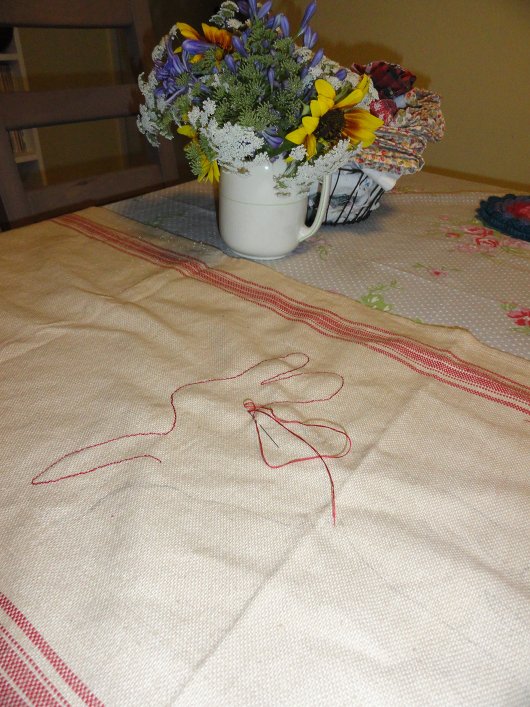
When they left, I started on a new piece of redwork. I bought a metre of this fabric when I was with Tricia in the Blue Mountains about two years ago. It sat there in a brown paper bag and when I was tidying up my workroom, I rediscovered it. Tricia made me a template of a running hare she used on one of her quilts, I rediscovered that too so I traced around it with pencil, and started stitching. It's going to be a table runner. 


This type if simple backstitch embroidery is the easiest thing to do. If you've never tried this before, get yourself a plain piece of fabric, draw on a simple design and see what you come up with. I have some needlework instructions here and free patterns; they make lovely Chirstmas gifts. All my stitchery patterns use this simple stitch.  Try to use a course weave pure cotton or linen fabric. The stitches will sit best on that kind of background.


The other small bit of sewing I've done this past week is to make a cover for my office chair. This is the chair I sit on when I'm on the computer and I've always wanted it to be more colourful. Well, look at it now! All it took was 30 minutes, a piece of fabric about three inches wider than the seat on all sides. I cut out the shape while the fabric was on the seat, I ironed down the hem, threaded elastic through using a safety pin to guide it and it came up really well. The top was just fitted to the size of the back rest and hemmed at the bottom. It's simple, it's easy to remove for washing, it used up some of the fabric I have here and it's made the seat look much better than it did. Not bad for 30 minutes work.

Hanno and our visitors will come home today and I'll be pleased to see them. It's been seven days since I've been out anywhere and while that doesn't bother me at all, I do have to pick up some fresh milk and fruit. Kerry, Sunny and Jamie will be here tomorrow so our dining table will be extended out to its full length and we'll all be packed around it for lunch. Luckily we have two high chairs - one for Jamie and one for Jonah. I think it will be another day to remember.

I delved a little further into the world of solitude and silence on the weekend. I spent much of Saturday morning going through old papers and cleaning up my work room. Late morning I had a brief visit from Ernie and Jenny, a phone call from Shane and then Hanno. Silence followed. I finished cleaning and reorganising my workroom with the window open so I could clearly hear the sound of the rain and wind outside.


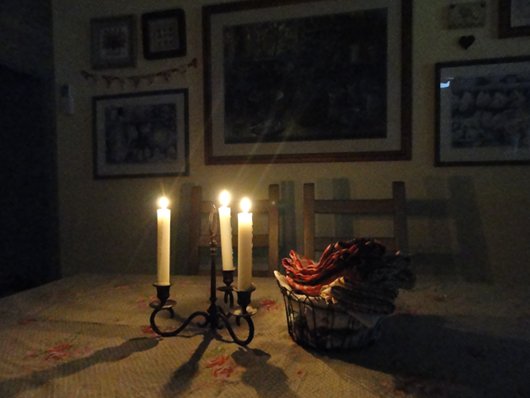
At around 2pm on Saturday I decided to have an electricity-free afternoon and evening. I'm really suited to this style of living because I go to bed early, get up early and now we're moving towards summer, I'm in bed when it's dark. So I organised candles for the evening and the morning and found some knitting I could do in low light. Next was my evening meal - I wanted something that required no electricity. I had a small bowl of leftover pasta in the fridge and I ended up adding celery, corn, capsicum, herbs and a small can of red salmon. I had that will a glass of water and a slice of watermelon. I ate in silence looking out into the fading light of the backyard.

When I had the meal and lighting organised, I decided that I would disconnect my laptop from the cable and only use it on the battery. If the battery ran out, that would be it. I'm using the battery power now as I write this at 7pm. If this turns out to be a short post, you'll know why, but I'm hoping it will stay with me until I take photos and upload them. Soon I'll go outside to look at the stars and then, by candlelight, I'll write, in longhand, an outline for a series of talks I'll be giving at the local libraries next year.

[Monday morning] It's a fine thing to withdraw from the electrified world every so often. You cut yourself off from light and the sound of TV and radio, washing machines, vacuum cleaners, electric beaters, fans and so many other things we take for granted. You become more aware of the natural movements outside, of the birds and the amount of light coming into the house. You become very aware of yourself too. There are no distractions, no noise to mask the swishing of a skirt, the scratching of a fountain pen on paper, or breathing. We are all so used to electricity now we forget that it the ability to brightly light our homes came to us relatively recently. In 1904 the first domestic electricity was generated in Sydney and by 1927, only 34 percent of homes had some form of electricity.  Now, most of us, are dependent on electric lighting and while I wouldn't like to live without electricity, I could live without lights. I love coming back to candles and lamps every so often. I last did this when Hanno was in Germany two year ago. Have you stopped yourself using electricity just because you could?
Thank you for the comments left during the week, especially those yesterday in response to Jill and Jack's call for help. Reading many of the comments, I found myself nodding in agreement and thinking that after love and time from parents, how little a baby needs in this world that tells us the opposite. All of you taking the time to help shows me again the true value of this wonderful community of friends who read here. We may not live near each other but we're close.

Repairing the throwaway culture

Angry Chicken's aprons

Christmas craft ideas

Sheds

Renters guide to sustainability

What's it like living off the grid

FROM COMMENTS HERE DURING THE WEEK

Diann's Domaine

Cabbage Tree Farm

Hands Heart Passion

I hope you have a lovely weekend and have time to relax and enjoy what you have around you. I'll be having an electricity-free day and night tomorrow, just because I can. I'm also deep cleaning my work room. Happy days!  See you next week. ♥
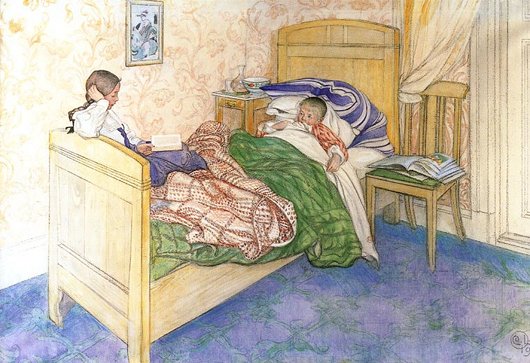
Both images are by the wonderful Swedish artist Carl Larsson from here.

Today I have an email from a reader who is due to have her first baby in March next year. "Jill and Jack" have been earning good money and have a mortgage but now with the baby on the way, they're finding it difficult to reduce their spending and prepare for the big event. I thought our wonderful Down to Earth community here would be able to give "Jill and Jack" a good idea of what the first baby costs and how to reduce the general weekly expenses while waiting for the baby. This is part of what Jill wrote:

We are very used to earning good money and are now confronted with dropping to only my husband's very good wage of around $100,000 p.a. So I've spent this evening working on our budget ...  We anticipate that the mortgage repayments will drop somewhat as we renegotiate our loans in November I believe.

As it is, I felt we were doing well to only have one old reliable car with Jack riding to work each day... and not spend a lot on clothing or cosmetics... but on doing our budget tonight I'm realising that we've been living over my husband's wage for several years at least. We haven't really tracked what we spend, other than putting a cap on our individual 'sanity allowances'. I know I have spent a lot on organic food and alternative health. We waste food and hope to do more home cooking - I have been eating more intentionally while pregnant.

(They have a good emergency fund but the sanity allowance (pocket money) Jill writes is $200 a week.)

Generally, we aspire to tithe 10% (which we've done consistently) and invest 10% (we haven't done this in the past several years).

Baby plans:
I like the idea of not being forced back to work by money but rather by interest or previous employers 'needing a hand'. We plan to have two kids which I guess might mean that I'll be at home for 5 years. I now have an ABN and can consult from home but don't know if this will pan out or if I'll want to distract myself from the kid(s).
Family have a lot of second hand gear for us and we'll get significant presents from older family eg. prams etc.

Key questions:
- How much should it cost us to live well? Particularly the food budget!
- How much do kids cost? In the first year of life and later?
- Should I be planning to go back to work, or can we easily live within Jack's salary still tithing and saving for our future?

Jill's email was much more comprehensive than the summary given above but it was much too long to include all of it. I don't want to give any advice on the cost of setting up for a baby other than to encourage Jill to accept all the secondhand and pre-loved clothes and equipment that she's offered. 


I do want to address the change of mindset though, Jill. It's a change that will take you from being a young couple who have worked hard and had the good fortune to buy a home and many of the other things you want, to being parents with the responsibility of raising a family. When you think about it, up until now, you two have been the children, buying what you want, going out and enjoying life - as you should. Your baby will change that. Not only in monetary terms but also in the amount of spare  time you'll have. There are many parents earning a lot less than you who have children, so it certainly can be done. I think it's best to consider the kind of parents you wish to be then work out from there. Work out what kind of life you want for your family - money is just the means to get the lifestyle you want. One thing I do know with certainty is that there will be change and sacrifices coming and there is no way around that. Some of them you'll love, some you won't love but they'll just be some of the changes that a baby will bring.

I hope you can address the matter of food wastage. You can do that by sticking to your budget and with menu planning and stockpiling. I believe fresh food is better for you than organic food that has travelled a long distance. Try to find a butcher and fruit and vegetable market and develop a relationship with the owners. There are a lot of growers who aren't certified organic and yet they grow their produce with no insecticides and herbicides, and if they're local, they'll be fresh. You need your food to be full of nutrients and fresh food is more likely to have them. There is a section in your budget for gardening, maybe you could enlarge on that, put in a vegetable garden and grow organically.

It would be great if you did track your money from now on, maybe for a month or two to see what you're both spending. I bet you'll be surprised. You have a lot of guessed items in your budget and you need to know the reality of it. For instance, you're spending $2000 a year on dental on top of your health insurance, and $15,600 a year on food for just the two of you. One of the sacrifices you both make may be that you halve your sanity allowance to $100 a week and put the other $100 towards your mortgage.

And now it's over to our dear readers. If you have any useful information for Jill and Jack, please take the time to comment. I am sure they're not the only parents to be or new parents reading here and there are many experienced parents here with a lot of knowledge.  Good luck!

I love being alone. There is something about living alone for a few days that puts life into perspective and cleanses the soul. It does for me anyway. When a house that is usually full of the noise of domestic activity falls silent, it brings me back into myself and all of a sudden there are new possibilities; I see things differently. There is the opportunity for work to be done when I feel like it, not when it is usually done. I don't mind telling you that the past couple of months have been really tough going. Since Hanno's accident and subsequent illnesses, many trips out to the hospital and therapist, dealing with my work and his, and trying to write, has been exhausting and on the razor's edge of impossible. We got through it by knowing that life would return to what we think of as normal when the time was right for it.

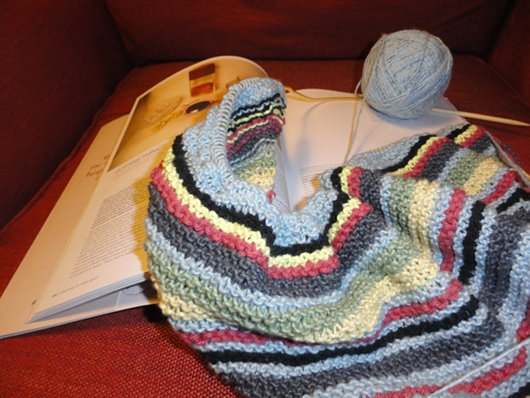
This is a winter shawl I'm making for myself using leftover bits of organic cotton.

These months have been a valuable reminder to me that life is not always sunshine and cups of tea in the garden. The easiness of life is balanced out, sooner or later, by the not so easy. There is always balance.

Just Frankie, the tea and me.

So where is Hanno? He's driving to Sydney with his relatives. They'll stay at Manly beach for a few days,  have a few days in the Blue Mountains and then come home again. After a few days here, they'll all be off again, with Jens and Cathy as well, up to the Carnarvon Gorge, Longreach, the Whitsunday Islands and through Gladstone to see Shane, Sarndra and Alex. And all the time I will be here doing what I do and enjoying the solitude. There is no place I would rather be, no finer house, no cleaner air to breathe, nowhere better to wake up.

Looking over from my reading spot, the back garden at 4pm.

Today the travellers left at 5.30am and I fussed outside over the chooks and garden for an hour or so. After breakfast of crumpets and tea I left the dishes in the sink and started organising myself for some writing I should have started six weeks ago. I worked for a few hours, then sorted through some fabric and yarn before Cathy came over and we went to the post office to send off a book to Kuwait. Back home again I read for a while and although I had a few things I could be doing, I  just ambled along, enjoying the silence and knowing that for dinner all I would be cooking was two poached eggs and some toast. Life's like that. One day it's chicken and vegetable casserole for six, the next it's poached eggs for one. There is always balance.

I am an introvert and I appreciate and enjoy solitude. Do you like being alone?

I am often asked to review books and say 'no' to most of the requests. Then Country Gardens Country Hospitality came along and I said 'yes'. I don't say 'no' to be contrary, it's because the majority of the books I'm emailed about don't interest me.  I wouldn't read them and I don't recommend anything that I wouldn't use myself. When this book arrived, I read the introduction and knew my intuition had stood me in good stead. This is part of it:

"... when I walked into Heather Roll's house, her dining room table was groaning with homemade slices and cakes that her gardening community had made for the launch of my latest book, which was taking place the next day. And when I arrived at the venue for the launch the following morning, each round table was set with beautiful arrangements of roses that had been picked from local gardens. It was impossible not to be deeply moved by such generosity.
...
Country cooking is most often a celebration of what is grown locally: livestock raised with integrity and with tender, loving care; eggs from backyard chickens; fruit from home orchards; vegetables from the garden. Produce is swapped and shared with neighbours, or snapped up at farmers' markets."


This book is beautifully presented, it felt very familiar to me and I loved reading it. The author, Holly Kerr Forsyth, travelled around Australia in 2010, during the drought, visiting the families and gardens featured in the book. In each home she visited, country hospitality was rich and abundant and old family recipes shared. Such recipes were: pink elderflower syrup, raspberry sorbet, French bean salad, apple and walnut cake, and many more. I don't know the people featured but I know what sort of kitchens they run and that they enjoy good wholesome food. These are country folk who most probably share my values, I feel like a neighbour to them.


Having written my own book I know how focused you need to be to write a book such as this. A book that endeavours to give a clear account of each family home and garden, and the food that is frequently produced there.  Country people in Australia are different to city folk and Holly Kerr Forsyth has captured that difference.  There is an eagerness to provide hospitality to visitors and a connection to local community that is often lacking in larger and busier places. This is a good book, I recommend it to you and although I was going to have a book giveaway, this one I'm keeping for myself. :- ) It's published by The Miegunyah Press, an imprint of Melbourne University Publishing Limited.


Another true gem I came across this week is the magazine Frankie. You and I both know I'm not one for magazines nowadays and most of the time I'm either at home, or wandering around completely oblivious to the commercial world around me. This week, while waiting for Hanno to finish his visit to the doctor, I wandered into the newsagent at Montville and there Frankie was, waiting for me. It cost ten dollars but I could not resist buying it - the cover is unlike anything I've seen on a magazine and I couldn't walk away. It looks and feels like a hand-stitched sampler. I thought it might be a new magazine but on the inside cover, it says it's the 50th edition, AND it's a Brisbane magazine! Why didn't I know?

I'm going to make one of these.

Walking back to the car I had a chance to look through it before Hanno returned and I was hoping it would not disappoint. It didn't. It's full of clever articles, the layout and design is innovative and beautiful, and even though I'm in my mid-60 and definitely not the demographic they're after, I loved it. They even have an advert for Etsy in there. Crikey, homemade strikes back. I loved Pui Pui Tam's An Open Letter to the man who threw the pie at my head and I've bluetacked the I've choreographed a special dishwashing dance for you poster to the side of my fridge.  I might do that dance during my days of solitude that start today, but I'll write about that tomorrow.

Sure there were things I rolled my eyes at, and there were parts where I thought, not again! When you're my age you realise that the wheel is never reinvented, it's refashioned, recycled, rehashed, repaired, renewed and revamped.  And they've certainly done that but in a genuine, original and authentic sense that is aimed at a generation much younger than mine. I haven't finished reading it, in fact I've only read about a quarter of the entire magazine, but it has won me over well and truly. I might not buy every copy but I will buy it when I can.

\
This is the inside back cover.

I often hear from my contemporaries that younger generations are lazy and dumbed down. I suppose some young people are like that (I know some older people are), but my own sons and DILs are that age, so is my editor Jo and her husband Eli, so too are Greg and Soph who visited two weeks ago, and Katie and Reuben who will visit next week. They aren't lazy and they're certainly not dumb. I reckon Frankie represents them. Their lives are focused on sustainability and truth, with a touch a whimsy and vintage nostalgia thrown in for interest's sake. They get it! and I think Frankie gets it too.

I did it!

Greenhorns is an American organisation who promote, recruit and support new farmers. I think this is one of the best ideas of heard about in a long time. I wish we had something similar here. Maybe we have, do you know of anything? If I had a bit more time I would certainly be open to mentoring some young people who were setting up their own place near me. Check out their blog, it's loaded with excellent articles and essays.

Almost half of all mothers in two-parent families are back at work before their youngest child turns one, completing a social revolution than has seen the dividing line between home and career disappear in less than a generation.

Freshman Farmer

Cinnamon girl - featuring kale and bacon hash

Top ten pudding recipeshttp://www.taste.com.au/recipes/collections/top+10+pudding+recipes from Taste.com

Teenagers value the simple things in life

From the comments here this week:

Life in the Cotswolds 

The Old Milkcan

The Little Black Cow Blog
Newer Posts Older Posts Home

ABOUT ME

Down to Earth is a blog by Rhonda Hetzel, dedicated to simple, intentional living — from home cooking and gardening to frugal budgeting and handmade crafts. It’s a space for gentle inspiration and everyday wisdom on creating a life that feels real, balanced, and deeply fulfilling.

Down To Earth Book

Down To Earth Book
My books are all published by Penguin. Down to Earth, The Simple Life and The Simple Home have been in book shops since they were published in 2012, 2014 and 2016, respectively. On 20 October 2020, Down to Earth was published as a paperback.

MY FAVOURITE PLACES

  • Grandma Donna's Place
  • Grandma Donna's YouTube
  • Grandma Donna's Instagram
  • This Simple Day
  • Nicole's Instagram

Popular Post of All Times

Making ginger beer from scratch

We had a nice supply of ginger beer going over Christmas. It's a delicious soft drink for young and old, although there is an alcoholic version that can be made with a slight variation on the recipe. Ginger beer is a naturally fermented drink that is easy to make - with ginger beer you make a starter called a ginger beer plant and after it has fermented, you add that to sweet water and lemon juice. Like sourdough, it must ferment to give it that sharp fizz. To make a ginger beer plant you'll need ginger - either the powdered dry variety or fresh ginger, sugar, rainwater or tap water that has stood for 24 hours to allow the chlorine to evaporate off. You'll also need clean plastic bottles that have been scrubbed with soap, hot water and a bottle brush and then rinsed with hot water. I never sterilise my bottles and I haven't had any problems. If you intend to keep the ginger beer for a long time, I'd suggest you sterilise your bottles. MAKING THE STARTER In a...
Image

The last post

This will be my last post here.  I've been writing my blog for 18 years and now is the time to step back. I’ve stopped writing the blog and come back a couple of times because so many people wanted it, but that won’t happen again, I won’t be back.  I’ll continue on instagram to remain connected but I don’t know how frequent that will be. I know some of you will be interested to know the blog's statistics. 
Image

How to make cold process soap

I'm sure many of you are wondering: "Why make soap when I can buy it cheaply at the supermarket?" My cold process soap is made with vegetable oils and when it is made and cured, it contains no harsh chemicals or dyes. Often commercial soap is made with tallow (animal fat) and contains synthetic fragrance and dye and retains almost no glycerin. Glycerin is a natural emollient that helps with the lather and moisturises the skin. The makers of commercial soaps extract the glycerin and sell it as a separate product as it's more valuable than the soap. Then they add chemicals to make the soap lather. Crazy. Making your own soap allows you to add whatever you want to add. If you want a plain and pure soap, as I do, you can have that, or you can start with the plain soap and add colour, herbs and fragrance. The choice is yours. I want to add a little about animal and bird fat. I know Kirsty makes her soap with duck fat and I think that's great. I think t...
Image

Preserving food in a traditional way - pickling beetroot

I've had a number of emails from readers who want to start preserving food in jars but don't know where to start or what equipment to buy.  Leading on from yesterday's post, let's just say up front - don't buy any equipment. Once you know what you're doing and that you enjoy preserving, then you can decide whether or not to buy extra equipment. Food is preserved effectively without refrigeration by a variety of different methods. A few of the traditional methods are drying, fermentation, smoking, salting or by adding vinegar and sugar to the food - pickling. This last method is what we're talking about today. Vinegar and sugar are natural preservatives and adding one or both to food sets up an environment that bacteria and yeasts can't grow in. If you make the vinegar and sugar mix palatable, you can put up jars of vegetables or fruit that enhance the flavour of the food and can be stored in a cupboard or fridge for months. Other traditional w...
Image

Cleaning mould from walls and fabrics

With all this rain around we've developed a mould problem in our home. Usually we have the front and back doors open and that good ventilation stops most moulds from establishing. However, with the house locked up for the past week, the high humidity and the rain, mould is now growing on the wooden walls near our front door and on the lower parts of cupboards in the kitchen. Most of us will find mould growing in our homes at some point. Either in the bathroom or, in humid climates, on the walls, like we have now. You'll need a safe and effective remedy at some point, so I hope one of these methods works well for you. Mould is not only ugly to look at, it can cause health problems so if you see mould growing, do something about it straight away. The longer you leave the problem, the harder it will be to get rid of it effectively. If you have asthma or any allergies, you should do this type of cleaning with a face mask on so you don't breathe in any spores. Many peopl...
Image

Five minute bread

Bread is one of those foods that, when made with your own hands, gives a great deal of satisfaction and delight. It's only flour and water but it symbolises so much. I bake bread most days and use a variety of flours that I buy in bulk. Often I make a sandwich loaf because we use most of our bread for lunchtime sandwiches and for toast. Every so often I branch out to make a different type of loaf. I have tried sour dough in the past but I've not been happy with any of them. I'll continue to experiment with sour dough because I like the idea of using wild yeasts and saving the starter over a number of years to develop the flavour and become a part of the family. However, the loaf I've been branching out to most often is just a plain old five minute bread. By five minutes I mean it takes about five minutes actual work to prepare but it's the easiest of all bread to make and to get consistently good loaves from. If you're having people around for lunch or...
Image

This is my last post.

I have known for a while that this post was coming, but I didn't know when. This is my last post. I'm closing my blog, for good, and I'm not coming back like I have in the past.  I've been writing here for 16 years and my blog has been many things to me. It helped me change my life, it introduced me to so many good people, it became a wonderful record of my family life, it helped me get a book contract with Penguin, and monthly columns with The Australian Women's Weekly and Burke's Backyard . But in the past few months, it's become a burden. In April, I'll be 75 years old and I hope I've got another ten years ahead. However, each year I'll probably get weaker and although I'm fairly healthy, I do have a benign brain tumour and that could start growing. There are so many things I want to do and with time running out, leaving the blog behind gives me time to do the things that give me pleasure. On the day the blog started I felt a wonderful, h...
Image

What is the role of the homemaker in later years?

An email came from a US reader, Abby, who asked about being a homemaker in later years. This is part of what she wrote: "I am a stay-at-home mum to 4 children, ages 9-16. I do have a variety of "odd jobs" that I enjoy - I run a small "before-school" morning drop-off daycare from my home, I am a writing tutor, and I work a few hours a week at a local children's bookstore. But mostly, I cherish my blissful days at home - cooking, cleaning (with homemade cleaners), taking care of our children and chickens and goats, baking, meal-planning, etc. This "career" at home is not at all what I imagined during my ambitious years at university, but it is far more enriching. I notice, though, that my day is often planned around the needs of my family members. Of course, with 4 active kids and a husband, this is natural. I do the shopping, plan my meals, cook dinner - generally in anticipation of my family reconnecting in the evening.  I can't h...
Image

Every morning at home

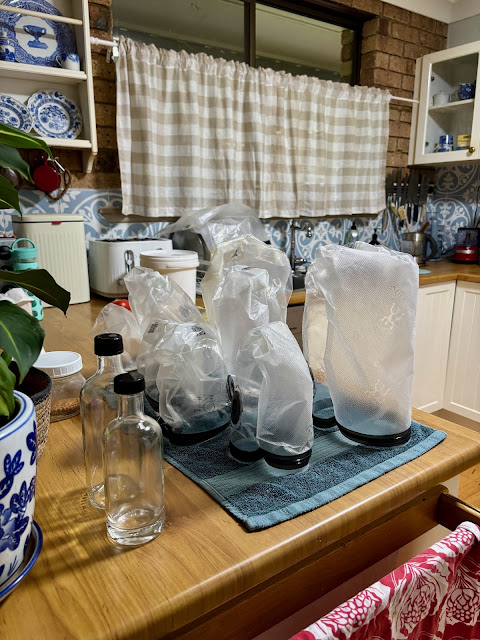
Every morning when I walk into my kitchen it looks tidy and ready for a day's work. Not so on this morning (above), I saw this when I walked in. Late the previous afternoon when I was looking for something, I came across my rolled up Zwilling vacuum bags and decided they had to be washed and dried. So I did that and although I usually put them outside on the verandah to dry it was dark by then. I turned the just-washed bags inside out and left them like this on a towel. It worked well and now the bags are ready to use when I bring home root vegetables, cabbages or whatever I buy that I want to last four or five weeks.
Image

You’ll save money by going back to basics

When I was doing the workshops and solo sessions, I had a couple of people whose main focus was on creating the fastest way to set up a simple life. You can't create a simple life fast, it's the opposite of that It's not one single thing either - it's a number of smaller, simpler activities that combine to create a life that reflects your values; and that takes a long to come together. When I first started living simply I took an entire year to work out our food - buying it, storing it, cooking it, preserving, baking, freezing, and growing it in the backyard. This is change that will transform how you live and it can't be rushed.  
Image

Categories

  • Backyard 244
  • Being Organised 257
  • Books 9
  • Budgeting 142
  • Chickens 42
  • Community life 289
  • Family 269
  • From Scratch 63
  • Grandmothering 69
  • Home 296
  • Individuality 185
  • Mentoring 55
  • My books 49
  • Organic Gardening 348
  • Preserving 97
  • Recycling 22
  • Retirement 22
  • Self Reliance 160
  • Simple Living 777
  • Sustainability 308
  • This blog 107
  • Weekend reading 362
  • Writing 4

Followers

Trending Articles

The last post

This will be my last post here.  I've been writing my blog for 18 years and now is the time to step back. I’ve stopped writing the blog and come back a couple of times because so many people wanted it, but that won’t happen again, I won’t be back.  I’ll continue on instagram to remain connected but I don’t know how frequent that will be. I know some of you will be interested to know the blog's statistics. 
Image

Making ginger beer from scratch

We had a nice supply of ginger beer going over Christmas. It's a delicious soft drink for young and old, although there is an alcoholic version that can be made with a slight variation on the recipe. Ginger beer is a naturally fermented drink that is easy to make - with ginger beer you make a starter called a ginger beer plant and after it has fermented, you add that to sweet water and lemon juice. Like sourdough, it must ferment to give it that sharp fizz. To make a ginger beer plant you'll need ginger - either the powdered dry variety or fresh ginger, sugar, rainwater or tap water that has stood for 24 hours to allow the chlorine to evaporate off. You'll also need clean plastic bottles that have been scrubbed with soap, hot water and a bottle brush and then rinsed with hot water. I never sterilise my bottles and I haven't had any problems. If you intend to keep the ginger beer for a long time, I'd suggest you sterilise your bottles. MAKING THE STARTER In a...
Image

Time changes everything

I've been spending time in the backyard lately creating a contained herb and vegetable garden. My aim is to develop a comfortable place to spend time, relax, increase biodiversity and encourage more animals, birds and insects to live here or visit. Of course I'd prefer my old garden which was put together by Hanno with ease and German precision. Together, we created a space bursting at the seams with herbs, vegetables and fruity goodness ready to eat and share throughout the year. But time changes everything. What I'm planning on doing now, is a brilliant opportunity for an almost 80 year old with balance issues. In my new garden I'll be able to do a wide range of challenging or easy work, depending on how I feel each day. It’s a daily opportunity to push myself or sit back, watch what's happening around me and be captivated by memories or the scope of what's yet to come.
Image

The most wonderful news

This post will give me more joy to write than anything else I could think of today.  I told you  there are a few exciting things happening here at the moment, well, I am now able to tell you the most exciting one of them.  Our son Kerry and his beautiful partner Sunny are having a baby!  Hanno and I will be grandparents in late March.  I can barely believe my eyes when I read what I have just written.  This is one of my original stitchery patterns. This wasn't planned but it's welcomed wholeheartedly by all of us.  Both Kerry and Sunny are hard workers and now that they have a baby to love and care for, they've decided it's time to buy an apartment together.  Sunny is going home to Korea to tell her family and when she comes back again, the search will start to find their first home together.  We are all so excited!  My knitting has taken on a life of its own and when I think of all the projects I could start, my head spins.  Thi...
Image

About Blog


Down to Earth is a blog by Rhonda Hetzel, dedicated to simple, intentional living — from home cooking and gardening to frugal budgeting and handmade crafts. It’s a space for gentle inspiration and everyday wisdom on creating a life that feels real, balanced, and deeply fulfilling.

Last Year's Popular Posts

The last post

This will be my last post here.  I've been writing my blog for 18 years and now is the time to step back. I’ve stopped writing the blog and come back a couple of times because so many people wanted it, but that won’t happen again, I won’t be back.  I’ll continue on instagram to remain connected but I don’t know how frequent that will be. I know some of you will be interested to know the blog's statistics. 
Image

Every morning at home

Every morning when I walk into my kitchen it looks tidy and ready for a day's work. Not so on this morning (above), I saw this when I walked in. Late the previous afternoon when I was looking for something, I came across my rolled up Zwilling vacuum bags and decided they had to be washed and dried. So I did that and although I usually put them outside on the verandah to dry it was dark by then. I turned the just-washed bags inside out and left them like this on a towel. It worked well and now the bags are ready to use when I bring home root vegetables, cabbages or whatever I buy that I want to last four or five weeks.
Image

You’ll save money by going back to basics

When I was doing the workshops and solo sessions, I had a couple of people whose main focus was on creating the fastest way to set up a simple life. You can't create a simple life fast, it's the opposite of that It's not one single thing either - it's a number of smaller, simpler activities that combine to create a life that reflects your values; and that takes a long to come together. When I first started living simply I took an entire year to work out our food - buying it, storing it, cooking it, preserving, baking, freezing, and growing it in the backyard. This is change that will transform how you live and it can't be rushed.  
Image

Workshops update

  This photo shows what the weather's been like here.  That's steam coming off my neighbours shed roof after a brief downpour of rain.  I hope we’re getting closer to organising these workshops. I didn’t explain this clearly enough: Group 1 is four workshops, Group 2 is four workshops. Out of those eight workshops I thought we probably end up doing three or four.
Image

Creating a home you'll love forever

Living simply is the answer to just about everything. It reduces the cost of living; it keeps you focused on being careful with resources such as water and electricity; it reminds you to not waste food; it encourages you to store food so you don't waste it and doing all those things brings routine and rhythm to your daily life. Consciously connecting every day with the activities and tasks that create simple life reminds you to look for the meaning and beauty that normal daily life holds.  It's all there in your home if you look for it. Seemingly mundane tasks like cleaning and cooking help you with that connection for without those tasks, the home you want to live in won't exist in the way you want it to.  Creating a home you love will make you happy and satisfied.
Image

Time changes everything

I've been spending time in the backyard lately creating a contained herb and vegetable garden. My aim is to develop a comfortable place to spend time, relax, increase biodiversity and encourage more animals, birds and insects to live here or visit. Of course I'd prefer my old garden which was put together by Hanno with ease and German precision. Together, we created a space bursting at the seams with herbs, vegetables and fruity goodness ready to eat and share throughout the year. But time changes everything. What I'm planning on doing now, is a brilliant opportunity for an almost 80 year old with balance issues. In my new garden I'll be able to do a wide range of challenging or easy work, depending on how I feel each day. It’s a daily opportunity to push myself or sit back, watch what's happening around me and be captivated by memories or the scope of what's yet to come.
Image

Simple life workshops on Zoom UPDATED

I've added more topics to the list. This post is for those readers who expressed interest in doing online Zoom workshops or who want to register now. The topics haven't been chosen yet but potential topics are:  vegetable gardening and composting; starting a vegetable garden and choosing vegetables suitable for a beginner;  cutting costs in the home, housework and routines; homemade laundry liquid and powder, soaking, stain removal and washing clothes and household linens; cooking from scratch and building your pantry to help you do it; homemade bread - white, rye, wholemeal and ancient grains. I'm not doing sourdough; living on less than you earn and developing a frugal mindset.
Image

Labels

  • Bartering
  • Chickens
  • Community life
  • Food security
  • From Scratch
  • Home Maintenance
  • Homemaking
  • Mentoring
  • My favourite place
  • Recipes - savoury
  • Reminders of what is important to us
  • Simple Living
  • The Simple Home - June
  • The Simple Home - May
  • Utilities
  • Wise Economy

Copyright © Down To Earth. Designed by OddThemes