down to earth
  • Home
  • About Us
  • Down To Earth Book
  • Privacy Policy

When you're an organic gardener, it pays you to work in with the natural ecosystem in your backyard.  Try to stay away from sprays, because even the organic options sometimes kill beneficial insects and have withholding periods. There will be times when you'll have to use a commercial organic spray, bait or powder, but make sure it's the last option. I don't think that every recommended organic methods works. For instance, over the 30+ years we've been growing vegetables, I've tried companion planting every so often, but it's never worked for us.  However, there are other organic techniques  that do work and we rely on them year after year.


Marigolds alongside bok choy, tomatoes and cucumbers.

One of the things we do here is to plant flowers in the vegetable garden.  Almost any flower will be suitable because most flowers bring in the bees, but there are a group of flowers that attract beneficial insects.  Not all bugs are bad and if you go around killing every insect you see, you will be doing completely the wrong thing.  Some bugs eat other bugs, or their eggs, and some of them lay their eggs in the bodies of other insects.  It sounds pretty gruesome but it's how the natural world works and it can help you.


Yarrow flowers - this plant is also good for activating compost.


Dill flowers 

Please be aware that the insects in each country may be different.  Some will be the same everywhere, but others specific to certain countries or regions.  In Australia, these insects are always a pest: the European wasp - these are aggressive and dangerous; ticks - the paralysis tick can kill dogs and cats; mosquitos - carry disease; the large earth bumble see - these were accidentally released in Tasmania and have been an environmental disaster, completing with native bees for food; fire ants - a relatively new pest but a serious threat in the areas they've colonised.


Daisies next to cos lettuce.

These are the beneficial bugs: most bees - in Australia there are two solitary native bees: the teddy bear bee and blue banded bee, and our little native bee, the sugar bag bee. We also have the honeybee, introduced into Australia in 1822 because the English thought there were no bees here. All those bees are good and if you have bees visiting your garden, particularly the native bees, you're very lucky.  There are photos here showing some of our bees, including the pest large earth bumble bee.  Ants are sometimes good and sometimes not.  If they start farming scale for the honeydew, find the nest and get rid of them.  Predatory wasps, hoverflies and most ladybugs are good fellows.  You can see photos of these bugs here.  It's a good idea to learn how to identify the beneficial bugs.   For the American and Canadian gardeners, here is a site for you.  Again, learn how to identify these insects.  They will help you produce all those vegetables you want.  For my UK friends, here is a site for you.  Other insects that you want in your garden include:
  • assassin bugs
  • lacewings
  • stink beetles
  • parasitic wasps and predator wasps like paper wasps and mud daubers
  • many spiders
  • dragonflies
  • praying mantises
  • robber flies
  • lady beetles, but not the 28 spot beetle that looks like a lady beetle - they eat plants  Photo here
  • ant lions
If you have children, you'll have to be careful if you have wasps visiting.  Our rule of thumb here is that if they start building a nest close to where we are, such as the one the paper wasps started building on our front verandah last year, we remove the nest.  Otherwise, they stay.  If you see the occasional wasps in your garden, it is nothing to worry about, it's  a healthy sign.  Predatory and parasitic wasps are not aggressive and will only sting if you disturb their nest or attack them.


Flowering lettuce also help attract insects.

If you're going to create a garden and be outside in the sunshine you have to expect to come across other living creatures.  Don't be scared of them.  Like us, they're a part of the beautiful natural scheme of things and have a role to play in our world.  If you're a new gardener, do some online research to educate yourself about what to expect in your region.  Work with the natural elements, not against them and you'll be rewarded.


Nasturtiums and yarrow.

Now you know what bugs you want in your garden, how do you get them there.  Flowers!  The insects will come if you plant the flowers they love.  Beneficial flowers include:
  • Cosmos
  • Daisies, including echinacea, feverfew, chrysanthemums, gerberas and chamomile  
  • Red clover
  • Queen Anne's Lace
  • Carrot flowers
  • Dill flowers
  • Marigolds
  • Alyssum
  • Nasturtiums
  • Yarrow
Most insects need water, so put out a small container, off the ground, full of pebbles or stones so the insects can land and leave the water safely. It would be best placed in a protected area, like under a tree, or close to some herbs. They'll need some pebbles to land on so they don't drown.  That would be an excellent project for the children.  It would get them involved in the garden and it could be their job to refill the water container, keep it clean and make sure there is the right amount of water and pebbles.

Gardening, particularly organic gardening, is not just planting seeds and watering; it's more involved than that.  It's all these little things that make the difference between a garden and a productive healthy garden.  And the thing about gardening is you learn something new every year, you never know it all, but even in those first few years, it gives rewards and pleasures that will bring you back year after year.

My sister recently moved into a new home - a cute little two bedroom cottage that is about 60 or 70 years old.  There are many things to love about her house but one of them is the larder.  It's set off the old kitchen where the original fuel stove still sits.  We don't build houses with larders now and few people have cellars but the good news is that the pantry is making a comeback.  It's one of the most requested spaces in new homes.  Food storage is back!


But here in the real world most of us have to deal with what we have and adjust our food storage to suit what's actually in our homes.  I'm lucky that I have a pantry in my kitchen and a stockpile cupboard just around the side of the fridge.  We also stockpile various items, mainly toiletries, frozen goods and bulk flour in our second bathroom.  It's cool in there most of the year, just like a larder would be. Over the years I've stored grains and flour there, we've only had one problem with mildew and mould, and that was with our extended period of recent rain last last year.


In the old days a larder was traditionally situated on the side of the house that got the least amount of sunshine but our second bathroom/larder is in the middle of our house and has no outside windows.  Our house is fully insulated so it remains at a fairly stable temperature and except for the hottest of hot days in summer, that bathroom is suitable for cool storage.  The floor is tiled so sitting bags of oats or flour there, after they've spent a day or two in the freezer keeps them cool, dry and safe.  When I start making cheese again, that is where they will be stored.  I'm going to ask Hanno to make two long shelves with hooks underneath so I can place the cheeses along the shelves and hang garlic, herbs and other odds and ends under them.  If I lived in a colder climate and I didn't have a room for cold storage, I'd be tempted to build a brick or block storeroom outside.  I'd completely seal every ventilation slot and window with wire mesh to prevent any nasties getting in.  It would be an excellent place to store vegetables, cheese, homemade wine, grain and flour.


Above is a variety of grains, pasta and small bags of SR flour being stored in the freezer.  Below, bulk flour for breadmaking.  I buy my flour from Simply Good at Morayfield, there is also a shop at Alderley. 


Your biggest enemy when storing food is humidity, sunlight and pests.  If you keep having problems with mould in your pantry, it may be too humid and you might be wise to look further away from your kitchen to store those foods.  I have found that if I always freeze dry foods when they come into the house, then store them in their unopened bags or in a glass container, I have almost no bug problems.  Sunlight on food dries it out and bleaches the colour.  If you've put up jams or fruits in jars, even though they look pretty on the shelf, they won't last as long as they would in a dark dry and cool cupboard. One thing is for sure, if you're like me and always cook from scratch, have a garden and a stockpile, it is worth all the time you put into making sure your food remains fresh and safe.  How have you set up your food storage areas?

This is a Friday photo feature that anyone with a blog can join. It opens the door to us sharing our lives through these photos and gives us all a new way to discover each other, and maybe form new friendships. Your photo should show something at home that you're thinking about TODAY. If you're in another country you should join in when you read this, even if it's still Thursday.

To take part, all you have to do is post a photo, write a short caption explaining it, and link it back to here. Please write a new post, don't link to an older one. When your photo is published, come back and add a comment below, with a link to your blog photo. Please visit all the blogs that appeal to you and leave a comment. If you are wondering why no one has commented on your On my mind post, maybe it's because you haven't commented on anyone else's. Slow down, take the time to cruise around and enjoy your cyber visits.


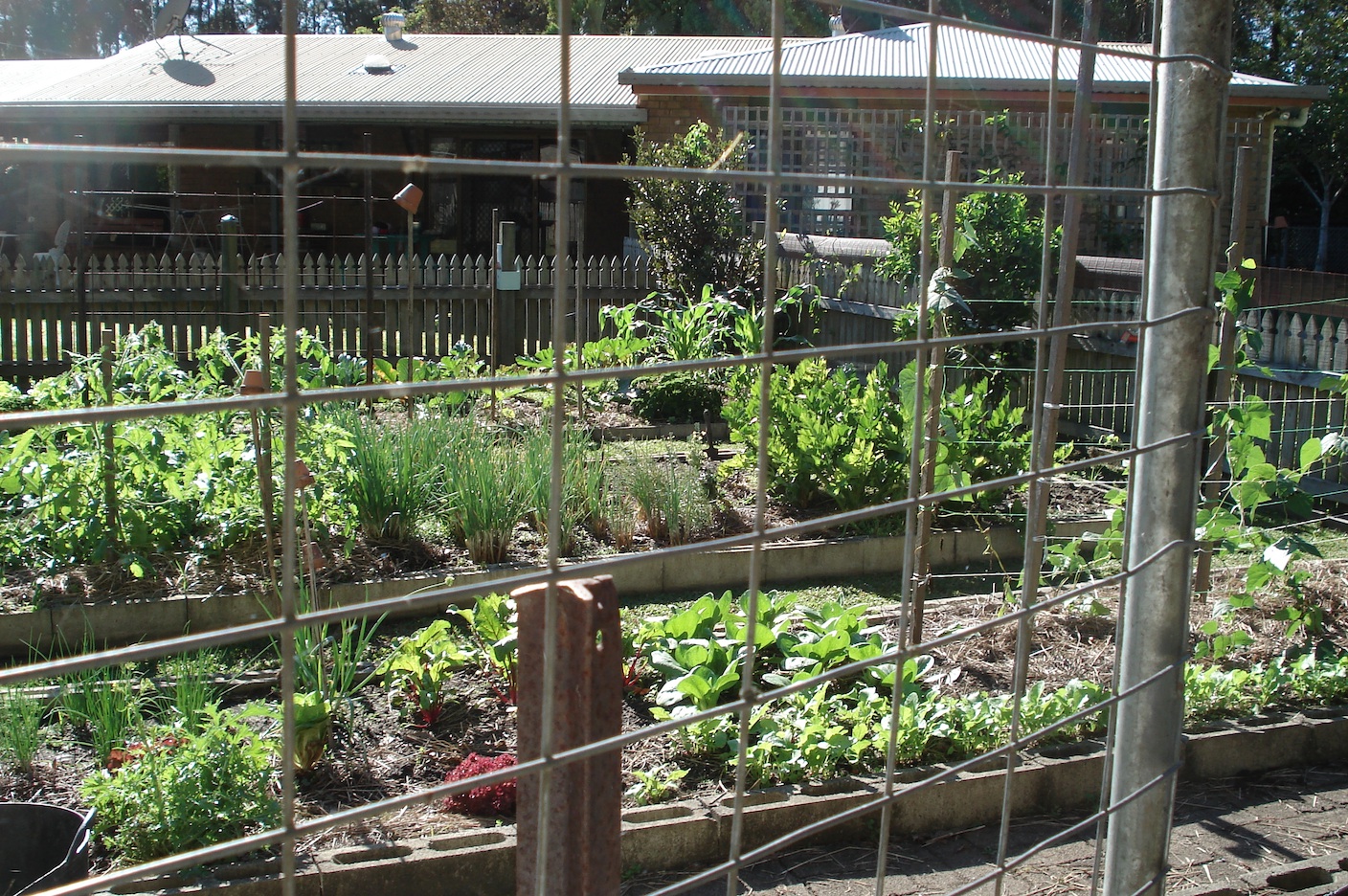
Meryl asked yesterday for a map of our garden, so that's been on my mind.  This photo was taken two years ago from the roof of the house.  When we set up our garden, fences were a priority.  Naturally, Hanno built them and put them up. I meant to add yesterday too, that the garden is his territory.  I plant seeds, water and harvest but Hanno does the bulk of the gardening work. 

The small backyard outside our back door is where Alice is fed, she also used to play in the main backyard but now she sleeps inside most of the time.  When we have guests, we often set up tables and chairs in the small backyard and we can lock out the dog and the chooks.  The chooks have got a big run attached to their house; sometimes they spend their days in there, sometimes they're let out to free range in the main backyard.  At the moment though, they're cleaning up the vegetable gardens for us in preparation for our March plantings - Hanno took out a piece of fence between their run and the garden so they can just wander in.  The main backyard is also fenced, we have a gate to go down to the creek and around the side of the house.  In my view, fences are necessary in a productive backyard.  Without them chooks will run amok and pets can go wherever they want to.  If you want to produce food, you have to be in control of the entire productive area.
We're starting to think about this year's vegetable garden.  We usually do our main planting in March and although I thought we might be able to bring that forward a bit because of the rising prices of vegetables after the floods, it looks like it will be March after all.  We're both busy with other things that are important and can't be put off.  So March it is.  Still that's only a couple of weeks away.


All these photos are of our vegetables in recent years.

Along with all of us in sub-tropical and tropical climates, I guess a lot of my northern hemisphere friends will be reading seed catalogues and making lists of vegetables for this summer's crops.  We generally plant the same reliable seeds and seedlings every year because what we grow what we eat.  If you're a new gardener and you're not sure what you should be planting, you'll find the answer in your kitchen.  Grow what you like to eat and what you can team up with the food you have in your stockpile and pantry. Whatever you're buying a lot of now at the store, make sure it has a spot in your garden.  If you don't have a lot of space or are a new gardener, plant the vegetables that cost the most to buy and the ones you use the most of.  If you intend canning/preserving tomatoes or peaches or beans, whatever it is, grow enough to eat fresh and to put up in jars.


Heirloom tomatoes - Lillian's orange Heirloom and Brandywine.


If you love potatoes, plant some.  A small crop the first year, and then expand on that in following seasons.  If you have room for vines to scramble over the earth, plant some vine fruit like watermelon or rockmelon|cantaloupe, as well as pumpkin. You can store pumpkins for about six months.  All vegetables, particularly melons, are great things to trade with neighbours for a dozen eggs or a jar of honey.  Make a bit of room on the edges of your vegetable gardens for herbs and just plant those you eat or will use in some way in your home.  Don't forget to take the time to enrich your soil with manures and compost. Nothing you will do in the garden is as important as that if you are going to rely on your garden to feed you.


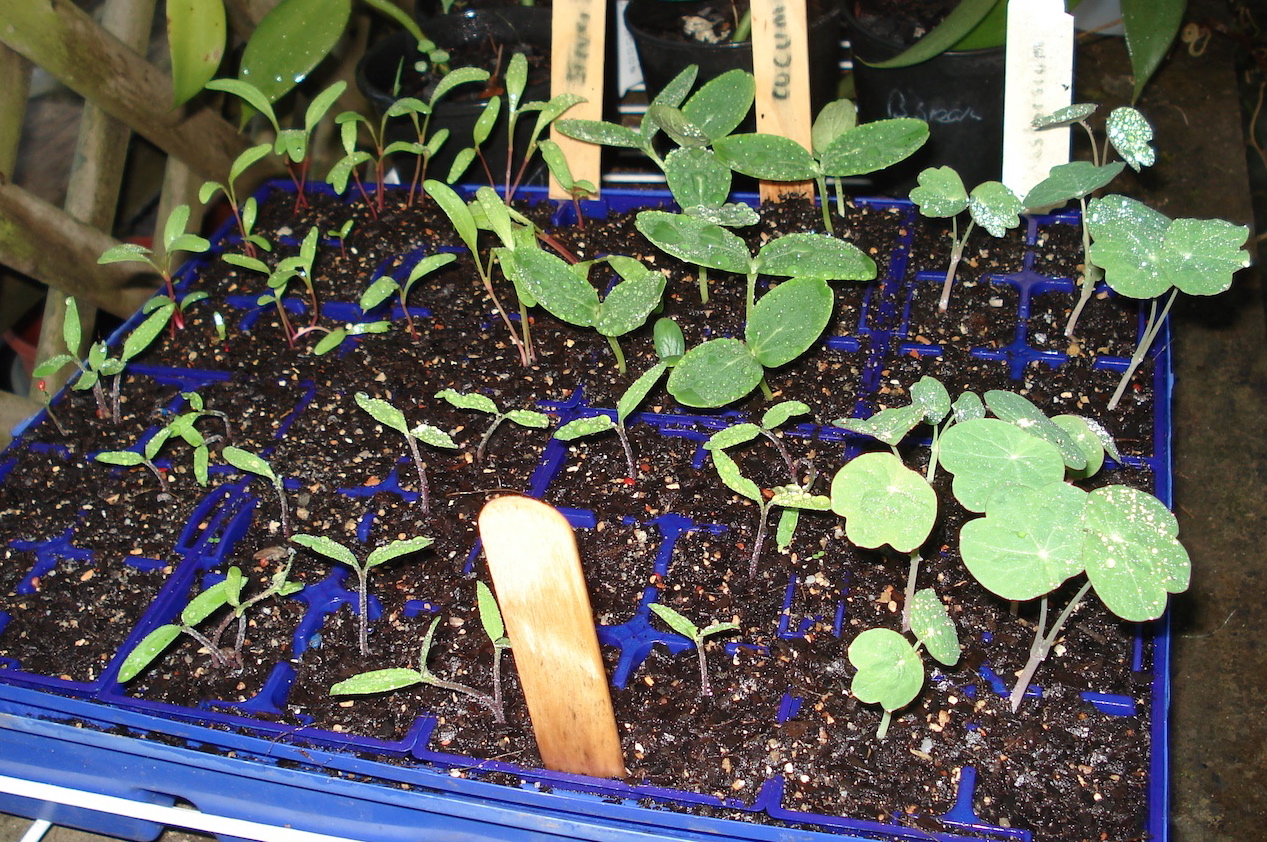
I have already planted up tomatoes but we'll also plant snow peas, Lazy Housewife beans, cucumbers, beetroot, turnips, celery, capsicums|peppers, chillies, ginger, radishes, Portugese cabbage and Sugarloaf cabbage, Swiss chard, spinach, kale, bok choy and Chinese cabbage (I am hoping to share some cooking with Sunny after the baby is born).  We'll put in a few lettuce and potatoes and add some chives to the already growing parsley, thyme, sage, comfrey and bay leaves.


Our backyard fruit is coming along well, we'll have another crop of lemons and oranges ready to pick soon, and a lot of passionfruit.  Blueberries are starting to come on and there are some mandarins and pawpaw|papaya this year.  I think we missed the bananas again but I might try a few strawberry plants closer to June.  It looks like it's shaping up to be a good growing year.  The tanks are full, we have compost maturing and we are ready, willing and able.  Are you planting this year?

We knew it would last for a long time but this economic crisis is dragging on longer than I expected it to.  There is no doubt there have been dire consequences for many people.  Homes and jobs have been lost and more than a few lives and businesses destroyed.  I hope genuine recovery is possible for all those who suffered.

At the beginning, when we were being warned to tighten our belts, I knew things would be tough, but I saw it as an opportunity for all of us to change, to move from being spenders to savers.  After a period of hardship, I hoped for progress that would lead us to an environmental awakening.  I hoped people would have a Eureka! moment and work out the savage link between spending and the overflowing landfills spewing carbon and methane into the atmosphere.


There is $72 in that bowl - it's my change jar.

Those of us who have been living within our frugal means for a long time knew that if we knuckled down and kept to our budgets, if we were cautious and if we didn't lose our jobs, if we could continue our thrifty ways, we would survive the crisis.  However, there wen't many of us doing that, most people were living close to the edge. As the crisis dragged on, I was surprised to see people I've known for a long time change in ways I never thought possible for them.  They started cutting back, being prudent with their spending, looking more to the future and not just to now; money stayed in their pockets and started being saved. Now that conditions are easing (in Australia), I have real doubts they'll return to their old ways.  It looks like permanent and deliberate change for them, with lives transformed.  

I hope we don't go through such a desperate and difficult period of time and not have it teach us valuable lessons. There has to be some good come from it.   The main thing it confirmed for me was to always spend less than I earn and that the best strategy for living well over a long period of time is to live on one income, even when there are two.  I've had many emails from people telling me their stories of how they have done that and the enormous difference it made, and had they not been firmly committed to that way of living, before the EC, they would have gone under.  It also reaffirmed my belief that stockpiling for many people, though not everyone, is a huge help in tough times, and  that when you're living from week to week changing small things helps a lot.  I'm firmly convinced that cooking from scratch can make a real difference to health and savings, and that overall, if you adjust the way you shop, eat plain and simple food, make your own cleaners and laundry liquid, and do it consistently, week after week, it will make a big difference to how much you save each week.   And sometimes that difference will make or break you.
So what do you think about it?  What, if anything, has the EC taught you?  Have you seen change and improvement?  Have you adjusted and reorgansied because of it?

I had an email from Theresa last week, she writes:

"Recently our family came upon some tough times when I woke up one morning with MS and needed immediate medical help. I'm only 30, otherwise healthy, and a stay-at-farm mother to a not quite 2 year old with a very supportive husband but no other family or even neighbors near by. 

While I am getting a little stronger each day and am hopeful that things will get normal again someday, things have been tough to say the least and I am terrified of what the future will bring. Both my husband and child had a terrible flu for a week straight too on top of it all and now I just don't know where to start putting things right again!

Every aspect of my life is difficult right now, even little chores like walking out to feed the chickens can be impossible in our heavy snow. I don't want to give up on our small farm, much needed home repairs, more children, or my life but it can be so hard to think about what needs to be done and get a plan started.

I wanted to try and see if you had any advice for others in circumstances like this. Even something like a broken bone or illness can cause chaos in a home and it is important to find a balance again."

Dear Thesesa, reading your email made me feel so sad knowing what you're going through with a young child to look after. I had to look up MS and it says there are many different forms of the disease, but in the most common form you have a severe attack, preceded by a viral illness, you slowly regain your strength in varying degrees, but attacks occur very year or two.

You say you have no family or neighbours close by but I wonder if you have a family member who could come and stay with you for a couple of weeks while you get back on your feet again. If you know the illness will be in the acute state again, you'll need to set up systems in your home to deal with that and maybe when you're in an acute phase, you'll need someone from the family staying to look after you, to help with your child and to do your chores. It sounds like you're in the US or Canada, are there any support groups for MS there? Do you have community nurses? Do you belong to a church that could help?

I expect you've thought a lot about your illness and maybe you've already thought about what I'm about to suggest. If you have the strength to do anything, it should be to look after your child, then daily food, then laundry and general house work - in that order. You'll have to develop an attitude of acceptance - accept that you cannot do what you want to do, and be happy to do what you can do. Don't fret over housework not done - accept it as a side effect of your illness. You, your child and husband come first, always. If all of you are okay, leave the rest.

I really hope one of your relatives can come and stay for a while. If someone can, ask them to set things up for you to manage when they're not there. So, for instance, get a feed hopper for the chickens and a water container that won't tip over. That will cut down on the number of times you have to go out to feed them and haul water out. If they can feed themselves, you can go out every couple of days for a visit with your child, then slowly come inside again. If you're making bread, get a breadmaker. Buy a slow cooker so you can fill it in the morning and have a meal ready at night. If you don't have a stockpile, now is the time to start so you don't have to shop for groceries or feel bad because you can't. Set your kitchen up so that the things you use a lot are within easy reach. Do the same with your child's room. Get an open topped toy box that all the toys can be dumped in - by your child, so you don't have to be constantly putting toys away. Keep books on tables for him/her to read and favourite toys within reach so that when you're not feeling well or strong, he/she can get those things. This is like being prepared for a disaster that you know will happen.  

You have to look after yourself and not stress out about not being able to do what you used to do. If you can organise your home for times when you have no strength or when you feel too ill to do anything, it will help you cope, in a small way, with your illness. Once the home is organised, you should be able to cope alone and with the help of your husband.

I hate asking for help and if you're the same, put that aside because you need help now. Tell your family you need someone to come and stay for a couple of weeks . Make lists of what needs doing to help you cope when you're alone. And let go of all thoughts of having a perfect home. You are the priority - your health and well being come before dusting, vacuuming and picking up. Accept there will be days when you can't do much at all, other days when all you can do is feed yourself and the family, and days when you can do much more, and be happy with that.

I expect your husband is working on the farm, and out of the house most of the day. You'll need to set up some sort of system so you can contact him if you become ill. Maybe a cell phone would work if you also have a landline. Suggest to your husband that he talks to a friend, doctor or counsellor about your illness. Even though he's not the one with the disease, he'd be feeling confused and anxious about it and he needs to talk to someone other than you about that.

There will be some good suggestions in the comments, I just know that, so let's open this up for discussion. You may have this disease too, or know someone who has, so if you do, tell us your experience. If you have any tips, write them down. Don't walk away from this. Even if it's just to wish Therese well, please leave a comment so she knows that even though we might be miles away and not know her by face or name, we acknowledge her pain and send kind thoughts.

Comments are closed on this post.
I haven't been doing all my regular work while I'm book writing but I'm still cooking, nothing stops that, and still knitting when I have a break.  As usual, we're eating leftovers when we have them and Hanno made about four litres of tomato relish/sauce so we can't complain about a lack of variety or quality.  Here are a few meals from the past few week.


On Saturday we had half this scone loaf fresh for lunch and finished most of the second half on Sunday.  A minute in the microwave freshened it up and made it warm again.  To make good scones you need a moist dough and then as you lightly knead it, you can add more flour in the kneading to make it easier to handle and cut.  There are many recipes for scones, this recipe makes a very tasty scone that is light and moist.

SCONES - these are similar to American and Canadian biscuits

INGREDIENTS
  • 3 cups SR flour
  • good pinch salt
  • 1 teaspoon sugar
  • 1 tablespoon butter
  • 2 tablespoons sour cream or natural yoghurt - this makes for a very light and tasty dough.  
  • enough milk to make a moist dough. If you have no sour cream or yoghurt, you could use buttermilk, whey or milk soured with vinegar or lemon juice

METHOD
  1. Combine the flour, salt and sugar. 
  2. Rub the butter and sour cream/yoghurt into the flour with your fingertips.  When it's combined well ...
  3. Add the buttermilk/whey/soured milk and mix in.  You want a dough that is not sloppy but it looks too wet.
  4. Take the dough out of the bowl and place on a floured bench.  Knead for less than a minute, incorporating more flour.
  5. Form into whatever shape you want, place on a baking tray, put into a hot over and bake for 20 minutes, or until the top is golden and it smells cooked.


We had a few sweet potatoes that were about to sprout (now they have, I'll plant the sprouting ends I cut off) so I wanted to use them straight away.  I made up a savoury mince - or ground beef with vegetables - with curry spices and liquid from the cooking tomato sauce.


After boiling the sweet potato, I mashed it and topped the meat with it.  Twenty minutes in the oven gave us a delicious, golden pie we dined on for two nights.


And this is Hanno's tomato relish/sauce.  He washed the tomatoes, chopped them an added two sticks celery and six large chopped onions.  In a large pot, add a slurp of olive oil, a couple of crushed garlic cloves, two tablespoons paprika, one tablespoon curry powder and a teaspoon each of salt and pepper - remember, it's a large pot.  Cook the spices, then add the vegetables and bring to the boil.  Leave the top off the pot and let the tomatoes to cook slowly allowing the liquid to evaporate off - this intensifies the flavour.  After about an hour, add one cup of sugar and one cup of vinegar - we used malt vinegar and white sugar, but you could use whatever you have in the cupboard.

When the sauce is thick and reduced by at least one third, take it off the stove and blend with a stick blender.  This is optional, we often have the chunkier relish, but it serves well as tomato sauce if you blend it.


This sauce/relish will develop in flavour as it's left to sit.  Use it on anything that needs tomato sauce, pizzas, sandwiches or pasta.  That amount made what you see in the containers above - about four litres/quarts.  We sterilised the jars in the oven and boiled the lids.  The sauce was added, the jars turned upside down and allowed to cool.  All the buttons on the lids were inverted and they're now stored in the fridge and the pantry cupboard.


And this is how I used the sauce last night on our dinner - more leftovers.  I made a meatloaf during the week and had a small portion left.  It wouldn't have been safe to keep it longer so last night I mashed some potatoes, made a coleslaw from white cabbage, onions, carrots and mayonnaise and served the meatloaf with the sauce.  It was delicious.


And finally, I saved the best till last - brown rice and sweet potato salad.  I could eat this salad every day.  Boil a cup of brown rice and bake a cut up sweet potato until it's cooked and browned.  When the rice is drained and  cool, add whatever vegetables you have on hand - I used sweet corn just picked from the garden, onions, celery and cucumber.  If I had red capsicum/pepper I would have added that too for the colour.  Add two level tablespoons mayo, salt and pepper to taste, mix it all together then add the sweet potato. Don't add it earlier as it will break up when you mix the salad.  We had this with cold chicken but it would be an excellent vegetarian dish served with tomato and radishes.

As you can see from this selection from the past week, we eat simple food but it's nourishing and delicious.  We had meat for almost every main meal last week but we often have meatless meals. Real food doesn't have to be expensive or complicated.  If you have a good recipe book, or someone to teach you, you will be able to feed your family a variety of good food that you don't pay an arm and a leg for.

Many thanks to everyone who voted for Down to Earth in the Bloggies. The voting ends in a couple of weeks.  I hope we all have a productive and interesting week and you enjoy your work and whatever you do in the coming days.


Dear Everyone

We were surprised to find that Down to Earth was nominated for the Best Australian or New Zealand Blog in the 2011 Bloggies.  Thanks to those who nominated D2E. We would like to shake your hand and make you a cuppa.  There are five nominees in the category:  Down to Earth, The Frugal Kiwi (who kindly told us about the nomination), Three Ring Circus, The Design Files and Babyology.  We would love you to vote for Down to Earth.

You can vote here: http://2011.bloggi.es/  Voting closes 20 February and there is only one vote per person.  If you vote twice, your first vote will be cancelled.

If you have time, please vote for Path to Freedom too - the Dervaes family do such a great job with their blog and website showing how well they live on their urban homestead.

♥
Rhonda and Hanno
I grew up in a much slower time.  A time when bread was delivered by horse and cart and a ginger beer merchant sold his product, from a cart, in stone bottles.  Believe it or not, that was the start of the commercialisation of food.  Previously mothers and grandmas had made bread and ginger beer at home.  A few years later we started taking our saucepan to the local Chinese shop, very infrequently I must add, for a treat of takeaway Chinese food - well before any thoughts of plastic or polystyrene containers.  These were slow times with lazy Sunday roast lunches, talking to the neighbours over the back fence and train travel when you'd take a Themos flask of tea and sandwiches to eat en route.   It was a time when you'd often hear: "we'll do it tomorrow.", "it has to cook for three hours.", "let it sit and ferment for a few days.".  Nothing was rushed


I sped up a lot while I was in my twenties, thirties and forties, and I doubt I gained much from it.  I've slowed down again, enjoying life a lot more, and now I'm wondering why we think we should rush through life.  When I was a young mum, I worked full time, studied for a degree, was on the P&C and other committees, had to drive three hours each way to reach the shops, spent time with friends and generally had a good time.  But I never considered myself busy and I always took time to sit with a cup of tea and talk to friends.  If anyone asked me to do something I could usually fit it in and I don't remember ever feeling stressed by the work I had to do.  Now I hear so many people say they're busy and I wonder if it really is busyness or are they rushed and think that is being busy.

Let me say here I mean no disrespect to anyone and I'm not undervaluing the work anyone does, either in the home as SAHMs and WAHMs or in the paid workforce.  This "I'm so busy" thing is a real mystery to me, but you see and hear it all the time in the media too - "everyone is busy".  I don't see any evidence that the workload of parents now is more than it used to be, and family life seems to be pretty similar to how we experienced it all those years ago. I wonder if it's the stresses of keeping a job, worrying about the mortgage or how to pay the rent, rushing to get things done and not taking time out when it's needed.  Does that add up to people being overwhelmed and feeling as if they don't have a spare minute?


Whatever it is, if you feel you are busy or rushed all the time, I encourage you to slow down, and take more time to do your work.  It may surprise you that you get more done and feel better for it.  When I closed down my business to return to my home, initially I rushed through my housework to make sure I got it all done.  I never did, so I felt anxious and inadequate.  Then I had one of my Eureka! moments, realised that housework never ends, I slowed down, took whatever time it took, concentrated on my work and came out better for it.  And I got more work done.  Rushing doesn't facilitate work, it blurs it, making you feel you're constantly behind and you have to hurry. Remember that fable The Hare and the Tortoise?  The tortoise came first.  

This minute is all you have.  Yesterday has gone, tomorrow hasn't happened, you only have now.  If you constantly rush through what you're doing, thinking of what you'll do next, you don't get to truly experience your minutes.  Slow down, think about what you're doing, experience it fully, and get something out of it.  Every thing you do is part of your life.  Make your minutes memorable.  Thoreau wrote: "I went to the woods because I wished to live deliberately, to front only the essential facts of life, and see if I could not learn what it had to teach, and not, when I came to die, discover that I had not lived. I did not wish to live what was not life, living is so dear; nor did I wish to practise resignation, unless it was quite necessary. I wanted to live deep and suck out all the marrow of life, to live so sturdily and Spartan-like as to put to rout all that was not life, to cut a broad swath and shave close, to drive life into a corner, and reduce it to its lowest terms, and, if it proved to be mean, why then to get the whole and genuine meanness of it, and publish its meanness to the world; or if it were sublime, to know it by experience..."  I live by that quote.  When I first read it many years ago it helped change my life.  The way he expresses it might sound a bit over the top now, but what he's saying is we need live deep, think about and really experience everything we do, whether it's good or bad, enjoyable or mundane, so that when we come to die we don't realise, too late, we haven't really lived.

There is a lot to be said for slow and deliberate living.  Let's reclaim our slow lives so we are able to see and genuinely experience what we do and who we spend our time with.  Try slowing down and being in the moment.  If you feel you are always giving and have no energy left to enjoy your home and your life, give yourself the gift of time out.  If you feel you have to rush through your work and that you're always busy, rushing will not help you, slowness will.  When you're more relaxed you'll feel more capable, you'll be able to do what you have to do and you won't get to the end of the day exhausted and wondering what you did all day.  If you've made a commitment to yourself to live a more simple life and you know that will be better for your family, include yourself in on the gift, by slowing down and seeing your work as productive and creative and not just chores to be rushed.
If you were wondering where we were yesterday, Hanno and I were out volunteering.  After an early breakfast of tea and toast, we travelled up the mountain, through mist and an occasional shower, to our neighbourhood centre.  As we arrived, so did Wendy (gee I miss those people I used to work with), then Hanno drove the bus into Brisbane's Foodbank and after our customary early morning talk, Wendy started her work and I printed out my notes for the second part of the soap making workshop.  We'd made bar soap the previous week, yesterday we finished off by making laundry liquid and talking about home made cleaners.  They were a wonderful group of women, all enthusiastic about cutting right back on the amount of chemicals in their homes and coming back for more workshops in the future.

So after the ladies left and I cleaned up, I had lunch with Beverly, heard about how the Bunya Festival went and started talking about the workshops.  Beverly said people have been coming in asking about them so we compiled a list and decided when to start.  Beverly said she'll do two - Crossing Cultures (indigenous awareness) and Bush Foods, a new volunteer will do Vegan Cooking, and one of the ladies at the soap making will do Baby Massage.  These will be in addition to those I'll do on breadmaking and sour dough, jams, sauces and pickles, organic vegetable gardening, chooks, worms, cooking from scratch, fermenting, the fugal home and blogging.  I'm going to phone a lady today to see if she'll do knitting and crochet for beginners.  It looks like it's forming into a very helpful group of topics.  They'll start in May, when the book is finished.

I'd like to thank Nicole, a young lady who surprised me by sending a beautiful box of natural soaps, lips balm, lotions, deodorant and beeswax candles.  Nicole said she has been reading the blog for three years and learned how to make soap from my tutorial.  The gift was her way of saying thank you for what she got from the blog.  Now she has a little Etsy business selling her beautiful products.  Thanks Nicole, I love what you sent.


This is the latest satellite map of the cyclone.  
Photo from the Australian Bureau of Meteorology.

So today I'm back at work on the book and while I write about food, Hanno will be putting my words into action.  We got some free tomatoes yesterday and he's going to make tomato relish and sauce.  More delicious home made goodies for the cupboard!  I'll tell him the recipe but he's is a pretty good cook so I'm happy to leave him to it.  He'll come in and ask if he needs to.  We'll also be keeping an eye on that huge cyclone/hurricane that's off the coast and moving closer towards our state.  It's 500 kms|310 miles wide and is expected to be a category 5 (winds 295 km/hour) when it crosses later tonight.  I have a bad feeling about this and even though people are being evacuated up north, I know many will be unable to leave.  I worry too about all the animals - both wild and pets left behind.  It's been a tough year so far with the weather and it looks like it will be much worse soon.  If you're up north I hope you'll be safe and can move to protected, high ground.  Don't worry about Hanno and I, we're further south (just where that cloud stops half way up the east coast), we'll get the rain but not much else.

Thanks to everyone who helped with the house affordability question last week.  I was heartened to see that many people thought living on one income (even if there are two) is a great frugal strategy, and it is possible to buy a home on one income as long as the house price is low enough and you're prepared to put in some hard work renovating.  I agree.  I hope that post and the comments it drew help not only the girl who wrote to me but many other people as well.  My own children want to buy homes and I know it's not easy.


It feels like the year is really beginning in earnest now the are school holidays over.  Hanno and I are starting to think about our vegetable garden again and next week I hope to get some time to plant up some seeds we have here.  I have some Portuguese cabbage, sent to me by Andrew in Melbourne, that we'll try, we have luffas in, some corn to harvest and fruit growing, but we need a lot more than that.  I have six tomato seedlings in pots as well, grown from seeds of the excellent large cherry tomato that came up wild last year.  That tomato was healthier than any we planted, it was big for a cherry tomato, prolific and absolutely delicious. If it ends up being as good this year, I'll sell some of the seeds in the Etsy shop.  I doubt our shop will open before Easter but we are working towards it.  I was told recently that if I intend selling soap, I have to pay a $400 fee to the government as I'm classified as a "chemical producer".  Pfffffffft.  We're not sure if it's worth it.


More nectarine jam!  We have enough for a year and to give away.  : - )

We had a fairly busy weekend, I worked on the book and other computer related things but didn't have time to go to the Bunya Festival on Saturday.  My friend Beverly, organiser of the event, brought us a message stick last week so I was disappointed we didn't get there.  We'll make sure we go next year.  Hanno worked on the roof replacing screws and he mowed the lawn.  I was exhausted yesterday and although I had every intention of working, I ended up cooking biscuits and a meatloaf, and relaxing with a bit of knitting and cricket in the afternoon.  I wonder how I can become so tired working as I do, with every comfort and Hanno's support.  I guess it's my age and the intensity of the work, whatever it is, a quick sleep is a good pick-me-up and I'm right again.


Today is the start of another busy week.  I have the second part of my soap making workshop to deliver tomorrow and there are just four more weeks before the completed book manuscript is due.  After that there will be two months editing with my Penguin editor, Jo, and the book will be finished. It will be wonderful to have it done, it's been so long in the making, but I think that after a couple of weeks putting things right here, sewing and knitting for the babies and visiting my sister in her new home, I'll be thinking about settling into writing again.  I have been a writer for many years now and it seems to be part of me.  It suits my nature as it's solitary and reflective and it helps me understand the world and how I fit in it.  Even from this tiny dot on the map, writing enables me to connect to you and be a part of a large and significant online community; and that, for me, is the icing on the cake. 

I hope you have a productive and wonderful week ahead.  Thanks for visiting me.


This is a Friday photo feature that anyone with a blog can join. It opens the door to us sharing our lives with these photos and gives us all a new way to discover each other, and maybe form new friendships. Your photo should show something at home that you're thinking about TODAY.  If you're in another country you should join in when you read this, even if it's still Thursday.

To take part in this, all you have to do is post a photo, write a short caption explaining it, and link it back to here. Please write a new post, don't link to an older one.  When your photo is published, come back and add a comment below, with a link to your blog photo. Please visit the blogs that appeal to you and leave a comment.  It's a way of becoming closer as an online community and a way of establishing friendships.


Today, and for the past few days, I've been thinking about this book.  It was sent to me by a lovely friend and it's already become my favourite cookbook.  This book is me.  It's how I cook, so it's wonderful to have it in my hands - a source of some great new recipes.  There are chapters on cooking with leftovers, entertaining on a budget, baking,  weekend meals to cook and keep, lunchbox food and breakfasts, along with many tips and food hints.

If you're Australian, you'll recognise a face on the cover - Margaret Fulton.  It's is written by her daughter and granddaughter.  I love this book.  Any cookbook with recipes for baked peach pancakes, slow roasted lamb shoulder and green pea hummus deserves a space in my home.


I just did a search for this:  reduced from $50 to $13.


I had an email this week from Rebecca who wrote:

I'm about to turn 30 and I live in a rented smallholding in the UK. My husband and I live as simply as possible, rearing nearly all of our own food and spending as little as possible. We are very happpy and love our lives. We're both well educated and work in environmental jobs, which we both enjoy, feeling that they are worthwhile and really contribute something to society. They pay fairly poorly (as is the case with all environmental work) but we don't need much money as we live simply and money simply hasn't been too much of an issue for us in our way of life. The problem is more of a long term one. We are trying to start a family, which will inevitably involve a salary reduction. ... However, ideally we would like to buy a house at some point in the not too distance future. I hope this doesn't just sound a spoilt list of 'wants'. ... We live in a fantastic rural community which we are very much part of and never want to have to leave; but renting is by its nature insecure and obviously we never know when our landlords may want their house back. This is also coupled with the fact that we don't really want to be paying rent in our old age, and have to carry on paid jobs until we die, just to meet rent.

In the UK, as I'm sure is probably the case in Australia and many other countries, house prices have gone through the roof in the last ten years and salaries haven't. You need two reaosnable salaries for a bank to give you a mortgage on the average priced house. As I said, money hasn't been an issue because we live frugally, and have saved a big deposit, but how on earth do you get a round the mortgage issue? Even with a large deposit, it is the mortgage that makes up the bulk of the house value. We work hard, and quite a lot of hours as our work is seasonal, and hard work isn't an issue. However, I don't think moving to take a highly paid, corporate job is an option for either of us - there is no work like that in the area and I think it would go against what we believe in. 

I know that you can't have everything at once. If we want to start a family, we have to accept a reduced income. We can possibly cut back a small amount, but we live very frugally, preparing all our meals from scratch, making as many ingredients as possible and rearing all of our own food. We work form home as much as possible, use the car as little as we can and don't really buy anything.  I know that there are lots of people my age struggling with similar issues and I'm sure there's a sensible way ahead. I'd love to hear what you think.

Hello Rebecca.  Yes, it's a problem here too and probably in many countries.   I hate to keep harping back to the old days but I think we can learn a lesson from our past. Back in the 70s, I lived in Balmain, a suburb in Sydney right on the harbour.  It was definately working class then but now it's been gentrified and a house that would have cost $19,000 in 1970 would now cost between $1 and $2 million.  But back then, $19,000 was an awful lot of money and we didn't think about buying, we kept renting.  I eventually left Balmain but I have friends who stayed and bought a house.  The way they got around it was to buy in an area they liked but the cheapest house they could find.  They then spent the next few years fixing as much as they could on weekends and at night.  Eventually, when the house was in better condition, they sold it and bought another, better, house.  They did that a few times until they had the house they wanted and could afford.  It took a lot of work and time but it was the way it was done then and they were happy to be in their own home, working for their future together.

If you do that, you have to be prepared to work on the house and improve it as you live in it.  It's tough and I'm not sure many people would like doing it but it would be a real challenge and it's a way of getting into the housing market.  Don't aim for the top house, aim the worst house in the best street instead.  When we started out it was common practice to start at the bottom, buying whatever you could afford - that might be an apartment or an old house, and you'd renovate and paint and work your way up. I have heard quite a few young people complain about baby boomers having it all and keeping them out of the property market, but this is how we got what we have.  We didn't think of buying the top of the market, we always started at the bottom, or wherever we could fit in the housing market that was within our budgets. 

In Australia now, ordinary houses in Sydney are selling for $600,000 - $1 million, although here where I live they're half that.  In smaller towns you can get a good house for $150,00 - $200,000.  Can you move to an area where the house prices are lower?  Can you take in a boarder where you are now to help with the rent while you save for a house?

There is an interesting article here about the current over average housing prices in the UK.  Maybe you should keep and eye on this, hold off for a while and see if the prices come down in the next few years.  In Australia, the government pay a first home owner's grant of  $7,000.  Do you have something like that?

I wish I could offer you a definite direction Rebecca, but this is one of those problems that is not so easy to solve.  As you know, our readers offer excellent advice and so I'm hoping we might get some helpful suggestions for you to try.

And now it's over to you.  If you're young and have moved into your own home, how did you do it?  Please share your experiences and thoughts on this as I'm sure Rebecca will be one of many who will benefit.

Let me start this by saying there are many ways to sterilise food by water bath.  This is how I do it and having been doing it for many years. I'm still here to tell the tale, but be warned, you need to do this carefully.

If you're a keen home cook and have ventured into making sauces, relish, chutney, bread and butter cucumbers or pickled beetroot, there will come a time when you might want to sterilise your jarred products so you can store them in your pantry  for eating later in the year.  I've written before about how we in the warmer climates tend to do less preserving/canning than our northern hemisphere friends - our gardens produce food almost all of the year, and here where I live it is quite easy to keep a kitchen garden going all year.  So instead of putting up our beans, carrots, soups and stews, we tend to eat our vegetables fresh, or if there is an excess, we freeze it.


Tomato relish and ginger beer.

Preserving/canning plays a part for us when we make a great pasta sauce or excellent relish, that is much tastier, healthier and cheaper than the store bought varieties, and we want to make a lot of it to use in the following months.  This is when we need to preserve/can what we cook.  Sauces, chutney and relish, in fact most foods with herbs and spices in them, will improve in flavour when preserved and left to develop flavour for a couple of months.  If you've never done it before, or only do a small amount each year, it's probably not financially sound to buy special equipment.  Here is a good way to sterilise your preserves in a water bath, without special equipment and by using what you already have in the kitchen.

Use modern recipe books for preserving|canning, or recipes from a trusted source, don't rely on very old canning books - some of the old methods of preserving|canning were unsafe.   When you first start doing this, use small quantities and small jars; when you know what you're doing, go bigger.  

You'll need a large saucepan like a stockpot, if it's not a stockpot, it has to be a pot big enough for all the jars to sit under the water.  I use recycled jars that have already been used for jam or honey.  You'll need metal lids that have plastic coating inside the lid to stop the food acids reacting to the metal.  Most of these lids have a little metal indent button that will indent when it's sealed correctly. Take a bit of time with the jars, they could be the difference between success and failure.  Check the rims by running your finger around the opening.  Make sure there are no chips or cracks and the lids are not dented or rusty.  Wide mouth jars are best because it's easier to fill them.


To sterilise your jars, wash them in warm soapy water, rinse, then place them in a low oven - 150C|300F for about 20 mintues.  You want to fill hot sauce into the still hot jars so do this while the sauce is cooking.

When you fill the jars, you fill it almost to the top, without spilling over the side.  You want a bit of what is called head space because some foods swell and bubble when they're heated and need this space to expand.  If you don't allow enough headspace the food might force the lid up and you won't get the jar to seal properly.  The general rule is  7mm|¼ inch for jams and jellys and 12mm|½ inch for tomatoes and fruit.

Before you fill the stockpot|saucepan, place either a round cake rack that fits well on the bottom of the pan, a folded tea towel or folded newspaper on the bottom of the pan so the jars don't sit directly on it.  Instead of using a wide mouth canning funnel, scoop the jam up in a medium sized jug to fill the jars.  Instead of canning tongs to lift the jars, you'll have to use the same jug to scoop some of the hot water out of the pot and when the jars are uncovered, pick them up with a tea towel folded a few times.


These are just some of my jars and bottles.  I never throw out wide mouth jars or interesting bottles and I buy some larger preserving jars.

When you finish filling your jars wipe them to make sure they're clean then, with the processing pot sitting on the stove, place the jars in the pot so they fit well without touching the jar next to it. Fill the pot with cold water, using a saucepan filled at the tap, then bring the pot to the boil - this will take 45 to 60 minutes. When it's slowly boiling, hold it at a slow boil for another 45 minutes for small jars and 1 hour for large jars. When the time is up remove the jars to sit on a tea towel on the bench to cool slowly for 24 hours. The prolonged heat will form a vacuum in the jars and you'll notice the lids will be slightly inverted, or you'll hear them pop as they cool down.

And that's it!  You don't need to buy all sorts of equipment, but like most things, if you really get into this you might want to expand on your utensils and equipment if you do a lot of preserving.  The important thing here is to try it and if it's a good fit for you, it's another useful and productive skill you have in your move towards a more sustainable life.

PLEASE BE AWARE: Low acid foods like meat, beans, carrots, peas, soup etc are not suitable for this type of preserving|canning.

Go here to read an older post of water bath processing.

ADDITION: Here our tap water isn't really cold and it's fine to use tap water on hot jars to fill the pot.  If you're in a colder place, you'll have to heat the water in the pot first, then place the jars.


Newer Posts Older Posts Home

ABOUT ME

Down to Earth is a blog by Rhonda Hetzel, dedicated to simple, intentional living — from home cooking and gardening to frugal budgeting and handmade crafts. It’s a space for gentle inspiration and everyday wisdom on creating a life that feels real, balanced, and deeply fulfilling.

Down To Earth Book

Down To Earth Book
My books are all published by Penguin. Down to Earth, The Simple Life and The Simple Home have been in book shops since they were published in 2012, 2014 and 2016, respectively. On 20 October 2020, Down to Earth was published as a paperback.

MY FAVOURITE PLACES

  • Grandma Donna's Place
  • Grandma Donna's YouTube
  • Grandma Donna's Instagram
  • This Simple Day
  • Nicole's Instagram

Popular Post of All Times

Making ginger beer from scratch

We had a nice supply of ginger beer going over Christmas. It's a delicious soft drink for young and old, although there is an alcoholic version that can be made with a slight variation on the recipe. Ginger beer is a naturally fermented drink that is easy to make - with ginger beer you make a starter called a ginger beer plant and after it has fermented, you add that to sweet water and lemon juice. Like sourdough, it must ferment to give it that sharp fizz. To make a ginger beer plant you'll need ginger - either the powdered dry variety or fresh ginger, sugar, rainwater or tap water that has stood for 24 hours to allow the chlorine to evaporate off. You'll also need clean plastic bottles that have been scrubbed with soap, hot water and a bottle brush and then rinsed with hot water. I never sterilise my bottles and I haven't had any problems. If you intend to keep the ginger beer for a long time, I'd suggest you sterilise your bottles. MAKING THE STARTER In a...
Image

The last post

This will be my last post here.  I've been writing my blog for 18 years and now is the time to step back. I’ve stopped writing the blog and come back a couple of times because so many people wanted it, but that won’t happen again, I won’t be back.  I’ll continue on instagram to remain connected but I don’t know how frequent that will be. I know some of you will be interested to know the blog's statistics. 
Image

How to make cold process soap

I'm sure many of you are wondering: "Why make soap when I can buy it cheaply at the supermarket?" My cold process soap is made with vegetable oils and when it is made and cured, it contains no harsh chemicals or dyes. Often commercial soap is made with tallow (animal fat) and contains synthetic fragrance and dye and retains almost no glycerin. Glycerin is a natural emollient that helps with the lather and moisturises the skin. The makers of commercial soaps extract the glycerin and sell it as a separate product as it's more valuable than the soap. Then they add chemicals to make the soap lather. Crazy. Making your own soap allows you to add whatever you want to add. If you want a plain and pure soap, as I do, you can have that, or you can start with the plain soap and add colour, herbs and fragrance. The choice is yours. I want to add a little about animal and bird fat. I know Kirsty makes her soap with duck fat and I think that's great. I think t...
Image

Preserving food in a traditional way - pickling beetroot

I've had a number of emails from readers who want to start preserving food in jars but don't know where to start or what equipment to buy.  Leading on from yesterday's post, let's just say up front - don't buy any equipment. Once you know what you're doing and that you enjoy preserving, then you can decide whether or not to buy extra equipment. Food is preserved effectively without refrigeration by a variety of different methods. A few of the traditional methods are drying, fermentation, smoking, salting or by adding vinegar and sugar to the food - pickling. This last method is what we're talking about today. Vinegar and sugar are natural preservatives and adding one or both to food sets up an environment that bacteria and yeasts can't grow in. If you make the vinegar and sugar mix palatable, you can put up jars of vegetables or fruit that enhance the flavour of the food and can be stored in a cupboard or fridge for months. Other traditional w...
Image

Cleaning mould from walls and fabrics

With all this rain around we've developed a mould problem in our home. Usually we have the front and back doors open and that good ventilation stops most moulds from establishing. However, with the house locked up for the past week, the high humidity and the rain, mould is now growing on the wooden walls near our front door and on the lower parts of cupboards in the kitchen. Most of us will find mould growing in our homes at some point. Either in the bathroom or, in humid climates, on the walls, like we have now. You'll need a safe and effective remedy at some point, so I hope one of these methods works well for you. Mould is not only ugly to look at, it can cause health problems so if you see mould growing, do something about it straight away. The longer you leave the problem, the harder it will be to get rid of it effectively. If you have asthma or any allergies, you should do this type of cleaning with a face mask on so you don't breathe in any spores. Many peopl...
Image

Five minute bread

Bread is one of those foods that, when made with your own hands, gives a great deal of satisfaction and delight. It's only flour and water but it symbolises so much. I bake bread most days and use a variety of flours that I buy in bulk. Often I make a sandwich loaf because we use most of our bread for lunchtime sandwiches and for toast. Every so often I branch out to make a different type of loaf. I have tried sour dough in the past but I've not been happy with any of them. I'll continue to experiment with sour dough because I like the idea of using wild yeasts and saving the starter over a number of years to develop the flavour and become a part of the family. However, the loaf I've been branching out to most often is just a plain old five minute bread. By five minutes I mean it takes about five minutes actual work to prepare but it's the easiest of all bread to make and to get consistently good loaves from. If you're having people around for lunch or...
Image

This is my last post.

I have known for a while that this post was coming, but I didn't know when. This is my last post. I'm closing my blog, for good, and I'm not coming back like I have in the past.  I've been writing here for 16 years and my blog has been many things to me. It helped me change my life, it introduced me to so many good people, it became a wonderful record of my family life, it helped me get a book contract with Penguin, and monthly columns with The Australian Women's Weekly and Burke's Backyard . But in the past few months, it's become a burden. In April, I'll be 75 years old and I hope I've got another ten years ahead. However, each year I'll probably get weaker and although I'm fairly healthy, I do have a benign brain tumour and that could start growing. There are so many things I want to do and with time running out, leaving the blog behind gives me time to do the things that give me pleasure. On the day the blog started I felt a wonderful, h...
Image

What is the role of the homemaker in later years?

An email came from a US reader, Abby, who asked about being a homemaker in later years. This is part of what she wrote: "I am a stay-at-home mum to 4 children, ages 9-16. I do have a variety of "odd jobs" that I enjoy - I run a small "before-school" morning drop-off daycare from my home, I am a writing tutor, and I work a few hours a week at a local children's bookstore. But mostly, I cherish my blissful days at home - cooking, cleaning (with homemade cleaners), taking care of our children and chickens and goats, baking, meal-planning, etc. This "career" at home is not at all what I imagined during my ambitious years at university, but it is far more enriching. I notice, though, that my day is often planned around the needs of my family members. Of course, with 4 active kids and a husband, this is natural. I do the shopping, plan my meals, cook dinner - generally in anticipation of my family reconnecting in the evening.  I can't h...
Image

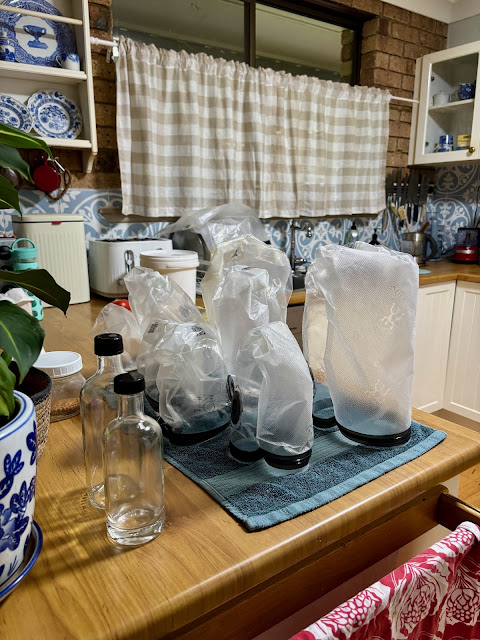
Every morning at home

Every morning when I walk into my kitchen it looks tidy and ready for a day's work. Not so on this morning (above), I saw this when I walked in. Late the previous afternoon when I was looking for something, I came across my rolled up Zwilling vacuum bags and decided they had to be washed and dried. So I did that and although I usually put them outside on the verandah to dry it was dark by then. I turned the just-washed bags inside out and left them like this on a towel. It worked well and now the bags are ready to use when I bring home root vegetables, cabbages or whatever I buy that I want to last four or five weeks.
Image

You’ll save money by going back to basics

When I was doing the workshops and solo sessions, I had a couple of people whose main focus was on creating the fastest way to set up a simple life. You can't create a simple life fast, it's the opposite of that It's not one single thing either - it's a number of smaller, simpler activities that combine to create a life that reflects your values; and that takes a long to come together. When I first started living simply I took an entire year to work out our food - buying it, storing it, cooking it, preserving, baking, freezing, and growing it in the backyard. This is change that will transform how you live and it can't be rushed.  
Image

Categories

  • Backyard 244
  • Being Organised 257
  • Books 9
  • Budgeting 142
  • Chickens 42
  • Community life 289
  • Family 269
  • From Scratch 63
  • Grandmothering 69
  • Home 296
  • Individuality 185
  • Mentoring 55
  • My books 49
  • Organic Gardening 348
  • Preserving 97
  • Recycling 22
  • Retirement 22
  • Self Reliance 160
  • Simple Living 777
  • Sustainability 308
  • This blog 107
  • Weekend reading 362
  • Writing 4

Followers

Trending Articles

The last post

This will be my last post here.  I've been writing my blog for 18 years and now is the time to step back. I’ve stopped writing the blog and come back a couple of times because so many people wanted it, but that won’t happen again, I won’t be back.  I’ll continue on instagram to remain connected but I don’t know how frequent that will be. I know some of you will be interested to know the blog's statistics. 
Image

Making ginger beer from scratch

We had a nice supply of ginger beer going over Christmas. It's a delicious soft drink for young and old, although there is an alcoholic version that can be made with a slight variation on the recipe. Ginger beer is a naturally fermented drink that is easy to make - with ginger beer you make a starter called a ginger beer plant and after it has fermented, you add that to sweet water and lemon juice. Like sourdough, it must ferment to give it that sharp fizz. To make a ginger beer plant you'll need ginger - either the powdered dry variety or fresh ginger, sugar, rainwater or tap water that has stood for 24 hours to allow the chlorine to evaporate off. You'll also need clean plastic bottles that have been scrubbed with soap, hot water and a bottle brush and then rinsed with hot water. I never sterilise my bottles and I haven't had any problems. If you intend to keep the ginger beer for a long time, I'd suggest you sterilise your bottles. MAKING THE STARTER In a...
Image

Time changes everything

I've been spending time in the backyard lately creating a contained herb and vegetable garden. My aim is to develop a comfortable place to spend time, relax, increase biodiversity and encourage more animals, birds and insects to live here or visit. Of course I'd prefer my old garden which was put together by Hanno with ease and German precision. Together, we created a space bursting at the seams with herbs, vegetables and fruity goodness ready to eat and share throughout the year. But time changes everything. What I'm planning on doing now, is a brilliant opportunity for an almost 80 year old with balance issues. In my new garden I'll be able to do a wide range of challenging or easy work, depending on how I feel each day. It’s a daily opportunity to push myself or sit back, watch what's happening around me and be captivated by memories or the scope of what's yet to come.
Image

The most wonderful news

This post will give me more joy to write than anything else I could think of today.  I told you  there are a few exciting things happening here at the moment, well, I am now able to tell you the most exciting one of them.  Our son Kerry and his beautiful partner Sunny are having a baby!  Hanno and I will be grandparents in late March.  I can barely believe my eyes when I read what I have just written.  This is one of my original stitchery patterns. This wasn't planned but it's welcomed wholeheartedly by all of us.  Both Kerry and Sunny are hard workers and now that they have a baby to love and care for, they've decided it's time to buy an apartment together.  Sunny is going home to Korea to tell her family and when she comes back again, the search will start to find their first home together.  We are all so excited!  My knitting has taken on a life of its own and when I think of all the projects I could start, my head spins.  Thi...
Image

About Blog


Down to Earth is a blog by Rhonda Hetzel, dedicated to simple, intentional living — from home cooking and gardening to frugal budgeting and handmade crafts. It’s a space for gentle inspiration and everyday wisdom on creating a life that feels real, balanced, and deeply fulfilling.

Last Year's Popular Posts

The last post

This will be my last post here.  I've been writing my blog for 18 years and now is the time to step back. I’ve stopped writing the blog and come back a couple of times because so many people wanted it, but that won’t happen again, I won’t be back.  I’ll continue on instagram to remain connected but I don’t know how frequent that will be. I know some of you will be interested to know the blog's statistics. 
Image

Every morning at home

Every morning when I walk into my kitchen it looks tidy and ready for a day's work. Not so on this morning (above), I saw this when I walked in. Late the previous afternoon when I was looking for something, I came across my rolled up Zwilling vacuum bags and decided they had to be washed and dried. So I did that and although I usually put them outside on the verandah to dry it was dark by then. I turned the just-washed bags inside out and left them like this on a towel. It worked well and now the bags are ready to use when I bring home root vegetables, cabbages or whatever I buy that I want to last four or five weeks.
Image

You’ll save money by going back to basics

When I was doing the workshops and solo sessions, I had a couple of people whose main focus was on creating the fastest way to set up a simple life. You can't create a simple life fast, it's the opposite of that It's not one single thing either - it's a number of smaller, simpler activities that combine to create a life that reflects your values; and that takes a long to come together. When I first started living simply I took an entire year to work out our food - buying it, storing it, cooking it, preserving, baking, freezing, and growing it in the backyard. This is change that will transform how you live and it can't be rushed.  
Image

Workshops update

  This photo shows what the weather's been like here.  That's steam coming off my neighbours shed roof after a brief downpour of rain.  I hope we’re getting closer to organising these workshops. I didn’t explain this clearly enough: Group 1 is four workshops, Group 2 is four workshops. Out of those eight workshops I thought we probably end up doing three or four.
Image

Creating a home you'll love forever

Living simply is the answer to just about everything. It reduces the cost of living; it keeps you focused on being careful with resources such as water and electricity; it reminds you to not waste food; it encourages you to store food so you don't waste it and doing all those things brings routine and rhythm to your daily life. Consciously connecting every day with the activities and tasks that create simple life reminds you to look for the meaning and beauty that normal daily life holds.  It's all there in your home if you look for it. Seemingly mundane tasks like cleaning and cooking help you with that connection for without those tasks, the home you want to live in won't exist in the way you want it to.  Creating a home you love will make you happy and satisfied.
Image

Time changes everything

I've been spending time in the backyard lately creating a contained herb and vegetable garden. My aim is to develop a comfortable place to spend time, relax, increase biodiversity and encourage more animals, birds and insects to live here or visit. Of course I'd prefer my old garden which was put together by Hanno with ease and German precision. Together, we created a space bursting at the seams with herbs, vegetables and fruity goodness ready to eat and share throughout the year. But time changes everything. What I'm planning on doing now, is a brilliant opportunity for an almost 80 year old with balance issues. In my new garden I'll be able to do a wide range of challenging or easy work, depending on how I feel each day. It’s a daily opportunity to push myself or sit back, watch what's happening around me and be captivated by memories or the scope of what's yet to come.
Image

Simple life workshops on Zoom UPDATED

I've added more topics to the list. This post is for those readers who expressed interest in doing online Zoom workshops or who want to register now. The topics haven't been chosen yet but potential topics are:  vegetable gardening and composting; starting a vegetable garden and choosing vegetables suitable for a beginner;  cutting costs in the home, housework and routines; homemade laundry liquid and powder, soaking, stain removal and washing clothes and household linens; cooking from scratch and building your pantry to help you do it; homemade bread - white, rye, wholemeal and ancient grains. I'm not doing sourdough; living on less than you earn and developing a frugal mindset.
Image

Labels

  • Bartering
  • Chickens
  • Community life
  • Food security
  • From Scratch
  • Home Maintenance
  • Homemaking
  • Mentoring
  • My favourite place
  • Recipes - savoury
  • Reminders of what is important to us
  • Simple Living
  • The Simple Home - June
  • The Simple Home - May
  • Utilities
  • Wise Economy

Copyright © Down To Earth. Designed by OddThemes