down to earth
  • Home
  • About Us
  • Down To Earth Book
  • Privacy Policy
We're fortunate today to have the following guest post by Kate @ Beautiful Chickens. Kate has hundreds of chickens at her property just west of Brisbane and she knows a lot about them.

♥:♥:♥
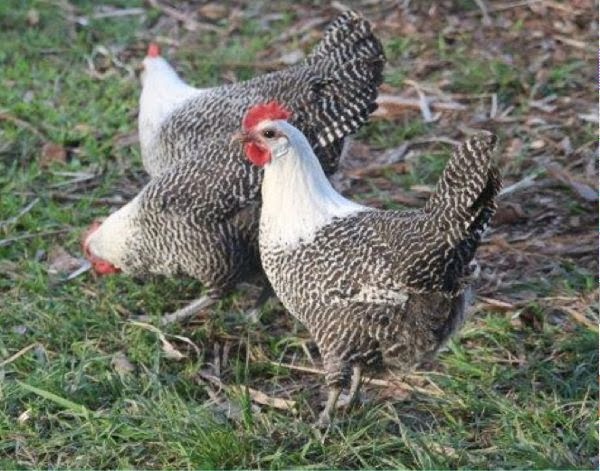
Silver campine, one of the rarest breeds in Australia but also one of our best layers.

Having chooks in the backyard has so many advantages that it’s hard to list them all. 

They make great pets, provide us with amazing nutritious fresh eggs (tasting nothing like the store bought eggs), are an intrinsic part of any vegetable garden system and are just delightful creatures that brighten everyone’s day. Having said all of that if you have never had chickens before and are not well prepared then keeping them can become an arduous task.

So before you go out and buy your first chickens, think on the following and plan well.

Have you had chickens before? It’s best to start off simple. Try to avoid anything too fancy and choose easy care breeds which give good egg production and friendly nature.

Do you have any particular colours or breeds in mind? Sometimes one just falls in love with a breed when you see it and really that is a personal thing! So long as they are available and would suit your particular setup then you should look for the breeds you love. However a word of warning, many internet sources and books list breed traits that can be misleading! So take the advice of the breeder on temperament and their particular traits.

How many eggs does your family require a week? It’s no good buying only bantams and expecting enough eggs to feed a large family.


One of our pretty cross breeds….heritage unknown but from a long line of farm bred chooks that have been thriving on a local farm in Mt Samson for decades.

Is there a budget on spending? It is important to be aware that some breeds are priced highly simply because they are rare, are show quality, may be difficult to breed and/or are in high demand. Many breeders devote a lifetime to breeding quality birds at considerable cost to themselves. Don’t expect these breeders to part with their lovely birds cheaply. Without their commitment many heritage breeds would no longer exist in Australia. There are chicken breeds and crosses to suit every budget and if cost is an issue then go for crossbreeds or younger stock. 


Gold laced Barnevelders

Do you already have a coop? Is it a chicken tractor, a small wooden style or a walk in large coop and will you free-range all the time, occasionally or rarely? 

Some breeds would be quite happy in small chicken tractor where others require more freedom. It’s also worth considering the block size ie suburban block vs acreage available for free-ranging. 

If there are circumstances that prevent free-ranging such as space, garden constraints, over-zealous dogs or predators then you should not feel guilty, just ask advice on the breeds and numbers that would work for your situation. Try to give them some sort of run if possible and supplement with a good variety of greens. 

While the cheap online coop may look appealing in the beginning if you plan to add more hens you will soon become frustrated with the size as will the hens, overcrowding is not good for them for many reasons. Also many of these coops do not last long in the weather so end up being an expensive option. eBay and Gumtree, (if you are patient) can be a good way to buy a better quality coop for reasonable cost as can a bit of DIY with recycled materials. Just make sure it is predator proof. In areas with pythons use bird mesh. Foxes and dogs can easily dig under a fence so look at ways to deter this and do not underestimate their determination. The ideal predator-proof coop is a concrete floor and a solid structure with bird mesh so when locked in nothing can get to them.

Position of the coop is also very important. They need protecton from cold winds but plenty of ventilation and shade in the heat. In Australia, generally north-east facing is best but depending on trees and aspect you need to plan accordingly. The coop itself also needs shade even if just another layer of corrugated iron, shade cloth or tarp as they heat up quickly in hot weather. 


Blue Australorps

Cleaning the coop. When a coop smells it’s time to clean as there is a build up of manure and this can adversely affect the health of the chickens just like humans! Deep litter systems are wonderful as they provide months of healthy living before bedding needs changing and then provide already composted manure for the garden. Most coops are not set up for this but if you have the option it’s worth doing! 

Do you have a second housing option? Having a second housing option may sound extravagant but it gives you the freedom to bring later additions into the flock gradually thus avoid bullying issues, particularly if the new chickens are younger. It is also good for broody and sick hens. It can be as simple as a guinea pig cage, large bird cage or a segregated area off an existing coop with whatever materials are available.

Do you have other pets? Some dogs are well behaved and leave chooks alone but for many when left to their own devices the temptation is too great! Whether it’s your own dog, a neighbour’s dog or wild dogs please consider how you will manage them. It may mean that free ranging is only possible when you are home or the dog needs containing or that a fenced run is required. They are only following instinct so it is up to us to be aware.

Coloured silkies.

Is it important to you that the chooks are friendly and easy to handle for children or yourself? Again research and take advice on this as there are breeds that are more friendly than others. Bantams make great pets and look gorgeous but lay limited eggs. There are breeds that lay large eggs that can be friendly too but not all! Favorelle crosses are a great friendly all round layer.

Thinking about rearing chicks? There is nothing as cute as a fluffy day old chick. They however require more commitment on your behalf as they need a heat source, dry bedding and medicated chick starter feed. If you don’t use mediated feed then cocci is a big risk that can cause death very quickly. It’s not hard but rearing chicks does need to be done correctly. The alternative is letting a broody hen rear them, this will require a separate run or coop until chicks are bigger.

What is pecking order? All chickens have a pecking order. This can be distressing to a first time chicken owner but it is the way of the chicken! There will always be a dominant girl and this will be most obvious when you try to bring a new bird into the flock. This bird will eat first, drink first, lay first and usually is the healthiest and probably the most productive. It may appear brutal but usually settles quickly. As mentioned before having a second housing option will help ease this as you can introduce new birds gradually. Younger birds or placid natured birds are more in danger of being bullied so never introduce one hen on its own if you can help it. Sometimes it is necessary to rehome a chicken who is a persistent bully but this is not common.

Are you aware of poultry health?
There are certain husbandry requirements to owning poultry and if you are aware you will avoid problems! It’s no different to owning a dog or cat. Prevention is better than cure.

Lice and mites: a dust bath area is imperative. Decide on treatment you will use and have on hand. Timber nests, roosts and straw are ideal hiding places for mites so treat these areas also with lime, diamataceous earth or your preferred treatment. 

Worms: Check regularly, dirty feathers around the vent is a sign and treat

Respiratory: Chickens can get colds or respiratory symptoms that are caused by exposure to wild birds or new birds, moldy dusty bedding, poor intestinal health or from anything that causes stress including overcrowding, dirty smelly coops, transport, mites/lice, worms, change in weather hot/cold and bullying from other chickens. Be careful of dusts for treating lice and mites as they are irritating to their respiratory system too. So be aware and act quickly if you see any sneezing, coughing, nasal discharge or rattly breathing. Most recover with some tender care or may need antibiotics from a vet. Separate the bird from the flock while unwell. These problems are of no danger to humans but practice good hygiene all the same. 


Pekin bantams, just one of the many colours.


Feed and water
Quality feed keeps hens healthy and give you more eggs! Speak to your local producer and decide which layer mash (grains) or pellets you will use. Mixed grain is not a complete feed as the protein is too low, 10% vs a quality layer mash which has 15-16% protein plus added vitamins, minerals and calcium. 

Feed should be available all day if you are not able to feed twice daily. Consider feeders that limit access by rodents or put feeder way at night. 

Chick starter:   0 to 6 week old chicks 
Pullet grower:  6 to16 week old pullets
Layer ration:   mature pullets over 16 weeks

Chooks love scraps but again they are not a complete feed so give only what they will eat each day and give a good mix of greens, fruits, bread, pasta or whatever you have! Again make sure there is none left for the rodents at night. 

Shell grit is also important for the hen to digest food and add calcium for egg shells. Make a separate dish and keep it full always as they will take what they need. 

Fresh cool water is also a necessity. If you are not able to change water daily look at making or buying a waterer designed to minimize slime and muck from chooks using nipples or lube cups. These also allow a greater storage of water. Apple cider vinegar is a great product to put in the water weekly as it helps to maintain a healthy gut, reduces slime build up in the waterer and is a general tonic for chickens. Do not use in hot weather. 

Be aware of where you buy food from
It’s always best to buy from a reputable produce store or a breeder who is willing to offer you after sales service and advice.
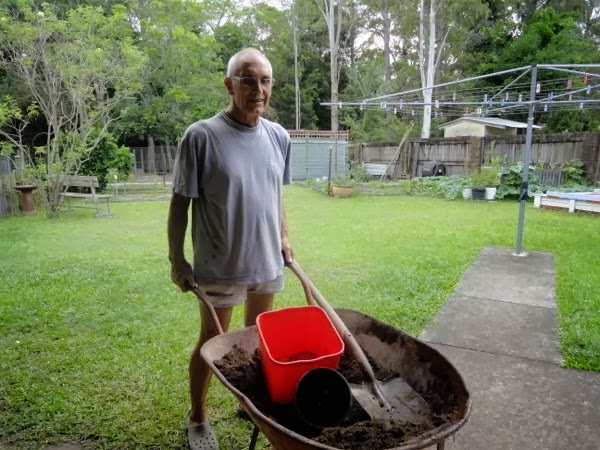


I miss our garden when it's not growing. At the end of our main season in November, I really feel like a break because I'm over watering, tending, harvesting and the rest of it. But then December, January and February come and go and I start missing the garden. I don't like paying high prices for inferior vegetables, I can never find anywhere near the freshness that we're used to and I start longing for the garden to be there again - fresh and available, right at our back door.

Head gardener Hanno.

These are unripe black passionfruit.

The time is right to plant again and the signs are already good. Our passionfruit vines are holding big juicy passions and we've had the best season ever for blueberries. I think it's going to be a good year in the garden. But things have changed out there. The chook house has been renovated and enlarged and that took a small area out of the garden. Hanno has put up a very strong climbing frame on the new chook wall and I expect that will help our vines grow during winter because the heat of the sun will hit the vines from both sides.


I started sowing seeds a few weeks ago and almost all of them are growing well, although the daikons didn't germinate and the granny's bonnets took 28 days to come up! That's a long time here, usually our seeds take only a few days when the days are so warm but like parsley, the granny's bonnets like to take their time. I have half a tray of curly kale because we grow for ourselves and the chickens. The more green vegies they eat, the darker yellow their yolks become. If you're a new gardener, I recommend curly kale to you. It's very hardy. They're at their best as a winter vegetable but will keep going in the heat as well. It's the best flavoured kale in our opinion and beats the dark kale hands down for versatility. This year, I'm trying Japanese spinach. Has anyone tried that? I've only sown six seeds at the moment because I have so many other leaves on the go, but I'm looking forward to test tasting it.

 Still growing in the garden now - pumpkin a few silverbeet and some beetroot.

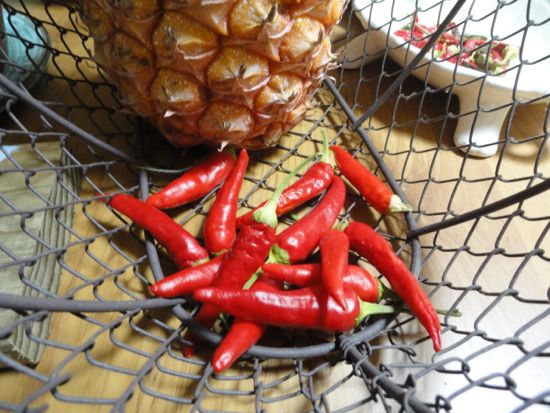
Chillies and a few other herbs - pineapple sage, thyme, parsley, sage, Welsh onions.

And another bucket of lemons waiting to be juiced.

I have three types of tomato - our self sown large cherry tomato that comes up every year sure as eggs, the French Rouge de Marmande and Amish paste. The seeds collected from our flat leaf parsley have germinated well and I have about 50 plants now. I'll share those with Sunny when she comes home. I have a nice selection of Sugarloaf cabbage and mini cauliflowers, magenta silver beet, Warrigal greens, pak choi, cucumbers, sweet potato, potatoes, about fifty garlics from last year's crop, calendulas - for ointments and oil, sprouting broccoli, brown onions, and peas, beans and sweet peas will be planted as seeds, along with many other root vegetables, directly into the ground. I've taken cuttings from the elder tree and that will be planted when it's ready, we brought another passionfruit vine that will be planted on the new trellis and I have a two year old avocado, grown from a seed, ready to pot on. There is certainly plenty of work to be done.


We've been building up our supplies recently and every time Hanno goes to the produce store or hardware, he brings home bags of cow manure and sugar cane mulch. Yesterday afternoon, when I took my photos, he'd just finished planting the kumquat tree that Shane and Sarndra gave us. Now I just have to wait for the other beds to be prepared and then planting will start. Once again, we'll be set up here to provide ourselves with plenty of fresh food. It makes me feel good to be alive.

We're both excited about the possibilities this growing season is presenting us with. We both have a new leash on life and feel thankful that we can do this work and provide for ourselves. It's going to be a good year here at the Hetzel homestead. What are your plans for the garden this year?

Yesterday I wrote about the inside work done in permaculture zones. Today we're focusing on the principles of permaculture and how they might apply in your home in addition to your outdoor area and gardens.

The 12 principles of permaculture:
  1. Observe and interact 
  2. Catch and store energy 
  3. Obtain a yield 
  4. Apply self-regulation and accept feedback 
  5. Use and value renewable resources and services 
  6. Produce no waste 
  7. Design from patterns to details 
  8. Integrate rather than segregate 
  9. Use small and slow solutions 
  10. Use and value diversity 
  11. Use edges and value the marginal 
  12. Creatively use and respond to change 
I'm not going to write about how we apply every one of these principles here because I want everyone to think about it themselves, and maybe tell me how they could work in your home. But I will write about a couple of them to give you the general idea. You'll see that a few of them are self-evident, some will need a bit of thinking, but that's why this is helpful - it gives you different ways of looking at your work and how to remain productive in your home. Just remember that one of the interesting concepts of permaculture is that one zone, idea, action, method or principle often has multiple outcomes over several other areas. So when you apply these principles to your home, you'll probably find that one principle relates to one or two others.


For example, catch and store energy marries up with obtain a yield in my home because we have solar panels for electricity and hot water. Self regulation feeds into this too because we had to train ourselves to turn off light switches and when buying new appliances, to buy energy efficient products that cost more up front but save money and energy over a long period of time. Of the moment cash savings are often overshadowed by long term savings, fewer products being bought and less white goods waste.


Observe and interact
This is the easy one. Observation and taking time are the keys here. It requires us to not operate on automatic pilot but to be mindful, to observe and take in what we're doing in our daily work, change what we can to make our home a more productive place and to simplify our work practices. We interact with each other, discuss problems, come up with combined solutions, and, when they spend time with us, invite our grandchildren to help with the simple tasks. This interaction with Alex and Jamie taps into principles 3, 5, 8, 9, 10 and 12.

Catch and store energy
This incorporates the obvious solar panels on our roof that catch solar energy and produce hot water and electricity to use in our home but it also applies in other areas too. The jams, chutneys and sauces in the stockpile cupboard that have been produced from the garden produce out back, prepared and stored in such a way that all the energy that went into the growing of that food, is captured and stored for our use later in the year when those foods are no longer available.


Integrate rather than segregate 
This is an important principle here because for me, it deals with the family and how we all work together. Our aim has been to bring our family into the way we live - even though they don't live here and we don't expect them to do what we're doing. It is enough for us that while they're here, they respect our lifestyle, help us when they can and do not want to separate themselves from what is considered to be an unusual life. When our grandchildren are here, we show them how to plant seeds, how to pick fruit and to collect eggs. We integrate them into our living systems to slowly teach them these life skills and to help them understand us.  All our children love eating the foods we grow and share with them. They all eagerly take our home produce when it's offered to them and in that way, even though they don't live here, they show that support and become part of our home on their visits.

Last weekend, we were asked to look after Alex while Shane and Sarndra went to a concert in Brisbane. Of course we jumped at the chance to have our grandson stay over night. We had a wonderful time together and even though they didn't have to, by way of saying thank you, Shane and Sarndra bought us a kumquat tree to add to our orchard. That showed me they understand our productivity ethic, and they are part of it through that understanding. While he was here, Alex ate what was here, he integrated seamlessly into our home and we didn't have to go out and buy special food just for him. It was a real pleasure to see him standing at the blueberry bushes eating the berries he picked. While he was here, he was part of what we've created and I hope as he grows, that will develop and he'll always feel part of it and want to spend time with us.


Design from pattern to details
This encourages you to step back for a moment, look at your work practices, study your patterns of work and to decide if they're working for you or against you. For instance, if the way you do your washing/laundry isn't resulting in clothes being clean and available when they're needed -  the overall pattern isn't functioning as it should. Instead of abandoning the washing altogether, you tweak the components of that pattern - where the clothes baskets are, who is responsible for loading the washing machine, is the washing machine working properly, what cleaning products are you using, how much do they cost, where are they stored etc. All these smaller components need to be looked at individually to see what the weak points are, and then changed to make a better and more efficient system. You modify or change the details to improve the pattern.

As I said, I had no intentions of deciphering these principles and how they may work in your home for you. My intention instead was to show you a few quick examples of how they might be applied in homes and have you think about the principles in your own home and see if applying all, or some of them, might help you understand and do your work. I'd love to hear your thoughts on this and I'd like to know if you think you can use permaculture, or part of it, to help you work in your own home.


And in keeping with the permaculture ethics of earth care, people care and fair share, I'm passing on some information that came by way of a comment yesterday. It might encourage you to get involved in a community project that needs support from like-minded folk.  malleepermaculture wrote:

Something that may be of interest, on this topic, to you and your readers, is a new Australian permaculture magazine that's going into print in the next few weeks. Pip Magazine is its name and it aims to help people build, connect, create, eat, grow, and nurture their way to a better life and better world. They are running a crowdfunding campaign in the spirit of the permaculture principle, "share the surplus". The campaign ends tomorrow so if you could maybe share the link in the comments or in a post, that will help them put together an Issue #2. 

Pip Magazine: pozible.com/domain/rd/pipmagazine


Permaculture is a design system started in Australia, originally for permanent agriculture and homesteads, but now the principles have spread world-wide and the design system is much more far reaching. Last year I wrote about how the permaculture could be applied inside the home as well as in the garden. I got a reminder recently that this subject might be an interesting one to write about again and hopefully by doing so I can encourage you to look to permaculture principles to examine your home life closely.


I am not a trained permaculturalist. I read the books by David Holmgren and Bill Mollison in the 80s, then, shortly before we came to live here in the mid-1990s, Linda Woodrow's superb book The Permaculture Home Garden was published. Linda's book showed me the possibilities lurking in backyards and even before we arrived here I'd decided to continue vegetable gardening, install a water tank and buy more chickens when we settled in. We don't follow the traditional design elements of permaculture, we prefer a more organised garden. It was enough for us to garden organically, but I never forgot the excitement I felt when, after reading Linda's book, I realised that a vegetable garden wasn't just a garden. It was a gateway into another kind of life.


This is going to be a good year for passionfruits.

The principles of permaculture are applied to working zones, generally in the garden and outdoor areas of a home, but they can also work well inside. Some folk get stuck when they stop spending and start working towards a simpler life and they don't know what they should or could be doing. I'm not saying that permaculture has all the answers but it will give you guidelines to apply to your home, it will encourage you to think deeply about the work you do there and maybe that will be the key that opens it all up for you.

Martha, Jezebel, Tammy and Annabell.
Tricia and Kathleen who always look important, busy and slightly surprised.

Maybe as you work through the zones and customise your home using them, you'll organise your work spaces in a more logical manner and discover ideas you never thought about before. Basically the house is Zone 0 and the work zones are the lower numbers. The further away you go from those zones, the less time you spend there and the less work is done there. I have listed my zones below. My list goes from Zone 0, which is the house itself, and works out from zone 1 through to zone 5; I added zone 6, which is my community. Go through the list, think about your home if it could work for you and then define for yourself what your zones are. 

Permaculture zones in our home and possibly many suburban, urban and rural homes:

Zone 0
The house. Here babies are conceived and cuddled, toddlers turn into school children, then teenagers. It is where people like you and me develop, create, think, relax, grow older and often thrive. Here in my home the house is now a place for grandchildren as well. The home is where families grow into strong units. At the edges of your property, your community starts. From here you'll reach out and be part of your community and hopefully you'll help build an active and thriving neighbourhood.

Zone 1
This is the zone were most of the daily domestic action happens and for me, that's the kitchen. Included in this zone are the freezer, pantry, stockpile cupboard and kitchen table. This zone is mainly for food storage and preparation as well as family meals and visiting guests. this is where all the action happens.

Zone 2
This is the living and relaxation area of our home - the lounge room, front and back verandahs. Zone 2 in the house is also directly connected to zone 1 in the garden. It is where I sort seeds, tie garlic and onions, write plant labels, process loofahs and store excesses of lemons.

Zone 3
This zone requires a little less attention but still it's busy. This is the laundry where we wash clothes, make cleaners, make and store soap and keep the ingredients for all our cleaners. Here is where babies are bathed when they visit and where our dirty clothes and stored and then washed.

Zone 4
This is our maintenance zone. It's is sewing and work room and the linen cupboard. In here I mend, sew, store fabrics, yarns, sewing machine, knitting needles, buttons and sewing tools.

Zone 4
Takes in the garage, the garden shed and Hanno's big shed. These areas are where we store broken furniture, bits and pieces waiting to be fixed, tools, lawn mowers, wheelbarrows, hay and backyard equipment.

Zone 5 
Budgeting zone. Although this is not an actual place and doesn't require daily monitoring, it's an important part of the system because it relates to every zone. Zone 5 must be working well for all the zones in the house and garden to function to their potential.

Zone 6
Your local community. In a functioning local area, the homes and the people who live in them are connected to and support their local community. Occasional work may be done there in the form of committee work, support for the local school, youth and sports clubs. If there is no community support, towns die, professionals such as doctors, midwives and dentists leave and CWA, community gardens, and other neighbourhood groups close down. A thriving community always has the support of its citizens.

These zones are set up according to your work and how often that works needs to be done. Zone 1 work is usually repeated many times every day. It's also the area where you place things that need attention every day.

But the zones are only part of this. There are 12 permaculture principles that play an important role because they make you think about what you're doing, they help you improve your work practices and they guide you to effectively apply the principles of permaculture to help you live according to your values. The principles of permaculture are guided by three ethics: earth care, people care and fair share. These three ethics are a way of saying we look after ourselves, our family, our community and we don't use more than we need - we share.

This post is getting to be a long one so tomorrow I'll write permaculture principles. Hopefully today you'll share your thoughts on how you might use these zone to help you organise your work at home.

If you're living in Brisbane, keep in touch with Roman and Jana (West End) at their blog Spurtopia because they're doing free workshops throughout the year. This young couple were featured on Gardening Australia last year. Click on their workshops tab for more information. The next workshop is 2 March at 2pm - Sustainable Living in a Rental Property - fee by donation, bookings essential. 


Weekend reading ...
Fashion - the most hyper-capitalist business
Knitting sheaths, to help the busy knitter
The surprising healing qualities of dirt
Washing up - a philosophical meander
Chemical leaching into food from packaging
Water harvesting is booming in these West Virginnia towns
Competing joys
Home things past
Traditional farmhouse butter - You Tube - it's a bit gloomy and stern in places but see it through. I found it delightful and particularly liked the family having breakfast of homemade, buttered fruit loaf with their cups of tea. This is a genuine look at a family still living a traditional life back in 1970.

Introducing ...
Grass stained me.  this is made me smile
Homegrown family life
Wolf it down

I hope you enjoy your weekend as much as we'll enjoy ours. Shane and Sarndra are going to a concert and we've been asked to care for Alex on Saturday night. They arrive tonight. It looks like a visit to Steve Irwin's zoo is on the agenda - it's just a few minutes down the road from us. Enjoy what you do and take some time to think about this beautiful life we're all living.

Newer Posts Older Posts Home

ABOUT ME

Down to Earth is a blog by Rhonda Hetzel, dedicated to simple, intentional living — from home cooking and gardening to frugal budgeting and handmade crafts. It’s a space for gentle inspiration and everyday wisdom on creating a life that feels real, balanced, and deeply fulfilling.

Down To Earth Book

Down To Earth Book
My books are all published by Penguin. Down to Earth, The Simple Life and The Simple Home have been in book shops since they were published in 2012, 2014 and 2016, respectively. On 20 October 2020, Down to Earth was published as a paperback.

MY FAVOURITE PLACES

  • Grandma Donna's Place
  • Grandma Donna's YouTube
  • Grandma Donna's Instagram
  • This Simple Day
  • Nicole's Instagram

Popular Post of All Times

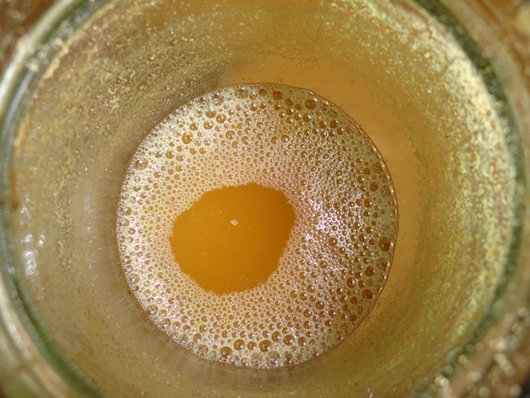
Making ginger beer from scratch

We had a nice supply of ginger beer going over Christmas. It's a delicious soft drink for young and old, although there is an alcoholic version that can be made with a slight variation on the recipe. Ginger beer is a naturally fermented drink that is easy to make - with ginger beer you make a starter called a ginger beer plant and after it has fermented, you add that to sweet water and lemon juice. Like sourdough, it must ferment to give it that sharp fizz. To make a ginger beer plant you'll need ginger - either the powdered dry variety or fresh ginger, sugar, rainwater or tap water that has stood for 24 hours to allow the chlorine to evaporate off. You'll also need clean plastic bottles that have been scrubbed with soap, hot water and a bottle brush and then rinsed with hot water. I never sterilise my bottles and I haven't had any problems. If you intend to keep the ginger beer for a long time, I'd suggest you sterilise your bottles. MAKING THE STARTER In a...
Image

The last post

This will be my last post here.  I've been writing my blog for 18 years and now is the time to step back. I’ve stopped writing the blog and come back a couple of times because so many people wanted it, but that won’t happen again, I won’t be back.  I’ll continue on instagram to remain connected but I don’t know how frequent that will be. I know some of you will be interested to know the blog's statistics. 
Image

How to make cold process soap

I'm sure many of you are wondering: "Why make soap when I can buy it cheaply at the supermarket?" My cold process soap is made with vegetable oils and when it is made and cured, it contains no harsh chemicals or dyes. Often commercial soap is made with tallow (animal fat) and contains synthetic fragrance and dye and retains almost no glycerin. Glycerin is a natural emollient that helps with the lather and moisturises the skin. The makers of commercial soaps extract the glycerin and sell it as a separate product as it's more valuable than the soap. Then they add chemicals to make the soap lather. Crazy. Making your own soap allows you to add whatever you want to add. If you want a plain and pure soap, as I do, you can have that, or you can start with the plain soap and add colour, herbs and fragrance. The choice is yours. I want to add a little about animal and bird fat. I know Kirsty makes her soap with duck fat and I think that's great. I think t...
Image

Preserving food in a traditional way - pickling beetroot

I've had a number of emails from readers who want to start preserving food in jars but don't know where to start or what equipment to buy.  Leading on from yesterday's post, let's just say up front - don't buy any equipment. Once you know what you're doing and that you enjoy preserving, then you can decide whether or not to buy extra equipment. Food is preserved effectively without refrigeration by a variety of different methods. A few of the traditional methods are drying, fermentation, smoking, salting or by adding vinegar and sugar to the food - pickling. This last method is what we're talking about today. Vinegar and sugar are natural preservatives and adding one or both to food sets up an environment that bacteria and yeasts can't grow in. If you make the vinegar and sugar mix palatable, you can put up jars of vegetables or fruit that enhance the flavour of the food and can be stored in a cupboard or fridge for months. Other traditional w...
Image

Cleaning mould from walls and fabrics

With all this rain around we've developed a mould problem in our home. Usually we have the front and back doors open and that good ventilation stops most moulds from establishing. However, with the house locked up for the past week, the high humidity and the rain, mould is now growing on the wooden walls near our front door and on the lower parts of cupboards in the kitchen. Most of us will find mould growing in our homes at some point. Either in the bathroom or, in humid climates, on the walls, like we have now. You'll need a safe and effective remedy at some point, so I hope one of these methods works well for you. Mould is not only ugly to look at, it can cause health problems so if you see mould growing, do something about it straight away. The longer you leave the problem, the harder it will be to get rid of it effectively. If you have asthma or any allergies, you should do this type of cleaning with a face mask on so you don't breathe in any spores. Many peopl...
Image

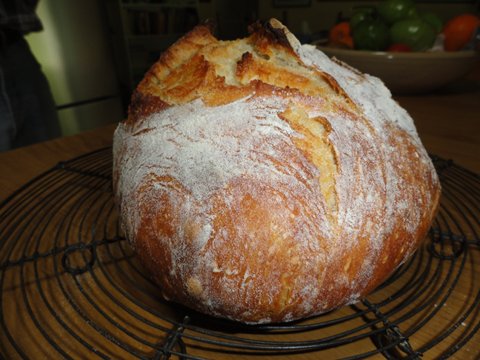
Five minute bread

Bread is one of those foods that, when made with your own hands, gives a great deal of satisfaction and delight. It's only flour and water but it symbolises so much. I bake bread most days and use a variety of flours that I buy in bulk. Often I make a sandwich loaf because we use most of our bread for lunchtime sandwiches and for toast. Every so often I branch out to make a different type of loaf. I have tried sour dough in the past but I've not been happy with any of them. I'll continue to experiment with sour dough because I like the idea of using wild yeasts and saving the starter over a number of years to develop the flavour and become a part of the family. However, the loaf I've been branching out to most often is just a plain old five minute bread. By five minutes I mean it takes about five minutes actual work to prepare but it's the easiest of all bread to make and to get consistently good loaves from. If you're having people around for lunch or...
Image

This is my last post.

I have known for a while that this post was coming, but I didn't know when. This is my last post. I'm closing my blog, for good, and I'm not coming back like I have in the past.  I've been writing here for 16 years and my blog has been many things to me. It helped me change my life, it introduced me to so many good people, it became a wonderful record of my family life, it helped me get a book contract with Penguin, and monthly columns with The Australian Women's Weekly and Burke's Backyard . But in the past few months, it's become a burden. In April, I'll be 75 years old and I hope I've got another ten years ahead. However, each year I'll probably get weaker and although I'm fairly healthy, I do have a benign brain tumour and that could start growing. There are so many things I want to do and with time running out, leaving the blog behind gives me time to do the things that give me pleasure. On the day the blog started I felt a wonderful, h...
Image

What is the role of the homemaker in later years?

An email came from a US reader, Abby, who asked about being a homemaker in later years. This is part of what she wrote: "I am a stay-at-home mum to 4 children, ages 9-16. I do have a variety of "odd jobs" that I enjoy - I run a small "before-school" morning drop-off daycare from my home, I am a writing tutor, and I work a few hours a week at a local children's bookstore. But mostly, I cherish my blissful days at home - cooking, cleaning (with homemade cleaners), taking care of our children and chickens and goats, baking, meal-planning, etc. This "career" at home is not at all what I imagined during my ambitious years at university, but it is far more enriching. I notice, though, that my day is often planned around the needs of my family members. Of course, with 4 active kids and a husband, this is natural. I do the shopping, plan my meals, cook dinner - generally in anticipation of my family reconnecting in the evening.  I can't h...
Image

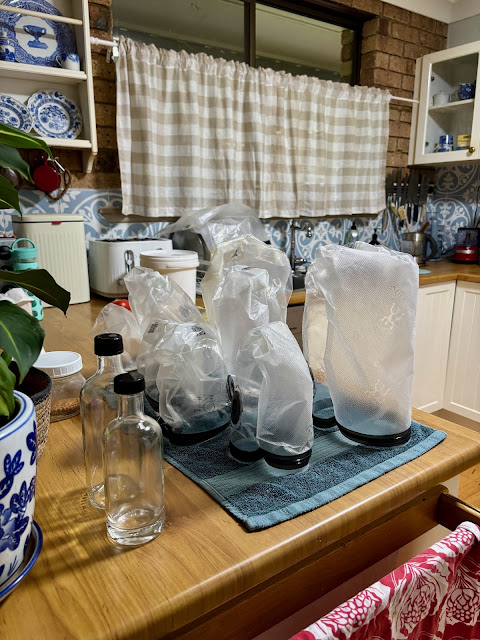
Every morning at home

Every morning when I walk into my kitchen it looks tidy and ready for a day's work. Not so on this morning (above), I saw this when I walked in. Late the previous afternoon when I was looking for something, I came across my rolled up Zwilling vacuum bags and decided they had to be washed and dried. So I did that and although I usually put them outside on the verandah to dry it was dark by then. I turned the just-washed bags inside out and left them like this on a towel. It worked well and now the bags are ready to use when I bring home root vegetables, cabbages or whatever I buy that I want to last four or five weeks.
Image

You’ll save money by going back to basics

When I was doing the workshops and solo sessions, I had a couple of people whose main focus was on creating the fastest way to set up a simple life. You can't create a simple life fast, it's the opposite of that It's not one single thing either - it's a number of smaller, simpler activities that combine to create a life that reflects your values; and that takes a long to come together. When I first started living simply I took an entire year to work out our food - buying it, storing it, cooking it, preserving, baking, freezing, and growing it in the backyard. This is change that will transform how you live and it can't be rushed.  
Image

Categories

  • Backyard 244
  • Being Organised 257
  • Books 9
  • Budgeting 142
  • Chickens 42
  • Community life 289
  • Family 269
  • From Scratch 63
  • Grandmothering 69
  • Home 296
  • Individuality 185
  • Mentoring 55
  • My books 49
  • Organic Gardening 348
  • Preserving 97
  • Recycling 22
  • Retirement 22
  • Self Reliance 160
  • Simple Living 777
  • Sustainability 308
  • This blog 107
  • Weekend reading 362
  • Writing 4

Followers

Trending Articles

The last post

This will be my last post here.  I've been writing my blog for 18 years and now is the time to step back. I’ve stopped writing the blog and come back a couple of times because so many people wanted it, but that won’t happen again, I won’t be back.  I’ll continue on instagram to remain connected but I don’t know how frequent that will be. I know some of you will be interested to know the blog's statistics. 
Image

Making ginger beer from scratch

We had a nice supply of ginger beer going over Christmas. It's a delicious soft drink for young and old, although there is an alcoholic version that can be made with a slight variation on the recipe. Ginger beer is a naturally fermented drink that is easy to make - with ginger beer you make a starter called a ginger beer plant and after it has fermented, you add that to sweet water and lemon juice. Like sourdough, it must ferment to give it that sharp fizz. To make a ginger beer plant you'll need ginger - either the powdered dry variety or fresh ginger, sugar, rainwater or tap water that has stood for 24 hours to allow the chlorine to evaporate off. You'll also need clean plastic bottles that have been scrubbed with soap, hot water and a bottle brush and then rinsed with hot water. I never sterilise my bottles and I haven't had any problems. If you intend to keep the ginger beer for a long time, I'd suggest you sterilise your bottles. MAKING THE STARTER In a...
Image

Time changes everything

I've been spending time in the backyard lately creating a contained herb and vegetable garden. My aim is to develop a comfortable place to spend time, relax, increase biodiversity and encourage more animals, birds and insects to live here or visit. Of course I'd prefer my old garden which was put together by Hanno with ease and German precision. Together, we created a space bursting at the seams with herbs, vegetables and fruity goodness ready to eat and share throughout the year. But time changes everything. What I'm planning on doing now, is a brilliant opportunity for an almost 80 year old with balance issues. In my new garden I'll be able to do a wide range of challenging or easy work, depending on how I feel each day. It’s a daily opportunity to push myself or sit back, watch what's happening around me and be captivated by memories or the scope of what's yet to come.
Image

The most wonderful news

This post will give me more joy to write than anything else I could think of today.  I told you  there are a few exciting things happening here at the moment, well, I am now able to tell you the most exciting one of them.  Our son Kerry and his beautiful partner Sunny are having a baby!  Hanno and I will be grandparents in late March.  I can barely believe my eyes when I read what I have just written.  This is one of my original stitchery patterns. This wasn't planned but it's welcomed wholeheartedly by all of us.  Both Kerry and Sunny are hard workers and now that they have a baby to love and care for, they've decided it's time to buy an apartment together.  Sunny is going home to Korea to tell her family and when she comes back again, the search will start to find their first home together.  We are all so excited!  My knitting has taken on a life of its own and when I think of all the projects I could start, my head spins.  Thi...
Image

About Blog


Down to Earth is a blog by Rhonda Hetzel, dedicated to simple, intentional living — from home cooking and gardening to frugal budgeting and handmade crafts. It’s a space for gentle inspiration and everyday wisdom on creating a life that feels real, balanced, and deeply fulfilling.

Last Year's Popular Posts

The last post

This will be my last post here.  I've been writing my blog for 18 years and now is the time to step back. I’ve stopped writing the blog and come back a couple of times because so many people wanted it, but that won’t happen again, I won’t be back.  I’ll continue on instagram to remain connected but I don’t know how frequent that will be. I know some of you will be interested to know the blog's statistics. 
Image

Every morning at home

Every morning when I walk into my kitchen it looks tidy and ready for a day's work. Not so on this morning (above), I saw this when I walked in. Late the previous afternoon when I was looking for something, I came across my rolled up Zwilling vacuum bags and decided they had to be washed and dried. So I did that and although I usually put them outside on the verandah to dry it was dark by then. I turned the just-washed bags inside out and left them like this on a towel. It worked well and now the bags are ready to use when I bring home root vegetables, cabbages or whatever I buy that I want to last four or five weeks.
Image

You’ll save money by going back to basics

When I was doing the workshops and solo sessions, I had a couple of people whose main focus was on creating the fastest way to set up a simple life. You can't create a simple life fast, it's the opposite of that It's not one single thing either - it's a number of smaller, simpler activities that combine to create a life that reflects your values; and that takes a long to come together. When I first started living simply I took an entire year to work out our food - buying it, storing it, cooking it, preserving, baking, freezing, and growing it in the backyard. This is change that will transform how you live and it can't be rushed.  
Image

Workshops update

  This photo shows what the weather's been like here.  That's steam coming off my neighbours shed roof after a brief downpour of rain.  I hope we’re getting closer to organising these workshops. I didn’t explain this clearly enough: Group 1 is four workshops, Group 2 is four workshops. Out of those eight workshops I thought we probably end up doing three or four.
Image

Creating a home you'll love forever

Living simply is the answer to just about everything. It reduces the cost of living; it keeps you focused on being careful with resources such as water and electricity; it reminds you to not waste food; it encourages you to store food so you don't waste it and doing all those things brings routine and rhythm to your daily life. Consciously connecting every day with the activities and tasks that create simple life reminds you to look for the meaning and beauty that normal daily life holds.  It's all there in your home if you look for it. Seemingly mundane tasks like cleaning and cooking help you with that connection for without those tasks, the home you want to live in won't exist in the way you want it to.  Creating a home you love will make you happy and satisfied.
Image

Time changes everything

I've been spending time in the backyard lately creating a contained herb and vegetable garden. My aim is to develop a comfortable place to spend time, relax, increase biodiversity and encourage more animals, birds and insects to live here or visit. Of course I'd prefer my old garden which was put together by Hanno with ease and German precision. Together, we created a space bursting at the seams with herbs, vegetables and fruity goodness ready to eat and share throughout the year. But time changes everything. What I'm planning on doing now, is a brilliant opportunity for an almost 80 year old with balance issues. In my new garden I'll be able to do a wide range of challenging or easy work, depending on how I feel each day. It’s a daily opportunity to push myself or sit back, watch what's happening around me and be captivated by memories or the scope of what's yet to come.
Image

Simple life workshops on Zoom UPDATED

I've added more topics to the list. This post is for those readers who expressed interest in doing online Zoom workshops or who want to register now. The topics haven't been chosen yet but potential topics are:  vegetable gardening and composting; starting a vegetable garden and choosing vegetables suitable for a beginner;  cutting costs in the home, housework and routines; homemade laundry liquid and powder, soaking, stain removal and washing clothes and household linens; cooking from scratch and building your pantry to help you do it; homemade bread - white, rye, wholemeal and ancient grains. I'm not doing sourdough; living on less than you earn and developing a frugal mindset.
Image

Labels

  • Bartering
  • Chickens
  • Community life
  • Food security
  • From Scratch
  • Home Maintenance
  • Homemaking
  • Mentoring
  • My favourite place
  • Recipes - savoury
  • Reminders of what is important to us
  • Simple Living
  • The Simple Home - June
  • The Simple Home - May
  • Utilities
  • Wise Economy

Copyright © Down To Earth. Designed by OddThemes