down to earth
  • Home
  • About Us
  • Down To Earth Book
  • Privacy Policy
We take the time every year to review our accounts because sometimes there are savings to be made. January is a good time to do it because we all feel fired up at the beginning of the year and often we've got more time because of the holidays. We wanted to increase our internet download capacity from 50GB to 100GB. We've been on 50 for a few years now and while we don't go over, we sail pretty close to the wind most months. The problem is that while we wanted to get more for our money, we didn't want to increase the amount we were already paying.  I started doing some research to see what our supplier's competition was offering. One of them had a plan that gave us what we wanted and it was cheaper than what we've been playing.


When you do this sort of research, you have to make sure you're comparing apples with apples. We want to keep some of our products bundled but that ruled out Optusnet, they don't offer broadband in our area. We also want the best service, uninterrupted service delivery and good technical support. Our current supplier, Telstra, delivers that most of the time.

So armed with information about a couple of their competitors having the product we want at a cheaper rate, I phoned Telstra and told them what I wanted. And that was to double my internet download capacity and not pay anymore for it. Cheeky, yes. I told the operator that while I was happy with the service I was currently receiving, I had to stick to my budget and would change providers if I had to. 

Straight away she transferred me to the "loyalty department". :- )

I repeated my request to the new operator, and was asked a few questions about how we used our home phone. We don't use it at all very much now because we use the mobile phone instead. She came back and told me that if I signed a contract for 24 months, she would change our home phone to a more expensive rate but we would have 100GB at ten dollar less than we pay now. Of course I took up the offer.

I tell you this, not because I think I'm anything special for getting a better deal, but to encourage you to look at your accounts and see if you can do the same.  If I had not done this we would have paid ten dollars more every month for the next 24 months and maybe some months we would have gone over our limit. Taking that ten minutes to enquire gave me a better deal for less money; I saved $240 over those two years. It's not a lot, these types of savings never are, but it's worthwhile doing because when you add that $240 to other savings we make, it's quite something.

You can do this sort of thing for insurances as well as your phone and internet charges. Just do some research first so you can show the person you talk to that you know what the opposition is offering and that you are prepared to change service providers if you need to. Be polite. I told the woman I spoke to that I would change if I had to but didn't tell her that I didn't want to change providers, I would hate to have to change my email address, I would rather miss the rest of this year's cricket than inform everyone I would need to inform that our email was different. I kept that to myself and used it as a bargaining tactic instead. We have to use whatever we can when we bargain. Service providers hate to lose existing good customers. So if you've been a good customer, use that to your advantage, do you research and make the call. You might just be surprised.

Have you made a saving like this recently? What did you do? What tips about saving on utility, insurance and service account can you share?


If you have a little time up your sleeve I hope you'll have a look at my DIL's facebook page, Bluebell Alexander. When we visited them after Christmas, Sarndra was having a little break from sewing but I saw her work room all set up nicely, ready to spring back into action. That time has come. Sarndra works from home and also at the local fabric shop. She's got a good eye for design and is a very good seamstress. If you're looking for well made clothes for boys or girls, from baby size to older, Bluebell Alexander is for you. If you're not looking for clothes, I would love it if you would help me get her to 1000 likes on Facebook. She's at 611 now, will you help? I wonder if we can do it. :- ) 

How much for a slice of toast?
The burbs
Six traits that help children succeed
Meadow Orchard
Toilet Roll seed starter
Ten great lentil recipes
Just a few of the many articles about why we're sweltering or freezing right now:
Australian heatwaves hotter and longer
Canada's carbon emissions projected to soar by 2030
Climate change likely to turn UK's weather more extreme
USA hotter, drier and more disaster-prone
Polar vortex across US puts millions at risk
Typhoon Haiyan and climate change
FROM THE COMMENTS HERE:
Ock Du Spock
Davids Cottage Down the Hill
B'more Bungalow


Most of you know there was a time when I didn't like being at home. I went to work, out shopping, socialising with friends and if there was nothing else, I'd go home. Things changed for me when I gave up work in my early 50s and although I didn't know it at the time I would never go back. I was about to turn my life on its head and to make the discovery of a lifetime. I was about to find a new world, right behind my front gate.

When I was here in my home in those early days, my kids were out at uni or working and Hanno was having fun in the shop he bought after he retired. I waved them goodbye in the morning and wondered what I would do. Well, to make a very long story short, we all know I ended up reskilling myself here. Domestic work and gardening changed me. I remembered how my mother and grandmother kept house and I modelled myself and my work on what they did. I already knew how to cook, grow vegetables, stockpile, sew and make various things but I'd buried the knowledge of those essential skills under too many Saturday morning shopping sprees and the increasing unhappiness and dissatisfaction I was feeling. I thought there was no cure for how I felt. I thought that was how life was.

 Partially sprouted beans and legumes for the bean and ham soup with bean sprouts, below.

But when I put on my apron and started making bread, and cooking wholesome food for dinner every night, I realised the benefits of not only cooking your own food but producing it as well. We already had a vegetable garden and chickens but I wanted to make the garden bigger and get more chooks. Instead of just having these things because we could, I wanted to make our backyard productive and supply our own food.  I wanted to see what was possible here, if we could move away from supermarkets and manufactured food and produce real food with our own hands. Over the following months that happened. New garden beds were added, fruit trees and vines planted and more chickens introduced into our little coop, and much more.


After a few weeks, I went to bed each night exhausted from the work I'd done but impatient for the new morning to break so I could do it all again. I had control over what I was doing and my self confidence was increasing daily. I was also feeling happy and content. What was going on!  People were supposed to be excited about going out and spending money, being out in the wide world and part of the hustle and bustle, and here I was being made whole again by planting saved seeds, washing up by hand and sitting in the shade of an elder tree.

My home mended my broken spirit.


Within the boundaries of this land we live on, I felt more alive than I'd felt in years. I made up for my lost income by working smarter and towards different goals, redefining what I wanted from life and what I believed success to be. To add to the abundance of fresh fruit, vegetables, herbs and eggs coming from our backyard, I shopped for groceries in a different way, stockpiled and learning to not waste food - not just once, but always.

It didn't take any extra cash, in fact it took less. I worked more but the work didn't feel like work - it was what I needed to do to live a better life and I was happy to do it. The house and yard work that both of us do now is fulfilling and enriching and it gives a flexible structure to our days. While initially being reluctant to join me, when he saw the difference in my attitude and that we didn't need the large amounts of money we used to spend, Hanno joined me and over the years he's simplified what he does too. I know I'm making it sound easy and quick, and it wasn't, but it wasn't difficult either.


The chickens exploring their yard after a tree was felled.

You can do what we did in your own way and in your own time. We can all define our borders and decide exactly what we'll have within them. We can create the world as we want it to be in our homes. We can walk around in 19th century dresses like Tasha Tudor if we wish to, or scarecrow clothes like I do; your version of simple living can look exactly how you want it to look. And we can provide ourselves with fresh organic vegetables from our own gardens or buy them from markets, we can keep bees for honey and hens for eggs, or barter for them; the choice is yours. We can bake, cook, sew, clean, read and work keeping our homes safe and comfortable. We can choose all that and mix it with as much of the outside world as we need to or want to. We can all do this, influenced only by the pattern of our own thoughts and values, oblivious to what goes on outside. And I have found that the more you make those decisions without that influence, the more self-reliant and independent you become. Think about that the next time you drive in your driveway or walk in your front door. It is your decision what happens in your home.


I don't think there are degrees of simple life - it's like being pregnant. You either are or you aren't.  It's the mindset of simplicity that makes the difference and when you have that, even in the very early stages, you're living simply. No one will ever be at the end point of it either. There is no glittering prize to collect when you have lived slow and simply for many years; there are always reassessments and adjustments to make and new ideas to explore. Your simple life is its own reward.

Thank you for so many beautiful comments yesterday. I truly appreciate you taking the time to connect with me both by coming here to read and then, the icing on the cake, your comments. I must have the best readers in the blogging queendom.

- - - ♥♥♥ - - - 

As I said yesterday, I had to think a lot about whether I could continue blogging. When I looked at what I have to, and want to do, I realised there was nothing in the mix that I was willing to give up. I wanted to continue living simply with no convenience foods or short cuts, I wanted to keep blogging and writing in various forms, I've been asked to continue my library talks this year, I have two beautiful grandsons I want to have a good relationship with, I have a family that I need and who need me, I want to continue gardening, baking and green cleaning. I love it all, I'm enriched doing these things on a daily basis. If I want to continue ambling along my simple path while doing all this writing, I have to work to a routine. I have to manage my time.


I write a list of tasks every morning that must be done during the day. Sometimes I allocate a time or a time limit to the task, sometimes it's left to do when I can manage it. But the aim of the exercise is to write most of the day - on the book, blog, forum and articles, and when I have a break, I go straight to the list and see what's there. I don't waste time then wondering what I should be doing. It might sound like enforced labour but writing takes a lot of intellectual planning and doing, and not much physical energy. I need to get up and move every hour or so and my list gives me tasks that get me moving while doing necessary jobs in the home.

So for instance, yesterday's list was this:
  • write shopping list
  • clean your room
  • vacuum
  • make a slice
  • knitt!!  I must have been serious with those exclamation marks. :- )
  • water plants on verandah
Chores such as cooking, feed animals, bread, general cleaning, bed making and a few other things don't go on my list because they're done automatically, often before I start writing, and I don't need a reminder. The list is for tasks that need to be done that day and change all the time. The list is made up in about five minutes each morning and later in the day, when I stop writing, I just go straight to the list. It saves time, it reduces the stress of wondering what needs to be done and I feel like I'm in control of my work, not the other way around. I think that's the key.

I keep my list on my computer or on a post-it note stuck to my computer. Put your list where you can see it. If you're busy in the kitchen, stick it to the fridge door, if you're going to be cleaning or doing the laundry, stick your list on the laundry bench.  If you don't think you'll be busy, or you feel a bit lazy, stick your list on the computer monitor or TV screen. Then when you sit down, you'll see your list and hopefully get up and do some work before you relax.


Today's list is:
  • make slice - this wasn't done yesterday so it's been transferred
  • talk to Tricia and Jo
  • make soup
  • repot two pot plants
  • make pineapple ice blocks for Jamie
  • water pumpkins and bush house
I don't put the list in order because sometimes my priorities change during the day but if I'm running short of time, I leave the least important thing - such as the slice. Another important part of list management is to define quantities or times, when necessary. In the list above I've noted "repot two pot plants". I know I don't have time for a gardening morning but I can manage to report two pots. These need to be done in summer, I can't put it off, so doing a few a week gets through that chore nicely. I could also put a time limit on it if I wanted to instead of a number. "Repotting for 30 minutes" would serve a similar purpose.


The other important part of this is that I take time for myself. It's not all about work. We work to have the lifestyle we have so we need to take time to enjoy each other, our home and the natural environment around us. I almost always have morning tea with Hanno on the front verandah and I usually have a rest after lunch. I have to look after me because I'm not as young as I used to be and I get tired easily. I want to go to bed every night tired because I've done a reasonable amount of work and I don't want to feel tired during the day.


In a few weeks my list might change from potting plants for 30 minutes to sewing for 30 minutes, or making soap. The things that make it on the list are those tasks that need doing that week. It takes a bit of thought and list making to keep my daily list relevant. I feel like I'm doing what I need to do and I'm not feeling stressed. Life's good and I hope that being lead by my list helps keeps it that way. How do you manage your time?
I have struggled with coming back to you this year. As you know I'm writing books again so the ease of just blogging about my days is not there for me now because I'm not working in my home as I usually do. I'm writing instead, while trying to carry on with as many of the simple things that I can manage. I'm also trying to put more time into the forum because that one-on-one contact, the daily posts and getting to know other women and (too infrequently) men really does inspire me to carry on and to write interesting and, I hope, inspiring books to help you along.


At one point I decided to have a break for a few months but I was uneasy with that. I really enjoy writing here and I'm not comfortable with cutting myself off. After thinking about it for a week or so, I decided to come back because I enjoy writing my blog and so many of you say you love reading it and that it's an important part of your day. It's an important part of my day too, so I'm here and will be here as much as I can be while I work on the books. Sometimes I'll blog frequently, at other times I'll miss days; just remember I'm still here and I'll be back as soon as I can be. I'm taking the email down too because I don't have time to reply and I feel guilty that so many unanswered emails are still sitting in my in-tray.


We enjoyed the holidays but all the anticipation of Christmas and the preparations that go along with it left both of us feeling tired and worn out. New Year's Eve came and went with me sound asleep, only just conscious enough when the neighbourhood fireworks started, to curse them and go straight back to sleep. All that energy that goes into the end of the year. Is it worth it? I believe that what really matters, then and now, is this minute, this hour and this day. And the worth of it? Well, it's worth it for me as I have many beautiful memories stored away that will make me smile and appreciate my family for many years to come.

 Having lunch with Shane, Sarndra and Alex at the Gladstone Yacht Club. 

Soon after Christmas we drove up to see Shane, Sarndra and Alex. We had the best time! They haven't furnished their guest room yet so we happily stayed in a hotel during our stay. We spent the days with them, had a morning when we met with some of the forum ladies (hi Vikki, Chris, Fiona, Rosie and Jenni) and the rest of the time, we slept. Both of us! We rarely do that. We slept in, we went to bed early, we slept in the afternoon. It was so relaxing. And it was so good to see Shane, Sarndra and Alex thriving in their new home. It did my heart good to be there, to talk face to face with Alex and it gave me more tender memories to dwell upon during the year.

I've spent a bit of time smartening up the blog and forum, thinking about new posts to come and making a Pinterest page. I have an idea that includes Pinterest soon so I hope you follow me by clicking the badge on the side bar. I'll be adding to Pinterest as often as I can. I haven't worked Pinterest out yet. Is it really just a collection of photos?  What do you think of it?

All the new chooks are laying now so we're getting an abundance of eggs.

I would dearly like to buy another camera this year too. I use a Sony Cybershot now and when it dies, I'd like to improve the quality of my photos. I'm interested in knowing what camera you use if you think it's a good one, but remember, I'm living on a budget so no suggestions that are just out of my range please.  I'd consider a good second hand camera too.

Hanno let the two young Barnevelders into the now almost dead vegetable garden. 

Just to bring you up to date, Hanno has been busy building an extension to our chook house. I'll do a post about it when it's finished and explain then why we made these changes. We're also waiting on some new chickens, we'll pick them up when the renovations are complete so there'll be a lot of chicken news on the way. If you've been reading for a while, you'll know that we start our vegetable growing in March every year, so I'll take you along with us as we do that. We're both excited about getting it growing again. Even though we enjoy having the time off over summer, we do miss those fresh vegetables a lot.

I defrosted the crushed pineapple I froze a couple of months back for cold summer drinks and to make a few ice blocks for Jamie.

Along with the rest of you, Hanno and I are changing and that results in changes here in our home. I'll be writing about those changes during the year, how we're preparing for a time we have less energy but still want to live our simplified lives. I also want to revisit the central concepts, as I see them, of simple life so I'll be revisiting baking, soap-making, paying off debt, living on a budget and preserving. As we change, so too do those things we do to support our simple life. No life is always the same so I think it will be helpful to talk about how we change and how those changes effect what we do.

Okay, first post finished, it feels good being back with you, so let's get on with it. I hope it's a great year for all of us. ♥♥♥


Written October 2011

I'm probably preaching to the converted here when it comes to homemaking and the importance it holds in our lives. There are so many homemakers here, from the traditional to the not-so traditional. Some of us are stay at home mums with children to raise, some work in corporate, retail, health or education sectors but still very much retain the homemaker's focus and find that the time spent at home well and truly prepares us for the work we do to earn a living. We have female and male, single and married homemakers, we have gay and lesbian homemakers, we have feminist and traditional homemakers, we have homemakers with many children and some with none. Some live alone, some are part of large families. Some homemakers combine volunteering with their home duties, some are forced to stay at home due to illness or disability but take pride in being a homemaker, doing as much as they can for themselves. Along with all the ways we differ, come all sorts of variations on how we work, income levels that effect what we do and how much we do for ourselves, and personal circumstances that dictate where we live and how we work.

We come in all shapes and sizes. There is no one-size-fits-all. There is no one right way to do this.


One of the things that unites us though is the common feeling that generally we're undervalued as homemakers. We know the work we do at home is vital for ourselves and our families but it's also part of what builds good citizens and strong countries. Usually, if someone doesn't understand or disapproves of what I do, I shrug my shoulders. I really don't care. Not everyone can like me or what I do, I'm realistic, I respect their right to have their own opinion. However, this is different, this is a commonly held view that is just wrong on so many levels. I love what freefalling said in her comment on the last homemaking post: "I kinda feel like I have a wonderful secret that only the enlightened are able to share." I think that is spot on. But then Cityhippyfarmgirl writes: "This is a subject that is close to my heart as I've been a stay at home mum since I had my eldest. I know our choices are right for us, I know I save us a bucket load of money for everything I make from scratch, and source from different places. I know my kids are getting the best start in life that I can give them, and yet still those occasional outdated comments that will come from someone completely irrelevant (bank teller, person on the street etc) cut to the bone."  When I read that, I feel it too.


I love it when I read of a homemaker who works in ways familiar to me. I like reading about people who have made a success out of working from home or working in a tough environment. But I also love to read that Richard has just bought the CWA cook book and he has cut back his outside working hours; that Liz wrote: "I was amused this week when my female housemate, my teenage daughter and me were out fencing the paddock for our new house cow, while my husband was inside cleaning and looking after the children."; and that Shannon and Mel are moving towards a formal commitment with their girlfriends. We are all different. Even those who appear to be very similar to us are different in many ways. Some of us work in our homes, some of us work outside them and some combine the two. And that is fine. How boring it would be if we were all dressed in grey, with blonde hair and freckles. It would be equally boring if we were all brown-eyed red heads, or all dark skinned, or all fair. Diversity is what makes the entire natural world so interesting and wonderful. I would love us to all be proud of whoever and whatever we are and to celebrate that diversity, not be threatened by it.


When I first started blogging about my version of a simple life most of the bloggers on this topic were writing about the politics of climate change, peak oil and group action. Very few wrote about home, family, house work or personal change; I think they were seen as mundane topics and too ordinary to be of any consequence. Well, I thrive on the mundane and ordinary, I dived in! I believed then and still do now, that any permanent change will only come when enough of us change ourselves first, then start working outwards. My change started when I returned to my home and started taking it seriously. When I realised that I could make myself happy by working at home, making this place as comfortable as possible for myself, my family and visitors, that was when I knew how profound and significant our homes could be. When I recognised that the work we do in our homes can enrich and empower, as well as being creative and satisfying, I knew that I had stumbled onto the mother lode. Our homes are our starting points - no matter what we do - whether we work at home or go out to work.  Home is where we start from and where we return to. Home is that important and it is the work done there that transforms the shell of four walls into a home that nurtures and protects. 


I would like us all to form a united approach on this. If people don't understand us, don't know what we're doing, or wondering if we're sitting around all day watching TV, let's tell them. When someone asks you what you do, tell them: "I'm a homemaker. I'm looking after my babies/elderly father/volunteering/working part-time" or "I'm a homemaker and a lawyer/nurse/miner/carpenter." or whatever it is you're doing, and "I'm learning to knit, cooking from scratch, growing organic food in the backyard, I'm working on cleaning the house without harsh chemicals. I make soap. I'm saving money at home so we can pay off our mortgage faster." or whatever your version of the way we live is. Tell them your "wonderful secret". If you just baked the best bread you've ever made, tell your friends and everyone else who will listen. If we have to listen to all the babble about "bling", smart phones, "I can't boil an egg", Jimmy Choo shoes and how they can't get by without their extra shot vanilla latte, then they can listen to us talk about how we finding meaning and satisfaction at home. Now that's fair trade! Let's tell everyone who will listen how we spend our time and do it with pride and a smile.

Let's be our own advertisement.

Written July 2013


There seems to have been a sharp rise in the number of products labelled "organic" on supermarket shelves in the past couple of years. Often I am asked if the weekly shopping should include organic fruit, vegetables, meat and chicken, as well as the newer products we're seeing now - butter, cheese, wine and tinned goods. I don't want to advise anyone as to what they should buy. We're all so different, we have different meeds, tastes and incomes and we all know that "organic" comes at a price.


I know I'm lucky to live in Australia and to pinpoint it more closely, in the hinterland of the Sunshine Coast. Not only do we have a beautiful climate and adequate rainfall here to grow a wide variety of backyard food, year-long, we also have a lot of producers' markets and small local markets. Within a short distance of where I live there is an organic supermarket and butcher and a food co-op with a lot of organic produce such as milk, cheese, grains, flour, dried fruit, chocolate, tea and coffee. Just up the road we have a dairy and whenever I drive past on that back road, I see those healthy goats and Guernsey cows roaming freely over rolling hills. It's not organic but it's local and fresh.

So for me, it's not a question of where do I find it? - it's easy to find. The question here is do I buy it?


Like most of us, I didn't really question "organic"when I first came to this way of living. To me then, it was premium and what I wanted to buy. But in the years since, I've thought a lot about what "organic" means and if I should tweak my budget, and go without other things, to buy mainly organic food. 

The answer for me now, is no. When I have a choice, I prefer to buy fresh and local.


The term "organic" means different things in different places. Here in Australia, producers apply for organic certification and then have to undergo a series of inspections and, all things going well, they get their certification and operate according to those standards. There are also producers who say they're organic, and might very well be, but are not certified. I think there is a diverse understanding of the term as well. Some people think that organic produce has been grown without the use of fertilisers and insecticides. But there are a number of "natural" fertilisers and a short list of acceptable insecticides used to grow organic produce. We use pyrethrum spray here - it's made from daisies and it's an acceptable insecticide for organic growers. We think of the fruit and vegetables we grow here as being organic but we use homemade fertilisers, Dipel and pyrethrum. They're all seen as organically acceptable but we don't have to follow any standards, we are simply making what we believe are the right choices to produce our own healthy food.

Now when I think of organic food I think not only of the synthetic chemical means of production but also elements that include social factors and logistics as well. Now it's not a question of whether my tomatoes have been sprayed, it's much more than that. Is food 'organic' if the people producing it are paid next to nothing? Is food still 'organic' is it's been flown from one side of the world - from place of production to place of sale? Shouldn't food miles play a part in what is seen as 'organic'? Can I still consider my food 'organic' if my apples, potatoes, onions, or whatever, have been stored for months in a cold room? I have had a shift in thinking and now I don't just rely on a label to tell me something is organic, I also include my own questions about origin, transportation, means of production and the workers who produced it.


When we buy our food, I think we should not only look at the health component, which takes in whether is was grown organically or not, we should also consider how far it's travelled from point of production to our door, how it's packaged, and where that packaging came from. We should consider the means of production and the workers who produced it. 'Organic' means more than chemicals and price. It also means social justice and sustainability.

We need to think about animals slaughtered for our food. I want the eggs and meat I eat to come from creatures that have lived a decent life. I'd rather never eat those products again if it meant I was supporting and helping to perpetuate cruelty in the form of caged poultry, gestation pens or whatever else.


Crikey, it sounds like I'm trying to complicate buying a bag of potatoes and a pork chop but what I'm hoping to do is to start a conversation about how we choose the food we buy. For me, genuine 'free range', fresh and local is premium now and it outweighs organic from another country, or even another state. I know I'm lucky to live where there is a wide variety of healthy food, in addition to our backyard produce, but that variety and choice brings important decision-making with it. I'd love to know your thoughts on this. Do you question how healthy and ecologically-sound organic produce is? Do you buy it if it's from another country? Have you, like me, replaced "organic" with fresh and local? Do you factor in the problem of animal cruelty or transport and food miles? I look forward to reading your comments.

Written in January 2010

Yesterday I wrote about one parent staying at home with the children and how that can help save money. Today I want to write about what often come up when that topic is featured - the lack of support for both SAHMs and working mums, or dads.

When I and my children were much younger, I worked. I was very fortunate in that I could always work from home as a writer. Hanno built an office at home and I would work there as a journalist, and alongside another women who I paid, we produced the town's newspaper and did various other writing jobs. I would start work early, then stop to make Hanno's breakfast and wake the kids for school. I'd do my housework, then return to work when the kids went off to school. They walked there, it was in the next street. I stopped work when they came home for lunch and we'd have lunch together, then worked again. I know I was a very lucky woman to have that working situation and I know it's not like that for most working women.

All graphics by Carl Larsson

I am very rarely in groups of women where this subject is talked about but I've seen it featured on TV and it's usually portrayed in a very negative way. It's SAHMs versus working women, like it's a battle over who has the high ground. No one has the high ground, most of us are just doing what we have to do to get by. At that time, I had friends who worked and most of the time, they had to work. I also had friends who were SAHMs who wanted to work but couldn't find a job, as well as friends who were working who wanted to be at home.

You can never be sure of anyone else's circumstances. What looks black and white, often is not. None of us should stand in judgement and say what others are doing is wrong. What I would like to see is a return to the way women supported each other as I was growing up. In those days we all encouraged each other, we supported our friends and other women in their choices and if we could help them, we did. 

Raising children is not an isolated process, our children grow not only within their family but also within their neighbourhood. They will come across all manner of people, some will be like us, some won't be, but being tolerant of the beliefs of others, makes the neighbourhood stronger and more resilient. It shows young children that not everyone is the same, or like us, but they're still good people. That builds confidence and children feel they can rely on the people they are growing up alongside - it makes them feel secure.


Life is not about possessions - it's about living and finding pleasure and goodness in our days. All of us can do that without demeaning the choices others make. I hope the next time you have the opportunity to join in a conversation where you could criticise, you'll decide against it. I hope we all move closer to support and encouragement rather than closer to disapproval and judgment. I hope that all of us together show our friends that there is no one right way. We all have to choose what is right for our family situation. Life is tough enough without having people in our family or neighbourhood criticise our choices. Living a more simple life isn't just about the practicalities of life, it is also about raising a fine family and building a community you feel proud to be a part of. This is one small step towards that.
Written January 2010

Getting finances organised and controlled is one of the early actions of most simple lives, even for those who have no need to budget their money. There are many people who strive to live more simply while earning a good living. They need to practise moderation and reduce the stuff they're surrounded by. The challenge for these people is to live to their values and, like those of us who have to budget, get the money organised so we can concentrate on the important task of living.

The last bowl of summer's fresh green beans.

While not everyone gets married or lives with a chosen partner, most of us do and that can be an important part of a strategy that supports and assists living on a budget. It is a common assumption nowadays that it takes two wages to raise a family. But for many families, where it has been decided that one parent should be at home with the children, they have made it work on one income, even with a number of mouths to feed. If you are undecided about whether this would work for you, sit for a moment and work it out.

If you have to pay for child care, transport, work clothes, hair cuts, makeup etc, and your job pays a minimal amount, it will probably save you money not to work. Always do the sums. Don't just assume that any job will be good for your family. Make sure it will actually be worthwhile. If your work related expenses add up to $300 a week and you're making $350 or $400, ask yourself if that is a valuable use of your time and efforts, because there is another way.

Real raspberry jelly.

If the parent earning the smallest wage stays home, it is then their job to run the home like a small business. It is their job to make a budget and stick to it, scan the flyers for grocery bargains, stockpile, learn the skills necessary to make healthy bread and nutritious meals from scratch. On these things alone, the home will function on less money. If you were going to earn fifty or a hundred dollars from that job you were offered, you should be able to save that amount with prudent shopping and cutting back.

Unless you are super organised, your grocery bill will increase when you work. You'll buy different foods because you need the convenience of them. You'll need to streamline your household activities because you won't have as much time to spend on chores and the children. Convenience foods usually make an entrance in those circumstances.

If you're in the position now of trying to decide whether to work, give this a try before you make the decision. Of course, there will be those who tell you that you should work, but you don't have to listen to them. If you're young and have always thought of yourself as a worker then being at home with your children will be just the challenge for you. You will be taking control of your family money and it will be your job to buy everything you need to stay happy and healthy on budget, you will pay the bills, on time, now and every month, you will make important choices every day about what your family consumes and it will be your job to stretch every penny until it hurts.

This is an interesting and significant job. You'll re-skill yourself in the kitchen, you'll learn to sew, mend and knit. Instead of buying new curtains or dishcloths, you'll make them. Gone are the days when you'd clean with spray and wipe chemicals, in your home that cleaning is done in a gentler way. You'll be cutting up old sheets for cleaning rags, sewing on buttons, repairing rips and generally making everything last longer. If you've never taken control of your home before it will be very liberating and exciting. Despite what your friends say, you won't be bored because your days will be filled with a purpose - to make you home comfortable and warm, to teach yourself life skills and to show your children, by example, how real life is.

Homemade soap and natural bristle scrubbing brush.

If you're trying to decide on whether to go back to work, or if you're already working at home but have stalled a bit because you have no role models and are unsure of your first or next step, I'm here to say that being a homemaker is enriching and life enhancing. It can help make your family a strong and tight unit, it can help provide the warmth and security necessary for a growing family and it might be the making of you. It was for me.

This way of life is not just for those who choose to stay at home. If you're newly married or in a relationship with no children and you're both working, try living off one wage and using the other to pay off debt. I know Little Jenny Wren and her family have always lived this way, even when she was working outside the home. I think those of you who read her blog would agree, she has built a beautiful and joy-filled life. This is not just a great budgeting strategy, it is a good way of moving towards the life you want to live.

So if you're at this point of your life, dive in. It will not be easy - you'll work more - but it will be satisfying, enriching and life enhancing work. You'll be stepping away from what is expected of you, but that will give you the unique opportunity to build the life you want, instead of trying to fit into the one size fits all life that is on offer in every shop, on every main street, in every Western country. Don't listen to the naysayers - building a life at home is an active and positive step towards a way of life that gives more than it takes. Dive in.
Written in 2009

We are back to a practical subject again today because I've been thinking about the word "germaphobe" and it scares me a little. I've come across this word a few times recently and I want to comment on it. We all know it makes good sense to keep a clean house, to raise children to wash their hands before they eat and, in general, to maintain good levels of cleanliness in the home. But you can be too clean.

Hang your dirty cloths and rags over the side of the laundry bin to dry while they're waiting to be washed.

Since television advertising started blabbing about the benefits of "whiter than white" and how we can rid our homes of germs, we've been brainwashed to believe that every germ is harmful, every germ must be killed and if we don't do that, we're not as good as our next door neighbours. What hogwash!

There are many medical studies around now that assure us that exposing children to pets and normal household dirt is good for them. It builds up the immune system and allows the body to naturally develop antibodies that fight those germs. Back a few years, when I was growing up, and even when my boys were young in the 1980s it was common for children to play out side. Out there, among the dirt, bugs and grass stains, not only were they having fun swinging on ropes and riding bikes, they were building bone strength, muscle tissue and healthy immune systems. Nowadays there is a tendency for children to play inside on computers and playstations, and inside is becoming increasingly clean. We have gone from the common family home with a dirt floor in the 1800s to stainless steel and the war against germs now.

We are surrounded by millions of bacteria and viruses but only a small number actually cause us any harm, the rest we live with, have evolved with, and being exposed to them has probably helped build tolerance to many of them. When we do our daily chores it's not necessary to rid the home of germs - it's impossible, and it's not a healthy option. Now, I'm not advocating that we leave our sink dirty and not sweep the floor. Of course we continue to do those things. We also need to wipe handles, cupboard doors, remote controls, light switches etc, but we shouldn't be using antibacterial wipes. Soap and water, vinegar or bicarb will do the trick. Using bleach, peroxide or disinfectant every day is overkill.

Wash you dishcloths once or twice a week, depending on how dirty they are. In between times, thoroughly rinse the cloth, wring it out and hang it over the tap or sink to dry. Few bacteria can survive dry conditions, they need moisture to propagate and thrive. Hang your dirty dishcloths and cleaning rags over the side of the laundry bin/basket so if they're wet they can dry out and not sit in the pile of dirty laundry, wet, waiting to be washed.

Take the pressure off yourself to kill germs, your aim should be to have a clean home. You'll never eliminate germs completely. So relax, put the bleach bottle away, stop buying the antibacterial wipes and allow the short sharp exposure to pathogens in the normal home to build your immune system. If you do that, your immune system will not only protect you from colds and flu but also from more sinister ailments.

ADDITIONAL READING 
Say hello to the 100 Trillion bacteria that make up your microbiome - Michael Pollan
Can you be too clean?


Newer Posts Older Posts Home

ABOUT ME

Down to Earth is a blog by Rhonda Hetzel, dedicated to simple, intentional living — from home cooking and gardening to frugal budgeting and handmade crafts. It’s a space for gentle inspiration and everyday wisdom on creating a life that feels real, balanced, and deeply fulfilling.

Down To Earth Book

Down To Earth Book
My books are all published by Penguin. Down to Earth, The Simple Life and The Simple Home have been in book shops since they were published in 2012, 2014 and 2016, respectively. On 20 October 2020, Down to Earth was published as a paperback.

MY FAVOURITE PLACES

  • Grandma Donna's Place
  • Grandma Donna's YouTube
  • Grandma Donna's Instagram
  • This Simple Day
  • Nicole's Instagram

Popular Post of All Times

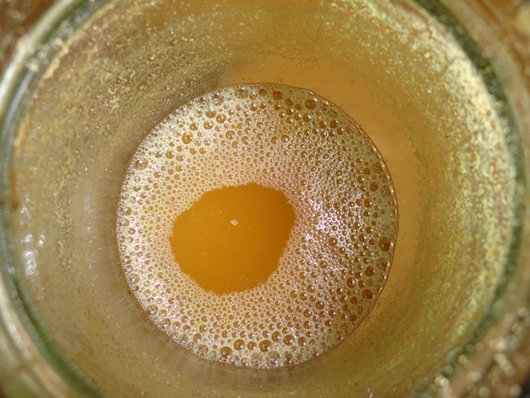
Making ginger beer from scratch

We had a nice supply of ginger beer going over Christmas. It's a delicious soft drink for young and old, although there is an alcoholic version that can be made with a slight variation on the recipe. Ginger beer is a naturally fermented drink that is easy to make - with ginger beer you make a starter called a ginger beer plant and after it has fermented, you add that to sweet water and lemon juice. Like sourdough, it must ferment to give it that sharp fizz. To make a ginger beer plant you'll need ginger - either the powdered dry variety or fresh ginger, sugar, rainwater or tap water that has stood for 24 hours to allow the chlorine to evaporate off. You'll also need clean plastic bottles that have been scrubbed with soap, hot water and a bottle brush and then rinsed with hot water. I never sterilise my bottles and I haven't had any problems. If you intend to keep the ginger beer for a long time, I'd suggest you sterilise your bottles. MAKING THE STARTER In a...
Image

The last post

This will be my last post here.  I've been writing my blog for 18 years and now is the time to step back. I’ve stopped writing the blog and come back a couple of times because so many people wanted it, but that won’t happen again, I won’t be back.  I’ll continue on instagram to remain connected but I don’t know how frequent that will be. I know some of you will be interested to know the blog's statistics. 
Image

How to make cold process soap

I'm sure many of you are wondering: "Why make soap when I can buy it cheaply at the supermarket?" My cold process soap is made with vegetable oils and when it is made and cured, it contains no harsh chemicals or dyes. Often commercial soap is made with tallow (animal fat) and contains synthetic fragrance and dye and retains almost no glycerin. Glycerin is a natural emollient that helps with the lather and moisturises the skin. The makers of commercial soaps extract the glycerin and sell it as a separate product as it's more valuable than the soap. Then they add chemicals to make the soap lather. Crazy. Making your own soap allows you to add whatever you want to add. If you want a plain and pure soap, as I do, you can have that, or you can start with the plain soap and add colour, herbs and fragrance. The choice is yours. I want to add a little about animal and bird fat. I know Kirsty makes her soap with duck fat and I think that's great. I think t...
Image

Preserving food in a traditional way - pickling beetroot

I've had a number of emails from readers who want to start preserving food in jars but don't know where to start or what equipment to buy.  Leading on from yesterday's post, let's just say up front - don't buy any equipment. Once you know what you're doing and that you enjoy preserving, then you can decide whether or not to buy extra equipment. Food is preserved effectively without refrigeration by a variety of different methods. A few of the traditional methods are drying, fermentation, smoking, salting or by adding vinegar and sugar to the food - pickling. This last method is what we're talking about today. Vinegar and sugar are natural preservatives and adding one or both to food sets up an environment that bacteria and yeasts can't grow in. If you make the vinegar and sugar mix palatable, you can put up jars of vegetables or fruit that enhance the flavour of the food and can be stored in a cupboard or fridge for months. Other traditional w...
Image

Cleaning mould from walls and fabrics

With all this rain around we've developed a mould problem in our home. Usually we have the front and back doors open and that good ventilation stops most moulds from establishing. However, with the house locked up for the past week, the high humidity and the rain, mould is now growing on the wooden walls near our front door and on the lower parts of cupboards in the kitchen. Most of us will find mould growing in our homes at some point. Either in the bathroom or, in humid climates, on the walls, like we have now. You'll need a safe and effective remedy at some point, so I hope one of these methods works well for you. Mould is not only ugly to look at, it can cause health problems so if you see mould growing, do something about it straight away. The longer you leave the problem, the harder it will be to get rid of it effectively. If you have asthma or any allergies, you should do this type of cleaning with a face mask on so you don't breathe in any spores. Many peopl...
Image

Five minute bread

Bread is one of those foods that, when made with your own hands, gives a great deal of satisfaction and delight. It's only flour and water but it symbolises so much. I bake bread most days and use a variety of flours that I buy in bulk. Often I make a sandwich loaf because we use most of our bread for lunchtime sandwiches and for toast. Every so often I branch out to make a different type of loaf. I have tried sour dough in the past but I've not been happy with any of them. I'll continue to experiment with sour dough because I like the idea of using wild yeasts and saving the starter over a number of years to develop the flavour and become a part of the family. However, the loaf I've been branching out to most often is just a plain old five minute bread. By five minutes I mean it takes about five minutes actual work to prepare but it's the easiest of all bread to make and to get consistently good loaves from. If you're having people around for lunch or...
Image

This is my last post.

I have known for a while that this post was coming, but I didn't know when. This is my last post. I'm closing my blog, for good, and I'm not coming back like I have in the past.  I've been writing here for 16 years and my blog has been many things to me. It helped me change my life, it introduced me to so many good people, it became a wonderful record of my family life, it helped me get a book contract with Penguin, and monthly columns with The Australian Women's Weekly and Burke's Backyard . But in the past few months, it's become a burden. In April, I'll be 75 years old and I hope I've got another ten years ahead. However, each year I'll probably get weaker and although I'm fairly healthy, I do have a benign brain tumour and that could start growing. There are so many things I want to do and with time running out, leaving the blog behind gives me time to do the things that give me pleasure. On the day the blog started I felt a wonderful, h...
Image

What is the role of the homemaker in later years?

An email came from a US reader, Abby, who asked about being a homemaker in later years. This is part of what she wrote: "I am a stay-at-home mum to 4 children, ages 9-16. I do have a variety of "odd jobs" that I enjoy - I run a small "before-school" morning drop-off daycare from my home, I am a writing tutor, and I work a few hours a week at a local children's bookstore. But mostly, I cherish my blissful days at home - cooking, cleaning (with homemade cleaners), taking care of our children and chickens and goats, baking, meal-planning, etc. This "career" at home is not at all what I imagined during my ambitious years at university, but it is far more enriching. I notice, though, that my day is often planned around the needs of my family members. Of course, with 4 active kids and a husband, this is natural. I do the shopping, plan my meals, cook dinner - generally in anticipation of my family reconnecting in the evening.  I can't h...
Image

Every morning at home

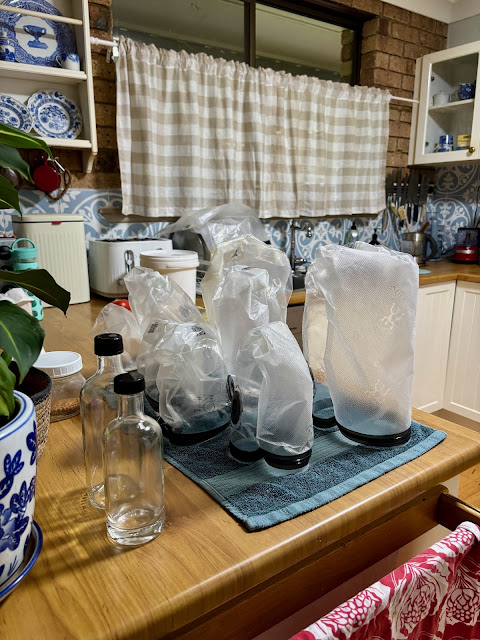
Every morning when I walk into my kitchen it looks tidy and ready for a day's work. Not so on this morning (above), I saw this when I walked in. Late the previous afternoon when I was looking for something, I came across my rolled up Zwilling vacuum bags and decided they had to be washed and dried. So I did that and although I usually put them outside on the verandah to dry it was dark by then. I turned the just-washed bags inside out and left them like this on a towel. It worked well and now the bags are ready to use when I bring home root vegetables, cabbages or whatever I buy that I want to last four or five weeks.
Image

You’ll save money by going back to basics

When I was doing the workshops and solo sessions, I had a couple of people whose main focus was on creating the fastest way to set up a simple life. You can't create a simple life fast, it's the opposite of that It's not one single thing either - it's a number of smaller, simpler activities that combine to create a life that reflects your values; and that takes a long to come together. When I first started living simply I took an entire year to work out our food - buying it, storing it, cooking it, preserving, baking, freezing, and growing it in the backyard. This is change that will transform how you live and it can't be rushed.  
Image

Categories

  • Backyard 244
  • Being Organised 257
  • Books 9
  • Budgeting 142
  • Chickens 42
  • Community life 289
  • Family 269
  • From Scratch 63
  • Grandmothering 69
  • Home 296
  • Individuality 185
  • Mentoring 55
  • My books 49
  • Organic Gardening 348
  • Preserving 97
  • Recycling 22
  • Retirement 22
  • Self Reliance 160
  • Simple Living 777
  • Sustainability 308
  • This blog 107
  • Weekend reading 362
  • Writing 4

Followers

Trending Articles

The last post

This will be my last post here.  I've been writing my blog for 18 years and now is the time to step back. I’ve stopped writing the blog and come back a couple of times because so many people wanted it, but that won’t happen again, I won’t be back.  I’ll continue on instagram to remain connected but I don’t know how frequent that will be. I know some of you will be interested to know the blog's statistics. 
Image

Making ginger beer from scratch

We had a nice supply of ginger beer going over Christmas. It's a delicious soft drink for young and old, although there is an alcoholic version that can be made with a slight variation on the recipe. Ginger beer is a naturally fermented drink that is easy to make - with ginger beer you make a starter called a ginger beer plant and after it has fermented, you add that to sweet water and lemon juice. Like sourdough, it must ferment to give it that sharp fizz. To make a ginger beer plant you'll need ginger - either the powdered dry variety or fresh ginger, sugar, rainwater or tap water that has stood for 24 hours to allow the chlorine to evaporate off. You'll also need clean plastic bottles that have been scrubbed with soap, hot water and a bottle brush and then rinsed with hot water. I never sterilise my bottles and I haven't had any problems. If you intend to keep the ginger beer for a long time, I'd suggest you sterilise your bottles. MAKING THE STARTER In a...
Image

Time changes everything

I've been spending time in the backyard lately creating a contained herb and vegetable garden. My aim is to develop a comfortable place to spend time, relax, increase biodiversity and encourage more animals, birds and insects to live here or visit. Of course I'd prefer my old garden which was put together by Hanno with ease and German precision. Together, we created a space bursting at the seams with herbs, vegetables and fruity goodness ready to eat and share throughout the year. But time changes everything. What I'm planning on doing now, is a brilliant opportunity for an almost 80 year old with balance issues. In my new garden I'll be able to do a wide range of challenging or easy work, depending on how I feel each day. It’s a daily opportunity to push myself or sit back, watch what's happening around me and be captivated by memories or the scope of what's yet to come.
Image

The most wonderful news

This post will give me more joy to write than anything else I could think of today.  I told you  there are a few exciting things happening here at the moment, well, I am now able to tell you the most exciting one of them.  Our son Kerry and his beautiful partner Sunny are having a baby!  Hanno and I will be grandparents in late March.  I can barely believe my eyes when I read what I have just written.  This is one of my original stitchery patterns. This wasn't planned but it's welcomed wholeheartedly by all of us.  Both Kerry and Sunny are hard workers and now that they have a baby to love and care for, they've decided it's time to buy an apartment together.  Sunny is going home to Korea to tell her family and when she comes back again, the search will start to find their first home together.  We are all so excited!  My knitting has taken on a life of its own and when I think of all the projects I could start, my head spins.  Thi...
Image

About Blog


Down to Earth is a blog by Rhonda Hetzel, dedicated to simple, intentional living — from home cooking and gardening to frugal budgeting and handmade crafts. It’s a space for gentle inspiration and everyday wisdom on creating a life that feels real, balanced, and deeply fulfilling.

Last Year's Popular Posts

The last post

This will be my last post here.  I've been writing my blog for 18 years and now is the time to step back. I’ve stopped writing the blog and come back a couple of times because so many people wanted it, but that won’t happen again, I won’t be back.  I’ll continue on instagram to remain connected but I don’t know how frequent that will be. I know some of you will be interested to know the blog's statistics. 
Image

Every morning at home

Every morning when I walk into my kitchen it looks tidy and ready for a day's work. Not so on this morning (above), I saw this when I walked in. Late the previous afternoon when I was looking for something, I came across my rolled up Zwilling vacuum bags and decided they had to be washed and dried. So I did that and although I usually put them outside on the verandah to dry it was dark by then. I turned the just-washed bags inside out and left them like this on a towel. It worked well and now the bags are ready to use when I bring home root vegetables, cabbages or whatever I buy that I want to last four or five weeks.
Image

You’ll save money by going back to basics

When I was doing the workshops and solo sessions, I had a couple of people whose main focus was on creating the fastest way to set up a simple life. You can't create a simple life fast, it's the opposite of that It's not one single thing either - it's a number of smaller, simpler activities that combine to create a life that reflects your values; and that takes a long to come together. When I first started living simply I took an entire year to work out our food - buying it, storing it, cooking it, preserving, baking, freezing, and growing it in the backyard. This is change that will transform how you live and it can't be rushed.  
Image

Workshops update

  This photo shows what the weather's been like here.  That's steam coming off my neighbours shed roof after a brief downpour of rain.  I hope we’re getting closer to organising these workshops. I didn’t explain this clearly enough: Group 1 is four workshops, Group 2 is four workshops. Out of those eight workshops I thought we probably end up doing three or four.
Image

Creating a home you'll love forever

Living simply is the answer to just about everything. It reduces the cost of living; it keeps you focused on being careful with resources such as water and electricity; it reminds you to not waste food; it encourages you to store food so you don't waste it and doing all those things brings routine and rhythm to your daily life. Consciously connecting every day with the activities and tasks that create simple life reminds you to look for the meaning and beauty that normal daily life holds.  It's all there in your home if you look for it. Seemingly mundane tasks like cleaning and cooking help you with that connection for without those tasks, the home you want to live in won't exist in the way you want it to.  Creating a home you love will make you happy and satisfied.
Image

Time changes everything

I've been spending time in the backyard lately creating a contained herb and vegetable garden. My aim is to develop a comfortable place to spend time, relax, increase biodiversity and encourage more animals, birds and insects to live here or visit. Of course I'd prefer my old garden which was put together by Hanno with ease and German precision. Together, we created a space bursting at the seams with herbs, vegetables and fruity goodness ready to eat and share throughout the year. But time changes everything. What I'm planning on doing now, is a brilliant opportunity for an almost 80 year old with balance issues. In my new garden I'll be able to do a wide range of challenging or easy work, depending on how I feel each day. It’s a daily opportunity to push myself or sit back, watch what's happening around me and be captivated by memories or the scope of what's yet to come.
Image

Simple life workshops on Zoom UPDATED

I've added more topics to the list. This post is for those readers who expressed interest in doing online Zoom workshops or who want to register now. The topics haven't been chosen yet but potential topics are:  vegetable gardening and composting; starting a vegetable garden and choosing vegetables suitable for a beginner;  cutting costs in the home, housework and routines; homemade laundry liquid and powder, soaking, stain removal and washing clothes and household linens; cooking from scratch and building your pantry to help you do it; homemade bread - white, rye, wholemeal and ancient grains. I'm not doing sourdough; living on less than you earn and developing a frugal mindset.
Image

Labels

  • Bartering
  • Chickens
  • Community life
  • Food security
  • From Scratch
  • Home Maintenance
  • Homemaking
  • Mentoring
  • My favourite place
  • Recipes - savoury
  • Reminders of what is important to us
  • Simple Living
  • The Simple Home - June
  • The Simple Home - May
  • Utilities
  • Wise Economy

Copyright © Down To Earth. Designed by OddThemes