down to earth

  • Home
  • About Us
  • Down To Earth Book
  • Privacy Policy
Today's photos show a very different kind of kitchen.  It's Caitlin's kitchen and she is living in China. 

Caitlin writes:

"So here is a photo of my kitchen sink.  I am currently a Peace Corps volunteer teaching English in a small town in the north west of China.  The name of my city is Qingyang and it is in Gansu Province.  I am about a 3 hour drive from Xi'an and the Terricotta soldiers.  I have lived here for about 18 months now and feel like I am at home and a very large part of me never wants to leave. 


So, the sink.  Well, it is just this small box of a sink that doesnt fit much, nor does it drain well.  It is also about 3 feet high and I am almost 6 feet tall, so back pains come with doing the dishes, which I avoid doing daily.  There is no hot water in my apartment here, so when it is cold my hands freeze while doing the dishes.  I would boil some water to do the dishes with, but my gas stove has proven dangerous and I try to use it as little as possible.  I do have a small electric hot plate that I cook with, but it only works with the wok that it came with and takes a life time to boil an entire wok of water.  The only hot water that I have access to comes from my shower heater which takes two hours to heat up and provides about 5 minutes worth of hot water.  However, I try not to plug it in too often because the electric wiring in my bathroom has started smoking recently.  The socket even exploded on me the other day with a loud POP and sparks flying everywhere.  I had a man come and fix it, but now I am terrified of it and wear gloves and wrap my hand in numerous towels when plugging it in for my twice-a-week shower. 


My kitchen has, as most kitchens in China, just a cement floor.  I am on the sixth floor and top floor of my apartment building and when it rains all the water comes in through the windows, onto my counter and then flood the floor--which I then mop with.  As well as the windows leaking, so does my ceiling, which is now cracking and falling down around me. 

Yay for China and their building codes.

But even with all of the obstacles, I have managed to keep up with cooking, a hobbie I love.  Some friends and I even produced an incredible Thanksgiving meal last month (minus the turkey--as there are no turkeys in China, nor ovens large enough to cook them).

I still love it here, though.  It has only made me more flexible and now I know that I can live just about anywhere and repair or simply live with just about anything.
 
谢谢和再见
(thank you and goodbye)"

Please don't forget to comment.  A comment is like payment for the time taken to post, and in this case in sending in the photos.  Many of us were enthusiastic about this series, so make sure all the photos get a good number of comments.  I don't want any of the ladies sending in photos to regret joining in.  Thank you friends.   

Tomorrow's kitchen is in France.
I am often asked what areas people should simplify first.  That question really has a lot of answers, depending on the person asking.  The general answer is that if you focus first on the things that help you stay alive - like food and shelter, you can't go far wrong.  So today we'll continue with the food theme and discuss food waste and using your leftovers.

I don't want to look up the food waste statistics.  Last time I did that I was shocked they were so high. It seemed like such a bleak and dark story of our lack of care. I do know, because I read it in a newspaper article, that currently 15 percent of food in American households is wasted every week.  That means that if your food budget is $100 per week, you'd be wasting, on average, $15 a week.  That's throwing $15 every week, or $780 every year, in the rubbish bin.  I would expect the figures in Australia, Canada and Europe to be similar to those in America.  We shame ourselves with statistics like that.  There should be no, or very little, food waste in your bin at the end of the week.  This is something we can all work on - I know I am guilty of leaving food too long in the fridge.

Of course the best way is to plan well so there is no wastage.  Planning needs to be done at the buying stage, assisted by meal plans, freezer and stockpile lists.  Often the food doesn't even get to the cooking or left over stage.  It sits neglected in the fridge for weeks and is then thrown in the bin.  (Insert my shamed face here.)

Meal plans are a bit like budgets.  They help you look at your resources in a way that helps cut down or eliminate waste and use what you have to get the best value for your dollar/pound.  If you haven't tried meal planning yet, give it a go. It may well save you lots of time, effort and money.  Don't forget to include snacks, fruit and baked goods in your plans and stick the plan on the fridge so everyone knows well in advance what's for dinner and how to help you prepare it.

LINKS FOR MEAL PLANS AND RECIPES
Australian recipe collections
Meal plans with recipes
Frugal menu ideas
Downloadable Food Plans Recipe Book (USA) with meal plans
Ten tips for successful meal planning (Canada)

Once the meal is finished, how often do you have leftovers?  If it's quite often, maybe you need to cook less.  I do know many cooks make too much on purpose so they have leftovers for lunch the following day.  I tend to make leftovers into the main meal the following night  Here is a recipe I made up last week from the leftovers of roast pork.  You could make the same thing with beef, lamb, goat, venison or chicken.  Just make sure you make too much gravy on the first night so that you have about a cup of gravy left over.

Coarsely mince up the leftover meat.  I used my food processor to do that.  It will only take 30 seconds or so to do.  I remember though, doing this task for my mum when I was young and using a meat grinder - one of those metal ones that you attach to the kitchen table and grind with the handle.  So, of course, the old-fashioned way is also suitable, or you could just cut it up with your sharp knife.  Make sure you don't over process it - you want to retain the texture of the meat, not have it like paste.

My mother used to call this dish - Hash, so here is my recipe for using leftover roast post - Pork Hash.


Peel four potatoes and boil them in a saucepan.

Add a small amount of olive oil to a frying pan, heat it and add one chopped onion, two chopped up sticks of celery and one carrot.  When the vegetables are soft and golden brown, add the chopped up meat, and stir.

 
If you have any leftover vegetables, add them too.  Stir it all together and add the gravy.

 
Stir until the gravy has coated the meat and everything is hot.   Then transfer the meat to an oven proof dish.

 
When the potatoes are cooked, mash them, adding a little butter, hot milk, salt and pepper.  Top the meat with the potatoes.

 
Cook in a hot oven for about 30 minutes or until the potatoes are golden brown.
 
 
I served ours with corn and beans from the garden and it was delicious.

On Monday I'll write about using food waste to feed the animals and how to make homemade dog food and treats.   Tomorrow we'll continue with our kitchen sink photos.

I have enough kitchen photos to show for the next few weeks.  When I'm coming to the end of them, I'll let you know when and where to send them.  So if you're interested in having your photos featured, get your photos ready in the next three weeks.  Tomorrow there is a kitchen from China and Sunday we have one from France.  That's you Caitlin and Shandora!  Caitlin, please send me a link to your blog if you have one.

Thank you for your visits this week.  It's been a very busy one for me, mostly doing things behind the scenes that might one day make it into the blog.  I hope you have a restful weekend. 

Vickie is the proud owner of today's kitchen.  Thanks for taking part in this Vickie.

Vickie writes:
"I'm Vickie from Sand Flat Farm in East Texas. I loved your idea of seeing everyone's kitchens.  I know you're getting swamped with photos, but I still wanted to send mine. This is our 70+ year old farmhouse which we recently redid cottage style. Everything vintage from garage sales, hand-me-downs, estate sales, etc., went into our farmhouse. I do have a stainless sink that was put in several years ago, and we didn't change that. I'd love to have one of those big deep farm sinks someday. 

 The kitchen was DARK knotty pine and we took off the cabinet doors and painted everything a light green and yellow. Over my kitchen window, I took an old crocheted pillowcase from a garage sale and fashioned a little valance. I collect old pitchers, and I have lots of things from my grandmothers. (I did have to get me a new microwave & stove because the others were kaput!)  I LOVE my kitchen and enjoy looking out the window at our farm while I'm cooking or washing up.


 Thanks for looking!"

You can visit Vickie's blog here.

Please don't forget to comment.  A comment is like payment for the time taken to post, and in this case in sending in the photos.  Many of us were enthusiastic about this series, so make sure all the photos get a good number of comments.  I don't want any of the ladies sending in photos to regret joining in.  Thank you friends.  
I guess this is stage three of our series.  You start living more simply by thinking about the changes you would like to make and you make them; then you sort out your financial situation and work on a budget.  Either one of the two first steps will generally make you realise that you need to economise and rid your home and food of as many chemicals as possible and that will lead you on to the practicalities of simple living - getting back to basics.

Back when I was a girl, there were few convenience foods and generally food was fresh. During the 1950s, food started to be overly processed and had preservatives added so that it could be sold in supermarkets instead of at little corner shops.  Instead of eating rolled oats we started eating corn flakes. Freshly squeezed orange juice was replaced by juice made with oranges from foreign lands, with preservative to help it last a long time and colourings to make it look fresh.  Margarine started replacing butter and we spread it on sliced, white, tasteless bread.

There is no doubt about it, the more you do for yourself, the more money you'll save and the more control  you'll have over the preservatives and chemicals you live with.  When I first started living more simply there were so many things I wanted to do, I needed to prioritise my lists.  I decided the best way for me to go would be to concentrate on those things we used a lot of or were a daily need.  Enter breadmaking.

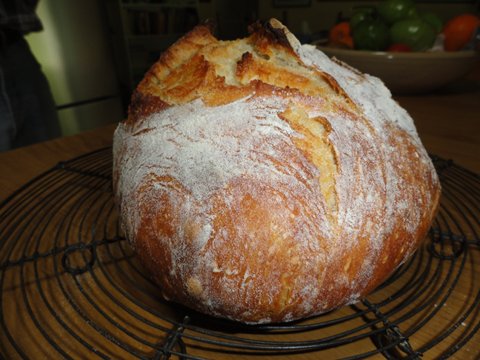
This is a rye loaf I made last week.
I love every aspect of breadmaking, maybe because my father was a baker, but the entire process makes me feel good.  I like selecting my flours, I like decanting large bags of flour into smaller bins, I like reading new recipes, I like making bread - both in the breadmaker and by hand, I like decorating it with oats, seeds and cornmeal, I like the smell of bread baking and I love serving it up for lunch most days.  Every one of those actions reaffirms to me my role of a provider of good food.

I think I make a pretty good loaf now but that wasn't always the case.  Breadmaking is like a mini science experiment that happens in the kitchen every day.  Early on I realised that to be good at it, I had to understand the process, not just enjoy the result.  If you're going to make good bread consistently and not waste too much flour, you have to know what happens, why you use certain flours and the role of gluten, yeast, salt, butter/oil and water.  The place I went to learn these things was Baking 911.  There is a menu at the top of the page that will lead you to all sorts of excellent information.  There are instructions on how to make cakes, biscuits, muffins etc but of you're interested in breadmaking, go to Bread101.  If something goes wrong with your bread, you'll probably find the reason why there.

But today I'll talk about my bread recipe and encourage you to try making your own bread, even if you've never done it before.  The recipe below, my general daily loaf, works with most types of flour - you'll just have to adjust the amount of water you use.  You can use one type of flour or a combination of flours - whole wheat, rye, corn and barley, whatever.  If you're using one of those heavy flours, a good tactic is to add a cup of white flour to the mix. It will make the bread rise more and give you a lighter loaf.  This recipe can be made by hand or in the breadmaker, and if you use the breadmaker, you can cook it in the machine or use the dough setting, remove the dough when it's gone through the cycle and bake the bread in your oven.  If you use fresh ingredients and follow the recipe you should get a good loaf of bread.
RECIPE
Mix the first three ingredients in a tea cup and allow it to froth up.  This is called proving the yeast.  If you do this, you will be certain that the yeast you're using is capable of making the bread rise.
  • 2 teaspoons dried yeast
  • 1 tablespoon sugar
  • ¼ cup warm water 

  • 4 cups baker's flour - also called strong flour or high protein flour. I used a combination of 2 cups white unbleached four and 2 cups rye flour
  • 1½ teaspoons salt
  • 1 tablespoon butter (softened) or olive oil (optional)
  • 1 tablespoon milk powder (optional)
  • About 2 cups warm water, start off by adding not quite 2cups and add the rest if it's needed.  You may even need more than 2 cups, it will depend on the flour and the humidity.  Just add it slowly
If you use the breadmaker to mix the dough, add the ingredients according to what type of machine you have.  I  usually start with the flour and put everything else on top.  It doesn't seem to matter much what order it goes in, as long as you mix it straight away, but if you're setting your machine to start early in the morning and loading the bucket at night, always do it in the order your machine needs. 

If you dont know how to make bread by hand, read these instructions from an earlier post.

Whether you're making your bread by hand or with a machine, get your clean hands in there and feel the dough.  That is the only way you'll know if you've used enough water.  Learn how to judge a good dough, know when you should add more water, or more flour.  You need your hands in the dough to make those judgements.  Look at the dough and learn during the various stages.

Breadmaking, the ability to make a good loaf of bread every day, it a great skill to have.  Once you've mastered this basic loaf, experiment with toppings and shapes.  Then move on to other types of breads - bread rolls, pizzas and calzone, fruit loaf, cinnamon loaf and rolls, Easter breads and the various delicious ethnic breads.

All these skills will allow you to produce delicious and wholesome food for a fraction of the price you'd pay in the shop, and you'll probably have a better product with no preservatives.  Breadmaking is not difficult but it takes time, patience and observation.  If you let it, bread can teach you to slow down a little.  Bread will not be rushed.

So if you've never made bread before, start with this recipe; if you've tried and failed, let this be a call to you to come back to it.  When you master a good loaf, you'll feel proud of your efforts and your family will love you for giving them this steaming, hot, nutritious treat every day.  If you have any problems, go to my Down to Earth forum, tell me what's happened and I, or one of the other members, will help you get back on track again.  And if  you do make the best loaf ever, take a photo of it and send it to me.  If I get a few, I'll make a bread gallery of all our loaves made during the coming week.  Don't let doubt, indifference or fear of failure stop you, dive in.

While I slept, the counter ticked over past 2 million visitors.  What a milestone!  Thank you for your visits.  It's always a delight for me to get to know you through your comments.  I do not have the time to reply to the comments very much but I read and appreciate every one of them  They show me in a very clear way that Hanno and I are not alone and that many other people strive to live a simple and gentle life.  BTW, together, you've read 3.5 million pages here.

...................................................................................................................................................................

Yesterday I wrote about one parent staying at home with the children and how that can help save money.  Today I want to write about what often come up when that topic is featured - the lack of support for both SAHMs and working mums, or dads.

When I and my children were much younger, I worked.  I was very fortunate in that I could always work from home as a writer.  Hanno built an office at home and I would work there as a journalist, and alongside another women who I paid, we produced the town's newspaper and did various other writing jobs.  I would start work early, then stop to make Hanno's breakfast and wake the kids for school.  I'd do my housework, then return to work when the kids went off to school.  They walked there, it was in the next street.  I stopped work when they came home for lunch and we'd have lunch together, then worked again.  I know I was a very lucky woman to have that working situation and I know it's not like that for most working women.

All graphics by Carl Larsson

I am very rarely in groups of women where this subject is talked about but I've seen it featured on TV and it's usually portrayed in a very negative way.  It's SAHMs versus working women, like it's a battle over who has the high ground.  No one has the high ground, most of us are just doing what we have to do to get by.  When I was working from home when I was younger, I had friends who worked and most of the time, they had to work.  I also had friends who were SAHMs who wanted to work but couldn't find a job and friends who were working who wanted to be at home.

You can never be sure of anyone else's circumstances.  What looks black and white, often is not.  None of us should stand in judgement and say what others are doing is wrong.  What I would like to see is a return to the way women supported each other as I was growing up.  In those days we all encouraged each other, we supported our friends and other women in their choices and if we could help them, we did. 

Raising children is not an isolated process, our children grow not only within their family but also within their neighbourhood.   They will come across all manner of people, some will be like us, some won't be, but being tolerant of the beliefs of others, makes the neighbourhood stronger and more resilient. It shows young children that not everyone is the same, or like us, but they're still good people.  That builds confidence and children feel they can rely on the people they are growing up alongside - it makes them feel secure.
Life is not about possessions - it's about living and finding pleasure and goodness in our days.  All of us can do that without demeaning the choices others make.  I hope the next time you have the opportunity to join in a conversation where you could criticise, you'll decide against it.  I hope we all move closer to support and encouragement rather than closer to disapproval and judgment.  I hope that all of us together show our friends that there is no one right way.  We all have to choose what is right for our family situation. Life is tough enough without having people in our family or neighbourhood criticise our choices.  Living a more simple life isn't just about the practicalities of life, it is also about raising a fine family and building a community you feel proud to be a part of.  This is one small step towards that.

Tomorrow we will move on to the practicalities of home.
Getting finances organised and controlled is one of the early actions of most simple lives, even for those who have no need to budget their money. There are many people who strive to live more simply while earning a good living.  They need to practise moderation and reduce the stuff they're surrounded by.  The challenge for these people is to live to their values and, like those of us who do budget, get the money organised so we can concentrate on the important task of living.


 The last bowl of summer's  fresh green beans.

While not everyone gets married or lives with a chosen partner, most of us do and that can be an important part of a strategy that supports and assists living on a budget.  It is a common assumption nowadays that it takes two wages to raise a family.  But for many families, where it has been decided that one parent should be at home with the children, they have made it work on one income, even with a number of mouths to feed.  If you are undecided about whether this would work for you, sit for a moment and work it out.

If you have to pay for child care, transport, work clothes, hair cuts, makeup etc, and your job pays a minimal amount, it will probably save you money not to work.  Always do the sums.  Don't just assume that any job will be good for your family.  Make sure it will actually be worthwhile.  If your work related expenses add up to $300 a week and you're making $350 or $400, ask yourself if that is a valuable use of your time and efforts, because there is another way.


Real raspberry jelly.

If the parent earning the smallest wage stays home, it is then their job to run the home like a small business.  It is their job to make a budget and stick to it, scan the flyers for grocery bargains, stockpile, learn the skills necessary to make healthy bread and nutritious meals from scratch.  On these things alone, the home will function on less money.  If you were going to earn fifty or a hundred dollars from that job you were offered, you should be able to save that amount with prudent shopping and cutting back.

Unless you are super organised, your grocery bill will increase when you work.  You'll buy different foods because you need the convenience of them.  You'll need to streamline your household activities because you won't have as much time to spend on chores and the children. Convenience foods usually make an entrance in those circumstances.

If you're in the position now of trying to decide whether to work, give this a try before you make the decision.  Of course, there will be those who tell you that you should work, but you don't have to listen to them.  If you're young and have always thought of yourself as a worker then being at home with your children will be just the challenge for you. You will be taking control of your family money and it will be your job to buy everything you need to stay happy and healthy on budget, you will pay the bills, on time, now and every month, you will make important choices every day about what your family consumes and it will be your job to stretch every penny until it hurts.

This is an interesting and significant job.  You'll re-skill yourself in the kitchen, you'll learn to sew, mend and knit.  Instead of buying new curtains or dishcloths, you'll make them.  Gone are the days when you'd clean with spray and wipe chemicals, in your home that cleaning is done in a gentler way.  You'll be cutting up old sheets for cleaning rags, sewing on buttons, repairing rips and generally making everything last longer.  If you've never taken control of your home before it will be very liberating and exciting.  Despite what your friends say, you won't be bored because your days will be filled with a purpose - to make you home comfortable and warm, to teach yourself life skills and to show your children, by example, how real life is.

Hopmemade soap and natural bristle scrubbing brush.

If you're trying to decide on whether to go back to work, or if you're already working at home but have stalled a bit because you have no role models and are unsure of your first or next step, I'm here to say that being a homemaker is enriching and life enhancing.  It can help make your family a strong and tight unit,  it can help provide the warmth and security necessary for a growing family and it might be the making of you.  It was for me.

This way of life is not just for those who choose to stay at home.  If you're newly married or in a relationship with no children and you're both working, try living off one wage and using the other to pay off debt. I know Little Jenny Wren and her family have always lived this way, even when she was working outside the home.  I think those of you who read her blog would agree, she has built a beautiful and joy-filled life.   This is not just a great budgeting strategy, it is a good way of moving towards the life you want to live.


So if you're at this point of your life, dive in.  It will not be easy - you'll work more - but it will be satisfying, enriching and life enhancing work.  You'll be stepping away from what is expected of you, but that will give you the unique opportunity to build the life you want, instead of trying to fit into the one size fits all life that is on offer in every shop, on every main street, in every Western country.  Don't listen to the naysayers - building a life at home is an active and positive step towards a way of life that gives more than it takes.  Dive in.

Today's kitchen is in southwestern Oklahoma in the United States and it is where Cat cooks for her family of six.

Cat writes:
"I hesitated to send mine as it's not the cute "homey" style of the others.  But then thought, "why not", as many different types of people can have the goal of a simpler life.  We had a water leak within a few months of purchasing this home (built in the 1960's) in 2007, necessitating a complete overhaul.  It's not complete yet as in the past two years since beginning, we've had a new baby and my husband had a 15-month overseas military deployment.  And now have another baby due in March.  But it's very functional for the large amount of cooking I do for our family of six, soon to be seven."


Please don't send anymore photos until I call for them.  I still have a number to go in this batch.  I'll let you know when you can send them again.  Thank you.

Please don't forget to comment.  A comment is like payment for the time taken to post, and in this case in sending in the photos.  Many of us were enthusiastic about this series, so make sure all the photos get a good number of comments.  I don't want any of the ladies sending in photos to regret joining in.  Thank you friends. 
Today's beautiful kitchen comes from New South Wales, which is the state I was born in.  Thanks for sharing your kitchen Melissa.


Melissa writes:

"The photo of my kitchen sink has a vintage dish draining rack that my mother gave me plus 2 wooden scrubbing brushes that I love to use. In the other 2 photo's I love to collect vintage china. I have also inherited quite a few pieces from my grandparents & my husbands grandparents. The christmas stockings that are hanging on the dresser I made a few years back. It's funny you mentioned about kitchens as I recently wrote a post on my blog about my kitchen which has more photo's.  Thanks for allowing me to show you my kitchen."
My blog is
http://vintagerose-at-plumthorpe.blogspot.com


 Check out Melissa's blog.  The photos of her daughter are very charming.

Please don't forget to comment.  A comment is like payment for the time taken to post, and in this case in sending in the photos.  Many of us were enthusiastic about this series, so make sure all the photos get a good number of comments.  I don't want any of the ladies sending in photos to regret joining in.  Thank you friends. 
Newer Posts Older Posts Home


My books were all published by Pengiun, and are available at Amazon US, Amazon UK and Amazon Au

Search here

Total Pageviews

Translate


I'm Rhonda Hetzel and I've been writing my Down to Earth blog since 2007. Although I write the occasional philosophical post, my main topics include home cooking, happiness and gardening as well as budgeting, baking, ageing, generosity, mending and handmade crafts. I hope you enjoy your time here.

MY FAVOURITE PLACES

  • Grandma Donna's Place
  • Grandma Donna's YouTube
  • Grandma Donna's Instagram
  • This Simple Day
  • Nicole's Instagram

Give More

Give More

Popular posts last year

Making ginger beer from scratch

We had a nice supply of ginger beer going over Christmas. It's a delicious soft drink for young and old, although there is an alcoholic version that can be made with a slight variation on the recipe. Ginger beer is a naturally fermented drink that is easy to make - with ginger beer you make a starter called a ginger beer plant and after it has fermented, you add that to sweet water and lemon juice. Like sourdough, it must ferment to give it that sharp fizz. To make a ginger beer plant you'll need ginger - either the powdered dry variety or fresh ginger, sugar, rainwater or tap water that has stood for 24 hours to allow the chlorine to evaporate off. You'll also need clean plastic bottles that have been scrubbed with soap, hot water and a bottle brush and then rinsed with hot water. I never sterilise my bottles and I haven't had any problems. If you intend to keep the ginger beer for a long time, I'd suggest you sterilise your bottles. MAKING THE STARTER In a...
Image

NOT the last post

This will be my last post here.  I've been writing my blog for 18 years and now is the time to step back. I’ve stopped writing the blog and come back a couple of times because so many people wanted it, but that won’t happen again, I won’t be back.  I’ll continue on instagram to remain connected but I don’t know how frequent that will be. I know some of you will be interested to know the blog's statistics. 
Image

How to make cold process soap

I'm sure many of you are wondering: "Why make soap when I can buy it cheaply at the supermarket?" My cold process soap is made with vegetable oils and when it is made and cured, it contains no harsh chemicals or dyes. Often commercial soap is made with tallow (animal fat) and contains synthetic fragrance and dye and retains almost no glycerin. Glycerin is a natural emollient that helps with the lather and moisturises the skin. The makers of commercial soaps extract the glycerin and sell it as a separate product as it's more valuable than the soap. Then they add chemicals to make the soap lather. Crazy. Making your own soap allows you to add whatever you want to add. If you want a plain and pure soap, as I do, you can have that, or you can start with the plain soap and add colour, herbs and fragrance. The choice is yours. I want to add a little about animal and bird fat. I know Kirsty makes her soap with duck fat and I think that's great. I think t...
Image

Preserving food in a traditional way - pickling beetroot

I've had a number of emails from readers who want to start preserving food in jars but don't know where to start or what equipment to buy.  Leading on from yesterday's post, let's just say up front - don't buy any equipment. Once you know what you're doing and that you enjoy preserving, then you can decide whether or not to buy extra equipment. Food is preserved effectively without refrigeration by a variety of different methods. A few of the traditional methods are drying, fermentation, smoking, salting or by adding vinegar and sugar to the food - pickling. This last method is what we're talking about today. Vinegar and sugar are natural preservatives and adding one or both to food sets up an environment that bacteria and yeasts can't grow in. If you make the vinegar and sugar mix palatable, you can put up jars of vegetables or fruit that enhance the flavour of the food and can be stored in a cupboard or fridge for months. Other traditional w...
Image

Cleaning mould from walls and fabrics

With all this rain around we've developed a mould problem in our home. Usually we have the front and back doors open and that good ventilation stops most moulds from establishing. However, with the house locked up for the past week, the high humidity and the rain, mould is now growing on the wooden walls near our front door and on the lower parts of cupboards in the kitchen. Most of us will find mould growing in our homes at some point. Either in the bathroom or, in humid climates, on the walls, like we have now. You'll need a safe and effective remedy at some point, so I hope one of these methods works well for you. Mould is not only ugly to look at, it can cause health problems so if you see mould growing, do something about it straight away. The longer you leave the problem, the harder it will be to get rid of it effectively. If you have asthma or any allergies, you should do this type of cleaning with a face mask on so you don't breathe in any spores. Many peopl...
Image

Five minute bread

Bread is one of those foods that, when made with your own hands, gives a great deal of satisfaction and delight. It's only flour and water but it symbolises so much. I bake bread most days and use a variety of flours that I buy in bulk. Often I make a sandwich loaf because we use most of our bread for lunchtime sandwiches and for toast. Every so often I branch out to make a different type of loaf. I have tried sour dough in the past but I've not been happy with any of them. I'll continue to experiment with sour dough because I like the idea of using wild yeasts and saving the starter over a number of years to develop the flavour and become a part of the family. However, the loaf I've been branching out to most often is just a plain old five minute bread. By five minutes I mean it takes about five minutes actual work to prepare but it's the easiest of all bread to make and to get consistently good loaves from. If you're having people around for lunch or...
Image

This is my last post.

I have known for a while that this post was coming, but I didn't know when. This is my last post. I'm closing my blog, for good, and I'm not coming back like I have in the past.  I've been writing here for 16 years and my blog has been many things to me. It helped me change my life, it introduced me to so many good people, it became a wonderful record of my family life, it helped me get a book contract with Penguin, and monthly columns with The Australian Women's Weekly and Burke's Backyard . But in the past few months, it's become a burden. In April, I'll be 75 years old and I hope I've got another ten years ahead. However, each year I'll probably get weaker and although I'm fairly healthy, I do have a benign brain tumour and that could start growing. There are so many things I want to do and with time running out, leaving the blog behind gives me time to do the things that give me pleasure. On the day the blog started I felt a wonderful, h...
Image

What is the role of the homemaker in later years?

An email came from a US reader, Abby, who asked about being a homemaker in later years. This is part of what she wrote: "I am a stay-at-home mum to 4 children, ages 9-16. I do have a variety of "odd jobs" that I enjoy - I run a small "before-school" morning drop-off daycare from my home, I am a writing tutor, and I work a few hours a week at a local children's bookstore. But mostly, I cherish my blissful days at home - cooking, cleaning (with homemade cleaners), taking care of our children and chickens and goats, baking, meal-planning, etc. This "career" at home is not at all what I imagined during my ambitious years at university, but it is far more enriching. I notice, though, that my day is often planned around the needs of my family members. Of course, with 4 active kids and a husband, this is natural. I do the shopping, plan my meals, cook dinner - generally in anticipation of my family reconnecting in the evening.  I can't h...
Image

Every morning at home

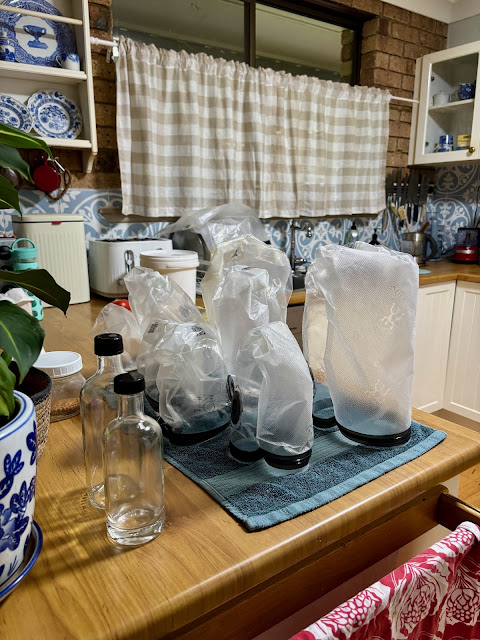
Every morning when I walk into my kitchen it looks tidy and ready for a day's work. Not so on this morning (above), I saw this when I walked in. Late the previous afternoon when I was looking for something, I came across my rolled up Zwilling vacuum bags and decided they had to be washed and dried. So I did that and although I usually put them outside on the verandah to dry it was dark by then. I turned the just-washed bags inside out and left them like this on a towel. It worked well and now the bags are ready to use when I bring home root vegetables, cabbages or whatever I buy that I want to last four or five weeks.
Image

You’ll save money by going back to basics

When I was doing the workshops and solo sessions, I had a couple of people whose main focus was on creating the fastest way to set up a simple life. You can't create a simple life fast, it's the opposite of that It's not one single thing either - it's a number of smaller, simpler activities that combine to create a life that reflects your values; and that takes a long to come together. When I first started living simply I took an entire year to work out our food - buying it, storing it, cooking it, preserving, baking, freezing, and growing it in the backyard. This is change that will transform how you live and it can't be rushed.  
Image


Trending Articles

NOT the last post

This will be my last post here.  I've been writing my blog for 18 years and now is the time to step back. I’ve stopped writing the blog and come back a couple of times because so many people wanted it, but that won’t happen again, I won’t be back.  I’ll continue on instagram to remain connected but I don’t know how frequent that will be. I know some of you will be interested to know the blog's statistics. 
Image

Every morning at home

Every morning when I walk into my kitchen it looks tidy and ready for a day's work. Not so on this morning (above), I saw this when I walked in. Late the previous afternoon when I was looking for something, I came across my rolled up Zwilling vacuum bags and decided they had to be washed and dried. So I did that and although I usually put them outside on the verandah to dry it was dark by then. I turned the just-washed bags inside out and left them like this on a towel. It worked well and now the bags are ready to use when I bring home root vegetables, cabbages or whatever I buy that I want to last four or five weeks.
Image

You’ll save money by going back to basics

When I was doing the workshops and solo sessions, I had a couple of people whose main focus was on creating the fastest way to set up a simple life. You can't create a simple life fast, it's the opposite of that It's not one single thing either - it's a number of smaller, simpler activities that combine to create a life that reflects your values; and that takes a long to come together. When I first started living simply I took an entire year to work out our food - buying it, storing it, cooking it, preserving, baking, freezing, and growing it in the backyard. This is change that will transform how you live and it can't be rushed.  
Image

Creating a home you'll love forever

Living simply is the answer to just about everything. It reduces the cost of living; it keeps you focused on being careful with resources such as water and electricity; it reminds you to not waste food; it encourages you to store food so you don't waste it and doing all those things brings routine and rhythm to your daily life. Consciously connecting every day with the activities and tasks that create simple life reminds you to look for the meaning and beauty that normal daily life holds.  It's all there in your home if you look for it. Seemingly mundane tasks like cleaning and cooking help you with that connection for without those tasks, the home you want to live in won't exist in the way you want it to.  Creating a home you love will make you happy and satisfied.
Image

Time changes everything

I've been spending time in the backyard lately creating a contained herb and vegetable garden. My aim is to develop a comfortable place to spend time, relax, increase biodiversity and encourage more animals, birds and insects to live here or visit. Of course I'd prefer my old garden which was put together by Hanno with ease and German precision. Together, we created a space bursting at the seams with herbs, vegetables and fruity goodness ready to eat and share throughout the year. But time changes everything. What I'm planning on doing now, is a brilliant opportunity for an almost 80 year old with balance issues. In my new garden I'll be able to do a wide range of challenging or easy work, depending on how I feel each day. It’s a daily opportunity to push myself or sit back, watch what's happening around me and be captivated by memories or the scope of what's yet to come.
Image

It's the old ways I love the most

I'm a practical woman who lives in a 1980’s brick slab house. There are verandahs front and back so I have places to sit outside when it's hot or cold. Those verandahs tend to make the house darker than it would be but they're been a great investment over time because they made the house more liveable. My home is not a romantic cottage, nor a minimalist modern home, it's a 1980’s brick slab house. And yet when people visit me here they tell me how warm and cosy my home is and that they feel comforted by being here. I've thought about that over the years and I'm convinced now that the style of a home isn't what appeals to people. What they love is the feeling within that home and whether it's nurturing the people who live there.
Image

Making ginger beer from scratch

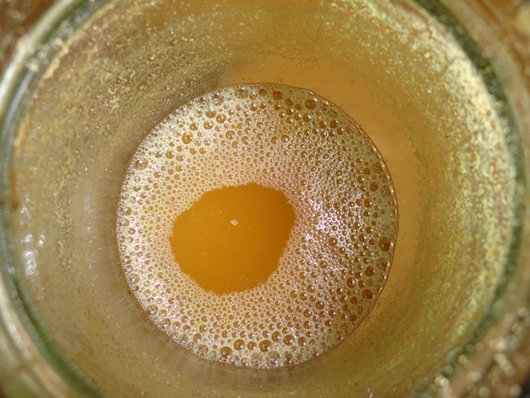
We had a nice supply of ginger beer going over Christmas. It's a delicious soft drink for young and old, although there is an alcoholic version that can be made with a slight variation on the recipe. Ginger beer is a naturally fermented drink that is easy to make - with ginger beer you make a starter called a ginger beer plant and after it has fermented, you add that to sweet water and lemon juice. Like sourdough, it must ferment to give it that sharp fizz. To make a ginger beer plant you'll need ginger - either the powdered dry variety or fresh ginger, sugar, rainwater or tap water that has stood for 24 hours to allow the chlorine to evaporate off. You'll also need clean plastic bottles that have been scrubbed with soap, hot water and a bottle brush and then rinsed with hot water. I never sterilise my bottles and I haven't had any problems. If you intend to keep the ginger beer for a long time, I'd suggest you sterilise your bottles. MAKING THE STARTER In a...
Image

An authentic look at daily life here — unstaged and real

Most days Hanno was outside happily working in the fresh air. It may surprise you to know that I started reading my book,  Down to Earth , yesterday - the first time since I wrote it 13 years ago.  I had lent it to my neighbor, and when she returned it, I started reading, expecting to find surprises. Instead, I realised the words were still familiar—as if they were etched into my memory. As I flipped through the pages, I was reminded of how important it was for me to share that knowledge with others. The principles in Down to Earth changed my life, and I truly believed they could do the same for others. After just 30 minutes of reading, I put the book down, reassured that its message still holds true: we can slow down and reshape our lives, one step at a time.
Image