down to earth

  • Home
  • About Us
  • Down To Earth Book
  • Privacy Policy


The news isn't getting any better, is it? I have never seen our nations' leaders working so co-operatively to try to stop a world-wide recession turning into a full blown depression. The initial steps taken a couple of weeks ago with "rescue" packages didn't do what was expected and the stock markets around the world continue to crash almost every day. It's Monday morning here and it will be interesting to see what happens here and in Hong Kong.

While that is all dismal news, I do have some good news for you. Along with a group of other writers, I have started another blog. It's a co-operative of writers who have similar values to mine and who are working towards a simple, green and frugal future. So what have we called this new venture? It's the Simple | Green | Frugal Co-op and it's open right now. You can find it here.

I will keep Down to Earth going. This is my baby and I'm not abandoning her, but the co-op expands on what I write about here in certain significant ways. Most of you know I'm 60 and Hanno is almost 70, we see things from a different perspective to those much younger. We don't have children living at home any more, we aren't studying now, we are established, we have no debt. Of course, we still remember what it was like during all of those stages but times have changed so much I can't write about those younger stages with an honest heart. I wanted to be part of a project that gives you honest, reliable and authentic information that is written by people who live it.

So I went searching. I looked for people who wrote well, who live what they write about, and who are at various stages of life. They also needed to be generous enough to want to be a part of a co-operative and who would share their stories away from their own blogs. I wanted passionate writers who shared my values and could help others live more simply. I couldn't be happier with the group who said "yes" so let me introduce you to them, in no particular order:
  • Julie from Towards Sustainability
  • Paul from A Posse Ad Esse
  • Melinda from 1 Green Generation
  • Marc from Garden Desk
  • FT from Notes from the Frugal Trenches
  • Sadge from Firesign Farm
  • Heather from Beauty that Moves
  • Eilleen from Consumption Rebellion
  • my good friend Sharon will help with admin
  • and myself
There are another six writers who have not yet committed and others who will be added as we progress through the coming months.

We hope to quickly build up an online resource that will help you change those things you need to change, we hope to inspire you to simplify and live to your true potential and we hope to help you survive the crash, in whatever form that comes.

I invite you to read our new blog and to connect with all the bloggers who write there; they all have excellent personal blogs. And please, it will help me a lot to have your feedback, both here and over there.

Hello all. We are wrapping up the swap soon. I will be posting some new photos tomorrow on our flickr site and would like for two lost swap buddies to contact me-(cdetroyes at yahoo dot com) so we can finish up except for a few photos. Would Pamela M who is partnered with Tracy G please e-mail me and e-mail Tracy, and would Lindsey, who is partnered with Lisa (the tin house) e-mail me and Lisa. I will leave you with an interesting link that give ideas and a few tutorials for handmade holiday gifts. There are some really great ideas there!
http://handmadehomeschool.wordpress.com/2008/10/07/handmade-holidays/
Another site has some great explanations on natural body products that can be given as gifts or used by yourself: http://www.naturalbeautyworkshop.com/my_weblog/2008/10/creating-all-na.html For those techies there is this tutorial that is a great gift idea: http://www.ohfransson.com/oh_fransson/2008/09/how-to-make-a-charging-basket.html and do take the time to check out oh fransson's blog-there are beautiful quilts and great explanations on how to make them!!
For the kitchen here are two links that are fun and useful :http://www.skiptomylou.org/2008/09/26/oven-mitt-pattern/ and http://mybyrdhouse.blogspot.com/2008/09/scrappy-hot-pad-tutorial.html Enjoy and don't forget that there are many ideas out there! Sharon


This small 500 litre tank holds water for pot plants on the verandah and vegetables in the front yard. We bought it for $49 on sale at Bunnings.


It hasn't rained here for about six weeks. Our large green water tank on the front verandah is empty but I am hoping for rain to start falling soon. I checked the radar, rain is on the way. Hopefully, in about 30 minutes, even before I post this, it will be raining.

Collecting the rain that falls on our roof is an important part of our land management. We have three rain water tanks that hold 15,500 litres (4100 gallons), we even have a downpipe on the chicken shed roof to collect a small amount of water there. When our tanks are full, that water is used to keep our vegetables and fruit growing and to water the chooks, dog and cat. Using it everyday, that water will last us about two months.


This is the first tank we installed here, it holds 5,000 litres. We use this water in the green house and on the fruit and vegetables.

One of the first things we did when we came to live here 12 years ago was to install a rain water tank. That was a 5,000 litre iron tank which is located near the greenhouse. When the government decided to encourage all of us to buy water tanks with the introduction of rebates, we installed a second 10,000 litre poly tank. In the past few months we bought a much smaller tank on the front verandah (for $49) to help us water the plants on the verandah as well as the potatoes and avocados in the front yard. It filled up the day we installed it, it's been empty since Monday this week. We never use water from the tap to water anything in the yard but we use tap water inside the house. In the future, we'll probably buy another tank and use that water indoors.


We bought this 10,000 poly tank when our state government brought in a rebate system. I think it cost us about $800 after the $1000 rebate.

Collecting rainwater is both environmentally sound and frugal. We see it as using a natural resource and while we use the water in those tanks, we don't have to pay for tap water. Having your own water stored in tanks and barrels also makes you independent of the system if you need to be. None of us knows what will happen in the future, but if anything did happen to the dam we get our water from, or if there was a general system breakdown, we would be have our own water here. We don't use our tank water inside the house but if we needed to, we would.


This is just a little DIY downpipe off the chook shed running into a 20 litre bucket. It was made with recycled materials.

It feels good to know that if anything disastrous happened in our region that, with careful management of our rain water, vegetable garden, chickens and grocery stockpiles, we would be able to look after ourselves and our family for a few months. If you have not yet thought about gaining some independence from the system, I encourage you to make a move towards providing yourself with some protection.

Each of our tanks collects water from a different part of the roof. The iron tank collects from the back of the house, the poly tank collects from the large shed roof and the eastern side of the house roof, the small green tank collects from the front of the house and the little downpipe system just collects from the chicken shed roof.

If you're in Australia, check your local State and local government websites to check if you're eligible for a water tank rebate. In other countries, it's easy enough to make a rain barrel from recycled or new materials. Click here for instructions.

Hanno is due to do some cleaning and maintenance on our corrugated iron tank soon. When he does, I'll take photos and write about what he does.

I was hoping to end this post by writing that rain is falling. It's not, but according to the radar it will be soon. HURRY UP!

MORE READING ABOUT HARVESTING RAIN WATER

Art by Carl Larsen from his gallery.

Why is it that Christmas, and the lead up to it, is so fraught with stress and panic? Back in my spending days, I use to think that I never had enough time to do everything I needed to do and I’d run around like a headless chook not getting much done at all. When lunch was over on Christmas day, I’d wonder why I got caught up, yet again, in the madness my Christmas had developed into.

Those days are long gone for me, I live at a more gentle pace now and whenever I go out very close to Christmas, I find the pushing and buying quite ugly. It doesn't have to be that way. With a bit of planning we could all celebrate the holidays simply and come out of it strengthened as a family rather than being shattered by it.

We have stopped giving gifts to all but our sons. A few small home made tokens of appreciation go to close friends, but Christmas is pretty much commercial free for us. We still give but we don’t give gifts. Through my voluntary work we organise a Christmas morning breakfast for our community and we cook breakfast for a few hundred people. We have that breakfast in a local park. Last year 450 people came to share the morning with us and we celebrated the morning by being a part of our community.

It’s great to see all walks of life come together in a celebration of Christmas. The town businesses donate most of the food and drinks, and the meal is enjoyed by the homeless, many family groups, and people who are alone at Christmas. We'll be back cooking breakfast for our community again this year and it's something I'm looking forward to. It’s an affirmation of the strength of our community that is remembered well into the year.

What will your Christmas hold this year? If you’ve been troubled with stressed filled holidays, I have a challenge for you. I want you to write a list of three things you usually do at Christmas that you don’t want to do this year. Then I want you to make plans in the coming weeks so that what is on your list is not a part of your Christmas. It’s a small step, but it might just be the catalyst you need to get yourself and your family to a truly happy and enriching Christmas.

ADDIT: I have two blogs I'd like to recommend to you. First is Renee and Marc's great blog, Garden Desk. They're building a polytunnel greenhouse to extend their growing period. It's really worth a visit to check it out. The other is a craft blog full of lovely work. It's Knot Garden, where you'll find some beautiful crochet and sewing. Happy reading.

Deborah has just sent this useful link about breaking the cycle of gift buying. Thanks Deborah!


Here's a closeup of what's happening in the old kale patch.

It's well into its second year and sure enough, a pineapple is growing in the backyard. I started this one off by planting the top of a store bought pineapple, it hasn't required any special treatment but it did take up a fair bit of space for just one plant.

Pineapples are surprisingly easy to grow here - in fact I live in the middle of the Golden Circle pineapple farm region, so that's no great surprise. It did surprise me, however, that the growing of this pineapple was as easy as it turned out to be. No pests attacked it, it withstood periods of pelting rain and then no rain at all for weeks. As long as we kept the water up to it, it thrived.


Stuck out in the middle of nowhere, our solo pineapple is slowly giving birth.

HOW TO GROW A PINEAPPLE IN YOUR BACKYARD
You grow pineapples from the tops of old pineapples. But make sure you grow a decent one. Be sure to only plant the top of a pineapple that was sweet and juicy because whatever traits your old pineapple had, so will the new one. You don't want to plant a pineapple that wasn't sweet, or tough, because that's what you grow in the new one.

Make sure you treat every pineapple like one that you will plant. Carefully twist or cut off the top green section off the fruit. Test taste, and if it's good enough to plant, remove all the flesh from the base of the green leaves, pick the lower leaves off so you have a bit of a stem to plant, then leave the pineapple top in the shade of your verandah to dry out for a week.


I'll plant this pineapple top during the week. Make sure you remove all the lower leaves.

During that week, prepare your garden bed. Pineapples like very good free draining soil. They won't produce fruit if the roots are standing in water. Add compost to the soil, dig it in and mound up the soil.

OR ... you can plant in a terracotta pot. Get yourself the largest pot you have, fill it with a mixture of ½ potting mix, ¼ compost and ¼ sharp sand and mix it well. Water the mix and let it sit for a week. Pineapples need a long hot summer but if you live in a frosty area, I'd still give them a go. If you plant in a pot, you'll be able to bring the plant inside during winter and keep it near a sunny window.

Plant the pineapple top in the soil just covering the base plate where the roots will come from. Don't bury the green stem as it might rot. Firm down the soil around the roots to make sure it doesn't fall over. Keep checking the plant for the first few weeks to make sure it's still upright and, hopefully, growing strongly.

Pineapples like an acidic soil in which to grow. Our soil here where the pineapple is growing is 6.5. If your pH is higher than that, add sulphur, according to the instructions on the packet and water your pineapple every so often with the leftover tea in your pot. That will help keep the soil slightly acidic.

Give the plant a good watering at least once a week and fertilise with weak compost or comfrey tea once a month. A pinch of sulphate of potash around the base of the plant at the beginning of the second summer will help with flowering.

Above all else though, you'll need patience because you won't notice any growth for about a year. In the second year the plant will grow and probably at the end of the second year, or in the second summer, you notice a fruit growing deep down in the middle of the plant. That's the point we're at here now.

MORE INFORMATION


Here he is, the main gardener digging for something. What could he be doing in our front yard? He's digging potatoes. Over the past couple of weeks we've harvested about 25 kg (55 pounds) from the back garden, on Saturday Hanno dug up another 30 kgs (66 pounds) in the front garden.


We thought these were kipfler potatoes but they turned out to be Colibans. No matter, we'll still put them to good use over the next few months. We have them stored in baskets in the coolest room of our house - the second bathroom. They're covered with a few layers of newspaper and a towel to make sure no light gets to them.


When looking up potato varieties yesterday, I found this excellent potato chart, and also discovered that Dutch Cream potatoes and Nicolas are two different varieties. I thought they were the same!


These potatoes, planted at the beginning of winter, will feed us for a few months and will be good for all types of dishes like mashed potatoes, potato salad and bake as well as great additions to omlettes, casseroles and soups. I love potatoes and it feels right to me to have a large stash of fresh potatoes ready for the coming months. They should finish around the time the next crop is ready to harvest.


A little bit further on from the potatoes is our second avocado tree. It's growing its first fruit. We eat a lot of avocado so it's wonderful have a couple of trees bearing fruit for us. When we first moved here there was a very old avocado tree in the backyard. We had the sewerage connected and, with all the trench digging, the tree died. Avocados hate having their roots disturbed. Hopefully these new trees will live to a ripe old age and will bear fruit for many years.


The photo above was taken from the chair I sit in when we're having morning tea. It's lovely sitting there because we see nothing other than plants and trees. That big green conatiner is the last water tank we installed. The water it holds waters the pot plants on the front verandah as well as the potatoes and avocados. None of the other plants in the front are watered and survive on rainfall alone.

Many of you know that I've been working on my book proposal and today I go back to work after a two week break. It's become clear to me over this break that I cannot continue to post every day during the week. I've been pushing myself to do it and other things have fallen behind. I'll still post frequently, just not as often as I used to. I need to do all the work my simple life requires, not just write about what should be done. You can subscribe to a feed of my posts so you will know when I've posted. You do that by clicking "subscribe in a reader" orange button in the side bar, and following the instructions it gives.

I hope this week will be a good one for you. It's getting closer to the end of year now so I imagine many of you are putting together a nice collection of Christmas gifts. Enjoy all the small steps and quiet moments your week holds.


A kookaburra on our clothes line yesterday.

There is always two sides to every coin, yin - yang, balance. In an attempt to balance yesterday's post, I offer this:

It is important now in these difficult days to remember that even though times are tough now, and may get tougher, we still have it in our power to get the most out of every day. Money, or the lack of it, shouldn't be our sole focus. Every day is part of your life, every minute should be lived well. When this day is over, well, it's over. If you don't live today to its full potential, you can't go back to it in five years time because you left a big space in today.

Now more than ever we should find joy in what we're doing and model that joy to our families and friends. Yes, I might be scrimping and saving, but I have my family, a roof over my head and I have decent work to do. My work now is to help my family live well with less and to be thankful that I live where I live and have the freedom to do what I choose, to write my blog, feed my chooks, bake good bread and be the best person I can be.

I was reminded of this important philosophy early this morning when I received an email from Michelle, a reader who has just started her own blog. She sent me her blog address and I decided on a quick visit before I started my post. Good luck with the blog, Michelle, and thank you for your kind words. However, the thing that touched me most when I read that first post what the paragraph from the Love of Nie blog that stated:

"Author Anna Quindlen reminds us not to rush past the fleeting moments. {or if I could enter here- the basket-head mother syndrome} She said: "The biggest mistake I made [as a parent] is the one that most of us make... I did not live in the moment enough. This is particularly clear now that the moment is gone, captured only in photographs. There is one picture of [my three children] sitting in the grass on a quilt in the shadow of the swing set on a summer day, ages six, four, and one. And I wish I could remember what we ate, and what we talked about, and how they sounded, and how they looked when they slept that night. I wish I had not been in such a hurry to get on to the next thing: dinner, bath, book, bed. I wish I had treasured the doing a little more and the getting it done a little less"

Oh, I do wish I'd written that because it is written in my heart. I too wish I'd captured more than I did of my children's young years - "I wish I could remember what we ate, and what we talked about, and how they sounded, and how they looked when they slept that night. I wish I had not been in such a hurry to get on to the next thing: dinner, bath, book, bed. I wish I had treasured the doing a little more and the getting it done a little less" That really speaks to me. You know that I'm a woman of 60 years and that I regret very little in my life, but that is a regret - that I didn't watch and play more. I don't know if I'm being too hard on myself, because there was a lot of playing and watching, and touching a sleeping face gently, and books being read and giggling. Maybe it's the tyranny of age that has loosened my grip on those memories. But the point is to make sure you make those memories every day, if not with your children, then with your partner, or friends, or pets.

Mine every day for the joy it holds and store that inside yourself.

Later today I'll be returning to the Nie blog to read about their horrible accident and to get to know Stephanie and Mr Nielson through the reposting of parts of her blog. There is some fund-raising going on to help the family recover as best they can and I encourage you to take some time today to read that blog and maybe get involved in the fund-raising. Stephanie's accident is a stark reminder of the fragile nature of all our lives. I wish Stephanie and her husband a complete recovery. Thank you to Michelle for showing me the way to the Nienie blog.


Just a quick note to wish everyone relaxing week-end with their families (especially those of us preparing for the cooler weather) and to let you know I have posted the more swap photos on our flickr photostream. There will be one more posting of photos so if you haven't sent yours in, please get them to me soon!! I hope to wrap up this swap in the next week. Hugs Sharon
One of the many things I love about the way I live is that I never feel helpless. I feel I'm in control of what I'm doing and where my life is headed. Gone are the days when I got swept along with recessions, credit squeezes or fashion trends. However, we do live in troubled times and I know a lot of people are losing their jobs, their investments and their money because of the current circumstances. It's not just the problems facing our international financial institutions that is worrying, it's also rising prices for food, rent, petrol/gas, and most of the consumer items we buy.

While there is a part of me that realises we need to slow down our rate of spending, I don't like to see what is happening now, because along with the many banks and businesses that are failing, many ordinary folk are too. I wonder what you're all doing to weather this storm. I have a feeling that we are in for a tough time and it will be protracted. The boost of Christmas sales won't be there this year, that will flow on to job losses and more small businesses going broke.

So what can we do to make sure our own boats don't sink?

It's really just continuing on the road many of us are already on - being prudent with our purchases, continuing to pay off debt and doing all those day to day things in our homes that conserve the resources we do have. We are all in different parts of the world, some have large families, some are couples, some singles but we all have things in common - we all have to have a roof over our heads, food in our bellies and money in our pockets. We are not helpless! We can plan for what is coming so we're better able to cope with it. So let's go over those home-based activities that will help us get through this.
  1. Spend only on needs, not wants.
  2. Stockpile food and groceries - this is the single best thing you can do to prepare for tough times.
  3. Track your money - make sure you know what you're spending money on.
  4. Redo your budget to stop money leaks.
  5. Pay off debt. Make a plan today to do it.
  6. Do all your tasks in one outing - plan what you have to do so you get everything done in one day - shopping, doctors visits, post office etc.
  7. Try to stay home a few times a week.
  8. Try to cut out unnecessary expenses - cut down on your internet, phone, cable TV etc.
  9. Plan your menu for a week.
  10. Cook from scratch.
  11. Eat your leftovers, never waste food.
  12. Have a couple of meatless meals every week.
  13. Stop eating out, stop buying takeaway food.
  14. Take lunch to work and school.
  15. Stop buying magazines, newspapers, coffees and drinks when you're out.
  16. Make your Christmas gifts this year.
  17. Stop listening to advertising. Now is not the time to spend.
  18. Explain to your children about the current tough times and ask them how they can work with the family to cut back.
  19. Learn to read your electricity and water meters so you can cut down on your consumption of both those resources.
  20. Get involved in your life - this is the perfect time to step up and become more independent by doing more things for yourself at home.
I bet many of you have some excellent ideas for cutting back and for surviving this crisis. Tell me what your plans are to get through these tough times.


Of all the household tasks I do every week, ironing is the one I struggled with the most. I have tried it every which way, and nothing seemed to help me squeeze any joy from it. In the end, I defied my own advice and did it quickly while watching TV. pffffffffffft

However, progress has been made. I hate giving up or giving in to anything. I have pushed and prodded ironing, I've moved from room to room looking for the perfect place and finally, my friends, I can tell you I've hit pay dirt. I have been ironing these past few days and I have enjoyed it! Persistence and the radio were the keys!

I used to have the ironing board set up in the spare bedroom (where there is a TV) but when we had a few visitors one after the other a month or so ago, I moved the ironing board into the small single bedroom left it set up there. I was doing some quick ironing in there a couple of weeks ago and realised I actually liked ironing better without the TV blathering away in the corner. I looked around the room and decided to set up an ironing station as there was a narrow table in there that was perfect for the task.

A few days ago, I moved everything around to suit the ironing. I faced the table to the window, found an old woollen blanket and cotton sheet and covered the table with them. The jewel in the crown though was a radio. I found our little radio that we use when there is a blackout and I put that on the shelf near the table. It actually tuned to Radio National, my favourite station, and that made me realise I would love ironing in that room. All our other radios don't pick up Radio National so I used to download podcasts to listen to on my little iPod. Now I just have to find the electric cable so I can plug it in and not play it with batteries.


So for the past few days I've been testing myself with the ironing and each day I have loved it. There is a radio guide online so I check it in the morning and if there is something interesting I set myself up to iron while I listen. I've been getting through a lot of ironing and I finally feel like I've found my true ironing home. Long live good radio and ironing stations with a view!

This is my ideal ironing room, it's Deb's from Homespun Living. Isn't it gorgeous. Mind you, I think only people who are living simply would describe a laundry room as gorgeous. :- ) Another ironing post, this time from Posy.

It just goes to show me, yet again, that most simple ordinary things hold their own joy and beauty, if only you look enough to find it.


I spent a small amount of time sowing seeds yesterday. In the past, I used to have trays and trays of seeds but now that we have a continuous garden, I get by with a large planting in March and then just sowing small numbers of seeds to fill in spots that arise during the year. Yesterday I planted up four golden nugget pumpkin seeds, four lemon cucumber seeds and six Moneymaker tomato seeds. The pumpkins will be planted where the kipfler potatoes are now, in the front garden, the cucumber and tomatoes will go into the vegetable garden when the snow peas are removed. That should have happened by now but we're behind with some work because of the fence building and my writing. No matter, everything happens in its own time.

I thought it might help some of the new gardeners if I wrote a little about sowing seeds. It seems to be a mystery to some and I remember when I first started gardening, I was never sure of the right depth to place the seeds or if I was doing the right things when I sowed my seeds.

The best seeds to sow are open pollinated or heirloom seeds. If you plant them. not only will you get vegetables far superior to those you buy in the supermarkets, you get the old varieties that have better taste. And the bonus is you can save the seeds from one of your plants at the end of the season and use them for your next planting. Using seeds from your own garden will give you plants that are better suited to your own conditions and if you keep planting your own seeds, they will improve each year. In Australia you buy heirloom seeds at Green Harvest, Eden Seeds, Diggers, Phoenix and a number of other small places. For gardeners in other countries, do a Google search for "open pollinated seeds" or "heirloom seeds" and you should find something close to you. There are many heirloom seed companies and they have their entire seed catalogue online, so it's just a matter of selecting what you want, paying for it and waiting for the post to arrive.

The general rule for seed planting is to plant the seed twice as deep as its size. So if you have a seed that is 1mm, you plant it 2mm into the soil. If your seed measures ¼ inch, you plant it ½ inch deep. Some seeds (beans, peas,) benefit from soaking in warm water for 24 hours - this breaks the hard seed casing and speeds up germination. After you soak the seeds, plant them into moist soil or seed raising mix and then don't water until they germinate. Please note: it is only pea and bean seeds you have soaked that don't require watering - all other seeds you sow must be kept moist, not wet. Parsley seeds can be soaked in hot water for 24 hours, then sowed just like other seeds - into moist, not wet, soil.

Seed raising mix in a bag is quite expensive to buy. The potting soil you use doesn't need a lot of nutrients in it, so don't use your best mix. All the nutrients the seeds need are inside the seeds, you just need to supply moisture and a growing medium that will allow the tiny new shoots to emerge easily. I often use compost in the trays and just cover the seeds with seed raising mix or potting soil mixed with sharp sand. Whatever you cover the seeds with needs to be light to allow those little shoots through.


Above and below are Lazy Housewife Beans drying in the shade of the back verandah. We eat these beans green, they're as good as Blue Lake, but I also dry some of them to keep in the pantry. When they're dry, they're similar to haricot beans and can be used in soups and casseroles as well as a variety of Mexican and French dishes. I will save some of these seeds to be planted in the garden.


Once the seeds are in and covered, put a tag on them with the name and date then water them gently with a spray bottle. I use a mix of water with a little Epsom salts added to water in. The Epsom salts is magnesium and it helps germination. The ratio is one teaspoon to one litre (quart) of water. If you have any left over, water your vegetables or citrus trees with it.

So that's it! Then you just wait for the first little bits of green to poke through and plant them when they're ready to plant. Tomato seedlings need extra care before they're planted in the garden though and I've written about that here.

Before I go today I have a couple of extras I'd like to add. Yesterday when I was working on my book, I spent quite a bit of time going through the archives. I was really touched by so very many of the comments you've made over the months. I read every comment that's made each day but reading them in one block made me realise, yet again, how much you all add to this blog. A little green community has built up here that is knowledgeable, supportive and generous. I sincerely thank all of you who regularly comment.

I also want to thank Sharon who is a constant help to me both on the blog and behind the scenes in emails. Sharon organises all the swaps and also posts on weekends to give you wonderful links for projects and gifts. I have added Sharon's email to the side bar so if you have any questions about swaps or links, you can email her direct.

Now, some responses to yesterday's post. Thanks to simple quilter who gave me the information to identify those tiny blue flowers we have in our lawn as lobelia. :- )

Rose, what a wonderful man Paul Newman was. RIP Paul.

Cassie, good luck with your garden. Lucky you have such a great helper there.

Lindsay, it sounds like you're starting off on an incredible journey. I'm pleased I could help you on your way. Please stay in touch and let me know how it goes for you.

Amanda, congratulations on the new baby. I hope things have settled down for you now. (hugs)

Donna, our haystack sits there for a while so the seeds die off. You can definitely use your hay for mulch. Just take a handful of hay and put it in your garden, water it and see what happens. If it does grow weeds, often you can just pick them out when they're at the green shoot stage. Usually it will just be the seeds of the plant, be it lucerne, wheat, rye etc. In that case, again, you just weed it out. But if your little test of mulch doesn't grow anything after sitting in the garden for three weeks, you'll know there are no seeds in it.

Hi Quinne, I hope that little baby of yours is chubby and giggling. :- )

ADDITION: Many of you know that I'm a great fan of Path to Freedom, it is the one site I've continued to visit for many years. Here is a video of theirs, it's well worth the time it will take you to view it. Make sure you visit the blog Anais writes. It's really good.


We had quite a full weekend with Hanno finishing the new chook fence and me flitting between writing and household chores. Of course there were lots of breaks and tea on the verandah so it was a productive and relaxing time for us. I watched the neighbours go in and out all weekend, mostly for short trips and I wondered if they were picking up forgotten groceries or DVDs to watch. I was just happy to sit and watch their comings and goings while I knitted and thought about what to write.

It's a lovely time of year now, the spring flowers are blooming, birds are visiting from far off places and it's bare arms weather - ideal for sitting with a lemon cordial and letting the world pass by. I am happy here, I feel as much a part of this place as all the trees deeply rooted in dry soil. We all get our nourishment from being here and I can't imagine being anywhere else.

Hanno did a great job on the fence using mostly recycled materials. We did have to buy the fence posts though. Almost all of yesterday was taken up with him making a patchwork of wire for the bottom of the fence. The top of it is all one roll of wire but the bottom is many different pieces. Even though it took a longer time to complete, he's happy to have used the scrap wire that was already here.


The fence is too high for any of them to fly over now so hopefully they'll be safe and secure. The wire all along the bottom is a small gauge so when we raise chicks, they won't be able to sneak through the fence without the mother hen.


And here in the late afternoon, is the finished fence. You can see Hanno in the distance just putting the finishing touches to it. Seth and his ladies have been inspecting the new work and I think they all approve.


Further over, on the other side of the yard, the bananas have put on their first flower of the season. I hope to see many more of those as the weeks go by but, for now, I'm happy that there is one bunch of bananas forming.


And here inside the shed is our haystack. This should be enough to do us all through summer for the hens' nests, the worm farm and the garden. I always feel good about having a haystack. For some reason, I feel I've got it together if we have enough hay for the full season.


BUMS UP! I took this photo while I was standing talking to Hanno. All I could see were chook bottoms and tail feathers pointing upward. They must have found some choice food over there because none of them moved away for quite some time.


Does anyone know what plant this is. These blue flowers have just come up in our grass. You can see a round leaf of the plant at the bottom of the photo in between the two blades of grass. The leaves look a little like violet leaves, but they're runners, not single leaves. I'd appreciate any suggestions you might have.


It will be another busy week here and I'm ready for it. I still have another week to go on my break from work and I have a fully planned week. There will be a lot of writing, a phone call with my agent halfway through the week, more knitting, some sewing and another step towards my embrace of ironing. Many of you would know I hate ironing but I've made a new ironing space for myself and it's made all the difference. I'm not saying yet that I enjoy ironing, but I've got myself to the stage where I don't mind it. But more on that another day, now I'm off to feed the chooks and dogs and to get on with my day. How was your weekend?

BTW, I spent some time on the weekend browsing though some blogs and found this little link to the Rose Garden on Jenny Wren's blog. It's an utterly charming and delightful blog and I couldn't leave after reading the first page. I had to go back through the archives. It's a real gem.


Newer Posts Older Posts Home

MY BOOKS

MY BOOKS


My books were all published by Pengiun, and are available at Amazon US, Amazon UK and Amazon Au

Search here

Total Pageviews

Translate


I'm Rhonda Hetzel and I've been writing my Down to Earth blog since 2007. Although I write the occasional philosophical post, my main topics include home cooking, happiness and gardening as well as budgeting, baking, ageing, generosity, mending and handmade crafts. I hope you enjoy your time here.

MY FAVOURITE PLACES

  • Grandma Donna's Place
  • Grandma Donna's YouTube
  • Grandma Donna's Instagram
  • This Simple Day
  • Nicole's Instagram

Give More

Give More

Popular posts last year

Making ginger beer from scratch

We had a nice supply of ginger beer going over Christmas. It's a delicious soft drink for young and old, although there is an alcoholic version that can be made with a slight variation on the recipe. Ginger beer is a naturally fermented drink that is easy to make - with ginger beer you make a starter called a ginger beer plant and after it has fermented, you add that to sweet water and lemon juice. Like sourdough, it must ferment to give it that sharp fizz. To make a ginger beer plant you'll need ginger - either the powdered dry variety or fresh ginger, sugar, rainwater or tap water that has stood for 24 hours to allow the chlorine to evaporate off. You'll also need clean plastic bottles that have been scrubbed with soap, hot water and a bottle brush and then rinsed with hot water. I never sterilise my bottles and I haven't had any problems. If you intend to keep the ginger beer for a long time, I'd suggest you sterilise your bottles. MAKING THE STARTER In a...
Image

NOT the last post

This will be my last post here.  I've been writing my blog for 18 years and now is the time to step back. I’ve stopped writing the blog and come back a couple of times because so many people wanted it, but that won’t happen again, I won’t be back.  I’ll continue on instagram to remain connected but I don’t know how frequent that will be. I know some of you will be interested to know the blog's statistics. 
Image

How to make cold process soap

I'm sure many of you are wondering: "Why make soap when I can buy it cheaply at the supermarket?" My cold process soap is made with vegetable oils and when it is made and cured, it contains no harsh chemicals or dyes. Often commercial soap is made with tallow (animal fat) and contains synthetic fragrance and dye and retains almost no glycerin. Glycerin is a natural emollient that helps with the lather and moisturises the skin. The makers of commercial soaps extract the glycerin and sell it as a separate product as it's more valuable than the soap. Then they add chemicals to make the soap lather. Crazy. Making your own soap allows you to add whatever you want to add. If you want a plain and pure soap, as I do, you can have that, or you can start with the plain soap and add colour, herbs and fragrance. The choice is yours. I want to add a little about animal and bird fat. I know Kirsty makes her soap with duck fat and I think that's great. I think t...
Image

Preserving food in a traditional way - pickling beetroot

I've had a number of emails from readers who want to start preserving food in jars but don't know where to start or what equipment to buy.  Leading on from yesterday's post, let's just say up front - don't buy any equipment. Once you know what you're doing and that you enjoy preserving, then you can decide whether or not to buy extra equipment. Food is preserved effectively without refrigeration by a variety of different methods. A few of the traditional methods are drying, fermentation, smoking, salting or by adding vinegar and sugar to the food - pickling. This last method is what we're talking about today. Vinegar and sugar are natural preservatives and adding one or both to food sets up an environment that bacteria and yeasts can't grow in. If you make the vinegar and sugar mix palatable, you can put up jars of vegetables or fruit that enhance the flavour of the food and can be stored in a cupboard or fridge for months. Other traditional w...
Image

Cleaning mould from walls and fabrics

With all this rain around we've developed a mould problem in our home. Usually we have the front and back doors open and that good ventilation stops most moulds from establishing. However, with the house locked up for the past week, the high humidity and the rain, mould is now growing on the wooden walls near our front door and on the lower parts of cupboards in the kitchen. Most of us will find mould growing in our homes at some point. Either in the bathroom or, in humid climates, on the walls, like we have now. You'll need a safe and effective remedy at some point, so I hope one of these methods works well for you. Mould is not only ugly to look at, it can cause health problems so if you see mould growing, do something about it straight away. The longer you leave the problem, the harder it will be to get rid of it effectively. If you have asthma or any allergies, you should do this type of cleaning with a face mask on so you don't breathe in any spores. Many peopl...
Image

Five minute bread

Bread is one of those foods that, when made with your own hands, gives a great deal of satisfaction and delight. It's only flour and water but it symbolises so much. I bake bread most days and use a variety of flours that I buy in bulk. Often I make a sandwich loaf because we use most of our bread for lunchtime sandwiches and for toast. Every so often I branch out to make a different type of loaf. I have tried sour dough in the past but I've not been happy with any of them. I'll continue to experiment with sour dough because I like the idea of using wild yeasts and saving the starter over a number of years to develop the flavour and become a part of the family. However, the loaf I've been branching out to most often is just a plain old five minute bread. By five minutes I mean it takes about five minutes actual work to prepare but it's the easiest of all bread to make and to get consistently good loaves from. If you're having people around for lunch or...
Image

This is my last post.

I have known for a while that this post was coming, but I didn't know when. This is my last post. I'm closing my blog, for good, and I'm not coming back like I have in the past.  I've been writing here for 16 years and my blog has been many things to me. It helped me change my life, it introduced me to so many good people, it became a wonderful record of my family life, it helped me get a book contract with Penguin, and monthly columns with The Australian Women's Weekly and Burke's Backyard . But in the past few months, it's become a burden. In April, I'll be 75 years old and I hope I've got another ten years ahead. However, each year I'll probably get weaker and although I'm fairly healthy, I do have a benign brain tumour and that could start growing. There are so many things I want to do and with time running out, leaving the blog behind gives me time to do the things that give me pleasure. On the day the blog started I felt a wonderful, h...
Image

What is the role of the homemaker in later years?

An email came from a US reader, Abby, who asked about being a homemaker in later years. This is part of what she wrote: "I am a stay-at-home mum to 4 children, ages 9-16. I do have a variety of "odd jobs" that I enjoy - I run a small "before-school" morning drop-off daycare from my home, I am a writing tutor, and I work a few hours a week at a local children's bookstore. But mostly, I cherish my blissful days at home - cooking, cleaning (with homemade cleaners), taking care of our children and chickens and goats, baking, meal-planning, etc. This "career" at home is not at all what I imagined during my ambitious years at university, but it is far more enriching. I notice, though, that my day is often planned around the needs of my family members. Of course, with 4 active kids and a husband, this is natural. I do the shopping, plan my meals, cook dinner - generally in anticipation of my family reconnecting in the evening.  I can't h...
Image

Every morning at home

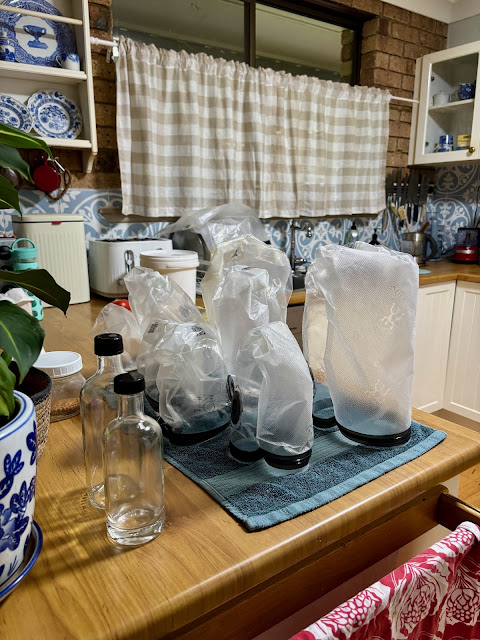
Every morning when I walk into my kitchen it looks tidy and ready for a day's work. Not so on this morning (above), I saw this when I walked in. Late the previous afternoon when I was looking for something, I came across my rolled up Zwilling vacuum bags and decided they had to be washed and dried. So I did that and although I usually put them outside on the verandah to dry it was dark by then. I turned the just-washed bags inside out and left them like this on a towel. It worked well and now the bags are ready to use when I bring home root vegetables, cabbages or whatever I buy that I want to last four or five weeks.
Image

You’ll save money by going back to basics

When I was doing the workshops and solo sessions, I had a couple of people whose main focus was on creating the fastest way to set up a simple life. You can't create a simple life fast, it's the opposite of that It's not one single thing either - it's a number of smaller, simpler activities that combine to create a life that reflects your values; and that takes a long to come together. When I first started living simply I took an entire year to work out our food - buying it, storing it, cooking it, preserving, baking, freezing, and growing it in the backyard. This is change that will transform how you live and it can't be rushed.  
Image


Trending Articles

NOT the last post

This will be my last post here.  I've been writing my blog for 18 years and now is the time to step back. I’ve stopped writing the blog and come back a couple of times because so many people wanted it, but that won’t happen again, I won’t be back.  I’ll continue on instagram to remain connected but I don’t know how frequent that will be. I know some of you will be interested to know the blog's statistics. 
Image

Every morning at home

Every morning when I walk into my kitchen it looks tidy and ready for a day's work. Not so on this morning (above), I saw this when I walked in. Late the previous afternoon when I was looking for something, I came across my rolled up Zwilling vacuum bags and decided they had to be washed and dried. So I did that and although I usually put them outside on the verandah to dry it was dark by then. I turned the just-washed bags inside out and left them like this on a towel. It worked well and now the bags are ready to use when I bring home root vegetables, cabbages or whatever I buy that I want to last four or five weeks.
Image

You’ll save money by going back to basics

When I was doing the workshops and solo sessions, I had a couple of people whose main focus was on creating the fastest way to set up a simple life. You can't create a simple life fast, it's the opposite of that It's not one single thing either - it's a number of smaller, simpler activities that combine to create a life that reflects your values; and that takes a long to come together. When I first started living simply I took an entire year to work out our food - buying it, storing it, cooking it, preserving, baking, freezing, and growing it in the backyard. This is change that will transform how you live and it can't be rushed.  
Image

Creating a home you'll love forever

Living simply is the answer to just about everything. It reduces the cost of living; it keeps you focused on being careful with resources such as water and electricity; it reminds you to not waste food; it encourages you to store food so you don't waste it and doing all those things brings routine and rhythm to your daily life. Consciously connecting every day with the activities and tasks that create simple life reminds you to look for the meaning and beauty that normal daily life holds.  It's all there in your home if you look for it. Seemingly mundane tasks like cleaning and cooking help you with that connection for without those tasks, the home you want to live in won't exist in the way you want it to.  Creating a home you love will make you happy and satisfied.
Image

Time changes everything

I've been spending time in the backyard lately creating a contained herb and vegetable garden. My aim is to develop a comfortable place to spend time, relax, increase biodiversity and encourage more animals, birds and insects to live here or visit. Of course I'd prefer my old garden which was put together by Hanno with ease and German precision. Together, we created a space bursting at the seams with herbs, vegetables and fruity goodness ready to eat and share throughout the year. But time changes everything. What I'm planning on doing now, is a brilliant opportunity for an almost 80 year old with balance issues. In my new garden I'll be able to do a wide range of challenging or easy work, depending on how I feel each day. It’s a daily opportunity to push myself or sit back, watch what's happening around me and be captivated by memories or the scope of what's yet to come.
Image

It's the old ways I love the most

I'm a practical woman who lives in a 1980’s brick slab house. There are verandahs front and back so I have places to sit outside when it's hot or cold. Those verandahs tend to make the house darker than it would be but they're been a great investment over time because they made the house more liveable. My home is not a romantic cottage, nor a minimalist modern home, it's a 1980’s brick slab house. And yet when people visit me here they tell me how warm and cosy my home is and that they feel comforted by being here. I've thought about that over the years and I'm convinced now that the style of a home isn't what appeals to people. What they love is the feeling within that home and whether it's nurturing the people who live there.
Image

Making ginger beer from scratch

We had a nice supply of ginger beer going over Christmas. It's a delicious soft drink for young and old, although there is an alcoholic version that can be made with a slight variation on the recipe. Ginger beer is a naturally fermented drink that is easy to make - with ginger beer you make a starter called a ginger beer plant and after it has fermented, you add that to sweet water and lemon juice. Like sourdough, it must ferment to give it that sharp fizz. To make a ginger beer plant you'll need ginger - either the powdered dry variety or fresh ginger, sugar, rainwater or tap water that has stood for 24 hours to allow the chlorine to evaporate off. You'll also need clean plastic bottles that have been scrubbed with soap, hot water and a bottle brush and then rinsed with hot water. I never sterilise my bottles and I haven't had any problems. If you intend to keep the ginger beer for a long time, I'd suggest you sterilise your bottles. MAKING THE STARTER In a...
Image

An authentic look at daily life here — unstaged and real

Most days Hanno was outside happily working in the fresh air. It may surprise you to know that I started reading my book,  Down to Earth , yesterday - the first time since I wrote it 13 years ago.  I had lent it to my neighbor, and when she returned it, I started reading, expecting to find surprises. Instead, I realised the words were still familiar—as if they were etched into my memory. As I flipped through the pages, I was reminded of how important it was for me to share that knowledge with others. The principles in Down to Earth changed my life, and I truly believed they could do the same for others. After just 30 minutes of reading, I put the book down, reassured that its message still holds true: we can slow down and reshape our lives, one step at a time.
Image