down to earth

  • Home
  • About Us
  • Down To Earth Book
  • Privacy Policy


Having the time and the inclination to make many of the things we use here is one of the most satisfying things about living this way. I love making soap, cooking from scratch, making cordials and fermented drinks, I love to sew and knit, and those activities result in products that are usually superior in quality to those bought in today's shops. It also give me the peace of mind of knowing that only the ingredients I put in with my own hands are in there; there are no nasties lurking. I add safety and certainty in with my other ingredients so I know that what I'm making is healthy, and not a product that might look good but is laden with chemicals I can't pronounce.

And so for all those reasons, I love making my own soap and laundry powder. I'm currently luxuriating in a lovely olive oil-rice bran oil-coconut oil soap that is creamy and lathers well. It's my favourite soap and if I never tried another home made soap, recipe I'd be happy with this one. I'm washing my hair with it too and it does a wonderful job, as good as the best organic shampoo.


Soap combines lye (caustic soda) with fats - I use only vegetable fats but it is also made with animal or bird fat. The chemical process that takes place, saponification, pulls the ingredients together and over the course of the next three or four weeks, the caustic elements in the soap neutralise, leaving a mild and soothing soap. Skin is the body's largest organ so it makes sense that whatever we rub onto our skin, especially if that is done many times during the course of the day, is safe and nourishing. Home made soap nourishes skin because it contains the natural glycerin, unlike commercial soap. Glycerin is extracted from commercial soap and sold as a separate product - it's more expensive than the soap, but removing it leaves the soap depleted. To counteract this, manufacturers add ingredients to make up for its lost and in doing so, make soap that is not so good for your skin.

Homemade laundry powder is another product that can easily be made at home. It's the combination of three ingredients - soap flakes, washing soda and borax, although if you use your grey water on your garden, you should leave out the borax. If you check the ingredients list on your commercial laundry detergent, you'll find a list of chemicals commonly used in many commercial cleaners that you have no idea about. I have been using homemade laundry powder in my front loader washer for many years now and have never had a problem. It cleans our clothes well and they come out smelling clean, not of artificially produced perfumes. Be warned, if you make up the recipe for laundry liquid, it can separate. If that happens, it's fine to use, you'll just need to mix it up to incorporate the liquid with the gel before you use it.

If you've never stepped into the world of homemade soap and laundry powder before now, why not give it a try. The powder in particular is easy and quick to make, MUCH cheaper than your commercial powder and does a good job without harming you or your clothes. My post about it and the recipe for it, and many other green cleaners, is here.

To make your own soap you'll need to step up a notch. It's more difficult, because you're handling a caustic product that burns, but if you make it when you're alone with no children or pets to distract you, it's easily done. My recipe for cold pressed soap is here.

I want to encourage you to start making some of your own products. Not only will it save you money, it will allow you the peace of mind of knowing what you're putting on your skin and on your clothes. There is a feeling of satisfaction that comes with this that you don't get when buying another box of soap or laundry powder. If you want it to, it will help you move further away from commerce and closer to an independent home. I know many people who read here are already doing this, but many are not. So if you're using your own non-commercial soap or laundry powder, please share your experiences with us.

MORE READING
This is a very good soap page with recipes and troubleshooting.

PS: I'm really pleased to see so many people interested in the swap. The deadline for joining is Thursday, so there is still time to sign up.


Hello all, Sharon here. I am a bit late in announcing a new swap today. I have decided that we will be swapping something very useful and something that can be very creative- kitchen towels and hot pads. I was going to put up my own tutorial for this, but after doing some research on the internet I found many so good tutorials that I will instead give you links to great ideas. For those who like to embroider here is Alicia Paulson of Posy gets Cozy great Polish Folk towels:http://aliciapaulson.com/Pleasant_Kitchen_Dishtowels.pdf. Her great site is: http://rosylittlethings.typepad.com/posie_gets_cozy/. Here is a sweet and very different kitchen towel: http://calamitykim.typepad.com/photos/whip_up_a_darlin_dress_to/index.html . For a fun quilted project I have several links: http://lindamade.wordpress.com/2007/08/28/hot-stuff-patchwork-oven-mitts/ , http://supamb.com/supafine/2007/10/24/how-to-sew-a-patchwork-kitchen-towel/ , http://writemamawrite.typepad.com/blog/2008/09/patchwork-kitchen-towel-tutorial.html , and http://sewmamasew.com/blog2/?p=550. I also found a felted hot pad at : http://www.purlbee.com/stars-stripes-felted-hot-pads/ . For those who want to practice their crochet I found this link which will take you to many many links!http://home.inreach.com/marthac/holder.html
To sign up for the swap please leave me (as a comment) :
1. your name
2. your e-mail (written out to stop those nasty spammers),
3. your country
4. whether you want to swap within your country, or internationally. Remember that if you swap internationally it many cost you a wee bit more in postage, but it is also so much fun!
The deadline for sign up is Thursday, Feb. 19
Rose will be helping me with the organization and the tracking of the swappers, and I have had many ladies who have signed up as my angels-those who will help me make sure that everyone gets a parcel. A great big thank-you and hug to everyone who is helping!
I also wanted to link you to a set of videos on You Tube. They are of Clara, a woman who lived through the Great Depression. She is seen in these videos talking about cooking and giving recipes that her family lived on during those hard years. I found these to be incredibly interesting. Clara is in her 90's now and all I can say is wow! I hope you all enjoy these as much as I did.
Episode 1: http://home.inreach.com/marthac/holder.htm
Episode 2 : http://www.youtube.com/watch?v=yREFkmrrYiw&feature=related
Episode 3: http://www.youtube.com/watch?v=yREFkmrrYiw&feature=related
Episode 4: http://www.youtube.com/watch?v=P4IjNV3lZkQ&feature=related
Episode 4 (part 2): http://www.youtube.com/watch?v=1IEWJmm4Tms&feature=related
Episode 5: http://www.youtube.com/watch?v=qptfhu9R0WI&feature=related
Episode 6:http://www.youtube.com/watch?v=9zXqkHvs0po&feature=related
Episode 7: http://www.youtube.com/watch?v=c5tXODF4of0&feature=related
Episode 8 (part 2) : http://www.youtube.com/watch?v=YhBZrPk2xaY&feature=related
Please keep all those who have lost so much in the bushfires in your prayers. Donations can be made online to the Australian Red Cross at :http://www.redcross.org.au/vic/services_emergencyservices_victorian-bushfires-appeal-2009.htm#Information_about_your_donation
I don't have time to post today but Eilleen at Consumption Rebellion has written a very interesting and intelligent post at the co-op about Children and the pressure to buy. It's well worth a read.

Sharon will be posting later about the new swap. I hope you all jump in and have some fun with it.

Changing old habits and establishing new routines is one of the hardest things you'll do when you move from a consumerist mindset to a more frugal and homemade one. When I first changed from my old life, I knew I had to do a lot more for myself but for the life of me I couldn't find the motivation to get all those new chores done. After a period of trial and error, I stumbled onto a good routine that established a rhythm to my days and I have not looked back. I like doing my housekeeping now - it grounds me and remind me every day that all the work both Hanno and I do, helps create a home we love spending time in and a relationship that grows stronger each year. Those home tasks carried out each day remind me that a simple life is a journey, not a destination.

Establishing a housekeeping routine can be a daunting task but is made easier by small actions repeated regularly. I didn't know it then, but when I made myself do my daily chores a little bit at a time, before too long, I got into a rhythm that carried me through what I had to do. When I took up the broom and pegs as my tools of trade, I started with a little list of jobs I would do within a certain amount of time. For instance, I would get up, shower, write, feed the animals and chooks, make breakfast, make the bed, clean the kitchen and make bread all before my unofficial time limit of 9 am. By 12 o'clock I had to have swept the floor, cleaned the kitchen benches and stove, and any laundry that needed doing that day. Keeping a list of tasks within a flexible time frame helped and I was surprised that, in the space of about a month, I had established a routine for myself that felt comfortable and easy to work with; and it got my housekeeping done. That surprised me because I hadn't liked doing housework before then, I thought it was boring. When I had that rhythm, I started thinking about what I was doing, how my work connected me to my female ancestors and how it made my life better. When I made that connection, I started liking most of what I did, I began looking for new things to learn and I settled into my home. At last, I felt truly comfortable in my own home.

Now that I look back on it, I know that getting into the rhythm of doing a certain number of chores each day, and repeating those actions, changed my habits and established positive new ones. So I'd like to share with you five things to do every day to help a establish a routine. As you can see, they're five very common things that most of us would need to do each day. I hope you you will add another five things that are required in your own life. This second set of five things will be those things specific to you and your circumstances - whether you have children or not, work outside the home or not, and possibly would change according to where you live. For example, if you live in an apartment, your chores would be different to those you would need to do in a house with a garden and chooks.
  1. Make the bed/s. When the children are old enough, this should be one of the chores they learn so they contribute to the running of the home.
  2. Sweep the floor.
  3. Wash up or run the dishwasher.
  4. Organise and tidy one area a day. This might be the laundry, kids' rooms, the family room or your finances and mail.
  5. Know what you'll eat tomorrow.
And when you have your daily routine working for you, add one weekly activity: learn or teach one new skill every week. A new recipe, new pattern, new stitch, or work though something over the weeks - like building a compost heap, learning about vegetable gardening, experimenting with sourdough or other fermented foods, teaching your children simple, practical skills like how to sew on a button, tie their shoe laces, tell time or read the sky - during the day for changes in the weather and at night for interest.

Learning new skills is something we all need to do and you need to make time for it and put in the effort to do it. At almost 61 years of age, I still look for new discoveries, and I hope I never lose the interest in doing that. I believe that when we lose the will to learn, we stop flourishing.

I hope this way of establishing housekeeping routines works for you. It is said that new habits need about three weeks to set up and become part of you. I never timed my changes so I wonder if that is true. Hopefully in a few weeks time, some of you tell me that it is.

Thanks for that previous post, Sharon. The money being raised for the fire victims is growing steadily. Australians have always been generous and supportive in times of crisis so it's good to see that tradition remains strong. The Red Cross is accepting donations both here in Australia and from their locations around the world. You can read about their current efforts here.

It seems I'm always running late these days. The book proposal that was supposed to be in on January 31 still hasn't been sent and after two busy days at work I plan on writing for the rest of this week and have it in on February 15. It is late because I made some last minute changes and my agent, Abby, was gracious enough to not mind the missed deadline. Work was particularly busy this week because I'm starting some new programs and we're planning our move to the new building and all that brings with it. Monday and Tuesday were HOT here, there is no air-conditioning at work so when I came home, I crashed. I'm still feeling a bit tired now, even with a good night's sleep, so I hope I come good during the day.

So, what is on my agenda today? I'll bake bread, sweep the floors and do a general tidy up and then settle into my sewing room to write most of the day. Hanno did a lot of gardening while I was at work so everything is fine outside. I have seedlings ready to plant in the garden and all the tomatoes need to be potted up. I hope to do that tomorrow when I'll see to the worm farm as well. They've been a bit neglected recently but they usually do okay as long as they have food and water.


I wrote last week that Rose had sent me some cotton called Down to Earth. When I start my new project this morning - at morning tea I plan on starting a set of dishcloths for Sarndra and Shane - I'll use some of Rose's cotton and see how it knits up. I'm knitting a set of aqua and red cloths so I'll use some of my Lions cotton for the thin red stripes.

These small squares of cotton that we knit for our wash or dish cloths can be made into other things as well. I showed the pot holder I'd half finished a week or so ago. Well, here it is now, finished, with some very quick hand quilting to attach the back to the front. All I did with it was to knit a square of Lions organic thick cotton, cut a square of cotton fabric to size and then quilt the front to the back. I'm already using it and it's worked really well. I have those saucepans with metal handles so pot holders are always used in my kitchen.


But there are other projects as well. When you've knitted up your own set of cloths, you could knit a few cleaning mitts. Just knit two rectangles (or one long one) the size of your hand and sew them together, leaving a hole for your thumb - in the same way we make a thumb hole in fingerless mittens. These make very good dusters or mitts for cleaning or washing dishes. If you have a swiffer, you could knit longer rectangles to replace the synthetic ones you need to buy replacements for. Two squares, some lining and a strap would make a sweet little shoulder purse for a little girl, or a big one. Or two squares and lining would also make a very serviceable padded digital camera pouch.

As you can see you can turn your squares into quite a few small items that will serve you well. Knitting the squares improves your knitting and you can experiment with different patterns, they're like modern day samplers. Women in the past used their samplers as decorations but we can put our samplers to use replacing products we used to buy. It's like permaculture knitting - we're getting multiple uses from the one thing.

Are you using your cotton squares for things other than dish and wash cloths? If you are I'd love to know what you're doing.

ADDITION: If you're looking for some good reading today, I recommend A Farmstead Pilgrimage to you. I have a handful of blogs I read when I have the time and Kris's has become a firm favourite. Even that first page, without any scrolling back, is a delight. Grab a cuppa and enjoy a visit there. Oh, her feedburner is broken and she can't find a way to fix it. If you can help can you contact her and offer your help. I'm sure she's apreciate if very much.


It seems that every time my husband and I check the news the death toll rises and the devastation is mind-boggling. I have seen many fires having grown up in the Southwestern US. Much of my home town (Los Alamos, New Mexico) burned down a few years ago in a man-made fire, but nothing compares with the loss of life and destruction in the Victorian bush fires. Here in the US, those who wish to donate to the relief efforts should contact their local Red Cross and they will put you in touch with the Red Cross of Australia. We send our prayers to those suffering in this disaster.
I didn't watch the news last night but Hanno told me there are over 160 lives lost in the fires now. Of course, there are many animals dead too, heavy stock losses and wild life carers are either nursing burnt or injured animals back to health or are euthanasing them. And the houses! An entire town lost with almost every home burnt to the ground, and many homes in other towns burnt, leaving only chimney stacks behind as silent reminders of what used to be. It is the worst tragedy we have ever had here. Our government is giving money to each family affected and paying for the funerals. Thanks for your prayers and kind thoughts. Australia is a sad place today.

I have two simple recipes for you today. It's food we've eaten in the past few days, easy to make and very tasty. They're both old-fashioned recipes and as my heritage is Irish, they come from the old country. If you're teaching yourself to bake from scratch, this cake is a good one to try. It's mixed by hand and apart from cutting up the dates, is merely a matter of adding and mixing.

DATE AND WALNUT LOAF - you can use any nuts you have on hand
The cake makes two small loaves or one large one.


Ingredients
1 ½ cups chopped dates
1 ½ cups walnuts
1 cup brown sugar
1 teaspoon bicarb (this is the rising agent for this cake)
3 tablespoons soft butter (vegans use the same amount of olive oil)
1 ¼ cups boiling water - add more if needed
2 ½ cups plain (all purpose) flour
1 beaten egg (vegans use ½ mashed banana)

Method
Boil some water.
Add the dates, nuts, sugar, bicarb and butter to a mixing bowl and mix together. Add the boiling water and mix again.
Add the egg, half the flour and mix, add the remaining flour and mix it in. If the mix is dry, add a little more water, enough to make a loose, but not runny, batter.
You do not have to beat this cake mixture. It's not a light cake and doesn't require the incorporation of air.
Add to a loaf tin (or two) and bake in a slowish oven (170C / 340 F) until cooked - about 40 minutes.


To check if the cake is cooked, poke a toothpick into the middle of the cake. If the toothpick comes out clean, it's cooked, if it comes out sticky and with moist cake mix on it, (see photo below) cook for another ten minutes.


If, when you do that, you're worried the top of the cake will burn, cover the top with a piece of alfoil.

When I cook this cake I always make a large one and cut it in two. We are enjoying the cake this week and I have another one in the freezer for later in the month.

It's a very good cake for packing into lunch boxes, but if it's to go in a school lunch box, you might have to leave out the nuts. I believe nuts are banned in some schools now.

My other recipe is colcannon.


Ingredients are mashed potato, cabbage and green onions or chives.

Method
Cook your potatoes as you normally do. About ten minutes before the potatoes finish cooking, cook a portion of finely sliced cabbage. You will need about one third cabbage to two thirds potato. I use a steamer on top of the potatoes to cook the cabbage. This saves money as I'm using the same heat that's cooking the potatoes to cook the cabbage as well. I use this method when I cook all our vegetables. The hard vegetables, like potatoes or pumpkin, go in the saucepan and the soft vegetables, beans, carrots, peas, zucchini, are cooked in the steamer on top.


Make up your mashed potato as you normally do, then add the cooked cabbage and green onions. Don't forget to season it with salt and pepper to your taste. This is delicious with any meat, chicken or fish meal and uses three vegetables in one dish.


We had a wonderful weekend here full of family, both old and new. On Friday night, Tricia and I went to cousin Susie's home on her brother Stephen's 55th birthday. Stephen died a few months back and as he didn't have a formal funeral, we chose that day to remember him. My uncle Hal, Stephen's dad, was there, as well as Susie's husband Nick and children, Angie and Billy. It was a good night, Susie, as usual, presented us with the most delicious meal (she is ,without a doubt, the best home cook in our family) and we talked and listened to some good music. Some of that music was Angie and Billy's brother Tom who you can listen to here. Have a listen, he is very good and this is a beautiful song. Tom is in Ireland at the moment.


Back: Billy, Angie, Billy's girfriend Zoe.
Front: Tricia, Susie and me.

I thought about family a lot over the weekend, triggered by that gathering, where we all sat outside on the deck on a perfect late summer's night with the bush surrounding us and the stars shining. Tricia and I are both early birds in the morning so we were tired and went home early. Honestly, it felt like it was about 3am when we got home, but it was only 9.45pm. LOL! Still we both went straight to bed, Hanno was already asleep, and I drifted off thinking of Stephen and how he would have been smiling down on us, happy to see us all there, and possibly surprised to see his father. They had been estranged for years. I will remember that night for a long time. RIP Stephen.

Of course, the next night was Shane and Sarndra's engagement party and wouldn't you know it, I didn't get a photo of them together. But here they are nontheless, Shane cooking, as usual, and Sarndra looking her gorgeous self, talking to some of the 50 guests.


We took Alice with us to the party. Hanno had stayed home with her the previous night as she is deaf now and becomes quite confused when left alone. Everyone made a big fuss of her and she behaved as if that was to be expected. I made her a new red bandana to wear. Here she is watching Shane cook sausages on the BBQ.


I am a very fortunate woman to have been born into this family of mine. They are all good people. It feels a bit like the changing of the guard to me now. In the past our important family gatherings were organised by our parents or grandparents, but now they are are no longer with us. Now, Tricia, Susie and I organise the gatherings and pass on the stories of our family to our children, so they can tell them to their children. It's an important part of family life, because if we don't do it, no one will. I am still thinking of the benefits and consequences of being part of my family. It's an ongoing thing and it's slow, like me, but I do know I'm a proud mother and very happy to welcome Sarndra into our family. I also love knowing that my children, Tricia's and Susie's are all similar, and interested in our family stories. I told Billy and Angie about my blog, because that is part of my story, so hello to them and to Zoe. :- )

There is a lot to be said for families, they can either make or break you. While nothing is ever perfect, generally a family will help you live to your potential and help you survive when times are tough. And they're dynamic, when they are made, they change again, new members added and old ones lost. The trick is to tell the stories to the new family members so they know where we come from and what type of people we are. The rest, I think, is up to luck and consistency.


Hello everyone! I've had a few emails asking if Hanno and I are okay and if we are close to the bushfires. At least 25 people have been killed by fires in Victoria, which is at the bottom of Australia. I'm happy to report we are a couple of thousand kilometres away from the fires. There are other fires in New South Wales, where Tricia lives, but they're not near her home at the moment. The temperatures down south are still very hot - well over 40C (104F) in many areas, and no doubt the temperatures are aiding the fires.

We live in Queensland, and while we certainly have the odd bushfire, summer is our wet season, so there isn't such a threat here. In fact, we have floods here in our state,with record rainfall in many little towns and areas along the coast. In a long strip along the coast, the rain has poured down without a break for almost a month. Again, Hanno and I are not close to the flooded areas.

I hope everyone who reads here is safe. I really feel for all those suffering in the heat, not just the people, but also the pets, stock and wildlife. I can't imagine how devastating it must be to lose your home to a fire or a flood. As well as the loss of human life, there have been heavy stock losses, both in the fires and the floods, and I'm guessing a lot of wild animals and reptiles have died too. It's so sad.

So far, this year has witnessed a cruel climate. I've seen on the news there have been record snowfalls and low temperatures in the UK and the US. I send my best wishes to everyone who is suffering either fire, flood or the extremes of high or low temperatures. Thank you for thinking of us, we are fine, I hope you are too. Stay safe everyone.


My sister Tricia travelled up from Sydney yesterday to visit for a few days. We have some family events to attend, the first one being a remembrance for our cousin Stephen, which will be held tonight at his sister Susie's home.

Tricia caught the train from the airport and I picked her up from the train station. I feel a bit removed from it when I'm in a busy place like that, people going everywhere and no familiar faces, or smiles. But there she was, suddenly, that face I've known all my life, we hugged and the talking started. Welcome back.

She had brought a few surprises with her. After going through hers and mum's photos, she collected some of our cousin Stephen to bring to show Susie. Among those photos from a far off distant time, was this one of us. I'm the blonde with the straight hair. I remember those home knitted angora tops we wore. Mine was pink and Tricia's was blue and I called them our fuzzy-wuzzy tops. The inscription on the photo's envelope, in my mother's hand, states Christmas 1950. Then, I would have been two and Tricia, four. We look older than that, my guess is we are four and six.

Another surprise she found was my first prayer book. It's called Pray Always - prayers and instructions for children. The copyright is New York, 1951. Wow.


Some one asked about my little jar cover, made to cover the sourdough (and ginger beer) as it ferments. When you have something fermenting, you want the jar to be open to the natural yeasts in the air but protected from insects. I made a couple of little pure cotton squares to do the job and they have worked well. So above, I've done a couple of drawings that will fit neatly on the top of one of these squares. When I do my next covers, I'll add more weights, four of the size used in the photo is not enough. I think my next covers will be round too, and I'll have buttons or beads hanging all the way around.

Please use the drawings if you like them. If you're unsure about how to make up a stitchery like this, I have written instructions here. They're simple and easy to make and don't take a lot of time, so perfect for a weekend project. The lovely thing about making these little bit and pieces is they become part of the patchwork of your home and remind you every time you use them, the importance of your home and your place in it.

I hope you have a restful weekend. Thank you for being here this week and welcome to the newcomers. The figures increased by ten thousand over the past month. Please say hello if you have the time. I hope you find what you're looking for here.

I'm not sure what happened to the layout of this post but I can't fix it. Sorry. : - )
Newer Posts Older Posts Home


My books were all published by Pengiun, and are available at Amazon US, Amazon UK and Amazon Au

Search here

Total Pageviews

Translate


I'm Rhonda Hetzel and I've been writing my Down to Earth blog since 2007. Although I write the occasional philosophical post, my main topics include home cooking, happiness and gardening as well as budgeting, baking, ageing, generosity, mending and handmade crafts. I hope you enjoy your time here.

MY FAVOURITE PLACES

  • Grandma Donna's Place
  • Grandma Donna's YouTube
  • Grandma Donna's Instagram
  • This Simple Day
  • Nicole's Instagram

Give More

Give More

Popular posts last year

Making ginger beer from scratch

We had a nice supply of ginger beer going over Christmas. It's a delicious soft drink for young and old, although there is an alcoholic version that can be made with a slight variation on the recipe. Ginger beer is a naturally fermented drink that is easy to make - with ginger beer you make a starter called a ginger beer plant and after it has fermented, you add that to sweet water and lemon juice. Like sourdough, it must ferment to give it that sharp fizz. To make a ginger beer plant you'll need ginger - either the powdered dry variety or fresh ginger, sugar, rainwater or tap water that has stood for 24 hours to allow the chlorine to evaporate off. You'll also need clean plastic bottles that have been scrubbed with soap, hot water and a bottle brush and then rinsed with hot water. I never sterilise my bottles and I haven't had any problems. If you intend to keep the ginger beer for a long time, I'd suggest you sterilise your bottles. MAKING THE STARTER In a...
Image

NOT the last post

This will be my last post here.  I've been writing my blog for 18 years and now is the time to step back. I’ve stopped writing the blog and come back a couple of times because so many people wanted it, but that won’t happen again, I won’t be back.  I’ll continue on instagram to remain connected but I don’t know how frequent that will be. I know some of you will be interested to know the blog's statistics. 
Image

How to make cold process soap

I'm sure many of you are wondering: "Why make soap when I can buy it cheaply at the supermarket?" My cold process soap is made with vegetable oils and when it is made and cured, it contains no harsh chemicals or dyes. Often commercial soap is made with tallow (animal fat) and contains synthetic fragrance and dye and retains almost no glycerin. Glycerin is a natural emollient that helps with the lather and moisturises the skin. The makers of commercial soaps extract the glycerin and sell it as a separate product as it's more valuable than the soap. Then they add chemicals to make the soap lather. Crazy. Making your own soap allows you to add whatever you want to add. If you want a plain and pure soap, as I do, you can have that, or you can start with the plain soap and add colour, herbs and fragrance. The choice is yours. I want to add a little about animal and bird fat. I know Kirsty makes her soap with duck fat and I think that's great. I think t...
Image

Preserving food in a traditional way - pickling beetroot

I've had a number of emails from readers who want to start preserving food in jars but don't know where to start or what equipment to buy.  Leading on from yesterday's post, let's just say up front - don't buy any equipment. Once you know what you're doing and that you enjoy preserving, then you can decide whether or not to buy extra equipment. Food is preserved effectively without refrigeration by a variety of different methods. A few of the traditional methods are drying, fermentation, smoking, salting or by adding vinegar and sugar to the food - pickling. This last method is what we're talking about today. Vinegar and sugar are natural preservatives and adding one or both to food sets up an environment that bacteria and yeasts can't grow in. If you make the vinegar and sugar mix palatable, you can put up jars of vegetables or fruit that enhance the flavour of the food and can be stored in a cupboard or fridge for months. Other traditional w...
Image

Cleaning mould from walls and fabrics

With all this rain around we've developed a mould problem in our home. Usually we have the front and back doors open and that good ventilation stops most moulds from establishing. However, with the house locked up for the past week, the high humidity and the rain, mould is now growing on the wooden walls near our front door and on the lower parts of cupboards in the kitchen. Most of us will find mould growing in our homes at some point. Either in the bathroom or, in humid climates, on the walls, like we have now. You'll need a safe and effective remedy at some point, so I hope one of these methods works well for you. Mould is not only ugly to look at, it can cause health problems so if you see mould growing, do something about it straight away. The longer you leave the problem, the harder it will be to get rid of it effectively. If you have asthma or any allergies, you should do this type of cleaning with a face mask on so you don't breathe in any spores. Many peopl...
Image

Five minute bread

Bread is one of those foods that, when made with your own hands, gives a great deal of satisfaction and delight. It's only flour and water but it symbolises so much. I bake bread most days and use a variety of flours that I buy in bulk. Often I make a sandwich loaf because we use most of our bread for lunchtime sandwiches and for toast. Every so often I branch out to make a different type of loaf. I have tried sour dough in the past but I've not been happy with any of them. I'll continue to experiment with sour dough because I like the idea of using wild yeasts and saving the starter over a number of years to develop the flavour and become a part of the family. However, the loaf I've been branching out to most often is just a plain old five minute bread. By five minutes I mean it takes about five minutes actual work to prepare but it's the easiest of all bread to make and to get consistently good loaves from. If you're having people around for lunch or...
Image

This is my last post.

I have known for a while that this post was coming, but I didn't know when. This is my last post. I'm closing my blog, for good, and I'm not coming back like I have in the past.  I've been writing here for 16 years and my blog has been many things to me. It helped me change my life, it introduced me to so many good people, it became a wonderful record of my family life, it helped me get a book contract with Penguin, and monthly columns with The Australian Women's Weekly and Burke's Backyard . But in the past few months, it's become a burden. In April, I'll be 75 years old and I hope I've got another ten years ahead. However, each year I'll probably get weaker and although I'm fairly healthy, I do have a benign brain tumour and that could start growing. There are so many things I want to do and with time running out, leaving the blog behind gives me time to do the things that give me pleasure. On the day the blog started I felt a wonderful, h...
Image

What is the role of the homemaker in later years?

An email came from a US reader, Abby, who asked about being a homemaker in later years. This is part of what she wrote: "I am a stay-at-home mum to 4 children, ages 9-16. I do have a variety of "odd jobs" that I enjoy - I run a small "before-school" morning drop-off daycare from my home, I am a writing tutor, and I work a few hours a week at a local children's bookstore. But mostly, I cherish my blissful days at home - cooking, cleaning (with homemade cleaners), taking care of our children and chickens and goats, baking, meal-planning, etc. This "career" at home is not at all what I imagined during my ambitious years at university, but it is far more enriching. I notice, though, that my day is often planned around the needs of my family members. Of course, with 4 active kids and a husband, this is natural. I do the shopping, plan my meals, cook dinner - generally in anticipation of my family reconnecting in the evening.  I can't h...
Image

Every morning at home

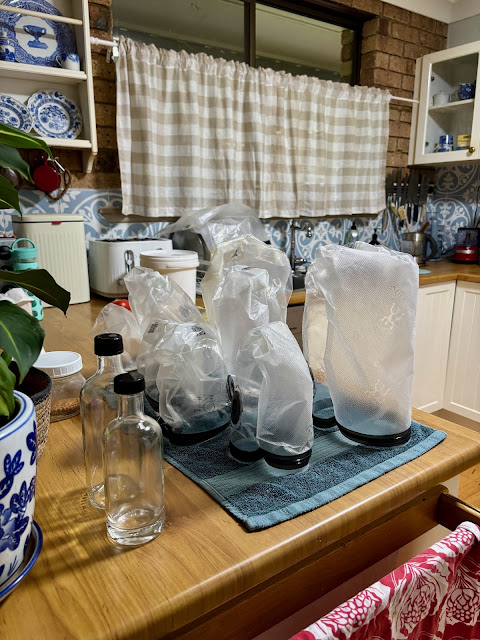
Every morning when I walk into my kitchen it looks tidy and ready for a day's work. Not so on this morning (above), I saw this when I walked in. Late the previous afternoon when I was looking for something, I came across my rolled up Zwilling vacuum bags and decided they had to be washed and dried. So I did that and although I usually put them outside on the verandah to dry it was dark by then. I turned the just-washed bags inside out and left them like this on a towel. It worked well and now the bags are ready to use when I bring home root vegetables, cabbages or whatever I buy that I want to last four or five weeks.
Image

You’ll save money by going back to basics

When I was doing the workshops and solo sessions, I had a couple of people whose main focus was on creating the fastest way to set up a simple life. You can't create a simple life fast, it's the opposite of that It's not one single thing either - it's a number of smaller, simpler activities that combine to create a life that reflects your values; and that takes a long to come together. When I first started living simply I took an entire year to work out our food - buying it, storing it, cooking it, preserving, baking, freezing, and growing it in the backyard. This is change that will transform how you live and it can't be rushed.  
Image


Trending Articles

NOT the last post

This will be my last post here.  I've been writing my blog for 18 years and now is the time to step back. I’ve stopped writing the blog and come back a couple of times because so many people wanted it, but that won’t happen again, I won’t be back.  I’ll continue on instagram to remain connected but I don’t know how frequent that will be. I know some of you will be interested to know the blog's statistics. 
Image

Every morning at home

Every morning when I walk into my kitchen it looks tidy and ready for a day's work. Not so on this morning (above), I saw this when I walked in. Late the previous afternoon when I was looking for something, I came across my rolled up Zwilling vacuum bags and decided they had to be washed and dried. So I did that and although I usually put them outside on the verandah to dry it was dark by then. I turned the just-washed bags inside out and left them like this on a towel. It worked well and now the bags are ready to use when I bring home root vegetables, cabbages or whatever I buy that I want to last four or five weeks.
Image

You’ll save money by going back to basics

When I was doing the workshops and solo sessions, I had a couple of people whose main focus was on creating the fastest way to set up a simple life. You can't create a simple life fast, it's the opposite of that It's not one single thing either - it's a number of smaller, simpler activities that combine to create a life that reflects your values; and that takes a long to come together. When I first started living simply I took an entire year to work out our food - buying it, storing it, cooking it, preserving, baking, freezing, and growing it in the backyard. This is change that will transform how you live and it can't be rushed.  
Image

Creating a home you'll love forever

Living simply is the answer to just about everything. It reduces the cost of living; it keeps you focused on being careful with resources such as water and electricity; it reminds you to not waste food; it encourages you to store food so you don't waste it and doing all those things brings routine and rhythm to your daily life. Consciously connecting every day with the activities and tasks that create simple life reminds you to look for the meaning and beauty that normal daily life holds.  It's all there in your home if you look for it. Seemingly mundane tasks like cleaning and cooking help you with that connection for without those tasks, the home you want to live in won't exist in the way you want it to.  Creating a home you love will make you happy and satisfied.
Image

Time changes everything

I've been spending time in the backyard lately creating a contained herb and vegetable garden. My aim is to develop a comfortable place to spend time, relax, increase biodiversity and encourage more animals, birds and insects to live here or visit. Of course I'd prefer my old garden which was put together by Hanno with ease and German precision. Together, we created a space bursting at the seams with herbs, vegetables and fruity goodness ready to eat and share throughout the year. But time changes everything. What I'm planning on doing now, is a brilliant opportunity for an almost 80 year old with balance issues. In my new garden I'll be able to do a wide range of challenging or easy work, depending on how I feel each day. It’s a daily opportunity to push myself or sit back, watch what's happening around me and be captivated by memories or the scope of what's yet to come.
Image

It's the old ways I love the most

I'm a practical woman who lives in a 1980’s brick slab house. There are verandahs front and back so I have places to sit outside when it's hot or cold. Those verandahs tend to make the house darker than it would be but they're been a great investment over time because they made the house more liveable. My home is not a romantic cottage, nor a minimalist modern home, it's a 1980’s brick slab house. And yet when people visit me here they tell me how warm and cosy my home is and that they feel comforted by being here. I've thought about that over the years and I'm convinced now that the style of a home isn't what appeals to people. What they love is the feeling within that home and whether it's nurturing the people who live there.
Image

Making ginger beer from scratch

We had a nice supply of ginger beer going over Christmas. It's a delicious soft drink for young and old, although there is an alcoholic version that can be made with a slight variation on the recipe. Ginger beer is a naturally fermented drink that is easy to make - with ginger beer you make a starter called a ginger beer plant and after it has fermented, you add that to sweet water and lemon juice. Like sourdough, it must ferment to give it that sharp fizz. To make a ginger beer plant you'll need ginger - either the powdered dry variety or fresh ginger, sugar, rainwater or tap water that has stood for 24 hours to allow the chlorine to evaporate off. You'll also need clean plastic bottles that have been scrubbed with soap, hot water and a bottle brush and then rinsed with hot water. I never sterilise my bottles and I haven't had any problems. If you intend to keep the ginger beer for a long time, I'd suggest you sterilise your bottles. MAKING THE STARTER In a...
Image

An authentic look at daily life here — unstaged and real

Most days Hanno was outside happily working in the fresh air. It may surprise you to know that I started reading my book,  Down to Earth , yesterday - the first time since I wrote it 13 years ago.  I had lent it to my neighbor, and when she returned it, I started reading, expecting to find surprises. Instead, I realised the words were still familiar—as if they were etched into my memory. As I flipped through the pages, I was reminded of how important it was for me to share that knowledge with others. The principles in Down to Earth changed my life, and I truly believed they could do the same for others. After just 30 minutes of reading, I put the book down, reassured that its message still holds true: we can slow down and reshape our lives, one step at a time.
Image