down to earth

  • Home
  • About Us
  • Down To Earth Book
  • Privacy Policy
Well, the first BIGGEST kitchen table worked well and is now finished. Thanks to everyone who took part on the first kitchen table talk on chickens. I've visited everyone who left a link and written down a couple of the recipes. It was a wonderful way to share what we know about chooks, looking at the photos showed me how different we all are.

The kitchen table was a lot of work and it will be something I will do each month, not each week ,as some of you indicated on your blogs. But it is definitely something worth repeating as it allows us to share and build a community of friends. When you travel around the other blogs, and I encourage you to do so, please leave a comment, even if it's just to say hello. Posting takes time and it's very disheartening to write and add photos and then have no one acknowledge you.

I am going back to work today. It will be a busy day because there are a lot of things to be put away after the Christmas breakfast, as well as a new tenant moving in, and all the normal visits and phone calls we have. I'm looking forward to going back, I've missed it.

I hope you all have a wonderful week as we all look towards this new year.


We'll start our kitchen table talks today with the topic, chickens in the backyard. I want to encourage you all to get involved in this, learn a useful skill, or contribute to the discussion, just like you would if we were all sitting around a kitchen table with our cups of tea and coffee. This talk is aimed at those folk who have never kept chickens before, want to, but haven't got much of a clue about their care and needs. I hope all of you who have experience with chickens join the table and help pass on the necessary information to the novices. Those of you with no chooks, please add your egg recipes.

I'm still not entirely sure how these talks will go. For the time being, if you want to ask a question, simply write it in the comments and I'll answer what I can or pass it on to our other experienced chook people. If you want to write your own post and show us your chickens, do that and give me the link to your post in my comments. You will have the weekend to add to this. I'll add all the links to my post soon after they turn up and we can all tour around reading what everyone has to say. On Monday morning, I'll do a followup.


The vast majority of chickens are hatched in Spring and Summer. Day old chicks are often available for sale but when I'm getting new chooks, I usually go for point of lay pullets that are between 18 - 22 weeks old. They will start laying a couple of weeks after you buy them. When you buy point of lay pullets, they will have been sexed and you'll get only hens. When you buy day old chicks, they won't have been sexed and you'll get approximately 50/50 girls and boys.

If you intend buying chickens, you need to have their housing ready before you bring them home. You MUST provide safe housing. There are a lot of predators around - dogs, foxes, feral cats and other wildlife that will wander in under the shadow of darkness. When you bring them home, lock the gate on their coop and leave them to settle in. Don't let them out to free range for at least a week - during that time they will learn that is their home. When chooks know their home, they usually come home to roost when the day light starts to fade and usually you don't have to go looking for them.


This is Margaret Olley, my favourite chook. She's a buff (that's the colour) Sussex.

CHICKEN REGULATIONS
Most local authorities will have a bylaw about the keeping of chickens. Where I live we can have up to 20 chooks and the chicken coop must not touch a neighbours fence. Please phone your local county, shire or council to ask about their regulations before you buy your chickens, or Google "chicken regulations ......." and add your town to the Google search, instead of the dots.
Brisbane area regulations
US regulations.

HOUSING
Chickens need a place where they feel safe and can lay their eggs. One nest per five chooks. We have four nests here with 11 chickens but we usually have at least one chicken broody and taking up a nest all the time. If the nests are high off the ground, you'll need to provide a little ladder or steps for the chooks to reach the nests.


Click on the photo to enlarge it. This is our set up. We have a hen house with a lockable enclosure attached to it. That is all fenced. There will be times when you need to keep one chook apart from the rest. When that happens, we put them in the lockable area attached to hen house - that is directly behind the lemon tree. When that area is not being used, we make fast compost in there. I'll write about that again another day. You can see the gate to the hen house is open. We close that every night.

Your ladies will sleep on a roost. That is a horizontal bar, like a small tree branch. The higher up the chickens is when they go to sleep, the higher up in the packing order they usually are. Generally your topchook will be up on the top roost at night.

Photos of chicken tractors.
Hen houses.
How to build a hen house.
Info on housing chickens.


TEMPERAMENT AND LAYING CAPACITY
Some chooks are flighty, some are very placid, but overall, chooks don't cope with stressful situations very well. Here is a handy guide to chicken breeds - I hope you get pure breed chooks. This chart will also tell you whether the chickens are suited to hot or cold temperatures. We have a mix of Sussex - one buff, one silver, one salmon Faverolles, two Rhode Island Reds, one New Hampshire, two Australorps, one Australorp cross, one buff (the colour) Orpington, and one barred Plymouth Rock.

If you live in a city, you may only be able to find crossbreed chooks like Isa browns. These are a hardy type of chook bred for the caged industry. They'll lay well, at the expense of going broody, which a lot of people like. They generally don't live as long as pure bred chooks.

NUMBER OF CHOOKS
The smallest number should be two. Solo chickens are sad birds. However, there will be times when you have to isolate your chooks and keep them on their own, generally chickens prefer to be with other chickens. However, having written that, we used to have a chook called Jewels - a golden Hamburg, who hated being with the other chooks and always sat with the dogs. Your chooks will know the other chooks by sight and when you want to introduce new chooks, the older ones will give them a hard time.

Get the number of chickens you have room for. We have 11 here and we get about 8 eggs a day. A little flock of three or five girls will give enough eggs for a family of four or six.


INTRODUCING NEW CHOOKS TO AN OLDER FLOCK
When you bring new chooks home, and you already have chickens, isolate the new birds, but put them where they can see and be seen by the other chooks. Keep them isolated for a few days. This will help them assimilate and when you let them out together, there will be less pecking.

PECKING ORDER
Pecking each other to establish pecking order is natural behaviour for chickens. Don't intervene unless you can see an open wound or blood. Then you'll have to remove that chicken until she has healed. Chickens can be vicious if they see blood.

LIFESPAN
From my experience, about ten years, give or take. Cross breed chooks, generally eight years. They will continue to lay eggs up until they die but when they're very old, you will only get about one egg per two months.

We have found over the years, that if you get a flock of say eight or ten girls, in five years you'll have maybe six or seven.

FOOD AND WATER
Chooks must have clean water ALL THE TIME. Get into the habit of giving them clean water every second day, or daily if they drink a lot. If you have bought day old chicks, they're need chicken starter crumbles, if you have point of lays they'll need laying pellets or laying mash (mash is a combination of grains). Or you can make your own mix. If you intend to supplement their diet with greens from the garden, or kitchen scraps, start this early as they get picky later and will stay with what they know. Chickens are omnivores, they eat meat, grains and vegetables. They love cheese, yoghurt, whey, sour milk and milk. They need a high protein diet to produce eggs constantly, if you have chickens that aren't laying give them a boost with some day old bread soaked in milk or porridge made with milk. They love this and will see it as a treat.


If you have grain like wheat or barley, sprouting it for the chickens gives them a good nutritional boost. Simply soak the grains for a couple of hours in a large flat container, or upturned bin lid, pour off the excess water and keep the container in the shade, covered with a cloth. Wet and rinse the grains every day and drain off the excess water. When the grains sprout, feed them to the chooks.

This is good natural supplement to help keep the hens' calcium level up. Either buy shell grit (at your local feed store where you buy chook food) or keep the shells of your own eggs and wash them out so they don't smell. When you have quite a few, put them in the oven, on a medium setting, for 10 minutes to dry out. When they're cool, put them in a blender and blitz them, or crush them inside a tea towel with your rolling pin. Store in a jar. The crushed shell powder can be added to the chook food as a calcium supplement.


Your chickens will be healthier and will give you better eggs if you let them free range. When chooks eat grass, they will have Omega 3 oils in their eggs, this is a great bonus for you and anyone eating the eggs.

Another little thing to keep your chooks healthy is to add some "real" raspberry cordial, with at least 25% real juice, or squashed frozen raspberries or jam to their water every so often. Read about it here. This is also a good treatment for diarrhoea (in chooks and kids).

Raspberry Cordial recipe
2 cups crushed fresh or frozen raspberries
Juice of one lemon
1½ cups sugar syrup
8 cups of water
Bring to the boil and simmer for five minutes. Cool, then decant to clean bottles. Store in the fridge for up to two months or freeze.

To a bucket of water, add about two tablespoons.

EGGS
You will know your ladies are maturing by their comb and wattles - the red bits on their faces. The comb and wattles will get larger and redder as they get close to laying. Depending on the weather, each hen will lay about five eggs a week, in the first year. It will decrease every year after that. They will stop laying when it is very hot or very cold and when they're moulting (replacing their feathers). When your girls first start laying, they might lay an egg with no shell or an egg with two yolks. The eggs usually start off small and get bigger as the hen matures. When the hen's hormones have settled down, you will get one ordinary egg with shell in tact.


Collect the eggs once a day. Your girls will usually lay in the morning. Don't wash the eggs, as that will remove a protective layer on the shell. If the egg is dirty, rub it with a cloth and remove as much dirt as you can. If you still need to wash it do so, but use that egg next. Don't let it sit in the fridge.

Eggs should be stored in the fridge, in an egg holder, so they don't roll around. There will be regulations on selling eggs in most places. We sell our eggs to friends and neighbours for less than they would pay in the shop. We put that money into the feed we buy.

CLEANING THE COOP
If you have a dedicated hen house, it will need to be cleaned out at least every week, depending on the number of chickens you have. Laying straw on the floor will help with the smell in wet weather, this straw can be placed on the compost heap after a couple of weeks. Don't expect your coop to be sparkling clean every day, it is outside and in a natural setting where wind will blow dust in and spiders will spin webs. It does need to be fairly clean and not smelly but it's not your kitchen.

Hanno has attached our roosts to the roof so when he cleans the coop, he simply attaches the roosts to the roof with a clip and can easily clean the floor.

If your chickens have lice - and it will happen from time to time - get some food quality diamateous earth and this will get rid of them. You can also rub it on the chooks, make sure you rub under their wings and around their comb and wattles. Read about chicken anatomy here.

BROODY HENS
Pure breed chooks will go broody. They want to hatch eggs and become mothers, but unless you have a rooster that will not happen. Hens don't need a rooster to lay eggs but they need a rooster to fertilise them. When our chickens go broody, we let them, unless they sit there for too long - over a month - and start losing weight. Generally they'll sit for a couple of weeks, hoping you don't see them, and they'll be in the darkest nest. Just put your hand in and collect the eggs every day as you normally would. If you don't want the chook to sit on the nest, you'll have to lock her our of the nesting area, but even then, she might find another dark place in long grass or in the hay bales and keep sitting. They do no harm sitting, we feel it's best to just let them sit.


This is Heather, our little French hen. She's a Faverolles - salmon coloured. She is broody almost all the time.


You will notice that I've not written about cold weather chickens, I have never kept chickens in a cold climate so I hope that our friends and neighbours in colder areas will write about that on their own blogs and give me their link so we can visit to read what has been written.

Please also write a post on your own blog is you want to add anything or if you do things differently - that's okay. This is just my version of keeping chooks. Again, post the link here so we can all read what you have to say.

I'm sure I've forgotten a few things. If you want to add anything, either comment, or write a post and let me know your link. I'll add all the links to my main post. As readers come through, they can tour around, reading our posts and adding comments as they go. Please use the biggest kitchen table banner if you want to, just click on it and "save as". Adding it to your own post will be a visual sign that you are part of the kitchen table discussion.

If you want to be a part of this, but don't have chickens or know how to keep them, please add your favourite egg recipe and send me your link. I'll include that in with the general mix of this.

Readers, as you read, please add your comments to give feedback and to let the writer know you've visited. Comments encourage posters to write more.

THERE IS MUCH MORE INFORMATION AVAILABLE VIA THE LINKS BELOW. JOINING OUR KITCHEN TABLE ARE...

Darren at Green Change writes about his plans for a chicken ark and where to buy chicken tractors (in NSW). Thanks Darren, you have a great site.
Thanks for the egg recipe, Emma @ The Berry Patch
Homehandymum at Adventures in Sideways Living has post and photos here of a chicken dome
Linda at Remote Treechanger hasa photo of her empty chook house and written her Sausage and Egg Pie recipe here.
Chookie from Chookie's Backyard has written a backyard chook primer here.
Donetta shows us her chickens, chook tractor and some recipes at A Life Uncommon.
Yategirl @ Kitchen Garden in the Suburbs joins the table with her photos of her chook house and chooks. She also writes about chook noise, which is an important piece of info for new chook owners.
Hana has shared a cake recipe on her blog Marmota B. Thanks for joining in, Hana.
You can see 25 lovely bugg Orpingtons over at Andi's To Be Quiet blog.
Amanda shows us how chickens and small children mix together quite nicely. Amanda's blog is You Reap What You Sow. How true!
Cyn shares her experiences with her flock at Yes Lord. Thanks for joining Cyn.
Leanne from At the Good Life shared her story of chooks and her rooster, Rory. It highlights the benefits of keeping a good rooster.
Stacey at One step at a Time writes that she's not offering much at the table, but I think she is helping build a stronger community AND she found someone who sells 'traditional and rare breed' Chickens in Wiltshire and has included plenty of egg recipes here
Linda has some fabulous photos of her Plymouth Rocks on her blog, Locust Trail Homestead, including a very handsome rooster. Welcome to the table, Linda!
Tricia at Little Eco Footprints has posted about her mixed flock of very pretty chooks. She shows how well a small number of chooks fit well into a small backyard.
If you want to read about breeding chickens and hatching eggs, go to A Joyful Keeper to read Joy's very interesting post. Thanks for joining us, Joy!
Cryptstitch has written about her very unusual white crested black Polish chooks here. Seeing the different varieties of chickens always amazes me.
Shelle from Brand New Ending promised to write about her little flock of bantam Rhode Island Reds, and she's done just that right here. It's well worth a visit.
Rose has joined us to tell us about her rescue chooks, and later, her tiny chicks. Wander over to Coastal Rose and read about her experiences. Thanks for joining the table, Rose.
Marita at Moderately Me shows us a photo of the most Australian of scenes - a chook house next to a fruit tree. Ours is near lemon, Marita's might be a lemon or an orange. Thanks for taking part, Marita!
Nell, I apologise. I did read your comment but forgot to answer it. We don't test our eggs, I don't think there is a regulation to do so here. We've kept chooks for 25 years and have never been sick after eating their eggs.
Lucie from Touchatou has written a wonderul post, in English and French, about her chooks and the wonderful winter house her husband built. Thanks for pulling up a chair at the table, Lucie.
There is a long and interesting post from Morgan at Growing in the Fens about their progression from a few chooks to 43. She's had chooks for eggs and the pot and there's a lot of information there. Thanks for joining in Morgan.
Alecat at Serenades and Solace has written about going from a chook dome to a rectangle chook run. There are photos of chooks there as wll as one of a great chook feeder. Thanks for the post, Alecat.
Linda has a delicious and simple egg recipe at her blog, Rebel Pigs. Thanks for joining the kitchen table. Linda.
Leanne At the Good Life, has written about what she is doing to stop a chook from eating the eggs in the nest. Very interesting. I hope it works, Leanne. Thanks for joining in.
The last post is a wonderful one from Michelle at You Just Gotta Keep Knittin'. Michelle writes about the "joys and realities" of keeping chooks. She has some wonderful photos and a great chook house. Thanks for joining the table, Michelle.
And one I missed, sorry Toria. At Unfinished Business, Toria has written a post about her chooks and ducks. There is information about building chook houses, with links, a book recommendation, photos and a recipe. A very interesting post. Thanks Toria.
Check out Rina's very interesting post at Into Still Waters about modifying rooster behaviour . It's well worth a visit.
The Thinker @ Thinkers Rock has written about how she keeps chooks using the knowledge her grandma gave her.

Can anyone help Melanie find pure heritage chickens in eastern Canada?

A View from the Green Barn is not officially part of the kitchen table but if you have a wander over there you'll find a lot of info about chooks, and they have just bought a new fangled automatic egg turner. Crikey!


Totally off subject but, here is some good info about dairy produce.

There are a few things Hanno and I do here that I know can't be managed by others who have less free time or space. I know some of you struggle to have the time for making soap or bread, some of you can't plant up a garden or keep chickens. But this idea today is something everyone can do. I've written about it before but it's worth a rerun because it needs reinforcing, to myself as much as anyone else, and not everyone reads the archives.

I reuse everything I can here, instead of throwing it "away" after one use. When I write "away" that means, relocating it to the landfill rubbish dump to decompose - that will take either weeks or many years, depending on what product it is. Throwing it "away" doesn't make it not exist, it simple removes the used product from your environment.


Net bags for buying vegetables, nuts and fruit. They're easy to make - it's just straight sewing.

I don't intend to drone on here about what you should be doing and to stop buying certain products, I'll leave that for your to decide. What I do want to do though, it to show you some alternatives and to encourage you to think about this huge problem.


One of the early swaps we did here was for handmade cloth napkins and another for cloth shopping totes. Both of these are easy to make, even for those new to sewing. We use our cloth napkins frequently, but not all the time. If the truth be told, my cloth napkins are what prompted this post. I realised I'd stopped using them every day, and have now left them on the kitchen table. Often it only takes a small change in your behaviour to make things easy and in full view, and you're back on track again. There are a number of links here to help you make a shopping tote. To make cloth napkins, simply machine or hand stitch the hems of appropriately sized squares of cotton or linen.


Did you know that it will take over a million years for a styrofoam cup to decompose? Or 550 million years from a disposable nappy/diaper to decompose? Other interesting, and horrifying, facts are here.

Speaking of nappies/diapers, Bel has written about cloth options as well as cloth menstrual pads and the Diva cup here. Bel's blogs are here and here. I hope to get some workshops happening for these at my work sewing circle this year.


Here is one way of storing leftover potato salad and two fish cakes (or whatever) in the fridge.

Getting back to the kitchen, let's think about reducing our need for plastic wrap. I have plastic wrap and aluminium foil here but I consciously avoid using it unless it's absolutely unavoidable. I also have snap lock bags here that I wash and reuse over and over again. You can avoid plastic wrap on leftovers by placing your food on a flat plate and covering it with an upturned bowl. Cheese will keep quite nicely it it's placed on a plate with a moist cotton cloth over it. You will need to rinse the cloth and replace it every couple of days. Jugs can be covered with a crocheted cover instead of plastic.


I use my aluminium foil to store celery, beans and carrots. By rinsing the vegetables, and wrapping them firmly in a piece of foil, celery will stay crisp for at least six weeks. I wash the foil between uses and reuse it. One piece usually lasts about four months.


Of course you all know about my obsession with knitted dishcloths. They are much better than the ones you buy at the supermarket that are used then "thrown away". Knitted dishcloths wipe and clean well and can be washed over and over again. One will last at least a couple of years. There are patterns for knitted dishcloths here and here and my favourite waffle weave pattern is one from Deb at Homespun Living, her pattern is here. I also clean with rags - I have a rag bag hanging in the laundry that is full of terry towelling squares. These squares are old towels that have passed their use by date and have been cut up to make rags. There is a post about rags and cleaning with them here.


I am sure there will be some good ideas for getting rid of disposables in the comments today and I'm looking forward to reading what you offer. Never believe that whatever you choose to do won't make a difference. It does. You are responsible for your own waste, and no one can reduce or stop your waste but you.


Hello ladies. I have decided to continue helping with the swaps. There have been many offers of help and I will be taking those up on their offers. I am hoping to have at least 2 (myself and one other and more if possible) to take care of the regular swaps and then at least 2 to help with the seed swaps (Bad Human for one)-that is so we can swap seeds continually as we live in different hemispheres. For the seed swaps I would love to have at least one from the US, and one from AU. For instance, you cannot ship seeds from country to country, and sometimes even from within a part of the country (such as Tasmania) to other parts of the same country-so having several people to manage the seed swaps would be heaven. Those who have offered to help please e-mail me: Sharon : cdetroyes at yahoo dot com and do put what country you are from and which swap you would like to help with. I am amazed at the generosity of our little community! Hugs and Happy New Year, Sharon

The above is from Sharon, this is me, Rhonda.
I appreciate the offers of help very much. Sharon has carried the swaps for a long time now and I really happy she's decided to continue. Now that she has some helpers, it will make it easier and there may be more swaps as a result. I don't have enough time to give to it now, and to be honest, it's grown like Topsy and it does take some organising. If it weren't for Sharon, and now her helpers, the swaps would have stopped.

Would all those who offered to help, please email Sharon at the address she gave and she will form her teams. And thank you, helpers. It does my heart good to see generosity in action and our little community working so well together.

Belinda, I've forwarded your email on to Sharon.

Coleen asked a question about future swaps in the comments today. I would like to keep the swaps going because they're a way we can connect with each other while practising our simple living skills. My good friend Sharon has helped with the swaps in the past but she's working on a big project in her own life, as well as helping me on the Co-op blog, so I need to ask for your help.

To keep the swaps going, I need two co-ordinators to come up with ideas for swaps, work out who will swap with who, and check that all the promised swaps happened. It's a big job, there is no pay, except my gratitude, and you will pull out your hair when people who promise to send something, don't. Sharon, and other ladies here, used to often make up extras to fill in for those people who signed up for the swap, received their swap gift, but didn't send anything back. It's a daunting task, time consuming, and not for the meek and mild, believe me.

So, now I've laid my cards on the table, do I have any takers? I would like one person from the USA (where most of my readers are located) who will look after the US and Canada, and one person from another country who will look after Australia, NZ, UK, Europe and the rest of the world.

I would also like to set up an ongoing seed exchange so if there is another person out there who could co-ordinate that, I'd love to hear from you.

I know it's a lot to ask but there are a lot of generous people out there who are hoping to build community and work towards sustainability, so I have no doubt you will step forward.


Good morning from Lulubelle and Martha!
Clicking on the photos will enlarge them.


This first bare patch is being prepare for potatoes.

When I had a look back on yesterday's post I realised it doesn't give a true picture of our garden at the moment. I showed only the bits with plants growing and most of the garden is empty right now. So here it is from both angles, so you see for yourself that abundance is worked for and in every garden there are periods of standing still.

In the photo above you can see the garden from one angle, in the photo below it's from the opposite angle. Note the black plastic compost bin, you can see it in both photos. Please excuse the washing LOL!


Our garden is fenced off from the chickens, although we do let all of them in there at certain times of the year. We set the garden up next to the chook house because we feed the chooks from the garden every day and didn't want to walk too far to do that.


I'll try to answer some of the questions in yesterday's comments. Emma, tomatoes stop setting their flowers in high temperatures, and by that I mean the flowers stop turning into tomatoes. I think the cut-off point is around 35 C. So if you're planting tomatoes and the weather is very hot, don't expect them to give too many tomatoes.

Kristi, we have problems with things like pumpkins, grapes, melons etc in the high humidity. We've been experimenting lately and found that a dose of copper oxychloride or copper hydroxide (it's organic) when planting helps quite a bit. Don't over do it though as copper stays in the soil for a long time.

Melanie, how exciting! I hope the house offer is accepted and you get your garden.

Donetta, we always ripen our tomatoes off the vine. We wait till they're a good size, pick them, and put them in an open bowl on the kitchen bench. They ripen beautifully.


Nikowa, we have a very unorthodox way of planting. We decide where to put the potatoes and everything else gets put in wherever we have room. We do a big planting in March, then as we eat our way through the produce, we have little patches that we fill in with whatever we need to grow or whatever has just come into season. The only problems we have when doing this is with tomatoes. We sometimes get wilt if we plant the tomatoes in any area the tomato family (potatoes, eggplant, peppers etc) has recently been planted in. However, the addition of a lot of new compost and old chicken manure, mixed, often lets us get away with it. Here is some information about crop rotation, and here.

Monkey Funk, you just want the beds raised slightly to give that extra help with drainage. We have clay soil here and needed to raise our beds but we've had this garden in for almost 11 years now and we've never had any problems. Over the years, the addition of lots of compost, manure and decomposed straw mulch has given us perfect soil.

kmaree warren, I'm sorry to hear about that storm wrecking your garden. Can you rig up something to protect your new seedlings? Maybe a small shade tunnel? Jerry Colby from Gardening Australia talked about protecting plants by surrounding them with hay bales recently. Maybe you could try that. Jerry's home is in Brisbane and he has a very good blog, you might find some good ideas here.

As a gardener, you need to think about how to modify the conditions in your garden to prevent loss of valuable growing time. Shade cloth structures, cloth and glass cloches, hay bales, bamboo poles with cloth skirts are all ways of protecting plants that don't cost a lot but do help. I'll post about these later.

Christine, one pineapple per plant. When we harvest THE pineapple, we'll pull that plant out.

Tricia and Dani with empty water tanks, I hope you get rain soon. Hanno will be doing a post about small water tanks soon. Maybe you could look at adding another small tank. It's such a worry, isn't it.

Good luck with the luffas, Laurie.

Joyceann, Dani, Mindy, and everyone wondering about the upturned pots - traditionally, upturned pots on top of garden stakes are used to stop people taking out an eye with a stake they don't see as they bend down. We use ours for that but I also love the look of them. Yes, it's a bit of whimsy and adds interest to the garden.

Mindy, I haven't hear of the Abraham Lincoln tomatoes. What are they like?

Sandra, I'll write about soil preparation in the next week or so.

I want to give my friend Lyn Bagnall a plug. Lyn wrote the best book on Australian vegetable gardening that I've ever read. It's called Easy Organic Gardening and Moon Planting and you can buy the book on her blog. Lyn's blog is well worth a visit, there is a lot of information about vegetable gardening there and she will answer questions. Lyn owns a small organic farm in NSW.

Happy gardening everyone!


Clicking on the photos will enlarge them.

It may seem strange to our northern hemisphere gardeners, and even to some in southern Australia, but summer is a time of low production in our garden. In fact, it's our worst time. This summer is fairly mild and we've only had a few very hot days so we have kept the lettuce going. That is usually the first to turn to seed. In the photo above you can see one small garden full of wax beans, bok choi, cucumbers, green onions, parsley, oregano, marjoram and yarrow. Almost everything else has been eaten and it's too early to plant our main crop.


Hanno decided to put up one of his shade tunnels to protect the seedling lettuce, silverbeet (chard) and cucumber. This is a very good protection from the sun and the heavy rain we get at this time of the year. November to March is our storm season and we can expect anything from hail to strong winds at any period in those months. Generally the storms will be on the afternoon of a hot day. The heat builds up during the day and in the afternoon, the thunder and lightning rolls in, we get torrential rain for 30 minutes, then all is quiet, and cooler.


Hanno has planted the cucumbers at the entrances to the tunnel to entice the bees to pollinate. Just behind the shade tunnel, on the other side, bush beans have been planted. The shade tunnels just slide over some small star pickets so they're easy to put up and remove.


The metal cucumber trellis at both ends are recycled greeting card holders from our shop. In fact, many materials we use in the garden are off cuts or someone else's throw aways.


Here, and in the top photo, we have more recycled metal in the form of concrete reinforcing steel that Hanno has secured with a metal star peg for the cucumbers to climb up. Garden construction can be very simple indeed.

We had to buy fruit and vegetables from the market this week. We've still got a couple of our own tomatoes but we bought a bag of tomatoes, some peaches, pineapples, bananas (ours are not ripe yet), onions, cucumbers, celery, garlic and carrots. I'm looking forward to our major planting in March, because soon after that we'll have vegetables galore in our backyard again. I'll start sowing some of our seeds at the end of January and take a lot of photos so it can be a subject of discussion at our kitchen table.


And for those of you who said you've missed seeing the chickens, I haven't taken any photos since this one just before Christmas.


And for good measure, THE pineapple as of yesterday afternoon. It's reached a nice size but it's not ripe yet. I'm going to give it another three weeks. I have four other pineapple tops to plant our when this one is ready. We'll be planting them in the front garden this year so they don't hold up vegetable production during their two year growth period.

As we are looking forward to March, I'm sure many other gardeners are too. And I know you'll all be looking through your seed catalogues and probably putting your orders in. The planning of a garden is such a joy. I hope there are many new gardeners this year. Don't worry that you have no experience, if you have some space, you are half way there. I'm sure we'll have a lot of gardening discussions around the kitchen table during the year, so if your inexperience is stopping you, don't let it. Work out what you want to plant - and don't go overboard in the first year, and I'm sure we can get you through it.

Just before I go, I'd like to point you in the direction of the long thread, the most wonderful craft blog. Today Ellen has listed 100 tutorial posts from all over the web - all from 2008. I've looked at some of them and I just know the entire list will be fabulous. While you're there, if you have small children, take a look at yesterday's post on the tooth fairy cushion. It's so cute. : - )


Regular readers will probably be pleased to know the white Christmas tablecloth is washed and back in the cupboard. ; - )

No one will hand you the life you want to live on a silver platter. The only life that is there for the taking, without modifications, is today's "normal" life of spending, debt, credit cards and never ending work to pay the bills. Most people, including me, usually fall for that one. A simple life needs work and requires that you step up and build, for yourself, the life you want. And because it is self made, simple lives are always slightly different to each other - anything home made and one of a kind is like that; it's one of the many charms of the unique when you don't settle for mass production.

When I envisioned what I wanted my life to become, I wanted to be as independent as possible from the shops and provide as much as I could from my own home. To do that I undertook a period of solo reskilling, usually with my friends telling me I'd gone a bit loopy. They didn't understand the need for sourdough, or any other kind of home baked bread, when there was plenty of bread available for the taking at the supermarket. They didn't understand making soap or jam or cordials or growing food and preserving it. They only started to understand when they were invited around and were delighted by the taste and freshness of what I served them.

When I stopped using cleaning products and started using vinegar, bicarb and washing soda, they really thought I'd lost it. I didn't care. I was on a roll by then, I knew what I was doing was good for us and saving a lot of money. I also started feeling pleased with the progress we'd made and that I didn't have to run to the shop for everything. As the months progressed into years, I could quite easily produce most of what we needed here in my home. It felt good and it inspired me on to keep going.

But a simple life can be many things. It doesn't have to include gardening, sewing or baking, there are many ways to build a simple life that suits you exactly. That is one of the benefits of it, you build the life you want to live.

Inspiration is a wonderful thing. You get it from your successes and by seeing other people work towards the same goals you have set for yourself. There will always be naysayers around and people who don't want you to change or succeed. Never listen to them, listen to your heart instead, it will keep you true to your purpose. I hope the biggest kitchen table will provide the inspiration and knowledge you need to take that next step, whether it be the first one in your simple life, or one much further down the track.

Linda, I think the gardening posts will work because gardening is the same world-wide. Yes, the severity of our seasons is different, but we will have many northern hemisphere gardeners taking part and I'm sure they'll fill in any gaps in my knowledge. And I will encourage them, and all others, to post about what works for them.

There is the facility in Blogger to disallow anonymous comments and after some recent anonymous comments I was tempted to use it. However, I am aware there are many people who read here who do not have a blog, nor do they want one. I am also aware that some people with blogs hide under 'anonymous' when they want to criticise. I have enabled comment moderation, and will keep it on from now on, but out of courtesy to me and to the other readers here, when you comment as anonymous, please add you name to the end of the comment so we have a rough idea of who you are. Thank you.

And now, with that unpleasantness out of the way, let's all work towards a better life for ourselves and our families. We have some wonderful people reading here and I know the biggest table will be a great way for us to share our knowledge, to support one another and to encourage all of us to live to our true potential.


I've had a very relaxed time since Christmas day just lounging around, knitting, watching cricket and thinking. I sometimes wish my brain would take a holiday but it keep churning out thoughts for me to reflect on. Oh well, it's better than the alternative. In the midst of a knitting frenzy yesterday, just after Ricky Ponting's duck (!), which is a cricket term for zero score, I started hatching this plan.

I've said previously that I wish I could wander into your homes and talk to you about various things; sometimes I have long and involved emails conversations with you; some of you have said you'd like me as a neighbour, a mum or a grandma. I remember those times when families and friends sat around the kitchen table discussing problems and learning how to do various things. I started thinking about how that dynamic could be replicated here, where we could all share our experiences and skills and pass that knowledge on to the younger and more inexperienced folk.

Despite what you read and see in the media, us older people aren't sitting around twiddling our thumbs. We are doing what we've done most of our lives - we're living each day, learning what we can learn, and passing on what we know to those who want to learn it too. I am over 60. I don't feel that age, in fact I don't feel any particular age, and yet when I look at my hands and face they tell me that much time has passed by. Happily, over those many years I've built up a collection of information that isn't always valued by our society but I think is worthwhile repeating. It's mainly the practical stuff that most lives are built upon. A lot of it has already been written about here, however, I intend to revisit topics like bread and soap making, preserving/canning, food storage, budgeting and stockpiling, composting, what to expect when you buy your first chickens and how to care for them, growing from seeds, how to build a garden from scratch, how to cook from scratch, how to develop flavour in food without adding anything artificial, the value of productive work, developing satisfaction in being a homemaker and other things as they cross my mind. I've talked to Hanno about this and he said he'd help me with some posts on outdoor chores and maintenance - how to attach a rain barrel to your house, cleaning out a water tank, simple car and lawn mower maintenance and whatever other things he thinks of.

I will write on these subjects and add photos for tutorials, then it's over to you to take up whatever is of interest to you and carry out your version of it in your own home, and post about it too. Add your photos so we can all see what you've done, if you've improved on what I did, or made a mistake. I'll link to everyone who takes part, you link back to every one in the group and we will create the world's largest metaphorical kitchen table, all discussing the one subject and how we all do it. I think it will be a great way for us all to expand our ways of doing things at their best The novices will learn from a range of different people, the more experienced will share their knowledge and, hopefully, improve on what they're already doing.

At the moment I'm thinking I'll do that post on a Friday, maybe once a month (or fortnight) to start, so you have the time over the weekend to add your post. Monday I can answer questions and link to whomever has joined in. So what do you think? Is it a good idea? I hope it's a way to share the knowledge we all need to live simple enriched lives, it's a way to more independence and it's a way to forge friendships and make a community around a very big (virtual) kitchen table.

It's been a lazy time for me this past week. I haven't made any bread or swept the floor for a few days. There are little balls of dog fur under the kitchen table. : - ) The weather's been hot and humid and I'm listening to my head when it tells me to take it easy. It's going to be a very busy year for me so I'm taking advantage of these slow summer days and you know what? I feel no guilt, I'm happy to tell you about my dirty floor, and I might even take it easy again today.

I do have to do some washing today. I've had my white cotton table cloth, used on Christmas day, soaking in a bucket of oxy-bleach water. It's time to wash it and hang it out to dry. It's been in the bucket for a week, another sign of this deliberate, delightful laziness.

As a writer I sometimes find things that I wish I'd written. Many of you, like myself, are admirers of Jewels and read each posts as soon as it's there. Of all the things Jewels has written about that beautiful life of hers, this paragraph is the one I admire the most, the one I keep returning to, and the one I wish I'd written:

"I hope your day is beautiful. Hold your children, your husband, those you love and care for, tenderly, close. Kiss them and hug them. Smile often-- a soft, bright, loving, accepting, approving, smile. Be thankful for those you love, and be sure and express your pleasure with them, to them--through words, through your touch, so they know what your heart holds, towards them. Sincerely praise for even the smallest things that are praise-worthy, and with eyes open wide, take note of, and be thankful for, each kindness shown to you. Life is fleeting, and the only moments we can be entirely sure of, are those that we're presently in, right here, right now. Let us live our lives deliberately, purposefully, making every one of those precious fleeting moments matter, for now, and for eternity, in our life and in the lives of those we love."

I feel those words right down to my bones, I hope you do too and I hope your day today is beautiful.

Although I've been deliberately lazy these past few days, I'm still working on my book and will continue to do that for months yet. It is just those chores in my home that are being put aside until I feel like doing them, or I am forced into action for fear of mildew - as in the case of the white tablecloth.

Another delicious part of my day today will be to finish off a book my friend Sharon sent as a surprise Christmas gift. It arrived new year's eve, quite out of the blue, there is was - Little Heathens by Mildred Armstrong Kalis. I'd hadn't heard of the book before I laid eyes on it but it's such a charming, well written account of growing up on a farm during the Great Depression, I'm sure it will remain one of my favourite books and will be reread over and over again. Thank you Sharon and Claude.

There are few pleasures I enjoy more than that moment I realise the book I've just started reading it something really special. That moment came to me on new year's eve. I'd just had a cool shower, was reclining on the bed in my white cotton nightie, the fan was buzzing overhead and I was surrounded by a half moon of pillows. Sheer luxury! After the first couple of pages I recognised the beauty of Little Heathens and was beginning to see glimpses of the familiar in it. I could see my own mother, and myself, in her mother, and reading through those pages made me realise that even though we were on different sides of the world and were not the same age, we had a similar childhood growing up in working class families in those long ago, hard, but simple, times. One of the themes of the book is hard times build character. I firmly agree with that and while I don't see myself as living in hard times now - even though I am - I see instead that I am what I am because of my childhood, those parts of it I choose to remember and those parts I choose to forget.

Little Heathens is one of those books you read slowly because you don't want it to end, I will finish it today but keep it in my knitting basket to browse through when I remember favourite parts of it over the next week or two. And one of the enduring memories I'll have of this lazy summer will be reading that book on a hot summer night, with my ceiling fan buzzing and smiling when I read "... the Urmys [her family] could easily have served as models for the source of H.L. Menchen's definition of Puritanism as 'the haunting fear that someone, somewhere, may be happy.' ... " : - )


Newer Posts Older Posts Home


My books were all published by Pengiun, and are available at Amazon US, Amazon UK and Amazon Au

Search here

Total Pageviews

Translate


I'm Rhonda Hetzel and I've been writing my Down to Earth blog since 2007. Although I write the occasional philosophical post, my main topics include home cooking, happiness and gardening as well as budgeting, baking, ageing, generosity, mending and handmade crafts. I hope you enjoy your time here.

MY FAVOURITE PLACES

  • Grandma Donna's Place
  • Grandma Donna's YouTube
  • Grandma Donna's Instagram
  • This Simple Day
  • Nicole's Instagram

Give More

Give More

Popular posts last year

Making ginger beer from scratch

We had a nice supply of ginger beer going over Christmas. It's a delicious soft drink for young and old, although there is an alcoholic version that can be made with a slight variation on the recipe. Ginger beer is a naturally fermented drink that is easy to make - with ginger beer you make a starter called a ginger beer plant and after it has fermented, you add that to sweet water and lemon juice. Like sourdough, it must ferment to give it that sharp fizz. To make a ginger beer plant you'll need ginger - either the powdered dry variety or fresh ginger, sugar, rainwater or tap water that has stood for 24 hours to allow the chlorine to evaporate off. You'll also need clean plastic bottles that have been scrubbed with soap, hot water and a bottle brush and then rinsed with hot water. I never sterilise my bottles and I haven't had any problems. If you intend to keep the ginger beer for a long time, I'd suggest you sterilise your bottles. MAKING THE STARTER In a...
Image

NOT the last post

This will be my last post here.  I've been writing my blog for 18 years and now is the time to step back. I’ve stopped writing the blog and come back a couple of times because so many people wanted it, but that won’t happen again, I won’t be back.  I’ll continue on instagram to remain connected but I don’t know how frequent that will be. I know some of you will be interested to know the blog's statistics. 
Image

How to make cold process soap

I'm sure many of you are wondering: "Why make soap when I can buy it cheaply at the supermarket?" My cold process soap is made with vegetable oils and when it is made and cured, it contains no harsh chemicals or dyes. Often commercial soap is made with tallow (animal fat) and contains synthetic fragrance and dye and retains almost no glycerin. Glycerin is a natural emollient that helps with the lather and moisturises the skin. The makers of commercial soaps extract the glycerin and sell it as a separate product as it's more valuable than the soap. Then they add chemicals to make the soap lather. Crazy. Making your own soap allows you to add whatever you want to add. If you want a plain and pure soap, as I do, you can have that, or you can start with the plain soap and add colour, herbs and fragrance. The choice is yours. I want to add a little about animal and bird fat. I know Kirsty makes her soap with duck fat and I think that's great. I think t...
Image

Preserving food in a traditional way - pickling beetroot

I've had a number of emails from readers who want to start preserving food in jars but don't know where to start or what equipment to buy.  Leading on from yesterday's post, let's just say up front - don't buy any equipment. Once you know what you're doing and that you enjoy preserving, then you can decide whether or not to buy extra equipment. Food is preserved effectively without refrigeration by a variety of different methods. A few of the traditional methods are drying, fermentation, smoking, salting or by adding vinegar and sugar to the food - pickling. This last method is what we're talking about today. Vinegar and sugar are natural preservatives and adding one or both to food sets up an environment that bacteria and yeasts can't grow in. If you make the vinegar and sugar mix palatable, you can put up jars of vegetables or fruit that enhance the flavour of the food and can be stored in a cupboard or fridge for months. Other traditional w...
Image

Cleaning mould from walls and fabrics

With all this rain around we've developed a mould problem in our home. Usually we have the front and back doors open and that good ventilation stops most moulds from establishing. However, with the house locked up for the past week, the high humidity and the rain, mould is now growing on the wooden walls near our front door and on the lower parts of cupboards in the kitchen. Most of us will find mould growing in our homes at some point. Either in the bathroom or, in humid climates, on the walls, like we have now. You'll need a safe and effective remedy at some point, so I hope one of these methods works well for you. Mould is not only ugly to look at, it can cause health problems so if you see mould growing, do something about it straight away. The longer you leave the problem, the harder it will be to get rid of it effectively. If you have asthma or any allergies, you should do this type of cleaning with a face mask on so you don't breathe in any spores. Many peopl...
Image

Five minute bread

Bread is one of those foods that, when made with your own hands, gives a great deal of satisfaction and delight. It's only flour and water but it symbolises so much. I bake bread most days and use a variety of flours that I buy in bulk. Often I make a sandwich loaf because we use most of our bread for lunchtime sandwiches and for toast. Every so often I branch out to make a different type of loaf. I have tried sour dough in the past but I've not been happy with any of them. I'll continue to experiment with sour dough because I like the idea of using wild yeasts and saving the starter over a number of years to develop the flavour and become a part of the family. However, the loaf I've been branching out to most often is just a plain old five minute bread. By five minutes I mean it takes about five minutes actual work to prepare but it's the easiest of all bread to make and to get consistently good loaves from. If you're having people around for lunch or...
Image

This is my last post.

I have known for a while that this post was coming, but I didn't know when. This is my last post. I'm closing my blog, for good, and I'm not coming back like I have in the past.  I've been writing here for 16 years and my blog has been many things to me. It helped me change my life, it introduced me to so many good people, it became a wonderful record of my family life, it helped me get a book contract with Penguin, and monthly columns with The Australian Women's Weekly and Burke's Backyard . But in the past few months, it's become a burden. In April, I'll be 75 years old and I hope I've got another ten years ahead. However, each year I'll probably get weaker and although I'm fairly healthy, I do have a benign brain tumour and that could start growing. There are so many things I want to do and with time running out, leaving the blog behind gives me time to do the things that give me pleasure. On the day the blog started I felt a wonderful, h...
Image

What is the role of the homemaker in later years?

An email came from a US reader, Abby, who asked about being a homemaker in later years. This is part of what she wrote: "I am a stay-at-home mum to 4 children, ages 9-16. I do have a variety of "odd jobs" that I enjoy - I run a small "before-school" morning drop-off daycare from my home, I am a writing tutor, and I work a few hours a week at a local children's bookstore. But mostly, I cherish my blissful days at home - cooking, cleaning (with homemade cleaners), taking care of our children and chickens and goats, baking, meal-planning, etc. This "career" at home is not at all what I imagined during my ambitious years at university, but it is far more enriching. I notice, though, that my day is often planned around the needs of my family members. Of course, with 4 active kids and a husband, this is natural. I do the shopping, plan my meals, cook dinner - generally in anticipation of my family reconnecting in the evening.  I can't h...
Image

Every morning at home

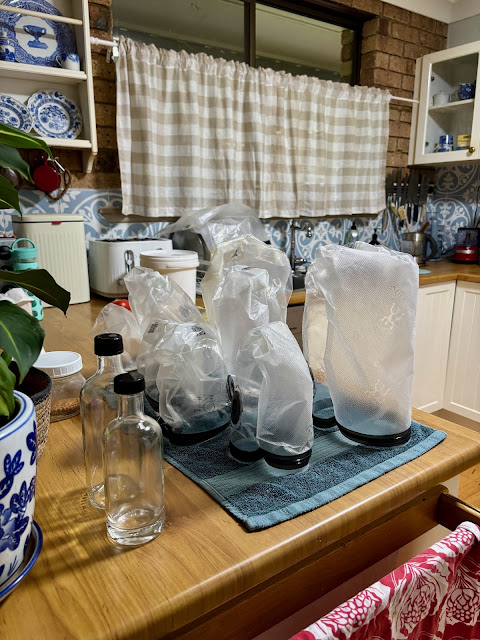
Every morning when I walk into my kitchen it looks tidy and ready for a day's work. Not so on this morning (above), I saw this when I walked in. Late the previous afternoon when I was looking for something, I came across my rolled up Zwilling vacuum bags and decided they had to be washed and dried. So I did that and although I usually put them outside on the verandah to dry it was dark by then. I turned the just-washed bags inside out and left them like this on a towel. It worked well and now the bags are ready to use when I bring home root vegetables, cabbages or whatever I buy that I want to last four or five weeks.
Image

You’ll save money by going back to basics

When I was doing the workshops and solo sessions, I had a couple of people whose main focus was on creating the fastest way to set up a simple life. You can't create a simple life fast, it's the opposite of that It's not one single thing either - it's a number of smaller, simpler activities that combine to create a life that reflects your values; and that takes a long to come together. When I first started living simply I took an entire year to work out our food - buying it, storing it, cooking it, preserving, baking, freezing, and growing it in the backyard. This is change that will transform how you live and it can't be rushed.  
Image


Trending Articles

NOT the last post

This will be my last post here.  I've been writing my blog for 18 years and now is the time to step back. I’ve stopped writing the blog and come back a couple of times because so many people wanted it, but that won’t happen again, I won’t be back.  I’ll continue on instagram to remain connected but I don’t know how frequent that will be. I know some of you will be interested to know the blog's statistics. 
Image

Every morning at home

Every morning when I walk into my kitchen it looks tidy and ready for a day's work. Not so on this morning (above), I saw this when I walked in. Late the previous afternoon when I was looking for something, I came across my rolled up Zwilling vacuum bags and decided they had to be washed and dried. So I did that and although I usually put them outside on the verandah to dry it was dark by then. I turned the just-washed bags inside out and left them like this on a towel. It worked well and now the bags are ready to use when I bring home root vegetables, cabbages or whatever I buy that I want to last four or five weeks.
Image

You’ll save money by going back to basics

When I was doing the workshops and solo sessions, I had a couple of people whose main focus was on creating the fastest way to set up a simple life. You can't create a simple life fast, it's the opposite of that It's not one single thing either - it's a number of smaller, simpler activities that combine to create a life that reflects your values; and that takes a long to come together. When I first started living simply I took an entire year to work out our food - buying it, storing it, cooking it, preserving, baking, freezing, and growing it in the backyard. This is change that will transform how you live and it can't be rushed.  
Image

Creating a home you'll love forever

Living simply is the answer to just about everything. It reduces the cost of living; it keeps you focused on being careful with resources such as water and electricity; it reminds you to not waste food; it encourages you to store food so you don't waste it and doing all those things brings routine and rhythm to your daily life. Consciously connecting every day with the activities and tasks that create simple life reminds you to look for the meaning and beauty that normal daily life holds.  It's all there in your home if you look for it. Seemingly mundane tasks like cleaning and cooking help you with that connection for without those tasks, the home you want to live in won't exist in the way you want it to.  Creating a home you love will make you happy and satisfied.
Image

Time changes everything

I've been spending time in the backyard lately creating a contained herb and vegetable garden. My aim is to develop a comfortable place to spend time, relax, increase biodiversity and encourage more animals, birds and insects to live here or visit. Of course I'd prefer my old garden which was put together by Hanno with ease and German precision. Together, we created a space bursting at the seams with herbs, vegetables and fruity goodness ready to eat and share throughout the year. But time changes everything. What I'm planning on doing now, is a brilliant opportunity for an almost 80 year old with balance issues. In my new garden I'll be able to do a wide range of challenging or easy work, depending on how I feel each day. It’s a daily opportunity to push myself or sit back, watch what's happening around me and be captivated by memories or the scope of what's yet to come.
Image

It's the old ways I love the most

I'm a practical woman who lives in a 1980’s brick slab house. There are verandahs front and back so I have places to sit outside when it's hot or cold. Those verandahs tend to make the house darker than it would be but they're been a great investment over time because they made the house more liveable. My home is not a romantic cottage, nor a minimalist modern home, it's a 1980’s brick slab house. And yet when people visit me here they tell me how warm and cosy my home is and that they feel comforted by being here. I've thought about that over the years and I'm convinced now that the style of a home isn't what appeals to people. What they love is the feeling within that home and whether it's nurturing the people who live there.
Image

Making ginger beer from scratch

We had a nice supply of ginger beer going over Christmas. It's a delicious soft drink for young and old, although there is an alcoholic version that can be made with a slight variation on the recipe. Ginger beer is a naturally fermented drink that is easy to make - with ginger beer you make a starter called a ginger beer plant and after it has fermented, you add that to sweet water and lemon juice. Like sourdough, it must ferment to give it that sharp fizz. To make a ginger beer plant you'll need ginger - either the powdered dry variety or fresh ginger, sugar, rainwater or tap water that has stood for 24 hours to allow the chlorine to evaporate off. You'll also need clean plastic bottles that have been scrubbed with soap, hot water and a bottle brush and then rinsed with hot water. I never sterilise my bottles and I haven't had any problems. If you intend to keep the ginger beer for a long time, I'd suggest you sterilise your bottles. MAKING THE STARTER In a...
Image

An authentic look at daily life here — unstaged and real

Most days Hanno was outside happily working in the fresh air. It may surprise you to know that I started reading my book,  Down to Earth , yesterday - the first time since I wrote it 13 years ago.  I had lent it to my neighbor, and when she returned it, I started reading, expecting to find surprises. Instead, I realised the words were still familiar—as if they were etched into my memory. As I flipped through the pages, I was reminded of how important it was for me to share that knowledge with others. The principles in Down to Earth changed my life, and I truly believed they could do the same for others. After just 30 minutes of reading, I put the book down, reassured that its message still holds true: we can slow down and reshape our lives, one step at a time.
Image