down to earth

  • Home
  • About Us
  • Down To Earth Book
  • Privacy Policy

In our fast-paced, consumer-driven world, we are constantly bombarded with the idea that convenience is key. The allure of shiny, ready-made products - quickly purchased with a swipe or click - seduces us. And yet, there is a deeper, more fulfilling way to live: making things at home rather than buying them. It’s an act of defiance against waste, excess, and the relentless push of consumerism. But more than that, it's a reclaiming of control, a celebration of simplicity, and a mindful exercise in frugality and time management.

At first glance, making things at home seems daunting. "Who has the time?" some might ask. "It's so much easier to buy." These thoughts are born from a culture that equates ease with value. But what if we flipped that equation? What if, instead of measuring value by the time saved, we measure it by the skill earned, the money conserved, and the creativity sparked?


Frugality is often misunderstood as deprivation, but in truth, it’s the art of stretching resources without sacrificing quality of life. It’s not about skimping, but about finding alternatives that enrich your day-to-day existence without spending. Making things at home allows for this kind of smart economy.


The weekly grocery bill can easily spiral out of control if we rely on pre-packaged, pre-made meals. But when we return to the basics, learning to cook from scratch, we find the key to living well within a budget. A loaf of bread, fresh from your own oven, costs a fraction of what you’d pay for a plastic-wrapped loaf, and its aroma fills your kitchen with warmth that no store-bought loaf could deliver. A simple stew, simmered slowly with seasonal vegetables and leftover cuts of meat, stretches ingredients far beyond the limits of fast food.

The same can be said for cleaning products. Store shelves overflow with specialised sprays, powders, and wipes, each promising miraculous results for a price. Yet, with a few household staples like vinegar, baking soda, and essential oils, you can create a multipurpose cleaner that costs pennies, is free of harsh chemicals, and is just as effective.


This is the hemp I used to use for my dish cloths. It was great to knit with but it didn't suit dishcloths - the knives easily cut it.  My go-to yarn is organic cotton. That is easy to knit, it dries quickly and it's soft to the touch.


The satisfaction I feel when I make something for my home far outstrips the feeling I used to get when I bought everything I needed. What I make suits my home better than most commercial products and as a bonus, I feel the warm embrace of self-reliance when I make them. I know it can be difficult to disconnect from the ease of buying pre-made everything but once you settle into to it, home production, moderation and self-reliance delivers long-term, constant contentment.


These are my organic cotton dishcloths.

Making things at home requires an upfront investment of time but it also encourages mindfulness and creativity. When we dedicate time to preparing a meal, mending a piece of clothing, or knitting a dishcloth, we are fully present in the moment. These acts become meditative, pulling us away from the frenzy of daily life and into a slower, more grounded rhythm.

One of the most significant benefits of making things at home is that the skills you develop compound over time. The first loaf of bread may feel like a laborious task, but by the tenth, you’ll have refined your technique and cut the time in half. You may begin by knitting simple scarves, but soon you’ll move on to sweaters, hats, and mittens. The satisfaction that comes from honing a craft and mastering a skill is unmatched by the fleeting joy of purchasing something ready-made.


There’s a profound shift that occurs when you start making things at home. When you’ve invested your time and effort into making something, it holds greater value. You care for it differently, knowing the energy that went into its creation.


In this way, making things at home is a practice in gratitude. It teaches you to honor the resources you have - time, money, and skill - and to use them wisely. It’s a path towards simplicity, sustainability, and self-reliance, where the things you surround yourself with are not just objects, but symbols of care, creativity, and intention.

In the end, making things at home is not just about frugality or time management. It’s about living with purpose, finding joy in the process and crafting a life that values quality over quantity, creativity over consumption, and mindfulness over convenience.

What do you regularly make to use in your home?


I eat my main meal at lunchtime. This is last week's lunch - corned beef with mashed potatoes, salad and homemade relish.

Although I seem to be moving further away from meat meals, I've had a craving for corned beef lately. It's a reminder of my youth because corned beef, mashed potatoes, cabbage and relish/pickles was a popular meal in Australia's suburbia in the 1950s/60/70s. My main problem with it is that the pieces of corned beef on sale at the supermarket are quite big and I don't want to waste what I buy. So when I see a small piece, I grab it, and at home, divide it in two and have a more reasonable size to cook and eat in the following days. I also use corned beef as a cold cut for sandwiches and when I make meatloaf, I divide that in two as well, eat one half for a couple of days and freeze the rest.


These meals are egg-based - above: asparagus quiche with filo pastry, below: tinned red salmon   with boiled eggs and salad.


Another thing I've been thinking about recently is how the increasing cost of living is impacting people all around the world, and how we can respond to it in a common sense way. First of all let me put my hand up and acknowledge that it's been fairly easy for me to keep my food costs to a reasonable level. I don't have to consider other family members who want their steak or leg of lamb meals and don't want to think about balancing the budget. This week at my local Woolworth's supermarket a leg of lamb large enough for a family roast (1.8kg - 2.8kg) is $42. Buying a leg that size will give you leftovers for meals the following day as well as cold cuts for sandwiches in the lunchboxes. Other popular meats include T-bone steak - $30 kg, Scotch fillet steak - $41.50 kg and eye fillet - $52.00 kg. If you buy eye fillet from the butcher, it costs around $70 kg. 😳 Cheap sausages are $5.90 for 550g, Angus beef sausages are $9.00 for six sausages. If you're going to serve your steaks with a salad, one iceberg lettuce is $3.00, 500 grams tomatoes is $5.00, a cucumber is $3.50, red onions are 68 cents each, so two = $1.36. I think you probably have the makings of salad dressing at home (olive oil/vinegar) but if you have to buy the processed dressing, it will cost you $3.00. You'll get 6 bread rolls for $2.85. To buy a steak/sausages and salad for four people for ONE meal will cost around $66!

There are a few delicious meat meals made using the cheaper cuts of beef - skirt steak, gravy beef, blade steak are just some of them. If you slow cook them as a casserole, stew or soup, they'll provide a wonderful meal that your family will enjoy. They're also suitable for freezing, so store your leftovers in the freezer for backup meals in the following days.


Meatballs, cabbage and boiled potatoes.


Beef casserole, using the cheaper cuts of gravy beef or skirt steak, with herb dumplings.


Leftovers - pasta with bolognese sauce.

I wouldn't pay that because I could make something delicious that would be much cheaper and nutritious for less. Everytime someone pays those prices it tells the supermarkets that we're willing to pay those inflated prices. And if you just buy the salad it's still $12.86. Instead of salad, you could do a potato bake - that would cost you $4.50 for 2 kg potatoes, one onions is 68 cents, a small jar of cream is $3.75, pack of pre-grated Parmesan cheese - $2 and your electricity to bake it would be around 50 cents. That option would cost $9.43.  Remember, theoretically, I'm cooking for a 4 person family.

Egg and bacon pie.


Making shortcrust pastry. It's easy but if you need a quicker option, buy a pack of filo pastry and use that instead.

OR you could make a quiche from scratch. That would cost $5.70 for 12 eggs (you'd have 6 leftover for breakfast), small jar of cream $3.75, garlic and onion about 85 cents, 500g bacon $6.75, and cheese $7.70. The homemade pastry would be $1.40 for 1kg of plain flour, $7.00 for 500 g butter (you'd have almost ¾ of the butter left over), the rest is just salt and water. There's a recipe for pie crust on Grandma Donna's blog here. This option would cost around $24.75 to make the quiche and you'd have eggs and butter leftover for another day and probably have quiche left over for lunches the following day. Add the salad at $12.86 and this meal would be $37.61. Both are reasonably healthy options but one meal is almost half the price of the other.


I buy frozen Australian peas and grow the greens and herbs I eat every week; they're really easy to grow, even in pots. My list includes parsley, chives, basil, cucumbers, radishes, rainbow chard, perpetual spinach, lettuce, chillies and green onions. I grow the lettuce in the shade of the bush house/verandah, the rest grow in the sun in the old sandbox. All of them are easy to grow from seed. I sprinkle seeds on the top of good potting mix in pots and grow in the shade. It requires water every second day and it will grow fast. I let the plants grow for about 4 weeks and while they're still small, I harvest a quarter of the pot with scissors and add them to my salads. The lettuce continues to grow after harvesting so I just give them a drink of Seasol to keep them healthy and they'll be ready to harvest again in 4 weeks. Setting yourself up to grow some of your own food will cost around $40, for seeds, potting mix and Seasol, but that should keep you going for a few months.

If I were to buy fresh parsley, chives, basil - all $3.20 a bunch, and rainbow chard - $4.70, spinach - $3.90, lettuce - $2.50. I woudln't buy all of them every week but most weeks herbs and green would cost me $10 if I didn't grow them myself.  I think this is an excellent chore for one of the kids to take on. They'd learn to produce food and give the family the FRESHEST herbs and vegies every week. But even if you do it yourself like I do, it's well worth it.

Here is a list of some of the many vegetables, legumes and nuts that contain protein.

What I'm getting at here is that there are always options and protein doesn't have to be meat, chicken or fish. You don't have to choose the thing you've always chosen. Be wise and think of what you can do with different ingredients and when this cost of living crisis is over, and it will end, you'll be proud of how you got your family through it by changing what you eat and adjusting what you spend.

Homemade potato and curried mince pies - no pastry.

Vegetable frittata - which is just a fancy way of saying eggs with whatever vegetables are in your fridge.

The main problem moving away from meal, chicken or fish meals is that they all deliver the protein we all need.  However, that doesn't mean there's no substitute for meat, fish or chicken. Egg, milk, cheese, yoghurt, legumes and pulses such as chick peas, split peas and lentils are all high in protein and they're all cheap, healthier than meat and better for the environment.  If you have some tried and true meat-less, or almost meatless, meals, please share them with us. And don't forget tinned fish such as tuna and salmon. Boths are cheaper than meat and very nutritious.

Mostly meat-free egg recipes

45 reasons to have eggs for dinner

Delicious RecipeTin Eats meals

Let's think about unit prices, generic brands and being flexible with our choice of brands. 

Unit prices are generally displayed under the product price on supermarket shelves. Checking the unit price gives us a more accurate understanding of the value for money of each item - even if something is "on special". So make your selections based on the unit prices, not the product price.

Generic brands can help you make ends meet in times like these. Supermarkets are retailers, not manufacturers so the generic brands are made by the same manufacturers that make the branded products you know well. There are no factories set up to make inferior generic brands - so manufacturers making flour, butter, tea, sugar etc. for the supermarkets just change the packaging and produce the generic brands you see on the shelves. And they're all cheaper than the well known brands. 

Being flexible - this is good advice all through life. Flexibility helps us cope with difficult times and situations. We can all switch to generic brands when we need to but we can also substitute ingredients so we don't have to buy something we might use in just one recipe. If a recipe you want to try suggests something you don't have in your pantry, look up one of the websites below to find a substitute for it.

Allrecipes

Food Network

Food52

Baking for the grandkids - cup cakes and sausage rolls.

And finally, use your common sense and go with your instinct. Often your instinct will guide you in cooking. Back yourself in everything you do. You might have to stop and change your mind when it doesn't work but every time you do something new, it will teach you something. Open up your memory bank and store everything you learn for another time when you need it.

If you want the recipe for anything above, please use the search bar on the right hand side.

Hello everyone! I've had a good break and although we've been going through a heatwave, that will end today and the weather will be cooler for a few weeks. It's a lovely time of year now, the spring flowers are blooming, birds are visiting from far off places and from the look of the rose leaves, the leaf-eater bees are happily munching away. It’s the ideal time for sitting on the verandah with a lemon cordial and letting the world pass by. I am happy here, I feel as much a part of this place as all the trees deeply rooted in our dry soil. We all get our strength and nourishment from being here and I can't imagine being anywhere else.


Washington navel orange. This flowers now and I harvest oranges in June and July.


This is a Grumichama or Brazilian cherry, a gift from Morag Gamble. It had a few flowers last year but this is the first year I'll get a harvest. It can be eaten fresh or used in jams and pies.


This little orange tree is a Lane's Late. It's full of flowers but I expect many of them to drop off between now and when it fruits. Most orange trees lose flowers but still give a good harvest.

Out in the garden, I've been focusing on my citrus trees. I have two Eureka lemons, a Washington navel orange and a Lane's Late orange. In  this area, the lemons fruit most of the year, the Washington navel from early June to mid July and the Lane's Late oranges from July to late August. Right now, both  orange trees are full of flowers and the two lemons are flowering on new growth. Of course, spring time is the best time of the year for growing most plants. It’s the time when plants naturally put on new growth and produce flowers, vegetables and nuts. If you’re able to give them some help, with good soil, manure, compost, the right growing conditions and water, the warmer weather and sunshine will do the rest. So if you’re thinking about growing food, spring is the time to get started.

Here is a post I wrote that might help beginner gardeners start spring gardens

Another post of mine about growing your own food


I have two blueberries planted a few weeks ago. It's the new Burst variety, supposedly larger and tastier than the blueberries I grew in the past. They're growing in 50cm wide grow bags.


When grown in the right climate, citrus are really tough plants. Mine were able to survive nearly two years of neglect when Hanno was sick and I had no time for gardening. I have almost no memory of those first 18 months without Hanno. I know I made food for myself and got a basic grocery delivery of milk, eggs, butter, tea, salt, flour, fruit and vegetables but I don’t think I made my bed everyday. I looked after Gracie with her food and grooming but most of the time we were two sad sacks sitting on the front verandah - me staring into the bush and her watching the front gate expecting Hanno to walk in. Grief is such a powerful force. I underestimated its emotional intensity and the power is has to change us. It took me a long time to work out the best way to keeping living true to my values and not become someone I didn’t recognise.


The flowers are growing very well and have brought a huge number of various bees, mostly native bees, to the garden.


Here is the herb garden as it is now. In here I'm growing two chillies, parsley, perpetual spinach, rainbow chard, apple cucumbers, French radishes and green onions. I've left one green onion to produce seeds and when that flower blooms and develops seeds, I'll collect the seeds to grow in future years.


After a few years of no sewing, I’m delighted to be back at my machine. I’m just finishing a half apron of blue gingham linen and I have green gingham linen that I’ll use to make a full apron. I’ll also make a summer nightie but I don’t have the fabric for that yet. Of course, there’s always mending to do so I’ve adjusted a couple of skirts and fixed hems too.


One thing that always surprises me are the scraps, thread and general rubbish that is generated by sewing. It’s not a huge amount but the accumulation of all those tiny scraps and threads that spread out over the sewing table and floor. After I publish this post, I’ll be cleaning the entire room.


There have been so many new readers here and on IG. I’m not sure why these sudden streams of new readers happen, I guess it’s other writers sharing a post or something from my blog. I hope you find what you’re looking for, especially information to help you live a more sustainable life. And to all my long-term readers, thanks for staying with me over the years offering support and friendship along the way. I appreciate you being here.

I was going to write about food today, the cost of living crisis, ways of saving when buying food and the different forms of protein but this post is getting too long so it will have to wait. I hope to get that written and on your screens asap - it will be this week. Take care, everyone. ♥️ 


ADDITIONAL READING
‘old-school’ laundry detergents best bet for cleaner clothes, 2024 Choice test finds
Know your measurements and stick to the rules
How to remove all four of the most common summer stains

It’s Gracie’s birthday today, she’s eight years old. I gave her a bath this afternoon so she’s not really talking to me but she’ll get over it soon because I bought BBQ chicken for her birthday lunch. She’s a wonderful companion and I’m glad we found each other.


I'll brush her soon.

I’m taking a break away from the internet. I’ve been holding on by a thin strand for the past couple of weeks and now is a good time to go. My sister, Tricia, is coming for a visit next week and we’ve got a lot of catching up to do. I’ve planned family dinners, picnics, fish and chips on the beach and we’re both going to be researching our family tree. I’ve been doing it on and off since 1980, when Shane was born. It was then I realised I was part of a long chain of family members and not a solo individual. Ancestry.com makes the process very easy now - as opposed to the very slow searching of microfiche and waiting for letters of enquiry to be delivered and returned. This is important information that we both want to pass on to our grandchildren before it’s too late.


In this little flower pot I have mainly foxgloves (my favourite flower) as well as Queen Anne's Lace, snapdragons and violets. I have two big pots of foxgloves which survived two years of neglect, and in this pot I have large foxgloves, mini foxgloves and I noticed the seeds germinating as well. Rest assured, there'll not be a shortage of foxgloves.


I promised you some photos of the garden when it was finished. It’s not finished and it will be one of those gardens that never is. It will change due to the heat of summer, the requirements of shade, the botanical look and feel I want and budget constraints. As I don’t have unlimited money to buy what I want, I’ve invested in mostly long-term, hardy plants such as roses, foxgloves and salvias. I know all of them will grow well here, even during summer. I’ve also planted Buddleia (butterfly bush), Gaura, Lavender, Violets, Queen Anne’s Lace, Snapdragons, Alyssum. Most of the roses are old English heirloom roses and I have one two climbing roses and three Cecile Brunner climbing roses.


The budget constraints I mentioned above have led me to a good way to stop my spending. I am one of those gardeners who WILL buy what I love unless I make some rules for myself. So I’ve decided I can buy the plants I want but I’m not allowed to buy anymore pots. I have two plastic pots which I dislike so when the terracotta and ceramic pots are all full, that’s it …… until one becomes available if a plant dies. 😎 I think I have four terracotta pots in the bush house. But overall I’m happy with the garden. It’s not the garden I once had but it’s enough for me. This afternoon, Kerry is coming over to help me in the garden with a couple of things I can’t do and then it will be watering, weeding, cutting flowers, pruning and fertilising from then on. I’m glad I have a garden again. I always smile when I see it from the kitchen window.


I’m not sure when I’ll return but when I do I’ve have the names of the roses for you, along with photos taken in the next few weeks. Take care. xx


It just shows the resilience of insects and birds. The garden that Hanno used to tend, which supplied 80 percent of the vegetables we consumed, was busy with wildlife. Bees buzzed, birds came for water and nectar, kookaburras mined the compost heap for the grubs they knew were in there, and reptiles drank and sunned themselves - always out of Gracie's reach. Then nothing. There were no flowers or plants to visit, no water in the bird baths, no isolated containers collecting rainwater. I sat quietly in the garden yesterday afternoon and was so happy to see how much life there was. I didn't see any reptiles but the bees and birds were in and out, swooping and dive bombing and checking out the flowers that were there. They know there are more flowers coming and they will gracefully wait for their return. I will too!

This post will be disappointing for some of you because this is not the garden update. I still haven't finished. Everything is planted but the pots are not in the places they'll sit. Placement is the hardest thing to work out, especially as this is  a flower garden and all flowers need sun.  To make it more difficult, when I move the large pots - and these are holding 90 - 100kg of potting mix plus the weight of the pot, I don't want to move them again for a few years. I have to get it right. Spring will arrive in just over four weeks time so I have to place the pots where they'll sit all summer-long. Some plants, mainly the roses, can tolerate our summer sun, some can't so I'm trying to work out which plants can sit on the shaded side of larger plants. I'll get there, I just need more time to figure it out.


I got my hair cut!  I think it's four years since it was cut and it was 11 inches below my shoulders. It feels so good to have it shorter again. It's much easier to wash and keep tidy and I don't get caught up in my ponytail when I'm asleep.

Last week I had a mobility assessment for my Home Care Plan. They sent a physiotherapist to assess me here at home. He did a range of tests such as having me stand and sit down as many times as I could in 30 seconds without holding on to anything. I did eight which he said was excellent! I also had to get in and out of bed, and stand in one spot and turn around in a circle. The only two I could not do were balancing on one foot and walking with one foot in front of the other - which required me to stand on one foot for a brief time. He asked me how I spend my days and I told him I'm baking, cooking, gardening, cleaning, playing with Gracie etc. just the normal stuff we all do, and he said I was well ahead of what he would expect of me at my age (76). I think the two I couldn't do are linked to my non-malignant brain tumour. It's always caused me to feel unbalanced and I think that will always be the case. So he scored me 90 percent which I'm happy with.  Let's hear it for house and yard work!!

A new digital electricity meter was installed on Friday so there'll be no more people coming to read the meter. The bills keep rolling in - my Council rates notice came on Thursday so I'm making sure I keep my budget on point and always save money when I have the chance.

My sister will visit from the Blue Mountains in August and my friend Nicole Lutze will visit tomorrow for morning tea. I'm making a whole orange cake with orange cream cheese frosting. I've only got a few lemons and no oranges left on my trees so with the fruit I had in the kitchen, I just made orange and lemon cordial. It is SO delicious - MUCH better than shop-bought cordial. I also have 500ml of syrup to make lemon cordial during the week - that will be the end of the lemons. We had a lot of rain earlier in the year so the fruit was large and juicy. If you live in a warm climate, or have a warm spot in your garden, I hope you'll grow a lemon or orange tree. They're easy to look after and will give you the tastiest fruit you can imagine.

LEMON AND ORANGE CORDIAL

First, juice your fruit. If you get 2 litres of juice you'll need 2 litres of syrup.

You can use sugar syrup or weak sugar syrup, depending on your taste. I used weak syrup but if I was making lemon cordial, I'd use normal sugar syrup.

Normal sugar syrup is 1 kg sugar to 1 litre of water.
Weak sugar syrup is 500 grams sugar to 1 litre of water.

To make the syrup add the sugar to the water and boil it. When the sugar has dissolved, let it cool.  Measure the amount of syrup you have and add the same amount of juice. When mixed together, bottle it and store it in the fridge. Dilute according to your taste - it will be about ¼ cordial to ¾ water.

If you end up with extra syrup, put it in a sealable jar and store it in the fridge. It will keep well and you can make your next batch of cordial with it.

You can also use honey or maple syrup but it will add that flavour to the cordial. I've never make cordial with anything but granulated sugar.

Today I'm cleaning and rearranging the back verandah. It's a real mess. It's a wonderful place to sit on a winter's afternoon and Gracie loves being out there with me. So it's a good investment of my time to make the place look and feel good. I washed the bench seat cushion covers yesterday and when they're on again, I'll finish the outdoor setting chairs, three of which still have to have their arm rests attached. Lunch will be lamb curry and rice, leftovers from the baked leg of lamb I had yesterday.  I'll end my day doing my Woolworths grocery order and sending that in so they can deliver it in the morning.

I hope you have a wonderful week and enjoy the work you do for yourself and your family. xx

ADDITIONAL READING
  • Small changes to what you eat can have big benefits for the planet
  • Ten effective habits to adopt if you’re an eco-enthusiast
  • Climate crisis is making days longer, study finds
  • A hairy caterpillar: a ginger toupee, twitching cartoonishl
  • Darn it! How to mend holey socks at home

This was what my garden looked like last week, then last weekend Kerry and Jamie added the rest of the pots. I think you'll be surprised at how much is there now but you'll have to wait until next week to see it.


These are just some of the supplies I had stored in the bush house. All of them have been used now and new potting mix bought this morning.

There are two of the roses I'm growing - the pink one is called Pinky and I've forgotten the name of the other rose. I have it written down so when I present my gardening post next week, I'll have it for you along with the names of all the other roses. I have a mix of Old English roses, Floribunda bush roses and miniature roses as well as lavender, salvias, butterfly bush, gaura and pelargonium.

I thought I'd be writing about gardening in this post but I'm not ready to present the garden to you yet. It's taken me much longer than I thought it would because I've lost a lot of my strength. After I do a couple of things, I have to sit down. I'm using a walking stick when I'm walking on the grass now ☹️ and that's slowing down much of what I'm doing. I ran out of potting mix yesterday so this morning I went to the local farmers' co-op to pick up another six 30 kg bags. They were loaded into my car and after driving home, I've only managed to get two of them out. I'm using my trusty green plastic trolley that I used to declutter the house last year. I can lift a bag out of the boot and let it fall into the trolley (difficult), then wheel the trolley through the garage to the clothes line (easy), then wheel it over the grass to where all the pots are (difficult). And the icing on the cake is then I have to sit down for ten minutes to recover! grrrr. Apart from all of that, I'm enjoying the process and I only have the smaller pots to deal with now. I think it'll look lovely when it's finished.

She's watching her bedding dry.

Gracie and I are doing well. I've just brought her bedding and blankets in after washing them so she'll be wrapped up warmly tonight. The temperatures have dropped and although it's not as cold here as it is in southern Australia, it's dropping to 6 or 7 or 8 every night this week.  I'm warm in my bed because I have an electric blanket and two doonas!  LOL yes, two, otherwise my feet get cold.


I did my fruit and vegetable shopping at the local roadside stall this week. I love it there. They sell produce from local growers and backyards, much of it is organic or chemical-free and all of it is fresher than the fare at Woolworths.


I made a madeira cake, aka pound cake,  through the week. I used my little bread loaf tin and baked a really tasty cake.  Here is the recipe I used. If you haven't made one of these cakes before, it's a different texture to a normal cake or a sponge, it's heavier than both of them but it moist and full of flavour.  I used a light icing made with plain icing sugar and orange juice. It would be a good cake for lunchboxes.

I've heard terrible things about the weather across the US, I hope you've not been in the areas of extreme heat, storms or floods. I hope the time you've had at home has been comforting and productive. Have you baked a cake this week? Or maybe you've been sewing or preserving. Let me know what you're up to. 

❤️ 😊 ❤️

ADDITIONAL READING

A week in wildlife

‘Africa’s most resilient lion’ and his brother filmed making 1.5km swim across dangerous African river

Self sufficiency vlog

Rose syrup and garden vegies


Newer Posts Older Posts Home
View mobile version

MY BOOKS

MY BOOKS


My books were all published by Pengiun, and are available at Amazon US, Amazon UK and Amazon Au

Search here

Total Pageviews

Translate


I'm Rhonda Hetzel and I've been writing my Down to Earth blog since 2007. Although I write the occasional philosophical post, my main topics include home cooking, happiness and gardening as well as budgeting, baking, ageing, generosity, mending and handmade crafts. I hope you enjoy your time here.

MY FAVOURITE PLACES

  • Grandma Donna's Place
  • Grandma Donna's YouTube
  • Grandma Donna's Instagram
  • This Simple Day
  • Nicole's Instagram

Give More

Give More

Popular posts last year

Making ginger beer from scratch

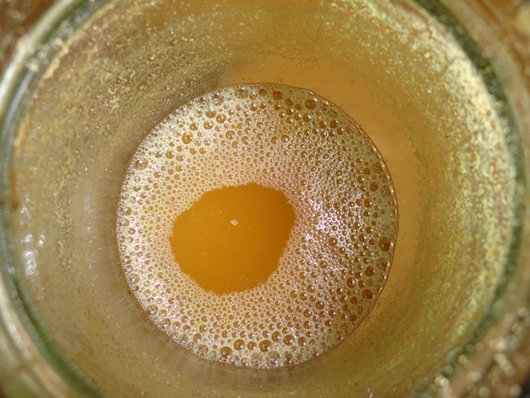
We had a nice supply of ginger beer going over Christmas. It's a delicious soft drink for young and old, although there is an alcoholic version that can be made with a slight variation on the recipe. Ginger beer is a naturally fermented drink that is easy to make - with ginger beer you make a starter called a ginger beer plant and after it has fermented, you add that to sweet water and lemon juice. Like sourdough, it must ferment to give it that sharp fizz. To make a ginger beer plant you'll need ginger - either the powdered dry variety or fresh ginger, sugar, rainwater or tap water that has stood for 24 hours to allow the chlorine to evaporate off. You'll also need clean plastic bottles that have been scrubbed with soap, hot water and a bottle brush and then rinsed with hot water. I never sterilise my bottles and I haven't had any problems. If you intend to keep the ginger beer for a long time, I'd suggest you sterilise your bottles. MAKING THE STARTER In a...
Image

NOT the last post

This will be my last post here.  I've been writing my blog for 18 years and now is the time to step back. I’ve stopped writing the blog and come back a couple of times because so many people wanted it, but that won’t happen again, I won’t be back.  I’ll continue on instagram to remain connected but I don’t know how frequent that will be. I know some of you will be interested to know the blog's statistics. 
Image

How to make cold process soap

I'm sure many of you are wondering: "Why make soap when I can buy it cheaply at the supermarket?" My cold process soap is made with vegetable oils and when it is made and cured, it contains no harsh chemicals or dyes. Often commercial soap is made with tallow (animal fat) and contains synthetic fragrance and dye and retains almost no glycerin. Glycerin is a natural emollient that helps with the lather and moisturises the skin. The makers of commercial soaps extract the glycerin and sell it as a separate product as it's more valuable than the soap. Then they add chemicals to make the soap lather. Crazy. Making your own soap allows you to add whatever you want to add. If you want a plain and pure soap, as I do, you can have that, or you can start with the plain soap and add colour, herbs and fragrance. The choice is yours. I want to add a little about animal and bird fat. I know Kirsty makes her soap with duck fat and I think that's great. I think t...
Image

Preserving food in a traditional way - pickling beetroot

I've had a number of emails from readers who want to start preserving food in jars but don't know where to start or what equipment to buy.  Leading on from yesterday's post, let's just say up front - don't buy any equipment. Once you know what you're doing and that you enjoy preserving, then you can decide whether or not to buy extra equipment. Food is preserved effectively without refrigeration by a variety of different methods. A few of the traditional methods are drying, fermentation, smoking, salting or by adding vinegar and sugar to the food - pickling. This last method is what we're talking about today. Vinegar and sugar are natural preservatives and adding one or both to food sets up an environment that bacteria and yeasts can't grow in. If you make the vinegar and sugar mix palatable, you can put up jars of vegetables or fruit that enhance the flavour of the food and can be stored in a cupboard or fridge for months. Other traditional w...
Image

Cleaning mould from walls and fabrics

With all this rain around we've developed a mould problem in our home. Usually we have the front and back doors open and that good ventilation stops most moulds from establishing. However, with the house locked up for the past week, the high humidity and the rain, mould is now growing on the wooden walls near our front door and on the lower parts of cupboards in the kitchen. Most of us will find mould growing in our homes at some point. Either in the bathroom or, in humid climates, on the walls, like we have now. You'll need a safe and effective remedy at some point, so I hope one of these methods works well for you. Mould is not only ugly to look at, it can cause health problems so if you see mould growing, do something about it straight away. The longer you leave the problem, the harder it will be to get rid of it effectively. If you have asthma or any allergies, you should do this type of cleaning with a face mask on so you don't breathe in any spores. Many peopl...
Image

Five minute bread

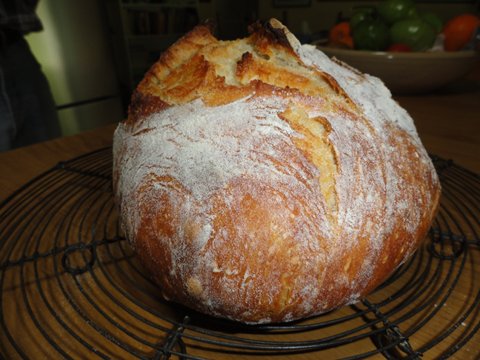
Bread is one of those foods that, when made with your own hands, gives a great deal of satisfaction and delight. It's only flour and water but it symbolises so much. I bake bread most days and use a variety of flours that I buy in bulk. Often I make a sandwich loaf because we use most of our bread for lunchtime sandwiches and for toast. Every so often I branch out to make a different type of loaf. I have tried sour dough in the past but I've not been happy with any of them. I'll continue to experiment with sour dough because I like the idea of using wild yeasts and saving the starter over a number of years to develop the flavour and become a part of the family. However, the loaf I've been branching out to most often is just a plain old five minute bread. By five minutes I mean it takes about five minutes actual work to prepare but it's the easiest of all bread to make and to get consistently good loaves from. If you're having people around for lunch or...
Image

This is my last post.

I have known for a while that this post was coming, but I didn't know when. This is my last post. I'm closing my blog, for good, and I'm not coming back like I have in the past.  I've been writing here for 16 years and my blog has been many things to me. It helped me change my life, it introduced me to so many good people, it became a wonderful record of my family life, it helped me get a book contract with Penguin, and monthly columns with The Australian Women's Weekly and Burke's Backyard . But in the past few months, it's become a burden. In April, I'll be 75 years old and I hope I've got another ten years ahead. However, each year I'll probably get weaker and although I'm fairly healthy, I do have a benign brain tumour and that could start growing. There are so many things I want to do and with time running out, leaving the blog behind gives me time to do the things that give me pleasure. On the day the blog started I felt a wonderful, h...
Image

What is the role of the homemaker in later years?

An email came from a US reader, Abby, who asked about being a homemaker in later years. This is part of what she wrote: "I am a stay-at-home mum to 4 children, ages 9-16. I do have a variety of "odd jobs" that I enjoy - I run a small "before-school" morning drop-off daycare from my home, I am a writing tutor, and I work a few hours a week at a local children's bookstore. But mostly, I cherish my blissful days at home - cooking, cleaning (with homemade cleaners), taking care of our children and chickens and goats, baking, meal-planning, etc. This "career" at home is not at all what I imagined during my ambitious years at university, but it is far more enriching. I notice, though, that my day is often planned around the needs of my family members. Of course, with 4 active kids and a husband, this is natural. I do the shopping, plan my meals, cook dinner - generally in anticipation of my family reconnecting in the evening.  I can't h...
Image

Every morning at home

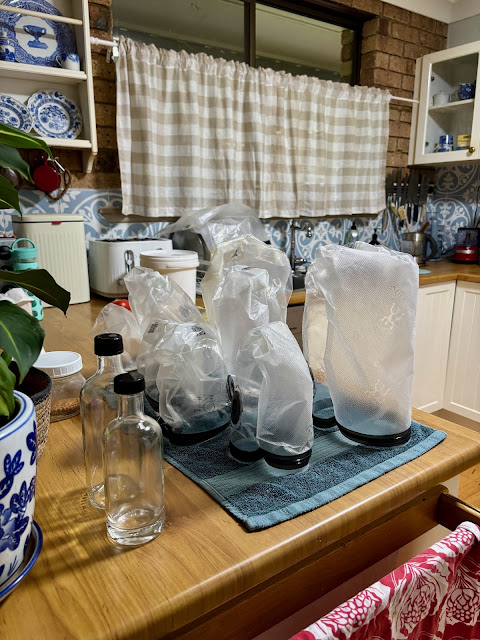
Every morning when I walk into my kitchen it looks tidy and ready for a day's work. Not so on this morning (above), I saw this when I walked in. Late the previous afternoon when I was looking for something, I came across my rolled up Zwilling vacuum bags and decided they had to be washed and dried. So I did that and although I usually put them outside on the verandah to dry it was dark by then. I turned the just-washed bags inside out and left them like this on a towel. It worked well and now the bags are ready to use when I bring home root vegetables, cabbages or whatever I buy that I want to last four or five weeks.
Image

You’ll save money by going back to basics

When I was doing the workshops and solo sessions, I had a couple of people whose main focus was on creating the fastest way to set up a simple life. You can't create a simple life fast, it's the opposite of that It's not one single thing either - it's a number of smaller, simpler activities that combine to create a life that reflects your values; and that takes a long to come together. When I first started living simply I took an entire year to work out our food - buying it, storing it, cooking it, preserving, baking, freezing, and growing it in the backyard. This is change that will transform how you live and it can't be rushed.  
Image

All previous blog posts

  • 2026 3
    • February 3
      • Workshops starting 1 March
      • Planting vegetable seeds and new workshops
      • Back where we belong
  • 2025 7
    • July 1
    • June 2
    • May 1
    • April 2
    • February 1
  • 2024 25
    • December 2
    • November 1
    • October 2
    • September 3
    • August 1
    • July 3
    • June 1
    • May 3
    • April 2
    • March 3
    • February 2
    • January 2
  • 2023 13
    • December 1
    • November 2
    • October 1
    • September 3
    • August 2
    • February 2
    • January 2
  • 2022 17
    • November 3
    • October 4
    • September 3
    • August 2
    • July 3
    • June 2
  • 2021 50
    • December 1
    • November 6
    • October 7
    • September 5
    • August 4
    • July 5
    • June 2
    • May 2
    • April 6
    • March 4
    • February 4
    • January 4
  • 2020 68
    • December 3
    • November 5
    • October 4
    • September 4
    • August 4
    • July 4
    • June 4
    • May 8
    • April 7
    • March 8
    • February 8
    • January 9
  • 2019 66
    • December 2
    • November 4
    • October 5
    • August 3
    • July 4
    • June 6
    • May 8
    • April 8
    • March 8
    • February 11
    • January 7
  • 2018 82
    • December 1
    • September 2
    • August 10
    • July 4
    • June 11
    • May 9
    • April 12
    • March 10
    • February 10
    • January 13
  • 2017 129
    • December 7
    • November 10
    • October 6
    • September 13
    • August 11
    • July 13
    • June 12
    • May 9
    • April 9
    • March 14
    • February 11
    • January 14
  • 2016 125
    • December 7
    • November 13
    • October 10
    • September 11
    • August 11
    • July 8
    • June 9
    • May 9
    • April 12
    • March 10
    • February 13
    • January 12
  • 2015 184
    • December 7
    • November 15
    • October 20
    • September 18
    • August 19
    • July 18
    • June 12
    • May 15
    • April 12
    • March 21
    • February 13
    • January 14
  • 2014 203
    • December 11
    • November 8
    • October 17
    • September 20
    • August 17
    • July 19
    • June 17
    • May 17
    • April 23
    • March 15
    • February 18
    • January 21
  • 2013 225
    • December 13
    • November 17
    • October 17
    • September 17
    • August 21
    • July 24
    • June 20
    • May 19
    • April 17
    • March 22
    • February 17
    • January 21
  • 2012 245
    • December 17
    • November 20
    • October 20
    • September 18
    • August 15
    • July 24
    • June 21
    • May 26
    • April 23
    • March 23
    • February 19
    • January 19
  • 2011 257
    • December 18
    • November 24
    • October 27
    • September 23
    • August 24
    • July 21
    • June 24
    • May 24
    • April 16
    • March 22
    • February 14
    • January 20
  • 2010 283
    • December 20
    • November 18
    • October 18
    • September 19
    • August 25
    • July 24
    • June 25
    • May 26
    • April 25
    • March 22
    • February 29
    • January 32
  • 2009 293
    • December 29
    • November 18
    • October 23
    • September 25
    • August 22
    • July 28
    • June 22
    • May 21
    • April 27
    • March 26
    • February 24
    • January 28
  • 2008 387
    • December 24
    • November 23
    • October 25
    • September 26
    • August 27
    • July 27
    • June 37
    • May 34
    • April 44
    • March 53
    • February 32
    • January 35
  • 2007 372
    • December 37
    • November 40
    • October 55
    • September 51
    • August 49
    • July 63
    • June 49
    • May 28


Trending Articles

NOT the last post

This will be my last post here.  I've been writing my blog for 18 years and now is the time to step back. I’ve stopped writing the blog and come back a couple of times because so many people wanted it, but that won’t happen again, I won’t be back.  I’ll continue on instagram to remain connected but I don’t know how frequent that will be. I know some of you will be interested to know the blog's statistics. 
Image

Every morning at home

Every morning when I walk into my kitchen it looks tidy and ready for a day's work. Not so on this morning (above), I saw this when I walked in. Late the previous afternoon when I was looking for something, I came across my rolled up Zwilling vacuum bags and decided they had to be washed and dried. So I did that and although I usually put them outside on the verandah to dry it was dark by then. I turned the just-washed bags inside out and left them like this on a towel. It worked well and now the bags are ready to use when I bring home root vegetables, cabbages or whatever I buy that I want to last four or five weeks.
Image

You’ll save money by going back to basics

When I was doing the workshops and solo sessions, I had a couple of people whose main focus was on creating the fastest way to set up a simple life. You can't create a simple life fast, it's the opposite of that It's not one single thing either - it's a number of smaller, simpler activities that combine to create a life that reflects your values; and that takes a long to come together. When I first started living simply I took an entire year to work out our food - buying it, storing it, cooking it, preserving, baking, freezing, and growing it in the backyard. This is change that will transform how you live and it can't be rushed.  
Image

Creating a home you'll love forever

Living simply is the answer to just about everything. It reduces the cost of living; it keeps you focused on being careful with resources such as water and electricity; it reminds you to not waste food; it encourages you to store food so you don't waste it and doing all those things brings routine and rhythm to your daily life. Consciously connecting every day with the activities and tasks that create simple life reminds you to look for the meaning and beauty that normal daily life holds.  It's all there in your home if you look for it. Seemingly mundane tasks like cleaning and cooking help you with that connection for without those tasks, the home you want to live in won't exist in the way you want it to.  Creating a home you love will make you happy and satisfied.
Image

Time changes everything

I've been spending time in the backyard lately creating a contained herb and vegetable garden. My aim is to develop a comfortable place to spend time, relax, increase biodiversity and encourage more animals, birds and insects to live here or visit. Of course I'd prefer my old garden which was put together by Hanno with ease and German precision. Together, we created a space bursting at the seams with herbs, vegetables and fruity goodness ready to eat and share throughout the year. But time changes everything. What I'm planning on doing now, is a brilliant opportunity for an almost 80 year old with balance issues. In my new garden I'll be able to do a wide range of challenging or easy work, depending on how I feel each day. It’s a daily opportunity to push myself or sit back, watch what's happening around me and be captivated by memories or the scope of what's yet to come.
Image

It's the old ways I love the most

I'm a practical woman who lives in a 1980’s brick slab house. There are verandahs front and back so I have places to sit outside when it's hot or cold. Those verandahs tend to make the house darker than it would be but they're been a great investment over time because they made the house more liveable. My home is not a romantic cottage, nor a minimalist modern home, it's a 1980’s brick slab house. And yet when people visit me here they tell me how warm and cosy my home is and that they feel comforted by being here. I've thought about that over the years and I'm convinced now that the style of a home isn't what appeals to people. What they love is the feeling within that home and whether it's nurturing the people who live there.
Image

Back where we belong

Surprise! I'm back ... for good this time. Instagram became an impossible place for me. They kept sending me messages asking if I'd make my page available for advertisers! Of course, I said no but that didn't stop them. It's such a change from what Instagram started as. But enough of that, the important part of this post is to explain why I returned here instead of taking my writing offline for good. For a few years Grandma Donna and I have talked online face-to-face and it's been such a pleasure for me to get to know her. We have a lot in common. We both feel a responsibility to share what we know with others. With the cost of living crisis, learning how to cook from scratch, appreciate the work we do in our homes, shop to a budget and pay off debt will help people grow stronger. The best place to do that is our blogs because we have no advertising police harassing us, the space is unlimited, we can put up tons of photos when we want to and, well, it just feels li...
Image

Making ginger beer from scratch

We had a nice supply of ginger beer going over Christmas. It's a delicious soft drink for young and old, although there is an alcoholic version that can be made with a slight variation on the recipe. Ginger beer is a naturally fermented drink that is easy to make - with ginger beer you make a starter called a ginger beer plant and after it has fermented, you add that to sweet water and lemon juice. Like sourdough, it must ferment to give it that sharp fizz. To make a ginger beer plant you'll need ginger - either the powdered dry variety or fresh ginger, sugar, rainwater or tap water that has stood for 24 hours to allow the chlorine to evaporate off. You'll also need clean plastic bottles that have been scrubbed with soap, hot water and a bottle brush and then rinsed with hot water. I never sterilise my bottles and I haven't had any problems. If you intend to keep the ginger beer for a long time, I'd suggest you sterilise your bottles. MAKING THE STARTER In a...
Image