down to earth

  • Home
  • About Us
  • Down To Earth Book
  • Privacy Policy
In the past week, I've had a couple of emails from international readers wanting to know about the native animals caught up in the unprecedented bush fires. We’ve had some rain over a large area but unfortunately, fires are still burning in some areas. We were all devastated to learn that three American men who came to Australia to help fight the fires, were killed when the plane they were fighting fires in crashed on Thursday. We send our sincere sympathy to their family and friends and thank them for the help they gave us. Rest in Peace.

This is a baby wombat rescued by Charles last year.  Sadly the mother was run over by a car.

I've got a good job. I rise when I want to, work and rest when I feel like it and every day I look after us and our home. Hanno does the same thing but generally, his work is outside; we also share a lot of tasks. Although I do the same thing every day, each day is different. I try to make as much as I can from scratch - that includes our meals, bread, biscuits, cakes and drinks as well as cleaning products such as soap, laundry liquid, cleaners for the kitchen, toilets, bathrooms, furniture, glass and floors. 

I start every day by making the bed. This is an extremely important symbolic gesture that reminds me to look after myself. Slow, simple tasks play a big part in my life.

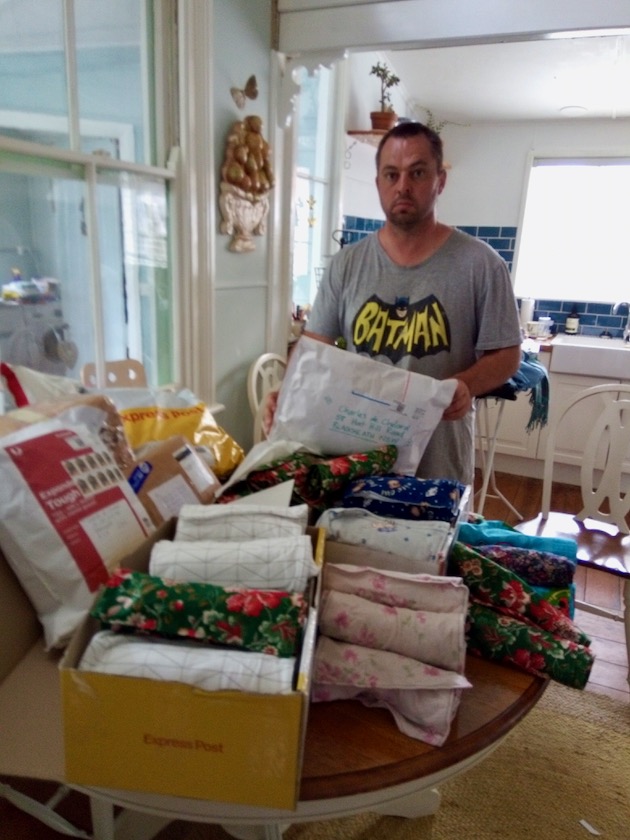
A few weeks ago, when Tricia told me that she was going to sew bat wraps and joey pouches for Charles to use in his wildlife rescue work, I suggested I call in our wonderful sewing bee girls to add a few more to the collection.  I didn't think that we'd end up receiving over 200 wraps and pouches but that's what arrived.  I know I can always count on you. Thank you, ladies, you've been so generous. ♥️

Charles with some of the parcels he received.

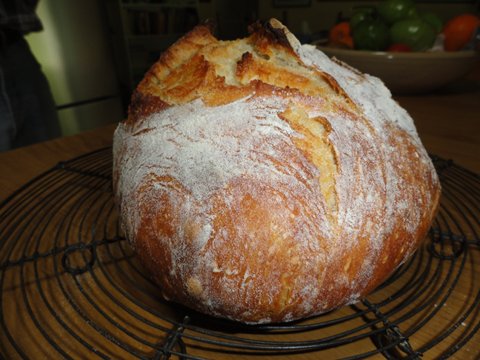
I've been working on a new loaf - a high fibre white. I usually make either white or rye loaves and I do that because Hanno loves rye bread and our main toast loaf is white. When I plan to make something regularly, I want to be able to easily buy the ingredients in bulk. I can get good white bread flour at the local supermarket and good rye flour at an organic supermarket that I have to drive to get to.


Recently I've been adding extra fibre to the loaves, using mainly milled rolled oats, but in this loaf, I also added rice bran. The oats add moistness and the rice bran gives a slightly nutty flavour. Both the fibre additions make for a slightly heavier loaf which is absolutely delicious as sandwiches on the day it is baked and makes really good toast.  Of course, if I have ends left over I either add them to a bag of frozen bread I turn into bread crumbs when I need them, or, when they're soaked in milk, they make up a high protein extra meal for the chooks. That will help you cut down on your feed bill as it provides a nutritious boost for your hens.
We don't go away on holidays anymore but always make sure that the time between Christmas and mid-January is like a holiday.  We both do what we want to do and make sure it's different to the regular things we do during the year. I forget about routines, my meal plans loosen up and I sleep when I'm tired. My main aim is to rest and recuperate, watch Test cricket, tend the garden, read and think and as I pack away another year, I prepare for the year ahead.

Peaches were prepared in front of the TV with the cricket on.


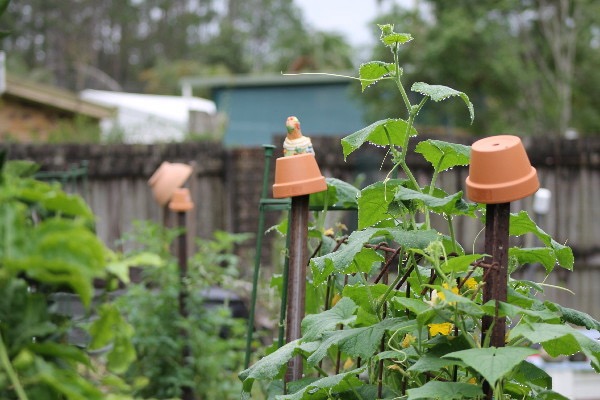
"Why are those pots upside-down on sticks?" - that's the question I'm asked more than any other. The second most asked question is this: "How can I start to live a simple life?"  Well, that's easy - stop shopping for things you don't need.  Of course, you could also take it one step at a time and start budgeting, menu planning, cooking from scratch, batch cooking, and making your own soap and household cleaners. You could mend your clothes, plant a vegetable garden and keep chickens. You need to keep up to date with your world, I do that via crikey.com, The Guardian and by maintaining a thoughtful connection with my online tribe; and you could lobby your local MP to find out their view of climate change and what they're doing about it. But if you want to start living more sustainably in a way that will help you save money, pay off debt, cut down on paid work or retire early, don't go shopping for "stuff". You don't have to prepare in any way, you don't have to research it, you don't need any special information or skill. You just stop. And you can do that right now. Today.
One of my nephews, Charles, is a volunteer wildlife rescuer and he spends a lot of his spare time in the Blue Mountains bush rescuing native animals. We all know our precious native wildlife has been decimated in the ongoing bush fires and injured and scared animals are now coming into local properties and homes looking for water and food. In the coming days, these are the animals Charles will be helping.  When the NSW RFS give the all-clear for people to return to the burnt bushland, Charles will set off looking for injured animals.  These animals will be carefully handled and taken to either a vet for diagnosis and treatment or a wildlife carer for longer term care. To do this work, Charles supplies his own equipment but there is a chance that he won't have enough wraps and pouches to transport the animals he finds.

I suggested to him that we - you, me and the rest of the gang here - could help him by quickly making a selection of what he needs.  I wonder if you'll join in with this.  The main need is for bat wraps and he needs 60 of them, he also needs some hanging joey pouches. Bat wraps and pouches are vital to help calm animals during transportation. Both these items are essential to Charles' work.

We're happy to accept whatever you can send - one, two, six or 20. They will help in a significant number of rescues. So who is up for this?  The patterns are simple straight sewing and the links are below for you to click on and look at.  Please be guided by the suggested fabrics - most are cotton, cotton flannelette, calico or wool. No buttons or Velcro are used. All the finished wraps and pouches need to be sent to Charles in the Blue Mountains, please contact me by email: rhondahetzel@gmail.com and I'll give you his postal address.

Bat Wraps
Hanging Joey Pouches

I wonder if there is a vet who reads my blog. I'd like to introduce you to Charles so he can speak to someone about rehydrating animals and general burns first aid. At the moment, he needs some burns cream, syringes and Vet Wraps.  If you can email me, I'll give you Charles' phone number so you can talk to him directly. Thank you.

I'll be making this part of our Instagram Sewing Bee so when you finish your sewing, please send me a photo of what you made, along with your IG name, so we can link to you from the Bee.

Thank you all. I know we'll get this started quickly so we can help Charles in his important work.
As the final hours of 2019 rolled along, I sat with increasing sadness watching our country burn. Each new day revealed red landscape and sky and then news reports started trickling in of farmers, homeowners and volunteer firefighters who died protecting properties, and millions of helpless animals dying trying to escape the ferocious, unpredictable fires.  These are our unique and beautiful Australian animals - the kangaroos, koalas, wombats, echidnas, possums and bats as well as snakes, lizards, birds and insects. If you have the chance to donate to the recovery programs, please do so. Our communities and wildlife need all the help they can get. Some may never recover, the ones that might need financial assistance to start again.


You can donate to Red Cross, Salvation Army, Victoria's Country Fire Authority, NSW's Rural Fire Service,  or have a look on Instagram where there are quite a few people who have set up Go Fund Me pages to help rebuild their lost homes and farms. Also on Go Fund Me are Will Connolly (egg boy) and the wonderful Magda Szubanski who are fundraising for long term mental health care to support men, women and children traumatised by the fires. These funds will be administered by registered charities such as Beyond Blue when the short term care ends.

I have two more links for you specifically for wildlife rescue and support, courtesy of my nephew, David.  WIRES Emergency Fund for Wildlife and Wildlife Victoria.

I sincerely thank you from the bottom of my heart if you can help us rebuild our burnt country. ♥️


Newer Posts Older Posts Home


My books were all published by Pengiun, and are available at Amazon US, Amazon UK and Amazon Au

Search here

Total Pageviews

Translate


I'm Rhonda Hetzel and I've been writing my Down to Earth blog since 2007. Although I write the occasional philosophical post, my main topics include home cooking, happiness and gardening as well as budgeting, baking, ageing, generosity, mending and handmade crafts. I hope you enjoy your time here.

MY FAVOURITE PLACES

  • Grandma Donna's Place
  • Grandma Donna's YouTube
  • Grandma Donna's Instagram
  • This Simple Day
  • Nicole's Instagram

Give More

Give More

Popular posts last year

Making ginger beer from scratch

We had a nice supply of ginger beer going over Christmas. It's a delicious soft drink for young and old, although there is an alcoholic version that can be made with a slight variation on the recipe. Ginger beer is a naturally fermented drink that is easy to make - with ginger beer you make a starter called a ginger beer plant and after it has fermented, you add that to sweet water and lemon juice. Like sourdough, it must ferment to give it that sharp fizz. To make a ginger beer plant you'll need ginger - either the powdered dry variety or fresh ginger, sugar, rainwater or tap water that has stood for 24 hours to allow the chlorine to evaporate off. You'll also need clean plastic bottles that have been scrubbed with soap, hot water and a bottle brush and then rinsed with hot water. I never sterilise my bottles and I haven't had any problems. If you intend to keep the ginger beer for a long time, I'd suggest you sterilise your bottles. MAKING THE STARTER In a...
Image

NOT the last post

This will be my last post here.  I've been writing my blog for 18 years and now is the time to step back. I’ve stopped writing the blog and come back a couple of times because so many people wanted it, but that won’t happen again, I won’t be back.  I’ll continue on instagram to remain connected but I don’t know how frequent that will be. I know some of you will be interested to know the blog's statistics. 
Image

How to make cold process soap

I'm sure many of you are wondering: "Why make soap when I can buy it cheaply at the supermarket?" My cold process soap is made with vegetable oils and when it is made and cured, it contains no harsh chemicals or dyes. Often commercial soap is made with tallow (animal fat) and contains synthetic fragrance and dye and retains almost no glycerin. Glycerin is a natural emollient that helps with the lather and moisturises the skin. The makers of commercial soaps extract the glycerin and sell it as a separate product as it's more valuable than the soap. Then they add chemicals to make the soap lather. Crazy. Making your own soap allows you to add whatever you want to add. If you want a plain and pure soap, as I do, you can have that, or you can start with the plain soap and add colour, herbs and fragrance. The choice is yours. I want to add a little about animal and bird fat. I know Kirsty makes her soap with duck fat and I think that's great. I think t...
Image

Preserving food in a traditional way - pickling beetroot

I've had a number of emails from readers who want to start preserving food in jars but don't know where to start or what equipment to buy.  Leading on from yesterday's post, let's just say up front - don't buy any equipment. Once you know what you're doing and that you enjoy preserving, then you can decide whether or not to buy extra equipment. Food is preserved effectively without refrigeration by a variety of different methods. A few of the traditional methods are drying, fermentation, smoking, salting or by adding vinegar and sugar to the food - pickling. This last method is what we're talking about today. Vinegar and sugar are natural preservatives and adding one or both to food sets up an environment that bacteria and yeasts can't grow in. If you make the vinegar and sugar mix palatable, you can put up jars of vegetables or fruit that enhance the flavour of the food and can be stored in a cupboard or fridge for months. Other traditional w...
Image

Cleaning mould from walls and fabrics

With all this rain around we've developed a mould problem in our home. Usually we have the front and back doors open and that good ventilation stops most moulds from establishing. However, with the house locked up for the past week, the high humidity and the rain, mould is now growing on the wooden walls near our front door and on the lower parts of cupboards in the kitchen. Most of us will find mould growing in our homes at some point. Either in the bathroom or, in humid climates, on the walls, like we have now. You'll need a safe and effective remedy at some point, so I hope one of these methods works well for you. Mould is not only ugly to look at, it can cause health problems so if you see mould growing, do something about it straight away. The longer you leave the problem, the harder it will be to get rid of it effectively. If you have asthma or any allergies, you should do this type of cleaning with a face mask on so you don't breathe in any spores. Many peopl...
Image

Five minute bread

Bread is one of those foods that, when made with your own hands, gives a great deal of satisfaction and delight. It's only flour and water but it symbolises so much. I bake bread most days and use a variety of flours that I buy in bulk. Often I make a sandwich loaf because we use most of our bread for lunchtime sandwiches and for toast. Every so often I branch out to make a different type of loaf. I have tried sour dough in the past but I've not been happy with any of them. I'll continue to experiment with sour dough because I like the idea of using wild yeasts and saving the starter over a number of years to develop the flavour and become a part of the family. However, the loaf I've been branching out to most often is just a plain old five minute bread. By five minutes I mean it takes about five minutes actual work to prepare but it's the easiest of all bread to make and to get consistently good loaves from. If you're having people around for lunch or...
Image

This is my last post.

I have known for a while that this post was coming, but I didn't know when. This is my last post. I'm closing my blog, for good, and I'm not coming back like I have in the past.  I've been writing here for 16 years and my blog has been many things to me. It helped me change my life, it introduced me to so many good people, it became a wonderful record of my family life, it helped me get a book contract with Penguin, and monthly columns with The Australian Women's Weekly and Burke's Backyard . But in the past few months, it's become a burden. In April, I'll be 75 years old and I hope I've got another ten years ahead. However, each year I'll probably get weaker and although I'm fairly healthy, I do have a benign brain tumour and that could start growing. There are so many things I want to do and with time running out, leaving the blog behind gives me time to do the things that give me pleasure. On the day the blog started I felt a wonderful, h...
Image

What is the role of the homemaker in later years?

An email came from a US reader, Abby, who asked about being a homemaker in later years. This is part of what she wrote: "I am a stay-at-home mum to 4 children, ages 9-16. I do have a variety of "odd jobs" that I enjoy - I run a small "before-school" morning drop-off daycare from my home, I am a writing tutor, and I work a few hours a week at a local children's bookstore. But mostly, I cherish my blissful days at home - cooking, cleaning (with homemade cleaners), taking care of our children and chickens and goats, baking, meal-planning, etc. This "career" at home is not at all what I imagined during my ambitious years at university, but it is far more enriching. I notice, though, that my day is often planned around the needs of my family members. Of course, with 4 active kids and a husband, this is natural. I do the shopping, plan my meals, cook dinner - generally in anticipation of my family reconnecting in the evening.  I can't h...
Image

Every morning at home

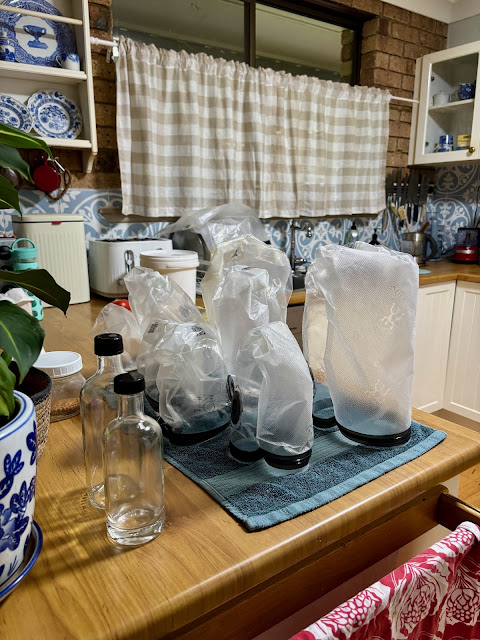
Every morning when I walk into my kitchen it looks tidy and ready for a day's work. Not so on this morning (above), I saw this when I walked in. Late the previous afternoon when I was looking for something, I came across my rolled up Zwilling vacuum bags and decided they had to be washed and dried. So I did that and although I usually put them outside on the verandah to dry it was dark by then. I turned the just-washed bags inside out and left them like this on a towel. It worked well and now the bags are ready to use when I bring home root vegetables, cabbages or whatever I buy that I want to last four or five weeks.
Image

You’ll save money by going back to basics

When I was doing the workshops and solo sessions, I had a couple of people whose main focus was on creating the fastest way to set up a simple life. You can't create a simple life fast, it's the opposite of that It's not one single thing either - it's a number of smaller, simpler activities that combine to create a life that reflects your values; and that takes a long to come together. When I first started living simply I took an entire year to work out our food - buying it, storing it, cooking it, preserving, baking, freezing, and growing it in the backyard. This is change that will transform how you live and it can't be rushed.  
Image


Trending Articles

NOT the last post

This will be my last post here.  I've been writing my blog for 18 years and now is the time to step back. I’ve stopped writing the blog and come back a couple of times because so many people wanted it, but that won’t happen again, I won’t be back.  I’ll continue on instagram to remain connected but I don’t know how frequent that will be. I know some of you will be interested to know the blog's statistics. 
Image

Every morning at home

Every morning when I walk into my kitchen it looks tidy and ready for a day's work. Not so on this morning (above), I saw this when I walked in. Late the previous afternoon when I was looking for something, I came across my rolled up Zwilling vacuum bags and decided they had to be washed and dried. So I did that and although I usually put them outside on the verandah to dry it was dark by then. I turned the just-washed bags inside out and left them like this on a towel. It worked well and now the bags are ready to use when I bring home root vegetables, cabbages or whatever I buy that I want to last four or five weeks.
Image

You’ll save money by going back to basics

When I was doing the workshops and solo sessions, I had a couple of people whose main focus was on creating the fastest way to set up a simple life. You can't create a simple life fast, it's the opposite of that It's not one single thing either - it's a number of smaller, simpler activities that combine to create a life that reflects your values; and that takes a long to come together. When I first started living simply I took an entire year to work out our food - buying it, storing it, cooking it, preserving, baking, freezing, and growing it in the backyard. This is change that will transform how you live and it can't be rushed.  
Image

Creating a home you'll love forever

Living simply is the answer to just about everything. It reduces the cost of living; it keeps you focused on being careful with resources such as water and electricity; it reminds you to not waste food; it encourages you to store food so you don't waste it and doing all those things brings routine and rhythm to your daily life. Consciously connecting every day with the activities and tasks that create simple life reminds you to look for the meaning and beauty that normal daily life holds.  It's all there in your home if you look for it. Seemingly mundane tasks like cleaning and cooking help you with that connection for without those tasks, the home you want to live in won't exist in the way you want it to.  Creating a home you love will make you happy and satisfied.
Image

Time changes everything

I've been spending time in the backyard lately creating a contained herb and vegetable garden. My aim is to develop a comfortable place to spend time, relax, increase biodiversity and encourage more animals, birds and insects to live here or visit. Of course I'd prefer my old garden which was put together by Hanno with ease and German precision. Together, we created a space bursting at the seams with herbs, vegetables and fruity goodness ready to eat and share throughout the year. But time changes everything. What I'm planning on doing now, is a brilliant opportunity for an almost 80 year old with balance issues. In my new garden I'll be able to do a wide range of challenging or easy work, depending on how I feel each day. It’s a daily opportunity to push myself or sit back, watch what's happening around me and be captivated by memories or the scope of what's yet to come.
Image

It's the old ways I love the most

I'm a practical woman who lives in a 1980’s brick slab house. There are verandahs front and back so I have places to sit outside when it's hot or cold. Those verandahs tend to make the house darker than it would be but they're been a great investment over time because they made the house more liveable. My home is not a romantic cottage, nor a minimalist modern home, it's a 1980’s brick slab house. And yet when people visit me here they tell me how warm and cosy my home is and that they feel comforted by being here. I've thought about that over the years and I'm convinced now that the style of a home isn't what appeals to people. What they love is the feeling within that home and whether it's nurturing the people who live there.
Image

Making ginger beer from scratch

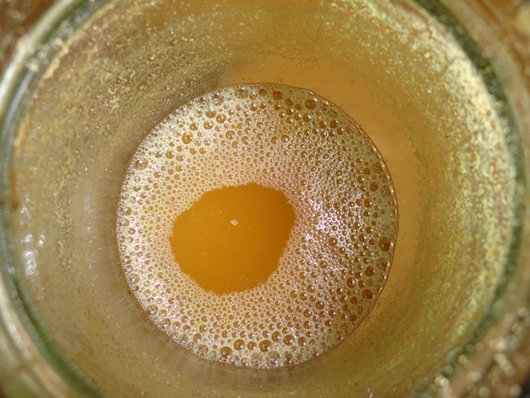
We had a nice supply of ginger beer going over Christmas. It's a delicious soft drink for young and old, although there is an alcoholic version that can be made with a slight variation on the recipe. Ginger beer is a naturally fermented drink that is easy to make - with ginger beer you make a starter called a ginger beer plant and after it has fermented, you add that to sweet water and lemon juice. Like sourdough, it must ferment to give it that sharp fizz. To make a ginger beer plant you'll need ginger - either the powdered dry variety or fresh ginger, sugar, rainwater or tap water that has stood for 24 hours to allow the chlorine to evaporate off. You'll also need clean plastic bottles that have been scrubbed with soap, hot water and a bottle brush and then rinsed with hot water. I never sterilise my bottles and I haven't had any problems. If you intend to keep the ginger beer for a long time, I'd suggest you sterilise your bottles. MAKING THE STARTER In a...
Image

An authentic look at daily life here — unstaged and real

Most days Hanno was outside happily working in the fresh air. It may surprise you to know that I started reading my book,  Down to Earth , yesterday - the first time since I wrote it 13 years ago.  I had lent it to my neighbor, and when she returned it, I started reading, expecting to find surprises. Instead, I realised the words were still familiar—as if they were etched into my memory. As I flipped through the pages, I was reminded of how important it was for me to share that knowledge with others. The principles in Down to Earth changed my life, and I truly believed they could do the same for others. After just 30 minutes of reading, I put the book down, reassured that its message still holds true: we can slow down and reshape our lives, one step at a time.
Image