down to earth

  • Home
  • About Us
  • Down To Earth Book
  • Privacy Policy
I wandered out to Hanno's big shed yesterday afternoon looking for Alice's old trampoline bed.  I rarely go out there, it's Hanno's territory and while there are very precious things in there - like my ancient school case full of old report cards and photos, there are also some things I don't want to know about - like jars of screws, too many hammers and a vintage fan I should sell.  No sooner had I walked in there when Hanno called out: "What are you looking for?"  LOL  I told him and he came in and showed me that the bed was high up near the roof on a ledge he'd built to hold a couple of old beds and mattresses.  Okay, so I wasn't going to get Alice's old bed but I was in the shed so decided to look around.  I knew I was there for a reason, just as I walked behind the hay stack, there were two little beauties just waiting for me - two old green bottles - one is 1½ litres/quarts, the other is 2 litres/quarts.  I swooped them up and took them inside.


I love recycling containers of all sorts but glass containers are my main prize.  And these, both large bottles with good seals, will help me provide cold water and lemon and fruit cup cordial over the coming summer months.  The cork on the wine bottle has been jammed in the top for who knows how many years and is now easy to take out and replace, while it still seals well. I also recycle stoneware mustard jars, as well as glass jam jars to use for my own homemade jam. There are some authorities who say you should never reuse lids when preserving/canning, I do it all the time and have never had a problem.  I make sure the lid is in good condition, the little rubber seal on the underside of the lid is not perished and there is no rust nor dents.  After boiling in the waterbath, if that little seal is indented, that is a good indication that I can store that jam in my cupboard for the next year.  Most lids last about six batches of jam, and for me, that's about six years of good use before I have to think about binning the jar. But if I find a replacement lid, that jar can go on indefinitely.  Uses for old jam jars.


And just a little tip, when you store biscuits in a jar, use the jars with the flip down metal catch - they're often French or Italian jars that can be bought fairly cheaply, or recycled if you buy the right product.  You can see that type of jar about, just to the left of the Thomas flask. I've found over the years if you use a screw cap, often the screw cap won't be secured properly and you won't know it until you go to get a biscuit for your morning tea and the lid isn't screwed on tightly.  The biscuits are stale.  Having the flip down catch, makes it perfectly clear that the lid is on or off, and you will save your biscuits every time.

I'm sure many of you are already recycling as much as you can but for those who are new to this, maximise your chances of success.  It's no use recycling anything if you don't use it.  Set up a cupboard to put all your recycled materials; clean everything properly, let them dry and add it all to your cupboard.  That cupboard will be your reminder to use a recycled container rather than buying something new.  When I got rid of my dishwasher, Hanno put in two shelves and that is where I hold most of my storage jars and bottles.


I know that recycling plastic is a great thing to do but I don't like recycling plastic that we'll use for food or drinks - even if it's food quality.  I have used recycled food quality plastic in the past, and still use a limited amount, but there is so much conflicting information regarding the leeching of toxins from plastics, I've decided to stay away from it until the scientists have a more definitive answer.  You can check what the symbols on plastics mean here.

This is from environment-green.com
  • By recycling1 plastic bottle not only saves anywhere from 100 to 1000 years in the landfill but also saves the environment from the emissions in producing new bottles as well as the oil used to produce that bottle.
  • For every1 ton of plastic that is recycled we save the equivalent of 2 people’s energy use for 1 year, the amount of water used by 1 person in 2 month’s time and almost 2000 pounds of oil.
 That is powerful stuff, but again, be very careful recycling plastic for food or drinks.

There are many different things you can recycle and by doing that you're helping with a huge international problem.  We've all heard about the floating rubbish in our oceans and we should all make a conscious decision to do what we can, and then follow up that decision with positive action.  I would love you to tell me how and what you recycle.  I am always looking for ways to improve what I'm doing and am interested in learning as much as I can.

ADDITIONAL READING
Environmental Benefits of Recycling Study - Australia, June 2010
I have been nominated as one of Australia's top 50 women bloggers by Kidspot.com. I'll let them explain their list, this is from their email:

Congratulations!

Kidspot editors have been poring over all the fantastic blogs created by Australian women and nominated yours as one of Kidspot's Top 50. This wasn't an easy job! We wanted to select what we thought were the very best blogs for our readers, based on the quality of content, ability to connect with readers, knowledge of subject area and dedication to regular posting. It's been really tough whittling down the quality blogs to just 50 and we know how many others are out there doing a great job.

Why did Kidspot compile the Top 50 Bloggers?

Kidspot wants our readers to discover the very best the online world has to offer. As avid consumers of digital media, we know how much great material is out there, but busy mums and mums-to-be may not have had the time to stumble around the worldwide web - so we did it for them, offering them an edited choice of the best 50 blogs written by Australian women! Kidspot believes the more time women spend reading great blogs online, the more chance they will dedicate more time to consuming their media needs on the internet. What's more, blogs are a powerful platform for women - not just mothers - to have a voice, and the louder that voice is, the more we can all rejoice.

If you get anything from my blog I hope you'll take the time to vote for me. You can cast your vote by clicking here or on the Kidspot button in the side bar. One vote per IP and you don't have to sign up for anything to vote. While you're there, check out some of the other blogs on the list. There should be some good ones.

Thanks everyone.
Let's continue on the theme of career Homemakers today because there is work to be done.  We need to form a strategy.  The common problem that seems to crop up with many is when friends and family criticise our choice to work at home.  I really don't get this. I think some of it stems from not understanding the work of a homemaker and part of it from a conformist mentality.  When everyone conforms to the group dynamic, it validates their choices.  When someone doesn't conform, it creates doubt and suspicion.  And although homemaking might sound like the most harmless of careers, it's a radical choice now and not everyone will be comfortable with this home revolution. We need to work together to help change these outdated attitudes so that not only do we work at home with the support of family and friends but we also open up the option of a homemaking career for younger people who, right now, might not even know it's an intelligent and important option.

As you age, confidence fills every atom of your being.  Well, it has for me. I've always been a confident person but now I'm older I just expect many people to have differing opinions and beliefs and when I'm made aware of how different I am to many of my contempories, I just shrug and get on with it - I expect it.  And that might be the key to this - expect that people won't understand and when they tell you that, it's not a shock and you can talk to them about your choice in a rational way.  Don't be hurt by what others say to you on this topic.  For some reason, some people who would never think of insulting or hurting you with a comment about how they don't like your new hair style, think it's perfectly okay to tell you they don't like the way you've chosen to spend your days.  They just don't think it will offend or upset you, and if they do, you don't want them as friends.  Walk away.


I think it would be helpful to think carefully about your reasons for wanting to be a homemaker  and then write it all down.  Include all the positive benefits like debt reduction, healthy food, family support, being greener and reducing stress in your life so that you're clear in your mind about your own particular reasons.  When this topic comes up, say that you know this way of living is the best for you and your family and explain your list in a positive and self confident way.  Be prepared to talk about your decision but don't go on about it too much.  If someone won't accept your choice, then just end the conversation with something like: "You might not understand why I need to do this but I'd appreciate your support."  During the course of your conversations with friends, tell them about something that you're enjoying at the moment, talk about your normal everyday activities - particularly those that might seem quaint or outdated.  Tell them about your bread and soap making and how everyone appreciates your skills.  Show them your knitting and sewing.  Demonstrate your life in gentle ways.  Be your own best advertisement.


Homemaking has been looked down upon for decades.  This is not going to change overnight.  But if we all develop a strategy to talk about our work in a way they highlights the significance of it, if we show, by example, that being a homemaker makes us content, if we reskill ourselves for a productive future, if we guide our families with grace and confidence and if we share our experiences in a thoughtful way then we'll gain some of the support we all hope for and validate our choice to be what we are.

I have just finished reading Radical Homemakers by Shannon Hayes, which was kindly lent to me by my friend and fellow radical homemaker, Sonya, from Permaculture Pathways. I enjoyed the book, and although I was radicalised many years ago and am already doing much of what the book is about, I did get a strong message from it - we need to stand up, be proud of our lives and talk to others about how we live and why we live this way. We need to develop small communities of like minded souls so that what we are doing becomes a common way of being. If we all do that, hopefully those small communities become bigger and young people will learn that having one partner stay at home to keep house, raise children, shop wisely and manage the income, is a valid, significant and acceptable way of living. And not to leave anyone out of this revolutionary equation, those single people, the divorced, widowed and never married out there who work a paid job and who live as simply as they can while they do it, they need to spread their message too. We all need to be role models and show that living a simpler life brings much more than a clean home, connected children, nutritious food and no debt; it brings contentment and enrichment with it, and it is a career.

I have had three careers - I was a nurse, a writer and now I'm a homemaker/housewife. Writing that sentence has highlighted to me just one of the hurdles we face - that of language. When I was a nurse and a writer, everyone knew what those terms meant; with homemaker or housewife they don't. Homemaker is more an American term than an Australian one, and housewife is old fashioned and implies that everyone is married. We need to coin a term that accurately describes this work we do and we need to realise that even though work at home is unpaid work, it has value and it contributes to our countries wealth. I really dislike those terms that make light of our work - domestic goddess, home engineer etc, we need something substantial that describes, in general terms, what we actually do. I do like the term homemaker because it could mean just about anything that is done at home, but I also like home worker.

We all need to help change the perception that happiness is gained by buying it, that economies should grow at the expense of their people and that stepping back from the mainstream idea of buying more than we need, with money we don't have, is a hippy fantasy. And on the more positive side, we need to show our younger people that living this way is empowering, engaging and revolutionary. At the moment young people see staying at home as a drudgery. They have to clean and cook, look after children, and sometimes frail parents, and when the only knowledge you have of those tasks is what is seen on TV or advertising, you start to understand what a negative perception there is in the community about working at home.

We have to show that working at home gives us freedoms that paid work rarely offers. Imagine your first day at a paid job. You're given a range of tasks to do, a time limit in which to do them and standards to meet. All the time someone is watching you, making sure you do everything according to their plan. Now imagine your first day in your new home. You have already talked about your values and needs with your partner, so you set about setting up routines and learning new skills that will support your visions. The sky is the limit. You may do your work to your own rhythm and to whatever standard you set yourself.

You start taking control of your home - this is not a place where you just spend time waiting for your partner to return home. This, my friends, is a work in progress, a place that you want to spend time in, you want to make beautiful, safe and comfortable. You want to create a home that will nurture those who live there and that provides a warm and welcoming feeling to those who visit. You decide on a plan that will see you use your home and the land it sits on to help you live. You decide to grow organic vegetables and fruit in the backyard, get a few chickens, make a worm farm, or keep bees. You want to live an environmentally sound life, to eat organic food, or at the very least, the freshest food you can. You decide to learn as much as possible to cut the cost of living in this healthier and organic way so you set about learning how to make soap, laundry powder, bread, jams, relishes, sauces, and pasta. You start mending torn clothes and household linens, then progress to making gifts and simple clothes for the children, you start knitting and crocheting with natural fibres. In short, you take your new life as the positive empowering career it is and run with it. You make the most of what you have and you reduce your impact on your environment while doing it.

Sure, I agree, no one wants to clean toilets or dirty nappies/diapers, but look at the alternative. Do you want to use a dirty toilet or have your baby unhappy and uncomfortable? Every job has parts that we don't like doing, life is not always about what we want to do. We need to step up to all our tasks - enjoyable and not so enjoyable, just do them and then get back to the rest of it.

I have already seen changes happening. More people are cooking and gardening now than in the past. There has been a revival in home crafts, sewing and knitting. More people are understanding that debt is a life sapping burden and working actively to paid of their debts. Many beneficial things are happening, but we need to drive this along and we need to talk about our lives in a positive way to show others that working in our homes helps build good lives. That might be evident to us but to the general population, it isn't. Let's start talking about the happiness that lies waiting when we live this way and let's show, by example, that housework rewards us with homes we want to spend time in. Stop talking about housework as if it's the last thing you'd want to spend your time on, discover the good in what you do and highlight it. Let's start supporting other women and men in the work they do, no matter what it is, unpaid or paid. We can change things if we start with our own front door and work our way out. Gentle reminders about our way of life, speaking up when we heard someone complaining about housework, writing about this on our blogs, all these things will help make a difference. All it takes is that a lot of us start doing it.

I am doing a soap making class at my neighbourhood centre next month and I'm continuing with my frugal home workshops but I'm also going to think about how I can engage with the young people at our Flexischool and talk with them about this. What will you do? Do you have any great ideas that we could all use to help show that housework is not only radical, empowering and enjoyable, it is also a career? If so, please share.


It's been over a month now with Sharon first admitted to acute intensive care, then long term intensive care, much of it spent intubated with a  machine breathing for her, but now she is recovering.  She is spending some time out of bed and has written me a couple of emails.  She was really touched by the outpouring of love and good wishes here and I'm sure that helped her recovery a tiny bit.

We have to make sure she is completely well before she can even think of returning here, but I knew you'd all want to know that she is getting better every day and her family is smiling again.
I have a couple of little things for you this morning.  First is a new (to me) blog that I think is very charming and interesting.  I'm on the look out for baby related sewing and I hit the jackpot here.  I really like her work.  So when you have a bit of time, visit Amanda @ Amanda Brooke and have a look around.  It's a delightful read.

I found this video and lyrics last week and have watched and read it every day since then.  I hope you enjoy it too.  I've included the lyrics below incase your computer is too slow for videos.  

How to be alone © Tanya Davis

If you are at first lonely, be patient.
If you’ve not been alone much, or if when you were, you weren’t okay with it, then just wait. You’ll find it’s fine to be alone once you’re embracing it.
We can start with the acceptable places, the bathroom, the coffee shop, the library, where you can stall and read the paper, where you can get your caffeine fix and sit and stay there. Where you can browse the stacks and smell the books; you’re not supposed to talk much anyway so it’s safe there.
There is also the gym, if you’re shy, you can hang out with yourself and mirrors, you can put headphones in.
Then there’s public transportation, because we all gotta go places.
And there’s prayer and mediation, no one will think less if your hanging with your breath seeking peace and salvation.

Start simple. Things you may have previously avoided based on your avoid being alone principles.
The lunch counter, where you will be surrounded by “chow downers”, employees who only have an hour and their spouses work across town, and they, like you, will be alone.
Resist the urge to hang out with your cell phone.
When you are comfortable with “eat lunch and run”, take yourself out for dinner; a restaurant with linen and Silverware. You’re no less an intriguing a person when you are eating solo desert and cleaning the whip cream from the dish with your finger. In fact, some people at full tables will wish they were where you were.

Go to the movies. Where it’s dark and soothing, alone in your seat amidst a fleeting community.
And then take yourself out dancing, to a club where no one knows you, stand on the outside of the floor until the lights convince you more and more and the music shows you. Dance like no one’s watching because they’re probably not. And if they are, assume it is with best human intentions. The way bodies move genuinely to beats, is after-all, gorgeous and affecting. Dance until you’re sweating. And beads of perspiration remind you of life’s best things. Down your back, like a book of blessings.

Go to the woods alone, and the trees and squirrels will watch for you. Go to an unfamiliar city, roam the streets, they are always statues to talk to, and benches made for sitting gives strangers a shared existence if only for a minute, and these moments can be so uplifting and the conversation you get in by sitting alone on benches, might of never happened had you not been there by yourself.
Society is afraid of alone though. Like lonely hearts are wasting away in basements. Like people must have problems if after awhile nobody is dating them.
But lonely is a freedom that breathes easy and weightless, and lonely is healing if you make it.
You can stand swathed by groups and mobs or hands with your partner, look both further and farther in the endless quest for company.
But no one is in your head. And by the time you translate your thoughts an essence of them maybe lost or perhaps it is just kept. Perhaps in the interest of loving oneself, perhaps all those “sappy slogans” from pre-school over to high school groaning, we’re tokens for holding the lonely at bay.
Cause if you’re happy in your head, then solitude is blessed, and alone is okay.

It’s okay if no one believes like you, all experiences unique, no one has the same synapses, can’t think like you, for this be relived, keeps things interesting, life’s magic brings much, and it doesn’t mean you aren’t connected, and the community is not present, just take the perspective you get from being one person in one head and feel the effects of it.
Take silence and respect it.

If you have an art that needs a practice, stop neglecting it, if your family doesn’t get you or a religious sect is not meant for you, don’t obsess about it.
You could be in an instant surrounded if you need it.
If your heart is bleeding, make the best of it.
There is heat in freezing, be a testament.

                       ~~~

I hope you have a wonderful weekend doing something you love that will refresh you for the week to come.  Thank you for your visits this week, I'll see you again next week.  Take care of yourself.
I rarely give up on anything.  I like to think that when a difficult household task presents itself,  I step up and work out ways around the problem.  Eventually I get things done.  Nothing should be too difficult.  Enter the sour dough loaf.  Grrrrrrr.  Over the years I have tried to make good sourdough.  I've made sourdough, but none of it is what I would call good.  If I get the taste right, the texture is not good.  If the texture is great, the loaf looks like a science project.  When I bought the artisan bread in five minutes book and used that recipe and method, I didn't like the taste at all.

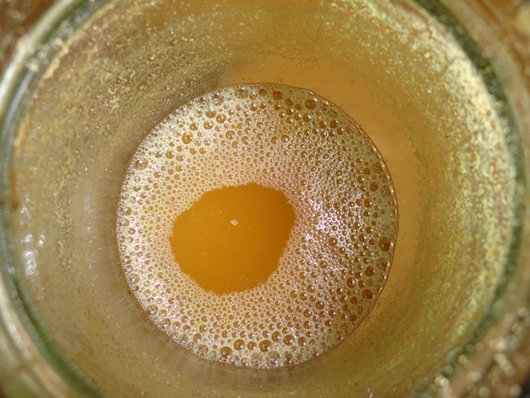
I am fortunate to be part of my blog neighbourhood.  Recently one of my blog neighbours sent me a sourdough starter.  His name is Henry.  Henry has been producing good bread and developing in flavour for a number of years.  I renamed Henry, Martha, daughter of Henry, and have been carefully tending her since she arrived. 

Henry arrived safe and sound after a long trip from Victoria.

I read the note that came with him and followed the instructions.  This is Martha, daughter of Henry, after her first feed and in her new container.

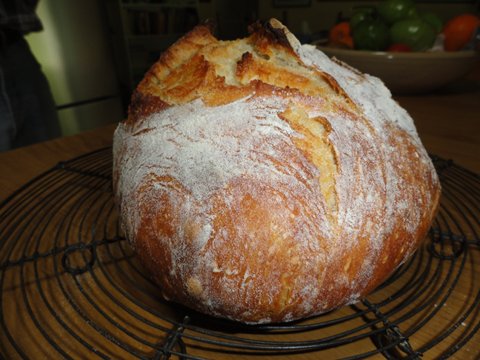
Yesterday I made my first loaf using some of Martha - I was aiming for a sandwich loaf similar to the one produced in a bakery near here. I'll let the pictures tell the story.


As soon as I saw the texture of the bread, I knew I hadn't left it rise long enough.  I'll fix that today.  I also cut it the wrong way, again, I'll fix that.  And to be honest, we did eat the bread; the taste was good but the texture was a bit rubbery and dense.  So I'm guessing the starter is giving me the taste we want, I just have to work on my times, and I need to start the loaf earlier than my regular bread.  I also need to read more about hydration rates and I must be more accurate with weights. It's definitely given me a lot to think about, and that's not a bad thing.

I would like to make a loaf like this.  We are having Hanno's 70th birthday next month and I'd like to have a few of these loaves sitting on the table for everyone to enjoy.  I think I'll go back to making the sourdough in my cast iron pot, instead of the regular bread tin for now.  I WILL master this.  Stay tuned, but don't hold your breath.

Thank you so much for your good wishes for Kerry, Sunny and the baby.  We, and they, appreciate everyone of them. 

It's been a while since I wrote about money and how to hold on to it. The new baby has refocused my mind on this topic because Kerry and Sunny will be saving for their home and Hanno and I will have a few extra expenses because we want to help provide for the baby.  We are on a limited budget, Hanno is on a pension while I still earn a small amount from my writing and the advertising on the blog and forum.  We have no debt, we have money in the bank but we have no superannuation/retirement plan/pension scheme to rely on.  We hope to live at least another 20 or 30 years so what we have right now is it for us, we need to be as frugal as we can be.


Self reliance has helped us get to the place we are right now.  We home produce a lot of our own needs and spend money only on raw materials and what we can't produce ourselves.  This has worked really well for us and it's very revealing how much money can be saved when you change your mindset to "thrifty" and you work for the benefit of your own well being and not to impress the neighbours or work mates.  The key to this isn't about how much money you earn but how much you save.  Imagine two people working the same job with the same amount of children and expenses.  If one worker spends their money buying everything they need, as well as what they want, they'll be existing from week to week, just focusing on the next payday.  If the other worker budgets, spends only on what is necessary, buys second hand when they can, recycles and reuses, knits, sews, mends, cooks and bakes, that worker will have money saved at the end of the pay period. So every week that goes by, the first worker comes out even or behind, the second worker will have something saved most weeks.  And I have to add that the second worker will probably also have the satisfaction of self reliance and the knowledge that their thrifty mindset is working for the family and not against it.

I hope we can all be that second worker.  

If you're both working you will have more expenses but you also have the capacity to save more.  It makes sense to have one person managing the money - that person should be the one who does it best.  Whoever is managing the money should do up a budget, ask their partner to help check out grocery bargains, write up the shopping list and meal plans; but you can both shop together.   If you have children, take turns at the shopping - always with a shopping list - so that you both understand grocery prices and both have a chance to save with your prudent and careful shopping. It is better to shop without young children, you need to be focused. If you are the one who is managing everything, you should be prepared to give a summary of your combined finances every month.  This will not only keep you on track, it will help your partner understand where the money is going and how much is being saved, or paid off the mortgage.  


If your partner is out working and you  are home raising children then it is your partner's job to earn money and your job to save money.  You will manage the money, actively look for ways to save, think carefully about your grocery shopping and look for bargains.  Try to work out a system where your partner looks after the children while you shop.  Your weekly grocery money is important to you, it's a lot of money to spend each week and you need to do it carefully.  After the shopping is done, you'll need to work out a system where you manage your food so that it is eaten as fresh as possible and it is stored in such a way that none of it is wasted.  It is estimated that about thirty percent of food bought for family homes is wasted.  That's like taking your weekly grocery money and throwing thirty percent of it in the rubbish bin!  That won't happen with any of us, we will be careful and will manage our money and our food mindfully.

If you're working for a living, or your partner is, then you are selling your life hours for money.  I calculated a little while ago that each year has only 8736 hours in it, giving us, if we live to be 80 years of age, just under 700000 hours in an entire lifetime.  When you think that you only have 168 hours in a week, and you sleep about 50 of them, then you have to be sure that life hours you sell must give you the best value.  Wasting money or hours cheats you of your life.  Work on a budget that will help you use your money in the best way possible.  And don't be caught up with fashion or the unrealistic expectations of children, family members, neighbours or friends.  Plan your spending with your partner and both work towards the good of the family.


Teach your children well.  Expect them to contribute to the welfare of the family by doing chores, keeping their room tidy and looking after their clothes, books and toys.  You won't teach them anything with over indulgence.  The only thing children learn when you give them more than they need is to how to take.  Have faith in your kids.  They will get more out of helping and knowing they're an important part of a happy family than just about anything else.  And their reward for this participation?  More time with you, of course.  Small children want to have time with their parents - it shows them how much they're valued and builds their self esteem.

I won't go into the ins and outs of budgeting with you now, I have many posts on budgeting and living well on less here.   We are all different, we all have different needs but we all have to conserve our life hours for real living.  Examine your life, think about what you want, talk about that with your partner and together make a plan to work towards it.  I hope that plan is a generous mix of sold work hours and work you do at home producing as much as you can for yourselves.  That is what Hanno and I have done and it has given us a life like no other.  I wish the same for you.

Newer Posts Older Posts Home


My books were all published by Pengiun, and are available at Amazon US, Amazon UK and Amazon Au

Search here

Total Pageviews

Translate


I'm Rhonda Hetzel and I've been writing my Down to Earth blog since 2007. Although I write the occasional philosophical post, my main topics include home cooking, happiness and gardening as well as budgeting, baking, ageing, generosity, mending and handmade crafts. I hope you enjoy your time here.

MY FAVOURITE PLACES

  • Grandma Donna's Place
  • Grandma Donna's YouTube
  • Grandma Donna's Instagram
  • This Simple Day
  • Nicole's Instagram

Give More

Give More

Popular posts last year

Making ginger beer from scratch

We had a nice supply of ginger beer going over Christmas. It's a delicious soft drink for young and old, although there is an alcoholic version that can be made with a slight variation on the recipe. Ginger beer is a naturally fermented drink that is easy to make - with ginger beer you make a starter called a ginger beer plant and after it has fermented, you add that to sweet water and lemon juice. Like sourdough, it must ferment to give it that sharp fizz. To make a ginger beer plant you'll need ginger - either the powdered dry variety or fresh ginger, sugar, rainwater or tap water that has stood for 24 hours to allow the chlorine to evaporate off. You'll also need clean plastic bottles that have been scrubbed with soap, hot water and a bottle brush and then rinsed with hot water. I never sterilise my bottles and I haven't had any problems. If you intend to keep the ginger beer for a long time, I'd suggest you sterilise your bottles. MAKING THE STARTER In a...
Image

NOT the last post

This will be my last post here.  I've been writing my blog for 18 years and now is the time to step back. I’ve stopped writing the blog and come back a couple of times because so many people wanted it, but that won’t happen again, I won’t be back.  I’ll continue on instagram to remain connected but I don’t know how frequent that will be. I know some of you will be interested to know the blog's statistics. 
Image

How to make cold process soap

I'm sure many of you are wondering: "Why make soap when I can buy it cheaply at the supermarket?" My cold process soap is made with vegetable oils and when it is made and cured, it contains no harsh chemicals or dyes. Often commercial soap is made with tallow (animal fat) and contains synthetic fragrance and dye and retains almost no glycerin. Glycerin is a natural emollient that helps with the lather and moisturises the skin. The makers of commercial soaps extract the glycerin and sell it as a separate product as it's more valuable than the soap. Then they add chemicals to make the soap lather. Crazy. Making your own soap allows you to add whatever you want to add. If you want a plain and pure soap, as I do, you can have that, or you can start with the plain soap and add colour, herbs and fragrance. The choice is yours. I want to add a little about animal and bird fat. I know Kirsty makes her soap with duck fat and I think that's great. I think t...
Image

Preserving food in a traditional way - pickling beetroot

I've had a number of emails from readers who want to start preserving food in jars but don't know where to start or what equipment to buy.  Leading on from yesterday's post, let's just say up front - don't buy any equipment. Once you know what you're doing and that you enjoy preserving, then you can decide whether or not to buy extra equipment. Food is preserved effectively without refrigeration by a variety of different methods. A few of the traditional methods are drying, fermentation, smoking, salting or by adding vinegar and sugar to the food - pickling. This last method is what we're talking about today. Vinegar and sugar are natural preservatives and adding one or both to food sets up an environment that bacteria and yeasts can't grow in. If you make the vinegar and sugar mix palatable, you can put up jars of vegetables or fruit that enhance the flavour of the food and can be stored in a cupboard or fridge for months. Other traditional w...
Image

Cleaning mould from walls and fabrics

With all this rain around we've developed a mould problem in our home. Usually we have the front and back doors open and that good ventilation stops most moulds from establishing. However, with the house locked up for the past week, the high humidity and the rain, mould is now growing on the wooden walls near our front door and on the lower parts of cupboards in the kitchen. Most of us will find mould growing in our homes at some point. Either in the bathroom or, in humid climates, on the walls, like we have now. You'll need a safe and effective remedy at some point, so I hope one of these methods works well for you. Mould is not only ugly to look at, it can cause health problems so if you see mould growing, do something about it straight away. The longer you leave the problem, the harder it will be to get rid of it effectively. If you have asthma or any allergies, you should do this type of cleaning with a face mask on so you don't breathe in any spores. Many peopl...
Image

Five minute bread

Bread is one of those foods that, when made with your own hands, gives a great deal of satisfaction and delight. It's only flour and water but it symbolises so much. I bake bread most days and use a variety of flours that I buy in bulk. Often I make a sandwich loaf because we use most of our bread for lunchtime sandwiches and for toast. Every so often I branch out to make a different type of loaf. I have tried sour dough in the past but I've not been happy with any of them. I'll continue to experiment with sour dough because I like the idea of using wild yeasts and saving the starter over a number of years to develop the flavour and become a part of the family. However, the loaf I've been branching out to most often is just a plain old five minute bread. By five minutes I mean it takes about five minutes actual work to prepare but it's the easiest of all bread to make and to get consistently good loaves from. If you're having people around for lunch or...
Image

This is my last post.

I have known for a while that this post was coming, but I didn't know when. This is my last post. I'm closing my blog, for good, and I'm not coming back like I have in the past.  I've been writing here for 16 years and my blog has been many things to me. It helped me change my life, it introduced me to so many good people, it became a wonderful record of my family life, it helped me get a book contract with Penguin, and monthly columns with The Australian Women's Weekly and Burke's Backyard . But in the past few months, it's become a burden. In April, I'll be 75 years old and I hope I've got another ten years ahead. However, each year I'll probably get weaker and although I'm fairly healthy, I do have a benign brain tumour and that could start growing. There are so many things I want to do and with time running out, leaving the blog behind gives me time to do the things that give me pleasure. On the day the blog started I felt a wonderful, h...
Image

What is the role of the homemaker in later years?

An email came from a US reader, Abby, who asked about being a homemaker in later years. This is part of what she wrote: "I am a stay-at-home mum to 4 children, ages 9-16. I do have a variety of "odd jobs" that I enjoy - I run a small "before-school" morning drop-off daycare from my home, I am a writing tutor, and I work a few hours a week at a local children's bookstore. But mostly, I cherish my blissful days at home - cooking, cleaning (with homemade cleaners), taking care of our children and chickens and goats, baking, meal-planning, etc. This "career" at home is not at all what I imagined during my ambitious years at university, but it is far more enriching. I notice, though, that my day is often planned around the needs of my family members. Of course, with 4 active kids and a husband, this is natural. I do the shopping, plan my meals, cook dinner - generally in anticipation of my family reconnecting in the evening.  I can't h...
Image

Every morning at home

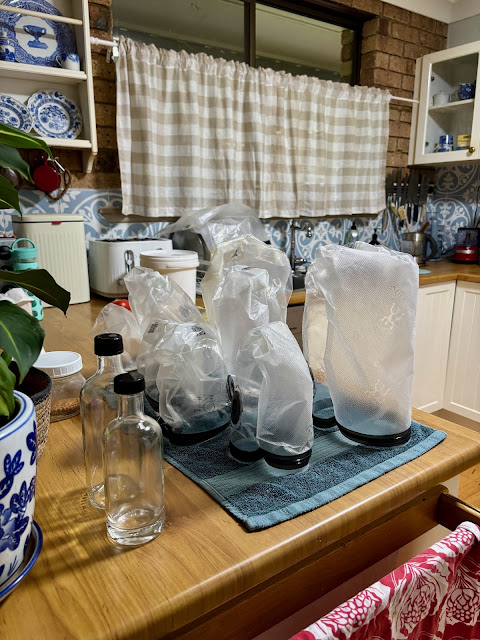
Every morning when I walk into my kitchen it looks tidy and ready for a day's work. Not so on this morning (above), I saw this when I walked in. Late the previous afternoon when I was looking for something, I came across my rolled up Zwilling vacuum bags and decided they had to be washed and dried. So I did that and although I usually put them outside on the verandah to dry it was dark by then. I turned the just-washed bags inside out and left them like this on a towel. It worked well and now the bags are ready to use when I bring home root vegetables, cabbages or whatever I buy that I want to last four or five weeks.
Image

You’ll save money by going back to basics

When I was doing the workshops and solo sessions, I had a couple of people whose main focus was on creating the fastest way to set up a simple life. You can't create a simple life fast, it's the opposite of that It's not one single thing either - it's a number of smaller, simpler activities that combine to create a life that reflects your values; and that takes a long to come together. When I first started living simply I took an entire year to work out our food - buying it, storing it, cooking it, preserving, baking, freezing, and growing it in the backyard. This is change that will transform how you live and it can't be rushed.  
Image


Trending Articles

NOT the last post

This will be my last post here.  I've been writing my blog for 18 years and now is the time to step back. I’ve stopped writing the blog and come back a couple of times because so many people wanted it, but that won’t happen again, I won’t be back.  I’ll continue on instagram to remain connected but I don’t know how frequent that will be. I know some of you will be interested to know the blog's statistics. 
Image

Every morning at home

Every morning when I walk into my kitchen it looks tidy and ready for a day's work. Not so on this morning (above), I saw this when I walked in. Late the previous afternoon when I was looking for something, I came across my rolled up Zwilling vacuum bags and decided they had to be washed and dried. So I did that and although I usually put them outside on the verandah to dry it was dark by then. I turned the just-washed bags inside out and left them like this on a towel. It worked well and now the bags are ready to use when I bring home root vegetables, cabbages or whatever I buy that I want to last four or five weeks.
Image

You’ll save money by going back to basics

When I was doing the workshops and solo sessions, I had a couple of people whose main focus was on creating the fastest way to set up a simple life. You can't create a simple life fast, it's the opposite of that It's not one single thing either - it's a number of smaller, simpler activities that combine to create a life that reflects your values; and that takes a long to come together. When I first started living simply I took an entire year to work out our food - buying it, storing it, cooking it, preserving, baking, freezing, and growing it in the backyard. This is change that will transform how you live and it can't be rushed.  
Image

Creating a home you'll love forever

Living simply is the answer to just about everything. It reduces the cost of living; it keeps you focused on being careful with resources such as water and electricity; it reminds you to not waste food; it encourages you to store food so you don't waste it and doing all those things brings routine and rhythm to your daily life. Consciously connecting every day with the activities and tasks that create simple life reminds you to look for the meaning and beauty that normal daily life holds.  It's all there in your home if you look for it. Seemingly mundane tasks like cleaning and cooking help you with that connection for without those tasks, the home you want to live in won't exist in the way you want it to.  Creating a home you love will make you happy and satisfied.
Image

Time changes everything

I've been spending time in the backyard lately creating a contained herb and vegetable garden. My aim is to develop a comfortable place to spend time, relax, increase biodiversity and encourage more animals, birds and insects to live here or visit. Of course I'd prefer my old garden which was put together by Hanno with ease and German precision. Together, we created a space bursting at the seams with herbs, vegetables and fruity goodness ready to eat and share throughout the year. But time changes everything. What I'm planning on doing now, is a brilliant opportunity for an almost 80 year old with balance issues. In my new garden I'll be able to do a wide range of challenging or easy work, depending on how I feel each day. It’s a daily opportunity to push myself or sit back, watch what's happening around me and be captivated by memories or the scope of what's yet to come.
Image

It's the old ways I love the most

I'm a practical woman who lives in a 1980’s brick slab house. There are verandahs front and back so I have places to sit outside when it's hot or cold. Those verandahs tend to make the house darker than it would be but they're been a great investment over time because they made the house more liveable. My home is not a romantic cottage, nor a minimalist modern home, it's a 1980’s brick slab house. And yet when people visit me here they tell me how warm and cosy my home is and that they feel comforted by being here. I've thought about that over the years and I'm convinced now that the style of a home isn't what appeals to people. What they love is the feeling within that home and whether it's nurturing the people who live there.
Image

Making ginger beer from scratch

We had a nice supply of ginger beer going over Christmas. It's a delicious soft drink for young and old, although there is an alcoholic version that can be made with a slight variation on the recipe. Ginger beer is a naturally fermented drink that is easy to make - with ginger beer you make a starter called a ginger beer plant and after it has fermented, you add that to sweet water and lemon juice. Like sourdough, it must ferment to give it that sharp fizz. To make a ginger beer plant you'll need ginger - either the powdered dry variety or fresh ginger, sugar, rainwater or tap water that has stood for 24 hours to allow the chlorine to evaporate off. You'll also need clean plastic bottles that have been scrubbed with soap, hot water and a bottle brush and then rinsed with hot water. I never sterilise my bottles and I haven't had any problems. If you intend to keep the ginger beer for a long time, I'd suggest you sterilise your bottles. MAKING THE STARTER In a...
Image

An authentic look at daily life here — unstaged and real

Most days Hanno was outside happily working in the fresh air. It may surprise you to know that I started reading my book,  Down to Earth , yesterday - the first time since I wrote it 13 years ago.  I had lent it to my neighbor, and when she returned it, I started reading, expecting to find surprises. Instead, I realised the words were still familiar—as if they were etched into my memory. As I flipped through the pages, I was reminded of how important it was for me to share that knowledge with others. The principles in Down to Earth changed my life, and I truly believed they could do the same for others. After just 30 minutes of reading, I put the book down, reassured that its message still holds true: we can slow down and reshape our lives, one step at a time.
Image