down to earth

  • Home
  • About Us
  • Down To Earth Book
  • Privacy Policy
There is no doubt about it, when most of us think of living a simple life, we think of the country.  Hanno and I live on the edge of a rural town, an hour's drive from our State capital.  We have lived in Hamburg, Sydney, various regional towns and cities and, for 13 years, in an isolated mining town; this way of life is suited to all those places, it is not just for country folk.  I received an email from a young city girl the other day.  She is 27 years old, newly married and longing to move to the country.  She and her husband both work in the city and travel in from the suburbs each day on the train.  She hates it and wants to start a family, be a SAHM and create a home in the country.  She wrote saying she's delaying all her dreams so they can save for a house deposit but it's making her miserable.  She wants to be making soap, knitting and cooking healthy meals instead.  I told her I would answer her email here in this post today.  I am sure many readers will also have friendly advice for her and maybe even be in the same position. If so, please take the time to share your experience.


The phrase "I live in the country" has a powerful and utopian feeling attached to it.  It makes us think of long walks down quiet  lanes, ducks on ponds, apron-clad grandmas taking scones from the oven and family dinners around a big kitchen table.  Of course, country living can include all those things, but so can city living. 

Start living the life you want right now where you are.  You don't have to be in a country location to do any of the things that Hanno and I do.  You are probably in a better place to shop frugally in a city, you have more supermarkets, butchers, green grocers and organic stores to choose from.  If one doesn't suit, you choose another.  You often don't have that choice in the country.  If you learn how to shop wisely and use that saved money for your deposit, you'll be able to move sooner.  You can learn how to cook from scratch in any kitchen.  You can make soap anywhere.   You can dispose of disposables, kick harmful chemicals out of your life, stop using plastic and start a natural beauty program right here, right now.  You can learn how to knit and sew and as you have a long train ride to the city for work, that time could be put to good use by knitting on the train.  All of those activities can help you slow down and live more simply, they will also help you save money so you can move sooner.  See this as a period of preparation when you can build your skills, not a time when you just want it over and done with.  All stages of life have good as well as bad bits, hopefully you'll learn equally from them both.


I often write about how important it is to provide a safe and comfortable home.  I think that is more important in the city because outside your front door can be so uninviting. and chaotic  Spending some time making your home the way you want it to be, within the limits of your tight budget, could be both a challenge and a blessing.  I know this to be as true today as it was when I first married: working side by side with your husband towards shared goals, especially if they require hard work and commitment, has the potential to bind you closer together and make you a solid unit.  Don't see this as hardship, although it might feel like it at times, this is just one stage of your life that will lead on to something better.  Going through these hard times makes the good times better, you appreciate what you work towards and you understand the value of a good days work.  Work is not an enemy, it can be the making of you.

See if you can work out a system where you live on one wage and save the other, or most of it.  If you can do that, you'll be in the driver's seat and you'll be making the most of your situation.  Talk to your husband about all this because you'll both need to be working towards the same goal.  Make plans for the future you want together so that you both have the rewards clearly in your minds.  You might need that when things don't go according to plan, and there will be those times.  If you are lucky, living simply will make you more generous, tender, kinder, happier and more content but it will also make you strong, capable and a fighter.  It is very rare indeed to have anything of value handled to you on a silver plate.  Most things of value need to be worked for.  Never forget that.


I think you're in a wonderful position.  You're young and living with the person you've chosen to be with forever.  That alone should help you climb most mountains you come across.  But if you two can combine forces, decide what you value, come up with a plan on how to achieve what you both want and then work side by side for it, you'll get there.  Simple living is a slow, small steps process.  Having things instantly is a modern ideal what will bring you undone.  Take your time, understand your strengths, work according to them and in time you'll get your dream.  When you look back in 20 years, you'll realise that this time brought many significant rewards that make you the person you want to be.


I send you my best and hope the coming months will bring you the kind of life you're longing for.    You might not be in the location you hope to be but you should be able to clearly see a way of getting there.  Remember, you're not just building a simple life, you're also building a life with your husband, respect and trust for each other and a marriage. And that takes time.
From an allotment in London to a small apartment in Sydney, today we see where Samantha works. I can't tell you how how much I love it when I find that young women, like Samantha, enjoy my blog and relate to what I write about.

Samantha writes"

"I am a 25 year old who lives in a small apartment in Sydney, Australia. I share my 2 bedroom flat with my husband and our cat. I have set our spare bedroom up as a sewing studio, and in it I create all sorts of crafty wonders! I enjoying making patchwork quilts, clothes, and childrens toys. Just recently, I have begun working with fabric from clothes purchased at thrift stores (often much cheaper than buying the fabric new in fabric stores, and better quality). 
 
 
I love country-style living and yearn for the day when I will have a real backyard. Currently I make-do with a small balcony, and tiny plot of land three stories below it. I have managed to grow herbs, lettuce, capsicums and snow peas in pots on my balcony, and get a real 'kick' out of growing my own food. I have been raising seedlings on my balcony ready to plant in a tiny plot of dirt I have dug in the apartment garden down stairs. I love to record all my quilting, crafting, and gardening adventures: http://hand-quilter.blogspot.com"
 
Well done, Samantha.

If there is one true thing I can count on, one thing that reconnects me with what is important and tells me, with certainty, that I am where I should be, it's gardening and pottering around outside.  The sky was bright blue, the temperature was about 20C and with two jumpers on I walked outside on Saturday to follow the call: "I'm digging potatoes!".  It gets to me every time; potato digging is always exciting.  You never know what will be there; it could be rotting seed potatoes or half eaten spuds attacked by insects and rodents, so when I walk away with good potatoes, I'm happy.  From one spot just two square metres, Hanno dug up a bucket full of spuds.  Nice work!  We'll leave the rest of the bed for another time.


There are quite a few vegetables that taste much better straight from the garden - potatoes are in that select group.  Any trouble you might have growing and tending them for three months is forgotten when you bite into that first new season potato.  They just need a little salt and pepper, a pat of butter and a sprinkling of fresh chopped parsley and you have a king's feast.  If you've been thinking about growing a few spuds, but hesitating, dive into it.  Your first good harvest will be your significant reward.


Just before I was called  into the garden I was working in my sewing room, tearing my sister Tricia's old linen dress into tomato ties.  I didn't know then that I would be using them within the hour but when I looked at the tomatoes, they had tangled themselves into a mess so I spent a few minutes untangling them and tying them to their stakes.


The tomatoes above are an unknown (to me) variety that grew out of the lawn just near our back verandah.  They're a cherry-type tomatoes but larger than our the Tommy Toes we usually grow so I'm thinking they might be Gardener's Delight that I had some seeds of a while back.  Whatever they are, the rogue seeds grew where it suited them and have grown into the healthiest tomatoes we've had in a long time.  There are so many trusses like the one pictured above, we'll be drowning in tomatoes soon.  We also have two large varieties growing in the garden and another batch I grew from seed planted yesterday.  If they all deliver on their promise, we'll have an abundance of tomatoes in jars for later in the year.  Bliss!

This dill plant is taller than I am!

When you think about it, apart from touching the skin and hair of our loved ones and the food we eat, there are few other natural things that pass over our fingers.  Most of what we touch these days is man-made - furniture, cars, door handles, appliances, vacuum cleaners, irons, the kitchen sink and bench, shopping bags, and the rest of it.  Reconnecting with the natural world brings me back to a more gentle and forgiving place where the soil feels right, the herbs smell divine and picking a snow pea and eating it straight from the bush assures me that even if I work inside amidst the artificial, the natural world waits patiently for me outside and always, always, welcomes me back again.


Eventually, when I came back inside, I had my little harvest basket full of produce.  It was full of green tomatoes that will ripen on the bench, a couple of fat cucumbers and some green beans.  A nice addition to our kitchen supplies.


Back yard food production not only gives you fresh, healthy, organic food, it also demonstrates the self confidence of knowing how to grow, of being a worthy custodian of the land you live upon and the wisdom of backing yourself by believing that a small seed, if tended and encouraged, will sustain you and your family.  So many of our traditional skills have been lost to us, but food gardening is still here, available to all who wish to plan their garden and work to achieve that dream.  If you're not gardening yet, I encourage you to start, even if it's in pots or containers.  And if you're already out there with Hanno and I, breathing in the fresh air, getting your hands dirty and feeling good because of it, well you would know what I'm talking about.  What's that saying about preaching to the choir?
Today we travel all the way to London UK to visit Dee on her allotment.  This is Dee's workspace, I'll let her explain.

Dee writes:
"Hello My Name is Dee and I'm from London UK I have an allotment that I work on almost daily, basically its a piece of land I rent from my local council to grow fruit and vegetables. My plot measures approximately 1/16 of an acre.

Living in a flat with no garden this is my only means of growing my own for my family and I'm so grateful for this opportunity as land here in London as you can imagine is scarce with waiting lists for council plots between 10 to 20 years. I was lucky, or as some might say, "not so lucky" to get my plot 4 years ago after nobody was prepared to take it on. It had been lying derelict for ten years and was covered in bramble, ivy and plum tree seedlings. I still have around a third to clear with the remainder in full production. Its been hard work at times but well worth it and yes I would do it all again. I cant explain the joy and satisfaction I get from feeding my family with fresh produce that I've nurtured from seed."
You can visit Dee's blog here.  <--  I fixed the link.
I love orange cake and am always on the lookout for a new recipe that improves on my current one.  This is it.  I made this cake last week after thinking about the recipe for about a month.  Yes, I know, over thinking, but I was trying to work out why this recipe would work and if it did, would it be bitter.  It isn't.  Orange cake is a great standby if you have an orange tree in the backyard but even  if you buy citrus, try this cake, it's a real delight.  You will need a food processor to make it.  I found the recipe here.

On the first day we had this cake hot from the oven with our morning tea.  Mmmmmm. The following day I iced the cake with lemon icing and sprinkled it with walnuts.  I think we should call the iced cake - with oranges and lemons - St Clement's Cake


INGREDIENTS
1 whole orange
3 eggs
180 g melted butter (6.3 oz)
1 cup white sugar
1½ cups self raising flour OR 1½ plain  (all purpose) flour with 1½ teaspoons baking powder sifted in


METHOD
Preheat your oven to 180C/350F.
Grease your cake tin - I used a bar tin
Wash the orange thoroughly - this is particularly important if the orange is not organic or from your backyard

Cut the orange into quarters, put the whole washed orange into the food processor and process it until it's completely broken down and no large pieces remain.  Add the rest of the ingredients and process again until everything is mixed together, about 30 seconds.
Scrape the batter into the cake tin and cook for around 40 minutes.


This will give you a deliciously moist cake with a full orange flavour.  And the best is there is no zesting, juicing, peeling or cutting.  Simple!

Thank you for your visits and for the love and support showered upon me during this very tough week.  I hope you have a beautiful weekend.

This post is another in the series, This is Where I Work.  Today's workspace comes to us from Mel who lives in Canada.  Mel is also one of the moderators on the Down to Earth forum, so it's lovely for me to get to know her a little better.


Mel writes:
"Life for me here in Canada is never dull. One husband + two kids + 3 dogs = chaos. While I don't work outside the home, I work very hard inside of it and decided that I needed my own space. So, when we purchased our home last summer and started renovating it, this was at the top of my list. I couldn't be more pleased with how it turned out. The table is so large and gives me lots of room to work. The wall above it is a bulletin board that we covered in fabric and framed in. I am always tearing recipes and such out of magazines and now have somewhere to put them. The shelves to the left of the table hold a lot of different supplies. It is nice to have everything within reach.


While it started out as my 'creative space', it has turned into more of a 'work space" for me. I never realized just how much time I spend here working on various things - menu planning, budgeting, scrapbooking and card making just to name a few. I have spent many hours sitting here this spring pouring over seed catalogs and planning our first garden. In fact, it was here that I decided I wasn't too old to learn how to knit. I find this space to be very inspiring and it is my favorite part of the house."
 
Thanks Mel!
 
Thank you all for your kind messages of support.  We will all miss Bernadette very much.


`````````````````````````````````````````````````````````
They've scared us all, you know.  I doubt it was their original strategy, but it is now.  When you see advertising for cleaners that promise to kill bacteria that harm our families; when you hear that some people throw out perfectly good food because it happened to be out of the fridge for a few hours; when skilful homemakers doubt their capabilities so much they don't think they can handle soap making, well I just shake my head and wonder why.  When new products came onto the market back in the 1950s, I believe there was a genuine belief many of the products would make life easier. Of course there is the ever present profit motive too but now a new element has been added to the equation, dependence.  Producers want us to be dependent on their products and they use fear to influence us.


We have grown to be a bunch of sooky la las. Instead of learning basic skills as children and teens, we are sitting in front of computers playing games, we are opening packets of chips and biscuits for snacks instead of biting into fruit or making a cake or a sandwich; we are bypassing that period in life when we were taught to knit, sew, mend, garden, collect eggs and honey and change a tyre on a bike or car.  Instead of buying ingredients at the supermarkets, we're buying premade, tinned and frozen meals and prewashed salads to serve on the side.  Instead of learning how to build a fine and healthy life we are watching others do it on TV, movie and computers screens and tend to believe it's out of our reach.

So what's wrong with all that convenience?  It's robbed us of our knowledge and skills.  We don't know how to cook for ourselves. We don't see the need to garden when we can buy what looks like fresh fruit and vegetables at the shops. We prefer our meat pre-sliced and unrecognisable on a plastic tray so we don't know our cuts of meat and we forget that for every bite of tender steak or pork, an animal has died.  We stop canning/preserving our excess food because we're scared of that word botulism.  We clean everything in our homes with chemicals that give us an environment SO clean, our babies are failing to develop resistance to everyday bugs.  In a nutshell, my friends, we've set ourselves apart from the natural world and we've traded our independence for convenience.

I think we lost out on that trade.

Since I regained my independence and reskilled myself, I now know that if you can trust your food suppliers to give you wholesome food then it is okay to leave milk, cheese or meat out of the fridge for a while.  There are no bugs lurking, just waiting to attack anything that steps out of the fridge.  Food spoilage will happen if you're sold old produce, or produce that has been contaminated in the food chain.  I have read of meat contaminated with ecoli in America, here in Australia, and I imagine in many other countries, there is a problem with contaminated fruit and vegetables from China.  That is a problem with government regulations and testing and should be brought to the attention of your local member of parliament or senator.  It is only when they get a lot of complaints from the people who vote for them, that they will stand up and demand action be taken.  Never underestimate the power of a written letter to a parliamentarian or congressman.  The thought of losing a vote is a powerful incentive to act on your behalf.


But the other things are there for us to change.  I believe the best way to learn is to find someone who is already doing what you want to do and ask them to teach you.  I am sure you'll be surprised at how generous and friendly older people are when asked about a skill. Most of them have grown up seeing mothers and fathers teach their children with the expectation that those same skills will be passed on again later.  If you have no one close by to ask, we all have computers, we can do our research about various products and ways of tending to our housework.  Books and blogs are also an excellent way of learning various skills.

And don't forget to think!  You can work things out, even if you've learnt that you shouldn't - that you should rely on others to do the thinking.  Gathering the skills of life will teach you that self reliance is a fine way to live.  We're not talking about rocket science here - this is the everyday work of women and men that has been part of our lives forever.  Don't let it slip away from you and your children.  Learning, and then teaching, will open up a rich life that will allow you to live well even if the system starts to crumble around you.  Understanding the natural world - including the bacteria and fungus that surround us, will show you that not everything has to be killed in order for us to live.


You don't have to live as Hanno and I do or learn every skill but you should learn about what you do.  If the only part of a simple life that you have the time or inclination for is cooking, then learn every aspect of it, and  pass that skill on.  If you want to add a new skill, learn about it thoroughly, so that you don't just know it, you understand it as well.  For instance, baking bread isn't just about the ingredients and method, it's also about understanding the chemical processes of baking so that you can fix problems that occur.
Even though we now have all manner of products that promise to give us a better life, I don't think we can look after ourselves as well as we used to.  When things go wrong, we're stumped.  We don't know what to do. We believe stupid claims made by advertisers.  Somewhere along the way we lost that burning desire to do for ourselves.  I hope I've rekindled the spark of that desire again within you.  Regaining independence is not difficult.  It is there for the taking but it is not purchased or available to the faint-hearted.  Be bold, step up and take back what is yours, you'll be better for it, and self reliance will be your fine reward.

 In respect for my good friend there will be no post today. 
Newer Posts Older Posts Home


My books were all published by Pengiun, and are available at Amazon US, Amazon UK and Amazon Au

Search here

Total Pageviews

Translate


I'm Rhonda Hetzel and I've been writing my Down to Earth blog since 2007. Although I write the occasional philosophical post, my main topics include home cooking, happiness and gardening as well as budgeting, baking, ageing, generosity, mending and handmade crafts. I hope you enjoy your time here.

MY FAVOURITE PLACES

  • Grandma Donna's Place
  • Grandma Donna's YouTube
  • Grandma Donna's Instagram
  • This Simple Day
  • Nicole's Instagram

Give More

Give More

Popular posts last year

Making ginger beer from scratch

We had a nice supply of ginger beer going over Christmas. It's a delicious soft drink for young and old, although there is an alcoholic version that can be made with a slight variation on the recipe. Ginger beer is a naturally fermented drink that is easy to make - with ginger beer you make a starter called a ginger beer plant and after it has fermented, you add that to sweet water and lemon juice. Like sourdough, it must ferment to give it that sharp fizz. To make a ginger beer plant you'll need ginger - either the powdered dry variety or fresh ginger, sugar, rainwater or tap water that has stood for 24 hours to allow the chlorine to evaporate off. You'll also need clean plastic bottles that have been scrubbed with soap, hot water and a bottle brush and then rinsed with hot water. I never sterilise my bottles and I haven't had any problems. If you intend to keep the ginger beer for a long time, I'd suggest you sterilise your bottles. MAKING THE STARTER In a...
Image

NOT the last post

This will be my last post here.  I've been writing my blog for 18 years and now is the time to step back. I’ve stopped writing the blog and come back a couple of times because so many people wanted it, but that won’t happen again, I won’t be back.  I’ll continue on instagram to remain connected but I don’t know how frequent that will be. I know some of you will be interested to know the blog's statistics. 
Image

How to make cold process soap

I'm sure many of you are wondering: "Why make soap when I can buy it cheaply at the supermarket?" My cold process soap is made with vegetable oils and when it is made and cured, it contains no harsh chemicals or dyes. Often commercial soap is made with tallow (animal fat) and contains synthetic fragrance and dye and retains almost no glycerin. Glycerin is a natural emollient that helps with the lather and moisturises the skin. The makers of commercial soaps extract the glycerin and sell it as a separate product as it's more valuable than the soap. Then they add chemicals to make the soap lather. Crazy. Making your own soap allows you to add whatever you want to add. If you want a plain and pure soap, as I do, you can have that, or you can start with the plain soap and add colour, herbs and fragrance. The choice is yours. I want to add a little about animal and bird fat. I know Kirsty makes her soap with duck fat and I think that's great. I think t...
Image

Preserving food in a traditional way - pickling beetroot

I've had a number of emails from readers who want to start preserving food in jars but don't know where to start or what equipment to buy.  Leading on from yesterday's post, let's just say up front - don't buy any equipment. Once you know what you're doing and that you enjoy preserving, then you can decide whether or not to buy extra equipment. Food is preserved effectively without refrigeration by a variety of different methods. A few of the traditional methods are drying, fermentation, smoking, salting or by adding vinegar and sugar to the food - pickling. This last method is what we're talking about today. Vinegar and sugar are natural preservatives and adding one or both to food sets up an environment that bacteria and yeasts can't grow in. If you make the vinegar and sugar mix palatable, you can put up jars of vegetables or fruit that enhance the flavour of the food and can be stored in a cupboard or fridge for months. Other traditional w...
Image

Cleaning mould from walls and fabrics

With all this rain around we've developed a mould problem in our home. Usually we have the front and back doors open and that good ventilation stops most moulds from establishing. However, with the house locked up for the past week, the high humidity and the rain, mould is now growing on the wooden walls near our front door and on the lower parts of cupboards in the kitchen. Most of us will find mould growing in our homes at some point. Either in the bathroom or, in humid climates, on the walls, like we have now. You'll need a safe and effective remedy at some point, so I hope one of these methods works well for you. Mould is not only ugly to look at, it can cause health problems so if you see mould growing, do something about it straight away. The longer you leave the problem, the harder it will be to get rid of it effectively. If you have asthma or any allergies, you should do this type of cleaning with a face mask on so you don't breathe in any spores. Many peopl...
Image

Five minute bread

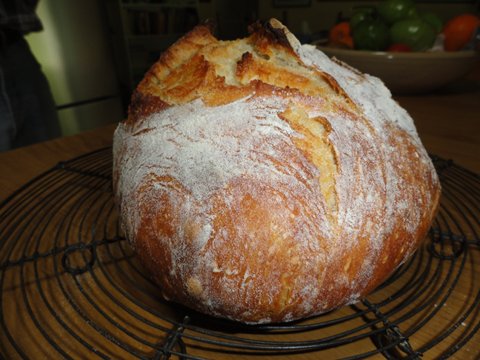
Bread is one of those foods that, when made with your own hands, gives a great deal of satisfaction and delight. It's only flour and water but it symbolises so much. I bake bread most days and use a variety of flours that I buy in bulk. Often I make a sandwich loaf because we use most of our bread for lunchtime sandwiches and for toast. Every so often I branch out to make a different type of loaf. I have tried sour dough in the past but I've not been happy with any of them. I'll continue to experiment with sour dough because I like the idea of using wild yeasts and saving the starter over a number of years to develop the flavour and become a part of the family. However, the loaf I've been branching out to most often is just a plain old five minute bread. By five minutes I mean it takes about five minutes actual work to prepare but it's the easiest of all bread to make and to get consistently good loaves from. If you're having people around for lunch or...
Image

This is my last post.

I have known for a while that this post was coming, but I didn't know when. This is my last post. I'm closing my blog, for good, and I'm not coming back like I have in the past.  I've been writing here for 16 years and my blog has been many things to me. It helped me change my life, it introduced me to so many good people, it became a wonderful record of my family life, it helped me get a book contract with Penguin, and monthly columns with The Australian Women's Weekly and Burke's Backyard . But in the past few months, it's become a burden. In April, I'll be 75 years old and I hope I've got another ten years ahead. However, each year I'll probably get weaker and although I'm fairly healthy, I do have a benign brain tumour and that could start growing. There are so many things I want to do and with time running out, leaving the blog behind gives me time to do the things that give me pleasure. On the day the blog started I felt a wonderful, h...
Image

What is the role of the homemaker in later years?

An email came from a US reader, Abby, who asked about being a homemaker in later years. This is part of what she wrote: "I am a stay-at-home mum to 4 children, ages 9-16. I do have a variety of "odd jobs" that I enjoy - I run a small "before-school" morning drop-off daycare from my home, I am a writing tutor, and I work a few hours a week at a local children's bookstore. But mostly, I cherish my blissful days at home - cooking, cleaning (with homemade cleaners), taking care of our children and chickens and goats, baking, meal-planning, etc. This "career" at home is not at all what I imagined during my ambitious years at university, but it is far more enriching. I notice, though, that my day is often planned around the needs of my family members. Of course, with 4 active kids and a husband, this is natural. I do the shopping, plan my meals, cook dinner - generally in anticipation of my family reconnecting in the evening.  I can't h...
Image

Every morning at home

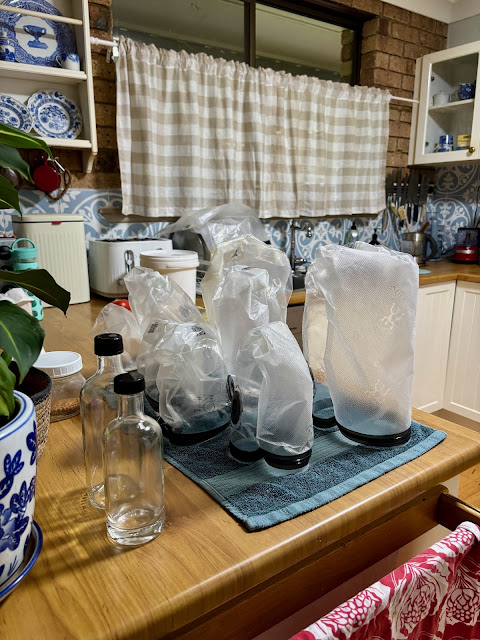
Every morning when I walk into my kitchen it looks tidy and ready for a day's work. Not so on this morning (above), I saw this when I walked in. Late the previous afternoon when I was looking for something, I came across my rolled up Zwilling vacuum bags and decided they had to be washed and dried. So I did that and although I usually put them outside on the verandah to dry it was dark by then. I turned the just-washed bags inside out and left them like this on a towel. It worked well and now the bags are ready to use when I bring home root vegetables, cabbages or whatever I buy that I want to last four or five weeks.
Image

You’ll save money by going back to basics

When I was doing the workshops and solo sessions, I had a couple of people whose main focus was on creating the fastest way to set up a simple life. You can't create a simple life fast, it's the opposite of that It's not one single thing either - it's a number of smaller, simpler activities that combine to create a life that reflects your values; and that takes a long to come together. When I first started living simply I took an entire year to work out our food - buying it, storing it, cooking it, preserving, baking, freezing, and growing it in the backyard. This is change that will transform how you live and it can't be rushed.  
Image


Trending Articles

NOT the last post

This will be my last post here.  I've been writing my blog for 18 years and now is the time to step back. I’ve stopped writing the blog and come back a couple of times because so many people wanted it, but that won’t happen again, I won’t be back.  I’ll continue on instagram to remain connected but I don’t know how frequent that will be. I know some of you will be interested to know the blog's statistics. 
Image

Every morning at home

Every morning when I walk into my kitchen it looks tidy and ready for a day's work. Not so on this morning (above), I saw this when I walked in. Late the previous afternoon when I was looking for something, I came across my rolled up Zwilling vacuum bags and decided they had to be washed and dried. So I did that and although I usually put them outside on the verandah to dry it was dark by then. I turned the just-washed bags inside out and left them like this on a towel. It worked well and now the bags are ready to use when I bring home root vegetables, cabbages or whatever I buy that I want to last four or five weeks.
Image

You’ll save money by going back to basics

When I was doing the workshops and solo sessions, I had a couple of people whose main focus was on creating the fastest way to set up a simple life. You can't create a simple life fast, it's the opposite of that It's not one single thing either - it's a number of smaller, simpler activities that combine to create a life that reflects your values; and that takes a long to come together. When I first started living simply I took an entire year to work out our food - buying it, storing it, cooking it, preserving, baking, freezing, and growing it in the backyard. This is change that will transform how you live and it can't be rushed.  
Image

Creating a home you'll love forever

Living simply is the answer to just about everything. It reduces the cost of living; it keeps you focused on being careful with resources such as water and electricity; it reminds you to not waste food; it encourages you to store food so you don't waste it and doing all those things brings routine and rhythm to your daily life. Consciously connecting every day with the activities and tasks that create simple life reminds you to look for the meaning and beauty that normal daily life holds.  It's all there in your home if you look for it. Seemingly mundane tasks like cleaning and cooking help you with that connection for without those tasks, the home you want to live in won't exist in the way you want it to.  Creating a home you love will make you happy and satisfied.
Image

Time changes everything

I've been spending time in the backyard lately creating a contained herb and vegetable garden. My aim is to develop a comfortable place to spend time, relax, increase biodiversity and encourage more animals, birds and insects to live here or visit. Of course I'd prefer my old garden which was put together by Hanno with ease and German precision. Together, we created a space bursting at the seams with herbs, vegetables and fruity goodness ready to eat and share throughout the year. But time changes everything. What I'm planning on doing now, is a brilliant opportunity for an almost 80 year old with balance issues. In my new garden I'll be able to do a wide range of challenging or easy work, depending on how I feel each day. It’s a daily opportunity to push myself or sit back, watch what's happening around me and be captivated by memories or the scope of what's yet to come.
Image

It's the old ways I love the most

I'm a practical woman who lives in a 1980’s brick slab house. There are verandahs front and back so I have places to sit outside when it's hot or cold. Those verandahs tend to make the house darker than it would be but they're been a great investment over time because they made the house more liveable. My home is not a romantic cottage, nor a minimalist modern home, it's a 1980’s brick slab house. And yet when people visit me here they tell me how warm and cosy my home is and that they feel comforted by being here. I've thought about that over the years and I'm convinced now that the style of a home isn't what appeals to people. What they love is the feeling within that home and whether it's nurturing the people who live there.
Image

Making ginger beer from scratch

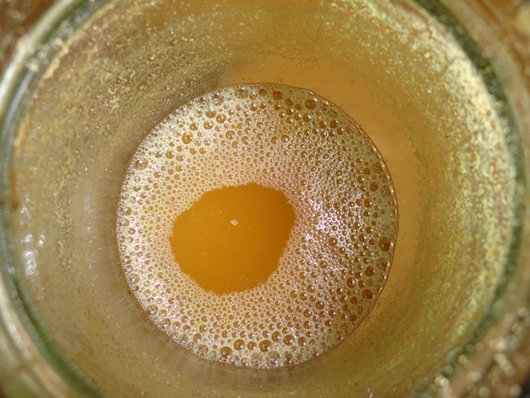
We had a nice supply of ginger beer going over Christmas. It's a delicious soft drink for young and old, although there is an alcoholic version that can be made with a slight variation on the recipe. Ginger beer is a naturally fermented drink that is easy to make - with ginger beer you make a starter called a ginger beer plant and after it has fermented, you add that to sweet water and lemon juice. Like sourdough, it must ferment to give it that sharp fizz. To make a ginger beer plant you'll need ginger - either the powdered dry variety or fresh ginger, sugar, rainwater or tap water that has stood for 24 hours to allow the chlorine to evaporate off. You'll also need clean plastic bottles that have been scrubbed with soap, hot water and a bottle brush and then rinsed with hot water. I never sterilise my bottles and I haven't had any problems. If you intend to keep the ginger beer for a long time, I'd suggest you sterilise your bottles. MAKING THE STARTER In a...
Image

An authentic look at daily life here — unstaged and real

Most days Hanno was outside happily working in the fresh air. It may surprise you to know that I started reading my book,  Down to Earth , yesterday - the first time since I wrote it 13 years ago.  I had lent it to my neighbor, and when she returned it, I started reading, expecting to find surprises. Instead, I realised the words were still familiar—as if they were etched into my memory. As I flipped through the pages, I was reminded of how important it was for me to share that knowledge with others. The principles in Down to Earth changed my life, and I truly believed they could do the same for others. After just 30 minutes of reading, I put the book down, reassured that its message still holds true: we can slow down and reshape our lives, one step at a time.
Image