down to earth

  • Home
  • About Us
  • Down To Earth Book
  • Privacy Policy
Despite being at home surrounded by what should be my housework, lately I've slipped out of my daily rhythm and life has become a disorganised and frazzled. My good friend Bernadette is gravely ill now, I've been visiting her in hospital and my sister Tricia, is visiting us so we've been talking, knitting, sewing and socialising and apart from a bit of cooking and washing, not much has been done here.  Everything is upside down.  Right now, Tricia and Hanno are awake and watching TV!  Usually when I rise to write, the house is as quiet as a mouse, but can I hear the sounds of the world cup on TV and I know if Australia scores a goal  there will be cheering and clapping. Uh oh, Germany scored. 

It's a public holiday here today - we have this ridiculous holiday for the Queen's birthday, it's not her birthday and even in the UK they don't celebrate this.  I'm not working today so I'll try to get back into the rhythm of my normal day.  It's easy working to a rhythm - you start with one familiar thing, others follow in a flow one after the other, you don't need to think about much and the work is done.  But as easy as it is, it doesn't take much to stop that flow, just one thing needs to be out and I'm lost.


Today's plan is to make the bed (I changed and washed the sheets yesterday), make breaksfast, get bread on to rise, clean up the kitchen, sweep the floor, water the garden and the plants at the front of the house.  Funnily enough, bread seems to be the stabilising influence in my routine.  When bread is rising, all  the other chores just fall into place.  Later this morning, I'll visit Bernadette, who is now at home.  It was her wish so her son took her back  home yesterday.  Later in the week the rest of her family will arrive so if I go today, I'll have some quiet time with her without getting in the way of family things.  I'm not quite ready to say goodbye yet.

When I come home, I'll clean up the bathroom.  It's a bit of a disaster at the moment because Hanno did a major repair in there.  There had been an unseen leak which seeped into the wall cavity, rotting the timbers in the door frame.  Hanno took them all out, replacing the rotting timbers, and then covered it all in again.  Cost of the repair was $19.  He had spare timber in the shed, got the gyprock free from the supplier (they were offcuts) and just had to buy sealer and anti-mould.  It was a big job, it took a week to complete, but now the bathroom is operational again - it just needs a good clean.

I haven't had time to take photos lately but hope to do a few this afternoon.  Apart from that, all I have to do is cook dinner and things will be back to normal - at least for today.  I wrote a post a few years ago call The Familiar Rhythm of the Unremarkable and that's exactly how I feel about my daily routine.  It's like an anchor.  It holds me firm when I get pushed this way and that and it shows me that while life has many changes and ups and downs, much of my home life remains the same; small moments, ever constant and a safe haven from the unspeakable.
Here is the work space of one very busy lady, Rebecca.  It never fails to amaze me how we all live in different countries where expectations and conditions are not the same, yet we share similar values and a desire to live simply.  Those values and desires unite us and therefore when I look at Rebecca's workplace it it familiar to me.  I feel like I could walk in there and start helping her with the children and garden and although it's thousands of miles from my place, I'd feel at home there.

Rebecca writes:  "My name is Rebecca and I live in the Netherlands. I am a childminder who works from home and so this is my work space. 
 

Since I am watching 1 yr old twins, the huge play pen is very handy indeed. The children get to play safely and when they have been picked up again by their parents, it folds up and stores away in a corner. It was quite hard to get a good overview picture of my living room but in the foreground you see a small part of our dining table. It is the biggest we could find in Holland. (2 mtrs 40 long and 90 cms wide) Since we have 5 children ourselves and always eat together at the table we needed one that was big enough. It also serves as folding surface for laundry, sewing table, crafts table etc. We do have central heating but we prefer to use the coalheater you see on the right.


The second picture is taken from the front of my house. It is where I grow as much veg as I can possibly get away with. There's brassica's under the netting, lettuce, beans, beets, kohl rabi and well quite a bit more. It is all the space I have available and it makes me so very happy to potter about in the soil and to feed my family fresh food.The neighbours think I'm nuts but I don't really care.

On the right you catch a glimpse of our Canadian Canoe. We just love to take that out onto the water and make trips with it. It is great family time and wonderful exercise too!

Ours is just a simple, small house. But it's our home and we feel so very comfortable here."
 
Thanks for being involved in this series, Rebecca.
Rachel asked about making soup from scratch, so here are my thoughts on soups.  I have two regulars  I make frequently over winter that are made in large amounts and are either frozen to eat later or will feed Hanno and I for about five or six days.  These are vegetable soup and pea soup.  Both are based on bone broths and both can be made without bones, using just vegetables.  I used to be a vegetarian until I read Nourishing Traditions.  That book convinced me that I should eat certain types of meat and these soups are the ideal recipes for those types of meat, and bones.


NOTES ON VEGETABLE SOUP
The vegetable soup recipe is here,  I wrote about it in Winter 2008.  Soups are very forgiving and are ideal recipes for new from-scratch cooks because you don't have to be precise with the quantities.  However, in the soup recipe I use a stockpot that holds about 8 litres/quarts and it results in about 7 litres of soup.  When you put the bones in the stockpot, cover them with water - that's about 2 - 3 litres, but it doesn't matter precisely how much water you use.  You just have to make sure you leave enough room for the vegetables.  If you don't have enough water in the soup, you can always add more as you go along.

To make the non-meat version of this soup, simply leave out the bones.  You could use a vegetable stock you made earlier but the soup makes its own stock as it cooks.  Add herbs just before you serve it to boost the flavour.

NOTES ON PEA SOUP
My pea soup recipe is here.  The same rule about water applies here.  Cover the bones and cook the stock, add the peas and if you need more water, add it.  You can use yellow or green peas or a mixture of both, or if you're growing pigeon peas, use them.

There are a number of soups you can make that you can whip up quickly and have on the table in less than an hour.  Some of these follow:

PEA SOUP RECIPE from NOURISHING TRADITIONS
This soup serves six and uses fresh or frozen peas

2 medium onions, peeled and chopped
3 tablespoons butter
2 pounds freshly shelled peas or frozen peas
1½ quarts chicken stock  (plain water will do here if you're vegetarian)
½ teaspoon dried green peppercorns, crushed
sea salt and pepper
piima cream or creme fraiche

BEETROOT SOUP from NOURISHING TRADTIONS
Serves six
6 medium beets
4 tablespoons butter
1 quart filtered water
sea salt or fish sauce and pepper
2 tablespoons finely chopped chives
piima cream or creme fraiche

Peel beets, chop coarsely and sauté very gently in butter for ½ hour or until tender.  Add water bring to the boil and skim.  Simmer about 15 minutes. Puree soup with hand-held blender. Season to taste, garnish with cultured creme.


Sauté the onions gently in butter until tender. Add peas and stock, brig to boil and skim.  Simmer about 15 minutes. Puree soup with a hand-held blender.  Season to taste.  Garnish with the cultured cream.

CAULIFLOWER SOUP

1 tablespoon olive oil
1 small cauliflower head, chopped
1 large onion, chopped
About 1½ litres/quarts of water or chicken stock
Salt and pepper
½ cup sour cream
2 tablespoons chopped chives

Chop the cauliflower and onion and sauté gently in oil until soft.  Add the water or stock and bring to the boil, then reduce to a gentle simmer.  Cook for 30 minutes, season to taste.  Blend using a hand-held blender.  Add the sour cream, sprinkle with chives and serve.

BOOK RECOMMENDATIONS

Nourishing Traditions - can be purchased in most countries
Women's Weekly Country Cooking - for Australians and possibly UK
Commonsense Cookery Book - Australians
Forgotten Skills of Cooking - Darina Allen
Ad Hoc at Home - Thomas Keller - I recommend this book because Thomas owns and cooks at The French Laundry, which is the one American restaurant my sons and I would like to visit.  This is his home cooking book.

From scratch cooking is usually called Country Cooking in the publishing world.  So if you're looking for a from-scratch book, look for Country Cooking.


Thank you for your visits and comments this week.  I hope you have a wonderful weekend doing things with those you love.

Back in the day, before the invention of supermarkets, most of our food was unpackaged and much of it was fresh.  I remember a time when there were little grocery shops on suburban corners which sold a wide variety of food.  We'd go there, the shop owner knew us by our first name, and we would buy just a small amount of food that we would eat that day.  Many of the people who shopped at these little stores also had a vegetable patch at home so tomatoes, potatoes, salads and green leaves were grown and eaten fresh from the backyard garden.


When we bought meat, it wasn't an unidentifiable slice of flesh on a polystyrene tray covered with plastic wrap that was plucked from a refrigerated open case.  We walked into butcher shops onto a floor that was covered with saw dust that contained a few drops of blood fallen from the carcasses hanging in plain view in the shop.  We recognised the animal our meat came from, we knew how the animal was cut up and we knew our pork, beef, lamb and chicken cuts.  I still buy meat from a butcher who buys local meat carcasses that hang in the store in full view.  I wouldn't buy anything from a butcher who buys meat in boxes and vacuum packs - that food has been processed in an unseen location.  Choice has been taken away from me.


Take back control of what you eat.  YOU be the person who chooses every part of your meal - stop buying fast food or convenience.  These foods take away that choice - if someone else is cooking your food then someone else is making important decisions that you should be making.

I really love the advice given by Michael Pollin and I heartily agree with it:
  • Don't eat anything your great grandmother wouldn't recognise as food.
  • Shop are the farmers' or growers' market - it's all fresh food straight from the grower.
  • Stay out of the middle of the supermarket - meat, fish, dairy products, fruit and vegetables are all on the outside aisle of every supermarket.  The processed stuff is in the centre.

It's quite a complicated process to unwind yourself from supermarket shopping.  Buying all your processed and pre-made favourites makes shopping a breeze - you know what you want, you don't have to think about ingredients, you buy and off you go.  But as you're unwinding yourself from the quagmire of supermarket food you should be reading labels, cutting out anything that has preservatives, artificial colourings and flavourings and buying food that is as unprocessed  and fresh as possible.  For instance, you'd think that buying oats for your porridge would be easy and straight forward.  Nope!  Rolled oats or oatmeal have been processed - or rolled and steamed to make them easier to cook.  That is acceptable to me, but quick oats aren't.  They've been further processed and if you apply the great grandma rule, you'd steer clear of quick oats but keep eating rolled oats.


Of course, all this depends on time and inclination.  If you're working outside the home, you might not be able to make your own bread every day, but if you bought a bread machine and set it to have the bread ready when you wake up, you're fine.  If you're someone who works in your home you might be prepared to make tomato sauce but are you going to make tomato paste?  It's all a question of time and whether you want to do it.  The reason you pay so much for processed food is that you're paying for someone else's time and energy to prepare the ingredients or an entire meal for you.


I tend to go with what I know.  I make similar meals to those I had when I was a child.  I change things around at times, I substitute ingredients that I don't have on hand, but basically it's similar food.  We eat butter not margarine, full cream  not low fat, sugar or honey not sweeteners.  If you're still buying lots of snack foods or prepared foods, stop buying them and replace them with home baking.  If you can afford organic ingredients for your baking, that's great. If you can't, it's still much better than the supermarket versions of that food.


If you're not a cook now, I want to encourage you to learn how to cook good, simple food. And when I say 'cook' I mean a wide variety of uncooked food as well, like salads and good dressings. If you are cooking, I encourage you to go back to basics, get rid of processed food and regain the choice of what you eat.  Part of the process of cooking should be learning how to select good food and for some, to start growing it as well.  Nothing will teach you more about fruit and vegetables than growing them yourself.

I am happy to share more recipes and to write about the process of cooking.  If you need help, ask.  We might be able to get a few  more people cooking at home.  This is part of the revolution was was writing about here.  This is important and empowering. Welcome to the revolution!


Thank you all so much for your lovely comments on the radio interview.  I'm back at my voluntary job today so I'm going to introduce you to Andrea in our This is Where I Work series.  I had a little chuckle when I looked at the first photo, Andrea.  In addition to your very tidy and organised desk (much tidier than mine), you have Down to Earth on one screen, a beach on the other and a map on your wall.  I think your thoughts are outside that office.  Congratulations on your engagement, love.


Andrea writes: "My name is Andrea, and I live in California in the USA.  I'll be 40 this year and am recently (amicably) divorced and even more recently engaged (that *is* the correct order of events, last time I checked - lol).  My fiance lives at the other end of the country, 2000 miles away, but will be moving into my house as soon as he does something with his house.  We plan for him to be a house-spouse and get the garden going.  The property isn't big enough for us to grow a ton, but it will support enough veggies and some chooks to give us a little more independence.  And thanks to you I've been researching aquaponics, so maybe some fish too!

This is where I spend my days.  I'm a programmer for a manufacturing company, so the view out my window is of the production floor.  It's a beehive of activity, which is good for motivation when I find myself lacking energy.  As workspaces go, it's fairly good.  Quiet, comfortable, with the equipment that I need to get my job done.  And I do like most of the people.  But this is not where I want to spend my life.  I don't even know what the weather is like all day!  But when we get my mortgage paid off and some more savings built, I'm hoping to trade this small, enclosed cubby for a lot of time in the sun with the fiance, garden, chooks, and fish."

I'll see you all tomorrow when I'll be writing about processed food.

A few weeks ago Radio National contacted me and asked if I would be interviewed for their program Life Matters.  I've listened to Life Matters for years so it didn't take me long to say "yes".  To tell you the truth I was a bit nervous so I remained low key and when the day of the interview arrived, I got myself a cup of tea and settled into my workroom, alone.  I had nothing to worry about.  The staff at the ABC are always so professional and friendly, and talking to Richard Aedy was like talking to a friend.  It was a very pleasant experience.  

If you would like to listen to the interview, there is an audio file on the Radio National website:  http://www.abc.net.au/rn/lifematters/stories/2010/2917437.htm
When you pick up your needles and start knitting for the first time, you'll join an extended family that covers the globe and goes back in time.  Knitting connects you.  As soon as you venture out into the community with wool and needles in hand, all manner of people talk to you, even if they've never met you before. All those long strands of yarn link us all together with questions about technique, gauge and ply, and it's quite common to show unfinished work to complete strangers and to listen to tales about old knitting needles, learning to knit as a child and being warmed to the bone by home made woolly jumpers and socks. Knitting arouses memory, curiosity and friendship.
At the moment, I'm working on a jumper for Hanno. It's quite a simple design, in washable  pure wool and if I keep going at my current pace, it will be finished by the end of June, maybe a little bit before. There is nothing better than settling into a comfortable armchair on a cool Sunday afternoon and watching an English murder mystery while chatting and knitting. My sister is visiting at the moment, she was sitting on the sofa with her quilt which she is hand stitching, and as I sat in my arm chair and picked up my knitting needles, a cool breeze came through the back door and I knew that this was where I was meant to be.
Are you still hovering on the edge of knitting?  Knitting will help slow you down, it's like meditation when you knit alone and an invitation to connect when you knit in public.  You can knit gifts of mittens, scarves, hats, dishcloths and bags when you start, and the more advanced jumpers, shawls, socks, and soft organic baby wear when you develop your knitting technique.  Whatever you knit will be unique and not a replica of the thousands of commercially produced knits that flood the market from China.

We are starting a knitting group at our neighbourhood centre soon. I have no doubt it will be popular with those people wanting to learn how to knit as well as those who like to knit with others around. Knitting circles are an excellent way to develop friendships and community - there are many groups I know of that knit for charity. I've been on the receiving end of that kind of generosity in my voluntary work and it fills be with a warm fuzzy feeling to give scarves, mittens and beanies to our homeless people that have been sent to me by the knitters here.   Knitting connects us all.
I have come to the realisation that if you're a knitter, you'll usually have something on your needles in every season.  I am tending towards wool knitting in the cooler months and cotton knitting when it's warmer.  I would love to know what you're knitting right now. And if you have any patterns to share here - something that you love or a quick and easy knit, please let me know.

Here are some new (to me) knitting links.
Patterns for hats
Cute pixie caps
An interesting knitting blog
Tea cosy patterns
Twice knit scarf - for using scraps of yarn
Simple cowl scarf
 UK hand knitting


I was asked to write a guest post on the ABC Pool site.  It's described as "a social media space that brings together ABC professionals and audiences in an open-ended process of participation, co-creation and collaboration. It’s a place to share and talk about creative work - music, photos, videos, documentaries, interviews, animations and more."  I was intrigued, I checked it out and dived right in.  It's a great site with a lot happening.

Click here to visit.
Newer Posts Older Posts Home


My books were all published by Pengiun, and are available at Amazon US, Amazon UK and Amazon Au

Search here

Total Pageviews

Translate


I'm Rhonda Hetzel and I've been writing my Down to Earth blog since 2007. Although I write the occasional philosophical post, my main topics include home cooking, happiness and gardening as well as budgeting, baking, ageing, generosity, mending and handmade crafts. I hope you enjoy your time here.

MY FAVOURITE PLACES

  • Grandma Donna's Place
  • Grandma Donna's YouTube
  • Grandma Donna's Instagram
  • This Simple Day
  • Nicole's Instagram

Give More

Give More

Popular posts last year

Making ginger beer from scratch

We had a nice supply of ginger beer going over Christmas. It's a delicious soft drink for young and old, although there is an alcoholic version that can be made with a slight variation on the recipe. Ginger beer is a naturally fermented drink that is easy to make - with ginger beer you make a starter called a ginger beer plant and after it has fermented, you add that to sweet water and lemon juice. Like sourdough, it must ferment to give it that sharp fizz. To make a ginger beer plant you'll need ginger - either the powdered dry variety or fresh ginger, sugar, rainwater or tap water that has stood for 24 hours to allow the chlorine to evaporate off. You'll also need clean plastic bottles that have been scrubbed with soap, hot water and a bottle brush and then rinsed with hot water. I never sterilise my bottles and I haven't had any problems. If you intend to keep the ginger beer for a long time, I'd suggest you sterilise your bottles. MAKING THE STARTER In a...
Image

NOT the last post

This will be my last post here.  I've been writing my blog for 18 years and now is the time to step back. I’ve stopped writing the blog and come back a couple of times because so many people wanted it, but that won’t happen again, I won’t be back.  I’ll continue on instagram to remain connected but I don’t know how frequent that will be. I know some of you will be interested to know the blog's statistics. 
Image

How to make cold process soap

I'm sure many of you are wondering: "Why make soap when I can buy it cheaply at the supermarket?" My cold process soap is made with vegetable oils and when it is made and cured, it contains no harsh chemicals or dyes. Often commercial soap is made with tallow (animal fat) and contains synthetic fragrance and dye and retains almost no glycerin. Glycerin is a natural emollient that helps with the lather and moisturises the skin. The makers of commercial soaps extract the glycerin and sell it as a separate product as it's more valuable than the soap. Then they add chemicals to make the soap lather. Crazy. Making your own soap allows you to add whatever you want to add. If you want a plain and pure soap, as I do, you can have that, or you can start with the plain soap and add colour, herbs and fragrance. The choice is yours. I want to add a little about animal and bird fat. I know Kirsty makes her soap with duck fat and I think that's great. I think t...
Image

Preserving food in a traditional way - pickling beetroot

I've had a number of emails from readers who want to start preserving food in jars but don't know where to start or what equipment to buy.  Leading on from yesterday's post, let's just say up front - don't buy any equipment. Once you know what you're doing and that you enjoy preserving, then you can decide whether or not to buy extra equipment. Food is preserved effectively without refrigeration by a variety of different methods. A few of the traditional methods are drying, fermentation, smoking, salting or by adding vinegar and sugar to the food - pickling. This last method is what we're talking about today. Vinegar and sugar are natural preservatives and adding one or both to food sets up an environment that bacteria and yeasts can't grow in. If you make the vinegar and sugar mix palatable, you can put up jars of vegetables or fruit that enhance the flavour of the food and can be stored in a cupboard or fridge for months. Other traditional w...
Image

Cleaning mould from walls and fabrics

With all this rain around we've developed a mould problem in our home. Usually we have the front and back doors open and that good ventilation stops most moulds from establishing. However, with the house locked up for the past week, the high humidity and the rain, mould is now growing on the wooden walls near our front door and on the lower parts of cupboards in the kitchen. Most of us will find mould growing in our homes at some point. Either in the bathroom or, in humid climates, on the walls, like we have now. You'll need a safe and effective remedy at some point, so I hope one of these methods works well for you. Mould is not only ugly to look at, it can cause health problems so if you see mould growing, do something about it straight away. The longer you leave the problem, the harder it will be to get rid of it effectively. If you have asthma or any allergies, you should do this type of cleaning with a face mask on so you don't breathe in any spores. Many peopl...
Image

Five minute bread

Bread is one of those foods that, when made with your own hands, gives a great deal of satisfaction and delight. It's only flour and water but it symbolises so much. I bake bread most days and use a variety of flours that I buy in bulk. Often I make a sandwich loaf because we use most of our bread for lunchtime sandwiches and for toast. Every so often I branch out to make a different type of loaf. I have tried sour dough in the past but I've not been happy with any of them. I'll continue to experiment with sour dough because I like the idea of using wild yeasts and saving the starter over a number of years to develop the flavour and become a part of the family. However, the loaf I've been branching out to most often is just a plain old five minute bread. By five minutes I mean it takes about five minutes actual work to prepare but it's the easiest of all bread to make and to get consistently good loaves from. If you're having people around for lunch or...
Image

This is my last post.

I have known for a while that this post was coming, but I didn't know when. This is my last post. I'm closing my blog, for good, and I'm not coming back like I have in the past.  I've been writing here for 16 years and my blog has been many things to me. It helped me change my life, it introduced me to so many good people, it became a wonderful record of my family life, it helped me get a book contract with Penguin, and monthly columns with The Australian Women's Weekly and Burke's Backyard . But in the past few months, it's become a burden. In April, I'll be 75 years old and I hope I've got another ten years ahead. However, each year I'll probably get weaker and although I'm fairly healthy, I do have a benign brain tumour and that could start growing. There are so many things I want to do and with time running out, leaving the blog behind gives me time to do the things that give me pleasure. On the day the blog started I felt a wonderful, h...
Image

What is the role of the homemaker in later years?

An email came from a US reader, Abby, who asked about being a homemaker in later years. This is part of what she wrote: "I am a stay-at-home mum to 4 children, ages 9-16. I do have a variety of "odd jobs" that I enjoy - I run a small "before-school" morning drop-off daycare from my home, I am a writing tutor, and I work a few hours a week at a local children's bookstore. But mostly, I cherish my blissful days at home - cooking, cleaning (with homemade cleaners), taking care of our children and chickens and goats, baking, meal-planning, etc. This "career" at home is not at all what I imagined during my ambitious years at university, but it is far more enriching. I notice, though, that my day is often planned around the needs of my family members. Of course, with 4 active kids and a husband, this is natural. I do the shopping, plan my meals, cook dinner - generally in anticipation of my family reconnecting in the evening.  I can't h...
Image

Every morning at home

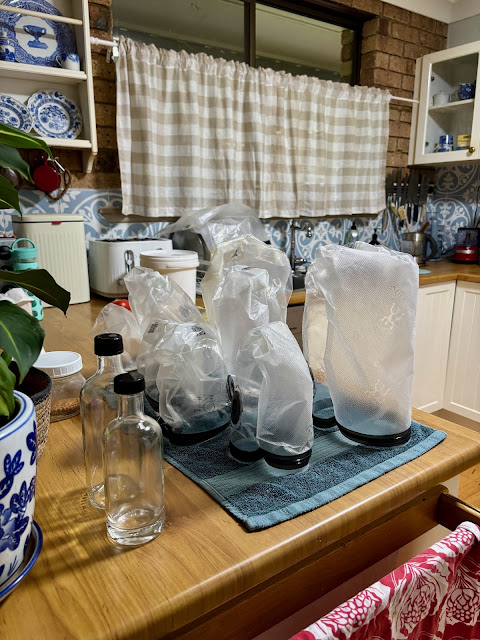
Every morning when I walk into my kitchen it looks tidy and ready for a day's work. Not so on this morning (above), I saw this when I walked in. Late the previous afternoon when I was looking for something, I came across my rolled up Zwilling vacuum bags and decided they had to be washed and dried. So I did that and although I usually put them outside on the verandah to dry it was dark by then. I turned the just-washed bags inside out and left them like this on a towel. It worked well and now the bags are ready to use when I bring home root vegetables, cabbages or whatever I buy that I want to last four or five weeks.
Image

You’ll save money by going back to basics

When I was doing the workshops and solo sessions, I had a couple of people whose main focus was on creating the fastest way to set up a simple life. You can't create a simple life fast, it's the opposite of that It's not one single thing either - it's a number of smaller, simpler activities that combine to create a life that reflects your values; and that takes a long to come together. When I first started living simply I took an entire year to work out our food - buying it, storing it, cooking it, preserving, baking, freezing, and growing it in the backyard. This is change that will transform how you live and it can't be rushed.  
Image


Trending Articles

NOT the last post

This will be my last post here.  I've been writing my blog for 18 years and now is the time to step back. I’ve stopped writing the blog and come back a couple of times because so many people wanted it, but that won’t happen again, I won’t be back.  I’ll continue on instagram to remain connected but I don’t know how frequent that will be. I know some of you will be interested to know the blog's statistics. 
Image

Every morning at home

Every morning when I walk into my kitchen it looks tidy and ready for a day's work. Not so on this morning (above), I saw this when I walked in. Late the previous afternoon when I was looking for something, I came across my rolled up Zwilling vacuum bags and decided they had to be washed and dried. So I did that and although I usually put them outside on the verandah to dry it was dark by then. I turned the just-washed bags inside out and left them like this on a towel. It worked well and now the bags are ready to use when I bring home root vegetables, cabbages or whatever I buy that I want to last four or five weeks.
Image

You’ll save money by going back to basics

When I was doing the workshops and solo sessions, I had a couple of people whose main focus was on creating the fastest way to set up a simple life. You can't create a simple life fast, it's the opposite of that It's not one single thing either - it's a number of smaller, simpler activities that combine to create a life that reflects your values; and that takes a long to come together. When I first started living simply I took an entire year to work out our food - buying it, storing it, cooking it, preserving, baking, freezing, and growing it in the backyard. This is change that will transform how you live and it can't be rushed.  
Image

Creating a home you'll love forever

Living simply is the answer to just about everything. It reduces the cost of living; it keeps you focused on being careful with resources such as water and electricity; it reminds you to not waste food; it encourages you to store food so you don't waste it and doing all those things brings routine and rhythm to your daily life. Consciously connecting every day with the activities and tasks that create simple life reminds you to look for the meaning and beauty that normal daily life holds.  It's all there in your home if you look for it. Seemingly mundane tasks like cleaning and cooking help you with that connection for without those tasks, the home you want to live in won't exist in the way you want it to.  Creating a home you love will make you happy and satisfied.
Image

Time changes everything

I've been spending time in the backyard lately creating a contained herb and vegetable garden. My aim is to develop a comfortable place to spend time, relax, increase biodiversity and encourage more animals, birds and insects to live here or visit. Of course I'd prefer my old garden which was put together by Hanno with ease and German precision. Together, we created a space bursting at the seams with herbs, vegetables and fruity goodness ready to eat and share throughout the year. But time changes everything. What I'm planning on doing now, is a brilliant opportunity for an almost 80 year old with balance issues. In my new garden I'll be able to do a wide range of challenging or easy work, depending on how I feel each day. It’s a daily opportunity to push myself or sit back, watch what's happening around me and be captivated by memories or the scope of what's yet to come.
Image

It's the old ways I love the most

I'm a practical woman who lives in a 1980’s brick slab house. There are verandahs front and back so I have places to sit outside when it's hot or cold. Those verandahs tend to make the house darker than it would be but they're been a great investment over time because they made the house more liveable. My home is not a romantic cottage, nor a minimalist modern home, it's a 1980’s brick slab house. And yet when people visit me here they tell me how warm and cosy my home is and that they feel comforted by being here. I've thought about that over the years and I'm convinced now that the style of a home isn't what appeals to people. What they love is the feeling within that home and whether it's nurturing the people who live there.
Image

Making ginger beer from scratch

We had a nice supply of ginger beer going over Christmas. It's a delicious soft drink for young and old, although there is an alcoholic version that can be made with a slight variation on the recipe. Ginger beer is a naturally fermented drink that is easy to make - with ginger beer you make a starter called a ginger beer plant and after it has fermented, you add that to sweet water and lemon juice. Like sourdough, it must ferment to give it that sharp fizz. To make a ginger beer plant you'll need ginger - either the powdered dry variety or fresh ginger, sugar, rainwater or tap water that has stood for 24 hours to allow the chlorine to evaporate off. You'll also need clean plastic bottles that have been scrubbed with soap, hot water and a bottle brush and then rinsed with hot water. I never sterilise my bottles and I haven't had any problems. If you intend to keep the ginger beer for a long time, I'd suggest you sterilise your bottles. MAKING THE STARTER In a...
Image

An authentic look at daily life here — unstaged and real

Most days Hanno was outside happily working in the fresh air. It may surprise you to know that I started reading my book,  Down to Earth , yesterday - the first time since I wrote it 13 years ago.  I had lent it to my neighbor, and when she returned it, I started reading, expecting to find surprises. Instead, I realised the words were still familiar—as if they were etched into my memory. As I flipped through the pages, I was reminded of how important it was for me to share that knowledge with others. The principles in Down to Earth changed my life, and I truly believed they could do the same for others. After just 30 minutes of reading, I put the book down, reassured that its message still holds true: we can slow down and reshape our lives, one step at a time.
Image