down to earth

  • Home
  • About Us
  • Down To Earth Book
  • Privacy Policy
This is one last Kitchen Sink post.  It is from Liz, who sent the photos and info some time ago but it didn't arrive at my end.  Anyhow, I'm delighted to present Liz's kitchen today - another small, cosy and efficient kitchen by the look of it.  Thanks Liz.

She writes:  "I am 25 and live in Portland, Oregon, USA. I am still at a very mobile stage in my life and have lived a lot of different places in Portland, but this apartment is by far my favorite! I will be so sad when I have to leave it. Here is my kitchen sink right after I've washed a big batch of dishes! I love doing dishes by hand, and this is a great sink for it. The window over the sink faces south, so it's always full of light and allows me to look over my backyard and the garden that I share with my upstairs neighbor. My apartment is part of a big Victorian house and I am on the ground floor, so I also have a backdoor (to the left of the sink) that goes straight into the backyard. I love doing dishes and looking out over my garden and the one in the adjoining yard. Right now it is early spring in Portland and you can see I have just cut some of the first flowers for vase on the windowsill. I have lots of hyacinths, tulips, lilies, and daffodils blooming along the back fence right now.


You can see my little compost bucket just to the left of the sink, I have a big bin in my backyard, into which go kitchen scraps from my apartment and my neighbors', my boyfriend's apartment a few blocks away, and from the kitchen at my office. You can also see the plastic bag full of more bags to be washed- I always reuse produce bags and take my own with me to the store. The white holiday lights stay up year round, as standing at the sink after dark blocks the light from the ceiling lamp- the holiday lights give a lot of extra light to help me see what I'm doing, and I think they're very attractive too! The white cleaning rag over the middle of the sink is cut from an old towel- old pieces of towel are used only for cleaning countertops, the stove, etc. to keep them separate from the ones used for the dishes. This kitchen is such a pleasure to work in, it's small but pretty with lots of storage place, and the big two-basin sink which I really appreciate!


I keep a blog on my own efforts towards simplicity, sustainability, and healthy living. The link is http://batchworthlane.blogspot.com. I also wrote a cover story last year for Mother Earth News magazine about my upbringing on a self-sustaining homestead. The link to that article is http://www.motherearthnews.com/Modern-Homesteading/Growing-Up-On-A-Homestead.aspx. You have to click separately on the image gallery link for the photos."
Living this simple life is quite different to how I imagined it would be.  When we first changed our spending habits, stopped buying stuff and began to conserve rather than consume, I believed we would live a quiet and thrifty life punctuated by the sound of us saying no to whatever cropped up.  Surpise! That hasn't happened.  What has happened is that we have more friends now than we have ever had, we do more, are more involved with our community and our lives have opened up and blossomed.  We smile a lot more.  We are happy.  I think that happiness comes from letting go of expectations of what we might possess and being open instead to what we can give.  


On a day to day basis, we are working more now than we ever have, but the work is satisfying and enriching.  Our daily work is directly related to what we need rather than what we want.  When I worked for money I had to deal with people I'd rather not talk to, I had to work according to the clock and someone else's idea of a fair day's work, and the work was irrelevant to me, apart from helping me earn a living.  We are working for our lives now rather than working for a living. What we do now consumes about the same amount of time, but we never have to put up with people we dislike, we have frequent breaks and complete days off when we want them.  We reap a full measure from what we put into our days.


I was wrong to believe that voluntarily living on less money might result in a miserable or quiet or meagre life.  Not buying books and magazine has lead me to our local library - a definite bonus resulting in more books, magazines and DVDs than I could ever go through.  Doing voluntary work has fed my soul and led me to a fine group of like minded people with whom I now share my life. Giving up recreational shopping has not only given me more time, it has given me my life back; a life that I have fashioned to suit myself rather than the advertising industry and merchandise.  Instead of dreading going to work, we cultivate soil, clean floors, built fences, cook, bake and sew, and feel thankful for the opportunity to do it..  This feels right.


You have to have the right mindset to live as we do but getting into it was really easy for me. I think I was ready for it, or overdue.  One week I was out spending and feeling miserable, the following week I was working on building a life that didn't include shopping at all but gave me the freedom to pick the elements that would work for us, and leave the rest.  I felt like I'd discovered the key to a new and wonderful world. And I had.   There are many things that have changed as we've moved through the years of simple living but one thing I still feel is that feeling of control of my own life and a crazy exhilaration knowing that the world is mine.
Last Wednesday was Sorry Day in Australia.  Sorry Day has been held on May 26 each year since 1998 to commemorate  and remember the history of mistreatment of Aboriginal and Islander people and of the forced removal of aboriginal and Torres Strait Islander children from their families over a period of 150 years.  These children are now known as the Stolen Generations.  In 2008 the Prime Minister of Australia apologised for the mistreatment of all those people.  I will never forget that day.


Bev and I after the presentation. The flag behind us is the Australian Aboriginal flag.

One of the volunteers at our Neighbourhood Centre is a remarkable woman called Beverly Hand.  Beverly is an elder of the Kabi Kabi people who live in this area.  Unfortunately there are very few Kabi Kabi people around now.  Beverly and I threw open the doors of the Centre for Sorry Day and about 50 people attended our Sorry Day event.  After morning tea there was a DVD about the Stolen Generations, then lunch and music was enjoyed by everyone there.  After lunch we gathered in our large room  for an explanation of aboriginal history from the 1700s to the present day.  Then Beverly presented a framed copy of  the Apology to me to be hung in the foyer of the Centre.  Beverly asked me to read it out to those gathered.  It was a very moving day marked equally by sadness about the past, acceptance of the present and optimism for the future.

This is what I read:
Today we honour the Indigenous peoples of this land, the oldest continuing cultures in human history.
We reflect on their past mistreatment.
We reflect in particular on the mistreatment of those who were Stolen Generations – this blemished chapter in our nation’s history.
The time has now come for the nation to turn a new page in Australia’s history by righting the wrongs of the past and so moving forward with confidence to the future.
We apologise for the laws and policies of successive Parliaments and governments that have inflicted profound grief, suffering and loss on these our fellow Australians.
We apologise especially for the removal of Aboriginal and Torres Strait Islander children from their families, their communities and their country.
For the pain, suffering and hurt of these Stolen Generations, their descendants and for their families left behind, we say sorry.
To the mothers and the fathers, the brothers and the sisters, for the breaking up of families and communities, we say sorry.
And for the indignity and degradation thus inflicted on a proud people and a proud culture, we say sorry.
We the Parliament of Australia respectfully request that this apology be received in the spirit in which it is offered as part of the healing of the nation.
For the future we take heart; resolving that this new page in the history of our great continent can now be written.
We today take this first step by acknowledging the past and laying claim to a future that embraces all Australians.
A future where this Parliament resolves that the injustices of the past must never, never happen again.
A future where we harness the determination of all Australians, Indigenous and non-Indigenous, to close the gap that lies between us in life expectancy, educational achievement and economic opportunity.
A future where we embrace the possibility of new solutions to enduring problems where old approaches have failed.
A future based on mutual respect, mutual resolve and mutual responsibility.
A future where all Australians, whatever their origins, are truly equal partners, with equal opportunities and with an equal stake in shaping the next chapter in the history of this great country, Australia.
One of the great benefits of eating food you have cooked from scratch is that you know what you are eating.  The ideal is that you buy all the raw ingredients, then you add what you want to add.  But what happens when you buy things like sausages?  They're raw, but what's in them?  Who would know.  In Australia, sausage, by law, must contain 50 percent meat - but that meat may come from any part of the animal.  And what about the other 50 percent, what's that?  Well, you could ask your butcher and be guided by what he says, but you could also make your own sausages at home.  It's simple.

Homemade sausages are a great way to play that trick that mums all over the world play with their younger children - hide the vegetable.  If you finely grate carrot, pumpkin, celery, onion or cabbage, often it goes unseen into little bellies.

When you make sausages you need to use meat that has a small amount of fat on it.  The fat helps with the flavour and to bind the meat together.  When you cook the sausages, a lot of this fat melts and drains away so you're not actually eating it.  Making sausages is a great idea if you buy your meat in bulk, or hunt, because you can use all those pieces that might go into a casserole or you have no other use for.  I don't use casings for my sausages - often sausages are encased in intestines - and if you want to use them, you can buy them from your butcher and fill them.  I find they're just as easy to cook with no casing of you mix them well and them put them in the fridge to firm before cooking.

Regarding the mincing/griding of the meat. One of the meats will have to be very finely minced/ground so that it binds the sausage together.  I like to have little pieces of pork in the sausages so I don't mince the pork as finely as the beef.


PORK AND BEEF SAUSAGES WITH SAGE
These amounts are approximate as it's not essential to be exact.  The meat below made 8 fat sausages but could make 10 - 12 long thin ones.
½ kg/1 lb beef with some fat - very finely minced/ground
½ kg/1 lb pork with some fat - not so finely minced/ground
½ cup dry breadcrumbs - I used crumbs from the shop but you could just as easily use stale bread that you dry out in the oven, then pulverise in a blender.
a couple of leaves of sage - or any other herb you like
salt and pepper to taste


You could add any spice, garlic or finely grated vegetable that you like - I just used the ingredients listed above.


Combine all the ingredients and work it well using clean hands.  Working the meat around in your hands to thoroughly combine the ingredients, helps the proteins stick together, and will keep the sausage together as it's cooking.  Form sausage shapes and place them in the fridge until you cook them.  I'm not careful about shaping, I'm sure you'd do a better job than I did.


If you're cooking for children, you might like to dip the sausages in plain/all purpose flour, then beaten egg and finally breadcrumbs. That way you'll get a golden crumbed sausage in which you could hide many nutritious vegetables.

Cook the sausages in a little olive oil on all sides,until they're brown, then lower the heat and allow them to cook for about 15 minutes more.  I served ours with some gravy, herbed mashed potato and green beans from the garden.  Delicious! and no MSG, unknown meat bits, colourings, preservatives or intestines.

I'm really pleased to open the new series of work space photos with Margy's place in Canada.  This, my friends, is spectacular!  Margy writes:

"Hello from Powell River, British Columbia, Canada. I live in a float cabin about twenty minutes by boat up Powell Lake. We bought it in 2001 as a summer cottage, but now that my husband and I are retired, we spend about 75% of the year living here. We love the remote lifestyle. We have propane for the stove, refrigerator and lights. We also have solar and wind power for some electric lights and to charge devices such as our satellite radio, computers and cell phones. We have chosen not to have television or the Internet. We check in with those things when we go to town for supplies, mail and other city chores. In the first picture you can see my cabin. It is anchored in place with steel cables and a log called a stiff leg. In the foreground is my floating garden. I grow tomatoes, squash, potatoes, peppers, lettuce, beets, onions, asparagus, strawberries and herbs. We don't have much space, but pack a lot in. In the background is our floating woodshed. Our woodstove keeps us toasty warm all winter. Stairs lead to shore and our outhouse.

Here's my kitchen. I get water directly from the lake below with a hand pump. As you can imagine, we are extremely careful with greywater. What goes down could come back up. We boil the water before using just to be safe. The cabin is 20X21 feet with a sleeping loft. The kitchen is at one side of the downstairs great room. One thing I like about my kitchen is that it's so handy. I have everything I need, but nothing extra. Thanks to blogs like Rhonda's, I've learned a lot about becoming self reliant. You see, I'm a transplanted city girl from Los Angeles, California. Last year I tried canning and making jam for the first time. I've also learned to make bread using my own sourdough starter. It's been great fun and I know i'm going to enjoy it for many more years to come. Thanks for visiting my little kitchen up the lake.

You can read more about my kitchen, cabin and off-the-grid living at my blog http://PowellRiverBooks.blogspot.com."
I think we're are gaining ground.  There has been a shift away from the purchased conveniences of modern living, women and men are beginning to see the light and more and more homemakers are returning to older and non-commercial ways of doing the house work and cooking.  It does my heart good to see how many younger women and men are expressing an interest in home cooking, knitting, mending, repairing and reusing, as well as making green cleaners and soaps. There is a move towards traditional home arts.  Here in Australia, fabric, yarn and craft stores are reporting record sales, and cooking has become popular again!


These traditional ways of housekeeping and home maintenance, passed down over the years by our grandparents, were replaced by convenience foods, cheap clothing and appliances, and when they started to disappear, most of us were too busy to notice.  The global economic crisis came along to show us that when we are given convenience on a plate it is at the expense of other significant things.  Many were surprised when they realised they could do a whole lot more in the home than they thought they could, for less money, while producing better quality, and they actually enjoyed doing it.

I believe it's a question of dependence versus independence.  Convenience encourages dependence.  If we buy food already cooked or half cooked, we forget our traditional foods and how to cook them.  If we always buy our clothes, we forget how to make them.  If we buy our knitwear, we never learn to knit.  There was a time when we never thought about having our nails "done", when we cut our own hair, fixed cars and lawn mowers, or we relied on friends and neighbours to help us do it, then we returned the favour by helping them do something we had the skill to do.  Now convenience and the cheapness of food, clothes and appliances makes us dependent on shops instead of each other.  We work to earn the money to pay for these things instead of learning how to do make them or repair them ourselves.


In my ideal world, mothers and fathers would teach their children how to live an authentic life in the modern world.  They'd make sure their children had the life skills they need to look after themselves, they would teach through example and they would be the people they want their children to become.  But we don't live in an ideal world, all we have is this one and while it is far from ideal, there are some thing we can all do to make our own family healthy, practical and competent.  From a young age, teach your children how to cook simple food, mend little things like toys, knit, recycle, plant seeds, harvest water, and how to care for what is theirs.  Giving them the responsibility of caring for a pet will teach them about nutrition, time management, gentleness and unconditional love.  Many parents think that teaching a child how to read before they go to school is a major achievement, but they need much more than that.  They need those practical life skills, those things they will enjoy learning while they're still young.  They will grow up confident and self reliant if you teach them these things, show them they are important part of the family and rely on them to help with the family work.  Giving to children only teaches them how to take.

I don't expect everyone to take up their knitting needles, start dressmaking or learn how to make a traditional meal from scratch, but I do see a move towards some of those things.  And the good thing is that many people realise that making and doing for oneself is a positive and life affirming thing; they enjoy it.  It has been a long time coming but the move is on and who know where it will lead us.  Now, more and more people are realising that we can change the way we live and because of that almost anything is possible.  I think real change is just around the corner.
This is the last set of photos in the kitchen sink series.  We have some really interesting photos coming in for the new series so I think you'll like that too.

Today we have Pat's kitchen in Oregon.  She writes:
"I have enclosed some pictures of my kitchen in Corvallis, Oregon. As you can see, itt is a small kitchen, but one that I find to be efficient and cozy! I love chickens, but do not raise them. Luckily I tend to my friends flock when she is away."


Please don't forget to comment. A comment is like payment for the time taken to post, and in this case in sending in the photos.  Many of us were enthusiastic about this series, so make sure all the photos get a good number of comments.  I don't want any of the people sending in photos to regret joining in.  Thank you friends. 
I'm at a loss to understand why foods go in and out of fashion.  It seems that people get sick of one thing, then go on to the next.  I'm the opposite, if I like something, I like it forever.  Is the TV program Masterchef only in Australia or is it in other countries as well?  Here in Australia, it's revolutionised the way people cook and has made cooking popular again.  I think that is a great thing but I don't like the emphasis on fine dining, it is not home cooking.  When we cook at home, unless it's for a celebration or special dinner party, I believe home cooking should look like home cooking.  Why make food into towers that are difficult to cut, drizzle sauces and oil, and strew flowers over a plate when what we home cooks are trying to do is present good nourishing food with a mimimum of fuss, several times a day, week after week. Restaurant food focuses on one plate, home food is best served, I believe, from the table with everyone serving themselves, taking exactly what they want.  Both have their place but if you're new to cooking don't confuse restaurant presentation with the more casual approach of the home cook.

Both my sons are fine dining chefs, so I do have an interest in both camps, however, I am an old fashioned cook.  I often read their ever growing collection of cook books written for chefs, and while I love both their cooking styles (one is French-based and the other mostly Asian), I remain firmly in the old fashioned camp. My favourite cook books are Nourishing Traditions and my old Barrosa Valley CWA (Country Women's Association) cookbook, circa 1950s.  But most of my recipes are in my head and while I do try new things occasionally, I generally stick to what I know.  The thing I really love about old fashioned cooking is that it often uses food that might be wasted, or foods that sit on the pantry shelf in a jar until it's needed.  This first recipe is a recycled food one and is one of Hanno's favourites.  

BREAD AND BUTTER PUDDING

Stale bread, stale fruit bread, stale cinnamon rolls or stale fruit scones - about 3 or 4, cut in thick slices and buttered.  Lay these in a buttered baking dish.
Make a custard - 4 eggs, beaten, plus 3 tablespoons of sugar, a slurp of good vanilla, and about 600 mls/or a little over one pint of milk.  Whisk together making sure the eggs have broken up and mix into the milk well.
Pour the custard over the bread slices and allow to sit for 30 minutes for the milk to soak into the bread.  Then put it in a slow oven (around 170C/340F) for about 20 minutes.  You want it to be golden brown on top with a hint of milky wobbles in the custard.  You don't want the custard to be completely set when you remove it from the oven.

Serve warm with a drizzle of cream.


MUSHROOM BAKE
Cook about 300 grams/ of dry pasta shapes - something like penne, bows or shells.  Drain and leave in the drainer.
In a frying pan, saute one chopped onion, 250 grams/½ pound fresh mushrooms (or more) and one or two garlic cloves.  When the onion is translucent and the mushrooms have wilted, turn heat off and leave in the pan.
Make a cheese sauce - mine is: 2 tablespoons plain flour and 2 tablespoons of butter in a saucepan, mix together and add salt and pepper.  Cook on low heat for about 2 minutes.  Add a dash of Tabasco or a sprinkle of chilli powder and stir in.  Add about 500mls/one pint of milk. I often use powdered milk for this.  Whisk this mixture together over medium heat until it starts to thicken, then add one cup of shredded cheddar cheese.  Stir the sauce until thick and smooth.
Then put the meal together.  In a lasagna dish, add the pasta, mushroom and onions and mix.  Pour the sauce over and mix in.  Top with some Parmesan and bake in a medium over until the top is golden brown.  Serve with a salad.

MIXED FRUIT BREAD

I kneaded the dough for this in the breadmaker.
375mls water
2 tablespoons soft butter
1½ teaspoons of nutmeg
1½ teaspoons of cinnamon
½ teaspoon salt
2 tablespoons brown sugar
2 tablespoons milk powder
4¼ cups bread flour
2 teaspoons yeast

2/3 cup mixed dried fruit in the fruit dispenser, or thrown them in half way through the kneading process.

Place everything in the machine and turn on to the dough setting.  When finished, shape and place in your bread tin and allow to rise again.  When doubled in size, place in the oven on about 190C/375F.

Cinnamon Glaze for the bread (optional)
Mix ½ cup icing/confectioner's sugar with ¼ teaspoon cinnamon and add 2 teaspoons of water.  Drizzle or paint on with a brush.

Happy cooking everyone!

Thank you for your visits and comments this week.  I'll be going through the simple living comments on the weekend and visiting the blogs listed there.  I hope you have a wonderful and interesting weekend.  See you next week!  ♥
Newer Posts Older Posts Home


My books were all published by Pengiun, and are available at Amazon US, Amazon UK and Amazon Au

Search here

Total Pageviews

Translate


I'm Rhonda Hetzel and I've been writing my Down to Earth blog since 2007. Although I write the occasional philosophical post, my main topics include home cooking, happiness and gardening as well as budgeting, baking, ageing, generosity, mending and handmade crafts. I hope you enjoy your time here.

MY FAVOURITE PLACES

  • Grandma Donna's Place
  • Grandma Donna's YouTube
  • Grandma Donna's Instagram
  • This Simple Day
  • Nicole's Instagram

Give More

Give More

Popular posts last year

Making ginger beer from scratch

We had a nice supply of ginger beer going over Christmas. It's a delicious soft drink for young and old, although there is an alcoholic version that can be made with a slight variation on the recipe. Ginger beer is a naturally fermented drink that is easy to make - with ginger beer you make a starter called a ginger beer plant and after it has fermented, you add that to sweet water and lemon juice. Like sourdough, it must ferment to give it that sharp fizz. To make a ginger beer plant you'll need ginger - either the powdered dry variety or fresh ginger, sugar, rainwater or tap water that has stood for 24 hours to allow the chlorine to evaporate off. You'll also need clean plastic bottles that have been scrubbed with soap, hot water and a bottle brush and then rinsed with hot water. I never sterilise my bottles and I haven't had any problems. If you intend to keep the ginger beer for a long time, I'd suggest you sterilise your bottles. MAKING THE STARTER In a...
Image

NOT the last post

This will be my last post here.  I've been writing my blog for 18 years and now is the time to step back. I’ve stopped writing the blog and come back a couple of times because so many people wanted it, but that won’t happen again, I won’t be back.  I’ll continue on instagram to remain connected but I don’t know how frequent that will be. I know some of you will be interested to know the blog's statistics. 
Image

How to make cold process soap

I'm sure many of you are wondering: "Why make soap when I can buy it cheaply at the supermarket?" My cold process soap is made with vegetable oils and when it is made and cured, it contains no harsh chemicals or dyes. Often commercial soap is made with tallow (animal fat) and contains synthetic fragrance and dye and retains almost no glycerin. Glycerin is a natural emollient that helps with the lather and moisturises the skin. The makers of commercial soaps extract the glycerin and sell it as a separate product as it's more valuable than the soap. Then they add chemicals to make the soap lather. Crazy. Making your own soap allows you to add whatever you want to add. If you want a plain and pure soap, as I do, you can have that, or you can start with the plain soap and add colour, herbs and fragrance. The choice is yours. I want to add a little about animal and bird fat. I know Kirsty makes her soap with duck fat and I think that's great. I think t...
Image

Preserving food in a traditional way - pickling beetroot

I've had a number of emails from readers who want to start preserving food in jars but don't know where to start or what equipment to buy.  Leading on from yesterday's post, let's just say up front - don't buy any equipment. Once you know what you're doing and that you enjoy preserving, then you can decide whether or not to buy extra equipment. Food is preserved effectively without refrigeration by a variety of different methods. A few of the traditional methods are drying, fermentation, smoking, salting or by adding vinegar and sugar to the food - pickling. This last method is what we're talking about today. Vinegar and sugar are natural preservatives and adding one or both to food sets up an environment that bacteria and yeasts can't grow in. If you make the vinegar and sugar mix palatable, you can put up jars of vegetables or fruit that enhance the flavour of the food and can be stored in a cupboard or fridge for months. Other traditional w...
Image

Cleaning mould from walls and fabrics

With all this rain around we've developed a mould problem in our home. Usually we have the front and back doors open and that good ventilation stops most moulds from establishing. However, with the house locked up for the past week, the high humidity and the rain, mould is now growing on the wooden walls near our front door and on the lower parts of cupboards in the kitchen. Most of us will find mould growing in our homes at some point. Either in the bathroom or, in humid climates, on the walls, like we have now. You'll need a safe and effective remedy at some point, so I hope one of these methods works well for you. Mould is not only ugly to look at, it can cause health problems so if you see mould growing, do something about it straight away. The longer you leave the problem, the harder it will be to get rid of it effectively. If you have asthma or any allergies, you should do this type of cleaning with a face mask on so you don't breathe in any spores. Many peopl...
Image

Five minute bread

Bread is one of those foods that, when made with your own hands, gives a great deal of satisfaction and delight. It's only flour and water but it symbolises so much. I bake bread most days and use a variety of flours that I buy in bulk. Often I make a sandwich loaf because we use most of our bread for lunchtime sandwiches and for toast. Every so often I branch out to make a different type of loaf. I have tried sour dough in the past but I've not been happy with any of them. I'll continue to experiment with sour dough because I like the idea of using wild yeasts and saving the starter over a number of years to develop the flavour and become a part of the family. However, the loaf I've been branching out to most often is just a plain old five minute bread. By five minutes I mean it takes about five minutes actual work to prepare but it's the easiest of all bread to make and to get consistently good loaves from. If you're having people around for lunch or...
Image

This is my last post.

I have known for a while that this post was coming, but I didn't know when. This is my last post. I'm closing my blog, for good, and I'm not coming back like I have in the past.  I've been writing here for 16 years and my blog has been many things to me. It helped me change my life, it introduced me to so many good people, it became a wonderful record of my family life, it helped me get a book contract with Penguin, and monthly columns with The Australian Women's Weekly and Burke's Backyard . But in the past few months, it's become a burden. In April, I'll be 75 years old and I hope I've got another ten years ahead. However, each year I'll probably get weaker and although I'm fairly healthy, I do have a benign brain tumour and that could start growing. There are so many things I want to do and with time running out, leaving the blog behind gives me time to do the things that give me pleasure. On the day the blog started I felt a wonderful, h...
Image

What is the role of the homemaker in later years?

An email came from a US reader, Abby, who asked about being a homemaker in later years. This is part of what she wrote: "I am a stay-at-home mum to 4 children, ages 9-16. I do have a variety of "odd jobs" that I enjoy - I run a small "before-school" morning drop-off daycare from my home, I am a writing tutor, and I work a few hours a week at a local children's bookstore. But mostly, I cherish my blissful days at home - cooking, cleaning (with homemade cleaners), taking care of our children and chickens and goats, baking, meal-planning, etc. This "career" at home is not at all what I imagined during my ambitious years at university, but it is far more enriching. I notice, though, that my day is often planned around the needs of my family members. Of course, with 4 active kids and a husband, this is natural. I do the shopping, plan my meals, cook dinner - generally in anticipation of my family reconnecting in the evening.  I can't h...
Image

Every morning at home

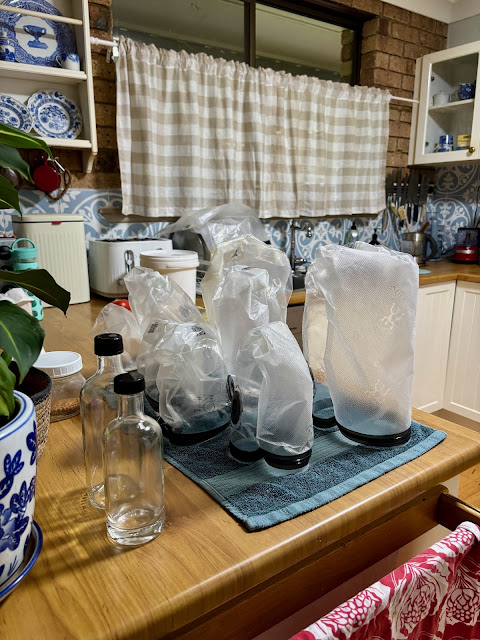
Every morning when I walk into my kitchen it looks tidy and ready for a day's work. Not so on this morning (above), I saw this when I walked in. Late the previous afternoon when I was looking for something, I came across my rolled up Zwilling vacuum bags and decided they had to be washed and dried. So I did that and although I usually put them outside on the verandah to dry it was dark by then. I turned the just-washed bags inside out and left them like this on a towel. It worked well and now the bags are ready to use when I bring home root vegetables, cabbages or whatever I buy that I want to last four or five weeks.
Image

You’ll save money by going back to basics

When I was doing the workshops and solo sessions, I had a couple of people whose main focus was on creating the fastest way to set up a simple life. You can't create a simple life fast, it's the opposite of that It's not one single thing either - it's a number of smaller, simpler activities that combine to create a life that reflects your values; and that takes a long to come together. When I first started living simply I took an entire year to work out our food - buying it, storing it, cooking it, preserving, baking, freezing, and growing it in the backyard. This is change that will transform how you live and it can't be rushed.  
Image


Trending Articles

NOT the last post

This will be my last post here.  I've been writing my blog for 18 years and now is the time to step back. I’ve stopped writing the blog and come back a couple of times because so many people wanted it, but that won’t happen again, I won’t be back.  I’ll continue on instagram to remain connected but I don’t know how frequent that will be. I know some of you will be interested to know the blog's statistics. 
Image

Every morning at home

Every morning when I walk into my kitchen it looks tidy and ready for a day's work. Not so on this morning (above), I saw this when I walked in. Late the previous afternoon when I was looking for something, I came across my rolled up Zwilling vacuum bags and decided they had to be washed and dried. So I did that and although I usually put them outside on the verandah to dry it was dark by then. I turned the just-washed bags inside out and left them like this on a towel. It worked well and now the bags are ready to use when I bring home root vegetables, cabbages or whatever I buy that I want to last four or five weeks.
Image

You’ll save money by going back to basics

When I was doing the workshops and solo sessions, I had a couple of people whose main focus was on creating the fastest way to set up a simple life. You can't create a simple life fast, it's the opposite of that It's not one single thing either - it's a number of smaller, simpler activities that combine to create a life that reflects your values; and that takes a long to come together. When I first started living simply I took an entire year to work out our food - buying it, storing it, cooking it, preserving, baking, freezing, and growing it in the backyard. This is change that will transform how you live and it can't be rushed.  
Image

Creating a home you'll love forever

Living simply is the answer to just about everything. It reduces the cost of living; it keeps you focused on being careful with resources such as water and electricity; it reminds you to not waste food; it encourages you to store food so you don't waste it and doing all those things brings routine and rhythm to your daily life. Consciously connecting every day with the activities and tasks that create simple life reminds you to look for the meaning and beauty that normal daily life holds.  It's all there in your home if you look for it. Seemingly mundane tasks like cleaning and cooking help you with that connection for without those tasks, the home you want to live in won't exist in the way you want it to.  Creating a home you love will make you happy and satisfied.
Image

Time changes everything

I've been spending time in the backyard lately creating a contained herb and vegetable garden. My aim is to develop a comfortable place to spend time, relax, increase biodiversity and encourage more animals, birds and insects to live here or visit. Of course I'd prefer my old garden which was put together by Hanno with ease and German precision. Together, we created a space bursting at the seams with herbs, vegetables and fruity goodness ready to eat and share throughout the year. But time changes everything. What I'm planning on doing now, is a brilliant opportunity for an almost 80 year old with balance issues. In my new garden I'll be able to do a wide range of challenging or easy work, depending on how I feel each day. It’s a daily opportunity to push myself or sit back, watch what's happening around me and be captivated by memories or the scope of what's yet to come.
Image

It's the old ways I love the most

I'm a practical woman who lives in a 1980’s brick slab house. There are verandahs front and back so I have places to sit outside when it's hot or cold. Those verandahs tend to make the house darker than it would be but they're been a great investment over time because they made the house more liveable. My home is not a romantic cottage, nor a minimalist modern home, it's a 1980’s brick slab house. And yet when people visit me here they tell me how warm and cosy my home is and that they feel comforted by being here. I've thought about that over the years and I'm convinced now that the style of a home isn't what appeals to people. What they love is the feeling within that home and whether it's nurturing the people who live there.
Image

Making ginger beer from scratch

We had a nice supply of ginger beer going over Christmas. It's a delicious soft drink for young and old, although there is an alcoholic version that can be made with a slight variation on the recipe. Ginger beer is a naturally fermented drink that is easy to make - with ginger beer you make a starter called a ginger beer plant and after it has fermented, you add that to sweet water and lemon juice. Like sourdough, it must ferment to give it that sharp fizz. To make a ginger beer plant you'll need ginger - either the powdered dry variety or fresh ginger, sugar, rainwater or tap water that has stood for 24 hours to allow the chlorine to evaporate off. You'll also need clean plastic bottles that have been scrubbed with soap, hot water and a bottle brush and then rinsed with hot water. I never sterilise my bottles and I haven't had any problems. If you intend to keep the ginger beer for a long time, I'd suggest you sterilise your bottles. MAKING THE STARTER In a...
Image

An authentic look at daily life here — unstaged and real

Most days Hanno was outside happily working in the fresh air. It may surprise you to know that I started reading my book,  Down to Earth , yesterday - the first time since I wrote it 13 years ago.  I had lent it to my neighbor, and when she returned it, I started reading, expecting to find surprises. Instead, I realised the words were still familiar—as if they were etched into my memory. As I flipped through the pages, I was reminded of how important it was for me to share that knowledge with others. The principles in Down to Earth changed my life, and I truly believed they could do the same for others. After just 30 minutes of reading, I put the book down, reassured that its message still holds true: we can slow down and reshape our lives, one step at a time.
Image