down to earth

  • Home
  • About Us
  • Down To Earth Book
  • Privacy Policy
This is the second last kitchen sink post, so get ready for a new series. I want you to send TWO only photos showing your work space - that could be in your home, where you work outside the home, in the garden, on your farm, at school, or, for all those lurking blokes out there, your shed, garden or garage or where you go out to work - it could be the cabin of a big rig or your office desk. Please write two paragraphs describing your work space and something about yourself. I imagine we will get photos of sewing machines, knitting projects in comfy chairs, sheds, cooking, cars, horses, gardens and all sorts of wonderful places from all over the world. Please tell me where you are from and include a link to your blog if you have one. Send your photos to rhondahetzel@gmail.com  ADDITION:  Please make sure your photos are around 100k, no bigger, and no videos please.  Thanks everyone.  This is going to be a great series.

Today's photo is from a town very close to where I live. In fact, the kitchen setup is very much like mine, including the placement of the fruit bowl. This is Debra's kitchen and she lives in Queensland, Australia.

Debra writes:
"This is my kitchen. It is just on 18 years old, we have been in this house since we owner built it back in 92, and I still love my kitchen. It is the hub of the house, as is most peoples. The only thing we have changed is we have put in a dishwasher, we removed 2 cupboards to do this, which left us with a little nook between the dishwasher and the next cupboard, which is a perfect spot for jars etc., and we have put in a new ceramic cooktop. The oven is still the same, we replaced the fan in that about 18 months ago, and the rangehood is still the original. The wide benchtop is brilliant. I did the tiling myself, and we also laid the slate floor ourselves. The kitchen window looks out over our entertainment area and greenhouse, and the dining area next to it looks out over the pool and garden area. I have a nice big walk in corner pantry, which, when tidy, has heaps of room for everything we could ever need.


My knitted dishcloth is hanging over my tap :) I have to knit some more. I picked up some lovely cotton from an opshop I think they were something like 50c a ball, and I get 2 or so per ball of wool. I like this waffle weave pattern the best. 
My home journal is on the bench, this has phone numbers, menus, school notes etc etc in it. My husband made my phone cupboard, the drawer holds pens etc. In the corner next to the dish drainer is the recipe book holder my sister made for me for my birthday. I use this a lot. My chook scraps bucket is next to the sink, and is used everyday. When the girls see me walking up the yard with this in the afternoon, they all come running!! I have a country wall hanging next to the phone, I picked this up from a garage sale for $2, and under that is my handmade wall/desk calender. This gets used a lot also. I don't like my home to be cluttered, but I do like a few favourites here and there. I will be purchasing some new stools for the breakfast bar shortly, as my husband made some but over the years they have slowly but surely broken, and he doesn't want to make them this time, I have my eye on some lovely ones, so I think these will be an added addition to our home soon. :)

You can visit Debra's blog by clicking here. 

Please don't forget to comment. A comment is like payment for the time taken to post, and in this case in sending in the photos.  Many of us were enthusiastic about this series, so make sure all the photos get a good number of comments.  I don't want any of the people sending in photos to regret joining in.  Thank you friends. 
Roots from the palm trees are invading our backyard drains and after thinking about it for some time, Hanno decided to take action.  He called out to me to come and help him.  I walked outside to see a long rope tied to our fig tree, the other end tied to the middle palm.  "I'm going to cut the palm tree down, you hold the rope so it doesn't fall on the shed."  So I was in charge of stopping a one tonne tree falling onto our shed.  We are living on the edge here, in more ways than one.  


In reality, all I had to do was hold the rope tight, Hanno would cut the tree so it fell away from the shed.  The rope was our insurance!  So he got our ancient electric chain saw and started cutting while I took photos and did the job asked of me.  All went to plan and the tree fell where he wanted it to with nothing damaged.  I am hoping he clears the rest of the trees and plants smaller fruit trees in their place.  The chooks will miss the palms, as they were a favourite summer afternoon resting place.
Inside the house, I did some writing and talking on the phone to my sister, Bernadette and my friend in Townsville, Kathleen.  When I sat to rest, I took up the needles and did some knitting.  Is there anything better on an overcast cool day than to sit in a warm room with your knitting or sewing? I sat, contentedly, for a few hours clicking, threading and flicking wool this way and that..  I could feel the strength and energy I lost yesterday return with every row.  Clicking away, not thinking of anything but the soft wool, slowly building a jumper/sweater for Hanno.


I'm working on three projects at the moment, although if you looked in my knitting basket you'd think it was 20. I think knitting baskets are supposed to be untidy and as long as the yarns don't start tangling together, I'm happy to see the mixture of colours and textures.  As well as Hanno's jumper, I'm knitting a big scarf and some mittens. They're all simple projects that I can make up as I go.  I'm not good with patterns and counting, so I tend to knit simply so I can change it when I feel the need.  What's on your needles right now?


I'm feeling on top of the world again today.  All that knitting healed me.  Today I'm back at the Centre for Sorry Day but I'll also take Bernadette to the doctor.  I hope you enjoy your day and if you're in Australia, please spare a thought for our first Australians.
Every morning, on that short walk over dewy grass to our chook house, I am usually aware of a feeling of acute optimism and hope for the day ahead.   I bend down to pick up a brick to keep the gate open, unlock the door to the coop, remove the block of wood that stops rats and other night visitors opening the food hopper, then call the girls to come out and greet the day.  They wait at the gate for me to walk out with them but often I stop to look at the garden.  It's backdropped by the house and I can stand there in the half-light with the bright green of the garden almost shining right in front of me while the house, lit then by only one kitchen light, stands in the shadows.  This scene almost always fills me with optimism and eagerness for the day ahead.


I felt that optimism yesterday when I stood looking, came back inside to get my camera, and took pictures of what I saw.  I thought I might capture that feeling and use the image as a computer wallpaper - a reminder to myself of what is possible, even in a small and simple backyard.

The chook house, with the flash.  The first of the girls share a meal at the hopper, Heather watches, waiting her turn, and Kylie, as usual, sits on the nest trying to hatch invisible eggs.

Yesterday was my big workday.  I needed to be full of enthusiasm and energy.  I left here around 7am to go to the bakery and  IGA to select food to serve at the Centre.  I did one of my Frugal Home workshops and knew I would have hungry mouths to feed.  I settled on fruit scones and tea for morning tea, with crackers and cheese, chicken and ham salad sandwiches, wedges of watermelon and orange, tea and coffee for lunch.  I over catered because there would be another meeting at night and whatever was left over could be eaten then along with the mushroom pasta bake I took from home for our evening meal.

I picked up all my supplies, was really pleased I had all my volunteers to help make the sandwiches, then settled down before anyone else arrived to write a short piece for the local newspaper.  The phone rang ... twice.  Two of my volunteers were sick and could not come in.  Luckily our high school trainee would be there along with one volunteer. 

We had a number of activities happening during the morning - a first aide for babies course and our sewing circle, as well as my workshop.  I made some phone calls then saw Sonya from the Permaculture Pathways blog walk in.  She came to learn how to make an apron so I took her out to the sewing room, invited her to make a cuppa, then went back to find our statistics file so I could use it in a report I was writing.  Babies, mums and dads started filing in for the first aide course, then my Frugal Home people arrived and we were into it.  I think the people who attended found it helpful. There were two ladies there who read my blog.  Hello Caroline and Natalie! The course over, we had lunch together, then I started writing my report for the later meeting.

People kept coming in to talk, I had about five phonecalls, another small meeting, then we closed the Centre for the day.  The presenter of a solar panel info session arrived to set up for his presentation at 7 pm.  I heated up the pasta bake, got the leftover sandwiches from the fridge and set up our small meeting room for our committee meeting.  That ran from 5 till 8pm and as it got later and I grew tired, I thought a couple of times about that view over my turnip tops and cabbages across to the house.  My feelings of optimism were being replaced by thoughts of a warm and cosy bed.


I drove home in the pouring rain and there Hanno and Alice were waiting for me as I knew they would be.  I sat with Hanno for five minutes, then went to bed, happy that I had used my time well that day.  And now I'm about to go out and walk to the chook house again and see that scene again in the half light.  I will spent this day at home baking and cooking and maybe napping this afternoon.  Tomorrow I'm back at the Centre again for Sorry Day, we have a big function planned that I am really looking forward to.

Thank you all so much for sharing your stories yesterday.  I have not yet read them all but will try to do that today.  I'm also going to visit the blogs mentioned but that will have to wait till later in the week.  I hope you have a lovely day today and enjoy what you do.

When I started living more simply I didn't know what simple living was.  All I knew was that I didn't want to work and for me that presented a dilemma.  You see, I am a working class girl.  So if I wasn't going to be working, what would I do?  It was important that I continue to work in some way so I was really pleased when I realised that I could change the way I lived by working in a different way.  Not only would I have a simple philosophy, I would also express myself by simplifying my everyday activities.  I didn't know it then but I was about to reinvent myself and my life and I would never look back.
This week's flowers are camellias and clivia.

It became clear very quickly that changing one thing lead to another and that most household activities were linked.  Learning how to stockpile, made me look at the way I cooked, that linked to my budgeting and how I spent my time.  Wanting to reduce the amount of waste we threw out and the amount of packaging we brought into our home lead me to knitting dishcloths, which lead to knitting jumpers, and sewing in all its various ways. So instead of planning what I would do, I just did what I was interested and that lead me on to the next thing and the next.

A fruit loaf made last week.

We all know this journey never ends and that there is no one size fits all - each and every simple life is different.  I am interested in knowing what lead you to your simple changes and how you have simplified.  If you have a blog, please leave a link so I can read a bit about you in the coming days.  This is a fascinating subject and I am sure that discussing it like this will help others who are thinking about change but haven't taken the plunge yet.

In with a lot of other emails I had one from Ceri through the week.  I asked her if it was okay to answer in a post because I think this is something many people struggle with.  To summarise, Ceri wrote that she and her husband have just moved from Dubai to Cyprus in the hope of living a simpler life.  She writes:  "What I would like to have some ideas on are  how to adjust and not feel guilty about being a stay at home wife.  We have no children and I have worked long and hard most of my adult life. My husband’s salary covers the bills and we can put aside a little for the future and the life insurance but there is very little spare outside of that.  ( I used to be a 3 overseas  holidays a year Radley handbag girl,)  Now  I have chosen to stay at home as this was part of the plan to drastically change our way of living, but I feel really guilty about not bringing in the bread even though I am learning to bake it.  I feel ashamed to tell friends that we cannot afford things and don’t want to make new friends for fear of them laughing at my simple ideas.   How do I overcome this?

 Also  how do I go about starting my own veggie garden in rented accommodation.  How would you suggest I do this so that I don’t upset the garden but still begin my dream of growing my own produce and know I can take it with me when the time comes to move on."

Dear Ceri, all changes take time to feel right and natural and this is a very big change so it doesn't surprise me that you feel uneasy.  One thing you should do is to think of what you're doing at home now as your real job.  It will be as time consuming as any paid job, maybe even more so, and thinking of it as your job might help you with your adjustment.  That is what I did when I left work. I wasn't earning money but I felt it was my job to save money in the home to make up for what I wasn't earning.  That lead me to everything I currently do in my home.  It is my job to shop for bargains and get value for every cent we spend; I must grow or buy good quality food for our table; it's my responsibility to look after our assets so they last as long as possible - that covers everything from bed sheets and clothing, to everything in our house and the house itself.  If I do my job properly, we'll spend less, conserve more and live well in the process.


With your husband going out to earn money and you saving your money at home, you'll make an excellent team.  Remember, you'll be leading the way here.  This is new territory for both of you.  Check through blogs you can relate to and see how others are living, then cherry pick what you think will work for you. Your job then is to customise that to really suit your lives, and add more of your own original ideas.  When I first left work, I wanted to live a simpler life, I wanted to built a life that would suit both Hanno and myself, I wanted to work hard but to really enjoy every minute of the day.  I knew there would be days of toilet cleaning and vacuuming carpets, but I also knew there would be many times I'd be out in the sunshine talking to the chickens and gardening, and times spent cozying up inside in the winter with my knitting.  I wanted all of it.


When you live like this you feel you're really in control and if that's the first time your own life has made you feel like that, it's very liberating.  You feel like you can take on the world!  Everyone's life is a series of stages - you've been through your three annual holidays and Radley handbags stage, now you've progressed to something beyond that.  (BTW, I have no idea what a Radley handbag looks like.)  What this stage is like is all up to you and your husband.  There should be no shame in what you're doing now and being open and honest with your friends is one of the greatest gifts you can give them.  Anyone who shuns you for not being able to buy what they buy is not worthy of being your friend.  But you'll have to develop pride  and satisfaction in the way you live before others will see it in that light too.  I hope you can just forget about what others are thinking - just live as you wish, develop your skills, become more self reliant, and I think that will bring you self confidence too.


There are a number of things you can do in rented accommodation.  
  1. First, ask the owner if you can put in a garden and show them drawn up plans for what you would like to do.  You may be surprised.  
  2. Go to the local recycle shop and buy some containers in which to grow lettuce, tomatoes, chard and herbs. Plant small varieties of the vegetables you like to eat in these containers.  If you plant against a wall, you'll be able to grow beans, peas and cucumbers too.  
  3. See if you can find a good market where you can shop weekly and accept the fact that while you can't garden now, it is waiting for you in the future. 
  4. Grow sprouts in your kitchen and learn how to make sour dough and yoghurt, gardening can wait.
There is a lot to take pride in when you build a life that makes you happy.  Money alone cannot buy that, it takes time, effort, skill and the ability to let go of what we've been programmed to believe.  Turning your back on conspicuous consumption, giving yourself time to hand-make a life and living with less is the opposite of what we are brought up to believe will make us happy.  When you live that way, it may be uncomfortable for some people but soldier on nonetheless; they'll get used to it or move on.  As you are settling into your new lives you should be focused on each other and your home, other things and people can wait.  But I believe that when you build the life you want; when you develop a rhythm to your days that helps you accomplish all you want and need to do; when you slow down and concentrate on building your new life, the people who mean something will be there.  And they will be people who will not make you feel shame in the way you live or how much you can afford to do.  It's a brand new way of life for you, Ceri, many things will seem strange and unusual, but you should also feel excited and optimistic.  You are on the verge or reinventing your lives and yourselves and you are very fortunate to be able to do that.  I wish you well in your new lives.

We went to the shops yesterday - a trip to the big mall down on the coast. Gulp.  Hanno jumped at the chance to come with me, he's been at home alone while I've been at work these past two days and there was a big electrical repair job being done in our area so the electricity was to be off from 8 am till 3pm. I needed to buy provisions for some of our homeless clients. Now that winter is here, they need sleeping bags, blankets and tents, so along with those thing we also bought saucepans, frying pans, and a couple of nifty little gas stoves and propane gas to keep the stoves going for a while.  It was good to have him with me to help with the bulky items we would buy.  In the end we fully loaded two big trolleys.

The scene at the end of our street when we came home.

It's interesting going into a place like that if you're not used to it.  People rush.  I'm sure they don't know they rush, but they do.  And, they apologise if they can't rush and if they hold you up so you can't rush.  The total of our bill was $955, and I had to pay with a cheque from the Centre I work at.  The girl put the items through but the register refused to take the cheque.  She called a supervisor and they both apologised that we couldn't be on our way quickly.  Hanno and I were just fine, we went and sat just off from the checkouts and waited.  We did some people watching as we both find that very interesting. Finally the supervisor asked me to go with her while she checked my details on the phone.  Everything was cleared and she apologised (again) for holding me up.  I told her it was fine and that I wasn't in a hurry.  She looked at me like I'd just landed from another planet.

Also at the end of our street - a timely reminder to slow down.

We went back to the till and she had to re-enter everything back into the computer because the first girl had wiped the sale from the system.  The supervisor apologised again because I had to wait.  "It's fine, dear"  I said.  "It's not your fault, and besides, I'm not in a hurry."  Her eyebrows turned into little pointy arrows and she peered at me above her glasses.  While I stood there waiting, customers walked into the queue behind me but glared when they realised I was holding everything up.

WARNING ... SLOW CUSTOMER IN AISLE 7!

I live in a slow world and nothing will make me hurry when I don't have to.  I realise it's a completely luxurious and indulgent way to live but it's one of the many benefits of growing older and I enjoy it immensely.  Not only is it an ideal way to be at home, but it gives you the chance to see what's going on when you're out and about; you can observe other people and you can see that they rush.

The back of our car was full of fleece blankets, sleeping bags, tents and little stoves.

I guess it took about 30 minutes to get through the checkout.  We didn't rush through like most others and we received several apologies because we could not rush.  Had the checkout staff been able to see what Hanno and I got up to after we left the store, I'm sure they would have shook their heads and mumbled something about pensioners or old people.  LOL  We ambled out with our two fully laden trolleys and went straight to the first coffee shop.  We both had a big mug of steaming hot coffee with weird squiggle art on the top and a dusting of chocolate powder, then loaded the car and returned to the store to look around, slowly.  Then we drove to the beach, bought some fish and chips in a paper parcel and sat, surrounded by seven hungry, begging herons, gazing out to the perfectly blue Pacific Ocean.  We didn't talk much, we didn't have to.  We fed the birds, enjoyed our lunch, then drove back home.


I don't know what I would have thought of two old codgers slowly dawdling in front of me in a shopping mall when I was younger and much faster.   I'm sure they wouldn't have annoyed me but I probably would have felt sorry for them, because they weren't getting through their shopping faster.  Let me say this loud and clear: life is fine in the slow lane.  The 15 minutes you might save by rushing isn't worth it. There is a time to rush, we've done that many times, but not rushing is much better.  You get to see what's really happening around you.  You really experience your time.  You are stress-free.  It's wonderful in the slow lane, join us, there aren't many of us here.
After today's kitchen, I have only two remaining in this series.  I'll start another series as soon as I've featured all the kitchen photos, so stay tuned for some more interesting peeks into the lives of readers all over the world.

Today we peek into Amy's American kitchen.  There is a lot going on in that kitchen with children and guests to feed.  If you visit Amy's blog you'll see some of her turkeys.


We renovated the very outdated kitchen and dining room when we bought this house.  We had very little money so we did the most with what we had.  For the entire kitchen and dining room (they started as two separate rooms) we spent less than $2500 and over a year.   Being a stay at home mom I spend most of my life within the walls of my home.  So I find it very important that my home make me happy and that is what my kitchen does, it makes me smile.  Countless meals have been cooked and eaten in here.  We LOVE to get together with friends and we often have house guests so where people are you must have good food.  And where there is good food there is usually a good mess too ;).  Needless to say many many hours are spent in this room.  It is very functional and very practical.  I like design with a practical use and try to use that throughout my whole house.
 
 
One of the most enjoyable things I have discovered over the past year is cooking with friends.  So almost on a weekly basis hours are spent in this kitchen with good friends cooking up some great food.  Laughing and even crying on occasion.  Everyone is welcome!  It is a gathering place.  The door is usually entered with a short knock before walking right in.  If you come through my kitchen door then you are more than likely a good friend and good friends in this kitchen can walk right in and sit right down.  Have yourself a glass of tea and chat for a bit.
 

On any given day you may find me in here making pasta, cheese, butter, bread, salsa, spaghetti sauce.  Doing Once a Month Cooking, canning, freezing or preserving.  We even have baby turkeys in it at that moment. 

Please don't forget to comment. A comment is like payment for the time taken to post, and in this case in sending in the photos.  Many of us were enthusiastic about this series, so make sure all the photos get a good number of comments.  I don't want any of the people sending in photos to regret joining in.  Thank you friends.  


I am always on the lookout for delicious thrifty meals that are fairly easy to make but in winter I keep coming back to this old standby that ticks all those boxes - split pea soup.  I think it's a favourite in many families but I thought I'd write about how I make it for anyone who hasn't discovered how to cook it entirely from scratch.

The key to most good food is good ingredients and this is no exception.  I start with a ham bone, this one bought on special after Christmas for $2, then I add two small packs (500g/1lb each) of split peas (one green and one yellow) $1.40 each and whatever vegetables from the garden or fridge I fancy.  I always use onions and carrots, for this soup I also used a celeriac root.  For additional flavouring, I added bay leaves and parsley from the garden.  So altogether, this soup cost me $3.40 for the ham bone and peas, and about three dollars for the onions, carrots and celeriac.  Add the cost of water, salt and pepper and gas to cook with, say 60 cents, and I'm up to $7.  This made up about 7 litres/quarts of soup, enough for Hanno and I for many days.

Assemble your ingredients.  If you don't have celeriac, use celery, which is more traditional.  The celeriac almost disintegrates in the soup and gives it a mild celery flavour.

Chop the vegetables and herbs.  Leave the bay leaves whole.


Place the peas in a large bowl and wash them in cold water, then pour boiling water over them and leave for a while.

Place the chopped vegetables, herbs and ham bone in a large pot and fill with water. I used a large stockpot that holds about 9 litres/quarts.  Bring to the boil and allow to simmer for about 30 minutes.

Add the peas and stir in.  Bring back to the boil and cook for about 2 hours on a slow heat.   It's ready when the meat falls off the ham bone.

 After you add the peas and boil them, you'll see scum rising to the top of the soup.  That's okay!  It's just the various starches from the peas - skim it off with your soup ladle.


The soup is ready when the meat is tender and the vegetables cooked to your liking.  Personally, I like the vegetables to be mushy.  Let the soup cook a little, remove the ham bone and take the meat off the bone, chop it into pieces and return to the soup.  Remove the bay leaves.

This soup doesn't need pre-made stock, it makes its own stock as it cooks.  Add your seasoning right at the end.  Pork tends to need a fair bit of salt and pepper and although I add pepper, I don't add salt to the soup pot.  Hanno has high blood pressure so salt is a no no for him.  I add my own salt to my dish.  I do add croutons that I make just before serving by brushing two slices of bread with virgin olive oil .  I then cut the slices into small cubes and dry fry in a frying pan.  Another useful addition to bulk the soup out is to add smoked sausage/frankfurts cut into disks.  When served with a dessert of fruit and yoghurt or custard, we find this is a satisfying and warming dish that we both enjoy.

This is one of those soups that tastes better each day when you reheat it, but it also freezesd very well.
Newer Posts Older Posts Home


My books were all published by Pengiun, and are available at Amazon US, Amazon UK and Amazon Au

Search here

Total Pageviews

Translate


I'm Rhonda Hetzel and I've been writing my Down to Earth blog since 2007. Although I write the occasional philosophical post, my main topics include home cooking, happiness and gardening as well as budgeting, baking, ageing, generosity, mending and handmade crafts. I hope you enjoy your time here.

MY FAVOURITE PLACES

  • Grandma Donna's Place
  • Grandma Donna's YouTube
  • Grandma Donna's Instagram
  • This Simple Day
  • Nicole's Instagram

Give More

Give More

Popular posts last year

Making ginger beer from scratch

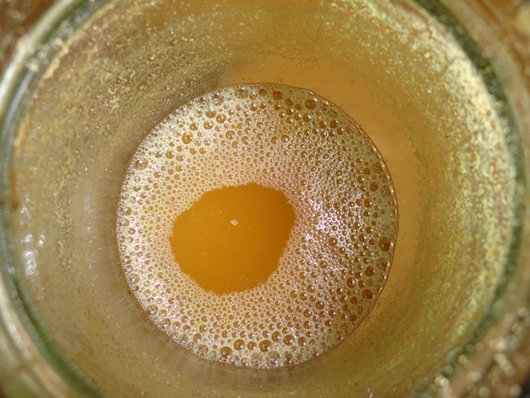
We had a nice supply of ginger beer going over Christmas. It's a delicious soft drink for young and old, although there is an alcoholic version that can be made with a slight variation on the recipe. Ginger beer is a naturally fermented drink that is easy to make - with ginger beer you make a starter called a ginger beer plant and after it has fermented, you add that to sweet water and lemon juice. Like sourdough, it must ferment to give it that sharp fizz. To make a ginger beer plant you'll need ginger - either the powdered dry variety or fresh ginger, sugar, rainwater or tap water that has stood for 24 hours to allow the chlorine to evaporate off. You'll also need clean plastic bottles that have been scrubbed with soap, hot water and a bottle brush and then rinsed with hot water. I never sterilise my bottles and I haven't had any problems. If you intend to keep the ginger beer for a long time, I'd suggest you sterilise your bottles. MAKING THE STARTER In a...
Image

NOT the last post

This will be my last post here.  I've been writing my blog for 18 years and now is the time to step back. I’ve stopped writing the blog and come back a couple of times because so many people wanted it, but that won’t happen again, I won’t be back.  I’ll continue on instagram to remain connected but I don’t know how frequent that will be. I know some of you will be interested to know the blog's statistics. 
Image

How to make cold process soap

I'm sure many of you are wondering: "Why make soap when I can buy it cheaply at the supermarket?" My cold process soap is made with vegetable oils and when it is made and cured, it contains no harsh chemicals or dyes. Often commercial soap is made with tallow (animal fat) and contains synthetic fragrance and dye and retains almost no glycerin. Glycerin is a natural emollient that helps with the lather and moisturises the skin. The makers of commercial soaps extract the glycerin and sell it as a separate product as it's more valuable than the soap. Then they add chemicals to make the soap lather. Crazy. Making your own soap allows you to add whatever you want to add. If you want a plain and pure soap, as I do, you can have that, or you can start with the plain soap and add colour, herbs and fragrance. The choice is yours. I want to add a little about animal and bird fat. I know Kirsty makes her soap with duck fat and I think that's great. I think t...
Image

Preserving food in a traditional way - pickling beetroot

I've had a number of emails from readers who want to start preserving food in jars but don't know where to start or what equipment to buy.  Leading on from yesterday's post, let's just say up front - don't buy any equipment. Once you know what you're doing and that you enjoy preserving, then you can decide whether or not to buy extra equipment. Food is preserved effectively without refrigeration by a variety of different methods. A few of the traditional methods are drying, fermentation, smoking, salting or by adding vinegar and sugar to the food - pickling. This last method is what we're talking about today. Vinegar and sugar are natural preservatives and adding one or both to food sets up an environment that bacteria and yeasts can't grow in. If you make the vinegar and sugar mix palatable, you can put up jars of vegetables or fruit that enhance the flavour of the food and can be stored in a cupboard or fridge for months. Other traditional w...
Image

Cleaning mould from walls and fabrics

With all this rain around we've developed a mould problem in our home. Usually we have the front and back doors open and that good ventilation stops most moulds from establishing. However, with the house locked up for the past week, the high humidity and the rain, mould is now growing on the wooden walls near our front door and on the lower parts of cupboards in the kitchen. Most of us will find mould growing in our homes at some point. Either in the bathroom or, in humid climates, on the walls, like we have now. You'll need a safe and effective remedy at some point, so I hope one of these methods works well for you. Mould is not only ugly to look at, it can cause health problems so if you see mould growing, do something about it straight away. The longer you leave the problem, the harder it will be to get rid of it effectively. If you have asthma or any allergies, you should do this type of cleaning with a face mask on so you don't breathe in any spores. Many peopl...
Image

Five minute bread

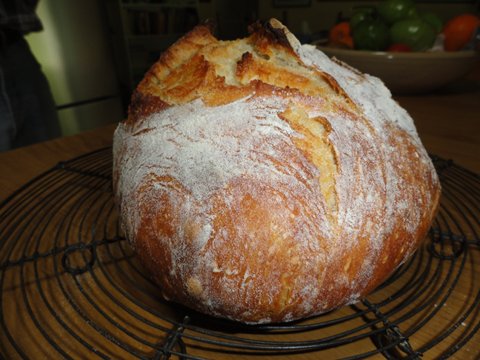
Bread is one of those foods that, when made with your own hands, gives a great deal of satisfaction and delight. It's only flour and water but it symbolises so much. I bake bread most days and use a variety of flours that I buy in bulk. Often I make a sandwich loaf because we use most of our bread for lunchtime sandwiches and for toast. Every so often I branch out to make a different type of loaf. I have tried sour dough in the past but I've not been happy with any of them. I'll continue to experiment with sour dough because I like the idea of using wild yeasts and saving the starter over a number of years to develop the flavour and become a part of the family. However, the loaf I've been branching out to most often is just a plain old five minute bread. By five minutes I mean it takes about five minutes actual work to prepare but it's the easiest of all bread to make and to get consistently good loaves from. If you're having people around for lunch or...
Image

This is my last post.

I have known for a while that this post was coming, but I didn't know when. This is my last post. I'm closing my blog, for good, and I'm not coming back like I have in the past.  I've been writing here for 16 years and my blog has been many things to me. It helped me change my life, it introduced me to so many good people, it became a wonderful record of my family life, it helped me get a book contract with Penguin, and monthly columns with The Australian Women's Weekly and Burke's Backyard . But in the past few months, it's become a burden. In April, I'll be 75 years old and I hope I've got another ten years ahead. However, each year I'll probably get weaker and although I'm fairly healthy, I do have a benign brain tumour and that could start growing. There are so many things I want to do and with time running out, leaving the blog behind gives me time to do the things that give me pleasure. On the day the blog started I felt a wonderful, h...
Image

What is the role of the homemaker in later years?

An email came from a US reader, Abby, who asked about being a homemaker in later years. This is part of what she wrote: "I am a stay-at-home mum to 4 children, ages 9-16. I do have a variety of "odd jobs" that I enjoy - I run a small "before-school" morning drop-off daycare from my home, I am a writing tutor, and I work a few hours a week at a local children's bookstore. But mostly, I cherish my blissful days at home - cooking, cleaning (with homemade cleaners), taking care of our children and chickens and goats, baking, meal-planning, etc. This "career" at home is not at all what I imagined during my ambitious years at university, but it is far more enriching. I notice, though, that my day is often planned around the needs of my family members. Of course, with 4 active kids and a husband, this is natural. I do the shopping, plan my meals, cook dinner - generally in anticipation of my family reconnecting in the evening.  I can't h...
Image

Every morning at home

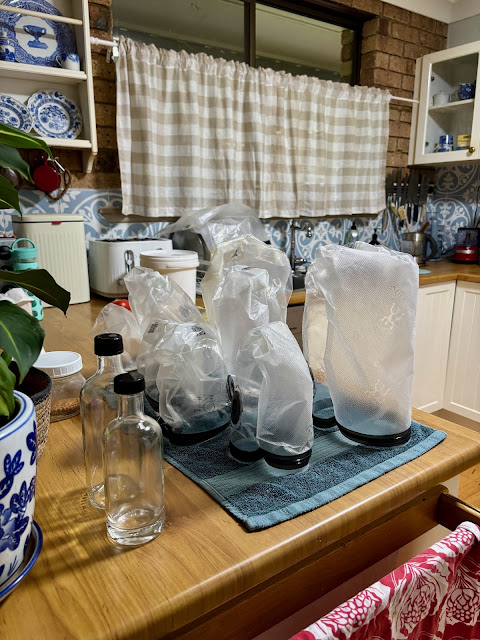
Every morning when I walk into my kitchen it looks tidy and ready for a day's work. Not so on this morning (above), I saw this when I walked in. Late the previous afternoon when I was looking for something, I came across my rolled up Zwilling vacuum bags and decided they had to be washed and dried. So I did that and although I usually put them outside on the verandah to dry it was dark by then. I turned the just-washed bags inside out and left them like this on a towel. It worked well and now the bags are ready to use when I bring home root vegetables, cabbages or whatever I buy that I want to last four or five weeks.
Image

You’ll save money by going back to basics

When I was doing the workshops and solo sessions, I had a couple of people whose main focus was on creating the fastest way to set up a simple life. You can't create a simple life fast, it's the opposite of that It's not one single thing either - it's a number of smaller, simpler activities that combine to create a life that reflects your values; and that takes a long to come together. When I first started living simply I took an entire year to work out our food - buying it, storing it, cooking it, preserving, baking, freezing, and growing it in the backyard. This is change that will transform how you live and it can't be rushed.  
Image


Trending Articles

NOT the last post

This will be my last post here.  I've been writing my blog for 18 years and now is the time to step back. I’ve stopped writing the blog and come back a couple of times because so many people wanted it, but that won’t happen again, I won’t be back.  I’ll continue on instagram to remain connected but I don’t know how frequent that will be. I know some of you will be interested to know the blog's statistics. 
Image

Every morning at home

Every morning when I walk into my kitchen it looks tidy and ready for a day's work. Not so on this morning (above), I saw this when I walked in. Late the previous afternoon when I was looking for something, I came across my rolled up Zwilling vacuum bags and decided they had to be washed and dried. So I did that and although I usually put them outside on the verandah to dry it was dark by then. I turned the just-washed bags inside out and left them like this on a towel. It worked well and now the bags are ready to use when I bring home root vegetables, cabbages or whatever I buy that I want to last four or five weeks.
Image

You’ll save money by going back to basics

When I was doing the workshops and solo sessions, I had a couple of people whose main focus was on creating the fastest way to set up a simple life. You can't create a simple life fast, it's the opposite of that It's not one single thing either - it's a number of smaller, simpler activities that combine to create a life that reflects your values; and that takes a long to come together. When I first started living simply I took an entire year to work out our food - buying it, storing it, cooking it, preserving, baking, freezing, and growing it in the backyard. This is change that will transform how you live and it can't be rushed.  
Image

Creating a home you'll love forever

Living simply is the answer to just about everything. It reduces the cost of living; it keeps you focused on being careful with resources such as water and electricity; it reminds you to not waste food; it encourages you to store food so you don't waste it and doing all those things brings routine and rhythm to your daily life. Consciously connecting every day with the activities and tasks that create simple life reminds you to look for the meaning and beauty that normal daily life holds.  It's all there in your home if you look for it. Seemingly mundane tasks like cleaning and cooking help you with that connection for without those tasks, the home you want to live in won't exist in the way you want it to.  Creating a home you love will make you happy and satisfied.
Image

Time changes everything

I've been spending time in the backyard lately creating a contained herb and vegetable garden. My aim is to develop a comfortable place to spend time, relax, increase biodiversity and encourage more animals, birds and insects to live here or visit. Of course I'd prefer my old garden which was put together by Hanno with ease and German precision. Together, we created a space bursting at the seams with herbs, vegetables and fruity goodness ready to eat and share throughout the year. But time changes everything. What I'm planning on doing now, is a brilliant opportunity for an almost 80 year old with balance issues. In my new garden I'll be able to do a wide range of challenging or easy work, depending on how I feel each day. It’s a daily opportunity to push myself or sit back, watch what's happening around me and be captivated by memories or the scope of what's yet to come.
Image

It's the old ways I love the most

I'm a practical woman who lives in a 1980’s brick slab house. There are verandahs front and back so I have places to sit outside when it's hot or cold. Those verandahs tend to make the house darker than it would be but they're been a great investment over time because they made the house more liveable. My home is not a romantic cottage, nor a minimalist modern home, it's a 1980’s brick slab house. And yet when people visit me here they tell me how warm and cosy my home is and that they feel comforted by being here. I've thought about that over the years and I'm convinced now that the style of a home isn't what appeals to people. What they love is the feeling within that home and whether it's nurturing the people who live there.
Image

Making ginger beer from scratch

We had a nice supply of ginger beer going over Christmas. It's a delicious soft drink for young and old, although there is an alcoholic version that can be made with a slight variation on the recipe. Ginger beer is a naturally fermented drink that is easy to make - with ginger beer you make a starter called a ginger beer plant and after it has fermented, you add that to sweet water and lemon juice. Like sourdough, it must ferment to give it that sharp fizz. To make a ginger beer plant you'll need ginger - either the powdered dry variety or fresh ginger, sugar, rainwater or tap water that has stood for 24 hours to allow the chlorine to evaporate off. You'll also need clean plastic bottles that have been scrubbed with soap, hot water and a bottle brush and then rinsed with hot water. I never sterilise my bottles and I haven't had any problems. If you intend to keep the ginger beer for a long time, I'd suggest you sterilise your bottles. MAKING THE STARTER In a...
Image

An authentic look at daily life here — unstaged and real

Most days Hanno was outside happily working in the fresh air. It may surprise you to know that I started reading my book,  Down to Earth , yesterday - the first time since I wrote it 13 years ago.  I had lent it to my neighbor, and when she returned it, I started reading, expecting to find surprises. Instead, I realised the words were still familiar—as if they were etched into my memory. As I flipped through the pages, I was reminded of how important it was for me to share that knowledge with others. The principles in Down to Earth changed my life, and I truly believed they could do the same for others. After just 30 minutes of reading, I put the book down, reassured that its message still holds true: we can slow down and reshape our lives, one step at a time.
Image