down to earth

  • Home
  • About Us
  • Down To Earth Book
  • Privacy Policy
Change is in the air. I can feel it in my bones. Housekeeping, the acts of budgeting, food production, home cooking, cleaning, and caring for a family, is becoming a more attractive option for young people to immerse themselves in. Instead of being seen as second best, it's now up there as being a healthy, dignified, modern, family-centred way of gaining balance and harmony in life. Gone are the days when ambition and promotion win every time. Now there is a gentler option, now it's okay to put yourself in the picture and decide that the work that pays the bills can function efficiently alongside the unpaid work of housekeeping. Working together, they pay the biggest and best dividends. 

This week's flowers from the garden are mini gerberas, zinnias, camellias and mock orange greenery.

After too many years of men and women working hard to buy everything they are supposed to want and need, up popped common sense to ask this question: "Why not work less and do more for myself so that I don't need so much money to live?" Could it be that simple? Living well on less, hmmm, it's got a good ring to it. Most of us have grown up with the idea that you must work to have the money to keep up with the Joneses and while that concept is the basis of our Western economies, I believe families have been short-changed by it. While our governments are saying that families are the centrepiece of the nation, they put the economy first; surely they should have equal footing. I’m not advocating we all give up work and stay home to mellow out but it shouldn’t be an all or nothing scenario. There should be an option for job sharing, part time work, two parents working at different times, working from home and home businesses. No one is telling us to cut our desires and expenses so we can give more time to family and to life. The emphasis is to build the economy, work longer, buy more, live in bigger houses and have “good debt”. Up until the second world war, before the days of credit cards and huge mortgages, we all lived very happily with less and by doing much of the work we now pay to have done for us. It's a vicious circle - we work to have the money to live well, but when we see all those things we want, we have to work more to pay for it all. We also spend more on food because we don't have the time to carefully prepare our own food. A quick burger or bucket of chicken may be handy at the end of a busy day but that and being tired and overworked is putting us in our graves too soon. 

A small garden harvest for that night's dinner.

I think the economic crisis has been another part of the push towards homekeeping - as people lose their jobs, they concentrate more on saving money in the home and realise they can save a lot and that the work is rewarding. Some have seen the sense of growing food if there is space in the backyard, some have been more aware of their grocery budget and some have started knitting, sewing and making gifts in an endeavour to enrich life and save money at the same time. Thirty-seven percent of American households are actively growing vegetable gardens now. Hanno went to our local market early on Sunday morning to buy seedlings and had to wait five minutes at 5.45am to be served. When he left, over 50 people were waiting at the little stall to buy their precious cargo. We have been buying seedlings on and off at that stall for 12 years and it's never been that busy. Things are changing. 


I think blogs have helped drive this change too. Instead of reading only what is edited and thought to be what people want to (and should) read in magazines and newspapers, guided not so gently by the influence of advertisers, along came blogs, where all we have to do it press "publish" to get our unsolicited, uncensored and unedited thoughts out there. Many of those thoughts are pedestrian and supporting the status quo but there were also many subversive blogs that showed happy housewives, beautiful homes filled with love but not much money, people being fulfilled and enriched by working in their homes and a kind of nostalgia for the old days when all that was commonplace. Blogs have shown us that the unorthodox and unconventional ways of those people not caught up in modern "must have" living are a valuable template for a way of life that allows us to enjoy home and family without working till we drop to achieve it. 

Home made baked egg custard with nutmeg topping.  Shhhh, the cook had a little taste.  Both Hanno and I agree it's drop dead delicious.  A triple D rating.

Housework and homemaking are sustainable. Whatever is put into it is paid back to the worker, not in dollars but in comfort, appreciation, happiness, satisfaction, calmness, love and security. It's one of the types of work that is self-fulfilling and gently layered. There is no corporate ladder, work can be left until tomorrow and you don't work overtime unless someone is sick, or on the odd occasion when a ballet costume needs to be made or covering the robot costume with tin foil before the school play just has to be done. More and more I see it – families with one main breadwinner, or two casual workers, whose main desire is to work enough to pay the bills but not enough to wipe out those years from 25 – 60. Vegetable gardening, DIY, home cooking, homekeeping, organisation and budgeting are making a comeback. I think a change to common sense has started, I hope there will be no going back.

Today's kitchen is from Annie Jones in Kansas City, Missouri, USA.  It looks like Annie does a lot of cooking in that kitchen.

Annie writes:
"In the first picture you'll see my double sink, with the coffee maker to the left and the dish drainer to the right. The dish drainer is holding baking stones and pizza pans. There is a lot of sunlight coming through the window, but it is shaded by our crab-apple tree in the summer.


In the second picture, taken on a different day, shows more pots and pans in the drainer. In addition to washing dishes by hand, I also use our dishwasher. You'll see my Bosch mixer on the very far left. I wouldn't want to be without it for mixing bread dough. I have a gas range and an electric combination microwave/convection oven above it. On the stovetop is a blue enamel pot. I use it exclusively for brewing a gallon of tea at a time for iced tea."
 
 
Please don't forget to comment. A comment is like payment for the time taken to post, and in this case in sending in the photos.  Many of us were enthusiastic about this series, so make sure all the photos get a good number of comments.  I don't want any of the people sending in photos to regret joining in.  Thank you friends.   

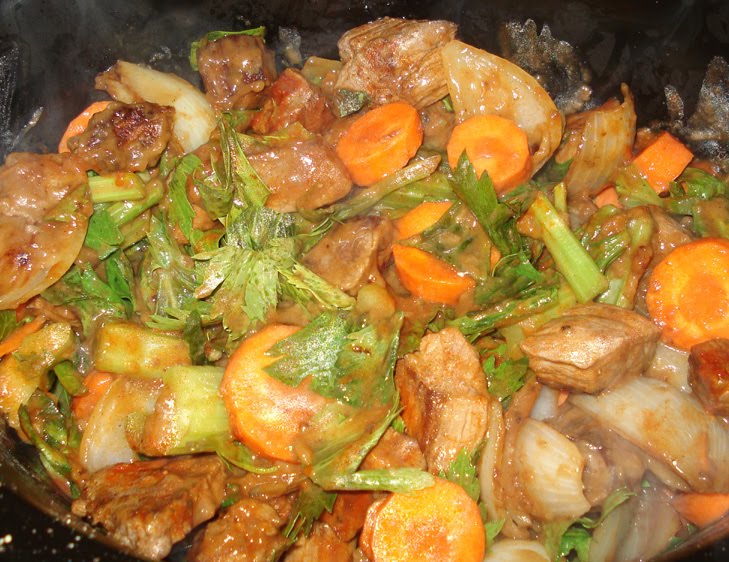
In the cooler months I love using my crockpot/slow cooker.  It tenderises cheaper cuts of meat over the long slow cooking process and it makes many kinds of excellent soup.  The trick is to keep to your cooking from scratch principles when using the crockpot; using tins of soup or stock in a carton is not an option.  You can get excellent flavour without adding any packets of sauce mix or pre-packaged soups, and you get the flavour without preservatives or artificial colourings. I thought I'd do a tutorial on a basic stew that is delicious as is, but also suitable for adding all sorts of  different vegetables, herbs and spices to change the character of it.  This version is a variation on beef stroganoff, without the mushrooms, but if you have some, go ahead and add them.

The trick to adding flavour to a crockpot meal is to take some time at the beginning of the process to  caramelise the meat in a frying pan and build up a flavour profile right from the start.  If you caramelise the meat and some of the vegetables, you have a better and more natural flavour than adding soup, stock cubes, powder or carton stock.

INGREDIENTS - serves four or five
Olive oil
1 kilo/ 2 pounds of chuck, blade, flank, skirt, round or topside beef - diced
salt and pepper to taste
2 tablespoons paprika
2 medium onions, quartered, or chopped if you're serving children
2 tablespoons plain/all purpose flour
1 cup water

2 medium carrots
2 sticks celery, including the tops
bay leaf and a couple of sprigs of thyme

METHOD
In a frypan, add enough olive oil to barely cover the bottom of the pan.


Add the meat in three batches.  Adding more meat to the pan will make it produce liquid, which you don't want.  Divide the meat equally into three portions and add one portion at a time.  Stand to the side cutting your vegetables while the meat browns but make sure you stir the meat so it doesn't burn.  Here, you're aiming for nicely browned meat.  Add salt and pepper to taste.  You'll need about ½ teaspoon of salt and about ¼ teaspoon pepper.  When the meat has brown properly, move it to the crockpot and add the next portion of meat.  You might have to add a bit more oil if the pan is dry.  You need oil for the meat to brown but you do not want oil swimming in the bottom of the pan.  On this second portion, add the paprika and stir in.  When it's browned, add it to the crockpot and bring in the final portion.  When the final portion has browned, add the onions and brown them.
This is an important step in building flavour, don't skip it or try to hurry it up.


When you have the last lot of meat and onions in the pan and it's finished browning, add two tablespoons of plain/all purpose flour and stir in.


When the flour has been stirred in and is coating the onions and meat, add 1 cup water and stir until the sauce thickens.


You'll notice the nicely brown sauce.  This is all natural flavour produced by taking the time to brown the meat and onions.

Now you can add all your ingredients to the stockpot/slow cooker.  You will add the carrots and celery uncooked.  Start by adding all the meat and sauce.


Above you can see the batch of meat that I added the paprika to.  It's now in the crockpot.


Add the vegetables, thyme and bay leaf, as well as all the meat.


Stir everything together in the crockpot. Turn it on to Auto - this will heat on high for a couple of hours, then automatically turn itself to the low setting to finish cooking.  Cook for about 4 or 5 hours, or all day on low if you're going out and you want a hot dinner waiting when you come home.


One hour before the end, add sliced potatoes or sweet potato.  If you're going out all day you can add the potatoes with the rest of the vegetables.  I like adding them at the end because I like them to retain their sliced shapes.


I served ours with boiled brussel sprouts and a dollop of sour cream.  If you prefer, you can add the sour cream to the sauce and stir it in before you serve it, or leave it out altogether. Before serving, check for seasoning and add more if it needs it.

And there you have it - beef stew cooked from scratch in a crockpot.  No need for tinned or packed soup or stock.  It's a delicious and healthy family meal.  If you have  the time this is one of those dishes ideally suited for freezing, so make a double batch and freeze half for next week.

Oh, another small tip, don't be tempted to add more liquid at the start.  The meat and vegetables will release moisture during the cooking process.

This is a basic recipe that can be changed.  Adding curry powder instead of paprika will give you a tasty and spicy beef curry.   Add tomatoes, some tomato paste and capsicum/bell peppers and you'll have an Italian beef casserole you could serve with pasta.

Whatever you're eating this weekend, I hope you make it with love.  It always tastes better if you stir in a good helping of it.  Have a happy and beautiful weekend!
There must be something in the air.  In the course of one day, I have turned into a crazy woman with lists.  I prowled the house yesterday seeing things left undone for so long, so I made lists of what should be done sooner rather than later.  Lists are my friends but today I'm feeling a bit overwhelmed by those I have made so I'm chopping the lists down to size.  I'll make a couple of master lists to work from, divide my time up, because I'm not going to get stuck in and do everything; I'll work through the lists as it pleases me.  It's not really an enormous amount of work, just tidying up, reorganisation and a bit of cleaning.  I'll start today.


My main focus is my knitting.  I've started a shawl/scarf for myself and those cold days at work.  I would love to have it finished next week, but it will take until the end of May, I think.  I'm also knitting Hanno's jumper and haven't progressed much beyond the back. I promises him he would have it by June. I wonder if there are other knitters out there like myself who have a few projects on the go at once.  I do that with books too, always reading a few at a time.  It's quite easy with non-fiction, and that is mainly what I read, because there are no characters or plots to remember.

I wonder how my gardening friends are going with their new gardens.  If you have the time to comment, I'd love to know.  I spent quite a bit of time in our vegetable garden yesterday.  I had my apron on, naturally, and wandered around with a camera in my apron pocket.  It was sunny and warm, no sound other than bird song and the gentle clucking of chooks, so while I picked vegetables for our dinner, I took these photos.  The rain has slowed the garden this year, even wiping out some of the legumes, which too much water often does, but the rest of it is looking good, a testament to that wonderful gardener I share my life with.

 The garlic standing like soldiers in the late afternoon sun.

 The cucumbers are almost done, although they've been sweet juicy and abundant for a couple of months.  It's time to plant some more.


New ginger plants just starting to poke their heads up.


There are new people arriving to read here every week. That always surprises me because I think everyone knows about our little community here, but still they come.  To all the newcomers, welcome.  I hope you find something here that helps you in some way.  Make sure you read the comments every day because there are many excellent points made by the wonderful people who read here.  And to everyone, I hope you are able to spend some time today in your natural environment - whatever that may be.

Thankfully, things are slowly starting to get back to normal after about six months of chaos, shopping, reorganisation, relocation and, at times, barely contained nervousness over moving our Neighbourhood Centre and Flexischool to a new and permanent location.  Finally we have a real home; it's the first time ever in our 17 year history that we have a building to call our own.  We'll never have to move again because we can't afford the rent or because the neighbours don't approve of our clients coming and going.  But now the move is complete, all the furniture, equipment, odds and ends purchased and installed. New services have started, old ones expanded,  and with the opening last Friday a wonderful confirmation of our community's support, I can relax and just get on with my job.  Phew!

Lunch on the verandah after the opening.

Now I can come home again and centre myself here.  There have been many days in the past few months when I have bought bread rather than make it, left the floor unswept because I was too tired to do it, or sat to knit and gone straight to sleep in my big old floppy armchair.  It goes to show that I am not the perfect angel many think I am and just like many of you I am overwhelmed by my life at times.  It happens to everyone and we all cope in our own way until things return to normal.  And that is where I am.  I'm looking forward right now to a gentle slow day when I catch my breath and start putting things to rights.

Hanno is taking a group of seniors out in the bus today.  They're going on a boat cruise along the Pumicestone Passage, back to the Tavern on shore for lunch and then home in the bus.  Price $5, it's subsidised by our Neighbourhood Centre and a partner.  It's a lovely day out for everyone, that gives our seniors a memorable day with friends but keeps them on budget.

So that leaves me home alone.

Summer in a bowl - my home made peach jam.  I still have three litres of it (shhhh).

I have some tasks I enjoy doing this morning - potting tomato seedlings into larger pots, building up the worm farm, and moving pot plants around for the winter conditions soon to be upon us.  Of course, I'll make the bed and sweep, but no bread making today as I'll be here by myself, so I'll make a tea cake for morning teas.  There is a load of washing that needs to be done and later in the morning I'll sweep and tidy the front verandah.  It will be sunny out there then so I can rearrange my pot plants for the winter sun.  

Some of the chooks wandering in the backyard.

To tell you the truth  I could do almost anything here at home today and I'd love it.  Just knowing that I have that big job behind me and many sunny winter days ahead, fills me with the kind of pleasure they often talk about in advertising but always fail to deliver.  Being here, pottering around, freshening things, gardening, cooking, baking and keeping my home in a way that suits Hanno and I are the small things that keep me going with love in my heart.  Nothing else gives me the kind of joy I feel when working in my home.  Oh, I love doing all manner of things and I get pleasure from many of them, but homekeeping - that warm and comfy feeling of knowing I'm fluffing up our nest and that in this space we call home, we can close the gate and be alone, together, that, my friends, is worth a queen's ransom.

I wish you a day full of peace and joy too, and I hope that like me, you'll find some time for knitting or whatever it is that you relax with.

Today's kitchen is in the beautiful far north of my state of Queensland. It's Joanna's kitchen, I'm sure you'll enjoy her story.
Joanna writes:
"We live in Far North Queensland on the Atherton Tablelands, in a small Queenslander cottage. The kitchen is cute, but TINY! It's about 1.5 metres wide by about 2.5 metres long. It has a double burner gas stove and a smallish wall oven. In this photo I've got two dehydrators on the counters, but they are put away when I'm finished with them to save space. There's no room for a dishwasher, but I've got four little 'dishwashers' running around helping, so that's okay (as long as they're not all in the kitchen at once!). The fridge and the open cupboard where I display my glassware are just outside the kitchen, in the dining area. 


I like the country feel to my kitchen, and I really don't mind it being so small (usually!) as I don't have a lot of appliances - just my Thermomix, dehydrator, electric frypan and crockpot.  At least it doesn't take long to clean!  The counters are made of wood and the sink is enamel.  I love how the windows open out into a tropical garden, where I can watch the birds and butterflies as I cook!

Hope you liked this glimpse into our home."

Jo's blog is: www.quirkycooking.blogspot.com


Please don't forget to comment. A comment is like payment for the time taken to post, and in this case in sending in the photos.  Many of us were enthusiastic about this series, so make sure all the photos get a good number of comments.  I don't want any of the people sending in photos to regret joining in.  Thank you friends. 

I may be missing for a few days this week - our internet is going from one company to another.  If that happens, I invite you to read some older posts.  Take care everyone!
I was asked in an email recently if I would reveal the secret of simple living. I have no secrets, I think I've been fairly open with what we're doing here.  I have a set of values I live by and everyone knows my day to day activities, so that was my reply. An email came back that surprised me quite a bit - it said that she had done most of what I was doing, made sure she planted what I planted, was knitting dishcloths and cooking from scratch, making soap, and a lot of other things exactly as I had written about them, but she had failed to find contentment. "What is the secret of contentment?"


Let me answer that question first and then I'll elaborate. The secret of contentment is to live the life you want to live. It must be your authentic life, not a copy of mine or anyone else's.  The secret is to find what you're passionate about and to carefully weave that into your life. The secret is to think carefully about what makes you truly happy, and then live a life that reflects that. I developed a certain set of values a few years ago and that value set, if I live true to them, makes me happy and content. I know deep down in my bones that if I am generous, kind and helpful, if I live slow and according to my values, and not those of mainstream Australia, if I give while expecting nothing in return, my life sails smoothly, even on troubled waters.  It's a circle. What you give out, comes back.  Always.

I often urge readers here to live their own lives.  What Hanno and I do is what suits us, it's not written about because it's THE way.  To find real contentment and to live well requires that you examine yourself and find what it is that makes you happy.  You need to think about how you want to live, what kind of person you want to be, what you want from life and develop a set of values that helps you live that way.  That is not easy to do and it takes a long time to figure out.  This part of the process is slow too.  You don't wake up one morning, think "I'm going to live simply" and then just copy how someone else lives.  Every element of your life must have meaning; making soap because I make soap is ridiculous and time consuming. Make soap only when it makes sense to YOU.  One of the advantages of this way of living is that it's organic and flexible and can be made to fit almost anyone.  Unlike mainstream living you don't fit a mould, you break the mould and then start adding and taking away until your life suits you.  You start with the mindset - the practical things that make up daily living change according to how old you are, whether you have children living with you, how much money and time you have.

Find what makes you happy and do it.  If you can't do it now, actively and earnestly work towards it.  And always remember, there is no final destination - we are in this for the journey and where it takes us.

For those who asked for the lemon tart recipe, here it is:

LEMON TART
Make a pastry case, my recipe is here, but you can use any good short crust pasty recipe. Blind bake the pastry and allow to cool.

FILLING
4 large eggs
Half to two thirds of a cup of fresh lemon juice - depending on how tart would want the filling to be
45 grams/1½ oz softish butter cut into little pieces
200 grams/7 ozs white sugar
½ cup cream

Put all the above in a bowl and beat with an electric beater for about three minutes.  Everything needs to be combined well and the sugar dissolved.

Pour the filling into the pastry case and bake in a slow oven, around 160*C/320*F.  The filling should set around the edges and still be a little bit wobbly in the centre.
Today we visit Affienia's kitchen in Leeds England.  This is another small kitchen and it shows beautifully what you can do with a small space and a bit of thought and creativity. 

Affienia writes:
"Here is my kitchen. The first is taken with me leaning on the fridge, the second with me leaning on the sink. As you can see there isn't much room to move! The 3 shelves and the racks with the knives etc on were all added by my other half in the 3 years we've been here. He also added the section of sideboard that the bokashi bin is on and a folding piece of sideboard that appears in front of the back door. We have plans to decorate at some point as the tiles are painted and it's all peeling off. I think there will have to be Gingham in there somewhere. All kitchens need Gingham I think.  I dream of a big farmhouse kitchen with a large central island to work at. But I have learnt to work in this kitchen if not to love it. I feel best about it when there is fresh bread on the side and all the washing up  is done :o)"


Please don't forget to comment. A comment is like payment for the time taken to post, and in this case in sending in the photos.  Many of us were enthusiastic about this series, so make sure all the photos get a good number of comments.  I don't want any of the people sending in photos to regret joining in.  Thank you friends. 


We have the official opening of our Neighbourhood Centre today - lunch for 100, plus politicians - gulp.  We've come a long way and this is a significant milestone for us.  Luckily we have the weekend to recover.  Some of you might remember that I'm changing ISPs and when that happens, I'll be offline for two or three days.  If I'm missing next week, that will be the reason.  Enjoy your weekend, I hope you spend it with those you love.  ♥
Newer Posts Older Posts Home


My books were all published by Pengiun, and are available at Amazon US, Amazon UK and Amazon Au

Search here

Total Pageviews

Translate


I'm Rhonda Hetzel and I've been writing my Down to Earth blog since 2007. Although I write the occasional philosophical post, my main topics include home cooking, happiness and gardening as well as budgeting, baking, ageing, generosity, mending and handmade crafts. I hope you enjoy your time here.

MY FAVOURITE PLACES

  • Grandma Donna's Place
  • Grandma Donna's YouTube
  • Grandma Donna's Instagram
  • This Simple Day
  • Nicole's Instagram

Give More

Give More

Popular posts last year

Making ginger beer from scratch

We had a nice supply of ginger beer going over Christmas. It's a delicious soft drink for young and old, although there is an alcoholic version that can be made with a slight variation on the recipe. Ginger beer is a naturally fermented drink that is easy to make - with ginger beer you make a starter called a ginger beer plant and after it has fermented, you add that to sweet water and lemon juice. Like sourdough, it must ferment to give it that sharp fizz. To make a ginger beer plant you'll need ginger - either the powdered dry variety or fresh ginger, sugar, rainwater or tap water that has stood for 24 hours to allow the chlorine to evaporate off. You'll also need clean plastic bottles that have been scrubbed with soap, hot water and a bottle brush and then rinsed with hot water. I never sterilise my bottles and I haven't had any problems. If you intend to keep the ginger beer for a long time, I'd suggest you sterilise your bottles. MAKING THE STARTER In a...
Image

NOT the last post

This will be my last post here.  I've been writing my blog for 18 years and now is the time to step back. I’ve stopped writing the blog and come back a couple of times because so many people wanted it, but that won’t happen again, I won’t be back.  I’ll continue on instagram to remain connected but I don’t know how frequent that will be. I know some of you will be interested to know the blog's statistics. 
Image

How to make cold process soap

I'm sure many of you are wondering: "Why make soap when I can buy it cheaply at the supermarket?" My cold process soap is made with vegetable oils and when it is made and cured, it contains no harsh chemicals or dyes. Often commercial soap is made with tallow (animal fat) and contains synthetic fragrance and dye and retains almost no glycerin. Glycerin is a natural emollient that helps with the lather and moisturises the skin. The makers of commercial soaps extract the glycerin and sell it as a separate product as it's more valuable than the soap. Then they add chemicals to make the soap lather. Crazy. Making your own soap allows you to add whatever you want to add. If you want a plain and pure soap, as I do, you can have that, or you can start with the plain soap and add colour, herbs and fragrance. The choice is yours. I want to add a little about animal and bird fat. I know Kirsty makes her soap with duck fat and I think that's great. I think t...
Image

Preserving food in a traditional way - pickling beetroot

I've had a number of emails from readers who want to start preserving food in jars but don't know where to start or what equipment to buy.  Leading on from yesterday's post, let's just say up front - don't buy any equipment. Once you know what you're doing and that you enjoy preserving, then you can decide whether or not to buy extra equipment. Food is preserved effectively without refrigeration by a variety of different methods. A few of the traditional methods are drying, fermentation, smoking, salting or by adding vinegar and sugar to the food - pickling. This last method is what we're talking about today. Vinegar and sugar are natural preservatives and adding one or both to food sets up an environment that bacteria and yeasts can't grow in. If you make the vinegar and sugar mix palatable, you can put up jars of vegetables or fruit that enhance the flavour of the food and can be stored in a cupboard or fridge for months. Other traditional w...
Image

Cleaning mould from walls and fabrics

With all this rain around we've developed a mould problem in our home. Usually we have the front and back doors open and that good ventilation stops most moulds from establishing. However, with the house locked up for the past week, the high humidity and the rain, mould is now growing on the wooden walls near our front door and on the lower parts of cupboards in the kitchen. Most of us will find mould growing in our homes at some point. Either in the bathroom or, in humid climates, on the walls, like we have now. You'll need a safe and effective remedy at some point, so I hope one of these methods works well for you. Mould is not only ugly to look at, it can cause health problems so if you see mould growing, do something about it straight away. The longer you leave the problem, the harder it will be to get rid of it effectively. If you have asthma or any allergies, you should do this type of cleaning with a face mask on so you don't breathe in any spores. Many peopl...
Image

Five minute bread

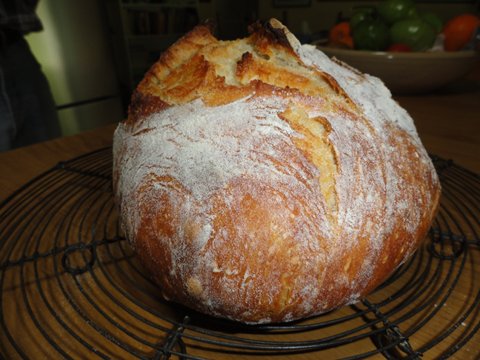
Bread is one of those foods that, when made with your own hands, gives a great deal of satisfaction and delight. It's only flour and water but it symbolises so much. I bake bread most days and use a variety of flours that I buy in bulk. Often I make a sandwich loaf because we use most of our bread for lunchtime sandwiches and for toast. Every so often I branch out to make a different type of loaf. I have tried sour dough in the past but I've not been happy with any of them. I'll continue to experiment with sour dough because I like the idea of using wild yeasts and saving the starter over a number of years to develop the flavour and become a part of the family. However, the loaf I've been branching out to most often is just a plain old five minute bread. By five minutes I mean it takes about five minutes actual work to prepare but it's the easiest of all bread to make and to get consistently good loaves from. If you're having people around for lunch or...
Image

This is my last post.

I have known for a while that this post was coming, but I didn't know when. This is my last post. I'm closing my blog, for good, and I'm not coming back like I have in the past.  I've been writing here for 16 years and my blog has been many things to me. It helped me change my life, it introduced me to so many good people, it became a wonderful record of my family life, it helped me get a book contract with Penguin, and monthly columns with The Australian Women's Weekly and Burke's Backyard . But in the past few months, it's become a burden. In April, I'll be 75 years old and I hope I've got another ten years ahead. However, each year I'll probably get weaker and although I'm fairly healthy, I do have a benign brain tumour and that could start growing. There are so many things I want to do and with time running out, leaving the blog behind gives me time to do the things that give me pleasure. On the day the blog started I felt a wonderful, h...
Image

What is the role of the homemaker in later years?

An email came from a US reader, Abby, who asked about being a homemaker in later years. This is part of what she wrote: "I am a stay-at-home mum to 4 children, ages 9-16. I do have a variety of "odd jobs" that I enjoy - I run a small "before-school" morning drop-off daycare from my home, I am a writing tutor, and I work a few hours a week at a local children's bookstore. But mostly, I cherish my blissful days at home - cooking, cleaning (with homemade cleaners), taking care of our children and chickens and goats, baking, meal-planning, etc. This "career" at home is not at all what I imagined during my ambitious years at university, but it is far more enriching. I notice, though, that my day is often planned around the needs of my family members. Of course, with 4 active kids and a husband, this is natural. I do the shopping, plan my meals, cook dinner - generally in anticipation of my family reconnecting in the evening.  I can't h...
Image

Every morning at home

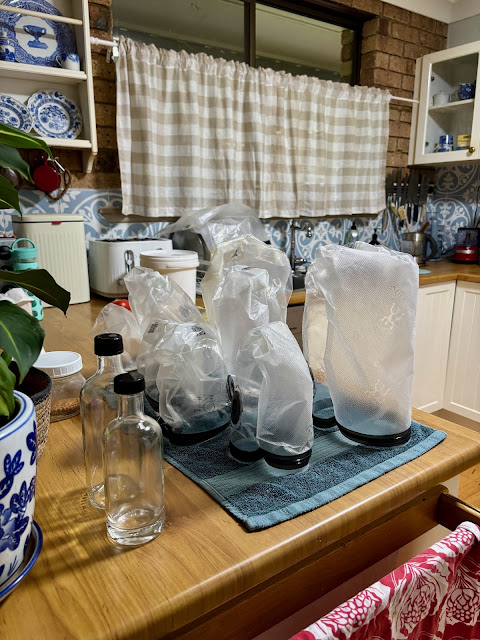
Every morning when I walk into my kitchen it looks tidy and ready for a day's work. Not so on this morning (above), I saw this when I walked in. Late the previous afternoon when I was looking for something, I came across my rolled up Zwilling vacuum bags and decided they had to be washed and dried. So I did that and although I usually put them outside on the verandah to dry it was dark by then. I turned the just-washed bags inside out and left them like this on a towel. It worked well and now the bags are ready to use when I bring home root vegetables, cabbages or whatever I buy that I want to last four or five weeks.
Image

You’ll save money by going back to basics

When I was doing the workshops and solo sessions, I had a couple of people whose main focus was on creating the fastest way to set up a simple life. You can't create a simple life fast, it's the opposite of that It's not one single thing either - it's a number of smaller, simpler activities that combine to create a life that reflects your values; and that takes a long to come together. When I first started living simply I took an entire year to work out our food - buying it, storing it, cooking it, preserving, baking, freezing, and growing it in the backyard. This is change that will transform how you live and it can't be rushed.  
Image


Trending Articles

NOT the last post

This will be my last post here.  I've been writing my blog for 18 years and now is the time to step back. I’ve stopped writing the blog and come back a couple of times because so many people wanted it, but that won’t happen again, I won’t be back.  I’ll continue on instagram to remain connected but I don’t know how frequent that will be. I know some of you will be interested to know the blog's statistics. 
Image

Every morning at home

Every morning when I walk into my kitchen it looks tidy and ready for a day's work. Not so on this morning (above), I saw this when I walked in. Late the previous afternoon when I was looking for something, I came across my rolled up Zwilling vacuum bags and decided they had to be washed and dried. So I did that and although I usually put them outside on the verandah to dry it was dark by then. I turned the just-washed bags inside out and left them like this on a towel. It worked well and now the bags are ready to use when I bring home root vegetables, cabbages or whatever I buy that I want to last four or five weeks.
Image

You’ll save money by going back to basics

When I was doing the workshops and solo sessions, I had a couple of people whose main focus was on creating the fastest way to set up a simple life. You can't create a simple life fast, it's the opposite of that It's not one single thing either - it's a number of smaller, simpler activities that combine to create a life that reflects your values; and that takes a long to come together. When I first started living simply I took an entire year to work out our food - buying it, storing it, cooking it, preserving, baking, freezing, and growing it in the backyard. This is change that will transform how you live and it can't be rushed.  
Image

Creating a home you'll love forever

Living simply is the answer to just about everything. It reduces the cost of living; it keeps you focused on being careful with resources such as water and electricity; it reminds you to not waste food; it encourages you to store food so you don't waste it and doing all those things brings routine and rhythm to your daily life. Consciously connecting every day with the activities and tasks that create simple life reminds you to look for the meaning and beauty that normal daily life holds.  It's all there in your home if you look for it. Seemingly mundane tasks like cleaning and cooking help you with that connection for without those tasks, the home you want to live in won't exist in the way you want it to.  Creating a home you love will make you happy and satisfied.
Image

Time changes everything

I've been spending time in the backyard lately creating a contained herb and vegetable garden. My aim is to develop a comfortable place to spend time, relax, increase biodiversity and encourage more animals, birds and insects to live here or visit. Of course I'd prefer my old garden which was put together by Hanno with ease and German precision. Together, we created a space bursting at the seams with herbs, vegetables and fruity goodness ready to eat and share throughout the year. But time changes everything. What I'm planning on doing now, is a brilliant opportunity for an almost 80 year old with balance issues. In my new garden I'll be able to do a wide range of challenging or easy work, depending on how I feel each day. It’s a daily opportunity to push myself or sit back, watch what's happening around me and be captivated by memories or the scope of what's yet to come.
Image

It's the old ways I love the most

I'm a practical woman who lives in a 1980’s brick slab house. There are verandahs front and back so I have places to sit outside when it's hot or cold. Those verandahs tend to make the house darker than it would be but they're been a great investment over time because they made the house more liveable. My home is not a romantic cottage, nor a minimalist modern home, it's a 1980’s brick slab house. And yet when people visit me here they tell me how warm and cosy my home is and that they feel comforted by being here. I've thought about that over the years and I'm convinced now that the style of a home isn't what appeals to people. What they love is the feeling within that home and whether it's nurturing the people who live there.
Image

Making ginger beer from scratch

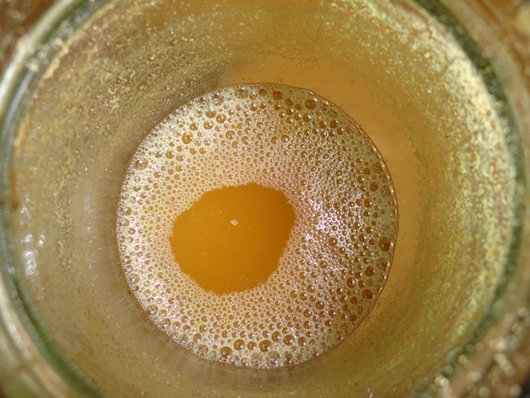
We had a nice supply of ginger beer going over Christmas. It's a delicious soft drink for young and old, although there is an alcoholic version that can be made with a slight variation on the recipe. Ginger beer is a naturally fermented drink that is easy to make - with ginger beer you make a starter called a ginger beer plant and after it has fermented, you add that to sweet water and lemon juice. Like sourdough, it must ferment to give it that sharp fizz. To make a ginger beer plant you'll need ginger - either the powdered dry variety or fresh ginger, sugar, rainwater or tap water that has stood for 24 hours to allow the chlorine to evaporate off. You'll also need clean plastic bottles that have been scrubbed with soap, hot water and a bottle brush and then rinsed with hot water. I never sterilise my bottles and I haven't had any problems. If you intend to keep the ginger beer for a long time, I'd suggest you sterilise your bottles. MAKING THE STARTER In a...
Image

An authentic look at daily life here — unstaged and real

Most days Hanno was outside happily working in the fresh air. It may surprise you to know that I started reading my book,  Down to Earth , yesterday - the first time since I wrote it 13 years ago.  I had lent it to my neighbor, and when she returned it, I started reading, expecting to find surprises. Instead, I realised the words were still familiar—as if they were etched into my memory. As I flipped through the pages, I was reminded of how important it was for me to share that knowledge with others. The principles in Down to Earth changed my life, and I truly believed they could do the same for others. After just 30 minutes of reading, I put the book down, reassured that its message still holds true: we can slow down and reshape our lives, one step at a time.
Image