down to earth

  • Home
  • About Us
  • Down To Earth Book
  • Privacy Policy
When you think about it, the only time we working and middle class people get to do exactly what we want everyday is when we retire or when we're on holiday/vacation.  I guess we have a fairly free and easy life in childhood and as a teenager, but then there are people telling us what to do and when to do it.  Retirement, whenever it happens, is all about freedom.  It's the freedom to do exactly what you choose to do each day, the freedom of time, and even though the weekly wage stops, if you've gone through several simple decades, and arrive at retirement's door with no debt, no mortgage, a roof over your head, money in the bank, some investments or a pension, you'll be fine.  There may be a few upheavals and you'll have to get used to a slower pace to your days but life in your 60s and I'm hoping beyond it as well, is wonderful.  I have never been happier than I am now.  

Things are different when you retire.  Many of your expenses  drop, your priorities change and you'll have time to bargain shop and to make a lot of the things you used to pay someone to make for you.  Depending on where you live and what benefits your government gives its seniors, you'll have to look at your budget now and make all the changes necessary.  For instance, in Australia, when you're on an old age pension, you get goverment discounts on your property rates, ambulance, telelphone, pharmacy costs etc.  Hanno and I decided to keep our private health insurance, even though it's very expensive, it gives us peace of mind to know that we can get medical help, choose our own doctors and go to hospital if we need to without having to go on a waiting list.  

Before you sit down to redo your budget, find out exactly what you're entitled to and claim it - it's one of the many reasons you've been paying tax all these long years - now you get a few pay offs.  There are other benefits too - just yesterday I parked my car in a seniors parking spot for the very first time. It was close to the front door of the place I was going to.  I felt like a bit of a fraud to tell you the truth, but the sign said "senior parking" I am a senior so I parked there.  Nice.  Check out the businesses in your area as well because many give seniors' discounts.

YOUR DAILY WORK
In the months before you retire, start thinking about what you'll do on a daily basis.  If you've always gone out to work, you might find it difficult to adjust but if you decide on your activities, whether they be home-based, volunteer-based or out in the community at a club or library, if you have something planned, you won't be sitting there on the first day wondering what to do.  As you all know, Hanno and I are as busy as we want to be.  We decided that we would use our retirement to provide as much for ourselves as we could.  That involves all sorts of home-based tasks like maintenance, gardening, cooking, baking, recycling and mending.  Living like this gives us variety and interest to our days and even though we've been working away here for several years now, it still feels fresh.  We take breaks whenever we want them, we take days off and sometimes we take ourselves out in the car for an outing. It's a peaceful and rewarding life full of the enrichment that comes from being self reliant and independent.

 Wash day for Alice.

Of course we do some voluntary work too.  I am the coordinater of our local neighbourhood centre and Hanno drives the bus there.  He collects food in the bus from the Foodbank in Brisbane and takes our seniors out on shopping trips and excursions.  If you have the chance to do some voluntary work, grab the opportunity with both hands because, in my experience, it has been rewarding and life changing.

YOUR HISTORY
Pass on what you know.  I believe it is my duty as an older woman to pass on what I know to those younger.  Older people are our connection to the past and if we don't tap into that, many skills and memories will be lost.  If you still have great grandparents, grandparents or parents living, ask them about YOUR history.  Even if you're not interested now, I guarantee you there will come a day when you will be interested and if your loved ones are gone then, you will never know.   Write down what they tell you so you can pass your family history on to your children.

And speaking of history, get rid of everything in your home that you don't need.  Ask your family if they want that second or third set of dinner ware.  Donate old clothes to charity. Clear out your cupboards so you can let more life in.

YOUR HEALTH
Stay active and look after your health because things can come back to bite you in your 60s and 70s.  I have been lucky so far and haven't had any health issues and I am confident that I'll be out in the backyard when I'm in my 80s, yelling out: "Hanno bring me the camera please. There are new birds here!"  Keep cooking from scratch and eating wholesome food.  Even if it's only one of you, it's important that you eat well.

Many people have an unrealistic idea of old age.  They think we oldies are helpless and feeble and not capable of much.  Well, I'm here to tell you that the majority of us are just fine and dandy, thank you.  We may not be able to lift what we once did and we may be taking naps in the afternoon (I am), but we're still waking up every morning eager to get stuck in to our tasks and to get as much from the day as we can.  Don't be scared of aging.  It has many rewards, and retirement, and the freedom that comes with it, is one of  life's golden eggs.

PS.  Go here and read Sonya's excellent post on learning and losing life skills.  I am happy to tell you that Sonya is coming to my home this morning to learn how to knit.  No doubt we'll talk of other matters too.  We all have to do this.  If you know someone who wants to learn something you know how to do, offer to teach.  It's the only way.
You don't see or hear of genuine articles much nowadays.  In my youth, it was a fairly common expression that meant something or someone was authentic.  I don't hear the saying at all connected to things now.  I believe that's because people are less concerned with the genuine now and more concerned with fashion and acquisition.  It matters not that something is true to its type, or that a person is outstanding because they're eccentric, unusual or passionately devoted to their beliefs and values.  Nowadays, it seems to me, that popularity is more important than rarity, it's safer to blend in with the crowd than have the courage of your convictions and that celebrity wins over the genuine article every time.

Shane and Sarndra came up for my birthday recently.  Shane is pictured here reading John Seymour's self sufficiency book while waiting for his mum to load the table with food.  Sarndra and Hanno were outside talking to the chooks.  : - )

I really love it when I come across a name that everyone seems to know but I've never hear before.  Hanno and I were watching the morning news on TV yesterday when the presenters were droning on about someone called Kim Cardasian.  Apparently Kim has millions of Twitter followers and is famous far and wide.  When I come across something like this, I smile and feel like I'm doing something right.  That somehow, even though millions know this person, this famous name has been filtered out of my simple world.  I have no clue who she is, where she lives, what she looks like.  That, to me, is success - I've filtered out a small shard of popular culture - gee it feels good.! I didn't get caught up in the hype or seduced by a need to know.  Even now, I decided not to Google her name to check my spelling.  The less I know about Ms Cardasian, the better.

So what of the genuine article?  Why do I hold high such a concept?  It's because it's easy to go along with the crowd and much more difficult to walk your own path.  In many different ways we are all walking the path less travelled.  We see what is considered "normal" now, we know that consumption is the new way and we have decided to reject it.  Instead of buying all that is new and shiny, in the latest fashion colours, we are standing our ground and going back to basics.  It's comfortable back there.  It's warm traditional oats soaked overnight and cooked slowly rather than cornflakes or all the new designer breakfast cereals; it's home baked bread instead of sliced white in plastic wrap; it's "come over and I'll teach you how to knit" instead of "let's go shopping".  Instead of buying fast food, we have it slow and easy bubbling away in the oven when the family comes home in the evening.  Even the smell of that home cooked food in the air when they walk through the door tells your family that someone loves them enough to make it all happen.  It's sitting around the table with the entire family, talking about today, and tomorrow, and this and that.  It's really knowing your family instead of just knowing what they tell you.

After the spaghetti and meatballs I served this lemon tart.

There are so many things that can be fake now - fingernails, breasts, flawless skin, "home cooking" that is bought over a counter or in a packet, "limited editions" that sell thousands and sometimes millions.  So when you see the genuine article, be that in a person, a way of life, or the ideals they engender, it stands out like a shining beacon.  There has probably never been a better, nor more difficult time, to stand up for the authentic, but doing that, going against the tide of popular opinion, and seeing others doing it too, will help you reject the flim flammery of the popular and hold close the values and beliefs that will help you lead a simpler and genuine life.

So now you've moved into your 40s, maybe even your 50s.  During your younger years I'm sure you heard all the negative silliness about aging but now that you're middle aged, you'll realise you're in the prime of your life.  You feel confident, ambitious and capable.  You are at the height of your money earning power, so you can pay off more debt now than at any other time.  Decisions made in previous decades about reducing debt are now starting to pay off and you can see the light at the end of the tunnel.  Hopefully, with a bit of hard work and determination, you'll pay off your mortgage now and keep putting something aside for your retirement.  Try your best to pay off your mortgage before you retire. And again, do not add to your debt burden.  Less is best.


FUNDING YOUR RETIREMENT
If you're working, it is a wise step to put money aside all through your  working life for your retirement.  In Australia, this is called superannuation and the government adds 9% of  every employee's annual earnings to their superannuation fund.  Most employees earning over $450 a week must put a certain amount of money into their own fund too.  They can add more if they wish and receive tax benefits for doing so.  Most Western countries have some form of government assisted retirement funding.

I want to make two important points about funding your retirement:
  1. You do not need as much as most investment brokers say you need.  For example, Hanno and I live well on less than $25,000 a year.
  2. Make sure you keep all you superannuation/retirement funding in one account.  As you move from job to job throughout your working life, make sure you have the details of your chosen superannuation/retirement account to give to your new employer each time you change jobs.  If you let them put your contributions into the account they usually use, you'll end up fragmenting your investment.  The more money you have in one account, the more likely you'll receive a good return on the investments made on your behalf with that money.  If you've got money in several accounts right now, I encourage you to take some time in the next few weeks to contact those companies with the details of where your funds should be and instruct them to transfer them over.  There may be a fee for doing that, find out what the fee is before you do it, but in the long run, you'll get a better return if you're funds are in one account.  That is why it's important to give your information to each new employer you have over the years - you'll avoid paying transfer fees.
TEACH YOUR CHILDREN WELL
Children need to be taught life skills all through their lives, and now, in their teens and 20s, is no exception.  Of course, you'll hit a brick wall if you've never tried to provide this type of parenting before - this is a life long style of parenting, starting when they were toddlers. Now you're at the pointy end, now you have to reinforce what you've been teaching them all their lives, now it really counts.  As in previous stages you make sure you are a good role model for them and always be the kind of person you want them to be.  Now you teach them about being a good and fair employee, you talk to them about how to treat their friends and acquaintance with respect, and above all, you help them develop self respect and confidence. 

There are also the practical skills like driving, shopping for groceries, cooking, looking after their own clothes - how to wash and iron them, and saving.  Even if you've encouraged saving and focused on money management before, now is the time to reinforce all that again because there will be a lot of peer pressure to spend, spend, spend.  This is the most difficult time for a parent, but it's also the most rewarding.  If you can set your children out into the world, fully equipped with the life skills they need, as well as the formal education of schooling - in whatever form that took in your family, you will have given your children their very best chance of a happy and successful life.


GROW INTO YOUR LIFE
As you age you'll realise that you don't have to please everyone around you.  You mature, and part of that maturity is to make yourself content.  This is the time of life when the children have grown out of their very dependent stage and with that, you get more time to yourself.  It's not as freeing as when they leave home, but at this stage you get an inkling of how things will be when your babies fly off and make their own lives.

Now is the time to develop your hobbies and to get enjoyment from the things you choose to do.  You'll have the time now to learn new skills, develop your passion for cooking, or painting, sewing, gardening, hiking, camping, or a hundred other things you'll now have time for.

If you choose to live like Hanno and I, now is the time to develop your home and land so it can support you in later life.  You might add chickens to the backyard, if you haven't already done so, you might add bee hives, aquaponics, or a couple of milking goats, and, of course, along with whatever you add, you should learn all you can about it.  Do you need to add more fences? You should do that now.  Whatever requires strength and energy, add it now because in your 60s, your strength will start to go and you'll wish you had thought to do it earlier.

If you're hoping to live with some degree of self sufficiency, now is the time to learn how to do everything that will help you with that aim.  You'll need to learn how to bake, put up jams and preserves, mend clothes and shoes, if you're a couple, divide the chores and learning up between you both with each taking the things you enjoy doing.  I like doing the inside tasks here and Hanno enjoys being outside, so he does most of the traditionally male chores like home maintenance and I am the homemaker.  Now is the time to look into how you can develop your knowledge and understanding of your roles.  Read - both books and blogs.  I believe blogs are a wonderful way of seeing how others are living so you may pick the bits that you want to do and incorporate them into your own life.


When you're entering the final years of your fifties, and while you're still earning money, do an audit of your home.  Look at your home in another way now - you want it to support you in your older years, you do not want it to be a burden.  Now might be the last time you have a chance to change what you don't like and what doesn't work for you.  Look at your furniture - is everything in good order?  You might need to replace a few items, but do so at the thrift shop, not the department store.  There are many items of old or antique furniture that may suit you that have been well made and made to last many years.  Even if you have to have things recovered, revarnished or painted, you'll end up with a more sturdy and longer-lasting piece than buying furniture from China or Vietnam.

You'll realise as you get older that you need much less so now is a great time to declutter.  You can give some of your odds and ends to your children as they leave home and start living their own lives, so keep a couple of boxes of the good stuff for them to use, and give away or sell what you don't need.

What you're aiming for at the end of your 50s is to have your children out in the world, working and set up in their own homes, you want to have your mortgage paid off, or almost paid off, you want your home to be supportive and comfortable and you want to know most of the things you need to help you live in that way you have chosen.  If you can say you've successfully done that, then you are set for the ride of your life in your 60s for that is the time when all your work pays off.  You can retire, do whatever you want to do every day, and you can live life to its fullest measure.  ♥


Today we have another Australian kitchen, in the state of New South Wales.  It's Carole's kitchen and as you can see it's packed with character and looks like a real cook's kitchen.

Carole writes:
"I live in a little town in the Hunter Valley N.S.W. my kitchen is great to work in. The window you see looks onto a little sunroom we built for my 89 year old Mum who lives with us you can see straight out into the back yard at the chickens, roses and a waterfall; we love it.


The little shelving you can see is where an old air con was and the builder made it into curio shelves for me; my jug collection is on them with antique laces for dividers.The cabinet with the rooster is for my spices. My husband made it out of an old wardrobe and I painted the rooster. The small cabinet beside it is an antique sterilising cupboard full of little treasures.


The 2nd pic is of our loved Irish dresser full of Willow Pattern which I have collected for years, and the little egg cupboard was made by Bob and painted by me; as you can tell we love chooks.  The third one is of my other dresser with all my collectibles, this is also part of the kitchen.


Please don't forget to comment. A comment is like payment for the time taken to post, and in this case in sending in the photos.  Many of us were enthusiastic about this series, so make sure all the photos get a good number of comments.  I don't want any of the people sending in photos to regret joining in.  Thank you friends.
I heard myself say this on radio the other morning: "Being thrifty is not about large amounts. You rarely make those large savings. It's more about constantly looking to save small amounts because over the course of a year, those small amounts become your large savings." When I finished the broadcast I thought about what had popped out of my mouth and that I should practise what I preach. I decided to review my phone and internet bills.

We've have had the same internet provider for many years - Optus. They've provided us with years of reliable service and apart from bumpy downloads because we lacked speed, we've been happy with them. On the other hand, we weren't happy with our phone company. We've had our account with them for a bit over two years and although we have a $29.95 account, we pay for all calls and when our bill arrives it's usually around $70. With the phone and internet combined we were paying $120 a month and still restricting our phone calls a lot.

After about one hour research online, we decided on staying with Telstra but increasing our bill to an Ultimate plan - $89.90, but with unlimited local and interstate calls, reduced calls to mobiles and either five cent or two cent/minute international calls. Adding the internet to that bill and bringing over our account from Optus gave us fast broadband with double the gigabytes for two dollars less than what we'd been paying. It's not much in savings but the plan we're on now is much better value for money. That's what you look for with these essential services; it's not so much the savings, although you do want them too, it's more about the value you get for your hard-earned dollars.

So we've now got a phone account that will allow us to call our relatives and friends either free or for a much smaller cost than we used to pay and we have doubled our internet download allowance and it's much faster. And all that for two dollars less than we used to pay. These occasional reviews of how we spend money are an essential part of living well within the confines of a small budget. Don't forget to look at how you're spending your money on these long term accounts. Technology is moving ahead rapidly and what you paid a premium for when you first took on that account, might be old hat now. It's worth a bit of research and talking to your account providers - they will not want to lose you as a customer. If you do your research, phone them with a polite attitude and ask for their advice, you may be surprised to find savings or better services there, or both.

It doesn't take much to make me happy, I'm on the verge of it every day, but yesterday as I worked at my voluntary job, I kept thinking about this phone account and how it would allow me to phone my sister whenever I felt like it. She lives a thousand kilometres away and in the past we've rationed the calls. Just thinking about it gave me a really warm feeling and as soon as I got home yesterday afternoon, while Hanno was still cooking our dinner, I phoned Tricia ... just because I could.
We are in Gail's kitchen today.  Gail lives in a Queenslander, which is a house up on stilts, surrounded by a veranda, usually on all sides.  They're wonderful old, distinctive houses that were built to suit living in the tropics.

Gail writes:
"This is my kitchen, it's an 100 year old Queenslander that my hubby and l brought 10 years ago. We have spent the last 10 years doing it up, we have nearly finished. Most of the work we did ourselves or had someone help hubby to do it, it took a while as hubby has to work full time. 


In the kitchen we replaced everything including the floor boards, we replaced the cupboards with drawers, which are more convenient, l collect tea pots, cups and saucers, milk jugs, anything with country animals on it, l love spending time here. Thankyou for coming to visit."   


Please don't forget to comment. A comment is like payment for the time taken to post, and in this case in sending in the photos.  Many of us were enthusiastic about this series, so make sure all the photos get a good number of comments.  I don't want any of the people sending in photos to regret joining in.  Thank you friends.
Today is a day of absolute pleasure for me.  I'll be sitting in the shade of the verandah reading one of my new books; tea will be had in the "good" cups. I'll knit and maybe go out for morning tea with Hanno.  I might even do some more research on my family tree. Today is my birthday, I am 62.

It seems like a good day to delve into my own history.  So far, I'm back to my great, great, great, great, great, great, great grandparents Thomas Bond and Grace Cook who were married in Yardley, England on 27 March 1654.  I've found two convicts on my fathers side - who came to Australia in 1799, and a soldier who accompanied the convicts on my mother's side - I have a letter he wrote in 1820 when he lived in King Street Sydney.  That address is now in the middle of Sydney's main business and shopping centre.

I'm pleased you're enjoying the current simple life series. Thank you all for your comments.  I hope you have a lovely day.

ADDITION on 16th: Thanks to every one who took time out to send me their special birthday wishes - I have an avalanche of emails and facebook messages as well as your comments here.  I love your messages and appreciate your friendship. Warm hugs to you all.
Hopefully you've landed in your thirties with only a few debts and a passion for living simply.  If you have, you're in the driver's seat.  If you do have some debt, there is still quite a lot you can do to untangle yourself before it strangles you.  The important part of this stage is that if you can set yourself up properly here, if you budget and pay off debt instead of add to it, you'll be fine.


It has been my experience that if young people aren't already attached in their the late twenties, now is the time they start settling down.  There is something about the thirties decade that compels us to find a mate and start having babies.  Even if the babies question doesn't come into the equation, many people seem to choose their thirties to slow down, find a partner, take stock of their lives and mature.


Before you dive into marriage or parenthood, sit a while and talk to your partner about what that will be between the two of you.  Some people don't want children, some want many. Some people have an unquestioned assumption that there will be one parent at home raising the children. Others believe that the children can be looked after in day care or by an accommodating grandparent while the parents work to pay off the home and make the most of two incomes.  Don't think you know what your partner is thinking - this is an important part of your life and you need to talk about it, don't just let it happen.  No matter what your choice, you should work out your strategy early, not when the children are toddlers and things aren't working out how you want them to.  I am not judging anyone here, the choice is entirely yours.  If I knew you personally, I would support whatever decision you made.  I believe we must support and encourage each other in our important life decisions, not criticise or mumble when backs are turned.  No matter what you choose to do, either stay at home to raise your children, work from home, or go out to work, this decade will be one that is dotted with times you'll feel overwhelmed and tired.  It goes with the territory, but it makes you stronger.

BUILD FINANCIAL SECURITY
So, you've finally reached your thirties.  It's not as bad as they said.  Right?  What you do now could set you up for life.  If you have the means to buy a house, do so.  It's still the number one best way to grow your personal wealth (oh how I hate that word. Please excuse its use.)  If you're not already in your own home, start making plans to save for a house deposit.  Even if it puts you back a few years, it's better in the long run to save a hefty deposit rather than a meager one - or, and I hope you don't do this - borrow the entire amount for the home.  Step up and save for it.  It will result in you paying less interest in the long run.

There are so many things you can do now. If you're married or living with a partner, discuss how you'll save.  If both of you are working, try to live on one wage and use the other one to save a house deposit or pay the mortgage.  This is a time of sacrifice, my friends.  You'll work hard, get tired, go without, regret decisions made, wish you'd done things sooner, or never, but in the long run, you'll come out the end of this decade stronger, more self assured and convinced that you can attain your goals.  One thing I know to be true, working together as a team, especially when times are tough, bonds you to your partner like nothing else.  Hardship makes you tougher and more resilient.

And here is one thing that I want you to remember - being thrifty and not wasting your money on flim flammery is not being cheap or miserly.  It's a mindset that will help you achieve your goal of living well, being content and happy. 

Here are some tools to help you save money and pay off debt:
  • Learn how to stockpile groceries.  It will save you time and money and both will be in short supply during your thirties.
  • Plan your menus.  This will help you organise yourself  so there is less confusion around what to cook for dinner, you'll know in advance what you need to prepare the meals, and there will be less food waste.
  • Plan your grocery shopping. Find the best supermarket close to you and don't be tempted by things you want but don't need.
  • Pack lunches for work and school.  Buying lunch every day is an unnecessary expense.
  • Learn how to make your own green cleaners.
  • Shop at thrift shops for children's clothes or swap clothes with friends.
  • Look on Freecycle or Craig's List when you need something.
  • Stop using disposable products unless you absolutely have to.
  • Don't use disposable nappies/diapers.  Modern cloth nappies/diapers are comfortable for baby, can be reused for all your babies and don't add to land fill.
  • Dry your laundry outside whenever possible.  If you don't have a washing line in the backyard, string one up.  How to build your own clothes line.
  • Learn how to read your electricity and water meters.  That skill will help you save a significant amount of money and natural resources over the years.  Click on the country  to find details for water meters -  Australia,    United Kingdom,    Canada    USA.  Click on the country to find details for electricity meters:  Australia,  United Kingdom,    Canada,   USA.  Saving Electricity.
  • Don't get into a habit of giving your children expensive gifts and clothes.  You children only want you to feel safe and secure.  They want to spend time with you and to feel loved - that is the most precious gift available, and it can be given every day.
  • Look for entertainment that doesn't cost an arm and a leg.  Frugal Family Fun.
  • Do an audit on your own assets - do you need a second phone, cable TV, a second car?  Get rid of everything you don't need that is adding to your cost of living.  Try to cut back on your phone and internet bills.

BUILD YOUR FAMILY
Starting your family will be like a minefield of conflicting messages and influences.  But if you stay close, if you live true to your values, your thirties will set your family into a firm and supportive unit.  Be a role model for your children.  That is the most important thing you can give them - it's more valuable than any toy or fancy bit of electrical computery.  Give of yourself to your chidlren and you'll get the best back from them.  Aiming for the best for them will remake you too.  Your children will see you when the outside world doesn't, they see you behind closed door when you aren't on your best behaviour and trying to impress.  Even in those times, you must be a role model for them because they'll become what you show them.

Amanda and Steve at the  Soulemama blog provide a loving and confident example of what life can be like at this stage.  If you've never visited that blog, go there soon and soak it all up.  It's inspiring and gentle and full of happy children, home loveliness and contented parents.   At Down in the Meadow the children are a bit older and a delightful example of family life.  And finally, an Australian family I have only just discovered via Little Jenny Wren - Hugo and Elsa  I love their stylish home, put together after trips to thrift shops and junk yards.  It clearly shows just what is possible.  If you are in your thirties and have a blog that illustrates the ideals I'm talking about here, please add a comment so that other readers can find you.

BUILD YOUR FUTURE
This decade is all about consolidation.  It's about bonding as a family, establishing boundaries, working towards common goals, becoming the person you want to be, being the kind of person you want your children to be and, again, being very careful with debt.  There is always some money trap waiting to spring - be careful, know your limits and stay strong.  Refusing to join the teeming masses is good for the soul as well as the bank balance.  By staying true to your values at this time you can become self confident, and feel a sense of enrichment that will carry you through those times when your friends can't quite work out where you're coming from.  As you grow older, you'll care less about what others think.  If you're sure the way you're living is right for you, never be put off it.  There will be times when you question your choices, that's good!  Don't forget to have fun along the way and look for the beauty that each day holds - sometimes it's difficult to find but it's always there.  This way of life should be full of opportunities for relaxation, enjoyment and learning.  Grab them every time they crop up.  And don't forget:
  • Expect to make mistakes and learn from them when they happen.
  • Continue to be self reliant.
  • Continue to save for your retirement.
  • Keep learning new life skills.
  • Always support your family and your friends and be kind to yourself.
  • Read.
  • Get enough sleep.


Newer Posts Older Posts Home


My books were all published by Pengiun, and are available at Amazon US, Amazon UK and Amazon Au

Search here

Total Pageviews

Translate


I'm Rhonda Hetzel and I've been writing my Down to Earth blog since 2007. Although I write the occasional philosophical post, my main topics include home cooking, happiness and gardening as well as budgeting, baking, ageing, generosity, mending and handmade crafts. I hope you enjoy your time here.

MY FAVOURITE PLACES

  • Grandma Donna's Place
  • Grandma Donna's YouTube
  • Grandma Donna's Instagram
  • This Simple Day
  • Nicole's Instagram

Give More

Give More

Popular posts last year

Making ginger beer from scratch

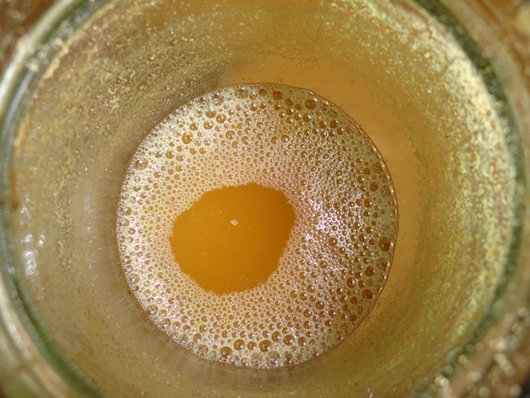
We had a nice supply of ginger beer going over Christmas. It's a delicious soft drink for young and old, although there is an alcoholic version that can be made with a slight variation on the recipe. Ginger beer is a naturally fermented drink that is easy to make - with ginger beer you make a starter called a ginger beer plant and after it has fermented, you add that to sweet water and lemon juice. Like sourdough, it must ferment to give it that sharp fizz. To make a ginger beer plant you'll need ginger - either the powdered dry variety or fresh ginger, sugar, rainwater or tap water that has stood for 24 hours to allow the chlorine to evaporate off. You'll also need clean plastic bottles that have been scrubbed with soap, hot water and a bottle brush and then rinsed with hot water. I never sterilise my bottles and I haven't had any problems. If you intend to keep the ginger beer for a long time, I'd suggest you sterilise your bottles. MAKING THE STARTER In a...
Image

NOT the last post

This will be my last post here.  I've been writing my blog for 18 years and now is the time to step back. I’ve stopped writing the blog and come back a couple of times because so many people wanted it, but that won’t happen again, I won’t be back.  I’ll continue on instagram to remain connected but I don’t know how frequent that will be. I know some of you will be interested to know the blog's statistics. 
Image

How to make cold process soap

I'm sure many of you are wondering: "Why make soap when I can buy it cheaply at the supermarket?" My cold process soap is made with vegetable oils and when it is made and cured, it contains no harsh chemicals or dyes. Often commercial soap is made with tallow (animal fat) and contains synthetic fragrance and dye and retains almost no glycerin. Glycerin is a natural emollient that helps with the lather and moisturises the skin. The makers of commercial soaps extract the glycerin and sell it as a separate product as it's more valuable than the soap. Then they add chemicals to make the soap lather. Crazy. Making your own soap allows you to add whatever you want to add. If you want a plain and pure soap, as I do, you can have that, or you can start with the plain soap and add colour, herbs and fragrance. The choice is yours. I want to add a little about animal and bird fat. I know Kirsty makes her soap with duck fat and I think that's great. I think t...
Image

Preserving food in a traditional way - pickling beetroot

I've had a number of emails from readers who want to start preserving food in jars but don't know where to start or what equipment to buy.  Leading on from yesterday's post, let's just say up front - don't buy any equipment. Once you know what you're doing and that you enjoy preserving, then you can decide whether or not to buy extra equipment. Food is preserved effectively without refrigeration by a variety of different methods. A few of the traditional methods are drying, fermentation, smoking, salting or by adding vinegar and sugar to the food - pickling. This last method is what we're talking about today. Vinegar and sugar are natural preservatives and adding one or both to food sets up an environment that bacteria and yeasts can't grow in. If you make the vinegar and sugar mix palatable, you can put up jars of vegetables or fruit that enhance the flavour of the food and can be stored in a cupboard or fridge for months. Other traditional w...
Image

Cleaning mould from walls and fabrics

With all this rain around we've developed a mould problem in our home. Usually we have the front and back doors open and that good ventilation stops most moulds from establishing. However, with the house locked up for the past week, the high humidity and the rain, mould is now growing on the wooden walls near our front door and on the lower parts of cupboards in the kitchen. Most of us will find mould growing in our homes at some point. Either in the bathroom or, in humid climates, on the walls, like we have now. You'll need a safe and effective remedy at some point, so I hope one of these methods works well for you. Mould is not only ugly to look at, it can cause health problems so if you see mould growing, do something about it straight away. The longer you leave the problem, the harder it will be to get rid of it effectively. If you have asthma or any allergies, you should do this type of cleaning with a face mask on so you don't breathe in any spores. Many peopl...
Image

Five minute bread

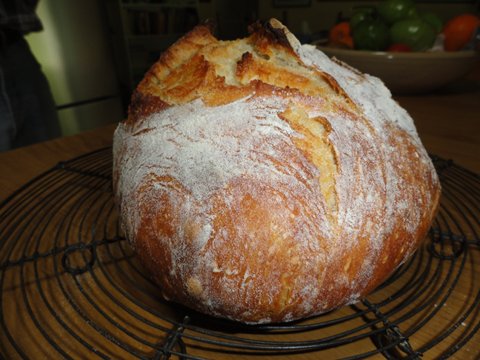
Bread is one of those foods that, when made with your own hands, gives a great deal of satisfaction and delight. It's only flour and water but it symbolises so much. I bake bread most days and use a variety of flours that I buy in bulk. Often I make a sandwich loaf because we use most of our bread for lunchtime sandwiches and for toast. Every so often I branch out to make a different type of loaf. I have tried sour dough in the past but I've not been happy with any of them. I'll continue to experiment with sour dough because I like the idea of using wild yeasts and saving the starter over a number of years to develop the flavour and become a part of the family. However, the loaf I've been branching out to most often is just a plain old five minute bread. By five minutes I mean it takes about five minutes actual work to prepare but it's the easiest of all bread to make and to get consistently good loaves from. If you're having people around for lunch or...
Image

This is my last post.

I have known for a while that this post was coming, but I didn't know when. This is my last post. I'm closing my blog, for good, and I'm not coming back like I have in the past.  I've been writing here for 16 years and my blog has been many things to me. It helped me change my life, it introduced me to so many good people, it became a wonderful record of my family life, it helped me get a book contract with Penguin, and monthly columns with The Australian Women's Weekly and Burke's Backyard . But in the past few months, it's become a burden. In April, I'll be 75 years old and I hope I've got another ten years ahead. However, each year I'll probably get weaker and although I'm fairly healthy, I do have a benign brain tumour and that could start growing. There are so many things I want to do and with time running out, leaving the blog behind gives me time to do the things that give me pleasure. On the day the blog started I felt a wonderful, h...
Image

What is the role of the homemaker in later years?

An email came from a US reader, Abby, who asked about being a homemaker in later years. This is part of what she wrote: "I am a stay-at-home mum to 4 children, ages 9-16. I do have a variety of "odd jobs" that I enjoy - I run a small "before-school" morning drop-off daycare from my home, I am a writing tutor, and I work a few hours a week at a local children's bookstore. But mostly, I cherish my blissful days at home - cooking, cleaning (with homemade cleaners), taking care of our children and chickens and goats, baking, meal-planning, etc. This "career" at home is not at all what I imagined during my ambitious years at university, but it is far more enriching. I notice, though, that my day is often planned around the needs of my family members. Of course, with 4 active kids and a husband, this is natural. I do the shopping, plan my meals, cook dinner - generally in anticipation of my family reconnecting in the evening.  I can't h...
Image

Every morning at home

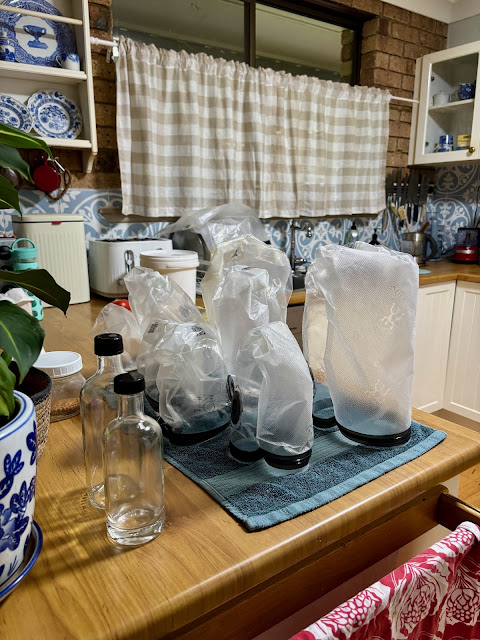
Every morning when I walk into my kitchen it looks tidy and ready for a day's work. Not so on this morning (above), I saw this when I walked in. Late the previous afternoon when I was looking for something, I came across my rolled up Zwilling vacuum bags and decided they had to be washed and dried. So I did that and although I usually put them outside on the verandah to dry it was dark by then. I turned the just-washed bags inside out and left them like this on a towel. It worked well and now the bags are ready to use when I bring home root vegetables, cabbages or whatever I buy that I want to last four or five weeks.
Image

You’ll save money by going back to basics

When I was doing the workshops and solo sessions, I had a couple of people whose main focus was on creating the fastest way to set up a simple life. You can't create a simple life fast, it's the opposite of that It's not one single thing either - it's a number of smaller, simpler activities that combine to create a life that reflects your values; and that takes a long to come together. When I first started living simply I took an entire year to work out our food - buying it, storing it, cooking it, preserving, baking, freezing, and growing it in the backyard. This is change that will transform how you live and it can't be rushed.  
Image


Trending Articles

NOT the last post

This will be my last post here.  I've been writing my blog for 18 years and now is the time to step back. I’ve stopped writing the blog and come back a couple of times because so many people wanted it, but that won’t happen again, I won’t be back.  I’ll continue on instagram to remain connected but I don’t know how frequent that will be. I know some of you will be interested to know the blog's statistics. 
Image

Every morning at home

Every morning when I walk into my kitchen it looks tidy and ready for a day's work. Not so on this morning (above), I saw this when I walked in. Late the previous afternoon when I was looking for something, I came across my rolled up Zwilling vacuum bags and decided they had to be washed and dried. So I did that and although I usually put them outside on the verandah to dry it was dark by then. I turned the just-washed bags inside out and left them like this on a towel. It worked well and now the bags are ready to use when I bring home root vegetables, cabbages or whatever I buy that I want to last four or five weeks.
Image

You’ll save money by going back to basics

When I was doing the workshops and solo sessions, I had a couple of people whose main focus was on creating the fastest way to set up a simple life. You can't create a simple life fast, it's the opposite of that It's not one single thing either - it's a number of smaller, simpler activities that combine to create a life that reflects your values; and that takes a long to come together. When I first started living simply I took an entire year to work out our food - buying it, storing it, cooking it, preserving, baking, freezing, and growing it in the backyard. This is change that will transform how you live and it can't be rushed.  
Image

Creating a home you'll love forever

Living simply is the answer to just about everything. It reduces the cost of living; it keeps you focused on being careful with resources such as water and electricity; it reminds you to not waste food; it encourages you to store food so you don't waste it and doing all those things brings routine and rhythm to your daily life. Consciously connecting every day with the activities and tasks that create simple life reminds you to look for the meaning and beauty that normal daily life holds.  It's all there in your home if you look for it. Seemingly mundane tasks like cleaning and cooking help you with that connection for without those tasks, the home you want to live in won't exist in the way you want it to.  Creating a home you love will make you happy and satisfied.
Image

Time changes everything

I've been spending time in the backyard lately creating a contained herb and vegetable garden. My aim is to develop a comfortable place to spend time, relax, increase biodiversity and encourage more animals, birds and insects to live here or visit. Of course I'd prefer my old garden which was put together by Hanno with ease and German precision. Together, we created a space bursting at the seams with herbs, vegetables and fruity goodness ready to eat and share throughout the year. But time changes everything. What I'm planning on doing now, is a brilliant opportunity for an almost 80 year old with balance issues. In my new garden I'll be able to do a wide range of challenging or easy work, depending on how I feel each day. It’s a daily opportunity to push myself or sit back, watch what's happening around me and be captivated by memories or the scope of what's yet to come.
Image

It's the old ways I love the most

I'm a practical woman who lives in a 1980’s brick slab house. There are verandahs front and back so I have places to sit outside when it's hot or cold. Those verandahs tend to make the house darker than it would be but they're been a great investment over time because they made the house more liveable. My home is not a romantic cottage, nor a minimalist modern home, it's a 1980’s brick slab house. And yet when people visit me here they tell me how warm and cosy my home is and that they feel comforted by being here. I've thought about that over the years and I'm convinced now that the style of a home isn't what appeals to people. What they love is the feeling within that home and whether it's nurturing the people who live there.
Image

Making ginger beer from scratch

We had a nice supply of ginger beer going over Christmas. It's a delicious soft drink for young and old, although there is an alcoholic version that can be made with a slight variation on the recipe. Ginger beer is a naturally fermented drink that is easy to make - with ginger beer you make a starter called a ginger beer plant and after it has fermented, you add that to sweet water and lemon juice. Like sourdough, it must ferment to give it that sharp fizz. To make a ginger beer plant you'll need ginger - either the powdered dry variety or fresh ginger, sugar, rainwater or tap water that has stood for 24 hours to allow the chlorine to evaporate off. You'll also need clean plastic bottles that have been scrubbed with soap, hot water and a bottle brush and then rinsed with hot water. I never sterilise my bottles and I haven't had any problems. If you intend to keep the ginger beer for a long time, I'd suggest you sterilise your bottles. MAKING THE STARTER In a...
Image

An authentic look at daily life here — unstaged and real

Most days Hanno was outside happily working in the fresh air. It may surprise you to know that I started reading my book,  Down to Earth , yesterday - the first time since I wrote it 13 years ago.  I had lent it to my neighbor, and when she returned it, I started reading, expecting to find surprises. Instead, I realised the words were still familiar—as if they were etched into my memory. As I flipped through the pages, I was reminded of how important it was for me to share that knowledge with others. The principles in Down to Earth changed my life, and I truly believed they could do the same for others. After just 30 minutes of reading, I put the book down, reassured that its message still holds true: we can slow down and reshape our lives, one step at a time.
Image