down to earth

  • Home
  • About Us
  • Down To Earth Book
  • Privacy Policy
Today's kitchen is Libby's in Woolongong Australia.  Woolongong is just south of Sydney.

Libby writes:
"I love my kitchen - I designed it myself (I used to work as a Kitchen Designer) so everything is just how I wanted it. My sink looks into our family room and out to the vegetable garden. And the main orientation from the kitchen, when I'm preparing food, is outside. We've been in this home for over 4 years now and my kitchen still makes me so very happy."

http://libby.withnall.com


Please don't forget to comment. A comment is like payment for the time taken to post, and in this case in sending in the photos.  Many of us were enthusiastic about this series, so make sure all the photos get a good number of comments.  I don't want any of the people sending in photos to regret joining in.  Thank you friends. 
PLEASE NOTE: I am not accepting any more kitchen sink photos.  After I have gone through those I still have, I'll start another pictorial type of post that you can be involved in.
There are certain times during the year when the air temperature is so mild and gentle we seem to blend into the natural environment and become part of it.  It was like that yesterday.  Late in the afternoon, as I was making dinner, I noticed Hanno was outside planting and watering.  I grabbed my camera and went out to join him.  There was no breeze, the air was neither cool nor warm, the conditions were perfect.  

Just a few short weeks ago, our garden was almost bare.  We stopped planting in November and have scratched a few harvests since then, but the main activity in the garden has been when we let the chook loose in there to scratch around for insect eggs and eat all the grubs and caterpillars.  After that, Hanno built the soil up again with cow manure, compost, old chook manure and worm castings.  When he planted the first lettuces and cucumbers in the garden a  few weeks ago, they burst into life and have been feeding us for the last week or so.  There is nothing better than the taste of fresh vegetables and nothing gives me a greater feeling of self reliance and confidence than walking outside in  the afternoon to collect food for our dinner.  It's sublime on every level.

While I was outside yesterday afternoon, I took these photos.  They speak for themselves, so I'll let them tell their own story.  My thanks to Hanno for providing us with such healthy, sustainable, organic food.

Welsh onions and lettuce.  Click on photos to enlarge them.

Just on the other side of the fence, Heather, our salmon Faverolles chook, waits, hoping for a lettuce leaf.

From the bottom end, unseen potatoes, beetroot, lettuce rocket/arugula and cucumbers.

Lots of capsicums/peppers, dill, parsley and green onions.

Sweet potato madly growing everywhere and some ginger nextto the girl Buddha.

Whenever something is harvested, a new plant takes its place.  Keeping up with succession planting is the most difficult part of this kind of vegetable production.

Tomatoes have been planted at the base of each post in this A frame.  Next to them are leeks and radishes.

There is an abundance of cucumbers.

Tools of the trade always at hand, a trowel for digging planting holes, an old grapefruit knife for removing seedlings from their punnets and a bucket of seaweed tea to help with transplant shock.

From this end, radishes, parsnips, sugarloaf cabbages, leeks and tomatoes.

Welsh onion, green beans, coriander, tomatoes, parsley, dill, capsicums/peppers and zinnias.

Capsicums/peppers, parsley, dill, green beans and Welsh onions.

Lettuce and, unseen, potatoes.

Cucumbers (left), yarrow (for herb tea), bok choi, sweet potato.

Yellow passionfruit.  There are black passionfruit at the other end of the trellis.

And to answer the most asked question on the blog, the upturned pots are to stop us taking an eye out on the stakes and bamboo canes, and they're also decorative - I like the look of them.
I've had another email asking for help with ideas so, with the permission of the writer, I'm opening this up so we all have a chance to offer ideas, support and encouragement.  Today's email is from Jo in the UK.  To summarise Jo's email,  her husband is working nights, her work hours have just been doubled and although she loves her job, she feels she has no time left for herself.  Jo lives in semi-rural England with her husband and two chidlren whom she loves very much.  Jo writes: 

"while others try to out do each other with credit cards, latest fashions, flashy cars, we don't, we have an allotment ( you probably knew what they are) large piece of land that we pay rent for each year, its ours for as long is we want it, we have had it five years now, we grow all our own veg and fruit there, we keep chickens in our back yard, I cook from scratch even the dogs and cats food. We mend things, reuse things, recycle a lot. But recently I feel we have lost out way, got stuck in a rut that I don't like and don't know how to get out of. 

I do like to be organized and I cant seem to relax, slow down or stop. At the moment .. I feel I cant take a look at what I am doing and change it, life seems to be going at 200mph and I cant keep up which makes me stressed, silly little things are getting me down, like not being able to refill the bird table every day, surely I should have time for this??, I cant find the passport forms, seems simple right, go to the post office and get new ones , but no for me I have to find the ones I have."

Jo, I think the mother in any family is like a wagon that loads the family aboard and keeps everything on track.  Mothers do much of the housework and if you have an outside job as well, you'll have a lot, and maybe too much to do.  Don't let the wheels fall off your wagon, ask for help, start saying "no", establish boundaries - for yourself and others, and give yourself time to relax and recover.  You are not a machine, you need time when you can do whatever you feel like doing - be that reading, sewing, gardening, thinking or walking - or spending time with the family.  But it has to be your choice and what YOU want to do.  If you always do for others, you get lost and eventually feel resentment.

Going ...

I think you might need to go back to your old work hours so you have more time at home.  You said you've just paid off a lot of debt so I doubt that is a problem for you.  You'll be able to do more, and organise yourself and your home in the way that suits you.  You mentioned that you recently took on more guinea pigs and that your work hours were doubled.  Those two actions sound like you're just going along with what others want from you.  Be proactive with your life.  You make the decisions and it's entirely your own choice what you say yes to.  You have consciously decided to grow vegetables and keep chooks, you need to also consciously decide to balance the time you spend working with time you give to yourself.  Not only do you need to invest time in your home and family, you need to invest it in yourself too. These two old posts may hold a message for you: When mama ain't happy, ain't nobody happy and Learning how to say NO.

going ...

When you get yourself back on track, you might also think about changing various things you do in the normal course of your day.  I often change things here so it stays fresh for me and I keep enjoying repetitive tasks.   Those changes might just be rearranging my work spaces and changing how I do certain tasks, but those tiny changes keep it interesting and keep me going back for more. Learn new skills, that brings interest too. And take breaks, make yourself a cuppa and sit reading for a while.  When you go back to work, you'll feel refreshed and that you are being looked after too.

gone!

Jo, you have got the basics right. There is no doubt about that.  You love your husband and children, you're all working together towards being debt-free, you've simplified your lives and are living in a way that will enrich you and keep your family strong.  But this is not suppose to be difficult.  You make your own rules, you decide what it is you do each day.  I think that if you ease off the accelerator and give yourself some time to regroup and organise your daily chores, you'll rediscover that joy you used to find in day to day life.  Remember to take small steps and to find joy in small achievements.  Look for the beauty in your lives and disregard what your friends and neighbours are doing.  You've make some significant steps towards a happy future, all this is just fine tuning.

I hope you have some words of encouragement for Jo.  If you do, please add to the comments.  Thank you friends.

Today I am featuring Heather's kitchen in Pennsylvania USA.  It's another unusual kitchen which proves, yet again, how diverse we all are.

Heather writes:
"We live in an octa-decagon shaped house that we built from a kit, so our kitchen is a little unconventional, but works just like any other kitchen.


My husband & a friend made the cabinets from leftover wood from our ceiling. You will see that I have my calendar/house binder, cookbooks & bread bowls stored on the island. My sink is a double-bowl stainless steel w/ a curved-neck spout for filling big stock pots.When I look out my kitchen sink window, I see our chicken coop & can check on the chooks. 
 

Our kitchen is part of our "great room" so when I'm busy in the kitchen, I can help my girls with their school work, talk w/ visitors & be warmed by the woodstove all at the same time! Most of our walls in the great room are windowed, so we use a lot of natural light & rarely have to turn the lights on during the day."
 
Please don't forget to comment. A comment is like payment for the time taken to post, and in this case in sending in the photos.  Many of us were enthusiastic about this series, so make sure all the photos get a good number of comments.  I don't want any of the people sending in photos to regret joining in.  Thank you friends.
 
 I received an email from a reader a day or so ago and I thought the answer might be of interest to others as well.  In part, the email asked:

"I have a few questions, my husband and I are in our 40's and have only one son left at home. We would like to change our home as it is a very small block although the house is a good size.We try and grow vegies and everything we can in-between the garden flowers and pots.We have an opportunity to buy a 5 acre property, but I am nervous I think it may be too big as we are getting older not younger and worry we won't manage our land when older? What motivated you to move to your plot and how large is it.? You and Hanno seem to manage very easily. I thought I'd ask you as your reasoning is always sound and very helpful in making our choice. I think a blog 1400 would suit me better as my hubby doesn't have too much free time with work."

We moved to our current home when Shane left school and Kerry was in his final year of school. We chose that time because we wanted to be closer to a university, potential employment, shopping and entertainment. This was a few years before we realised how toxic our lifestyle had become and then changed to a more gentle and slow life. Luckily for us, we bought our one acre piece of land a couple of years before the property boom and since then it has more than tripled in price. We were looking for a small simple brick house with a bit of land. What we got was that, plus a permanent creek wandering through remnant rainforest at the end of a one lane dead-end street. Bliss! Even though what we have is very simple, and the absolute opposite to what most people were buying then, when I walked on to this block of land, I thought I'd died and gone to heaven. The garden was in its original state, the house was dated and needed work, but I knew at the very second I saw the backyard, that this was where I wanted to live. I was 49 then, Hanno was 58.
This is our house as seen from the garden (click to enlarge). As you can see, we have a solar hot water system (right), skylights, whirlybirds (to extract hot air from the roof), as well as a TV satellite dish that was disconnected many years ago. 

Five acres would have been too much for us then and would be a worry for us now. We used to have the boys to help mow the lawns (it took just over three hours) but now Hanno breaks the job up into a number of sections. It's slower but it's easier that way. An acre gives us room for our house, chooks, a double work shed for Hanno, a garden shed, bush-house, water tanks, vegetable garden, fruit trees and a large wild garden at the front that hides us from the road. I agree with you, a smaller block would give you the best of both worlds - you'd have enough land to do what you want to do, spread out and have out-houses but you'd still be able to manage the work of a 1400 block for many years to come. If you bought the larger block would you be able to subdivide it and sell off what you don't want?
In the house, look for work areas that will support productivity and family areas that encourage closeness.

Make sure the house has enough of the right kind of spaces. Look for a large pantry and stockpile cupboard close together, a work room for your sewing and mending, a well laid out kitchen that will allow you to preserve/can your excess garden produce and a place to sit and shell peas or read. If you have money left over after the purchase, buy some things that will help you be sustainable. Water tanks to harvest rainwater from your roof will help you every day you garden, skylights will help you bring light to rooms without electricity, solar hot water or panels for the entire house would be ideal.
Our back verandah is set up most of the time for the work we do there - there is a spare washing machine that is hooked up to the rain water tank, we dry clothes there when it rains, the animals are fed there, the wheelbarrow waits, the hose is ready to be used.  But we have had the best parties there too.  I had my 50 birthday party on this verandah, surround by family, friends, flowers and a hundred flickering candles.

It sounds like you're already gardeners and plan on continuing with that so look for a warmish climate with good rainfall.  Check your local authorities for flood history and look up the weather statistics for the past few years.  Overall, you want to live in an area that will support the work you wish to do in your home - like keeping chickens and growing food.

Even though you're still in your 40s, now is the time to look 30 years ahead.  You want a house and land that will allow you to work it easily while your husband is still working outside the home, you want a house that will be easy for you to live in for many years to come (our house has no stairs) and you want to know you're safe and sound and live well with your neighbours - go and meet the neighbours whenever you look at a new house.  You are paying for the location as much as for the building and land so know what you're buying into.  Ask every neighbour, and the people you're buying from, what the neighbours are like.  A bad neighbour is as concerning as a bad flood report - they will impact on your life in a negative way.  Steer clear.  You need to be fit and healthy to live as we do but as you age you also need access to medical facilities - make sure they aren't too far away.  You'll also need to be fairly close to a supermarket, butcher, and other primary producers if possible.

As we could afford additions, we put them in.  Here Hanno is adding a lattice on which we now grow passionfruit. The main reason we added the lattice was to shade our bedroom wall and windows from the afternoon sun.

Look for efficiency, comfort, warmth and productivity in a house, rather than luxury.  A coat of paint does wonders for most places.  See if you can save a few dollars by buying a smaller home on a large block, and spend the rest of your budget modifying the house to suit you both.  Hanno and I did that.  We knew many things weren't to our liking when we bought here, but when we moved in we took the time to change what we didn't like.  As money became available during the first few years of us being here, we kept adding those elements we wanted - like the skylights, tanks, gardens and fences.  Fences are important and if you're gardening and keeping chooks, a house cow or goats, you'll need good fences.  And not only to keep critters in, but to keep them out as well.  Make sure, when you do your changes, you use recycled materials if you can, they cut the cost considerably, and help to make your home more sustainable and earth-friendly.


Never underestimate the importance of fences. Here you can see the garden looking towards the back of the property and the chook house, below you can see the opposite view of the chook house view of the garden. Fencing will allow you to garden in peace and keep the chooks safe at the same time.


I highly recommend The New Complete Book of Self Sufficiency by John Seymour to you. He writes about and illustrates the ins and outs of a one acre small holding as well as a five acre one. You'll be surprised and pleased at his thoughts on the one acre plot - there is an abundance of crops, animals and fields of food for people and animals. It's really worth a read. I hope I've answered your question in a way that will help you look at things in a different way and will help you plan for your future. Please keep in touch and let me know what you decide on and how it goes when you eventually move.

The work of a simple homekeeper can sometimes be complicated.  I keep changing things, particularly my work spaces.  I love change and look for ways to change so that my work stays interesting and is done efficiently.  I am currently in the middle of cleaning up and rearranging my work room.  This room used to be Hanno's office and even now he tenaciously holds on to a tiny portion of it - a cupboard and a drawer.  I'm sure that cupboard would serve me well as a space to hold my fabrics and wool, but that is a change for a future time and unlike the old Rhonda who was terribly impatient, now I'm like a statue - just quietly watching and waiting for THE time.  I cannot divulge my plan here because Hanno reads the blog every day, but change is coming, I feel it in my bones.  ;- )


Yesterday I organised the desk space, moving my laptop over to its Winter position and the sewing machine to the left of it.  I like looking out the window during summer but now the light has changed I prefer to look into the corner.  As usual, my notebooks and notes are to my right.  It's strange how you can live with things for years and not notice them.  I've used one of the kids old mouse pads for donkey's years.  We bought our first computer in 1988 when the kids would have been 8 and 7 so I am sure this Mickey Mouse pad is from those very early days.  When I saw it yesterday I knew I couldn't live with it another day, so a quick project later, I now have a quite nice floral mouse pad.  It took me all of five minutes from start to finish and I will be able to replace the floral when I'm sick of it.

All I did was to draw the shape of the mouse pad, with pencil, directly onto the fabric, then cut it out. I sprayed each side with craft adhesive - do this outside as it's very sticky and smells a lot, then press the fabric carefully onto the pad It takes a little while for it to dry but when it does, it's ready to use.
 
I needed a little place to keep all the little things that commonly come with sewing - tape measures, bias binder makers, pins, cottons, embroidery threads, pin cushions etc. so I found a little shelf unit Hanno made for me many years ago.  It was outside in the shed but I bought it inside, gave it a good scrubbing with my liquid soap and a stiff brush and it came back to its beautiful, simple self.  I think it looks really sweet and it holds all those things that I need nearby but not on my desk.  I'm really happy with it.

Today's task is to finish up in here, which I'll do after I finish writing this blog. I have a number of baskets, containers and shelves on which to place my various stashes; the fabrics need to be tidied up by refolding and replacing them on their shelves. I also want to move the overlocker/serger so I don't hit my shins on it and rearrange what is under the desk. I hope to get it all done this morning so I can sew this afternoon. What are you doing today/tomorrow?  ♥
If you've been lucky enough to grow potatoes in your backyard you'd know the sign you look for to indicate when you should harvest.  It's when the green potato tops die down and you're left with bare earth.  Of course, you can harvest before then, but when the top dies, you know that no more growth will follow.  If you were to go out to a commercial non-organic potato farm, you'd probably see them spray herbicide (poison) onto the crop about a week before harvest.  They give their plants a certain amount of time, then harvest.  They need to kill off the green tops so they don't make the mechanical harvesting of potatoes too difficult.  The green tops clog up the machine at worst; at best, it's just more rubbish to deal with during the harvest.

One of our many potato crops in years gone by.  The potatoes are at the back in the middle of the photo.

Potatoes are an important crop for us.  If we want to eat organic potatoes that have not been sprayed with poison a week before harvest, we have to grow them ourselves.  That's fine with me.  Home grown potatoes, like backyard tomatoes, have much more flavour than those bought at the market.  You can also "bandicoot" new small potatoes from the side of the bushes while they're still growing.  There is nothing quite like new potatoes, fresh from the garden that afternoon, simply boiled and served up with a little butter and a sprinkling of herbs.  That, my friends, is one of the perks of vegetable gardening and it doesn't matter how much you can afford to pay for your potatoes at the market, you can never buy that degree of freshness.


Hanno bought Sebago seed potatoes a couple of weeks ago, as they were the only type he could find, but we both wanted Dutch Cream.  We got some Nicolas from the shop, they're similar to Dutch Creams, and I spent a short time cutting them for chitting a couple of days ago.  Chitting is the process of allowing your potatoes to develop shoots before you plant them in the ground.  If the potatoes are a medium size, or small, you don't have to cut them. However, if you have larger potatoes, for the sake of economy, you can cut them in half, making sure you have shoots, or eyes on each half.  Place all the potatoes, or potato pieces in egg cartons to keep them from rolling around and so the cut sides can dry out completely.  Leave them in a shaded light area out of the sun. When the shoots are a few inches long, plant them out in the garden.


I feel like a real farmer when we grow potatoes.  They're substantial and they need to be stored properly; they feel like real crops.  Potatoes make great filling meals with only a few additions - like my kartoffelpuffer recipe here, or as a fine addition to meat when you make your favourite potato salad.  So if you can find a space, take the plunge and grow some potatoes.  Even if you don't have much space, you can grow potatoes successfully in wire cages.  Just poke four star pegs into the grown, wrap chicken wire around them, place some compost in the bottom of the cage with potatoes on top and cover with soil and straw.  As the potatoes grow, keep adding compost mixed with soil and straw and each time the green tops grow again, add more.  You'll get good potatoes growing them like this but nothing is as good as potatoes grown in the garden bed.  By the way, don't grow potatoes in old car tyres.  Tyres contain many chemicals, including cadmium, and it's best to keep them well away from your garden.


There is no doubt about it, potatoes are an excellent crop for the backyarder.  If you haven;' tried them yet, take the dive this year. I'm sure you'll be pleased you did.

Growing organic potatoes fact sheet.

If you're a new gardener living on the Sunshine Coast or northside Brisbane, Sonya will be presenting some workshops for beginners on April 18,  go here to find details.  I know Sonya and I'm sure your money will be well spent.

This kitchen is both sad and a place that brings back beautiful memories.  This is Cadi's kitchen in Virginia USA.   Cadi, I send you much love during your sadness.  It sounds like you and Brent shared many happy hours in your kitchen.  I hope you continue to find peace there.

Cadi writes:
"This is "my kitchen sink."

We rent a small, old bungalow-style house in Richmond, Virginia in the U.S.A where I'm a teacher. Just a bit over a month ago my love, Brent, passed away suddenly. I have many memories of us cooking dinner together in this lil' kitchen, of being silly, drinking wine while cooking, him teasing me about my lumpy mashed potatoes, me teasing him about being a messy cook...

For a long time I didn't step into the kitchen. Friends brought us food. And I seriously took dirty dishes to a friends house to wash them in her dishwasher. Crazy, huh? I just couldn't motivate myself to do much at all. Then one Saturday morning I realized just how nice it was to stand at the sink & wash the dishes, just how Brent and I used to. And it brought beautiful memories and a sense of peace.


We have a plain & simple kinda life. The second picture shows our dining area, just off the kitchen. Green is my favorite color. We usually have fresh flowers - even if it's just something tiny. The dresser holds linen & art supplies my children (two boys, 11 & 13) use. The toys in the basket are from their early childhood & are now mostly used when guests with wee lil' ones visit us.

My blog is at www.maehegirl.blogspot.com  "

Please don't forget to comment. Cadi needs our love and support now.  Thank you friends.
Newer Posts Older Posts Home


My books were all published by Pengiun, and are available at Amazon US, Amazon UK and Amazon Au

Search here

Total Pageviews

Translate


I'm Rhonda Hetzel and I've been writing my Down to Earth blog since 2007. Although I write the occasional philosophical post, my main topics include home cooking, happiness and gardening as well as budgeting, baking, ageing, generosity, mending and handmade crafts. I hope you enjoy your time here.

MY FAVOURITE PLACES

  • Grandma Donna's Place
  • Grandma Donna's YouTube
  • Grandma Donna's Instagram
  • This Simple Day
  • Nicole's Instagram

Give More

Give More

Popular posts last year

Making ginger beer from scratch

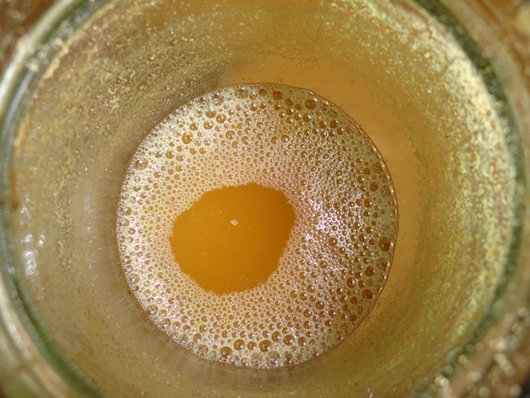
We had a nice supply of ginger beer going over Christmas. It's a delicious soft drink for young and old, although there is an alcoholic version that can be made with a slight variation on the recipe. Ginger beer is a naturally fermented drink that is easy to make - with ginger beer you make a starter called a ginger beer plant and after it has fermented, you add that to sweet water and lemon juice. Like sourdough, it must ferment to give it that sharp fizz. To make a ginger beer plant you'll need ginger - either the powdered dry variety or fresh ginger, sugar, rainwater or tap water that has stood for 24 hours to allow the chlorine to evaporate off. You'll also need clean plastic bottles that have been scrubbed with soap, hot water and a bottle brush and then rinsed with hot water. I never sterilise my bottles and I haven't had any problems. If you intend to keep the ginger beer for a long time, I'd suggest you sterilise your bottles. MAKING THE STARTER In a...
Image

NOT the last post

This will be my last post here.  I've been writing my blog for 18 years and now is the time to step back. I’ve stopped writing the blog and come back a couple of times because so many people wanted it, but that won’t happen again, I won’t be back.  I’ll continue on instagram to remain connected but I don’t know how frequent that will be. I know some of you will be interested to know the blog's statistics. 
Image

How to make cold process soap

I'm sure many of you are wondering: "Why make soap when I can buy it cheaply at the supermarket?" My cold process soap is made with vegetable oils and when it is made and cured, it contains no harsh chemicals or dyes. Often commercial soap is made with tallow (animal fat) and contains synthetic fragrance and dye and retains almost no glycerin. Glycerin is a natural emollient that helps with the lather and moisturises the skin. The makers of commercial soaps extract the glycerin and sell it as a separate product as it's more valuable than the soap. Then they add chemicals to make the soap lather. Crazy. Making your own soap allows you to add whatever you want to add. If you want a plain and pure soap, as I do, you can have that, or you can start with the plain soap and add colour, herbs and fragrance. The choice is yours. I want to add a little about animal and bird fat. I know Kirsty makes her soap with duck fat and I think that's great. I think t...
Image

Preserving food in a traditional way - pickling beetroot

I've had a number of emails from readers who want to start preserving food in jars but don't know where to start or what equipment to buy.  Leading on from yesterday's post, let's just say up front - don't buy any equipment. Once you know what you're doing and that you enjoy preserving, then you can decide whether or not to buy extra equipment. Food is preserved effectively without refrigeration by a variety of different methods. A few of the traditional methods are drying, fermentation, smoking, salting or by adding vinegar and sugar to the food - pickling. This last method is what we're talking about today. Vinegar and sugar are natural preservatives and adding one or both to food sets up an environment that bacteria and yeasts can't grow in. If you make the vinegar and sugar mix palatable, you can put up jars of vegetables or fruit that enhance the flavour of the food and can be stored in a cupboard or fridge for months. Other traditional w...
Image

Cleaning mould from walls and fabrics

With all this rain around we've developed a mould problem in our home. Usually we have the front and back doors open and that good ventilation stops most moulds from establishing. However, with the house locked up for the past week, the high humidity and the rain, mould is now growing on the wooden walls near our front door and on the lower parts of cupboards in the kitchen. Most of us will find mould growing in our homes at some point. Either in the bathroom or, in humid climates, on the walls, like we have now. You'll need a safe and effective remedy at some point, so I hope one of these methods works well for you. Mould is not only ugly to look at, it can cause health problems so if you see mould growing, do something about it straight away. The longer you leave the problem, the harder it will be to get rid of it effectively. If you have asthma or any allergies, you should do this type of cleaning with a face mask on so you don't breathe in any spores. Many peopl...
Image

Five minute bread

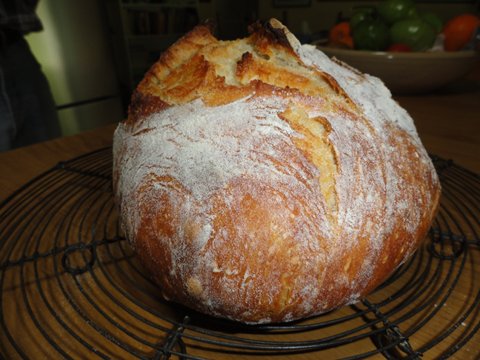
Bread is one of those foods that, when made with your own hands, gives a great deal of satisfaction and delight. It's only flour and water but it symbolises so much. I bake bread most days and use a variety of flours that I buy in bulk. Often I make a sandwich loaf because we use most of our bread for lunchtime sandwiches and for toast. Every so often I branch out to make a different type of loaf. I have tried sour dough in the past but I've not been happy with any of them. I'll continue to experiment with sour dough because I like the idea of using wild yeasts and saving the starter over a number of years to develop the flavour and become a part of the family. However, the loaf I've been branching out to most often is just a plain old five minute bread. By five minutes I mean it takes about five minutes actual work to prepare but it's the easiest of all bread to make and to get consistently good loaves from. If you're having people around for lunch or...
Image

This is my last post.

I have known for a while that this post was coming, but I didn't know when. This is my last post. I'm closing my blog, for good, and I'm not coming back like I have in the past.  I've been writing here for 16 years and my blog has been many things to me. It helped me change my life, it introduced me to so many good people, it became a wonderful record of my family life, it helped me get a book contract with Penguin, and monthly columns with The Australian Women's Weekly and Burke's Backyard . But in the past few months, it's become a burden. In April, I'll be 75 years old and I hope I've got another ten years ahead. However, each year I'll probably get weaker and although I'm fairly healthy, I do have a benign brain tumour and that could start growing. There are so many things I want to do and with time running out, leaving the blog behind gives me time to do the things that give me pleasure. On the day the blog started I felt a wonderful, h...
Image

What is the role of the homemaker in later years?

An email came from a US reader, Abby, who asked about being a homemaker in later years. This is part of what she wrote: "I am a stay-at-home mum to 4 children, ages 9-16. I do have a variety of "odd jobs" that I enjoy - I run a small "before-school" morning drop-off daycare from my home, I am a writing tutor, and I work a few hours a week at a local children's bookstore. But mostly, I cherish my blissful days at home - cooking, cleaning (with homemade cleaners), taking care of our children and chickens and goats, baking, meal-planning, etc. This "career" at home is not at all what I imagined during my ambitious years at university, but it is far more enriching. I notice, though, that my day is often planned around the needs of my family members. Of course, with 4 active kids and a husband, this is natural. I do the shopping, plan my meals, cook dinner - generally in anticipation of my family reconnecting in the evening.  I can't h...
Image

Every morning at home

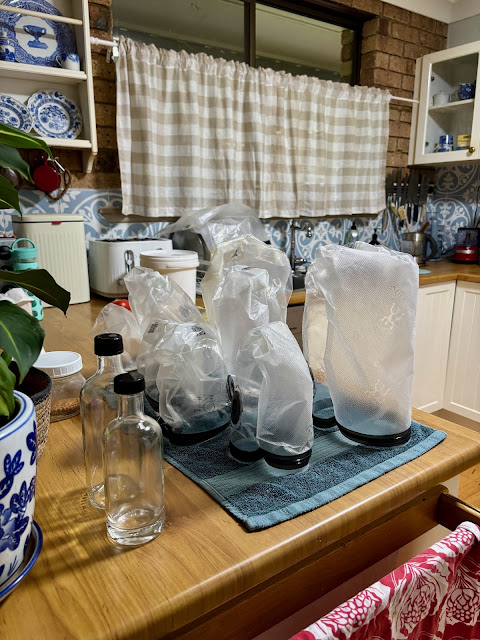
Every morning when I walk into my kitchen it looks tidy and ready for a day's work. Not so on this morning (above), I saw this when I walked in. Late the previous afternoon when I was looking for something, I came across my rolled up Zwilling vacuum bags and decided they had to be washed and dried. So I did that and although I usually put them outside on the verandah to dry it was dark by then. I turned the just-washed bags inside out and left them like this on a towel. It worked well and now the bags are ready to use when I bring home root vegetables, cabbages or whatever I buy that I want to last four or five weeks.
Image

You’ll save money by going back to basics

When I was doing the workshops and solo sessions, I had a couple of people whose main focus was on creating the fastest way to set up a simple life. You can't create a simple life fast, it's the opposite of that It's not one single thing either - it's a number of smaller, simpler activities that combine to create a life that reflects your values; and that takes a long to come together. When I first started living simply I took an entire year to work out our food - buying it, storing it, cooking it, preserving, baking, freezing, and growing it in the backyard. This is change that will transform how you live and it can't be rushed.  
Image


Trending Articles

NOT the last post

This will be my last post here.  I've been writing my blog for 18 years and now is the time to step back. I’ve stopped writing the blog and come back a couple of times because so many people wanted it, but that won’t happen again, I won’t be back.  I’ll continue on instagram to remain connected but I don’t know how frequent that will be. I know some of you will be interested to know the blog's statistics. 
Image

Every morning at home

Every morning when I walk into my kitchen it looks tidy and ready for a day's work. Not so on this morning (above), I saw this when I walked in. Late the previous afternoon when I was looking for something, I came across my rolled up Zwilling vacuum bags and decided they had to be washed and dried. So I did that and although I usually put them outside on the verandah to dry it was dark by then. I turned the just-washed bags inside out and left them like this on a towel. It worked well and now the bags are ready to use when I bring home root vegetables, cabbages or whatever I buy that I want to last four or five weeks.
Image

You’ll save money by going back to basics

When I was doing the workshops and solo sessions, I had a couple of people whose main focus was on creating the fastest way to set up a simple life. You can't create a simple life fast, it's the opposite of that It's not one single thing either - it's a number of smaller, simpler activities that combine to create a life that reflects your values; and that takes a long to come together. When I first started living simply I took an entire year to work out our food - buying it, storing it, cooking it, preserving, baking, freezing, and growing it in the backyard. This is change that will transform how you live and it can't be rushed.  
Image

Creating a home you'll love forever

Living simply is the answer to just about everything. It reduces the cost of living; it keeps you focused on being careful with resources such as water and electricity; it reminds you to not waste food; it encourages you to store food so you don't waste it and doing all those things brings routine and rhythm to your daily life. Consciously connecting every day with the activities and tasks that create simple life reminds you to look for the meaning and beauty that normal daily life holds.  It's all there in your home if you look for it. Seemingly mundane tasks like cleaning and cooking help you with that connection for without those tasks, the home you want to live in won't exist in the way you want it to.  Creating a home you love will make you happy and satisfied.
Image

Time changes everything

I've been spending time in the backyard lately creating a contained herb and vegetable garden. My aim is to develop a comfortable place to spend time, relax, increase biodiversity and encourage more animals, birds and insects to live here or visit. Of course I'd prefer my old garden which was put together by Hanno with ease and German precision. Together, we created a space bursting at the seams with herbs, vegetables and fruity goodness ready to eat and share throughout the year. But time changes everything. What I'm planning on doing now, is a brilliant opportunity for an almost 80 year old with balance issues. In my new garden I'll be able to do a wide range of challenging or easy work, depending on how I feel each day. It’s a daily opportunity to push myself or sit back, watch what's happening around me and be captivated by memories or the scope of what's yet to come.
Image

It's the old ways I love the most

I'm a practical woman who lives in a 1980’s brick slab house. There are verandahs front and back so I have places to sit outside when it's hot or cold. Those verandahs tend to make the house darker than it would be but they're been a great investment over time because they made the house more liveable. My home is not a romantic cottage, nor a minimalist modern home, it's a 1980’s brick slab house. And yet when people visit me here they tell me how warm and cosy my home is and that they feel comforted by being here. I've thought about that over the years and I'm convinced now that the style of a home isn't what appeals to people. What they love is the feeling within that home and whether it's nurturing the people who live there.
Image

Making ginger beer from scratch

We had a nice supply of ginger beer going over Christmas. It's a delicious soft drink for young and old, although there is an alcoholic version that can be made with a slight variation on the recipe. Ginger beer is a naturally fermented drink that is easy to make - with ginger beer you make a starter called a ginger beer plant and after it has fermented, you add that to sweet water and lemon juice. Like sourdough, it must ferment to give it that sharp fizz. To make a ginger beer plant you'll need ginger - either the powdered dry variety or fresh ginger, sugar, rainwater or tap water that has stood for 24 hours to allow the chlorine to evaporate off. You'll also need clean plastic bottles that have been scrubbed with soap, hot water and a bottle brush and then rinsed with hot water. I never sterilise my bottles and I haven't had any problems. If you intend to keep the ginger beer for a long time, I'd suggest you sterilise your bottles. MAKING THE STARTER In a...
Image

An authentic look at daily life here — unstaged and real

Most days Hanno was outside happily working in the fresh air. It may surprise you to know that I started reading my book,  Down to Earth , yesterday - the first time since I wrote it 13 years ago.  I had lent it to my neighbor, and when she returned it, I started reading, expecting to find surprises. Instead, I realised the words were still familiar—as if they were etched into my memory. As I flipped through the pages, I was reminded of how important it was for me to share that knowledge with others. The principles in Down to Earth changed my life, and I truly believed they could do the same for others. After just 30 minutes of reading, I put the book down, reassured that its message still holds true: we can slow down and reshape our lives, one step at a time.
Image