down to earth

  • Home
  • About Us
  • Down To Earth Book
  • Privacy Policy
Today's we have another Australian kitchen. This is Anita's kitchen in Victoria..

Anita writes:
"My kitchen has become a much more important part of my life since I returned to being full-time a stay at home Mum almost 2 years ago. I developed a chronic illness (fibromyalgia) 3 1/2 years ago which eventually made me unable to continue my job as a nurse. In many ways this challenging time has also been a blessing. I have returned "home" and we are a much better family for it. While I'm no domestic goddess, I'm working on it every day. This kitchen is the hub of activity here. I am trying to focus on my health which means preparing healthy meals from scratch as often as possible. Sometimes we fall off the wagon, but we always manage to get back on track.
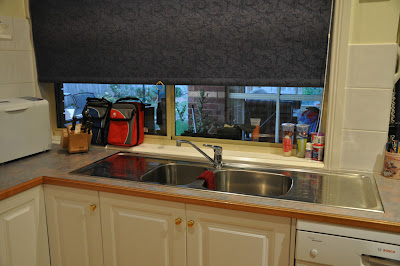
I love that our kitchen has signs of our family life - kids lunch boxes on the windowsill, waiting to be filled tomorrow morning; a fridge covered in kids artwork and notices from school and sport; even two silly "pet aliens" on the windowsill which the boys got for their birthdays from friends.

On the bench is the second-hand breadmaker I recently bought on ebay, so that we can enjoy healthier home-baked bread. I'm not up to kneading by hand due to pain in my arms, shoulders and hands at times, so the breadmaker is a great help. Always present on my kitchen sink is a handknitted dishcloth or two.

My health is slowly improving but I'm not in a great hurry to return to paid work if we can manage on one income for a bit longer. I cherish being home for my two boys, aged 8 and 6, and my hubby too.

Thanks for visiting my kitchen :)"  You can visit Anita's blog here.
Please don't forget to comment. A comment is like payment for the time taken to post, and in this case in sending in the photos.  Many of us were enthusiastic about this series, so make sure all the photos get a good number of comments.  I don't want any of the people sending in photos to regret joining in.  Thank you friends.
Today we return to north America, this time to Nova Scotia in Canada, to Sheila's kitchen.  There is a reference to the weather in Sheila's story so I'll let you know she sent these photos in mid February.

Sheila writes:
"I have attached pictures of my kitchen for you , We built this house about 5 years ago and I really wanted a nice island to work from and I must say it is a pleasure to work here.


I have plenty of space and love to bake and cook and so does our 18year old grandson . As you can see we have an open concept house, this actually extends right into the living room.

I live in Nova Scotia Canada and right now we are experiencing some winter weather lots of snow on the ground but quite mild , you can feel spring in the air and I will be happy to see it come ;-)

Sheila's blog is here.

According to bizymoms.com, I'm one of the five top home and garden bloggers. They interviewed me recently and here is that interview. If you have time, read the other interviews too. The lovely Melinda from One Green Generation is there as well. Thanks Bizymoms.
Today's kitchen is Tanya's in beautiful Tasmania - the island State at the bottom of Australia.  Tanya, I have the same Fowlers Vacola and we have very similar kitchen cupboards.

Tanya writes:
"I took these photos at dawn hoping not to have too much light exposure but they are still flooded. Through every season, the sun comes streaming through that window and I have never had any curtains or blinds on it because I love to look out on the garden and the chickens. Last night I bottled some tomatoes and some beans so when I came out this morning after my husband, he had taken the cooled bottles and placed them on a tea towel and up ended to Fowlers Vacola Pot (1950’s version) on the sink to dry.

On the sill above the sink I keep a bottle of hand wash and a great narrow vase that fits here just right and often holds bunches of herbs from the garden. The white ceramic pot near the sink is my compost bin for the chook scraps. It is one of my favourite things because it is just the right size for daily scraps, cleans up so easily and has a handle for carrying and also a lid with airing holes and a carbon filter.

At this time of year there is always an overflowing colander of tomatoes. Beside those I also have some Australian Limes that were swapped for some eggs and I have been making Blueberry Jam with Lime and Coriander (crushed seed not leaf), a beautiful combination. Another great “couldn’t do without” is my table in the middle of the kitchen. It is an old Singer sewing machine base with a marble slab on top. This is where I make pasta, knead dough and do a lot of food prep.

My blog can be found at www.suburbanjubilee.blogspot.com"

Please don't forget to comment. A comment is like payment for the time taken to post, and in this case in sending in the photos.  Many of us were enthusiastic about this series, so make sure all the photos get a good number of comments.  I don't want any of the people sending in photos to regret joining in.  Thank you friends.
One of the things I love about this series is the kitchens come from all over the world.  We can see real kitchens and know that although we are different, we are all basically the same.  Today's kitchen is Marian's in the Netherlands.

"I send you pictures of both my kitchens. In my home in Amsterdam my 20 years old kitchen is most of the time tidy without things on the sink. That's because I learned my family to clean up after using the kitchen. In that way I function the best I can with a fulltime job as a teacher and three grown up children (17, 19 and 21 years old) We have a dishwasher but we have to wash a lot by hand too. 

 The picture of the other kitchen is from my allotment. It's 15 minutes on our bike from our city appartment to reach it. We have a nice garden and a wooden house 26m2 that's made by hand by my husband and his father about 30 years ago. There's no electricity in the cottage but we use a small solarsystem for the lights. In spring and summertime we live in our cottage and enjoy the outdoorlife still close by Amsterdam.


I have two weblogs, both in Dutch, http://www.vuurvlindertje.web-log.nl  is about my daily life and the things I like to make. I just started the other blog http://www.lifeandco.web-log.nl and I will use it to write about our allotment and about our first steps to simple living. We already started baking our own bread, we make our own granola, we are growing our own vegetables. I'm a teacher of textiles and crafts so I can repair and make a lot. It's nice to see how our tiny steps we make to a more simple way of living awakens the thoughts of our children about the way that life is constructed. It gives us all a sort of new consciousness about our lifestyle.
Please don't forget to comment. A comment is like payment for the time taken to post, and in this case in sending in the photos.  Many of us were enthusiastic about this series, so make sure all the photos get a good number of comments.  I don't want any of the people sending in photos to regret joining in.  Thank you friends.
I made another batch of liquid soap last week and I found the process much easier this time.  My first attempt last September was a long, drawn out process that went over two days and while I was doing it, I felt it wasn't working out properly and all that time would be wasted.  You can imagine my surprise when from the blobs of what looked like vaseline, a clean and golden liquid soap arose.

I used that soap and loved it, however, I have to tell you that unless you're really into soap making or simplifying your life in every way you can, this is probably not a project you'll be interested in.  This soap is really the liquid version of my plain soap - everything you use this liquid soap for, would be just as easily served by using homemade bar soap.   Of course, it won't be a rich golden colour, but the results will be the same.  Similar to the bar soap it is not stripped of glycerine like commercial soaps are and it feels really restorative on your skin. Both bar and liquid can be used for washing dishes and hands, stain removal, shampoo, horticultural soap, washing the floor and anything else you can think of.  If you want to get rid of detergents, this is the soap for you, but it doesn't have to be the liquid version, the bar soap would work as well.  I used this link the first time I made this soap and found it confused in places, although it does contain a lot of information and a good recipe. 


Where this soap comes into it's own is as a lovely addition to a gift basket.  If you want to make up baskets of assorted soaps, or all purpose cleaning baskets as gifts, the liquid soap would be a wonderful addition.  It is also much cheaper to make your own soap - bar or liquid - than it is to buy them, and it will allow you to ditch the detergents you're probably using now, which also includes the plastic bottles they come in.


Making this soap does take a long time from start to finish, but most of that time you're not doing anything, you're waiting for the soap to get to the next stage.  I guess the amount of time you're actually working on the soap would be about 30 minutes.  So if you're wanting to cast off plastics and detergents, or working on your gifts, give it a try.

And this, my friends, will be my last post for a while.  I'm taking a break to slow down and look for meaning in my life.  I have books to read, recipes to try and many things to think about, as well as a lot of projects I want to work on.  I need moments of solitude, I need to shut the gate for a while and I need to shake things up to see what comes back to me when the dust settles.

Be kind to yourself while I'm gone.  I'll see you soon.
Hello everyone! Today we can all take a peek at Kit's kitchen in Missoula, Montana.


"My kitchen is very small! What one would call a galley kitchen, but I find it is very efficient and I really don't have to move very much to get what I want....lol The deciding factor in the colors of my kitchen is the pottery I have collected for years, it is called Rooster and Roses and was something my mother had when I was a little girl. I only have one original piece from that collection (the lamp on the cupboard) and so have started my own. I also have always loved the bold colors and design, of my favorite artist Mary Engelbreit and have added lots of her illustrations and unusual items like my homemade tea cup lamp and black and white checkerboard to liven things up a bit.


My home is 60 years old and the cupboards are original and I have never touched the white paint. I love the patina and "look" of so many hands having touched them. There are even little notes attached from the first owners that are so precious to me (on the inside). I hope you enjoy it as much as I do!"

Please don't forget to comment. A comment is like payment for the time taken to post, and in this case in sending in the photos.  Many of us were enthusiastic about this series, so make sure all the photos get a good number of comments.  I don't want any of the people sending in photos to regret joining in.  Thank you friends.

I've been thinking about this for a while, and I don't do it lightly, but after Friday's post, I'll be taking a break from blogging for a while.  I'm not sure how long I'll be away, maybe a week, maybe a month, maybe longer. I don't know yet.  I have a few other things on my plate right now and along with my voluntary work, I'll be kept busy.  And the truth is I've been non stop busy for well over a year.  I want to take time out for myself, for Hanno and for my family.  I need to dive right into my home again and reacquaint myself with the ins and outs of it. I've barely had a chance to do that for these past few months and I miss it.

I am not stopping my blog, I actually enjoy blogging, and when I get up in the dark every morning and make my way to the computer, thinking about my days so I can write about them, it helps me account, in my own mind, for these hours I've been given.  It helps me live simply.  So for the next few weeks I hope you'll be patient with me, know that I'll be back with you as soon as I can be and that I look forward to the morning when I make my way, in the dark, to the computer again.

I'll be at the Down to Earth forum and will continue posting three kitchen sinks per week. I hope you continue to enjoy them as much as I do.  Thank you to everyone who has sent in photos and to all the readers whose wonderful comments have kept me going.

See you again on Friday.
Newer Posts Older Posts Home


My books were all published by Pengiun, and are available at Amazon US, Amazon UK and Amazon Au

Search here

Total Pageviews

Translate


I'm Rhonda Hetzel and I've been writing my Down to Earth blog since 2007. Although I write the occasional philosophical post, my main topics include home cooking, happiness and gardening as well as budgeting, baking, ageing, generosity, mending and handmade crafts. I hope you enjoy your time here.

MY FAVOURITE PLACES

  • Grandma Donna's Place
  • Grandma Donna's YouTube
  • Grandma Donna's Instagram
  • This Simple Day
  • Nicole's Instagram

Give More

Give More

Popular posts last year

Making ginger beer from scratch

We had a nice supply of ginger beer going over Christmas. It's a delicious soft drink for young and old, although there is an alcoholic version that can be made with a slight variation on the recipe. Ginger beer is a naturally fermented drink that is easy to make - with ginger beer you make a starter called a ginger beer plant and after it has fermented, you add that to sweet water and lemon juice. Like sourdough, it must ferment to give it that sharp fizz. To make a ginger beer plant you'll need ginger - either the powdered dry variety or fresh ginger, sugar, rainwater or tap water that has stood for 24 hours to allow the chlorine to evaporate off. You'll also need clean plastic bottles that have been scrubbed with soap, hot water and a bottle brush and then rinsed with hot water. I never sterilise my bottles and I haven't had any problems. If you intend to keep the ginger beer for a long time, I'd suggest you sterilise your bottles. MAKING THE STARTER In a...
Image

NOT the last post

This will be my last post here.  I've been writing my blog for 18 years and now is the time to step back. I’ve stopped writing the blog and come back a couple of times because so many people wanted it, but that won’t happen again, I won’t be back.  I’ll continue on instagram to remain connected but I don’t know how frequent that will be. I know some of you will be interested to know the blog's statistics. 
Image

How to make cold process soap

I'm sure many of you are wondering: "Why make soap when I can buy it cheaply at the supermarket?" My cold process soap is made with vegetable oils and when it is made and cured, it contains no harsh chemicals or dyes. Often commercial soap is made with tallow (animal fat) and contains synthetic fragrance and dye and retains almost no glycerin. Glycerin is a natural emollient that helps with the lather and moisturises the skin. The makers of commercial soaps extract the glycerin and sell it as a separate product as it's more valuable than the soap. Then they add chemicals to make the soap lather. Crazy. Making your own soap allows you to add whatever you want to add. If you want a plain and pure soap, as I do, you can have that, or you can start with the plain soap and add colour, herbs and fragrance. The choice is yours. I want to add a little about animal and bird fat. I know Kirsty makes her soap with duck fat and I think that's great. I think t...
Image

Preserving food in a traditional way - pickling beetroot

I've had a number of emails from readers who want to start preserving food in jars but don't know where to start or what equipment to buy.  Leading on from yesterday's post, let's just say up front - don't buy any equipment. Once you know what you're doing and that you enjoy preserving, then you can decide whether or not to buy extra equipment. Food is preserved effectively without refrigeration by a variety of different methods. A few of the traditional methods are drying, fermentation, smoking, salting or by adding vinegar and sugar to the food - pickling. This last method is what we're talking about today. Vinegar and sugar are natural preservatives and adding one or both to food sets up an environment that bacteria and yeasts can't grow in. If you make the vinegar and sugar mix palatable, you can put up jars of vegetables or fruit that enhance the flavour of the food and can be stored in a cupboard or fridge for months. Other traditional w...
Image

Cleaning mould from walls and fabrics

With all this rain around we've developed a mould problem in our home. Usually we have the front and back doors open and that good ventilation stops most moulds from establishing. However, with the house locked up for the past week, the high humidity and the rain, mould is now growing on the wooden walls near our front door and on the lower parts of cupboards in the kitchen. Most of us will find mould growing in our homes at some point. Either in the bathroom or, in humid climates, on the walls, like we have now. You'll need a safe and effective remedy at some point, so I hope one of these methods works well for you. Mould is not only ugly to look at, it can cause health problems so if you see mould growing, do something about it straight away. The longer you leave the problem, the harder it will be to get rid of it effectively. If you have asthma or any allergies, you should do this type of cleaning with a face mask on so you don't breathe in any spores. Many peopl...
Image

Five minute bread

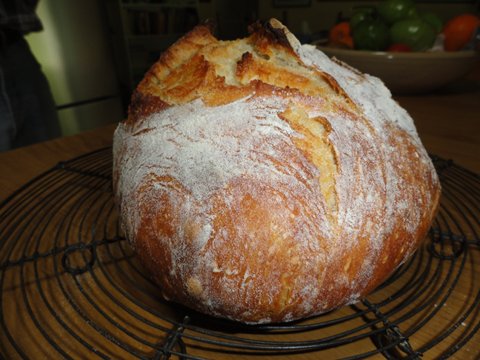
Bread is one of those foods that, when made with your own hands, gives a great deal of satisfaction and delight. It's only flour and water but it symbolises so much. I bake bread most days and use a variety of flours that I buy in bulk. Often I make a sandwich loaf because we use most of our bread for lunchtime sandwiches and for toast. Every so often I branch out to make a different type of loaf. I have tried sour dough in the past but I've not been happy with any of them. I'll continue to experiment with sour dough because I like the idea of using wild yeasts and saving the starter over a number of years to develop the flavour and become a part of the family. However, the loaf I've been branching out to most often is just a plain old five minute bread. By five minutes I mean it takes about five minutes actual work to prepare but it's the easiest of all bread to make and to get consistently good loaves from. If you're having people around for lunch or...
Image

This is my last post.

I have known for a while that this post was coming, but I didn't know when. This is my last post. I'm closing my blog, for good, and I'm not coming back like I have in the past.  I've been writing here for 16 years and my blog has been many things to me. It helped me change my life, it introduced me to so many good people, it became a wonderful record of my family life, it helped me get a book contract with Penguin, and monthly columns with The Australian Women's Weekly and Burke's Backyard . But in the past few months, it's become a burden. In April, I'll be 75 years old and I hope I've got another ten years ahead. However, each year I'll probably get weaker and although I'm fairly healthy, I do have a benign brain tumour and that could start growing. There are so many things I want to do and with time running out, leaving the blog behind gives me time to do the things that give me pleasure. On the day the blog started I felt a wonderful, h...
Image

What is the role of the homemaker in later years?

An email came from a US reader, Abby, who asked about being a homemaker in later years. This is part of what she wrote: "I am a stay-at-home mum to 4 children, ages 9-16. I do have a variety of "odd jobs" that I enjoy - I run a small "before-school" morning drop-off daycare from my home, I am a writing tutor, and I work a few hours a week at a local children's bookstore. But mostly, I cherish my blissful days at home - cooking, cleaning (with homemade cleaners), taking care of our children and chickens and goats, baking, meal-planning, etc. This "career" at home is not at all what I imagined during my ambitious years at university, but it is far more enriching. I notice, though, that my day is often planned around the needs of my family members. Of course, with 4 active kids and a husband, this is natural. I do the shopping, plan my meals, cook dinner - generally in anticipation of my family reconnecting in the evening.  I can't h...
Image

Every morning at home

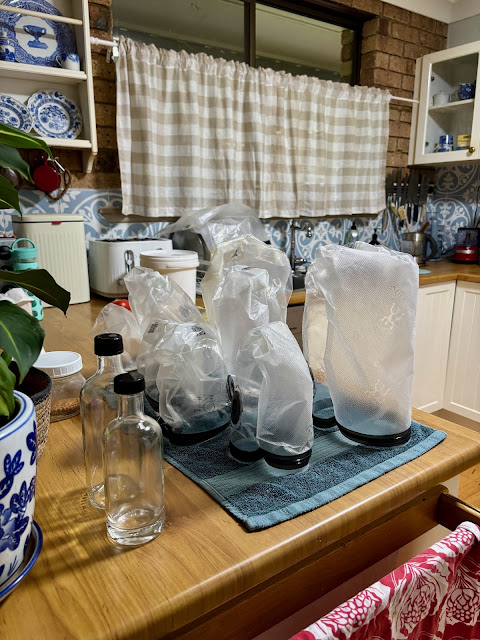
Every morning when I walk into my kitchen it looks tidy and ready for a day's work. Not so on this morning (above), I saw this when I walked in. Late the previous afternoon when I was looking for something, I came across my rolled up Zwilling vacuum bags and decided they had to be washed and dried. So I did that and although I usually put them outside on the verandah to dry it was dark by then. I turned the just-washed bags inside out and left them like this on a towel. It worked well and now the bags are ready to use when I bring home root vegetables, cabbages or whatever I buy that I want to last four or five weeks.
Image

You’ll save money by going back to basics

When I was doing the workshops and solo sessions, I had a couple of people whose main focus was on creating the fastest way to set up a simple life. You can't create a simple life fast, it's the opposite of that It's not one single thing either - it's a number of smaller, simpler activities that combine to create a life that reflects your values; and that takes a long to come together. When I first started living simply I took an entire year to work out our food - buying it, storing it, cooking it, preserving, baking, freezing, and growing it in the backyard. This is change that will transform how you live and it can't be rushed.  
Image


Trending Articles

NOT the last post

This will be my last post here.  I've been writing my blog for 18 years and now is the time to step back. I’ve stopped writing the blog and come back a couple of times because so many people wanted it, but that won’t happen again, I won’t be back.  I’ll continue on instagram to remain connected but I don’t know how frequent that will be. I know some of you will be interested to know the blog's statistics. 
Image

Every morning at home

Every morning when I walk into my kitchen it looks tidy and ready for a day's work. Not so on this morning (above), I saw this when I walked in. Late the previous afternoon when I was looking for something, I came across my rolled up Zwilling vacuum bags and decided they had to be washed and dried. So I did that and although I usually put them outside on the verandah to dry it was dark by then. I turned the just-washed bags inside out and left them like this on a towel. It worked well and now the bags are ready to use when I bring home root vegetables, cabbages or whatever I buy that I want to last four or five weeks.
Image

You’ll save money by going back to basics

When I was doing the workshops and solo sessions, I had a couple of people whose main focus was on creating the fastest way to set up a simple life. You can't create a simple life fast, it's the opposite of that It's not one single thing either - it's a number of smaller, simpler activities that combine to create a life that reflects your values; and that takes a long to come together. When I first started living simply I took an entire year to work out our food - buying it, storing it, cooking it, preserving, baking, freezing, and growing it in the backyard. This is change that will transform how you live and it can't be rushed.  
Image

Creating a home you'll love forever

Living simply is the answer to just about everything. It reduces the cost of living; it keeps you focused on being careful with resources such as water and electricity; it reminds you to not waste food; it encourages you to store food so you don't waste it and doing all those things brings routine and rhythm to your daily life. Consciously connecting every day with the activities and tasks that create simple life reminds you to look for the meaning and beauty that normal daily life holds.  It's all there in your home if you look for it. Seemingly mundane tasks like cleaning and cooking help you with that connection for without those tasks, the home you want to live in won't exist in the way you want it to.  Creating a home you love will make you happy and satisfied.
Image

Time changes everything

I've been spending time in the backyard lately creating a contained herb and vegetable garden. My aim is to develop a comfortable place to spend time, relax, increase biodiversity and encourage more animals, birds and insects to live here or visit. Of course I'd prefer my old garden which was put together by Hanno with ease and German precision. Together, we created a space bursting at the seams with herbs, vegetables and fruity goodness ready to eat and share throughout the year. But time changes everything. What I'm planning on doing now, is a brilliant opportunity for an almost 80 year old with balance issues. In my new garden I'll be able to do a wide range of challenging or easy work, depending on how I feel each day. It’s a daily opportunity to push myself or sit back, watch what's happening around me and be captivated by memories or the scope of what's yet to come.
Image

It's the old ways I love the most

I'm a practical woman who lives in a 1980’s brick slab house. There are verandahs front and back so I have places to sit outside when it's hot or cold. Those verandahs tend to make the house darker than it would be but they're been a great investment over time because they made the house more liveable. My home is not a romantic cottage, nor a minimalist modern home, it's a 1980’s brick slab house. And yet when people visit me here they tell me how warm and cosy my home is and that they feel comforted by being here. I've thought about that over the years and I'm convinced now that the style of a home isn't what appeals to people. What they love is the feeling within that home and whether it's nurturing the people who live there.
Image

Making ginger beer from scratch

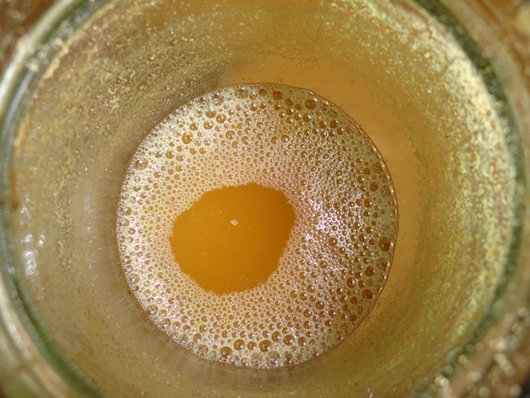
We had a nice supply of ginger beer going over Christmas. It's a delicious soft drink for young and old, although there is an alcoholic version that can be made with a slight variation on the recipe. Ginger beer is a naturally fermented drink that is easy to make - with ginger beer you make a starter called a ginger beer plant and after it has fermented, you add that to sweet water and lemon juice. Like sourdough, it must ferment to give it that sharp fizz. To make a ginger beer plant you'll need ginger - either the powdered dry variety or fresh ginger, sugar, rainwater or tap water that has stood for 24 hours to allow the chlorine to evaporate off. You'll also need clean plastic bottles that have been scrubbed with soap, hot water and a bottle brush and then rinsed with hot water. I never sterilise my bottles and I haven't had any problems. If you intend to keep the ginger beer for a long time, I'd suggest you sterilise your bottles. MAKING THE STARTER In a...
Image

An authentic look at daily life here — unstaged and real

Most days Hanno was outside happily working in the fresh air. It may surprise you to know that I started reading my book,  Down to Earth , yesterday - the first time since I wrote it 13 years ago.  I had lent it to my neighbor, and when she returned it, I started reading, expecting to find surprises. Instead, I realised the words were still familiar—as if they were etched into my memory. As I flipped through the pages, I was reminded of how important it was for me to share that knowledge with others. The principles in Down to Earth changed my life, and I truly believed they could do the same for others. After just 30 minutes of reading, I put the book down, reassured that its message still holds true: we can slow down and reshape our lives, one step at a time.
Image